“So I’ll cherish the old rugged cross, til my trophies at last I lay down. I will cling to the old rugged cross, and exchange it some day for a crown.”
The cross has long been an integral part of Christianity. It has been a symbol of faith, a marker of hope, and a reminder of God’s love. 2000 years ago Jesus died on a cross, and ever since, millions have associated Christianity with a cross. Before Christ was crucified on one, the cross was just a terrible way of putting someone to death.
Crucifixion was used by the Persians, Greeks, and Macedonians, but the Roman’s really perfected it.
Tens of thousands of people have been put to death on a cross throughout history.
It was considered at the time to be one of the most brutal, shameful and humiliating ways to die. The cross was seen as a source of death and pain, but Jesus turned it into a symbol of life and joy. God’s own Son forever changed the meaning of the cross when He was nailed to one and gave His life. Now when you google, “the cross” the first thing that pops up is a description of Christianity and our beliefs.
Jesus changed the entire purpose of a cross, and He did it for us. Sadly, the cross doesn’t mean to some what it means to others. The cross is a reminder of the life we have to come, but for others it is a made up story or fairytale. It is truly incredible how two people can look at the cross and think two entirely different things.
Interestingly enough, Paul actually wrote about this very problem in 1 Corinthians 1.
Written around 55 AD, Paul, the author, wrote to the church at Corinth for several reasons. They needed to understand the difference between divine and human wisdom. They needed pointers on marriage and sexual conduct. They had an idol problem, weren’t sure how Sunday services should be conducted, had no idea about the resurrection, and so much more. All in all there’s a lot to learn from this letter, but the part we will look at is found in 1:18-25.
Chapter 1-4 is all about human wisdom versus divine wisdom. If you’ve ever wondered why the world thinks we’re crazy, Paul answers that in this section.
The message of the cross. The cross causes different reactions in each person.
The cross divides, delivers, and decides.
The Cross Divides The Saved and Lost (18)
The Cross Delivers True Wisdom (19-21)
The Cross Decides Your Future (22-25)
”The teaching about the cross seems foolish to those who are lost. But to us who are being saved it is the power of God. As the Scriptures say, “I will destroy the wisdom of the wise. I will confuse the understanding of the intelligent.” Isaiah 29:14 So what does this say about the philosopher, the law expert, or anyone in this world who is skilled in making clever arguments? God has made the wisdom of the world look foolish. This is what God in his wisdom decided: Since the world did not find him through its own wisdom, he used the message that sounds foolish to save those who believe it. The Jews ask for miraculous signs, and the Greeks want wisdom. But this is the message we tell everyone: Christ was killed on a cross. This message is a problem for Jews, and to other people it is nonsense. But Christ is God’s power and wisdom to the people God has chosen, both Jews and Greeks. Even the foolishness of God is wiser than human wisdom. Even the weakness of God is stronger than human strength“ (1 Corinthians 1:18-25, ERV)
I’ve been studying the nature of Christian love recently. I try to study where my knowledge is insufficient or personal character is lacking. It has been difficult for me to love others the way Jesus loved others. I still have a long way to go. Other people can be unlovable, and threats are to be dealt with! This is the perhaps one of the more common baselines of human thought.
Jesus calls us to transcend these primal dispositions and pursue a truly selfless love. We have many obstacles to overcome in our pursuit of the kind of love Jesus shows. The idea of “love of self” has been perverted by the world. We’ve all seen a saying that goes something like, “You can’t love others unless you love yourself.” While the underlying motive behind that saying may have been pure, it has been used to justify narcissistic tendencies or excuse bad behavior.
But what if I genuinely don’t love myself? How can I love my neighbor like I love myself if I don’t feel anything (or very little) positive about myself? Our understanding of biblical love may need to change a little. In all of scripture (and even in apocryphal and pseudepigraphal writings), love for our neighbors almost always translates to providing for their needs.
A person may not love self, but they will not starve their bodies out of hatred (remember, an exception by its nature is not the rule; a rule is something so often true that it is reliably predictable). They will not neglect the basic functions of being just because their view of self is not completely perfect.
Love does not necessarily have anything to do with how we feel about a person. It is sometimes called “the strongest emotion” but this is not completely accurate. There is an emotional aspect to love, often described as σπλαγχνον (splanknon, compassion) or οικτιρμος (oiktirmos, heartfelt pity), though this is not exhaustive. But αγαπη love is a decision to help another person, despite how we might feel about them.
What does biblical love look like? If we love our neighbor, we’ll feed them when they’re hungry, encourage or give affirmation when they need it, help them financially (anonymously, if we want to avoid God’s judgment), give grace to their weaknesses and mistakes, and overlook hurtful actions done to us.
Who are our neighbors? Our enemies, our friends, and everyone else who lives on this planet. More realistically, any other human in our proximity. If we see a need and have the ability to help, godly love compels us to help. When Jesus comes back he will ask, “Did you take care of my people?” So much more could be said about this, but next week we will look at the kind of love God wants us to have for him.
The author of Hebrews uses the example of the Melchizedekian priesthood to establish the priesthood of Christ. Jesus belonged to the tribe of Judah, which Moses did not mention regarding the earthly priesthood. Therefore, there was a need for a covenant change to allow a non-Levite to serve as a priest. The writer of Hebrews spends chapters eight and nine explaining how the New Testament replaced the Old Testament in line with prophecy (see Jeremiah 31.3–14). In summary, the Holy Spirit confirmed that it was God’s will for Jesus to be a priest, but since He could not serve as a priest on earth because of Moses’ Law, Jesus instituted the New Testament so that He could be our High Priest in heaven.
Some believe that Jesus will reign as King from David’s throne in a future Jerusalem-based kingdom. However, there is an obstacle preventing Jesus from doing so on earth. God cut off David’s seed from sitting on David’s throne, as mentioned in Jeremiah 22:30, making it impossible for any of Jeconiah’s (or Jehoiakim’s) descendants to reign in Judah. This fact is relevant because Jeconiah was an ancestor of Joseph, Jesus’s foster father. Matthew traces Jesus’s legal lineage through Joseph in Matthew 1:12. Since Jesus is a descendant of Jeconiah, he cannot reign as an earthly king even though it was God’s will for Christ to be King. If God had not taken away the right of Jeconiah’s descendants to reign in Judah, Jesus could have certainly been an earthly king.
So, how is Christ a king? Jesus promised to establish a kingdom (Matthew 16:18–19). When Pilate pressed him, Jesus admitted to being a king (John 18.37). However, consider how Jesus qualified the nature of His kingdom in John 18.36. “My kingdom is not of this world. If My kingdom were of this world, then My servants would be fighting so that I would not be handed over to the Jews; but as it is, My kingdom is not of this realm” (NASB 1995). This truth means that Christ’s kingship is spiritual rather than earthly, as is His priesthood. It is worth noting that Jesus also accomplished this through His New Testament.
Many people misunderstand the truth and think that the apocalyptic language of a millennial kingdom in Revelation 20.6 refers to a future earthly kingdom that Christ will rule in Jerusalem. This misunderstanding is because they do not understand the interchangeability of the terms “kingdom” and “church” in Matthew 16.18–19. The word “church” is a Latin loanword that does not appear in the Bible. The actual word for church is “assembly.” Thus, the church represents the people. The word for “kingdom” is “basileia,” which means a kingdom or realm over which a king has sovereign authority. Therefore, God’s will was for Christ to choose a group of people from all over the world willing to submit to his authority.
According to the Book of Daniel, God showed King Nebuchadnezzar a prophetic dream about the future (see Daniel 2). In the dream, a cut stone struck a large image at its feet, causing the entire image to shatter and signifying the end of all worldly authority. Different materials comprised the image’s body parts, representing different empires. Babylon was the head of gold, Persia was the chest and arms of silver, Greece was the belly and thighs of bronze, and Rome was the legs of iron and feet of iron and clay. The feet mingled with clay represented the internal weakness of Rome. Commentators are familiar with this dream’s timeline. However, some believe that the Kingdom of God, symbolized by the cut stone, is yet to appear. However, according to Daniel, the kingdom emerged during the reign of the Roman emperors, referred to as “those kings.”
Jesus said, “Truly I say to you, there are some of those who are standing here who will not taste death until they see the kingdom of God after it has come with power” (Mark 9.1 NASB 1995). For those who refuse to believe that Jesus established His kingdom as He intended, there must be more than one person of advanced years who can prove they are older than two millennia! We understand that the power to which Jesus referred was the Holy Spirit, who descended on the apostles on the day of Pentecost, around 33 AD (Acts 2.4). As a result, Jesus reigns as King today and will continue to do so until His return. Following His return, Jesus will hand over His authority to the Father and the redeemed from all ages (1 Corinthians 15.24).
Combining biblical texts and prophecies creates a deep understanding of Jesus Christ’s position as King and High Priest, which goes beyond worldly limitations. Jesus fulfills the roles God has designated for Him, not as a political leader or a member of the old priesthood, but in a heavenly and everlasting sense through the New Testament and His heavenly kingdom. This understanding challenges traditional beliefs about a future earthly kingdom, instead emphasizing Christ’s spiritual reign, which began during His ministry and continues today. As Christians, we have the honor of living in this heavenly kingdom that Christ, our eternal King and High Priest, rules over in a merciful and benevolent manner. Recognizing this broadens our spiritual understanding and strengthens our faith in the eternal truth of God’s word and His ultimate plan for redemption.
There were some members of the early church who had difficulty accepting some of the basic teachings of Christianity. The Hebrews writer told them, “We have many things to tell you about this. But it’s hard to explain because you’ve stopped trying to understand. You’ve had enough time by now that you should be teachers. But you need someone to teach you again the first lessons of God’s teaching. You still need the teaching that is like milk. … Anyone who lives on this is still a baby and not able to understand much about living right. But solid food is for people who have grown up. From their experience they’ve learned to see the difference between good and evil” (Hb 5.11-14).
What’s the basic stuff that prevents us from being mature?
6.2 — Baptisms. This is probably Jewish washings and other irrelevant customs from the old system. They should’ve been past this by now.
6.2 — This one doesn’t really apply to us today, but “laying hands on people”, usually to give them God’s blessing or supernatural power.
6.2 — The resurrection of the dead and final judgment.
These basics should be a given for every Christian. The Hebrews writer’s audience had “had enough time by now to become teachers” only a couple decades after Jesus’s work. It’s been about 2,000 years for us. We have no excuse to be stuck in the basics!
So what should we be doing?
Hebrews 7-10 — Understand that Jesus is far superior to any other system of belief, he’s in the highest position of power in the universe, he lives to serve as our perfect high priest, the old system (Old Law) is irrelevant now (8.13), that Jesus’s sacrifice cleared humanity of how the Old Law convicted us of sin (9.15), understand that his return means rescue for those of us who are waiting for him (9.28), to think about and encourage each other to show love and do good things for other people (10.24-39), and to never lose our confidence in the power of our king (10-11).
This is a very simplified list for the sake of brevity, but a mature Christian tries hard to be like Jesus in how they live. They don’t give in when pressured by circumstance to deny Jesus through bad behavior. They accept suffering with grace and patience. Their confidence in who Jesus is and what he will do for us is never severely shaken. Their love for Christian family compels them to do good for them, and to encourage them by living like Jesus.
God’s choice of people to carry out His plan is never solely based on merit. If so, who could He use? Noah had exceptional, extraordinary faith, but he also struggled with weakness. Abraham is renowned for his faith, but in Genesis 20 he is going to fall back into the same moral trap he had previously laid for himself. In fact, this chapter reveals a habitual failing on his part (12-13). Developing faith is not flawless or perfect, even as it grows and matures. Let’s notice five things in Abraham’s stumbling steps on his road of trusting God’s providence.
The Deception (1-2). It seems like deja vu, a repeat of the circumstance with the Pharaoh in Egypt (12:11-13). Abraham has journeyed south, back near the border of Egypt. He encounters the king of Gerar, Abimelech, there, and he tells the king that Sarah is his sister. Taking Abraham’s word at face value, Abimelech “sent and took Sarah” (2) in order to make her his wife.
The Dream (3-7). We know nothing of the man’s character until God comes to him in a dream. Abimelech could declare his blamelessness to God (4), his integrity of heart, and the innocence of his hands (5). God validates his claim and informs him that He had intervened to prevent sin in his interaction with Sarah (6). The heart of God’s message to Abimelech is to restore Sarah to Abraham, a prophet, to have him intervene on his behalf. There is also a warning concerning His wrath if the king disobeys (7).
The Discussion (8-13). Abimelech’s first discussion is with all his servants, “greatly frightened” at their master’s news (8). There had to be no small amount of righteous indignation when the king addresses the patriarch, asking, “What have you done to us? And how have I sinned against you, that you have brought on me and on my kingdom a great sin?” (9a-b). Abraham receives a deserved, stinging rebuke (9c). The king also shows incredible empathy, wondering aloud what Abraham had experienced to resort to such tactics (10). The best Abraham could do is rationalize that he anticipated widespread unbelief and aggression wherever he went, and telling a half-truth (whole lie!) would keep his wife and himself safe (11-13). You wonder if Abraham could see the flimsiness of his excuse as he said it out loud.
The Diplomacy (14-16). Abimelech believes what God says about his counterpart, and the offended shows great kindness and generosity to the offender. He endows Abraham with sheep, oxen, male servants, female servants, land, and 1000 pieces of silver. With this, he shows his integrity and character from beginning to end in this matter.
The Devotion (17-18). The best thing Abraham did in this encounter was pray to God for the king of Gerar. In response, God opened the wombs of Abimelech’s household, wombs he had closed because of the appropriation of Sarah. While there was certainly a lesson for Abimelech to learn concerning the uniqueness and greatness of Jehovah (we will see this king not only in the next chapter, but in the next generation in an eerily similar situation with Isaac in chapter 26), was there also a lesson for Abraham? He had already shown so much faith in his life, going where God said go and believing what God promised. But, he had this blind spot in his faith.
We should constantly evaluate our faith. Are there any blind spots? Maybe we trust Him in our relationships, but not in our finances. Maybe we are trying to seek Him first in so many areas, but we keep falling into the same bad habits or poor coping mechanisms in some area of struggle. This incident shows us God’s patience and special regard for His children, but it also reveals the need we have for letting our trials and temptations refine us and get us to a better spiritual place. We might occasionally be shamed by those outside of Christ who prove greater integrity than we show in a moment of weakness. That should drive us closer to God and make us trust Him more in subsequent trials! It appears to work that way for Abraham.
Genesis 14 is more than a Sunday morning Scripture-reader’s nightmare (though the first ten verses would intimate the most golden-tongued!). We are introduced to an obscure, enigmatic character whom David and the writer of Hebrews will compare to Christ. However, what is the background of this King of Salem and his important encounter with Abram?
There is a local war around the Salt Sea, “four kings against five” (9). The cause of the conflict is the rebellion of the kings of the valley (Sodom, Gomorrah, Admah, Zeboiim, and Bela) against Chedorlaomer, who had conquered all the nations in the region–the Rephaim, the Zuzim, the Emim, the Horites, the Amalekites, and the Amorites (4-7). The confederation of the valley kings “arrayed for battle against” Chedorlaomer and his allies (1) “in the valley of Siddim” (8). The kings of Sodom and Gomorrah, Bera and Birsha, died in the tarpits of Siddim as they fled from the invaders’ army, and the rest of the army of the five kings fled to the hill country (10).
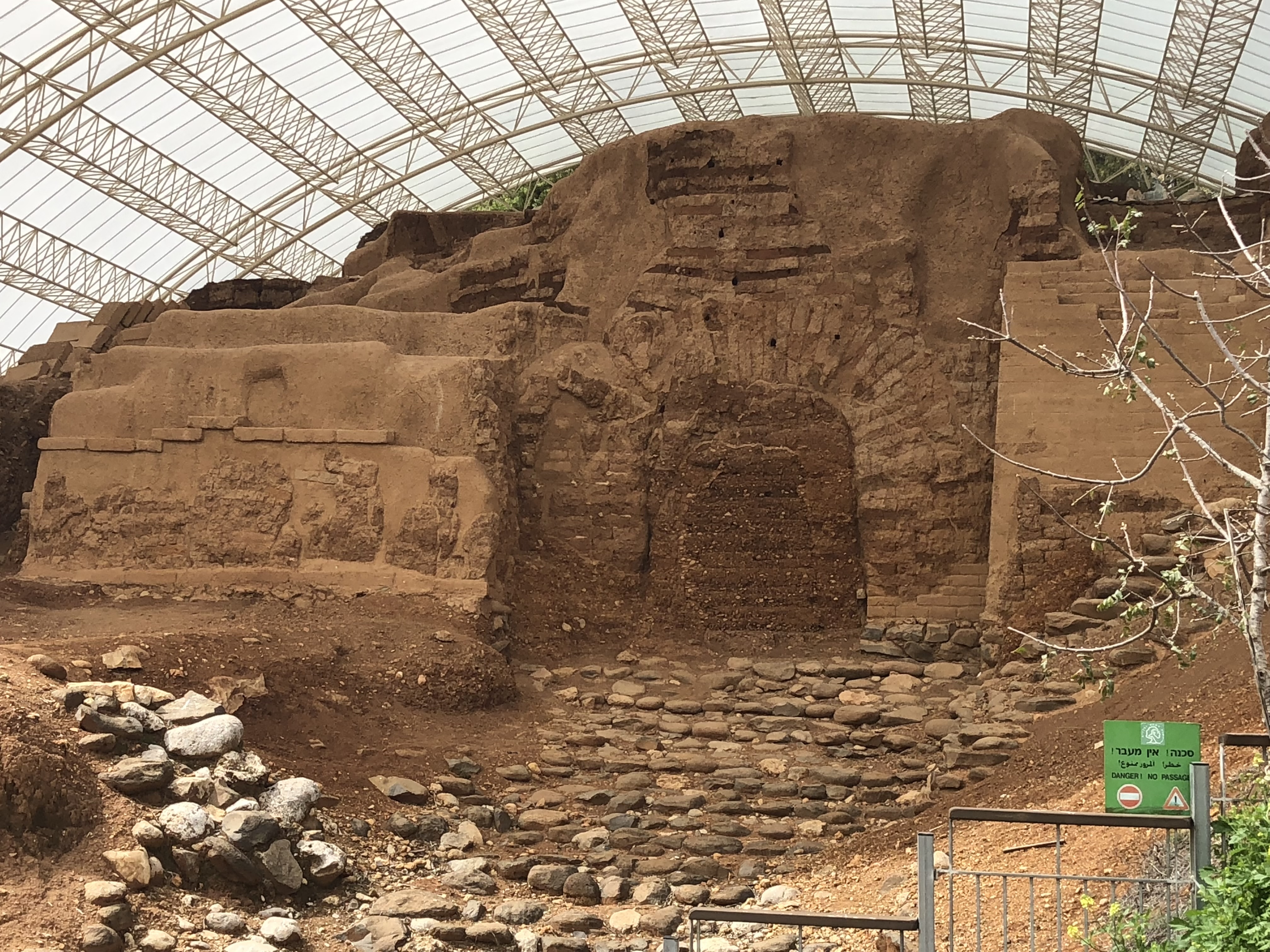
Chedorlaomer and his allies plunder all the goods of Sodom and Gomorrah and take Lot, the women, and the people of his house along with his possessions (11-12,16). An escapee tells Abram what happens, and the patriarch musters his allies and his own personal army to get his nephew and his house back safely (13-15). He has a battle plan, dividing his forces and attacking at night, and they defeat the invader in what is modern-day Syria (15-16). On multiple occasions, I have visited the ruins at Dan and have seen the so-called “Abraham Gate.” It dates back at least as far as Abraham’s day, almost 2000 years before Christ.
(My photo of the “Abraham Gate,” March 2018)
After rescuing Lot and his house and goods, Abram is met by a priest named Melchizedek (18). The Holy Spirit, through the author of Hebrews, uses Genesis 14:17-20 and Psalm 119:4, and this one incident with Abraham to drive home an incredibly powerful point. Jesus is a High Priest, not like the Levites who descended from Aaron, but like this obscure figure, Melchizedek.
The Bible uses a literary device called an antitype. “From the Greek antitupos, which occurs in Heb. 9:24 and 1 Pet. 3:21, where the AV translates it ‘figure.’ An antitype is the substance of which a type is the shadow, or the fulfilment of that which the type foreshadowed” (Cairns, Alan. Dictionary of Theological Terms 2002: 33). The antitype is always the greater; the type is always lesser and represents in some way the greater. So, Melchizedek is a type of Christ. He himself was greater than the Levitical priesthood in the ways we read in Hebrews 7, but the specific attributes we read about Melchizedek in this chapter are more fully and greatly found in Jesus.
What are the specific types?
His position (18; Heb. 7:1). He is the king and priest of the Most High God. As king, he is king of righteousness and king of peace (2).
His preeminence (20; Heb. 7:2,4-5). Abraham paid tithes to Melchizedek, signifying the greater prominence of the priest over the patriarch.
His perpetuity (Psa. 110:4; Heb. 7:3). “Without father, without mother, without genealogy, having neither beginning of days nor end of life, but made like the Son of God, he remains a priest perpetually.” None of Melchizedek’s ancestors or descendants filled this role, so in that way “he remains a priest perpetually.”
His purpose (19; Heb. 7:6-7). Melchizedek blessed the one who had the promises, an indication of his greater position and authority.
His precursory place (Heb. 7:8-11). Melchizedek lived many generations before Aaron, through whom the Levitical priesthood descended. Aaron was still in “Abraham’s loins,” meaning that Abraham did not have children yet. Much later, he would sire Isaac, who beget Jacob, etc., until finally Aaron was born through this genealogy.
In the way that Melchizedek served as greater than Levi, Jesus more fully and greatly serves as greater than Levi. If it were a math problem, we would say Levi < Melchizedek < Christ. Obviously, then, Levi < Christ. The writer of Hebrews, in chapter seven, draws some conclusions about this type of Christ. Because Christ is the antitype of Melchizedek,
It makes sense that perfection comes from His priesthood rather than the Levitical priesthood of Judaism (11).
There needed to be a change of laws (from Moses’ to Christ’s)(12).
It is right that this greater High Priest comes from a different tribe in which none had or could have served as priest (13-14).
Christ serves as priest “not on the basis of a law of physical requirement, but according to the power of an indestructible life” (15-17).
He sets aside the old law and brings in a better hope (18-19).
He was appointed High Priest by means of the oath of God (20-21).
He has become the guarantee of a better covenant (22).
He does not die, but continues forever as High Priest (23-24).
He is able to save forever those who draw near to God through Him (25-28).
It is this last truth, concerning His salvation, where the author draws out several incredible points for our consideration. It is the crescendo of his “Melchizedek argument.” His work is unparalleled–He always makes intercession for us (25). His character is unparalleled–He is holy, innocent, undefiled, separated from sinners and exalted above the heavens (26). His sacrifice and offering is perfect (27). His oath is unparalleled–He is a Son, made perfect forever (28).
Of all the ways the writer establishes the superiority of Christ over all rivals, this one is the most interesting to me. It shows the masterful way God weaves events and Scripture together. The writer of Hebrews is making the point that the Levitical priesthood has been replaced by something better. Why would you exchange the superior for the inferior?
After this encounter, which seems relatively insignificant until David and the writer of Hebrews later expound upon it, Abram refuses to enrich himself by the unsavory people of Sodom. The new King of Sodom only wants the people, but offers Abram to keep all the returned spoils from Chadorlaomer. Abram will have no part in that, taking only provisions necessary for the completed battle. Abram will continue to rely on God’s promises to take care of his needs, and he parts company with the king of this wicked domain.
(Picture taken on March 10, 2018, running at the Dead Sea with Keith Kasarjian)
I have been seeing this 15-second commercial on TV recently. It is a picture of the sky above the clouds and the words, “When you die, are you going to heaven or not? You can know for sure. Heaven or not.net.”
Purchasing commercial time is very expensive. Someone is dedicated, and the subject matter could not be more important! As an ’80s song put it, we are living in a material world. Many do not think deeply enough about what happens after this life. A website dedicated to the very subject had me hopeful.
Visiting the website, I was impressed with the number of Scriptures used and the effort to use the Bible for every single point made. They cover the biblical explanation for our origin, the reliability of Scripture, the problem of sin, the sacrifice of Christ, and the need of salvation. I say biblical because they cite Scripture in each of these subject areas.
Please believe me when I say that I want to endorse and commend this website. I do not know who is behind it, other than the site “God Life,” a well-put-together website full of resources. But there were at least two erroneous statements made which contradict what the Bible teaches.
First, they claim that we are born with sin. Introducing the problem of sin, they write, “That makes it (heaven, NP) a problem for us…because we sin. It is our heritage. We are born with it.” We are born into a sinful world. Eventually, every one of us make the choice to sin. Their next statement, Romans 3:23, is correct. But it is different to say that “all have sinned” and that we are all born with sin. Ezekiel 18:4,20 state the truth that the son does not “bear the punishment of the father’s iniquity.” Teaching that we are born in sin is communicating the false idea that we inherit Adam’s sin. We surely inherit a fallen world because of his choice (Rom. 5:12), but as surely do not inherit his guilt. Our guilt comes through our own accountability. A newborn or small child is not accountable.
Second, their suggested remedy for addressing our sin problem in order to go to heaven is one of the most egregious religious errors formulated by religious people: “the sinner’s prayer.” They urge the reader to pray, “Dear God…I know I have sinned against you. Please forgive me. I receive Jesus…your only Son…right now as Savior of my life…having died to pay for my sins. Thank you for forgiving my sins…and for my new life.I pray this prayer in Jesus’ holy name, Amen!”
They are right to say that going to heaven means “you have to receive God’s gift of forgiveness and acceptance,” but wrong to suggest something that we have no biblical teaching or example for. The very first time Jesus was preached and the listeners asked what they should do, Peter could have given the counsel in the paragraph above. But he did not. He called for repentance and baptism (Acts 2:38), and those who gladly received the word did just that (Act 2:41). Please consider Mark 16:16, John 3:3-5, Acts 22:16, Romans 6:1-4, Galatians 3:26-27, Ephesians 4:4-6, Colossians 2:12, Titus 3:5, and 1 Peter 3:21.
All these passages show us that receiving God’s gift of forgiveness and acceptance goes beyond saying a prayer. It requires doing what people did in the first-century, when the gospel began to be preached and people first sought to do what they were taught. We need biblical example and teaching to adequately answer these sincere people’s powerful question.
If you have ever watched any home improvement TV shows, I’m sure you have seen the ads for Home Depot and their slogan, “Getting Projects Done.” This ad is aimed at the do-it-yourself’er, the DIY’er.
I have to admit that I am a DIY’er. I enjoy watching TV shows and YouTube videos of other DIY’ers and experts, trying to learn as much as I can to make my next project easier and hopefully have better results. I’m confident that many of you are DIY’ers as well. There is a certain satisfaction that comes from successfully completing a DIY project. No matter how large or small, no matter if it’s something around the house, a landscaping project in the yard, a repair or something to the car, truck, or, my personal favorite, the tractor.
No matter how much we learn on how much knowledge we acquire taking on these projects, there is one project that is way too big and way too important for any DIY’er. That project is our salvation. No matter what our DIY abilities are, we cannot save ourselves. Paul says, “For I am not ashamed of the gospel. For it is the power of God for salvation to everyone who believes, to the Jew first and also the Greek” (Romans 1:16). Then, he writes, “For by grace you have been saved through faith, and this is not your own doing; it is the gift of God, not a result of works, so that no one may boast” (Ephesians 2:8).
No man’s wisdom, knowledge, message, experience or abilities can save him, but God’s gospel can. It is the only thing that can save us and the only way to salvation (John 14:6). God, through the death, burial, and resurrection of Jesus Christ has provided a way to rescue us from the consequences of sin. He offers us salvation so that we can have a second chance at life and an opportunity to experience a spiritual rebirth into a new life in the Spirit and ultimately eternal life with Him in heaven (Acts 2:46-47). God says, “Come now, let us reason together, says the Lord: Though your sins are like scarlet, they shall be white as snow; though they are red like crimson, they shall become like wool” (Isaiah 1:18).
If you have not been obedient to the gospel and need to take advantage of the salvation that God has offered or you have need of the prayers of God’s people, don’t try to do it yourself. Do what God says do for the help only He can give.
As a global learner, I enjoy having background noise serve as the soundtrack to my life. It could be music or a talking head providing news or opinions. I can block out the details and rely on the background noise to keep me going. In addition to learning strategies, individuals with ADHD like myself find certain grooves oddly exhilarating, similar to an energy drink. I frequently run errands on Thursdays each week, and this week was no exception. Therefore, it was inevitable that I would have my “symphony” supporting me. Amid the hustle and bustle, I heard a headline stating that more than half of American “clergy” have considered quitting since 2020 (see Blair, 2024).
Whenever I encounter such information, I look into it further. After I finished my errands, I looked up an article about the subject online. For the sake of brevity, the study concluded that the changing religious landscape following the pandemic was the primary source of discontent. These “clergy” have claimed that the pandemic has made it more difficult for them to interact with congregations and that the decline in in-person attendance depresses them. According to the demographics of those surveyed, the so-called Silents (born 1925–1945) and Generation X (born 1965–1980) are less likely to want to quit than Millenials (born 1981–1996) and Baby Boomers (born 1946–1964). Catholic and Orthodox ministers were less likely to feel this way than Protestants.
These attention-grabbing headlines no doubt fill our hearts with existential dread. However, we must realize Jesus’ promise that even death could not prevail against His Church (Matthew 16.18). One knows that regardless of how dire things in the world may seem, there are always those not bowing the knee to Baal (1 Kings 19.18). Hence, Satan could be the author of such headlines designed to discourage the faithful disciples of Jesus Christ. Satan whispers, “You are all alone in your devotion. And would a loving God truly expect you to shoulder these burdens alone?”
But lest we grow too comfortable, we are reminded of Jesus’ words following the Parable of the Unjust Judge, also known as The Persistent Widow (Luke 18.1–8). Jesus asked, “When the Son of Man comes, will He find faith on the earth?” I know that contextually, Jesus is asking if His followers will have the faith to pray. At least, other preachers often say this as they exegete Luke 18.8. Well, yes. But is it so tidily summed up in the one word “prayer”? Jesus’ question is whether people will continue to believe and be faithful, even in the face of delays or challenges, just as the widow was persistent in her pursuit of justice. As a result, we can interpret this verse as an encouragement to keep the faith and pray, even when justice appears slow, or God’s promises appear delayed. It expresses a theme of perseverance and faithfulness in the Christian life, particularly in light of Jesus’ return.
Jesus expressed concern about whether He would find faithful followers upon His return. The followers can show their faithfulness to Him by exercising their faith through prayer. Unfortunately, people prefer tangible things over intangible ones, leading to practical materialism and a lack of faith. Additionally, scientific advancements may encourage disbelief by providing natural explanations. The hurried, self-centered, and financially motivated nature of the modern age can also undermine faith, which requires quiet contemplation. Faith is a moral quality rooted in the heart, not just an intellectual asset. It grows by living a righteous life, feeding on Biblical promises, and putting one’s limited faith into practice. Therefore, building faith requires setting aside regular quiet time for meditation and communing with God. Faith progresses through continual moral effort.
We are currently living in a time where people are hesitant to return to the Church after the pandemic, which was a time of isolation and a shift in priorities for many. In addition, those who provide moral leadership face challenges, feeling a growing temptation to step away from their roles. This combination of factors is worrisome in response to our Lord’s probing question in Luke 18.8. This study paints a concerning picture of the future of spiritual commitment and the resilience of faith communities.
However, despite these challenges, there remains a beacon of hope. The persistence of faith, even in a few, can be a powerful testament to the enduring nature of spiritual commitment. In the face of adversity, the true strength of faith often emerges, not just in the tranquility of prosperous times but in the tumult of trials. To answer Jesus’ question and reaffirm enduring faith and commitment, faith communities must explore ways to nurture resilience and adapt and thrive.
In today’s world, we face various challenges that can test the foundations of our faith communities. Distractions and the effects of global pandemics can make it difficult to hold onto our beliefs. However, these challenges can also provide opportunities for spiritual growth and renewal. Jesus’ question in Luke 18.8 invites us to deepen our faith, pray more persistently, and live out our beliefs with renewed vigor and commitment. As believers, we all have a unique role in this ongoing faith journey. Instead of seeing our challenges as insurmountable obstacles, let us embrace them as catalysts for strengthening our collective resolve. Doing so ensures that Jesus will find a thriving and active faith on earth when He returns.
On the 17th day of the second month in his 600th year, they entered the ark (7:11). This is followed by 40 days of rain and flooding. The water prevailed on earth for 150 days. The ark rested on the 17th day of the seventh month (8:4). From that day until the cover is removed on the first day of the first month of Noah’s 601st day (8:13), there were 163 days in which the water recedes. During that period, the mountains are seen on the first day of the 10th month of his 600th year (8:5) and the raven is sent on the 10th day of the 11th month (8:6). From the day the cover is removed until they exit the ark, there is 57 days spent waiting. The 27th day of the second month of his 601st year, they do finally leave (8:14). The total time of the flood, then, is 313 days and their total time in the ark is 370 days.
This past fall, we went on our first cruise as part of a Bibleland Passages tour. We spent 12 nights at sea in very comfortable accommodations, all the food you could eat, and even amenities like fitness centers and theaters. When we moved to Bowling Green, we stayed in the Hammers’ RV for a month in the KOA. Though the quarters were cramped, it was very comfortable and had indoor plumbing, running water, and air conditioning. Can you imagine spending just over a year in a floating barge without electricity, running water, climate control (apart from nature), and so many conveniences we simply take for granted today?
Noah and his family waited on the Lord as He, the great and original scientist (the very maker of the laws of science), not only destroyed the earth but provided a feasible timetable to make it habitable again (2) for the eight souls who would leave the ark up on Mt. Ararat (4). It was a gradual, but steady process (5) until the ground was dried (13-14).
Moses begins the chapter with a summary, including the idea that “God remembered Noah” (1). On His timetable, He affects the conditions necessary for Noah and the rest of his family to repopulate the earth. It is equally beautiful that Noah remembers God, sacrificing “of every clean animal and of every clean bird” (20). The Lord accepts Noah’s worship and vows never to duplicate this act, despite man’s evil inclinations (21). Instead, God would perpetuate “seedtime and harvest, and cold and heat, and summer and winter, and night and day” (22). No wonder Moses would encapsulate this great patriarch’s faithful life as a man who walked with God (6:9). And what a humbling truth that God walked with Noah, all the way through these cataclysmic events and brought them safely through the water (1 Pet. 3:20).
While you will not ever face any global floods, you will be deluged with difficulties in this short life. Do not think that God could ever forget you, even as you are tossed about in the sea of struggle! God will remember you, rescue you, and reward you as you keep walking with Him! The waters of weeping will dry up and you will again stand on solid ground–whether in this life or in the eternity which follows! Trust that!
Not only did chapter one help with the question of where we came from, but it also gives crucial insight into who we are. Genesis 1:27 teaches us more than the nature of the Godhead. It tells us something about ourselves. We are made in the image of God, in His likeness (5:1)! There is a part of us reflecting God! I agree that “God’s image obviously does not consist in man’s body which was formed from earthly matter, but in his spiritual, intellectual, moral likeness to God from whom his animating breath came” (TWOT, 768).
Certainly, what Moses wrote in Genesis 1:27 helps us appreciate the additional clarification yielded from the first use of the Hebrew “teledoth” (account, NASB, NLT, NIV; “history,” NKJ; “generations,” ESV) in Genesis 2:4. This is a peg Moses drives down to separate his inspired account into significant sections. I have an excellent chart from Donnie Bates dividing up the book of Genesis, using “teledoth” as a textual marker.
1:1-4:26–The generations of the heavens and the earth
5:1-6:8–The descendants of Adam
6:9-9:29–The descendants of Noah
10:1-11:9–The descendants of the sons of Noah
11:10-11:26–The descendants of Shem
11:27-25:11–The descendants of Terah (Abraham’s father)
25:12-25:18–The descendants of Ishmael
25:19-35:29–The descendants of Isaac
36:1-37:1–The descendants of Esau
37:2-50:26–The descendants of Jacob
(Syllabus handout for “Genesis,” Bear Valley Bible Institute)
In the midst of unfolding “the generations of the heavens and the earth,” Moses centers on the creation of man and woman. Notice how he does so.
Preparing the earth for man (2:4-6). After speaking of the earth 21 times from Genesis 1:1-2:1, Moses speaks of it five times in these three verses. In context, the shrubs and the plants to be cultivated from the ground served a purpose. They would provide food for man (15-17). There is a sense in which man’s being in God’s likeness is demonstrated in his place and dominion over the whole earth (1:28-30; 2:16,19-20). As God is over everything, He delegated authority to man over the earth. Of course, God is the sustainer and provider of what the universe needs to continue to operate (Mat. 5:45; Acts 14:17; Col. 1:17), but man was created to be a steward of its resources. Incidentally, there was at least a time when God did not send rain but rather mist from the ground for its provision (6).
Creating man from the earth (2:7). There is also a unity or harmony between man and the earth. God created the ground, then He formed man from the dust of the ground. He breathed life into man’s nostrils and man became a living being. The word translated “being” (soul) here seems to be used to speak of his having life and animation. The Bible clearly teaches there is an everlasting part of a person, but that’s not Moses’ purpose in this verse. Moses is describing how the first man came to life. The same word is used of “living creatures” (1:20-21; cf. 2:19).
Fitting man for the earth (2:8-15). Moses goes to great lengths to speak more of God’s provisions for man’s habitation of the earth. He planted a garden and trees for man’s dwelling place (8-9). He provided rivers to water the garden (10), and it flowed out of the garden in four tributaries–Pishon, Gihon, Tigris and Euphrates (11-14). James Smith notes, “The author seems to be describing the geography of ancient Sumer just north of the Persian Gulf in what is present-day Iraq. Ancient pagan legend remembered a paradise at the northern end of the Persian Gulf” (The Pentateuch, OT Survey Series, 59). Associated with these geographical markers, Moses makes the first mention of money (11-12). Man’s job is to care for the earth prepared by God for him (15).
Preparing man for his time on earth (2:16-17). God does more than give man physical purpose. He is giving him spiritual boundaries. Moses includes this command about the “forbidden fruit” to show God’s loving nature in creating man with the ability to choose. At this point, evil is not part of man’s consciousness nor has it stained his soul, but it exists as the opposite of the “good” that God created (see Moses’ repeated use of “good” in chapter one). Man would have to choose to leave the “good” of sinlessness, but that was a choice from the beginning. What Paul says of the Gentiles is true, ultimately, of everyone since Adam: “In the generations gone by He permitted all the nations to go their own way” (Acts 14:16).
Giving man what the earth alone could not give him (2:18-25). Of course, God knew what man needed before man had an opportunity to even discover it. God determined to give man a “helper suitable for him” (18). He presents all the animals for Adam to name, and among these there is no “suitable helper” (19-20). It is not incidental that God created woman from man. He could have formed her from the dust of the ground, the same as man but apart from him. But, denoting the intimate connection He intended, He makes her from him (21-22). As has been noted, is there anatomical symbolism here? She was not taken from his head or his heel to rule over or be enslaved to him. She was a partner is truest sense, taken from his side.
Adam recognizes this and speaks a truth beyond just his circumstances (21-24). God teaches that gender is not fluid, but fixed (note the pronouns and description throughout the paragraph). God teaches the permanency of marriage (23-24), which Jesus will reference in restoring marriage under His covenant (Mat. 19:1-9). God gives the first allusion to the church, and Paul will draw on the analogy in Ephesians 5:22-33. God gives gender roles in the leadership of the church, hearkening back to this cross-cultural circumstance in 1 Timothy 2:8-15.
But there is more than doctrinal truth being instilled here. There is the most beautiful earthly relationship ever made by God, transcending every relationship except the one between a person and God! God knows our physical, emotional, social, and spiritual needs. His original remedy for that was marriage! What a wise creator we serve!
One of the first and most basic questions most people seek the answer to is “where did I come from?” Since I am here, there must be some explanation. And since that explanation predates me and anyone I could consult personally or through recorded history, I must look for an explanation outside of those sources. Any answer is subject to evaluation for its credibility and reasonableness.
The book of Genesis asserts itself as the all-encompassing answer to all the big questions humanity inevitably asks. One finds its answers feasible, reasonable, and intelligible. Having 50 chapters, 1533 verses, and 32,267 words, it is a large book that sets the tone for the 65 books which follow it. It was first written for the Jews to understand their history and their place in God’s eternal plan. This is accomplished in many ways. One significant way is through Moses’ repeated, periodic use of a word translated “generations,” “account,” “genealogies,” or “order.” The word is used 13 times in Genesis, with apparent intentionality. It is how Moses divides the contents of the entire book (2:4; 5:1; 6:9; 10:1,32; 11:10,27; 25:12-13,19; 36:1,9; 37:2). We will note those transitions as we move through the book.
The book is called “Genesis” because it reflects the idea of “beginnings.” Truly, “The title of the book of Genesis in Hebrew is bereshith, which literally means “in the beginning.” This title is the first word of the first verse. In a similar way the Hebrew titles of each of the first five books of the Old Testament are taken from a significant word in the first sentence of the book, usually the first or second word, or both. This was the practice also in the literature of other ancient languages in the Middle East” (Reyburn, UBS, 19).
The book can be easily divided into two parts, one more general and the other more specific. Genesis 1-11 deals with the creation of the whole world, while Genesis 12-50 deals with the choosing of a single people from among the whole world. James Smith describes Genesis as a book unfolding the construction, destruction, and reconstruction of the world (The Pentateuch, 36). We see the construction in the creation accounts of the first two chapters, the destruction in the fall, the flood, and the foolhardy rebellion at Babel (Gen. 3-11), and the reconstruction through the call of Abram and his descendants (Gen. 12-50).
Look for important themes as you move through the book of Genesis. Again, consider Smith’s suggestion of major theological truths uncovered by the book: the doctrines of creation, sin, judgment, grace, election, promise, and faith as they are repeated not only in Genesis but throughout the rest of the Bible (40). Another way to trace the book is geographically, as much of the book revolves around at least five significant journeys made by Abraham, Isaac, and Jacob.
Genesis helps us understand the world, its maker, ourselves, and our place in this world. Each chapter will unfold some aspect to help us understand the most important “whys” we will ever think to ask. It is written in narrative form, but is full of rich, theological truth which the subsequent writers and speakers of the Bible frequently look back to as foundational. There are over 100 quotations or allusions to Genesis made to Genesis in the New Testament alone on themes as basic as creation, salvation, human identity, marriage, judgment, the nature of God, the devil, the role of woman, sexuality, and much, much more. Let us journey together with the Bible’s first steps!
Understanding Revelation’s Message for Then and Now
Brent Pollard
John wrote the Book of Revelation when the Roman Empire persecuted Christian communities. Emperor Domitian had exiled John to the island of Patmos. So, while in exile during Domitian’s reign, John wrote to encourage other persecuted Christians. Given the focus of the first three chapters on seven specific churches in Asia Minor (i.e., Turkey), as well as the emphasis on this being an urgent message (1.3; 22.10), we can conclude that the original audience of John’s apocalypse was these seven churches located in the heart of the imperial cult.
The imperial cult’s prominence in Asia Minor created significant tensions for Christians in Ephesus and Smyrna, two of the seven cities to which Jesus sent His message. Polycarp, a disciple of John, was martyred in 155 AD in his hometown of Smyrna. Domitian (81–96 AD) declared himself to be a god, adopting the title “Dominus et Deus” (Lord and God). Loyal Romans believed participating in cultic rites was a way to pledge allegiance to the emperor and Rome. We can quickly see how this caused problems for the burgeoning Christian community, which only referred to Jesus as their Lord and God.
The Christian community suffered socioeconomic consequences as a result of this refusal. Evidence shows that participation in the Imperial Cult was a prerequisite for engaging in certain types of business or trade in some parts and times of the Roman Empire. Members of trade guilds, which governed various kinds of commerce and industry, for example, might be expected to participate in the Imperial Cult as part of their membership.
Christians who refused to worship the emperor would have been economically marginalized. It’s no surprise that John compares imperial cult submission to having the “mark of the beast” (Revelation 13.16–18). The gematria system reveals the meaning of the number “666” to be “Nero Caeser.” As such, the beast was Rome, with Nero as the first prominent persecutor of Christians, responsible for the deaths of Peter and Paul, among others.
The calls for faithfulness and warnings against compromise in Jesus’ direct messages to the seven churches would have resonated in the context of the temptation to assimilate and abandon spiritual beliefs for worldly acceptance or prosperity. While the specific nature of persecution differed across time and emperors, the struggles referenced in Revelation reflect a consistent tension between the emergence of Christianity and the Roman imperial system.
Symbols like Babylon the Prostitute and the Beast represent the decadence and oppression of Rome, especially under despotic rulers who declared themselves gods and demanded worship. Revelation transitions from tribulation under oppressive powers to expressing hope in God’s ultimate triumph over evil. This message of persevering faith leading to redemption would have encouraged early Christian communities to face real-world hardships and persecution.
While modern forms of oppression differ, Revelation reminds believers that staying true to one’s values in adversity is critical. Its themes demonstrate that faith and integrity will triumph over darkness. Deliverance comes through steadfast devotion. And, in a world of growing groupthink and social credit systems, Christians in the twenty-first century may need this message of perseverance even in the face of socioeconomic isolation and persecution as a reminder not to bow the knee to anyone but Christ.
Revelation, with its intricate tapestry of symbols, warnings, and prophecies, is a testament to the enduring human spirit in the face of overwhelming oppression. Its timeless message transcends its ancient origins, providing comfort and guidance to generations. As believers faced the might of the Roman Empire in the past, today’s challenges, while different, are no less demanding. Revelation reminds us that faith can move mountains in any age and that the light of truth, no matter how dimmed by adversity, will always find its way.
I Timothy 3 concludes with a beautiful poetic sentence designed to sum up Christianity: God was shown to us in human form.
He was morally perfect in spirit. The angels saw him. The message about him was told to everyone. People in the world believed in him. He was taken up in glory.
4.1-6 address the teachings of legalistic people — they teach that Christians have to avoid certain practices that God doesn’t prohibit. This section can be summarized with verses 4-5: Everything that God made is good. Nothing he made should be refused if we accept it with gratitude. Everything he made is made pure through prayer.”
9-16 wraps up chapter four, especially 9-10 — We hope in the living God who will save all people, especially those who are faithful to him. This is why we work and struggle.
Chapter five is about each Christian’s responsibility to God’s family. It also includes a list of vulnerable members who should be provided for by the church. In that same section, 17-18, we learn that elders who lead well and dedicate a lot of their time to the church should be paid to do so, particularly those who counsel and teach.
Being an elder isn’t easy. It’s a ton of pressure, and the qualifications are strict. So 19 includes protections for those elders: don’t even listen to an accusation against an elder unless two or three other people also witnessed what he’s being accused of.
It’s easy to gossip about elders if we don’t like what they do. But this verse sets the standard for how we should talk about our spiritual leaders. Verse 21 takes it even further — when it comes to correcting an elder (or any other sinning member for that matter), we can’t be biased at all. Paul invokes three different ultimate-authority figures in this statement. We can’t throw someone under the bus just because we don’t like them.
I Timothy 1.5 is the purpose of teaching and Christianity in general: love from a pure heart, a good conscience, and a genuine faith. Love from a pure heart doesn’t do good for others hoping to get something in return. It’s a love that’s selfless because that’s the right thing to do.
A good conscience doesn’t mean we feel extra guilty about bad things. In fact, emotion has little to do with συνειδήσεως (the word translated conscience). Conscience means an awareness of the difference between right and wrong. A good conscience means we act on our understanding of what is good.
A genuine (or sincere) faith is one that’s above any kind of scrutiny. A sincere faith isn’t hypocritical. To some extent, anyone who has any kind of standard for themselves is a hypocrite. We’re never going to live up to God’s standards of morality, but that doesn’t mean that hypocrisy defines us. The Pharisees were extremely legalistic, but had depraved lifestyles. That’s a hypocrite. A genuine faith is one that at least tries to meet the standard.
1.7 calls out the problem directly: there were members who were eager to teach but had no business doing so. This is, unfortunately, one of issues facing the church today. Many take the approach of emphasizing regulations and rules and prohibitions, which is what these bad influences were doing. The goal of our teaching is to cultivate love from a pure heart, a good conscience, and a sincere faith. But this is not done by teaching just the thou-shalt-nots of Christianity, which we’ll see next week when we study verse nine.
1 Peter 5:10 says, “And the God of all grace, who called you to his eternal glory in Christ, after you have suffered a little while, will himself restore you and make you strong, firm and steadfast.”
The entire purpose of 1 Peter is to encourage and exhort Christians in their suffering. Peter ends the entire book with a promise that God will make them strong, firm and steadfast. This same God has called us into His eternal glory in Christ. John Gill once said, “This call is not a mere external one by the ministry of the word, which is not always effectual and unto salvation; but an internal, special, and efficacious one, and which is high, holy, heavenly, and unchangeable.”
This call is what labeled us as Christians, what saved us from darkness, and what gave us God’s Son. We can learn so much about who we are as Christians by studying this word in the New Testament. The Greek word kaleo is used by several authors to explain our spiritual state.This word teaches us what we used to be without Christ. Without being called we would not be holy, we would still be in the darkness, without being called we would not be labeled as God’s children, and without being called we would not be in the eternal glory in Christ.
Peter’s use of the word “called” in his letter is through inspiration. It helps us recognize our condition outside of Christ. It shows servants how to endure suffering. It gives an example to wives on how to submit to their husbands. We can see that we were outside of Christ and the blessings of the light before being called.
In 1 Peter, almost every use of the word “called” is followed by a definite article. Five times out of six “you” is said immediately following the word “called.” This call is directed towards us as Christians. We are called to do or be these various things for God. God also has called us. Peter writes that God is the one calling which implies that we must do the answering. So when are we going to answer the call from God?
As we live our Christian lives we must keep in mind our former condition, and be thankful for where we are now. God has truly blessed us by calling us as Christians. So do we give thanks to Him for what He has done? Do we carry out the standards that are in place by being called out? We must evaluate our christian walk and see if we are living up to our call to be separated from the world, and connected to Christ.
Joshua, at the end of his life in Joshua chapter 24, summons all the tribes of Israel and their leaders to Shechem. He reminds them of their journey as a nation so far, what all God has done for them since the days of their forefathers, and everything God has done for them from Egypt until that present moment. Starting in verse 14, Joshua calls the people to fear the Lord and serve Him in sincerity and in faithfulness and to put away the gods beyond the River and of Egypt.
Joshua issues a challenge to the people, that if it’s evil in their eyes to serve the Lord, to choose that day whom they will serve—whether the gods beyond the River or the gods of the Amorites whose land they conquered. As for Joshua and his house, they will serve the Lord. Israel answers, “Far be it from us that we should forsake the Lord to serve other gods” (v. 17a). They review what they have seen and what they know that God did for them since bringing them out of Egypt. Joshua continues to challenge their response. They respond the same way: “No, but we will serve the Lord” (v. 21). Joshua once again warns them, that by renewing this covenant, they are becoming witnesses against themselves. The words they say are weighty; it is nothing to play around with. The moment they choose God, that decision comes with accountability and responsibilities. Israel answers, “We are witnesses” (v. 22).
This scene of unity as the entire nation of Israel come together to answer their calling to serve God is incredible. Just imagining all of those people coming together to renew their covenant relationship with God is a chilling image, in a good way. However, the other side of this story, the part that makes this scene a tragic one, is the reality of their eventual disobedience and apostasy. Just a single page after this part of the Bible, we know what begins to take place in Judges. Israel’s continual downfall as they constantly forget their God and stray towards other pagan gods of the peoples they failed to drive out as God commanded them.
Reading this interaction between Joshua and the people of God and knowing what takes place shortly after makes us wonder: how many people in that crowd that day were truly zealous for God?
We do not do faith alone; Christianity was designed by God to be something that we share with each other and with those around us. However, it is also a double-edged sword in that we as participants of this faith journey can mistaken other’s zeal for our own. When things are going well and you see work being done, it is easy for our emotions to get heightened. And there is a sense in which we need to promote that kind of synergy among the members of the Body in all that we do. However, boil it down to the core. At the end of the day, we are accountable for what we do individually. As difficult as it is, we have to constantly challenge ourselves and ask: “Is my faith truly mine? Is this zeal for God that I feel truly my zeal for Him—or is it a momentary passion that I feel vicariously through others?”
It is a dangerous thing, living vicariously through others. Passion in the hands of others does not do much good to us in the long run. The same goes for faith. I wonder just how many people among the number that was present there when the covenant was renewed were truly zealous for God. And I wonder how many in that number was just saying the right things, looking the right way, and just went along with the flow. Feeling the passion and the emotions around them in that moment, mistaking it for their own zeal for God. Living vicariously through others is dangerous for obvious reasons, but it is harmful in that it is deceiving. The deception is that the congregation’s overarching atmosphere, culture, and zeal can replace one’s own true desire for God. Personal zeal for God requires real work, effort, and endurance.
Let us never become a people who lives vicariously through others’ faith. Rather, let us individually be producers and workers for the kingdom, that when we do come together corporately like tonight, the fruits we bear are hundred-fold.
For the past four years I have been going though what I believe to be the toughest battle I have ever had to face in my life with our warrior princess Kiyomie’s medical condition. God blessed me with my greatest desire and greatest fear as a father; which was to have my daughter; and one of my babies getting sick and me not being able to do anything to make them better.
We decided that my wife would come to the United States in October of 2017 after our homeland was devastated by category five Hurricane Maria. It was a difficult but necessary decision because Kerssel was pregnant and the prenatal care she needed wasn’t available post-hurricane. I joined my wife in February of 2018 and we had flights booked to return home in April of 2018. Before traveling I had set up everything in Kiki’s nursery which was also my office where I did my studies; her crib was right next to my desk, I had so many plans for my baby girl and was ready to bring her home.
What we had no idea of is that we were heading right into another hurricane; one of a different nature. Kiki suffered severe brain injury during birth and this changed our entire life: we could not return home, we had to leave my six year old son Éjiké and our families behind in Dominica which ached our hearts daily. The life we knew was basically over. We had our family’s support but were here all alone, in a foreign land with no one close to come help during the toughest period of our life.
We both had to resign from our jobs. We were forced to sell everything we owned in order to survive here, we went from being one hundred percent independent to one hundred percent dependant on others, we had to seek assistance to pay our monthly bills and purchase the most basic of necessities for our children and ourselves– diapers, wipes, deodorant, toothpaste, bath soap and everything else. We were unable to care for ourselves the way we used to, unable to provide for our children, only going to the doctor or dentist if we were very ill, not purchasing new clothing or undergarments even though we desperately needed them.
Through so many sleepless nights, emergency room visits and hospital stays we managed to keep surviving, by the grace of God. It is hard and lonely but we have no choice other than continuing to be resilient and keep focused on Kiki getting better. (We’ve had so many nights that we got little to no sleep that right now we consider a night of 4 hours of sleep a good night rest)
We didn’t think that our life could have gotten any worse but then on August 10th 2020 we got the dreadful news that my wife’s mom had suddenly passed at only 56 years old. From that day our lives was under a dark cloud; well, that’s how it felt. Mom, as we all called her, was our main pillar of support; our greatest cheer leader and prayer warrior; she sent messages every single day to both Kerssel and I telling us how strong we are and great parents we are and that Kiki will be healed and to remain faithful. That day in August took so much away from us, after mom’s passing everyday just felt like we were going through motions, like robots, just floating around under that dark cloud.
Mrs. Dawn Pitcock had been working with Kiki since she was discharged from the NICU. She and her family became a friend and remained in close contact even after Kiki aged out of the First Steps program. She had mentioned her church and asked if we’d like to visit, but we never did then. We were still under this dark cloud. Sometime after mom’s passing Dawn asked whether we would mind if she and elders from her church come by to visit and pray with us.
Russell, Dana and Dawn came one Sunday after service, we conversed for a while, we prayed and we cried; that blessed Sunday afternoon is one I will never forget as it felt like that first ray of sunshine piercing through the dark clouds. We started studying and getting a better understanding of God’s word with the assistance of Russell, Neal and Greg. Our faith started to grow stronger and we began feeling better, our lives felt a little less cloudy day by day. We started attending Sunday service when we were
able to, Kiki’s condition determines whether we can but we kept studying via zoom.
We had discussed baptism a few times but I didn’t feel fully ready until April 6th, 2021, on that day, I called Neal and told him that we were ready. When we got to church building there were several other members of our Leman Avenue family there to support us. Kerssel and I were baptized on that day and man that felt good, it was a new life in every aspect.
Yes we are still going through tribulations. Kiki still has tons of medical complications and has a long way to go. Yes we still seek assistance to cover every single expense that we have. BUT, because our faith in God, and ourselves have grown, our bond with God is getting stronger and our understanding of God’s word and love for us and his purpose for allowing us to go through what we are going through; we are able to better appreciate our situation. God have been right there with us all along, he continues to supply our every need; he has, housed us, fed us, and clothed us physically and spiritually.
In our lives on a daily basis we encounter troubles, problems, adversity; no matter how small or complex they are, they always pose a challenge physically, emotionally, psychologically and spiritually.
In these moments we feel weak, we feel defeated and are forced to face problems to great for us to handle; so we turn our attention to God and begin questioning him, WHY? Why am I going through this? Why me? What Lord can I do to solve this problem? During these challenges we are unable to continue our tasks like normal; so we stop, evaluate our situation, ask God for wisdom, obey his word, have faith and trust him to bring the help that we need.
The apostle James had a response to adversity which has helped me through my own troubles.
James 1:2-6
Consider it pure joy, my brothers, when you are involved in various trials, because you know that the testing of your faith produces endurance. But you must let endurance have its full effect, so that you may be mature and complete, lacking nothing. Now if any of you lacks wisdom, he should ask God, who gives to everyone generously without a rebuke, and it will be given to him. But he must ask in faith, without any doubts, for the one who has doubts is like a wave of the sea that is driven and tossed by the wind.
When going through these challenging times in life the best resort is to turn to Jesus, I can guarantee without any doubt that no matter what the problem is, you will find guidance to a solution within the word of God. Apply the appropriate scripture, faith and the very best effort you can, to every adversity you face and you will be victorious.
In conclusion I say to you, through every adversity, trial and tribulation seek God for he is always waiting to guide us through our troubles and ultimately draw us closer to him.
Have faith no matter how small it is: Faith in God, faith in yourself, faith that God is greater than your problem, faith that God is helping you through the adversity, faith that you will overcome.
Nurture your faith and watch your faith grow. Mathew 17:20 tells us, “…Because of your lack of faith. I tell all of you with certainty, if you have faith like a grain of mustard seed, you can say to this mountain, ‘Move from here to there,’ and it will move, and nothing will be impossible for you.”
If you can move a mountain with faith the size of a mustard seed, can you imagine the magnitude of power you would possess with faith the size of a tennis ball or basketball or greater?
I’ll close with some words and verses I recite whenever I’m having a moment of weakness during a challenge and the effect that they have on me is miraculous, I recited them right before coming up here; they are:
I believe that God is with me. I believe that God is helping me. I believe that God is guiding me.
I can do all things through Christ who strengthens me (Philippians 4:13). What shall we then say to these things? If God be for us, who can be against us? (Romans 8:31)
Thank you for listening, thank you for being our family when we most needed one, thank you for the support given to my family in every single way.
Isaiah 65.17-25 is interesting. Some have mistakenly concluded that it is a prophecy of Christ’s “millennial kingdom” because it resembles passages in John’s revelation. However, we might agree that it refers to the millennium only if others use that term to describe the entire period between Jesus Christ’s two advents.
Contextually, this prophecy appears alongside others concerning the church or the kingdom. Paul summarizes the blessings God promised Isaiah in this passage: “Blessed be the God and Father of our Lord Jesus Christ, who has blessed us with every spiritual blessing in the heavenly places in Christ” (Ephesians 1.3 NASB1995).
And we’ve been in these final days since Pentecost (Acts 2.16-21). As a result, we should not be surprised by its longevity (i.e., more than two millennia and counting) because God metaphorically predicted that its cohorts would live a long time (Isaiah 65.20). Furthermore, this extension is advantageous because it provides opportunities for those who need to repent (cf. 2 Peter 3.9).
But what does Isaiah 65:25 mean by the wolf eating with the lamb? Because wolves and lambs are predators and prey, people assume it must refer to the millennial kingdom. Otherwise, the wolves would be the ones devouring the lambs. So, we can’t discuss anything current. Nonetheless, they fail to remember that there once existed a time when wolves and lambs ate together. They did so on the ark that God instructed Noah to build. The ark served as God’s refuge during His wrath.
Today, the church serves as that refuge. Even when wolves are nearby, lambs will still be able to eat within that place of safety. Some people believe God’s providence protects His children, so they have no fear despite living in a wolf-infested world. Others argue that because God changes the obedient’s nature through the Gospel, the wolves and lambs can eat together within the church because their personalities have changed. They are brand-new creatures (2 Corinthians 5.17). All of these interpretations are correct, but there is an intriguing corollary.
Who was the primary apostle to the Gentiles? Peter’s sermon converted the first Gentiles (Acts 10.34ff), but the Lord chose to send Paul to the Gentiles (Acts 26.17). Jesus tore down the dividing wall between Jew and Gentile (Ephesians 2.13-15), allowing those like Paul to welcome the Gentiles into Zion (cf. Isaiah 62.1-3). However, what do we know about Paul’s history? Paul belonged to the Benjamite tribe.
God allowed Israel to prophesy his sons’ futures as he lay dying (Genesis 49.1-27). According to Jacob, “Benjamin is a ravenous wolf; In the morning he devours the prey, And in the evening he divides the spoil” (Genesis 49.27 NASB1995). Paul was thus a ravenous wolf whose conversion caused him to eat with the lambs (Acts 20.7). No longer a church persecutor content to put Christians to death for their crime of faith in Jesus, Paul became Christ’s ambassador to increase the flock of Christ.
A true example of the wolf eating with the lamb is found only in God’s kingdom, the church.
Most of you have heard 1 Timothy 4:12, “let no one look down on your youthfulness,” at some point in your lives. But what about the second half of the verse? In I Timothy Paul has been instructing Timothy on how to deal with men like Alexander and Hymenaeus. These men had been blaspheming and teaching false doctrine. Paul clearly states that the goal of their instruction should be love from a pure heart, a good conscience and a sincere faith (1:5).
Skipping down to chapter four, Paul tells Timothy that no one should look down on him because of his age. Timothy is charged to teach the gospel and handle the men that have been teaching false doctrine. To do so, he can’t let others’ view of him cause him to stop doing his job. When Paul says “youthfulness,” the original text uses a word that could be ascribed to someone as old as 30. Paul’s main point is that in “speech, conduct, love, faith and purity, show yourself an example of those who believe.” This is what Timothy should have been doing. Forget the age, forget what other men are saying, and LIVE as an example. Paul wanted Timothy to be a “tupos” or “type” that men can follow. Timothy could do nothing about his age, so his effectiveness was to be rooted in his example.
So, young Christians today, what can we do to be an example? There are five things we can do. First involves our speech. This is external. People can hear the way you talk in your everyday life. Make sure it is blameless and pure. Don’t give someone a reason to reject you because of how you speak in your private life. Second involves our conduct. Once again this is external. Having proper conduct is vital if people are to see you as something more than just a youth. Be a man/woman of God whether you’re being watched or not. Third involves love. This is more internal than external. This love is an agape love. Sacrifice for others at the expense of your own good. This also goes back to 1:5 “love from a pure heart.” Fourth involves faith. This is also internal. Work on your own faith. Build your own relationship with God. Last involves purity. Be pure in your relationships and in your life when no one else is around. Do these things as “an example (type) to those who believe.”
Paul continues on in verses 4:13ff to discuss other ways he can be an example: giving attention to the public reading of scripture, exhorting and teaching, and using his spiritual gift he had been given by the Holy Spirit.
Paul wanted Timothy to be a living example. When these men were looking down on him for his age, Paul didn’t tell him to focus on his experience, but on the source. Focus on your own spiritual life, your own personal reading of God’s Word, your own prayer life. Don’t blame them or use them as an excuse. Be an example they can respect and follow. Show them what a true Christian looks like.
Timothy had a hard job on his hands, since he was facing false teachers and blasphemers that were tearing apart the church. He had to work and be the proper influence for the Christians there at Ephesus. As teens today, you also have a hard task ahead of you. Many in the church think that you don’t need to be working yet. God says otherwise. You can and should be an example for others to see. Each one of you has your own group of friends that only you can influence. So be the example. In your speech, in your conduct, in your love, your faith and your purity. Show them the truth, and never neglect your own Christianity.








 The Preacher Pollard Blog