Sharing The Filling Fullness Of Christ

Wednesday’s Column: Third’s Words

Gary III

Gary Pollard

Some phrases in the Bible are simple to read, but very difficult to comprehend. In this article, I’d like to walk through a process together in an attempt to make sense of a difficult phrase (thanks, Paul). One of those is in Ephesians 1.23: “…the fullness of him who fills all in all.” This is a description of Jesus, specifically as it relates to His being the head of the church. But what does that phrase mean? 

I will not pretend to have the answer, but I would like to make a couple of suggestions. Firstly, “fullness” appears to describe the church. In my limited knowledge of Greek, it seems to be grammatically tied to “body.” The church – His body – is His fullness. Both are nominative, both are the subject of the sentence. 

Secondly, Jesus fills all in all. It’s that last phrase that’s so hard for me to comprehend. What does it mean, that “He fills all in all?” Based on the fact that some form of “fullness” is used three times in a single phrase, it appears to have reference to his nature. He is not confined by time or space and is present everywhere. 

If the church is His fullness (the word is possessive in Greek), and He is omnipresent (or, creation is full of Him), then the church must be extremely important. Again, I am not a scholar, I may be mistaken. 

I would, though, like to attempt to make application from this difficult phrase. If the church is, ideally, representative of the very nature of Christ, are we living up to it? Is our passion for the lost like His was/is? Is our love for each other as strong as His is for the church? Do we treat the church as if it were the body of Christ (because it is)? Do we keep in mind, as we interact with each other, that we all answer to Him? Are we trying to mold culture to His image, or are we being molded to culture? 

We really have to think about this one to try to make sense of it. Comprehending this phrase is anything but easy (at least for me!). But the church – which is one distinct unit, not a series of denominations – is supposed to represent Jesus. Our values, our demeanor, our goals, our mission, our attitudes, our behavior, and our purpose should scream to others, “We are not of this world.” If these do not, we are not representing Jesus. No one will do this perfectly, but the standard is high. 

When we begin to understand this phrase a little more, it shifts from being hard to understand to being hard to hear. We have a huge responsibility, but we also have a global family to support us. The standard is high, but our Head is also our Savior. As things slowly go back to normal, let’s keep this in mind! We’re not just Christians to be good people, we’re Christians to show the world who Jesus is.

A Bat’s Worst Nightmare

Thursday’s Column: Captain’s Blog

IMG_0806

Carl Pollard

I’m gonna be honest. I am not a fan of winter. It’s cold, snow is terrible, It’s freezing, and I hate snow. The worst thing about winter is that It gets dark at like 3 pm. In the summer you have these nice long, warm days but In the winter you got about 6 hours of daylight before it gets dark again.
Darkness is referred to quite a bit in scripture and many times it is used to describe sin. For example, “Walking in darkness” = walking in sin. “Living in darkness” = living in sin.
As Christians we are described as being taken out of darkness (sin) to walk in light (righteousness) (Ephesians 5).
But how did we get to this point? We read in John 8:12, “Again Jesus spoke to them, saying, “I am the light of the world. Whoever follows me will not walk in darkness, but will have the light of life.”
Because of Christ and His sacrifice and love for us we can now have the light of life. Without Christ we are forever in darkness, but with Christ he is our light that leads to salvation.
The choice to follow Christ means that our standard is The Light. Notice, He says, “will not walk in darkness…” This word is skotia which is described as, “the state of being devoid of light, darkness, gloom.” When we choose to live like the world, there is no light in us. When we remove Christ as our guide and live in sin, we are plunged into darkness.
But if He is our standard of living, in hard times we will have light, when we lose a loved one we will have light, and when we face difficult decisions we will have light.
The question we need to ask ourselves is this, “Do we prefer darkness over light? Do we prefer sin over righteousness?” The choice is ours, and each one of us makes this decision every day.
You may be asking what all of this has to do with the pandemic going on right now…well a bat started this whole thing, and bats live in caves, caves are dark and living in darkness is living in sin. Don’t be a bat.
maca-solitary-roosting-bat

CHURCH INVADERS

Monday’s Column: Neal At The Cross

61482521_10156347607435922_101144894977867776_n

Neal Pollard

During a prayer recently, a brother thanked God that our congregation had not been “invaded.” I thought it was an interesting, thoughtful way to thank God for His protection from physical harm, but it also took my mind in another direction. More often than we’ve faced armed intruders, the Lord’s church has had its share of others who have snuck or pushed their way in and to detrimental results.

Churches Have Been Invaded By Wolves. They are described in stark terms, being “ravenous” (Mat. 7:15) and “savage” (Acts 20:29). They do as Ezekiel described, “tearing the prey” (33:27). The Bible is describing false teachers who speak perverse things to draw away disciples after themselves. What’s so alarming is that these are “from among your own selves” (Acts 20:30). These are individuals whose teaching is false by the Bible’s standards, and the fruit of whose teaching causes people to be severed in their relationship to God. Jude describes them as those who can creep in unnoticed, “ungodly persons who turn the grace of God into licentiousness and deny our only Master and Lord, Jesus Christ” (Jude 4). God’s remedies to stop such church invaders are godly, qualified shepherds (Acts 20:28-30; cf. John 10:12) and active, thoughtful Bible students who effectively discern spiritual fruit (Jude 3; Mat. 7:15-20). 

Churches Have Been Invaded By Leaven. Paul addresses an issue “within the church” at Corinth (1 Cor. 5:12), which he illustrates by referring to “a little leaven” that “leavens the whole lump” (1 Cor. 5:6). The leavening influence here was unchecked sexual immorality that the church came to accept rather than address. Paul urges Corinth to take action regarding immoralities like those he lists in verses 9 through 11. When a church normalizes and embraces what Scripture condemns, it has been invaded and taken over from God’s will. Churches who adapt views which accommodate the moral decline of their members rather than challenge their members to rise up to The Standard have been invaded. 

Churches Have Been Invaded By Legalists. Jesus targeted the Pharisees more often than any other single group in the gospels. He is most plain in Matthew 23, noting that “the scribes and the Pharisees have seated themselves in the chair of Moses” (2). While in context Jesus is dealing with matters under the Old Law, what He observes continues to today. How many have put themselves in the seat that rightfully belongs only to God? They exact rules that are too hard for anyone, even themselves, to follow (4), that are borne of improper motives (5-12), that are harder than God’s rules (13), that make disciples of themselves rather than Jesus (15), that major in the minors (23-25), and that create superficial righteousness and inward rottenness (27-28). Such churches are afflicted with those who appear alive, but are spiritually dead. 

Surely we want “to grow up in all aspects into Him who is the head, even Christ, from whom the whole body, being fitted and held together by what every joint supplies, according to the proper working of each individual part, causes the growth of the body for the building up of itself in love” (Eph. 4:15-16). There’s only one Lord for the one body (Eph. 4:5). He is head over all things to the church, which is His body (Eph. 1:22-23). That is the basis and marching orders for us to prevent any and all “church invaders.” May we keep vigilant to protect the purity of His church (cf. Eph. 6:10-17)! 

367078204_0412ed840e


BLACK FRIDAY

Neal Pollard

It was September 24, 1869. The Civll War was barely an excruciating national memory and the nation was rebuilding. That specific day was a Friday, the day a cruel scheme by two Wall Street investors was discovered and led to an implosion of the Stock Market. It was referred to as “Black Friday.” The tie of this term to the Christmas shopping season is also surprising. In the 1950s, the Philadelphia police department used the phrase to describe the mayhem brought by the combination of suburban shoppers, tourists, attendees of the Army-Navy football game, and increased shoplifting in stores. They would have to work extra-long shifts this day after Thanksgiving. It was a derogatory term until relatively recently, when retailers in the late 1980s co-opted the expression to depict the day as the day retailers were trying to take their businesses from the “red” to the “black.” This meant bargains for shoppers, the best day to get out and shop and spend. While the advent of online shopping and retail promotions have created new and additional days of holiday shopping deals, “Black Friday” still symbolizes the happy time of “the most wonderful time of the year” (information from Sarah Pruitt, History Channel). 

For the Christian, black Friday was the day darkness fell over the whole land of Palestine around 30 A.D. (Mat. 27:45). It had to take place to save humanity who were sitting in the darkness of sin (Mat. 4:16) facing the grim prospect of eternal, outer darkness (Mat. 8:12; 22:13; 25:30). It was a horrible day. It was a day of seeming loss, with Jesus’ followers sensing total defeat. Jesus was undergoing six hours of horrific torture before succumbing to death. Satan seemed victorious. But God, according to His eternal, humbling, and essential plan, took that day of darkness and defeat and used it to bring the only profit that ultimately matters. It was actually a day of triumph (Col. 2:15). It became a day of victory for us (1 John 5:4). What turned that day from sorrow to joy was the Sunday that followed that Friday. That Friday death was God’s gift to the whole world, and it profits anyone who responds to it by obedient faith (Rom. 6). 

This Sunday (and every Sunday), we get to celebrate this gift and what it means to us when we take the Lord’s Supper. We think back on those dark events, thank God for what they mean to us now, and look ahead with hope and assurance to what it means for our eternal destiny. It was a day of defeat, but God transformed it into the day of victory! 

cozumel100

“THE CHURCH”

Neal Pollard

Did you know that Paul uses the phrase, “the church” nine times in the relatively brief letter to the church at Ephesus? This is a church Paul worked with for three years (Acts 20:18,31). He taught them in person and then he sends this epistle full of teaching (Eph. 1-3) and application (Eph. 4-6). In both parts of the letter, he makes important statements about “the church.”

• “(God) gave Him to be head over all things to the church, which is His body…” (1:22-23a; see 4:4).

• The manifold wisdom of God is meant to be made known by the church (3:10).

• God’s glory is meant to be shined through the church (3:21).

• Christ is the head and savior of the church (5:23).

• The church is subject to Christ (5:24).

• Christ loved the church and gave Himself up for her (5:25).

• Christ seeks to present to Himself the church in all her glory (5:27).

• Christ nourishes and cherishes the church (5:29).

• The husband/wife illustration is about Christ and the church (5:32).

When you add in the times Paul discusses “the body” (1:23; 2:16; 3:8; 4:4; 4:12; 4:16; 5:23; 5:30), it is easy to see why Ephesians has often been labeled the book which exalts the church of the Christ (in contrast with Colossians, touted as the book which exalts the Christ of the church).

Ephesians destroys the concept of the religious division also known as denominationalism. Where Christ has spoken on how to be saved, how to worship, how the church is to be organized and led, and religious bodies teach as divine doctrine the precepts of men (Mat. 15:9), they become plants which the heavenly Father has not planted (Mat. 15:13). If that is true of what the Pharisees did with God’s law concerning honoring father and mother (Mat. 15:3ff), doesn’t it follow that it would include all of Christ’s doctrine?

Ephesians is a great letter to discover the truth that Christ desires religious unity among believers, a unity derived from believers submitting to His teaching and will. But to limit our interpretation of this book to just that idea is a tragic shortcoming. The whole letter begins with a powerful, humbling truth: “God chose us” (1:4). We are His treasures, the praise of His glory. We are precious and valuable to Him–He predestined us to adoption as sons (1:5), He redeemed us with His blood (1:7), He lavished us with His grace (1:8), He made known to us the mystery of His will (1:9), He gave us an inheritance (1:11), hope (1:12), and a pledge (1:13-14) that we might be wise, knowledgeable of His will, enlightened, and strengthened (1:15ff). All these spiritual blessings (1:3) are reserved for those who submit to Jesus as the head and strive to follow the pattern of New Testament teaching. When we do, we have access to the greatest possible relationship in the whole universe! “To Him be the glory in the church and in Christ Jesus to all generations forever and ever. Amen” (3:21).

I Just Can’t Share Their Bitterness

Neal Pollard

I write this as someone who has spent his entire life in a preacher’s home. I grew up a preacher’s kid, whose dad was fired twice (once for baptizing a black woman and later for standing against the “New Hermeneutic”). I have been a full-time preacher for nearly thirty years myself. Now, my sons are devoting their lives full-time to preaching. To an extent, our family’s lives have revolved around preaching. Have there been hurts, disappointments, and occasions of mistreatment? Certainly. Of course, plumbers, lawyers, accountants, engineers, and builders will tell you the same. But, we work with Christians, who should know better? That’s true, but they are still humans constantly struggling with the battle of self. 

My dad has always spoken of the value and blessing of the church, even when dealing with personal hurts. He loves the Lord and His church. As we grew up in the home, he taught us to have a high esteem for the precious bride of Christ. In college, I had one teacher who especially counseled us to look at the church–and the people who make it up–with hopeful, optimistic eyes. We generally find what we are looking for. If we are looking for injustices, offenses, and disappointments, we’ll see an endless supply of it whether we’re looking at elders, deacons, long-time members, or new or weak Christians. If we can view the foibles of others with patience, compassion, and empathy, we are likely to help each other grow and transform. We will definitely steer away from an “us versus them” mentality.

If you are in full-time ministry for any length of time, you will have some stories to tell. Some will be full of joy and excitement. Share these generously. They will encourage and edify. Some will be unbelievable, but not in a good way. Use wisdom and discretion about how, who and if you tell those. What are we hoping to accomplish by such sharing?

Preaching is not lucrative business. It’s not paradise on earth. It’s not easy and not everyone can (or should) do it. But, it’s the greatest work in the world! It constantly impacts eternity in seen and unseen ways, in a way that perhaps nothing else can match. There will be some lumps and bumps. Ask Paul (2 Cor. 11:23ff). But, listen to Paul, too. In prison, he wrote of rejoicing about preaching despite its various pitfalls (Phil. 1:14-24). Some seem bitter about how they have been treated in preaching, and I hope they can work through it. But, I love this life so much, and I just can’t share their bitterness!

IMG_6377
Our staff introducing themselves to the 2019 Future Preachers Training Campers

Where Is Your Faith?

Neal Pollard.

How many household conversations begin, “Where is my?” Women leave purses in restaurants, men leave their wallets in the other pants pocket, and kids are apt to leave just about anything anywhere. How many vacations begin with the family wondering where some vital item is, fearing that it is sitting at home and not packed in the suitcases?

The disciples had just heard Jesus deliver some powerful lessons (Luke 8:10- 21) and now they were heading across the lake from Galilee to the country of the Gerasenes. En route, while Jesus slept, a fierce windstorm descends and rocks their little boat. In a panic, they awaken Jesus, pleading, “Master, Master, we are perishing!” (Luke 8:24). Jesus calms the storm and subsequently their fears, but He admonishes them, “Where is your faith?” (Luke 8:26).

That is a fair question. They had just heard the Master teacher doing His usual, masterful job (Luke 7:22-28, 31-36; etc.) and seen Him do some incredible miracles (Luke 7:1-10; 11-15; etc.). Between disembarking and the present distress, where did their faith go? The question Jesus asked His disciples is a fair question for each of us today. “Where is your faith?”

IS IT LOST (Luke 18:1ff)? Jesus positively teaches a parable about this in His story about the widow and the unjust judge. The woman was persistent and the judge, who feared neither God nor man, granted her petition due to her tenacious pursuit. Jesus makes application by asking, “When the Son of Man comes, will He really find faith on the earth?” (Luke 18:8). It is possible for any one of us to lose our faith. The parable of the sower and the soils shows that people can lose their faith as a consequence of both good times and bad times (cf. Luke 8:11ff). It is equally tragic to see people lose their faith just a few steps into their spiritual journey, several miles down the road, or especially near the end of the road!

 IS IT HIDDEN (Luke 8:16)? Jesus demonstrates how ludicrous a view hidden faith is from heaven’s vantage point by illustrating it this way: “No one, when he has lit a lamp, covers it with a vessel or puts it under a bed” (Luke 8:16a). His point is that light is not doing its job when it is covered, and our faith is not doing its job when it is covered. There will be many settings throughout life when being a Christian and standing up for the Lord will not be popular, admired, or congratulated. What will we do with our faith in such circumstances?

IS IT MISPLACED (Luke 18:9ff)? Everybody puts their trust in someone or some thing. The Bible says that people trust in their own power and might (Psalm 44:6), their wealth and riches (Psalm 49:6), their national leaders (Psalm 146:3), their own hearts (Proverbs 28:26), their idols (Isaiah 42:17), mankind (Jeremiah 17:5), their own achievements (Jeremiah 48:7), or their physical beauty (Ezekiel 16:15). Many of these attributes can serve us in properly placing our faith in God, but far too many are resting all they are or hope to be on those rather than God. In Luke 18:9, Jesus speaks a parable in warning against those who “trust in themselves.” Despite a culture that preaches the preeminent idea of “believing in yourself,” God makes that subservient to trusting in Him.

IS IT VISIBLE (Luke 7:9)? A centurion whose servant was dying was humble, devoted and perceptive in his approach to Jesus, pleading with Him to heal that dear one for him. Jesus marveled aloud, “I have not found such great faith, even in Israel!” The Centurion did not have to wear a badge or button that said, “I believe in the Lord.” People are watching us every day, our speech, decisions, attitudes, actions, and reactions. While it is nice when someone asks, “Are you a Christian?,” how much better for them not to have to ask?

So, “Where is your faith?”

60602590_10157475706779824_6496018119713095680_o
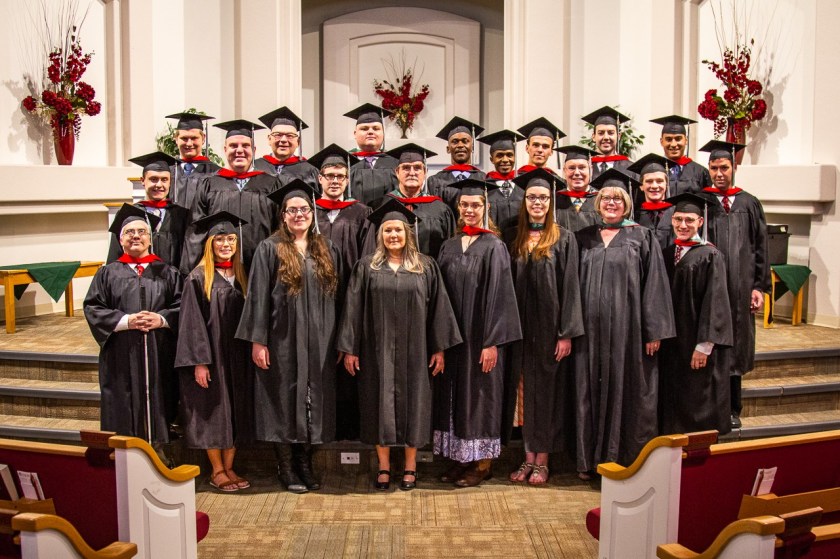
The 2019 Bear Valley Bible Institute graduating class

“It Shall Stand Forever”

Neal Pollard

Kathy and I visited the Notre Dame Cathedral in Paris, France, in February of 2006. It is an ornate, historic building. It dates to the 1100s, surviving the threats of many wars including World War I and World War II. But, it has been dilapidating for some time. Earlier today, a fire inside the spire caused it and one of its towers to collapse. Now, officials are saying that the whole frame is burning and will not survive. Whether or not they rebuild this Catholic Church building, this 900 year edifice will be gone.

There are buildings that have been around millennia before New Testament Days on most of the continents. If they continue until the Second Coming of Christ, they will cease to exist that day (2 Pet. 3:10). King Nebuchadnezzar had a dream over 500 years before Christ, and God helped Daniel understand its meaning (Dan. 2:28). The colossal figure he saw in that dream was a vision about the coming Kingdom of Christ. Daniel says, “In the days of those kings the God of heaven will set up a kingdom which will never be destroyed, and that kingdom will not be left for another people; it will crush and put an end to all these kingdoms, but it will itself endure forever” (Dan. 2:44). 

A careful study of unfolding history reveals this particular kingdom to be the church of our Lord, a Kingdom Jesus said would be established during the lifetime of some of His disciples (Mat. 16:28). It would come with power (Mark 9:1), a promise Jesus reiterates in Acts 1:8-11. That power came by way of the Holy Spirit’s coming upon the apostles on the Day of Pentecost in Acts 2. Through this means, the Lord’s church was established in Jerusalem that day (Acts 2:37-47). The Roman Empire, which ruled the earth that day, eventually collapsed. No nation or empire can rival the spiritual Kingdom of Christ. His church will stand forever (Heb. 12:28). Nothing can overtake or overpower it (Mat. 16:18). 

Assaults against the church have been ongoing for twenty centuries. At times, it has been invisible to recorded history, but it continues to stand. Her members have been assaulted many times throughout the centuries. Property has been destroyed. Possessions have been taken. Lives have been lost. But, still she stands! This Kingdom shall stand forever! A Divine promise encircles it. This confidence is fire proof! 

notre_dame_a_paris_01
Notre Dame Cathedral before today’s fire

Adopting Orphans

Neal Pollard

It was nearly twenty years ago that I walked with Keith Kasarjian through an orphanage in eastern Ukraine. I cannot remember how many children were there, but there were many. My first impression was their appearance–unwashed and tattered clothes, dirty bodies, and many had mussed or shaved heads. But my overwhelming impression was regarding their behavior. They clung to us, wanting our attention. They couldn’t speak much, if any, English, and our Russian was sparse. There was a hunger in their eyes, not for food but for attention and affection. While we were not there for very long, the memory of that evening is as fresh today as it has ever been. They had no family, few possessions, and terribly uncertain futures. Legally, culturally, and financially, adopting dozens of foreign children was virtually impossible. Not a few tears were shed when we said goodbye and as we looked back at that evening.

An orphan “is someone whose parents have died, are unknown, or have permanently abandoned them” (Merriam Webster online; Concise Oxford Dict.). While Scripture mentions physical orphans 36 times, including twice in the New Testament, the concept of spiritual adoption is an important way the New Testament describes what God does through Christ to make us part of His family. Particularly, Romans 8-9, Galatians 4-5, and Ephesians 1 describe this process.

Consider how we appear to God. Even our righteous deeds are like filthy garments (Isa. 64:6). He even figuratively described His Old Testament people as like castoff children abandoned and helpless whom He bathed, clothed, and took care of (Ezek. 16:1ff). But, that figure could certainly be applied to us today. Scripture depicts sin as making us stained (2 Pet. 2:13), spotted (Eph. 5:27; 1 Pet. 1:19), and unclean (Rev. 21:27). Yet, God saw us and loved us (Rom. 5:6-8). He wanted us to be part of His family (Eph. 2:19).

The difference between God and us is that He is able to take all of us. He wants to, and He has the resources and power to make it a reality. He feels perfect pity for us who are orphaned by sin, and He acts on that compassion by inviting us into His family. If we accept His offer, He makes it happen. That being the case, why would we ever reject what only He can give? We can go from being the lowliest reject to being a child of God!  Truly, it doesn’t seem like much of a dilemma. If we see ourselves, spiritually, as we are, we will anxiously accept what only He can give us.

Ukraine 2003

Make It A Momentous Monday

Neal Pollard

  • Pick out a local church leader and pray for him and his family for several minutes, being very specific in your petitions on their behalf.
  • Email a missionary to encourage them and get an update on how their work is going.
  • Buy a gift card and try to give it anonymously to a young or struggling family you know.
  • Thoughtfully select several people to compliment and encourage by writing on their Facebook wall or other social media platform.
  • Briefly visit a brother or sister in an assisted living facility or nursing home.
  • Ask a co-worker, classmate, or neighbor what you can be praying for them about.
  • Listen to a book of the Bible in its entirety on your commute.
  • Let go of a grudge or deep-seated resentment.
  • Do an unexpected deed of kindness for a random stranger.
  • Speak to someone you see regularly about your faith–what God is doing in your life, what’s going on at church, etc.
  • Spend some one-on-one time with one of your children (playing a game they enjoy, going for a walk, taking them out to eat, etc.).
  • Show love to your mate in some tangible way you know he/she enjoys (speak their “love language”).
  • Practice pleasantness with everyone you meet today, being mindful of your facial expressions and body language.
  • Carve out some time for meaningful, personal devotion (including Bible reading, singing, and prayer)–make worship more than a Sunday matter!

None of these are overly time-consuming. Pick as many as you can. If you cannot get to them all today, then pick up where you left off tomorrow. Grow your list. Use your imagination and creativity. Find yourself looking and acting more like Jesus!  See yourself in Matthew 5:13-16.

candle-335965_960_720

Of One Blood

Neal Pollard

The NHS (National Health Service of Great Britain) says, “Blood is made up of red blood cells, white blood cells and platelets in a liquid called plasma. Your blood group is identified by antibodies and antigens in the blood” (nhs.uk). There are eight blood types among human beings in the world. In most countries, more people have either [A+] or [O+], although a few countries have more [B+] blood types. But the type of blood a person has is not specific to a race. [O-] blood types can give to all blood types, and [AB+] blood types can receive from all blood types. Most blood types can give to and receive from more than one blood type. You may not think much about your blood type, but it matters to you when you need a transfusion. It matters to everyone when you donate blood. 

In Paul’s incredible sermon in Athens, he cites a scientific truth now accepted by all science. He says that God “made of one blood all nations of men for to dwell on all the face of the earth” (Acts 17:26). While the word translated “blood” is found in the Greek New Testament, modern translations do not have that original word in the text. Instead, it has literally “He made from one (“man” inserted by translators) every nation of mankind…” (NASB, ESV, ) or “he made of one every nation of men” (ASV). This produces no great tension between versions. Science tells us that blood type is determined by genetics, so the same conclusion can be drawn from either rendering. Humanity is bound together by something that transcends racial barriers. In fact, all mankind–regardless of race–is related. God saw to that by the creating us all from the same person. He designed the human body, whatever skin color or ethnicity, to survive through the same vital substance (Lev. 17:11)–blood! 

We live in a world that desperately wants to divide us by political party, nationality, skin color, gender, and a thousand subcategories. Division is worldly minded and contrary to God’s Spirit (Jude 19). I find it incredible how God reminds us, even in Paul’s subtle phrase in an apologetics lesson, that He desires us to be united according to His will. What matters to Him is not measured by such superficial, external things as race. It is the content of character. Most of all, it’s the blood of His Son!

kids-race.jpg

Lessons Learned At The Stadium

Neal Pollard

Corey Sawyers and I decided a few weeks back to go to the Georgia-Tennessee game at Sanford Stadium in Athens, Georgia, this past Saturday. Thanks to various reward programs and good deals, we were each able to do it all for less than a discount airfare. We were gone about 24, action-packed hours. We even were able to connect with the Shillidays, who had the same idea as us and made the trip from Colorado to Georgia. It was a lot of fun and we made some great memories. While there, especially in the several hours we were at the stadium, several things occurred to me that I would like to share.

  • People get emotionally invested and passionate about what they love.
  • Diverse individuals can unite around a common cause.
  • We sacrifice (time, inconvenience, effort, money, and voice) for what we truly care about.
  • We can be bold enough (vocally and visually) to let everyone know where we stand.
  • We may be too quick to forget past successes, but we’re also quick to forget past failures. 
  • With sufficient interest, we can endure discomfort (backless seats, extreme heat and humidity, and no elbow room).
  • We do not let lack of knowledge or understanding of a subject (like the rules and strategy of college football) to keep us from speaking up.
  • We tend to be proud of our history and heritage (coaches, players, broadcasters, past seasons), feeling a sense of connection or belonging through it.
  • Despite aforementioned unpleasantries and sacrifices, most remain willing to do it again in the future. 
  • We can quickly build a bond with likeminded people, even strangers, out of a common love.

It’s easy to see the comparisons and contrasts between our Saturday experience and trying to be a Christian in our world today. Obviously, I am not disparaging going to ballgames and having a good time. It’s great fun! But, it always reminds me of my need to exhibit greater commitment and zeal for the only thing that matters eternally. My prayer is that, in every way it can be measured, my heart, mind, soul, and strength will be most invested in loving the Lord, His church, and the lost. It also makes me aware of the vast potential in every person, properly directed, to seek first the Kingdom of God! How many, adequately exposed to God’s will and His offer of salvation, will wholeheartedly embrace and share it? Seemingly, the numbers are staggering! May we be enthusiastically about the Lord’s business. 

Bear Valley at Sanford Stadium
Bear Valley crew at Sanford Stadium shortly before kickoff.

What Are We Saying About The Church?

Neal Pollard

Recently, in an excellent lesson about gossip, the teacher recounted an incident I, and many others, could echo from the background of our own experience either in ministry or our personal lives. A mother asked her wayward daughter why she no longer was a member of the church. Her convicting reply, “The way that you always talked about the church, why would I be?” The way this daughter heard her parents talk about the church, she concluded the church was full of hypocrisy, flaws, and inadequacy. She was simply modeling what she heard them say throughout the years.

I’m thankful for the sound counsel we received well before we had children. We were advised never to speak ill of the church in front of our children, to run down elders, deacons, preachers, and other members. Knowing Kathy, she would have done this intuitively. For me, it was extremely helpful with my impetuous nature. Even whispered words in the front seat of the car, going home from church, will inevitably be heard by the little ears in the back seat (the same is true of the dinner table and other times the family is together). We may be blowing off steam, we may not have deep vendettas against the object of our criticism and complaint, and we may soon forget what we’ve said, but impressionable ears and hearts may internalize the words and materialize the message with their deeds and lives. 

The attitude, relationship, and loyalty our children have toward the church is most shaped and determined, for good or ill, by our example as parents. What will help us speak well of the Lord’s church? 

  • Remember who conceived of it, from nature to organization to purpose, etc. (Eph. 3:9-11).
  • Remember whose it is (Mat. 16:18-19; Eph. 5:33).
  • Remember our mission to bring others into it and that our home is our primary mission field (Mat. 28:19).
  • Remember how Jesus feels about the church (1 Tim. 3:15; Eph. 5:25).
  • Remember that the church is the location of the saved and we should do all we can to help our children make up that number (Acts 2:47; 1 Cor. 12:13).
  • Remember all that the Bible says God seeks to accomplish through the church: growth (Eph. 4:16), His glory (Eph. 3:20-21), and His grace (2 Cor. 8:1), among so many other things.

We may struggle to see our family harbor grudges and hard feelings against the church. Many factors may contribute to that, but we should begin with ourselves. What are we saying about the Lord’s bride? What is our attitude toward her? I cannot imagine that anything is more impactful than that, and that is probably the thing we can most control! May our family remember that our theme song, concerning the church, is, “I love Thy kingdom, Lord!” Surely this will influence how they feel about her, too. 

3

Abraham Lincoln’s Memorandum Of August 23, 1864

Neal Pollard

Somehow, I was unaware of the existence of a document which Abraham Lincoln drafted and had endorsed by every member of his cabinet, though unseen by them, and which remained sealed until November 11, 1864. These were not only dark times for the nation, embroiled in civil war for over three years at that point, but gloomy for the war-weary north which could not end the conflict against the greatly outmanned but tactically superior south. Politicians and citizens were unhappy with the perceived lack of success and progress at such high cost—the death and disabling of so many of her sons in the prime of their lives.  Lincoln detected that popular sentiment was such that he would not be reelected. Thus, he drafted his memo, which read, 

This morning, as for some days past, it seems exceedingly probable the this
Administration will not be reelected. Then it will be my duty to so cooperate
with the President-elect as to save the Union between the election and the
inauguration: as he will have secured his election on such ground that he
cannot possibly save it afterward (Coolidge 139). 

Lincoln seemed to think that the north had had enough of this war and would rather sue for peace and allow our sea to shining sea to be two nations rather than continue with such devastating effects a war they could see no end to. He appears dedicated to whatever he could do to preserve unity.

Of course, several things changed the course of Lincoln’s fate in his bid for reelection that swept him decidedly into office for a second term. There was the north’s victorious show in The Battle of Atlanta, Fremont’s withdrawal from candidacy, the Democrats internal division between the Copperheads—eager to end the war now—and the War Democrats, and the fact that no electoral votes were counted from the Confederate States of America.  But, Lincoln could not see the future. He was preparing for what he saw as the worst.

There is a well-worn battle taking place in our world. It is not technically between two factions. It might be framed as Christianity versus other world religions. It could be cast as New Testament Christianity versus so many individual denominations. Yet, internally, there are multiple stressors to the biblical unity Christ prayed and died for, too (John 17:20-21). 

Christians are soldiers (Eph. 6:10ff), but our battle is not with flesh and blood (Eph. 6:12).  Our war and weapons are not “of the flesh” (2 Cor. 10:3-4). All the same, many have grown weary of fighting the good fight and not a few feel as though we are fighting in a losing cause. The restoration ideal of doing Bible things in Bible ways seems archaic and impossible to growing numbers of saints. Some fight with equal vigor to preserve traditions not rooted in Scripture, and unnecessarily harm the great cause. 

As we strive at all costs to be true to the pattern of New Testament Christianity, let us do so going to whatever lengths we can to maintain unity wherever possible. Not for a moment does that mean sacrificing truth or compromising even one “thus says the Lord.” But it does mean embracing a spirit of love and protectiveness for the precious Bride of Christ, the church. That involves loving and working with those who are the members of it. 

Ultimately, the Lord’s cause will prevail. His victory is as assured as every other divine promise. We must be striving on His side to share in that. For now, we cannot give up the fight! Let’s cooperate wherever and however we can, standing unitedly on the foundation of Christ and His will. The rest (which is most of it), we will leave to our Great Commander In Chief!

Works Cited:
Coolidge, Louis A. American Statesman Ulysses S. Grant (New York: Chelsea House, 1983).

blind-memo-recto-al0204

“Immediately”

Neal Pollard

The astute reader of the book of Mark finds the word 40 times in 39 verses (the Greek word most often translated “immediately” in Mark is actually found 44 times). It is a key word found consistently throughout the gospel but especially in the first six chapters. Usually, the word is used to quantify the time between Jesus performing a miracle and it taking effect. The point seems to be to show the power and Divine nature of Jesus. It is also a thread that runs throughout the book to highlight key thoughts and main ideas in this second book of the New Testament. The word is used to highlight the Father’s affirmation of Christ following His baptism (1:10), Jesus’ journey into the wilderness to triumph over the Devil’s temptations (1:12), the disciples’ decision to leave their occupation to follow Jesus (1:18,20), Jesus’ entering the synagogue to show unparalleled authority and power (1:21), the news and fame that followed Christ’s teaching and healing (1:28), and the immediate response of the one healed by Jesus–the first of many uses of the word “immediately” to highlight such (1:29-30). The proof for Jesus’ identity was immediate. The effect of Jesus’ miracles was immediate. The impact of Jesus’ miracles and teachings on friend and foe was immediate. Mark’s use of this word seems to indicate how overwhelming and unmistakable the proof of Jesus was.

This is not to say that one should rashly decide about the Lord. The book of Mark is part of God’s way to convince man about who Jesus is. Take the time to read it and learn of Him. Like the other three gospels, Mark contains the miracles, teaching, claims, and events in Christ’s life at the end of which one must ultimately make a decision concerning who He is. Remember, though, “He who believes and is baptized will be saved; but he who does not believe will be condemned” (Mark 16:16). Weigh the evidence, and then decide. Follow the example of so many in the book of Mark and let the power and person of Jesus have an immediate impact on your life and your soul.

15843359028_6e6cbd3894_b

The Gift That Jesus Gave

Neal Pollard

Often, during this time of year, there is an emphasis placed upon the gifts brought by the magi to Jesus—“gifts of gold, frankincense, and myrrh” (Mat. 2:11).  They understood how Jesus was worthy of worship (2:2,11) and celebration (2:10).  Their giving flowed from that recognition.

The book of Hebrews turns the tables and reveals the Jesus who is the gift-giver. The same Greek word used to describe the wise men’s gifts to Jesus is used twice by the writer of the epistle to talk about Jesus’ gift. He does so in the context of Jesus’ work as a High Priest, as contrasted with the gifts offered by priests under the Law of Moses. In Hebrews 5:1, the writer talks about the qualifications necessary to serve in that role—taken from among men, working on behalf of men in order to offer both gifts and sacrifices for sin. Chapter five deals more with His qualification to serve and offer, but the writer does deal with the gift itself later on. Later on turns out to be chapter eight. The writer uses that same word for “gifts” in Hebrews 8:3-4 to talk about what Jesus offered. His gift is contrasted with those that cannot make the worshiper “perfect in conscience” (9:9). He gave His own blood (9:10) and with it obtained eternal redemption which will “cleanse your conscience from dead works to serve the living God” (9:14). The writer summarizes that gift, “the offering of the body of Jesus Christ once for all” (10:10), as the gift that sanctifies us to God.

But what do we give in return? We cannot repay His priceless gift. But God presupposes that we will be motivated to give. Jesus does, referring to worship in Matthew 5:23-24. He does again, referring to the monetary gifts of the wealthy and the sacrificial (Luke 21:1-4). The Hebrews writer will use Abel as an example of faith-fueled giving (11:4). But our most generous gifts to Christ, however moved by sincere love and unwavering commitment, is but a shadow and reflection of His gift. We give Him money, honor, time, energy, heart, and everything else we can, because He is the greatest giver of all. May we take the time, every day, to honor and give freely, to the Gift-Giver!

hqdefault

A Wonderful Savior!

Neal Pollard

Since I was a boy, “A Wonderful Savior” has been one of my favorite hymns. A multitude of reasons are cited in this beautiful song, all of which builds my adoration for the Lamb of God! Let me suggest three reasons why I think Jesus is a wonderful Savior.

He has a wonderful nature. Jesus is Divine and eternal. He possesses all the traits of Deity without qualification or limitation (Col. 2:9). That means He has the power to save “to the uttermost” (Heb. 7:25). Not only does He, as God, have the power, but He has the love (1 John 4:8). He has not only the power and the will, but also the desire.

He demonstrated wonderful love. Again, what could drive the perfect God to die for woeful, sinful, and wicked man? There was nothing in us deserving of love, so this says everything about Him and nothing about us. He loves me because HE is wonderful (Gal. 2:20; Eph. 5:25; cf. Rev. 3:9).

He has opened wonderful doors of opportunity. Paul loved using this terminology. He told Corinth in two letters about the Lord opening such doors for him (1 Cor. 16:9; 2 Cor. 2:12). He told the church at Colosse (4:3). He reported as much to the church at Antioch at the end of the first missionary journey (Acts 14:27). We cannot separate these opportunities from the Savior. Who do we seek to promote? What is our message? Who is the object of hope? He opens doors because of who He is. The Godhead, when we pray and seek His will, opens the doors through divine providence. How enriching and rewarding when we step through those wonderful doors!

Fanny J. Crosby had in mind the event up on Mt. Sinai when Moses received the ten commandments and the Lord descended in a cloud and stood with Moses there. It is a beautiful picture of a God who condescends to lowly man. That’s what Jesus did! He lowered Himself for us (Phil. 2:5ff). Thank God for such a Savior as we have!

blesed-assurance


Appreciating The Blessings In A Key Text

Neal Pollard

Joshua 21:43-45 is the key text in that book because at this point that Joshua can say that God gave everything that had been promised. With the settling of the land, the land promise made to Abraham was now fulfilled. Israel was not fully a nation after becoming a people and having law, but now they are. Notice the facets of God’s promise to them.

“So the Lord gave Israel all the land which He had sworn to give to their Fathers” (43). God gave them physical blessings. They owned and called home the land God promised their ancestors.

“The Lord gave them rest on every side” (44). He gave them emotional blessings. This was a long time in coming for these battle-weary warriors. The anxiety of being the underdog, of facing frightening foes, all of that (at least for now) was behind them.

“No one of all their enemies stood before them; the Lord gave all their enemies into their hand” (44). He gave them spiritual blessings. These idolaters and heathen people could not stand before them and the Lord dispossessed them, giving them into the hands of His chosen people.

No wonder this summary statement is made: “Not one of the good promises which the Lord had made to the house of Israel failed; all came to pass” (45). This was the God of Joshua. It’s also the God of us.

This text shows us how comprehensively God blessed the lives of His children. These verses speak of a material inheritance. Even if it is the choicest spot on the globe, it cannot compare to what God will give to His faithful. Let’s rejoice in the hope Peter shares, regarding the promise of His coming (2 Pet. 3:4). He writes, “But the day of the Lord will come like a thief, in which the heavens will pass away with a roar and the elements will be destroyed with intense heat, and the earth and its works will be burned up. Since all these things are to be destroyed in this way, what sort of people ought you to be in holy conduct and godliness, looking for and hastening the coming of the day of God, because of which the heavens will be destroyed by burning, and the elements will melt with intense heat! But according to His promise we are looking for new heavens and a new earth, in which righteousness dwells” (2 Pet. 3:10-14).

18664277_10155415084714198_6856619033011736779_n
The supposed “Garden of Gethsemane” (photo credit: Carla Moore)

Service With A Smile

Neal Pollard

Jesus showed the greatness of service by washing the disciples’ feet (John 13:12-17). As they fought over who was the greatest, Jesus revealed that He came to serve and not to be served (Mat. 20:25-28). God refers to Him in the great prophesy about His suffering as “My Servant” (Isa. 52:13; 53:11). Why, then, are we more apt to jockey for prominence, position, power, and prestige? Is it not that, in such times, we’ve lost our focus and stopped “looking unto Jesus” (cf. Heb. 12:2)? What are some practical ways we can reflect Jesus through service? Consider the following as a pump-primer:

  • Write a note of encouragement
  • Pleasantly let a merging driver merge in front of you
  • Fervently pray for the good of someone who has been hurtful to you
  • Meet a widow(er) for lunch or coffee
  • Volunteer to babysit so a young couple can go on a date
  • Anonymously send a small amount of money or gift card to a college student, preacher student, or missionary
  • Visit a shut-in
  • Participate in a feeding the homeless event
  • Tell an elder you love and appreciate him
  • Pay for the meal of a young family who looks like they could use the help
  • Ask a neighbor if there is something you can be praying about on their behalf (and, if they’re willing, pray for that on the spot)
  • Text or email someone you know is in a stressful circumstance and express confidence in them
  • Take a small group to go sing for someone confined to a hospital or nursing home
  • Volunteer to work with small children to make a craft or baked good for the elderly
  • Police the bathrooms and pews at church and tidy up little messes you see
  • Make visitors to our assemblies feel welcome and help them find a class or a seat (with a pleasant smile)

There may be profound ways we can serve, but realize that any act of service may be far more profound than we think. We may not know in this life how a simple act opens a heart and opens a door of opportunity for Christ. Think like a servant and seek ways to serve! The greater others think you are, the greater your need to serve. But however much or little you think of yourself, think of others. Then, serve them!

2159516316_763603c0c9_z

A Strategy The World Never Sees Coming (Poem)

Neal Pollard

How I treat you says much about me
My demeanor and my disposition
It’s my calling card but your memory
Of who I am and my primary mission.

For I treat you as I would treat Jesus
As if He were standing before me
That He came not for ease but to ease us
He was driven by the needs He would see.

If we all were an advocate for each other
More concerned with the good of our neighbor
Moved deeply by each sister and brother
A faithful worker in that needed labor

The world preaches, “Me, mine, and my!”
“For me you must give, serve, and do!”
The world is dead, but we must die
To self and the self-centered view.

Imagine a world where everyone tried
To defer to the people around them
Just walk in love, by the Savior’s side
When they look at you, they will see Him!

500906697_2bf2ba28c9_b