Dealing With Sin Aggressively

Sin won’t quit on its own. It has to be killed. The Bible doesn’t offer a gentle plan; it hands us a sword. Cut off the hand. Gouge out the eye. Put the old nature to death. This is love for the One who died so we could live free.

Carl Pollard

I was listening to a preacher on Facebook the other day and he said something that made me think. He said, “stop treating your sin like a pet, it’s time for us to deal aggressively with our sin!” I started looking for all the places in scripture that this concept is described. 

Jesus is clear: “If your right eye causes you to sin, tear it out and throw it away. For it is better that you lose one of your members than that your whole body be thrown into hell” (Matthew 5:29,). Sin isn’t a bad habit to manage, it’s a deadly growth that has to be cut out. The Bible never tells us to make peace with it. It tells us to kill it. That’s the normal Christian life.

Paul is clear: “So now it is no longer I who do it, but sin that dwells within me” (Romans 7:17). That word “dwells” means sin has set up camp inside us. It’s not a visitor; it’s a squatter that wrecks everything it touches. The only answer is eviction, forceful, immediate, and final. The Spirit is the one who hands us the tools.

Colossians 3:5 is clear: “Put to death therefore what is earthly in you: sexual immorality, impurity, passion, evil desire, and covetousness, which is idolatry.” “Put to death” is a command to act now, not later. It’s not about slow improvement; it’s execution. Lust doesn’t get a warning, it gets killed. Greed doesn’t get an excuse, it gets the cross. Every morning we take sin’s corpse out to the curb.

Jesus continues: “And if your right hand causes you to sin, cut it off and throw it away” (Matthew 5:30). He’s using strong language on purpose. If something in your life, your phone, your habits, your friendships, keeps tripping you up, get rid of it. No debate. The word “causes you to sin” is the same one used for setting a trap. Whatever sets the trap has to go.

Romans 8:13 shows how we win: “For if you live according to the flesh you will die, but if by the Spirit you put to death the deeds of the body, you will live.” Notice it’s “by the Spirit.” We don’t grit our teeth and try harder. We pray, read Scripture, fast, and stay accountable, then the Spirit does the heavy lifting. This is daily, ongoing war, not a one-time fix.

Sin won’t quit on its own. It has to be killed. The Bible doesn’t offer a gentle plan; it hands us a sword. Cut off the hand. Gouge out the eye. Put the old nature to death. This is love for the One who died so we could live free. Fighting sin hard is just what grace looks like in real life. Start today: name the sin, grab the weapon, trust the Spirit. Eternity is too close for anything less.

What New Christians Need From Us

Neal Pollard
  • Excitement. From the moment they are part of the body of Christ, new Christians need to experience our joy over them. This needs to be sustained over their first weeks and months as a Christian. While developing relationships cannot stay at this initial phase forever, neither should they feel forgotten in a few days (cf. Acts 15:3; Phil. 1:25).
  • Embracing. While hugs and affection can be an effective means of helping everyone, including spiritual babes, I mean here making new Christians feel a part of the “group.” They have likely exchanged circles of influence and will have to give up some unwholesome relationships. They will do so, often still “rough around the edges” or still working through some worldly ways. They need our friendship and acceptance, our mature assistance as they are grafted in to the body (Rom. 15:7).
  • Example. New Christians by their nature do not know a lot about how to be a Christian. They rely on role models. Therefore, we will watch our attitude, our general speech, our words about others, our choices (recreation, clothing, entertainment, etc.), and our actions. Much is at stake (Mat. 18:6-7).
  • Enlistment. New Christians don’t have exhaustive experience with what the Christian life is to be like. They don’t know what next steps are, though they are usually “on fire” for the Lord and raring to go! Our task is to help them see that Christians are to do more than “be,” they are to “do.” We need to call them alongside and help them serve. If we can do this from the beginning, they will not have instilled in them the habits of inactivity or reduce the Christian life to a few hours assembling. Take them visiting, get them to help teach, have them sit in on Bible studies, and generally find what they are good at and help them find outlets to exercise their gifts (Rom. 12:6-8; Eph. 4:16).
  • Edification. That requires time spent together. Whether this occurs through table fellowship, social interests, church work, and just quality time, they need to be built up in the faith. If we will deepen the relationship generally, they will be more receptive to the most important way to be uplifted–through the assemblies (Heb. 10:24-25). This instruction remains vital, to “encourage one another and build up one another” (1 Th. 5:11).

What would you add?

A Better Home

Carl Pollard

Do you remember going to bed on Christmas Eve as a child? Time seemed to go by at a snail’s pace! As children, we felt like we were always waiting—for birthdays, Christmas, or Halloween. Tuesday evenings felt endless because in our house we had Waffle Wednesday. Even those small joys filled us with excitement. Sadly, as we grow older, that anticipation often fades. We should strive to foster that child-like excitement in our Christian walk as we consider what’s ahead.

In 2 Corinthians 5:1-10, the Apostle Paul speaks of our future bodily resurrection. These verses remind us of God’s promise and encourage us to live differently, focusing on the hope of a Better Dwelling. Many Christians are motivated by a fear of hell rather than the reward of eternal life. However, if we embrace the truth of God’s Word, we find a greater motivation—hope.

Paul describes our bodies as temporary, like tents or clay jars (2 Corinthians 5:1-2, 4). Decline is an inevitable part of life, and our bodies are not meant to last. This leads to a natural response: groaning, expressing discomfort. For many, the desire is for relief from physical pain, but for Christians, that “something better” is the promise of resurrection life and restoration.

An essential theme of Genesis is that God created everything as good, and He is committed to restoring His creation. According to 2 Corinthians 5:1-10, He will undo death through the resurrection of our bodies. The Spirit given to us is a guarantee that God has started the work of restoration in us and will see it through to completion. 

What is still to come? Paul says we have “a building from God, eternal in the heavens” (vv. 1-2). This is a NEW body. In the resurrection, Paul says we will be “putting on” a new body. “What is mortal will be swallowed up by life” (v. 4). Life as we know it will be overshadowed by eternal, perfect existence. The best part is being “at home with the Lord” (v. 8). 

The promise of resurrection promotes a different way of living. Are you willing to give up a resurrected body for a tent? Paul affirms three resolutions we should have. First, remember what we ought to believe; we know of God’s promise of resurrection. Second, remember the resurrection as encouragement during decline. Third, remember where you would rather be: “We would rather be away from the body and at home with the Lord” (v. 8). 

With these in mind, we will “walk” according to what we believe about the future and trust that God will keep His promise. Paul phrases it as “walking by faith and not by sight” (v. 7). 

Our anticipation for new life in the presence of God shapes how we live today. If you’ve lost sight of this, refocus now. Let’s strive to be resurrected and spend eternity together with the Lord.

Emulating The Early Church

Carl Pollard

There is no greater achievement than to embody the believers we read about in Acts 4. How did they act, and what did they do? While they were not perfect, they were shaped under the guidance and leadership of inspired apostles. What we need today is to become the church of the past in the present.

If people truly understood the Church, no one would ever leave it. Many today express valid concerns about those who have departed and continue to leave. It appears there is a significant lack of appreciation for the Lord’s church. I believe this stems from misunderstanding. If people grasped what the Lord’s church represents and recognized God’s work within it, we would cultivate a much deeper love for the church.

The longer I spend among the body of Christ, the more I recognize the church as essential to my life. As you know, the church isn’t merely a building or an institution; it is the living, breathing body of Christ, designed by God to fulfill His eternal purpose. Unfortunately, many misunderstand or undervalue the church’s role.

The church was not conceived in the mind of man; it is God’s spiritual body, composed of those who have obeyed the gospel of Jesus. Christ reigns as the head of that body. 1 Peter 2 describes the church as a temple, a nation, and a royal priesthood—this is the Lord’s Church.

One term used to describe the church signifies the universal body of believers. From the beginning, the church has been part of God’s grand design. It is not a human invention but a divine institution established by Christ Himself. In Matthew 16:18, Jesus states, “I will build my church, and the gates of Hades will not prevail against it.” Here, we learn from the Son of God that the church is a divine creation, birthed from Christ’s authority and sacrifice.

The family we join through baptism originated in the mind of God. We need the one true church—not a cheap imitation. This family began with God’s vision, was fulfilled by the sacrifice of His Son, and was established in Acts 2 through Peter’s preaching. We need THAT church!

This family consists of all kinds of people; it is a melting pot, as God designed it to be. Within the church, Satan attempts to isolate and polarize individuals based on these differences. Paul reminds us in Galatians 3:28 that, in the one true church, distinctions such as male or female, slave or free, Jew or Gentile do not matter. We are all ONE in Christ. What some may view as a weakness is, in fact, our strength—if we can embrace it.

Acts 4:32 states, “Now the full number of those who believed were of one heart and soul, and no one said that any of the things that belonged to him was his own, but they had everything in common.” They were unified in purpose, prayer, and perseverance. They shared the same goals, prayed for the same needs, and faced challenges together.

When confronted with threats and opposition, the early church responded with fervent prayer, coming together to seek God’s strength and guidance. They prayed for resilience in their faith—an essential prayer for us all to share TOGETHER. The early church exemplified unity, and our goal as a body of believers today should be to cultivate that same unity now and in the future.

Origen’s “On First Principles” (Preface 7-8)

Gary Pollard

[Editor’s Note: Gary is translating the Ante-Nicene Fathers works, beginning with Origin’s work. It is meant to update the British English of Roberts and Donaldson. What follows is part of that translation]

  1. Another thing the churches teach is that the earth was created on specific days in a specific era. One day it will be destroyed because people do bad things. But when it comes to what existed before this earth (or what will exist after it), we don’t have any explicit information. No one has said anything about it. 
  2. Finally, we learned that the sacred writings were written by God’s spirit. They have two different meanings, too — one that is obvious as soon as you read it, and one that most people miss. The words that we read are a kind of transcendent mystery. They give us an idea of “divine” things. Here’s what every believer agrees on: Everything in the law is spiritual, that’s true. But the deeper meaning is only known to people who have been given special knowledge and intelligence from God’s holy spirit. The word “ασωματον” (asomaton, not having a body) doesn’t exist in our normal vocabulary. Besides, it doesn’t exist in the sacred writings either. If anyone says, “But it’s in The Doctrine of Peter,” we’ll just tell them, “No one thinks that work is inspired, and no one includes it in our collection of legitimate books.” Anyways, in The Doctrine of Peter Jesus is portrayed as saying, “I am not a non-physical daemon.” Whatever it says, we can prove that that book wasn’t even written by Peter, or anyone else guided by God for that matter. Even if The Doctrine of Peter was legitimate, though, we could prove that “ασωματον” doesn’t mean what they say it means. The way they use it, “incorporeal daemon” means something like “the kind of body that a demon has” (whatever that is). A demon-body is supposed to be totally different from our physical bodies (they say). But whoever wrote The Doctrine of Peter was clearly biased. They wanted to communicate that Jesus didn’t have the same kind of body daemons have, which they say is naturally invisible and kind of like the air around us. Their point was that Jesus had a solid, tangible body like ours. Unintelligent people say that anything beyond the material universe is “incorporeal”. They say this because the stuff outside of our material universe “can’t be touched or held or interact with the forces we understand.” 

Sassafras: A Sweet-Smelling Aroma

Darrell Dubree

As a young boy, my dad and i would spend many hours preparing firewood for the long winters in Indianapolis Indiana. Dad loved the smell of sassafras when split with an axe. He would talk about when  he was a young boy and how they would use green sassafras to make toothbrushes. They would take a small piece a fray the ends. Back in that day, money was tight. He explained that seasoned sassafras was used for toothpicks. You can split a small piece and sharpen the end with a pocket knife. He would go on to explain how sassafras was not the best firewood. Seasoned sassafras was a good kindling used to start a fire. Dad would explain how you could determine how old a tree was by counting the growth rings of the main trunk. He would say, as long as the tree was connected to its source of nourishment it would continue to grow and develop new growth rings year after year. He would talk about the different types of wood and their best uses or qualities. For example, some for furniture, some for structural support in buildings, tool handles, somewhere even resistant to certain insects.

Just the other day as I was preparing firewood, I split open a piece of sassafras and the familiar aroma brought back those words spoken by my dad, some 50 years ago.

As I stood there remembering my dad and the simple things he would teach me. It occurred to me that these lessons could be applied to the Christian and their role in the body of Christ (Rom. 12:5-8).  Secondly, just as a saw separates the tree from its source of support and nourishment. Sin and death can separate the Christian from their support and nourishment (Rom. 11:22). May we stay connected to God through studying his word, prayer and encouraging one another and taking advantage of every opportunity to continually add growth rings to our spiritual tree (2 Pet. 3:18). “And walk in love, just as Christ also loved you

and gave Himself up for us, an offering and a sacrifice to God as a fragrant aroma” (Eph. 5:2). 

This congregation over a decade ago began talking of the need to expand and have a bigger footprint in Warren County. That dream has now become reality. Praise be to God! The Bible tells us in Hebrews 9: 27, “And as much as it is appointed for men to die once and after this the judgment.” After this we have one more move to make. To Heaven or to Hell. I want to go to heaven, don’t you? This is why I want to go to heaven:  Because in heaven,

There won’t be no time for crying
No more sickness, no more dying
Great joy awaits us in those mansions far away
When we rest from all of our labors, 
Jesus will be our next-door neighbor
We’re going to be moving, moving away.

How do we prepare for this move?

Hear- Romans 10:14, 15
Believe-Romans 10-17
Repent-1 Corinthians 7:10
Confess- Matthew 11:32-33
Baptism- Mark 16:15-16
Live faithful the rest of your days- Hebrews 10:32

Does Consciousness Continue After Death?

Gary Pollard

One of the commonly asked questions on my list is, “Does consciousness continue after death?” I was fairly confident in what I believed about this one until 3:00 PM today (11.19). Carl dropped the problem of the Transfiguration on me: How are Moses and Elijah present with Jesus before the resurrection? The purpose of this article is to sort out the Gnostic and the scriptural, but also to hopefully put more minds on this question. It’s been bothering me for several hours now. 

The overwhelming weight of scripture seems to be in favor of death being (from our perspective) an instantaneous transition to Jesus’s return and the resurrection. There are some teachings that potentially complicate this view (like the Rich man and Lazarus, thief on the cross, saints under the altar), but the concept of a “place of waiting” made no sense to me in light of the rest of scripture. What’s the point of dividing the sheep and the goats if they’ve been tortured/resting for the last umpteen years? And why are the “goats” surprised at their fate if they’ve already been punished for however long? And how/why is poor Abraham dealing with the pained cries of the rich man in torment? There is, after all, a wide abyss separating the two places (maybe the acoustics are really good). It makes the most sense that Jesus was using an image they would’ve been familiar with (from I Enoch 22, 51) to illustrate the importance of viewing money appropriately. Paul clearly says that we’re given life only when Jesus returns (cf. I Thess 4.14ff), and that Jesus being brought back to life was a visible example of what will happen to all of us too (I Cor 15.20-24). Our hope for consciousness after this life is solely in God’s promise to bring us back when his son returns. 

William Tyndale (1484-1536) said, “By putting the departed souls in Heaven, Hell, and Purgatory, you have destroyed the arguments that Christ and Paul used to prove the resurrection. … What’s the point of resurrection, then? And what’s the point of judgment? … The true faith affirms the resurrection, which is what we’re told to always watch for. Pagan philosophers deny this and claim that the soul is immortal. The Pope combined the spiritual doctrine of Christ and the fleshly doctrine of philosophers, things so dissonant that they’re totally incompatible. And because the fleshly-minded Pope is okay with pagan doctrine, he has no problem corrupting the scripture to establish the doctrine [of Heaven]. If the soul is in Heaven, tell me what the point of resurrection is?” The doctrine of “heaven” widely adopted by our culture is unsupported by scripture and has far more in common with Gnostic and Egyptian beliefs (i.e. Pleroma and Duat). 

So is there an intermediate place where departed souls go to experience the beta version of eternity? I didn’t think so. I’m pretty confident that our culture’s concept of heaven is wrong — on linguistic (ουρανος means “sky” or the place above the sky, which we call “space” today), scriptural (our new life comes when Jesus returns), and historical-cultural grounds (the early, pre-Catholic Christians believed that we would get life in a new body on a new/renewed earth when Jesus returns). 

But the original question was, “Is there consciousness after death?” From a biblical point of view, I believe (until the Transfiguration Conundrum is sorted anyways) the answer is yes and no. From the perspective of the dead, the transition between death and resurrection is instantaneous. I was comatose for about a week several years ago and couldn’t believe I’d been out for that long. Now, that’s not dead — but it at least proves a point. If you aren’t conscious you aren’t aware of time passing. So the “blink of an eye” statement in I Corinthians 15 makes perfect sense! But the bible does suggest that the dead are not conscious, though this is contested (cf. Ecc 9.5, Dan 12.2, Ps 115.17, 146.4 I Thess 4.14-17, and the 50+ times the bible describes death as “sleep”). Regardless of which answer is correct, what we can all agree on is this: 

Brothers and sisters, we want you to know about those who have died. We don’t want you to be sad like other people — those who have no hope. We believe that Jesus died, but we also believe that he rose again. So we believe that God will raise to life through Jesus any who have died and bring them together with him when he comes (I Thess 4.13-14). 1

No Death

Gary Pollard

Many substances give a temporary feeling of euphoria/well-being while harming the cells and systems of our bodies. Some of them don’t alter our state of consciousness (refined sugar, salt, tobacco products), some of them do (alcohol, amphetamines, narcotics). Sin is the transcendent version of those things — it often makes us feel good for a little while, but always leads to death. 

Sin is simultaneously opposed to law (I Jn 3) and uses law to kill us (Rom 6-8). This is a very confusing dynamic at first, but it all comes down to the heart. Paul says that a heart set on God is going to sin, but not because it wants to. It’s because sin uses our weakness compared to the standard of God’s law to trip us up. John says that we’ll always have sin, and that not all sins lead to eternal death. What John and Paul both agree on is this — we are totally powerless by ourselves, but God’s grace covers our mistakes. 

Sin is also a relentless, enslaving force. Few passages more clearly demonstrate this than Romans 6-8. This discourse seems almost contradictory at several points, but I believe this is by design. There is a constant tension between gratitude for grace and recognition of our own sinful nature. I believe this is stated the way it is to keep us in the proper mindset. On the one hand, we have God’s grace and that covers our sins. On the other, we don’t want to run too far with it and fall from grace. This section details a struggle within each Christian to serve God only, while our bodies furiously pull us towards sinful actions and thoughts. Paul’s conclusion at the end is two-fold: Wretched man that I am, who will deliver me from this body that only brings me death and There is no condemnation for those who are in Christ Jesus.

Fashion Tips From The Great Designer

Neal Pollard

Louis Vitton, Dior, Gucci, Prada, Rolex, Hermès, Tom Ford, Armani, Saint Laurent, and Burberry are the ten biggest names in fashion in 2024. They set the fashion trends of the world, for good, neutral, or bad. But, I would like to consult two names not on that list who have timeless and divinely-inspired tips for dressing in a way that wins heavenly awards.

  1. Be Modest In Appearance (1 Tim. 2:9, all quotes from the NLT). “Modest” is a concept word, one that is not so specific that it spells out every detail–how long, tight, revealing, or seductive an apparel item is. It speaks of respectability, sensibility, and suitability. In a world that allows almost anything to go, the godly person is going to have a more thoughtful, self-examining approach to the clothing worn before others. That standard may be stricter than a spouse, parent, or friend endorses or encourages.
  2. Wear Decent And Appropriate Clothing (1 Tim. 2:9). “Decent” means capable of feeling shame or “a self-conscious timidity which fears committing an act unworthy of oneself or representing oneself in an unworthy manner” (Brannan, Lexham Gk. NT Lex., 2020, np). “Appropriate” is “to have understanding about practical matters and thus be able to act sensibly—‘to have sound judgment, to be sensible, to use good sense, sound judgment” (Louw-Nida, 383). As Paul is talking about clothing, it is right to ask if it is ever possible for one to dress in a way that could be determined to be shameless and insensible? Is there a line between decent and indecent, appropriate and inappropriate? Between completely covered from head to toe and completely uncovered from head to toe, one must choose fashion that can reasonably be described as Paul does here.
  3. Do Not Draw Attention To Yourself (1 Tim. 2:9). This is a helpful qualifier. In context, Paul points out drawing attention to self “by the way they fix their hair or by wearing gold or pearls or expensive clothes.” Those things were contrasted by individuals “who claim to be devoted to God” who “should make themselves attractive by the good things they do” (10). As Peter adds, the contrast centers upon which part of oneself a person chooses to accentuate. It is not about sex appeal, but spiritual appeal.
  4. Don’t Be Concerned About Outward Beauty (1 Pet. 3:3). Isn’t that hard in the world we live in? Everything from media, advertising, entertainment, retail fashion, and even pornography pushes especially women to put on clothes that show off features spotlighting their bodies. Worldly fashion can become a competition for who looks better. Peter says not to be concerned with such efforts.
  5. Clothe Yourself With The Beauty That Comes From Within (1 Pet. 3:4). He calls this fashion sense “so precious to God.” Whereas the most age-defying person ultimately loses the battle of the calendar, the one who dresses “with the beauty that comes from within, the unfading beauty of a gentle and quiet spirit” is always in style with Him.

Why do these fashion tips from the Great Designer seem so strange and foreign to our culture and world? Isn’t it because the world is guided by different principles and precepts? The apostle John says, “And this world is fading away, along with everything that people crave. But anyone who does what pleases God will live forever” (1 John 2:17). The world is a different authority, with a different emphasis, set of values, and destiny. It is not to be our standard. For that, we look to the One who made us and knows us better than we know ourselves.

1 Corinthians: That There Be No Divisions Among You (XXIV)

Unity And The Resurrection (Part 2)(15:29-58)

Neal Pollard

After having dealt with the many witnesses to the resurrected Christ, the erroneous denial of His resurrection, and the connection of the resurrection to His second coming, Paul turns his focus not just to the impact of His resurrection on how we live but also to our own resurrection. Notice at least three more observations in the second half of this chapter, designed to unite these Christians around the truth of the resurrection.

THE IMPLICATIONS OF THE RESURRECTION (29-34)

Paul launches abruptly from the second coming to an odd argument in support of the resurrection–this enigmatic practice of being baptized for the dead (29). It has been said that there are about 40 different explanations for “the baptism for the dead.” I believe Paul is saying that some were motivated to be baptized out of their desire to be reunited with their saved loved ones after this life. I studied with and saw a man baptized (by Riley Keown and some firefighters) who was strongly motivated by a desire to be reunited with his Christian mother. That would be for nothing if the dead are not raised. 

Furthermore, why would a Christian risk danger and death if there is no resurrection (30-31)? What keeps a Christian from “Epicureanism,” simply being devoted to indulging the senses through food and drink, if there is no resurrection (32)? Why strive to live morally and surround oneself with moral influences, if there is no resurrection (33-34)? At least four vital implications are covered by Paul, if the dead are not raised.

THE NATURE OF OUR RESURRECTION (35-49)

Now, Paul gets down to what our resurrection will be like in this section of his discussion. He addresses the question of how and what kind of body (35). Notice.

It will conform to God’s law of sowing and reaping (36-37, 42-44). Paul illustrates this with seed sowing in this life. You cannot reap what you do not sow. The body has to die before resurrection is possible. We will see this more in-depth, but what is raised is much better than what dies. 

It will be a bodily resurrection (39-41).  We cannot miss this fact. Paul refers to the “body” ten times from verses 35-49 ( in addition, “flesh and blood” is verse 50 is actually this same word, too). Our resurrection body will be of a different nature, but it will still be a body. It will be a body as God wished (38), a heavenly body (40), an imperishable body (42), a glorious body (43), and a spiritual body (44). Yes, that leaves some things unanswered, but whether or not our resurrection will be bodily is not unanswered. We will not be a disembodied spirit for eternity. We will have a new body, which Paul describes here. 

It will be spiritual and heavenly (44-49). This body will be engineered to inhabit and live for eternity. Our spirits will continue to live; there is continuity. But, we will inhabit a new, spiritual and heavenly, body! 

THE RESULTS OF THE RESURRECTION (50-58)

Paul lays down an order of operations or procedure here. We will be changed in an instant when the trumpet of God sounds (50-52). We will assume an imperishable, changed body (53-54). Death will die (54). It will be powerless over the saved and resurrected child of God (54-57). 

There is so much richness and depth to this discussion of the resurrection, but Paul gives us enough to favorably receive his final charge. He concludes, “Therefore, my beloved brethren, be steadfast, immovable, always abounding in the work of the Lord, knowing that your toil is not in vain in the Lord” (58). Persevere because living the Christian life is worth it! You are not wasting your time. Obey Him! Wait and see. Because Christ was raised, we will be raised! As the song suggests, “What a day, glorious day, that shall be!”

We Have A Problem

Gary Pollard

Nearly every culture in history hoped for immortality or rebirth or “the transmigration of the soul.” This is evident in the myths and stories handed down for millennia. Ancient Egyptians believed in Duat, the terrifying world of departed souls. Here, among other tests, the departed soul must verify that they’ve not committed certain sins (theft, murder, deceit, adultery, blasphemy, and 39 others). If they passed all of these tests, they believed they’d be reborn among the stars of heaven. Many other ancient cultures had remarkably similar beliefs, but we won’t go into these for the sake of word count.

The point is that everyone desired new life. We have it already! Jesus came to this earth when every major culture had a well-established, fully-developed…problem. What do we do after we die? Just about everyone believed we’d go to “heaven” (among the stars), but their views of life-after-death varied somewhat. Jesus — God in human form — gave a solution to this very well-developed problem: Himself. 

We’re so far beyond this archaic conundrum. Colossians 3 tells us what God wants us to do now that we already have new life! 

  1. In 3.1-4, our new life means thinking about higher things. 
  2. In 3.5-9, our new life means getting rid of bad behaviors. 
  3. In 3.11-12, our new life means we have an identity that transcends cultural boundaries because our allegiance is to Jesus first. 
  4. In 3.12-17, our new life means we do everything we can to be at peace with each other and pursue a united spirit. 
  5. In 3.18-4.1, our new life means that we try to structure our homes and lifestyles in the most functional possible ways. 

Our new life is hidden in Jesus. We are already immoral, and death is just the pivotal moment when the “seed” of this body becomes the fully-developed “plant” of a new, immortal body (cf. I Cor 15). Jesus and his inspired writers beautifully and simply answered the millennia-old questions asked by every culture prior to his arrival. We will meet him in the air. He will rescue us when earth is destroyed. We will live with him forever in a perfect new world. No other religion so boldly answers these questions, another evidence of Christianity’s divine origin! 

What’s Next?

Wednesday’s Column: Third’s Words

Jesus came back to life after he died. In his new body, he spent time with his apostles and ate with them (Acts 10.41). Clearly this resurrection body was a real, physical body (though different in ways we don’t yet understand, cf I Cor 15.44). God the father used his power to bring Jesus back to life (Acts 2.32), and will do the same for us after we die. 

The bible gives us some pretty clear information about where we’ll be going after we die, and it’s amazing. We have life now, and we don’t seriously question its reality. Death is just a blip from our perspective (cf I Cor 15.52). We’ll have life then, and it’ll be just as real. So where are we going? Our citizenship is in “the heavens” (Phil 3.20). For some reason, most translations have it singular — “in heaven,” even though this is dative plural in Greek. Jesus is going to come back from the heavens too (3.20). The plural form of ουρανος (“heavens”) is also found in Col 1.5, 16, 4.1; II Cor 5.1; Eph 1.10, 3.15, 4.10, 6.9; I Thess 1.10, Hb 1.10, 4.14, 8.1, 9.23, 10.34, 12.23, 25; I Pt 1.4, II Pt 3.5, and many other passages. It can mean “skies”, but in many contexts it means “space”. This makes perfect sense in light of II Pt 3.13 and Rev 21.1-2 (cf Is 65.17; use of παλιγγενεσια in Mt 19.28). 

After our death, we’ll be given a body and source of life that cannot be killed (I Cor 15.42-49; I Pt 1.3-7). This applies to good people and bad people. The difference for good people is that we’ll get to leave Earth with Jesus, while everyone else will suffer forever. We want to avoid everyone else’s fate, so we do our best to follow God as he gives us constant forgiveness. 

Gary Pollard

The Tie That Binds

Tuesday Column: Dale Mail

image-e1601983688162

Dale Pollard

When it comes to the families that make up the church, what ties us together is a common bright future. While every family has its differences, one constant remains— the church. All strive to follow those guidelines laid out in scripture. Paul says in Philippians 1:6, “And I’m SURE of this, that He who began a good work in you will bring it to completion at the day of Jesus Christ.” 

The writer speaks with assurance and that confidence is well-placed. From His-story we see that God always completes His projects. He never dreams, He creates. He decided to create the world and here it is. He decided to save the world, and here we are. 

Paul also would write in Romans 7-8 that the flesh tends to get in the way of the spiritual. God is perfect, but we’re not. That’s what makes us a work in progress. Aren’t we thankful that God provides the solutions to “fix” us up? 

We’re involved in a great work because there simply is no better work  than what is being done by His church. That being said, many of us struggle with overcomplicating things. We try to make sense of our individual lives, and when we leave God out it all becomes a discouraging battle. Where’s the peace? Joy? Confidence? Maybe it was left behind when we left God’s path. Thankfully God came down to earth years ago to teach us everything we need to know. We see that in His interactions with people. Even His twelve original followers were an odd group. 

Each had a diverse background. Some were Fishermen and some tax collectors. 

Each one had a unique personality too! They ranged from timid to assertive.

Each one had spiritual battles from greed to crippling doubt.  

Yet each one rallied under His leadership and were united through a common hope. 

What’s changed? Not much. 

The personalities, talents, backgrounds, and flaws mixed together create a unique blend that make up each one of us. Yet, here we are rallied under His leadership, united in common hope. 

Members of the church in the Bowling Green area at an FCA fundraiser.

Made To Be Functional

Wednesday’s Column: “Third’s Words”

Gary III

Gary N. Pollard, III

Ephesians 4 describes some spiritual gifts. Their purpose is to allow the church to function as it should. A properly functioning church spends eternity with God. 

A functional church is on the same page (one mind), has spiritual depth, and is workable (more on that in a bit). 

Ephesians 4.12ff is about members’ roles. What are they for? Everyone serves to equip saints. Saints are people who have pledged allegiance to God. 

We train for morally good works and become stronger through encouragement (12,16). We work toward a unified mindset, knowing Jesus, spiritual maturity, and we pursue the highest standard (Jesus) (13,14). 

We work to avoid immaturity and gullibility (14). We pursue maturity until our mindset emulates Christ’s (15). He’s described (multiple times) as the standard we have to have. There’s no room for spiritual laziness here. 

Jesus causes growth spiritually, but only if we’ve become soil that can be worked. If our minds aren’t mature, we aren’t workable. Elders are spiritual farmers, our hearts are the soil. If we use Jesus as our standard, we are workable. If not, we’re spiritually dead. 

So, what can we do individually? Make the church strong by pursuing unity, by having spiritual depth, and by being workable. If we work on those things we will spend forever with God. 

Sharing The Filling Fullness Of Christ

Wednesday’s Column: Third’s Words

Gary III

Gary Pollard

Some phrases in the Bible are simple to read, but very difficult to comprehend. In this article, I’d like to walk through a process together in an attempt to make sense of a difficult phrase (thanks, Paul). One of those is in Ephesians 1.23: “…the fullness of him who fills all in all.” This is a description of Jesus, specifically as it relates to His being the head of the church. But what does that phrase mean? 

I will not pretend to have the answer, but I would like to make a couple of suggestions. Firstly, “fullness” appears to describe the church. In my limited knowledge of Greek, it seems to be grammatically tied to “body.” The church – His body – is His fullness. Both are nominative, both are the subject of the sentence. 

Secondly, Jesus fills all in all. It’s that last phrase that’s so hard for me to comprehend. What does it mean, that “He fills all in all?” Based on the fact that some form of “fullness” is used three times in a single phrase, it appears to have reference to his nature. He is not confined by time or space and is present everywhere. 

If the church is His fullness (the word is possessive in Greek), and He is omnipresent (or, creation is full of Him), then the church must be extremely important. Again, I am not a scholar, I may be mistaken. 

I would, though, like to attempt to make application from this difficult phrase. If the church is, ideally, representative of the very nature of Christ, are we living up to it? Is our passion for the lost like His was/is? Is our love for each other as strong as His is for the church? Do we treat the church as if it were the body of Christ (because it is)? Do we keep in mind, as we interact with each other, that we all answer to Him? Are we trying to mold culture to His image, or are we being molded to culture? 

We really have to think about this one to try to make sense of it. Comprehending this phrase is anything but easy (at least for me!). But the church – which is one distinct unit, not a series of denominations – is supposed to represent Jesus. Our values, our demeanor, our goals, our mission, our attitudes, our behavior, and our purpose should scream to others, “We are not of this world.” If these do not, we are not representing Jesus. No one will do this perfectly, but the standard is high. 

When we begin to understand this phrase a little more, it shifts from being hard to understand to being hard to hear. We have a huge responsibility, but we also have a global family to support us. The standard is high, but our Head is also our Savior. As things slowly go back to normal, let’s keep this in mind! We’re not just Christians to be good people, we’re Christians to show the world who Jesus is.

VISITORS—HANDLE WITH CARE!

Neal Pollard

I’m not sure where the phrase, “handle with care,” originated. It’s usually reserved for advice regarding that which is fragile or even volatile. It really is applicable to those who visit our assemblies because of their value and importance. They came through the doors of our church building intentionally and with a purpose. Initially, we cannot know why or how sincere their purpose. That process of discovery could not be more important. Consider some reasons why we should handle every visitor with care:

  • Each has an eternal soul (cf. Mat. 25:46). 
  • God could not love that visitor any more than He does (John 3:16; 1 Tim. 2:6).
  • God loves that visitor as much as He loves you and me (Acts 10:34-35). 
  • That visitor is likely seeking spiritual guidance (cf. Mat. 7:7).
  • Each visitor is subjected to a first impression, being left by you and me.
  • That visitor is going to make judgments about the church, the Bible and Christ based on what he or she sees (or fails to see) from you and me.
  • The smallest gesture of kindness toward such a one could lead to the salvation of a soul.
  • We cannot know what anyone else is doing to make their first visit a good one.
  • Each one is being exposed to the Bible and to New Testament worship, and follow up can lead to further interest.
  • That soul is connected to many others, who might subsequently be reached (2 Tim. 2:2). 
  • You and I are official ambassadors for Christ (2 Cor. 5:20).
  • The Golden Rule should prompt our warmth, helpfulness, and sensitivity (Luke 6:31).
  • We are each part of a team, trying to connect each of them with what only Christ can offer them (1 Cor. 12:18; John 14:6).
  • There is no guarantee that there will be a next time (Prov. 27:1).
  • Statistics tell us that most visitors find the churches they visit to be unfriendly toward “outsiders” (see, for example: Thom Rainer).
  • Loving others is commanded, and visitors are included in “others” (Rom. 13:9; Gal. 5:14; Jas. 2:8; etc.).
  • Visitors constitute perhaps the easiest inroad to developing interest in a Bible study, as such have reached out to us by attending.
  • Our excuses (“I’m shy,” “That’s not my job,” “I’m not good at it,” “I’m busy”) ring hollow when carefully examined. 
  • We love the church and believe in its relevance and importance.
  • Each contact is a valuable way you and I can contribute service for our Servant-Savior (cf. John 13:12ff; Mat. 20:28).

The list is far from exhaustive. I am convinced that none of us neglects a visitor out of contempt or even indifference. Yet, it is good for you and I to encourage each other, to “stimulate one another to love and good deeds” especially as it pertains to assembly-related matters (Heb. 10:24-25). Wouldn’t it be exciting to be the friendliest church around, especially if our message and practice is faithful to God’s Word? What a powerful combination! Let’s help each other earn such a reputation, for reasons such as the above. 

fellowship201

We Sure Love Baptisms!

Neal Pollard

There are some things about social media that are extremely irritating—click baiting, pot-stirring, fight-picking, self-pitying, and the like. But there are a great many positives in that medium, too. Of all of them, I believe that posts of baptisms have to be my favorite. I do not appear to be alone in that estimation.  Judging from post reactions and comments, a great many others do as well. We love it when there are pictures. We love the “back story.” We love knowing that our friends, neighbors, co-workers, and family members have good, honest hearts softened by the power of Divine Revelation. We love knowing they have a clean slate and a fresh start, and are poised to begin their walk on Narrow Road.

All of this leads me to several random observations:

  • True good news needs no hype, trumping, manufacturing, or baiting.
  • It is New Testament thinking to rejoice at such good news (Acts 8:39; 15:3).
  • What a confirmation the obedience of others to the gospel is to our own decision to do so.
  • It restores our faith in the potential of humanity and the power of the gospel (Rom. 1:16; Heb. 4:12).
  • It builds our confidence in the Bible to see people imitate the examples of the New Testament, doing what they did the way they did it (Mark 16:16; Acts 2:38; 8:13, 38; 9:18; 10:48; 16:14-15; 31-33; 22:16; Rom. 6:3-4; Gal. 3:26-27; Eph. 5:26; Col. 2:12; Titus 3:5; 1 Pet. 3:18-21).
  • The average Christian wants what is best for others, which is just one reason Christians are the best people on earth.
  • We want good news to travel fast, far and wide.
  • We know it pleases the Lord when a person comes to Him in obedient faith (see Luke 15).

There are doubtless many more observations we could make, but these are enough for me to thank God for His people and those who daily make the decision to become His people. It builds my faith and hope in my fellow human beings and my trust in heaven’s plan of salvation.  Thank you for finding joy in the right and best things! And let’s keep striving to perpetuate that joy through leading souls to the Savior.

12924440_10207948347340678_5218772026345282016_n
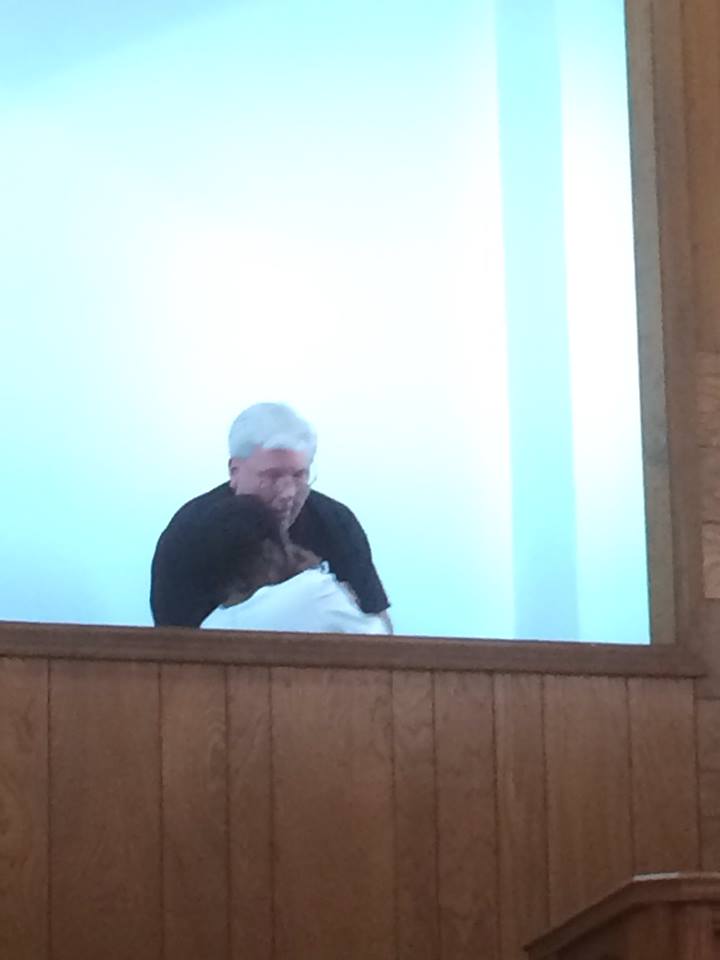
“Debbie” being baptized into Christ during a gospel meeting with Keith Mosher in Sylvester, GA, this week (photo credit: Jason Willis)

Ignoring The Symptoms

Neal Pollard

“What is that smell in the kitchen sink?” “Ah, honey, I’ll look at it, uh, soon.” “When?” “Uh…soon.” “It’s been like this for six month now, honey…honey, are you listening to me? Agh! Look, the drain is bubbling…”

“Mr. Smith, when did you first notice the mole discoloring and becoming asymmetrical?” “Well, um, I think it was last fall.” “Why did you wait a year to get this checked out? I’m pretty sure it’s cancer. To be straight with you, Mr. Smith, I don’t know how this will turn out for you.”

“Brother Jones, have you noticed that sister Blue is acting withdrawn?” “Yea, she lost her job last month and her children are grown and gone.” “Brother Jones, I’ve noticed that she’s recently stopped coming on Sunday nights.” “Yea, Brother Jackson, we need to go visit her this week.” “I know. We’ve been saying that…every week.” “Well, we’ll get there.”

May I suggest that none of these three scenarios is likely to turn out pleasantly? Yet, damage and expense to our material things, or even the loss of physical life to a dreaded disease, are not as devastating or frightening as the loss of a soul. The tragedy is that there are normally symptoms that accompany apostasy (i.e., turning away from the Lord). It is not enough to see the symptoms. We must respond in a timely manner.

One symptom is a decrease in faithful attendance. When individuals who would not miss a service choose to do something else, an alarm has been sounded. Something is replacing their dedication and commitment to Christ. When it is odd or noteworthy that someone is missing services, we need to respond with a card, call, or visit. Somehow, let them know they are missed. Do not lay this solely at the doorstep of preachers and elders. These folks need to be inundated with our concern. Run the risk of offending them. Why should they get offended at genuine brotherly love?

Another symptom is a decrease in reliability in doing church work. The tasks they once did and were counted on to do they no longer do with consistency. Maybe they felt unappreciated or overly burdened. Maybe they needed relief or at least a break. Or, maybe spiritual struggles and worldly concerns have overwhelmed them. Whatever explains the cause, respond to the effect. Tell them how important and special they are. Praise their work. Help them. Encourage them.

Yet another symptom is a change in behavior and withdrawal. This is perhaps the most common precursor and symptom in a spiritual struggle. Distancing themselves from the rest of the church family, a loss of enthusiasm for the church, worship, and/or its programs, and a change in personality within the congregation are all telling signs something isn’t right. We are taught that individuals in a marriage are constantly changing. Those same individuals fill our pews and participate in the church’s work. Let us never take each other for granted or ignore this symptom.

Ultimately, it is not the church’s responsibility to stand for an individual in the judgment (2 Cor. 5:10). Yet, we have a mutual responsibility to each other (1 Pet. 3:8). To borrow from the medical analogy above, when one member of the body hurts, we should all respond to help him or her (1 Cor. 12:26). Please do not be blind to the symptoms of those around you. Ask them how you can help. Do not let them spiritually die because of our neglect.

maxresdefault

BEFORE YOU BUY THAT BODY ART

Neal Pollard

While there are many matters that are much higher priorities than tattoos, I thought you might like to hear from Dr. Bernadine Healy, the first woman to direct the National Institute of Health, former president of the American Heart Association, and the person who led the American Red Cross response to the terrorist attacks on September 11, 2001.  She contributed an article in 2008 to U.S. News and World Report magazine (August 4/August 11, 2008, p. 69) entitled, “The Dangerous Art of the Tattoo.”  Let me say that I am eager to study, convert, and then value and consider as a brother or sister anyone who has tattoos-no matter how many or how big the “body art” is.  They are entitled to the same love and respect as any other member of God’s family.

My target audience are those who may be considering getting one or another one.  Dr. Healy brings up some important issues in the article.  First is the matter of tattoo “remorse.”  Healy reports that “upwards to 50 percent of those who get tattoos later wish they hadn’t.”  Interviews conducted by researchers at Texas Tech with those suffering such remorse cited “moving on from the past, problems wearing clothes, embarrassment, and concerns that tattoos could adversely affect job or career.”

Healy’s second concern should cause one to really take notice.  There are myriad health concerns associated with both getting tattoos and having them removed.  There is a toxic release of low-level carcinogens associated with removal, which in itself is said to a long and very painful process.  There are allergic reactions and skin infections that can follow tattooing.  Healy writes, “The FDA warns about the risk of tattoo parlors transmitting viruses like HIV and the cancer-causing hepatitis C.”  MRI scans can cause tattoos to swell or burn.  She says much more, and I would recommend your getting the article if you are interested in reading it.

Here is the relevant point.  Anything, whether drugs, tobacco, alcohol, fornication, “overuse” of food, or ink, that hurts our bodies needs to be avoided.  May we never forget what Paul told Corinth.  “Or do you not know that your body is the temple of the Holy Spirit who is in you, whom you have from God, and you are not your own?” (1 Cor. 6:19).  We are stewards of all God’s resources, which includes our bodies. Let us make wise and God-honoring decisions concerning them, too! Too, it is so important to try and see the far-reaching consequences of decisions we make today.  We cannot know how we will feel, so we should exercise increased caution before doing something permanent to ourselves.