Singing With The Understanding–Miscellany* 

Neal Pollard

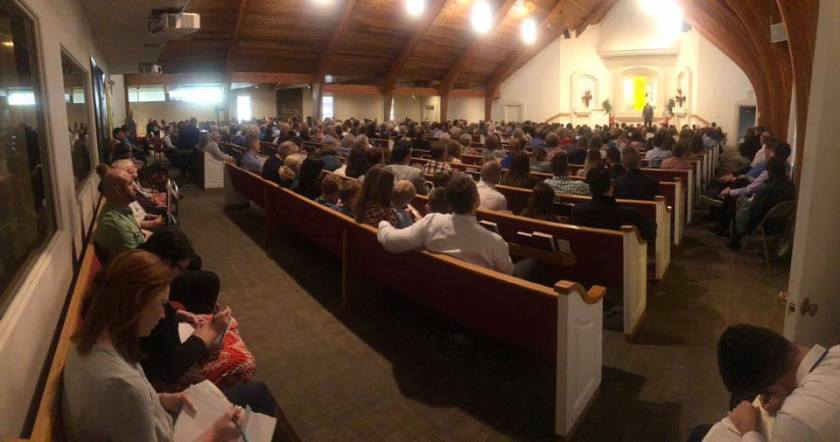
We are a diverse group who gather to sing for worship. We vary in age, education, religious background and literacy, race, and doubtless other factors. Some of us have been singing the same hymns for decades, while others may be seeing those hymns for the first time.  There is a mutual responsibility, one for the song leader and one for the participant. Yet, I would argue that the leader has the greater obligation to assist the participants in offering better worship. Mindless participation is the fault of the participant, but being led to speak and teach words they don’t understand is not.  What can the song leader do to increase the effectiveness of “singing with the understanding.”

Engage In Thoughtful Preparation. When picking out songs to lead, opt for simplicity. Archaic or technical words can hang up and distract the worshipper. It is fruitful to ask the question, “How will this be comprehended by the average participant?” Does the song read like we speak today? If we’re not careful, we can tend to speak through song in mystical terms that help disconnect the mind and the mouth. Do we know what it means to “vanquish all the hosts of night”? Do we know what “cassia-dipped” garments are? Do we know what’s referenced “where Eden’s bowers bloom”? How do I “launch my bark”? These are lyrics from songs that are sung every week in congregations across the land, but words I’d venture to say that many, if not most, do not comprehend. We must give thought in preparation.

Engage In Adequate Explanation. Something that can help in song leading is to point out words or expressions we’re about to sing, defining and explaining them. This does not necessitate a second sermon, but as part of preparation we should be ready to clarify obscure or difficult words. For example, from songs we often sing, we find:

  • “Repining”–To feel or express discontent; to fret
  • “Guerdon”–A reward
  • “Warble”–To sing (especially used of birds)
  • “Fain”–Gladly
  • “Trysting”–Meeting 
  • “Essay” (as used in I’ll Never Forsake My Lord)– To attempt
  • “Cloven”–Divided
  • “Garish”–Bright and gaudy
  • “Fen”–A swamp

While some songbooks, like Praise For The Lord, have footnoted some of these difficult words, many worshippers don’t pay attention to them. So many of us project our hymns in worship. The onus (i.e., duty) is on the leader to explain.

Engage In Balanced Variation. Everyone has their favorite type and genre of psalms, hymns, and spiritual songs. Song leaders are no different than worshippers. How important it is to balance out old and new hymns, considering the typical “audience” present to participate. 

Engage In Heavenly Petition. Anyone who leads in worship should season their preparation and participation with petition to God. Pray about doing what you’re tasked with doing as effectively as possible. 

What a blessing to have willing, talented worship leaders. We have a powerful opportunity to show God’s wisdom in singing according to the authority of the New Testament (cf. Col. 3:16; Eph. 5:19). Let’s capitalize on that by putting everyone in the optimal position to sing with proper spirit and understanding!

*–Miscellany–A group or collection of different items; a mixture

Screen Shot 2018-11-26 at 10.56.34 AM

I Met A Soul Today (POEM)

Neal Pollard

A lonely soul was crying out
For someone to direct
Their mind to know the will of God
But I chose to deflect.

An edgy soul was acting out
Intimidating and coarse
Yet they were searching for the truth
I recoiled with too little remorse.

A hopeful soul was reaching out
And attended our worship service
But I was busy, too much to do
To connect, plus I was nervous.

A hurting soul, in time of loss
Crossed my path today
I felt so bad that he was grieved
But still I hurried on my way.

A lost soul was needing Christ
She is destined for eternity
I was busy, nervous, no zeal for her
Guess I was too caught up in me

The next soul that I come upon
Lord, may I try with zeal
To share your grace and teach your Word
And your matchless love reveal.

a20cold20day2015

The Greatest Longing Of The Soul

Neal Pollard

Quick. Name the top three accomplishments of Grover Cleveland’s presidency. I’ll wait. 

Nothing? Don’t feel dense or unpatriotic. He’s not in most historians’ top 10 (25?) of American presidents. But on yesterday’s date, 132 years ago, he was at the helm and dedicated the Statue of Liberty in New York Harbor.  This, if you don’t recall, was the proposed gift of French historian Edouard de Laboulaye in honor of America’s alliance with France during the Revolutionary War, sculpted by Frederic-Auguste Bartholdi, designed by Viollet-le-Duc and Alexandre-Gustave Eiffel (yes, that Eiffel), completed in France in 1884, and delivered to America the next year with the last rivet fitted on October 28, 1886 (via Instagram). The pedestal of the statue contains a sonnet by poet Emma Lazarus, well-known to most of us, that reads, 

“Give me your tired, your poor,
Your huddled masses yearning to breathe free,
The wretched refuse of your teeming shore.
Send these, the homeless, tempest-tost to me.
I lift my lamp beside the golden door” (ibid.).

With all the debate about immigration–a Reuters story revealed that immigration tops the economy and healthcare as the top issue for voters (Read here)–there is no denying why so many people around the world want to come to the United States. We have long been regarded as the haven for poor masses yearning to breathe free and wanting a home inside “the golden door.” Many have come and achieved incredible success in our country. Many more than that have come to find that immigrating here did not solve their problems or make their dreams come true.

There is a greater longing of the soul, a desire for something even more than prosperity.  Jesus teaches us that material things won’t last (Mat. 6:19-20). Peter tells us what comes of such ultimately (2 Pet. 3:10). 

There is a greater longing of the soul than even freedoms afforded by nations and governments. Many will abuse those freedoms through immoral choices.  Proverbs 14:34 strongly applies.

The most noble, highest longing of a soul is for the freedom only Christ can provide. To be free from the slavery of sin (John 8:31-36), from guilt of sin (Psa. 51:1-14), and from the power of sin (Heb. 2:14) is man’s wisest quest. A person with an abundance of money, liberty, and other earthly advantages may still be buried by the influence of sin. To know there’s a solution right now–who wouldn’t want that?

Don’t forget what Jesus tells people everywhere: “Come to Me, all who are weary and heavy-laden, and I will give you rest” (Mat. 11:28). 

23905208_10155150150870922_199173094846852320_n

Are You Dogmatic?

Neal Pollard

Brett Petrillo, one of my co-workers at Bear Valley, showed me a word (in Colossians 2:20) I did not know was in the Bible. Actually, it’s in the Greek Bible, and the word is “δογματίζω  (dogmatizo). According to BDAG, it means “to put under obligation by rules or ordinances; obligate” (Arndt, et al, 254). Kittel adds that these are rules that seem to be right but are put forward as if “to establish a decree” or “to publish an edict” (Kittel, et al, 178). The shorter form, “dogma,” is found a few times and simply means a formal, governmental decree that may or may not be in accordance with God’s will (Lk. 2:1; Acts 17:7; Heb. 11:23; it’s also used of the Old Law in Eph. 2:15 and Col. 2:14, translated as “ordinances” or “decrees”). In Colossians 2:20, the longer, verb form is translated “submit yourselves to decrees” (NASB), “submit to regulations” (ESV), “subject to ordinances” (KJV), and “submit to (the world’s) rules” (NIV). 

It was dogmatic people asking these Christians to submit to their rules. Paul describes and defines the specific rules in the circumstances plaguing the Colossians. Some were acting as their judge regarding food, drink, festivals and days (16), adding fleshly (and, in some cases, heretical) requirements (18), and making rules which did not originate with Christ (21) that he describes as “the commandments and teachings of men” (22). Paul condemns such rule making (19,23). 

How does this teaching apply to us today? We are right to point out those who tell us we don’t have to obey things which God requires of us. Lessening God’s requirements in areas He holds us responsible for is spiritually fatal. This is replacing divine commands for human ordinances. 

Yet, we cannot miss the point that the other extreme is just as wrong. To make laws, regulations, and commands and bind them upon brethren is still to replace divine commands for human ordinances. This very context points out how God feels about this.

The Lord does not need our help. He knew what His will for us was, and we cannot improve upon that. We must make sure that we’re not pressing our opinion, preference, tradition, or judgment, saying that such is the more righteous, spiritual, or godly course of action. If it is a matter of divine indifference, we should never make it a test of fellowship. Those who decide differently from us are not “less sound” or somehow “suspect.” A humble effort to follow God’s revelation will truly make us “people of the book.” To obligate people to more than that is to be “dogmatic.”

dogmatic

My Father, From An Early Age

Neal Pollard

My father, from an early age you taught me to be true,
But when I wavered on what that was, I could always look at you.

You taught me how the Lord comes first at work, at school, at play
But how much easier that became when you practiced that each day.

Dear child, I may not perfectly that narrow path traversed
But when you see me fail, dear child, I pray I will reverse

For fathers come, they teach us much, and character is fashioned
By what we think and say and do, by each prayer and passion

Dear Father, help me teach my children to walk in holy ways
But let me do that by my living, I have but a fleeting, few days

May Your lessons, Lord, they come to learn at my feet of clay,
Instill a faith that will survive ’til they get to the Judgment Day.

IMG_8978

God’s Family

Neal Pollard

Our first annual congregational retreat was such a success. It was well-planned, well-run, and well-attended. Every age demographic was represented, and brothers and sisters who normally do not get to spend time together enjoyed the weekend in sweet fellowship. We sang, worshipped, listened to five lessons, participated in ice breakers, played card games, did recreation time together (hiking, putt-putt, basketball, volleyball, roller skating, and the like), and took our meals together. By the end of the weekend, we felt a special closeness that was still being felt when we reunited for the evening worship service. We left with no doubt that we wanted to do more of this, already anticipating next year!

James tells us every good and perfect gift comes down from God (1:17). Paul reminds us that every spiritual blessing is found “in Christ” (Eph. 1:3), which means these are found in “the church, which is His body” (Eph. 1:22-23). God’s eternal purpose was to bring together all believers (Eph. 2:8) in that church (Eph. 3:9-11). One of the metaphors for the church in an epistle full of them is “the household of God” (Eph. 2:19). 

God is our Father (Eph. 1:2; “Father,” referring to God, is found eight times in Ephesians).  He adopted us (Eph. 1:5) and wishes to give us an inheritance (Eph. 1:11). We are fellow-heirs with all others He adopted into His family (Eph. 3:6). 

At a time when some are so down on the church, can I remind you what our being in His family means to God?

It means there is something He wants to give us (Eph. 1:14-17)–“Fellowship.”

It means there is something He wants us to know (Eph. 1:18-19)–“His love.”

It means there is something He wants to do for us (Eph. 1:20-21)–“Far more abundantly above all we ask or think.”

Paul ends the first section of Ephesians exclaiming, “To Him be the glory in the church and in Christ Jesus to all generations forever and ever. Amen” (Eph. 3:21). We left that patch of ground between Tabernash and Granby on a spiritual high because of a greater closeness we felt for each other. We understood, appreciated, and loved each other more. We were changed by the time together. It wasn’t geography, background, skin color, age, or economics that drew us together. It was Jesus, who made a way for us to be a part of God’s family! I’ve never appreciated that more than I do today. My prayer is that we will continue to build on that marvelous, spiritual foundation. 

44591280_2075637079125985_5399439877290852352_n
Picture of most of the group following morning worship. 

The Fight Between The Skunk And The Snake

Neal Pollard

Some time ago, I wrote, “I passed by a skunk and a snake, fighting tooth and nail. I didn’t stop and pet either or take sides. I got out of there as fast as I could.” That was metaphorical rather than actual, though I’ve had encounters with each animal individually. My point had to do with some of the “fights” that regularly occur on social media about some of the most unnecessary causes.

The common ground of these posts and articles are their extremely polarizing effect, drawing a multitude of allies and opponents. So often, they relate to matters that, of themselves, will not effect a single person’s eternity (though the poor stewardship of time, emphasis, tone, and attitude might imperil more than a few).

I have been tempted to weigh in on probably a thousand of these spats and civil wars, but I do not. It’s not that I do not have decided views on nearly all the debates. Instead, I try to project myself into the future. Will it expand my influence for Christ for good? What will my comment add to the spirit of brotherly love, magnanimity, unity, and church growth? Will I truly be helping struggling souls? Will it elevate the view of Jesus’ bride in the eyes of the lost, the weak, and the wayward? 

After reflecting, the answer is always the same. I cannot answer that for my interjecting brethren. Nor am I one to avoid preaching or personally discussing matters because they may be unpopular or alienating. However, because social media is more impersonal and lacking in the interpersonal dynamics of face-to-face interaction, we run a much greater risk of being misunderstood. 

Today, controversy can be created in real time. As a good friend of mine put it, “Everybody has a megaphone now.” What really requires courage is stepping out from behind a computer or phone and personally interacting with someone we disagree with in civil, loving discourse. It may not foster page views, mass reactions, and reams of online comments, but in the end it may reach more hearts and minds. 

In our current culture, dividing people into camps against each other is incredibly easy. But is it wise? Is it right (Proverbs 6:19b)? 

maxresdefault

I Am Not Irreplaceable 

Neal Pollard

It is said to have housed between 400,000 to 700,000 scrolls containing essentially everything that had been written up to its point in time. But the Royal Library of Alexandria, Egypt, was eventually destroyed. The first residential university, home to perhaps 2000 teachers and 10,000 students from the fifth to the 12th century in Nalanda, India, was destroyed by the Turks and never rebuilt.  In the heart of Germany was an opulent room, a thing of beauty so incredible some called it an eighth wonder of the world and said to be worth $142 million in today’s money. But the Nazis destroyed The Amber Room. The same can be said of Herod’s Temple, the first library of Japan, the first Byzantine encyclopedia, and countless other artifacts, buildings, and writings (via historyofinformation.com). 

How many considered these institutions and items that which would endure forever? Of course, Jesus warned that the things of this world cannot last (Mat. 6:19-20; cf. 2 Pet. 3:10ff). 

Most Christians understand that principle. We know material things cannot and will not last, being eventually effaced by the hands of time. But what about us? We rightly preach how the church needs us and that each of us fills a unique, needed position in the body of Christ (Eph. 4:16; 1 Cor. 12:18). As long as we have health and opportunity, we need to leverage our talents for the good of the Lord’s kingdom. Wherever we’re planted, preachers, elders, teachers, deacons, professors, directors, presidents, house parents, custodians, secretaries, counselors, etc., we need to give the Lord the best we can for as long as we can. 

But, no matter how effectively we are doing our work and what results we are seeing, we are not irreplaceable. What a horrible day it must have been for the church when Paul and Peter were martyred. Yet, the church continued its work (cf. Dan. 2:44). The same is true today. This will prevent any of us from feeling too big for our britches. It’s also a good reminder for the church itself, who may place too much importance on a single individual. Truly, some people leave big shoes and large holes to fill. But, it shall stand until Christ comes again. Perhaps one’s leaving a work (however that occurs) will force someone (or several someones) to step up and carry on the work. So much good can come from that!

Let’s do our best for as long as we can and trust that God can continue to work through men and women to continue his work after we no longer can!

16281785391_6dd2d073ae_b


How To Unite In A Culture Of Division

Neal Pollard

It’s no news flash to observe that our culture seems hopelessly divided along political lines. That seems to impact race, gender, and other lines, too. The most tragic consequence of this is that it has not left the church unaffected. Social media is often a barometer for how emotional and passionate brethren on both sides of this divide can become when discussing some specific aspect of this. We cannot hope that social media will provide the answer. Who your friends are and what their leanings are on political issues influence what shows up on your homepage as they share politically or socially charged blogs, videos, and the like. Pundits have, for a few years, theorized and analyzed the reality of a “political social media bubble.” Barton Swaim, in an August 1 article on The Weekly Standard online, said, “more than any other social media platforms, Facebook and Twitter are avenues for the kind of acrimony that has embittered our politics and poisoned reasonable dialog” (https://www.weeklystandard.com/barton-swaim/a-political-social-media-bubble). It’s not just conservative publications making that observation. Google the term “political social media bubble” and conservative, moderate, and liberal outlets can at least agree about its existence (a trip to The Guardian, New York Times, National Review, et al finds plenty of material if written from different points of view drawing different conclusions).  Too often, God’s people get drawn into this hurtful, messy arena and turn on each other like gladiators in the Roman Colosseum. The God of heaven must certainly weep.

This weekend, I visited the Lord’s church in Chesapeake, Virginia, a state that is often a political cauldron boiling hotter than many other places. I’m not sure how many congregations were represented, but we had to have had close to half white and half black people attending (with various Asian and Hispanic visitors there, too). Politics were mentioned a few times, but only in the sense that they have too often become a stumbling block and distraction in the Lord’s church and that they cannot solve our nation’s problems. But I was beholding the answer without it having to be pointed out. Those in attendance had a thirst for a “thus saith the Lord.” People of different colors lovingly, naturally worshipped, fellowshipped, visited, laughed with, and enjoyed each other throughout the weekend. It was genuine. It was deep. It was powerful. And it was neither contrived nor manipulated. Its glue and bond was the blood and body of God’s Son. Christ is the great uniter. As we unite on His terms and His way, we destroy barriers. That’s by design.

What Paul says to Jew and Gentile in Ephesians 2:14-18 can have application between black and white, Republican and Democrat, rich and poor, male and female, or however our country wants to erect barriers. Christ is our peace and can break down the barrier of any dividing wall. He helps us view each other as “fellow citizens” and “family” (2:19) who are “together” (2:21,22). When we get ahold of that, nothing can keep us apart!

43368956_10155859106275922_391409913101811712_n
At yesterday’s PM worship services at the Chesapeake church of Christ

Lessons Learned At The Stadium

Neal Pollard

Corey Sawyers and I decided a few weeks back to go to the Georgia-Tennessee game at Sanford Stadium in Athens, Georgia, this past Saturday. Thanks to various reward programs and good deals, we were each able to do it all for less than a discount airfare. We were gone about 24, action-packed hours. We even were able to connect with the Shillidays, who had the same idea as us and made the trip from Colorado to Georgia. It was a lot of fun and we made some great memories. While there, especially in the several hours we were at the stadium, several things occurred to me that I would like to share.

  • People get emotionally invested and passionate about what they love.
  • Diverse individuals can unite around a common cause.
  • We sacrifice (time, inconvenience, effort, money, and voice) for what we truly care about.
  • We can be bold enough (vocally and visually) to let everyone know where we stand.
  • We may be too quick to forget past successes, but we’re also quick to forget past failures. 
  • With sufficient interest, we can endure discomfort (backless seats, extreme heat and humidity, and no elbow room).
  • We do not let lack of knowledge or understanding of a subject (like the rules and strategy of college football) to keep us from speaking up.
  • We tend to be proud of our history and heritage (coaches, players, broadcasters, past seasons), feeling a sense of connection or belonging through it.
  • Despite aforementioned unpleasantries and sacrifices, most remain willing to do it again in the future. 
  • We can quickly build a bond with likeminded people, even strangers, out of a common love.

It’s easy to see the comparisons and contrasts between our Saturday experience and trying to be a Christian in our world today. Obviously, I am not disparaging going to ballgames and having a good time. It’s great fun! But, it always reminds me of my need to exhibit greater commitment and zeal for the only thing that matters eternally. My prayer is that, in every way it can be measured, my heart, mind, soul, and strength will be most invested in loving the Lord, His church, and the lost. It also makes me aware of the vast potential in every person, properly directed, to seek first the Kingdom of God! How many, adequately exposed to God’s will and His offer of salvation, will wholeheartedly embrace and share it? Seemingly, the numbers are staggering! May we be enthusiastically about the Lord’s business. 

Bear Valley at Sanford Stadium
Bear Valley crew at Sanford Stadium shortly before kickoff.

The Problems Of A Two-Headed Snake

Neal Pollard

A woman in Woodbridge, Virginia, saw a rarity in her front yard: a two-headed copperhead snake. The snake only has one heart and one set of lungs, but each head has its own brain. This produces multiple problems. Both heads want to eat, and since eating takes time the snake is vulnerable to predators for twice as long. Second, each snake wants to go its own way. That means they can’t respond very quickly when under attack. Even getting water can be precarious, as one head can drag the other down when drinking. An expert at the Wildlife Center of Virginia said, “Based on the anatomy, it would be better for the right head to eat, but it may be a challenge since the left head appears more dominant” (Dana Hedgpeth, The Washington Post, 9/24/18). Experts also say that these internal conflicts prevent these rare “dual-cephalic” creatures from living very long.

James tells us that the double-minded man is unstable in all his ways (1:7) and implies that double-mindedness reflects impurity of heart (4:8). The first instance of the word relates trusting God or doubting in times of trials, and the second relates to following a spiritual leader, whether the devil and the world or God. It is hard to run with the devil and walk with God. So often, there’s the temptation to try to do both. But, this conflict is so basic and so contradictory that it will contribute to our spiritual death. It makes us vulnerable to attack. 

What this requires is decisiveness. Jesus taught, “No one can serve two masters; for either he will hate the one and love the other, or he will be devoted to one and despise the other. You cannot serve God and wealth” (Mat. 6:24). We must choose who we will listen to (Josh. 24:15). Otherwise, we will remain in peril and we will ultimately, spiritually die. Paul put it this way, that “they that are after the flesh do mind the things of the flesh; but they that are after the Spirit the things of the Spirit. For to be carnally minded is death; but to be spiritually minded is life and peace” (Rom. 8:5-6). The struggle is real, but the problem must be overcome. We must strive to be singleminded in our dedication and devotion. That means we can’t live for the world and the Lord. It is an either/or proposition. Jesus says, “He who is not with Me is against Me; and he who does not gather with Me, scatters” (Luke 11:23). Let’s make the right choice and simplify everything. Let’s honor one head and make it the right one (cf. Eph. 1:22). 

two-headed-snake_759_fb

How Will We Be Remembered?

Neal Pollard

Seven churches in Asia Minor (modern-day Turkey). Each remembered for an overall characteristic. The same is true for individual Bible characters, isn’t it? Most remember Moses, Samson, David, Jeroboam, Jonah, Jeremiah, Nehemiah, Judas, Peter, Paul, and John for a particular attribute, whatever else could describe their lives. That’s more than fascinating. It’s sobering.

What about you and me? Is there a word others–those we attend school with, work with, live near, attend church with, or share family ties with–would use to describe us? Here are some possibilities:

  • Grumpy
  • Disagreeable
  • Dishonest
  • Hot-tempered
  • Unreliable
  • Divisive
  • Worldly
  • Gossiping
  • Selfish

Such attributes are the cumulative result of the attitude, words, and actions that we portray each day we live. Everybody has good days and bad days. But, there is an overall tenor and flavor to our lives that cause people to associate something with us. However, the word might be different:

  • Gentle
  • Patient
  • Loving
  • Kind
  • Serving
  • Sacrificial
  • Unselfish
  • Humble
  • Uniting
  • Faithful
  • Courageous

That, too, is being built moment by moment, day by day.

With both groups of words, we can think of people who epitomize characteristic above. But I want to know, “Which one would best describe me?” Don’t you want to know that about you?  The good news, if you don’t like the answer there’s time to change that. Dickens’ Christmastime novel about Ebenezer Scrooge is written to make that very point. Infinitely more importantly, the Bible is written to make that point. We can be transformed through the influence of Christ in our hearts and lives (Rom. 12:1-2; 2 Cor. 3:18). How will you be remembered? 

40178175_715421765474325_1935029354081812480_n

WHAT DOES IT REQUIRE TO ACCEPT INSPIRATION?

Neal Pollard

It is of no little concern to me that men who are supposed to be gospel preachers, many of them men tainted by a corrupted higher education at denominational theology schools, have a poor opinion of the doctrine of inspiration. Like little hungry lambs, these men are led by their “scholarly” shepherds who are eager to bring them to the poisoned waters of the “Q” theory and the documentary hypothesis. They consume the rancid food of deutero-Isaiah and trito-Isaiah.

Their erudite educators push them to believe extrabiblical theories rather than internal claims. Where they get their sermon material and on what they preach would be quite interesting to know, and to what authority they appeal even more so. What does it take to simply accept that the Bible is completely, inerrantly, and plenarily from God through inspired men?

A Belief In A Personal God, Able And Willing To Communicate With Man. If we can accept that the Creator God continues to care and be interested in us and what becomes of us, can we also trust that His love would lead Him to accurately, honestly communicate His will–a will He would accurately supervise from beginning to completion and preserve through the process of transmission through the ages?

A Belief In Divine Omnipotence. Is God powerful enough to give us the Word as the Bible claims and is He loving enough and of character sufficient to let the Bible be what it claims to be? Could He provide for us in the 21st century His complete will? Do we have trouble with the idea that God is able to breathe out His Word to and through men and then preserve it for all time?

A Belief That The Bible’s Claims Take Precedence Over Man’s Criticisms. Humanistic thought is quick to accept man’s opinions and conclusions over what the Bible simply says. What qualifies any man to do that? Are we better off to accept the claims made by the most tested, assaulted, yet exonerated book of all times, which, when followed, leads man to the greatest and highest life, or the claims made by men, which repeatedly prove to lead man to emptiness, misery, and hopelessness?

It is frustrating to hear arrogant, though feeble, frail, finite, and flawed men taking cheap shots at scripture, undermining the divine inspiration of the Bible. Herein lies a very critical rub. John 12:48 says the words of Christ will one day judge us. Revelation 20:12 speaks of the books and the book of life being opened, judging mankind.

What will be the standard of judgment? The words of Q, deutero, and JEDP? It just does not make sense, and swallowing such a low view of inspiration will undermine the faith of many. May we have the humility and trust to accept the Bible at face value, believing it to be what our capable God claims that it is!

2_timothy_3_16

The Art Of Conversation

Neal Pollard

With conversation, when both are active listeners, you are exchanging ideas. Along with this, there’s body language and tone of voice which give clues to what the words mean to the speaker. You negotiate, reason, affirm or deny, and continue through these patterns while discussing any number of subjects. This process is invaluable to building relationships, working together, and even evangelism. For all its advantages, social media lacks almost all of those dimensions.

MIT professor and psychologist Sherry Turkle, in the book Reclaiming Conversation (New York: Penguin, 2015), makes the case that we are talking more than ever but we’ve lost the art of conversation.  Turkle observes, “From the early days, I saw that computers offer the illusion of companionship without the demands of friendship and then, as the programs got really good, the illusion of friendship without the demands of intimacy” (7).  What demands? Paying attention, building trust, having empathy, and giving thoughtful responses (as opposed to rude, reckless ones). 

I’m not trying to militate against the use of social media platforms, texting, or emailing. But the more we gravitate toward those to do our “communicating,” the less we successfully navigate the more difficult, yet more rewarding, art of conversation.

When we read the Bible, we are struck–from beginning to end–with the pervasive importance of dialogue and conversation. From Genesis one, where we read the Godhead’s conversation, “Let us make man…,” to Jesus’ conversation with John in Revelation 22, conversation is indispensable. Not only did God create interpersonal relationships and the vehicle of conversation to build them, but He models it throughout the pages of Scripture.

This article seeks to inform, teach, and even persuade, but it is only one dimension of communication. One might argue that other forms of communication are not only necessary, but in many cases will be more effective. The snippets and soundbites of social media postings, much more condensed and lacking context, while being pithy and thought-provoking, are no substitute for what happens face to face in the tension, hard work, and unpredictable dynamic of conversation. Conversation necessitates practice, attention, and mental engagement. 

From the dawn of time, God observed that it’s not good for man to be alone (Gen. 2:18). As suggested by the title of another book by Turkle, Alone Together, we find ourselves increasingly isolated from others and more ill-equipped for building real life relationships. The antidote to that is simple and so attainable.

Let’s engage people more. Let’s resort more to making real life connections and less to hiding behind screens. Let’s look for opportunities to do this with friends, acquaintances, and strangers. Let’s connect more in real life. As with anything, the more we practice the better we’ll get at it. 

36061_1459393010529_4771877_n
Photo credit: Michael Hite


Labor Day

(Bulletin Preview)

Neal Pollard

Tomorrow, most of us will be able to celebrate the Labor Day Holiday. That means, ironically, that most of us will have a day off from–well–labor. Schools and workplaces across the nation will shut their doors and many will be off for their last “summer vacation.” Friday, an anticipated 3 million passengers took to the friendly skies to enjoy the long weekend. We can either thank Peter McGuire or Matthew Maguire for being the mastermind of this holiday, both secretaries for New York labor unions who made significant efforts to recognize a day for American workers.

The U.S. Department of Labor has published a lot of useful information about this holiday, which it states was started as a “national tribute to the contributions workers have made to the strength, prosperity, and well-being of our country” (dol.gov). It was a local observance in the northeast at the height of the Industrial Age, though Oregon was the first state to pass statewide legislation to observe the holiday. That same year, 1887,  Colorado, Massachusetts, New Jersey, and New York followed suit. In 1894, Congress made it a legal holiday to be celebrated the first Monday of September. 

In the early days, there were picnics, street parades, speeches by prominent men and women, and “Labor Sunday” which was “dedicated to the spiritual and educational aspects of the labor movement” (ibid.). The first parade, in New York City in 1882, had up to 20,000 marchers as well as “Windows and roofs and even the lamp posts and awning frames…occupied by persons anxious to get a good view of the first parade in New York of workingmen of all trades united in one organization” (ibid.).

I find it interesting that we honor work with a day of rest and that the holiday itself has seen a shift in emphasis and expression. That’s neither a complaint or criticism. I intend to enjoy Labor Day with Kathy, taking the vacation day given to me in my working agreement. 

But, as we celebrate this national holiday, it’s fitting to recognize the hard work done by so many in this congregation. When you teach Bible classes, lead in worship, decorate bulletin boards, provide transportation to services, stock our pantry, do work on our facilities, engage in soul-winning efforts, practice hospitality, serve officially as church leaders (whether elders, deacons, or someone else tasked with some work), prepare the communion, clean the kitchen, organize the teacher’s work room, go on mission trips, make visits, handle church finances, coordinate worship, serve as ushers and greeters, host youth devotions, or the many, many other things you do, you are doing honored work. Jesus taught that greatness comes through service (Mat. 20:25-28; Jn. 13:12-17). New Testament writers honored those who work among us, Paul urging us not to “be weary in well doing” (Gal. 6:9) and to “always give yourselves fully to the work of the Lord” (1 Cor. 15:58, NIV). Often, Scripture speaks of the Godhead working. It instructs us to be “to the work.” Enjoy the holiday tomorrow. Yet, in the general, ongoing sense, “We must work the works of Him who sent Me as long as it is day; night is coming when no one can work” (Jn. 9:4). Labor on, brothers and sister!

labor_day_new_york_1882

When Will I Ever Be Free…

Neal Pollard

…Of concerns over the future–decisions to make, the specter of tomorrow, growing old, retirement?
…Of sin–fighting temptation and not always winning, beating one thing and then finding another cropping up in its place, and the guilt it brings?
…Of disappointment–both of what I inflict and what is inflicted upon me?
…Of fear–when it comes to my spouse, my children, my parents, my brethren, our nation?
…Of doubt–whether in the process of prayer, struggles with asking God “why?,” or especially doubting myself?
…Of neglect–leaving undone things central to my purpose as a Christian due to apathy, distraction, misplaced priorities, and the like?
...Of failure–trying and not succeeding, not trying hard enough, not knowing what or how to try, and of simply falling short?
…Of betrayal–whether through gossip, lying, broken promises, insincerity, or treachery?
…Of insecurity–that can result from any of these and other struggles?

We don’t always have days when we wonder these things, but they come around often enough that they can prey on our minds. Sometimes, we face these questions due to our shortcomings. Other times, it’s because of the failings of others. Both can lead to despair.

The wonderful news is that we can be free of them all. There is a day coming when none of these will weigh us down ever again. I love the encouragement of the Hebrews’ writer, who urges, “Therefore, since we are surrounded by so great a cloud of witnesses, let us also lay aside every weight, and sin which clings so closely, and let us run with endurance the race that is set before us, looking to Jesus, the founder and perfecter of our faith, who for the joy that was set before him endured the cross, despising the shame, and is seated at the right hand of the throne of God. Consider him who endured from sinners such hostility against himself, so that you may not grow weary or fainthearted” (12:1-3). 

Whether we are struggling due to our sinfulness or if it is any other weight, we’re encouraged to hang on and hang in there. When the struggle might be the greatest, that’s when we’ve got to turn and fix our focus on Jesus. Watch how He won! See what He did! Remember that He helps make it possible for us to fight and win.  

If you are in the valley of despair right now, for whatever reason, don’t give up! Look to Jesus. Hang on! The end is in sight. Through Him, we will overcome!

4345500222_b70e4f3204_b


Encouraging To Read The Mind Of Our Teens

Neal Pollard

In a recent question and answer session, it became apparent what’s really on the hearts and minds of our teens. You could see the depth and conviction of the questions and concerns filling the hearts of our teens. They want to know more about how to share their faith, what to say and how to say it. They want to know how to be a bigger influence on the world around them. They want to know what the Bible says about a wide variety of matters. 

It’s hard for our teenagers to live in this world. They are facing challenges we never even imagined could be a reality. The world’s worldview is drifting and dangerous, yet these courageous young people have a David-like heart of faith and are showing dauntless daring to do what’s right. I have no idea what they’ll ask or how they’ll drive our conversation for the next couple of days, but I look forward to it based on what I’ve already seen. They are from all over the country, facing problems and pressures that in some cases are based on their region of the country and, thanks to mediums like social media, some things in common with every other teen in the room with them. As BJ remarked, the more things change the more they stay the same. In broad principle, there is nothing new under the sun. But, I’m encouraged to see how God’s people of this generation are embracing the challenge with a desire to know what God has to say about it. We’d appreciate your prayers as we seek to encourage so many teens who have already encouraged us greatly!

IMG_3874
A still from a singing in the Atrium at PTP from a few nights ago.


PREACHER, DON’T BE DISCOURAGED

Neal Pollard

Recently, a young woman present to hear me speak in Kentucky asked me if I was related to a “Neal Pollard” who preached in Missouri in the 1960s. She had just attended her father’s funeral, and in going through his things after his death she found his baptismal certificate. I was elated to hear these details. Her dad and his mother, her grandmother, were baptized on October 13, 1963, by a young Freed-Hardeman student. This young man who was baptized would go on to serve for many years as an elder in the Lord’s church. Later that night, I called my dad and found out that Charles Eddy was one of 15 people who was baptized when he preached his “tryout” sermon at Kewanee. He had only preached four times in his life and this was his only sermon at that point. It was on the judgment and entitled, “What Will The End Be?” He had no idea what had happened with any of these men and women he baptized when only 19 years old. That was 55 years ago.

I have seen my dad go through some trials as a gospel preacher. There have even been times when he has been mistreated, but he has faithfully preached the gospel for well over half a century. In that time, he has done countless Bible studies, counseled Christians and non-Christians over literally tens of thousands of hours, ministered to young and old, healthy and sick, preached “in season and out of season” (2 Tim. 4:2) and even occasionally “endured hardship” while fulfilling his ministry (2 Tim. 4:5). He is a man of great faith and prayer, but I’ve seen him discouraged. He has wondered if his efforts mattered very much. That is often a side-effect of service.  But, I reveled to hear his excitement as we relived that memorable day and talked about that first work–of course, he was hired after having 15 baptisms in his “tryout” sermon! Dad also has done local work in Tennessee, Kentucky, Mississippi, West Virginia, North Carolina, and Georgia for those five-plus decades. Now that he’s retired, he still preaches every week for the church in Andrews, North Carolina. At 74-years-old, he’s still studying with and baptizing people and helping to build the faith of all different kinds of people. My dad has always been very evangelistic, but I don’t know how many have been baptized under the influence of his preaching. But, he’s also helped so many stay faithful and encouraged their growth and development. Occasionally, I still get to hear from them in person or through social media.

There are so many men through the years who have labored, like my dad, in anonymity–not considered “big names in the brotherhood.” Yet, many, many people will be in heaven because of their work. May every one, including but not limited to preachers, be encouraged in doing the Lord’s great work!  “But as for you, brethren, do not grow weary of doing good” (2 Th. 3:13).

20180805_213935.jpg
The first of many, many times my dad would fill out one of these. 

“Just A Broken Guy…”

Neal Pollard

The chilling audio from Richard “Beebo” Russell reveals an internal conflict nobody, not family, friend, or co-workers, knew was going on. The 29 year old ground worker at Seattle-Tacoma International airport took a Horizon Air Dash-8 airplane on an unauthorized joy ride, complete with complicated aerial stunts before crashing into a remote island on Puget Sound. Before crashing, he spoke with air traffic controllers and pilots and confessed to the inner turmoil. The words used by loved ones to describe him range from “warm” and “compassionate” to “happy” and “regular” (Alex Horton, Washington Post, 8/13/18).  Of course, the behavior was irregular and bizarre, and it ended tragically for the young man as he fatally crashed the plane.

As we walk through this world, we meet and interact with people who may be projecting an outward appearance that is masking inward pain and trouble. It may lie behind their broad smile. That’s a disturbing thought, but what can we do? We cannot read their minds. There is no full-proof way to prevent every tragic action, but we may have more power than we think. Consider some things all of us can do with everyone in our lives.

Be kind. Look people in the eyes. Smile at them. Even if it slows you down from some important task, don’t overlook the people God puts in your path. Your helpful word might sink deeper into their spirit than you realize. Let’s be like the inhabitants of Malta, who showed Paul and his companions “extraordinary kindness” as they simply “kindled a fire and received” them all (Acts 28:2). We’re told as Christians to put on a “heart of kindness” (Col. 3:12). How will anyone know the proof of our kind hearts? We will display it.

Be concerned. We fear being nosy or busybodies. Don’t do that. But there is room for active concern. Such is more apt to listen than advise, to help and not gossip, and to do than to judge. People who are surrounded by those they know care for them have a better chance at emotional survival. Look at the example of Paul, pressured by the concern for congregations and intensely concerned for individuals led into sin (2 Cor. 11:28-29). The word Paul uses for his concern for individuals literally means “to cause to be on fire; burn” (BDAG, 899). It’s the word used to describe the heavens being on fire (2 Pet. 3:12). Paul was “inflamed with sympathy, ready to aid” (ibid.). That’s got to be us, too!

Be helpful. Our Christianity should be tangible, not theoretical. We must be attuned to needs and ready to help (cf. Titus 3:14). Let’s avoid empty words that lack the intent of action. Acts of service, doing for others, are powerful and penetrating. God tells us, “On the day of salvation I helped you” (2 Cor. 6:2; Isa. 49:8). A helper sees a need and meets it. Oh, the impression that can make on a weary struggler. 

Listen, for all we know, this young man was surrounded by people who were kind, concerned, and helpful. Ultimately, each of us is individually accountable for our actions (2 Cor. 5:10). But, our neighborhoods, cities, states, and nations will be a better place when Christians are active bearers of such faithful fruits. Treat everyone you see as the eternally-bound souls that they are! Help them. We know the One who mends the broken (cf. Ezek. 34:16). 

a6866107-2a6b-41a4-a91e-365513e5516c-seattle_plane

He Understands Me

Neal Pollard

Marge Singleton and Merle Kilgore cowrote a song that was a hit for Teresa Brewer at the end of the “doo wop” era, entitled “He Understands Me.”  The heart of the lyrics, which are repeated, is: “He understands me the way you never did. He loves me the way you never did. 

He takes the time to notice I’m around. He builds me up, he never lets me down.” This is obviously a song about young love and a young woman who has found somebody much better than her “ex.” This is the age old complaint of many a man and woman, of feeling taken for granted. 

But in the most important relationship you can have, you have Someone who understands you better than you understand you. He wants a relationship with you and He went further to prove it than anyone else ever will or could. He left a place of safety to suffer. He left a position of supremacy to be a servant. He left the peer-ship of sovereignty for submission. He limited Himself to humanity without surrendering His deity to save the most important of every person, including you.  Because He successfully navigated the perils of this life, He can offer you eternal life.

Meanwhile, there are daily benefits for you because “the Word became flesh” (John 1:1-2,14). 

Intercession. Paul says, “Who is the one who condemns (cf. lays a charge against God’s elect, 33)? Christ Jesus is He who died, yes, rather who was raised, who is at the right hand of God, who also intercedes for us” (Rom. 8:34). The Hebrews’ writer adds, “He always lives to make intercession for [those who draw near to God through Him]” (Heb. 7:25). He earnestly appeals to God with urgency and intensity for you. Try to picture that. He’s addressing God for you!

Intervention. Hebrews 2, which warns against the possibility of drifting away from Jesus, gives a multitude of reasons why you would never want to do that. One reason was He became one of us to die for us (9). His appearance here helped Him understand by experience your struggles (10). He claims you as spiritual family (11-13). He went to war with the devil for you and won (14-15). He gives you help (16). He paved the way for God’s favor toward you (17). The writer says He had to become one of us to be a “merciful and faithful high priest…,” and being tempted “He is able to come to the aid of those who are tempted” (17-18). When you appeal to Him for help, He will!

Invitation. Knowing that Jesus has been through what you’ve been through, by itself, is comforting. Hebrews 4:15 says your high priest sympathizes with your weaknesses, having been tempted in all things like you are except that He never sinned. Those facts lead to a consequence, signaled by the “therefore” of verse 16. Because Jesus successfully took your place, you get to go someplace you otherwise never could! You can go directly to the Father’s throne of grace. You can do so confidently (boldly!). When you do, you will not only find “help” (same word as “aid” in 2:18) but you also grab hold of mercy and grace. You can step inside the greatest power source in the universe for help, pity, and favor, and you are invited to do so!

Do you know why you have intercession, intervention, and invitation? Because He understands you! He’s been through what you’ve been through. He knows. He gets it. But, combined with that, “He is able” (Heb. 7:25)! Are you taking advantage of these benefits? Why would any of us neglect to do so?

weeping