We love our enemies and show kindness to people who hate us.
We focus on the transcendent — I know some Christians who are upset about the election results because it may mean their families never get into the country. As an American, I wholly disagree with that mentality — immigration is not a right but a privilege, and must be done legally. That said, I understand their frustration. Our immigration system has become insanely corrupt. It usually takes years, an enormous amount of money, lots of traveling, and miles of paperwork to do it legally. Our ancestors didn’t face anywhere near the same bureaucratic challenges that are in place today. Yes, they came here with nothing but a good work ethic and a desire to contribute, which is arguably not present today. I’m saying all of this because many — understandably — become defensive when someone says, “Maybe we should be compassionate.” What they hear is, “We should just dissolve our borders and overlook the rampant violent crime it causes.” Nope. But we should be patient with and compassionate toward our foreign-born Christian families. We’ll never win hearts and minds by leaning further into our national identity than we do our transcendent one.
Be grateful, always. Our hope isn’t in any human being or human administration. The powers that be exist because God put them there! Whatever happens in the coming years, we’re grateful that God is and rules.
Remember the past. The ancient Israelites met the most trouble when they forgot lessons learned by their predecessors. Repeated mistakes result in repeated outcomes.
Keep eyes on the ultimate goal, first and foremost. My wife and I are expecting our first child after ten years together. Yes, that changes a lot about how I view the world! Yes, I’m breathing a little easier with the possibility of better economic times ahead. But those issues pale when compared with the responsibility of aiming a conscious mind at God. Nothing matters more than hearing, “Good job,” when our Creator returns. Ideally, my loved ones hear the same thing. We’re in for perhaps brighter days — but that can’t distract from what actually matters.
You have heard that it was said, “Love your neighbor and hate your enemy.” But I tell you, love your enemies. Pray for those who treat you badly. If you do this, you will be children who are truly like your father who is in the heavens. He lets the sun rise for all people, whether they are good or bad. He sends rain to those who do right and to those who do wrong. If you love only those who love you, why should you get a reward for that? Even the tax collectors do that. And if you are nice only to your friends, you are no better than anyone else. Even the people who don’t know God are nice to their friends. What I am saying is that you must be perfect, just as your father in the heavens is perfect (Mt 5.43-48).
A “satan” (σαταν) is an enemy or an obstacle of some kind. A “devil” (διαβολος) is one who puts down another person’s character or accuses them. Both describe a similar goal: to make someone less favorable in the eyes of another and prevent their acceptance. Our enemies did this in God’s presence (cf. Job 1 & 2 and at least one non-canonical source), but this is no longer the case thanks to Jesus’s sacrifice! He defeated them for good (Col 1 and 2), so “who is there to condemn when God is the one who justifies?” (Rom 8.33-34).
My point is this: there is one leader of the satans, but there are many who accuse and put down. Perhaps this is why we’re told to avoid even entertaining an accusation against elders if there aren’t multiple witnesses (I Tim 5.19). We often absolutely deserve these accusations — we’re human, we fail all the time. That’s not the way God sees our relationship with him, though! Look at Rom 8.1ff, Jn 3.18, I Jn 1.9, and all of Hb 8. Provided we believe in him and aim higher than our physical bodies, he gives life and not condemnation.
I’m writing this shortly after noon on Election Day 2024. I’ve not kept up with the details of the presidential race, and have mostly unplugged from the rhetoric. This is not out of self-righteousness or some other holier-than-thou attitude. To put it bluntly, I don’t need another reason to view others in a negative light! It’s way too easy to become a satan/devil when all I choose to be exposed to is the weakness of others. Everyone sins, everyone fails to live up to God’s intrinsic perfection (Rom 3.23). Even we who believe have to fight our sinful selves for as long as we’re in our current bodies (cf. Rom 7-8). I have to think that those who shove only the evil of other humans down our throats 24/7 are motivated by the same spirit as those who accuse(d) us before God. It’s much harder (for me anyways) to be “perfected in love” if all I see is the worst of humanity.
In a roundabout way, this article is about how we decide to live after God puts a leader in charge of this country (cf. Dan 2.21). We all have a sense — rightfully so — that this election will determine the viability of our great country in the short and long term. We will likely either lose our national identity and freedoms and security, or we’ll push that decline further into the future. Will we get who we deserve or will God spare us for a few more years? I don’t know. But we beg God to give us the power to love other people and live like Jesus — whether he gives us Trump or Harris, economic prosperity or decline, national security or devastation, freedom of speech or censorship, etc.
“When the assembly of the godly will appear and sinners will be judged for their sins and driven from the face of the Earth, when the Righteous One will appear before the eyes of the righteous whose chosen works hang on the Lord of armies, light will appear to the righteous and chosen who live on the Earth. Where will the sinners live then? Where will those who denied the Lord of armies find shelter? It would be better for them if they had not been born: when the secrets of the righteous will be revealed, the sinners are judged, and the godless are driven from the presence of the righteous and chosen, those who possess the Earth will no longer be powerful and exalted. They will be unable to see the faces of the holy ones because the Lord of armies will cause his light to appear on the faces of the holy, righteous, and chosen. Then the kings and the mighty will perish and will be given into the hands of the righteous and holy. None of them will seek mercy for themselves from the Lord of armies, for their lives will have ended”(I En 38; non-canonical book, for comparison).
Praise God’s name forever and ever! Power and wisdom belong to him. He changes the times and seasons. He gives power to kings, and he takes their power away (Dan 2).
Lord, you are a great and awesome God. You keep your agreement of love and kindness with people who love you. You keep your agreement with the people who obey your commands. But we have sinned. We have done wrong, we have done evil things. We turned against you. We turned away from your commands and good decisions. The prophets were your servants. They spoke for you to our kings, our leaders, our fathers, and to the common people of this country. But we did not listen to them. Lord, you are innocent, and the shame belongs to us, even now. Shame belongs to the people from Judah and Jerusalem, and to the people of Israel, and to everyone who lives near and far in many nations across the Earth. They should all be ashamed because of the evil things they did against you. Lord, we should all be ashamed. All of our kings and leaders should be ashamed. Our ancestors should be ashamed, because we sinned against you. But Lord our God, you are kind and forgiving, even though we rebelled against you. … All of these terrible things have happened to us, … but we still have not asked the Lord our God for help. We still have not stopped sinning. We still do not pay attention to your truth, Lord. … Now, our God, hear your servant’s prayer. Listen to my prayer for mercy. For your own sake, do good things for your holy place. My God, listen to me! Open your eyes and see all the terrible things that have happened to us. See what has happened to the city that is called by your name. I am not saying that we are good people. That is not why I am asking these things. I am asking these things because I know you are kind. Lord, listen to me! Forgive us! Lord, pay attention, and then do something! Don’t wait! Do something now! Do it for your own good! My God, do something now for your city and your people who are called by your name (Dan 9.4-19).
Lord, I have heard the news about you. I am amazed, Lord, at the powerful things you did in the past. Now I pray that you will do great things in our time. Please make these things happen in our own days. But in your anger, remember to show mercy to us.
Figs may not grow on the fig tree, and grapes may not grow on the vine. Olives may not grow on the olive trees, and food might not grow in the fields. There might not be any sheep in the pens or cattle in the barns. But I will still be glad in the Lord and rejoice in God who saves me. The Lord God gives me my strength (Hab 3.1-2, 17-19).
Who can accuse the people God has chosen? No one! God is the one who makes them right. Who can say that God’s people are guilty? No one! Christ Jesus died for us, but that is not all. He was also raised from death. And now he is at God’s right side, speaking to him for us. Can anything separate us from his love? Can trouble or problems or persecution separate us from his love? If we have no food or clothes or face danger or even death, will that separate us from his love? … But through all of these troubles, we have complete victory through God who has shown his love for us. Yes, I am sure that nothing can separate us from God’s love — not death, life, angels, or ruling spirits. I am sure that nothing now, nothing in the future, no powers, nothing above us or nothing below us — nothing in the whole created world — will ever be able to separate us from the love God has shown us in Christ Jesus our master” (Rom 8.34-39).
Jesus is the one who says that all of this is true. Now he says, “Yes, I am coming soon.” I agree completely — come back to us, Jesus our master” (Rv 22.20).
Political divide in the church is not new. I’m sure, to some degree, idealogical division has existed since the church’s conception. It’s not a coincidence that Jesus chose a militant political activist and an enemy of that political activist to be among his apostles. He expected them to set aside their differences in favor of a truth that transcended anything earth-based.
We understand this intellectually, but it’s hard for most of us to see how that’s relevant when American political issues are so different from first century issues. Most of us think (rightly so in many cases) that the intrinsic differences between conservatives and progressives are moral rather than merely ideological. How could anyone claiming to be a Christian vote for a leftist politician when theirs is the party of abortion, hedonism, and (which is ironic and paradoxical) restrictions on fundamental freedoms?
Conservative values do intersect with Judeo-Christian morals far more than progressive ones. But our values can (and have — I’ve witnessed it myself many times) cause us to ignore or blatantly violate scriptural principles. Are we ugly to people who’ve been deceived, or who tell themselves that they’re voting on an issue-by-issue basis? Do we love our enemies and pray for them? Have we determined that — even in matters not covered in scripture — we will defy governing authorities that God put in place? Do we elevate certain political or ideological figures to deity by how we perceive them? The number of conservative Christians who have conflated faith with flag is staggering. More than a couple of times, I’ve heard a Christian say something to the effect of, “God expects me to fight for my faith and my family.” Where is that even implicitly taught in scripture?
But this is not new. The overwhelming majority of Americans before (and during and after) the Civil War were reliable church-attendees.1 Brother excluded brother on the basis of ideology and ethnicity.2 I’ve preached at some old churches whose ancestral members (during the Civil War) brought their rifles to church so that they could fight their fellow countrymen after services. The odds of a believer leaving worship to slaughter a believer on the other side were quite high.
This year has been tense, to grossly understate reality. We are divided over legitimate issues of national identity and security, individual freedoms, and behavioral regulation. Christians all over the country wait with bated breath to see if the “right” political figures are installed in the next election. To conservatives and progressives alike, this is seen as a fundamentally existential election. The future of our country depends on it!
This may be true. We do live here, and we have legitimate concerns about our future and about the sanity of our culture. But many American Christians put the principles of their supposed faith in the back seat once before — at the cost of 620,000 lives (equivalent to roughly 7,000,000 Americans today by percentage of population3).
Don’t read, “Gary doesn’t think these issues are important,” or, “He doesn’t understand how bad things have gotten.” I’m far more plugged in to these issues than I should be as a die-hard conservative who professes belief in Jesus. We’ve gotten to the point, though, that we can’t have both: it’s time to choose.
Are we Christians, or are we conservative Americans? Or even progressive Americans? Don’t fall into the trap of conflating faith with flag, or faith with political issue(s)! This planet is not our home. We are not American Christians. We are Christians who happen to live in the United States! Our view of people is supposed to be colored by how Jesus would treat them — not by how friendly or hostile they are to our Constitution or Bill of Rights or natural laws! God expected his people to show patience, love, humility, and altruistic care to godless, hedonistic, depraved people who illegally put them to death (cf. Mt 5.44; I Pt 2.12-14, 3.9, 3.15, 4.7; Rom 12.14, 12.17-19).
We could legitimately say that our political opponents are, in every sense of the word, enemies. Existential, moral, ideological enemies. Do we love them? Do we pray for them? Are we kind to them? Do we bless them? Would we turn the other cheek? Do we want, more than anything, to see them saved on the last day? We do not have a monopoly on salvation — in fact, Jesus will determine who leaves with him and who stays behind by how we treat each other (cf. Mt 25.32ff). No “Christian” who fails to live by Jesus’s principles of godly love will be saved on the last day (Hb 12.14).
“Try to live in peace with everyone. And try to keep your lives free from sin. Anyone whose life is not holy will never see the master. … You have come to the meeting of God’s firstborn children. Their names are written in the heavens. You have come to God, the judge of all people. And you have come to the spirits of good people who have been made perfect. You have come to Jesus — the one who brought the new agreement from God to his people. You have come to the sprinkled blood that tells us about better things than the blood of Abel. Be careful and don’t refuse to listen when God speaks. Those people [the Israelites] refused to listen to him when he warned them on earth [not to touch the holy mountain]. They did not escape. Now God is speaking from the heavens. So now it will be worse for those who refuse to listen to him. When he spoke before, his voice shook the earth. But now he has promised, ‘Once again I will shake the earth, but I will also shake the sky.’ The words ‘once again’ clearly show us that everything that was created will be destroyed — that is, the things that can be shaken. And only what cannot be shaken will remain. So we should be thankful because we have a kingdom that cannot be shaken. And because we are thankful, we should worship God in a way that will please him. We should do this with respect and fear, because our God is like a fire that can destroy us” (Hb. 12:14,22-29).
God’s people are going to be lifting up many prayers for the USA this year. In order for those prayers to be as potent as possible, here’s four biblical principles that will give them more power.
Evaluate your spiritual life. The prayers of righteous men and women make the most impact (James 5:16).
God can’t be seen as just one option. Think of the rascally child who, after receiving a “no” from his father, approaches his mother in secret seeking a “yes.” That child should receive a stern chat— perhaps a spanking? When we approach God, we must do so with His will above our wants. Sometimes the two line up! If they don’t, accept the answer and press on.
Saturate your petitions with praise and thankfulness. Even when odd viruses seem to mysteriously appear or the “wrong” man takes the office— God deserves your praise with a thankful heart. After all, He reigns with perfection and justice on His throne (Psalm 97:1). God has given us the cure to a horrible sickness that not even all the scientists in the world could cure (Ephesians 2:8). Nothing that happens today or any day will ever change those things. We’ve only just scratched the surface here, too. God deserves every bit of your praise and thankfulness, no matter what.
Don’t miss the big picture when you pray. Our minds have a way of fooling us into thinking that current events are the big picture. That’s just not true. What’s more important? The growth and faith of every member in His church. For an encouraging study, look at all the congregations in biblical history that were built up numerically and spiritually— despite who was leading the country at the time. What’s most important is not this country or nation, it’s His kingdom and that kingdom to come.
Are you righteous? Please pray for this world and pray for His church. If there’s something keeping you from the righteousness of God, that’s far more urgent than anything else and that’s what deserves your full attention.
Let’s be a happy and hopeful people— let’s be those who practice righteousness.
For some, it’s their wallets. But, “beware, and be on your guard against every form of greed; for not even when one has an abundance does his life consist of his possessions” (Luke 12:15).
For some, it’s their walls.Whether the one at our national border or the ones around our home. National security is important. Law and order derives from God and Scripture (Rom. 13:1-7; 1 Pet. 2:13-14). But, remember, “Unless the LORD builds the house, they labor in vain who build it; Unless the LORD guards the city, the watchman keeps awake in vain” (Psa. 127:1). There should be higher motivation.
For some, it’s wokeness. Whether to protect hyper-racism or to combat cancel culture, some on either side will be driven by this issue. This certainly has been central to those whose vote is driven by education matters. Yet, it is so easy to let subjective ideas supplant God’s authoritative Word. We must be convicted by the truth of Jesus’ words in John 12:48: “He who rejects Me and does not receive My sayings, has one who judges him; the word I spoke is what will judge him at the last day.”
For some, it’s the womb. How sobering to vote in support of taking the life of the unborn or to be motivated by such. May we remember that one of the things God hates are “hands that shed innocent blood” (Prov. 6:16)!
For some, it’s worry. It may be general unease and anxiety about the “direction” of our country. There’s a fine line between civic duty and sinful worry. God is always on His throne. As ever, “…the Most High is ruler over the realm of mankind and bestows it on whomever He wishes” (Dan. 4:32).
For some, it’s the Word. The continued ability to teach the gospel to the lost, to worship together according to that Word, and to live according to God’s Word should underlie everything we do. That includes informing our votes in elections. But, may we keep in mind what the angel tells Zechariah to tell Zerubbabel: “‘Not by might nor by power, but by My Spirit,’ says the LORD of hosts” (Zech. 4:6). No election, however favorable to our convictions, is a substitute for making disciples (Mat. 28:18-20).
Many say “democracy is on the ballot,” though what that means depends on who says it. Hopefully, we all prayerfully deliberate and do our best to align everything we believe, endorse, and encourage with what the Word says! But when we leave the voting booth, we need to “go into all the world” and give them what they need more than anything–the hope of eternal life!
Being well-informed is an essential part of remaining free. Without an understanding – from reliable sources – of what’s going on in the world, we make ourselves vulnerable to deception. That said, it’s my humble opinion that we need a news detox/vacation.
We need a detox because virtually all information sources pander to their political audiences.
We need a detox because most reports are negative, defamatory, or otherwise divisive.
We need a detox because it’s caused many to determine a person’s value by their opinions on current issues.
We need a detox because it’s increasingly affecting our churches.
We need a detox because God expects us to love people (Phil 2.3-4; Gal 6.10; I Cor 13.4-7). Being constantly bombarded with reasons to dislike others doesn’t help.
We need a detox because there’s so much more to life than politics and negativity. It’s much harder to appreciate or recognize positivity if we’ve overdosed on current events.
We need a detox because constant exposure has not done anything good for our mental health.
Please don’t see this as a suggestion to live under a rock. That helps no one. Instead, see it as an opportunity to step back, cool off, and recalibrate how we view other people. It simply cannot hurt society to have more patience, compassion, and empathy!
Christian monasticism arose within the fourth century AD. The proponents of monasticism felt they were able to live holier lives in isolation. There are still monasteries around today, but the movement is not nearly as popular as it used to be. I think all but a few introverts would enjoy the idea of spartan monasticism today. Besides, monasticism is antithetical to Christian teaching since it is hard to be salt and light to the world, secreting yourself away from where you can influence others (Matthew 5.13-16). But, oh, are we not vexed (oppressed) like Lot living in Sodom? (2 Peter 2.7-8) We are. And that is why we sometimes fantasize about living in a genuine, Christian community.
That is a rather funny fantasy, though. Christians do have this community. It is called the ecclesia (the assembly or church). Early Christians availed themselves of it by meeting DAILY for worship and fellowship (Acts 2.46-47). We often use economic rationale to justify limiting our assemblies to a maximum of about four gatherings a week. But did our Christian forebearers not have to work? Did these brethren lack familial responsibilities? We must agree that they learned to make time for what was important to them. These earliest Christians truly embodied the command to seek God’s righteousness and Kingdom first (Matthew 6.33).
However, “Going Galt” is a different concept entirely. The term comes from a dystopian novel by Ayn Rand in the same vein as George Orwell’s 1984. Rand’s book, entitled Atlas Shrugged, presents a mysterious man named John Galt who seeks to persuade those producers exploited by a heavy-handed government to withdraw to seclusion to deprive said government, termed “looters,” from continuing to use them. Ultimately, these “strikers” (striking from participation in said society) desire to establish a new capitalistic society founded on Galt’s philosophies, concepts like individualism and reason. It was a flop in its time but has since become popular among the politically conservative and libertarian.
A person choosing to “Go Galt” in 2021 would move to an area where they can find political kinship with the existing population. In other words, to co-opt our current colorful political nomenclature, someone voting “red” would move from his “blue” majority state to one matching his voting preferences. “Going Galt” would also mean ditching businesses that have become overtly political in their messaging. A recent example of this would be the avoidance of the Coca-Cola Company for embracing critical race theory. As the current bogeyman is socialism, the idea of those advocating “Going Galt” is to deprive champions of socialism of the material needed to advance the political ideology further. Essentially, you cut off their access to taxpayers and lower their profit margins.
Peter referred to the Old Law as being a burden no one could keep (Acts 15.10). In many ways, trying to isolate ourselves from others as Christians or “Go Galt” morally would prove an equally arduous task. It is easy to highlight a particular product to avoid, but the said product’s producer likely makes many other products that we may not escape. Or, if you have a 401(k), your mutual fund may buy into stock in the company you wish to punish. You would have to do your research. I do appreciate the idea. The problem, as always, is one of execution and consistency.
As we often say, “We are in the world but not of it” (cf. John 17.15-18). Jesus said the only way we could avoid these types of problems would be for God to take us out of this world. However, that is not practical since He is sending us out into that world with the Gospel (cf. Matthew 28.19-20; Mark16.15-16). Ultimately, choosing where to live and work or the products one buys, as long as no one supports immorality, falls under the umbrella of Christian liberty (cf. 1 Corinthians 6.12; 10.23;8.1ff; Romans 14.1ff). I may have a problem with the direction that the Walt Disney Company has gone, but I cannot condemn you for subscribing to Disney Plus so you can watch “baby Yoda.” Disney Plus isn’t something like pornography, even if parents need to be mindful of the secular humanistic and evolutionary concepts found in Disney programming today.
The most excellent solution for those contemplating something akin to monasticism or “Going Galt” is to lose yourself in the local church. Seek opportunities for fellowship with your brothers and sisters. In so doing, not only do you find needed support, but you can find those to help shoulder your burdens as you help to shoulder theirs (Galatians 6.2,10). The church, after all, is one of those heavenly places where our blessings may be found (Ephesians 1.3).
Isaiah 5 is an interesting chapter. Isaiah tells the people how they’ve corrupted God’s vineyard (1-7). Isaiah then outlines Judah’s corruption (8-23). Lastly, Isaiah prophesizes that a foreign nation will punish Judah for her sins (24-30). As Isaiah speaks of Judah’s sins, he includes Judah’s political class in the middle section. It is hard not to think about how many of these sins given for Judah rings true for the United States today.
Axios, not a news organization friendly to President Trump, hence “progressive,” wrote an article exposing the “relationship” between Representative Eric Swalwell and a Chinese spy named Fang Fang (aka Christina Fang). Fang began “associating” with Swalwell while he was just a city councilman in Dublin, California. Fang raised money for Swalwell’s campaigns for Congressional office. The question raised by those alarmed by Swalwell’s association with Fang, who left the country in 2015 after coming under investigation, is what information, if any, was leaked to China. Despite Swalwell’s assertion that it was not a “romantic” relationship, it is interesting to note that Swalwell’s brother and father likewise maintained social media connections with Fang until the story from Axios broke.
Swalwell spoke to Politico and blamed President Trump for the Axios story. He says that the only crime committed was that someone leaked information to Axios. Swalwell is silent about whether he had a sexual relationship with the known Mata-Hari-type spy. As one commenter stated during a national talk show, though, it seems unlikely Fang would have “wasted four years drilling a dry hole” (an idiom from the oil industry). When money is involved, there is typically the expectation of something to be given in return. At least one news outlet, since the Axios story broke, has noted how “pro-China” Swalwell has been during his Congressional career.
One of the signs of Judah’s corruption given in verse 23 was justifying bribery. Note that passage: “…Who justify the wicked for a bribe, And take away the rights of the ones who are in the right!” (NASB) I do not mean to single Swalwell out. Nor do I wish to sound that only those sharing his political affiliation are capable of sin. The problem may well be how Christians view our democratic process. We continuously turn a blind eye to our political class because we are not a theocracy. Hence, we feel that we should stress their secular leadership qualities rather than their moral character.
The older I become, the more I feel inclined to accept the judgment of brother David Lipscomb about the Christian’s political involvement. For those unfamiliar with brother Lipscomb’s view, he stated that since we are citizens of God’s kingdom, we do not involve ourselves in political affairs. Concerning voting, brother Lipscomb said that we don’t know the will of God concerning who the winner of a contest should be. Thus, to vote against the candidate that God has chosen to fulfill His purpose is to vote against God’s will. It is a complex subject falling within the realm of judgment rather than doctrine, however. While Paul shows us that one may utilize his citizenship rights (Acts 16.35-39;25.11), he did not live in a republic, as do we. Rome had already become imperial. Therefore, Paul was subject to the whims of an authoritarian leader.
Thomas Jefferson famously stated that he feared that God’s justice could not sleep forever. The context of Jefferson’s words was the institution of slavery. Whether the American Civil War was of God or not, it took bloodshed to deal with an injustice ignored by our Founding Fathers. We might use Jefferson’s words out of their context, though, to warn that our God’s justice will not sleep forever when it comes to our rampant immorality from the ordinary citizen to those in leadership. In many respects, we have become a people who call good, evil, and evil, good. Woe to us, indeed.
I bet you’re probably sick hearing about two big topics right now so for the sake of this little article and your sanity— I won’t even mention them by name. Believe me, I wish my blog posting day didn’t fall on this particular Tuesday. I thought about avoiding any p*******l-related angles all together. The fact is, it’s a big deal and it’s probably what’s on your mind today.
Well we better pray about it!
I’m sure you’ve heard that in your congregation many times. Let’s clarify what that needs to look like in my life and in every God-fearing individual’s life.
When we bring God a petitioning prayer concerning anything, large or little, let’s first remind ourselves of the sacred ingredients that make up an effective prayer.
Evaluate your spiritual life. The prayers of “righteous” men and women make an impact. James 5:16
God can’t be seen as one option. Think of the rascally child who, after receiving a “no” from his father, approaches his mother in secret seeking a “yes.” That child should receive a stern chat— perhaps a spanking? When we approach God, we must do so with His will above our wants. Sometimes the two line up! If they don’t, accept the answer and press on.
Saturate your petitions with praise and thankfulness. Though the virus remains active or the “wrong” man takes the office— The Almighty deserves your praise and thankful heart. After all, He reigns with perfection and justice on His throne (Psalm 97:1). God has given us the cure to a horrible sickness that not even all the scientists in the world could cure (Ephesians 2:8). Nothing that happens today or any day will ever change those things. We’ve only scratched the surface here, too. God deserves every bit of your praise and thankfulness— no matter what.
Don’t miss the big picture when you pray. Our minds have a way of fooling us into thinking that current events ARE the big picture. That’s just not true. What’s more important? The growth and faith of every member of His church. I can’t help but think of congregations that have been spiritually strengthened and grown— despite an earth shaking pandemic. What’s most important is not this country or nation, it’s His kingdom and that kingdom to come.
Are you righteous?
Please pray for this world and pray for His church. If there’s something keeping you from the righteousness of God, that’s far more urgent than anything else. Your faith is what deserves your full attention.
Let’s be a happy and hopeful people— let’s be those who practice righteousness.
This article requires a preface. Christianity is apolitical. Were our Savior in the voting booth, He would not have a party affiliation. Though I cannot say Jesus Christ would stand with David Lipscomb, advocating Christians abstain entirely from political involvement, I know our Lord would remind us that the Father establishes the governments of men (cf. Daniel 2.20-21;4.17,25; Romans 13.1ff). Frankly, I cannot imagine our Emmanuel casting a ballot. However, I think He would still be concerned by a government allowing abortion on demand and loose sexual ethics since these things subvert God’s Will.
2020 is, of course, an election year in the United States, and it is safe to say that the world is watching to see how this election will turn out. Obviously, other governments have preferences about whom they would rather work with on the global stage. Vladimir Putin of Russia is no different. On October 7, 2020, various news outlets reported Putin’s statement about the upcoming election. Putin stated he could see himself working well with a Joe Biden Administration since the latter’s party shared “common values” with the Communist Party of the Soviet Union (Gehrke). One may recall that Putin was a member of the communist party and KGB officer (Wiki).
Despite what you may be anticipating, I am not using Putin’s “endorsement” as a means to influence the American reader to vote for “the other guy.” I am taking issue with Putin’s words that these shared values are akin to “Christian values” (Swindoll). Unfortunately, there is a lie that primitive Christianity was communist. This misunderstanding is an extrapolation from the benevolence of the early church. Yes, Christians are said to have held all things, including their property, in common (Acts 4.32). Yet, context is critical. There was no mandate to forfeit personal, worldly property to the leadership of the church. In communism, by contrast, the State (i.e., leadership) owns all capital.
After Barnabas gave the proceeds from his real estate sale to the Apostles (Acts 4.36-37), Ananias and Sapphira also sold their property (Acts 5.1). Acts 5 records how Ananias and Sapphira decided to keep a portion of their profit but lie about the size of their donation to the church’s coffers. They told the Apostles that they were giving all. Peter exposed their lie. In addition to his rebuke of the foolish pair, which included their sudden deaths, Peter said, “While it remained unsold, did it not remain your own? And after it was sold, was it not under your control? Why is it that you have conceived this deed in your heart? You have not lied to men but to God” (Acts 5.4 NASB—emphasis mine). Note that Ananias and Sapphira maintained ownership of their capital in contradiction to socialist dogma.
We think Paul went on his journeys to found local congregations of the Lord’s church, but God tasked Paul with collecting aid for the brethren of Jerusalem and Judea during a famine (Acts 11.27-30). As Paul instructed these new local congregations about their contributions (cf. 1 Corinthians 16.1-2), he told them God did not want them to feel compelled to give. They were to provide as they purposed in their hearts cheerfully (2 Corinthians 9.7). Like the Macedonians, some presented themselves to God so that they could give despite their poverty (2 Corinthians 8.1-5). Others, however, such as the Achaeans, were able to give more freely. Hence, Paul used the example of the Macedonians to encourage the Achaeans of Corinth to be liberal with their giving (2 Corinthians 8.10-15).
So, I am sorry, Mr. Putin, that you have confused communist values with Christian values. Christianity is not communist. The church can be benevolent without being socialist and should be (cf. Matthew 25.31ff).
It’s a jungle out there, so here’s some friendly reminders:
We’re here for a short time, not a long time (James 4.14).
God ultimately controls the outcome of November 3rd (Romans 13.1).
This earth is fallen anyway and we’re looking forward to something way better (II Peter 3.10).
We have more pressing matters to attend to (Ephesians 2.10; 4.11; Matthew 28.18ff).
We’re ambassadors, not crusaders (II Corinthians 5.11ff).
Mercy always trumps a condemning attitude (James 2.11ff). Contextually, this is about not showing favoritism based on appearance or status. A broader application concerning our attitude toward others in general is appropriate.
Our attitudes may well be what condemns or saves a lost soul (Philippians in general, but specifically 2.5-11).
Don’t be rude to people, but especially not to those in our spiritual family (Galatians 6).
What we do about our beliefs speaks far more powerfully than what we say about our beliefs, and that can be amazing or especially harmful (James 2.18).
Inasmuch as we don’t want laws or policies enacted that violate God’s Word and we want precious freedoms, especially religious ones, preserved and protected, we can really get into what is going on in Washington, from Capitol Hill to Pennsylvania Avenue. Many know that “D.C.” is an abbreviation for “District of Columbia,” an area of land created at about the time of our nation’s founding under the direct jurisdiction of the U.S. Congress that is not a state.
However, as politics has vied for sports and entertainment as an idol in our culture, it has become the source of unnecessary and even immoral strife between Christians. Blind support and allegiance for one major political party or the other can do more than make us inconsistent. It can make us a stumbling block. It seems to me that D.C. can stand for some dangerously different things.
Distracted Christians. Search high and low in your New Testaments, written during the time of the wicked, often unfair-to-Christians, Roman Empire. The disciples were about the business of evangelism (Acts 8:4) and growing the church (Acts 6:7). Can the rumblings and drama from the nation’s capitol get us so transfixed that we cannot see past it or through it to our individual and collective mission as God’s people? He has us here to get people into the Kingdom of His dear Son (Col. 1:13). Everything else is secondary.
Divided Churches. For as long as I’ve been preaching, I’ve seen politics come between brethren in the local church. Thankfully, it does not usually become significant enough to trouble the entire congregation but I have seen it do so. What’s more, I’ve seen brothers and sisters become so confrontational and flagrant about politics–especially through the relatively recent medium of social media–that it has been a stumbling block to new and weak Christians. Perhaps the political world in our country has never been so intensely divisive as it currently is, and what typically troubles the world troubles the church. But, when souls are negatively impacted, God will hold the offenders accountable.
Devil’s Cauldron. Please don’t misunderstand. Politics, like money, is a neutral matter. But, like money, it can become the root of all sorts of evil (cf. 1 Tim. 6:10)–enmities, strife, outbursts of anger, disputes, dissensions, and factions (Gal. 5:20). Just prior to this list of activities that are the carrying out of the desires of the flesh (Gal. 5:16), Paul warns, “For the whole Law is fulfilled in one word, in the statement, ‘You shall love your neighbor as yourself.’ But if you bite and devour one another, take care that you are not consumed by one another” (Gal. 5:14-15). Who benefits when things like politics distract and divide Christians? It is not the lost, the church, or the Lord!
I can think of a least three godly, wonderful Christians who are public servants in political office and making a profound impact for good–Bill Reiboldt, Sheila Butt, and John DeBerry. They demonstrate that God’s people can devote themselves to politics without sacrificing their faith and example. For those of us “on the outside looking in,” in our love of country and freedom, may we never allow our attitude, words, or actions to betray our highest calling. The more effectively we reach lost souls, reflect the mind of Christ, and reveal the hope of the gospel, the better our nation (and world) will become. What will that make us? Disciples of Christ!
From my last trip to Washington, a few summers ago.
I do not mean to suggest that God is pleased with this nation today. Scripture would indicate that He is anything but happy with our immorality, materialism, and hypocrisy from the highest levels of government on down to the citizenry (cf. Prov. 14:34). From 2008-2016, He put Barak Obama in the White House. In 2016, He put Donald Trump there. The very idea of both of these statements has managed to put a lot of people, including Christians, into a whipped up frenzy for the last decade-plus. But Scripture reminds us, “God reigns over the nations; God is seated on his holy throne” (Psalm 47:8).
In Romans 13, Paul reveals some startling, difficult truths:
The authorities that exist are established by God (1)
Resisting them is resisting God (2)
Governmental authority is a minister of God to you for good (4)
It is necessary to be in subjection to such (5)
It is disheartening to see so many good people of God sidetracked and distracted by the world of politics, especially in the fevered pitch of the activities currently ongoing. Without true insight into what’s really going on, from “deep state” to “abuse of power,” too many are up at verbal arms metaphorically going door to virtual door in search of a fight about all of this. Wherever we see ourselves on the political spectrum, as we face seeming corruption from both sides of the political aisle, we should ask ourselves a question. Why is this happening in our land today?
God reigns over the United States today. He is at work. Is all of this His means of refining or judging us? I do not purport to know with certainty.
Does God want us to spend our precious time debating politics, fighting our philosophical foes on it? Does He want us to hitch our precious influence to crusading for or against impeachment and its endless tributaries? Or does He want us redoubling our efforts to seek and save the lost, being salt and light in an unsavory, dark world?
God is going to settle the matters swirling in and around D.C. in accordance with His sovereignty. Meanwhile, we must keep our focus on the eternal souls of humanity helping to prepare them for the inevitable appointment before the King of kings and Lord of lords (Mat. 25:31-33; 1 Tim. 6;15). While we don’t know what He has in mind in these matters, we do know what He has in mind at the end of time.
It’s no news flash to observe that our culture seems hopelessly divided along political lines. That seems to impact race, gender, and other lines, too. The most tragic consequence of this is that it has not left the church unaffected. Social media is often a barometer for how emotional and passionate brethren on both sides of this divide can become when discussing some specific aspect of this. We cannot hope that social media will provide the answer. Who your friends are and what their leanings are on political issues influence what shows up on your homepage as they share politically or socially charged blogs, videos, and the like. Pundits have, for a few years, theorized and analyzed the reality of a “political social media bubble.” Barton Swaim, in an August 1 article on The Weekly Standard online, said, “more than any other social media platforms, Facebook and Twitter are avenues for the kind of acrimony that has embittered our politics and poisoned reasonable dialog” (https://www.weeklystandard.com/barton-swaim/a-political-social-media-bubble). It’s not just conservative publications making that observation. Google the term “political social media bubble” and conservative, moderate, and liberal outlets can at least agree about its existence (a trip to The Guardian, New York Times, National Review, et al finds plenty of material if written from different points of view drawing different conclusions).Too often, God’s people get drawn into this hurtful, messy arena and turn on each other like gladiators in the Roman Colosseum. The God of heaven must certainly weep.
This weekend, I visited the Lord’s church in Chesapeake, Virginia, a state that is often a political cauldron boiling hotter than many other places. I’m not sure how many congregations were represented, but we had to have had close to half white and half black people attending (with various Asian and Hispanic visitors there, too). Politics were mentioned a few times, but only in the sense that they have too often become a stumbling block and distraction in the Lord’s church and that they cannot solve our nation’s problems. But I was beholding the answer without it having to be pointed out. Those in attendance had a thirst for a “thus saith the Lord.” People of different colors lovingly, naturally worshipped, fellowshipped, visited, laughed with, and enjoyed each other throughout the weekend. It was genuine. It was deep. It was powerful. And it was neither contrived nor manipulated. Its glue and bond was the blood and body of God’s Son. Christ is the great uniter. As we unite on His terms and His way, we destroy barriers. That’s by design.
What Paul says to Jew and Gentile in Ephesians 2:14-18 can have application between black and white, Republican and Democrat, rich and poor, male and female, or however our country wants to erect barriers. Christ is our peace and can break down the barrier of any dividing wall. He helps us view each other as “fellow citizens” and “family” (2:19) who are “together” (2:21,22). When we get ahold of that, nothing can keep us apart!
At yesterday’s PM worship services at the Chesapeake church of Christ
Barak monitored the results of the latest Imperial policies out of Rome. And he hashed it and rehashed it with his brethren at the fellowship meals, on his job at the fish market, and definitely, with vehemence, within his inner circle of friends and family. Elchanan came from a long line of zealots, and, although he had become a Christian several years before, his leanings and passion about the matter were well-known to anyone who spent any time with him. Michael, Zechariah, and Esther voiced their empathy for Elchanan’s position, while Gaius, Claudia, Junius, and Manius, ever loyal to the politics of their native homeland, aligned themselves with Barak. Unfortunately, they all also were Christians who worshipped together or in neighboring congregations around Jerusalem. They got so caught up in it that they marched, they protested, they pledged allegiance with oaths, they argued, and they held one another in contempt and suspicion. Meanwhile, Jews and Gentiles all around them lived and died without hearing the message of Jesus and the purpose He died to make available to them. They did not associate those early Christians with love. They had no clue about the heart of the gospel message, the good news they needed in the unstable times in which they lived. They failed to see distinctiveness and kindness. They saw a mirrored reflection of their unregenerate selves. Mired in the smallness of contemporary concern, the church at Jerusalem, distracted from their mission, never taught lost souls, devoted themselves to service, or lived lives that showed utmost trust in Jesus and His power to save and transform. Predictably, these small bands of disciples circled their chariots around themselves and hid their lights under their baskets.
That’s not quite the way Luke records it. Politics was a constant, headline news matter in the first century. There was volatility and polarization. With the theatre and stadiums, there were no shortages of entertainment diversions, too. But, reading the book of Acts, you find a quickly growing band of disciples reaching the thousands in number precisely because they stayed above the sensual fray of politics or any other ephemeral concerns. They understand what lasted and what wouldn’t. From the first verse that records their collective activity, they were “devoted” (Acts 2:42). Their devotion was powerfully, primarily, and passionately Jesus and His will.
It doesn’t matter that we’re 2000 years removed from that, or that our situation isn’t exactly parallel. Our mission hasn’t changed. Our primary focus must be the same as theirs. Ever wonder who benefits the most from our getting mired in the mud of these carnal things? It isn’t Jesus!
Up until this past election cycle I had never even heard of WikiLeaks. Months and endless press later, I have become very familiar with this website. For those who may have been living under a rock for the past few months, WikiLeaks is a website that publishes secret information, news leaks, and classified media that they receive from anonymous sources for the world to see. Just looking on their page the other day, I discovered links that would allow me to read private emails from a presidential candidate and her associates, secret files about global surveillance, private emails between top employees at Sony Pictures, and I could have even watched a classified video.
Through all of this browsing it made me start to wonder. With hindsight being 20/20, would the ones who wrote these emails or committed these acts have written or done things differently if they knew that in the future they would be exposed and the whole world would be able to see and judge them because of these leaks?
More importantly, this also got me thinking further about myself. Do I have any secrets that I would fear if they ever got out? Do I ever have thoughts in my head that are impure and unfaithful? Do I allow myself to continue to have these thoughts because, after all, I’m keeping them to myself? After all, who’s going to know?
Allow me to answer that question for us all: GOD KNOWS! Like WikiLeaks in our world, God can, and does, unearth all these dark spots in our personal lives. But whereas there are still plenty of classified files and incriminating private emails out there that haven’t been, and won’t ever be, exposed by WikiLeaks, God already knows EVERYTHING there is to know about us.
As it says in Psalm 139:1-4, “O Lord, You have searched me and known me. You know when I sit down and when I rise up; You understand my thought from afar. You scrutinize my path and my lying down, and are intimately acquainted with all my ways. Even before there is a word on my tongue, behold, O Lord, You know it all.” God knows everything we do on the outside and the inside. Having that realization is very intimidating.
For more evidence of this you can also look at Hebrews 4:12-13, which states, “For the word of God is living and active and sharper than any two-edged sword, and piercing as far as the division of soul and spirit, of both joints and marrow, and able to judge the thoughts and intentions of the heart. And there is no creature hidden from His sight, but all things are open and laid bare to the eyes of Him with whom we have to do.”
We will all be judged. Not just based on what our family, friends, and the rest of the world see, but based on the EVERYTHING that God sees. You can’t hide anything from God. Knowing this, are there changes we need to make in our lives? Are there things we need to do and think about differently?
The good news is that it’s never too late and God is a forgiving God. If we do sin, we need to confess these sins to God ask for forgiveness (1 John 1:9). I challenge you to live with the knowledge in the front of your mind that God is always watching and listening. There are no secrets with God and there is no misleading God. Live the life He requires and you will receive your eternal reward in Heaven.
“Finally, brethren, whatever is true, whatever is honorable, whatever is right, whatever is pure, whatever is lovely, whatever is of good repute, if there is any excellence and if anything is worthy of praise, dwell on these things” (Phil. 4:8).
AD 30—Tiberius, who became cruel and mad, was the Roman Emperor when the church was established. Under his reign, right around the time of Pentecost, Rome was filled with terror after the murder of his once trusted advisor turned traitor, Sejanus (tribunesandtriumphs.org). Sanderson Beck comments that he was “preoccupied with sexual and sadistic perversions” the last several years of his life (he is believed to have been murdered)(san.beck.org). Jerusalem was directly governed by Rome. Acts, though probably written in the 60s, begins its historical chronicle around AD 30.
Acts 2:41—“So then, those who had received his word were baptized; and that day there were added about three thousand souls.”
Acts 4:4—“But many of those who had heard the message believed; and the number of the men came to be about five thousand.”
Acts 5:14—“And all the more believers in the Lord, multitudes of men and women, were constantly added to their number.”
Acts 6:7—“The word of God kept on spreading; and the number of the disciples continued to increase greatly in Jerusalem, and a great many of the priests were becoming obedient to the faith.”
See also Acts 12:24 and Acts 19:20,
AD 62-63—Nero, described as licentious, cruel, tyrannical, murderous, criminal, arson, vain, perverse (tribunesandtriumphs.org) and, by historian Donald Wesson as a “cross-dressing exhibitionist” (ancient.eu), spearheaded the first organized persecution of Christians (N.S. Gill, ancienthistory.about.com). Tacitus says he blamed the Christians for his own burning of Rome. Many are the accounts of the cruel ways Nero put them to death (eyewitnesstohistory.com). Eusebius reports that Nero put both Paul and Peter to death (Church History, Book 2, Ch. 25). Before his death, Paul would report of such rapid growth throughout Nero’s reign. Peter’s outlook could not have been brighter.
Colossians 1:23—“if indeed you continue in the faith firmly established and steadfast, and not moved away from the hope of the gospel that you have heard, which was proclaimed in all creation under heaven, and of which I, Paul, was made a minister.”
1 Peter 1:3—“Blessed be the God and Father of our Lord Jesus Christ, who according to His great mercy has caused us to be born again to a living hope through the resurrection of Jesus Christ from the dead.”
AD 90s—Domitian, best remembered as “the evil emperor who murdered thousands of Christians” (tribunesandtriumphs.org), reigned when John wrote his epistles and the book of Revelation. He was notorious for his cruelty and detachment from reality. John writes Revelation in large part to steady the Christians to withstand the onslaught of persecution caused by Domitian. His message to the Christians during the reign of Domitian was consistent:
1 John 4:4—“You are from God, little children, and have overcome them; because greater is He who is in you than he who is in the world.”
1 John 5:4—“For whatever is born of God overcomes the world; and this is the victory that has overcome the world—our faith.”
Revelation 1:6-7—“He has made us to be a kingdom, priests to His God and Father—to Him be the glory and the dominion forever and ever. Amen. Behold, He is coming with the clouds, and every eye will see Him, even those who pierced Him; and all the tribes of the earth will mourn over Him. So it is to be. Amen.”
How bad did things look, from an earthly perspective, during the reigns of evil rulers like Tiberius, Nero, and Domitian? The thing is, the early Christians did not look at things from an earthly perspective. As those trying to walk in the footsteps of New Testament Christians, will we imitate their faith and that perspective?
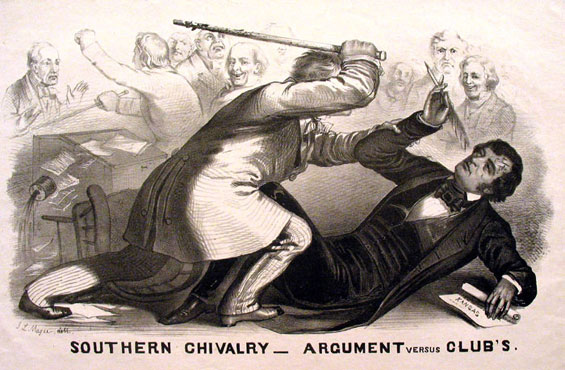
In 1856, Charles Sumner, a Massachusetts Senator, delivered an excoriating speech full of vicious name-calling and personal insults—especially against Senators Douglas and Butler—for their defense and advocation of slavery and especially the violence in Kansas in response to the actions of John Brown and his followers. The speech went on for two days, and shortly after its completion a man named Colonel Preston Brooks, a U.S. representative from South Carolina and distant relative of Andrew Butler, retaliated by beating Sumner with a cane. It was a serious enough beating that Sumner would take years to recover. Sumner would become an iconic hero to northerners and Brooks, who as punishment for the crime was fined $300, a darling of the south. Newspaper headlines of the time, in each region, painted their man a hero and the other man a demon (read a sample here: http://history.furman.edu/benson/docs/sumenu.htm). It is not the loathsome sin of slavery that I wish to highlight here, but the age-old tendency to blindly defend a person or position one feels inclined toward and the incredible efforts to vilify those on the other side of the issue—no matter what.
People are inclined to line up behind men rather than the Messiah. It is not just during political season or for certain social agenda items that this occurs, but more importantly in every season of the year when it comes to religious matters. Paul decried men’s tendency to be “of Paul…of Apollos…and…of Cephas” (1 Cor. 1:12). In the religious world, division has occurred because men have lined up behind some man’s teaching. Often, this teaching is a misconstrued view of a passage (for example, John 3:16, Acts 16:31, Mark 16:17, etc.) or a teaching without benefit of a passage (for example, having an experience of grace, saying a sinner’s prayer, infant baptism, etc.). As with politics, people can become blind apologists for their leaders and champions who promote what they already believe. Often, no amount of reason and logic can overcome the predisposed bias of the adherents. Lost in the cacophony of religious debate can be clear, simple biblical truth. Religious division is not the product or prompting of God (1 Cor. 1:10; 14:33). It is entirely of human origin. While there are some matters where God has not legislated, there are also some clear “right” and “wrong” matters in Scripture. Where God has spoken, we must take His word and will over that of absolutely anyone else. Otherwise, we will find ourselves guilty of elevating one above the One we must all ultimately give an account to. That would be an injustice and violation to top even “The Brooks-Sumner Affair.” May we keep our allegiance to God free from the taint of personal prejudices, even in the matter of our religious convictions. Psalm 119:89.
“Rancor” is synonymous with hostility, bitterness, spite, and vitriol. In Ephesians 4:31, Paul warns the Christian against “bitterness and wrath and anger and clamor and slander [and] malice.” While it didn’t seem possible that this election cycle could produce more heat and saber-rattling than the last couple, it has already exceeded it. It is almost painful to watch the cable news networks, but we should expect the world to behave like the world. Yet, when I see brethren so vehemently defending their candidate and excoriating those who disagree with them, I am truly disheartened. Social media continues to pour gasoline on this already potent fire.
I try to imagine the apostles and early Christians, were they to have such an outlet, tying into one another and beating their chest as they debated each other over the merits of Claudius over Nero, devoting so much time arguing their points about which candidate would better favor the cause of Christianity. Inspired writers had every opportunity to show such a participation and bias, but they are conspicuously silent. While I do not agree with the extreme that David Lipscomb took in his book On Civil Government, can we not, if we are not careful, veer toward the other extreme through blind allegiance to rulers who, when dispassionately and objectively viewed, honor and demonstrate evil over godliness? Whether it is foul language, deceit and dishonesty, and glorifying sexual immorality (a la Playboy!) or lying, pro-abortion, and criminal behavior, I am baffled as to why a Christian should get so invested in one candidate or exorcised at the other. May we never prioritize America over our dear brotherhood or our heavenly goal. We gauge that priority by our thoughts, speech, attitude, and actions regardless of what we claim.
As a husband and father for whom the prospect of grandchildren may not be many years hence, I grasp with such personal investment the gravity of this year’s election and the current world situation. Yet, I can let the fear of that eclipse the infinitely bigger picture. What a glorious day it would be if we could steer our consuming passion toward Jesus and the mission He left us!
You may have a decided leaning toward the Republican or Democratic offering in this year’s election. Given this year’s choice, I don’t believe you can cling to either without your hands being very dirty. That being said, may we all be prayerful and imminently restrained in our interchange especially with our brethren and before the eyes of the world. Our unity in truth, our common mission, and our Christian example are eternally more important than politics. Period!
Being patriotic and having a political heritage like we do in this country, we may have strong, personal convictions in the realm of politics. Engaging in the political process, from volunteering to voting to political meetings, can help us not only be a positive agent of change but also salt and light before the world. But nothing can have a quicker negative impact on ministry than a “stumping sermonizer” or “campaigning church man.” I’ve known preachers who seem CONSUMED with politics and can hardly speak without ranting about it. It just comes out! Beware that the mouth speaks out of the abundance of what’s in the heart (Mat. 12:34). Some preachers betray that they’re dwelling more on things below than things above (Col. 3:1-2).
The church began in the midst of political rottenness and corruption. Tacitus wrote of Augustus Caesar that he “seduced the army with bonuses, and his cheap food policy was successful bait for civilians. Indeed, he attracted everybody’s goodwill by the enjoyable gift of peace. Then he gradually pushed ahead and absorbed the functions of the senate, the officials, and even the law. Opposition did not exist. War or judicial murder had disposed of all men of spirit. Upper-class survivors found that slavish obedience was the way to succeed, both politically and financially” (https://facultystaff.richmond.edu/~wstevens/history331texts/augtotib.html). Of course, certain Jews did consume themselves with political interest and revolted against Rome—A venture that ended badly at Jerusalem and Masada. Read Tamarin’s classic book, Revolt In Judea, if you want the horrible details. Politicians of the first century were guilty of wanton sexual immorality, including homosexuality and adultery; They practiced infanticide and whet their appetites for death and violence in their stadiums and arenas. Where is Peter’s or Paul’s diatribe in scripture against vices and corruptions that sound a lot like our day? Where are the early Christians with their pickets and protests against the government? Instead, “They went everywhere preaching the word (Acts 8:4)!
Political activism will hurt our efforts to effectively evangelize. How tragic to lose a soul trying to win a political argument! Political activism, in preachers, can negatively impact what the church has paid them to do. They certainly didn’t pay him to spend all day on social media trolling stories or writing quips. They didn’t hire him to go to political rallies, being more wrapped up in affairs of state than affairs of heaven.
Paul was actually able to have an audience with the most prominent politicians of his day. Was he interested in discussing national or imperial policy with them? Before Felix and Agrippa, he preached righteousness, temperance and judgment to come. In Acts 27, he says God appointed him to speak before Caesar. What could happen among us if more were devoted to spiritual revival than political reform?