The Brooks-Sumner Affair

Neal Pollard

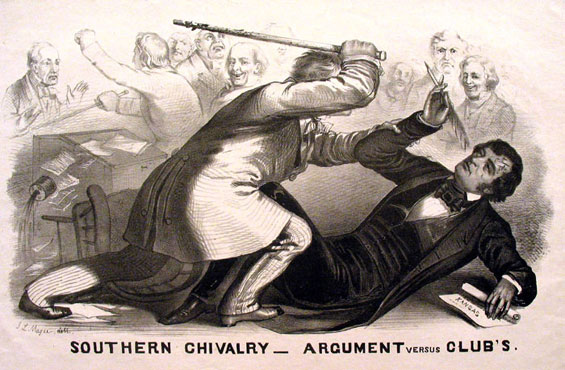
In 1856, Charles Sumner, a Massachusetts Senator, delivered an excoriating speech full of vicious name-calling and personal insults—especially against Senators Douglas and Butler—for their defense and advocation of slavery and especially the violence in Kansas in response to the actions of John Brown and his followers. The speech went on for two days, and shortly after its completion a man named Colonel Preston Brooks, a U.S. representative from South Carolina and distant relative of Andrew Butler, retaliated by beating Sumner with a cane. It was a serious enough beating that Sumner would take years to recover. Sumner would become an iconic hero to northerners and Brooks, who as punishment for the crime was fined $300, a darling of the south. Newspaper headlines of the time, in each region, painted their man a hero and the other man a demon (read a sample here: http://history.furman.edu/benson/docs/sumenu.htm). It is not the loathsome sin of slavery that I wish to highlight here, but the age-old tendency to blindly defend a person or position one feels inclined toward and the incredible efforts to vilify those on the other side of the issue—no matter what.

People are inclined to line up behind men rather than the Messiah. It is not just during political season or for certain social agenda items that this occurs, but more importantly in every season of the year when it comes to religious matters. Paul decried men’s tendency to be “of Paul…of Apollos…and…of Cephas” (1 Cor. 1:12). In the religious world, division has occurred because men have lined up behind some man’s teaching. Often, this teaching is a misconstrued view of a passage (for example, John 3:16, Acts 16:31, Mark 16:17, etc.) or a teaching without benefit of a passage (for example, having an experience of grace, saying a sinner’s prayer, infant baptism, etc.). As with politics, people can become blind apologists for their leaders and champions who promote what they already believe. Often, no amount of reason and logic can overcome the predisposed bias of the adherents. Lost in the cacophony of religious debate can be clear, simple biblical truth. Religious division is not the product or prompting of God (1 Cor. 1:10; 14:33). It is entirely of human origin. While there are some matters where God has not legislated, there are also some clear “right” and “wrong” matters in Scripture. Where God has spoken, we must take His word and will over that of absolutely anyone else. Otherwise, we will find ourselves guilty of elevating one above the One we must all ultimately give an account to. That would be an injustice and violation to top even “The Brooks-Sumner Affair.” May we keep our allegiance to God free from the taint of personal prejudices, even in the matter of our religious convictions. Psalm 119:89.

southern_chivalry

DIVIDING OVER POLITICS

Neal Pollard

“Rancor” is synonymous with hostility, bitterness, spite, and vitriol. In Ephesians 4:31, Paul warns the Christian against “bitterness and wrath and anger and clamor and slander [and] malice.” While it didn’t seem possible that this election cycle could produce more heat and saber-rattling than the last couple, it has already exceeded it. It is almost painful to watch the cable news networks, but we should expect the world to behave like the world. Yet, when I see brethren so vehemently defending their candidate and excoriating those who disagree with them, I am truly disheartened. Social media continues to pour gasoline on this already potent fire.

I try to imagine the apostles and early Christians, were they to have such an outlet, tying into one another and beating their chest as they debated each other over the merits of Claudius over Nero, devoting so much time arguing their points about which candidate would better favor the cause of Christianity.  Inspired writers had every opportunity to show such a participation and bias, but they are conspicuously silent. While I do not agree with the extreme that David Lipscomb took in his book On Civil Government, can we not, if we are not careful, veer toward the other extreme through blind allegiance to rulers who, when dispassionately and objectively viewed, honor and demonstrate evil over godliness? Whether it is foul language, deceit and dishonesty, and glorifying sexual immorality (a la Playboy!) or lying, pro-abortion, and criminal behavior, I am baffled as to why a Christian should get so invested in one candidate or exorcised at the other.  May we never prioritize America over our dear brotherhood or our heavenly goal. We gauge that priority by our thoughts, speech, attitude, and actions regardless of what we claim.

As a husband and father for whom the prospect of grandchildren may not be many years hence, I grasp with such personal investment the gravity of this year’s election and the current world situation. Yet, I can let the fear of that eclipse the infinitely bigger picture. What a glorious day it would be if we could steer our consuming passion toward Jesus and the mission He left us!

You may have a decided leaning toward the Republican or Democratic offering in this year’s election. Given this year’s choice, I don’t believe you can cling to either without your hands being very dirty. That being said, may we all be prayerful and imminently restrained in our interchange especially with our brethren and before the eyes of the world. Our unity in truth, our common mission, and our Christian example are eternally more important than politics. Period!

detail-of-american-flag-11279635008nzaN

PREACHERS AND POLITICAL ACTIVISM

Neal Pollard

Being patriotic and having a political heritage like we do in this country, we may have strong, personal convictions in the realm of politics. Engaging in the political process, from volunteering to voting to political meetings, can help us not only be a positive agent of change but also salt and light before the world. But nothing can have a quicker negative impact on ministry than a “stumping sermonizer” or “campaigning church man.” I’ve known preachers who seem CONSUMED with politics and can hardly speak without ranting about it.  It just comes out! Beware that the mouth speaks out of the abundance of what’s in the heart (Mat. 12:34). Some preachers betray that they’re dwelling more on things below than things above (Col. 3:1-2).

The church began in the midst of political rottenness and corruption. Tacitus wrote of Augustus Caesar that he “seduced the army with bonuses, and his cheap food policy was successful bait for civilians. Indeed, he attracted everybody’s goodwill by the enjoyable gift of peace. Then he gradually pushed ahead and absorbed the functions of the senate, the officials, and even the law. Opposition did not exist. War or judicial murder had disposed of all men of spirit. Upper-class survivors found that slavish obedience was the way to succeed, both politically and financially” (https://facultystaff.richmond.edu/~wstevens/history331texts/augtotib.html). Of course, certain Jews did consume themselves with political interest and revolted against Rome—A venture that ended badly at Jerusalem and Masada. Read Tamarin’s classic book, Revolt In Judea, if you want the horrible details.  Politicians of the first century were guilty of wanton sexual immorality, including homosexuality and adultery; They practiced infanticide and whet their appetites for death and violence in their stadiums and arenas.  Where is Peter’s or Paul’s diatribe in scripture against vices and corruptions that sound a lot like our day? Where are the early Christians with their pickets and protests against the government?  Instead, “They went everywhere preaching the word (Acts 8:4)!

Political activism will hurt our efforts to effectively evangelize. How tragic to lose a soul trying to win a political argument!  Political activism, in preachers, can negatively impact what the church has paid them to do. They certainly didn’t pay him to spend all day on social media trolling stories or writing quips. They didn’t hire him to go to political rallies, being more wrapped up in affairs of state than affairs of heaven.

Paul was actually able to have an audience with the most prominent politicians of his day. Was he interested in discussing national or imperial policy with them?  Before Felix and Agrippa, he preached righteousness, temperance and judgment to come.  In Acts 27, he says God appointed him to speak before Caesar.  What could happen among us if more were devoted to spiritual revival than political reform?

THE POLLS ARE OPEN

Neal Pollard

All over the nation, poll levers are being pulled, votes cast, and the office of many political positions is in the process of being filled by the winning candidate. People in this place of democracy are, at this moment, helping to decide the political fate of individuals vying for a place of public leadership. Those elected may or may not be persons of worth and integrity. Their careers may be starting, extending, or ending, depending on the majority’s say. They may gain or lose a place of authority based on their political, international, domestic, economic, and social philosophies. After all, public officials are always vulnerable to the fickle feelings of the voter.

Everywhere in the world at every moment, everyone is casting a vote of a different nature. Only one figurative ballot is used in this worldwide decision. Only two choices appear on the ballot. The issues are paramount in importance. This vote is not cast secretly behind a curtain, either. Many times, a righteous minority may be caused to suffer because of the foolish “majority vote” (cf. Proverbs 14:34). When all of life is over, the voting record of every individual will be made public. In fact, all people of all nations for all time will know which choice every individual elected to make in his life. And yet, with this poll, one can change his vote as long as life and opportunity are his.

Does the Kingdom take PRIMARY importance in your life? In Matthew 6:33, Jesus says, “But seek ye first the kingdom of God, and his righteousness; and all these things shall be added unto you” (Mat. 6:33). The head of this kingdom is Christ “and he is the head of the body, the church; who is the beginning, the firstborn from the dead; that in all things he might have the preeminence” (Col. 1:18, emp. NP). God demands first place. We must love Him more than anyone or anything else (Lk. 10:27). Whatever keeps us from attending the worship assembly, from actively seeking the lost, and from modeling true Christianity before the world, takes priority over serving and obeying God in His Kingdom.

Are you casting the VOTE of your life for or against Jehovah? All Israel stood before Joshua to decide to whom their life belonged. In Joshua 24:15, Joshua had said “God or gods.” “And the people answered and said, God forbid that we should forsake the Lord, to serve other gods; For the Lord our God, he it is that brought up and our fathers out of the land of Egypt, from the house of bondage, and which did those great signs in our sight, and preserved us in all the way wherein we went, and among all the people through whom we passed: And the Lord drave out from before us all the people, even the Amorites which dwelt in the land: therefore will we also serve the Lord: for he is our God” (Josh. 24:16-18). The people of God cast their vote out of appreciation, for they remembered the deliverance of God. The people of God cast their vote out of attention, for they recognized the power of God. The people of God cast their vote out of alarm, for they revered the justice of God. The people of God cast their vote out of aversion, for they rejected the enemies of God. Joshua reminded them that God would go with them only as long as they went with God. Because God is a jealous God who wants first place in our lives, He expects the import of our lives to reflect our submission and trust in His way.

Does King Jesus REIGN in your heart? The promise of Christ’s coming included the announcement of Gabriel, who said, “And he shall reign over the house of Jacob for ever; and of his kingdom there shall be no end” (Lk. 1:33; cf. Dan. 2:44). The “throne of the heart” is often mentioned in figurative language. All of us place something there. We place our accumulation before that throne (Matt. 6:21), our affections around that throne (Col. 3:1; Rom. 12:2), and our allegiance before that throne (Jas. 4:4; 1 Jn. 2:15-17). Is Jesus “a resident” in the “castle” of your heart? If so, is He King or peasant to you? The Bible calls Jesus “the King of the ages” (1 Tim. 1:17), “The blessed and only Sovereign, the King of kings…” (1 Tim. 6:15), and “KING OF KINGS AND LORD OF LORDS” (Rev. 19:16). How much greater than the mere prince of the power of the air (Eph. 2:2) is our Almighty King Jesus!

God created every person with the ability to freely choose. He will not rule us dictatorially (tyrannically). He leaves the power of choice in our hand. Yet, we must choose carefully. The decision we make has eternal consequences. King Jesus says, “He who rejects Me, and does not receive My sayings, has one who judges him; the word I spoke is what will judge him at the last day. For I did not speak on My own initiative, but the Father Himself who sent Me has given Me commandment, what to say, and what to speak. And I know that His commandment is eternal life; therefore the things I speak, I speak just as the Father has told Me” (Jn. 12:48-50). Whether we elect Him King of our lives or not, He has been appointed by God to judge us on an appointed day. The polls are open. Will you choose Christ and His law?

size0