Friday’s Column: Supplemental Strength



Many have heard, “Do not be deceived: bad company corrupts good morals” (I Corinthians 15.33). It’s not difficult to understand the concepts in this verse. If our closest relationships are with worldly people, our ethics and behavior will reflect this. Fun fact: the word for company here is ὁμιλία (homilia). The first part of the word sounds a lot like “homie,” so it’s easy to remember.
I want to look at the word “corrupt” a little more closely. At first, I thought it might be similar to Ephesians 4.29, “Let no corrupting talk come out of your mouths…” But that word is completely different and more closely describes decomposition. “Corrupt” in I Corinthians 15.33 means, “To cause deterioration of the inner life” (BDAG 1054).
Paul uses this same word earlier in the book. In I Corinthians 3, Paul talks about the church and her foundation (as in, her foundation is God and not men). By verse seventeen – still addressing the church – he says, “If any man destroys the temple of God, God will destroy him, for the temple of God is holy, and that is what you are” (emp. mine).
“Destroy” is usually ἀπόλλυμι (apollumi) or λύω (luo), but in this verse it’s the same word that’s translated “corrupt” in I Corinthians 15.33.
So what does this mean for us? It’s an extremely solemn warning to those who are corrupting or dividing the church today. At Corinth, the division was due to worldliness and basing their Christianity on prominent men like Paul or Apollos.
If our conduct is dividing the church, we need to read I Corinthians 3.17.
If what we’re talking about corrupts the bride of Christ, we need to read I Corinthians 3.17.
If we abuse the influence we have in the church, we need to read I Corinthians 3.17.
If our opinions, preferences, political views, or behaviors are in any way eroding the family of God, we have to quit them. A bad argument was enough for Paul to tell Euodia and Syntyche to, “Work out your salvation with fear and trembling” (Philippians 2.12). Their argument was hurting the church at Philippi, so Paul told them to get it together or their souls would be lost.
If love for the church does not motivate us to pursue unity, then it is time for us to cultivate a healthy fear of what negative actions can do to our souls. The church is eternally important and infinitely precious, so what could go wrong if we’re always looking out for others?


Many emotions run through our hearts when we’re faced with the loss of a loved one. These emotions can present themselves as questions:
Who can answer these questions? Who can provide comfort? Who can guide our hearts through the heartbreaking moments of life?
Is it not the Creator of life who can explain the end of life, even though “end” is a very human term?
100 years from now I’ll be alive and so will you. 150 and 200 years from now, I’ll be alive and so will you.
In Genesis 1:26-28, God said, “Let us create man in our own image.”
How sad and how tragic it would be to live your life with no hope! Today, I’m here to offer wonderful, comforting news, at a time where such news seems all but missing.
God loves you more than anyone else does.
Though many cry for and with you when you grieve the loss of a loved one, that love falls short of the one who expresses His love in a way that’s perfect and unfailing. You will experience feelings you may not be able to put into words, but God feels and understands them. God can walk you through them. Life doesn’t have to be impossibly tragic and void of purpose.
God created the heart, so He can heal yours. God created the mind, so He can sort yours out. God made the soul, so He can save yours. God created the body, so He can give you rest. God created the eyes, so He can wipe your tears away. God created the shoulder, but His are the only shoulders capable of bearing the weight of all those who lean on them.
“Therefore comfort one another with these words” (1 Thes. 4:18).


Conceived of in God’s mind in the eternity before time (Eph. 3:9-11), purchased by Jesus’ blood (Acts 20:28), spoken of as the body (Eph. 1:22-23) and bride (Rev. 19:7) of Christ, and described as the temple of the Holy Spirit (1 Cor. 3:16), the church is valued and treasured by Him. As members of that church, we might develop a distorted picture of what the church should look, feel, think, and act like in our ever-changing world. What is the church to be?
A Museum? Is the church meant to be a relic of the past, a historical marker where the past is revisited, revered, and enshrined? No doubt, we stand on the shoulder of great workers and warriors of the past, but we are not meant to devote our focus to days gone by. It is but a slight renovation to go from museum to mausoleum. Our best days should be ahead!
A Marketplace? Some see the church as a direct reflection of the culture. Stands on moral, social, and doctrinal issues are dictated by the views of the moment. “Change” is the key word, and selling the gospel becomes the preeminent goal (John 2:16; 2 Pet. 2:3). A church built foremost on society rests upon sand (Mat. 7:26-27).
A Monastery? The church–though a haven from the craziness of the world–can become insulated and isolated. It is great to let our closest friendships and relationships to be fellow Christians, but we can become so secluded and shut off that we become a cloister that ceases to be soul-winners. Our worship services and Bible classes can be so full of insider language that the unchurched have no idea what we say much less what we mean.
A Movement? Sometimes, we speak of the Restoration Movement whose leaders were trying to get people back to the Bible for “rule” and “practice.” But the New Testament church did not begin on the American Frontier during the Great Awakening or even shortly before it. It is not to be a political, national, or even social movement. To think of it on those terms is to degrade and devalue it.
It is to be a model, safe to follow and imitate by others because she follows Christ (Mat. 5:13-16; 1 Cor. 11:1). It is to be a militant group, whose weapons build and save and defeat the devil (2 Cor. 10:3-5; Eph. 6:10-17). It is to be a mission, on a mission for the Master (Mat. 28:18-20; Eph. 4:11-16). It is to be a medicine dispensary, offering salve and healing from the Great Physician (Luke 5:31-32). It should reflect the Master in thought, in tone, in teaching, and target! May we all think more critically about what we think about the church!


When Harry Procter first marketed his Ivory soap in 1891, he used the simple slogan, “It floats!” Within a few years, however, he conceived of a new angle he could use to peddle Ivory to the masses. He decided to have an independent laboratory analyze his soap along with Castile soaps also available on the market in the 1890s. The laboratory’s conclusions were used by Procter to declare that Ivory was “99 44/100% Pure.” And that was Ivory’s new slogan. 1
The problem with that slogan is that there was no standard for comparison. Who defined what “pure” meant? Was it the independent laboratory that Procter paid to do the analysis? That does not pass the smell test. If paid to find a particular result, are you going to maintain your integrity and admit that there was no litmus test for soap purity? Thus, when you look at a package of Ivory soap today with its vaunted claim of being “99 44/100% Pure,” remember that is a subjective statement based on a clever marketing ploy. In other words, Ivory is pure only because it proclaims itself to be so.
If we are not careful, we can be guilty of doing something similar spiritually. That is, we might puff ourselves up, stating we are superior to those around us when we have no objective basis for our statement. Jesus cautioned us against such behavior. He told us not to do things to be seen of men in His Sermon on the Mount (Matthew 6.1-6). He gave the parable of the Pharisee and the publican to caution us that we should not seek to justify ourselves by looking upon others with contempt (Luke 18.9-14). The sobering truth is that even when we have done everything commanded of us, we are to say, “We are unworthy slaves; we have done only that which we ought to have done” (Luke 17.10b NASB). Indeed, Jesus calls us to second-mile service (Matthew 5.41).
Regarding the final judgment, Jesus warned that there would be some who would stand before Him and laud those works (of their devising) they had done. His response for them will be, “I never knew you; depart from Me, you who practice lawlessness” (Matthew 7.23 NASB). It is not as if the desires of God are unknown. He has declared them to us. And this constitutes the criteria for our judgment (John 12.48). Indeed, we must do the will of the Father (Matthew 7.21). As such, we have an objective standard by which to compare our lives. Beyond that, we are to show mercy. We must walk in the same love as Christ had for us (Ephesians 5.1-2). That was a generous love putting our interests ahead of His own. In like manner, we must avoid allowing the abuse of our Christian liberty to cause another to stumble (1 Corinthians 8.9). Only when doing such, can we begin to say that our righteousness is not like filthy rags (Isaiah 64.6).
Fortunately, we do not have to guess whether we are living lives pleasing to Him. Hence, even if we cannot quantify our purity with an exact number like 99 44/100%, we can still rest assured that the blood of Jesus Christ has us thoroughly cleansed (1 John 1.7). In the interim, we plead with David, “Create in me a clean heart, O God, And renew a steadfast spirit within me.” (Psalm 51.10).
Reference
1 “Ivory (Soap).” Wikipedia, Wikimedia Foundation, 10 June 2020, en.wikipedia.org/wiki/Ivory_(soap).


When we forgive someone we usually do not forget what we forgave. Unless there is an underlying condition, our minds do not automatically or immediately delete irrelevant information, like something we no longer hold against another person. Because of this, it can be hard to understand what God’s forgiveness means for the Christian. We’ll think, “I know He has forgiven me, but there’s no way He’s forgotten about it. Maybe it will ‘cloud’ His decision to forgive me next time I ask.”
This is a very common mindset, and one that I struggle with daily. When we look at scripture, though, it paints a very different picture of what God’s forgiveness really does!
Forgiveness is the word ἀφίημι (afiemi). It has several definitions, according to Bauer:
1. To dismiss or release someone from a place or presence.
2. To release from a moral obligation or consequence, to cancel, remit, or pardon.
3. To move away with implication of causing a separation, to leave or depart from.
(BDAG 155)
Knowing this, we should look at Hebrews 8.12, “For I will be merciful to their iniquities, and I will not remember their sins anymore.” We understand that context is geared toward contrasting the old and new covenant, but it at least gives us insight into the process behind forgiveness.
When we get forgiveness from God, that sin is eradicated. It no longer exists, it will not affect our relationship with God anymore. “Remember” in Hebrews eight is, “To call information to memory.” It’s not only that God no longer holds a sin against us, it’s that it ceases to exist in His mind. How awesome is that?
When we ask God for forgiveness, let’s approach His throne with humility, yes, but also with confidence that He has the power and desire to make that sin disappear from our account forever.


This post is for the lady across the street. She works at the gas station. This post is for Charles. That’s the guy we always call when the office printer breaks down or a leaky roof needs repaired. This article is for my family. My family means the world to me and if my life can help ensure an eternal future together (and I mean every one of them) then I have accomplished something truly great. This post is for my wife. My wife will be in heaven with me— she must be! The truth is, this post is for the faithful child of God, the disgruntled member in the pew, the discouraged elder, and frustrated preacher— this post is for people. It’s for the new child of God that is still dripping wet from the waters of baptism, to the battle-hardened Christian with years of faithful service. God drew a line in the sand long ago after humans fell from grace and separated ourselves from Him. On one side of that line you have the lost. Their sheer abundance in our communities and the world has caused many congregations to become numb to their horrific eternal state. Still, on the other side of that line you have the faithful. No, not the uncommitted pew-warmers, but the faithful. Sadly there are those inside the church that are on the wrong side of the Divine line. Often they blend in with the faithful because they look and act like the faithful do. This is nothing new, but elderships still scratch their heads over stunted growth and disappearing members. Preachers lose their voices as they pound evangelism and outreach from the pulpit. The reservoirs are being depleted by years of drought.
You’ll hear a lot of this kind of talk in some men’s meetings as the guys will sit around the table. After drinking coffee and filling their bellies with biscuits and gravy, it’s common for them to kick back and discuss what’s going on in the church. Obviously there are some big issues! So, who’s to blame? In an attempt to unmask the villain, one middle aged man exclaims, “if the leaders would _______”. A couple of his friends, who have clearly visited this topic a few times, nod their heads in approval. Another gentleman, with a white mustache, grunts as he repositions himself in his tin folding chair. Talk like this is uncomfortable, and it’s exhausting for many of them. The head hog at the trough clears his throat to let the others know he’s about to offer his respected opinion. He squints his eyes, leans back, then makes this statement. “It’s really society, you know. People just don’t go to church like they did when I was growing up!” Following this declaration, most of them will give their affirming “Mmm”’s and “exactly rights.” It’s at this point the tragic generational blame game begins. The wheels spin for a while, then everyone gets up and goes back to their homes to enjoy the rest of their Saturday. Tomorrow morning they dress up in their suits and ties and drive to worship. At worship they sit in the same spot, as the service carries on in it’s usual order.
In a world full of people intent on destroying and demonizing one another, the church needs to be the church— now more than ever. Our communities, friends, family, and nation need us to be the church. That starts with you and me. Paul said, “Encourage and build one another up…” in 1 Thessalonians 5:11. We can’t do this enough, and we can’t overstate it’s importance. Who have you encouraged and built up this week? How will you do it today? The church is God’s way of improving people, and the church is God’s perfect project— for people.


We’ve lost the battle when our sermons, articles, and classes center around answering the question, “How often must I assemble? How many times a week do I have to come to church? Are Sunday night and Wednesday night mandatory?”
How unnatural for a disciple, a committed follower of Jesus who is in love with Him and who has such a relationship with Him that He is priority number one, to approach the assemblies in such a way! Must? Have to? You see, the question is wrong. The mentality and approach is where the work needs to occur.
When Jesus and His church are my passion, the thought-process becomes “I get to,” “I want to,” and “I will!” Neither parents, grandparents, spouses, elders, preachers, siblings, nor anyone else have to get behind anyone and push the one who has put Jesus at the heart and center of their lives.
Not a legalistic or checklist mindset. Instead, an outgrowth of what’s happening in my life between my God and me. Church “attendance” is but one evidence of this, but it certainly is an evidence of this. Church and religion are not just a slice of the pie of a committed Christian’s life. Christ is the hub in the wheel of their life, and each spoke of the wheel is attached to that hub. The difference could not be more dramatic!


John Moody McCaleb was a missionary in Japan for the better part of his life. He moved to the island nation during the Meiji era, in which Japan was sprinting to catch up to the technology and emulate the political philosophy of the West. The war-weary pacifist, David Lipscomb, strongly influenced McCaleb. (I would dare say that it did not take much to sway him since his father, a Union soldier, was shot and killed by a fellow Union soldier as he was crossing a stream since he did not hear the latter’s order to halt. 1)
Hence, when Japan became an Imperial state in its early Showa era, McCaleb’s pacifistic ideology put him at odds with his adopted home. He was sent “home” to the United States in October of 1941, just a couple of months before the Japanese bombed Pearl Harbor. Since his expulsion, McCaleb’s house, which survived the tumultuous world war, has become a museum. A contemporary caretaker of the museum noted that McCaleb never flew an American or Japanese flag in front of his residence, stating “my true nationality is the kingdom of heaven.” 2
Perhaps, it should not surprise us that the first stanza of a hymn penned by McCaleb reads as follows: “Of one the Lord has made the race, Through one has come the fall; Where sin has gone must go His grace: The gospel is for all.” Yes, this pioneering American missionary of the Restoration Movement wrote one of the most beloved hymns highlighting the Great Commission (cf. Matthew 28:19-20), The Gospel Is for All.
I wished to share this to drive home one point. McCaleb failed to see cultural distinctions as “racial” in nature. McCaleb understood as Paul told the Athenians in Acts 17.26-27: “and He made from one man every nation of mankind to live on all the face of the earth, having determined their appointed times and the boundaries of their habitation, that they would seek God, if perhaps they might grope for Him and find Him, though He is not far from each one of us. (NASB)” Indeed, we are of one race, the human race.
When we look for the genesis of our divisions in God’s Word, we read Genesis 11 and the account of the Tower of Babel. Within that chapter, humanity, united, sought to use its solidarity to rebel against God. God couldn’t allow that for, because thus united, He observed, “Behold, they are one people, and they all have the same language. And this is what they began to do, and now nothing which they purpose to do will be impossible for them” (Genesis 11:6 NASB). And so, God divided us by giving us different languages.
Someone might scoff that vocabulary is not an insurmountable barrier since we learn the tongues of others today. First, it is not as if there were primers to teach one another the new languages existing initially after the Tower of Babel. Second, thus motivated to disperse, they went on to develop cultures independent of one another centered on those communication divisions. They intermarried those of their lingual group who had developed customs different from other lingual groups. It was a positive feedback loop.
Might I humbly suggest that this remains the source of our societal ills today when it comes to poorly labeled “race relations,” since we are only one race? We have different cultures and customs. Language is not an insurmountable obstacle because we know the syllabaries and alphabets of those speaking different languages from ourselves. With this knowledge, we take the Gospel to every creature.
But if we want to know what causes a man to kneel on the neck of a subdued man because he has more melanin in his skin, it is not a “racial problem.” It is a sin problem. And even though we all like to think that those resembling ourselves are free of such biases, it is something against which we all must carefully guard our hearts, whether we possess little or much melanin.
Each of us is created in the image of God and must seek to treat one another as we desire to be treated (Matthew 7.12). Please keep this in mind whenever you see the “if-it-bleeds-it-leads” type of headlines the devil likes to employ to impede the progress of the Gospel in this world. He seeks to do so by convincing men that the essential things are the least important, but that the amount of melanin in one’s skin is of greater import.
REFERENCES
1 Walker, Wayne. “‘The Gospel Is For All.’” Hymnstudiesblog, WordPress.com, 6 Nov. 2008, hymnstudiesblog.wordpress.com/2008/11/06/quotthe-gospel-is-for-allquot/.
2 Ikuma, Koji. “The Old Missionary Museum of Zoshigaya, a Story of One of the Famous Christian Missionaries in Japan.” Unfamiliar Japan Tours, Unfamiliar Japan Tours.com, 19 Aug. 2016, uj-tours.com/missionary-house/.





Conflict stinks. It’s unpleasant, uncomfortable, and far too easy to do poorly. Conflict is a delicate game balancing a desire to achieve a certain outcome without causing unnecessary escalation.
We live in a world where evil is alive and well. No one wants evil to exist, but it does because of sin. Both good and bad people sometimes do evil things. Those people should be held accountable and justice meted. Our country has had a consistent pattern of civil unrest after an injustice. We no longer know how to have healthy conflict.
Every single person on the planet is guilty. Every single person on the planet is hopeless without God. Every person on the planet would die lost if not for Jesus and the forgiveness He offers. Not one person is perfect.
We must face the fact that the only way to have true stability, love, acceptance, and goodness is to go through God. Only when we look to an objective standard – one that cannot change simply because man’s threshold of tolerance has – will we have peace.
“Happy are the peacemakers, because they will be called children of God” (Matthew 5.9).


Walk with me through the crowd. At times, it will be frightening, heartbreaking, disgusting, even angering. Some are in masks. Some aren’t. You see far-left and far-right extremists, assaulting each other and maybe threatening you. Past the rioters, the protesters, the grief-stricken. You even see political activists posing as Christians spewing divisive rhetoric around–acting and reacting. There are racists of every color. Politicians. The lukewarm and apathetic. Some are jobless. Some homeless. Some wealthy and well-to-do. Many enjoy a comfortable lifestyle. They are from literally every walk of life. In many ways, this crowd is full of folks who are nothing alike or have little in common with others in it. But, in the way that counts most, they are so much alike.
You try to push through the enormous crowd full of the listless, the rudderless, the hopeless, the lonely, and the misunderstood. As you get back behind them, there’s the devil and his angels pouring over their playbook. He is the ruler of this world (John 12:31), unleashing the spiritual forces of wickedness (Eph. 6:12). There is a connection between this “prince of the power of the air” and “the spirit that is now working in the sons of disobedience” (Eph. 2:2). He wants us all distracted from what he’s trying to hide behind him. He’s pushing the crowd further away from it. But look. You see bands of faithful, committed disciples at the foot of a rough hewn cross. You join them there and look up at your Savior. It was worth the effort to swim through the crowd and see through the devil at God’s answer. He is hanging there for that enormous crowd, to help them escape the clutches and curse of darkness. He offers light, love, grace, goodness, hope, forgiveness, reconciliation, and life. Contrast this with the carnage you have just sifted through.
Now, go back through that crowd and find someone else who needs Him, someone who realizes that for all the sin, evil, suffering, and problems they will not find the answers in that crowd. They certainly will not find it in the one who’s behind that crowd, inciting and inflaming it. Get them through the crowd to the cross (Mat. 7:13-14). Each one liberated from the crowd will be eternally grateful!


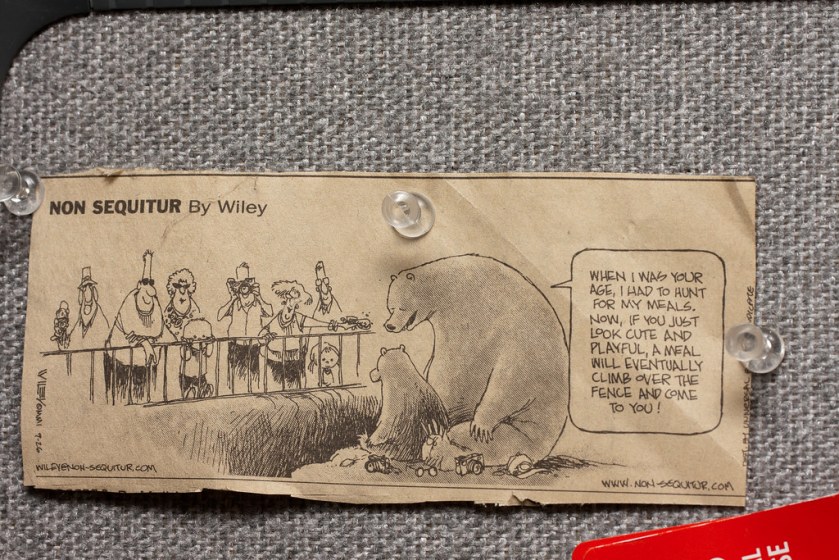
Wiley Miller is the creator of the comic strip, Non Sequitur. When apolitical, Miller’s strip can be enjoyable. I cut one of his strips from a daily edition of The Fayetteville Observer (Fayetteville, NC) back in the early aughts featuring “the eternal optimist.” In the one-panel comic, the grim reaper stands before a man in business attire. This eternal optimist calls to his wife in another room: “Well, honey, it doesn’t look like I have to worry about that long commute anymore.” I kept that strip until it yellowed with age and crumbled into oblivion. I did so for another reason than having a dark sense of humor. I hope I am an optimist on the order of the businessman finding something good to say even in the face of death.
Paul had such a character. He told the Philippians that he had everything to gain in death, as a Christian, and needed only remain for the sake of the brethren (Philippians 1.21-26). Nearing the end of his life, a confident Paul told Timothy, “I have fought the good fight, I have finished the course, I have kept the faith; in the future there is laid up for me the crown of righteousness, which the Lord, the righteous Judge, will award to me on that day; and not only to me, but also to all who have loved His appearing.” (2 Timothy 4.7-8 NASB). Why was Paul an eternal optimist? It was not because he was free of sin. Indeed, Paul considered himself the chief of sinners (1 Timothy 1.15). However, Paul was full of faith and understood God’s grace.
We cannot afford to live in fear, whether that fear is of death or whether we are “good enough.” We must do the will of God. John says, “But if we walk in the Light as He Himself is in the Light, we have fellowship with one another, and the blood of Jesus His Son cleanses us from all sin” (1 John 1.7 NASB). That faith may not always take us to places providing comfort. Shadrach, Meshach, and Abed-nego had their faith put to the test. Nebuchadnezzar had instructed everyone to bow to his golden image in worship. The young Hebrews refused because they remembered the Law of Moses and their covenant relationship with God. Nebuchadnezzar was angry with the young men and told them they would perish in a fiery furnace. They replied, “O Nebuchadnezzar, we do not need to give you an answer concerning this matter. If it be so, our God whom we serve is able to deliver us from the furnace of blazing fire; and He will deliver us out of your hand, O king. But even if He does not, let it be known to you, O king, that we are not going to serve your gods or worship the golden image that you have set up.” (Daniel 3.16b-18 NASB).
Did you notice why they did not fear? Can you see why they were optimistic? They understood their God was more powerful than a king and could deliver them. Yet, even if God did not deliver them, they still realized they had an obligation to serve Him regardless. These days the world seems scary. There is so much bad news on TV. But our God is more powerful. Thus, we can even say, “If I do catch COVID-19, God will deliver me. But even if He does not, I know Heaven will be my home.” Other scenarios would likewise suffice as an example. However, this is one of the things that seems to be on the minds of many today. Build your faith and become an eternal optimist as well. The world, in turn, will become a less daunting place.


The story is told about a man hanging from the end of a rope at the bottom of a well. His feet hadn’t touched the ground and he estimated that he still had about 100 more feet to go.
With no way out, and his grip starting to fail, he figured he was in the last few moments of his life. Finally he couldn’t hold on any longer and fell…6 inches to the ground.
Just like the man in the well, we all have those times when we get worried and stressed for no reason. Because this man couldn’t see the bottom of the well, he was worried.
How often are we like this? We can’t see the future, we don’t know what’s underneath us and so we do what feels natural and worry. Sometimes we let the things that we can’t control worry us and God has told us to trust Him.
Jesus in His sermon on the mount addresses this problem of worry. In Matthew 6:25-27 He tells us that God cares for our wellbeing.
Jesus said to “look at the birds of the air that they do not sow, nor reap, nor gather into barns.” Now I hope that we feel more important than birds, because we are.
Christ didn’t suffer on the cross for birds, He did that for us. Birds aren’t given the promise of eternity, But we are.
And yet, we still worry.
The man in the well thought that it was 100 feet to the bottom of the well, but that was what he thought.
Lucky for us we don’t have to “think” or guess what life holds or if we will have food and clothing. The things we get anxious about are foretold to us in scripture.
Those that aren’t Christians are worried about death, but we KNOW what happens after we die. Those that aren’t Christian’s are anxious about so much. And that all goes away if we are in Christ. Fear of the unknown is transformed into trust.
So, even though it may seem like we are hanging on the verge of death in life, don’t be anxious. I encourage all of us to let go, and let God.
We may think that there’s a 100 foot drop beneath us, but in reality God is right below us, waiting for us to let go and trust in Him.


Some phrases in the Bible are simple to read, but very difficult to comprehend. In this article, I’d like to walk through a process together in an attempt to make sense of a difficult phrase (thanks, Paul). One of those is in Ephesians 1.23: “…the fullness of him who fills all in all.” This is a description of Jesus, specifically as it relates to His being the head of the church. But what does that phrase mean?
I will not pretend to have the answer, but I would like to make a couple of suggestions. Firstly, “fullness” appears to describe the church. In my limited knowledge of Greek, it seems to be grammatically tied to “body.” The church – His body – is His fullness. Both are nominative, both are the subject of the sentence.
Secondly, Jesus fills all in all. It’s that last phrase that’s so hard for me to comprehend. What does it mean, that “He fills all in all?” Based on the fact that some form of “fullness” is used three times in a single phrase, it appears to have reference to his nature. He is not confined by time or space and is present everywhere.
If the church is His fullness (the word is possessive in Greek), and He is omnipresent (or, creation is full of Him), then the church must be extremely important. Again, I am not a scholar, I may be mistaken.
I would, though, like to attempt to make application from this difficult phrase. If the church is, ideally, representative of the very nature of Christ, are we living up to it? Is our passion for the lost like His was/is? Is our love for each other as strong as His is for the church? Do we treat the church as if it were the body of Christ (because it is)? Do we keep in mind, as we interact with each other, that we all answer to Him? Are we trying to mold culture to His image, or are we being molded to culture?
We really have to think about this one to try to make sense of it. Comprehending this phrase is anything but easy (at least for me!). But the church – which is one distinct unit, not a series of denominations – is supposed to represent Jesus. Our values, our demeanor, our goals, our mission, our attitudes, our behavior, and our purpose should scream to others, “We are not of this world.” If these do not, we are not representing Jesus. No one will do this perfectly, but the standard is high.
When we begin to understand this phrase a little more, it shifts from being hard to understand to being hard to hear. We have a huge responsibility, but we also have a global family to support us. The standard is high, but our Head is also our Savior. As things slowly go back to normal, let’s keep this in mind! We’re not just Christians to be good people, we’re Christians to show the world who Jesus is.

Here’s a quick recap of the bizarre events that unfold in Acts 20:
Each word that was written in Scripture was penned under God’s guidance— for our guidance. This means that even those accounts that might initially strike us as pointless are, in truth, spiritually-pointed.
With this is in mind, let’s briefly examine three life lessons from Eutychus that deliver relevant reminders for the 21st-century Christian.


Yesterday was an emotional day. As expected, our attendance was a fraction of our normal size. The current threat is not yet over, but it was a stride toward what we pray is an imminent return of many more. Even from behind the masks and with the required social distancing, the joy and excitement was palpable. From preschool children to even a few octogenarians, our local brethren once again were able to do as God’s people have done for 2,000 years. We had others, mostly in higher risk categories or in daily contact with those who are high risk, who parked outside and tuned in via FM transmitter. They were in proximity with each other and able to fellowship with those around them and many on their way into and out of the building. A great many at home tuned in to the Live Stream and let us know of the hope and joy they feel that we’ve taken this step, several letting us know that as soon as is medically safe they will be there, too.
Our godly, wonderful shepherds have agonized over how to “return to normal” legally, wisely and safely. At the heart of most of their discussions and “church business” is how this “layoff” or separation or disruption will effect the faith and dedication of us sheep. Their hope is that we will view this situation as one that, for a time, made us a church full of “shut ins” that we could accommodate through virtual services (and later drive-in services) to help keep us connected rather than seeing this as the permanent arrangement or to excuse choosing other activities over assembling when there is no such crisis in place.
None of us knows the future, and it is hard to predict how every individual will respond post-pandemic. But, the heart of each of us will be at the heart of the matter as we prayerfully decide the timetable for our return. To shape and guide us on that spiritual journey, God has given us insight into the hearts of His saints through the centuries to influence our spiritual hunger. Here is but a sampling:
But it’s the sons of Korah’s words in Psalm 84 that I want to close considering.
The separation and disruption was not of our choosing, but it might have and adverse effect upon us and cause us to forget the blessings of being together in praise and worship to our God. May the inspired words from saints like these help us fortify our souls as we anticipate the time when we are able once again meet each other in His presence for worship!