HOW TO TRULY MAKE A DIFFERENCE IN THE LIVES OF OTHERS

Neal Pollard

Bloomberg Businessweek’s Ira Boudway wrote a fascinating article about the perennially successful head basketball coach of the San Antonio Spurs. He called the piece, “The Five Pillars of Popovich.” Gregg Popovich, who has led the Texas team to five NBA championships in a little over 20 years, is the epitome of steady in a league notorious for constant change. Boudway laments that Popovich wouldn’t actually cite his own pillars of success, but the thoroughly researched column definitely exposes the principles that have made this legendary coach tick with exquisite precision. Those five pillars, in order, are:

  • Own your luck. That is, be modest, humble, and don’t try to take credit for things you didn’t do.
  • Do your work. The same tenacious ethic that made him way more of a player than he should have been has translated into his incredible success as a coach.
  • Unleash your anger (strategically). Know when (and how) to get angry, channeling your passion and conviction into others.
  • Widen your world. Always be a learner, and inspire others to do the same.
  • Know your people. Build relationships, taking time to really know the people in your circle of influence. Former player Will Perdue articulates what so many say of the coach, saying, “I was kind of amazed by how much he wanted to know about you as an individual… He saw you as a human being first and a basketball player second.” In Pop’s own words to Sports Illustrated in 2013: “Relationships with people are what it’s all about. You have to make players realize you care about them. And they have to care about each other and be interested in each other. Then they start to feel a responsibility toward each other. Then they want to do for each other.”

(Bloomberg Businessweek article)

We would modify and adapt the wording of some of the pillars, but the principles are unmistakably sound. When it comes to spiritual leadership, whether in the home or the church, these qualities are powerfully attractive.

Great leaders work hard to give others the credit and, most of all, God the praise. The goal is more important than the glory (Eph. 3:20-21).

Great leaders will not ask others to do what they won’t do (Mat. 23:3-4). They exemplify what they expect (Heb. 13:7).

Great leaders get the difference between the “big stuff” and the “small stuff.” Spiritual wisdom helps them channel their passion nobly. They reserve emotion for the eternal and temperance for the temporary.

Great leaders are learners, growers, and improvers. They hate complacency and disdain settling. Nowhere do they demonstrate this more than their pursuit of sacred truth, as consummate Bible students (2 Pet. 3:18).

Great leaders truly know those whom they lead. Assumptions, perceptions, prejudices, and appearances hamstring and even sabotage leaders. There is no substitute for loving people, genuinely caring about and being intimately involved in the lives of those whom they lead (John 10:1ff).

People are looking for leaders like this. They will follow them to the ends of the earth and, consequently, to heaven! None of these qualities necessitates a Ph.D. or a million dollars. They simply require dedication and discipleship! May God raise up more men who have the will and want to be successful leaders for Him!raburntrip-gunnison-9-21-07069

Knowing What D.C. Stands For

Neal Pollard

Inasmuch as we don’t want laws or policies enacted that violate God’s Word and we want precious freedoms, especially religious ones, preserved and protected, we can really get into what is going on in Washington, from Capitol Hill to Pennsylvania Avenue. Many know that “D.C.” is an abbreviation for “District of Columbia,” an area of land created at about the time of our nation’s founding under the direct jurisdiction of the U.S. Congress that is not a state.

However, as politics has vied for sports and entertainment as an idol in our culture, it has become the source of unnecessary and even immoral strife between Christians. Blind support and allegiance for one major political party or the other can do more than make us inconsistent. It can make us a stumbling block. It seems to me that D.C. can stand for some dangerously different things.

Distracted Christians. Search high and low in your New Testaments, written during the time of the wicked, often unfair-to-Christians, Roman Empire.  The disciples were about the business of evangelism (Acts 8:4) and growing the church (Acts 6:7). Can the rumblings and drama from the nation’s capitol get us so transfixed that we cannot see past it or through it to our individual and collective mission as God’s people? He has us here to get people into the Kingdom of His dear Son (Col. 1:13). Everything else is secondary. 

Divided Churches. For as long as I’ve been preaching, I’ve seen politics come between brethren in the local church. Thankfully, it does not usually become significant enough to trouble the entire congregation but I have seen it do so. What’s more, I’ve seen brothers and sisters become so confrontational and flagrant about politics–especially through the relatively recent medium of social media–that it has been a stumbling block to new and weak Christians. Perhaps the political world in our country has never been so intensely divisive as it currently is, and what typically troubles the world troubles the church. But, when souls are negatively impacted, God will hold the offenders accountable. 

Devil’s Cauldron. Please don’t misunderstand. Politics, like money, is a neutral matter. But, like money, it can become the root of all sorts of evil (cf. 1 Tim. 6:10)–enmities, strife, outbursts of anger, disputes, dissensions, and factions (Gal. 5:20). Just prior to this list of activities that are the carrying out of the desires of the flesh (Gal. 5:16), Paul warns, “For the whole Law is fulfilled in one word, in the statement, ‘You shall love your neighbor as yourself.’ But if you bite and devour one another, take care that you are not consumed by one another” (Gal. 5:14-15). Who benefits when things like politics distract and divide Christians? It is not the lost, the church, or the Lord!

I can think of a least three godly, wonderful Christians who are public servants in political office and making a profound impact for good–Bill Reiboldt, Sheila Butt, and John DeBerry. They demonstrate that God’s people can devote themselves to politics without sacrificing their faith and example. For those of us “on the outside looking in,” in our love of country and freedom, may we never allow our attitude, words, or actions to betray our highest calling. The more effectively we reach lost souls, reflect the mind of Christ, and reveal the hope of the gospel, the better our nation (and world) will become. What will that make us? Disciples of Christ!

11168488_10153052239815922_846243704468580330_n
From my last trip to Washington, a few summers ago. 

Walking 10 Miles To Avoid The “Bear”

Neal Pollard

Spoiler alert: This story does not make me look good.

It was 1984, and my family and I lived in Roopville, Georgia. We were enjoying one of those idyllic west Georgia October days, with temperatures cool enough for a jacket but the sun graciously, brightly beaming. It was a perfect Saturday to explore the woods, which is what my little brother, Brent, and I decided to do. I was 14 and he was 9. My parents owned several acres behind our house, and we boys felt adventurous. In such a mood, I decided I’d like to see how far those woods went, but rightly wondered if Brent was game for such a walk. Therefore, I had to have a ruse. We hadn’t walked too far when there was some noise nearby, and I went to work–concerned face, raised eyebrows, hushed voice, and panicked eyes. “Brent, I think I just saw a bear!” Trusting me to be a legitimate source of truth, he accepted my statement at face value. What was my solution to this sudden dilemma? Brent wanted to retreat back to the house, probably less than a quarter mile behind us. What sense did that make? Far better to keep walking away from the safety of our home deeper into the woods of neighbors and eventually strangers. As every older sibling knows, far too often seniority can trump sensibility. So, we ran from that “bear” for miles and hours. Eventually, our circuitous journey took us several miles south just outside the little town of Centralhatchee. We were gone for most of the daylight hours of that fateful Saturday, and the only credible decision I made that day was knowing we should walk north on Highway 27 to get back home. Suffice it to say, I was not hailed as the conquering hero upon our return that evening. But, throughout that walk, I built and strengthened the narrative that this lengthy sojourn was about escaping the razor-sharp clutches of my mythic bear. I mentioned it so often to Brent that day that it just became easy to tell my parents with such conviction. Under the vise of interrogation, my story unraveled. My punishment was swift and enduring.

I knew better. I wanted this adventure and I wanted company. One needs a calculator to compute the number of bad decisions cascading from my developing prefrontal cortex. But, in my heart of hearts, I knew I was lying to Brent. In time, I believed the lie myself. We survived my harebrained scheme, but my credibility took a hit.

“Honesty is the best policy.” That’s true of character. It’s no truer than for anyone in a position to teach someone else God’s Word. Some teachers themselves are deluded and believe a lie (2 Th. 2:10-12). Others “are false apostles, deceitful workers, disguising themselves as apostles of Christ. No wonder, for even Satan disguises himself as an angel of light. Therefore it is not surprising if his servants also disguise themselves as servants of righteousness, whose end will be according to their deeds” (2 Cor. 11:13-15). Such an eternal task befalls the teacher (Jas. 3:1). We must be honest with the text, honest with our conclusions, and that starts by being honest with ourselves. We’re leading people somewhere with how we live and what we say we believe is right and wrong. Let’s handle that with care. It’s about both the journey and the destination (Mat. 7:13-14).

51443429_2225973147661676_5918745592820924416_n
Exceedingly stylish pic of me and the bro a few years before the Centralhatchee Bear Escape.

Dark Churches

Neal Pollard

I was intrigued by an article written by Janet Thompson of crosswalk.com. The eye-catching title asked, “Why Is The Church Going Dark?” She meant this literally. Her complaint was about the design of many auditoriums having dim lighting and being windowless, almost like a movie theatre or concert venue. She wondered if this was to reach a younger generation or to set a certain mood. 

While I prefer a well-lit room, there is a more significant concern. Jesus taught, “You are the light of the world. A city set on a hill cannot be hidden; nor does anyone light a lamp and put it under a basket, but on the lampstand, and it gives light to all who are in the house. Let your light shine before men in such a way that they may see your good works, and glorify your Father who is in heaven” (Mat. 5:14-16). His words have nothing to do with church building designs, LED lighting, or window sizes. Preaching to His disciples, Jesus wants us to know that those reflecting His light cannot be hidden, but shine in such a way that others will see our good works and glorify God. 

  • Dark churches are situated in neighborhoods that know nothing about them.
  • Dark churches are so indistinct that the world can see no difference between themselves and those churches. 
  • Dark churches have no vision or plan to fulfill God’s purpose for them.
  • Dark churches exist to assemble, but not much more.
  • Dark churches focus inwardly, but neither outwardly nor upwardly. 
  • Dark churches operate from fear and prefer the safe route, taking no risks and attempting only what they can produce.
  • Dark churches are disconnected from the Light of the world.

It is good for us to constantly challenge ourselves, when setting budgets, making plans, gauging our true priorities, or evaluating the leadership or the pulpit. Are we doing what will help us be “Light-Bearers” or what will cause us to be “Dark Churches”? What an important question! Our actions determine the answer. 

dark churches

The Influence Of Papaw Mitchell

Neal Pollard

May 14, 2004, was the day I preached my maternal grandfather’s funeral. It was a signal honor to do so. He had passed away early on Wednesday morning, May 12. The morning he passed, I wrote this about him:

Within you today are a temper and trends
A view toward the unfolding tomorrow
Have you stopped to question on what that depends
From what spiritual bank you do borrow?

Though each person forges his own internal road
Based on unique decisions and conscience
Before him to help pave it is an influence to goad
A role model, an example bestowed.

For those so endowed with a godly loved one
One righteous, driven by the Giver of grace.
To see their own faith is to look at one done
A journeyman who victoriously ran his own race.

I know one like that, a follower of Him
Who led much family both of flesh and of faith
Who shaped hearts and lives in times good and times grim
Who laid course that to follow was safe.

When we all get to heaven and give praises unending
Who knows what will be or how we’ll appear?
I know that for anyone in that Paradise spending
That all who shaped our faith will be clear.

Everyone that knew Harold Edward Mitchell, Sr., was closer to heaven because of his influence. He lived over 90 years, converting from denominationalism in young adulthood and ultimately serving decades as an elder. At his funeral, I shared five facts about my “Papaw Mitchell.”

  • He loved his family. He wasn’t gregarious, but rather reserved. Yet, he taught his family the right way to live and how to face death, to know what ultimately counts, what was right and what was wrong.
  • He had a sense of adventure. From semipro baseball as a teen to seeing the entire country in retirement, a lifelong cotton farmer had a wider view of the world. He came of age in the depression and endured some terrible grief, but no one could remember hearing him complain. 
  • He worked hard. He wasn’t a waster of resources, least of all time. He was up with the sun and down with the sunset. He instilled that work ethic in his children and grandchildren. 
  • He put Christ above all else. As a Christian, he took what the Bible guided him to do and be in life at face value. His life went beyond mere rule-keeping. He kept the rules, but he loved the rule-maker. You could see Jesus living in him.
  • He was ready to die. That’s the most important thing any of us could have said of us.

I saw grandpa the Monday night before he passed away. He was able to talk, but it was the first time I saw him that I felt he might not live forever in that earthly body he took such good care of. It was probably the first time I thought seriously about my own mortality. Our spirits are engineered for eternity, but our bodies of clay wind down more each day. In the fifteen years that have passed since then, I am more aware of that than I was even then. Our pilgrimage here won’t go on indefinitely, though we’ll live as long as God lives.

Examples like my Papaw motivate me to clear the hurdles from my path and stay dependent upon God to help me, like him, to finish my face. To die faithful and prepared means to live faithfully and make preparation. One day, someone will speak at your funeral and mine. What can they honestly say about the example and influence we will have left on others?

grandpa mitchell and uncle larry
Papaw (L) and Uncle Larry (my mom’s older brother), probably between 30-40 years ago.

Distracted And Delayed By Baggage

Neal Pollard

On May 7, Bill McGee wrote in a USA Today article about the crashed Aeroflot plane that killed 41 of the passengers onboard: “Reports from people on the plane indicate the evacuation may have been slowed by passengers grabbing their bags. Videos show passengers taking their carry-on bags with them as they exited the plane,” the AFA said in a statement. “We will never know if more lives could have been saved if the bags were left behind” (online edition, “Were lives lost at the cost of carry-ons in Aeroflot plane crash that killed 41?”).  It’s outrageous and unbelievable that people would care more for their luggage than human lives, but that appears to be the case.

In Luke 12:15, Jesus taught, “Take heed and beware of covetousness, for one’s life does not consist in the abundance of the things he possesses.” The NASB translates the first part of the verse, saying, “Beware, and be on your guard against every form of greed….” Watching video footage of those passengers making an emergency exit with carry-ons in hand is a rather graphic, unmistakeable illustration of Jesus’ point. Unfortunately, we can have a harder time seeing ourselves doing the same thing in the prioritization of our lives. We may be aghast at the thought that their seemingly greedy decision came at the expense of some people behind them being able to escape the flames, but Scripture teaches the devastating effect greed can have on our own lives and the lives of those we influence.

Paul teaches that such can be a “snare,” “harmful desires,” plunging men into “ruin and destruction” that pierces them “with many griefs” (1 Tim. 6:9-10). It’s interesting that Paul’s inspired counsel is to “flee from these things” (11). We should consider that an inordinate desire and pursuit of material things may hurt not only ourselves, but the people that come along behind us. That includes our children, grandchildren, and the other people who are guided by our influence and example. They are watching what we value most and what has our greatest attention and affection. We may not be caught on camera, but God sees it with perfect, all-seeing eyes. 

Let’s be careful not to allow this world to cloud our judgment, making the things of this world more important than souls or the will of the Lord. The stakes are higher than whether we exit an airplane alive. It’s about how we leave this world and enter the next one.

Screen Shot 2019-05-09 at 7.24.14 AM

The Bible And The College Cheating Scandal

Neal Pollard

One of the nation’s biggest news stories last week involved a college admissions scam that included several high-profile people, including at least two Hollywood actresses. A California man, Rick Singer, spearheaded a scheme to bribe coaches and administrators at such colleges as Yale, Stanford, Georgetown, USC, and other prestigious universities. The bribes bought these privileged High School students extra time to take the SAT and ACT, make fake athletic profiles, and substitutes to take their entrance exams for them. This has proven embarrassing for both the colleges and those breaching this most basic of ethical codes (via Foxnews.com, Madeline Farber). 

Someone observed that there is a bit of irony and hypocrisy in all of this. We feel outraged at this glaring lack of honesty and ethics, but students who attend these (and other) universities have been taught for decades that there is no such thing as absolute truth and an objective standard of right and wrong. Are we surprised when people live out the consequences of such world views? Remove a measurable, immutable standard, and anything goes! It disgusts us to see such values in action, but people of influence in our society have been pushing such values for a long time. 

In addition to its answers to all of life’s crucial questions, the Bible lays down an ethical code that is universal and logical. Its rules are blind to nationality, economic status, gender, age, or any other category one falls into he or she might appeal to as an exception. In fact, those who have more have greater expectations made of them (see Luke 12:48).  The Judgment Day will be eminently impartial. No one will manipulate the results. No one can sidestep heaven’s requirements for salvation without an eternal consequence. Just because one is religious leader does not mean that they are above the law of Christ. Again, there are higher standards for those who are in positions of leadership (Jas. 3:1; Heb. 13:17; 1 Tim. 4:16; etc.). 

It’s not at all surprising that a society which rejects God’s guidelines finds itself sinking into a moral and ethical abyss (cf. Prov. 14:34). But, it does go to show that no one wants to reap the harvest from sowing the seeds of sin. However, there is no way to avoid it (Hos. 8:7; Gal. 6:7-8). Our challenge is to live lives of consistency, exemplifying the benefits of respecting and adhering to God’s standards. Jesus calls such modeling “salt” and “light”which highlights God’s existence and relevance in our world (Mat. 5:13-16). 

We cannot keep others from being cheaters and liars, but we can show them a powerful alternative!

070223-f-7861r-001

Make It A Momentous Monday

Neal Pollard

  • Pick out a local church leader and pray for him and his family for several minutes, being very specific in your petitions on their behalf.
  • Email a missionary to encourage them and get an update on how their work is going.
  • Buy a gift card and try to give it anonymously to a young or struggling family you know.
  • Thoughtfully select several people to compliment and encourage by writing on their Facebook wall or other social media platform.
  • Briefly visit a brother or sister in an assisted living facility or nursing home.
  • Ask a co-worker, classmate, or neighbor what you can be praying for them about.
  • Listen to a book of the Bible in its entirety on your commute.
  • Let go of a grudge or deep-seated resentment.
  • Do an unexpected deed of kindness for a random stranger.
  • Speak to someone you see regularly about your faith–what God is doing in your life, what’s going on at church, etc.
  • Spend some one-on-one time with one of your children (playing a game they enjoy, going for a walk, taking them out to eat, etc.).
  • Show love to your mate in some tangible way you know he/she enjoys (speak their “love language”).
  • Practice pleasantness with everyone you meet today, being mindful of your facial expressions and body language.
  • Carve out some time for meaningful, personal devotion (including Bible reading, singing, and prayer)–make worship more than a Sunday matter!

None of these are overly time-consuming. Pick as many as you can. If you cannot get to them all today, then pick up where you left off tomorrow. Grow your list. Use your imagination and creativity. Find yourself looking and acting more like Jesus!  See yourself in Matthew 5:13-16.

candle-335965_960_720

THE MYSTERY OF INFLUENCE

Neal Pollard

Several years ago, a fourteen-year-old girl named Shannon Smith was shot to death in her own back yard. A bullet lodged in her brain. Though already tragic and horrific, the story was made more tragic by the inexplicable nature of the shooting. Police, judging from the trajectory made by the entry would, concluded that the bullet fell from the sky. Somewhere nearby, some unknown person had fired a gun for no known reason. The bullet completed its path of travel inside an unsuspecting teenager. Tragic, indeed!

Who fired the gun and why? The action pales next to the consequence. Someone aimlessly fired a weapon. A child died and parents were left to mourn her loss. It was all so unnecessary and avoidable!

Christians are a special people, a God-possessed, holy group (1 Pet. 2:9). The world sees Christians (Matt. 5:16). They react to children of God, either “glorifying” (Matt. 5:16) or “blaspeming” (2 Sam. 12:14) Him. Christians are either transformed from worldliness or conformed to it (Rom. 12:2). Conformity carries tragic consequences.

Influence is an inevitable burden carried by every Christian. Others watch what we do, hear what we say, and evaluate our judgments. What we wear, how we talk, where we go, and with what we entertain ourselves may seem harmless or at least harmful only to us. Yet, we can aimlessly fire and eternally wound another’s soul by our influence.

The man or woman who fired that gun may not realize even now what they did with one “harmless” squeeze of a trigger. Maybe they will not know on this side of time. Just so, we may be shocked on that day to realize how many or exactly whom we influenced. We’re on a spiritual battlefield (Eph. 6). Let’s be careful not to shoot at the wrong side! We may wind up doing harm to the very people we’re commissioned to save. Let’s watch our aim!

635556363784254557-phxdc5-5gjqo8l36pjzj76wfkp-original
Shannon Smith (undated photo)

AN IRRECONCILABLE IRONY

Neal Pollard

Some years ago an AP wire report yielded this incredible, true story.  Apparently a dirty joke was sent by a company employee to 6,000 people!  What was so unusual?  The perpetrator, intending to send a daily report to reporters and government officials, was a federal communications commission employee!  The headline read, “Joke Is On The FCC” (via Philadelphia Inquirer, 5/9/99). The FCC, charged with setting decency limits on various media outlets, was guilty of that which they are employed to prevent. Ironic!

The jokes abound.  Plumbers have the worst pipers.  Electricians have the faultiest wiring.  Doctors are the sickest people.  Preachers’ kids get in the most trouble.  They learn it from the elders’ kids.  While these are more axiomatic than true, there are guilty plumbers, electricians, doctors, preachers, elders, lawyers, politicians, and the like out there.  They get such attention because they fail at that which is supposed to epitomize and characterize them!

Christians become Christians through grace and obedient faith (Eph. 2:8-10).  But Christianity is more than a state of being.  It requires certain characteristics to be in one’s life.  A Christian is part of a spiritually “chosen race, royal priesthood, and holy nation” and is a person “for God’s own possession” (1 Pet. 2:9).  Moreover, a Christian is one redeemed from all iniquity, purified unto himself, and zealous of good works (Ti. 2:14).  A Christian is one who has put fleshly deeds to death (Col. 3:5).  A Christian takes on “the fruit of the Spirit” (Gal. 5:22-23), which means assuming a code of conduct and disposition of heart that is clear before the world’s eyes (Matt. 5:14-16).

There is an irreconcilable irony when a Christian is indistinct, indifferent, immoral, and inconsistent!  Like salt without taste, a Christian who dresses, talks, and behaves like a worldly person cannot be properly used by God (cf. Matt. 5:13).  A Christian without ethics, morality, honesty, and integrity is a walking oxymoron.  A Christain who talks one talk and walks another makes no sense and draws no following, at least none leading to Christ (cf. John 12:32; 1 Cor. 11:1).

Will the “Great Report” reveal that we, as Christians, spoke and showed the saving message or the wrong message?  What message are we sending to others?  Let it not be the irony of wearing a name we are not honoring.

Doctor in lab coat smoking a cigarette   Original Filename: 88300580.jpg


How Will We Be Remembered?

Neal Pollard

Seven churches in Asia Minor (modern-day Turkey). Each remembered for an overall characteristic. The same is true for individual Bible characters, isn’t it? Most remember Moses, Samson, David, Jeroboam, Jonah, Jeremiah, Nehemiah, Judas, Peter, Paul, and John for a particular attribute, whatever else could describe their lives. That’s more than fascinating. It’s sobering.

What about you and me? Is there a word others–those we attend school with, work with, live near, attend church with, or share family ties with–would use to describe us? Here are some possibilities:

  • Grumpy
  • Disagreeable
  • Dishonest
  • Hot-tempered
  • Unreliable
  • Divisive
  • Worldly
  • Gossiping
  • Selfish

Such attributes are the cumulative result of the attitude, words, and actions that we portray each day we live. Everybody has good days and bad days. But, there is an overall tenor and flavor to our lives that cause people to associate something with us. However, the word might be different:

  • Gentle
  • Patient
  • Loving
  • Kind
  • Serving
  • Sacrificial
  • Unselfish
  • Humble
  • Uniting
  • Faithful
  • Courageous

That, too, is being built moment by moment, day by day.

With both groups of words, we can think of people who epitomize characteristic above. But I want to know, “Which one would best describe me?” Don’t you want to know that about you?  The good news, if you don’t like the answer there’s time to change that. Dickens’ Christmastime novel about Ebenezer Scrooge is written to make that very point. Infinitely more importantly, the Bible is written to make that point. We can be transformed through the influence of Christ in our hearts and lives (Rom. 12:1-2; 2 Cor. 3:18). How will you be remembered? 

40178175_715421765474325_1935029354081812480_n

“Just A Broken Guy…”

Neal Pollard

The chilling audio from Richard “Beebo” Russell reveals an internal conflict nobody, not family, friend, or co-workers, knew was going on. The 29 year old ground worker at Seattle-Tacoma International airport took a Horizon Air Dash-8 airplane on an unauthorized joy ride, complete with complicated aerial stunts before crashing into a remote island on Puget Sound. Before crashing, he spoke with air traffic controllers and pilots and confessed to the inner turmoil. The words used by loved ones to describe him range from “warm” and “compassionate” to “happy” and “regular” (Alex Horton, Washington Post, 8/13/18).  Of course, the behavior was irregular and bizarre, and it ended tragically for the young man as he fatally crashed the plane.

As we walk through this world, we meet and interact with people who may be projecting an outward appearance that is masking inward pain and trouble. It may lie behind their broad smile. That’s a disturbing thought, but what can we do? We cannot read their minds. There is no full-proof way to prevent every tragic action, but we may have more power than we think. Consider some things all of us can do with everyone in our lives.

Be kind. Look people in the eyes. Smile at them. Even if it slows you down from some important task, don’t overlook the people God puts in your path. Your helpful word might sink deeper into their spirit than you realize. Let’s be like the inhabitants of Malta, who showed Paul and his companions “extraordinary kindness” as they simply “kindled a fire and received” them all (Acts 28:2). We’re told as Christians to put on a “heart of kindness” (Col. 3:12). How will anyone know the proof of our kind hearts? We will display it.

Be concerned. We fear being nosy or busybodies. Don’t do that. But there is room for active concern. Such is more apt to listen than advise, to help and not gossip, and to do than to judge. People who are surrounded by those they know care for them have a better chance at emotional survival. Look at the example of Paul, pressured by the concern for congregations and intensely concerned for individuals led into sin (2 Cor. 11:28-29). The word Paul uses for his concern for individuals literally means “to cause to be on fire; burn” (BDAG, 899). It’s the word used to describe the heavens being on fire (2 Pet. 3:12). Paul was “inflamed with sympathy, ready to aid” (ibid.). That’s got to be us, too!

Be helpful. Our Christianity should be tangible, not theoretical. We must be attuned to needs and ready to help (cf. Titus 3:14). Let’s avoid empty words that lack the intent of action. Acts of service, doing for others, are powerful and penetrating. God tells us, “On the day of salvation I helped you” (2 Cor. 6:2; Isa. 49:8). A helper sees a need and meets it. Oh, the impression that can make on a weary struggler. 

Listen, for all we know, this young man was surrounded by people who were kind, concerned, and helpful. Ultimately, each of us is individually accountable for our actions (2 Cor. 5:10). But, our neighborhoods, cities, states, and nations will be a better place when Christians are active bearers of such faithful fruits. Treat everyone you see as the eternally-bound souls that they are! Help them. We know the One who mends the broken (cf. Ezek. 34:16). 

a6866107-2a6b-41a4-a91e-365513e5516c-seattle_plane

Out-Cheered At Home

Neal Pollard

It’s hard to beat the weather and the views at the average Rockies baseball game. This past Tuesday, 29 Bear Valley guys converged on the upper deck overlooking first base as the “good guys” took on those world-champion Houston Astros. For the unfamiliar (or disinterested), the Astros are the defending Worlds Series champions. They’re very good this year. But, so are the Rockies. Whenever Colorado can sniff first place when August is in view makes it a “great” season, by their standards (spoken by a long-suffering fan). We came into that game having won 12 out of 16 games in July. Several of us got there early–for a game which would start an hour late due to bad weather–and the thing that struck us was how many orange shirts and jerseys there were. Again, for the uninitiated, those are Astro rather than Rocky colors. But, it wasn’t their apparel that stuck out. It was their boisterous, relentless cheering. As much as I like Colorado baseball, I get frustrated with how quiet the average fan in the stand is (perhaps they are lulled into a tranquil state by those rich sunsets and cool breezes. Opposing teams’ fans seem less affected. We were louder than usual, but they were louder than us.

“Home field advantage.” It’s supposed to mean something, but Tuesday night was a reminder that it can be taken away. These were committed fans. We saw Texas license plates in parking lots. No doubt, some arranged their travel to attend a game while visiting our fair state. Or, they’re locals whose allegiance is strong enough to brave the prospects of tens of thousands of people who oppose their point of view. They weren’t embarrassed or ashamed to proclaim their loyalty. They were eager.

We often sing, “This world is not my home.” Truly, Peter calls the Christian an alien and stranger (1 Pet. 2:11). Our citizenship is in heaven (Phil. 3:20). The Devil has control of this world and its domains (Eph. 2:2; 6:12; John 12:31; 1 Cor. 15:24; etc.), though Jesus will win in the end and He causes us to triumph now (2 Cor. 2:14; 1 John 4:4). 

We enter the daunting arena of the world clothed with Christ. He wants us to stand out and to be heard. No, not obnoxious, but He expects us to infiltrate it with His influence (Mat. 5:13-16). We won’t sway the crowd or determine the outcome, but we will make a difference if we show up, stand up, and speak up. The world will be aware of our presence, even if it disapproves. That’s not really the point is it–to have their approval? The point is to show our unswerving loyalty. We know that we are on the winning side! With humility but also boldness, we should make that known!

37756309_10155703074395922_7614667387320664064_n

The Kindest Elder I’ve Ever Known

Neal Pollard

He was appointed an elder during the Reagan administration. At the very time he was appointed, the congregation was reaching the climax of a very traumatic incident. A man who was a charter attender, but not a member, when Bear Valley began meeting, he has seen every great work this congregation has dared to do, walked through its every valley, and he has done so with as even-keeled and unflustered way as I have ever known. I have heard him preach both here and abroad, watched him do short-term missions, make difficult shepherd visits, hug and encourage more people than I can remember, and seen his kindness and humor generously displayed. He was not usually the first to speak when elders conversed, but his insights have always been profound. He always did what he did with class and compassion.

I was crestfallen when I recently heard Maynard Woolley tell the eldership that he was ready to step aside as an elder after nearly 30 years of service. Only Harry Denewiler served more years in that role for the Bear Valley church of Christ. He stayed on a couple of years after five great men were appointed to this work in 2016, helping them to acclimate, learn, and grow under his, Ernie Barrett’s,  and Dave Chamberlin’s tutelage. A telling tribute to the breadth of his leadership was the collective, deeply respectful, regret that he was going to resign. Maynard is a man who one appreciates more and more the longer one works alongside him.  His faithful wife, Donna, has both encouraged him and endured, as an elder’s wife for so long, what not many women living have.

Some men impress with refined oratory, outspoken and charismatic ways, and larger-than-life personalities. Others live more understated ives, but their value cannot be overstated. Maynard Woolley is such a man. We will miss his formal oversight, but we look forward to his continued faithful service and loving example. Thank you, Maynard, for what you’ve done and for who you are.  Bear Valley bears the imprint of your bearing.

35328348_1752403114806253_5029729612142215168_n

What Are We Saying About The Church?

Neal Pollard

Recently, in an excellent lesson about gossip, the teacher recounted an incident I, and many others, could echo from the background of our own experience either in ministry or our personal lives. A mother asked her wayward daughter why she no longer was a member of the church. Her convicting reply, “The way that you always talked about the church, why would I be?” The way this daughter heard her parents talk about the church, she concluded the church was full of hypocrisy, flaws, and inadequacy. She was simply modeling what she heard them say throughout the years.

I’m thankful for the sound counsel we received well before we had children. We were advised never to speak ill of the church in front of our children, to run down elders, deacons, preachers, and other members. Knowing Kathy, she would have done this intuitively. For me, it was extremely helpful with my impetuous nature. Even whispered words in the front seat of the car, going home from church, will inevitably be heard by the little ears in the back seat (the same is true of the dinner table and other times the family is together). We may be blowing off steam, we may not have deep vendettas against the object of our criticism and complaint, and we may soon forget what we’ve said, but impressionable ears and hearts may internalize the words and materialize the message with their deeds and lives. 

The attitude, relationship, and loyalty our children have toward the church is most shaped and determined, for good or ill, by our example as parents. What will help us speak well of the Lord’s church? 

  • Remember who conceived of it, from nature to organization to purpose, etc. (Eph. 3:9-11).
  • Remember whose it is (Mat. 16:18-19; Eph. 5:33).
  • Remember our mission to bring others into it and that our home is our primary mission field (Mat. 28:19).
  • Remember how Jesus feels about the church (1 Tim. 3:15; Eph. 5:25).
  • Remember that the church is the location of the saved and we should do all we can to help our children make up that number (Acts 2:47; 1 Cor. 12:13).
  • Remember all that the Bible says God seeks to accomplish through the church: growth (Eph. 4:16), His glory (Eph. 3:20-21), and His grace (2 Cor. 8:1), among so many other things.

We may struggle to see our family harbor grudges and hard feelings against the church. Many factors may contribute to that, but we should begin with ourselves. What are we saying about the Lord’s bride? What is our attitude toward her? I cannot imagine that anything is more impactful than that, and that is probably the thing we can most control! May our family remember that our theme song, concerning the church, is, “I love Thy kingdom, Lord!” Surely this will influence how they feel about her, too. 

3

A GREAT FISHERMAN

By: A blessed fish

Let me tell you about the greatest fisherman I have ever known.

He has always found success at his favorite fishing hole. A special place where the inlet was fruitful, and many fish loved to be caught. His technique is simple. A welcoming lure. A handshake, a hug and a smile. Just to let you know you’re wanted.

He will always catch-n-release and the fish always feel better for the experience. Many wide eyed and spiritually young fish will enter the inlet, hoping that someone would catch them and show them the kind of love this great fisherman offers. He never judges a fish – their size, beauty, wealth or position. He only lets them know how glad he is to see them at the inlet.

His success is solely based on persistence, perseverance and patience. Three times a week you can always count on him being right there at the inlet. Waiting for the opportunity to hook’em and hold’em. He always makes every fish feel welcome and wanted.

He knows every fish by name. If he thinks a fish has drifted off down steam, he will go in search, armed with a tackle box full of Christian love and do his best to bring them back to the inlet. Not for him, but for their sake and for God’s sake.

He hooked this fish over 11 years ago. My wife led me to the inlet. But, he hooked me and let me know that I was welcome here. He helped save this soul for eternity.

I think he is getting tired now, but few may notice.  So many years of fishing, but he is still there almost every Sunday morning, Sunday night, and Wednesday night. I think he wants to share his favorite inlet with others who share his passion. Man, woman, or child, he wants us to join him. We don’t have to wait. We don’t have to be assigned the duty. We just need to step into the water and follow his lead. There is plenty of room at the inlet. Let’s all join this fisherman at the Bear Valley inlet and make sure every fish that enters knows they are wanted and welcome.

The great fisherman’s name is Clint and this fish will always love him.

Mathew 4:19-20

And He said to them, “Follow Me, and I will make you fishers of men.” Immediately they left their nets and followed Him.

———————————————

 NEAL’S NOTE: This was submitted to me by someone who wants to remain anonymous. Truer, more fitting words could not be spoken about one of the most special people any of us have ever known. We’re very blessed to have Clint Stephens as a member at Bear Valley, one of the men who was at the time a shepherd when I was hired. Enjoy!

1919171_1242785955488_6164179_n
Clint “fishing” on a mission trip in Cambodia a few years ago. 

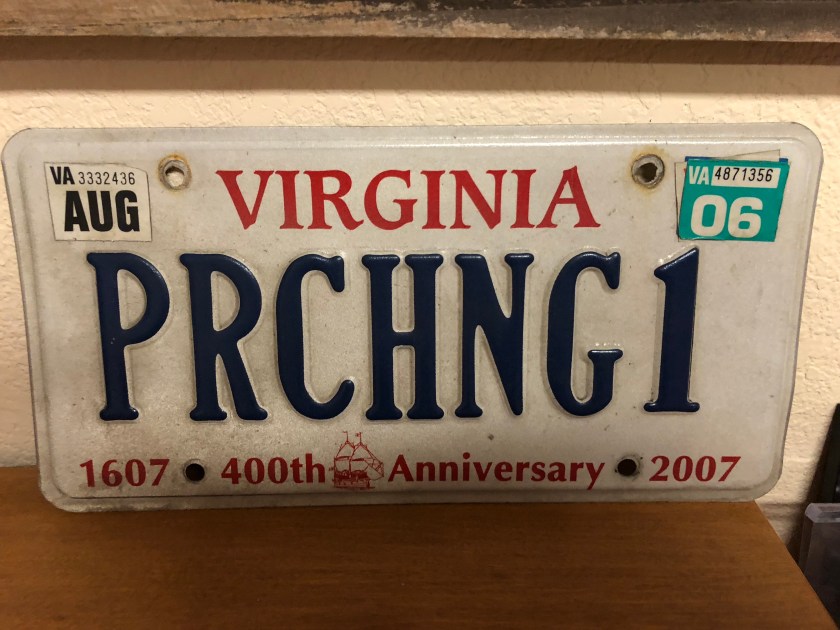
“PRCHNG1”

Neal Pollard

The title above, PRCHNG1, was once the vanity tag on a truck I owned. When in 2004 I said a sentimental goodbye to the “Black Bullet” (as Kathy affectionately named my 1985 Chevrolet Custom Deluxe pickup, which I traded in on a “new” 1992 Dodge Dakota), I transferred the tags down at the DMV.

As I picked up a number at the front counter, I had my tags in hand, and the receptionist saw them. It launched an interesting conversation.

She said, “Oh, I’ve always wanted to try that. I bet that’s so fun. Is it scary?”

I was puzzled and said so.

She said, “Your tags. How long have you been parachuting?”

I guffawed.

You may have surmised by now that my tag stood for “Preaching One.” I worked with DMV originally to find something that gave that clue. “Preacher,” “Mr Preach,” “Preacher,” and several others were already snagged. So I settled on “PRCHNG1.”

I thought it was clear, but apparently my fellow motorists either thought I was in some airborne division or maybe purchased hand guns. I don’t know.

As Christians, we’re told to be salt, light, and leaven, to clearly point others to Jesus.

When others see your works (cf. Mat. 5:16; 1 Pet. 2:12), do they conclude that you are a Christian? Or does the general tone and slant of your life lead people to contrary conclusions?

Be careful! Others are watching us, and they make assumptions about our character and lives by what they see. Let us make it plain (cf. Hab. 2:2)!

IMG_4176


“Vain Jangling”

Neal Pollard

The English language has done some changing in the 400-plus years since the King James Version was made available. Within its pages, you’ll find phrases like “straitened in your own bowels” (2 Cor. 6:12), “superfluity of naughtiness” (Jas. 1:21), “bloody flux” (Acts 28:8), “filthy lucre” (Ti. 1:7), and “the thick bosses of his bucklers” (Job 15:26). There is a beauty and picturesqueness to the Elizabethan English, though. One example of this is in 1 Timothy 1:6, which warns against “vain jangling.” To me, that’s a vivid way of translating a compound Greek word translated elsewhere as “fruitless discussions” (NASB), “idle talk” (NKJV), “vain discussion” (ESV), “meaningless talk” (NIV), and “empty talk” (MEV). Have you ever heard anyone jangling keys or coins in their pockets? It’s usually a nervous tic and mindless habit, but it can loud and annoying. In the 17th Century, the word meant to “talk excessively or  noisily, squabbling” (Apple Dictionary, 2.2.2).

In context, Paul gives the culprits, the creed, the consequence, the contrast, and the cause of this “vain jangling.” The culprits are “certain men” (1:3) or “some men” (1:6). Their creed is “strange doctrines” (1:3), “myths and endless genealogies” (1:4), and this “fruitless discussion” (vain jangling). The consequences are dire, as such will “give rise to mere speculation” (1:4). The contrasts are “the administration of God which is by faith” (1:4) and “instruction (in) love from a pure heart and a good conscience and a sincere faith” (1:5). The cause is revealed in verse 7, that “they want to be teachers of the Law, even though they do not understand either what they are saying or the matters about which they make confident assertions.” Paul had a particular circumstance in mind, but is there an application to us today?

In 2018, there are numerous platforms and avenues to communicate. It can be easy to forget that James’ warnings about the tongue are not limited to words which are audibly heard, but whatever we speak. I need to be cautious about being a religious noisemaker, banging and clanging with reckless abandon. My words have meaning, and they hold the power of spiritual life or death within them (Prov. 18:21). Thus, great restraint, copious forethought, and thoughtful execution ought to permeate my speech, wherever it is “heard.” Otherwise, I may simply be declaring my thoughtless ignorance, both uninvited and unwelcome, and come off sounding like three dollars of pennies churning in the pocket of a champion fidgeter.

Paul speaks of Christians as “ambassadors” for Christ (2 Cor. 5:20). We must represent Him righteously and accurately. We may be the first and only megaphone through which Christ is proclaimed, so let us speak accordingly. Let’s make Him proud, for His message is “words of sober truth” (Acts 26:25), not vain jangling.

ntts3l5

Communication Landmines

Neal Pollard

Paul writes two letters of instruction to Timothy, the preacher at Ephesus. As his father in the faith (cf. 1 Tim. 1:18), Paul wanted the younger man endowed with the wisdom and courage to be God’s man.  Timothy would face pressures and temptations from many different directions. The apostle’s words also provide some common sense to help him do the sometimes difficult task of preaching and ministry.

In a letter full of the theme of godliness, 1 Timothy, Paul gives him some intriguing encouragement in the sixth chapter. He says, “If anyone advocates a different doctrine and does not agree with sound words, those of our Lord Jesus Christ, and with the doctrine conforming to godliness, he is conceited and understands nothing; but he has a morbid interest in controversial questions and disputes about words, out of which arise envy, strife, abusive language, evil suspicions, and constant friction between men of depraved mind and deprived of the truth, who suppose that godliness is a means of gain” (6:3-5). In this brief admonition, he gives Timothy several tips to help him be a useful communicator of God’s truth. He urges Timothy to avoid:

  • Compromise. Not only here, but throughout the letter, Paul urges Timothy to teach the pure doctrine of Christ, those sound words and that godly doctrine. If we bow to pressures and change the revealed word of Christ, we become deadly communicators.
  • Conceit. Ironically, the conceited often look down upon others. Yet, Paul ties the arrogance to ignorance (“understands nothing”). When we encounter one who condescendingly communicates, we are prone to tune them out even if they are telling the truth. It is incongruous to have a pompous preacher speak of the lowly Jesus. It’s a credibility killer.
  • Controversy. We live in the age of controversy. It is splashed all over the traditional media and social media. It is often manufactured, and it is the mark of a morbid (literally, “sick”) mind. The controversialist will be found at the heart of disputes, ever seeking to dig up something, hash and rehash it, and keep it going. We can be accused of that for simply trying to communicate God’s will, especially when unpopular, but some are never far from contention. It is characteristic of them.
  • Constant friction. This is listed last among several other results of controversy, along with envy, strife, abusive language, and evil suspicions. Have you ever been around someone who keeps up an atmosphere of tension? The chip is always on the shoulder. Their communication is always confrontational. It appeals to the depraved and deprived, according to Paul.

Paul was so bold that he would die for preaching the truth (cf. 2 Tim. 4:1-8). Yet, he urged Timothy to be peaceable, kind, adept, patient, and gentle when communicating it (2 Tim. 2:24-25). Is it possible to courageously stand with the Christ but do so using the precise scalpel of Scripture (Heb. 4:12) rather than the reckless explosives of excess? Yes, and each of us must predetermine that we will do so no matter how others act and react.

5385-boxing_controversy_people-630w-tn

WHEN MISUNDERSTOOD

Neal Pollard

It will happen, at least occasionally. A remark you make gets taken out of context, will not be correctly heard, or will be heard through the personal filters of the listener. Your facial expressions and body language may not accurately express your feelings or at least not tell the whole story. People may ignore the adage, “Believe none of what you hear and only half of what you see.” While that truism may be naive and certainly not entirely true, we’ve all been on the receiving end of others’ misunderstandings of what we’ve written, said, or done. What do we do when we feel we’ve been unfairly treated by the misunderstandings of others? Consider the following:

  • Try to understand others better.  Everybody has been through the same thing. I need to make sure I’ve not misunderstood intonation, intention, motivation, emotion, or information. It’s easy to happen.
  • Don’t obsess over the hurt. The world has enough victims, and the perpetual victim is exhausting. I cannot afford to fixate on the fracture. I am usually best served to let it g.
  • Rejoice in the great company you are keeping. Jesus’ whole life and ministry was misunderstood by the religious leaders of His day. Their misunderstanding was certainly not the meat of His mission. His eyes focused on the bigger picture. He was perfectly sinless and still unjustly treated. I can rejoice when I’m in a similar position, sinful though I am.
  • Turn to God, not gossip. This is hard! The urge to lash out and retaliate can seem irresistible, but it’s definitely possible. How much greater peace and harmony would come if we resolved to pray (even for the “misunderstander”) when misunderstood?
  • Redouble your efforts to spread salt and light. I may be tempted to throw up my hands and say, “What’s the use? If this is what I get, I quit.” That doesn’t sound so good when I can read it in print. Instead, I need to strive harder to do good.
  • If necessary, clarify but with utmost love and kindness. But, let me do some serious soul-searching and ask, “Is it really necessary?” Can I turn my cheek(s) and move on? If I truly cannot, I need to cleanse my heart of sinful anger and act in genuine love and kindness toward my “aggressor.”
  • Remember that wisdom is justified of her children. Ultimately, the body of work that is your life will leave a clear impression. Most people who know us know more about us than we think. They see what side of the ledger our lives are lived on and they draw conclusions accordingly. I just need to be characterized by righteousness and good works.
  • Be sure you are communicating clearly. Communication is a problem in every medium and relationship. Some do better than others, but all make mistakes. When I am misunderstood, I need the humility and honesty to step back and ask if I asked for a reaction through unclear meaning or veiled messages.

I hate to be misunderstood. But as with every other trial, I can often find blessings even in these distasteful situations. My prayer is that I will not be conformed to the world (or the worldly), but I can be transformed by the renewing of my mind. That’s going to turn out for the best (Rom. 12:1-2).

misunderstood1