Wednesday’s Column: Third’s Words

Gary Pollard


Do you remember what your childhood fears were? Maybe you never really grew out of those fears. I can remember a number of phobias I had as a child, one of which was not arachnophobia. In fact, my younger brother and I would collect spiders from the backyard and put them all in a container in our bedroom. At night we would put a flashlight behind our clear cage and watch all the spiders make their webs— occasionally fighting each other. I don’t believe our mom ever discovered this little secret. For some reason, as I grew older (more mature) I developed a fear of spiders despite having played with them often as a young kid. Fears can be funny like that. They can come from bad experiences or just somewhere in the back of our minds.
There’s a lot of fear in the world today! One of my favorite psalms in the Bible is Psalm 46. We read about what seems to be the worst case scenarios, but God still reigns over all. What if the earth gives way? What if the mountains are thrown into the sea? What if the wrong man becomes our new president? What if this virus never goes away? Even so, we have no reason to fear. God is bigger than our fears. Know we serve a Being with that much power should fill us with courage. What are you afraid of?


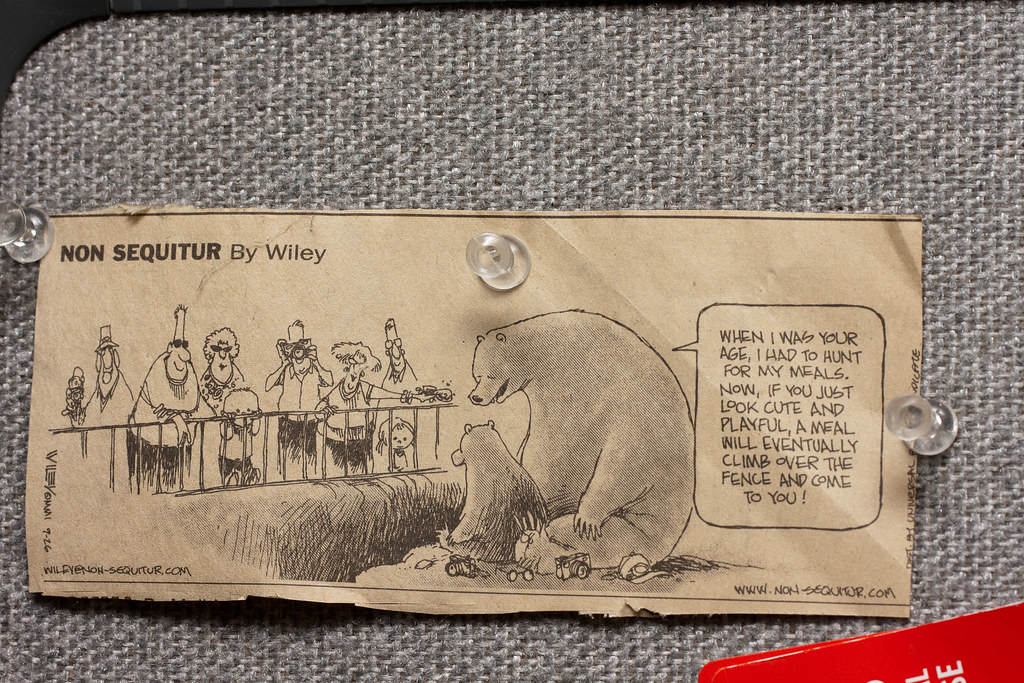
Wiley Miller is the creator of the comic strip, Non Sequitur. When apolitical, Miller’s strip can be enjoyable. I cut one of his strips from a daily edition of The Fayetteville Observer (Fayetteville, NC) back in the early aughts featuring “the eternal optimist.” In the one-panel comic, the grim reaper stands before a man in business attire. This eternal optimist calls to his wife in another room: “Well, honey, it doesn’t look like I have to worry about that long commute anymore.” I kept that strip until it yellowed with age and crumbled into oblivion. I did so for another reason than having a dark sense of humor. I hope I am an optimist on the order of the businessman finding something good to say even in the face of death.
Paul had such a character. He told the Philippians that he had everything to gain in death, as a Christian, and needed only remain for the sake of the brethren (Philippians 1.21-26). Nearing the end of his life, a confident Paul told Timothy, “I have fought the good fight, I have finished the course, I have kept the faith; in the future there is laid up for me the crown of righteousness, which the Lord, the righteous Judge, will award to me on that day; and not only to me, but also to all who have loved His appearing.” (2 Timothy 4.7-8 NASB). Why was Paul an eternal optimist? It was not because he was free of sin. Indeed, Paul considered himself the chief of sinners (1 Timothy 1.15). However, Paul was full of faith and understood God’s grace.
We cannot afford to live in fear, whether that fear is of death or whether we are “good enough.” We must do the will of God. John says, “But if we walk in the Light as He Himself is in the Light, we have fellowship with one another, and the blood of Jesus His Son cleanses us from all sin” (1 John 1.7 NASB). That faith may not always take us to places providing comfort. Shadrach, Meshach, and Abed-nego had their faith put to the test. Nebuchadnezzar had instructed everyone to bow to his golden image in worship. The young Hebrews refused because they remembered the Law of Moses and their covenant relationship with God. Nebuchadnezzar was angry with the young men and told them they would perish in a fiery furnace. They replied, “O Nebuchadnezzar, we do not need to give you an answer concerning this matter. If it be so, our God whom we serve is able to deliver us from the furnace of blazing fire; and He will deliver us out of your hand, O king. But even if He does not, let it be known to you, O king, that we are not going to serve your gods or worship the golden image that you have set up.” (Daniel 3.16b-18 NASB).
Did you notice why they did not fear? Can you see why they were optimistic? They understood their God was more powerful than a king and could deliver them. Yet, even if God did not deliver them, they still realized they had an obligation to serve Him regardless. These days the world seems scary. There is so much bad news on TV. But our God is more powerful. Thus, we can even say, “If I do catch COVID-19, God will deliver me. But even if He does not, I know Heaven will be my home.” Other scenarios would likewise suffice as an example. However, this is one of the things that seems to be on the minds of many today. Build your faith and become an eternal optimist as well. The world, in turn, will become a less daunting place.


Have you ever been afraid of your imagination? At times that fear can be so convincing that you truly believe that the worst case scenario is somehow inevitable. Try and make that opening question relevant to your life. Think about a specific event or experience where you were afraid of something that never came to fruition. The grip of anxiety can be debilitating as you wait for your medical test results to come in. You agonize over the poor quality of life you might have if there is ever an unexpected economic collapse. Your hairline might rapidly recede as you stress over the outcome of the war our nation is still involved in, and do I even need to mention the new global pandemic? You’re robbed of sleep as you imagine the potential horrible outcomes that may never happen. These things may never happen because the Lord could come. They may never happen because whatever you’re afraid of— it’s simply worse in your own mind. It may never happen because God has proven Himself to be one who calms the storm instead of letting you perish.
I believe we would all benefit from recalling those occasions in our past where fear proved unnecessary and we worked ourselves up for nothing! If the fear in your life has a big appetite and it’s devouring all your time and peace, maybe it’s time to feed something else. Sitting Bull once said, “Inside of me there are two dogs. One is mean and evil and the other is good. They fight each other all the time. When asked which one wins I answer, ‘the one I feed the most.’” How vividly this illustrates a daily struggle for so many. Fear and faith will scrap with one another until we decide which one will win. Do you think our faith would emerge victorious every day if we could physically witness God’s power, but in a miraculous way? If my own eyes could witness Jesus bring the dead back from the grave, cast out a demon, or walk on stormy waters, then I would never worry again. Or would I? Seeing Jesus perform miracles never made anyone perfect. His disciples were far from perfect and they stood feet from the Savior while He did things only God could do.
On one occasion, which was hinted at earlier, Jesus calms the storm after being abruptly awakened by His terrified followers (Mark 4). There are some details about this account that will help us feed our faith when fear threatens to win the day.
First, our cries to God, even in the desperate times, are heard. The disciples exclaim, “Don’t you care that we’re about to die?” Following this fearful plea, Jesus will demonstrate a fraction of His awesome power. After all, what is calming a stormy sea to the One who spoke every drop of water into existence?
Second, excessive fear of anything in this world is a foolish mistake. God is bigger and greater than our worries.
Third, God is not asleep. It may seem like He is when we don’t feel optimistic about the future, but it’s when we recognize that He’s the only answer to our peace that He will calm our storm.


Fear not…
Military Threats. Whether Al Qaida, the Taliban, Iranian nuclear weapon building, alliances between China, North Korea, and Russia, or armed forces spread too thin.
Natural Catastrophe. Whether global warming, meteors crashing through the atmosphere, glacial melting, California sliding off into the ocean, or events like tornadoes, tsunamis, and hurricanes.
Economic Collapse. Whether the breaking of Social Security, a major stock market crash, the mounting U.S. debt, recession, the real estate bubble bursting, bankruptcy, out of control inflation, or job losses to illegal immigrants.
Potential Persecution. Whether the steadily rising antagonism against Christianity, overthrow by foreign oppressors, the mounting tide of immorality promoting sin, or the epidemic ignorance of the Bible in our land.
Health Problems. Whether Coronavirus, cancer, heart disease, Alzheimer’s, ALS, AIDS, kidney failure, dementia, arthritis, blood clots, or liver disease.
Academic Decline. Whether comparative test scores with children in other nations, a socially-charged curriculum agenda, the “dumbing down of America,” the de-emphasis of classroom competition, or outcome-based education programs.
Rather, “Fear God” (Ecc. 5:7; 1 Pet. 2:17). “Do not fear those who kill the body but are unable to kill the soul; but rather fear Him who is able to destroy both soul and body in hell” (Matt. 10:28). “You shall follow the Lord your God and fear Him” (Deut. 13:4). “The secret of the Lord is for those who fear Him” (Psalm 25:14). “He will fulfill the desire of those who fear Him; He will also hear their cry and will save them. The Lord keeps all who love Him, but all the wicked He will destroy” (Psalm 145:19-20). “And His mercy is upon generation after generation toward those who fear Him” (Luke 1:50). “I most certainly understand now that God is not one to show partiality, but in every nation the man who fears Him and does what is right is welcome to Him” (Acts 10:34-35).
Neal Pollard
72% of Americans, age 13-24, view pornography frequently (55% of men 25 and older). Those numbers only drop to 41% and 23% of those professing to be Christians (Barna, July-August 2015, Barna Study Here). So, perhaps this was inevitable. A few years ago, potentially millions of people started receiving a disturbing email from an anonymous source claiming to have hacked into their email and installed malware to discover their pornographic consumption. Experts say these hackers have just enough facts and information to frighten many of the recipients. They attempt to blackmail the recipients, demanding hundreds or even thousands of dollars in bitcoin. Otherwise, they promise to email proof of their readers’ perverse, clandestine interests to everyone in their contact list.
These hackers are relying on people’s fear of being found out, thinking that if even a tiny percentage of fearful folks pay the ransom it will make their spam to millions pay off. This hoax has probably raised the heart rate of many who consume pornography but felt like they were getting away with it. But the FBI say it is just that–a hoax.
God created man with a built-in sensitivity to our accountability. Many have a “certain fearful looking for of judgment” (Heb. 10:27). Some day, the secrets of men will be judged by God through Christ (Rom. 2:16). Solomon said, “For God will bring every act to judgment, everything which is hidden, whether it is good or evil” (Ecc. 12:14). But, “We must all appear before the judgment seat of Christ, so that each may be recompensed for his deeds in the body, according to what he was done, whether good or bad” (2 Cor. 5:10).
The good news is that no one has to be afraid of the judgment or having everything which is hidden shared with the whole world. “God our Savior desires all men to be saved and to come to the knowledge of the truth” (1 Tim. 2:3-4). Peter adds, “The Lord is not slow about His promise, as some count slowness, but is patient toward you, not wishing for any to perish but for all to come to repentance” (2 Pet. 3:9).
God wants our sins to be covered by the blood of His Son. Not just “big sins” (as we distinguish them), but every sin, great and small, that we struggle with! How great to face the judgment with those sins hidden from His perfect view.

Neal Pollard
While the knowledge of my fear of snakes is widespread, some of the events of my past that hardened that horror as less so. A couple of years before moving to Colorado, we were hit by Hurricane Isabel. On our one acre lot, we had well over 100 trees. In fact, about 100 of them fell in that storm, which was the deadliest and costliest of the 2003 Atlantic hurricane season. Cleanup took months, as the storm shook up the environment in some notable ways. To me, the most disturbing was that it forced a great many copperhead snakes out of their dry dens and rocky hillsides down into neighborhoods like ours. In the course of several months of cutting and removing trees, we ran into about a dozen of these demonic creatures.
On one occasion, a copperhead was near my foot. Also near my foot was a garden hoe, which I promptly dispatched for the purpose of eliminating this threat. To my utter dismay, the blade of the hoe, put to the head of the snake, sank into the rain-softened ground. Rather than killing the snake, it made it mad. At this point, I was in a quandary. Pushing the hoe harder was not causing further harm to the snake, but releasing the snake from the hoe felt like a bad option, too. For what seemed like a week, I continued to work the hoe on that copperhead until it was hurt badly enough for me to properly finish the job.
Have you ever been caught on the horns of a dilemma which seemed bigger than you? As you were in the throes of it, you prayed, pleaded, and petitioned God for help. You realized that without His help, you were in big trouble. It could have been regarding your health, finances, a relationship, a sin struggle, or big decision. Most of us become keenly aware of our need of God’s intervention in moments like those. Yet, it is a helpful reminder that even when life is not so scary or circumstances are less dramatic, God is still in control. Our prayers should reflect this. Our plans should be governed by it. Our priorities should show that we get that.
What will happen to our nation in time to come? What might the church face that scares and intimidates us? What could happen in our individual lives that fills us with dread? No matter what, trust that God is always in control. Take heart in this truth: “The Lord is my light and my salvation; Whom shall I fear? The Lord is the defense of my life; Whom shall I dread? When evildoers came upon me to devour my flesh, My adversaries and my enemies, they stumbled and fell. Though a host encamp against me, My heart will not fear; Though war arise against me, In spite of this I shall be confident” (Psalm 27:1-3).
In other words, God is always in control!

Neal Pollard
…Of concerns over the future–decisions to make, the specter of tomorrow, growing old, retirement?
…Of sin–fighting temptation and not always winning, beating one thing and then finding another cropping up in its place, and the guilt it brings?
…Of disappointment–both of what I inflict and what is inflicted upon me?
…Of fear–when it comes to my spouse, my children, my parents, my brethren, our nation?
…Of doubt–whether in the process of prayer, struggles with asking God “why?,” or especially doubting myself?
…Of neglect–leaving undone things central to my purpose as a Christian due to apathy, distraction, misplaced priorities, and the like?
...Of failure–trying and not succeeding, not trying hard enough, not knowing what or how to try, and of simply falling short?
…Of betrayal–whether through gossip, lying, broken promises, insincerity, or treachery?
…Of insecurity–that can result from any of these and other struggles?
We don’t always have days when we wonder these things, but they come around often enough that they can prey on our minds. Sometimes, we face these questions due to our shortcomings. Other times, it’s because of the failings of others. Both can lead to despair.
The wonderful news is that we can be free of them all. There is a day coming when none of these will weigh us down ever again. I love the encouragement of the Hebrews’ writer, who urges, “Therefore, since we are surrounded by so great a cloud of witnesses, let us also lay aside every weight, and sin which clings so closely, and let us run with endurance the race that is set before us, looking to Jesus, the founder and perfecter of our faith, who for the joy that was set before him endured the cross, despising the shame, and is seated at the right hand of the throne of God. Consider him who endured from sinners such hostility against himself, so that you may not grow weary or fainthearted” (12:1-3).
Whether we are struggling due to our sinfulness or if it is any other weight, we’re encouraged to hang on and hang in there. When the struggle might be the greatest, that’s when we’ve got to turn and fix our focus on Jesus. Watch how He won! See what He did! Remember that He helps make it possible for us to fight and win.
If you are in the valley of despair right now, for whatever reason, don’t give up! Look to Jesus. Hang on! The end is in sight. Through Him, we will overcome!

Neal Pollard
Today, everyone is hurting. Whether because of gun or knife violence or vehicular homicide, groups of people in our nation and other parts of the world are being torn from time and prematurely vaulted into eternity. We weep and mourn for the loss. We consider the enormous grief and heartache multiplied many families face from California to Florida, Connecticut to Texas, Colorado to Tennessee, Virginia to Nevada (and many other places). Those whose voices we hear the most through all of this, like the national and local media, seem fixated on learning the perpetrator’s motive each time it occurs. Experts and analysts look at religious ideology or mental health issues. It seems as if they believe that if they can determine the motive, that will solve the violent epidemic that has disturbed the peace of so many people in our society. The danger of oversimplifying any specific tragedy notwithstanding, there are some right answers the world will have a difficult time embracing but that get us so much closer to resolving this plaguing problem. Why are these horrific crimes occurring?
Brethren, in this frightening, dark, and uncertain atmosphere, a world which “lies in the power of the evil one” (1 John 5:19), we must share what we know! John says, “We know that we are of God…and we know that the Son of God has come, and has given us understanding so that we may know Him who is true; and we are in Him who is true, in His Son Jesus Christ. This is the true God and eternal life” (5:19a, 20). We have security, confidence, understanding, and hope, all because of God and His Son. Take courage and share that with everyone you can! It’s the only hope the world has!

Gary Pollard III
Have you ever been terrified? I have: I’ve been hit head-on at highway speed, been attacked by feral dogs on the Navajo reservations, and once had to eat kale.
Fear is a normal part of our life, and is sometimes an annoying reminder that we are vulnerable. Fear can save your life, or cause you to push yourself to overcome. Fear can also help you get to heaven.
The Bible talks about the fear of the Lord all throughout. The concept of fearing God is mentioned over 578 times in scripture! How do we fear the Lord? A very long time ago, a man named Jonathan Edwards preached a sermon called “Sinners in the Hands of an Angry God.” The premise of his sermon is that we are all walking a frayed tightrope over the fires of Hell with God just waiting for us to trip up and be eternally lost. His sermon is extremely well-known (even today), but is not an accurate portrayal of God’s disposition toward us (I John 1.7). Our fear of God – literal fear – comes from knowing that He is our judge and creator. It stems from a sense of awe at who He is and what He can do.
We’re all told to fear the Lord, but how do we do that in 2017? When you’re about to do something that the back of your mind tells you is probably not a good idea, think about the power of God. Think about standing in judgment before Him and how He would view your decisions. Think about the fact that your very existence is due to Him – do you think He’s not aware?
God is love by nature (I John 4.7, 8), but God is also our righteous Judge (Romans 2.2). Let’s keep that in mind this week while we’re making our decisions.

Neal Pollard
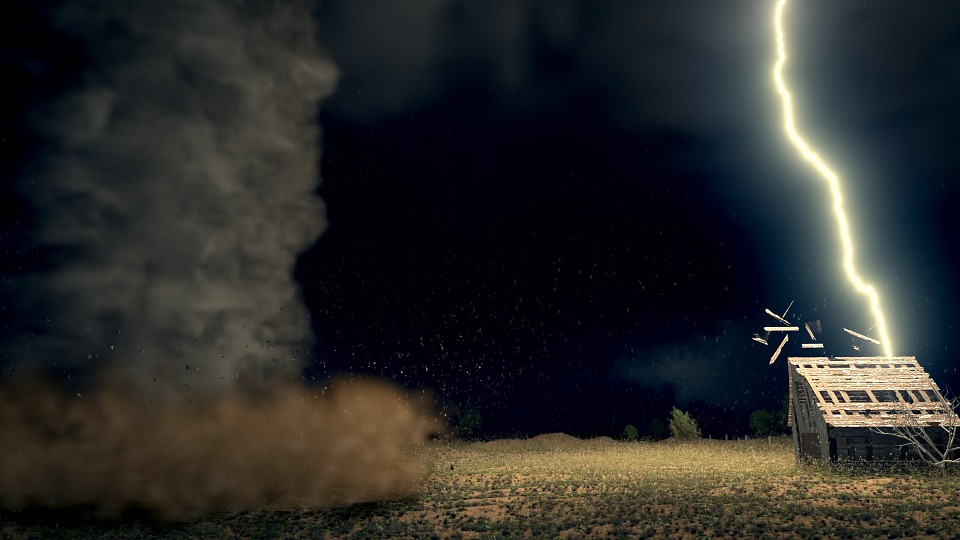
Springtime in the plains is a notorious time for storms. I was driving through northwest Texas near the time when three storm chasers were killed southwest of me on Tuesday afternoon. They died pursuing the storm, not directly because of it. They were there because conditions were ripe for tornadoes. 17 people were killed by tornadoes in 2016, but 24 have already died in them this year. Hollywood has captured our awe and fascination with them since The Wizard Of Oz. We view storms as mysterious, ominous, powerful, and frightening. They come in so many forms—hurricanes, floods, blizzards, cyclones, and more. But “storms” are synonymous with fear and sorrow.
Wouldn’t you classify some of the major, traumatic events of your life as storms. They build and threaten, they strike, then they leave aftermath. The storm may take but a moment, but recovery can take days, months, or even years. Not surprisingly, the Bible uses the storm metaphorically to describe such moments in our lives. David wrote, “I would hasten to my place of refuge from the stormy wind and tempest” (Psa. 55:8). The man we most associate with such figurative storms, Job, laments, “You lift up the wind and cause me to ride; And you dissolve me in a storm” (30:22). Most frequently, the Bible uses storms representatively to describe God’s judgment. But, as Job and David show, sometimes storms strike the innocent and undeserving.
What do we do when facing a storm? We heed precautions. We take shelter. We wait and endure. We ask for and trust God’s protection.
The world is full of people riding out storms today. That includes Christians. These storms are assaulting their bodies, bank accounts, relationships, spiritual strength, and spirits. Some feel safely sheltered, while others feel as if they are barely holding on. How do we face our storms?
* Seek help from others (Heb. 12:12-13; Ecc. 4:9-10).
* Search for possible benefits from it (Psa. 66:10; Rev. 21:3-4; Js. 1:2-4; etc.).
* See God’s power to help in it (Psa. 18:19; Rom. 8:28-38; 2 Pet. 2:9a).
* Shelter in the place of safety (Exo. 33:22; Psa. 91:1; Mat. 7:24-27).
God doesn’t cause evil or sin, but He allows it. We will always struggle with the “why” of this. But, we can grow our dependence on our great, perfect God when we are being battered. He is faithful. He wants to help. Lean on Him through your storms!

Neal Pollard
“Peace” is a geopolitical term associated with such terms as talks, treaties, accords, and the like. It’s the political antithesis of war. Of course, the term is co-opted by a wide variety of people in society, but so often peace is a misunderstood concept. Or, people turn to the wrong source for peace.
The primary New Testament word for peace means “a set of favorable circumstances involving tranquility” or “to be without trouble, to have no worries, or to sit down in one’s heart” (Louw-Nida). BDAG defines it as harmony in relationships, a state of concord, and state of well-being. But, what is sometimes asserted as peace is not necessarily peace as God defines it.
There is false peace (1 Th. 5:3). Paul addresses the words of those characterized as “in darkness” (4-6), lacking sobriety (7-9), as offerers of peace and safety in the face of destruction. These people are not after the right kind of peace and Paul implies they are “destined for wrath” and condemnation (9). People who want peace on their own terms, living sinful lifestyles in rebellion against the will of God, advocate false peace. Whether or not they achieve some measure of that in this life, they are not destined to enjoy it eternally.
There is forged peace (1 Th. 5:13). Paul teaches that peace and harmony between people is something that must be worked toward. He tells the Christians to “live in peace with one another,” and then he proceeds to tell them how this is done. It includes submitting to the church’s leadership (12-13), and it calls for church leadership to give the church family whatever is needed from admonition to encouragement (14) and to lead the congregation to pursue peace and follow their example (cf. 15-22). The kind of harmony and unity God wants is not accidental or incidental. It is the product of diligence and determination.
There is the Father’s peace (1 Th. 5:23). Paul begins both epistles to the Thessalonians by tying together true peace and the Heavenly Father. Here he writes, “Now may the God of peace Himself sanctify you entirely; and may your spirit and soul and body be preserved complete, without blame at the coming of our Lord Jesus Christ.” God’s peace is comprehensive, complete, and conquering. It strengthens one now and saves one at Christ’s second coming. Contrast this peace with the peace offers. Jesus does. He tells His disciples, “Peace I leave with you; My peace I give to you; not as the world gives do I give to you. Do not let your heart be troubled, nor let it be fearful” (John 14:27).
Right now, people have a growing desire for peace. There are turning in many directions for it. Ultimately, it won’t be found in the White House, the military, on Wall Street, or from within our own resources apart from the Father. Let us strive to forge peace between ourselves as His people, and model and offer it to a lost world desperately desiring it.

Neal Pollard
The hope of finding survivors on the cargo ship El Faro has severely dwindled, as one of two lifeboats, severely damaged, has been discovered as well as one body. While the other lifeboat from the ship, with a capacity for 43 persons, has not been found in the ocean waters off the Bahamas, the 735 foot long ship sent a distress signal Thursday from near the eye of Hurricane Joaquin as it battled 20-30 foot waves. The Coast Guard is hopeful, but the realistic expectation is that this will soon be a recovery rather than rescue mission (info from cbsnews.com and reuters.com). Out of all the frightening ways to face death, being lost at sea has to be near the top. There’s the foreboding strength of battering waves, the immense, liquid darkness of the deep, the mystery of what lies beneath the surface, the horrific experience of drowning, and the overall helplessness in the face of a fierce overwhelming force. Since maritime history goes back for millennia, people both ancient and modern have faced the terrors of shipwreck. Dating at least as far back as the ship found off Dokos, Greece, dating back to 2700-2200 B.C. carrying a cargo of pottery (read more at http://www.mhargolid.nl/data/webb1992.pdf), mankind has experienced the sinking of ships.
No wonder New Testament writers seize on this common situation of life. Luke records (Acts 27:14) and Paul looks back on (2 Cor. 11:25) literal shipwrecks the apostle survived. How fitting that he is the one who describes those who lose their faith as those who have “suffered shipwreck” (1 Tim. 1:19). Preventing shipwreck, according to Paul, necessitates.
We had the feeling of finality of those lost at sea. Thankfully, as long as one lives, he or she can be recovered from spiritual shipwreck. But, they must come back from such depths and take hold of God’s life preserver, His Son Jesus Christ! Let us do our part to rescue the perishing, snatching them with pity from sin and the grave (2 Pet. 3:9).

Neal Pollard
In 1 Peter 1:13-19, there are three commands that relate to something that must be done regardless of how much time it takes to complete. They are, “fix your hope completely on grace” (13), “be holy in all your behavior” (15), and “conduct yourselves in fear” (17). There’s a fourth command of this type in verse 22: “Love one another from the heart.” All of these are done as the result of a salvation taught by the prophets and revealed to us. Because we’ve been saved, we should fix our hope on grace, be holy in behavior, conduct ourselves in fear, and love one another from the heart. Considering what God has done for us, we should be eager to do what He tells us to do. At the heart of the discussion, Peter calls for holiness. “Holy” is found 10 times in 1 Peter, but there are synonyms in the book, too (“behavior” or “manner of life”—7 times; “do good” or “right”—13 times). We want to be holy, do good, and behave, and this letter says a whole lot about how that looks. It’s faithfulness in suffering, distinctiveness in daily living, and keeping heavenly in focus. It’s captured in Peter’s petition (2:11). Our world places more emphasis on happiness than holiness, and if you have to choose one the world says choose happiness. But, God calls us to choose holiness. How do we do that?
We take the time for what is most important to us—sports, social media, hobbies, work, shopping, and the like. None of that ultimately matters. As we do anything, these or other things, we must make sure that we are holy in heart and conduct. It’s worth the time and will be worth it when there is no longer time.

Neal Pollard
If I have a favorite chapter of the Bible, it would have to be 2 Timothy 4. Yes, I love the first eight verses, but that alone is not what cinches this chapter as dearest to me. It’s Paul’s personal remarks starting in verse nine. There’s his longing to see his spiritual son, Timothy. Twice he implores Timothy to come see him (9, 21). He’s in prison, persecuted for preaching the Prince of Peace. He longs for Christian companionship. Then, he shares his dejection over the abandonment of certain fellow-workers (10). He wants to see cohorts with whom he has done spiritual battle (11). He has personal needs and wants (13). He warns Timothy of a spiritual troublemaker (14-15). Then, he shares personal feelings of isolation and loneliness, a time when he needed a Christian brother by his side but had none (16). Bold, risk-taking Paul, who would stand up to any opposition, the epitome of true manliness, was now in undoubtedly dire, dank conditions, the smell of squalor in the air. Whatever he saw, heard, and felt as he wrote, Paul scratched out these words: “At my first defense no one supported me, but all deserted me; may it not be counted against them. But the Lord stood with me and strengthened me, so that through me the proclamation might be fully accomplished, and that all the Gentiles might hear; and I was rescued out of the lion’s mouth. The Lord will rescue me from every evil deed, and will bring me safely to His heavenly kingdom; to Him be the glory forever and ever. Amen” (16-18). These words aren’t the end of the letter, but they are the end of the matter!
This faithful Christian was deserted by men, but he felt God’s presence and power:
You and I cannot fathom the price Paul paid for proclaiming Jesus. But even if we were ever to face privation, punishment and pain for our faith, what was true for this apostle will be true of us. He promised to be with us always (Mat. 28:20) and never forsake us (Heb. 13:5). Even if you ever feel physically alone, you will have the spiritual assistance Paul speaks of in 2 Timothy 4. Through it all, you can say with Paul, “To Him be the glory forever and ever. Amen!”

Neal Pollard
It is hard to describe the beauty of faith evidenced in Room 913 yesterday as all the elders and their wives, Wes and Teri Autrey, and Tiffanie and Bethany Vaught stood with Myrna and the rest of the Murphy family at University Hospital yesterday. We sang songs and Dave Chamberlin prayed a touching, loving prayer. Moments later, a godly, wonderful woman made her transition from this life to the better one. Despite the inevitable, natural flow of tears, the heartache of separation, and the final earthly stanza of a beautiful, 59-year-old love song played by Ray and Myrna. Myrna was an obvious success as a mother, wife, grandmother, and friend, but central to everything she did and who she was was Christ. She did not fear death nor the condition that brought it. She was ready because of Christ.
When I think of the red-letter days that have occurred in our nation and world during my lifetime, whether the bombing of the Murrah Building, the horrors of 9/11, the unbelievable natural disaster of the December 26, 2004, tsumami (“Boxer Day Tsumami”), the disappearance of the Malaysia Airliner, and the like, I am made to think how many stood in the wake of such tragedy without the hope and promise made possible through Christ. Yet, every ordinary day where death looms through the natural course of life, people come to those final moments either ignorant or bereft of the bright prospect of what happens beyond death. Certainly, some think they have hope, but it is not hope rested in what they can find in Scripture but rather what they think, feel, or have been told is real and true. In some ways, those situations are the most tragic of all. Others are convinced that we are the result of chance and will cease to be when we draw our last breath, yet they continue to try and live with purpose and even act in the interest of others without bothering to ask why they behave civilized with such an animalistic point of view.
But for the one whose hope is built on the truth of what God’s Word says, there is no tidal wave of heart or explosion of life powerful enough to wrench us free from that hope. Paul exalts that we are saved by unseen hope (Rom. 8:24-25). In the rest of the chapter, he proclaims the unfailing love and promise of God for the redeemed who place their trust in Him. Paul encourages the Thessalonians not to face death, sorrowing like a world without hope (1 Thess. 4:13). Without Christ’s resurrection, there is no hope (cf. 1 Cor. 15:19-20). However, because He lives, we can face tomorrow, all fear is gone, we know who holds the future, and life is worth living (Bill Gaither lyrics from “Because He Lives”).
The Murphys will have sorrow and grief to bear. This is a testimony to their humanity. But they look at tomorrow with an even brighter anticipation. This is a testimony to the Christ who lives in them. It is available for us all!