We Sure Love Baptisms!

Neal Pollard

There are some things about social media that are extremely irritating—click baiting, pot-stirring, fight-picking, self-pitying, and the like. But there are a great many positives in that medium, too. Of all of them, I believe that posts of baptisms have to be my favorite. I do not appear to be alone in that estimation.  Judging from post reactions and comments, a great many others do as well. We love it when there are pictures. We love the “back story.” We love knowing that our friends, neighbors, co-workers, and family members have good, honest hearts softened by the power of Divine Revelation. We love knowing they have a clean slate and a fresh start, and are poised to begin their walk on Narrow Road.

All of this leads me to several random observations:

  • True good news needs no hype, trumping, manufacturing, or baiting.
  • It is New Testament thinking to rejoice at such good news (Acts 8:39; 15:3).
  • What a confirmation the obedience of others to the gospel is to our own decision to do so.
  • It restores our faith in the potential of humanity and the power of the gospel (Rom. 1:16; Heb. 4:12).
  • It builds our confidence in the Bible to see people imitate the examples of the New Testament, doing what they did the way they did it (Mark 16:16; Acts 2:38; 8:13, 38; 9:18; 10:48; 16:14-15; 31-33; 22:16; Rom. 6:3-4; Gal. 3:26-27; Eph. 5:26; Col. 2:12; Titus 3:5; 1 Pet. 3:18-21).
  • The average Christian wants what is best for others, which is just one reason Christians are the best people on earth.
  • We want good news to travel fast, far and wide.
  • We know it pleases the Lord when a person comes to Him in obedient faith (see Luke 15).

There are doubtless many more observations we could make, but these are enough for me to thank God for His people and those who daily make the decision to become His people. It builds my faith and hope in my fellow human beings and my trust in heaven’s plan of salvation.  Thank you for finding joy in the right and best things! And let’s keep striving to perpetuate that joy through leading souls to the Savior.
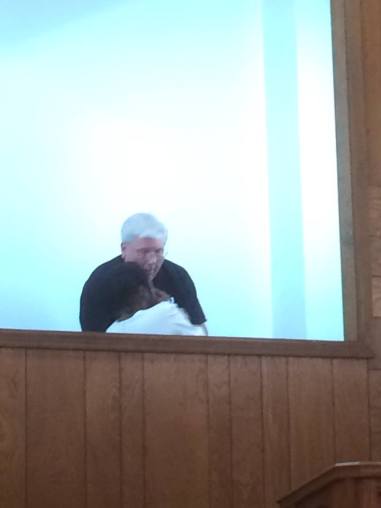
12924440_10207948347340678_5218772026345282016_n
“Debbie” being baptized into Christ during a gospel meeting with Keith Mosher in Sylvester, GA, this week (photo credit: Jason Willis)

How Could He Not Take That Shot?

Neal Pollard

His coach, Jay Wright, and teammates expected and wanted him to take the last shot in the 2016 NCAA basketball championship game. The senior point guard had intentions of doing so, too, but at almost the literal last second he turned and delivered a short pass to Junior Kris Jenkins who sank a three-pointer just before the final buzzer. It was the game-winning shot, lifting Villanova over North Carolina for the Pennsylvania school’s first championship since their legendary victory in 1985. Ryan Arcidiacono, who grew up 20 miles from campus and constantly dreamed of hitting a game-winning shot for the championship, will be remembered, as much as Jenkins, for delivering one of the most exciting games in college basketball history—Jenkins for his beautiful shot and Arcidiacono for his unselfish pass.

For those who know coach Wright’s philosophy, this turn of events is absolutely no surprise. Google “Jay Wright unselfish” and a multitude of articles come up talking about how the coach drills the idea of putting everybody else above yourself from the time kids enter his program. Players earn his trust and confidence by proving themselves converts to his selfless style of play. It is heartwarming to see such values being instilled in impressionable young people.

The local church must adopt the philosophy of its leader, Christ. He modeled it (Ph. 2:5-11) and mandated His followers do the same (Ph. 2:3-4). An atmosphere of unselfishness cultivates spiritual and numerical growth, just as selfishness inhibits such growth. Selfless service is most often bypassed by the world, though most deeply appreciate seeing demonstrations of it. Deference to others is a mark of distinctiveness that must be found in disciples. The better we do this, the brighter the light of Christ can shine through us!

1024px-2005_1104hoopsmania0005

What “We” Do To Achieve Spiritual Success

Neal Pollard

It is an unmistakable emphasis in the book of Nehemiah. The word “we” appears 38 times in 30 of the book’s 406 verses! Working together was the continuous mindset of Judah. They knew such a mentality would ensure success (2:20).

Teamwork accomplishes much more than individual performance! If a ball team has only one “star player,” the defense wins by shutting down the one performer. If the work of the church is carried on by only one or a select few, the devil has a better chance of shutting it down. Everyone must get invested! Success hinges on it. Notice where cooperation in the local church brings spiritual success.

When we build (4:6). Not church buildings, but relationships, knowledge, and commitment. A church has never grown on the back of massive, modern facilities. But, God wants us to build up His church (1 Th. 5:11). The more visits and calls each member makes, the better we build. The more encouragement and assistance we provide, the better we build. More Christians doing more for the Lord produce spiritual success in the church.

When we pray (4:9). Facing trouble and uncertainty, God’s people came together to pray. This is reminiscent of the prayer meeting in the home of John Mark’s mother, “where many were gathered together and were praying” (Acts 12:12). What a success that was! At least 3000 or so were devoting themselves to prayer at the Jerusalem church (Acts 2:42). Preachers, teachers, and missionaries are made bold, the sick and hurting are made hopeful, those in danger, travelers, and those confused are made calm by the prayer of the saints. That is vital to spiritual success!

When we carry on (4:21). Churches encounter setbacks and suffer defeats. Willful sinners going out from among us (1 Jn. 2:19), plans or programs that fizzle or die, disorderly members (2 Th. 3:6), false teachers (1 Pe. 2:1), apathetic members (John 15:5-6), the death or loss of a church leader, or general discouragement can tempt us to give up in our labors (cf. Gal. 6:9). We need each other to spur ourselves on in completing the important works that will glorify God. It is not how many defeats a church suffers, but how well a church, no matter how many “losses,” overcomes them.

When we give (5:12; 10:37). Two interesting instances of giving are recorded in the book of Nehemiah: (1) Giving to restore what was rightfully God’s (5:12), and (2) giving the manner that God rightfully expects (10:37). Church members who will spend generously on dinner and a movie but who give the Savior of their souls comparative pocket change, like Zaccheus, need to repent by restoring what rightfully belongs to God (Luke 19:8). Churches that give by faith and sacrifice are always stronger for it, if their living matches their giving. God wants to be “first” (10:37; Mat. 6:33), and that applies to our giving.

Certainly, many other elements are needed to help a church achieve spiritual success for God. But, Nehemiah and his brethren found success by working together. That spirit of unity will help us, as a church, to go forward and do things necessary for us to continue to be a great church! Let’s grow together!

2176418_02575c1b

Live Beyond Yourself


Neal Pollard

“Two little lines I heard one day,
Traveling along life’s busy way;
Bringing conviction to my heart,
And from my mind would not depart;
Only one life, ’twill soon be past,
Only what’s done for Christ will last.”

The first stanza of the powerful, convicting poem by C.T. Studd has been the seeming anthem of one of God’s great, 21st Century spiritual warriors, Cy Stafford. I first met Cy around 2000, and his balanced, measured information and guidance helped us identify and deal with a false teacher in East Africa. His interest and concern were for the Christians, new and more seasoned, who might be impacted by this man’s influence.  That godly zeal for God’s people was an indicator of the mind of a missionary, minister, and mentor of men.  The subsequent years have shown me what a true leader and visionary, with God’s help and to God’s glory, can accomplish. Cy is not larger than life, gregarious, charming per se, or glossy in any way. He is steady, focused, and determined.  He has helped change the world by equipping men and women to reach the world. Alongside so many missionaries and Christians indigenous to East Africa, Cy has steadily worked to grow the church and its influence where some of the earth’s poorest and humblest people live.  He often has spoken of the window of opportunity that daily shrinks and he has worked with an urgency to do what he can to make sure everyone has the opportunity to hear the gospel at least once.

Cy and Stephanie have made countless sacrifices of time, comfort, safety, and security because their mission was far broader than themselves. While some in ministry appear motivated by self-interest, self-promotion, and self-absorption, the Staffords have valiantly sought to put the spotlight foremost on Christ and then upon others’ needs.  On whatever day each exchanges the cross for the starry crown, their legacy will have been that of living beyond themselves.   What a convicting challenge to each of us to engage in thoughtful self-examination! What is my agenda? What is my aim? What is my aspiration?

“Give me Father, a purpose deep,
In joy or sorrow Thy word to keep;
Faithful and true what e’er the strife,
Pleasing Thee in my daily life;
Only one life, ’twill soon be past,
Only what’s done for Christ will last.”

Hebrews 11 speaks of great Old Testament heroes of faith who lived and died as those with a “desire” for “a better country, that is, a heavenly one…” (16). These same ones are called “strangers and exiles on the earth” (13), whose sight was set much higher than self. The whole of the New Testament reveals that a heart set on heaven will reside in one who also has his eyes on others (cf. Phil. 2:3-4). All too rarely do we receive such vivid examples of individuals who have so fully committed themselves to the Great Commission, who challenge us to imitate them in living beyond self. Cy is one of the best examples of this I will ever know.

“Only one life, yes only one,
Now let me say,”Thy will be done”;
And when at last I’ll hear the call,
I know I’ll say “twas worth it all”;
Only one life,’twill soon be past,
Only what’s done for Christ will last. “

God, give us more Christians like Cy Stafford! Let that begin with me.

cy and stephanie

Launch Out Into The Deep

Neal Pollard

When Jesus met Peter, it may have seemed like an ordinary day to the Galilean fisherman. Simon Peter and his partners had just spent a long night fishing with no results.  You can imagine they were irritated and frustrated, maybe even feeling sorry for themselves. Then, Jesus commandeered Simon’s boat and used it to teach. This presumably would have been Peter’s first impression of Christ, though we do not know how closely he was paying attention to the Lord.  In Luke 5:4, Jesus stops preaching to the crowd and addresses Peter. He says, “Launch out into the deep and let down your nets for a catch.” Jesus has ulterior motives, but the command is for Peter to literally cast his nets to try to make a literal catch of fish. Immediately, though, Peter is exposed to something far greater than anything earthly or material. Notice how this account illustrates the call of scripture in which Christ tells us, like Peter to launch out into the deep in faith to do great things for Him.

Launch out into the deep…even if, despite great effort, you have failed in the past (Luke 5:5). Simon explained that he and his associates had struck out overnight. Jesus was telling him not to worry about the past. He tells us the same things today. If you have failed in trying to do right or have succeeded in doing wrong, don’t give up hope. Launch out again!

Launch out into the deep…at the prompting of God’s Word (Luke 5:5). Simon was willing. What a great character trait. He tells Jesus, “Nevertheless at Your word I will let down the net.” Simon says, “I value and respect your word enough to try again where I failed in the past.” Do we trust God’s promises and revere God’s commands enough to keep trying and biting off big things for the Lord?

Launch out into the deep…and involve others with you (Luke 5:7). Of course, with the Lord’s help, Simon became a success. In fact, the disciple knew immediately that he was not big enough to tackle his opportunities alone. He got his partners involved. In the Lord’s church today, each of us as Christians are partners and associates together with Christ (2 Cor. 5:18-6:1). Launching out into the deep requires involving as many as possible, for the task is so great and too much for one alone.

Launch out into the deep…and astonishing things can happen (Luke 5:9-11). First, the catch of fish is astonishing to them. Then, Jesus’ commissioning of them is astonishing (to turn from fish to men). Finally, their response is astonishing. They get to land, leave their boats and all they have, and follow Jesus. Eventually, they change the entire world! Launch out into the deep.  Who knows what you can do through Christ (cf. Phil. 4:13), but it will be astonishingly amazing.

Obviously, this was about men and not about fish.  Jesus was not interested in making them rich fishermen in Galilee.  He was looking to enrich the people of Galilee and far beyond through these fishermen. All it took was for some men who believed in God’s power to launch out into the deep.

The Word Is “Relationship”

Neal Pollard

Soon, we’ll have lived in our current home for two years.  We are enjoying the house, the location, the neighborhood, and most of the neighbors. However, one that lives pretty nearby has proven less than pleasant.  His wife is an officer in our neighborhood HOA, and each month’s newsletter is a new posting of the hierarchy’s “95 theses.”  Hardly anyone can keep from committing at least one infraction—certainly not us.  They’ve had very little communication with us except when the husband complained that our compost pile was too close to the fence (on the other side of which were his garbage cans).  Recently, while seeking our permission to re-paint their house, he took the opportunity to inspect the state of cleanliness of our garage.  I share his desire that we keep our homes and yards in good shape, as property values are riding on our collective interest in such.  The problem for them is that they have spurned our efforts at a relationship and they have done nothing to create one themselves.  Thus, we tolerate and peacefully co-exist.  But, there is no relationship.

Have you thought about how vital relationships are to our lives?  Think about how ineffective we are with people without them.  At best, we are mere associates. At worst, we become antagonists.  Think of how vital the entity of relationship is to:

  • Marriage (1 Pet. 3:7).
  • Parenting (Deu. 6:1ff).
  • A congregation (1 Th. 5:11).
  • Shepherding (John 10:4-5).
  • Church discipline (2 Cor. 2:6-8).
  • Restoring the erring (Gal. 6:1-2).
  • Preaching (2 Tim. 2:24-26; 4:2).
  • Church works (Eph. 4:16).
  • Deacons’ work (Acts 6:7).
  • Soul-winning (Col. 4:2-6).
  • Friendship (Prov. 18:24b).

Taking the time to build rapport may be mentally and emotionally exhausting at times.  The best of relationships will have their downs as well as their ups.  But God created us social beings not meant for isolation (Gen. 2:18).  Joel O’Steen is shallow and superficial in his “preaching,” but tens of thousands of people are drawn to him because they find him relatable. His message is deadly, but his method is engaging.  Some who consider themselves the staunchest “defenders of the faith” are virtual porcupines with their quills primed to stick those in their proximity.  Surely those of us striving to follow New Testament Christianity can strive to build relationships while we steadfastly teach and follow the truth.  How much more effective will we be as we conquer this principle every day?

The Lightning March

Neal Pollard

It was unusual for foot soldiers to play a major role in the Middle Ages. Harold II of England’s 7000 infantrymen were an exception. He marched them from London to York, about 216 miles, in a week. The rate of the march was 30 miles per day for an entire week!  “A sustained rate of thirty miles per day for seven days was in most circumstances unheard of. A sustained twenty miles per day would have been considered extraordinary.”  The army moved faster than news of its approach. This helped turn the Battle of Stamford Bride in 1066, known as “Harold’s Lightning March”  (Hackett, Jeremiah.  World Eras, Vol. 4: Medieval Europe, 814-1350, p. 128). What seems lost to history is how Harold motivated such rapid movement.  To build such resolve and determination in so many people, in unified purpose, must speak to Harold’s leadership ability.

All of us are marching with rapid pace toward the end of life and eternity.  Hasn’t it been going by so quickly?  It truly is a “lightning march.”  At the end of the march, will we have won the battle?  The church of every generation, and not just individuals, are making this march.  What impression are we leaving on the world around us, what battles of significance will have been won?  Think of the first-century church.  They “turned the world upside down” (Acts 17:6).  They “preached to every creature under heaven” (Col. 1:23).  They permeated their immediate communities, surrounding communities, and the remotest communities (cf. Acts 1:8-11).  Think of those brave, sacrificial Christians during the 19th Century who rallied together around the principle of restoring New Testament Christianity.  With a great reverence for the pattern of Scripture, they sought to imitate the faith and practice of that first-century church.  In their wake was growth and influence.

In both cases, profound as their influence was, they rapidly left the scenes of time.  Their influence remained, but succeeding generations of the Lord’s Army—for whatever reasons—slowed their pace considerably.  We may glorify the church of the 1950s, at one time known as the fastest growing religious group in our country.  But most of them have gone and those who remain have grown slower in their pace. What about the church of the early 21st Century?  How will we be remembered?  Never forget that, in part, this is influenced by what you and I are doing as soldiers under the Lord’s direction.  We could not want for better guidance and a better Commander.  We should have ample motivation.  It is high time we pick up the pace!  Victory awaits (1 Cor. 15:54-58).

THE TACTICS OF TROUBLEMAKERS

Neal Pollard

When you come across Sanballat, Tobiah, Geshem the Arab, and the unnamed others of Nehemiah six, you can’t help but be struck by how timeless some things are.  The book of Nehemiah recounts the great construction project led one of the Bible’s great leaders, Nehemiah.  In fact, this Bible book is a great instruction manual on great traits of leadership.  Despite his skill, though, Nehemiah faced several obstacles.  He had overcome poverty, internal strife, and discouragement, only to encounter the opposition of troublemakers at this stage of the work. Notice what they did and how great leaders respond to such tactics.

He faced insincerity (1-3,10-12).  The aforementioned men tried to pull Nehemiah away from wall-building under the guise of a “meeting.”  Yet, the text says they sought him harm.  Later, we see that these troublemakers have hired an associate of Nehemiah’s, who fabricates a story meant to frighten him.  Both times, Nehemiah saw through the deception.  His answer was to focus on the work, refusing to leave it to become trapped in their snare.  When we are engaged in great works for Christ, there will be those, either out of jealousy or their own heart problems, who don’t want it to succeed.  Perhaps even despite an air of piety or “righteous concern,” they are willing to twist the truth to undermine our work.  Like Nehemiah, we must refuse to leave the work to be dragged into unproductive distractions.

He faced insistence (4).  They sent this same message at least five times!  Imagine Nehemiah and the others, up on the wall, finishing the job as the troublemakers keep pestering them with the same mantra.  Look at what Nehemiah does.  He sticks to his guns.  What grit and determination!  We should know that troublemakers often have nothing better to do.  They aren’t working on their own “walls,” so they choose to do nothing better than try to tear down the walls of others.  We must be prepared to keep working, however much they pester.

He faced insinuation and invention (5-7).  This is a favorite weapon in the troublemaker’s arsenal. They used talebearing, slander, gossip, and the like to try and undermine the work.  You can imagine the sneaky, slithery way in which they did it, can’t you?  “It is reported.” “Gesham says.”  “We’re going to report you to the king.”  What Nehemiah did in response is such a lesson for us.  He didn’t wring his hands or spend a lot of time with counterarguments.  He had truth on his side and did not feel compelled to wallow in the mud with the mudslingers.  He knew he was doing right, and he simply told them so.

He faced intimidation (9).  God gives us insight into the motivation of the troublemakers. Nehemiah says, “They all were trying to make us afraid.”  Why these mean-minded men were so obsessed with halting the work is not exactly clear, but pride and self-importance seem to play a part.  Nehemiah counteracts their bullying by going way over their head! He took it to God, praying for strength to overcome their pressures and threats. Obviously, as we read, God answered Nehemiah’s noble prayer.  When we face such intimidation, we have access to the same power!  That’s the first place we should turn when bullied by troublemakers.

How incredible that something which happened 2500 years ago can be so relevant to us today.  The old adage attributed to Aristotle is true: “To avoid criticism say nothing, do nothing, be nothing.”  Well, for Christians trying to do God’s work today, “nothing” is not an option.  We must be ever at work building His kingdom.  Thus, expect trouble and troublemakers.  Then, look to Nehemiah for the strategy to overcome them!  It still works.

“As We Go Our Separate Ways…”

Neal Pollard

I’ve heard this prayed my whole life: “Be with us as we go our separate ways.”  I fully appreciate what is meant, but I lament a trend I’ve seen for many years.  Too often, we go our separate ways until the “next appointed time.”  We have no contact with one another. Instead, the bulk or totality of our contact is with worldly people with ungodly philosophies.  While we need to be among the world to exert salt and light, perhaps we have neglected something else that first century Christians took full advantage of.  Luke describes it this way, saying, “Day by day continuing with one mind in the temple, and breaking bread from house to house, they were taking their meals together with gladness and sincerity of heart” (Acts 2:46).  As he had observed in verse 42, they were continually devoting themselves to fellowship.  This created a close knit community that could not only weather some huge storms of opposition, but it helped them produce an attractive environment that thousands of people wanted to be a part of. Perhaps we discount or even overlook what a vital part of church growth that fellowship and time together had on the early church.

Today, we have our civic activities, our kids’ full slate of responsibilities, our work and overtime, our personal entertainment regimen, and similar time-consuming matters that are not inherently wrong but that can help create a dramatic separation from our spiritual family during the week.  Where is the time allotment for getting together with other Christians during the week?  Have we relegated or resigned ourselves to Sunday morning, Sunday night, and Wednesday night?  Are we losing the art of hospitality, of having spiritual family over to deepen Christian relationships?

Wouldn’t it be wonderful to be able to speak of each other and say that our hearts have “been knit together in love” (Col. 2:2)?  In that same context of the church’s beginning mentioned earlier, Luke adds, “All those who had believed were together and had all things in common” (2:44).  What will happen to the local church that becomes very intentional about this, not just with an exclusive few but in a way that includes new Christians, potential Christians, the otherwise disconnected, and those of different as well as similar demographics? Certainly, it requires time, effort, and even some expense, but what will it yield?  A feeling of connection in the place of separation.

How To Make Others Friendlier

Neal Pollard

I am exasperated at how unfriendly the people at church are. They never speak to me.  When they do speak, I feel as though I am simply being tolerated. I do not feel a part of their “crowd.” It is so unfair! Yet, I have the answers for me and any other poor soul who has encountered such unfriendliness when at the assemblies.

I AM GOING TO MAKE EVERYONE CONVERSE WITH ME.  I’ll strike up conversations with everyone at church, including those I hardly even know. To make it better, I am going to find out what interests them so I’ll have plenty to say and hear with the. I’m not going to give them the chance to not speak to me. I will eagerly listen to what they say, and they will think they’ve never met someone so sincerely interested!

I AM GOING TO WEAR A BIG SMILE. I am going to develop a personality so magnetic that no one can resist getting to know me better. My grin will be like an open invitation to visitors and members alike. I bet they’ll wonder what’s gotten into me, that I’m so happy. They’ll be eager to be a part of what makes me so cheerful!

I AM GOING TO DO UNSOLICITED ACTS OF KINDNESS. I’ll send them notes of cheer, cards of sympathy, and letters of encouragement. I’ll visit their sick family members and neighbors. They won’t know what hit them. I’ll pray for those folks down at church…by name…every night!

I AM GOING TO STAY AROUND LONGER AFTER THE LAST “AMEN.” I’ll hang around the auditorium, get to the foyer early enough to catch the early departures, talk to the elderly, the small children, and the visitors. I bet they’ll mistake me for a deacon or an usher.

I AM GOING TO STUDY EVERY PASSAGE ON KINDNESS AND FRIENDLINESS I CAN FIND. I’ll memorize, ” Be kind to one another, tender-hearted, forgiving each other, just as God in Christ also has forgiven you” (Eph. 4:32). I will model Colossians 3:12: “So, as those who have been chosen of God, holy and beloved, put on a heart of compassion, kindness, humility, gentleness and patience.” I’ll carry a plaque with me that reads, “A friend loves at all times, and a brother is born for adversity” (Prov. 17:17). I am going to memorize the beatitudes (Mat. 5:3-12), the fruit of the Spirit (Gal. 5:22-23), and the Christian graces (2 Pet. 1:5-7).  I can’t kill them with kindness unless I’ve got my guns loaded.

Now I’m ready! Those unfriendly folks at church don’t stand a chance. I’ll melt every cold stare. I’ll dodge every harsh word. I’ll reflect every criticism with the shield of warmth. I’ll be so friendly…hmmmmm…maybe that was a part of the problem anyway. If were friendlier….

God Is “Number Conscious”

Neal Pollard

Occasionally, the accusation, “You are just number conscious,” flies. If we speak in terms of attendance and emphasize its importance, we may justify mentioning it by saying that numbers represent souls. That is true, but there is no need to be ashamed of “number consciousness.”  After all, the Holy Spirit must have been.

Did you know that He moved men to use the noun arithmos (from where we get “arithmetic”) 18 times in the New Testament, including five times in Acts. Each time the word is used, God has been counting. In Acts, God is keeping track of the numbers being converted and the numbers making up the church.  Arithmos, in the literal sense, means “to count,” “to reckon,” and “number” (TDNT 1:461). In these passages in Acts, arithmos is used literally and specifically–“the number of the men came to be about 5,000” (4:4), “a number of men, about 400, joined themselves [to Theudas]” (5:36), “the number of the disciples continued to increase greatly” (6:7), “a large number believed” (11:21), “the churches were increasing in number daily” (16:5). Except for Gamaliel’s Acts 5 speech, the Acts passages report numerical growth in the early church.

Gearing our programs and preaching at all costs and compromise to optimize attendance figures is not the idea.  Truth offends and turns away many. The early church had a large share of enemies and detractors. While many submitted to immersion, some resorted to throwing stones (7:58; 14:19). The early Christians were tarred, run over, beaten, imprisoned, burned alive, fed to lions, exiled, and otherwise mistreated. Though this was sporadic, it could be intense. They had a number of enemies, but, through their living hope (1 Pet. 1:3), they worked at their mission and God gave the increase (1 Cor. 3:6).  All the while, Heaven kept count.

Long before the cross, God said, “All souls are Mine” (Ezek. 18:14). He’s been in every delivery room.  He’s heard every baby’s cry, watched every skinned knee, been privy to every child’s fear, and seen every sinful thought, word, and action develop. He was there at the moment every individual crossed the line from “safe” to “separated” (cf. Isa. 59:2). As Redeemer, God marks down each instance where one goes from “separated” to “saved.”

Let’s think like God on this.  Pursue evangelistic opportunities, teach the truth, and the numbers will increase. Be “number conscious”!

Snapshots

Neal Pollard

We are going through photos of Gary for a collage to be used at Sunday’s church graduation party.  It has been quite an exercise in nostalgia and reminiscence.  I have seen everything from his baby pictures to his senior pictures, with every stage in between the two.  My how he has changed and grown!  Since he was born at the end of 1993, his first several years in photo were captured the more “old-fashioned” way–pre-digital, 35-mm prints.  Those pictures symbolize so many memories of what was going on in life, in general, as well as what was going on specifically in his life. 

When you look in the New Testament, you see snapshots, if you will, of churches.  There is Jerusalem church of Christ in multiple stages, from a flourishing beginning (Acts 2) through internal issues (Acts 5), perceived prejudice (Acts 6), persecution and scattering (Acts 6-8), and financial hardship ().  The Bible doesn’t really show us what ultimately happens to this congregation, though at some point in history it seems to have ceased to exist.  Ephesus church of Christ has the longest, most dramatic history of any church in the New Testament. The church was established in probably the early to mid-50s A.D. on Paul’s second missionary journey.  The epistle to the Ephesians would have been written around 62 A.D.  Paul wrote Timothy, the preacher at Ephesus, before he was beheaded in the late 60s.  John addressed the church in Revelation, which would have been a generation later in the 90s.  What a transformation occurs and not all of the changes were positive.  As they went from a newborn congregation to being mature in age, somewhere they lost their relationship with God (Rev. 2:4-5).

When we look at our own lives, spiritually, we can the changes that come with “aging.”  The question is whether or not this is a graceful process.  Spiritually, are we growing more lovely and attractive, or are we gnarled and callused with the unchecked presence of sin in our lives.  A Heavenly Father has privy to what we have been and what we have become.  He loves us perfectly, but are we making Him proud?  Are we making progress?