A Tower Reaching Heaven (And Comparative Mythology)

Dale Pollard
Babylon’s Babel 

Sumerian culture talks about a ziggurat dubbed “Etemenanki” and it was hailed as the “House of the Foundation of Heaven and Earth.” It was dedicated to Marduk, a serpentine/dragon deity, and the patron deity of Babylon. It was said to have measured three-hundred feet tall and featuring seven stacked levels.

Famed Assyriologist, George Smith (1840-1876), provided a translation of some Sumerian clay tablets and here’s his brief summary of the inscription: 

“…we have the anger of the gods at the sin of the world, the place mentioned being Babylon. The building or work is called tazimat or tazimtu, a word meaning strong, and there is a curious relation, lines 9 to 11, that what they built in the day the god destroyed in the night.”
(The Chaldean Account of Genesis, 1876, p. 162).

Egypt’s Babel 

A portion of the Qur’an makes a few claims that resemble the legendary biblical tower— save a few key differences. In the Islamic story, the event takes place in Egypt and the Pharaoh orders a minister named Haman to build a tower that reaches the heavens.

Mexico’s Babel 

Pedro de los Rios, writing sometime before 1565:

“Before the great inundation which took place 4,800 years after the erection of the world, the country of Anahuac was inhabited by giants, all of whom either perished in the inundation or were transformed into fishes, save seven who fled into caverns. When the waters subsided, one of the giants, called Xelhua, surnamed the ‘Architect,’ went to Cholula, where, as a memorial of the Tlaloc which had served for an asylum to himself and his six brethren, he built an artificial hill in the form of a pyramid. He ordered bricks to be made in the province of Tlalmanalco, at the foot of the Sierra of Cecotl, and in order to convey them to Cholula he placed a file of men who passed them from hand to hand. The gods beheld, with wrath, an edifice the top of which was to reach the clouds. Irritated at the daring attempt of Xelhua, they hurled fire on the pyramid. Numbers of the workmen perished. The work was discontinued, and the monument was afterwards dedicated to Quetzalcoatl.”
(Mexico as it is and was, 1844, Brantz Mayer, p. 28)

Non-Canonical Coincidences 

In the Greek Apocalypse of Baruch (written between the 1st-3rd Cen.) we find a description of the condition of Jerusalem after the sack by Nebuchadnezzar.

The Greek Apocalypse details a vision of Baruch ben Neriah and in it he sees the punishment of the builders of the “tower of strife against God,” which sounds remarkably similar  to the Tower of Babel.

Abydenus (a Greek historian of the mid-fourth century B.C.), as quoted by Eusebius, spoke of a great tower at Babylon which was destroyed. The record notes:

“[U]ntil this time all men had used the same speech, but now there was sent upon them a confusion of many and divers tongues”

Josephus, the Jewish historian, quoting from an ancient source, records these words:

“When all men were of one language, some of them built a tower, as if they would thereby ascend up to heaven, but the gods sent storms of wind and overthrew the tower, and gave every one his peculiar language; and for this reason it was that the city was called Babylon”

(Antiquities of the Jews, 1.4.3).

THE TRUTH BEHIND THE TOWER 

While we don’t need the extra biblical evidence and anecdotes to prove what God already told us, it’s certainly interesting and faith-building to discover. We shouldn’t forget the main message of His account. When humans are united we’re either powerfully wicked or powerfully righteous. The top of our metaphorical towers will either touch heaven or hell and the end result depends on what we’ve decided to unite under. If Christ is on the banner we fly then we’ll find success. If pride, greed, or any other selfish ambition brings us together— that tower will inevitably fall.  

The Birth of Behemoth-Buildings 

First to Scrape The Sky: 

The first skyscraper was built in Chicago by William LeBaron Jenney in 1885. While that nine story structure no longer stands, many skyscrapers from that time period remain.

King of the Towers: 

The Burj Khalia in Dubai is the tallest building in the world— standing at 2,717 feet tall. 

Jenney’s “Home Insurance Building” (demolished in 1932 to make room for a larger building)

How We Know Jesus Is Better (from Hebrews)

Gary Pollard

Old System — Priest had to make a sacrifice for himself first, because he’s fallible, too. 

New System — Jesus was a perfect sacrifice; he never made a mistake. 

Old System — Priest was mortal, so his viewpoint was confined to his lifespan, altitude, and number of people he knew. 

New System — Jesus came from an all-knowing, immortal father. His perspective spans all of time, and he has a bird’s-eye view of all of earth. 

Old System — Priest had to bring blood that didn’t belong to him. In fact, it was just the blood of an animal. That wasn’t enough to forgive everyone’s mistakes! 

New System — Jesus brought his own blood, which has enough power to forgive anyone who seeks him. 

Old System — Priest had to make sacrifices constantly, both on a regular schedule, and whenever someone brought a sin offering. 

New System — Jesus made one sacrifice, which was and remains all we need. 

Old System — Priest could only enter the most special place one time per year. 

New System — Jesus lives to enter the father’s presence every single time we pray. 

Old System — No sin could really be forgiven, and every sin required restitution. 

New System — Our sins are completely forgiven, and Jesus keeps us pure with his own blood. 

We might take this new system for granted, but our king Jesus is the most perfect high priest. We will live forever because of what he’s done (and continues to do) for us! 

Gifts…

Neal Pollard

  • Are sometimes wrapped as children (Psalm 127:3).
  • Are irrevocable (Romans 11:29). 
  • Are different, according to the grace given to us (Romans 12:6).
  • Are variegated (1 Corinthians 12:4).
  • Some (faith, hope, love–1 Corinthians 13:13) are to be earnestly desired above miraculous gifts (1 Corinthians 12:31).
  • Are to be earnestly, zealously desired (1 Corinthians 14:1,12).
  • Are spiritual and not to be neglected (1 Timothy 4:14). 
  • Are to be “kindled” (2 Timothy 1:6).
  • Are heavenly and “tasty” (Hebrews 6:4).
  • Are to be “employed” in serving one another (1 Peter 4:10).

As we enjoy presents from loved ones today, may we appreciate those which God has given to us to use for His glory and purpose. Above all, may we give thanks to God “for His indescribable gift” (Romans 5:15-16; 2 Corinthians 9:15).

MERRY CHRISTMAS FROM THE MAKERS OF POLLARD GREENS (Gary, Dale, Carl, Brent, and Neal)

Carl is far left, Brent is in green plaid, Gary is in black plaid, Dale is to his immediate right, and Neal is far right.

The Power Of A Name:

A Lesson from McDonald’s #McDStories Debacle

Brent Pollard

McDonald’s ill-conceived #McDStories campaign has emerged as a classic example of a well-intended marketing strategy gone wrong in a world where hashtags have become increasingly important. In January 2012, McDonald’s launched this hashtag to highlight their food suppliers, which McDonald’s hoped would reassure customers after the damaging Sparboe Farms scandal. Unfortunately, the campaign backfired spectacularly, as Twitter users took advantage of the opportunity to share “McHorror Stories.”

This blunder highlighted the vital lesson that a corporation or individual cannot control or reserve hashtags since they are in the public domain. Due to McDonald’s public relations team’s apparent lack of awareness of this fact, current and former employees, angry clients, and pranksters hijacked the #McDStories hashtag. 

History has documented a religious occurrence that bears a resemblance to this event. The followers of Jesus Christ in Antioch, Syria, were dubbed “Christians” (Acts 11.26). Although the term may have originated as a derisive moniker, early disciples eagerly accepted it, even in mortal danger.

On the other hand, people who use the term “Christian” to describe themselves without truly adhering to its biblical meaning have usurped and degraded it over time. Despite their name, their actions and words frequently contradict New Testament teachings. This appropriation has allowed critics to mock and malign the faith, highlighting the wrongdoing committed in the name of Christianity.

Despite these challenges, the intrinsic value of “McDonald’s” and “Christianity” remains unaffected. As of this writing, a single McDonald’s share is worth a healthy $295.22, indicating the brand’s tenacity. Genuine bearers of the name “Christian,” derived from the only name offering salvation (Acts 4.12), hold immeasurable value. 

Therefore, while McDonald’s and the Christian community have seen their names hijacked and misused, the essence of these entities’ worth remains intact. An unjust focus on a few’s negative stories and actions cannot diminish the good done by many. The ultimate value of a name lies with the one who holds it, and it is vital to call out critics who misrepresent these identities.

Countless others uphold and honor a name for every person who misuses it. McDonald’s and Christianity are global organizations serving millions of people, the vast majority happy and fulfilled. However, as the uproar over #McDStories demonstrated, the loudest voices aren’t always the most representative.

In conclusion, the bearer and most people using a name determine its value. One should balance the focus on negative outliers with the positive stories that go untold. Names evoke a rich tapestry of emotions that are impossible to condense into a hashtag or be appropriated by a minority, from McDonald’s to Christianity. 

References:

  • McDonald’s #McDStories Twitter campaign backfires. Telegraph Media Group Limited 2012. Web. 13 February 2012.
  • Matz, Karin. McDonald’s dumps egg supplier after safety, cruelty concerns. 2011. Web. 13 February 2012.
  • McDonald’s Corporation MCD. Morningstar, Inc. 2023. Web. 13 July 2023.

Don’t Hate (1 John: Part 8)

Wednesday’s Column: Third’s Words

Gary Pollard

I’ll be repeating the book of I John in present-day terminology. It’s not a true translation of the book, as I am not qualified to do so. It will be based on an exegetical study of the book and will lean heavily on the SBL and UBS Greek New Testaments, as well as comparisons with other translations (ESV, NASB, NIV, ERV, NLT). My goal is to reflect the text accurately, and to highlight the intent of the author using concepts and vocabulary in common use today. 

This is not an “essentially literal” translation, and should be read as something of a commentary. 

Don’t Hate

This is what you’ve heard from the beginning: you should love each other. Don’t be like Cain, he was evil. He slaughtered his own brother. Why would he do that? Because he did evil things, and his brother was morally pure. 

Don’t be surprised, family, if the world hates you. You know you’ve transferred from death to life when you love your Christian family. Those who don’t love their Christian family are still dead. 

Anyone who hates their Christian family is a murderer — and you know that no murderer lives forever. 

God is Protective of His Church

Wednesday’s Column: Third’s Words

Gary III

Gary Pollard

Many have heard, “Do not be deceived: bad company corrupts good morals” (I Corinthians 15.33). It’s not difficult to understand the concepts in this verse. If our closest relationships are with worldly people, our ethics and behavior will reflect this. Fun fact: the word for company here is ὁμιλία (homilia). The first part of the word sounds a lot like “homie,” so it’s easy to remember. 

I want to look at the word “corrupt” a little more closely. At first, I thought it might be similar to Ephesians 4.29, “Let no corrupting talk come out of your mouths…” But that word is completely different and more closely describes decomposition. “Corrupt” in I Corinthians 15.33 means, “To cause deterioration of the inner life” (BDAG 1054). 

Paul uses this same word earlier in the book. In I Corinthians 3, Paul talks about the church and her foundation (as in, her foundation is God and not men). By verse seventeen – still addressing the church – he says, “If any man destroys the temple of God, God will destroy him, for the temple of God is holy, and that is what you are” (emp. mine). 

“Destroy” is usually ἀπόλλυμι (apollumi) or λύω (luo), but in this verse it’s the same word that’s translated “corrupt” in I Corinthians 15.33. 

So what does this mean for us? It’s an extremely solemn warning to those who are corrupting or dividing the church today. At Corinth, the division was due to worldliness and basing their Christianity on prominent men like Paul or Apollos. 

If our conduct is dividing the church, we need to read I Corinthians 3.17. 

If what we’re talking about corrupts the bride of Christ, we need to read I Corinthians 3.17. 

If we abuse the influence we have in the church, we need to read I Corinthians 3.17. 

If our opinions, preferences, political views, or behaviors are in any way eroding the family of God, we have to quit them. A bad argument was enough for Paul to tell Euodia and Syntyche to, “Work out your salvation with fear and trembling” (Philippians 2.12). Their argument was hurting the church at Philippi, so Paul told them to get it together or their souls would be lost. 

If love for the church does not motivate us to pursue unity, then it is time for us to cultivate a healthy fear of what negative actions can do to our souls. The church is eternally important and infinitely precious, so what could go wrong if we’re always looking out for others? 

cross-cornerstone

Making Sense Of Grace

Wednesday’s Column: “Third’s Words”

10423661_10207901451272315_9069631728203375436_n

Gary Pollard III

Grace is a touchy subject. As with many other words commonly used in religious circles, it has potential to be misused or misunderstood. My hope is that this brief study on grace will shed some light on a confusing subject.

First, grace is possible for all men to have (Titus 2.11). It has been clearly displayed and advertised to everyone. The word “appeared” in that passage is epiphane, which means “to make an appearance.” No one is exempt from grace if they follow the right steps to receive it!

Second, grace keeps us in good standing with God if we are walking in the light (I John 1.7,8). In Acts 2.47, chairo (pronounced ky-roe) is translated “favor.” In Luke 6.32-34 Jesus uses it in a very interesting way. He says, “If you only love those who love you back, what credit is that to you?” Credit is charis, the word for grace.

So what is grace? What does it mean to you and me? If we are walking in the Light – trying our very best to follow God’s commands and allowing our faith to be the driving force of our lives – God takes care of our sin problem. When we slip up and make a mistake, God removes it from our record. This does NOT mean that we can sin all we want and God will just overlook it (see Romans 6.1,2). It does, however, mean that God is not waiting to strike us out of the book of life the moment we make a mistake.

Grace is what happens when God wants to do good for mankind. Luke 6.35 says, “Love your enemies, and do good, loan to others without expecting anything back; and your reward will be great, and you will be sons of the Most High; for He Himself is kind to ungrateful and evil men.” The word kind in the bolded phrase is charis: grace. It does not mean the same thing for evil men that it does for the Christian, but it does help us to get a better sense of what this word means.

God is rooting for His children (Christians). He WANTS us to get through this life and die in Him (Psalm 116;15). He isn’t our accuser waiting for us to slip up so He can condemn us. He helps us along the way, He shows good will to us, and He gives us His grace so that we can spend an eternity with Him as long as we are walking in the Light.

“Dia dhuit. Hoi. Shalom. Konnichiwa. Marhaba. Namaskar. Zdravo. Ahoj…”

“Hello!”

There are many ways to say it, but all of them are meant to be warm and welcoming. While I have been privileged to visit 22 countries around the world, so many of you have visited me from all over the globe. In the last month, you have “stopped in” from the following countries (in addition to the United States):

Algeria                       India                    Poland
Australia                    Indonesia           Portugal
Austria                       Ireland                Qatar
Bahamas                    Italy                     Romania
Belgium                     Jamaica               Russia
Brunei                        Japan                  Saudia Arabia
Burundi                     Kenya                  Sierra Leone
Cambodia                  Kuwait                Singapore
Cameroon                  Latvia                 Somalia
Canada                       Lebanon            South Africa
Cayman Islands        Lesotho              South Korea
China                           Liberia               Spain
Colombia                    Madagascar       Sri Lanka
Croatia                        Malawi                Sudan
Dominican Republic   Mexico              Sweden
Egypt                           Moldova              Tanzania
Fiji                               Morocco               Thailand
Finland                       Myanmar             Trinidad & Tobago
France                         Namibia               Turkey
Germany                     Nepal                    Uganda
Ghana                          Netherlands        Ukraine
Greece                          New Zealand      United Arab Emirates
Grenada                       Nigeria                 United Kingdom
Guyana                         Pakistan               Vanuatu
Hong Kong                   Peru                      Vietnam
Hungary                       Philippines           Zambia
Zimbabwe

I do not know how many languages or religions you represent, but I am thrilled you are interested enough to read this blog. It is dedicated to New Testament Christianity, built upon the belief that the Bible is the Word of God and communicates His complete will for all people everywhere. If you have any Bible questions and I can be of service, please do not hesitate to reply to the blog. I will do my best to answer it at quickly as possible. All of us are looking for answers to life’s biggest question. I am convinced the Bible has the answer to any question that ultimately matters. And, please, come back to the blog any time! 

Do You Feel Plutoed?

Neal Pollard

Poor Pluto. First it’s a planet and then it’s not anymore. It has become the Rodney Dangerfield of our solar system. In an award-winning move that probably did not make the “sub planet” feel better, “plutoed” was selected as the Word of the Year by the American Dialect Society in Anaheim, California, a little over a decade ago. The word means “to demote or devalue someone or something.”

Do you ever feel “plutoed”? Do you feel like people don’t appreciate you like they should? You may get that feeling on the job, when you’re working harder than anyone else and somebody else gets the credit, the promotion, and the attention. You may get that feeling in your marriage or in the home, whether you’re the husband, wife, parents, or children. You may even sometimes feel “plutoed” by the church. Maybe you feel that your difficulties or problems are being ignored. You might think your contributions or ideas are not taken seriously enough. I’m sure elders, deacons, preachers, Bible class teachers, their spouses, along with everyone else, has to deal with that “plutoed” feeling periodically.

Will you remember a few things? First, remember the value God placed on your soul by sending Jesus to die to save it (Gal. 2:20; Eph. 1:7). Second, remember that God’s system of rewarding is on His time and His terms, but He will not let faithful service go unnoticed or unblessed (Mat. 6:4,6,16; 1 Tim. 5:25). Third, remember that you are valuable because of who you are, a child of God (1 Pet. 2:5,9; Rev. 1:5-6). Finally, remember to focus on helping everyone around you feel valued. It’s the way you want to be treated (Lk. 6:31). It’s the right and Christ-like way to acts (Acts 10:38). And, there may be somebody out there sorely in need of being “de-plutoed.” Think about it! Appreciate the value you and others have because of the God who made it all and owns it all.

0000

My Social Media Pledge

Neal Pollard

  • I will try to use social media to encourage and edify others (1 Thess. 5:11; 1 Cor. 14:26b).
  • I will avoid the shocking, inflammatory, and divisive tactics increasingly characteristic of S.M. (cf. 1 Cor. 1:10; Prov. 12:18; Prov. 15:2,4; etc.).
  • I will ask, “Would I say this in the way I am saying this?,” if face to face with this person or this group of people (Prov. 23:7).
  • I will not use Social Media to pick fights or put people on the defensive (cf. 2 Tim. 3:1ff).
  • I will not be Nellie Nitpicker and Contrary Charlie. About. Every. Single. Little. Thing.
  • I will respect that my connections have connections that are not Christians and I want to be sure to say what I say in accordance with Ephesians 4:15 and 2 Timothy 2:24-26.
  • I will sever connections with individuals who consistently display a lack of self-control with their words and attitudes. Souls are too precious.
  • I will abhor the thought of doing what would put Christ to an open shame (cf. Heb. 10:29).
  • I will double-check myself to avoid bragging and self-promotion (1 Cor. 13:4-5).
  • I will conquer the desire to have the last word, pile on, or fight fire with fire (Mat. 5:39-42).
  • I will not let the false teaching, bad attitude, or meanness of another be my rationale for behaving in a way that brings Christ shame or jeopardizes my own soul (cf. 1 Cor. 9:24-27).
  • I will always be trying to set the table for productive evangelism or retrieving the wayward (Jas. 5:19-20; Col. 4:6).
  • I will always try to portray the doctrinal, moral, and ethical values of my Lord, thus avoiding reflecting and glorifying whatever values conflict with His (Mat. 5:14-16).
  • I will try to promote, not pummel, the bride of Jesus, appreciate, not attack, the elders, and unite, not untie, wherever possible.
  • I will shun passive aggression in myself first, but also in others.
  • I will deal with dirty laundry in its appropriate way, which is not on Social Media.
  • I will actively try to show grace to everyone, including cantankerous curmudgeons.
  • I will, foremost, realize my own imperfections and try every day I use Social Media to do so in the way Jesus would, if He had Facebook, Snapchat, Instagram, Twitter, a blog, LinkedIn, etc. In a way, through you and me, He does. I will let that sink in!

20080704_p070408jbweb-0279-515h

Pilgrims And Strangers

Neal Pollard

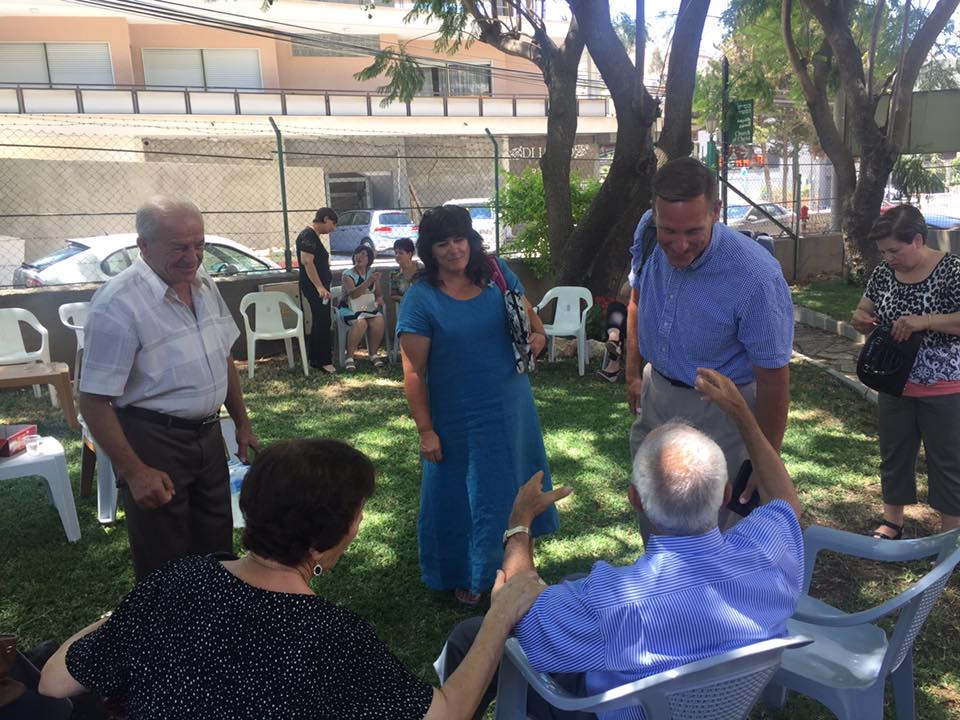
The two Sundays Kathy and I spent in Israel were with the church in Nazareth, about two hours north of where we are staying near Jerusalem. An interesting fact in a nation where an overwhelming majority of citizens are either Jews, the largest group, or Muslims, still a significant, but smaller group, is that there is a fairly small number of those professing to be Christians. The congregation in Nazareth, which has around 40 members, is comprised almost entirely of Arab people. As I spoke with one of the men yesterday, he said something that will stay with me a long time. He talked about how Arab Christians are viewed by their fellow-citizens. If Jews sees him standing beside a Muslim, they think he’s a Muslim. As most Arabs in Israel are Muslim, that seems logical. They see him as a potential threat and enemy. But, Arabs who find out he’s a Christian, and there are so many ways to readily see he’s not a Muslim–clothing, customs, etc.–see him as infidel or even a traitor. His remarks were in response to the sermon I preached from 1 Peter 2:21-25 on how Jesus handled persecution. He says that the Arabic Christians can tend to feel like people without a country.

Now, while you and I do not share the unique circumstance of Arab Christians in Israel, there is a similarity we see from earlier in 1 Peter 2. Peter tells Christians, “ Beloved, I urge you as aliens and strangers to abstain from fleshly lusts which wage war against the soul. Keep your behavior excellent among the Gentiles, so that in the thing in which they slander you as evildoers, they may because of your good deeds, as they observe them, glorify God in the day of visitation” (11-12). We’re going to “look” different, abstaining from fleshly lusts. We’re going to “act” different, keeping our behavior excellent doing good deeds. Whether we physically look like the people who observe us or we look different from them, our Christianity will be noticeable and observable. That’s not the same as doing your works in order to be seen of men (Mat. 23:5). Instead, living the Christian life–no matter what–will inevitably catch the attention of the people around us. 

I’m grateful for the object lesson I received. Pray for our Arab brethren, men and women in a spiritual sense who are “without a country.” Pray for our brethren in places where their faith in Christ is scorned and more overtly persecuted. Pray for us, that we will be salt and light which stands out and stands up for Jesus in our daily places where darkness persists.

19990219_10154823106870922_5613897177568887225_n
John and Carla learning a few Arabic words and phrases from the local Christians.

Do Brotherhood

Neal Pollard

Hayden Holland, who obeyed the gospel less than three years ago, taught his first Bible class last night at Teens in the Word. It was an excellent, hour-plus long study of the parallels between serving in the military and living the Christian life. In this very practical study, Hayden mentioned the Army’s concept of brotherhood. The fraternity and bond built by basic training and the structural philosophy of the armed forces creates this sense of brotherhood among soldiers.  Without fellowship, he said, disputes will pull soldiers apart. Throughout his lesson, Hayden urged us to “do brotherhood.” Brotherhood is a noun, meaning “the feeling of kinship with and closeness to a group of people or all people” (Dictionary, version 2.2.1, 2016). Peter uses the word in 1 Peter 2:17, a word, according to BDAG, meaning, “A group of fellow-believers, a fellowship” (19; cf. 1 Pet. 5:9—“brethren”). Hayden’s exhortation to us was to do what it takes to create that feeling and fellowship.  Saying we are brethren, even acknowledging and teaching what God says is necessary to become part of that brotherhood, is insufficient of itself.  There is something to be done!

He directed us to the seven values touted by the army—“loyalty, duty, respect, honor, integrity, courage, and selfless service”—as examples of how we can “do brotherhood” in the Lord’s Army (cf. Eph. 6:10ff). Doing brotherhood means taking time to listen to and help our brothers and sisters in Christ when they are struggling. It means spending time together, engaging in each others’ lives. It means being faithful to live out what we say we believe daily, in the world and in the absence of our church family, because we love them and don’t want to let them down. It means talking out our problems and disagreements. As we work to see ourselves as a part of something bigger than just ourselves, the effect is revolutionary. Non-Christians see the bond we have with our brethren and it draws them. Jesus told His disciples that this brotherly love would be their identifying mark to a searching world (John 13:34-35).

How often it has been observed that Christianity is more than a state of being; it requires a life of doing. The brotherhood consists of all those within the body of Christ. But, that “group” has to be maintained, sustained, and retained. Such requires action! My action and your action. Let’s be sure we are “doing” brotherhood!

17862689_10212031358357411_591145317067498345_n

Identifying As A Christian

Neal Pollard

There are so many “identifying” stories these days. A white woman, Rachel Dolezal, identifying as a black woman, was back in the news over the weekend. A biological female who identifies as male and has taken testosterone, Mack Beggs, won the Texas girls wrestling title. In a recent interview, Dr. Keith Ablow suggested that such delusional (he is using the term in a psychological, not pejorative, sense) reasoning opens the door for a young person who “identifies” as a 65-year-old to receive Medicare benefits (foxnews.com). Really, every new case of “identifying” reveals the absurdity behind the thinking. All the wishing, wanting, and hoping in the world cannot change ironclad facts. As we used to say discussing reality of any kind growing up, “It is what it is.”

If there is anything more harmful than delusion, it may be denial. For centuries, good, sincere people have claimed to be Christians who have not followed what the New Testament reveals is necessary to become one. They have followed some humanly-devised plan or idea (accept Jesus in your heart by faith, say a prayer, believe the Holy Spirit gives you an experience of grace, etc.). Leaders and teachers who have devised such ideas do not do so from a sustainable, biblical source.  Repeatedly, whether in the gospels (Mark 16:16), the book of history (Acts 2:38; 22:16), or the epistles (Rom. 6:4; Gal. 3:27; Col. 2:12; 1 Pet. 3:21), we find a simple, but essential, act that stands between one not being and being a Christian. But the idea that one can fail to do this and still be a Christian is pervasively taught, believed, and practiced.

Akin to this is the belief that one can claim to be a Christian, then live any way they wish. Their speech, conduct, and attitude can exactly mirror and mimic the world’s. Their aspirations, pursuits, and values can be completely worldly. But, when death visits a loved one or comes to them or at some similar time when it would be advantageous to claim so, they aver that they are a Christian. While they may have followed God’s plan to become one, they think of themselves as saved and safe even while walking in darkness (cf. 1 John 1:6-9).

It takes more than a claim. Facts are stubborn things. The ultimate source of what is factual is God’s Word. It educates us about gender (Gen. 1:27) and race (Acts 17:26). It educates us about who a Christian is (Acts 2). It educates us about faithful Christian living (cf. Rom. 12:1-2). If we wish to be accurate in the way we “identify” ourselves, we must let Scripture inform our view!

rachel_dolezal_speaking_at_spokane_rally_may_2015