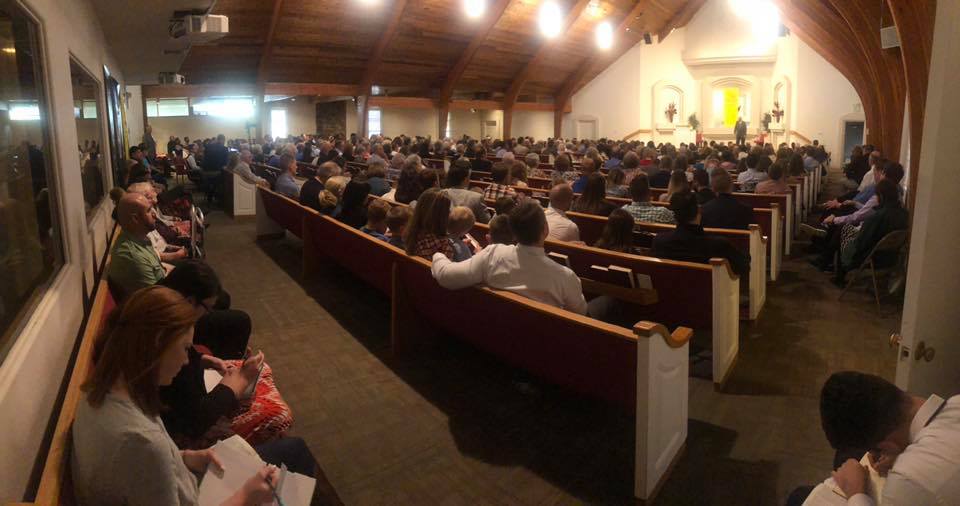
The Road To Involvement

Neal Pollard

Recently, I asked a man about how he and his family got to be so active and faithful in their service to Christ. He said that at one time they were those members who came to church services, spoke to a few people, then left. Attendance was sporadic and they were convinced that they did not know how to elbow their way into the various works going on.

He explained how that changed for them. As their kids got older, they made themselves go to every service regularly, to every church event that was announced, and even took time off to go to Bible camp. He and his wife both started teaching and saying yes to doing things, no matter what. This was intentional. They were not happy just being those people sitting in the pews watching things happen.

At some point, he explained, people started noticing and asked them to do more. The elders started asking them to take on more. Other Christians encouraged them in different ways. Now, being busy is who they are. They could not go back and be happy, just sitting there waiting and not doing anything. Their formula was profoundly simple. Be present and available.

Church leaders have a definite responsibility to equip “the saints for the work of service” (Eph. 4:11-12). The word equipped there means ” to make fully ready” (Zodhiates, WSNTDICT, np). Elders, with the help of preachers and other members, provide ministries and works to accomplish the overall work of the church. Through various ways, they enlist the help of members to get it done. They communicate and even train.

So, what are the saints’ responsibility? Ephesians 4:16 says each individual part must be in “proper working” order. That starts by being present and available, volunteering, and saying yes to things. This family has really drawn a roadmap to involvement. Or, at least they are doing a great job of following God’s inspired roadmap. Let’s be like the very first Christians, who “were continually devoting themselves to the apostles’ teaching and to fellowship, to the breaking of bread and to prayer” (Acts 2:42). Such a condition is so often contagious!

Five Ministry Ideas For Member Involvement

Tuesday’s Column: Dale Mail

Dale Pollard

You must have a plan. If the leadership has no plan to grow, then the members don’t have a path to follow. According to one Gallup poll taken in 2020, 47% of adults are affiliated with a religious group of some kind in the U.S. Those numbers drop even lower after considering the amount of members that make up the Lord’s church. Of that remnant, the faithful are in the minority. Knowing that God is able to help His church grow is one thing, but creating an environment that encourages growth is another. According to Paul, the more streamlined and dynamic we can be in our service to Him, the more growth occurs. 

“…from the whole body, being fitted and held together by what every joint supplies, according to the proper working of each individual.” 

  • Ephesians 4.16

So let’s simplify it. 

A growing environment focuses on two areas: 

A. For Spiritual Growth…

  • Have an excellent customized Bible curriculum
  • Focus efforts on the worship service planning 
  • Emphasis on group focused programs (teens, young adult, & seniors) 

B. For Numerical Growth…

  • Plan to grow your staff (outreach minister, youth minister, co-minister/associate) 
  • Look for needs and create jobs/ministries to fulfill those needs by getting others involved. Churches are often stagnant because there aren’t enough outlets for all members to plug in. 

Five Job Ideas For Church Families 

  1. Social Tech Team: Perfect for a youth group looking to get involved in public communications. Facebook, Instagram, church websites, podcasts, YouTube channels, e-banners, PowerPoint slides, and numerous other lights to help your “city” (Mat. 5:14) become more visible. Online presence is crucial and a team of young people seem perfect for that job. 
  2. Scoop Squad: There are visitors who walk in the back door each Sunday and for some reason they aren’t all coming back. What if your congregation had a few folks who have taken it on themselves to seek them out in the crowd and invite them to lunch? To their home? A cup of coffee? These people are soul focused and they’re determined to keep visitors coming back to hear more about Jesus. 
  3. Conversion Crew: Appoint someone with a passion for soul winning to head up a group that’s passionate about training others in the art of conversion. The more capable teachers you have, the more likely your members will invite the lost.
  4. The Howdy Boys: There’s nothing better than a warm smile and a handshake to make your presence in the room feel appreciated. The Howdy Boys (or the Welcome Women?) excel in conversation. They’re extroverts who can make a visitor’s first experience a stress-free one. After all, they get more than a “howdy” from a stranger. They’ll get directions to the nearest child care room, bathroom, classroom, and coffee room. Side note, “Caffeinated Christianity” isn’t a bad Bible study group name. 
  5. Builder Brigade: The question, “where can I help?” isn’t bad unless there isn’t an answer because there aren’t any options. Having a person(s) to help others find where their talents can bring Him the most glory is invaluable. If one were to place membership and then their talents were quickly put to work, the chances that apathy set in go down. Remove that “checklist mentality” by removing the option to simply attend without any responsibility. A team designed to create jobs or help others find their job is an important job. 

“You’ll End Up Naming Everybody On The Team”

1280px-walter_johnson_and_calvin_coolidge_shake_hands_final

Neal Pollard

Quirky closer (a redundant statement) Sean Doolittle was interviewed last week right after the Washington Nationals clinched the city’s first trip to the World Series since FDR was first inaugurated there. Asked how they did it, Doolittle said, “I think once you start naming guys that stepped up in different ways, you’ll end up naming everybody on the team. We got so many contributions from different guys who had to embrace new roles. There are so many examples of that up and down this team” (MLB.COM). That’s frequently the testimonial of winners. It takes everybody pitching in and doing their part, All-Stars or role players, starters or reserves, veterans or rookies. However you distinguish between them, each person must step up and successful teams do just that!

Have you thought about how the church was designed to be that way? Congregations successful in executing the mission of Jesus are filled with members who step up in different ways, make contributions, embrace new roles, and exemplify team spirit. Paul tells us that “we are to grow up in every way into him who is the head, into Christ, from whom the whole body, joined and held together by every joint with which it is equipped, when each part is working properly, makes the body grow so that it builds itself up in love” (Eph. 4:15-16). Notice the all-inclusive wording of Paul, pointing out what Jesus desires for His church. “Grow up in every way…” “From whom the whole body….” “Held together by every joint….” “When each part is working properly….”

God expects each of us to step forward, using our talents, opportunities, financial blessings, influence, time, energy, and intellect to reach lost souls, strengthen the church, and meet needs. A church filled with people stepping up and embracing Christ’s mission will stand out in a community and glorify God. We will grow and be built up. 

In 1895, Vilfredo Pareto observed that society divided into what he called the “vital few” and the “trivial many.” There is a top 20% and a bottom 80%. From such a genesis, we ultimately got the 80/20 rule, that 20% of the people in an organization do 80% of the work (Explained here: FORBES.COM). Maybe, we’ve heard that so much that we’ve just resigned ourselves to it being a universal truth. Do not be content until you discuss the growth and work of this church, and by the time you’re done “you’ll end up naming everybody on the team.” That’s the goal! Let’s pursue it!


I-N-V-O-L-V-E-M-E-N-T Equals Church Growth

Neal Pollard

The early church grew (Acts 2:41; 5:14; 6:1,7; 9:31; 11:24). As we read of this growth explosion, we see the key role member involvement played. Christians were spreading the word (8:4), involved in each other’s lives and in the lives of the lost around them. This is such a simple concept, but churches not practicing it are not growing. What is involved in involvement?

  • I–“I” am the heart of involvement. I must resolve to be involved. I must do my part, for I will give an account for my level or lack of involvement (1 Cor. 3:8).
  • N–“Negativity” is the enemy of involvement. “I can’t help.” “It won’t do any good.” “I don’t like working with that person.” Listen closely. Involved Christians rather say “I can do” (Phil. 4:13) and “we are well able” (Num. 13:30).
  • V– “Visitation” is a part of involvement. Matthew 25:34-46 confirms it. Non-Christian visitors, sick, imprisoned, and needy folks need it. Those who do it are richly rewarded, and those who are recipients of it profoundly appreciate it.
  • O– “Obedience” is the cause of involvement. Faithful Christians believe the commands to make disciples (Mat. 28:19), build up brethren (Rom. 14:19), and meet needs (Js. 1:27).
  • L– “Love” is the motive of involvement. Paul says good deeds, without love, are profitless (1 Cor. 13:1-3). The counsel of Scripture is “by love serve one another” (Gal. 5:13).
  • V– “Victory” is the goal of involvement. By being involved, we help others win the victory (Js. 5:19-20), we help the cause of Christ advance, and we aid our own walk in the light that leads to eternal reward (1 Jn. 1:7).
  • E– “Everybody” is the scope of involvement. What able-bodied Christian is excluded from the work God has given the church? Once, a man did nothing and gave every excuse imaginable. We remember how that turned out (Mat. 25:28-30).
  • M– “More” is the adjective of involvement. That is, “more involved” and “more people involved.” Has there ever been a church with too many involved? God is able to do more than we ask or imagine (Eph. 3:20), and He wants to see us always trying to do more for Him!
  • E– “Evangelism” is the fruit of involvement. Active churches attract the curiosity of the community. Those involved in the church’s work naturally grow more spiritual-minded, and by this grow more bold in sharing the gospel.
  • N– “Now” is the time for involvement. What in our lives do we definitely know will change between now and the never-seen tomorrow (Prov. 27:1)? Let’s kill the excuses! Resurrect the enthusiasm! Start today!
  • T–“Teamwork” is the mindset of involvement. We’re to work together. No one man, no staff, no eldership, no group of deacons or others can or should do the work of an entire congregation. The local church is a team.

To become adequately involved, let’s ask three questions.

“What needs doing in this church?”
“Who needs help in doing it?”
“What can I do?”

Be an Isaiah, a child of God who enthusiastically says, “Here am I, send me” (Isa. 6:8)!

41824748_10216815660249540_2034412809957146624_n

I Am Not Irreplaceable 

Neal Pollard

It is said to have housed between 400,000 to 700,000 scrolls containing essentially everything that had been written up to its point in time. But the Royal Library of Alexandria, Egypt, was eventually destroyed. The first residential university, home to perhaps 2000 teachers and 10,000 students from the fifth to the 12th century in Nalanda, India, was destroyed by the Turks and never rebuilt.  In the heart of Germany was an opulent room, a thing of beauty so incredible some called it an eighth wonder of the world and said to be worth $142 million in today’s money. But the Nazis destroyed The Amber Room. The same can be said of Herod’s Temple, the first library of Japan, the first Byzantine encyclopedia, and countless other artifacts, buildings, and writings (via historyofinformation.com). 

How many considered these institutions and items that which would endure forever? Of course, Jesus warned that the things of this world cannot last (Mat. 6:19-20; cf. 2 Pet. 3:10ff). 

Most Christians understand that principle. We know material things cannot and will not last, being eventually effaced by the hands of time. But what about us? We rightly preach how the church needs us and that each of us fills a unique, needed position in the body of Christ (Eph. 4:16; 1 Cor. 12:18). As long as we have health and opportunity, we need to leverage our talents for the good of the Lord’s kingdom. Wherever we’re planted, preachers, elders, teachers, deacons, professors, directors, presidents, house parents, custodians, secretaries, counselors, etc., we need to give the Lord the best we can for as long as we can. 

But, no matter how effectively we are doing our work and what results we are seeing, we are not irreplaceable. What a horrible day it must have been for the church when Paul and Peter were martyred. Yet, the church continued its work (cf. Dan. 2:44). The same is true today. This will prevent any of us from feeling too big for our britches. It’s also a good reminder for the church itself, who may place too much importance on a single individual. Truly, some people leave big shoes and large holes to fill. But, it shall stand until Christ comes again. Perhaps one’s leaving a work (however that occurs) will force someone (or several someones) to step up and carry on the work. So much good can come from that!

Let’s do our best for as long as we can and trust that God can continue to work through men and women to continue his work after we no longer can!

16281785391_6dd2d073ae_b


Producers Versus Consumers

Doug McNary

Allow me to take you back to the early 1930’s, when the U.S. economy was in the throws of the Great Depression. It was a time of record setting negative economic growth. Many Americans lost their means to sustain basic life functions. Many Americans lost all Hope.

At the time, President Herbert Hoover believed in the importance of the role of individuals in society and the economy.

He said, “Economic depression cannot be cured by legislative action or executive pronouncement. Economic wounds must be healed by the action of the cells of the economic body – the producers and consumers themselves.”

Now, let us fast forward to the church today. We find the church in a time of record setting negative growth. And according to a 2014 Pew Research Study, less than 27% of Millennials (defined as ages 18 to 35) regularly attend religious services. Yet, 67% say they believe in a heaven and 84% think there is a God. So, what does the mean?  

I think deep down inside, millennials believe there is a God, but worldly distractions and alternate priorities keep them from contemplating what that really means. A lack of understanding or knowledge of the truth translates into a lack of action. Their ignorance may lead to eternal demise.

So, let’s rewrite Hoover’s insight:

“Church growth cannot be cured by the action or pronouncement of church leaders. Church wounds must be healed by the actions of the members of the church body – the producers and consumers themselves.”

Church growth will not be achieved by elders, deacons or preachers alone. It must be cured by each of us also doing our part.

So I ask myself, “Am I a producer, or a consumer?”

In Matthew 5,  Jesus said,

“You are the light of the world. A city set on a hill cannot be hidden; nor does anyone light a lamp and put it under a basket, but on the lampstand, and it gives light to all who are in the house. Let your light shine before men in such a way that they may see your good works, and glorify your Father who is in heaven.”

Honestly, I have been a consumer long enough. I sit in my pew every worship service, I do my daily bible reading, and dwell on God’s word… I have been a faithful Christian, with a proverbial basket over my head.

I want to be a producer…

–Sharing, Caring, and Acting to make a difference for the Lord’s church.

I want to be a producer…

–Proclaiming to others the Truth found in the Bible.

I want to be a producer…

–Openly Praising the Lord, each and every day, in my words and actions.

I want to be a producer…

–Participating in the building up of the body of our church by being involved in the work of the church.

I can no longer be just a consumer, I want to be a producer… Finding creative ways to prick the heart of a lost soul, for the sake of Christ!

Now here is the challenge:

I want to do these things… But, will I?… And how about you?

My brothers and sisters, I pray that each one of us can get up out of our “consumer” pew and DO Something Each Day to help our Lord’s church grow! I pray that we can all become “producers” for Christ.

I leave you with this thought…

In one of my favorite movies, Shenandoah, Jimmy Stewart played the role of the father, Charlie Anderson. He sat at a campfire with his family as they were searching for his lost son. They were all about to give up hope when Charlie said: “If we don’t try, we don’t do. And if we don’t do, why are we here on this earth?”

Brothers and Sisters, if we truly love the Lord’s church, we must try, we must do!

nakedspur_trailer_3

Going Places (GUEST BAKER: Trent Woolley)

Trent Woolley

The other day I stumbled upon this rather innocuous quote – “Once a year, go someplace you’ve never been before” (Life’s Little Instruction Book).  Obviously, this quote is talking about travel, but I would like us to think of it as challenging ourselves to do things that we may have never done before. So, let’s take a look at some things that might help us, as a church, go places that we may have never been before:

  •   Volunteer to teach a class, or help teach a class, or help teach others how to teach a class
  •   Offer to pick-up someone who needs a ride to church
  •   Spend a month at the greeting table getting to know our visitors
  •   Prepare and present a 90 Seconds of Power
  •   Pray with an elder
  •   Commit to visit all the shut-ins this year
  •   Write a note of encouragement to all our members whose last name begins with R,
  •    or M, or C…
  •   Host a devotional for: the teens, the young professionals, the young families, the
    tweeners, the seniors
  •   Teach the congregation a new song, or an old song we don’t know
  •   Stand at one of the doors and greet everyone who comes in

    This is just a short list of some places we might have never been before, I’m sure
    there are other places that we all would like to try and go to.

    And if we start to think “I can’t do that”, let me remind us of what God tells us in Joshua 1:9: “Have I not commanded, you? Be strong and courageous. Do not be frightened, and do not be dismayed, for the LORD your God is with you wherever you go.”

night-camera-lens-map


Each One Will Bear His Own Load

Neal Pollard

Ulm Minster, a Lutheran church building in southern Germany, is the tallest church building in the world, has the tallest steeple in the world, and is the 4th tallest structure built before 1900. Construction began in the 1300s and was finished in 1890. The masonry building is thought to be the tallest load-bearing brick or masonry building in the world. That means that each brick supports its own weight (Wells, Matthew. Skyscrapers: Structure and Design, King: London, 2005. p. 8).

In Galatians 6, Paul urges Christians to reach out, gently and introspectively, to help a fallen brother (1). We do so because it is the fulfillment of Christ’s law to help each other (2). None of us is above this (3). But at the same time, we have personal accountability (4) and responsibility (5). The example, in context, is financial support of the Word rather than fleshly indulgence (6ff). But a fair application of this principle extends to the need we each have to pull our own weight. Just as I need to help others in need, I need to realize my need to stand on my own two feet. What are some areas where the individual Christian must bear his own load?

  • Involvement in the work of the church. 1 Corinthians 12 tells us every member plays a vital part to the overall function of the body. I cannot just be a pew-sitter. I must be at work. When I hear announcements about needs or opportunities, I should not console myself thinking that others will do it. Let them do their part. I must do mine.
  • Financial contribution to the church. Being in a generous, giving church is no substitute for my personal obligation. The command is to “each one of you” (1 Cor. 16:2; 2 Cor. 9:6-7).
  • Personal relationship with God. A godly spouse, parent, or child is a wonderful asset in our lives, but none are a substitute for my own faith and intimacy in the relationship with God. No one can say my prayers, read my Bible reading, or walk my walk with the Lord.
  • Battling temptation.  Temptation is common to all men and escape is available to every man, but none can do the escaping for me (cf. 1 Cor. 10:13). I can draw strength from others and receive prayers from others and confess to others, but it is ultimately a battle I must win, with God’s help, in the trenches of my own life.
  • Being an encouragement to those in need. The exhortation to “therefore encourage one another and build up one another” (1 Th. 5:11) is very personal. The uplift I give is uniquely mine and no one can give this in the way that I can.
  • Visiting those who are sick, in prison, and the like. Matthew 25:31-46 puts the individual in the Judgment before Christ. That means I will answer for whether or not I did this, whether preachers, elders, deacons, or others did.
  • Meeting benevolent needs. The same passage challenges me in meeting the physical needs of those around me. Paul makes it personal, too, in Galatians 6:10.
  • Loving the brotherhood, with each individual brother and sister. This is to be the trademark trait of a disciple of Christ (John 13:34-35). And, it is individual (cf. 2 Th. 1:3). As I measure how I treat, talk about, and think about the spiritual family, am I bearing my load?

Pink Floyd was pessimistic when they said, “All we are is just another brick in the wall.” But, there is such an exciting prospect when we consider that we make up that holy temple to the Lord (Eph. 2:19-22). When all of us, as individuals, bear our part of the load, more and more growth and expansion is possible! Help each other, but do your own part. It’s the way Christ wants it.

ulmer_mc3bcnster-westfassade

Christian, Who Are You?

Neal Pollard

  • You Are An Insurance Agent—Life (Philippians 2:16), Health (cf. 1 Peter 2:24), and Fire (2 Peter 3:9-10).
  • You Are A Tour Guide (1 Peter 2:9; Acts 8:31).
  • You Are A Soldier (Ephesians 6:10ff; 2 Timothy 2:1-3).
  • You Are A Slave (Romans 6:17).
  • You Are A Firefighter (Jude 23).
  • You Are An Ambassador (2 Corinthians 5:20).
  • You Are A Priest (Revelation 1:6).
  • You Are A Conductor (2 Corinthians 2:14; 9:11).
  • You Are A Day Laborer (John 9:4; cf. Matthew 20:1ff).
  • You Are A Farmer (2 Timothy 2:6; Luke 8:5).
  • You Are A Fisherman (Matthew 4:19).
  • You Are A Gem Distributor (Colossians 1:27).
  • You Are A Taste Tester (Colossians 4:6; Hebrews 5:14).
  • You Are Royalty (Revelation 1:5-6).
  • You Are A Student (2 Timothy 2:15).
  • You Are A Body-Builder (Ephesians 4:16).
  • You Are A Restorer (James 5:19-20; Galatians 6:1).
  • You Are A Physician’s Assistant (Hebrews 12:12-13; cf. Mark 2:17).
  • You Are A Standard-Bearer (Philippians 3:16; 2 Timothy 1:13).
  • You Are A Builder (1 Corinthians 3:10).
  • You Are A Judge (John 7:24; 1 Corinthians 6:2).
  • You Are A Nutritionist (1 Timothy 4:6).
  • You Are A Maintenance Worker (Phlippians 2:2; Titus 3:8,14, KJV).
  • You Are A Cleaner (2 Timothy 2:21; James 4:8).
  • You Are A Runner (1 Corinthians 9:24; Galatians 2:2; 5:7; etc.).
  • You Are A Boxer (1 Corinthians 9:26).

I’d be amazed if I did not leave out several of our job titles and descriptions. Suffice it to say that there is plenty of work for all of us to do. The next time we find ourselves figuratively twiddling our spiritual thumbs, wondering how we can be involved, let’s draw from the exhaustive inventory of tasks the Lord has left us!  Remember, “Whatever you do, do your work heartily, as for the Lord rather than for men” (Col. 3:23).

laborer

Tools In God’s Toolbox

Neal Pollard

Romans 6:13 tells us our body is an instrument, and we choose to use it for righteousness or unrighteousness. The Greek word translated “instrument” there means “tool or weapon.” What kind of tool or weapon are you? Are you an instrument God holds in His hand to do His will?

  • Are you a battering ram? The ancients would use a log or some other hard object to break down a wall or door. Have we filled our hearts with the Word to the degree that we can, speaking the truth in love (Eph. 4:15), break down barriers keeping the honest-hearted from God?
  • Are you a crowbar? Crowbars pry objects apart. There are things we should separate from our thinking and lifestyle. Are we trying to pull away from worldliness (Js. 4:4)?
  • Are you a chisel? This is a tool that does meticulous, detailed work. Its blade carves or cuts hard materials. Do we have the tenacity and trust needed to use God’s Word and benefit from His providence to remake our lives into the image of Christ (cf. 2 Co. 3:18)?
  • Are you a level? We live in not only a dishonest world but also a corrupt world. So many call good evil and evil good (Isa. 5:20). Can people find in us a reliable standard of right and wrong, as we reflect the principles of God’s Word? Levels are used to determine whether something is true and as it ought to be.
  • Are you a plane? The plane smooths rough surfaces by repetitiously moving back and forth across the surface. All four Gospels (Mat. 3:3; Mk. 1:3; Lk. 3:4; Jn. 1:23) speak of John the immerser’s work as making ready the path of the Lord, making His paths straight. We are not forerunners of Jesus; we follow in His steps (1 Pe. 2:21). As we do follow Him, we are going to forge a path safe for others to follow (1 Co. 11:1).
  • Are you a magnet? A magnet is an object that draws and holds another object disposed toward such attraction. Magnets can be used as tools themselves, but they are often made a part of other tools, such as hammers and screwdrivers. By living like Jesus, you will draw people to Him.

Paul also referred to “tools” or “weapons” when talking to the Corinthians. He mentions “armor of righteousness” and “weapons of our warfare” (same word). In both cases, the tools or weapons are spiritual and figurative, yet with them we can help shape and build up those around us. Be a tool in God’s toolbox!

toolbox_226362564


A LOOK AT SOME GREAT MEMBERS

Neal Pollard

Anything special, big and worthwhile a church attempts, be it a new program, evangelism, visitation, the Bible School, or a lectureship, will fail if it rests only on the shoulders of the elders, preachers, or select few. The late Wendell Winkler was fond of saying, “Programs do not work. People do.” Programs are only as effective as the people in the local church work to make them.  It is estimated that nearly a gazillion little things must be done for something of any magnitude to go smoothly, and the active, tireless labor of as many as possible makes all the difference.

Active members are so crucial to a church being successful, in God’s eyes. Here is a tribute to some very special members of a congregation:

The REMEMBERS: These are the folks who don’t “forget” events on the church’s calendar, who don’t say “Oh, was that this week?”  As you involve yourself in the church’s work, you take seriously the ever-relevant principle, “But you shall remember the LORD your God…” (Deut. 8:18). God does not like to be forgotten (Psa. 42:9; Jer. 2:32; Ezek. 22:12).

The DISMEMBERS: These are folks who are willing to sever themselves from their normal routines, preempting other events, to support an activity or event.  Such are living out Matthew 6:33 and Romans 12:1-2. God richly blesses Christians who make such decisions.  You are those who know it is better to “cut off” anything that keeps you from doing what you can for the Lord (cf. Heb. 12:1).

The EMBER MEMBERS: These are members who are involved, supporting the works and activities of the church. You have your fire lit. You want to be a better child of God. Keep the fires of enthusiasm, rededication, and determination burning brightly. We see your glow. It encourages all of us. You can help smoke out spiritual enemies even better through your faithful participation.

God bless every faithful member of His church. Your support for good works is overwhelming.  Let us use each event and opportunity to make the church, with its every member, stronger.

WHAT ABOUT ME? (POEM)

Neal Pollard

My sister is taking a meal to the sick
My brother has gone a wayward one to see
They both were busy, no “convenient” time to pick
But what about me?

They invite their neighbors to come to church
Have over people with frequency and glee
For good deeds they seem to constantly search
But what about me?

He’s a leader of others, she’s winsome and sweet,
He’s teaching the class, she’s full of hospitality,
They’re meeting the visitors, their lunch they will treat,
But what about me?

My life’s not more complicated, my resources so few,
That some little something I just cannot do
God wants me to warm so much more than my pew,
Others are active, and I can be too.

I don’t have to do some dramatic, huge act,
But with little needs every life’s brimming and packed,
If I could be impressed with just one simple fact,
I can supply something where once it had lacked.

I’ll look at life differently today, as I can,
Will spring to my feet after bowing my knee,
When asked, “Who’ll help this child or woman or man?”
I’ll say, “What about me?”

workshop-in-the-word-2007-281.jpg