Greatest In The Kingdom Of Heaven

Monday’s Column: Neal At The Cross

pollard

Neal Pollard

I stood at the doorway of her humble apartment in a small Kentucky town. This Christian woman in her mid 80s, mother of three and newly-widowed, was adopted by the local church and seen after especially by a son who lived in the same town. I had received a sweet letter from her, expressing her appreciation for the great work being done by especially World Video Bible School. Her former preacher in the 1990s had introduced it to her, and she told me that she gave their DVDs away all the time.

Between the time I received her letter and dropped by her home, I talked to another lady in that same, small congregation. She praised the character and good works of the woman who wrote me the letter. I was told of the various hardships and challenges faced by my penpal. She was raised in religious error, but learned the truth from her husband’s family. The husband never obeyed the gospel and did not encourage her faith. Despite being subject to cruel treatment, she was not only a faithful, submissive wife, but she was full of righteous works. She became a walking Bible, the fruit of tenacious daily Bible study. She has written, supported, and encouraged missionaries all over the world for over 40 years. For decades, she has graded Bible Correspondence Courses

The woman I met had the humility and sweet spirit of a child. She bore the marks of hardship, having undergone hip replacement and other maladies of aging and falls. But the thing that struck me was the twinkle in her eye and the genuine joy she has in being a Christian. As she talked about her life and as I had ultimately heard about her life from a few of her church family members, I could not help but think that this woman has suffered so much physically and emotionally. But you could not tell it from her attitude and disposition. The gentle enthusiasm I first read in her writing translated to a winsome smile and zeal face to face. 

She had been weathered and battered by life, yet she had all the marks of a triumphant overcomer. Still faithful to meet with the saints every time the doors are opened, she lives Christ in her daily life. I could not help but think of the woman Mark tells us about in his gospel, the one who anointed Jesus’ head with “an alabaster vial of very costly perfume of pure nard” (14:3). In praising her “good deed” (14:6), Jesus summed it up by saying of her, “She has done what she could” (14:8). No one knows this dear sister across our brotherhood. She’s not an author, public speaker, gospel writer, or appointed church leader. But she epitomizes greatness as defined by Jesus.

I left my visit doing some serious self-examination. How’s my attitude? What am I doing with what God has given me? How am I blessing the lives of others? When others have been around me or speak about me, what characteristics come to mind? Every life is given a variable amount of resources and opportunities (Mat. 25:14-30). We will account for how we used them. Have we tried to tell others about Jesus? Have we reminded others of Jesus? Helen reminded me of my Savior! I left resolved to be more like her, trying to imitate her as she so clearly imitates Him (1 Cor. 11:1)! 

Considering Our Legacy

Friday’s Column: Brent’s Bent

brent-portrait

Brent Pollard

Have you ever heard of a necropolis? It means a “city of the dead.” We are most likely familiar with the necropolises left by the ancient Egyptians, but they exist among other cultures as well. For example, there is a necropolis near Dargavs, Russia. They say that if you look inside the windows of the “houses” in this city, you can see the inhabitants with their possessions. Unlike Egypt, Russia’s necropolis, which I’ve referenced were for the commoner. There are about 10,000 “residents” of this necropolis. Such monuments to the dead fascinate me. Why do men build such monuments and, indeed, cities for the dead? 

I think the word that most often comes to mind is legacy. People want to leave a legacy, the proof of their existence. Legacy derives from the Latin “legate.” A legate was a post in the Roman army. The Roman Senate tasked a general with a particular task which the soldier faithfully performed. It is not difficult to see how the word evolved likewise to indicate a messenger or diplomat. By the middle ages, a legate became someone executing another’s will. Thus, as we think of our legacy, we are referring to that which outlives us. It is something testifying about our life. It serves to impart a message or gift to the future. 

The Hebrews’ writer says Abel left such a legacy. “By faith Abel offered to God a better sacrifice than Cain, through which he obtained the testimony that he was righteous, God testifying about his gifts, and through faith, though he is dead, he still speaks” (Hebrews 11.4 ). The remarkable thing about Abel’s legacy is that God serves as his Legate. Thus, God provides this testimony about the departed Abel. Hence, one cannot doubt the truthfulness of the testimony. That, friends, is better than any pyramid or endowment. 

Men often praise those unworthy of such following their demise because they held power or prestige. Plus, their efforts to honor the deceased eventually come to naught. Again, I am mindful of Percy Bysshe Shelley’s poem, Ozymandias. A traveler tells of a monument upon which he happened. The monument’s inscription suggests the visitor look upon his works and despair. But there was nothing but a desert waste as far as the traveler could see. Even so, the fictional Ozymandias was so proud. He was confident in his legacy, which decayed with time. 

As we contemplate our legacy, we may think of progeny to carry our DNA into the future. God even says that children are a reward (Psalm 127.3). But we are powerless to change the people our offspring become in adulthood. Yes, we trust Solomon’s proverb about a trained child not departing from the way (Proverbs 22.6). But we know this is not universal. Therefore, future generations may soil one’s genetic legacy by their conduct. This phenomenon was undoubtedly the case with the few righteous kings of Judah, whose sons often did evil in worshipping foreign gods. 

No, the only suitable legacy is one whose Legate is God. Like Abel, we need to ensure that our deeds please Him to Whom we must give account. Our righteousness is like “filthy rags” (Isaiah 64.6 KJV). But when we are faithful, like the man with five talents, we will be welcomed into the joys of our Master (Matthew 25.20-21). It may be that when I “shuffle off this mortal coil,” none but my family and close friends will note my passing. If I have the testimony of God, though, I will have something far greater than any monument people may leave for me. So, strive not for earthly accolades or a fleshly heritage. Instead, work to ensure that God provides your eternal legacy.  

Parkour

Wednesday’s Column: Third’s Words

garyandme521

Gary Pollard

What is faith? I don’t have faith in my parkour abilities. My lack of faith comes from several factors: basic safety awareness, physique, and reality. Because of this, I have little or no confidence in my ability to scale walls. Faith is rational confidence. We’re confident about things we understand and have experience or proficiency with.

Faith in God is confidence. We’re confident that God exists. We’re confident that he made everything. We know he loves us. We know he’s coming back. We know that faithful people get to live with him.

A faithful Christian is a rationally confident Christian. When we’re doing our best to live moral lives, we’re confident in grace. We’re confident in our destination. We have reason to have confidence in God because we’ve worked on knowing him. We have the Bible and creation itself to help us know God. The more we know him, the more confidence we have.

What if I want more confidence in my parkour abilities? I’d have to hit the gym like crazy and somehow become graceful. I’d have to want to develop that skill. Confidence comes from experience and knowledge.

What if we need more faith? Get to know God more. Pay attention to all of the ways life points to a much higher power. Get close to other Christians. Get excited for heaven. No one can walk away from that without more confidence in our awesome God.

The Truth Is Out There

Wednesday’s Column: Third’s Words


Gary Pollard

I believe that God exists. I believe that He communicated with His creation by direct contact, messengers, and a series of ancient texts. I believe that He wants His human creation to be with Him after they die. I believe that He expects those who claim to be His to act within the guidelines He set in those ancient texts. I believe that there is life after death and that where we go depends on whether or not we follow this God.

Why do I believe this, though? What reason do I have to believe in something I cannot experience with my senses? I was not there thousands of years ago when the prophets and Hebrews talked to God. I was not there when God came here to teach. I was not there when the authors of the original texts delivered their writings to the early church. The ancient texts translated into English sometimes do not effectively communicate the emotion of the words and concepts in the original language. So why do I believe these things? Why do you believe these things?

Think about this carefully. From Genesis to Revelation the message is clear: God wants His people to exist with Him after time is destroyed. This message was communicated to an impossible variety of people, sometimes separated by hundreds of years, thousands of miles, culture, kingdom, race, and language. There are tens of thousands of manuscripts of these ancient texts in many, many different languages. There are some 25,000 New Testament manuscripts or fragments that are separated by about a thousand years, at least 8 different languages, thousands of miles of geography, and many different cultures. Yet, they are at least 95% accurate to each other. The remaining 5% do not contain a single contradiction; rather, they are spelling errors, slips of the pen, writing on the wrong line, or minor variances (“God said” vs. “He said” or “and” vs. “but”).

Of the rich libraries we have of ancient literature, none can hold even the dimmest candle to the profound accuracy and unity of the scriptures. They could not have been produced by man alone. There had to be Someone not confined by time supervising each person as they wrote. Keep in mind, these ancient cultures did not have the advantage of modern communication. They were almost totally isolated from each other and would have known little of the others’ existence, much less what they experienced or wrote from God. Our Bible has supernatural origins and its contents reveal the nature of our Creator. What I believe comes from this book because I know it is God’s message to mankind. I encourage those who have not already done so to do an in-depth study of the origin of scripture. It is one of the most faith-building studies anyone could undertake. When you know with certainty that what you are reading contains the actual thoughts and desires of God, it bolsters your faith in ways I could not begin to adequately describe.

Mine!

Wednesday’s Column: Third’s Words

garyandme521

Gary Pollard

When I first got into shooting, I relied pretty heavily on what others believed. There was (and is) a wide range of opinions on which platforms are the best, which calibers are the most effective, or which subcultural group is the worst (mall ninjas, fuds, tacticool operators, etc.). Most hold their opinions with great passion and will advocate for their position vehemently. I never really enjoyed shooting with the platforms and calibers I initially chose because I made all of my decisions based on the preferences of people I respected and admired. There’s nothing wrong with this, but I did not yet feel as if the sport was truly mine. Several years later, countless thousands of rounds, and hours of research, and I’ve found my place. I prefer 9mm, Glocks or Caniks, Combloc, AR platforms, 6.5 Grendel is the best intermediate round, etc. In other words, it’s not an “inherited” faith. I like what I like based on the energy I’ve dedicated to study and practice.

When it comes to elements of our faith, how often do we challenge our personal beliefs? Unlike firearms – which are subjective and spiritually irrelevant – our faith is based on an objective standard. It is difficult to have a strong, personal faith if most of what we believe is based on what others taught us or what others believe. We may even adopt their beliefs because we admire and respect them as people. That’s not a great foundation. Humans are fallible!

Approaching scripture as a blank slate, asking only, “What does God want me to believe about ______?” is the best way to grow. The only opinion that matters is God’s! When we hear something that elicits an emotional response and seems to conflict with our current beliefs, we shouldn’t panic. God’s word determines validity. If we can approach scripture without bias, we’ll grow exponentially. Challenging our beliefs does more than simply refine our understanding – it forces us to take ownership of our faith. Not only will this cause growth, it will also deepen our love for God and our confidence in eternal destination!

On an elk hunting trip in Gunnison, CO, around 2008.

“Let Him Die”

Friday’s Column: Supplemental Strength

brent-portrait

Brent Pollard

It sounds like an ad pitch when you say 9 out of 10 doctors agree about something. Chewing gum manufacturers, for example, would talk about how many dentists concurred about the safe use and benefits of certain brands of gum. This past summer, at the height of a health crisis, my doctors, who swore an oath to “do no harm,” told my parents to let me die. Yes, 9 out of 10 doctors thought I’d be better off dead. They said that even if I could recover, I would have no quality of life. My parents would have none of it. Through threats of litigation, my dad “persuaded” them to take those measures that led to my return from the brink. Nine out of ten doctors were wrong. I survived. They were correct about the impact on my singing voice thus far, but none of the other dire predictions proved accurate. 

The 13th Surgeon General of the United States, C. Everett Koop proved himself an ally to the pro-life movement in the United States cautioning how abortion led to a culture of death where even euthanasia becomes acceptable. Koop saved lives as a pediatrician in his civilian life. So, he asked why he should support the destruction of the thing he had long sought to preserve. That is a good question. Doctors affirm their intentions by stating the revised Hippocratic Oath. And, as they do so, they promise not to play God. But unfortunately, what Koop feared seems to be on the horizon. In addition to doctors willing to be instruments of death, you find collaborators in society at large in pop culture and government. Perhaps you have heard of certain billionaire humanists extolling the virtues of culling the global population. The verbiage of the “elite” makes it sound as if the vile demon of eugenics, as exercised in the early twentieth century by Margaret Sanger and Adolph Hitler, has returned.  

God is pro-life, as He is the author of it. David tells us that God is watching us being knit together in our mother’s womb during gestation (cf. Psalm 139). Furthermore, God indicated that a few of His servants had pre-birth life purposes bestowed on them by God (Jeremiah, Jeremiah 1.5; Paul, Galatians 1.15; John the Immerser, Luke 1.15; Samson, Judges 13.5). Finally, as the Messianic psalm states, God takes us from the womb (Psalm 22.9-10). How do we lose sight of this?  

First, we acknowledge that not everyone believes in God. With the absence of God, there can be no morality. Murder needs no excuse. It becomes expediency.

Second, people become callous. Research has enlightened us concerning how prevalent depictions of violence and death have become. Children play video games in which they blow opponents to bits with bullets and rockets. Adults watch television shows with blood and guts. When a pandemic comes along, you get a surreal feeling. You recognize death but feel emotionally impacted only when the coronavirus takes a kinsman. If you are tired and deal daily with death, what is one more non-related person in the morgue?

Third, there is selfishness. The infirm, demented, or chromosomally-impaired become too burdensome on a child or parent. Some European countries allow for euthanasia in such cases. It happens in the United States, too but through neglect and the provision of substandard care. (I know, I just lost an aunt under those circumstances.)

Finally, there are fiduciary factors. A patient becomes too expensive to sustain. Insurance or administrators want the plug pulled. It is nothing personal. It is just money. 

Please understand that I don’t believe that all doctors would react the same under the same circumstances. Indeed, I’ve had doctors pray with me, advocate for me, and acknowledge that God has extended my life. So there are faithful, Christian doctors. But nine out of ten doctors in their fellowship at the teaching hospital in which I found myself thought I should die. It is a sad commentary of where we find ourselves in the United States today. So choose life and advocate for it. 

“God created man in His own image, in the image of God He created him; male and female He created them.” (Genesis 1.27 NASB1995) 

Two that never gave up on Brent were our parents (here is mom with him in late June).

FIGHTING HAGRITES AND OTHERS

Monday’s Column: Neal At The Cross

Neal Pollard

1 Chronicles 5 devotes a relatively large amount of space to an incident that happened during King Saul’s reign. It involved the sons of Reuben, the Gadites, and the half-tribe of Manasseh waging war with a people identified as “the Hagrites, Jehur, Naphish, and Nodab” (18-19). The contested area of land was east of the Jordan River in the territory allotted to the Israelites mentioned in verse 18.  At least some of the people they fought seem descended from Hagar and Ishmael. The focus was on the large land grab made by these Israelites in battle. They won this war in terms of spoil (21) and casualties (21-22). 

Today, we wage war of a very different type. New Testament writers describe it. It is not according to the flesh, but is intense nonetheless (2 Cor. 10:3-5). It is a fight of faith (1 Tim. 1:18). It is against world and spiritual forces necessitating our adorning spiritual armor of God (Eph. 6:10ff). We can feel overmatched and overwhelmed by this enemy. What can help us stay in the fight? There are four statements back in 1 Chronicles 5:18-22 that we can legitimately apply to our spiritual warfare today. Will you remember these?

You Will Be Helped (20).

The chronicler says this of the Israelites. “They were helped against them,” and it is implied in this verse that their help came from above. There is no way we could overcome the world (1 John 4:4; 5:4) without Divine help. God gives His help generously, gently, and graciously (Jas. 1:5). He tells us that all we need to do is ask (cf. Mat. 7:7). God’s help is THE difference-maker! 

Cry Out To God In The Battle (20).

If we are striving to be faithful, we will be in a battle. What can be done? These Israelites were helped because they cried out to God in the midst of the strife. I love how Paul says it to the Philippians: “Be anxious for nothing, but in everything by prayer and supplication with thanksgiving let your requests be made known to God. And the peace of God, which surpasses all comprehension, will guard your hearts and your minds in Christ Jesus” (4:6-7). Don’t neglect prayer in the thick of the fight. Paul follows up his description of our spiritual armor, urging “all prayer and petition…at all times” (Eph. 6:18).

God Answers Those Who Trust In Him (20).

To me, nothing is more beautiful to consider than an army bowed in prayer to God to help them. As a citizen of this nation, it is wonderful to consider our military filled with men and women doing that. But, the most beautiful picture of all has to be of God’s Holy Nation (1 Pet. 2:9) filled with spiritual warriors who so put their trust in God that they are constantly before His throne in prayerful petition. Revelation 8 describes in beautiful imagery how carefully and preciously He handles the prayers of the saints brought unto His throne. It is likened to sweet-smelling incense. God is a loving Father who is pleased when His children demonstrate trust in His leadership and guidance. The promise of Scripture is that those who trust in Him are delivered and are not disappointed (Ps. 22:4-5). 

Understand The War Is Of God (22).

We often sing, “The battle belongs to the Lord.” This passage tells us why the enemy was slain. “The war was of God.” The result was that they settled in their place until the exile, which was over 300 years later.  As great as that was, we stand to experience a far greater victory. God disapproves of unworthy battles–“foolish and ignorant speculations, knowing that they produce quarrels” (2 Tim. 2:23), “foolish controversies” that “are unprofitable and worthless” (Tit. 3:9), or quarrels and conflicts that are fueled by our giving into the sins of our flesh (Js. 4:1ff). Be careful not to be a foot soldier carrying out the agenda of the foe. But if we are on the Lord’s side, we can be assured that He will gain the victory and we’ll be fighting on the winning side. 

Maybe we wonder why God recorded events like this in Scripture. It certainly shows His mind, nature, and power. But it also helps us understand His point of view and His desire in our lives today. The church has “Hagrites” to face. You and I have our own “Hagrites” to battle. How they won is how we’ll win. May the song on our hearts and lips ever be, “Faith is the victory that overcomes the world!”

8 Reminders For The Restless Mind

Tuesday’s Column: Dale Mail

dalejanelle2021

Dale Pollard

  1. Don’t carry burdens that aren’t yours (Proverbs 3.5-6)
  2. Remember the extraordinary times that God has carved out a path where there was no path before (Isaiah 43.16-19) 
  3. Don’t forget, God can see what you can’t see (Proverbs 16.9) 
  4. Even if you stumble, God won’t let you stay down (Psalm 37.23-24) 
  5. God’s vision is bigger and better than yours (Jeremiah 33.3) 
  6. God hasn’t forgotten about you (Proverbs 20.24) 
  7. Remember to be very specific when praying to God (2 Samuel 5.19) 
  8. Always be sure your will is His will (James 4.15) 

If you’re struggling with the anxieties that can come from making life’s difficult decisions, read these verses. Perhaps they will give you some insight that help you to answer that crucial question, 

“How should I be praying about this?” 

Give it to God and rest up! 

“When you lie down you will not be afraid, when you lie down your sleep will be sweet.” 

Proverbs 3.24 

Listen! 

Tuesday’s Column: Dale Mail

Daleheadshot

Dale Pollard

Listen! That’s how Jesus starts His lesson in Mark 4:3. He has just stepped out onto a boat so that He could speak to the large crowd that had gathered to hear Him. This was a very special sermon. Jesus is going to give the secret to all of His parables by telling a unique parable about the farmer who goes out to sow on the various kinds of ground. When Jesus said “Listen!” He was talking to a specific kind of person. 

He wasn’t interested in the one who would hear His words and then fall away later when called to stand up for their faith. He wasn’t looking for the one who would hear His words and then foolishly decide that this world had more to offer. 

Jesus said “listen!” because He knew that some would hear His words and those words would change their lives. They would live out His teachings. They would become those lamps He would later discuss later in the chapter. Those who truly listened to this specific sermon and took it to heart would bear fruit. It’s humbling to think that some only believe they’ve listened to Jesus, but on the last day will find out that they only thought they listened (verse 25). 

Are we listening to the Savior? One way Jesus tells us we can know if we and others are listening is by looking at the fruit being planted. This section of scripture is a great reminder that there are many who will not hear the Lord and His life-changing and life-saving message, but there are also those out there in our communities who are willing and waiting for us to share Him with them.

THE IMPERATIVES OF ROMANS 15

Monday’s Column: “Neal At The Cross”

16174665_10154303308455922_2453812807432667966_n

Neal Pollard

When examining a passage that we need to put into practice, one of the most important things we can do is to find the imperatives in that passage. For example, the Great Commission in Matthew 28 contains one imperative–“make disciples” (19).  Two participles tell us how to do that: “baptizing” and “teaching” (19-20). Another example is Ephesians 5:18-21. There is a double imperative here: “Do not be drunk with wine” (18), but “be filled with the Spirit” (18). How do you obey the command to be filled with the Spirit? There are five ways, according to Paul. You are filled with the Spirit by “speaking,” “singing,” “making melody,” “giving thanks,” and “being subject to one another.” 

In his closing appeal to the Romans, Paul is concerned about how church members are treating each other. There are apparent struggles among them over their diverse religious past. Paul pictures this as those “weak in faith” (14:1)  and those who are “strong” (15:1). The strong is also called one who has faith (14:2). Apparently, God not only expects that congregations will have both categories of Christians, but He expects us to successfully work through situations that arise out of this fact. 

Apparently, one of the most damaging ways we handle such differences is by “judging” one another (14:3-4,10,13). The way Paul uses that word here means to “pass an unfavorable judgment upon, criticize, find fault with, and condemn” (BDAG 567). The issues in their circumstance were things like eating meets offered to idols and observing special days (14:5-6). Those things seem strange, even trivial, to us today. But the church in every generation has their own petty problems to negotiate, things that are struggles of faith nonetheless (14:16-23). This clash of convictions and maturity levels must be successfully met and overcome. How?

That’s where we turn to Romans 15. Paul gives two imperatives that are at the heart of negotiating the prickly situations like those we are facing right now. They are “please your neighbor” (15:2) and “accept one another” (15:7). Those two commands can be the hardest thing to do when we disagree with how our brother (or sister) handles a matter, especially matters without clearcut instruction. To “please” is to accommodate others by meeting their needs and sacrificing self-interest. None of us wants to do that, but if you are strong (15:1) it’s what you do. It’s what Jesus did (15:3)! To “accept one another” is best defined by contrasting it with its opposite, which in this context is to “regard with contempt” (14:3). That’s reflected in a sinful attitude, dismissing, disdaining, judging, and looking down on. 

Think about the difference when one obeys or disobeys these two God-given commands. If our mentality is to “please” and “accept,” how does that affect our relationship with those drawing different conclusions in matters of judgment? If we choose to please ourselves and reject our spiritual family based on their different conclusions, where do we wind up? According to Paul, it’s not a good place (14:12,15). 

I have yet to hear of a congregation without at least “two sides” in negotiating all that’s involved in reacting to the current pandemic. Everything from masks to isolating versus assembling to rational versus irrational fear gets dragged into the conversation. It’s easy to dig our trenches deeper and draw our lines bolder. What is to govern us in these tedious, perilous times? At the heart of it all, we must obey our Lord’s instruction. “Please your neighbor for his good, to his edification” (15:2) and “accept one another, just as Christ also accepted us to the glory of God” (15:7).  Never lose sight of this! 


“Childhood Fears”

TUESDAY’S COLUMN: “DALE MAIL”

Daleheadshot

Dale Pollard

Do you remember what your childhood fears were? Maybe you never really grew out of those fears. I can remember a number of phobias I had as a child, one of which was not arachnophobia. In fact, my younger brother and I would collect spiders from the backyard and put them all in a container in our bedroom. At night we would put a flashlight behind our clear cage and watch all the spiders make their webs— occasionally fighting each other. I don’t believe our mom ever discovered this little secret. For some reason, as I grew older (more mature) I developed a fear of spiders despite having played with them often as a young kid. Fears can be funny like that. They can come from bad experiences or just somewhere in the back of our minds.

There’s a lot of fear in the world today! One of my favorite psalms in the Bible is Psalm 46. We read about what seems to be the worst case scenarios, but God still reigns over all. What if the earth gives way? What if the mountains are thrown into the sea? What if the wrong man becomes our new president? What if this virus never goes away? Even so, we have no reason to fear. God is bigger than our fears. Know we serve a Being with that much power should fill us with courage. What are you afraid of?


THE GREATNESS OF LOVE

Thursday’s Column: Captain’s Blog

IMG_0806

Carl Pollard

Love is the ultimate gift we can have as Christians. Paul in 1 Corinthians 13 shows us why love is greater. It’s patient, kind, humble, and selfless. He wraps up this section by saying, “But now faith, hope, love, abide these three; but the greatest of these is love.” Why is love the greatest?
The Importance of Faith. Paul tells us that now “abide these three.” He uses the Greek word meno (“to continue to exist, remain, last, persist, continue to live).” We are commanded to remain in and live in faith. What does this mean? It means our lives must be transformed by our faith. It must be a LIVING faith. Not a one time faith, but a continual faith and trust in God. And this applies to all three attributes. Continue to live in faith, hope and love. We have to ask, “What does it look like when a Christian lives in faith?” To understand this we need to recognize that faith is “state of believing on the basis of the reliability of the one trusted, trust, confidence.” Faith is the Christian fully trusting in God because we believe in His promises.
People have ruined the meaning of faith. They will say that Christians have a “blind faith,” one that is almost illogical and irrational. As Christians we aren’t commanded to have a blind faith, but a faith based off of the evidence that we can see. There is evidence of an almighty creator, evidence that is seen in His infallible word, evidence that can be seen in His marvelous creation, and evidence that is based in logic by just taking a moment to look at the many different ways that God has revealed Himself to us. Paul tells us to live in faith, a faith that is backed by confidence.
The Need For Hope. The Christian walk is based on the hope of heaven. Biblical Hope is a confident expectation of the future we have as Christians. There’s a great need for Hope. Many in the world feel hopeless, especially when they see the news and look at what is going on around them. It can be easy to feel hopeless at times. To feel overwhelmed by the sin that surrounds us. It’s natural to feel this because we live in a fallen world where people do whatever they want with no regard for others. Paul remind us that we have hope, and even more than that, he tell us to remain in this hope and let it be an encouragement in times of need.
If we ever feel helpless, think of what we have to hope in as people that God has Called: The hope of a reunion with fellow Christians that have gone on, the hope of an eternity spent with the Father, the hope of a time where God will wipe away the tears of his children, and the hope of a time where we will never have to experience heartbreak and say those painful goodbyes. Each one of us will experience death, but it is not the end because we have hope.
The Greatness Of Love. Love is greater than faith and hope. Why? Why is love the greatest? What happens to our faith? It becomes sight. The One we have had faith in will be with us in person. The future we have hoped for all our lives will become a reality. But love, love will continue on for an eternity.
As Christians we will be separated from those who are filled with hate and be in a place filled with love. Our faith and hope will end, but love will never cease. Think about a place filled with pure love. Surrounded by likeminded people that have this sacrificial love, and living forever with the Author and perfecter of true love.
Why is love the greatest? Because it lasts.
98076001_10222323083564109_2429609840536977408_o

David’s Prayer In the Cave (Psalm 142)

Thursday’s Column: Captain’s Blog

carl pic

Carl Pollard

It was in one of the lowest points in his life that David finds himself hiding in a cave praying to God. He says, “With my voice I cry out to the Lord; with my voice I plead for mercy to the Lord” (Psa.‬ ‭142:1‬).

David describes the circumstances that have caused him to feel discouraged. He says in verse 4, “Look to the right and see: there is none who takes notice of me; no refuge remains to me; no one cares for my soul.”

How often do we find ourselves feeling this same way? It could be the people we work with that don’t see the value of our Christianity. It could be friends at school pushing us to break our Christian values. It could even be our own families that don’t care for our souls.

David felt the loneliness of desertion with his own son, he felt betrayal from Saul, and he even willfully separated himself from God when he went after Bathsheba.

Many times we find ourselves in the cave. It could be that outside circumstances have put us there, or we sinned and are feeling the consequences of those choices.
‭‭
Put yourself in his shoes, hiding in a dark, desolate and damp cave feeling alone and deserted by everyone. Everyone except God. David never lost sight of God, and he knew that God would answer his prayer.

When we find ourselves in the dark, feeling deserted and alone, don’t lose sight of God. He will never turn His back on a struggling Christian. He cares for your soul.

havo_20080520_nc481huku-3_dboyle

Hope In A Hopeless Situation

Monday’s Column: Neal at the Cross


IMG_1922

Neal Pollard

Nadezhda Khazina was born in Russia at the turn of the 20th Century. She met and married the famous poet, Osip Mandelstam, in Kiev, Ukraine, after the Russian Revolution and establishment of communism. The couple saw enough of that system of government to conclude it was destructive and harmful, so they railed against it as they had opportunity. Mandelstam had a wide audience through his poetry, and his 1934 epigram about Joseph Stalin was a work he called “his suicide note” and that has been described as his “sixteen line death sentence.” He was arrested, exiled, and died of exposure and neglect four years later. Nadezhda became even more active in crusading against the tactics used in the Soviet Union, then near the end of her life she wrote a two volume autobiography of her life and work: Hope Against Hope (1970) and Hope Abandoned (1974)(https://spartacus-educational.com/RUSkhazina.htm). What’s interesting is looking up the name “Nadezhda” or the more familiar form “Nadia”; the name means “hope.” In fact, Lois Fisher-Ruge wrote a book by that title in 1989.

Do you see the irony? Her name meant hope, but her life was full of hopes dashed and hopelessness in the midst of her struggle. But, she kept on working because of the hope she felt. 

Peter writes 1 Peter to Christians who were going to see some seemingly hopeless situations in their lives. Some of them lived in Bithynia, a region whose governor, Pliny, famously bragged to the emperor Trajan at the turn of the second century about his pogrom of executing professed Christians for their faith. This was just about half a century after Peter writes this epistle warning of persecution. 

Despite Peter’s warning about the testing of their faith in unfavorable circumstances, he frequently mentions not just the ultimate reward we see for faithfully serving Christ but also “hope.” Five times in the first three chapters, Peter mentions this hope. It’s a living hope caused by Christ’s resurrection (1:3), a complete hope (1:13), a hope in God (1:21; 3:5), and a reasonable hope (3:15). The world around them was hopeless; they lived without hope. They wanted to drag the Christians into that hopeless state, but Peter urges them to hold onto hope. 

Our hopes are tested by times like these, by a world full of sin and iniquity. It’s easy to restrict our focus to this earth and this life. Peter’s words are for us, too! Do not be hopeless! You have Christ. Only those in Him have legitimate hope! 

DCIM/101MEDIA/DJI_0254.JPG
Drone photo from Nick Dubree of our drive in service at our new property. 

Some Exciting Gifts From God   

Tuesday’s Column: Dale Mail

DaleandJanelledirectorypic

Dale Pollard

There’s a magic moment when a child discovers that two different paint colors combined can create an entirely different color. The possibilities seem endless! Red and yellow paints are dumped on a blank canvas and mixed to create a bright orange. That same excitement, on a whole new level, can be experienced when we discover that God mixed with “human nature” creates something far better and more beautiful. God is often the ingredient missing from our potential success as well as those goals we sometimes attempt to make alone. Consider the impact He has on our common life struggles…

1. When God is mixed with our sin – He creates forgiveness (Romans 4:7)

2. When God is mixed with our finances – He creates a healthy view of money and how to use it (Proverbs 13:11)

3. When God is mixed with our relationships – He creates a stronger and more      fulfilling bond (Eph. 4:2-3)

4. When you mix God with uncertainty – He creates certainty (Romans 8:28)

5. When you include God in difficult decisions – you find direction (Prov. 3:5-6)

6. When you mix God with depression/anxiety – you discover some relief (1 Peter 5:6-7)

7. When you include God in your work – you will get the best results (1 Cor. 2:9)

8. Add God to any fear – you not only get courage, but a total removal of fear (1  John 4:18)

In short, the more yellow you add to red, the brighter the orange. The more God you add to your life, the brighter the future becomes. If you desire a vibrant life, then God is what needs to saturate your mind, heart, and decisions.

When God is in my mind my mind becomes more holy.

When God finds His way into my heart, my heart develops more purity.

No meaningful and lasting change can be accomplished by sheer willpower and determination— if those two things are not mixed with an all-powerful God.

dale and tyler

BEWARE OF SPIRITUAL ATTRITION

Monday’s Column: Neal At The Cross

25586779_10155207977480922_6214117991468108390_o

Neal Pollard

Life has dramatically changed for us on a daily basis. Whether it be liberties that have been restricted or routines that have been disrupted, we have experienced significant upheaval. Some of it has been dramatically better, as for many we have been given a slower pace that has produced much more time with family and projects done together that we will always treasure. There is vast potential for much better marriage and family habits to come from this experience, as well as a reshuffling of priorities on the other side of this quarantine.

Of course, for many this will be remembered as a season of trial. We are hearing of members of the church who have contracted and even died with this deadly virus. Church families around the nation have members who are part of the at least ten percent of those who have lost their jobs or been laid off. How many parents, grandparents, and other loved ones are in nursing homes, assisted living facilities, hospitals, and residences where we cannot have physical contact with them for their safety’s sake? As devastating as anything, though, is the dreadful disruption to “church life” because we cannot assemble together for church services, fellowship activities, devotionals, seminars and workshops, and the like. There will be permanent, far-reaching impacts physically, economically, and socially, but what about spiritually?

Guard Against Social Disconnection

For the time being, we are more or less forced into social distancing. Hopefully, this can be modified soon and ultimately return to pre-virus levels. It will be important to return to the physical dimension of contact with each other provided uniquely through our assemblies. My prayer is that we will treasure fellowship like never before. We will zealously obey the command to consider how to stimulate one another to love and good deeds through our assemblies (Heb. 10:24-25), being “devoted to one another in brotherly love” and to “give preference to one another in honor” (Rom. 12:10) between our scheduled services (Acts 2:46). Don’t let the devil use this to form a permanent social wedge between you and the church.

Guard Against Stress And Anxiety

There are no psychological studies to measure the effects of mass isolation and sheltering in place on a scale like this has caused. No doubt, the more functional and stable the home environment and the more emotional support available to a person, the better he or she will fare. How many cut off from their normal routines are also constantly feeding themselves a steady diet of the news, which none can rightly classify as edifying? Conspiracy theories aside, there are the stressors like the ones mentioned above. Fears can eclipse faith and worry can lead to weakness. This trial is an excellent opportunity to build trust (Psa. 37:3-6), endurance (Jas. 1:3), righteousness (Heb. 12:11), hope (Job 13:15), and more. 

Guard Against Spiritual Doldrums And Self-Absorption

This has tested our time management skills. Having more time on our hands does not automatically translate into “making the most of the opportunity” (Col. 4:5). Will we have done more binge-watching or Bible reading through this? Will we have tended more to self-care or finding ways to serve (phone calls, texts, emails, cards, etc., to spiritual family and others we might influence and encourage)? Will we have focused more on how this has impacted us or how we can impact others?

The good news is that, for all of us, this is a story whose last chapters have not been written. Each day is an opportunity for spiritual growth and improvement. None of us would have wished something like this to happen, but each of us chooses what we will make of it. Let’s remain vigilant. Certainly, Satan would like to take advantage of us (2 Cor. 2:11), and he could use our current circumstances to dislodge us from faithfulness. Yet, Scripture promises something that we can count on: “Submit therefore to God. Resist the devil and he will flee from you. Draw near to God and He will draw near to you” (Jas. 4:7-8a). May that be the end result for us all! 

social-distancing-4981230_960_720

 Is Our Savior Sleeping? 

Tuesday’s Column: Dale Mail

Daleheadshot

Dale Pollard

Have you ever been afraid of your imagination? At times that fear can be so convincing that you truly believe that the worst case scenario is somehow inevitable. Try and make that opening question relevant to your life. Think about a specific event or experience where you were afraid of something that never came to fruition. The grip of anxiety can be debilitating as you wait for your medical test results to come in. You agonize over the poor quality of life you might have if there is ever an unexpected economic collapse. Your hairline might rapidly recede as you stress over the outcome of the war our nation is still involved in, and do I even need to mention the new global pandemic? You’re robbed of sleep as you imagine the potential horrible outcomes that may never happen. These things may never happen because the Lord could come. They may never happen because whatever you’re afraid of— it’s simply worse in your own mind. It may never happen because God has proven Himself to be one who calms the storm instead of letting you perish.

I believe we would all benefit from recalling those occasions in our past where fear proved unnecessary and we worked ourselves up for nothing! If the fear in your life has a big appetite and it’s devouring all your time and peace, maybe it’s time to feed something else. Sitting Bull once said, “Inside of me there are two dogs. One is mean and evil and the other is good. They fight each other all the time. When asked which one wins I answer, ‘the one I feed the most.’” How vividly this illustrates a daily struggle for so many. Fear and faith will scrap with one another until we decide which one will win. Do you think our faith would emerge victorious every day if we could physically witness God’s power, but in a miraculous way? If my own eyes could witness Jesus bring the dead back from the grave, cast out a demon, or walk on stormy waters, then I would never worry again. Or would I? Seeing Jesus perform miracles never made anyone perfect. His disciples were far from perfect and they stood feet from the Savior while He did things only God could do.

On one occasion, which was hinted at earlier, Jesus calms the storm after being abruptly awakened by His terrified followers (Mark 4). There are some details about this account that will help us feed our faith when fear threatens to win the day.

First, our cries to God, even in the desperate times, are heard. The disciples exclaim, “Don’t you care that we’re about to die?” Following this fearful plea, Jesus will demonstrate a fraction of His awesome power. After all, what is calming a stormy sea to the One who spoke every drop of water into existence?

Second, excessive fear of anything in this world is a foolish mistake. God is bigger and greater than our worries.

Third, God is not asleep. It may seem like He is when we don’t feel optimistic about the future, but it’s when we recognize that He’s the only answer to our peace that He will calm our storm. 

IMG_4740

Why Do We Sigh?

Friday’s Column: Supplemental Strength

brent 2020

Brent Pollard

 I was watching a program from Japan in which the protagonist sighed. We can relate to sighing. I know I may find myself sighing quite a bit. (One researcher noted we all sigh about every 5 minutes. 1) In this program, however, another person, walking by, cautioned the protagonist not to sigh since that allowed happiness to escape. Later, I observed another Japanese show where the same idea was expressed. I know the Japanese have proverbs and idioms, but I’ve yet to locate the source for that expression. I presume it’s a cultural thing since it’s the only context in which I’ve seen it expressed.

 Why do we sigh?   A sigh serves as a reset, both physically and mentally, for the body. 2 As such, it’s an important biological function. Yet, we likewise tend to sigh when we’re frustrated. In fact, that seems to be when we become aware of our sighs. For this reason, most people interpret sighing with negative emotions. 3 If I sighed while we’re having a “vigorous discussion,” you might conclude I’m angry with or didn’t like you. However, the heated exchange might have simply stressed me, triggering a sigh to release the pent-up anxiety.

Despite being commanded to be “anxious for nothing” (Philippians 4.6), we’ve already observed people do sigh. Obviously, if we sigh every 5 minutes, our sighs cannot always be about anxiety. Yet, it remains amazing God provided for a means of regulating excess anxiety through that rush of relaxation one receives by sighing. This, is of course, in addition to the inconceivable peace received from prayer (Philippians 4.6-7). It may be that with one’s sigh, he is refocused upon his task. Thus, a burden is momentarily laid aside so one can get a better grasp of it to carry it further to the goal.

Jesus told us not to worry, but He also said each day has enough trouble of its own (Matthew 6.33-34). One should try to practice mindfulness in connection with his faith. Since we do notice our sighs of frustration and anxiety more often, we ought to allow our sigh to signal us concerning our stress and take the appropriate measures to resolve it. If a sigh is prompted by a person, either you forbear (tolerate—NASB) them in love (Ephesians 4.2), or you talk to them about the troubling matter privately (Matthew 18.15-17; Acts 18.24-28).  If a sigh is because we feel we’re a failure, let us remember the sufficiency of God’s grace (2 Corinthians 12.9). By walking in the Light, we have the continuous cleansing of Jesus’ blood (1 John 1.7). And if someone we’ve tried to reach with the Gospel frustrates us, after we’ve delivered ourselves of bloodguilt (Ezekiel 3.17-19), let us recall the sad truth that only a few find the narrow way (Matthew 7.13-14). Our sigh may be a sign that it is time to knock the sand from our sandals and move on (Luke 9.5).

Yes, rather than serving to remind him of something negative, a Christian’s sigh might also serve as an opportunity, an opportunity to reset his faith.


References

1 Heid, Markham. “3 Reasons You Sigh So Much.” Prevention, Hearst Magazine Media, Inc, 11 June 2019, www.prevention.com/health/a20508517/why-you-sigh-so-much/.

2 Lewis, Jordan Gaines. “Why Do We Sigh?” Psychology Today, Sussex Publishers, LLC., 10 Apr. 2013, www.psychologytoday.com/us/blog/brain-babble/201304/why-do-we-sigh.

3 ibid

53267075_10156153405380922_4144800791061856256_o

The Secret Message 

Tuesday’s Column: Dale Mail

83538761_557569434843824_1603081807199207424_n

Dale Pollard

If he was nervous, it was clear that the king’s palace guards couldn’t tell. They checked his left thigh for a weapon, and when they were satisfied they allowed Ehud to enter the throne room chamber. Ehud is just steps away from going down in history as the man who delivered the Israelites from the Moabite oppression. If he can pull this off, he and his people will enjoy eighty years of peace. It was a big job, and if you know this account, it was a big in more than one way. Hanging from his right side, unknown to anyone but him, is an eighteen inch double-sided sword. It was a weapon made for stabbing, and Ehud planned to use it for it’s created purpose. The guards stationed outside the chamber open the door for him. The room is filled with servants and more armed security, but this is probably not the first thing to catch your eye. There, in the middle of the room on the throne sat an extremely obese man. He’s been the ruling power over God’s people for eighteen years now and as king, he clearly took advantage the royal food supply. His name was Eglon. He, along with the sons of Ammon and Amalek, defeated the Israelites and then claimed the city of palm trees, Jericho.

Ironically, the palm tree was considered a symbol of peace and victory. Many years later, people would lay the branches of these trees down before Jesus the Nazareth as He enters Jerusalem. It seems reasonable to assume that Eglon was glad when he saw Ehud walk towards him. After all, Ehud was the man in charge of gathering Israel’s tribute and delivering it to him. With these funds, the king was free to continue living his life of gluttony and leisure. However, this time God was about to give a gift to the Israelites— Eglon’s life.

Ehud begins to look for the perfect opportunity to kill the king. He says to Eglon, “I have a secret message for you.” At this, Eglon clears the room. Now it’s just Ehud and the king. They’re alone in Eglon’s roof chamber. Ehud continues, “It’s from God.” This is out of the ordinary, and the king seems to have some level of respect for Jehovah, because he then stands up. I would imagine, a man of his size didn’t usually make a habit of standing unless it was absolutely necessary. Ehud pulls from his right thigh the hidden sword and quickly thrusts it into Eglon’s belly. The fat closes over the blade, and his insides spill out. Ehud locks the door and makes his escape. The guards assume Eglon is relieving himself in the coolness of his roof chamber. They wait until the point of embarrassment before opening the door, only to find their king dead. Ehud manages to rally the Israelite troops— slaying ten thousand mighty Moabites. Peace fell on the land for the next eighty years until the children of Israel once again fell away from God.

This account is found in Judges 3, and it’s an interesting, perhaps disgusting account, of how God delivered His people. Believe it or not, there are a few takeaways for us today. Sometimes Christianity involves bravery on our part. God was with Ehud, and He’s still with us today. Even so, humans still face very real fears. Whether you’re asked to lead a prayer in worship, or you’re thinking about talking with those in your social circles about Christ, or making an uncomfortable hospital visit, faithful service requires courage. It’s always been that way. Another lesson we can learn from this account is that God strengthens our faith by testing that faith. Just look at how zealously Ehud conquers the strong and valiant Moabites after Eglon’s death. When we can witness how God has worked in our past, it can build our faith in God’s ability to assist us in the future. If God is for us, who can be against us? Absolutely nobody. 

australia-trentham-trentham-falls-moody

My God Is So Big

Tuesday’s Column: Dale Mail

IMG_1381

Dale Pollard

My problems are so big, my worries so mighty, there’s nothing my anxieties can’t do. Wait, that’s not how that song goes. It’s been said that the there are more stars in the known universe than all of the sand on earth combined. That being said, in just one grain of sand there are more atoms than all of the stars. That’s pretty amazing. Our planet is but a speck in the grandeur of space. Countless stars, planets, galaxies, lightyears and somehow God is well aware of the happenings of people.

Have you stood on the mountain tops? Have you observed the power of the oceans as the waves crash on the shore? Has your heart almost stopped after the vibrating sensation of a thunder clap resinates in your chest? The might of the Creator is everywhere in the world around us and at times it just demands to be noticed.

1 Kings 19:11-13 is a section of scripture that is mysterious and fascinating. The Lord of hosts is about to show Himself to a depressed and exhausted Elijah, but in a way that he would never forget. “The Lord said, ‘go out on the mountain in the presence of the Lord, for the Lord is about to pass by.’ Then a great and powerful wind tore the mountains apart and shattered the rocks before the Lord, but the Lord was not in the wind. After the wind there was an earthquake, but the Lord was not in the earthquake. After the earthquake came a fire, but the Lord was not in the fire. And after the fire came a gentle whisper. When Elijah heard it, he pulled his cloak over his face and went out to stand at the mouth of the cave. Then the voice said, ‘what are you doing here Elijah?’” In the hush of Horeb, Elijah seeks to avoid the troubles of his world. The acoustics of the mountainous area along with the time spent in silence must have made the shattering rocks, raging fire, splitting hills, and rumbling earth all but deafening and definitely a terrifying display of divine power. Then in sharp contrast, a still whisper comes. This gentleness, no doubt, is the reason Elijah decides to cautiously emerge from his hiding place. God is teaching His worn-out servant a lesson that holds true for us today.

The fact is, there is no more God, His wisdom, power, and presence in an earthquake than there is in the sweet breath of a blooming flower. The quiet ticking of a wrist watch reveals just as much intelligence and purpose as does the striking of a clock tower’s bell. One may walk out into an open field at night and stare up into the vast sky, lit up with numerous twinkling stars and declare, “I’ve found God!” But God is no more in the sky than He is in the blades of grass flattened beneath your feet. The question came to Elijah from that still voice, “What are you doing here?” To the prophet, his problems were too great and too large and his solution was to run and hide. God, in a magnificent way, is trying to remind Elijah of his place. Our place in life is not to take matters into our own hands or solve life’s many difficulties on our own. The answer is not to run away, but to walk humbly with our awesome God. He is strong enough to lift our burdens, wise enough to counsel us, patient enough to allow us to learn, and loving enough to constantly forgive. My God is so big, so strong, and so mighty, there’s nothing my God cannot do— for you, too. 

28661198_10215059820467071_276448063235616888_n
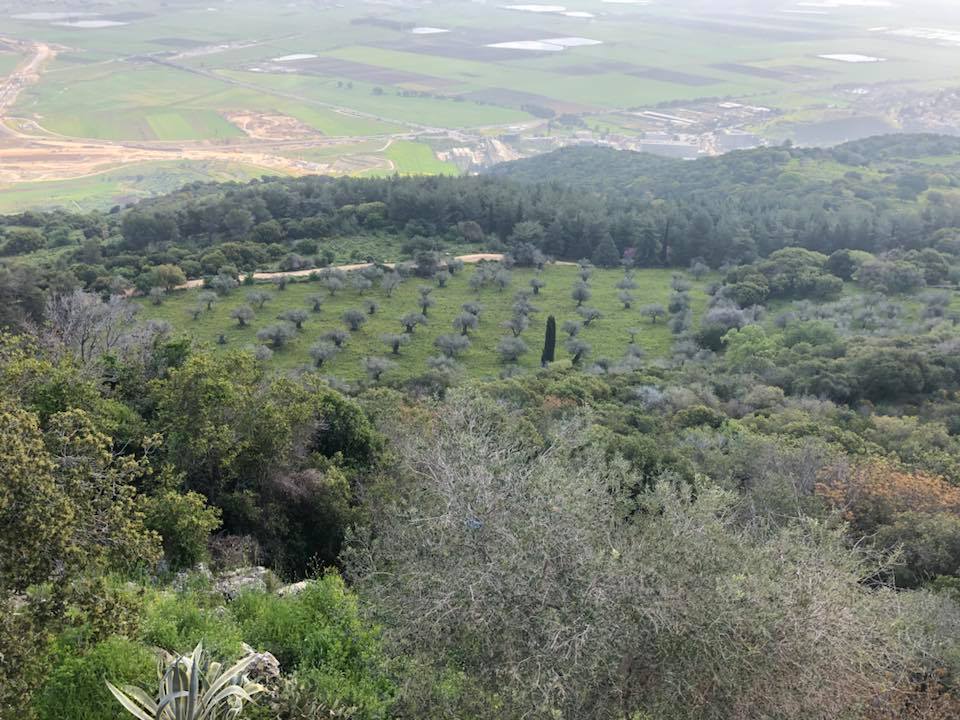
A view from Mt. Carmel (Israel)