The Relationship Between Preachers And Elders

There are too many horror stories about dysfunctional relationships between preachers and elders. The church hurts and is hurt when there is friction, disunity, and rivalry between these two vital roles. There may be many reasons for why such exists, instances where there is blame on one side or the other or on both sides.

Neal Pollard

There are too many horror stories about dysfunctional relationships between preachers and elders. The church hurts and is hurt when there is friction, disunity, and rivalry between these two vital roles. There may be many reasons for why such exists, instances where there is blame on one side or the other or on both sides. But, stating the obvious, an adversarial attitude should not exist. To the contrary, there should be great love and unity between them. 

The best New Testament example we have of the elder-preacher relationship is Acts 20:17-38, between Paul and the Ephesian elders. Paul was their local preacher for at least three years (31). Luke records what that relationship looked like. What words describe their relationship together?

  • TIME (18). Paul and these elders were together. Relationships require time. What will happen when elders and preachers never collaborate, work together, and engage in fellowship and social time together? Paul said he was with them “the whole time.” 
  • HUMILITY (18). Pride and ego are damaging, destructive, and devastating qualities. “A man wrapped up in himself makes a very small package.” There is no place for pride in healthy leadership. There must be an ability to admit wrong and an attitude of putting others above self (cf. Phil. 2:3-4). Elders must desire the flock to follow the Chief Shepherd, not themselves (29-30). Preachers must be found “serving the Lord with all humility” (19). 
  • EMOTION (19, 37-38). This is beautiful. Luke notes the tears of the preacher (19) and the elders (37). If there is ever a time when a man should shed tears, it ought to be over spiritual things. Relationships are forged when elders and preachers expend emotion over their mutual work. 
  • HONESTY (20,27-28). Relationships are undermined by dishonesty, aren’t they? Honesty is about more than merely telling the truth. It’s about not withholding, in proper spirit and attitude, what the other really needs to hear. In a healthy relationship, where each is assured of the love and confidence of the other, that honesty can exist. Paul did not “shrink back from declaring to [them] anything that was profitable” (20). He did not shrink back from declaring to them the whole purpose of God (27). There must be an atmosphere of trust, where neither side is afraid to speak with kind frankness. 
  • INTEGRITY (20-21,28,33-35). Akin to honesty is integrity. This speaks to character and principle. It drove Paul to work hard in ministry. It drove the elders to guard and shepherd the flock (28). It drove Paul to avoid covetousness and materialism (33). It drove a desire to prefer giving to receiving (35). Godly leaders are men of character!
  • COURAGE (22-28). Neither shepherding nor preaching is for sissies! Timidity and lack of conviction greatly damages the church. Paul relegated his own life to second position to the gospel (22,24). Faithful shepherding required the same (28). 
  • COMMENDATION (32,38). This is crucial! Balancing with the occasional need to confront each other with care is the need for each to generously, genuinely, and publicly praise and commend one another. Nothing demonstrates unity in a congregation more than elders praising the preachers behind their backs, and preachers praising the elders behind their backs. Certainly, it’s good for each to overhear the other, too. The word “commend” in verse 32 means to place before, give or provide. Paul’s commending them to the grace of God was committing them to it. But, the general tone of the relationship was one of praise for the other’s work. 

Notice how they part company. It’s beautiful and it should typify the elder-preacher relationship today. “When he had said these things, he knelt down and prayed with them all. And they began to weep aloud and embraced Paul, and repeatedly kissed him, grieving especially over the word which he had spoken, that they would not see his face again. And they were accompanying him to the ship” (36-38). They prayed together. They were unashamedly affectionate. They loved one another and liked one another. They hated to part company. Does that seem strange or foreign to you? I hope not! It’s our best New Testament pattern for what that relationship should look like! May it characterize this relationship in every congregation today! 

Jesus, Let Us Come To Know You (Part One)

Neal Pollard

What did He look like as a child or grown man? Isaiah 53:2 leads one to believe He had no remarkable, distinguishing physical characteristics. What earthly interests did He have? What was His favorite subject in school? Who did He spend time with the first 30 years of His life? Was He tall or short? How did He sound when He laughed?

These questions have long fascinated man, but they matter little. If they mattered to His contemporaries, they would have written about them. If they mattered to God, surely there would be a record of them. Yet, the physical things about Jesus tell one little about who He is. When little children sit on His knee, when the poor and hurting find comfort from Him, and when the enemies of truth are on the scorched end of His rebukes, He is teaching the things about Himself that mattered most. As we seek to know Jesus, here is what we learn.

He is Our Teacher

On 12 separate occasions, the gospels record somebody calling Jesus “rabbi”–never in jest or ridicule. In John 20:16, He is called “Rabboni.” The former term meant “my master” and the latter meant “my great master.” The terms were meant to rank a person’s ability and proficiency as a teacher of the Law. People marveled at Jesus’ teaching ability (cf. Luke 20:26; John 7:46; Matthew 7:29). He taught with so many different methods, whether object lessons, parables, questions and answers, or through questions. His teaching changed lives, from the apostles to strangers to even enemies. People may have debated Christ’s claims and doubted the power behind His miracles, but they could never answer His teaching.

Jesus is our teacher, too. Certainly, He teaches us through the Scripture (cf. 2 Peter 1:3). He left us everything we need to go to heaven, and He is holding us accountable for it (John 12:48).

But He also teaches us with His example. He practiced perfectly the things He taught, so that even His enemies could find no fault in Him (Luke 23:4; John 8:46). He had the perfect attitude toward truth, so that while He was never abusive or unkind He did set forth truth in plain, simple terms to make clear that if the shoe fit His listener should wear it. He loved His students with a perfect degree of love. He loved truth, but He also loved everyone. When people rejected truth, He sorrowed for them. He wanted all saved, even those who crucified Him.

He further teaches us with His approach. He had the widest of vision, intending everyone of every race and nation to hear the gospel (Matthew 28:18-20). He had the clearest of insight into His students. He set an incomparable moral standard. He did not just condemn sinful acts, but also the hearts behind such actions and so emphasized that we should act out of perfect love and faith.

He had a perfect method of teaching, teaching, as Franklin Camp might say, “old truths in new robes.” He adapted His methods to His audience, and He utilized the common things of life they knew. Jesus came to show us the Father. But, He also came to show us ourselves. His teaching also showed us so much about who He is!

People To Lean On In Times Of Loss

Cooper Dillingham
(with his family at Lads ’23)

 As many of you know, last month my grandfather passed away. The days following this, many people reached out to my family, to comfort us. I am so thankful that my family and I have so many people to lean on in times of loss.

 In that time of ruin, I thought of our 2023 L2L theme, which was in Nehemiah 2:17-18. This verse reads, “Then I said to them, “You see the trouble we are in, how Jerusalem lies in ruins with its gates burned. Come, let us build the wall of Jerusalem, so that we may no longer suffer derision.” And I told them of the hand of my God that had been upon me for good, and also of the words that the king had spoken to me. And they said, “Let us rise up and build.” So they strengthened their hands for the good work.” This passage speaks about the importance of rebuilding the walls of Jerusalem, and when you look deeper into this verse it also shows how we can strengthen each other. 

First, we see that Nehemiah acknowledged the problem. He saw that the walls of Jerusalem were in ruins and spoke up about it. Sometimes it’s easy to turn a blind eye to problems that don’t personally affect us. Sometimes we unintentionally cause a problem and don’t want to acknowledge how it may affect others.  Nehemiah shows us how important it is to acknowledge an issue and make it our responsibility to fix it. Romans chapter 8:28 says, “And we know that for those who love God, all things work together for good, for those who are called according to his purpose.”  We, too, must be willing to recognize issues, acknowledge problems and take steps to address them, because God will ultimately use those resolutions for His glory. In the days that followed my grandfather’s passing, I saw my family rise in the midst of our brokenness. When we build one another up with helping hands, as God commands us to do, we are showing others the heart of our savior, Jesus Christ. In this way, even in the face of intense hardship, we can give glory and praise to God through our actions. 

Secondly, Nehemiah communicated a vision. He shared his message with the Israelites and told them what he believed needed to be done. He also spoke about the gracious hand of God, and the support he had received from the king. We must communicate our vision for the church, and know what is needed to accomplish God’s will. For some people, communication may be difficult. But Nehemiah shows us the importance of having a plan of action and encouraging others to join us in executing it. In the same way, we need to have the plan to expand the borders of the kingdom, the wisdom and guidance to rally others, and the love for our brothers and sisters in Christ to encourage them to keep building. We must work together, utilizing our unique skills and talents to achieve our goals.

Lastly, God gave Nehemiah strength through joy. Nehemiah 8:10 says, “And do not be grieved, for the Joy of the Lord is your strength”. This isn’t the only occurrence in the bible that tells us of God’s ability and willingness to strengthen those who show their unwavering love and faith for Him. Isaiah chapter 40 verse 31 says, “but they who wait for the Lord shall renew their strength; they shall mount up with wings like eagles. They shall run and not be weary, they shall walk and not faint.” God’s people found joy and strength in building a wall day in and day out. I know for a fact that if I had to build a wall day after day I wouldn’t have that same joy. This strength was not from their bodies but from the power of God. Now if He can give that kind of strength, then I promise you, we can all build each other up, no matter how hard we have to work for it and no matter the circumstances. 

Whether it’s supporting a grieving family, having a Bible study, or any other service  we need to be prepared to build someone up and let God work in our daily lives. We have many opportunities to spread the Good News through our actions and our words. 

I know that’s an area I can personally work harder in. I know there are going to be people in your life that you try to share the gospel with, but despite your efforts, they will completely reject all that God has to offer through Christ. It’s really hard to have the confidence to build someone up who doesn’t know God like we do and doesn’t want to know him. But like Nehemiah, we need to be confident, not in ourselves, but in our Savior.

Seeing The Eye Doctor

Tuesday’s Column: Learning From Lehman

Tim Alexander

Does this look familiar to anyone? Yup, it’s an eye chart that your eye doctor uses to test your vision. Can everyone see the top row? How about the second? Third? Fourth? How far down can you go before you just cant see anymore? The letters on the page never changed but, the further away you got, the less clearly you could see things.

But, then comes the good part. The doctor starts adjusting those lenses until your vision becomes clearer and clearer and you breathe that big sigh of relief because you can finally see the whole picture! But, albeit briefly, when they take away the lenses that gave you such clear vision so you can put your glasses back on, things may become unclear again.

As time passes for many, if not most, your vision begins to change again, your eyes start to lose focus, and you have to go back to the Doctor and let him help you to see clearly again. Some may only need a little adjustment because their vision isn’t too far off, while others may feel like they’re starting all over because their vision is worse than it was before!

Well, you visit your Doctor on a regular basis to make sure you can still see clearly. But, after a while you begin to go less and less until one day you can barely see anything clearly enough to even see where you’re going.

So you finally decide you need to go back so the Doctor can get you back on track but, when you get to the office, the door is locked! You don’t understand what’s going on! 

You KNOCK yet, no one opens the door for you!

There are others getting the same help you SEEK but, you can’t find anyone willing to help you!

You call and ASK for help but, they just won’t give it to you!  

So you start looking around. Finally you see a note on the door. It reads:

“Dear Mr. Smith,

I’m sorry to inform you that I will no longer be caring for you. You knew you were supposed to follow my directions and come back as scheduled to keep your vision on track. Yet, you chose to ignore my instructions and now your vision is so bad you may never see clearly again. From now on you must visit a different doctor to take care of your needs because I am tired of trying to help you when you keep making the same mistakes over and over again by not listening to me. Goodbye and good luck.” 

You can’t believe it. Your doctor turned his back on you? Just because you failed to follow his prescription here and there? What do you do now…?

Let me tell you something friends…

THE WORLD IS OUR EYECHART. Things can get fuzzy from time to time. Sometimes so much so that you may feel you can barely see at all.

THE BIBLE IS OUR GLASSES. As long as we focus on it regularly, our vision can stay a lot clearer than it will if we only make occasional visits now and then.

 BUT, THE BEST NEWS IS JESUS IS OUR DOCTOR! No matter how many times you make a mistake, as long as you do your best to follow His directions, you will never find the door locked when you need Him.

If you just don’t see things clearly in all directions, make an appointment with the Doctor NOW and let Him take care of your needs.

If you are already a patient, when your vision starts to get a little fuzzy, DON’T WAIT! Go back to the Doctor to get things back in focus as quickly as possible! If you don’t, you may find yourself with an appointment you scheduled for later, but later never comes…

Planning Like Prophets

Tuesday’s Column: Dale Mail

Dale Pollard

Vision: The ability to think about or plan for the future with imagination and wisdom. 

 In the book of Revelation we read of seven churches that needed to develop different areas of weakness in order to be the church Christ needed them to be. 

The Old Testament is also filled with valuable information and strategies to help congregations develop and execute their visions. Each church family will differ and since that’s the case, each congregation needs custom vision.

Here are two Old Testament passages that give us some insight into the mind of God on the subject of vision planning

  1. A Good Vision Is Visible 

         Habakkuk 2:2-3 

Though Habakkuk’s message was concerning the the conquest of Babylon, this text is invaluable for us today. 

Here we read God’s strategy for successful/effective planning. 

“Write down the revelation 

It should be tangible
    “and make it plain on tablets”

It should be precise 
    “so that a herald may run with it.”

It should be effectiveA vision without legs won’t go far. 

“For the revelation awaits an appointed time;
    it speaks of the end
    and will not prove false.
Though it linger, wait for it;
    it will certainly come
    and will not delay.”

 A vision should be lasting. When God spoke to the prophets they would often record things that would happen years in the future. With these future events written down, the following generations could plan accordingly. God is coming back and eternity is coming, we must create a plan so that we and those after us can continue to prepare. 

  1. If It’s Not His, It’s Hopeless 

          Jeremiah 23.16 

“This is what the Lord Almighty says:

God must have a voice 

“Do not listen to what the prophets are prophesying to you;

The ungodly shouldn’t have a voice when it comes to planning a vision for God’s people
    they fill you with false hopes.
They speak visions from their own minds,
    not from the mouth of the Lord.”

God must have a voice because the vision shouldn’t be born from the mind of man!

Launching Audacious Dreams

Neal Pollard

I was too young to remember any of the Apollo missions (the first moon landing was six months before my birth). As a child of the ’80s, I remember the NASA space shuttle missions (there was a total of 135 of them) including the two disastrous ones. In 2021, a new era is underway. This one is being driven, not by government, but by private funding. This new chapter in space flight and exploration is a space race between well-known billionaires, Richard Branson (Virgin Galactic), Jeff Bezos (Blue Origin), and Elon Musk (SpaceX). I missed Sir Richard’s flight in the rocket plane, Unity, on July 11th. But this morning I watched the entire maiden voyage of Bezos’ rocket, New Shepard, as he reached a height of 66.5 miles in the suborbital flight carrying Jeff, brother Mark, and both the oldest and youngest people to fly into space (Oliver Daeman is 18 and aviation pioneer Wally Funk is 82). From take off to touch down, the flight took 11 minutes.

These new ventures, like their predecessors, are sure to fire the imagination of the next generation, develop new technology, and generate national pride. The new frontier, for now, seems to be to launch space tourism. It dawned on me that those bankrolling these ventures and putting in the time and manpower to realize these goals creates multiple challenges to overcome.

It’s hard. 
It’s expensive.
It’s risky.
It’s frustrating.

Sure, there was a little flight training for the four passengers of New Shepard (classroom instruction, demonstrations, and practice), but the company website adds these facts: “Blue Origin has been flight testing New Shepard and its redundant safety systems since 2012. The program has had 15 successful consecutive missions including three successful escape tests, showing the crew escape system can activate safely in any phase of flight” (Source). Today’s flight was originally slated for 2018 (Source). Fortune Magazine says that Bezos has spent $5.5 billion of his own money on Blue Origin to this point (Source). Why expend the effort, money, energy, and risk? Men like these billionaires have proven they know what sells and how to turn a profit, but it also taps into the daring and adventure of the human spirit.

The dreams and visions of Joel 2:28-32, fulfilled on Pentecost when the church was established, are the miracles, signs, and wonders by which the apostles proved the truth of their message. In context, those dreams and visions were specific, supernatural demonstrations of the Holy Spirit. But Jesus wants us to share His dream and vision, first articulated in Matthew, Mark, and Luke. We call it the Great Commission. He spelled out the game plan for His apostles in Acts 1:8. Start local, move regional, and end up global. Share the gospel. Reach the lost. Grow the church. Over and over and over again! We’re going to have to dream big and conjure of visions of great things. We serve the same God the apostles did.

But, audacious dreams are hardexpensiverisky, and frustrating. They require us to change and grow. They cost us time, talent, and treasure. They may cost us friendships and relationships. They will include failures and misses as well as successes and hits. Yet, we are reaching higher than even outer space. Our ultimate goal is heaven! 

As impressed as I am with these billionaires’ ambitions for outer space, we are children of the Creator and heirs of the Most High. His resources as infinite. His promises are sure. His mission is clear. Let’s launch ambitious dreams for Him. Lost souls are counting on it! 

Creative Commons: January 23, 2019: NS-10
Platform: New Shepard
Location: West Texas Launch Site
Photographer: Blue Origin

WHY PLANNING IS POWERFUL

Monday’s Column: Neal At The Cross


Neal Pollard

  • It forces us to focus. So often, churches just “do stuff.” We don’t ask who, what, where, when, or how. We don’t ask if the thing is effective, evangelistic, edifying, or empowering. Is it outmoded? Is it merely self-serving? Can it be improved? Planning clarifies. 
  • It makes us intentional. Whether we are looking at what is currently done or what should be done, planning makes us deliberate. Especially is this true when we consider whether or not the activity, program, or work is merely internally-focused (for us) or externally-focused (for lost souls). Do we plan to grow? Reach a tangible number of people each year? Increase the depth of our footprint in the community? If so, how? Specifically how? 
  • It says that leadership is thoughtful. Planning takes precious man hours from the leadership, but how it pays off! Personal analysis, congregational analysis, and biblical analysis require thought. Done well, it will build conviction that doctrine is never to be tampered with, but that methods and means in harmony with Scripture require judgment, discrimination, and scrutiny. Putting thought into the church’s works and needs is Acts 20:28 in motion.
  • It combats chaos. So often, a church’s works lack cohesion and coordination. There are no filters in place to ask if an individual work fits with the church’s vision and mission. Works may be good, but who knows what goes on with them or if they are working. Who is accountable? To whom are they accountable?
  • It expresses discontent with the status quo. It is easy to continue with works, programs, and activities that are already in place and have people managing and executing them. But, most of our methods and means of doing church work need to be evaluated regularly to ask if changes are needed. Change brings discomfort and takes work, but as our resources change–time, talent, treasure–we may find that we are more or less able to engage in the various works of the church. We should always be looking for more and better ways to serve and glorify God. 
  • It is biblical. Jesus had a tangible plan for world evangelism (Acts 1:8). Paul had a tangible plan for growing the church through the missionary journeys (Acts 15:36ff). Look at how 1 Timothy reflects and requires planning to help the Ephesus church (1 Tim. 3:15). Paul had a tangible plan for establishing elders in congregations throughout the island of Crete (Ti. 1:5ff). Something that was in God’s mind in the eternity before time (Eph. 3:9-11) deserves our best effort, using our brightest minds to find biblical ways that are most effective to grow and strengthen it! 

Goals, dreams, intentions, and ideas will not, by themselves, accomplish anything. We must work to make those things a reality. But, a crucial first step is to articulate where we want to go. That makes planning so powerful! 

What Is The Church To Be?

Monday’s Column: Neal At The Cross

pollard

Neal Pollard

Conceived of in God’s mind in the eternity before time (Eph. 3:9-11), purchased by Jesus’ blood (Acts 20:28), spoken of as the body (Eph. 1:22-23) and bride (Rev. 19:7) of Christ, and described as the temple of the Holy Spirit (1 Cor. 3:16), the church is valued and treasured by Him. As members of that church, we might develop a distorted picture of what the church should look, feel, think, and act like in our ever-changing world. What is the church to be?
A Museum? Is the church meant to be a relic of the past, a historical marker where the past is revisited, revered, and enshrined? No doubt, we stand on the shoulder of great workers and warriors of the past, but we are not meant to devote our focus to days gone by. It is but a slight renovation to go from museum to mausoleum.  Our best days should be ahead!

A Marketplace? Some see the church as a direct reflection of the culture. Stands on moral, social, and doctrinal issues are dictated by the views of the moment. “Change” is the key word, and selling the gospel becomes the preeminent goal (John 2:16; 2 Pet. 2:3). A church built foremost on society rests upon sand (Mat. 7:26-27). 

A Monastery? The church–though a haven from the craziness of the world–can become insulated and isolated. It is great to let our closest friendships and relationships to be fellow Christians, but we can become so secluded and shut off that we become a cloister that ceases to be soul-winners. Our worship services and Bible classes can be so full of insider language that the unchurched have no idea what we say much less what we mean. 

A Movement? Sometimes, we speak of the Restoration Movement whose leaders were trying to get people back to the Bible for “rule” and “practice.” But the New Testament church did not begin on the American Frontier during the Great Awakening or even shortly before it. It is not to be a political, national, or even social movement. To think of it on those terms is to degrade and devalue it. 

It is to be a model, safe to follow and imitate by others because she follows Christ (Mat. 5:13-16; 1 Cor. 11:1). It is to be a militant group, whose weapons build and save and defeat the devil (2 Cor. 10:3-5; Eph. 6:10-17). It is to be a mission, on a mission for the Master (Mat. 28:18-20; Eph. 4:11-16). It is to be a medicine dispensary, offering salve and healing from the Great Physician (Luke 5:31-32). It should reflect the Master in thought, in tone, in teaching, and target! May we all think more critically about what we think about the church!

antique-church-pew-1

“First, Sit Down…”

Screen Shot 2019-12-21 at 9.08.51 AM
Not pictured: Riley, who was under the weather. 

Neal Pollard

In Luke 14, Jesus gives a couple of short parables about counting the cost of discipleship. He prefaces them by saying, “If anyone comes to Me, and does not hate his own father and mother and wife and children and brothers and sisters, yes, and even his own life, he cannot be My disciple. Whoever does not carry his own cross and come after Me cannot be my disciple” (26-27). If we drink deeply of this statement, we see exactly how challenging it is. The choice is always between Jesus and everything and everyone else. How badly do we want what only Jesus can give? Think hard, then decide!

Then come the parables. The first is a construction parable, of one building a tower. He first sits down and calculates the cost in order to be able to finish and avoid ridicule (28-30). The second is a military parable, of a king going into battle. He first sits down and considers whether or not he can win (31-32). The common denominator in both parables is to first sit down and deliberate. Ultimately, there is action which follows, but the planning precedes it.

In how many congregations do elderships or men in the absence of elders never get proactive and formulate a plan for the immediate, intermediate, and far off future? Leadership must cast the vision and deliberate about where that congregation is going and how it will get there. What will be done to grow? How can we get more members active? How can we best utilize the collective resources of the congregation? The Bible reveals all the answers, but it is essential for the church’s leaders to gather around the drawing board.

It was exciting to spend a few hours at the Lehman elders’ 2019 retreat to discuss the short-term plans of the congregation. These men are convicted about the stewardship of the work they eagerly consented to do as our shepherds. They want us to be more effective, but they are determined to set the tone and example for us. I’m amazed at how deeply they care about us and the growth they want us to collectively experience. Words like emphasis, accountability, and purpose continually came up. Building a biblical culture, which works against our contemporary culture of consumers rather than producers, is foremost in their minds. They desire for us to “grow together” as a church, drawing those outside of Christ to our spiritual family.

I cannot wait to see what God will do through such capable leaders in 2020 and beyond. We are blessed with such godly, conscientious elders. Please don’t miss a day praying for Russell, Riley, Kevin, John, Darrell, and Bobby and their families. Also, please never miss an opportunity to express your love, encouragement, and support of them as they strive to do their best to fulfill their God-given duty. Or, as Paul put it, “But we request of you, brethren, that you appreciate those who diligently labor among you, and have charge over you in the Lord and give you instruction, and that you esteem them very highly in love because of their work. Live in peace with one another” (1 Th. 5:11-12). 

They are first sitting down this weekend, but then they will challenge us all to “rise up and build” (cf. Neh. 2:18). 

THE KIND OF LIFE WE SHOULD LIVE

Neal Pollard

Most of us are familiar with the intimate words spoken by Jesus to His followers in John 14:1-6. They were words of active comfort for a man who was imminently facing the worst suffering humanity could ever know. Yet, from those gentle words of guidance, we find a beacon to show us what kind of life it is possible for us to live—no matter what!

We can live a fearless life (John 14:1). Our hearts don’t have to be troubled. That doesn’t mean we won’t face fears and uncertainties. How can we avoid it? But we can let our fears be subjugated to our Father. We can trust the Bible’s promises and follow its guidance on this (cf. John 14:27; Phil. 4:7).

We can live a faith-filled life (John 14:1b). A “theocentric” (God-centered) point of view will influence our decision-making and daily living. We can have assurance and conviction (Heb. 11:1), but we must have a faith accompanied by works of obedience (Js. 2:20). All of us have lives centered around something that we make most important of all. There are many noble things that could fill in that blank—profession, family, friends, or the like. These may be part of our identity, but they should not define us. Our faith should define us.

We can live a focused life (John 14:2-4). Jesus urges His disciples to focus on at least three things:

  • Focus on the Father’s house (2). Long for heaven.
  • Focus on the Son’s coming (3). Anticipate His return. We know death is an appointment followed by the Judgment (Heb. 9:27).
  • Focus on God’s fellowship (4). Long to be where God is and to follow where He leads. Let that desire lead you to fellowship with Him and His saints publicly and privately in your personal devotional life.

We live in a world full of distractions—technology, appointments, hobbies, politics, and sports. Never let any of those things get your life out of focus.

We can live a follower’s life (John 14:6). We must believe that Jesus is the only way. We must shun the politically-correct notion that says there are many ways. We must live the exclusive way that Scripture teaches. We cannot serve God on our own terms. We must submit to His way and His truth, and we can enjoy the eternal life He offers.

Fame, fortune, fun, friendship, and such may draw and lure us. But none of those things will last. Jesus points to the kind of life we should live. May we be wise enough to listen.

blaine_mansion_during_renovation

What Vision Is

Neal Pollard

It is the ability to see what a thing could be. A carpenter, looking at a tree, sees with a trained eye much more than others can see. With his expert shaping, appropriate tools, and seasoned patience, he can make out of that tree what was once only in his mind. The Lord needs people, from the leadership down, who look at the community, each other, their income, and their abilities and see what could be done. It takes no effort, emotion, or education to say, “It can’t be done!” That’s what is expected. Vision sees what could be.

It is the ability to not obsess over what a thing has been. Due respect is owed to the labors of the past, and due recognition is owed both its successes and failures. The past, however glorious, will have ample samples of both. Yet, the people, plans, and programs of today and tomorrow should not be shackled and chained exclusively to was has been. Vision is not always settling for being “has beens.” “Will be” is what Paul seemed more focused in pursuing (cf. Phil. 3:10-12). Biblical vision recognizes that doctrine cannot change, but methods, technology, tools, and people invariably do. Vision asks how people living in the present time can best reach people living in the present time and prepare them for an endless eternity.
It is the ability to trust in what God can make it be. No plan would succeed without God’s hand in it. I love the prayers where brethren plead, “Help us in the things that are right and defeat us in the things that are wrong.” Among the Bible’s heroes are those who factor God into the plans and say, “We are well able” (Caleb, Num. 13:30). “I can do all things” (Paul, Phil. 4:13), “There is nothing too hard…” (Jeremiah, Jer. 32:17), and “No good thing does He withhold” (the sons of Korah, Psa. 84:11). Our vision can be bold when “our” is God and us! Since God made the sky, the limit exceeds even that! Our giving, our ambitions, our goals, and our sights should be set to reflect our belief in that fact.
Where will we be this time next year? In five or ten years? Vision plays a role in that. Vision attempts to see the unseen, forget the past, and trust the One who holds past, present, and future in His all-powerful hand. With those truths factored in, let us dream big dreams!

glasses-928465_960_720

What Kind Of Church Do We Want To Be?

Neal Pollard

V–ictorious? Faith is the victory that overcomes the world (1 Jn. 5:4). No coach hopes to win without first planning and architecting. The blueprints have already been put in place (Rom. 6:17), but we must work the plans to be a success in God’s eyes!

I–nvolved? Do we want to merely keep house and meet together each week? That is not New Testament Christianity (cf. Acts 2:46). They took Christianity out of the church building’s doors. They were tangibly involved in doing God’s work. Will be be?

S–erving? This is a self-serving world. Many seem intent to climb over whoever is in their way to the top. Jesus’ religion runs contrary to that (John 13:12-17), and He calls us to follow His example. A serving church is a living, thriving, arriving, surviving church.

I–mpactful? Do our neighbors know who we are? What about the surrounding communities? What about the farthest reaches of our world? Don’t you want to be part of a church putting a Christ-sized impression on those around us?

O–bedient? We have one authority (Col. 3:16-17; John 14:1-6; Acts 4:12). There are potential masters, but only one will lead us to heaven. A church that steps outside His “lines” will become eternally out of bounds. Those intent on obeying Him will be saved (Heb. 5:9).

N–urturing? Don’t we want to be part of a people with an infinitely more profound purpose than that found by the patrons and workers portrayed in the old sitcom Cheers? We want everyone to know our name and be glad that we came, but we should also want a place where we can grow in every right, positive way. This must be a church that cares about all, whatever our age, background, interests, income, or education!

A–ble?  Do we want to focus on our liabilities or, through Christ, our limitless resources? We have so much to do, but we’ve been given so much to do it. Don’t we want to be part of a “can do” church, doing with our might what our hands find to do?

R–eaping? If we are a working church, we will see results. They will come through baptisms, programs of work, outreaches, visitation, stronger fellowship, missionary success, and much, much more. As my good friend, Cy Stafford, says, “What God controls, grows.” The law of sowing and reaping is positive, too (Gal. 6:8).

Y–earning? A church that is alive and growing is full of holy desire, enthusiasm, and a confidence that we can do all things through the Christ alive within us (Phil. 4:13). Our greatest desires will be to do spiritual things to the glory of God.

How does a church become a visionary church? We must be intentional! What do we intend to do?  With God’s help, that is up to us!

12642872_1029468160409554_6928711640322573340_n

Why These Are Exciting Times

Neal Pollard

I am filled with a tremendous sense of optimism that is not generated by politics, current events, the media, the economy, or any other worldly thing.  Neither am I fueled by some Pollyanna spirit.  Yet, I cannot shake this swelling tide of hope that fills me on a daily basis.  It is a hope for what the church and its members can be in the face of the growing challenges we face in this culture and around the world.  Why are these such exciting times?

The darkness is allowing the light to shine brighter!  Sadly, moral, ethic, philosophical, and civil behavior is eroding.  The messages being sent by those in power and authority are increasing anti-biblical.  Those who have lived for any length of time have witnessed a pretty dramatic shift in thinking and behavior.  This is reflected in so many things from language on the job and on “the street” to what is allowed and promulgated in TV and movies to the blatant lifestyle choices of the rank and file.  What all this means is that as Christians we can, by leading “a quiet life in all godliness and dignity” (1 Ti. 2:2; cf. 1 Th. 4:11), shine the light of Christ (cf. Mat. 5:14-16).  As we share Christ with those in our circle of influence, we can countermand the marching orders of the “world forces of this darkness” (Eph. 6:12).  That, brothers and sisters, is exciting!

People are earnestly searching! I read with interest the studies about exiting millennials, new world orders (not just conspiracy theories, but fundamental shifts in worldviews), spirituality over organized religion, and the like. For all of that, down where we live day by day on our jobs, at school, in our neighborhoods, and our community and civic activities, people are longing for meaning and purpose in their lives.  Yes, they can be confused and misguided.  Yes, they have broken and messed up lives.  Yes, this produces a great challenge to churches as we are intentional and outwardly focused.  But, we have not seen a day in any of our lifetimes where biblical ignorance and, thus, directionlessness has been greater.  Remember what Jeremiah said: “I know, O Lord, that a man’s way is not in himself, nor is it in a man who walks to direct his steps” (10:23).  There are many who would say with the Ethiopian nobleman, “How can I (understand, NP), unless someone guides me?” (Acts 8:31).

The church is ripe for revival! It seems that the tale most churches with whom I have contact tell boils down to larger numbers, greater involvement, and younger members occurred in the past! Thus, panic, pessimism, and perplexity lace the private conversations and public addresses of the pulpits, the pastors, and the pews. Perhaps it is time for congregations to consider moving from the defensive to the offensive. I don’t know that individual Christians have ever been more impressed with the dire urgency of evangelizing than right now. I believe the conviction and dedication of our Christian soldiers is palpable.  With bolder leadership, concerted efforts, and a faith-filled plan of action, I believe the church as a whole is poised for growth.  This will require a change of priority, focus, and commitment, but I believe that we are more than ready for it.  We are eager for it!

But, time is short!  Paul is right.  “The night is far spent, the day is at hand. Therefore let us cast off the works of darkness, and let us put on the armor of light” (Rom. 13:12).  If ever the mantra, carpe diem, has applied, it is right now!  May our anthem become, “Rise up, O men of God!”

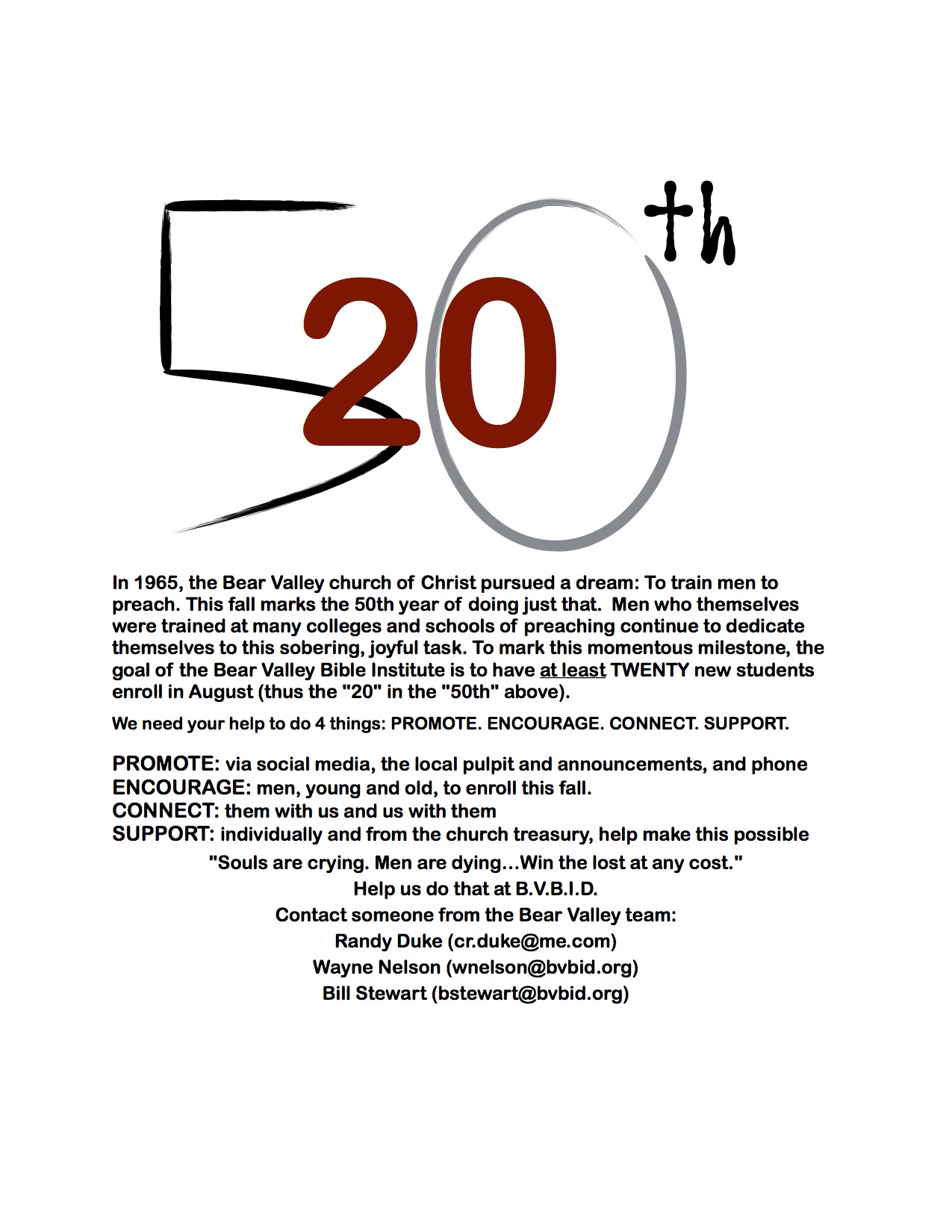
A Mass Appeal To Help Us Reach A Worthy, Wonderful Goal!

50th anniversary

Melvin Otey’s lecture from the 2013 lectures. Stay tuned for details on 2014’s program!

THE SWISS PARAGUAYAN

Neal Pollard

Moises’ Bertoni’s story is fascinating.  Born in Switzerland in 1857, son of a renowned lawyer, Bertoni was an idealist and an adventurer whose scientific passions took him first to Brazil and ultimately to Paraguay, where he and his wife raised their thirteen sons!  They suffered many hardships in the area known as Alto Parana, a department (like a region or state) featuring the Parana River.  When still living on the Brazil side of the river, it overflowed its banks and deluged the Bertoni home, destroying ten years of research on two continents.  Once in Paraguay, they faced pumas, jaguars, tapirs, monkeys, and anacondas.  He wrote, in an 1885 personal letter, “We have passed through all the difficulties that human existence can offer…villainy, the most absolute misery, freaky weather, hunger! We have born up under all of it, amazed at ourselves. We are not willing to give in…We are on the field of battle, and the fight offers only two outcomes: victory or death!”

Not surprisingly, Bertoni became an eminent figure in Paraguayan history renowned for his scientific research, agricultural advancement, publishing, environmentalism, and his work as an expert student the Guarani race of people who were his neighbors.  He suffered many disappointments and failures before succumbing to malaria in 1929, but his approach to the challenges of life proved him a fighter who persevered (some information via Mike Caesar, “Paraguay’s First Man Of Science,” 2002).

Though Bertoni was misguided in some of his pursuits, he exemplifies a principle we should all apply to our lives as Christians today.  Whatever difficulties and challenges we face, we must remember that we, too, are on the field of battle.  As he framed his work, how much more is ours a matter of “victory or death”?  Repeatedly, New Testament writers cast Christianity as a battle fraught with adversity (Rom. 13:12; 2 Cor. 10:4; Eph. 6; 1 Tim. 1:18; 2 Tim. 4:7; etc.).  Yet, this is the promised finale of the fight, that “you are from God, little children, and have overcome them; because greater is he that is in you than he who is in the world” (1 Jn. 4:4).  In the next chapter, John explains that we overcome by faith (1 Jn. 5:4).  Some day, unless Christ’s coming precedes it, physical death will overtake us, but, if we are faithful in Christ, we will experience eternal victory!