Walking Worthy

Carl Pollard

In Ephesians 4:2, the Apostle Paul urges Christians: “Be completely humble and gentle; be patient, bearing with one another in love.” This verse comes as Paul transitions from the profound doctrines of God’s grace in chapters 1–3 to practical living. Having been called into one body through Christ’s redemptive work (Ephesians 4:1), we are to “walk worthy” of that calling. These four virtues, humility, gentleness, patience, and forbearance in love, form the foundation for preserving “the unity of the Spirit in the bond of peace” (Ephesians 4:3).

Humility means having a low estimation of oneself, not out of self-loathing, but from recognizing our utter dependence on God’s grace. It is the opposite of pride, which destroys relationships. Jesus exemplified this perfectly, saying, “Take my yoke upon you and learn from me, for I am gentle and humble in heart” (Matt. 11:29). Philippians 2:5–8 calls us to have the same mindset as Christ, who emptied Himself and took the form of a servant. Without humility, we cannot serve one another or maintain unity.

Gentleness, often translated as meekness, is strength under control. Aristotle described it as the balance between excessive anger and passivity. It is not weakness but controlled power, as seen in Jesus driving out the money changers yet never sinning in anger. Galatians 5:23 lists gentleness as fruit of the Spirit. In a divided church, gentleness defuses conflict and reflects Christ’s character.

Patience. or longsuffering, means being “slow to anger.” It mirrors God’s character: “The Lord is… patient with you, not wanting anyone to perish” (2 Peter 3:9). Love “is patient” (1 Corinthians 13:4). In relationships, patience endures irritations without retaliation, remembering how much God has patiently borne with us.

Finally, we are to “bear with one another in love.” This means making allowances for others’ faults, forgiving as God forgave us (Colossians 3:13). Agape love motivates this forbearance, seeking others’ good even when it costs us.

These virtues are not optional suggestions but commands for every follower of Christ. In a world defined by division, pride, and impatience, the church must shine as a countercultural community. Imagine families, workplaces, and congregations transformed by this grace. But we cannot manufacture these traits in our strength; they flow from the Spirit as we abide in Christ (Galatians 5:22–23).

So, examine your heart: Where do pride or impatience hinder unity? Repent and yield to God. Walk in humility, gentleness, patience, and love, for in doing so, you glorify the One who first loved us and display the beauty of His calling to a watching world!

Halloween: A Reflection on Darkness and Light

Brent Pollard

A Matter of Personal Conviction

Whether or not a Christian should take part in Halloween festivities is ultimately a matter of personal conviction and conscience. As Paul wrote, “Each one should be fully convinced in his own mind” (Romans 14.5). I respect that there is a difference between believers attending wholesome community events—such as church-sponsored “trunk-or-treats”—and those who embrace the world’s fascination with the macabre. However, I want to caution Christians not to join the world in celebrating darkness, fear, and death.

Jesus taught that His followers are to be “the light of the world” (Matthew 5.14). How can we reflect His light if we participate in a celebration that often glorifies the very darkness we are called to overcome (Ephesians 5.8–11)?

The Pagan Origins of Halloween

Halloween’s origins trace back to the Celtic festival of Samhain, which marked the end of the harvest and the start of winter. The Celts believed that on this night, the barrier between the living and the dead weakened, allowing spirits to roam freely. To protect themselves, they lit bonfires and wore disguises to confuse wandering souls.

Scripture repeatedly warns against attempts to communicate with or ward off the dead. God told Israel, “There shall not be found among you… a medium or a necromancer or one who inquires of the dead” (Deuteronomy 18.10–11). Though today’s observance may seem harmless, its roots were steeped in superstition and fear of spirits rather than faith in God’s providence.

Roman Influence and Ancient Traditions

When Rome conquered Celtic lands, two Roman observances were merged with Samhain—one honoring the dead (Feralia) and the other celebrating Pomona, the goddess of fruit and trees. Some historians suggest that the custom of bobbing for apples originated from Pomona’s symbol, the apple.

This blending of pagan and civic ritual was typical of the ancient world. Yet Christians are urged not to conform to the world’s customs (Romans 12.2) or mix holy devotion with pagan superstition (2 Corinthians 6.14–17).

The Catholic Church and All Saints’ Day

In 609 AD, Boniface IV consecrated the Roman Pantheon to “All Saints,” creating a day to honor Christian martyrs. This celebration, later shifted to November 1 in the eighth century by Gregory III, is now called All Saints’ Day or All Hallows’ Day. The night before—All Hallows’ Eve—gradually evolved into “Halloween.”

Later, All Souls’ Day (November 2) was added to pray for all departed believers, forming a three-day observance known as Hallowtide. The intent may have been to Christianize pagan customs, but as with many such efforts, the old superstitions persisted under new names.

How Halloween Came to America

Medieval Europeans practiced “souling,” going door to door to offer prayers for the dead in exchange for food. Children later began “guising,” dressing in costumes to receive gifts. These traditions were brought to America by Irish and Scottish immigrants. In America, pumpkins replaced turnips as lanterns, and Halloween evolved into a largely secular, community-centered celebration.

However, Christians should remember that not all cultural inheritance is worth keeping. Paul reminded the Corinthians that while “everything is permissible,” not everything is beneficial (1 Corinthians 10.23).

The Dark Turn: From Pranks to Violence

From the late 1800s through the early 20th century, Halloween was often marked by destructive mischief—toppled outhouses, broken fences, and vandalized property. Communities responded by encouraging “trick-or-treating” as a safer alternative, channeling youthful energy into friendly fun instead of lawlessness (cf. Romans 13.10).

The Wholesome Era: Mid-Century Innocence

For several decades, Halloween reflected a more innocent, child-centered character. The imagery of It’s the Great Pumpkin, Charlie Brown (1966) captures that gentler spirit. But this era was short-lived. Beginning with Alfred Hitchcock’s Psycho and crystallized by 1978’s Halloween, the holiday once again took a darker tone. Instead of laughter and imagination, horror and bloodshed became its trademarks.

Modern Halloween: A Culture of Fear and Death

Today, many Halloween attractions and films glorify brutality and fear. The Saw franchise, “haunted” attractions that simulate torture, and “extreme haunts” that require liability waivers all reveal a troubling fascination with terror and pain. This fascination often crosses the line from harmless fun to a celebration of evil. The prophet Isaiah’s warning feels relevant: “Woe to those who call evil good and good evil, who put darkness for light and light for darkness” (Isaiah 5.20).

When society laughs at what should make it grieve, something vital has been lost. As Thomas Aquinas noted, when fear and cruelty turn into entertainment, compassion withers.

What Does the Bible Say About Halloween?

The Bible does not explicitly mention Halloween, but its principles still apply. We are told to “abstain from every form of evil” (1 Thessalonians 5.22) and to think on “whatever is true, honorable, just, pure, lovely, commendable” (Philippians 4.8). These principles guide our decision-making and help us discern what is beneficial to our faith.

Christ’s victory over darkness is total. “The light shines in the darkness, and the darkness has not overcome it” (John 1.5). We do not need to dabble in darkness to prove our courage or find excitement. Our joy comes from walking in the light (1 John 1.7).

Practicing Christian Discernment on Halloween

Discernment is essential. Paul commands, “Abhor what is evil; cling to what is good” (Romans 12.9). The question isn’t whether a Christian can hand out candy or dress up—it’s whether we are celebrating fear or reflecting faith.

Our participation should always glorify Christ (Colossians 3.17). If we choose to engage with the day at all, let it be to share light, kindness, and the gospel with our neighbors. “Do not be overcome by evil, but overcome evil with good” (Romans 12.21).

Conclusion: Light in the Midst of Darkness

On a night when much of the world delights in fear, the Christian’s calling is to stand as a beacon of peace and truth. Rather than imitating the darkness, we can offer an alternative—a message of victory through Christ, who conquered death itself. Let us be inspired to be that beacon, to share the light of Christ in the midst of darkness.

“For once you were darkness, but now you are light in the Lord. Walk as children of light” (Ephesians 5.8).

A Kingdom Opportunist

October hits, and life kicks into overdrive. Halloween, Thanksgiving, Christmas, New Year’s, it’s a relentless lineup! Family visits, work parties, and the creeping numbers on the scale keep you on your toes and in a food coma. In all this, it’s easy to let Bible study and prayer slip. But if you’re too busy for God, you’re too busy. So how do you balance life with spiritual growth?

Carl Pollard

October hits, and life kicks into overdrive. Halloween, Thanksgiving, Christmas, New Year’s, it’s a relentless lineup! Family visits, work parties, and the creeping numbers on the scale keep you on your toes and in a food coma. In all this, it’s easy to let Bible study and prayer slip. But if you’re too busy for God, you’re too busy. So how do you balance life with spiritual growth? Be a Kingdom Opportunist,  someone who spots and acts on God-given moments to advance His work, not for personal gain, but for His glory.

A Kingdom Opportunist sees openings in daily life and responds with faith and courage. Scripture shows us people who lived this way, always ready to act when God opened a door. 

Paul didn’t let circumstances stop him. In Acts 16:25-34, he and Silas are beaten and chained in a Philippian jail. Instead of giving up, they’re praying and singing hymns at midnight. When an earthquake opens the prison doors, they don’t run; they stay and share the gospel with the jailer, leading him to Christ. In Acts 17, Paul’s in Athens, surrounded by idols. He spots an altar to an “unknown God” and uses it to preach the gospel. Synagogue, marketplace, or jail cell, Paul turned every moment toward Christ. He teaches us to see opportunities in tough spots: a coworker’s question, a neighbor’s grief, a delayed schedule. These aren’t interruptions, they’re opportunities! 

In Acts 16:13-15, Lydia, a businesswoman in Philippi, hears Paul’s message by the river. God opens her heart, and she responds immediately, following Jesus and opening her home to Paul’s team. Her hospitality makes her house a base for the early church. Lydia didn’t need a stage or a title, she used her home, influence, and resources to serve God. What do you have? A spare hour? A skill? A kitchen table? Like Lydia, you can use what’s in your hand. 

Barnabas, the “son of encouragement,” saw what others missed. In Acts 9:26-27, when the disciples feared Saul (later Paul) because of his past, Barnabas took a chance, vouching for him and bringing him into the church. In Acts 11:25-26, he tracked down Paul in Tarsus, kickstarting his ministry. He also gave John Mark a second shot after a failure (Acts 15:36-39), helping him grow into a key servant. Barnabas invested in people, seeing God’s work where others saw problems. Who needs your encouragement? A struggling teen, a new Christian, a friend who messed up? A kind word or second chance can shift someone’s path for God’s glory.

Scripture is filled with examples. Esther risked her life to save her people, seeing her role as queen as God’s timing (Esther 4:16). The Shunammite woman gave Elisha a room, creating space for God’s work (2 Kings 4:8-10). Andrew brought his brother Peter to Jesus in a simple act that changed everything (John 1:40-42). Each saw God’s hand and acted, not for themselves, but for His purpose.

Unlike worldly opportunists chasing self-interest, Kingdom Opportunists are driven by God’s glory. They’re prayerful, discerning, and bold, ready to move when God opens a door. To live this way, pray daily for eyes to see opportunities. Study Scripture to be ready to share your faith. Use what you have: time, talents, or a listening ear. Step into hard situations with trust, like Paul. Encourage others, like Barnabas. And stay humble, pointing to Jesus.

God’s still opening doors every day, at work, home, or in your community. My prayer is that we’ll see these moments, respond with faith, and act with courage. As we do, God’s Kingdom grows, one opportunity at a time. You’re equipped for this moment. 

Be a Kingdom Opportunist!

A Wonderful Life

Ian Fleischman

I watch It’s A Wonderful Life every year around Christmas time, and this year was no exception. Something was different this year though, as I get older I get just how rich George Bailey was even before he lost the money to Mr.Potter (the antagonist). One bad moment in a lifetime made him feel as if he had nothing to live for, no friends to go to bet for him, and ultimately he was blinded to the rest of his reality.


When others felt like rushing off and conquering the world, he looked at the need to do what was right which meant putting what he wanted to do on hold. He helped many families in the community be able to own their own well built houses, he gave money out of his pocket when the market crashed, and he stood up to evil when it would have been easy to side with it.


That being said, when Mr.Potter put a hit out on George’s head, he ran from everyone that loves him. He tried to k!ll himself by jumping off a bridge, but then he ended up saving someone sent to help him. He was then revealed a reality of what life in the town would be like without him. The town was absolutely crooked and in poverty. Those who loved him didn’t even know him. Those who he had helped were helpless in this reality. It was after experiencing this twisted alternate reality that he did in fact have a wonderful life.


He really had it made and was rich in a way that money cannot put a price on. He had a great family and friends all around him willing to help him with his money issue. One thing this goes to show that life isn’t meant to be done solo.


When God made us, He made us have a natural craving for community and companionship. There’s a good reason for that, because when we ourselves are weak we have those around us who love us to help support us at our lowest points. There’s been so many times in life where I have let what is in front of me make me feel hopeless, but I have been reminded time and time again of God’s love through those around me showing His love, comfort, and support to me.


It truly is a wonderful life. I am blessed by God with being able to have a relationship with Him, amazing family and friends, and so many other things. It’s A Wonderful Life is a must watch, because there’s so much to learn from it. God bless you all, and I hope everyone has a great Christmas!

The Beauty Of Community

Neal Pollard

God created us knowing our need for socialization (Gen. 2:18). Since the making of man and woman, humanity has been in or sought community. All of us are in the global community of humanity, since “He made from one man every nation of mankind to live on all the face of the earth” (Acts 17:26). Wherever or whenever you live, you share basic needs, fears, drives, and desires no matter how different your social, economic, and political circumstances are.

But think about your more immediate community. Over the last few days, Kathy and I have been reminded of this. Last Friday morning, we received a ring notification. It was a teen girl telling us our milk cow, Peaches, was in her yard! This neighbor lived far enough away that I didn’t know who she was! I immediately followed her (without my phone) while Kathy went to grab the halter. But she didn’t know where this girl lived.

In the three hour fiasco of getting her back in our pasture, it was a cooperative effort between us and multiple neighbors. Kathy went door to door talking to our neighbors, trying to find either the girl or the cow. She and our next door neighbor, Tracy Harrell, exchanged several texts through the morning trying to find our “girl.” She walked next door to our sweet neighbor, Brenda Willoughby (whose sister is Lehman’s Gracie Norton’s dear friend), in search of Peaches. It took the help of community to resolve our “crisis.”

Later that same day, coming back from Columbia, Kentucky, Kathy and I were driving back on a back road near our house. A freak storm downed two trees on Iron Bridge Road, standing between us and returning before Kathy had to leave for our Friday night singing and my speaking at a congregation’s family retreat. Vehicles began to pile up and several of us got out of our vehicles as a couple of guys with chainsaws began cutting through branches and sectioning the trees. The rest of us drug them out of the road. We moved one, then the other. Working right next to me at both trees, ironically, was Tracy’s husband, David. We were neighbors not only in a literal sense, but in the sense of cooperating to resolve a “crisis.”

God has created the church as the ultimate community. He conceived it from eternity (Eph. 3:9-11). He knew not only that He would be glorified in it (Eph. 3:21), but that we would benefit from the support, help, and strength found in it. This community is also described as a family (1 Tim. 3:15; 5:1-2). Think about how we lean on our physical families as a community, where we share, lift loads, intervene, and more. In the church, there are times when I am strong and you are weak. God tells me to bear your burdens (Gal. 6:2). Other times, I may be the one who is weak and needs your strength (Gal. 6:1). Many crises, physically, economically, socially, and spiritually, plague our wonderful spiritual community. The proper response is to rally around each other, showing our love and care by pitching in to help resolve whatever crisis arises.

Thank God that He gave us the best social network we could have to survive the challenges of this world. Tragically, some turn to politics, sports, and similar communities what God designed to supply through the community of His people. When we trust His plan, we are blessed by experiencing the beauty of the community He thought up to help us make it through this world spiritually alive! May we lean on each other, whatever our “crisis.”

Community

Chase Johnson

Community matters a lot to God. Let me tell you why. Paul writes about unity and community so much, there must be some significance. Church isn’t a place you go. It’s a body. We don’t visit church just to have personal time with God. Jesus didn’t come just so we could have a personal relationship with Him. He is building a temple, a family, a dwelling place for God (Eph. 2:22). If you read Ephesians 2:19-20, we join ourselves with the saints, apostles, prophets, and Christ Himself.

Community is hard. Maybe we don’t like the people, the church, songs, classes, preacher, or teacher. Then we disconnect. It is hard because it is mean to tie people together that normally wouldn’t get a long (Gal. 3:28). There was Matthew the tax collector and Simon the Zealot. Paul was intelligent and well-educated, and Peter was a fisherman. The point is that we find people who have experienced Jesus lukewarm us. We learn how to love. 

Personally the biggest way I have grown is through difficult relationships and difficult times. We gain spiritual growth, also learning to ask for help from friends. With spiritual growth comes greater joy, peace, patience, hope, and life. 

Think on this. When we keep things surface level we are robbing the body of Christ of mature believers. We cannot avoid the difficulties of community. We must learn to mature. Here are some challenges:

  • Challenge One: Pray for opportunities to connect with people at church or anywhere, workplace or neighborhood, that might be isolated.
  • Challenge Two: Invite the new person in church for coffee or food, or just write them an encouraging card. Connect with them in some way. Don’t fly see that person as a tool for the church. While we are tools and have a purpose, we are all human.  

Think of the example in Mark 2:3-5. Four friends are holding on to the corners of a mat with their paralyzed friend in it. They break open the roof and lower him down. Imagine the emotional state of these friends. They had to be in some distress for their friend. Where did that lead them? Directly to the feet of Jesus. We all face the same giant of life. Hold on to one another! Lean into community!

For those who feel lonely or isolated, take a step. Be a safe place for someone else. Reach out. Be a friend. Sometimes you have to go first. 

Why did Jesus die on the cross? Some say He paid the price for our sins. God loved the world. He who knew no sin was made sin for us (2 Cor. 5:21). These are very true, but He also died so that we could be unified in community. 

A Word Of Hope To The Lonely

Neal Pollard

She sits alone in an empty house, the TV her only companion,
Her children grown, her husband gone, she feels deserted, abandoned.
A visitor who brings a cheery smile and sits, to spend some time together.
Breaks up the clouds of isolation, and brings her sunny weather.

A family is seeking for community, they step inside our door,
Their faith unshaped, their search intense, they know there must be more. 
The experience is new, they feel uncertain, how will they be received?
Warmth and connection will influence if the gospel is believed.

A teenager who lives in a virtual world, unsure and insecure,
A room full of peers can’t undo their feeling lonely and unsure.
Purpose and identity are still being shaped and formed,
Fear and insecurity can be expelled if those peers are kind and warm.

It is not good for man to be alone, God said from the beginning,
Before He made us He had a thought both wise and also winning.
“The church,” He said, “will be a place where my wisdom will be known,”
He paid for it with His dear Son, made a people of His own.

Within that church a fellowship, where lives are shared completely,
Where hearts are touched and lives are filled so fully and so sweetly.
The world’s a cold and lonely place, and life brings pain and sorrow,
We need each other yesterday, today, and still tomorrow.

The Qualifications Of Elders

Gary Pollard

I Timothy three deals with the qualifications of Christian men who want to be elders. 

1 — Wanting to be an elder is a good thing. 

2 — An elder must have a squeaky clean reputation, both inside and out of the church. He also has to be faithful to his wife. A man who isn’t faithful to his wife certainly can’t be faithful to the bride of Christ. 

3 — An elder can’t be alcoholic or violent; he should be known for being gentle and peaceful. He also can’t be materialistic. Since elders who preach, teach, and work hard deserve to be paid (5.17-18), this shouldn’t be a weakness for them. 

4-5 — Are repeats of verse 2, but expands this to an elder’s family. If he neglects his family’s spiritual health, he’ll neglect the church’s spiritual health. 

6 — An elder can’t be a new Christian. 

7 — An elder has to have the respect of people who aren’t in the church. 

Verses 8-13 are the qualifications for deacons. They’re nearly identical to elders, and the faithful-to-their-wives issue is repeated here. This section has been a source of controversy for years, but it’s explained very clearly in 3.11-12: they must be faithful to their wives, and their wives must also have the respect of other people. It also applies to widows in 5.9 — they have to have been faithful to their husbands (and meet some other qualifications) to be financially supported by their church family. 

“Let’s Go Back To Church”

Neal Pollard

A law enforcement officer interviewed on a Chicago news station was commenting on the most recent, tragic shooting, this one in the Windy City’s northern suburb town of Highland Park. He began talking about root causes of these shootings, comparing these shooters to weeds that pop up various places. In the midst of this, he made an incredible statement: “Let’s go back to church.”

I got to thinking about what, if any, connection these shooters had with organized religion. Is there a trend? In 2018, John Lott, President of Crime Prevention Research Center, wrote, “What is most shocking is how few of these killers appear to be religious, let alone Christian. Just 16 percent have any type of religious affiliation at the time of their attacks, with a slight majority of those being Muslims” (https://dailycaller.com/2018/05/26/religion-of-mass-public-shooters/). His criteria was a mass public shooting in which at least four people were killed. He counted 69 killers in 66 shootings from 1998-2018. Just four of these identified themselves as Christians and just three were “clearly regular church goers” (ibid.). 

On the other side of the coin, The New York Times shared the results of a study done by the University of Kentucky of 3000 participants in 13 countries. The lead paragraph by writer Benedict Carey states, “Most people around the world, whether religious or not, presume that serial killers are more likely to be atheists than believers in any god, suggests a new study, which counters the common assumption that increasingly secular societies are equally tolerant of nonbelievers. Avowed atheists exhibited the same bias in judging sadistic criminals, the study found” (https://www.nytimes.com/2017/08/07/health/atheists-religion-study.html). 

But, truly this is not about finger-pointing. For those with a biblical worldview, we can see a connection between society’s that violate God’s will and a great many consequences (Prov. 14:34). That is perhaps a needed point for a different article. Instead, consider something about the wisdom of God in how He intended the church to function and behave. From the very beginning, the church was established to be a place of community and fellowship (Acts 2:42). It was also designed to be a place of internal accountability (1 Cor. 5; Gal. 6:1-2; Jas. 5:19-20). In Christ, the individual is given a better, more positive view of self (1 Pet. 2:5,9; 1 John 3:1-3), of fellow-believers (John 13:34-35), and even those who are different than them and even persecutors of them (Mat. 5:38-48). 

I would argue that there are so many more reasons why one should consider attending church. There is an eternal gain that makes anything which happens in this life bearable (Rev. 2:10). There are spiritual blessings in such abundance that it’s hard to count them all (Eph. 1:3ff).  There I a joy in serving with others and in the serving of others (Gal. 5:13; John 13:12-17). Yet, there is also an antidote to isolation and the frightening results of the echo chamber that occurs in the absence of others to help balance and challenge us to be better and live better. Isolation and loneliness seem to be occurring in epidemic proportions. This certainly is a scourge on mental health, but it also has social, emotional, spiritual, and even physical consequences. Perhaps that law enforcement expert is right. Maybe the answer is as simple as, “Let’s go back to church.”

“Let us hold fast the confession of our hope without wavering, for He who promised is faithful; and let us consider how to stimulate one another to love and good deeds, not forsaking our own assembling together, as is the habit of some, but encouraging one another; and all the more as you see the day drawing near” (Heb. 10:23-25).

via Flickr (creative commons)

How TEN Creative Congregations Are Growing In 2020 

Tuesday’s Column: Dale Mail

DaleandJanelledirectorypic

Dale Pollard

COVID19 may be a serious problem, but the real damage is the affect it has had on congregations who are tempted to just throw in the towel. These congregations are just hoping that next year will be a better one. It’s this mindset that makes some feel like God has somehow lost control over this year— is God smaller or weaker than the virus? Absolutely not. 

Here are TEN creative congregations that have decided to adapt and overcome some of the challenges of 2020— and they’re working! Who’s to say it won’t work for your church family? 

  1. The Hebron church of Christ in Grant, Alabama, despite a smaller building, bought new microphone equipment so that they are able to have drive-in services and members are able to listen through their car radios. An un-intimidating way for visitors to be able to drive up and hear the gospel preached from the comfort of their own vehicles. Many other churches are also doing this, bringing people from the community to hear the gospel preached.
  2. The Chase Park church in Huntsville, Alabama, has implemented the local police force to help people exit in and out of the building in an orderly fashion. This has developed a great relationship with the police officers who have shown interest in the church after meeting some of the loving members. 
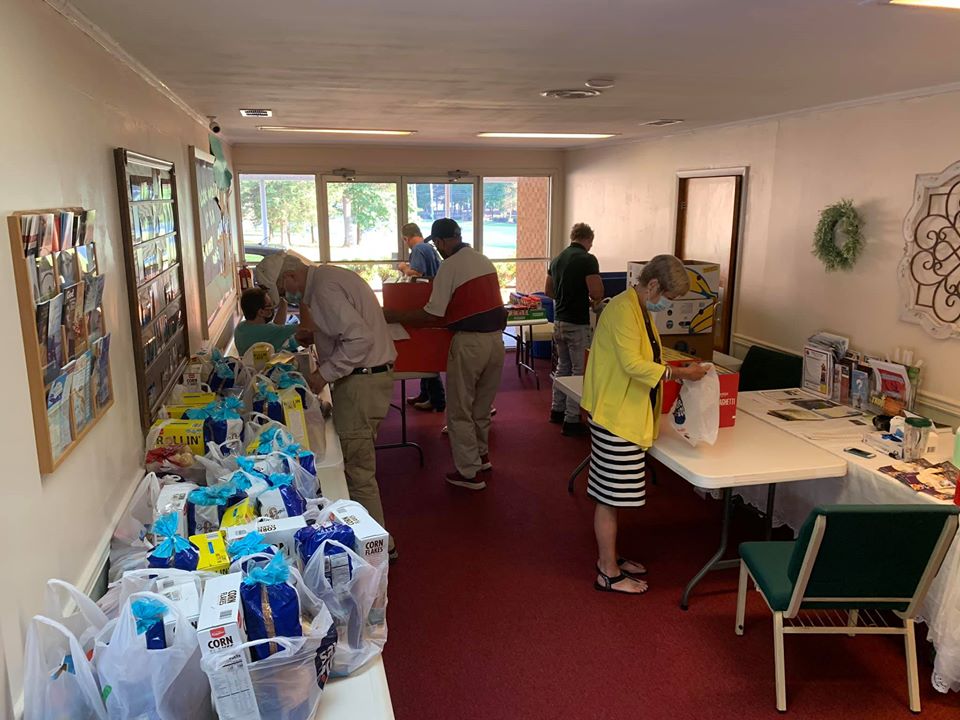
  3. The Farley church in South Huntsville, Alabama, had a food drive for those in the community who have fallen on hard times. Gloves and masks were worn to load the groceries up in people’s cars. Some church pamphlets were given, emails and phone numbers were written down, along with any prayer requests they might have. It has resulted in several local contacts. 
  4. Many of the Lehman Avenue church members in Bowling Green, Kentucky, led by the elders, have been driving around every Sunday afternoon to visit shut-ins. They deliver bread, sing, and pray with them. It has made a great impact on the morale within the body there. 
  5. The Wisconsin Avenue church in Huron, South Dakota, have come up with a creative way to reach out to the community by building what they call a “Blessing Box” in front of the building. In this box the locals have access food and Bible study material. 
  6. The preacher of the LaFollete church, Ben Shafer, in Tennessee, has been producing daily devotional videos to help the members stay connected and in the Word. This is also being done by Bud Woodall, the preacher for the Northeast congregation in Albuquerque, New Mexico, Andy Miller, a minister for the Southern Hills church in Franklin, Tennessee, and in countless other congregations.
  7. The hispanic minister, Chase Turner, at the Jackson Street church in Monroe, Louisiana, has discovered that posting videos/messages in Facebook groups that locals are a part of is a great way to get people interested in spiritual conversations. It has proven to be very effective! 
  8. Colt Mahana, who ministers at the Dahlonega church in Georgia, has started a daily college Bible study over Zoom. This daily study has made the college group there more engaged than they were before the pandemic. 
  9. Dr. Bob Turner had this to say about a church in Mannford Oklahoma: “I visited with several elders from numerous congregations over the last few months…I wanted to share what an eldership in Mannford, Oklahoma, has done over this period of time. While they do their classes over Facebook live, they have done additional things to help the congregation. First, they spend their Wednesday night time for prayer. Instead of teaching a class, they invited people from the community to submit prayer requests and they spend Wednesday evening praying for all the requests they receive. Second, they make special use of each holiday. For example, at Easter, since they could not host an Easter Egg hunt at the park with a potluck, the elders and wives stuffed eggs and the elders went to every home with children in the congregation and hide eggs for all the kids to have their own hunt at home. For Mother’s Day, they made a customized card and personally wrote a note and signed each card for every mother in the congregation. These are a few of the areas they have been creative to do and help members know they are cared for, thought about, and prayed over during this time. They have also emphasized that when they get back together, they want to do it right in order to make a good impression on anyone that might visit. They have constantly communicated with everyone in the congregation each week to make sure they have opportunity to share anything they might be dealing with.”
  10. Chuck Ramseur is working with a congregation in Virginia Beach, Virginia. This church family set up the Marco Polo app and encouraged everyone to share anything and everything going on during the day in their lives. It has helped them stay connected daily. Another area they took up working on is helping with the Crisis Pregnancy Center (alternative for woman thinking about abortion).This ministry has been one of the best outreach programs for the church. They’ve also planned services in the park on Sundays when they could not meet in the building, but could meet with social distancing in an open area.

So, there’s the proof! God is bigger than COVID19.

105950189_3248468518508147_1343333531772853091_o


Audience Analysis

Neal Pollard

People, in talking about public speaking, will sometimes speak of “audience analysis.” What they mean is that you need to know your audience or you run the risk of being irrelevant, disconnected, and even possibly offensive. You may assume too much of them or sell them way short. Neither extreme is effective.

A wonderful sign for any congregation is the presence of especially non-Christian visitors, especially those from our community. Hopefully, we are doing something right when these visitors make repeat visits to our assemblies. However, too often, I fear that we have not done sufficient “worship neighbor analysis” or, equally, “Bible class neighbor” analysis. I recently was in a class when a teacher made a remark about how poorly a specific religious group scored on a Bible comprehension quiz. The remark itself was poignant and effective, but the cackling laughter from a few near the front of the class was easily heard throughout the classroom. I’m sure it was heard by two students sitting near them whose background is in that religious group. One is a brand new Christian and the other is a non-Christian visiting with him. Not only was the members’ reaction unnecessary, it displayed a lack of awareness of who else was present.

At times, we select songs from a century when “thees” and “thous” were commonplace and whose vocabulary was drastically different from how we speak today (“guerdon,” “cassia,” “pinion,” “dross,” and “hoary”). Even songs I have long been fond of read in ways that seem almost foreign to us today. Preparation for worship leadership should include a cognizance of how new Christians, young people, non-Christians, and the like will process or even if they can process such.

Specifically biblical or theological terms which we know people like our neighbors, coworkers, and classmates do not understand should not be uttered undefined. Making assumptions in an age marked by a growing lack of biblical literacy can undermine our effectiveness. It can make the most relevant message of all seem irrelevant and incomprehensible.

Of course, most fundamentally, one of the most unforgivable sins in the eyes of the typical visitor is to be ignored or made to feel invisible. We may hesitate to engage someone because we lack awareness of their “status” (visitor or member). Instead of risking embarrassment, scorn, or an expenditure of time, we walk past them or speak to someone we know we know. Perhaps, in believing that true seekers find, we let ourselves off the hook despite Jesus’ call for us to sympathetically consider others (Lk. 6:31; 1 Pet. 3:8).  Common sense should move us to see that we can attract or detract, depending on how we react.

Spiritual maturity will steer us to be mature, kind, patient, and self-aware. Basic thoughtfulness will help us prepare, speak, and act in ways that make us magnets for the Messiah rather than repellant from the Redeemer. The effort will be appreciated and, I truly believe, rewarded. If we need to, let’s break out of our bubbles of isolation and seek to see things through the eyes of others—especially “the little” (Mat. 10:42; 18:6-14) and “the least” (Mat. 25:40).

4aee607aa23e1943b2f475b58974c89f-bulletin-board-church

Who Is The Greatest?

Neal Pollard

  • The preacher who dazzles with his insight, personality, influence, popularity, or following?
  • The teacher who is the students’ favorite?
  • The member who is “balling” (making a lot of money and having a lot of success in business)?
  • The family with the biggest house and nicest automobiles?
  • The one with the best academic pedigree, with the proverbial alphabet soup behind their name?
  • The folks who are best known and most influential in our community?
  • The ones who are incredibly fit and attractive?
  • The greatest debater, philosopher, and reasoner we know?
  • The elder who is most successful in his career?
  • One who seems to combine a great many or even all of these attributes?

It could be one of these individuals, but despite and not because of the specifics just mentioned. But, we so easily fall into the trap that causes us to think that those criteria are what make one greatest.  Such can cause us to vest blind trust in them or put them in a higher place than is right. Worse, we can try to be motivated to define and promote ourselves as greatest through these means.

The tendency is so fundamental. Jesus warned against it in places like Matthew 20:25-28 and 23:12. His disciples, like James (4:6-10), Peter (1 Pet. 3:8; 5:5-6), Paul (2 Cor. 10:12-18), Jude (16), and the rest, at least implicitly, address the same trap. We all fight the desire to be seen so as to be admired. We may do so through our marriages, our children’s accomplishments, our economic status, our apparent importance, our having it all together, our professional prowess, or any other asset we feel responsible for having. If we use these things to place ourselves above and/or push others below, we are disqualifying ourselves for greatness in the only way that matters—God’s way. False modesty isn’t the answer, either.

We must look at ourselves as dependent creatures. It’s all His and without Him we’d have nothing!
We must look at ourselves as devoted stewards. It’s all His and He expects us to use it wisely, on His behalf!
We must look at ourselves as divine instruments. It’s all His and He works through us to do His will!
We must look at ourselves as dutiful slaves. It’s all His and so are we, living and serving at and for His pleasure!

The warning and disclaimer is that this transformation must happen at heart-level, rooting out thoughts and attitudes that, while fleshly, are so easy to embrace. If the weeds of pride aren’t dislodged from deep within, this effort will prove impossible. But, if it could not be done, God would not have spent so much time instructing us to live and walk by the Spirit rather than by the desires of the flesh and mind. It is the old song, “None of self and all of Thee.” To the degree we adorn that mindset and make that transformation, to that degree we will achieve greatness God’s way!

5122193