“Weapons Of Mass Instruction”

Neal Pollard

The Department of Homeland Security has a fact sheet about the threat of chemical, radioactive, and biological weapons, euphemistically referred to as “weapons of mass destruction.” The International Atomic Energy Agency’s director, Yukiya Amano, spoke recently about the potential harm terrorists could inflict if they get their hands on such materials (cf. dhs.gov; iaea.org). A self-defining term, such weapons, bombs equipped with such agents as smallpox or ricin, could tear through populated areas and cause havoc in communities. Weapon implies something aggressive and powerful. Mass suggests an untold, large number. Destruction means done away or undone. The prospect of such is unnerving.

Yet, the Bible calls itself a weapon. It’s a sword (Eph. 6:17). It is a precise, sharp sword (Heb. 4:12). God says His “word” is “like fire…and like a hammer which shatters a rock” (Jer. 23:29). The word of God fights and destroys evil. It tears down prejudice. It melts away stubborn disobedience. It slaughters the old man. Everyone who does not yield to it now will ultimately do so (Phil. 2:10-11).

This weapon is intended for the masses. As the gospel is the power of God to save (Rom. 1:16) and the gospel must be preached to save (Rom. 10:10-17), the Great Commission—“Go into all the world and preach the gospel to all creation” (Mark 16:16)—entails taking the weapon out of hiding and applying it is “all the word” by preaching it. We’re not permitted to conceal it. If the weapon is appropriately received, it elevates man in his plight here (John 10:10) while it cuts away the spiritual dross (Ps. 119:119), circumcises the heart (Col. 2:11-12), and surgically removes the sin that will keep a soul from heaven (cf. Jer. 4:4). There is not a soul on the globe that can do without exposure to this weapon.

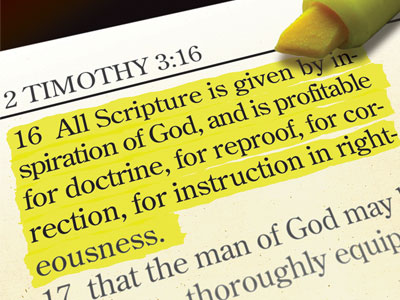
This weapon, meant for the masses, builds up and enlivens (John 6:63). It bears fruit (Luke 8:15). It gives spiritual health (Prov. 4:22). It is an aid and help (Psa. 119:147) At least 48 times, God’s word is called instructions. The word is said to be profitable because it instructs (2 Tim. 3:16). It instructs us on how to walk and please God (1 Th. 4:1), how to have fruitful discussion (1 Tim. 1:5), and how to have wisdom and understanding (cf. Prov. 23:23). It is a weapon which, when used, can save a life for eternity.

Are we working as agents to disseminate this weapon of mass instruction? We do not want to be guilty of far worse than war crimes as we stand before the heavenly tribunal! Eternity demand that we use this weapon!

6891372851_bddcc8d834_o

19 WAYS TO TANGIBLY IMPROVE YOUR RELATIONSHIP WITH GOD TODAY

Neal Pollard

  • Try to spend 5 minutes of prayer in which you do nothing but praise Him.
  • Do something for Him that requires you to step out of your comfort zone—initiate a conversation with a stranger, give a tract to a co-worker you’ve been talking with, etc.
  • Have a devotional with your family.
  • Call a shut-in or stop by and visit a widow(er).
  • Write a missionary, expressing appreciation and giving encouragement.
  • Anonymously give a sacrificial amount of money for a family in need or someone dependent upon support (school of preaching student or teacher, missionary, etc.).
  • Contact an elder, asking him something you could do to help them in their work.
  • Make a list of at least 20 blessings God has given specifically to you.
  • Speak to someone at church services you have never spoken to before.
  • Invite a family from church you don’t know well over for dinner.
  • Put a packet with bottled water and granola bar, along with a tract, into a Ziplock bag to give to the person at the intersection asking for assistance.
  • Pick out a Bible book you are unfamiliar with and start breaking it down, looking for key words, purpose statement, and other clues to better understanding it. Take copious notes.
  • Pray for someone you are having problems with, an enemy, critic, or one who has offended you.
  • Alone or with your spouse and/or children, sing several songs of praise and admonition.
  • Carry a meal to a young mother who has had a difficult day.
  • Give a big smile and warm greeting to a fellow shopper or employee at a store or restaurant.
  • Ask the secretary for a list of last Sunday’s visitors and send them each a warm, brief note.
  • Think of an area for spiritual improvement in your life and ask God to help you focus on it, being transparent and sincere as you petition Him.
  • Ask the person closest to you (parent, spouse, sibling, etc.) something they need for you to pray for on their behalf.

Can you think of additional ways?

Launch Out Into The Deep

Neal Pollard

When Jesus met Peter, it may have seemed like an ordinary day to the Galilean fisherman. Simon Peter and his partners had just spent a long night fishing with no results.  You can imagine they were irritated and frustrated, maybe even feeling sorry for themselves. Then, Jesus commandeered Simon’s boat and used it to teach. This presumably would have been Peter’s first impression of Christ, though we do not know how closely he was paying attention to the Lord.  In Luke 5:4, Jesus stops preaching to the crowd and addresses Peter. He says, “Launch out into the deep and let down your nets for a catch.” Jesus has ulterior motives, but the command is for Peter to literally cast his nets to try to make a literal catch of fish. Immediately, though, Peter is exposed to something far greater than anything earthly or material. Notice how this account illustrates the call of scripture in which Christ tells us, like Peter to launch out into the deep in faith to do great things for Him.

Launch out into the deep…even if, despite great effort, you have failed in the past (Luke 5:5). Simon explained that he and his associates had struck out overnight. Jesus was telling him not to worry about the past. He tells us the same things today. If you have failed in trying to do right or have succeeded in doing wrong, don’t give up hope. Launch out again!

Launch out into the deep…at the prompting of God’s Word (Luke 5:5). Simon was willing. What a great character trait. He tells Jesus, “Nevertheless at Your word I will let down the net.” Simon says, “I value and respect your word enough to try again where I failed in the past.” Do we trust God’s promises and revere God’s commands enough to keep trying and biting off big things for the Lord?

Launch out into the deep…and involve others with you (Luke 5:7). Of course, with the Lord’s help, Simon became a success. In fact, the disciple knew immediately that he was not big enough to tackle his opportunities alone. He got his partners involved. In the Lord’s church today, each of us as Christians are partners and associates together with Christ (2 Cor. 5:18-6:1). Launching out into the deep requires involving as many as possible, for the task is so great and too much for one alone.

Launch out into the deep…and astonishing things can happen (Luke 5:9-11). First, the catch of fish is astonishing to them. Then, Jesus’ commissioning of them is astonishing (to turn from fish to men). Finally, their response is astonishing. They get to land, leave their boats and all they have, and follow Jesus. Eventually, they change the entire world! Launch out into the deep.  Who knows what you can do through Christ (cf. Phil. 4:13), but it will be astonishingly amazing.

Obviously, this was about men and not about fish.  Jesus was not interested in making them rich fishermen in Galilee.  He was looking to enrich the people of Galilee and far beyond through these fishermen. All it took was for some men who believed in God’s power to launch out into the deep.

HOW BAD DO YOU WANT THE TRUTH?

Neal Pollard

Do you want the truth as bad as Jiang Xulian wanted a six-karat diamond from Thailand?  The 30-year-old woman stole the jewel from a jewelry fair in Nonthaburi, swallowed it, and tried to smuggle it out of the country.  CCTV caught the heist and an X-ray in Bangkok revealed the diamond in her large intestine.  Eventually, a surgeon removed the gem, worth $392,000, and Xulian faces three years in prison (read more here).

In successive parables, Jesus compared the search and pursuit of the kingdom of heaven to treasure, the first unspecified valuables and the second pearls (Mat. 13:44-46). David calls the law of the Lord “more desirable than gold, yes, than much fine gold” (Ps. 19:10; cf. 119:72, 127). Solomon adds his inspired counsel to “buy truth, and do not sell it” (Prov. 23:23).  Repeatedly, the Bible lays out the superiority of spiritual treasure above not only physical treasure but all else (Mat. 6:19-21).

  • Some do not stand in the truth (John 8:44).
  • Some question even the existence of truth (John 18:38).
  • Some suppress the truth in unrighteousness (Rom. 1:18).
  • Some exchange the truth for a lie (Rom. 1:25).
  • Some do not obey the truth (Rom. 2:8).
  • Some are not straightforward about the truth (Gal. 2:14).
  • Some do not receive the love of the truth so as to be saved (2 Th. 2:10).
  • Some do not believe the truth (2 Th. 2:12).
  • Some are self-deprived of the truth (1 Tim. 6:5).
  • Some have gone astray from the truth (2 Tim. 2:18).
  • Some are always learning but never able to come to the knowledge of the truth (2 Tim. 3:7).
  • Some oppose the truth (2 Tim. 3:8).
  • Some turn their ears away from the truth (2 Tim. 4:4; Ti. 1:14).
  • Some lie against the truth (Jas. 3:14).
  • Some stray from the truth (Jas. 5:19).
  • Some malign the truth (2 Pet. 2:2).
  • Some do not practice the truth (1 Jn. 1:6).
  • Some do not have the truth in them (1 Jn. 1:8; 2:4; etc.).

The point of Scripture is that these are people who not only do not want the truth but are trying to avoid it.  They lack sufficient hunger and desire for the will of God or the rule of God in their lives. It is not something they treasure.

What about us?  Do we want God’s truth so badly that we are willing to sacrifice, pursue, and strive to obtain it? Its value is without comparison! Its reward is beyond comprehension. Let’s encourage each other to be truth-lovers, willing to pay whatever price is necessary to have it.

See The Living God (Poem)

Neal Pollard

I cannot stop staring at the mountains and the skies

The beauty is so breathless, an endless feast for my eyes

I cannot look at all this and give credit to luck or chance

I’m a victor of the Creator, not a victim of circumstance.

The heavens preach this sermon, Our God He loves and lives

All nature shares the message, what joy and hope it gives

He’s up in heaven waiting until the day He’ll bring us home

For now He’s left us evidence, and we pray, “Lord Jesus, come.”

I cannot stop looking into my little baby’s eyes

I see his parents’ imprint when he laughs and when he cries

In awe my tears are welling as his face shows eternity

This little one God’s endless power shows to all who clearly see

You cannot look at people and fail to see the living God

Our design says a designer, to say “no God” is to play the fraud

He’s patiently waiting for more people to come to Him and live

What will you do with this moment?  Give what you have to give.

I cannot stop reading this Book that explains it all

My cause, my purpose, my destiny, His plan, His way, His call

It has proven to be perfect, it’s been tried and tried again.

It says there is an answer to my problem it calls sin.

The Bible shares the mind of God, it helps us find the way

It helps us understand His heart, and how to live today

It pierces our hearts so we’ll make room to put His will inside

How great our God to show us the path where we can walk at His side

In An Average Assembly, You’ll Find…

Neal Pollard

  • Brand new Christians
  • Young parents
  • The unemployed
  • Spiritual leaders
  • Those struggling with worldliness
  • Someone diagnosed with a serious condition
  • Strugglers with addiction
  • Couples with marital troubles
  • Those with loved ones no longer faithful to Christ
  • Widows/widowers
  • Someone who has been deeply hurt or betrayed
  • Those in serious financial debt
  • Those who are the only Christians in their family
  • Someone facing an enormous life change
  • Some who are experiencing great successes and good news
  • Empty nesters
  • Retirees
  • Community and business leaders
  • Those who grew up in the church
  • Expectant parents
  • Racial minorities
  • The highly educated
  • Extroverts
  • Introverts
  • The emotionally fragile
  • Singles
  • Divorcees
  • Those bearing burdening secrets
  • People brimming with optimism
  • Nurturers
  • Takers
  • Critics
  • Encouragers
  • The easily distracted
  • Those forced to attend
  • Hard working servants
  • The dutiful
  • The physically and mentally challenged
  • Daily Bible students
  • Non-Christians
  • Those who need to make serious spiritual changes
  • The lonely
  • Those without formal education
  • Smilers
  • Scowlers
  • The impatient
  • Notetakers
  • Probably 10,000 other “subcategories”

But, do you know what’s so amazing?  God knew that His single volume, the Bible, could reach into the hearts and lives of everyone of them through a single medium.  He calls it preaching (1 Cor. 1:18-25).  It worked 2000 years ago.  It works today.  What an awesome God to meet us right where we live through a message and means that fills our every longing.

METH-FLAVORED MILKSHAKE

Neal Pollard

It allegedly happened in 2014, but now Fred Maldonado is taking In-N-Out Burger to court for what he said he found at the bottom of his cup.  While their is some “fishiness” to his story and the restaurant “will vigorously defend [against] these baseless claims,” Maldonado “found a napkin and two capsules in the bottom of his milkshake cup” and “later testing revealed that the capsules contained methamphetamine” (from “Businesstech” article).

Search the internet a little and you will find more stories than you can probably stomach about what people have found in their prepared or packaged food and drinks.  As a consumer, the thought of such is enough to make you grow everything you eat and never eat out again.  In the supposed “meth” incident, add danger to disgust!  There is a certain amount of faith and trust one has that those responsible for getting his or her food (or drink) will give them what and only what they paid for.

Tragically, every Sunday in churches across the globe, people sit down to receive what they sincerely believe to be the “bread of life” (cf. John 6:35) and the “water of life” (John 4:10). They trust that the one who is delivering it to them, maybe one they consider a friend and a spiritual brother, is giving them exactly what is claimed—the Word of God. Yet, Scripture warns that there are those who taint the message with something far more appalling and dangerous than anything else could be.  Instead of truth, they get myths (2 Tim. 4:4). Instead of the sure word of Scripture, they get destructive heresies (2 Pet. 1:19-2:1). Instead of light, they get darkness (John 12:46). Instead of Christ, they get philosophy, empty deception, tradition of men, and elementary principles of the world (Col. 2:8).

Paul wrote that divine judgment awaits any who “did not believe the truth, but took pleasure in wickedness” (2 Thess. 2:12).  The hearer has a responsibility to check what the teacher says, to make sure it is right and true (Acts 17:11).  God will hold everyone responsible for what they did with His Word. Even though teachers face a stricter judgment (cf. Jas. 3:1), He holds you and me responsible for avoiding dangerous, disgusting doctrine.  It takes practice to have our “senses trained to discern good and evil” (Heb. 5:14).  Take charge of your own spiritual nourishment, from what you hear on Sunday to what you read every day!

“Let’s Go Throw Rocks At The Campbellite Preacher!”

Neal Pollard

That one statement was what introduced my great grandfather to the gospel and is a big reason why my mom was raised in the church and why I was, too.  A “Campbellite preacher” (so named because of Alexander Campbell, a leading figure of the 19th Century who pleaded with people to throw off the division of denominationalism and restore simple New Testament Christianity) was in their Mississippi community, preaching at the local school house.  Several teenage boys, including my then 19-year-old great-grandfather, conspired together to stand outside and throw rocks at the preacher.  The big talk apparently came to nothing harmful, but standing out there my grandfather was convicted by the preaching.  As the result, he studied more deeply and carefully the Scriptures and found that the denomination he was a part of did not teach the same plan of salvation he read in the New Testament.

Plain, New Testament teaching and preaching, which faithfully and accurately handles the Scripture, has a profound effect on an honest heart.  One who is already persuaded that the Bible is the inspired Word of God, who is convicted that it was faithfully transmitted through time, can see from gospel preaching what God’s will is for “matters of life and godliness” (2 Pet. 1:3).  Such allow the powerful Word to operate skillfully upon their hearts, being persuaded of its penetrating truths (Heb. 4:12).  Even one who may start out angry at the messenger but who is “fair-minded” (cf. Acts 17:11) will “receive the word with all readiness, and [search] the Scriptures daily to find out whether these things [are] so.”  Such an unprejudiced, open-minded attitude will serve such individuals well not only in learning how to become a Christian, but also in how to live the Christian life.  We must keep an honest and good heart if we will be the “good soil” Jesus praises in His parable of the soils (Luke 8:15).

Whatever your age, position in life, race, education level, or physical address, are you teachable? Do you receive the word in humility (Jas. 1:21)?  James says that your soul’s salvation is ultimately at stake.  Whether it regards becoming a Christian or living the Christian life, keep an open and tender heart!  You’ll be eternally grateful that you did.  So may many of your descendants!

If The Bible Is God’s Word…

Neal Pollard

  • It answers the biggest mysteries of this life that so baffle humanity.
  • It reveals the plan of the Creator of everything.
  • We are accountable to it.
  • It tells us where we are going.
  • It will give us a guide we can have confidence in as we head to the future.
  • We cannot refuse to follow it.
  • We should share it with as many people as we possibly can.
  • It is not on a par with other books; it is superior to all of them.
  • He disapproves of religious division.
  • There is a right way to worship Him.
  • We can know the truth.
  • We discover some great, precious and exciting truths and promises.
  • The New Testament church is eternally important.
  • We should read and study it faithfully.

Investigate the Bible and explore its origin and the book as it is today.  God’s Word is not afraid of investigation.  It has been more scrutinized than any other book ever written, and it still stands.  It is a foundation we can confidently build our lives upon.  It is a guide that can safely lead us now and forever.  Have you been in the book of books today?

THE MASTER’S MATERIAL

Neal Pollard

A while back it was popular in the religious world to talk about Jesus’ encounter with two disciples on the road to Emmaus. The emphasis has often been on the disciples’ experience. I believe the biblical emphasis is on the character of Jesus. The disciples are contemplating Him even as they encounter Him. They describe Jesus as “a man who was a prophet mighty in deed and word before God and all the people” (Luke 24:19). Notice three reasons why He was so mighty in word before all the people.

JESUS KNEW HIS MATERIAL. Luke 24:27 says, “And beginning with Moses and all the Prophets, He interpreted to them in all the Scriptures the things concerning Himself.” Truly His knowledge is perfect and ours is not, but there is no excuse for failing to study–both on our own and for a class we are teaching or sermon we are preaching.

JESUS KNEW HOW TO RELATE ITS MEANING EFFECTIVELY. The men journeying to Emma’s, after walking with Jesus, said, “Did not our hearts burn within us while He talked to us on the road, while He opened to us the Scriptures?” (Luke 24:32). The dismal method of too many Bible classes is to essentially read and paraphrase in verse by verse fashion. Preaching can too often be disorganized in delivery or vague in message. Paul told Timothy, “Do your best to present yourself to God as one approved, a worker who has no need to be ashamed, rightly handling the word of truth” (2 Tim. 2:15, NIV).  Robertson says of “rightly handling” that it means “cutting straight…Since Paul was a tent-maker and knew how to cut straight the rough camel-hair cloth, why not let that be the metaphor?” (Vol. 4, 619). As presenters of truth, tell what it meant then and in context, and then apply it!

JESUS KNEW HOW TO MAKE THE MATERIAL LIVE IN HIS STUDENTS. Luke 24:45 says, “He opened their minds to understand the Scriptures.” That is just what we are after as teachers, preachers, and proclaimers of the Word. We are not just fact-reporting. We are trying to get into the heart. Remember that Jesus sought to change lives with His teaching.

Only Jesus was the perfect teacher. But we can always be better and great. Let us mimic the Master’s approach to His material!

“Moral Leadership?”

Neal Pollard
This is how Seth Fiegerman at Mashable summarized new Apple CEO Tim Cook’s recent moves, an array of social activist “statements” that includes an Apple gay pride parade and declaring himself homosexual, calling to attention to perceived environment and climate change, and associated causes. Fiegerman also synonymously dubbed his activism as “moral authority” and “staking out moral ground.”   The evocative title of the article is “Apple’s new moral era begins” (6/8/15). As a happy “Macster” with an iPad and iPhone, I am not a frustrated PC user looking for an opportunity to rage against the Apple machine.  It is what it is.
Whether or not you agree with Cook, he is most certainly assuming definite moral leadership.  Indeed, it is not overstating things to say he is “moralizing,” as vehemently as any preacher, professor, or reformer could.  In his powerful position at one of the most influential companies in the world, Cook is spending his leadership capital in a profound, definite, and specific way.  However, it is not as if he invented moral leadership.  Anyone with any influence in any point in history is wielding moral leadership, staking out moral ground with at least some degree of moral authority.  The defining question is, “Whose morality?”
The Bible defines morality.  As the product of a transcendent, all-powerful authority, the Bible is the only legitimate standard of morality.  It outlines a specific way of living, using words like godliness (see especially 1 Tim. and 2 Pet.), moral excellence (2 Pet. 1:5), detailing a moral lifestyle (cf. Gal. 5:22-23), and the like. It also forbids a specific way of living, using terminology like immoral and immorality.  Its standard is specific.  Consider a few examples:
  • If a man marries a woman and her mother, it is immorality (Lev. 20:14).
  • Divorcing your wife and marrying another woman is adultery, unless your wife is guilty of sexual immorality (Mat. 19:9).
  • A man who had his father’s wife was guilty of immorality (1 Cor. 5:1).
  • Sodom and Gomorrah were guilty of gross immorality and going after strange flesh (Jude 7).
  • Along with a covetous, idolatrous, drunk, or swindling person, God says to avoid the immoral (1 Cor. 5:11).
  • Immoral men are placed alongside homosexuals, kidnappers, liars and perjurers as contrary to sound teaching (1 Tim. 1:10).
  • Esau selling his birthright is called immoral (Heb. 12:16).
There are many other examples of Scripture defining morality, often by pointing out its opposite.  People who use their influence to lead people to do the immoral are certainly exerting moral leadership, but it is leadership contrary to the heart and will of God.  There is a vital need for you and me, as those who love and trust God’s Word, to exert true, moral leadership, to exalt His morality.  A saying attributed variously to Edmund Burke, John Stuart Mill, and Charles Aked, is very familiar to most: “The only thing necessary for the triumph of evil is that good men should do nothing.”  May we step forward and exert moral leadership that honors God.

Ready For A Trivia Quiz?

Neal Pollard

Here are the rules: Don’t use any resources to look up these answers.  This is a quiz to test your knowledge.

  1. What is Mark Zuckerberg best known for co-founding?
  2. How many regular season games are there in an NFL, MLB, and NBA season?
  3. What is the name of Apple’s media library, media player, and mobile device management application?
  4. What is Ree Drummond’s famous nickname?
  5. Captain America, The Hulk, and Iron Man are all part of a group of superheroes better known by what name?
  6. Which online social networking service restricts users to 140 characters or less?
  7. What is the name of the author of 50 Shades Of Grey?
  8. Name three different, major cell phone service providers.
  9. What is the name of the ABC television series that pairs professional dancers with celebrities who compete against each other?
  10. What is the name of the video-sharing website whose logo is a redbox with a play button symbol in the middle of it?
  11. What is the brand name of Wal-Mart’s generic line of food products called?
  12. What is the name of the website where users can upload, save, sort, and manage images (“pins”) and other media content in collections called “pinboards”?
  13. What upbeat 2013 song by Pharrell Williams lost its Oscar bid to the song “Let It Go”?
  14. What movie did the song “Let It Go” famously appear in?
  15. Name two major cable news networks.

Hopefully that was fun.  How did you do?

If you got 12-15 right, you are fluent in current culture.
If you got 8-11 right, you are passable in current culture.
If you got 4-7 right, you are possibly living on an Amish farm or serving a stint in solitary confinement.
If you got less than 4 right, you may not have a pulse.

(Note: measurements are strictly facetious and unscientific).

Now for a second quiz:

  1. In what Bible book is it said, “We brought nothing into this world, and it is certain we can carry nothing out”?
  2. What was King David’s father’s name?
  3. Name two sons of Jochebed.
  4. Joel, Haggai, and Hosea are all books of the Bible from what literary genre?
  5. What was the name of the hometown of the apostle Paul? What was the name of his famous teacher?
  6. What two men were considered to replace the apostle Judas and which one did God select?
  7. What was the name of the town where Jesus was born?
  8. On what island was the apostle John exiled?
  9. Name two righteous kings of Judah.
  10. What were the names of the rivers Naaman preferred over the muddy Jordan River?
  11. Name the books of the Bible commonly referred to as “the gospels.”
  12. What is another name for the deliverers of Israel whose ranks included Othniel, Tola, and Ibzan?
  13. Who penned the words, “Pride goes before destruction”?
  14. What Jewish sect who opposed Jesus also did not believe in the resurrection?
  15. Who penned the book of Acts?

How did you do on that test?  We absorb so much of the culture because it surrounds us and demands our attention. We see it, hear it, and are in so many ways surrounded by it. The Bible is something we must be intentional about. We must go to it and spend time in it.  When we do, we’ll grow in more than mere knowledge (cf. 2 Pet. 3:18).  We’ll be nourished (1 Tim. 4:6), delighted (Ps. 1:2), enlivened (Ph. 2:16), protected (Ps. 119:11), revived (Ps. 119:25), and sanctified (Jn. 17:17).  We’re not trying to win a trivia contest.  We’re trying to overcome the world and go to heaven.  Bible reading, studying, and meditation is key to that!  Spend some time in The Word today and every day!

Answers To The First Quiz:

  1. Facebook
  2. 16, 162, and 82
  3. iTunes
  4. “The Pioneer Woman”
  5. “The Avengers”
  6. Twitter
  7. E.L. James
  8. Sprint, AT&T, TMobile, Verizon, etc.
  9. “Dancing With The Stars”
  10. YouTube
  11. Great Value
  12. Pinterest
  13. “Happy” or “Happiness Is The Truth”
  14. Frozen
  15. CNN, Fox News, MSNBC

Answers To The Second Quiz:

  1. 1 Timothy (6:7)
  2. Jesse
  3. Moses and Aaron
  4. Prophecy (particularly, “Minor Prophets”)
  5. Tarsus; Gamaliel
  6. Matthias and Barsabbas; Matthias
  7. Bethlehem
  8. Patmos
  9. Hezekiah, Josiah, Asa, Jehoshaphat, etc.
  10. Abanah and Pharpar
  11. Matthew, Mark, Luke and John
  12. Judges
  13. Solomon
  14. Sadducees
  15. Luke

question marks

CRAIGSLIST CASUALTIES

Neal Pollard

Ad consultant Peter Zollman issued a report in June 2014 saying that more than 40 slayings and 30 convicted killers have been linked to Craigslist (Stephanie Slifer, CBS News online, 1/28/15).  Robbery is most often the motive behind the crime. Parry Aftab, a lawyer who specializes in Internet privacy and security law, offers these precautions:

  • Never go alone
  • Meet at a central location
  • Make sure someone else knows where you’re going and communicate frequently with them throughout the transaction
  • Research the seller’s name and address on the web
  • Don’t get cornered
  • When you arrive, snap a picture of the person and/or their license plate
  • Use common sense and if you’re uncomfortable, leave (ibid.).

If you’re like me, you’ve used Craigslist many times and have lived to tell the tale.  We’ve not always followed all these rules, though a great many of them seem like common sense.  We’ve bought and sold and have had great experiences with decent, friendly folks.  The worst I can recall is that someone in our immediate family bought a vehicle from one less than forthcoming about all its flaws.

While these are very helpful public service tips, there is a danger far greater and much more common.  What is at stake is even more serious than the taking of physical life as it involves the soul.  The Bible warns about teachers who project themselves to be speakers of truth but are far from it.

  • By smooth speech and flattering words, they deceive the hearts of the simple (Rom. 16:18).
  • They turn the grace of God into lewdness and deny Christ (Jude 4).
  • They bring in destructive heresies which many follow (2 Pet. 2:1-2).
  • They exploit people with deceptive words (2 Pet. 2:3).
  • They prey on those inclined to turn their ears from truth toward fables (2 Tim. 4:3-4).
  • They are detestable, disobedient and unfit for anything good (Ti. 1:16).
  • They pervert the gospel of Christ (Gal. 1:7).
  • They captivate the impulsive (2 Tim. 3:6).

So often, these teachers find those already looking for a cheap and easy message.  However, often they draw in sincere folks who allow themselves to be misled.  In either case, while God holds teachers responsible (Jas. 3:1), He also holds hearers responsible (Lk. 8:18; Acts 17:11; 2 Tim. 2:15).  We must make ourselves accountable for what we and our families hear—eternity is on the line!

A VISIT TO A TEEN’S RELIGIOUS WORLD

Neal Pollard

I love the World War II generation and the enormous impact they have had on our nation!  Perhaps no generation has had a greater challenge since them than the one presently coming to maturity.  Last night, at Teens In The Word, we asked the teens to describe the religious philosophy of their peers as they interact with them at school, their jobs, and their extracurricular activities.  It was heartening to see and hear our teens’ conviction, knowledge, and heart, but disheartening to discuss the fruit of a couple of generations of our culture’s social experiment to reprogram the thinking of people, especially this burgeoning generation.

Our teens attend schools in Douglas, Jefferson, and Denver Counties, go to large High Schools, charter schools, private schools, and homeschools. Despite these diversities, what they encounter is remarkably similar.  It might surprise you that many of their peers believe in a Higher Power and would consider themselves spiritual. More than anywhere else, these peers attend community churches.  Whatever the church growth gurus and experts claim, the teens that go to these churches tell our teens something very different.  Their religious experience is heavily dependent upon entertainment, doing fun things with a party atmosphere, not motivated or influenced by much biblical teaching, segregated from adults, hard-rocking music, dancing, and overall a very tactile experience.  What impact does it have on “faith”?  If speaking in terms of growing closer to God and learning more about Him, not that much. The prevailing worldview of many of our teens’ friends is “what’s right for me may not be right for you,” that God and the devil, heaven and hell are mindsets more than realities (really just your conscience inside of you), and that essentially the only or worst sins, the “objective wrongs,” are offending others and judging others.  When our teens seek to assert objective truth from scripture, they sometimes encounter scorn or rejection. While our teens know a varying degree of peers whose faith and beliefs are more concrete and committed, perhaps the most frequently observed comment last night was that many of their peers “believe in God but not the Bible or Christ.”  They see the Bible as a book of myths or fairytales and not the revealer of truth or a standard of authority.

As we closed our class last night, I was left awestruck.  Our teens are among my most cherished heroes.  They are on the frontline of faith, battling in a world more opposed to truth than that of any generation now living which preceded them.  We were struck with more than admiration, though.  We felt determination, the need to redouble our efforts to establish and defend the trustworthiness and integrity of the Bible, the existence of God, and from that the authoritative nature of Scripture.  Not only will this bolster the faith of our teens, but it will help them in dialoging with those among their peers possessing good and honest hearts (cf. Lk. 8:15).

Here are four things you can do right now for our teens.  (1) Pray for them. (2) Live Christ without hypocrisy before them. (3) Actively encourage them. (4) Help equip them.  Look for heroes where you will.  I have found mine!

Our teens recently feeding the homeless (photo credit: Lexi Hoagland)

“CONTRADICT: THEY CAN’T ALL BE TRUE”

Neal Pollard

Kathy just called me and told me she saw this bumper sticker on a truck as she fought traffic on Wadsworth Boulevard.  How clever!  It uses the same religions that the infamous “Coexist” bumper sticker uses, including Hinduism, Daoism, Shintoism, Unitarian Universalism, Satanism, Atheism, Islamism, and Judaism. There is a website where these bumperstickers can be purchased (http://www.contradictmovement.org; warning: I do not endorse everything on this web site, whether message or method).

The “Coexist” campaign is meant to promote pluralism,  a theory or system that recognizes more than one ultimate principle. The very idea is contradictory.  The Koran says, “And whoever desires a religion other than Islam, it shall not be accepted from him, and in the hereafter he shall be one of the losers” (3.85).  Shintoism says that humans become gods (kamis) after death, and they do not believe in absolute right and wrong with the soul losing individual identity and becoming part of one great guardian spirit (Japan-Guide.com; litesofheaven.com).  Atheism believes, since there is no God, that there is no judgment and no accountability to a higher power. Taking any number of tenets about conduct, salvation, our nature, deity, afterlife, and the like, one sees inescapable and frequent contradiction between these faiths and philosophies.  Yet, even without all of this, there is the exclusive truth claim of Christianity in Scripture.  The “Contradict” bumper sticker has a passage that says much.  “I am the way, the truth, and the life. No man comes to the Father but through Me” (John 14:6).  Jesus speaks of an exclusive way, calling it “the” way and saying there is “no other” way.

The “Coexist” mentality is founded, for some, upon a noble enough desire, the desire for peace and harmony.  Yet, it seeks the wrong way to peace and harmony, letting mankind devise their own way for this to exist. We do not have that prerogative.  The Bible reveals God, the Creator, in a specific way, revealing His nature, His will, and His expectations.  With that, there is human accountability and an expectation that people will follow that way or suffer the consequences of disobedience.  Conflicting, opposing positions contradict one another, and they cannot all be true!

The “Moral Compass” Of The Modern Culture

Neal Pollard

If a nation or people will move back toward the Bible, it must overcome three philosophical barriers.  I mentioned these in an earlier blog (read here).  Here are the three barriers:

  • The Cultural Sickness Of Subjectivity.  Subjectivism, in its final form, makes the individual “god” and their views supreme. Thoughts and feelings trump a rational look at an individual matter, and even searching for an objective viewpoint is disdained.
  • Society’s Warped View Of Tolerance.  Rather than “hate the sin, love the sinner,” the mantra is “there is no sin and no sinner.”  Though everyone has a line in the sand somewhere, no one wants anyone putting their behaviors on the other side of the line.
  • The Average Person’s Ignorance Of The Bible.  Of course, we are getting past the point where the average person believes the Bible or has a favorable view of it.  The fruit of the seeds of biblical illiteracy is more than immorality.  It includes prejudice against the Bible and contempt for those who seek to upheld it in most any forum.

Certainly, those professing to follow the Bible and its guidelines have hurt their own cause through ungodly attitudes, hypocrisy, isolation, and prejudices of their own.  Christians must be willing to make the first (and even second and third) steps (cf. Mat. 5:41).  We must model biblical teaching with righteous lives (Mat. 5:14-16; 1 Pet. 2:9).  We cannot expect the world to act Christlike, but we must expect that Christians will not be worldly.  We can effect the change we want to see, and, in time, align the culture’s moral compass with the Creator’s.

THE MOANING OF A DOVE, THE GROWLING OF A LION

Neal Pollard

One of the more interesting Hebrew words in the Old Testament is the word translated “meditate” in passages such as Psalm 1:2.   הָגָה (“Haga”), most often found among the poets and prophets, has a wide range of meaning depending on derivation of the root word.  Elihu uses the word to speak of the “rumbling” of God’s voice (Job 37:2). Moses uses the word to speak of a “sigh” (Ps. 90:9). Isaiah uses the word to speak of the “moaning” of a dove (38:14) and “growling” of a lion (31:4). The occult mediums “whispered” and “muttered” their incantations (8:19) (Harris, et al, TWOT, 1999, n/p).  Yet, the word is often used to speak of a low voice within, pondering and rehearsing what God’s Word has to say and what it means.  This is how David and Joshua use the term in speaking of meditating day and night on God’s Word (cf. Jos. 1:8).  It is possible that in carefully considering God’s Word, the student would rehearse or mouth the words of God as they contemplated and looked into it.  One lexicography renders it “to read in an undertone” (Koehler, et al, HAL, 1999, n/p).

How one studies the Bible is very personal, but for it to have value and assist us in living the way God wants us to, there has to be a process in place that takes us beyond mere reading to comprehension and then on to application.  Meditation upon the Bible seems a vital part of this.  When is the last time in your personal Bible reading that you memorized, rehearsed, and meditated upon what you read that day?  Do you revisit in your mind what you read earlier, pondering meaning and relevance in your attempt to live as God wants you to live?  Have you found yourself returning to its truths again and again, convicting yourself of needed changes and improvements in your Christian walk?

Meditating upon God’s Word will build your reverence of it, your conviction that it as modern and relevant as today’s sunrise, and your view of it as the inspired, authoritative Word of God.  It will bind your mind and heart to the mind and heart of God.  It will help you elevate your thoughts and consider the bigger picture of eternity and not just the mundanity of earth.  It will have you singing with David, “Oh, how I love Your law! It is my meditation all the day” (Ps. 119:97).

Can You Do Something With Your Children?


Neal Pollard

“Older people”—in which I include not just the elderly but anyone whose children are older—and even others should practice compassion and sympathy toward our dear parents who are making the effort and sacrifice to be present in our assemblies with their wonderful small children.  Attention spans and articulation of needs are challenges up to a certain age.  Even good children wrestle with rambunctiousness and precociousness.  This is natural and certainly forgivable.  With compassion, we must acknowledge that some children have special needs and cannot help some of their behaviors.

Yet, there can be children who are simply spoiled and undisciplined.  While all of us are experts on how others should be raising their children, we all come to the task regarding our own children as rank novices.  God knew that, and so He instructs us as to what to do with our children.

“Train” them (Pro. 22:6). If we are not careful, we can let our children train and condition us.  Have you ever seen children who consistently “ruled the roost” in their homes?  Training implies intention, planning, forethought, and concerted effort. When children seek to impose their will, it takes great will-power and discipline on our part to show them what is and is not appropriate.

“Bring them up” (Eph. 6:4).  Who was it that said “if you don’t bring them up, you’ll let them down?”  I agree with them.  Paul urges fathers to raise children “in the discipline and instruction of the Lord.”  We must mold them into God-followers, which means appealing to their minds and bodies.  The instruction addresses the mind. The discipline guides the body.  The antithesis would be undisciplined, ignorant children in the most important area of life—the spiritual!

“Love” them (Tit. 2:5).  Here, Paul urges mothers in this all-important, pervasive action.  Sadly, some think love equates to indulgence, permissiveness, and helpless by standing.  Not at all!  Only loving parents will make their children obey the rules, be polite and well-behaved, and considerate of others.  How sad and unloving when parents constantly shift blame or excuse misbehavior rather than address it and help correct it.

Train them, bring them up, and love them.  Do this, and others will sincerely enjoy being around your children, will compliment them consistently, and thank you for making the effort.  Fail to do it at the potential peril of the child and yourself!  Do what God says should be done with your children!  You will be glad you did.

IS TRUTH “OBJECTIVE” OR “SUBJECTIVE”?


Neal Pollard

“You folks believe baptism is essential, but we believe we are saved when we accept Jesus in our hearts by faith.” “Why does the church of Christ think it is wrong to use a piano?”  “You must not like women.  You sure don’t let them use all their ‘gifts’ in your worship and leadership.”  These are just three random examples of statements of perception made by our friends and family concerning “our beliefs.”

How would you answer these?  Even within the Lord’s church, more than one answer is often offered.  Sadly, too often the heat of emotion eclipses the light of scripture in these matters.  How is truth determined?  Is it man’s right to decide what truth is “for him”?  Can I have my truth and you have your own, different truths, and we both are right?  Please understand that I am not speaking of matters of judgment, opinion, matters that must be determined by principles of scripture, scruples, and conscience.  Take the three examples mentioned-baptism, church music, and the role of women.  Are these matters that must be decided by mere human judgment, opinions, and conscience?  Or can we “know the truth” on these things (cf. John 8:32)?

All of this ultimately boils down to our attitude and approach to God’s Word.  Do we accept it at face value and glean from it what it has already said, or do we infuse (insert) into it our predetermined values and desires?  Consider the three examples.

Baptism is connected to salvation in the gospels (Mk. 16:16), the history book of the New Testament (Acts 2:38; 22:16; etc.), and the epistles (Rom. 6:1-6; Gal. 3:27; Col. 2:12; 1 Pet. 3:21; etc.).  Why would we deny it?  Do we really hope to make scripture fit our view by trying to make Bible verses conflict with each other (cf. John 3:16; Acts 16:31)?  If the Bible repeatedly says baptism is necessary for salvation, isn’t that a truth objective and universal?  If not, why not?

Singing is specifically commanded in major worship passages like Colossians 3:16 and Ephesians 5:19.  We have no doubt that God wants us to sing.  Now, some say that it is a matter of preference whether you sing with or without instrumental accompaniment.  I find it interesting that a New Testament writer teaching a New Testament principle makes his point with an example from the first covenant.  In Hebrews 7:14, the penman writes, “For it is evident that our Lord arose from Judah, of which tribe Moses spoke nothing concerning priesthood.”  Moses did not forbid a man of Judah from serving as a priest.  God simply specified that the tribe of Levi was to be the priestly tribe.  Was priesthood selection a matter of personal preference?  Absolutely not (see 1 Kings 12)!  

Women’s role in the church is discussed in the midst of an epistle the thesis of which is that the church may know how to conduct herself (1 Tim. 3:15).  Part of that conduct regards women’s role in the church (1 Tim. 2:9-15).  The Christian woman is not to teach or have authority over the man (2:11-12).  The reason is not tied to Greek culture, but way back to original design at the beginning of the world (2:13-14).  When some push for an “expanded” role for women, are they letting cultural pressure of heavenly desire drive them?

Certainly, we cannot be callous or altogether dispassionate in studying or discussing these matters.  But, without recognizing a sovereign, divine standard of truth, what are we doing with Scripture?  Whether meaning to or not, we are subjugating God’s stated will to our subjective, ever-shifting will.  John 12:48 reminds us that the latter will ultimately be irrelevant.

“What Ever Happened To Toasters?” (*)

Neal Pollard

That’s what Tidewater resident Laila Cheikh might want to know.  She made a cash withdrawal for her cab company drivers from her Newport News, Virginia, Bank of America branch and got an unexpected “gift.”  Someone accidentally included a dye pack, like those given to bank robbers, in her bag of cash.  It exploded, leaving a huge mess and a foul smell.  That was on August 14, 2008.  In March, 2009, she sued Bank of America for bodily injuries from the dye (via USA Today Online, 8/14/08; Janie Bryant, The Virginian-Pilot, 3/14/09).  It’s unclear if the case has ever been solved.

I imagine you have had a day or two when you were delivered a less than pleasant surprise.  It may have been a dose of bad news.  Perhaps it was that person whose apparent color-blindness regarding the red light roped you into a fender bender that changed your morning plans.  It might have been a pink slip from a company you’ve faithfully served for years.  So many things can happen unexpectedly which alter your course or have a negative impact on you.

Though it will not compare to the day Job had (Job 1-2), it will test your character, your attitude, and your Christian example.  What you do when the unexpected and unpleasant “blows up in your face” is crucial!  You can be a light or you could cross over to the “dark side” (cf. Matt. 5:13-16; 1 Th. 5:8-10).  It’s up to you.  You never know what might be in the “bag of life.”  Be ready!


(*) They used to give new customers a toaster when they opened a bank account (before my time).