The Restorers

Neal Pollard

You can credit (or blame) a 16th-Century French scholar, printer, and typographer named Robert Etienne for our modern division of the Bible into individual verses. He’s sometimes known by his Latin name, Robert Stephanus. Overall, he did an incredibly commendable job. Sometimes his divisions are head-scratching, like in Ezra 2. This chapter has 70 verses, as he gives each family of the returning exiles their own verse. I’m not sure there is a better way to divide it, though. So, who are these people, that whole assembly of returnees numbering 42,360 plus 7,337 servants and 200 singers? 

They were people willing to endure difficulty. The journey itself would have been over 1000 miles. They leave the comfort and prosperity of Babylon to resettle their native homeland. They will have to rebuild or at least remodel houses and whole villages, not to mention rebuild the temple and the walls around the city of Jerusalem. These were not lazy people!

They were led people (2). Ezra tells us who the leaders were by name. The first three named are among the most prominent leaders in the post-exilic period. Zerubbabel (cf. Zech. 4; Neh. 7,12) not only helps lead the exiles back to the land, he leads the temple reconstruction project (5:2). He insures that the work is done by the Jewish people, and not by their enemies (4:1-3). He is identified as governor of Judah (Hag. 1-2). Jeshua is usually found alongside Zerubbabel (4:3). He is identified in the books of Ezra, Nehemiah, Haggai and Zechariah as the High Priest. Nehemiah, for whom the Old Testament book is named, will also serve as governor of Judah, was likely a prophet, and previously served as a high official in Persian court (Neh. 1). Eleven men in all are listed as the leaders who shepherd the exiles back to the land. They appear to be highly qualified men, perseverant in their own right. 

They were purposed people (3-67). Ezra divides his list into categories. Many are generally listed as men at the heads of certain families (“sons of…,” 3-35), priests (36-39), Levites (40), singers (41), gatekeepers (42), temple servants (43-54), “Solomon’s servants” (55-57, probably descendants of those selected by Solomon to work on the temple), and several whose genealogical record was unverified (58-63). Who was more important? That is entirely the wrong question! Each group had a purpose, and God and His leaders were depending on them to fulfill it! Verse 70 lists all these groups, who dwelled in their cities and squared up to their tasks.

They were generous people (68-69). Well, not all of them, but certainly “Some of the heads of fathers’ households, when they arrived at the house of the Lord which is in Jerusalem, offered willingly for the house of God to restore it on its foundation” (68). They gave according to their ability (69). Through them, God continues to provide for the future of His people.

As we consider the great, ongoing work of restoration, God is seeking the same things from us: perseverance, submission, purpose, and generosity. He will do great things, even in the midst of shambles and dysfunction, when there are people possessed of qualities like these. We will see that longterm projects will have hiccups and stalls, but a huge step occurs when people are willing to step out by faith. 

The Fruits Of Restoration

Monday’s Column: Neal At The Cross

Neal Pollard

There is nothing like the satisfaction of completing a task that was especially hard-fought and challenging. But, there was Judah in Ezra’s day in Ezra six after Haggai and Zechariah’s message propels them to the finish line concerning the temple (14). After earlier opposition from their neighbors, Judah is assisted by the most powerful nation on earth “with all diligence” (13). It was not nearly as glorious as the original temple (3:12; Hag. 2:3), but it was rebuilt and available for Judah to use to worship God as before the captivity.

Consider some of the fruits of their obedient, faithful efforts from Ezra 6:13-22. These are the some of the fruits of restoration.

Joy (16,22).

In a world where everybody just wants to be happy, few know genuine joy. The happiness for the people here is so intense and deep-seated because God is the source and reason for it. They celebrated the dedication (16) and Ezra says “the Lord had caused them to rejoice” (22). There is a unique, genuine joy available to those who are seeking to build their lives and religion according to the Lord’s pattern (Rom. 15:13). 

Faithful Worship (17-20).

Following the revealed instructions from God through His leaders, the people were now enabled to dedicate the temple (17), appoint the priests (18), and observe the Passover (19-20). They have returned to the proper place, people, and practice of worship. That is the epitome of restoration. When we submit to the instructions of the New Testament regarding who leads (1 Tim. 2:8,11-12), where we participate (Heb. 10:24-25), and how we worship (cf. Col. 3:16-17), faithful worship, when done in proper spirit, follows (John 4:24). 

Purity (20-21).

The ones who could participate in the Passover were those who had purified themselves. That started with the leadership (19) and extended to the rest of the participants (19-20). It mandated separating from “the impurity of the nations of the land” (20). They could come before God with pure and holy hands (cf. 1 Tim. 2:8). Think about what Peter tells believers: “Since you have in obedience to the truth purified your souls for a sincere love of the brethren, fervently love one another from the heart, for you have been born again not of seed which is perishable but imperishable, that is, through the living and enduring word of God” (1 Pet. 1:22-23). 

Divine Aid (22).

Do your best and try your hardest, but you will fall terribly short without this factor. God’s providence paved the road and opened the door to restoration. The Lord “…had turned the heart of the king of Assyria toward them to encourage them in the work of the house of God.” “The Lord had caused them to rejoice.” One of the fruits of seeking to restore God’s will and ways in our public and private lives today is this assurance. Jesus promises, “I am with you always” (Mat. 28:20). “I will never desert you, nor will I ever forsake you so that we can confidently say, The Lord is my helper…” (Heb. 13:5-6). 

Be body builders, building the Lord’s church the Lord’s way. Let’s go all the way back to the Bible. The end result is a multitude of blessings (Eph. 1:3) like those mentioned in Ezra 6:13-22. 

Rescuing Your Brother

Monday’s Column: Neal At The Cross

Neal Pollard

Friday night’s snow storm was almost blizzard-like, in manner if not in measure. With the winds, visibility was near zero. The drive from the church building to our house, all 8.8 miles of it, had to be negotiated at speeds of about 20 miles per hour at times. It was the first night of our gospel meeting with Melvin Otey, who did an excellent job! In attendance were all of our sons and their wives. I’m grateful that all three of our children learned to drive in Colorado and have a lot of experience handling snowy conditions. But, as a parent, you are never without concern. Thanks to Life360, I could watch their progress. And I did. I watched as one by one each made it to their homes. Only one of them did not. I saw that one of them was stuck at “0 MPH” kind of in the middle of nowhere. Thanks to cellphones, I could call him. Turns out that he had slidden off the road and was stuck. Another of our sons was not far away and he was able, with difficulty, to reach them and take them to his home. I watched every bit of it “unfold” on Life360. The saga ended with their safe arrival at 12:30 AM. They were able to pull out his truck without difficulty or damage. It turned out as well as it could.

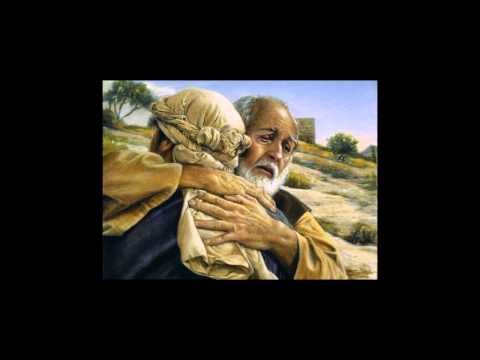
This all made me think about what the heavenly perspective must be like. The Father does not rely on an App to see fuzzy details of His children’s situation. He sees with the perfect omniscience and is present with the perfect omnipresence of an Almighty God. While He has the power to do whatever He pleases, He has bound Himself to allow His children to exercise free will. When one of His children drifts into danger, He is dependent upon others of His children to rescue them. I am reminded of how anxiously He desires their safe return, how thankful He is when others of His children intervene, and how joyful He feels when He sees His children safe at home. Do you remember in the parable of the prodigal son? Luke 15:20-24 shows the joy and celebration of a father overjoyed that his son, astray in a sinful condition, had come back home. He could not contain his happiness. That story depicts God.

It also makes me appreciate Paul’s words in Galatians 6. “Brethren, even if anyone is caught in any trespass, you who are spiritual, restore such a one in a spirit of gentleness; each one looking to yourself, so that you too will not be tempted. Bear one another’s burdens, and thereby fulfill the law of Christ” (1-2). Or James’ closing admonition, that “if any among you strays from the truth and one turns him back, let him know that he who turns a sinner from the error of his way will save his soul from death and will cover a multitude of sins” (5:19-20). It should be the natural response of one brother who knows of another brother overtaken and astray to act, to “restore” and “turn him back.” The Father is happy when this happens! The stakes are infinitely higher than physical safety. Eternity is in the balance! Is there a brother or sister out there who needs you and me to rescue? If so, it is time for us to act! Consider the Father. Consider the brother. Let’s go get them back!

Friday night at Lehman

A Simple Way To Identify The Church Jesus Started 

Tuesday’s Column: Dale Mail

IMG_1381

Dale Pollard

There are just too many voices in the world today muddying the waters when it comes to 21st century Christianity. In fact the term, “Christianity,” doesn’t mean much the average person. In fact, the average person will most likely have several friends who carry this title and they know based on their morals— they’re not really different. Sadly it’s a description that doesn’t describe much, other than an individual that believes in God. That’s really it! This word has been tragically stripped of what we understand to be the most rewarding life you could possibly live. There’s simply no higher calling, there is no greater purpose in life, and you just can’t beat the retirement plan. 

Now let’s do something to help the seeking world out. 

Let’s make it our priority to understand the church in such a way that we can simplify her mission and her origin. 

Here are two terms that will help:

  1. The term “restoration” may sound similar to “reformation”, but the two terms could not be more contrary to each other. Restoration is an attempt to return the church to the pattern we find in the New Testament, while reformation is a changing of what currently exists. It’s a modification or addition which creates something new entirely. The Old Testament is filled with the pleas of the prophets for the people to restore their relationships with God. 

    2.  The definition of the word “denomination” is evidence that restoration is not only possible, but needed. Denomination, in the religious world, describes a branch off of an  original. Any branch coming off of the New Testament church, is simply not it. 

Five Facts About The Lord’s Church 

  1. The New Testament church was established by Jesus, not Luther, Henry the 8th, Calvin, Smith, or Wesley
  2. The New Testament church was established in Jerusalem, not Oxford, London, or Amsterdam
  3. In New Testament times people were told to believe in Jesus, repent of their sins,  be baptized by a total immersion of water, and to live faithfully (Acts 2:38, 16:30-31, 2:16, Mark 16:15-16; Romans 6:1-4; Revelation 2:10) 
  4. Christians in the New Testament met on the first day of the week to partake in the Lord’s Supper (Acts 20:7)
  5. The New Testament church was a united church, while denominationalism is, by its very nature, divided. 

If the church you are a part of can say the same, you can be confident that it is the church that Jesus established. If this is not what the church you are a part of teaches and practices, then perhaps this will be some information that will help you begin a life-changing search to find God’s will for your life. 


We Can All Use Some Help

Friday’s Column: Learning From Lehman

candela

Steve Candela

Fun fact about myself…  I would be a whole lot more comfortable running into a burning building than I am standing up here speaking.  But just like any situation on a fire ground, the job will get done. 

James 5:19 says,  “My Brethren, if any among you strays from the truth and one turns him back, let him know that he who turns a sinner from the error of his way will save his soul from death and will cover a multitude of sins.”

There have been countless times in my life where help was not only desired or needed, but necessary.  As a Fireman I’d like to tell you that I’m made of iron, nothing can hurt me and I don’t need help from anyone, “I got this”. Problem is, this would be the furthest thing from the truth. In order to get the job done it takes a team. We have guys that fight fire, guys that search for victims, guys that drive the trucks, pump the water, we have guys in charge of the operational strategy, and so on.  We even have guys that their only job on a fireground is to go in and save a fellow firefighter in trouble if they get stuck, disoriented or hurt. This is called a RIT team.  We as Christians work in a similar fashion. Ok, so we don’t have the ranking system, but we all have duties. We all have jobs and responsibilities, right? 

Robert Muszynski was a fire chief in Chicago Ridge, Illinois. He had worked at multiple fire departments throughout his career but this is where he finally decided to retire in 2014 at the age of 58. I do not know specifically if he was a follower of Christ. I do, however, know of his dedication to his work and his firefighters. He was recognized several times in magazines and various fire department-related web articles for his encouraging quotes and respectable works in the fire service. I’d like to share with you a couple of his quotes and how I’ve related it not only to my job but my spiritual life as well. 

 Bob said, “Always stay hungry for the job, and you will never get full.” Complacency causes you to become bored, disengaged, and think that you know it all.  Keeping interest and staying engaged is very important.  You could say for us as Christians to always stay hungry for the word of God, read as often as you can and you’ll never get full. There is always more to learn from scripture. Create discussion among your friends or host a Bible study. Always Stay Hungry for the word. 

He also said, “Good firefighters will know their job. Great Firefighters will also know the job of the person above them as well as teach their job to the people below them.”  As an Engineer I am in between the ranks of firefighter and captain. I have a great relationship with my captain. He’s been a fantastic guide, teacher, mentor, and leader of our crew. I know his job and what it entails, and I strive to be in that position someday. As with the firefighters below me I try to be that role model that teaches them everything it takes to become an engineer and give them ample opportunities to come to me for guidance. A good Christian will know what it takes to be a good Christian, but is that where it stops? No. To be great Christians we need to be aware of what our elders and deacons have in the works. They do so much for us already; maybe there’s something you can help with? Take a task off their plate so they can work on the next important project. What about the people who need saving? You might not see yourself as a great teacher, but there is something inside every one of us that we have to offer to someone else. By creating conversation with our visitors you might reveal their needs. You could be the one to lead them to where they need to be and teach them something along the way. 

As hard as it is to admit, sometimes a Fireman can use a little help.  Christians can too.  Leading up to the scripture reading above, James has been talking to fellow believers in Christ, encouraging them to never give up faith. It’s so easy today for us to stumble and fall. We have people and priorities tugging and pulling us in every direction away from God. James knew this. He makes it clear that we are to help our fellow Christians who may wander from the truth and become worldly. It’s our job to help them get reconnected with God. Like addressing and correcting poor behavior in the firehouse this can be a difficult assignment. We need to be careful in how we complete this task so we don’t fall into the same sin or come across as too “high and mighty” (Galatians 6:1 says, “Brethren, even if anyone is caught in any trespass, you who are spiritual, restore such a one in a spirit of gentleness; each one looking to yourself, so that you too will not be tempted.”) This means be tactful not attacking. Genuine love and care must be the tactic. 

Steve interviewed last year by NBC about the walk to honor firefighters who died on 9/11.

“Toying With God All My Life”

Monday’s Column: Neal At The Cross

IMG_1922

Neal Pollard

It was such a beautiful moment yesterday morning. A brother in Christ from our area who has been attending with us for a few months responded to the invitation. As Kevin and I took his confession, he spoke of sins in his past that fill him with regret. Though he was raised in the church, he has been away from the Lord for a long time. Among the things he expressed from his tender heart, he confessed, “Ive been toying with God all my life.” His point was simple. He felt doubt about God’s existence and concern for him, and it led him to make regrettable choices. But, recently, his study of God’s word and fellowship with God’s people led him to see how real God is and how much he needs Him in his life. 

I wonder how many of us could confess that, at times and in ways, we’ve toyed with God in some way. Perhaps we appealed to Him only when we were in trouble that we couldn’t solve ourselves. Maybe we promised Him we’d be faithful if only He’d give us something we specifically prayed for or thought we needed, and when we got it we broke our promise. It might have been a time or season when we “played church” and acted the role of Christian in the building but acted like the world when around them. 

This is not a tendency that started in our current generation. It is a human tendency. Bible writers exposed such thinking. God tells Ezekiel, “But as for you, son of man, your fellow citizens who talk about you by the walls and in the doorways of the houses, speak to one another, each to his brother, saying, ‘Come now and hear what the message is which comes forth from the Lord.’ They come to you as people come, and sit before you as My people and hear your words, but they do not do them, for they do the lustful desires expressed by their mouth, and their heart goes after their gain. Behold, you are to them like a sensual song by one who has a beautiful voice and plays well on an instrument; for they hear your words but they do not practice them” (Ezek. 33:30-32). This is similar to what Isaiah wrote (29:13) and Matthew (15:8-9) and Mark (7:6,7) quote. It’s playing with God to speak as though we desire His Word and even listen to it but be driven by desires and a heart that practice something different (cf. Jas. 1:21-25). 

I need to have the good heart our dear brother expressed on Sunday morning. One who wants others to see and know how much He believes in God, loves Him, and intends to serve Him. May we all keep our hearts tender to God’s Word and let its power do its surgical work in removing what doesn’t belong and moving us to act on what does belong. 

Coming Together, Coming Apart

Monday’s Column: Neal At The Cross

pollard

Neal Pollard

Last Saturday, John Moore and I traveled a couple of hours over to Lexington, Kentucky, to see several places associated with the “Restoration Movement.” This restoration effort, coming at a time of spiritual awakening where people were rethinking their approach to the Bible as well as questioning religious teaching, led to independent movements of people who concluded it was not only possible but necessary to go back to the Bible for everything they taught and believed. Rejecting religious creeds, disciplines, and manuals, they sought to do Bible things in Bible ways, speaking where the Bible speaks and being silent where it was silent. While we should not revere or unduly exalt the people who led this effort, neither should we abandon their work. We should imitate their spirit of letting the Bible, not human tradition, be our sole rule and guide.

Two independent movements, most associated with Barton W. Stone and Alexander Campbell, began to conclude that they were of the same mind and judgment in desiring to get back to simple, New Testament Christianity. They met in 1832 in downtown Lexington on Hill Street. John and I stood at this very spot, now a parking lot for a major bank.

Untold numbers of people from the northern and mid-Atlantic United States to the southern and, at the time, western United States obeyed the simple New Testament message they and others preached. They established colleges, held lengthy evangelistic meetings to preach the gospel, had religious discussions and debates, began journals and periodicals, wrote books, and shared the gospel with their neighbors, family, and friends. More and more were leaving religious division to simply be New Testament Christians. 

John and I went from that place where great hope and renewal occurred just a few minutes north up to a little community called Midway. It is a quaint little town, with antique shops, trains, and a beautiful little college named for the town. We first went to a church building, built on the site of another building where in 1860 the well-meaning group of saints there, to aid what in their view was atrocious singing, accompanied their singing with a piano-like instrument known as a melodeon. The practice of adding mechanical instruments of music would spread to congregations throughout the state and ultimately out to the Lord’s church all over the country. Something lacking the authority and approval of Christ, but meeting with the tastes and preferences of men, was introduced and disrupted the unity and harmony of God’s people. It would take years to form a wedge wide enough to cause systemic division and disunity, but it happened alarmingly fast. 

Throughout history, the precious attribute of unity (Psa. 133:1) has required great effort to achieve and has proven difficult to maintain (1 Kings 12:1ff). However, God commands it (1 Cor. 1:10; Rom. 12:16; Phil. 1:27). He is pleased when we pursue and preserve it, so how does He view when we viciously sever, undermine, and destroy it? History is a great teacher, if we allow it to be. May we have hearts desiring nothing else than God’s Word as the foundation of our teaching and lives, and pursue that with a spirit of harmony and oneness which permeated the church at its very beginning! 

A Simple Way To Identify The Church Jesus Started 

Tuesday’s Column: Dale Mail

image

Dale Pollard


There are just too many voices in the world today muddying the waters when it comes to 21st Century Christianity. In fact, the term “Christianity” doesn’t mean much to the average person. In fact, the average person will most likely have several friends who carry this title and they know based on their morals— they’re not really different. Sadly it’s a description that doesn’t describe much, other than an individual that believes in God. This word has been tragically stripped of what is the most rewarding life you could possibly live. There’s simply no higher calling, there is no greater purpose in life, and you just can’t beat the retirement plan.

Now let’s do something to help the seeking world out.

Let’s make it our priority to understand the church in such a way that we can simplify her mission and her origin.

Here are two terms that will help

  1. The term “restoration” may sound similar to “reformation”, but the two terms could not be more contrary to each other. Restoration is an attempt to restore the church to the pattern we find in the New Testament, while reformation is a reforming of what currently exists. It’s a modification or addition which creates something new entirely. The Old Testament is filled with the pleas of the prophets for the people to restore their relationships with God.

2.  The definition of the word “denomination” is evidence that restoration is not only    possible, but needed. Denomination, in the religious world, describes a branch off of an  original. Any branch coming off of the New Testament church, is simply not it.

Five Facts About The Lord’s Church

  1. The NT church was established by Jesus, not Luther, Henry the 8th, Calvin, Smith, or Wesley
  2. The NT church was established in Jerusalem, not Oxford, London, or Amsterdam
  3. In NT times people were told to believe in Jesus, repent of their sins,  be baptized by a total immersion of water, and to live faithfully (Acts 2:38, 16:30-31, 2:16, Mark 16:15-16)
  4. Christians in the NT met on the first day of the week to partake of the Lord’s Supper, Acts 20:7
  5. The NT church was a united church, while denominationalism is, by it’s very nature, divided.

If the church you are a part of can say the same, you can be confident that it is the church that Jesus established. If this is not what the church you are a part of teaches and practices, then perhaps this will be some information that will help you begin a life changing search to find God’s will for your life.

church

When My Love For Christ Grows Weak

Thursday’s Column: Captain’s Blog

carl pic

Carl Pollard

A problem that each one of us as Christians face at one time or another, a problem that has been around since the establishment of the church, is the problem of a weakened love for Christ. This problem results from family crisis, various diseases, the death of a loved one despite our fervent prayers and crying out to God, different forms of persecution, or watching as a respected Christians loses his faith in God.
As Christians we will experience problems that will cause our love for Christ to fail.
Our faith and love for Christ are tied together as one. If you lose your faith, love is weakened and vice versa. The song, “When My Love for Christ Grow Weak” says this, “See His anguish, see His faith, Love triumphant still in death.” Love can be restored and faith can be strengthened if we would just dwell on the sacrificial love of Christ.
Since love is strengthened by increasing our faith in Christ, notice Revelation 2. The church in Ephesus had done well in many areas. They were hard working, patient, upright (they hated evil), noble minded (tested the claims of false prophets), they knew how to deal with evil men, and rather than growing weary, they persevered and had endurance (3). But they had one major issue…their love for Christ had grown weak.
Verse 4 tells us they were living the life of a Christian, but totally devoid of love. The Ephesians were doing a lot of good things, but out of obligation and duty rather than being properly motivated by a love for Christ. While they appeared to be righteous on the surface, they had no relationship with God. They were going through the motions but it was all done without love.
Sadly this is a problem that many face in the church today. They experience hardship and lose their love. They continue to live as a Christian out of duty and because it’s the “right thing to do.” Since the Ephesians fell into the same rut that we too can sometimes struggle with, it’s beneficial for us to look at what they were told to do in order to restore their relationship with Christ.
The solution is threefold. So let’s notice what we must do “when our love for Christ grows weak.”
Remember where you came from (Rev. 2:5). When our love for Christ grows weak, what must we do? Remember why you made the decision to become a Christian. Remember where you came from. A life filled with sin. A life devoid of hope. A time when you couldn’t call God your father. Remember the blessings of baptism. The sin that was wiped away. The relationship that was established with God, through Christ. Remember what you felt the moment you came out of the waters of baptism. The joy and relief in knowing that God now calls you HIS child. “When my love to Christ grows weak, When for deeper faith I seek, Then in thought I go to thee, Garden of Gethsemane.” Remember what makes our Christianity a reality. Remember what it cost for God to forgive your sin.
Repent (Rev. 2:5).  Metanoeson means “to change ones mind.” I want you to picture yourself in your car, you’re headed to lunch with the perfect restaurant picked out. As you’re getting closer, your wife says, “I’d rather go to Chick Fil A. Step 1, your wife has changed her mind about where she wants to eat. And so…Step 2, you turn the car around, you change directions and head to Chick Fil A…making the right call to keep your wife happy. That, is repentance. “A change of mind that leads to a change of direction.” The Ephesians were told to first, remember where they came from, and then to repent. Change direction, go back to a time when they had both good deeds and a love for a christ. A change of mind, from heartless service to love filled devotion.
Return and “Do the things you did at first” (Rev. 2:5). When Our Love For Christ Grows Weak, return to the way we were living before sin ruined our relationship with God. We must confess (admit the wrong) to God, and to each other (James. 5:17). Acknowledge the presence of sin. And change, even if it costs us. Each one of us can remember the times where our Christianity was strong and growing, but since we are human, it’s easy to become:
 Complacent (feeling satisfied with where we are, with no motivation to grow or change). Depressed (with current circumstances or personal trials).
Distracted (by work, family, hobbies, friends).
Emotionless (feeling so overwhelmed with sin that we just give up, lose hope).
There’s a cure for each one of these problems. Remember Christ. Dwell on the love that God has for each one of us.
lovechristweak.001

After Cuts Become Scars

Neal Pollard

David was broken and battered by sin. He would feel its effects from his public life to his private life for the rest of his life. In the aftermath of his actions with Bathsheba and the subsequent cover-up, the wounds of sin left visible scars. Nathan’s accusing words perhaps ringing in his ears, he sits down to pen by inspiration the haunting, but hopeful, 51st Psalm. We often dwell more on the first part, the multifaceted description of sin and the more beautiful pictures of forgiveness. But, to me, the most beautiful part of the psalm is when David starts using the word “then.”

Satan would love for sin to defeat us. He would like the guilt to overwhelm us, to keep us from the restoration David longs for here. David is speaking prospectively, asking for a clean heart, renewed spirit, spiritual fellowship, joy and sustenance from God. But, he asks for it for a purpose. In doing so, he shows us what God wants to do with us and for us after our “cuts” become “scars.”

After the cuts become scars…

REACH OUT TO THE LOST (Psalm 51:13). On the other side of repentance, David was anxious to help others reeling from their spiritual wounds. As we overcome through God’s help, we can be a tool in His hand to relate to and rescue others struggling just like we did. It would be far better to have never gone down the road of sin, but having truly come back we can understand the desperate, dark place transgressors are walking. 

BE A FAITHFUL WORSHIPPER (Psalm 51:14). David, the master musician, had lost his song in the far country. He yearned for joyful song. Worship loses its power and purity in our lives when we are living in darkness. We feel hypocritical and empty, just going through the motions. But, back in His glorious light, we can experience that lifted up feeling once more. David shows us the blessing of restoration, a spirit renewed to enjoy further renewal in faithful worship.

GIVE GOD SACRIFICES (Psalm 51:15-17). David mentions the sacrifice of praise, a broken spirit, a broken and a contrite heart. It is obvious, from context, that these sacrifices would reveal themselves in his service to God and to others. This is not merely guilt-driven service, an effort to make amends for the evil influence of his sin. Having been made whole, David has a clarity of purpose that appreciates better what God wants from him. We can be fruitful and useful to Him, scars and all. 

ACCEPT GOD’S DELIGHT (Psalm 51:18-19). How many times did David relive those moments from the rooftop to the prophet’s visit? How often did he wish he could just go back and undo it all? How long did he wrestle with accepting God’s forgiveness and wondering if God could take him back? He shows an appreciation for the prospect of God’s delight. He rightly feels responsible for others, and he wants to lead them to do what’s right. But, I love what he anticipates. He knows God will be delighted with the offering.  Did you know that? Did you know that God can delight in you again, when you bring him your sin-scarred life and offer your righteous sacrifices? He doesn’t want to discard you. He wants to delight in you!

It must have continued to be hard for David. He had reminders everywhere. He could not undo his past. But, he did the right thing. Having dealt with his past, he focused on the present and looked to the future. That’s what God wants us to do after our cuts become scars!

people-2566201_960_720

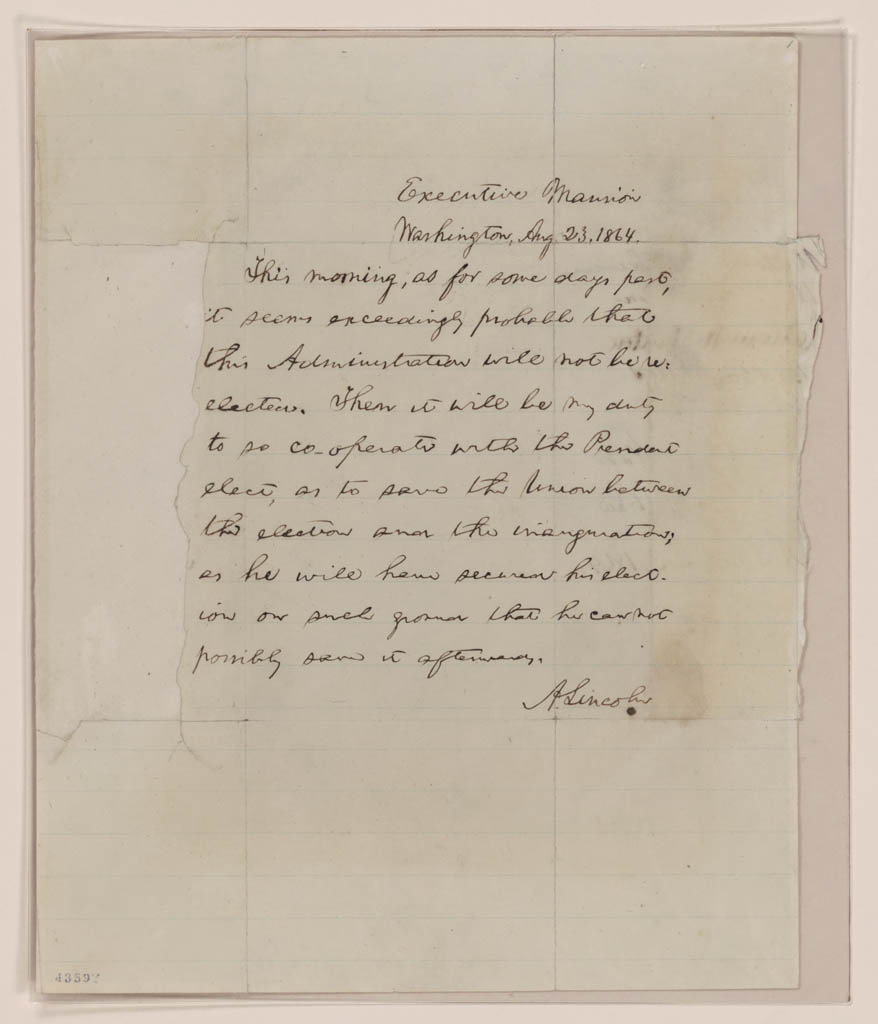
Abraham Lincoln’s Memorandum Of August 23, 1864

Neal Pollard

Somehow, I was unaware of the existence of a document which Abraham Lincoln drafted and had endorsed by every member of his cabinet, though unseen by them, and which remained sealed until November 11, 1864. These were not only dark times for the nation, embroiled in civil war for over three years at that point, but gloomy for the war-weary north which could not end the conflict against the greatly outmanned but tactically superior south. Politicians and citizens were unhappy with the perceived lack of success and progress at such high cost—the death and disabling of so many of her sons in the prime of their lives.  Lincoln detected that popular sentiment was such that he would not be reelected. Thus, he drafted his memo, which read, 

This morning, as for some days past, it seems exceedingly probable the this
Administration will not be reelected. Then it will be my duty to so cooperate
with the President-elect as to save the Union between the election and the
inauguration: as he will have secured his election on such ground that he
cannot possibly save it afterward (Coolidge 139). 

Lincoln seemed to think that the north had had enough of this war and would rather sue for peace and allow our sea to shining sea to be two nations rather than continue with such devastating effects a war they could see no end to. He appears dedicated to whatever he could do to preserve unity.

Of course, several things changed the course of Lincoln’s fate in his bid for reelection that swept him decidedly into office for a second term. There was the north’s victorious show in The Battle of Atlanta, Fremont’s withdrawal from candidacy, the Democrats internal division between the Copperheads—eager to end the war now—and the War Democrats, and the fact that no electoral votes were counted from the Confederate States of America.  But, Lincoln could not see the future. He was preparing for what he saw as the worst.

There is a well-worn battle taking place in our world. It is not technically between two factions. It might be framed as Christianity versus other world religions. It could be cast as New Testament Christianity versus so many individual denominations. Yet, internally, there are multiple stressors to the biblical unity Christ prayed and died for, too (John 17:20-21). 

Christians are soldiers (Eph. 6:10ff), but our battle is not with flesh and blood (Eph. 6:12).  Our war and weapons are not “of the flesh” (2 Cor. 10:3-4). All the same, many have grown weary of fighting the good fight and not a few feel as though we are fighting in a losing cause. The restoration ideal of doing Bible things in Bible ways seems archaic and impossible to growing numbers of saints. Some fight with equal vigor to preserve traditions not rooted in Scripture, and unnecessarily harm the great cause. 

As we strive at all costs to be true to the pattern of New Testament Christianity, let us do so going to whatever lengths we can to maintain unity wherever possible. Not for a moment does that mean sacrificing truth or compromising even one “thus says the Lord.” But it does mean embracing a spirit of love and protectiveness for the precious Bride of Christ, the church. That involves loving and working with those who are the members of it. 

Ultimately, the Lord’s cause will prevail. His victory is as assured as every other divine promise. We must be striving on His side to share in that. For now, we cannot give up the fight! Let’s cooperate wherever and however we can, standing unitedly on the foundation of Christ and His will. The rest (which is most of it), we will leave to our Great Commander In Chief!

Works Cited:
Coolidge, Louis A. American Statesman Ulysses S. Grant (New York: Chelsea House, 1983).

blind-memo-recto-al0204

Still Restoring

Neal Pollard

The idea of restoring New Testament Christianity is “that God set forth His standard of acceptance in salvation, worship, church organization and daily living” and “to follow the teachings of God, revealed in the New Testament, to direct our lives in the same way as He did first century Christians” (therestorationmovement.com/about.htm). We can open our Bibles and find a pattern for what the New Testament church is to look like, not in customs and culture, but in commands and cause. Yet, a tendency we must guard against is a haughty spirit that portrays the idea that we have already arrived. Consider four areas where we need to keep at the restoration plea and overcome neglect.

  • CHURCH DISCIPLINE. For years, I have seen this referred to as “the forgotten commandment.” At times, people will say of it things like “it doesn’t work,” “it’s harmful,” “it runs people away,” etc. Were we to substitute that argumentation for subjects like women’s role, worship, or baptism, wouldn’t we cry heresy or apostasy? However, in far too many instances, we have simply ignored and failed to practice this plain, New Testament teaching (Mat. 18:15-17; Rom. 16:17; 1 Cor. 5; 2 Thes. 3; Ti. 3:10-11).
  • EVANGELISM. It is so much easier to focus upon ourselves, to devote all our resources to internal issues.  Is there a spirit of evangelistic zeal running rampant among us? Is this an area to restore, to be like the early church? Perhaps we may be intimidated by the culture of political correctness. It could be the risk of ruining relationships or even rejection that causes us to avoid efforts at soul-winning. It could even be that we need to build our conviction for or commitment to this imperative given by the resurrected Savior Himself (Mat. 28:18-20;Mark 16:15-16;  Luke 24:44-47).
  • CHURCH ORGANIZATION. It is very likely that the number of churches of Christ which have elders are in the minority. At times, the reality of a shortage of qualified men is to blame. At other times, preachers or others prefer not to have elders. But, even where churches are “scripturally organized” (i.e., having elders and deacons), there is room for restoration— Preachers preaching and evangelizing, elders leading and shepherding (pastoring), and deacons actively carrying out  and administrating the ministries and works of the local church.  At times, there is a need to restore the roles of each of these works so that the proper, appointed men are doing the work Scripture outlines for them.
  • BROTHERLY LOVE. This is difficult, in a world increasingly characterized by hate, discord, and general worldliness. In our culture, where it’s easy to become disconnected with others—even our Christian family—we must strive to restore the beacon and central identification mark Jesus urged when He said, “ A new commandment I give to you, that you love one another, even as I have loved you, that you also love one another. By this all men will know that you are My disciples, if you have love for one another” (John 13:34-35). Isn’t there room for more concentration upon this command, which will be reflected in how we treat each other locally and in the brotherhood as a whole (1 Pet. 2:17)?

I love to spend as much time as possible talking about what the church is doing right. It is doing so much right. By following the New Testament pattern regarding salvation, worship, the church’s purpose, and the like, we stand out in a religious world that has lost its way. Meanwhile, however, let us stay at the business of restoring the church to the pattern revealed in Scripture, even in areas that are more difficult and demanding though just as necessary.

Making sparks

Biggest Misunderstandings About Public Responses

Neal Pollard

There are a couple of examples of public responses to the gospel message in the Bible, both in Acts.  One is positive and the other is negative.  As Peter was preaching that God has made Jesus Lord, the Pentecost crowd interrupted him with the question, “What shall we do?” (Acts 2:37).  As Stephen was delivering a similar message, his audience stopped listening and they cried out with a loud voice before putting the preacher to death (Acts 7:54ff).  Mention is made of a one another response that could apply to the corporate assembly, confessing sins (Jas. 5:16; 1 Jn. 1:9).  How public the setting was when Peter called for Simon to repent we do not know for certain (Acts 8:18-24).  So, why do we end our sermons with a call to publicly respond?  Is this simply borrowed from the denominations or is it just a rote tradition devoid of deeper purpose?

Often, we have explained the invitation as being an “expedient,” which I think it is.  When we speak of an “expedient,” we refer to a practice that is thought convenient, practical, suitable or appropriate but neutral (neither right nor wrong) and a-biblical (not found in the Bible but not unbiblical).  It is a sensible activity.  Hopefully, the sermon contains a call to change and is persuasive in nature.  Maybe, the person comes in the door that day convicted of his or her need to become a Christian or repent of public sin.  Affording a moment that makes it easy for one needing to obey Christ in one of these ways to do so is appropriate.

I have been in assemblies in this country and overseas that do not have such a time set aside or that do so at other times during the gathering—some do so at the beginning of the service so that a person can worship without being alienated from God (cf. Mat. 5:24), some invite anyone who needs to publicly respond to remain standing after the lesson and a song, some encourage people who need to respond to write their need on a card or piece of paper and hand it to an usher, the preacher, the elders, or someone designated to collect such communication.

While I think it is good for us to consider that there is more than one way to do this and that we are not mandated to do it at all in the assembly, I believe our current arrangement is a fine way to try and help people who need to make spiritual changes and improvements.   Yet, someone who feels the need to make such a response often hesitates or decides against it.  Certainly, the problem on such an occasion might be fear or delay, but is it ever due to some misunderstanding such a one has?  Here are a few of the biggest misunderstandings people have about responding to the invitation:

  •  Nobody but me is struggling with sin in their lives.  Truth: Romans 3:23.
  •  It is a sign of weakness to respond publicly.  Truth: Luke 15:10, 17
  •  Everybody will look down on me, judge me, or gossip about me if I respond.  Truth: Luke 15:28-32
  •  People will distance themselves from me if I respond.  Truth: 1 Corinthians 12:26-27.

Maybe you are thinking this or something similar.  May I assure you that every righteous person on earth and all the inhabitants of heaven would like nothing better than to help you be right with God.  Death and the Judgment loom, and we cannot let anything keep us from making proper preparation for them.  So, if you need to respond today or any day, won’t you come?

14-church-carpet

THE BOY WHO STAYED HOME

Neal Pollard

When we think of the parable in Luke 15, we inevitably think of the younger son who left home for the far country of sin. We appreciate God giving us the prodigal (reckless; wastefully extravagant) son in this parable to illustrate hope, love, and forgiveness, no matter what we may have done. Then we think of our favorite character in this story, the father. He represents God and reveals God’s eagerness to embrace and restore a sinner who repents. He gives the undeserved, unexpected, and unanticipated (cf. Eph. 2:4-8).

Then, there’s that other main character in the story. How does he strike you? After all, his brother has been reckless and irresponsible and his dad lets him off scot-free and even throws him a party. He robbed his father blind, and he isn’t even punished one bit. How do you see the brother who stayed home? Let at the text more closely and see how God sees him.

  • He was guilty of self-righteousness. He complains to the father about the reception his brother received (29). With self-righteousness, there’s an exaggerated view of our own goodness. There’s an exaggerated view of the other guy’s badness. There’s a comparison where we come out on top of the other guy. There are often judgmental assumptions made about the other guy. Let’s not forget that Jesus condemns self-righteousness (cf. Luke 18:10-14). If the Father walked up on some of our condescending conversations, He would spoil our fun since the spirit of self-righteousness is so far removed from the spirit of a loving Father who longs for His wayward children to come home.
  • He lacked self-control (28). He appears quick-tempered, not waiting for an explanation. We have the conversation between the younger son and the father, and the older son and the father. Where is the conversation between the two brothers. Didn’t he claim to be the good, righteous one? There was no self-control in the way he talked to his father or about his brother. “If anyone thinks himself to be religious, and yet does not bridle his tongue but deceives his own heart, this man’s religion is vain” (Js. 1:26).
  • He was selfish. Why did he wring his hands about the younger brother’s wasteful spending? The father, who knew this son, answered, “All that I have is yours.” There is no evidence that the older brother was concerned about his formerly depraved brother or his once-grieving father. He seems more interested in how these things impacted him. He appears faithful to his father, but for the wrong purpose. What difference would it have made if the older brother saw the prodigal as someone to serve rather than slam?
  • He had an unforgiving spirit. His brother has sinned against him, but he was unwilling to forgive him. One of the servants called him “your brother” (27), the father calls him “this brother of yours” (32), but the only time he directly refers to him he calls him “this son of yours” (30). Behind these parables, the Pharisees and scribes grumble at Jesus receiving sinners. In the first two parables, people sought the lost. In this last parable, the older brother made no effort to go after his brother. God implies as early as Cain and Abel that we are our brother’s keeper (cf. Gal. 6:2; Js. 5:19-20). Not only did he not search for his brother, but now he won’t forgive him.
  • He was jealous. He thought the father was better to his erring brother (29-30). You can almost hear him saying, “You love him more than you love me.” He couldn’t stand to see his brother honored. How contrary to the way God wants His children treating each other (Rom. 12:10; Eph. 4:31-32). The older brother was making accusations and he hadn’t even spoken to him. He thinks the worst of him and is utterly lacking in brotherly affection.
  • He was not humble, but rebellious against his father’s will.  He wanted to tell the father how to run his house. Do you notice the younger son respectfully addressing his father (21)? There’s little if any respect from the older son (29-30). The Bible condemns self-will. Peter condemned those despising authority and the self-willed (2 Pe. 2:10). Some people are loyal to the church as long as they can have their own way.

Some of us may find ourselves in the position of the prodigal. None of us will ever be in the position of the father. May we never find ourselves in the position of the boy who stayed home. If we do, we may lose our place in the father’s house!

hqdefault

The Danger Of Being Swept Away

Neal Pollard

You may have heard that I was caught in a rip tide during Carl’s senior trip. We were at St. Pete’s Beach in the Tampa-area, swimming and playing in the water not far from a fishing pier. Somehow, I was pulled into a riptide and quickly pulled out toward the Gulf. The shore quickly grew distant and my subpar swimming abilities were tellingly useless. A couple of fishermen told me I was caught in it and my best hope was to try and move parallel to the waves and angle for a point about a half-mile up from where I was. That was a painfully slow process, and the water kept taking me where it wished.  I was on the other side of the pier, moving generally toward that point but still in the grips of the tide, when Dale swam out and helped pull me out of the current until I could finally get to shallower water and make my way back onto the beach. At the risk of sounding melodramatic, I believe Dale saved my life.

Only after this did I learn that, according to the CDC, there was an annual average of 3,536 fatal, unintentional drownings in the United States from 2005 to 2014. That’s about ten deaths per day. Nearly 80% of all people who die from drowning are male. A lack of swimming ability is the greatest risk factor in drowning, and 57% of all people, age 15 and over, who drown do so in “natural water settings” (like the ocean)(cdc.gov).  I also was reminded, from the Pandora playlist Dale piped through our van’s sound system, that he has an interesting sense of humor—playing “Under the Sea,” “The Ocean,” “High Tide, Low Tide,” “In Too Deep,” “Riptide,” “Drowing,” and “How To Save A Life” (plus a bunch more).

But I also have a different perspective toward some of the songs in our songbook:

  • “Soul you are drifting along on the tide, out on life’s ocean so boundless and wide…”
  • “Some poor fainting, struggle seaman, you may rescue, you may save…”
  • “Throw out the lifeline, someone is drifting away…”
  • “While on the sea hear the terrible roaring…”

As I look back, the currents were strong but the force was subtle. It did not take long for me to be moved away from the shore and taken away. Making the right efforts played a part in my staying afloat. Ultimately, however, I needed outside help to come back to shore.

The writer of Hebrews says, “For this reason we must pay much closer attention to what we have heard, so that we do not drift away from it” (2:1). A.T. Robertson says of the word “drift”: “Here the metaphor is that ‘of being swept along past the sure anchorage which is within reach’ (Westcott), a vivid picture of peril for all” (342). BDAG says it is an imagery of flowing water and means “be washed away” or “drift away” (770). The Greek Old Testament uses the word in Proverbs 3:21, where Solomon urges his son to not let wisdom “vanish from [his] sight.” The epistle’s nautical metaphor pictures vividly what can happen in our spiritual lives. We can  lose sight of where we are, and we may begin to struggle and start to succumb to the pull of the current. We must continue to make the effort to pull away and we should accept the attempts of those who seek to rescue us.

Spiritually, none of us want to become a casualty. We do not want to perish. May we realize that falling away from God is not usually sudden or dramatic. It is often subtle and gradual. Let’s pay much closer attention to what we have heard! It’s our lifeline.

13237839_10153686555335922_4716771003949535795_n

AFTER 31 YEARS, MURDER VICTIM IS FOUND ALIVE

Neal Pollard

There was a disappearance and a murder confession.  So, the last thing police expected when they stopped at “Mrs. Schneider’s” apartment in Dusseldorf, Germany, was to find the 1984 murder victim, Petra Pazsitka, talking to them.  Thus began the unraveling of an elaborate plot by Ms. Pazskitka to disappear and reemerge with a new identity.  She was successful for 31 years, living in several West German cities without a passport, driver’s license, and social security card. She supported herself by “living off illicit cash-in-hand work” (via uk.news.yahoo.com). Why did the college student who had just completed her thesis on computer languages leave the grid and go into hiding? So far, there has been no explanation given. Perhaps there will eventually be more details and insight into this bizarre situation, but for now a grief-stricken family can take some measure of comfort in knowing their loved one they thought was dead is alive.

Spiritually, we are surrounded by the living dead.  It is the result of choices they’ve made.  This is even true for some who have abandoned God’s family and reemerged in the world having cast off the privileges and position of that honorable name they took on when they were baptized into Christ.

Paul says, “The mind set on the flesh is death” (Rom. 8:6). He tells Timothy, “But she who gives herself to wanton pleasure is dead even while she lives” (1 Tim. 5:6). God diagnosed an entire church, Sardis, “having a reputation of being alive” as being dead (Rev. 3:1). Of course, nothing illustrates the point better than Jesus’ parable of the Prodigal Son.  The younger son was off in the “far country,” and through that lifestyle he reached the point of desperation and despair. He repented and came home, where his father declared “my son was dead and is alive again” (Luke 15:24).

Sometimes, it makes no sense to us why a brother or sister leaves God’s family, abandoning spiritual life, hope, and heaven for spiritual death, hopelessness, and hell.  Yet, we must continue to search for them.  Let us pray that we can find those long since declared dead and encourage them so that we “save a soul from death and cover a multitude of sins” (Jas. 5:20). Search for them. Appeal to them. Help them reclaim the blessed identity they had when they had “life and peace” (Rom. 8:6).

CHANGING YOUR ORBIT

Neal Pollard

On September 16, 1991, the space shuttle Discovery dodged a chunk of a Soviet Cosmos rocket.  It came within 10 miles of the van-sized debris.  If Discovery had not changed its orbit, it would have been so close a call that it would have been yet another tragedy for our then active space program.  Mission commander John Creighton said it was “very simple” to maneuver, but absolutely vital to ensure the crew’s survival.

When I mention “conversion” in a spiritual context, what do you think about? Following his mention of Elijah’s exemplary prayer life, James ends with a big dose of encouragement.  James uses the word translated “convert” or “bring back.” It is an active word, meaning we cause one to change his or her belief or course of conduct, with a focus on that one then turning in the right direction.  The end result, conversion, is the state of their having done that.

To me, it is a blessing to see somebody back in attendance and being involved after they have been away from the Lord and His church.  It would be better for a brother or sister to never fall away, but it is definitely a joy to see one have the determination and courage to come back home.

Doesn’t heaven view it the same way? Jesus says in one of the “lost parables,” “I tell you that in the same way there will be more rejoicing in heaven over one sinner who repents than over 99 righteous persons who do not need to repent” (Luke 15:7).  In conversion, one is changing what their life is orbiting.  It is no longer sin and self, but God.  What a blessing to see someone go from a path of destruction to the way of life! May this perspective drive our actions in reaching out to our “erring brethren.”

WHEN MY FLAME FLICKERS

Neal Pollard

A fire requires just a few basic things to keep going—starter, combustible material, oxygen, and maintenance.  It can take a while to get a fire started, but it needs ventilation to get going and stay going.  After it’s caught, the fire must be cared for and tended.  Otherwise, the fire dies.

Paul says something interesting to Timothy as he writes a last letter to his spiritual son.  In it, he urges the young preacher to “kindle afresh the gift of God” (2 Tim. 1:6).  The word “kindle,” found only here, means “to cause to begin or blaze again” (BDAG, n. pag.). Josephus uses this word to speak of Herod the Great who, after killing his beautiful wife in a jealous rage, eventually “his affections were kindled again; and indeed the flame of his desires for her was so ardent” addressed her affectionately as if she were still alive (War of the Jews, 1.444; See also Josephus, Ant. 8, 234 and 1 Clement 27:3).  Paul is most concerned that Timothy was in danger of losing his spiritual passion, and he writes him to reignite the flame.  Perhaps the fire had already gone out.  What’s interesting is what Paul does to try to help rekindle Timothy’s fire.

  • SUPPLICATING (1:3).  Paul tells Timothy he prayed for him day and night.  Not only was he praying, he tells Timothy he’s praying for him.
  • SUPPORTING (1:4).  It had to help Timothy to know how much Paul longed to see him.  Timothy may have felt alone at Ephesus, without faithful fellowship and Christian companionship. Knowing of Paul’s desire for a joyous reunion, especially Paul’s recall of Timothy’s previous emotional engagement (“your tears”), may have been fire-starter!
  • STIRRING UP (1:6-14).  The mentor challenges the minister to raise the bar.  He says, “Don’t be ashamed” (8; Onesimus wasn’t, 18, and Paul wasn’t, 12).  He says, “Retain the standard of sound words” (13). Then he says, “Guard the treasure” (14; cf. 1 Tim. 6:20).

Paul did everything he could from within prison walls to support a struggling saint whose spirit was soggy and smoldering.

Do you know any Christians whose fire is going out or maybe has already been extinguished?  Have you wondered what you might do for them?  Follow Paul’s pattern.  Pray for them, then gently let them know you are.  Try to spend time with them, if they’ll let you.  Then, as a spiritual, self-examining one (Gal. 6:1), appeal to their courage, the trustworthiness of divine truth, and the impact that word will have in keeping them on course in fulfilling their true purpose in life.

If I ever find myself struggling and wavering, I will want a Paul to do for me what I read about in 2 Timothy 1.  However hardened sin might make my heart, I hope I will still realize—if only deep inside—that my most important objective is to be ready for heaven when I die.  I would hope I could still be reached by a caring Christian who wouldn’t let my fire go out permanently!