Assumption Consumption

Monday’s Column: Neal at the Cross

Neal Pollard

The definition is stark and candid: “A thing that is accepted as true or certain to happen, without proof.” We live in an age where making assumptions is rampant and relentless. In current society, we make assumptions about one another based on political affiliation, skin color, and even masks. Charity and the benefit of the doubt are disappearing from too many circles, and that should have us all concerned. But, instead of panicking and giving up, Christians should see this as an opportunity to reach hearts for Jesus.

Immediately after writing about how powerful the command to love one another is (cf. Mat. 22:40; Rom. 13:8), Paul warns, “But if you bite and devour one another, take care that you are not consumed by one another” (Gal. 5:15). The current, so-called “cancel culture,” public humiliation, online shaming, boycotting, etc., is presumptuous and worldly. While the nuances of what we are seeing these days may be unique to us, the mindset and behavior are ancient and basic. If you keep reading Paul’s words, you can identify the culprit. A failure to walk by the Spirit leads us to carry out the desires of the flesh (Gal. 5:16). 

How can we know which characterize us? It is palpably simple. Notice.

Check Your Deeds

Paul lists out 15 specific deeds of the flesh–plus an encompassing “things like these”–which keeps the practicers from inheriting the kingdom of God. Nestled among sexual immorality and drunkenness are “enmities” (hostility and hatred), “strife” (to express differences of opinion with antagonism or hostility), “outbursts of anger” (intense, passionate “boiling over” of displeasure; rage), “disputes” (a feeling of hostility or being against), “dissensions” (party strife within a community, TDNT 89; i.e., Republican, Democrat?), “factions” (division based upon different opinions or loyalties)(Gal. 5:20). If God chose to drop the apostle Paul into our country right now for a week, surely he would preach this text to us! He’s describing the current crises and even many Christians’ response to it and one another. These are very nearly half of the deeds of the flesh specifically mentioned. Read your newsfeed, look at the articles being forwarded, watch cable or online news, and the like. More personally, I need to ask if I am exhibiting these deeds of the flesh in my words and actions. 

The antithesis of such deeds and the fruit which counteracts and conquers them. “Love, joy, peace, patience, kindness, goodness, faithfulness, gentleness, self-control” (22-23). Insert each of these qualities into your deeds and see if those fleshly deeds can survive. It has become routine and expected to see the incivility and hostility of the deeds of the flesh. The fruit of the Spirit will overcome them! But we must discipline ourselves to exhibit them, even in the face of those employing those worldly ways.

Crucify Your Flesh

Sounds painful doesn’t it? It doesn’t sound like something that comes easily or naturally. But, if Jesus owns you, these “passions and desires” must be put to death (24). Kill them! Harness the hostility and defeat those desires. We cannot give ourselves the old “that’s just the way I am” pass. We are not our own. We belong to Him. Nail it to the cross of self-denial!

Chart Your Course

Paul says, “If we live by the Spirit, let us also walk by the Spirit” (25). “Walk” means “to be in line with a person or thing considered as standard for one’s conduct” (BDAG 946). It means living in conformity with a set standard. We don’t have to guess what that is, and understand that it will look very different from the world’s standard. We cannot stoop to their level or conform to their rule (Rom. 12:1-2). 

Consider Your Brethren

To end this discussion, Paul tells us how not to treat others–“boastful, challenging one another, envying one another” (26), then how to treat others (6:1-2). We gently restore one another and bear one another’s burdens. We are protective and constructive. We care about souls, and that takes precedence over winning arguments and having our incisive one-liners quoted. We see souls like Jesus sees them!

It’s discouraging to see our society losing the ability to reason and discuss respectfully. It is destructive to see our brethren giving in to such devilish tactics. May we be aware that we are not serving and honoring our Master if our means to accomplish our ends cause us to use fleshly ways. Paul says it best: “But each one must examine his own work” (Gal. 6:4). God help me to do so humbly and honestly! 

Can Others See the Christ In You?

Brent Pollard

Once I preferred laptops, but since the advent of Android and Apple tablets, I migrated back to the desktop PC. When attempting to accomplish work, there is something to be said for sitting at a dedicated workspace to help productivity. Even so, I usually choose desktop wallpaper to reflect my interests from the religious to whimsical. My capricious nature typically ensures that wallpaper is changed frequently.  

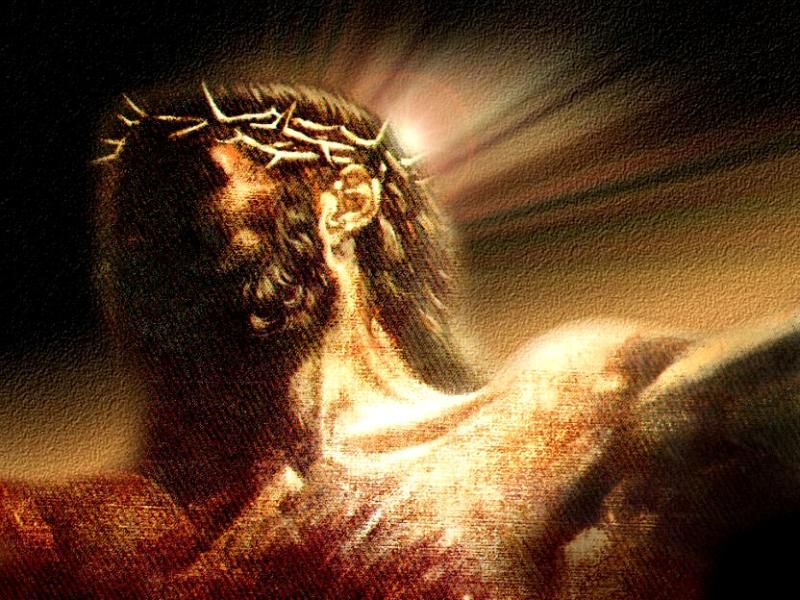
One day after having selected an artist’s rendering of the Christ wearing a crown of thorns for my wallpaper, I noted how I had allowed the desktop of my PC to become cluttered with icons and files. Though they made finding things more manageable, they obscured the image I had chosen for my inspiration. I had to do some cleaning so that I could once again see Christ! 

Spiritually, I feel as if we sometimes equally “mask” the presence of the Christ in our lives. It is not our intention to do so, of course. We are just going about our regular business. Yet, there comes the point in out lives in which we begin doing what we feel is most convenient, despite what this “convenience” does to the presence of the Christ in our lies. Soon, others are unable to readily see the Christ in our lives since He has become obscured by our ephemera. If this persists, others will be unable to see Him at all.  

When this happens, it is time to clean up or bring order to the chaos. One needs to put things in their proper place so that the image of Christ becomes accentuated rather than obscured (cf. Matthew 6.33). It may take a bit of work, but the effort is worth more than anything else in this world because of its eternal implications. 

Dear reader, are others able to see the Christ in your life? If not, perhaps it is time for spiritual cleansing. The only thing equal to the task, great or small, is the blood of Jesus Christ. For the one having never clothed him or herself in Christ (Galatians 3.27), baptism brings about the forgiveness of sins (Acts 2.38). For the immersed believer, the blood of Christ continuously cleanses us as we walk in fellowship with Him and fellow Christians (1 John 1.7).  

Check your image in the spiritual mirror (James 1.22-25). If you cannot see the Christ, rest assured others cannot see Him either. Let us always strive so others can see the Christ in us.   

Monday Through Saturday Relationships

Gary Pollard

We get an interesting glimpse into the life of the early church in Acts 2.44-47. While it is not practical for us to live in that same way, there is one principle that we should examine. The early church spent a great deal of time together outside of their worship on the first day of the week. Acts 2.46 says, “And day by day, they were devoted to the temple together and breaking bread in their homes, they received their food with glad and generous hearts, praising God and having favor with all of the people.” What’s going on here? The members of the church dedicated time every day to growing in their relationships with one another. To them, “church” was so much more than just showing up for worship every time the doors were open. It was the Monday through Saturday relationships that fortified their faith. 
What was the result of this dedication? “And the Lord added to their number day by day those who were being saved” (Acts 2.47). Are we likely to live for a faith we have not invested in? Are we likely to stand up under trials if we do not have a sense of community in the church? Are we likely to resist temptation without strong ties in God’s family? The early church faced trials we could never understand, yet they remained faithful because of their strong relationships and resulting faith. 
The early church relied on constant contact with one another to help them build their faith. Nothing builds a Christian’s faith more than being around a group of people who want the same thing (to live like Christ), genuinely care for one another, and share a common goal (heaven). 

A Big Blip

Dale Pollard

A family decided they didn’t want their little puppy anymore and for whatever reason they decided to dump this dog on the side of the road after tying it in a black plastic bag. At some point there was a woman who was driving down that road and she just happened to notice that something wasn’t right. When she discovered that there was a dog inside the bag she took it to a vet and then, eventually, to an adoption shelter. One day I decided to walk into the pet store to simply look around— and that’s when I saw him. Huddled in the back of his crate, a shaggy and skinny puppy with tan fur sat quietly, while it seemed every other dog in that store was madly barking. I opened the crate and he timidly came out— there was nothing I could do. This dog was mine. I named him “Bro” and to this day he continues to provide loyal companionship and plenty of laughs. The fact is, I’ve never been more attached to another animal and I’d never even think about giving him away. 

Solomon was a man determined to find the purpose of life. In Ecclesiastes we can read about these lavish experiments that he conducts all in the name of research. In the first two chapters he writes in a very depressing manner all the while Divine inspiration drives him toward the answer to life’s greatest question. He acknowledges the fact that everybody in every generation is just a small blip on earth’s timeline. The rich, poor, wise, and foolish all must embrace the same fate. They will all die and will eventually be forgotten. Solomon is concerned that everything, his wealth and kingdom, will be left to a fool after he’s gone, and that’s exactly what happened. Rehoboam, his son, proves to be an awful king and heaps destruction on God’s people. So, what’s the point? None of it matters. Well, without God nothing matters! The word most associated with this book is the word “vanity,” which means “useless or futile.” Without God, your life is worthless and it will amount to nothing. Solomon’s discovery of this unchanging truth will remain true throughout every age because it’s a truth that comes from the Creator of life. 

It’s unlikely that not a single person on earth values your life. Still, even if that were the case, because God’s hand guides you and touches all that you do, you have everything. My dog is not an expensive pure bred beauty, but to me there is no dog that could take his place. Apparently someone didn’t think too highly of him in the past, but that mangy thing lucked out and found the right owner. Who owns you? If money owns you, you’re getting left on the side of the road. If anything in the world owns you, you’re getting left behind. If God doesn’t own your life, you’ll never find purpose or lasting joy in this life— or the next. It could be that you feel like you’ve been placed in a trash bag and the world has mistreated you your entire life. Maybe that’s crushed your confidence and taken your sense of self worth, too. Though our lives are just a blip in the grand scheme of things, God can make your life a big blip by providing you with not only purpose, but with a love far too great to comprehend. The God of heaven has given us a mission and if we accept His invitation we’re going to make a lasting mark on this world— and enjoy lasting bliss in the world to come. 

Bro today

What Happens After “Happily Ever After”?

Monday’s Column: Neal at the Cross

pollard

Neal Pollard

It’s something they never tell you in the romantic movie. The ending of the storyline so full of twists and turns, where he and she might not have ended up together but seemed destined to be together, is so happy and perfect. Both are all smiles, with stars in their eyes, when we see “The End” and the credits roll.

They never tell you what happens after the fairy tale wedding or the long-awaited kiss. He refuses to ask directions as they fade into the sunset. They argue over where to eat that romantic dinner. He speaks without thinking and says something thoughtless, followed by tense silence. 

I am not critiquing one of the sacrosanct principles of romantic movies and books. Happy endings can be a great escape from reality and a feel good experience. Yet, when we hold it up as the unqualified expectation for our own lives, we set ourselves up for trouble. Social media is rife with posts and pictures which can perpetuate the fiction that the people we friend and follow are constantly living out “happily ever after.” Life is always grand, and success and satisfaction is the constant. 

Don’t misunderstand. So much of what we experience in life is shaped by attitude. Being positive can help us negotiate those hairpin curves in the road of life. But, coping through positivity is different from allowing disappointment to make us disenchanted with failing to meet the unrealistic expectation that every problem and adversity can be wrapped up into a pretty, neat package with a frilly bow on top. 

It’s quite the balancing act, isn’t it? Scripture teaches to think on healthy, beneficial things come what may (Phil. 4:8). Or, as Solomon puts it, “All the days of the afflicted are bad, but a cheerful heart has a continual feast” (Prov. 15:15). Yet, Job (14:1) and Solomon (Ecc. 2:23) do not sugarcoat the reality that life is often painful, grievous, and full of trouble both day and night. 

May I offer some encouragement?

  • To the newlyweds, neither of you is perfect and there is no way you can always agree and get along without mutual compromise and effort. You will have so many great days, but there will be some mountains to climb and valleys you must pass through. No couple out there is breezing through married life. Turning to one another (and God) rather than on one another when marriage is hard will forge your bond come what may (1 Pet. 3:7).
  • To the new parents, though that baby looks perfect and angelic, he or she will introduce demands, needs, concerns, and challenges you never knew existed before. Each developmental stage will be accompanied by incredible highs and lows. As you look into the faces of your children, you will be looking at eternity and knowing the weight of your decisions and leadership. But, savor those little ordinary moments. You are placing puzzle pieces that will one day become your children’s picture of their childhood. How you handled the hard times will be at least as important as how you handled the fun times (Prov. 22:6). 
  • To the new Christian, it is right for you to relish the feeling of relief and joy over being forgiven and cleansed from sins. The burden of guilt has been lifted. You are experiencing something in Christ that you never knew existed. But, there will be difficult days. The devil lurks (1 Pet. 5:8). Selfish desires can derail (Jas. 1:13-15). Suffering for your faith should be expected (1 Pet. 4:16; Acts 14:22), but by hanging on your eternal destiny is better than you can imagine. Along the journey, you will grow, mature, and develop into someone better and stronger as Christ lives in you (Gal. 2:20). 
  • To the Christian who publicly repents, you had no idea how much support, love, and encouragement you were going to receive. You feel the relief of forgiveness and restored hope. There’s clarity and purpose where there had been confusion and distraction. Things are better now (cf. Jas. 5:16; 1 Jn. 1:9), but the battles and temptations that led you away are still there. You will still have to face the consequences of bad choices, but you will not regret turning to God and your spiritual family for help. This is the first step of your rededication. Keep walking and never stop (Mat. 7:13-14; 1 Th. 2:12).

There are so many other phases and circumstances deserving the same kind of encouragement. The bottom line for each is the same. When viewed with heavenly eyes, each of us is staring at the ultimate happy ending. Even as our exterior deteriorates, our inner man is renewed daily (2 Cor. 4:16). Our momentary difficulties will give way to incomparable glory (2 Cor. 4:17-18).  The best is yet to come (2 Cor. 5). But, between now and then, we all have to negotiate bumps in the road. That’s OK. Keep following Christ on this narrow road and the “ever after” will transcend your greatest hopes (Mat. 16:24ff). 

Sailing Stones 

Friday’s Column: Supplemental Strength

81121814_2462862270639428_5746232403106463744_n

Brent Pollard

Death Valley. The very name is foreboding. Yet, Death Valley is the home to an extraordinary phenomenon known as “sailing rocks.” On the border of California and Nevada, there is a section of the Death Valley National Park called the Racetrack Playa. It is a dry riverbed. Why is it referred to as a “racetrack?” Dotting the Racetrack Playa are those sailing stones that seemingly move of their own accord. No human eye has observed one of the rocks move, and yet, it is evident that they do. Stones weighing even hundreds of pounds move across the dry riverbed, leaving evidence of their journey in a trail through the sand behind them.  One of the longest observed tracks was 1,500 feet long. And so, these rocks race across Death Valley.

First recorded in the early 1900s, scientists have endeavored to discover the truth behind the sailing stones. In 2014, scientists were finally able to capture the movement of the rocks using timelapse photography. As the National Parks website suggests, “The results strongly suggest that the sailing stones are the result of a perfect balance of ice, water, and wind.” 1 The National Park Service further detail the findings of cousins, Richard and James Norris:

Their observations show that moving the rocks requires a rare combination of events. First, the playa fills with water, which must be deep enough to allow formation of floating ice during cold winter nights but shallow enough to expose the rocks. As nighttime temperatures plummet, the pond freezes to form sheets of “windowpane” ice, which must be thin enough to move freely but thick enough to maintain strength. On sunny days, the ice begins to melt and break up into large floating panels, which light winds drive across the playa pool. The ice sheets shove rocks in front of them and the moving stones leave trails in the soft mud bed below the pool surface. 2

It is undoubtedly a remarkable sight. The wonder this phenomenon instills likewise reminds us of the majesty and power of the Invisible Intelligence (cf. Romans 1.20), creating the very physics making moving rocks possible.

As I read about the sailing stones, I could not help but recall the words of Jesus when asked by the Pharisees to rebuke His followers. The occasion was Jesus’ triumphant entry into Jerusalem. The people were crying out their “hosannas” to the Lord. Jesus told the Pharisees, quoting from the prophet Habakkuk, that “if these become silent, the stones will cry out!” (Luke 19.40 NASB; Habakkuk 2.11) Indeed!

If you ever question your worth to God, recall the sailing stones. Without the benefit of intelligence or purpose, they still point to their Creator. They appear to be immovable, and yet are pliable by the laws God put in place. As I take stock of what I can do, I note that even I can do more than the sailing stones, possessing locomotion and free will. How shameful, then, when I choose to sit silent as a boulder. May God use me like a rock so others can see my deeds and give God the glory (Matthew 5.13-16).

REFERENCES:

1 The Sailing Stones of Death Valley. (n.d.). Retrieved August 27, 2020, from https://www.nationalparks.org/connect/blog/sailing-stones-death-valley

2 The Racetrack. (n.d.). Retrieved August 27, 2020, from https://www.nps.gov/deva/planyourvisit/the-racetrack.htm

1280px-runningrock2

How To Be Worthy

Thursday’s Column: Captain’s Blog

IMG_0806

Carl Pollard

Nothing is worse than washing your hands only to find that there aren’t any more paper towels. A paper towel roll with no towels is completely worthless. You can’t dry your hands with the roll (trust me I’ve tried), and you’re left feeling grumpy as you wipe your hands on your clothes.
 
In Matthew 5:13, Jesus tells us that we “are the salt of the earth.” Why are we given this description? The Greek word for salt is “halas” and its definition will blow your mind…it means salt. Jesus is talking about literal salt, so why would He tell us that we are a high sodium white crystalline substance? Salt adds flavor, it preserves food, and in small amounts can fertilize land. The Christian is salt because we add flavor to the world in the form of the gospel. We are able to preserve people’s souls through Christ. We help people grow with the help of God’s Word. That’s our job. We are the salt of the earth.
 
But what happens if we lose our flavor? We become worthless. Salt loses flavor when it comes in contact with moisture. If we become exposed to the world and let it take away our Christianity, what are we good for? We can’t add flavor, preserve, or even be fit to throw on some dirt. A paper towel roll with no towels does nothing. It can no longer be used for the purpose it was made for. The Christian who doesn’t live for Christ is deserting their purpose, and God sees them as worthless.
 
What are we showing the world? Are we carrying out our duty as followers of Christ? Don’t let it be said of us that we have lost our flavor. Don’t let God look at our life and say it is worthless to Him.

Learning A Lesson From A Lantern

Wednesday’s Column: Third’s Words

Gary III

Gary Pollard

I’m a big fan of old fashioned lighting, especially old kerosene lanterns because they’re simple. I went to light one of my lanterns and the flame wouldn’t stay alive for more than a few seconds. I thought, “Maybe the vent is covered in carbon and there isn’t enough oxygen for the flame.” So, I took it apart, cleaned it out, and put it back together. I was sure it was the vent.

To my chagrin, the flame died within seconds even after the lantern was cleaned. Next I trimmed the wick because it seemed too dark; perhaps having a fresh wick would allow the flame to stay alive. It wasn’t a stopped vent, so it had to be the wick. Sure enough, the flame died even with a fresh wick. At this point I was stumped. 

The next day it occurred to me whilst putting gas in my car: the lantern was just out of kerosene! It was obvious to the extreme. I knew Chelsea would never let that one go. When I got home I put the kerosene into the lantern which, of course, was the solution to a simple problem that I overcomplicated.

This is a mundane example of a profound truth: we make mistakes as humans. Worse yet, some people put words in God’s mouth that He never used. “My God is a God of love – He wouldn’t condemn me just for this one little sin.” “God doesn’t care if we live the way we want.” Some use phrases like this with great confidence while overlooking an obvious truth: God has told us what He does and does not care about in His word.

If we aren’t in the word listening to God and allowing Him to change us, our solutions will end in failure. There was only one solution to keep that flame going in my lantern. There is only one right way to follow God, and He’s told us how to do that! Life will be so much easier for those who look to God for answers before relying on their own wisdom.

welcome-home

The Bible Is Not Boring (Latest Post)

Latest Post Today (August 26, 2020)

A Message From The Rattling Bones

Tuesday’s Column: Dale Mail

Dale Pollard

Six hundred years before Christ would make His providential appearance, a righteous man finds himself in captivity. While exiled, Ezekiel, was able to witness the spirit of God in a very intimate way (Ezekiel 1). Even so, he was still living under the thumb of the Babylonians like every other Israelite with him. While under these unideal circumstances though, he is privileged to see awe-inspiring visions from God. Have you ever paid attention to the eerie sensations described throughout this book? In Ezekiel 1:4 the prophet feels a great and stormy wind on the bank of the river Chebar. The wind brings with it a massive cloud with fire flashing around it and a substance like glowing metal in the center of it. The wings of the creatures he saw (verse 24) made sounds like that of roaring waters. The voice of the Almighty was like the sound of a great army camp. What sights he was able to see! This great connection to God didn’t take away his pain or sorrow, though.

 Chapter 19 is one long lament as Ezekiel cries over his hardhearted Israelite brothers. Why won’t they listen to him? Even after Ezekiel performs some radical visual illustrations like eating his bread over dung and laying on his side for an entire year, they won’t respond to the “invitation.” How frustrating is that, preachers? God never abandons His faithful servant, but His confused prophet is still left to wonder what God is going to do about the mess which makes up his reality. A familiar feeling for many faithful Christians today.  

Never underestimate the hand of the Almighty. This truthful statement can be pulled from Ezekiel 37, when the prophet is taken up and then placed in the middle of a dark valley. Ezekiel is surrounded on all sides by heaps of dry human bones and he’s probably wondering why in the world God has taken him to such a place. The text answers the question by asking a question. God speaks to Ezekiel and says, “Can these dry bones live again?” What an odd thing to ask. However, Ezekiel responds, “Only you know, O Lord.”

 It’s always when we’re deep in the valley’s of life that we’re forced to answer the difficult questions about God’s abilities. When we’re surrounded by darkness, the question we have to ask is, “Does God have the power to see me through this?” If you remember, Ezekiel has become frustrated with the fact that Israel just won’t listen to him or Him. He’s lost hope in their ability to change— they’re just too far gone. However, God demonstrates to His prophet in a dramatic way that NOTHING is impossible for Him. 

He doesn’t bring the bones to life in the blink of an eye, but we know He could have. Instead, He allows Ezekiel to hear those bones rattle and to hear the sounds of fibers and flesh sticking together. He wanted to leave an impression on Ezekiel to demonstrate the might of the Almighty. Ezekiel had no idea how those bones came to life, but he knew one thing for certain. God did it. You may not understand why God has allowed you to enter your valley, but you can be certain that He has the power to see you through. You are standing on your two feet because God has given you the strength to do so. God has promised His faithful servants a heavenly light at the end of our tunnels and whatever God says— He will always accomplish (Ezekiel 37:14). 

Going To The Son Road

Monday’s Column: Neal at the Cross

Neal Pollard
Avalanche Lake hike (Glacier Natl. Park)

It has been on my bucket list for as long as I can remember, going to northern Montana to see Glacier National Park. Though I lived only a long day’s drive from it for 13 years, it took moving across the country before we made the trip. Sometimes, the event cannot live up to the hype, but that was not the case with this experience. The beauty is as diverse as it is breathtaking. While there is so much to see, some of the most memorable sights are to be found along a route in the park known as the Going-To-The-Sun Road.

It has to be 50 of the most beautiful miles on the planet, with diverse wonders. You’ll see mountain streams cutting through the landscape.

There are breathtaking views of the northern Rocky Mountains throughout the length of this iconic road.

And, of course, there are the lakes that dot this God-kissed path.

There may be some impressive, enjoyable creations of man, but no one can outdo the Master Creator for displays of beauty. I’m glad I took some pictures, but there is no way I could ever forget what I saw.

I could not help thinking about how such an experience reinforces my faith in the existence of God or how it shows me what kind of God He is. How could anyone see what is on display in places like that park, then come away denying Him or concluding that mere random chance produced it?

But, given the name of this road, I also could not help but think about an analogy Jesus used when He walked the earth. He referred to the path of discipleship, following Him, as the narrow way (Mat. 7:14). It is a one-lane road, a singular path (“the way,” John 14:6). It can be an uphill climb (Acts 14:22; 1 Pet. 2:21). But, not only is there much beauty to be found along the journey (John 10:10), the payoff is without rival (Mat. 10:22; Rev. 21:1ff).

The Going-to-the-Sun Road is open only for a season and, though park officials can estimate when it will close each year (mid-to-late October), this cannot be precisely predicted. The road that leads to the Son is likewise open only for a season (Heb. 9:27), but no one knows when that road will forever be closed (Mat. 24:36; 25:10).

It breaks my heart to realize that most people are not on the “Going-to-the Son” road. They have charted a path that may bring them pleasure for a season (Heb. 11:25), but it will end in their eternal destruction (Mat. 25:46). Jesus has His disciples here to show others the way to Him (Mat. 28:19). He is preparing a place far superior to this world (John 14:2-3), a place we should be looking for (2 Pet. 3:13) and longing for (Heb. 11:16).

For all its tears and sorrows, the road of life is full of so much beauty, too. There is never a regret in taking the path of the Savior. But, there are lost and weary travelers who need our help to find it, too. May we find someone today to introduce to the “Going-to-the-Son Road.”

Why I Am Not a Buddhist

Friday’s Column: Supplemental Strength

B

Brent Pollard

There is one teaching of Buddhism that I have looked upon favorably, that our problems stem from earthly attachment and desire. I cannot argue with principles I also find recorded in the pages of the Bible, after all. Yet, despite the growing popularity of Buddhism in the West, I find Buddhism wholly deficient in addressing the spiritual needs I have. In a nutshell, Buddhism lacks two essential things I believe are needed to save.  

First, it does not embrace the only name given among men, whereby we must be saved (Acts 4.12). I recognize this is not an insurmountable obstacle for a nonbeliever. The nonbeliever secularizes the Christ and strips Him of His Divinity. Or he or she might declare Jesus of Nazareth to be a mere fabrication of men. Interestingly enough, though, since I am considering Buddhism, there are those co-opting Jesus as One influenced by the teachings of the Buddha. The theory is that Jesus was in India, learning Buddhism somewhere between the ages of 12 and 30. (That would be a fantastic departure for One Who proved His knowledge of Scripture on par with rabbis many years His senior at the age of 12, wouldn’t it? –Luke 2.46-47. This supposed abandonment of Moses’ Law also ignores His stated purpose of being the living embodiment of the same –Matthew 5.17.) 

Second, it foolishly looks within oneself to find salvation. Buddha claimed to be an ordinary man. Thus, Buddha implied anyone could achieve “enlightenment” as he had done. Buddha said that you find salvation looking within yourself. Perhaps it sounds like an oversimplification of a system of faith, but that is a distinct difference. Within Buddhism, one does not need even the existence of gods, let alone the True and Living God, since he or she attains enlightenment all alone. Meanwhile, the great monotheistic religions acknowledge that man is incapable of saving himself. Those traditions maintain that despite being created innocent and pure, we utilized our free moral agency to serve the lust of the flesh, lust of the eyes, and pride of life (1 John 2.15-17). 

Which of these ideas are more consistent with observation? Outside of the innocence of youth, do people tend to be motivated by selfishness or altruism? There has been a long-standing debate as to whether humans are born inherently good or bad. Few are those attributing good as the default position of the mature heart. Indeed, a child left to his or her own devices, without proper guidance, will become subject to the corrupting influence of those three avenues to sin previously identified above. Thus, Judaism, Islam, and Christianity all encourage parents to guide children properly regarding morality, to mold them into the servants of principle.  

In contrast, the Holy Bible teaches that there are ways seeming right to us, leading to our destruction (Proverbs 16.25). Jeremiah, the prophet, confesses to God that man cannot even order his steps (Jeremiah 10.23). These two truths ensure as Jesus taught that the vast majority of people are traveling the broad, highway to hell (Matthew 7.13-14).  

To allow for such blind groping in the dark, Buddhism has to allow for a continuous system of rebirth. In other words, few, if any, are they who manage to attain enlightenment on their first try through life. He or she will more likely fail only to be reborn and try again and again. And that is the greatest tragedy of the belief that you can look within yourself to find salvation. You get stuck on this Ferris wheel of rebirth. Paul tells the Athenians that even those who are groping can easily discover God since He is not far from us (Acts 17.22-30).  

Though I do not wish to be unfair to those embracing the Buddhist belief system, I have to wonder if the attraction of the Western mind to Buddha’s religion has more to do with the mindset implanted by the liberty afforded to citizens of Western democracies.  In other words, do Westerners instead prefer the idea of independence from God, telling him or her what to do to be righteous?  I am inclined to believe the latter.  

I can speak to my own heart. I know its evil. So, I find myself caught up in that same war with my members, as experienced by the apostle Paul (Romans 7.14ff). Like Paul, I ask who can save me from this body of death (Romans 7.24). And like Paul, I find my Savior to be Jesus Christ (Romans 7.25;8.1-2). For that reason, when presented with the choice, I believe in the Son of Man rather than Siddhartha Gautama. My righteousness is like filthy rags (Isaiah 64.6). A wretch like me can only be saved by grace through faith (Ephesians 2.8-10). 

I Love You.

 Thursday’s Column: Captain’s Blog

Carl Pollard

“I love you” is a phrase that is often thrown around without pausing to stop and think what those words actually mean. The world has corrupted the definition of love. People will say, “I love pizza” then turn to their spouse and say, “I love you.” Love, for us, has become more like infatuation in today’s world. There has to be a distinction between love and infatuation. So where do we find love’s definition? We find it in the perfect, practical, and powerful Word of God. 


“I love you” to the Christian should mean, “I love you with a love from God.” Mankind has invented some truly incredible things. Self- driving cars, submarines that can go to the deepest depths of the ocean, cures for thousands of different diseases, buildings that stretch thousands of feet into the air, and the list goes on and on. Humans have invented some truly impressive things, but love is NOT one of them. 1 John 4:7 tells us that love is from God. Love is in no way of human origin because it defies the very nature of mankind. God loves us in spite of what we’ve done. Any wicked deed, the dirtiest of sins that perhaps we can’t even forgive ourselves of; God’s love is truly remarkable. Man’s love is weak, it has no substance. If we only love the lovable then that is not a love from God. We were meant to be impressed by the love of God. We were meant to be inspired by it. 1 John 4:11 says, “beloved, IF God so loved us, we also ought to love one another…” This “if” is not a “perhaps God loves us.” This Greek word is a marker of a condition, existing in fact. It is proven as fact. Let this love from God push you to do something you wouldn’t normally do. Love the unlovable, love God’s people, love God fervently. 
When we make “conditions” for love we are failing to really understand what kind of love we ought to have. We might say “well I’ll love him/her when they apologize for being so rude,” or “I’ll show my love when he/she admits that they were wrong!” We may even think, “The moment they show me some love I’ll return the favor.”
God has already made His own conditions. If you want to know God, love one another because He loved us first. He demonstrated true love for us to imitate. God has given us the definition of love. It is limitless. Does love cost us anything? If it doesn’t we may need to re-evaluate whether or not we are truly loving. 
What is love? Love originated from God and that’s why God is love (1 John 4:16).

I didn’t know her name but we called her the Tootsie Roll Lady. Every Sunday kids would flock to her after services had ended. She would open a large bag full of the candy and give it to all of us. She ended up passing away a few years after we moved, and I remember dad saying, “Mrs. Compton passed away.” I said “who?” he replied, “The Tootsie Roll Lady.” I didn’t know much about her, not even her name, but I knew she loved us. To this day when I think of love she pops into my head.

1 John 4:16 says, “We have known and believed the love God has for us. GOD IS LOVE. And whoever abides in love abides in God, and God in him.” God came to earth in the flesh, does that not speak volumes of His love? If you were in a perfect paradise and you saw the wickedness and pain on earth, would you leave? Jesus would witness the destruction of the earth on account that every mans thoughts were wicked continually. Jesus would witness the sinful degenerates perverting the natural ways of life in Sodom and Gomorah. Jesus would watch the sinfulness of man through the ages and then leave His throne to come save us. Every time we scheme and turn our backs on Him, God still loves us. Not only that, Jesus is the one who is mediating in our relationship with God for our own sake. 

Love is not infatuation or a feeling of butterflies, so what is it? It is an emotion that was created by God. It is an action done by God for our benefit. It is an attribute that every Christian should be striving to perfect. 

With that in mind, I love you. 

THE BIBLE IS NOT BORING PODCAST: A MUST LISTEN

Hosted by Dale and Carl Pollard

TBNB EPISODE: ANGER

Patriotism

Wednesday’s Column: Third’s Words

Gary III

Gary Pollard

I’m a red-blooded American. I love my rights, I love my guns, I love my country, I love my freedoms. I am filled with patriotic pride whenever these things come into play and whenever this great country succeeds. I love the United States of America. 

It hit me whilst mowing at my parents’ property that I do not usually feel the same sense of “patriotism” when it comes to the church. There is absolutely nothing wrong at all with being patriotic, but most of my fervor, emotional energy, love, and grace is awakened by love for a country that won’t last forever. 

We’re all — to some extent — in this boat. We live on this earth, in this time, with these problems. It’s hard to draw focus away from what’s going on here and balance that with undying love for the church. 

Our nation has made some big mistakes in the past (and present), but because it is — overall — a great nation, we don’t pack our bags and move to a different country. Yet, many allow hurt feelings, imperfections, miscommunications, differing opinions, and even stuff like dress codes and translation preference dampen their love for the church. 

If we show (and we means me, too) the same level of love, concern, and emotion for the body of Christ that we do for our country, there isn’t anything that can slow us down. If we extend the same level of grace for the imperfections of others in the church as we do for the imperfections of our nation, there’s no stopping us. Our allegiance is to our country, but even more to our King. If we can live that out, we will grow the church immeasurably. 

pledge_of_allegiance_to_the_flag2c_8th_division_lccn2001703605

Words For The Aching Heart 

Tuesday’s Column: Dale Mail

image 

Dale Pollard

Why do we hurt? In Bible classes and in sermons you have been pointed to scriptures such as James 1:2, which says, “Count it all joy my brethren, when you fall into various trials.” You may then find yourself wondering about that specific trial you are forced to miserably wade through. 

Perhaps you think, “But what good could possibly come from this?” Or maybe you even question, “why would God let me experience this kind of heartache?” This is when a faithful Christian may sink into a pessimistic kind of bitterness that slowly steals each smile and smothers even the faintest glimmer of hope. If Jesus could sit with you and lovingly give you some wisdom, I’d imagine this is what He’d say.

I dreaded that cross, the cruel instrument of death.
I felt such intense emotion with each painful and strained breath.
Embarrassed, I was stretched naked amid a hateful crowd—
but prayed for their forgiveness, with my bleeding head bowed.

I intimately knew trauma, isolation, abandonment, and shame.
I lost everything for everyone, so peace and glory you would gain.
It’s that joy I’ve set before you, even seen through tearful eyes,
that will push you, as it did Me, through each valley and each sigh. 

No matter what you’re fighting here, don’t worry, stress or fear.
Today it hurts, tomorrow it’s over, in the twinkling of an eye I’ll appear.
Life is brief and fragile like that of a lowly dove, and like the dove,
with broken wing still mending, look hopefully above.
–Dale Pollard
(These words were inspired by the words found in Hebrews 12:1-3.)

I’d like to encourage you, if you’re suffering through a trial in life, to read Psalm 69.  It’s a lament psalm, which may help you put into words what your aching heart is feeling.

“What we really need and what the psalms of lament provide is a way to live through times of disorientation with God as an intimate traveling companion.”
– Glenn Pemberton

gettyimages-155353005-58bdb2013df78c353c7f2a6d

When You’re Caught Dead To Rights

Monday’s Column: Neal At The Cross

pollard

Neal Pollard

In 1976, I was in first grade attending school in Barrackville, West Virginia, where my dad preached. One of my buddies was a black-haired kid named Carl. He got me in more trouble, wetting paper towels and throwing them on the bathroom ceiling in our school, exploring a filthy, condemned house across the street from the church building, and probably other acts of mischief I have chosen to repress. The worst Carl incident is probably still recalled in janitorial circles throughout the greater Fairmont area. Apparently, the school was replacing a lot of windows. There were sheets and sheets of panes of glass propped up against the school building. Carl, who looked a lot like Alfalfa from the Little Rascals, said he thought he could throw a pane of glass further than I could. The very suggestion made alarms go off in my head. This was wrong, dangerous, and I’m sure I threw in illegal. How I went from those thoughts to a sheet of glass- throwing-contest I honestly don’t remember. But I did and we did several times until an aforementioned janitor yelled at us to stop and stand still. I didn’t move but surprisingly Carl took off in a sprint. By the time the janitor made his way to my asphalt courtroom, I was feeling serious buyer’s remorse. I was arraigned and was told to report to the judge, better known as the principal, first thing in the morning.  I remember two things about that next day. One was that this is the only incident of my childhood that merited two spankings from my parents. The other was how gentle and kind the principal was. I later found out that the principal had told mom and dad that they would not make us pay for the broken glass.  I had no defense. Carl had hung me out to dry, but I forged my dastardly destiny the moment I cast my lots with that little rascal. I was at the mercy of one who could have made my life much harder, but he simply urged me to reform–the very thing I was eager to do. That was the last memory I have of Carl.

Have you ever been caught dead to rights–no excuse or mitigating circumstances (just plain guilty)? In John 8:1-11, there is a powerful lesson on forgiveness centering around a woman caught in adultery. We can look at this text from a variety of perspectives, but this very guilty woman was literally in the center of them all and at the heart of the text. Who was this woman to everyone present?

  • To all the people, she was an object of curiosity and possible amusement.
  • To one man, she was a sexual object to use.
  • To the scribes and Pharisees, she was a pawn for their use.
  • To the law of Moses, she was a sinner worthy of death.
  • But to Jesus, she was a person to defend, a soul to save, and a forgiven one to send.

This woman was viewed from every conceivable angle, from curious spectacle to sexual object, from contempt to compassion. The view that mattered most, Jesus’ vantage point, saw her not only for what she was but for what she could be. The example of her story helps us to appreciate that not only is sin bad, but it can be remedied. Jesus would say to every obedient one today what He told her. “Neither do I condemn you; go and sin no more.”

4409500248_d6dc2f6b48_b


“Received Up Into Heaven” 

Friday’s Column: Supplemental Strength

81121814_2462862270639428_5746232403106463744_n

Brent Pollard

With the death of Nero, a path to the imperial throne was opened to Vespasian by those soldiers serving under the former’s command. Vespasian had made a reputation for himself in the conquest of Britain and the subjugation of Jewish revolts beginning in AD 66. Thus, given the opportunity by his men, Vespasian founded the Flavian Dynasty, which his son, Titus, would succeed. As emperor, Vespasian left the task of quelling the Jewish rebellion to his son, Titus. Thus, Titus remained in the theater of conflict while his father returned to Rome.

In AD 70, Titus crushes the Jewish rebellion by destroying Jerusalem and the Second Temple. Vespasian dies from an illness within a decade, opening the throne to his son, Titus. As emperor, Titus completed the Roman Colosseum and dealt with the crisis of Pompeii and Herculaneum. Upon his death, Titus’ younger brother, Domitian, became emperor and built the Arch of Titus in AD 81 to commemorate Titus’ conquest of Jerusalem. Titus serves only about three years as emperor.

It is of note that the triumphant arch Domitian dedicates is to Titus, who only completes his father’s work in Judea and Jerusalem. No doubt, Vespasian would have approved seeing as he desired to lay the foundation for his family’s rule. In life, Vespasian had likewise sought to emphasize his son’s actions. In other words, though ambitious, Vespasian was generous enough to share the spotlight with his son to further his machinations. As homecomings go, Titus was a son well-received by his father. One can question if the son was as accomplished as his father, given the brevity of his reign. If for no other reason than establishing the desired optics, though, Vespasian knew to give Titus a grand reception upon the completion of his task on the battlefield, since it glorified himself as well.

I recently completed a study on the Harmony of the Gospels; that is, the complete narrative one finds when fleshing out the revealed narrative of Christ by coalescing all four gospel accounts into a single account.  I noted that despite being the shortest gospel, only Mark ends in a manner consistent with the once-coveted literary “happily-ever-after.” Indeed, Mark 16.19-20 has Jesus returning to the Father and the disciples carrying out their Master’s work. Matthew ends his gospel with our Lord’s promise to remain with us. Luke ends his thoroughly-researched gospel by showing the rejoicing disciples continuing in their praises to God. John ends the last written gospel by telling us that despite not having a complete record of Christ’s life, we have enough information to develop a saving faith.

As a Christian, I appreciate the perspective of each inspired gospel author. I have always been partial to John’s gospel with its unique approach, but now find myself most enamored by Mark’s inspired conclusion. In stark contrast to the prodigal son, in which a rebellious son squanders his father’s inheritance in the far country, but finds a gracious, welcoming father upon his repentance, we have in Mark’s closing an obedient Son returning triumphantly to the deserved adulation of His Father. The text is simple enough. The New American Standard Version states, “…He was received up into heaven and sat down at the right hand of God” (Mark 16.19).

That was what Jesus eagerly anticipated. The Hebrews writer said it was this impending joy enabling Him to endure the shame of the cross (Hebrews 12.2). If Titus deserved a triumphant arch for doing his father’s bidding, shouldn’t a much more deserving Son receive from His Father the name above all names? (Philippians 2.9-11) No Christian doubts Jesus was worthy of this honor, but is there not something uplifting about reading the confirmation Mark provides? Given what Jesus accomplished, we relish this affirmation since we know His vicarious sacrifice enables us likewise to join Him in His death, burial, and resurrection (Romans 6.3-5,8-9). We can see by faith Stephen’s vision granted him before his martyrdom of the Christ standing at God’s right hand, looking at human events intently (Acts 7.56). Truly, He is our great High Priest (Hebrews 4.14-16), interceding for us (Romans 8.34).

Further Reading:

Wasson, Donald L. “Vespasian.” Ancient History Encyclopedia, Ancient History Encyclopedia, 11 Aug. 2020,www.ancient.eu/Vespasian/.

Chilver, Guy Edward Farquhar. “Vespasian.” Encyclopædia Britannica, Encyclopædia Britannica, Inc., 20 June 2020, www.britannica.com/biography/Vespasian.

Wasson, Donald L. “Titus.” Ancient History Encyclopedia, Ancient History Encyclopedia, 11 Aug. 2020, www.ancient.eu/titus/.

“Arch of Titus.” Wikipedia, Wikimedia Foundation, 4 June 2020, en.wikipedia.org/wiki/Arch_of_Titus.

800px-arch_of_titus_283250104217829

The Asparamancer

Thursday’s Column: Captain’s Blog

IMG_0806

Carl Pollard

I came across an article with this title, “Fortune Teller uses asparagus to predict the future.” Of course, I clicked on it, and here’s what I learned:

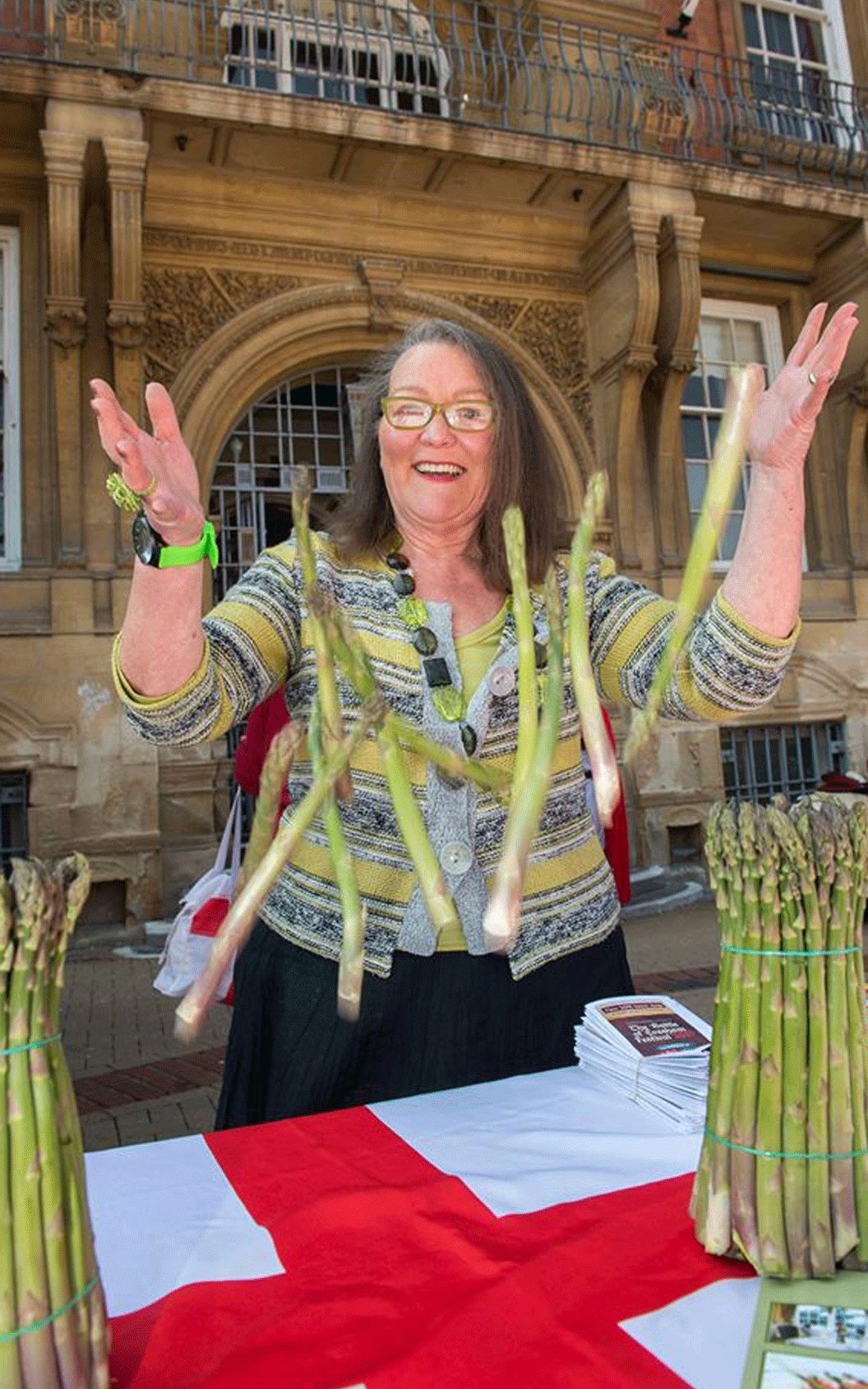
Her name is Jemima Packington and she is known as the “Asparamancer.”
She throws asparagus in the air and then reads the patterns that have landed on the ground. So far she has correctly predicted Trump’s election, British soccer league losing the World Cup, and the spike in vegetable sales across the world.

But Jemima isn’t always correct. She once said about her wrong predictions, “I am usually about 70 percent accurate with my predictions. This is because not every asparagus is meant to be used for prophesying. I take what I do very seriously and this is especially important when it comes to picking the right asparagus” (ecr.co.za).

If only reading the future were as simple as throwing vegetables in the air, but unfortunately it’s not.

Matthew 24:36-39 says, “But of that day and hour no one knows, not even the angels of heaven, nor the Son, but the Father alone. For the coming of the Son of Man will be just like the days of Noah. For as in those days before the flood they were eating and drinking, marrying and giving in marriage, until the day that Noah entered the ark, and they did not understand until the flood came and took them all away; so will the coming of the Son of Man be.”
‭‭
As humans we cannot see the future, only God can. We won’t have a warning that will let us know when He is coming. So that begs the question, “How are you living?” It would be amazing to always have a clean house. if someone dropped by you can invite them in and know it looks fine. My mom hated inviting people over when our house was dirty. She’d clean for hours before even one of our friends would come over.

What kind of house do you have? When God comes back, will He find a dirty house? A life that was spent in vanity and on self-service? Or will He find a clean and orderly house, one that has been prepared and one that has lived a life of service to God? As we think about the future, may we never fail to ask ourselves, “How is my house?”

asparaguslady_trans_nvbqzqnjv4bqcca9bu0tuyhkzjzhtsjqzg57efzlvro-v_knyx87nok

Discipleship

Wednesday’s Column: Third’s Words

20638721_440919206307154_5479040032968788217_n

Gary Pollard

We are supposed to be disciples. Discipleship is a mark of a healthy church. If we want to be true disciples, we must simply love God and we’ll know what it means to be disciples. Be a disciple. Discipleship is good. 

You’ve heard these statements before. They go along the same lines as, “We need to love God,” or, “We need to be godly,” or, “We need to be good Christians.” These are all true statements, but – at best – are greatly impractical and – at worst – are greatly discouraging. Ambiguous statements with no specific instruction will never accomplish anything. 

So, what is a disciple? The word used in the New Testament is μαθητής (mathetes). It describes someone who “engages in learning through instruction from another” and “who is rather constantly associated with someone who has a pedagogical reputation or particular set of views” (BDAG 609). 

A disciple is someone who passionately pursues something or someone in a specific subject field. A passing interest in pulmonology does not make one a pulmonologist. We know this. A passing interest in Christianity does not make one a Christian. 

If we’re there every time the doors are open but our Bible knowledge is lacking, we are not disciples. If we claim the title “Christian” but the foundation of our faith is a political viewpoint, we are not disciples. 

A disciple passionately studies. A disciple is an exegete. Disciples passionately incorporate and live out the teachings of scripture, which they get from their study. If we are as enthusiastic about our faith as we are about our hobbies, we are disciples. If we want to be called disciples, we must also be considered dedicated students of the word and of the One. 

open_bible