Kathy’s article two weeks ago really got me thinking. Since I’ve leaving home I’ve frequently thought, “I wish I knew this when I was younger.” I know this is something everyone’s experienced! While it’s nice to have the knowledge, it’s quite frustrating. I could have saved myself from so much heartache, embarrassment, anger, regret and pain.
Sometimes I feel like I don’t have any wisdom to offer since I’m still in my early 20’s and I’m not a mom (unless you consider Bear to be my child, because I do #dogmom). But I’ve often thought about things I wish I knew growing up and about what I could’ve done differently.
Here’s what I would tell myself:
Your parents are more than likely trying their best. I am ashamed to say that I was maybe 20 when I realized that my parents are people, too. They have…
In many cases the battles that wage inside of us are never seen by others. The Bible, however, gives us a few clues as to what might be going on inside our hearts.
A cheerful disposition can be the sign of a healthy heart according to Proverbs 15:13. Sometimes our appearance can show the darkness that has crept in.
Consider the following verses,
“And the LORD had regard for Abel and his offering, but for Cain and his offering he had no regard. So Cain was very angry, and his face fell. The LORD said to Cain, “Why are you angry, and why has your face fallen?” (Gen. 4.5-6).
God already knew what was in Cain’s heart, but notice how He tells Cain the outward signs of his inward struggles.
He’s angry and his countenance had fallen. In the following verses Cain ends up killing his own brother because that darkness had taken over.
God knows the heart. He knows every aspect of the heart.
In 1 Kings 12, Jeroboam has just become king over the Northern tribe of Israel. In the Southern kingdom they had the capital of Jerusalem where all the Israelites in that region would gather to sacrifice to the Lord. The Bible indicates to us the very plans that Jeroboam said in the “privacy” of his heart. He built his own place of worship and foolishly stood those golden calves up for his new kingdom to worship.
Jesus proves once again that He’s the son of God by reading the hearts of many individuals in the New Testament (Luke 16:15).
May we never forget that we serve a God who can read our hearts. There are things we can hide from every human on earth, but certainly not God. Let’s also never forget that we don’t have the ability to read hearts and attempting to do so is to pretend to be something other than human.
Our hens are good layers, even when molting and during bitter cold temperatures. Now that Spring and warmer temperatures are here, they are averaging an egg per day per chicken. But getting into the head (brain?) of a chicken is an impossible task. Many times, we have no idea why they do what they do. Their habits down to their individual decisions defy explanation. The hens have three nesting boxes, but many months ago they all decided they preferred just one. They all use it. Occasionally, you can find all four eggs neatly nestled together in one pile. More often, you will find that one of them has done her own thing. We have found eggs under the roost, at their feed trough, or in some stray, lone position. I need to post a game camera inside to solve mysteries like this.
What I do know is that none of them are acting out of a rational, intelligent decision to act out of step with the crowd. They are just being odd and quirky. There’s neither rhyme nor reason.
All of us, by intelligent design, are social creatures (Gen. 2:18; Ecc. 4:9-12). Whoever makes up our circle, however small or large it is, we do not typically like to be at odds with or stand out from them. At school, at work, wherever our social life takes us, we do not usually crave to speak or act in a way that ostracizes ourselves.
However, there are times when following the guidance of God and His Word will put us at odds with the world. Describing the sacrificial life we are called to as Christians, Paul writes, “Do not be conformed to this world, but be transformed by the renewal of your mind, that by testing you may discern what is the will of God, what is good and acceptable and perfect” (Rom. 12:2, ESV). Using the faculty of intellectual perception (mind, BDAG 680), which has been “renewed” (caused to become new and different, with the implication of becoming superior, LN 593), we use the filter of God’s Word to understand what is morally good, acceptable to God, and meeting His highest standard. If we are asked or pressured to do something by “the crowd” that does not pass this test, we cannot comply. Even though we dislike their disapproval, even if it makes us uncomfortable, even if it means potential sacrifice and suffering, and even if it means isolation and ostracism, we make the choice to stand alone. It is more important for us to know and to help others to know God’s will on the matter than to blend in with the group in doing what violates His will.
Few of us want to be seen as odd and strange, but Scripture warns that it can happen. Peter writes, “For the time that is past suffices for doing what the Gentiles want to do, living in sensuality, passions, drunkenness, orgies, drinking parties, and lawless idolatry.With respect to this they are surprised when you do not join them in the same flood of debauchery, and they malign you; but they will give account to him who is ready to judge the living and the dead” (1 Pet. 4:3-5). We may bear the scorn of the crowd on occasion, but we are more concerned about the judgment. There, the number of those unprepared to stand before Him will be much greater than those who are ready. Let’s always be more concerned with what He thinks about our conduct!
A lot of you do not know this about me but I grew up on a dairy farm. Holstein cows were a part of every day of my life up until about five or six years ago.
I have milked, showed, studied, and researched cows for years and invested so much time, effort and even money into cows. I can answer almost any question and have a deep conversation at any moment and can be confident in my answers when it comes to a Holstein cow… who won the show, who owns it, where it came from, her genetics.
The thing is… cows are no longer part of my life. I still have all that knowledge that worked so hard for, but it is basically useless in my everyday life.
Most people I deal with today would think I was crazy and probably take offense if I came up and asked what they thought about the rump and legs on that cow.
The need for that knowledge faded away just like every other earthly thing will and does for each of us.
I am sure we all have things in our life that seemed so important at one time and that we have moved on from. It faded away and was not near as important as we thought it was. Things of this earth will always fade away at some point.
God, Jesus, and the Bible does not fade away and never will!
1 Peter 1:4 tells us that God has given us an inheritance that is incorruptible and undefiled and that does not fade away. It is reserved in heaven for each of us because of the blood that Jesus shed for us. We should have the same knowledge and confidence in the Bible and about Jesus that we have about our hobby or job or whatever else it is that consumes our time and know that it will never become useless. If anything, it should get more and more important in our lives.
We should be able to have:
-Have a conversation about Jesus and not be nervous -Be confident in answering questions about the Bible -Quote scripture and passages from heart just as we can the facts about our hobby or job and whatever interest we have that consumes us on a daily basis.
1 Peter 3:15 says, “But sanctify the Lord God in your hearts, and always be ready to give a defense to everyone who asks you a reason for the hope that is in you, with meekness and fear;” God has given us everything we need to be prepared to win souls AND to save our own soul. 2 Timothy 3:16-17 tells us, “All Scripture is given by inspiration of God, and is profitable for doctrine, for reproof, for correction, for instruction in righteousness, that the man of God may be complete, thoroughly equipped for every good work.”
We need that same knowledge, passion, and fire for studying the Word of God and being the “workman” that we are for our hobbies and earthly things. Being able to teach anyone at any time about Jesus and have ready answers for them. There are people out there that want to hear about Jesus. We need to be ready and able to talk to them, teach them and most importantly be an example to them. Remember: ““Study to show thyself approved unto God, a workman who does not need to be ashamed, rightly dividing the word of truth” (2 Tim. 2:15).
– Are you the worker God wants you to be?
– Are you ready to use the tools He has given you? The Bible, your abilities and talents
– Are you ready to put in the time and effort that you need to to be the Christian that
God wants you to be? To study and learn from something that will never fade away or become useless.
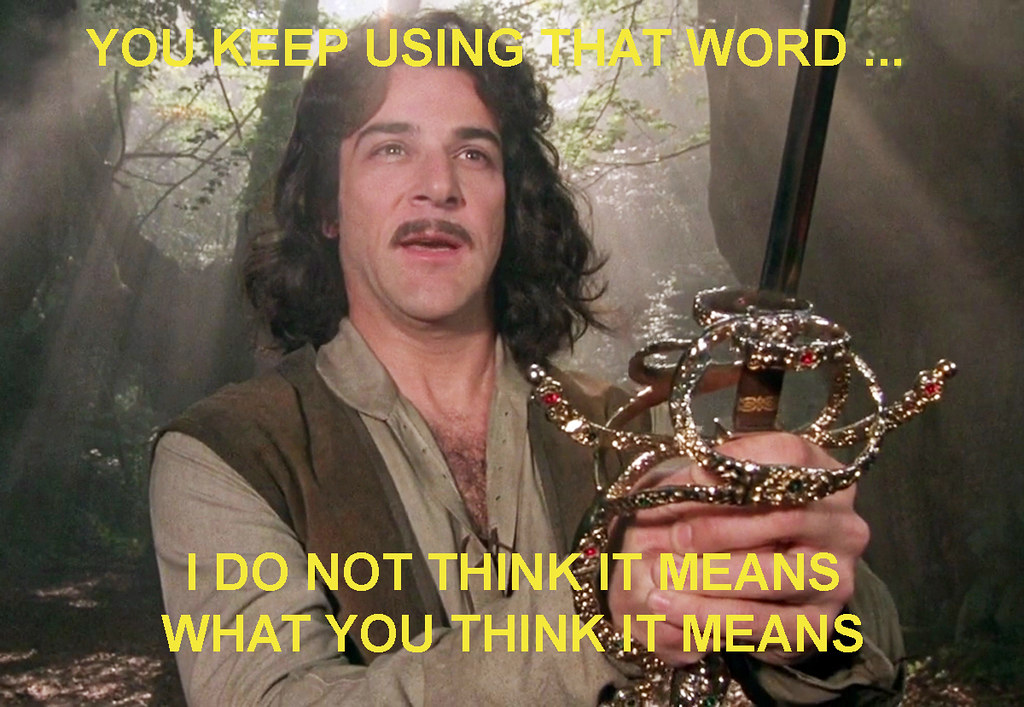
In The Princess Bride, one character questions another for the latter’s repeated use of a word telling him that he did not think that word meant what the one using it thought it meant. I have run into a little bit of that myself recently with the odd usage of the word “wholesome.” I grew up when “wholesome” described something good for the body, mind, or spirit. The folks at Lexico dot-com have my back on this one:
“Conducive to or suggestive of good health and physical well-being.”
1.1 “Conducive to or characterized by moral well-being.” 1
However, for current usage, it sometimes helps to consult a tertiary source like Urban Dictionary dot-com. Anyone can define a word, and users vote for the meanings they think are best. User, 265daysofpatandspongebob, provided the most current and popular user-contributed definition of “wholesome.”
“An embodiment of the following: self-less, considerate, sweet, compassionate, thoughtful, generous, genuine, doesn’t talk trash about other people,”2
Yes, I realize that the grammar is not perfect, but that is not the point. Somehow people have come to associate this adjective with the result of having been nurtured by the wholesome. For example, it would be hard to be selfless without wholesome influences. A secondary definition offered by another contributor was essentially something or someone bringing a smile to another’s face.3 Finally, there was the usage I had encountered. The fourth most popular submission asserted that something wholesome expressed love and affection, not lewdness.4
While I can appreciate that people realize that lewdness is not a virtue, not all love and affection are “wholesome.” The forum in which I encountered this word recently was about a story of a young adult who took in a runaway teen. Sadly, the young woman previously traded her body for a place to stay and assumed her new caretaker would desire the same type of “payment.” To his credit, he told her that she had value other than just her body and deserved good treatment with no strings attached. Those who are saying that the story was wholesome, I suppose, were expressing surprise that a vehicle of popular culture was not glorifying casual relations, especially between those of about a ten-year age difference. Thus far, the relationship presented is platonic. Perceptions of the story’s “wholesomeness” among audience members may change if a romance develops between the adult and the teen, even if the former waits to pursue romantic feelings until the latter reaches what the West considers the age of majority.
While I would prefer people to react this way because of moral instruction, I fear it stems more from the self-righteousness associated with political correctness. In other words, it has more to do with #MeToo than God said. After finally understanding how people are using “wholesome,” I thought of how I’ve previously seen the word used by other forum members in the past. The very first time I encountered this odd definition of “wholesome” was in a story with a fantasy setting. A woman befriends a female dragon. The dragon assumes a human form and lives with the woman, and takes care of her like a maid. The dragon acts smitten with the human, but the human has no romantic interest. But with the addition of other dragons who take up residence with the human, the setting assumes the form of a non-traditional family. Like the other story, I referenced, the relationship is platonic. However, the LGBTQ+ community lifted it as a positive example of the gay lifestyle. Commentators talked about how “wholesome” it was. Again, the idea was that it highlighted love and affection without lewdness. Hence, making it more acceptable to the “straights” in the audience.
It seems religious instruction is as lacking as English education today. If newspeak continues replacing our language, we might see other words perverted to accommodate meanings wordsmiths never intended for them. I am mindful of the warning from God as given by His prophet, Isaiah.
“Woe to those who call evil good, and good evil; Who substitute darkness for light and light for darkness; Who substitute bitter for sweet and sweet for bitter!” (Isaiah 5.20 NASB1995)
In the interim, take the time to teach the young people in your life what is wholesome. Let them know that being wholesome requires more than the absence of lewdness, causing others to smile, or remaining selfless. To be wholesome means you surround yourself with makes you a better, more moral person. The only thing capable of doing this is Christ, the Word, and the church.
Works Cited
1 “WHOLESOME: Definition of WHOLESOME by Oxford Dictionary on Lexico.com Also Meaning of WHOLESOME.” Lexico Dictionaries | English, Lexico Dictionaries, www.lexico.com/definition/wholesome.
Have you ever seen those little rocking horses that little kids ride? They hop on and rock back and forth, but they never go anywhere. There’s a whole lot of motion and work put in, but there’s never any progress made. Just like we don’t sit in a rocking chair to go somewhere, we need to understand how to work towards growth and maturity in our faith and knowledge.
We can work towards growing as Christians, but if we aren’t studying properly, or have the wrong mindset, our work and effort will never produce the outcome we are looking for. 2 Peter 3:18 tells us to “grow in the grace and knowledge of our Lord and Savior Jesus Christ. To him be the glory both now and to the day of eternity.” We are told by Peter through inspiration from God to “grow” and this isn’t a suggestion. It’s an imperative we are commanded to obey.
If you’re like me, this seems like a general command that can be overwhelming. If we want to grow a garden we have to do several things in order to be successful. We have to prepare the soil (no rocks or weeds) in order to give the plants what they need to grow and produce. There’s maintenance work to be done once the plants begin to grow. Keep weeds from choking out the plants, and make sure they are watered. Keep animals and bugs from destroying the plants. Make sure they get enough sunlight. And depending on the type of plant we will need to trim and cut excess leaves and stems to help it produce more produce (see what I did there?). Having a garden takes time, effort and patience.
Gardens don’t just magically appear. But there are some rare exceptions. I was burning some old clothes and furniture last year and I decided to throw some spoiled corn in the fire. When summer came around guess what I had sprouting out of my fire pit? Stalks of corn! And I got a great harvest of about 9 kernels. I ate them and it was pretty good! As Christians we will grow to a point without having to work too hard. We can learn from the lessons we hear at church, we can grow from what our parents teach us, but there will come a time when that won’t be enough. The corn in my fire pit only grew so much before it started turning brown. Turns out the roots were only surface deep because there was a sheet of metal keeping them from growing deeper. This in turn affected the produce that came from the plant. Hopefully as Christians we want to produce more than 9 kernels, and in order to grow properly we need put in the work.
Peter tells us that as Christians we must increase in grace (Eph. 2:8-9; Col. 3:16; 2 Pt. 1:2), grow in knowledge (Eph. 4:15; Col. 1:10, 2:19; 1 Pt. 2:2), and be motivated by a desire to glorify Christ (2 Pt. 3:18).
Our effort should produce results. In order for this to happen we must know the proper steps to take. We should never be satisfied with our knowledge of scripture. There’s no such thing as knowing too much Bible. We should never settle for the small amount of growth we encounter at services 3 times a week.
In the following fictional scenario, an unnamed extremist country has defeated the United States of America (work with me, there’s a point to this). They established a puppet government and required survivors to pay exorbitant, unreasonable taxes. The country has dealt with oppression under their rule for long enough that rebellions start to take place, but aren’t very successful.
Some are desperate enough (or simply weren’t patriotic to begin with) to work for the state controlled by the enemy. Worse, their job is to force an already oppressed people to pay tributes they can’t afford. The enemy has killed too many Americans. The enemy has humiliated the country – once the global power – in ways that may never be reversed. Any American working for the enemy is a traitor.
Imagine we have two different individuals in this dystopia: one is a freedom fighter, dedicated to overthrowing the enemy, the other is a traitor (and fair game for the freedom fighters). Both of them somehow find God, follow His word, and end up working together in a congregation of dedicated followers. The freedom fighter would kill the traitor, except for something that changed his mind forever: Jesus. The traitor would abuse and absolutely ruin his own people before Jesus.
If this seems far-fetched, consider that two of Jesus’ disciples were Matthew (a tax collector for the Romans and a traitor in the eyes of Jewish people) and Simon the Zealot (a freedom fighter sworn to kill people like Matthew). Their political and social views were radically different, but Jesus brought adjustments to their world views that changed them forever. They were no longer a freedom fighter and tax collector, but followers of Jesus (see Acts 1.12-14).
While there aren’t likely too many Christians with national animosity at that level, we aren’t strangers to the political division that affects every aspect of our lives. You may have even seen it play out in your church. We have focused too much on politics!
Many with good intentions (that includes me) have even said something like, “We should be able to get along, Republican and Democrat, if we’re in the same church.” That’s technically true, but misses the point.
We are not republicans or democrats (or any other political party, for those outside of the States). Our identity is not tied to a political party. We are Christians. Our leader is Jesus, our country is Heaven, our flag is His church. Yes, we live in our own countries and must be good citizens (Romans 13). Yes, we’re going to have differing viewpoints on social issues.
We have to stop blurring the line between our political parties and our faith! On both sides of the political aisle is immorality and incompetence. Christianity is beautiful because it shifts our primary allegiance and focus to God, not government. It’s a new allegiance that allowed former traitors and freedom fighters to work together for a greater cause!
If someone asks us to describe our world view and our first thought is political preference, we’re wrong. We will only have unity and peace when God is our common king. We can say that He is already, but our actions confirm or deny that claim. If God is our king, we will be good citizens (Romans 13.1-7). If God is our king, we will love each other deeply (I Peter 1.22). If God is our king, our morality/worldview/outlook will come from His word and not from our preferred political party (principle found in I Peter 1.14-19; Romans 14; Acts 1.13; John 18.36). I struggle with this. Many of us do. We have to be Christians before anything else, and remember that our primary allegiance is to God!
Listen! That’s how Jesus starts His lesson in Mark 4:3. He has just stepped out onto a boat so that He could speak to the large crowd that had gathered to hear Him. This was a very special sermon. Jesus is going to give the secret to all of His parables by telling a unique parable about the farmer who goes out to sow on the various kinds of ground. When Jesus said “Listen!” He was talking to a specific kind of person.
He wasn’t interested in the one who would hear His words and then fall away later when called to stand up for their faith. He wasn’t looking for the one who would hear His words and then foolishly decide that this world had more to offer.
Jesus said “listen!” because He knew that some would hear His words and those words would change their lives. They would live out His teachings. They would become those lamps He would later discuss later in the chapter. Those who truly listened to this specific sermon and took it to heart would bear fruit. It’s humbling to think that some only believe they’ve listened to Jesus, but on the last day will find out that they only thought they listened (verse 25).
Are we listening to the Savior? One way Jesus tells us we can know if we and others are listening is by looking at the fruit being planted. This section of scripture is a great reminder that there are many who will not hear the Lord and His life-changing and life-saving message, but there are also those out there in our communities who are willing and waiting for us to share Him with them.
“Outlook” is one’s point of view or general attitude about life. It’s really the way one looks out at the world and sees it. Your outlook may be colored by a lot of things going on in the world right now. It’s easy to let the negative, scary, and discouraging events cloud our view. Are there some proactive measures we can take to improve that picture? Yes!
Invest in someone. Perhaps no one should have had a harder time keeping positive than the apostle Paul. Read all that he suffered and endured (2 Cor. 11:23-33). He repeatedly labored under the threat of danger (1 Cor. 15:30) and death (cf. 2 Tim. 4:6). Yet, he exuded positivity (Phil. 4:13,19; 2 Cor. 9:8). Surely one reason was Paul’s knack for investing in others. He mentored Timothy (1 Tim. 1:2; 2 Tim. 1:2), Titus (Ti. 1:4), and Onesimus (Phile. 10). He spent time nurturing and developing churches like Corinth (1 Cor. 4:14-15) and Thessalonica (1 Th. 2:7-8, 11). He was willing to run the risk of being disappointed by the people he invested in (2 Tim. 4:10). For every Demas, there was a Luke (2 Tim. 4:11). There is someone who needs to benefit from your wisdom, maturity, experience, and understanding. Seek them out and help them, for their sake but also for yours.
Clarify your purpose. It is easy to reduce our view of this life to a daily grind we find ourselves working at. We can get lost in our routine, not unlike Martha whose outlook was distorted by hers (Luke 10:41). Being organized and fulfilling our responsibilities are vital, but what can help restore joy and meaning to all of it is regularly remembering why we engage in it all. Marriage, parenting, friendships, occupation, education, daily Christian living, church membership, and personal growth all serve a deeper purpose. Paul’s advice to slaves with earthly masters has broader application: “Whatever you do, do your work heartily, as for the Lord rather than for men, knowing that from the Lord you will receive the reward of the inheritance. It is the Lord Christ whom you serve” (Col. 3:23-24).
Reduce media consumption. If you constantly monitor news and current events, you will stay discouraged and fearful. The media has always thrived on reporting on the worst events happening, and it seems there is more and more of it to report. The same kind of thing can happen with too much social media consumption. Polarizing, inflammatory posts and reactions can form a black cloud over you pretty quickly. When Paul urges us to ponder things that cause pleasure and delight (Phil. 4:8), I’m pretty sure he wasn’t thinking of anything like what the media is churning out.
Increase personal interaction. Technology has steadily pushed so many toward isolation and disconnection. The pandemic forced this tendency further. Those monitoring the news cycle du jour (see previous point) retreat into virtual bunkers of suspicion against people of different colors, nationalities, and political persuasions. They become impersonal caricatures, grotesquely exaggerated and larger than life. How do you break through resulting prejudices? The Lord’s way was to be in people’s lives. Engage them. Listen to their stories. Grow empathy. Understand their hurts, fears, and needs. Realize their humanity and remind yourself how profoundly and infinitely God loves each and every one of them (John 3:16; 1 Tim. 2:4). People can be broken, full of dysfunction, and even prickly, but we will brighten our outlook when we get out of our shells and into their lives.
Focus on encouragement. Several times, I heard the late gospel preacher, George Bailey, say, “A man wrapped up in himself makes a pretty small package.” I have yet to meet a self-absorbed person who is happy with what they’ve filled themselves with. We’re just not wired that way. Paul’s central focus with the Philippians is on how to think right, their mindset and attitude. He urges placing others above self and looking out for others’ interests (Phil. 2:3-4). It’s amazing how God has wired us. When we find people to uplift and build up, it improves our own outlook. There are countless folks all around you who are struggling with their outlook. Compliment, express appreciation for, and gratefully acknowledge them. It’s a godly thing to do, but a side-effect will be what it does for you!
Look up and look ahead. Though not every time, usually my dampened outlook can be attributed to not only looking too much at this world and myself but also by not looking more at the world to come and God. It’s harder to focus on what’s invisible to the naked eye, but it’s crucial. Paul reminds us, “for we walk by faith, not by sight” (2 Cor. 5:7). Spend more time in God’s throne room and His inspired library. Deepen your dependency upon Him. In doing so, focus more intensely on His promise of the world to come (John 14:1-3; 2 Pet. 3:13; Rev. 21:1ff). This life is temporary. Eternity is–well–eternal! Looking up, you’ll see the all-knowing, all-powerful, ever-present, and all-loving God (Psa. 139:1-18). Looking ahead, you’ll see victory (1 John 5:4).
I think we’ll always struggle with dark days and discouragement. Did Paul? Read 2 Corinthians and 2 Timothy. But, he and other Bible writers give us a laundry list of ways to combat these and make them temporary. David was walking through the valley of the shadow of death, but He could still see divine presence, divine comfort, divine provision, divine blessings, and divine promise (Psa. 23:4-6). So can we! It just may take adjusting the way we look out at the world.
Minimalism is a term often associated with the arts and humanities. It can also be a term used to describe a lack of decoration or adornment in design. One notes that minimalism features everywhere today, from webpage design to people’s desire to live in tiny houses. Despite sounding like a paradox, I suppose one can make the case that minimalism is the ultimate form of refinement. Even Leonardo DaVinci allegedly proclaimed that simplicity is the art of sophistication.
Since minimalism appears to be beloved, why is it so difficult to share the simple Gospel to a postmodern world? What could be more straightforward than the Gospel of Jesus Christ? Paul distilled it to three topics about Christ, even though each of those topics can fill volumes of their own accord (cf. 1 Corinthians 15.1ff). Yes, the Gospel, at its core, is the death, burial, and resurrection of Jesus Christ. Our salvation is contingent on symbolically reenacting His death, burial, and resurrection (Romans 6.3-6). Indeed, the salvation plan is so simple that kids sing a song detailing those steps to the tune of “Pop Goes the Weasel.”
Yet, when it comes to religion, complex human emotion appears to trump Divine simplicity. Ask Naaman. When told how to cure his leprosy, Naaman balked. The prophet told him to dip himself seven times in the Jordan River to cleanse his leprosy. Naaman stormed off.
“Behold, I thought, ‘He will surely come out to me and stand and call on the name of the Lord his God, and wave his hand over the place and cure the leper.’ Are not Abanah and Pharpar, the rivers of Damascus, better than all the waters of Israel? Could I not wash in them and be clean?” (2 Kings 5.11-12 NASB1995)
Luckily, Naaman’s wise servants were not turned away by simplicity. They reminded their master he would do any great thing to cure his leprosy. So, why not just wash? (2 Kings 5.13) Similarly, I do not think that telling people to be immersed so that they can wash away sins and call on the Lord’s name (Acts 22.16) is a matter of complexity. It is simple. The stumbling block for those unwilling to obey is typically prejudices and fears. They think another way is better. Perhaps, this other way was taught to them by a dear, departed loved one. They do not want to “condemn” their relative by obeying the Gospel.
However, obeying the Gospel is not an act of judgment. In rendering obedience, I am demonstrating a good conscience before God (1 Peter 3.21). We allow God to take care of the implications and trust, like Abram, “Shall not the Judge of all the earth deal justly?” (Genesis 18.25 NASB1995). No doubt, if that loved one who taught us something differently had the opportunity to be preached the simple Gospel of Jesus Christ, then they would have obeyed too.
If time permitted, I could expound upon other areas in which human emotion overly complicates the minimalism of God’s Divine plan for items such as worship. Yet, as with the virtue I am extolling, minimalism, it is best to keep this focused and concise. We should not be surprised that God would make the most critical things, like salvation, simple for us all to understand. Minimalism, experts remind us, is user-friendly and accessible. That is why we like it so. And it is also why God, the Master Designer, set up things so that the simplest among us can gain wisdom from it (Psalm 19.7).
Indeed, what can be more minimalist than the Gospel?
Last weekend, we had an opportunity to see good friends of ours when Kathy did a Ladies Day in “L.A.” (Lower Alabama). We met Justin and Anna Maynard when they served as missionaries in Tanzania, and we have also been to Israel with them. They have two beautiful Standard Poodle puppies, a girl named Ruby and a boy named Colton. They are both smart, but Colton has to be a canine Einstein. Perhaps the best measure of his intelligence is his absolute love of going to the church building with Justin (see picture below). Some years ago, I wrote about a dog from my childhood that was faithful to be at the building when the church met (The Dog At Church). What I appreciate about Colton is how eager he is, every single time, to “go to church.” When Justin asks, “You wanna go to church?,” Colton goes ballistic! When he gets there, he sprints to the door and impatiently waits for his “dad” to open the door. Then, he runs around excitedly (I watched him do laps around the auditorium for several minutes before contentedly sprawling out on the floor to rest). He does a flying leap onto one of the other minister’s couch and thoroughly enjoys the whole experience at the church building.
His enthusiasm is so high, it made me think of what David once said: “I was glad when they said to me, ‘Let us go to the house of the Lord’” (Psa. 122:1). The sons of Korah described being in the house of the Lord, “with the voice of joy and thanksgiving” (Psa. 42:4). Maybe it was his memories of “sweet fellowship together” with others who “walked in the house of God in the throng” (Psa. 55:14). In those last two passages, the writers look back with longing to a time when they could do freely what now was impossible to do. They longed to be there. The psalms, as much as any book, describes zealous worshippers. Think about Psalm 95:6, which admonishes, “Come, let us worship and bow down, let us kneel before the LORD our Maker!”
I watched Colton and I asked myself, “Do I have that attitude toward going to ‘church’?” Frankly, I can let a sour mood or personal problems or distractions dampen my joy and zeal for being there. Here’s a creature who will not live eternally, is not made in the image of God, and for whom Jesus did not die, but whose unbridled enthusiasm is overflowing! The next time I’m tempted to grumble or grimace as I approach the “next appointed time,” I hope I will remember Colton Maynard, who loves to go to church!
It’s hard to have balance while times change. Some seize current social realities and use them as opportunities to push unbiblical ideas (God’s design for marriage, leadership in worship, leadership in the home, etc.). As a result, our human nature kicks in and we’re ready to swing the other way. After all, we don’t want to be associated with groups who don’t teach or practice what God wants, right?
Balance is way more difficult to maintain than reactionary practices in either direction. Both are extremely harmful to the church! Compromising doctrine is never acceptable, but gaining a reputation for being old-fashioned or otherwise incompatible with modern culture is equally harmful.
I Corinthians 9.19-23 is an awesome text for this. We’ll look at a few key points in this passage briefly.
It’s About Serving Other People (9.19)
It’s About Winning Them (9.19)
It’s About Meeting Them Where They Are (9.20-22)
It’s About the Message (9.23)
We do what we do because we want to save souls. We cannot maintain a church culture based on reaction because it does not save souls. It is not a sustainable culture and has led to many viewing the church as being incompatible with the modern world. This was never God’s design! We must never compromise doctrine, but we must always try to win souls. We need to do what we can to meet folks where they are and show them something better.
“I have become all things to all people, that by all means I might save some” (9.20).
In the first chapter of Genesis we read that God made man dominion over every creature He had made. Then in James 3:7 the inspired writer says, “For every kind of beast and bird, of reptile and sea creature, can be tamed and has been tamed by mankind.” When we think about the implications of that and then apply it to the world of the Old Testament it becomes even more impressive. The first humans lived with all kinds of beasts, including the dinosaurs. Whatever image comes to mind when you think of those extinct reptiles, it’s probably not that of a tame animal. God gives us a curious glimpse into the past where humans and dinosaurs not only coexisted, but we managed to tame them. In Ecclesiastes, the preacher concludes his sermon in chapter 12 by saying we must prepare ourselves for the day we meet our Creator. The spirit that He made will one day return back to Him. Solomon then says, “fear God.”
The correlation between “spirit” and “fear” is also seen in the New Testament. Paul writes to a fearful and wavering Timothy, “God did not give us a spirit of fear but of power, love, and a sound mind” (2 Timothy 1:7). The message in the Old and New Testament then is, “fear nothing but God.” When Adam and Eve were in the garden they feared nothing because that’s not the spirit that God gave them. He gave us one of power, because of the God we serve. He is our Father and He has all the power. He gave us a spirit of love. We aren’t animals. We aren’t lions who display great power but lack the ability to love. We were made in the image of God and that means we have both a spirit, which is our life force, and a soul— our eternal life force. On top of all this God gave us the spirit of a sound mind. The Greek word used there means a mind that is calm. Even in the face of calamity and craziness, we can be calm. Why? Because we are God’s children and God is in control. One day every faithful Christian will get back that perfect spirit given to His original creations. Spirits without fear.
Think about what “self” does to some wonderful concepts:
Righteousness (“To cause someone to be in a proper or right relation with someone else,” Louw-Nida 451). Jesus despised self-righteousness, “And He also told (a) parable to some people who trusted in themselves that they were righteous, and viewed others with contempt” (Luke 18:9). We should be eager for God to declare us righteous, but slow to do so for ourselves.
Service (“functioning in the interest of a larger public, rendering of specific assistance,” BDAG 230). Jesus proved that service centers around ministering to and helping others (John 13:12-17). Notice the tack which reveals one to be spiritually mature. “Now we who are strong ought to bear the weaknesses of those without strength and not just please ourselves” (Rom. 15:1).
Interest. While the word isn’t found in the New Testament, the idea is there and so translators include it in passages like Mark 8:33, 1 Corinthians 7:34, and Phllippians 2:4,21. Each of these passages urge us to focus on others rather than self. Meanwhile, Scripture warns against selfish ambition (Rom. 2:8; Phil. 1:17; 2:3; Jas. 3:14,16).
Love. There’s a specific word for love in the New Testament that we’re encouraged to demonstrate, toward God (Mat. 10:37; 1 Cor. 16:22) and fellow Christians (Ti. 3:15). But, Paul warns about how dire the world becomes when men become lovers of self (2 Tim. 3:2).
Justification (“to take up a legal cause; to render a favorable verdict,” BDAG 249). Scripture often uses this word to speak of God doing this for us through Christ (Luke 18:14; Ac. 13:39; Rom. 2:13). But, it is an ugly thing when we manipulate and distort facts and truth to justify self (Luke 10:29; 16:15).
Will. We are all equipped with a free will, with which we should serve the will of God (John 7:17). Yet, Scripture exposes as wicked those who are “self-willed” (2 Pet. 2:10). Paul warns against appointing a man an elder who is “self-willed” (Ti. 1:7). Such is arrogance. It comes from one who thinks he or she is better than anyone else, looking down on others (Louw-Nida 763).
But for all of these ways “self” can get in the way of God’s plans and desires, self is not always a qualifier of destructive behavior. Notice what else Scripture says. There is “self”:
Denial. It is indispensable to spiritual discipleship (Luke 9:23).
Sacrifice. It is integral to spiritual transformation (Rom. 12:1).
Discipline. It is imperative to spiritual survival and eternal reward (1 Cor. 9:27).
Control. It is included in spiritual fruit-bearing (Gal. 5:23).
Further investigation into God’s Word would no doubt reveal more examples like these, but here is the point. Our old self is to be crucified with Him (Rom. 6:6). It is to be laid aside (Eph. 4:22; Col. 3:9). When this truly occurs within us, we will not place self above God and others. We will devote ourselves to the kind of lives that reach the lost, strengthen the saved, glorify God, and ultimate save ourselves (Acts 2:40).
While feeding the cats this morning, two males got into a kerfuffle. I stuck my foot between the two moggie pugilists and gently but firmly sent them to their mutual corners. One of the participants, the victim, decided to make himself scarce for a time. Meanwhile, the instigator continued chowing down. Enter my father. My siblings can attest that my dad can cut quite the intimidating figure. It seems apparent that even cats can appreciate this. Dad sternly stated the aggressor’s name and walked towards him. The feline perpetrator may be the alpha among the cats, but he slinked away from my father. The guilty glances he returned to my father said, “Yes, I did something I should not have done.” Even so, the guilty cat lacks the intellect to grow from having been caught in his transgression.
Despite being human, there may be many persons able to identify with our mischievous cat. They may feel guilty when confronted with their sin, but they will not allow that discomfort to prompt restoration. Eventually, they will sufficiently recover to resume their everyday life. Hence, wrongdoers may view guilt as a wholly negative emotion, a pesky nuisance. Sadly, they might find validation from a few pop psychologists. I recall one Christian telling me that her therapist assured her that she would feel better if she would discard her pesky religious convictions. Despite what such pop psychologists have said in the past, this guilt can be a positive. The apostle Paul addresses this subject in his second epistle to the Corinthians.
“For the sorrow that is according to the will of God produces a repentance without regret, leading to salvation, but the sorrow of the world produces death.” (2 Corinthians 7.10 NASB1995)
So, if you will permit me to anthropomorphize my cats further, my cat experienced worldly sorrow. This lack of godly sorrow means that the next time a similar situation confronts this male cat, he will fall back into the same behavior that earned his initial rebuke.
Fortunately, God gave humans the propensity to experience sorrow according to His will. This sorrow can lead to repentance (2 Corinthians 7.8-9). No one enjoys being like Nathan, pointing the accusatory finger at a friend (cf. 2 Samuel 12.1-15), not even Paul. Paul said that he initially regretted his role (2 Corinthians 7.8). However, such finger-pointers realize, like Paul, that inflicting momentary guilt leads to a restoration of another’s relationship with God. The only prerequisite for imposing godly sorrow upon another is to ensure your eye is free of beams while spotting specks in your brother’s eye (Matthew 7.3-5).
We feel guilt for a reason. Guilt helps us understand that our actions have strained our relationship with God and others. As such, guilt causes us to preserve our connective bonds. When acknowledging we have wronged someone, we make amends to them. We will not allow the rift to continue or grow. Research also suggests that you may be more trustworthy if you are more prone to feel guilt (Emamzadeh). Such guilt-prone people are more reliable because they want to avoid the guilt that comes from strained relationships entirely. Therefore, they will avoid situations imperiling a relationship. Just as a quick aside, we should not confuse shame with guilt either. Shame causes a person to see themselves as a failure rather than seeing a mistake that they can rectify with another. We all sin and fall short of God’s glory (Romans 3.23). So, we all have flaws. However, we can make sure that we do not purposely do anything disrupting our relationship with God and others. To that end, guilt can be a positive thing that though uncomfortable, leads to our refining in the fire.
There’s a fact that we must understand about our Christianity: we can’t make it through this life if we don’t let God help. God has offered His hand to us. He wants to help us. Problem is, we don’t always accept. When we refuse the help of God, we open the door to stress and anxiety. When we try to handle life on our own we are quickly drowned in helplessness and worry. But God wants to help us.
In 1 Peter 5, we are told a comforting fact about the Creator. In speaking of our humility in submitting to the leaders of the church, Peter tells us, “Humble yourselves, therefore, under the mighty hand of God so that at the proper time he may exalt you, casting all your anxieties on him, because he cares for you” (6-7).
Peter tells us how we can show humility to God, by casting our anxieties on Him. And most of the time we refuse help because of our pride. We don’t need directions because our pride keeps us from admitting we are lost. We don’t need the user manual because doing so means accepting that we don’t know how to build a dresser.
Accepting help takes humility. Peter tells us that in order to show humility toward God we must accept the fact that without God we are lost. We are told in Scripture that God bears our burdens, but an important question we must ask is, “How do we let God bear our burdens?”
Transfer Your Concern.
Peter tells us in verse seven to cast our anxieties. This word “casting” is a very interesting word. It literally means to “transfer from one person to the next.” It is the act of handing off something to someone else. I want to pause and analyze a very intriguing and complex game. It’s called “hot potato.” Now it can be hard to understand the goal and purpose of this game so I’ll try as best I can to explain it. You take a hot potato and toss it around to other people…And that’s the game. When it comes to our anxiety that is exactly what we are told to do. Toss it like a hot potato because you don’t want it or need it.
When Peter tells us to cast our anxieties on God, he is telling us to get rid of it completely. Not just tell God about what’s worrying us, but literally transfer our concerns and worries over to God. We sometimes will tell God about our anxieties in prayer and then continue to worry and stress over our situation. If we do this we aren’t fulfilling the command given. God bears our burdens by taking what we transfer to Him. If we never give it to God He will not have it.
Pinpoint Your Anxiety.
Verse seven also says, “Casting your anxiety.” What is anxiety? The word here is speaking of an emotion characterized by feelings of tensions. It’s worried thoughts and physical changes like increased blood pressure and weight gain or weight loss.
Peter is talking about the emotions we deal with when it comes to stressful situations. The emotions we feel when trying to solve an issue we are worried about. The situations we lose sleep over, the problems that are constantly in the back of our minds eating away at our joy and contentment. Those feelings are the ones that God wants to take from you. Those are the emotions that God wants to bear for us. But we must pinpoint what it is that is causing anxiety. What stress am I dealing with? More importantly, what am I doing about that stress?
Understand God’s Care.
Then verse seven says, “Casting your anxieties on Him because He cares for you.” Why do we transfer our concerns to God? Because He truly cares. What concerns us concerns God. In letting God bear our burdens we must believe the fact that God truly cares about us (Psa. 40:17; Jn. 10:11ff). It is plainly shown to us in Scripture that God cares. But it’s interesting to notice that in His earthly ministry Jesus was often asked a question. For example, in Mark 4:38 the apostles are on the Sea of Galilee and a storm comes upon them. The waves are crashing down, the wind is beating on the boat, the Savior is sleeping, and the apostles lose their faith in God. They come to him and ask, “Do you not care that we are perishing?”
In Luke 10:40, Jesus enters the house of Mary and Martha. Mary sits at His feet while Martha is distracted by serving and being hospitable, and Martha says to Jesus, “Do you not care?” We find ourselves in the storms of life and Jesus is nowhere to be seen and we immediately ask “Do you not care?” We get distracted and our problems aren’t getting fixed and we cry out “do you not care?” It is a question we tend to ask God, and we still fail to see the care of the Savior.
“Oh, yes He cares I know He cares. His heart is touched with my grief. When the days are weary, the long nights dreary, I know my Savior cares.” Do you understand that God cares for you? Or have you found yourself asking the same question the disciples asked Jesus? Do you fully understand the love that God has for you?
If we ever doubt God’s care, just think of Christ hanging on the cross taking your sin. Receiving the punishment for my sin. Does Jesus care? The answer is a resounding yes! And we can know that He cares.
Fundamental Idea: Poking one’s nose where it doesn’t belong.
II Thessalonians 3.11 – “We hear that some of you are idle, not busy working, but being busybodies.”
This person is more likely to accept charity than contribute to the good of others (cf. 3.7-11).
Some at the Thessalonian church were confused about the second coming and may have stopped working (2.1, 2).
Not being occupied with providing or pursuing the work of the church leaves one vulnerable to pursuit of ungodliness.
I Timothy 5.13 – “Besides that, they learn to be idlers, going from house to house – not just idle, but a gossiper and busybody.”
Paul is warning about the potential danger of financially supporting young widows (as opposed to older widows) who could be taken care of by family. Those who don’t look out for their own have “denied the faith and are worse than unbelievers” (5.8).
By having little to occupy their time, they may end up intruding into things they shouldn’t.
Acts 19.19 – “And a number of those who had practiced magic arts brought their books together and burned them in the sight of all…”
Magic arts is the emphasis here, surprisingly. An interest in unhealthy subjects is the same word as busybody.
Being occupied with things that aren’t our business or are spiritually harmful is considered sinful! While we should be vigilant to take care of our spiritual family, we should pursue balance by not having an unhealthy interest in others’ affairs and by filling our time with cultivating godliness.

























 The Preacher Pollard Blog