On a particular occasion, I was listening to a great sermon on worship. It was interesting and, in a very real way, enjoyable. But it was also forceful and convicting. The longer he preached, the more the message kept penetrating and pricking my heart. His sermon consisted of two points, that worship is an intentional meeting with God and, when we come, we must bring an offering. That may sound somewhat plain, but it was powerful.
Do not think that my view is that it is not a good sermon if your toes have not been crunched and you have not gone on a guilt trip. I love feel good sermons on grace and heaven, the same as the next brother or sister. However, as I listened to him preach that night, I thought of so many sermons by Camp, Clark, McCord, Winkler, Nichols, and others of their ilk. The rich overflow from a man who has studied, prepared, and honed his ability to present gospel truths reaches into the heart of a hearer. If we open our hearts during such sermons, we will be convicted by our shortcomings but motivated by the lesson to improve, grow, and increase what is good.
As he spoke about the “bucket,” I thought about the fact that more times than I want to admit I have come with an empty or nearly empty bucket. But hearing him preach about it, I felt resolve to fill it up next time I meet God in worship. In fact, that was what struck me most about his sermon. The more I heard, the more I wanted to please, love, and obey my Lord. It was painful, but exhilarating!
In our dramatically consumer-centric culture, you and I must break out of such selfishness and humbly approach the Audience of worship and give our everything to please Him. We need to come with our prayers, praise, thoughts, longings, meditation, money, and the like, urgently desiring to give and give some more to our great God! That will do more than transform our worship. It will change our very beings to the core!
If you grew up going to Sunday School, this may be one of the lessons you learned as a child. The kernel I remember is that Abram gave Lot the first choice of land and Lot chose the one that looked better; that would cost him, but God would richly bless Abram. As I recall, the takeaway for us preschoolers was not to be selfish and trust that God will take care of us. Not bad, sister Gober!
But, keeping with the context of the call of Abram, perhaps we can glean even more. Let us examine how they got to this point and what significance it has on the overall objective given to Abram.
First, we see Abram’s prosperity (1-4). As we saw, the Pharaoh unwittingly adds to his resources when he thought he was wooing a potential wife. But with all Abram brought and accumulated, it amounted to him being “very rich in livestock, in silver and in gold” (2). He has left Egypt and returned to Bethel, where he had formerly built an altar (3-4; 12:8).
Second, we see Abram’s piety (4b). Abram was an altar-builder (12:8; 13:4,18; 22:9). No doubt, he influenced his son, Isaac, who would also become an altar-builder (26:25). Abram repeatedly found it necessary, in arriving at some significant point, to call on the name of the Lord. While his faith is still developing, he understands the uniqueness and power of Jehovah. It drives him to his knees in worship.
Third, we see Abram’s problem (5-7). Sometimes, we refer to “good problems”–dilemmas that grow out of otherwise positive circumstances. That is what happens on this part of the journey (cf. 36:7). Lot and Abram both had so much flocks, herds, and tents that “the land could not sustain them while dwelling together” (6). There was strife between the men’s herdsmen (7), and perhaps it threatened the peace between them (8). Sometimes, growth and progress create problems that would not exist in periods of decline and difficulty.
Fourth, we see Abram’s proposal (8-13). Choosing unity over plenty, Abram proposes that they separate with all their goods and possessions so that each could sustain and provide for their own (8-9). For him, the overriding concern was, “we are brothers” (8). Abram tells Lot that whichever way he chose, he would then chose the other way (9). Lot looked down on the valley of the Jordan and saw well-watered plains “like the garden of the Lord” (10). Lot took all he had with him and went east to the land of Canaan in the cities of the valley (12). There is foreboding in Moses’ summation of Lot’s destination, first alluding to the coming destruction of Sodom and Gomorrah (10) and the little city of Zoar where Lot and his daughters will flee during that destruction (10). Second, there is the startling statement: “Now the men of Sodom were wicked exceedingly and sinners against the Lord” (13).
Finally, we see Abram’s prospects (14-18). The Lord appears to Abram and tells him to look in every direction. God promises to give all the land he could see to his descendants, offspring that would be as prevalent as the dust of the earth (16). He tells Abram to walk the land and survey it, with the promise, “I will give it to you” (17). Abram takes his household and belongings and camps in Hebron, where he promptly builds a place of worship (18).
God is blessing this man of faith, who, in turn, is remembering God and following the ways of God in his dealings with others. God rewards His proper prioritizing, and sees fit to use him in furthering His plans and intentions. God uses faithful, selfless people to accomplish His will. May we have a heart of wisdom which approaches life’s decisions, big and small, with the sole motivation of loving God wholeheartedly and loving our neighbors as ourselves. Out of this drive, we will be people God partners with to do great things to His glory!
On July 5, 2023, Zach Swope’s set a Guinness World Record by watching 777 movies. The 32-year-old man did it for a cause, to raise awareness about autism and suicide awareness. He did it at a cost, even though he had an unlimited membership that allowed him to watch all these movies for $22 per month. After all, consider the time expended. He saw several movies multiple times to reach this historic milestone, including one movie (“Puss in Boots: The Last Wish”) 47 times (Source).
While there are a multitude of applications we could observe about Mr. Swope’s endeavor, I want to focus in on just one. Zach was dedicated to be present as often as possible. He was willing to do what it took to be there because it was part of an ultimate goal. It caught the attention of others. It was the result of an attempt to fulfill a tangible purpose.
However you feel about Swope’s use of time or money, consider an opportunity we have. The Lord and the local church provide us multiple times to come together to study the Bible each week. There are, typically, multiple opportunities to assemble to worship God together. Periodically, there are extra occasions given to study and worship through special events or classes. While merely attending these will not earn one the reward of eternal life, it can greatly aid the aim. The time spent is invaluable. Any expense or sacrifice potentially rewards and enhances life. It can certainly influence people in our lives in a most positive way!
Perhaps the best-known passage on the subject provides the most insight on the value of attending: “And let us consider how to stimulate one another to love and good deeds, not forsaking our own assembling together, as is the habit of some, but encouraging one another; and all the more as you see the day drawing near” (Hebrews 10:24-25). What does God tell us here?
Assembling is deliberate–“Let us consider”
Assembling is cooperative–“Let us…together”
Assembling is purposeful–“How to stimulate one another to love and good deeds”
Assembling is considerate–“Stimulate one another…encouraging one another”
Assembling is habitual– Just as “forsaking our own assembling together” is
Assembling is spiritual– “As you see the day (Judgment, cf. 10:26ff) drawing near”
It is true that one can attend every service, but still not go to heaven. One’s heart might not be right there (Matthew 15:8-9). One’s life might not be right when not there (Jeremiah 7:9-10). But, it is much more difficult to go there when our approach to attending is lackadaisical, not prioritized, or deemed optional and dispensable. Wouldn’t it be wonderful to develop a reputation within our circle of influence as one as dedicated to worship as this young man was to moviegoing?
FILLING IN FOR DALE THIS WEEK AS HE AND JANELLE WERE BUSY WITH THIS:
Jude Mitchell Pollard (born 8/20/23)
Neal Pollard
Luke shows us two demonstrations of Jesus’ power as He traverses the roads and villages of the northern half of Palestine during the early part of His public ministry. These show the diversity of Jesus’ work, even what He did simultaneously. This ultimate example of “multi-tasking” was performed for two situations that were about as opposite of each other as could be. Notice some of these contrasts in Luke 7:1-17:
The Centurion’s Servant
The Widow’s Son
The Centurion reaches out to Jesus (3)
Jesus reaches out to the widow (12-13)
The Centurion was already convinced of His power
The widow was seemingly oblivious to His power
The Centurion was rich and powerful (2,5,8)
A widow with no children had no prospect (12)
The servant is about to die (2)
The son is dead already (12)
Jesus marveled at the man’s faith (9)
Jesus felt compassion for the grieving mother (13)
The Centurion was a Gentile
Nain, a Galilean city, would be Jewish (12)
Jesus healed the servant from afar (6-10)
Jesus touched the coffin and raised the son (14)
Nothing is said of the people’s reaction (10)
The crowd fears and glorifies God (16-17)
Yet, Jesus is the thread that holds them both together. Whether He is responding to the faith of a devout Roman or responding to the grief of an indigent widow, He knew He could help and He was willing. He knew He had something to offer they could not find anywhere else. He is willing and able to transform sorrow into celebration. These events serve to spread good news about Him all around Him (17). People may not yet understand who He is, but these actions let them know He was no ordinary man or rabbi. Those in the funeral procession say, “A great prophet has arisen among us!” And, “God has visited His people!” (16). As glowing a tribute as this was, they didn’t yet grasp the full picture of Jesus. But, they knew He was special.
I think about the diverse people we see and know every day. They are black and white, young and old, male and female, rich and poor, educated and uneducated, natives and transplants. Perhaps you can take two people in your circle of influence and make up a column of contrasts like the one above. Despite their differences, they will be united by one significant thing. They need what only Jesus can give, and He can certainly give it to them. Whether they are actively seeking Him or unaware of their need of Him, you and I can forever change their life and circumstance when we introduce them to Jesus. May God help us to do that for someone today!
The debate between creationists and atheists is probably not new to you. This heated debate frequently takes the form of verbal duels, with each side trying to persuade onlookers to take their side. Unfortunately, these arguments rarely convince their opponents to change their minds. In most cases, they are speaking to an already confident audience.
Since I hold a creationist worldview, I frequently read works that reinforce that view. Unfortunately, the strategy used to make the case for God’s existence often comes off as bland and unpersuasive. These tactics wouldn’t have influenced me had I not already convinced myself.
Ultimately, faith is the deciding factor. We can’t provide indisputable evidence since we weren’t around for the “Big Bang” or creation. We found our faith in the evidence that we found most convincing, be it ancient fossils or direct revelation from God. This truth leads me to an essential aspect of my approach when discussing my faith.
When asked about my faith, I usually explain why I think there must be a higher power, pleading only for tolerance and acceptance. I want to debunk the myth that people who believe in God are stupid. To this end, allow me to provide two fundamental arguments that offer compelling evidence of a Creator.
First, I’d like to discuss the concept of a “God-shaped void” in every person’s soul. Aurelius Augustinus Hipponensis, a theologian born roughly 320 years after Jesus of Nazareth, is widely credited with developing this idea. However, the French mathematician Blaise Pascal may be a more likely originator. Pascal’s perspective gives us much to ponder.
According to Pascal, the search for and disappointment in material happiness are signs of a more profound spiritual longing. He contended that only something infinite and unchanging, like God, could fill this gaping chasm. This void brings us to an intriguing point about our universal need for worship.
We can’t help but wonder if there is a universal, hardwired urge to worship. How come religion is so pervasive? What accounts for the universality of references to spiritual phenomena like ghosts and ghouls? How do some people discover spirituality in the great outdoors? These occurrences point to an innate desire to worship. Skeptics, however, might have a different take on this.
Skeptics may write off religion as the product of neuroses, thereby tagging the vast majority of humanity as mentally ill. The paradox here is apparent: It takes neurosis or paranoia to believe you’re the only sane person in the room. Interestingly, skeptics themselves seem to show a form of devotion.
Even skeptics have their form of religious devotion. Non-believers hold science in high regard and defend its tenets with great zeal. Like accusations of heresy in religious contexts, challenging their scientific beliefs can elicit strong reactions. This reaction has led me to question the source of our knowledge.
While I value science’s role, I am skeptical of its origins. Believers credit their knowledge to God or a higher power. Atheist scientists rely heavily on human-made discoveries and theories with inherent flaws. Changes in academic science are possible and frequent. However, God’s Word does not change. This immutability brings me to another critical argument I wish to present.
The ontological argument is my second piece of evidence for God’s existence. Anselm of Canterbury first advanced this line of a priori knowledge-based philosophical reasoning in 1078. Here’s what Anselm proposed:
Anselm theorized that God must exist because He is “a being than which no greater can be conceived.” This argument may seem complicated, but it claims that God must exist because everyone can imagine a supreme being and that having a physical presence is one measure of greatness. The universal nature of belief in God provides further credence to this argument.
The fact that people all over the world believe in God lends support to this claim. It resonates with the concept of a “God-shaped void,” implying a global recognition of a supreme entity Whom men desire to worship. With these points in mind, what do I conclude about the existence of God?
Is there a God? Yes, I think so. I suggest you give that idea some thought, too. Perhaps you already know about God but still, feel something is missing. Seek Him out; you won’t regret it. I believe that you can find Him because I have found Him.
Chapter two is what we’re probably most familiar with when we study I Timothy. Here are the highlights: 1 — God expects us to pray for everyone, specifically that God will do good things for them and give them what they need. “All people” includes people who hate us and want to harm us. 2 — God expects us to pray for anyone who has authority over us. This is for the specific purpose of living quiet and peaceful lives. 3 — This makes God happy, and he’s the one who will save us in the end. 8 — Anywhere Christians are together and worship is being offered to God in some way, he expects godly men to lead that worship. This goes back to 1.4 and the word usually translated “administration” or “stewardship”. The word is οικονομια (oikonomia), and would be best translated “house-law” in this context. The church is God’s house, so he expects us to follow his rules. This is a difficult passage for many to accept because it contradicts our culture’s view of equality. Many in the world think this passage is misogynistic, but it isn’t. When it comes to worship — and because the church is God’s house, not ours — he wants godly men to lead. Notice that not just any man can lead! Hymenaus and Alexander were men, but they weren’t qualified. Men who lead can’t have anger issues and can’t be argumentative. If a man who has those issues leads a prayer or any other act of worship, according to I Tim 2.8 it’s just as sinful as if a woman did the same. 9-15 lists some of the reasons that this is the case, but I want to focus on the most difficult verse in this section (15 — “…but women will be saved through having children, if they continue to live in faith, love, and holiness with self-control”). On its face, this is a weird verse. What’s going on here? Men have the responsibility of leading worship and leading their families. We’re told that this is because Eve sinned first, then Adam (14). Maybe Paul doesn’t want Christian women to get the wrong idea, thinking there’s no hope for them because of something someone did thousands of years before. Women are the only people who can bring new life into the world. The church is made up of people, and only because of mothers. This could be an encouragement — “Women, we’re only here because of you. This is so important that if you live faithfully, you have just as much a claim to salvation as your male counterparts”. This is echoed in I Pt 3.7. But it may also be a call to avoid the lifestyles of the women in II Tim 3.6-7, who may have been former employees at the Temple of Artemis.
Between 2003 and 2017, I have seen (or heard) lions in several places across northern Tanzania. Each time you see or hear one is truly unforgettable. They are fierce, fast, and powerful creatures. Each time, I have been grateful to have had the safety of an automobile to offer protection.
In three trips to Israel, I have not seen or heard a lion. That’s because you can’t find one in the wild there today. But, after Assyria carries off Israel into captivity, they settled people from other nations into Samaria and the other cities of the northern kingdom. These newly-settled citizens did not fear the Lord, so He sent lions among them to kill some of them (2 Kings 17:25). They appeal to the king of Assyria to help them “know the custom of the god of the land” (26). The king of Assyria’s solution was to send a priest from among the exiled Israelites back into the land who lived in Bethel and taught the new inhabitants “how they should fear the Lord” (28). Sound like a feel good story of mass conversion, right? Well, not exactly.
The people, like the Athenians later in history (Acts 17:16-23), just added Jehovah to their list of gods. “They feared the Lord and served their own gods” (33). They had no history with and no grounding in the Law of Moses , so they continually violated His will and commandments (34-40). “So while these nations feared the Lord, they also served their idols; their children likewise and their grandchildren, as their fathers did, so they do to this day” (41).
Mixed up religion is not just a problem of ancient times. It is alive and well today. What do people serve alongside Jehovah? The teaching and commandments of men, patriotism, tradition, money, culture, and more. They take elements of each and the end result is a watered-down, unacceptable substitute for true religion governed and guided by a reverent, informed knowledge of God’s Word. Syncretism is “the amalgamation (act of combining or uniting) or attempted amalgamation of different religions, cultures, or schools of thought.” Some world religions are syncretistic in nature. But, true religion–biblically defined–does not allow for anything mixed with it. In fact, the Bible defines true religion as “pure and undefiled” (Jas. 1:27). Worship is according to truth (John 4:24), and God’s Word is truth (John 17:17).
God does not allow for watered down substitutes and self-customized religion. The only way to avoid that is to know what His Word says, and then do it (Jas. 1:21-25). Otherwise, our efforts are made in vain (Mat. 15:9). Mixed up religion condemns. The sage observation of Jeremiah ought to serve as our beacon of light: “I know, O Lord, that a man’s way is not in himself, Nor is it in a man who walks to direct his steps” (10:23).
Got real close to this dude in Ngorogoro Crater, 12/7/17
When we think about Jesus and material possessions, perhaps we think of passages like Luke 8:3 that tell us He lived from the financial support of Mary Magdalene, Joanna, Susanna, and many others. Or His own words: “The foxes have holes and the birds of the air have nests, but the Son of Man has nowhere to lay His head” (Luke 9:58). Jesus lived humbly. Despite this, how often do we reflect on Jesus’ giving?
He gave Himself. Scripture says this explicitly in several places. He gave Himself “for our sins” (Gal. 1:4;). He gave Himself “for me” (Gal. 2:20). He gave Himself “for us” (Eph. 5:2; Ti. 2:14). He gave Himself for the church (Eph. 5:25). He gave Himself “for all” (1 Tim. 2:6). No matter how you look at the cross, it must be described in terms of His giving. This gift was the most significant act of all history. The writer of Hebrews says “we have been sanctified through the offering of the body of Jesus Christ once for all” (10:10). Isn’t it interesting that Paul praises the unexpected generosity of the Macedonian givers, in part, by saying “they first gave themselves to the Lord and to us by the will of God” (2 Cor. 8:5). Gracious, generous giving is impossible without our first giving ourselves to God. Submitting ourselves to Him in utter dependency, yielding our will and desires, is a prerequisite for Christlike giving.
He found it more blessed to give than receive (Acts 20:35). This was His mentality and outlook. His default position was doing for others, not having others do for Him (Mat. 20:28). Paul, speaking with the Ephesian elders, reflects back on this character trait of Jesus, saying, “In everything I showed you that by working hard in this manner you must help the weak and remember the words of the Lord Jesus, that He Himself said, ‘It is more blessed to give than to receive.’ ” What is Paul talking about? In the context, he is talking about material things like gold, silver, and clothing (33), material needs (34), and helping the weak by working hard (35). He’s not referring to the Sunday collection (cf. 1 Cor. 16:1-2), but an attitude of heart instead. Again, the Macedonians embodied this attitude. Paul is still speaking of them when he writes, “Each one must do as he has purposed in his heart, not grudgingly or under compulsion, for God loves a cheerful giver” (2 Cor. 9:7). We should grow to the point where it brings us joy to give to God. Isn’t that how Jesus gave Himself for us? Study Hebrews 12:1-3 closely!
He gave with grace (2 Cor. 8:9). Most lexical definitions of “grace” include the word “gift,” “favor,” and “benefit.” These are undoubtedly giving terms and, when Paul uses it in 2 Corinthians 8:9, a financial term. Paul says, “For you know the grace of our Lord Jesus Christ, that though He was rich, yet for your sakes He became poor, so that you through His poverty might become rich.” He ties Christ’s gracious giving to his admonition that Corinth be gracious givers, too. He urges them to complete this gracious work (6), to abound in this gracious work (7), and co-participate in this gracious work (19-20). For Jesus, grace meant giving up something to meet the needs of others. For us, gracious giving means giving up something to supply the needs of others. Like with Jesus, we prove the sincerity of our love by gracious giving (8).
Should we give out of duty and obligation? Not entirely and certainly not primarily. Should we give out of gratitude? That’s certainly better than guilt. How about giving out of an effort to imitate our Savior? When we are giving, it is not merely “to the church.” It is giving to the head of the church, the one who gave everything to purchase it (Acts 20:28). Remarkably, sacrificial giving is a tangible, explicit way for us to give like Jesus. Could there be a stronger motivation?
In Phil 2.2 Paul uses an imperative — make my joy complete. Because of this imperative, we know that something was still missing with that church. How were they to complete his joy? By having one mind, possessing one love, working closely with each other, by avoiding selfishness or pride, by practicing humility, by considering others to be more valuable than self, and by investing in the lives of others.
Look at the language used in 2.1 — if you’re encouraged by Christ, if you’re encouraged by love, if you share a common mindset, if you’re capable of compassion and pity, then make my joy complete by being unified and putting others above self.
When we think of issues in a church, our minds usually go straight to false teaching. We want to make sure nothing inaccurate makes its way into our doctrine. That’s definitely an important part of our spiritual health, but it isn’t the only issue we face.
This entire letter is all about how critical it is that we keep our relationships with each other healthy. And this isn’t the only time God communicates that message with us — I Jn 4.20 says, “If you hate anyone in your Christian family, God’s love doesn’t exist in you.” Mt 5.23 tells us that we shouldn’t even worship if there’s bad blood between us and someone else. Mt 18 tells us how important it is to resolve conflicts when they come up.
God has made it very clear that it’s just as important to be on good terms with our Christian family as it is to avoid false teaching.
We know little about the treasurer from “Ethiopia,” introduced in Acts 8. How did he come to believe in Judaism? What was his given name? What happened to him after Phillip baptized him into Christ? A study of this enigmatic figure is fascinating.
Did you know that the treasurer’s homeland was known as the “Kingdom of Meroe”? The remnant of the once-powerful Kingdom of Kush ruled over even their Egyptian neighbors for a time. If you recognize the name “Kush,” it is because Noah had a grandson named “Cush” (cf. Genesis 10.6-8; Daniel 11.43). The “Ethiopians” are Cush’s descendants.
The “Kandake” line of queens ruled over Meroe. It is known as “Candace” in English Bible translations. The sequence of queens is likely named Candace, a famous empress who ruled the Kushites during Alexander the Great’s conquest. She was a well-known military general and tactician. According to legend, Alexander refused to invade “Nubia” for fear of being defeated by her.
The Ethiopian eunuch, as treasurer, would overlook an impressive treasury. Meroe was a prosperous kingdom due to her trade with the Romans and African tribes from Africa’s western grasslands. They traded with the Romans for gold and other sub-Saharan products until the third century AD. Meroe maintained prominence after their trade with the Romans declined in the early third century due to her ability to smelt iron. Meroe’s workers’ tools and weapons were sought after by her neighbors. Meroe eventually fell from grace and was conquered by her southern neighbor, Axum. This formerly independent state is now an integral part of Sudan.
Meroe’s inhabitants worshiped Egyptian gods and a few gods of their creation. Someone proselytized people in the region at an unknown point in antiquity. According to the Old Testament book of Jeremiah, Jews were living in lower Egypt just before Judah and Benjamin’s Babylonian captivity (cf. Jeremiah 44.1ff). God foresaw those fleeing south to avoid the Babylonians and warned them against their actions (cf. Jeremiah 42.19ff). The treasurer is an example of someone who converted to Judaism. There remain adherents to Judaism in the region today.
What distance did the treasurer go to worship God? Meroe to Jerusalem was about 3,000 miles round trip. So, the treasurer was devout. And consider that once in Jerusalem, the Old Law prohibited his entry into the Temple proper because he was a eunuch and forbade entry. Thus, his desire to be close to God was strong!
Though we do not know the treasurer’s name, we know some of the Meroitic men’s surnames. Arkinidad, Amanislo, Pakheme, Shorkaror, Teritegas, and Yesbokheamani were some of their names. Such names are foreign to the English-speaking ear. It’s possible that the treasurer’s name sounded strange to Philip as well.
What happened to the Ethiopian treasurer after he became a Christian? The treasurer returned to Meroe and converted Queen Candace and many of his fellow Meroites, according to Irenaeus and Eusebius, two Christian writers of the second century AD. They also stated that the treasurer was a martyr dying in Ceylon after preaching the Gospel throughout Arabia Felix (i.e., Yemen). Though we cannot verify the information of Irenaeus and Eusebius, it is consistent with the character introduced on the sacred page.
“An Italian newspaper recently carried an interesting story about a young couple in Milan who had a wonderful attendance record at a particular cathedral. The priest assumed they were very devoted to their faith because they regularly spent an hour before one of the statues in the church’s worship area. He thought they were doing some intense praying. Only later did he discover the couple simply came to re-charge their cell phone from the electrical outlet behind the statue” (King Duncan, via Waterview, Richardson, TX, 3/16/14).
My first reaction to that was to chuckle, then be a little indignant, and then become introspective. The thought that someone may come to church services for apparent honorable intentions but be serving some baser motive may be shocking, but it is not unheard of. Jesus taught, “This people honors me with their lips, but their heart is far away from me” (Mat. 15:9). Jesus is quoting Isaiah, and it was a problem in that prophet’s day, too. Think of what another prophet wrote. Ezekiel said, “They come to you as people come, and sit before you as My people and hear your words, but they do not do them, for they do the lustful desires expressed by their mouth, and their heart goes after their gain” (Ezek. 33:31).
When I come before the Great I Am, not only must I keep from distractions. Deeper than that, I must examine my overall motivation for being at worship or serving the Lord. Why am I a Christian? Self-examination is as important as any spiritual exercise there is (2 Cor. 13:5). Nobody else may know why we are before the Lord in worship, but He does. May He see our motivation as transparent and true, honest and sincere!
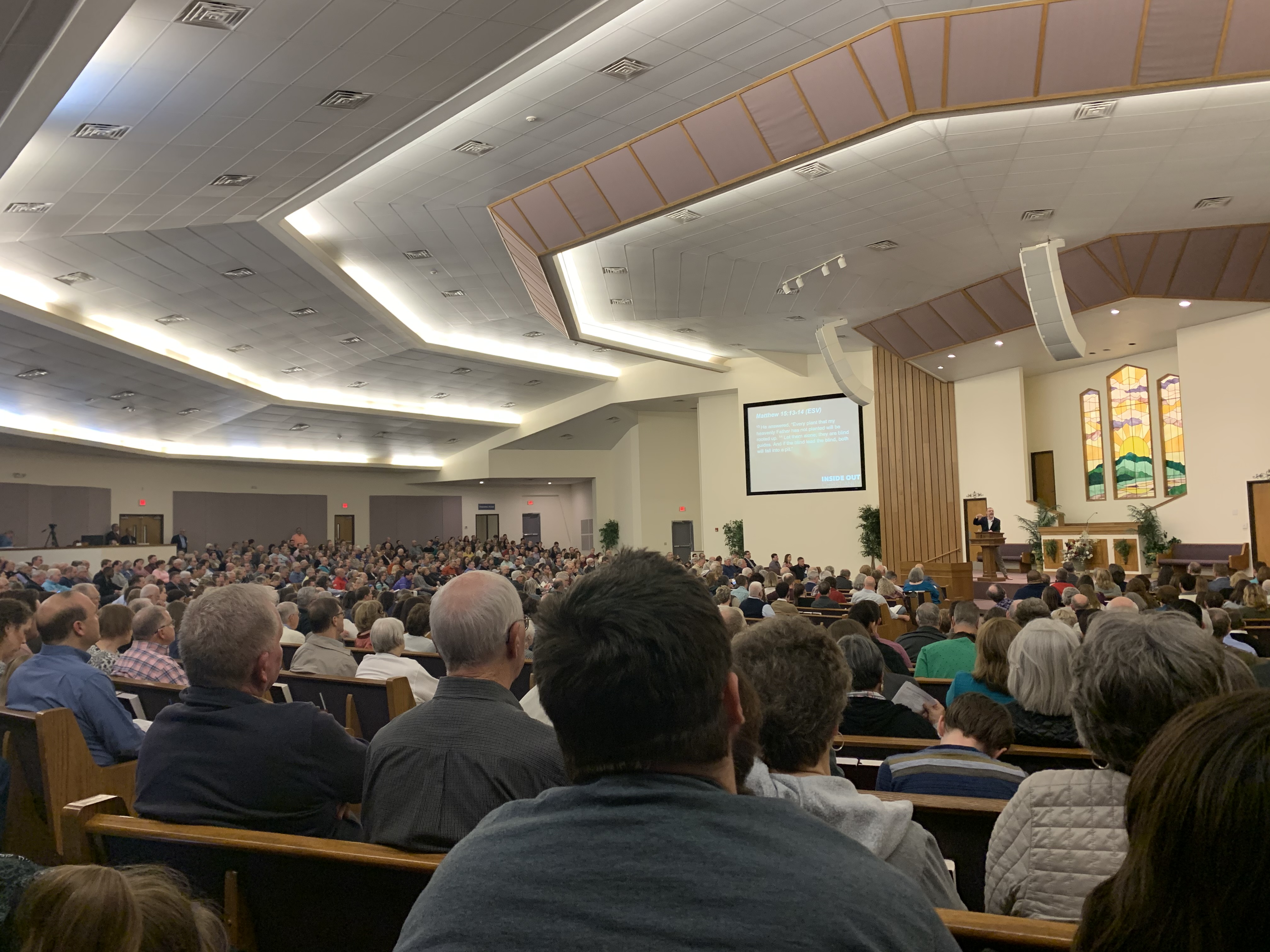
It was a great Sunday night crowd. Why not? Between the monthly Q&A sermon, the monthly singing night, and the ice cream fellowship, there were several additional drawing forces. It was so enticing for one grade-school boy that he made the unusual decision to sit on the front row, dead center. If you were there, you probably saw him. If you weren’t, you can see him on YouTube.
This young man had an unobstructed, undistracted view to some significant events. First, he was literally a couple of feet from Hiram as he preached. On multiple occasions, when he posed a question to the audience in his sermon, this young man nodded in silent answer. He was “locked in.” If he moved or squirmed, I didn’t see it.
Second, he witnessed the love, care, and support of the church family during the invitation song. One of our new Christians responded, asking for prayers and expressing a desire to live a more faithful life. Joe not only had the preacher on one side and an elder on the other, but the little boy had to move down to make room for several men who came down front to show their love and support for Joe. This great young man watched the emotion, joy, and concern of a church obeying the command, “confess your sins to one another, and pray for one another so that you may be healed” (Jas. 5:16).
Third, he sat there and sang several songs after the response. Each time I looked, he was enthusiastically trying to sing even songs he probably did not know. He has an expressive face, and the prevailing emotions I could see–including when I led–appeared to be all positive and interested.
After services, he was in the multipurpose room (MPR) indulging in some ice cream and having as much fun as a little boy could hope to. He was visiting and playing, and he was eating. Then, he went home.
I did not get the chance to ask him if he enjoyed being at church last night, but I think I know the answer. Children don’t do the best job of pretending, if they do or don’t like something. He appeared to have enjoyed himself. But he did more than that. He served as a great example to me. Not only did he come to the worship, but he came to worship. As he gave, he also received. I’d like to think his experience last night will be something he never forgets, something that serves as a foundation for his spiritual future. His mom brought him last night. Pray for him, that as he grows up, he will develop a faith that brings him to worship and carries him through life (cf. 2 Tim. 1:5).
“At that time the disciples came to Jesus and said, “Who then is greatest in the kingdom of heaven?” And He called a child to Himself and set him before them, and said, “Truly I say to you, unless you are converted and become like children, you will not enter the kingdom of heaven. Whoever then humbles himself as this child, he is the greatest in the kingdom of heaven. And whoever receives one such child in My name receives Me…” (Mat. 18:1-5).
Kevin praying for Joe, with our little fella on the front row (far left next to Bryce)
For the next several weeks, I’ll be repeating the book of I Peter in present-day terminology. It’s not a true translation of the book, as I am not qualified to do so. It will be based on an exegetical study of the book and will lean heavily on the SBL and UBS Greek New Testaments, as well as comparisons with other translations (ESV, NASB, NIV, ERV, NLT). My goal is to reflect the text accurately, and to highlight the intent of the author using concepts and vocabulary in common use today.
This is not an essentially literal translation, and should be read as something of a commentary.
I Peter – Part VIII
Our lifestyles were hostile to God, but he died for us anyway! Moral perfection died to save morally imperfect people. He wanted to bring us to God! He was killed physically, but his spirit was brought back to life. This is the form he had back in Noah’s day. Even then he wanted to save people who were about to face total destruction! God waited patiently for them to change, giving them chance after chance while Noah was building the ark. They died; in fact, only eight people survived that flood.
Water saved Noah and his family from those evil people, and water saves us from evil, too. We don’t bury ourselves in water to take a bath. We bury ourselves in water to ask God for a clean slate. We can only do that because Jesus was brought back to life, sat next to God, and was given total control of every supernatural force.
Mentally prepare yourself to suffer. Jesus suffered while he was human! When we suffer physically, it’s because we stopped doing bad things. As long as we’re alive, we’re not chasing the unhealthy passions humans have. We do what God wants. You used to chase those unhealthy passions! You craved all things bad, got drunk, partied without restraint, and practiced horrible things while worshipping fake gods.
Since you used to do this, your old friends are shocked that you don’t anymore. They hate you and mistreat you now, but they’ll have to answer to God. He’s going to judge everyone who’s ever lived. Remember, the hope for rescue that Jesus gave us was offered to people who aren’t alive anymore. Since everyone’s going to face God, everyone is given the chance to live like God wants.
There is nothing like the satisfaction of completing a task that was especially hard-fought and challenging. But, there was Judah in Ezra’s day in Ezra six after Haggai and Zechariah’s message propels them to the finish line concerning the temple (14). After earlier opposition from their neighbors, Judah is assisted by the most powerful nation on earth “with all diligence” (13). It was not nearly as glorious as the original temple (3:12; Hag. 2:3), but it was rebuilt and available for Judah to use to worship God as before the captivity.
Consider some of the fruits of their obedient, faithful efforts from Ezra 6:13-22. These are the some of the fruits of restoration.
Joy (16,22).
In a world where everybody just wants to be happy, few know genuine joy. The happiness for the people here is so intense and deep-seated because God is the source and reason for it. They celebrated the dedication (16) and Ezra says “the Lord had caused them to rejoice” (22). There is a unique, genuine joy available to those who are seeking to build their lives and religion according to the Lord’s pattern (Rom. 15:13).
Faithful Worship (17-20).
Following the revealed instructions from God through His leaders, the people were now enabled to dedicate the temple (17), appoint the priests (18), and observe the Passover (19-20). They have returned to the proper place, people, and practice of worship. That is the epitome of restoration. When we submit to the instructions of the New Testament regarding who leads (1 Tim. 2:8,11-12), where we participate (Heb. 10:24-25), and how we worship (cf. Col. 3:16-17), faithful worship, when done in proper spirit, follows (John 4:24).
Purity (20-21).
The ones who could participate in the Passover were those who had purified themselves. That started with the leadership (19) and extended to the rest of the participants (19-20). It mandated separating from “the impurity of the nations of the land” (20). They could come before God with pure and holy hands (cf. 1 Tim. 2:8). Think about what Peter tells believers: “Since you have in obedience to the truth purified your souls for a sincere love of the brethren, fervently love one another from the heart, for you have been born again not of seed which is perishable but imperishable, that is, through the living and enduring word of God” (1 Pet. 1:22-23).
Divine Aid (22).
Do your best and try your hardest, but you will fall terribly short without this factor. God’s providence paved the road and opened the door to restoration. The Lord “…had turned the heart of the king of Assyria toward them to encourage them in the work of the house of God.” “The Lord had caused them to rejoice.” One of the fruits of seeking to restore God’s will and ways in our public and private lives today is this assurance. Jesus promises, “I am with you always” (Mat. 28:20). “I will never desert you, nor will I ever forsake you so that we can confidently say, The Lord is my helper…” (Heb. 13:5-6).
Be body builders, building the Lord’s church the Lord’s way. Let’s go all the way back to the Bible. The end result is a multitude of blessings (Eph. 1:3) like those mentioned in Ezra 6:13-22.
Each Sunday, Christians come together to worship our Creator. But before we can properly worship God, we need to know what He wants from us. We can’t just come together and do what we think God would want. There is no guesswork required because God has plainly told us. This isn’t an article on our singing, taking the Lord’s supper, or reading scripture. But worship requires knowledge, and this knowledge will help us to properly prepare when we come together.
If our knowledge is lacking, what happens? In Leviticus 10, Nadab and Abihu offered God something He did not ask for. “Now Nadab and Abihu, the sons of Aaron, took their respective firepans, and after putting fire in them, placed incense on it and offered strange fire before the Lord, which He had not commanded them. And fire came out from the presence of the Lord and consumed them, and they died before the Lord” (1-2).
“Strange fire?”
Depending on your translation there are several different interpretations of what they offered.
ESV “Unauthorized”
NKJV “Profane”
RSV “unholy”
None of these translations speak well of their actions, and we read the consequences of their actions. They offered God a sacrifice without proper knowledge. Some would say that how God responded was uncalled for, and while His actions may seem extreme, there are several facts we learn about Worship.
We learn that when God tells us how to do something, we better listen. We learn that proper knowledge of how to worship is essential. We learn that God takes worship seriously.
I’m thankful that God doesn’t deal with us today in the same way. The times that I’ve caught my mind wandering in the songs we sing, or when I loose my train of thought during the Lord’s supper, I’m sure that God has had plenty of opportunities to strike me down.
Leviticus 10 is a sobering reminder. And we need to ask ourselves, “Are we offering strange fire to God?”
We can avoid doing this by having the proper knowledge of what God has commanded.
It’s not about what we think sounds good, or what we think God would like.
It’s about our Creator. We don’t need to guess; He has clearly told us. In John 4:23-24, Jesus in speaking with the Samaritan woman says, “You worship what you do not know; we worship what we know, for salvation is from the Jews, But an hour is coming, and now is, when the true worshipers will worship the Father in spirit and truth; for such people the Father seeks to be His worshipers.”
What does God want us to know about worship? The people God seeks to be His are the ones who worship in Spirit and Truth.
The word Spirit literally means, “As the source and seat of insight, feeling, and will.”
Basically what Jesus is trying to convey is that:
When we sing, we sing with feeling
When we pray, we pray with feeling
When we remember Christ, we feel the weight of the sacrifice.
When we read God’s word, we do it with feeling.
God wants our hearts to be in worship.
A knowledge of God helps us accomplish this command. Which is exactly why Jesus says to worship in spirit, but also in Truth. Our emotions and feelings are based on the truth that God has revealed. The truth that comes from divine inspiration. If we worship in spirit and neglect the truth, we are offering strange fire. If we worship in truth alone without emotion, we are offering strange fire to God.
In order to worship, we must have a knowledge of what God wants from us.
Today’s article may be a little chaotic. It’s about something not well-defined or understood, and its solution is unknown to me. This article will hopefully serve as a target; it’d be good to have lots of Christian minds brainstorming solutions to this issue.
Just about everyone’s had THE virus. I’ve had it once for sure, maybe twice. It don’t mess around. I started developing symptoms after recovery that, apparently, quite a few people have developed. It’s commonly called Long Covid or PASC. Symptoms include fatigue, cognitive difficulties, decreased mobility, respiratory and cardiological issues, pain, malaise, and many others (psu.edu). You probably either know someone dealing with this now, or are dealing with it yourself.
Research is not super easy to get ahold of, and what I could find was either low-quality or not peer reviewed. Its existence isn’t really contested, but little is known about its prevalence. Best I could find was that about 43% of those who recover will experience Long Covid. Many haven’t recovered after almost two years!
My concern with this is its potential effect on faith. Things like driving at night, interacting with lots of people, spending time together outside of worship, church events, service projects, teaching/preaching/song leading, evangelism, etc. are part of our Christian life. While some of these can be difficult on a good day, they’re now practically impossible (or significantly more difficult) for people with Long Covid.
The church has always had members with chronic, debilitating diseases. Normally, our shut-ins are a very small percentage of overall membership. With Long Covid often compared to the effects of chemotherapy, this number is likely to grow significantly. If roughly half of our recovered members end up with these long-term effects, how do we address this?
Since it affects both young adults and senior citizens, how do we navigate its impact? What can members who now have Long Covid do to stay active in their churches? While living with a chronic health condition is no cake walk, those of us who do are at least mentally equipped to accept it. Members who enjoyed good health before Long Covid are struggling to adapt to this change.
At some point in the near-ish future, I hope to write an article with potential solutions. It will be geared toward those who’re experiencing major health issues for the first time. In the meantime, it wouldn’t hurt to do a lot of praying, planning, brainstorming, and creative problem solving. Nothing’s too big for God, and we’ll find a solution with his help.
Your version may use the word “hallelujah” to begin Psalm 135. Hallelujah means “praise the Lord.” While it is synonymous with giving thanks, it means to laud a superior quality or act, to acclaim and express joy in doing so. What is so noteworthy is that the psalmist does this in very specific ways, recounting times in history when God demonstrates His power and glory on behalf of His people. As we walk through the psalm, we see this. Why is He to be praised?
HIS CHOOSING OF HIS PEOPLE (4)
HIS NATURE (5)–Great, Above All
HIS WORK IN CREATION (6-7)–Heaven, Earth, Seas, All Deep, Vapors, Lightning, Wind, Rain
HIS DEFEATING OF THEIR ENEMIES (8-11)–Egypt, Amorites, Canaanites
HIS BLESSINGS (12)–Gave His People A Heritage (Possession)
HIS POWER (13)–His Name And Remembrance
HIS PROMISES (14)–Compassionate Judgment
HIS SUPERIORITY OVER HIS RIVALS (15-18)–Deaf, Dumb, And Blind Idols, Just Like Humans
The writer calls on God’s people to praise and worship Him in song, expressing their adoration (1-3). He ends with a threefold call to “bless the Lord” (19-21). May I suggest that you work through something both in your daily life and in your preparation before every time you assemble to worship? Call it setting the table for fellowship with the Divine. Either meditate on the specific works and ways of God that are worthy of admiration, praise and honor or pray to Him, expressing these matters in specific terms. Focus on how He’s demonstrated greatness in blessing your life and the lives of those around you. Perhaps it’s answered prayer, providence, deliverance, or relief. Focus on His power and might in the affairs of our nation, in the activities of our congregation, and the occurrences within your family and personal life. Let the worship flow as you look around at all you see in nature, from the universe to right out your window. Think about the gift of Jesus for your sins. All of this will surely cause you to echo the writer in Psalm 135 and call out to others, “Praise the Lord!”
Fifteen consecutive psalms (120-134) are so-called “Psalms of Ascent.” They were given this name because they were songs designated for the Israelites to sing on their way to worship in Jerusalem. Moses had instructed them at the giving of the Old Law, “For I will drive out nations before you and enlarge your borders, and no man shall covet your land when you go up three times a year to appear before the Lord your God” (Ex. 34:34). You can imagine how especially those who came a long distance to Jerusalem (it’s over 100 miles from Mt. Hermon and Beersheba, for example) might benefit from a reminder of why they were making this lengthy journey. As most would walk, this would help pass the time while preparing their minds. This is not a bad idea for us even on a 10 or 20 minute drive to the church building on Sunday morning.
There is quite a bit of uneven terrain, mountains and valleys, in the area around Jerusalem, and the temple required a steep climb as there were three valleys surrounding Mount Zion and the temple complex. So, people coming from every direction would have to “go up to Jerusalem” (Zech. 14:17; John 2:13; 5:1). But, it was more than a physical ascent, this trip to the temple. It was more significantly a spiritual ascent, an effort to get closer to God. While we can and should draw near to God daily in our personal devotion, there is still great significance and benefit when we join each other in the presence of God to worship Him and fellowship with Him and each other (Heb. 10:24-25). Each time, this should be an ascent for us!
Notice the repetitive use of “will” in Psalm 121. The word is used eight times in these eight verses. The word points to the future and indicates either anticipation or trust. The writer is confident, especially of what he expects God will do. Such assurance had to take his heart higher!
I WILL LIFT UP MY EYES TO HIM (1)
He starts with what he will do. The writer will look up to God, seeking help and strength. A heart ready to worship is one who sees things as they really are. I am spiritually destitute and needy, and I depend on God for everything. When that is my mindset, I am prepared to praise, thank, and petition Him!
GOD WILL HELP ME (1-2)
Whatever problems, distractions, struggles, and temptations are weighing me down and wearing me down, God will help me! His power is proven. Just look at the creation (2). He has not lost an ounce of strength from that moment to now.
GOD WILL NOT LET ME FALL (3)
The terrain around Jerusalem is often rocky and uneven. I suppose it is easy for anyone’s foot to slip on those roads up to the holy city. But, spiritually, it is a different matter. If I fall, it will not be God’s fault (John 10:27-29). If I hold to God’s unchanging hand, I will successfully complete my journey.
GOD WILL NOT FALL ASLEEP ON THE JOB (3-4)
Night and day, moment by moment, God is alert. He sees everything I do and everything that is done to me. How comforting to know that the All-seeing eye never droops or closes. He does not nod off, even for a moment.
GOD WILL GUARD AND PROTECT ME (5-8)
Half of this psalm is devoted to this idea. God is not just passively involved, watching me. He is actively involved, keeping me (5,7), providing me shade (5-6), protecting me (7), and guarding me (8). Our God is not inanimate! He is involved! It is why we pray. It is why we trust in His providence. It is why we serve and obey Him. As we love to sing, “There is a God! He is alive. In Him we live and we survive.” The writer of Hebrews quotes three Old Testament passages (Deut. 31:6; Josh. 1:5; Psa. 118:6) to convey two promises: “Let your conduct be without covetousness; be content with such things as you have. For He Himself has said, “I will never leave you nor forsake you.” So we may boldly say: “The Lord is my helper; I will not fear. What can man do to me?” (13:5-6).
When you enter to worship, enter with the heart and faith of the righteous pilgrims on their way to the temple for one of the annual festivals. Come with your heart ready, and come with a heart full of faith and trust in the object of your worship. You will leave rejuvenated and resolved.
Lying in a bed for three and a half months will make you feel icky. You can only bathe with washcloths. Some nurses loaded those cloths with water and got me wetter than an Anglican baptism. Those “baths” made me feel better. However, before being discharged, I finally took a shower. That was the best. I felt refreshed. The only downside was seeing my hair come out in clumps as I washed my hair. It seems I am fated to look like the Stooge, Larry Fine.
Where do you find your refreshment? Is it in a cool drink on a sultry day? Is it standing by a fireplace in winter? Such actions reinvigorate us. This result is what refreshment accomplishes. The sinner can find refreshment in obedience. In his second recorded sermon, Peter says:
“Therefore repent and return, so that your sins may be wiped away, in order that times of refreshing may come from the presence of the Lord” (Acts 3.19 NASB1995).
This refreshing comes from being immersed in Christ (cf. Acts 22.16). I would encourage any who have not yet clothed themselves in Christ to allow their faith to lead to this total submission, in which one joins the Lord in His death, burial, and resurrection (Romans 6.3-5). No, it is not a work, nor is the power in the water. It is where we symbolically contact the blood of Christ and express a clear conscience before God (1 Peter 3.21). It is a necessity for salvation.
Yet, there remains refreshment for the Christian as well. Paul speaks of his desire to meet with the brethren of Rome in Romans 15. He tells them to join him in prayer so his arrival will refresh him (Romans 15.32). That is an interesting word choice. In fact, this is the only time this word, συναναπαύομαι, appears in Scripture. The word means to rest along with, but here implies a spiritual refreshing.
I like that idea of “resting with”, though, especially as it applies to Christian fellowship. We spend our weeks in the world and get beaten up by the forces of the adversary. How refreshing is it when we pause and rest with our brethren in worship and Bible study? I know I have gone to services feeling poorly, physically, only to find myself reinvigorated on my way back home. It has the same effect mentally and, most importantly, spiritually. Unfortunately, my recovery prevents me from joining the brethren currently. Still, you better believe that I eagerly await the day I can rejoin them even more than when I wished for a shower.
It is sad when brethren find excuses to avoid refreshment since it is one of the blessings we receive in the heavenly places (Ephesians 1.3). Earthly diversions cannot reinvigorate the spirit as can God. Oh, it might bring temporary happiness, but the participant of earthly delights is left feeling empty, needing entertainment and diversion yet again. Services are not a chore when one comes seeking to worship God and rest beside their brethren.
“And let us consider how to stimulate one another to love and good deeds, not forsaking our own assembling together, as is the habit of some, but encouraging one another; and all the more as you see the day drawing near.” (Hebrews 10.24-25 NASB1995)
Genesis 3 records for us the fall of man. This account reveals to us the methods Satan uses to tempt us, and the choice that changed the course of the world. We can learn a lot about the devil in his first interaction with God’s creation.
“Now the serpent was more crafty than any other beast of the field that the Lord God had made. He said to the woman, “Did God actually say, ‘You shall not eat of any tree in the garden’?” And the woman said to the serpent, “We may eat of the fruit of the trees in the garden, but God said, ‘You shall not eat of the fruit of the tree that is in the midst of the garden, neither shall you touch it, lest you die.'” But the serpent said to the woman, “You will not surely die. For God knows that when you eat of it your eyes will be opened, and you will be like God, knowing good and evil.””
We don’t know how long Adam and Eve were in the garden. There is no timeframe between chapter 2 and 3.
It could’ve been a month, a year, a century that has gone by. Whatever the time frame, Satan comes to Eve and places doubt in her mind. This is quite possibly the worst lie ever told. “Did God really say…?” While Satan doesn’t physically appear and speak to us today, he still uses this same tactic. He has destroyed many churches’ worship to God. “Did God really ask for music with no instruments?” “Did God really say for the women to be silent?” By casting doubt Satan has corrupted the worship and faith of millions.
After he casts doubt, he then blatantly contradicts God, “you will not surely die.” And once again he continues to blatantly contradict God’s word today. The message Satan tells the world is completely different from what God has given to us. Satan contradicts the Father. Rather than “love you neighbour as yourself” he says “love yourself above your neighbour.” Rather than “serve God and keep his commandments, he says “serve yourself and listen to no one.” Satan contradicted God in the past and continues to do so today.
After he casts doubt and blatantly contradicts God, he then offers power, “you shall be like God.” Obviously in their close relationship with God, they understood who created the world. The created wanted to be like the creator, but the devil offered a lie. Satan only has one thing to offer– sin. He oftentimes portrays this lifestyle of sin as a lie.
He offers happiness and joy, but at the end of the day all he has to offer is sin and regret.
Eve was tempted by Satan, and he used the same methods then as he does now. Eve experienced:
The lust of the flesh (she wanted to eat of the fruit)
The lust of the eyes (literally says “it was a delight to the eyes,” v.6)
Pride of life (she wanted to become wise and have power)
The devil always knows what to say in order to get us to stumble. We must be vigilant and ready to refuse the tempter when he appears.






















 The Preacher Pollard Blog