Her Own Tent, or His Dwelling Place?

Brent Pollard

Why Ezekiel 23 Is Still Relevant Today

Some Scripture, like Ezekiel 23, is similar to opening a furnace door. You are met with scorching heat and flame, not pleasantries. The pictures God paints are fierce and even shocking. God calls Samaria and Jerusalem “two sisters” who are “unfaithful,” revealing the spiritual adultery of Israel and Judah. This chapter is full of judgment, sorrow, betrayal, and holy indignation. We need to fully understand and feel the depth of God’s anger and heartbreak.

God doesn’t give just a symbol. He tells a tragic story about spiritual infidelity. Those whom He loved and nurtured turned their backs on Him to chase after paramours. There is a sobering revelation in the sisters’ names that you cannot ignore: even as Jerusalem played the harlot, her very name served as a reminder that God’s dwelling place was supposed to be within her.

The names of the two sisters are Oholah and Oholibah.

Samaria, the northern kingdom, is called Oholah, or “her own tent.” Jerusalem is Oholibah, meaning “My tent is in her.” The linguistic shift is critical because it exposes the root of their sins: while Samaria operated under self-governed worship, Jerusalem betrayed an actual divine indwelling.

Israel strayed from the path God had chosen, establishing rival shrines at Dan and Bethel to forge a separate religious identity under the rival king, Jeroboam. Oholah chose her own way, yet this separation did not exempt her from wrath. Conversely, Judah stuck with the kingly lineage of the man after God’s own heart, maintained the temple and the ordinances of God’s presence. Thus, Oholibah could rightly claim that the divine Council dwelt directly within her borders, rather than remaining at a distance.

The privilege of hosting God’s presence sharpened the distinction. But for Oholibah, that very honor made her unfaithfulness worse than her sister’s. The contrast is not simply about privilege but about the growing burden of responsibility and guilt.

When Holy Privileges Become Heavy Guilt

Ezekiel 23 demonstrates that proximity to holy things is not the same as true holiness. You can live by a river and die of thirst. Judah had God’s altar and name, but her heart pined for idols. The most dangerous place sometimes is an empty pew with a wandering heart.

You can be devoted to all kinds of things and not be in agreement with God. Everyone puts up a tent, but it matters whose tent it is and who lives in it.

The Temple of God Is Not of Stone

This truth deeply informs the New Testament. In this new covenant, God’s presence is no longer confined to a stone temple in Jerusalem but now dwells within His people. He underlines this by reminding the church, “Don’t you know that you are God’s temple and that God’s Spirit dwells in you?” (1 Corinthians 3:16). He also asserts, “Your body is a temple of the Holy Spirit who is in you” (1 Corinthians 6.19).

Think about that for a moment: the God whom even heaven itself cannot contain (1 Kings 8.27) chooses to live in redeemed people. We were made to carry His presence and to rejoice in Him alone, not just to know about God. God still separates the outwardly religious from those in whom He truly dwells.

How Do You Enter God’s Presence? The answer from Acts 2:38.

This difference is not based on emotions, background, sincerity, or spiritual claims. The line is drawn in the New Testament by entrance into Christ. On Pentecost, the convicted asked, “What shall we do?” Peter did not send them off on private religious quests. He said, “Repent and be baptized in the name of Jesus for forgiveness. And you will receive the Holy Spirit” (Acts 2.38). The promise is simple: forgiveness and Spirit.

Baptism is not an empty rite. It’s the transition from the old life to the new life in Christ. Through baptism we are joined with His death, buried with Him, and raised to live anew (Romans 6.3–4). “For all of you who were baptized into Christ have clothed yourselves with Christ” (Galatians 3.27). God’s presence dwells in us only in Christ.

The Holy Spirit: God’s Pledge, Seal, and Guarantee

Paul uses marketplace language for a treasure in heaven. God “sealed us and put the Spirit in our hearts as a pledge” (2 Corinthians 1.22). Jesus’ followers are “marked with a seal, the promised Holy Spirit, who is the pledge of our inheritance” (Ephesians 1:13–14). The Spirit is our guarantee, an indication of what God still has for us. Earnest money guarantees a sale; the Spirit guarantees our inheritance. God has put heaven into us, as His bond, promising to bring us home.

Being a Christian isn’t just choosing a religion like choosing a hobby or neighborhood. Rather, a Christian is one in whom God dwells. There is no greater honor and joy on earth than to be the home of the Almighty.

Living Like the Temple You Were Born

Ezekiel reminds us that we must not make light of this truth. Oholibah kept the house of God, but lived for another. This is a warning to us. God’s presence is not an invitation to complacency, but to holiness. The Spirit comforts us and guarantees our inheritance, but He is also the Holy Spirit who leads us into holy living through Providence and the Word.

We have to face this truth every day. We cannot say “God dwells in me” and make peace with idols at the same time. We cannot take the old tent and re-arrange it to follow Christ. Simply rearranging things is not repentance. Sin cannot be a welcome guest in the temple of God. A temple is only for one thing: to honor the One Who fills it.

Leave Your Own Tent.

The question Ezekiel 23 asks is not just, “Which sister are you?” Its message questions us: Is God really dwelling in you, or are you still clinging to your own tent, the confines of your self-made faith? If you have His Spirit dwelling in you, are you living in all things as the temple of God? This is the ongoing problem and main point of Ezekiel 23.

The gospel does not call us to set up our own tents and ask God’s blessing. Rather, it calls us out of our own tent, into Christ. In baptism, sins are washed away, the old self dies, new life starts, and the Spirit is given. The Christian life is not a life of self-will, but of becoming a proper vessel for the Lord.

Oholah tells us not to make religion in our image. Oholibah is an example of how enjoying sacred privileges cannot excuse unholy living. Christ calls us higher. To be wholly His. Washed. Sealed. Indwelt. Sanctified. God has not been distant; He has placed His Spirit in us as a guarantee.

Let us not retreat into our tents, but live as those in whom God dwells, carrying His presence with intentionality, showing His holiness in all we do, and showing the world what it means to be truly His. Let our lives be temples, not only honored by His presence but changed by it, boldly announcing: God lives here.

 Gideon: When the Deliverer Becomes the Danger

Brent Pollard

Few stories in Scripture trace spiritual decline more vividly than Gideon’s. Here was a man summoned from obscurity by the voice of God Himself. He was fearful, hiding grain from Midianite raiders in a winepress. Yet God called him a “mighty man of valor” before he had drawn a sword (Judges 6.12 ESV). Through divine power—not human strategy—Gideon led three hundred men to scatter an army beyond counting.

He had torn down his father’s altar to Baal. He had cut down the Asherah pole. He had obeyed when obedience was costly.

But the final chapter of his life tells a different story. It is the kind every Christian needs to hear, because its warning is not aimed at the faithless. It is aimed at those who have tasted victory and grown comfortable in its shadow.

The Dangerous Moment After the Battle

When Gideon returned from defeating Midian, Israel greeted him with a stunning proposal:

“Rule over us, you and your son and your grandson also, for you have saved us from the hand of Midian” (Judges 8.22 ESV).

Notice the fatal error buried in the compliment: “You have saved us.” Not God. Gideon.

This temptation is ancient and persistent. Whenever God works through a man, there is always a crowd ready to worship the instrument rather than the Hand that wielded it. Israel looked at the victory and saw a hero. They should have looked at the victory and fallen before God.

To his credit, Gideon refused.

“I will not rule over you, and my son will not rule over you; the LORD will rule over you” (Judges 8.23 ESV).

In that moment, he spoke a profound truth: God does not share His throne. He does not delegate sovereignty to human dynasties. He is King—not merely as a title but as an unalterable reality (1 Samuel 8.7; Isaiah 43.15; 1 Timothy 6.15).

There are no great men of God—only men of a great God. Reverse that order, and the fall has already begun.

A Nation Looking for a King It Already Had

Israel’s request was more than flattery; it was bad theology. They wanted a hereditary monarchy: Gideon, then his son, then his grandson.

But God had already defined their identity:

“You shall be to me a kingdom of priests and a holy nation” (Exodus 19.6 ESV).

Their king was not meant to sit in a palace. Their king spoke from Sinai. He led them through the wilderness as a pillar of cloud and fire (Exodus 13.21) and promised to drive out their enemies if they remained faithful (Exodus 23.20–33; Deuteronomy 7.17–24).

Israel wanted something visible, permanent, and human. God offered something invisible, eternal, and divine. The tragedy of the human heart is that it often prefers the former.

The same impulse appears in every generation. People long for a leader they can see rather than a God they must trust. When the church looks to personalities rather than Christ, it has already taken the first step toward Gideon’s error.

Gold in the Wrong Hands

Although Gideon declined the crown, he did not decline the gold.

He asked each soldier for a gold earring from the Midianite plunder. The request seemed modest, and the soldiers gladly complied. They spread out a garment and tossed in their share.

The total reached seventeen hundred shekels—roughly forty to seventy-five pounds of gold—along with ornaments, pendants, royal garments from Midian’s kings, and camel collars (Judges 8.26).

It was a fortune. And fortunes have a way of bending the soul.

The issue was not the amount but what Gideon did with it. Wealth itself is not condemned in Scripture, but it always tests the heart (1 Timothy 6.9–10; Proverbs 30.8–9; Matthew 6.21).

The real question is never what we possess, but what possesses us.

The Ephod That Became an Idol

Gideon used the gold to make an ephod and placed it in his hometown of Ophrah.

In its proper setting, the ephod was a priestly garment associated with worship and divine inquiry. The high priest wore one described in Exodus 28.6–14, and simpler versions were worn by Samuel (1 Samuel 2.18) and David (2 Samuel 6.14).

But during times of spiritual confusion, the ephod could be used in false worship. In Judges 17–18, Micah’s household shrine included one alongside carved images. Hosea later listed the ephod among the religious symbols Israel would lose in exile (Hosea 3.4).

What Gideon intended is uncertain. Perhaps it was meant as a memorial. Perhaps it was intended as a means of seeking God’s will.

But the result was devastating.

“And all Israel whored after it there, and it became a snare to Gideon and to his family” (Judges 8.27 ESV).

The irony is painful. The man who destroyed Baal’s altar created something that led Israel into spiritual adultery. The destroyer of idols became the maker of a new one.

The danger did not come from outside. It came from within—from the very victory that should have driven him closer to God.

When Good Things Become Ultimate Things

The language of Judges 8.27 is deliberately shocking. Israel “whored after” the ephod. Throughout the Old Testament, idolatry is described not merely as error but as adultery—the betrayal of a covenant relationship (Ezekiel 16.15–34; Jeremiah 3.6–10; Hosea 2.2–5).

God had delivered Israel from oppression and scattered an innumerable army with three hundred men. Yet Israel redirected its devotion toward a golden garment in a small town.

The pattern is ancient and ongoing. God acts. Man receives. Man then worships the gift rather than the Giver.

Israel did this with the bronze serpent Moses made until Hezekiah destroyed it because people burned incense to it (2 Kings 18.4). They trusted in the temple building rather than the God who dwelt there (Jeremiah 7.4).

Any good thing—a tradition, a practice, a religious symbol, even memories of past faithfulness—can become a substitute for the living God. The most dangerous idols are often the most religious-looking ones.

A Private Life That Told the Truth

The closing verses reveal a man whose private life contradicted his public words.

Gideon had many wives and seventy sons. He also kept a concubine in Shechem who bore him a son named Abimelech—“my father is king” (Judges 8.30–31).

Read that name again. Gideon publicly refused the crown, yet he named his son “my father is king.”

His mouth said one thing. His life said another.

Spiritual compromise rarely announces itself. It grows quietly through private choices until the consequences can no longer be hidden. Gideon’s household increasingly resembled that of a ruler rather than a servant.

Scripture repeatedly warns that the heart is deceitful (Jeremiah 17.9). A man may refuse a crown with his lips while building a palace with his life.

What Happened After the Funeral

When Gideon died, the collapse was immediate.

“As soon as Gideon died, the people of Israel turned again and whored after the Baals and made Baal-berith their god” (Judges 8.33–34 ESV).

They forgot the LORD who had delivered them. They also failed to show kindness to Gideon’s family (Judges 8.35). Soon, his son Abimelech would drench Shechem in blood while seizing the power his father had publicly declined (Judges 9).

This is what happens when faith depends on a man rather than God. When the man dies, the faith dies with him.

Israel’s devotion to the Lord lasted exactly as long as Gideon lived. That is not faith. It is borrowed conviction—and borrowed conviction always comes due.

Every generation must choose for itself whether it will serve the Lord (Joshua 24.15; Deuteronomy 6.6–9).

Five Warnings from Gideon’s Decline

Gideon’s early chapters inspire courage. His final chapter demands self-examination.

First, no past victory guarantees future faithfulness. Gideon defeated Midian but could not defeat the pride that followed the battle (1 Corinthians 10.12; Philippians 3.13–14).

Second, leaders must point beyond themselves. When people credit the preacher rather than the Lord, something has gone wrong (John 3.30; 1 Corinthians 3.5–7).

Third, religious traditions can become traps. The ephod itself was not evil, but devotion to it became a snare.

Fourth, private compromise eventually produces public consequences. The hidden life always surfaces (Luke 12.2–3; Numbers 32.23).

Fifth, faith must be personally owned, not merely inherited. Secondhand religion cannot survive the loss of its human source (2 Timothy 1.5; Deuteronomy 4.9).

The Reign That Never Fails

Gideon began as a hesitant servant who trusted God and obeyed His call. Through him, the Lord delivered an entire nation from oppression.

But his story reminds us that the battle for faithfulness does not end with a single victory. It continues every day until we stand before God.

Even those who have torn down altars can build new ones without realizing it.

In the end, Gideon’s greatest words remain his truest legacy:

“The LORD will rule over you” (Judges 8.23 ESV).

Not Gideon. Not any man. The Lord.

And when God truly reigns—over a heart, a home, or a congregation—His people remain secure. Not because they are strong, but because He is.

“The LORD is king forever and ever” (Psalm 10.16 ESV).

That is the only throne that never topples. That is the only reign that never ends.

Isaiah: The Holy One Who Rules The World (XL)

God Vs. Gods (44:1-28)

Neal Pollard

God calls to His chosen people, reminding them that He formed them and set them apart for Himself (1). Everything He promises in this chapter is built upon the foundation of that truth. They were perpetually guilty of aiming infinitely too low in what to place their trust in. As we read, we can relate to that. We doublecheck our investments, log a great many minutes in our workout routines and dietary plans, expend a lot of passion and energy into political matters, and engage our hearts in other earthly things while ignoring and neglecting the God who made us and set us apart by Christ. Because He has given His Son, we have even less reason to misplace our trust today. Walk though this powerful chapter and make the comparison the prophet leads Israel to make.

Recognize You Belong To God (1-5). Just as He chose them (1), He speaks of all He has provided for them as their God. He mentions water (3), His Spirit (3), and fruitfulness (4). Consequently, His discerning people would say, “I am the Lord’s” and revel in being claimed by Him (5). This came with blessings for them and their descendants. 

Trust In The True God (6-23). God sets Himself apart by who He is–Lord, King, Redeemer, and Lord of hosts (speaking of military might)(6). He proves Himself trustworthy by His unique nature, calling on them to compare Him to the gods of the nations around Him. Gary Smith provides a great chart which shows the contrasts stated and implied in the text here: 

What was said?What contrast was implied?
1. Men “form” idols (44:9)God “forms” the world and his people
2. Idols do not help; give no profit (44:9)God strengthens and helps his people
3. Their witness does not see, know (44:9)God’s witnesses see and know
4. Idol makers tremble in fear (44:11)God’s people need not fear
5. Idol makers will be ashamed (44:11)God’s people will not be ashamed
6. Idol makers get tired and weary (44:12) God’s strengthens so people are not weary
7. Idol makers measure on  wood (44:13)God measures out the heavens with his hand
8. Idols are images of humanity (44:13)God made man in his image
9. Idols are wood and metal (44:14)God made the wood and the metals
10. People worship what they make (44:15) The Maker/Creator should be worshipped
11. People seek divine deliverance (44:17)Only God can bring real deliverance
12. Idols blind people’s eyes (44:18)God opens people’s eyes
13. Idols give no understanding (44:19)God gives wisdom and understanding
14. Idolatry is a deceptive lie (44:20)God reveals the truth
15. Idols lead people astray (44:20)God calls people to turn from lies

(NAC, 239).

Isaiah presents the case, showing how utterly ludicrous it is to trust in a god that one has to make, who is useless, who is mindless, who is powerless, and who after he has crafted it worships it. He writes, “he makes a god and worships it; he makes it an idol and falls down before it” (15).

Instead, by discerning who God is, the people appreciate how fully He has forgiven them (22). Their right-thinking response is to praise Him for being a God without rival (23).

Understand That We Are Restored By God (24-28). He is our Creator and Sustainer (24). He has the ability to do what He promises and determines. This God is the One who promises to rebuild, to even do so by the hands of a foreign power who is hundreds of years from being born (28). A God without limits of power and who sees the future as if it is the past is the God who promises to restore His people. 

Idol Worship And YAHWEH Coin

Dale Pollard

Israel first heard Exodus 20.4 spoken by God from heaven in an audible voice.

“You must not make for yourself an idol of any likeness of what is in heaven above or on the earth beneath or in the water under the earth…” 

Obviously this wasn’t enough to keep humans from doing the exact opposite. 

“They (Israel) forsook all the commandments of the LORD their God and made for themselves molten images, two calves, and made an Asherah and worshiped all the host of heaven and served Baal. Then they made their sons and their daughters pass through the fire, and practiced divination and enchantments, and sold themselves to do evil in the sight of the LORD, provoking Him. So the LORD was very angry with Israel and removed them from His sight; none was left except the tribe of Judah.

Also Judah did not keep the commandments of the LORD their God, but walked in the customs which Israel had introduced. The LORD rejected all the descendants of Israel and afflicted them and gave them into the hand of plunderers, until He had cast them out of His sight” 

(2 Kgs 17.16-20). 

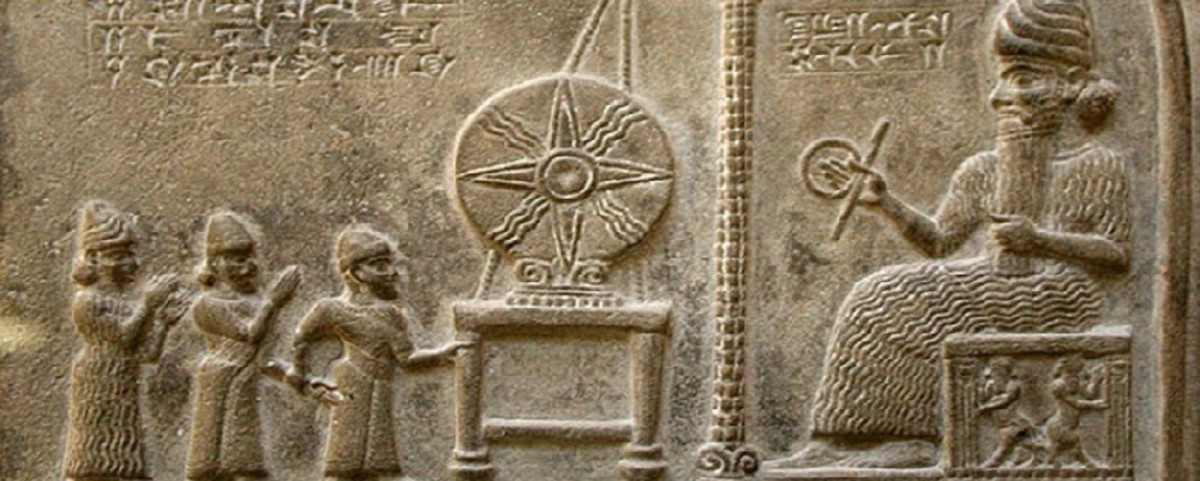
Both the Egyptians and the Babylonians assigned stars to their many gods. The practice of star worship was common place among the Assyrians— and especially the Chaldeans.

IMG_2312.jpeg

“…beware lest you raise your eyes to heaven, and when you see the sun and the moon and the stars, all the host of heaven, you be drawn away and bow down to them and serve them, things that the LORD your God has allotted to all the peoples under the whole heaven” (Deut. 4.19). 

Were there any depictions of Israel’s (and our God), Yahweh? The evidence is sparse, but here’s a possible example. 

IMG_2279.jpeg

An Achaemenid period coin inscribed with the word Yehud depicts a supreme deity as a seated figure riding on a winged wheel. 

IMG_2280.jpeg

Images of Ezekiel’s wheel (Ophanim) or Elijah’s “flying chariot” also come to mind. These motifs are seen depicted not only in the ancient middle and near East, but throughout the entire ancient world. Orthostats (foundation blocks with artistic impression), stone stele, reliefs, and a plethora of artifacts all share a striking resemblance. While these artistic depictions and their character identities aren’t entirely accurate to biblical accounts, many aspects mimic and even seem to acknowledge true Divinity. 

“He bowed the heavens and came down;
thick darkness was under his feet.
He rode on a cherub and flew;
he came swiftly on the wings of the wind.” Ps. 18.9-10 

A Marriage Made In Heaven?

Neal Pollard

What do you know about the book of Hosea? At the head of the Minor Prophets, Hosea is often known as the book about the prophet and the prostitute. But it is much more than that. It is a book about a marriage commanded by God between His messenger and a “wife of whoredom” that reflected a marriage made by God with His chosen nation. The prophet’s name means “deliverance” but it was written to warn about the northern kingdom about impending judgment and destruction. Certainly, the prophet reveals the spurned Husband offering Himself as the only means of salvation which the people foolishly were rejecting for a relationship with cruel, unrighteous idolaters who desired only to use and abuse them. It was written during an extremely prosperous time for the Northern Kingdom, when Jeroboam II reigned. 2 Kings 14:25 says he “restored the border of Israel from the entrance of Hamath as far as the Sea of the Arabah, according to the word of the Lord, the God of Israel, which He spoke through His servant Jonah the son of Amittai, the prophet, who was of Gath-hepher.” He was mighty and recovered cities for Israel that had been taken from Judah (2 Ki. 14:28). But, while they prospered militarily and economically, they were spiritually destitute. 

But it is not simply about terrifying judgment on a rebellious nation. It is a love story, though it was a tragic story of unrequited (i.e., unreturned) love. Like Hosea’s wife would leave him for her lovers, Israel left God for idols. Like Hosea went and redeemed his wife despite her faithfulness, God longed for Israel to return to Him. Despite her rejection, He would say to her, “How can I give you up, O Ephraim? How can I hand you over, O Israel? How can I make you like Admah? How can I treat you like Zeboiim? My heart recoils within me; my compassion grows warm and tender” (11:8). While judgment is implied even in that (Admah and Zeboiim were destroyed alongside better-known Sodom and Gomorrah), it is not what God wanted. 

It is also good to look for the “New Testament” sprinkled throughout this book. Not only does the theme reflect a desire God has for people today through Christ, but there are quite a few passages in the New Testament which quote from this relatively brief Old Testament book. Here is my list:

  • Hosea 1:10 is quoted in 1 Peter 2:10.
  • Hosea 2:23 is quoted in Romans 9:25.
  • Hosea 6:6 is quoted in Matthew 9:13 and 12:7.
  • Hosea 10:8 is quoted in Luke 23:30 and Revelation 6:16. 
  • Hosea 11:1 is quoted in Matthew 2:15.
  • Hosea 13:14 is quoted in 1 Corinthians 15:55.

So, we see everything from Christ’s infancy as a human to His victorious resurrection foretold in this great, Old Testament book. An overriding principle to see as we walk through the book is that though God will punish those who absolutely refuse to return to Him, He loves us with a perfect love and desires nothing more than a relationship with us. We need to be wise and touched by that truth and be faithful to Him! 

(Photo credit: Kathy Pollard, March 2018–the valley of Jezreel taken from Mt. Carmel)

Mixed Up Religion

Neal Pollard

Between 2003 and 2017, I have seen (or heard) lions in several places across northern Tanzania. Each time you see or hear one is truly unforgettable. They are fierce, fast, and powerful creatures. Each time, I have been grateful to have had the safety of an automobile to offer protection. 

In three trips to Israel, I have not seen or heard a lion. That’s because you can’t find one in the wild there today. But, after Assyria carries off Israel into captivity, they settled people from other nations into Samaria and the other cities of the northern kingdom. These newly-settled citizens did not fear the Lord, so He sent lions among them to kill some of them (2 Kings 17:25). They appeal to the king of Assyria to help them “know the custom of the god of the land” (26). The king of Assyria’s solution was to send a priest from among the exiled Israelites back into the land who lived in Bethel and taught the new inhabitants “how they should fear the Lord” (28). Sound like a feel good story of mass conversion, right? Well, not exactly.

The people, like the Athenians later in history (Acts 17:16-23), just added Jehovah to their list of gods. “They feared the Lord and served their own gods” (33). They had no history with and no grounding in the Law of Moses , so they continually violated His will and commandments (34-40).  “So while these nations feared the Lord, they also served their idols; their children likewise and their grandchildren, as their fathers did, so they do to this day” (41).

Mixed up religion is not just a problem of ancient times. It is alive and well today. What do people serve alongside Jehovah? The teaching and commandments of men, patriotism, tradition, money, culture, and more. They take elements of each and the end result is a watered-down, unacceptable substitute for true religion governed and guided by a reverent, informed knowledge of God’s Word. Syncretism is “the amalgamation (act of combining or uniting) or attempted amalgamation of different religions, cultures, or schools of thought.” Some world religions are syncretistic in nature. But, true religion–biblically defined–does not allow for anything mixed with it. In fact, the Bible defines true religion as “pure and undefiled” (Jas. 1:27). Worship is according to truth (John 4:24), and God’s Word is truth (John 17:17). 

God does not allow for watered down substitutes and self-customized religion. The only way to avoid that is to know what His Word says, and then do it (Jas. 1:21-25). Otherwise, our efforts are made in vain (Mat. 15:9). Mixed up religion condemns. The sage observation of Jeremiah ought to serve as our beacon of light: “I know, O Lord, that a man’s way is not in himself, Nor is it in a man who walks to direct his steps” (10:23). 

Got real close to this dude in Ngorogoro Crater, 12/7/17

Is God Frustrated?

Thursday’s Column: Captain’s Blog

Carl Pollard

About a month ago I wrecked my motorcycle at The Hebron Church of Christ work day. It was very embarrassing because I wrecked it in front of everyone that was there. I decided that it would be a good idea to take my bike up the steep grass hill behind the fellowship hall. I was going a little too fast and completely forgot about the drainage ditch at the top. I came over the top of the hill, slammed my front tire into the ditch, and laid my bike down. I ended up bending the highway bars into the side of the frame, breaking my left mirror off, bending the clutch bar, toe shifter and kickstand, and cracking a couple of ribs.
After I had fixed most of the issues, I then spent hours trying to bend the highway bars back into shape. I tried using a mallet, a blowtorch, a ride mower and tow strap, and even got so frustrated I ran over the bars with my truck. Nothing was working so I eventually just gave up. I’ll admit, it’s not pleasant at all to work so hard on something only to realize it was for nothing. We don’t like giving up, but sometimes it’s the only thing we can do.
Did you know there was a time that God Himself gave up? In Romans 1, Paul spends some time describing men that have upset God. In verse 18 we read that these men refuse to acknowledge God and even go so far as to suppress the truth. These ungodly men were determined to bury the truth. Even though God had clearly revealed Himself, these men refused to see it. Because of this God gave up. Three specific reasons are mentioned by Paul.
They exchanged the truth for a lie. Romans 1:24-25 tells us that these men were involved in idol worship. God gave up because they chased after lust and the rituals involved in serving false gods. God quit trying because they exchanged the truth about God for the lies of idolatry. God is the source of Truth, and we can be guilty of accepting a lie instead of Truth. The lie here is idol worship and these men placed more importance on statues and images. While we may not be worshipping a literal idol, we can still practice this today. We can worship the lie of possessions. When we spend more time detailing our truck, boat, or house than we do in our personal relationship with God, we are bowing to a lie. If we place more importance on anything other than God, we are exchanging truth for a lie.
They exchanged the natural for the unnatural. Verses 26-27 shows us the wickedness that they were caught up in. God quit pursuing them because they exchanged the natural for the unnatural. The word “natural” here means, “that which is in accordance to the basic order of nature.” Specifically Paul is talking about human nature. God did not intend for men to be with men and women with women. And yet these people knew the consequences of their actions, and chose to continue in them. Therefore, God gave up.
They chose to ignore God. In Verse 28 these men failed to acknowledge God so He gave them up to a debased mind. This word “debased” means, “unqualified, worthless.” Their action of ignoring God resulted in a worthless mind. A mind that sought after things that are contrary to God’s will. How terrible it would be to find out on the day of judgment that God wanted me, but I chose to ignore His love. God cannot be with the person who constantly ignores His existence, and so eventually He will stop trying.
Has God given up on me?