Thursday’s Column: Carlnormous Comments

Carl Pollard


My dad has discovered YouTube. He had been using the service to watch streaming worship services during the height of the coronavirus lockdown; he has since noted its potential entertainment value. One of his favorite channels is one that plays classic country music from the 1950s and 1960s. Recently, however, he has been watching the videos of hikers along the Appalachian, Pacific Crest, and Continental Divide Trails. I use to enjoy hiking in my healthier days, so I have sat down to watch more than one of these videos with him. I have never even contemplated doing a thru-hike of one of the previously mentioned 1,000 mile plus trails, but have admired those who have completed them. As I watched one video of a hiker who undertook the Appalachian Trail to conquer his depression, I heard him use an unfamiliar term: “trail magic.” In another video, a young woman from Opelika, Alabama, used the words in regards to her trek along the Pacific Crest Trail. Curiosity compelled me to look that phrase up. The phenomenon originated on the Appalachian Trail but has since popped up along the other lengthy trails as well.
The Appalachian Trail Conservancy defines trail magic as follows:
“1) Finding what you need most when you least expect it. 2) Experiencing something rare, extraordinary, or inspiring in nature. 3) Encountering unexpected acts of generosity, that restore one’s faith in humanity.” 1
As the videos demonstrated, trail magic presented itself in a cooler of cold drinks left at a taxing point in the trail. Or maybe a veteran thru-hiker set up a tent at a spot along the pathway to feed the hikers who came through. It could also be a person volunteering to provide a wearied hiker a ride to his or her nightly lodging when the trail came close to a town offering a hostel or hotel serving hikers. Thru-hikers have no reason to expect that any of these things will happen to them as they make their journey even though it happens enough to warrant a name (i.e., trail magic). That is why it is so appreciated.
When I read that, my mind immediately associated aspects of this phenomenon to what those of us who are Christians call “providence.” How often have we found something unexpected in our life, typically at the most opportune time, that screams “God” to us? In other words, a sudden something that points to God’s hand at work in our lives. No, providence is not a miracle, since it does not circumvent the laws of nature to occur. It works within the established framework around us, making it even more amazing since it can require God’s forethought rather than just a momentary expression of His unlimited power. Yet, it is as appreciated by us as any miracle would be since it satisfies our momentary need, whether remission from cancer or unexpected inflow of funds when presented with a financial crisis.
This characteristic of God has earned Him a unique name first applied by father Abraham, Jehovah-Jireh. Do you recall the reason Abraham called God by that name? God had asked him to offer his only son as a sacrifice. This son was the promised one for whom he had long waited. Yet, Abraham complied. When his son, Isaac, noticing a missing sacrifice, asked his father about it, he replied, “God will provide for Himself the lamb for the burnt offering, my son” (Genesis 22.8 NASB). After nearly sacrificing his son, an angel stopped Abraham, and Abraham noted a ram with its head stuck in a nearby thicket. Abraham offered the ram as a sacrifice in place of his son and called the location “Jehovah-Jireh,” meaning “The Lord will provide.”
Our path to Heaven is strait and narrow (Matthew 7.13-14). It is, therefore, most welcome that as we make our way through this life that we encounter this celestial trail magic. Let us never fail to thank our God since He is also Jehovah-Jireh.
REFERENCES
1 Bruffey, Daniel. “Trail Magic.” Appalachian Trail Conservancy, The Appalachian Trail Conservancy, appalachiantrail.org/explore/hike-the-a-t/thru-hiking/trail-magic/.


When I take the time to pause and think about who God is, it blows my mind. He’s all powerful, loving, righteous, faithful, and just. When we look at His character and the perfection that surrounds Him, it can almost seem overwhelming. A God with that much power and glory takes the time to listen to me. He hears the prayers that each of us pray.
If you’re like me, this can be very intimidating. Every time we bow our heads and pray, we are talking to the creator of worlds, the one that spoke everything we see and know into existence. We pause and reach out to God, and He listens to us. The creator listens to the cries of His creation. What a wonderful God we serve.
On our own we could never reach out to God and build our relationship with Him. We lie, cheat, steal, and lust after that which is darkness. God is the Father of light, and darkness cannot be found near Him. But God gave us a way to be justified, a way to petition Him and strengthen our Father to Son relationship.
Have you ever struggled with prayer? Maybe we fail to understand the tremendous blessing that it is. Maybe we fail to set time aside each day to talk with God. Maybe we feel like we aren’t holy enough to pray to God. Or maybe we feel like we don’t know how to pray.
Many Christians already know that it’s important to pray. We’ve heard that prayer is vital in the Christian walk. Thing is, we don’t know how to pray. And there are three main reasons why this is the case.
We are weak. Romans 8:26 says, “Likewise the Spirit helps us in our weakness.” Paul uses the word “likewise” which tells us that what he is about to say is tied to what he has just mentioned. And so we must ask, what weakness is Paul referring to? In context, the earth is made weak because of sin (18-22). We ourselves have been made weak because of sin (23-25). Therefore since we are not strong, the Spirit helps us pray to God, even in our current state of weakness.
We pray for the wrong things. Continuing on in verse 26, “For we do not know what to pray for as we ought…” James tells us something similar in 4:3. “You ask and do not receive, because you ask wrongly, to spend it on your passions.” We have a tendency to pray for the wrong things, and this ties directly into our weakness. We are weak because we pray for the wrong things. We say things like, “take this problem away” instead of saying “help me to use this problem to grow my faith.” We pray for things like, money, physical blessings, and selfish desires. We don’t know how to pray.
We confuse our will with God’s, and expect Him to change His mind and agree with us. We fail to see God’s perfect plan. We are short-sighted and selfish in our prayers. Because of this, we are weak and don’t know how to pray.
We use the wrong words. The last part of verse 26 says, “but the Spirit himself intercedes for us with groanings too deep for words.” “Intercede”, “to plead on behalf of another.” We may be weak, we may ask for the wrong things, but the Spirit pleads to God on our behalf. It should be a comfort knowing that one of the Godhead helps us in our prayers to God. Paul gives the Spirit a unique description. He says the Spirit “intercedes for us with groanings too deep for words.” When I hear the word “groan” I think of the sound I make when I eat too much food. Or the sound someone makes when their football team fumbles the ball. This word groan is far from this. It means “an involuntary expression of great concern or stress.” The concern that the Spirit has for us is so strong that it cannot be described with words. When we go before the throne of God, we are using the wrong words. There is no way that we can express to God what we feel. The Spirit then intercedes (pleads) on our behalf, expressing so great a concern, that words cannot be used to describe it.
We may not know how to pray, but God in His perfect love has provided for His Children. What an awesome God we serve.

Neal Pollard
There is an obscure Bible character that holds a great deal of fascination for me. His name is Harbona(h) and his name only appears twice, both in connection with the account of Esther. He is introduced in Esther 1:10 and plays a key role in this divine story of providence in Esther 7:9. His name means “donkey driver.” Granted, his name means more than that. The Exhaustive Dictionary of Bible Names says his name means, “Warlike; martial; a destroyer. Ass driver; the anger of him who builds” (Cornwall and Smith 96). Harbonah was the eunuch in Ahaseurus’ court who informed the king of Haman’s treachery, saying, “Behold indeed, the gallows standing at Haman’s house fifty cubits high, which Hanan made for Mordecai who spoke good on behalf of the king!” Ahaseurus, true to form, wasted no time and said, “Hang him on it.” Thus, ended the life of the man who tried to end the life of the Jews, through whom the Messiah of the world would eventually be born. Thus, Harbonah has an important footnote in the beautiful unfolding of God’s providence in the life and book of Esther. His name is favorably included in only sacred volume God ever moved men to write. That’s a pretty good legacy for a man whose name means “donkey driver.”
All of us are probably curious, if uninformed, about what our name means. I once learned that my middle name, by which as a “junior” I am called, Neal, means “champion.” Lest I should be exalted above measure, my first name, Gary, means “hunting dog.” My surname, Pollard, means “tree topper.” Thus, taken together, I can be proud to know that my full name means “champion hunting dog tree topper.” Solomon wrote about a good name, calling it better than it is more desired than great wealth (Prov. 22:1) and better than a good ointment (Ecc. 7:1). Regardless of what your given name means, what means most and how your name will be remembered on the lips of others, good or bad, is determined by what you do on this earth as is associated with that name. So even if your name is Rafe Bosephus McGillicutty, that name will be sweet on others’ lips if how you wear your name honors the Lord and promotes His cause.


We know that tomorrow isn’t promised and we also understand that, unless God comes first, everyone will die one day. With that being said, I am almost 100% certain that nobody reading this will pass from this life after having a cow fall through your roof. The “steaks” just aren’t that high. While this is an unlikely way to die, it’s not an impossible way to go. In fact, this is exactly what happened to Joao Souza in 2013. A one-ton cow was grazing on the hills behind his home in Caratinga before it somehow found it’s way up on to his roof. An unknowing Souza was snoozing on his couch when suddenly his life was over. The asbestos-filled roof collapsed under the weight of the cow. Being done in by a bovine is not exactly a bodacious way to make that final transition, but the media had reported two more similar events of cows seemingly falling from the sky in this area just two years prior. Even though this event actually occurred, how ridiculous would it be for us to spend our days in fear— worrying that we will meet a similar fate?
The last verse of Matthew six will tell you not to exert so much energy worrying about tomorrow. This passage has brought peace and comfort to many Christians throughout the years, but many of us still worry about our tomorrows. I guess if our tomorrows were actually ours to begin with, we may really have something to fear. The truth is, God owns the future. He doesn’t tell us not to worry about the things that are unlikely to happen, He simply tells us not to worry. God’s almighty hand still holds the world, and for the faithful believer this reality can set your mind to rest. I’m not sure what tomorrow brings. It’s possible that a cow could even come crashing through my roof and send me into eternity— but that’s alright. It’s not just alright because I could use a little more dairy in my diet, but it’s alright because a life in Christ comes with a secure future. It doesn’t matter what Fox News tells us when the Good News already told us everything we need to know. No matter what the day may bring nothing can change the fact that Jesus came, He died, and He definitely is alive, well, and active every day. Don’t worry about tomorrow. Let’s live our lives with joy and in the peace only He can provide.

I hope this moos you and that you have an udderly fantastic day. If this beefed up your spiritual cow-fidence please share with someone else.

This has been a beautiful spring. I cannot recall a time in recent memory when I’ve noted so many dogwood flowers in the trees. Our daffodils have been more prolific as well. There is phlox and violets blooming throughout the yard. Since I know that it is through nature that God first reveals Himself to us (cf. Romans 1.20), I could not help if wonder if what I have been seeing is providential. Think about it. We are in the midst of a pandemic and have been asked to shelter in place. What if God providentially boosted the fertility of the spring to grab the attention of all of the people stuck at home? It is a nice thought, isn’t it? Certainly, those who’ve inherited the earth (Matthew 5L5) would take notice of that.
Yet, the truth is, I cannot say this with any degree of certainty. My statement about this spring’s beauty is contingent on the amount of attention I have paid to it this year as well as the joy I’ve experienced having more time to spend outdoors since “normal” life has been shut down. The thought has occurred to me that maybe every spring is as beautiful, I’ve just been too busy or distracted to notice. Perhaps, there were plenty of equally beautiful things that had existed but went unobserved.
Maybe you’ve heard of “Schrodinger’s cat.” This is a thought experiment proposed by physicist Erwin Schrodinger, based on idea he had gotten from Albert Einstein. I won’t bore you with the details. Suffice it to say, a poor kitty is imperiled by two deadly things inside a closed box. After an hour, you check to see if the cat has died. As crazy as it sounds, quantum mechanics allows for the cat to be both alive and dead until such time as one makes an observation; that is, until he or she opens the box. It is at the point of observation that the fate of the cat goes from superposition to a single state. If you find the thought experiment flawed, you’re not alone. Other physicists thought that it was ridiculous that a cat’s fate was contingent on whether or not we observed it. The radiation or the poisoned air would have killed the cat long before we opened the box. Another camp gave it a many-worlds interpretation. In other words, they say that upon opening the box, you as the observer become entangled with the cat on a quantum level and you both continue on in a reality in which the cat is either alive or dead. Since there are two possibilities, two worlds result in which the cat is alive and the cat is dead.
I apologize if I thoroughly confused you. Fortunately, it is not the wisdom of man that saves, but the wisdom of God (1 Corinthians 1.19-21). However, I referenced the thought experiment in order to frame my concept of a “Schrodinger’s spring.” God’s natural laws lead to a rebirth every year that He gives as we go from winter’s death to spring’s life. Because Christ sustains this creation (Colossians 1.15-17), we know that the promise God made with Noah will be kept (cf. Genesis 8.22). Hence, there will be “seedtime and harvest.” Yet, as I admitted about myself, there have likely been many years when I have failed to observe this unfolding process. There is a sense in which I allowed myself to be taken into a different world, one devoid of the joy God’s creation brings. We can do this when it comes to many different things besides nature, can’t we?
When I fail to note God’s providence and majesty, I create a world for myself that lacks contentment and joy. I don’t look to become satisfied with the state in which I am (cf. Philippians 4.11-13), but waste my life yearning for something else. We see the difference taking a moment to express gratitude made in the life of one former, Samaritan leper. Jesus had already cleansed his flesh, but extended forgiveness to him in response to the gratitude he had shown (Luke 17.18). A thankful heart is more predisposed to recognize the blessings of God, including the provisions made for our salvation. This is why, as with the cleansed Samaritan, it prompts worship. In what other way can we respond but with that desire to prostrate ourselves at His feet?
The next time you see the smiling face of the a child or a colorful sunset, remember “Schrodinger’s spring.” God has certainly surrounded you with blessings. It may be that in the hustle and bustle of life you simply haven’t had the time to notice. Make observations and change your reality as well.


There’s a magic moment when a child discovers that two different paint colors combined can create an entirely different color. The possibilities seem endless! Red and yellow paints are dumped on a blank canvas and mixed to create a bright orange. That same excitement, on a whole new level, can be experienced when we discover that God mixed with “human nature” creates something far better and more beautiful. God is often the ingredient missing from our potential success as well as those goals we sometimes attempt to make alone. Consider the impact He has on our common life struggles…
1. When God is mixed with our sin – He creates forgiveness (Romans 4:7)
2. When God is mixed with our finances – He creates a healthy view of money and how to use it (Proverbs 13:11)
3. When God is mixed with our relationships – He creates a stronger and more fulfilling bond (Eph. 4:2-3)
4. When you mix God with uncertainty – He creates certainty (Romans 8:28)
5. When you include God in difficult decisions – you find direction (Prov. 3:5-6)
6. When you mix God with depression/anxiety – you discover some relief (1 Peter 5:6-7)
7. When you include God in your work – you will get the best results (1 Cor. 2:9)
8. Add God to any fear – you not only get courage, but a total removal of fear (1 John 4:18)
In short, the more yellow you add to red, the brighter the orange. The more God you add to your life, the brighter the future becomes. If you desire a vibrant life, then God is what needs to saturate your mind, heart, and decisions.
When God is in my mind my mind becomes more holy.
When God finds His way into my heart, my heart develops more purity.
No meaningful and lasting change can be accomplished by sheer willpower and determination— if those two things are not mixed with an all-powerful God.


We find God not in an anxious mind, but a still heart. God exhorts us in Psalm 46.10a, “Be still, and know that I am God” (KJV). Contextually, this statement occurs amid the possibility of much turmoil. We admit sometimes we must move forward to receive God’s deliverance, as the Israelites did when pressed by pharaoh’s army at the Red Sea (Exodus 14.13-16). Yet, there are also times when we can do nothing. For those times, we’re to be still.
What do we mean by “still?” Without trying to sound like a Hebrew scholar which I’m not, allow me to suggest by using this word God is saying, “Drop your arms!” In other words, quit fighting or putting up a resistance. The New American Standard states in Psalm 46.10a we are to “cease striving.” Each of us reach a point in our life when the time for our struggle ends and we must enter the vestibule of God’s Providence.
What do we do, for example, when the doctor says we have cancer? The Kubler-Ross model of grief puts anger as third on its list of seven stages. We all experience grief differently, so anger may come either sooner or later for you than at stage three. However, I can tell you from experience, anger is something you feel dealing with cancer. “Why me? Why not this sinner over here? I never smoked. I never drank. I’ve been chaste.” Yet, God says, “Be still, and know that I am God.” He has shown us through His Word, His grace is enough (2 Corinthians 12.8-10). And for any lingering anxiety, there’s prayer. What does prayer do? It grants peace we cannot even comprehend (Philippians 4.6-7).
Though an entire lesson can be given about Providence, let me briefly suggest why it’s more awesome than the miracles for which people beg when they hear “cancer.” For a miracle, God instantaneously suspends natural law, and directly intervenes. It’s amazing, I admit. It shows His power in a way one cannot ignore (e.g. parting the Red Sea). Yet, it’s also not the thing to which He must resort to heal one’s body of a disease like cancer. His Providence is there to use the immune system which He placed within us. Providence is quiet. It requires that we be still to observe it. When we do, we see God in a thousand different things. Like a domino stacking champion, God aligns the bits and pieces that, when struck, fall into place revealing the beautiful mosaic He planned for us all along.
The more still you make yourself throughout life, the more you see His Providence. Through prayer comes peace, yes, but so, too, the wisdom to know when to move and when to be still (James 1.4-6). So, let go and let God. Live faithfully and trust Him do the rest.


Dale Pollard
The book of Jonah is a unique book in the Old Testament. Unlike other prophetic books, God chooses to focus on the prophet himself rather than the message being preached by him. While many lessons can be pulled from this four chapter book, there’s one in particular that we can all benefit from hearing from time to time. That lesson is that in order for true change to occur in our lives there must be a genuine transformation of the heart.
The book begins with God’s call to Jonah to preach to the wicked people of Nineveh and then closes with God’s response to Jonah’s anger at the penitent hearts of the Ninevites. Between these two divine speeches you read about the prophet’s incredible experience in the belly of a great fish. Many artist’s have painted pictures of Jonah desperately trying to keep his head above the waves while a terrifying monster breeches the surface with its mouth wide open preparing to swallow him. While this may be the image that comes to mind, Jonah gives us an interesting detail in his prayer. He recalls how the waters closed over him and he eventually reaches the sea floor where he is helplessly tangled in the weeds. While the murky waters cloud his vision his fate seemed very clear. Jonah admits that he called out to the Lord provoked by his great distress and this mental plea was a desperate attempt to preserve his life. God answers this cry by sending him a slippery savior. Jonah, while known to be a little on the dramatic side, will later recall how it was in the moment when his life was fainting away that he “remembered the Lord.” God saved a blatantly rebellious man who in no way deserved that salvation but He also allowed Jonah to reach great depths and come face to face with his own spiritual reality. Jonah was a long way from God, but not geographically.
Before Jonah became soaked by the stormy seas, he was soaked in a sin problem that had taken root in his heart. God allowed Jonah to physically experience rock bottom so that he could acknowledge some spiritual issues that distanced him from God. While Jonah may have desired to run from God, he came to the conclusion that being away from God was not the relief he thought it would be.
As traumatic as this event was, Jonah seems to emerge from the belly of the fish with lingering spiritual issues. Though he preaches to the city of Nineveh, there is still anger and hatred dominating his heart. The last chapter gives us a glimpse of this as he directs this anger towards the very God that saved him. In order for true change to occur, there must be a genuine change of heart. While low points can help us examine our heart health for a moment, relentless determination to live life differently is the key to success. A hopeful reminder for anyone who may find themselves in the depths of sin, there is no place too dark where God is not able to hear your prayers.
Neal Pollard
While the knowledge of my fear of snakes is widespread, some of the events of my past that hardened that horror as less so. A couple of years before moving to Colorado, we were hit by Hurricane Isabel. On our one acre lot, we had well over 100 trees. In fact, about 100 of them fell in that storm, which was the deadliest and costliest of the 2003 Atlantic hurricane season. Cleanup took months, as the storm shook up the environment in some notable ways. To me, the most disturbing was that it forced a great many copperhead snakes out of their dry dens and rocky hillsides down into neighborhoods like ours. In the course of several months of cutting and removing trees, we ran into about a dozen of these demonic creatures.
On one occasion, a copperhead was near my foot. Also near my foot was a garden hoe, which I promptly dispatched for the purpose of eliminating this threat. To my utter dismay, the blade of the hoe, put to the head of the snake, sank into the rain-softened ground. Rather than killing the snake, it made it mad. At this point, I was in a quandary. Pushing the hoe harder was not causing further harm to the snake, but releasing the snake from the hoe felt like a bad option, too. For what seemed like a week, I continued to work the hoe on that copperhead until it was hurt badly enough for me to properly finish the job.
Have you ever been caught on the horns of a dilemma which seemed bigger than you? As you were in the throes of it, you prayed, pleaded, and petitioned God for help. You realized that without His help, you were in big trouble. It could have been regarding your health, finances, a relationship, a sin struggle, or big decision. Most of us become keenly aware of our need of God’s intervention in moments like those. Yet, it is a helpful reminder that even when life is not so scary or circumstances are less dramatic, God is still in control. Our prayers should reflect this. Our plans should be governed by it. Our priorities should show that we get that.
What will happen to our nation in time to come? What might the church face that scares and intimidates us? What could happen in our individual lives that fills us with dread? No matter what, trust that God is always in control. Take heart in this truth: “The Lord is my light and my salvation; Whom shall I fear? The Lord is the defense of my life; Whom shall I dread? When evildoers came upon me to devour my flesh, My adversaries and my enemies, they stumbled and fell. Though a host encamp against me, My heart will not fear; Though war arise against me, In spite of this I shall be confident” (Psalm 27:1-3).
In other words, God is always in control!

Neal Pollard
Have you ever had someone that seemed to have it out for you? Not only did they not like you, but they actively undermined you. They may have slandered you or even lied about you. You may have even felt that they were trying to ruin your life!
Have you ever had something that seemed to overwhelm and overshadow you? It could be something from your past, present, or future, worry, guilt, regret, fear, trouble, pain, problem, or other stress. Maybe it was something that was nearly impossible to shake or something of which you were constantly reminded.
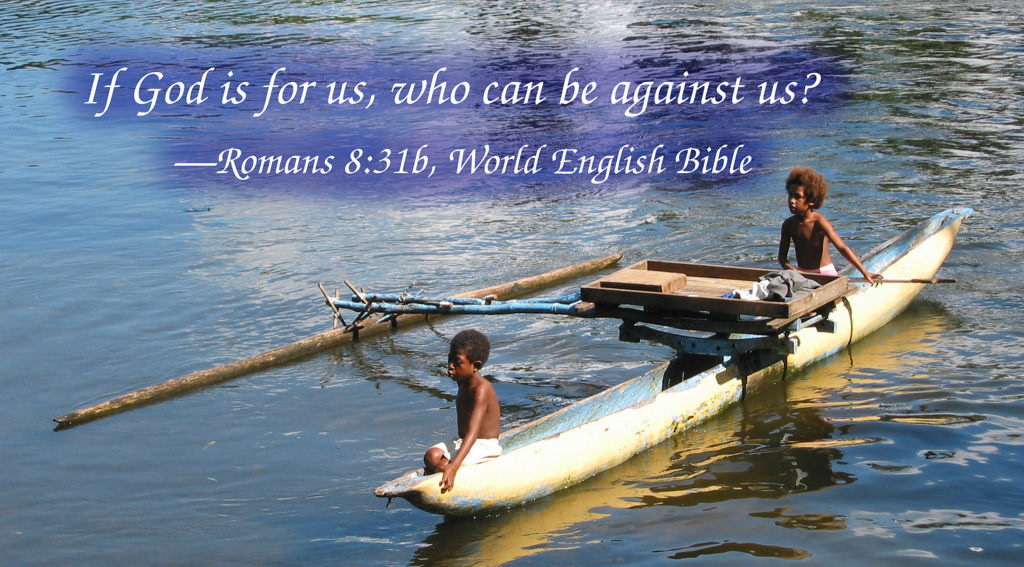
In a beautiful context writing about assurance, Paul asks, “If God be for us, who can be against us?” (Romans 8:31). That is an eminently fair question to ask. Here are some potential foes that could undo us: tribulation, distress, persecution, famine, nakedness, sword, death, life, angels, principalities, powers, the present, the future, height, depth, or any other created thing (35, 38-39). Examine that list closely. Doesn’t it include just about every potential threat and trial? Do we believe the assertion of Romans 8:31, this rhetorical question firmly implying that God is bigger and stronger than any potential problem or person?
When it comes to our righteous plans, isn’t this same principle vital to our process? What can we do and be as a church? The only limitation is that which goes against God’s will or that which can dominate God’s will. We must give great care to the first part, but we need not worry for a second about the second part. There will be factors that strain or intimidate. There will be reverses and failures. But, if we will persist and persevere, what can defeat us?
How exciting, in our personal and congregational lives, to serve a God more powerful than any foe or fear! We can succeed by His help and to His glory, come what may! Let us trust this timeless truth and live our lives as though we believe it!

Neal Pollard
Inquiring minds want to know. How does God work through providence? How does He answer our prayers to strengthen, help, lead, and endow us with wisdom? We are without doubt that God is active, interested, and involved in our lives today. Deism denies this, saying that a Creator set things in motion and then permanently stepped out of the picture on planet earth. Theism affirms His present involvement and interest in the affairs of men today. The dogmatic at either extreme purport to speak for God, absolutely affirming or denying what He does or does not do. There is an area in which we cannot say how God operates or whether it is the Father, Son, or Spirit who is at work simply because it has not been revealed and we are not in a position to observe what is transpiring in the heavenly realm. Moses once said, “The secret things belong to the LORD our God, but the things revealed belong to us and to our sons forever, that we may observe all the words of this law” (Deut. 29:29). Moses told Israel that some things aren’t revealed to us, but he also said some things are revealed. We are obligated to observe what is revealed. We are on dangerous ground when we affirm what Scripture does not reveal.
Scripture does not reveal that the Spirit is involved in our decision-making in a direct way apart from the Word. It does not indicate that He is stirring inside our hearts, influencing us to think, speak, or act in a given way for a given purpose or moment. He does not give us our words in the miraculous way He did for the apostles, who had no need to prepare or study for a given moment (cf. Matt. 10:19-20). When we boldly assert such things, we stand without the foundation of revealed truth beneath us and, at best, stand upon dangerous conjecture.
The Spirit’s work in written revelation informs my heart and mind, and it (Scripture) awakens me to appreciate and depend upon the power of God through that word and its promises. The Bible says we are strengthened with might through His Spirit in the inner man (Eph. 3:16). We do not know the full implication of that promise, though we are thrilled by it. What a leap it is to go from acknowledging the Spirit strengthens us to claiming He gives us thoughts, ideas, or direct guidance in addition to His Word. If we say, “The Spirit led me to take this job” or “The Spirit told me to speak to that person” or “The Spirit told me I’m saved,” we speak from ignorance (i.e., lack of knowledge or information). Kathy once studied with a woman and showed her the multitude of passages proving the essentiality of baptism, but she replied, “But the Spirit told me I’m saved.” We know that it was her own will and desire in her heart that she attributed to God. That is the danger of such reckless assertions. We easily confuse what we desire and prefer with “the will of God” or even “the Spirit’s work.” God repeatedly warns that our hearts can deceive us, that we can credit God for what, in reality, is our will (Prov. 14:12; 16:25; Jer. 10:23).
We do need to study the personality, the work, and the Deity of the Holy Spirit more. It is obvious, hearing and reading after even some brothers and sisters in Christ, that we have neglected studying about Him. Let us handle each other without suspicion, in a spirit of love and kindness and without attacking people and personalities. Let us also always be careful not to “exceed what is written” (1 Cor. 4:6), never adding to or taking away from what is revealed (Rev. 22:18-19). Yet, let us be grateful that our great God is interested and involved in our lives, being content to affirm only what Scripture reveals.

Neal Pollard
It is a true paradox. Today, I’ve been married longer than I have ever been. I’ve been a father longer than I have ever been. The same is true for me as a Christian, a preacher, and every other relationship I am in. My experience in all of these has never been greater than it is right now. Yet, as I examine things, I realize just how much I do not know. I am not saying that truth is unknowable, for such a statement would be false and contradictory to what God affirms in Scripture (John 8:32; Eph. 1:18; 1 Tim. 3:15; etc.). It is just that I realize how little I understand compared to what needs to be understood, that I find the challenge of putting truth into practice in every situation requiring wisdom and understanding as daunting as I ever have. Yet, despite such a realization, my optimism has never been greater. Why? Because I have never believed more strongly in the power and wisdom of God, nor have I ever depended more on Him for strength and provision where I am lacking than I do today. I feel smaller, but He seems bigger. While the walk on the narrow way seems a steeper, more strenuous, incline each day and the challenges to faith more daunting, more than proportionate to this is my realization that God “is able to do exceedingly abundantly above all that we ask or think, according to the power that works in us” (Eph. 3:20). My conviction about what the Bible says has never been stronger. My belief in God’s existence, involvement, concern, and righteousness has never been more than this moment. Yet, my awareness of my finiteness and limitations, the transiency of this life, and the ferocity of the adversary is acute. Incredibly, this doesn’t cause me to despair. It causes me to hope. It takes the focus off me and puts it where it belongs—on Him! He is able to establish me through His Word (Rom. 16:25). He is “able to make all grace abound to” me, that I, “having all sufficiency in all things, may have an abundance for every good work” (2 Cor. 9:8). The most important thing for me to know, every day in every challenge and responsibility, is that God is able (Rom. 14:4; Phil. 3:21; 2 Tim. 1:12; Heb. 2:18).
Don’t misunderstand me. I am not despairing. I am not even frustrated. I am hopeful and excited. One of the greatest promises of Scripture is, “But He gives more grace” (Jas. 4:6). He will walk with me through the darkest valleys (Psa. 23:4). As He holds my hand and guides me through His word and His providence, He also points me toward His house. He tells me He will help me get home and when the narrow way becomes too steep or arduous for me to walk alone, He will carry me in His everlasting arms (cf. Deu. 32:7). I will keep studying His inspired guidebook and striving to apply it to my life. And as I do, I will increase my dependence and reliance upon Him, confident that “He who has begun a good work in [me] will complete it until the day of Jesus Christ” (Phil. 1:6). That’s really all I need to know!
Neal Pollard
Shortly before Joab turns the tide of Absalom’s rebellion by killing him, David, the rebel’s father, had reached a low ebb in his reign. David and his faithful followers had been on the run from Absalom for some time, hiding and trying to escape rout and death. Worry was a regular exercise for David during this time (2 Sam. 15:14), as was weeping (2 Sam. 15:30) and weariness (2 Sam. 16:14). Just before the fateful day of his son’s death, David and his loyal followers fled for their lives and survived thanks to the crafty counsel of Hushai. The state of the people, at this point, is described in 1 Samuel 17:29: “The people are hungry and weary and thirsty in the wilderness.” They were at the end of their rope, worn and frazzled by their very real problems.
Have you wrestled with worry, weeping, and weariness lately? Can you relate? Maybe you are feeling overwhelmed and overmatched by things going on in your life. As we read this account, there are several reasons to hope.
THEY WERE NOT ALONE. 2 Samuel 17:22 notes that it was “David and all the people who were with him” who arose and crossed the Jordan to go to Mahanaim. Each struggled, anxious and uncertain, but how comforting that they were able to go together. The Christian should never have to go it alone. There are those around us who to help bear our burdens (Gal. 6:2). From the beginning of the church, this has been the case. Acts 2:44 says, “All who had believed were together.” While each of us may be struggling with individual problems, struggling is part of the human condition (Job 14:1). In God’s wisdom, He has made the church a place where we can help and support each other (1 Th. 5:11).
THEY WERE BENEFICIARIES OF KINDNESS. What happens when they get to Mahanaim? Shobi, Machir, and Barzillai are waiting for them. That had to be encouraging by itself. But look what they had with them—“beds, basins, pottery, wheat, barley, flour, parched grain, beans, lentils, parched seeds, honey, curds, sheep, and cheese of the herd” (28-29a). Those three men saw their brethren were suffering, hurting, and needy. So what did they do? I have seen this in the church more times than I can remember. A brother or sister was in financial, emotional, or spiritual need, and their brethren showered them with kindness and love. So many of God’s people take to heart Paul’s exhortation, “Be kind to one another, tender-hearted…” (Eph. 4:32a). See 1 Corinthians 13:4, Colossians 3:12-15, and 1 Peter 3:8, and you see the heart of so many of our fellow-Christians. How helpful when we are in the wilderness!
THEY WERE SOON VICTORIOUS. David draws up a battle plan in 2 Samuel 18:1, and before long the threat was quelled. There were still plenty of challenges that lay directly ahead, but they had doubtless learned a valuable lesson in the wilderness. Their victory did not mean that they were exempt from further problems, but they had experienced God’s deliverance. What a powerful lesson for us! Yes, we will continue to struggle so long as we are pilgrims on this earth (cf. 1 Pet. 2:11), but there is a victorious “day of visitation” on the horizon (1 Pet. 2:12).
Are you “in the wilderness”? Hang in there! Focus on the people God has put in your life, be attuned to their kindness and encouragement, and remember the great victory God has promised you.


Neal Pollard
Almost five years ago, I was sitting in an unlocked car with Ralph Williams on the streets of Chittagong, Bangladesh. Our driver and a native preacher had gone into an alley to find some breakfast for us. It was about 7:00 AM, and all at once hundreds of men in full Muslim attire, white caps and white cloaks or brightly-colored hats and basic-colored cloaks, began streaming past us. As I saw them, and among them undoubtedly some clerics and an imam or two, I confess to having had an elevated heart rate. I felt vulnerable and a bit unsafe, knowing I stood out with my comparatively pale skin and American clothes. My Bangladeshi vocabulary is very sketchy. I kept thinking that I could not do much to protect myself or my more elderly companion.
Have you ever felt vulnerable, alone, helpless, and afraid? Perhaps it takes more than a vivid imagination and a throng of Islamic pedestrian commuters to invoke such feelings from you, but most all of us experience feelings of being susceptible, anxious, and even alarm. David certainly did!
He wrote, “Be gracious to me, O LORD, for I am in distress; My eye is wasted away from grief, my soul and my body also. For my life is spent with sorrow And my years with sighing; My strength has failed because of my iniquity, And my body has wasted away. Because of all my adversaries, I have become a reproach, Especially to my neighbors, And an object of dread to my acquaintances; Those who see me in the street flee from me. I am forgotten as a dead man, out of mind; I am like a broken vessel. For I have heard the slander of many, Terror is on every side; While they took counsel together against me, They schemed to take away my life ” (Psalm 31:9-13). Distress. Grief. Sorrow. Sighing. Failing strength. Wasted body. Reproach. Dread. Forgotten. Broken. Terror.
Perhaps you relate to that. A job loss. A failed relationship. Financial stress. A fearful diagnosis. An accident. What do you do in the face of threats, trouble, and trials? The rest of Psalm 31 answers that. Trust in God (14), put your “times” in His hand (15), call upon Him (17), trust His provision (19-22), love Him (23), be strong, take courage, and hope in Him (24). In a word, “God” is the answer. But we must reach out to Him for that help. When we do, we see our concerns in the clearer light of His power!

Neal Pollard
Something happened yesterday that makes me ashamed. Before I share that, consider a prayer that we pray–or should pray–with frequency. We say in public prayer and many of us in private prayer, “Lord, please open a door of opportunity.” That’s scriptural and it follows the great example of Paul, who said, “Praying at the same time for us as well, that God will open up to us a door for the word, so that we may speak forth the mystery of Christ…” (Col. 4:3). God opened a “door of faith” for Paul and Barnabas to evangelize (Acts 14:27). Spiritual healthiness involves wanting opportunities to serve the Lord, especially in making His kingdom grow. If we believe that it is right to pray to God for this and we believe that God answers those prayers, what happens in our lives? There are people He providentially places in our path for us to reach with the gospel.
Yesterday, in a BeauJos restaurant in Idaho Springs, I had such a moment. Dale, my middle son, excitedly told me as I was returning from washing my hands, “Dad, that couple was praying for their food! You should go talk to them!” I told him something like “if the time is right, I’ll do that, son.” Yes, I realize how “lame” that was. I repented before Dale, and now ask your forgiveness, for such rationalization. When could there be a better time? Yes, I know what I would say next time. It dawned on me as I was praying last night.
Dale is so gracious. He told me, “That’s all right, dad. It’s not like you only get one chance.” Isn’t that a wonderful truth? What a motivator! God is the God of the second chance. Not only that, if I prayed for an opportunity and he sent that one in BeauJos, won’t He do it again. Next time, I resolve to be ready. I must be. If I am to trust prayer and God’s provision, He will put someone in my path. May I be ready and willing to share Christ with them!