The Christian Decision

Carl Pollard

Our family used to hike a lot when we lived in Colorado. There were many hikes that I went on that were straight up miserable. Ive always been the chunky kid, but the worst part about this was that I  was surrounded by a healthy and very active family.. This meant that on every hike I was the one in the back feeling like I was about to pass away. Hiking was never really something I was the best at. There are several times I remember thinking, “I’m not going to make it.” 

We used to hike a trail called “Moffit Tunnel” It was an 11 mile hike that ended with a summit path that gained 3000 feet of elevation in under half a mile. As you can imagine the path was practically vertical, and filled with rocks, mud, snow, and sadness. 

When I think of “a hard path” this is what comes to my mind. In Matthew 7:13-14, Jesus describes the way to salvation as a path that isn’t for the faint hearted; it’s for the dedicated Christian that is determined to reach eternal life. There’s no denying that the Christian life can be tough. It is filled with persecution, especially for those who aren’t as fortunate to have the freedoms we enjoy in America. The Christian life is tough because we will face persecution, but we are more likely to face rejection in our society today for standing up for some very unpopular teachings. If we are devoted to teaching and standing with God’s Word this means we must defend God’s view on homosexuality, marriage, divorce, and remarriage, baptism, sin, hell, and many more divisive topics. If we are devoted to walking the difficult path we must remain faithful in the rejection, hatred and persecution we will face. 

But the rejection and hate from the world isn’t the only thing hard about this path.

As Christians we are commanded to put ourselves to death. Matt. 10:37-39 say,  “Whoever loves father or mother more than me is not worthy of me, and whoever loves son or daughter more than me is not worthy of me. And whoever does not take his cross and follow me is not worthy of me. Whoever finds his life will lose it, and whoever loses his life for my sake will find it.”

Walking the difficult path means we have put ourselves to death. In doing so we are saying we love Christ more than our parents, our children and ourselves. In order to walk the difficult path we must be willing to take up our cross and follow Jesus. The cross is an instrument of death. The cross we pick up is the instrument of death that we have used to crucify ourselves on. Once we have taken up our cross we have made the decision to love Christ over anyone and everyone. We no longer serve ourselves because we have died to Christ. 

When we choose to walk the difficult path we are no longer living without purpose. We have a goal, a meaning for our lives. God uses us to spread His saving word to others. We have purpose in everything we do. We are here to encourage each other, to save souls, and to glorify God. One of humanity’s most asked question, “Why am I here?,”is answered by God. How we serve God will ultimately change someone else’s eternal destiny. We are given the true words of life that are able to save our most valuable possession, our souls. We also experience the blessing of having confidence in death. Death is scary. Why are so many scared of death? It’s the unknown, the end of our existence as we have known it. As Christians, when we choose to walk the difficult path, we are given the promise that when we face death we can be confident in knowing our soul is in the hands of almighty God. We know what is coming, and we can find hope in this. 

It was a hard climb, but what a payoff!

Trail Magic

Friday’s Column: Supplemental Strength

81121814_2462862270639428_5746232403106463744_n

Brent Pollard

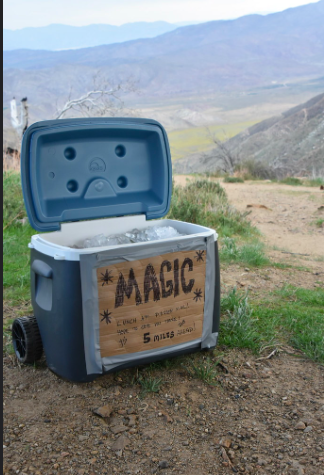
My dad has discovered YouTube. He had been using the service to watch streaming worship services during the height of the coronavirus lockdown; he has since noted its potential entertainment value. One of his favorite channels is one that plays classic country music from the 1950s and 1960s. Recently, however, he has been watching the videos of hikers along the Appalachian, Pacific Crest, and Continental Divide Trails. I use to enjoy hiking in my healthier days, so I have sat down to watch more than one of these videos with him. I have never even contemplated doing a thru-hike of one of the previously mentioned 1,000 mile plus trails, but have admired those who have completed them. As I watched one video of a hiker who undertook the Appalachian Trail to conquer his depression, I heard him use an unfamiliar term: “trail magic.” In another video, a young woman from Opelika, Alabama, used the words in regards to her trek along the Pacific Crest Trail. Curiosity compelled me to look that phrase up. The phenomenon originated on the Appalachian Trail but has since popped up along the other lengthy trails as well.

 The Appalachian Trail Conservancy defines trail magic as follows:

“1) Finding what you need most when you least expect it. 2) Experiencing something rare, extraordinary, or inspiring in nature. 3) Encountering unexpected acts of generosity, that restore one’s faith in humanity.” 1

As the videos demonstrated, trail magic presented itself in a cooler of cold drinks left at a taxing point in the trail. Or maybe a veteran thru-hiker set up a tent at a spot along the pathway to feed the hikers who came through. It could also be a person volunteering to provide a wearied hiker a ride to his or her nightly lodging when the trail came close to a town offering a hostel or hotel serving hikers. Thru-hikers have no reason to expect that any of these things will happen to them as they make their journey even though it happens enough to warrant a name (i.e., trail magic). That is why it is so appreciated.

 When I read that, my mind immediately associated aspects of this phenomenon to what those of us who are Christians call “providence.” How often have we found something unexpected in our life, typically at the most opportune time, that screams “God” to us? In other words, a sudden something that points to God’s hand at work in our lives. No, providence is not a miracle, since it does not circumvent the laws of nature to occur. It works within the established framework around us, making it even more amazing since it can require God’s forethought rather than just a momentary expression of His unlimited power. Yet, it is as appreciated by us as any miracle would be since it satisfies our momentary need, whether remission from cancer or unexpected inflow of funds when presented with a financial crisis.

 This characteristic of God has earned Him a unique name first applied by father Abraham, Jehovah-Jireh. Do you recall the reason Abraham called God by that name? God had asked him to offer his only son as a sacrifice. This son was the promised one for whom he had long waited. Yet, Abraham complied. When his son, Isaac, noticing a missing sacrifice, asked his father about it, he replied, “God will provide for Himself the lamb for the burnt offering, my son” (Genesis 22.8 NASB). After nearly sacrificing his son, an angel stopped Abraham, and Abraham noted a ram with its head stuck in a nearby thicket. Abraham offered the ram as a sacrifice in place of his son and called the location “Jehovah-Jireh,” meaning “The Lord will provide.”

 Our path to Heaven is strait and narrow (Matthew 7.13-14). It is, therefore, most welcome that as we make our way through this life that we encounter this celestial trail magic. Let us never fail to thank our God since He is also Jehovah-Jireh.

 REFERENCES

1 Bruffey, Daniel. “Trail Magic.” Appalachian Trail Conservancy, The Appalachian Trail Conservancy, appalachiantrail.org/explore/hike-the-a-t/thru-hiking/trail-magic/.

Screen Shot 2020-07-03 at 7.09.01 AM