Ephesians 1.3 says, “In Christ, God has given us every spiritual blessing in the heavenly places.” What does that mean? We hear “spiritual blessings” and might gloss over it as another Christianese phrase. Here’s a short list of what those spiritual blessings are.
1.4 — God chose us before Christ made the world.
1.4 — He chose us out of love to be his special people.
1.5 — He chose us to be his own children through Jesus Christ.
1.6 — God gives grace liberally.
1.7 — We are free because of Jesus’s sacrifice.
1.7 — We have forgiveness because of God’s grace.
1.8-9 — God told us how we can get that grace. He didn’t set up a system that we would have to look super hard for, he made sure to preserve the information needed to find him.
1.10 — He is bringing the heavens and the earth together through Jesus.
1.12-13 — He made grace available to every country on earth, not just one group.
1.13-14 — He gave us his spirit as a downpayment on our reward.
While we won’t fully appreciate these spiritual blessings until later (Paul says these riches are “too great to fully understand” in 3.8), we’re still extremely grateful that God has done so much to give us hope for eternal life.
It becomes clear from reading the second letter to the Corinthians that Paul feels the need to defend himself and his actions among his readers. He feared that he had been misunderstood in his previous work among them (cf. 1:12-14). In fact, it seems as though this is the purpose of the letter (look also at 5:11-12). If you remember from the first letter, he had some pretty challenging and unpopular things to say about how they were behaving. It’s not far-fetched to think that some of them not only would not appreciate what he said, but would attack him as the messenger for saying it. Sometimes, however lovingly and kindly we share the truth, it will offend the hearer who, instead of repenting, tries to undermine the one who said it. As we read this section, think of Paul as a man, just like his audience, who has feelings, struggles, difficulties, and temptations, too. He also needed them to know that it was because he cared so much about them that he would not “shrink from declaring to [them] anything that was profitable” (cf. Acts 20:20). What drove Paul to minister to the Corinthians? Notice several things he says in 2 Corinthians one.
THE GRACE OF GOD (12)
He would not boast in himself, whether his abilities or knowledge or influence. Those are empty and unsatisfying. His motives were pure and he was helped by a grace he wanted them to appreciate, too. When we understand our need of God’s grace, it will move us to give Him our all in response.
THE JUDGMENT DAY OF GOD (13-14)
Paul wanted them to be able to legitimately boast together and of one another at “the day of the Lord” (cf. 5:10). The word “boast” in modern English has negative connotations–bragging, arrogance, and sinful pride. Paul wanted to have confidence in them as they faced this Day, as confident as he hoped they were of him in view of it. We should share the whole counsel of God to make sure people are ready for the most important day of all.
THE PROMISES OF GOD (20)
He shared the positive and negative, the promises and the warnings, because he knew God meant what He said. He would not equivocate or talk out of both sides of his mouth. He was going to give them “the whole purpose of God” (cf. Acts 20:27). He knew God was the supreme promise-keeper (2 Tim. 4:8; 2 Cor. 5:11-14).
THE GLORY OF GOD (20)
Paul taught them for the glory of God. The Word is God’s. The promises are God’s. The salvation is from God. How silly for the fragile pottery to brag (4:7); the glory belongs to the Potter. Anything worthwhile we accomplish is always because of God.
THE WORKING OF GOD (21-22)
Paul was moved by the knowledge that God is the one who establishes men (21), sets us apart (21), and gives us His Spirit (22). Knowing this, we should share Him with people so that God can accomplish His work in their lives.
THE WITNESS OF GOD (23-24)
Wise teachers and preachers will remember that God is watching their work. He can see where no one else can–our hearts and motives. Knowing He knows me inside and out, I will check myself and do His work to bring the joy and strength of the hearers (23-24).
THE PEOPLE OF GOD (2:1-4)
We should be moved by genuine love and concern for people. Those who share the word should share life with those who receive the word from them. Building relationships, being together in all the ups and downs of life, is what it is all about. It’s hard to imagine staying motivated to share the gospel with people we isolate ourselves from.
Perhaps there are some preachers and teachers who just love beating up on their listeners (or readers). Motivation is individual to each one (Phil. 1:15-17). I have to believe that every faithful proclaimer wants not only to please God but also help as many people as possible go to heaven. There are so many great reasons why Christians should want to share God’s Word with others. Paul gives us a handful of them here.
I’ll be repeating the book of II Peter in present-day terminology. It’s not a true translation of the book, as I am not qualified to do so. It will be based on an exegetical study of the book and will lean heavily on the SBL and UBS Greek New Testaments, as well as comparisons with other translations (ESV, NASB, NIV, ERV, NLT). My goal is to reflect the text accurately, and to highlight the intent of the author using concepts and vocabulary in common use today.
This is not an essentially literal translation, and should be read as something of a commentary.
Introduction
This is from Simon Peter. I’m a dedicated follower of Jesus Christ and one of his apostles. I’m writing to everyone who has a faith that’s just as valuable as ours. Your faith is just as valuable because it also came from the perfection of our God and rescuer Jesus Christ. My wish for you is that you enjoy grace and peace because you know God and Jesus, our master.
JesusHelpedYouEscape
We have everything we need to be alive and live a morally good life thanks to him. His power made that possible! We have everything we need because of our relationship with him. He called us to his family because he is amazing and perfect. He’s made some incredible promises to us. Those promises were designed to give us access to his nature. We have access because we’ve escaped a worldly lifestyle characterized by unhealthy desires. Since we’ve escaped, make sure you back your faith with moral goodness. Once you have moral goodness, expand your knowledge of God. That knowledge should lead to self-control. Self-control should lead to endurance. Endurance should lead to godliness. Godliness should lead to good relationships with each other, which should lead to love. If you are growing in these areas, you can’t be described as useless or unproductive in your relationship with our master, Jesus Christ. If you don’t have these qualities, you’re blind or shortsighted because you’ve forgotten that your record was cleared.
There is a story about a father building his daughter a wheelchair from the ground up after she got paralyzed in a car crash. Her father was willing to do all the research and put all the time in to building a wheelchair for his daughter who he loved so much. I don’t think I would trust my dad to make me a wheelchair, but this father demonstrates the love he has for his daughter and the lengths he would go to to keep her safe. We are told in multiple different ways how deep the Father’s love is. As the song goes, “Why should I gain from His reward I cannot give an answer.” I want to share just three points with you tonight why we gained from his reward.
The first one is that His love is so deep that He created us. Genesis 1:27 says that God created man in His image. Since we are made in God’s image, we are His special creation. In return for Him to love us so much we need to love Him and obey Him.
Then when we messed up God loved us so much that He gave His only Son for our sins (John 3:16). He was willing to do anything for us as His children. I know this is a point that is used a lot. Would you give your son? Not just your son, but your only son. Now I don’t have children but I’m sure that if I did that I would not be willing to do that. If you go on to verse 17 it says that He did it so that we might be saved. If we do what is commanded here on earth we will have an eternal home.
The third point we gained from his reward was because he loved us so much that He wanted us to have an eternal home with Him. Go back to John 3:16. It says that whoever believes in Him shall not perish but have everlasting life. Now going back to the example I gave just a moment ago. I don’t think I will ever love anyone enough to give my son. Now let’s back up for a minute and ask ourselves why do we not love each other that much? We are all God’s creation so we should love others like God tells us.
Thinking back to my childhood when my dad would get mad at me I failed to realize that he loved me enough to help me do right. God loves me enough to give me the opportunity to stand up here and give this devo. And God loves everyone of us enough to give His only Son for our foolishness. And now our job is to love Him so much to obey his laws.
How many of you have ever sat at a red light in traffic only to realize when that light turns green there’s still no place to go… and then before you get through the intersection the light turns red again. Frustration at its finest.
Who has ever been seated to eat somewhere and it takes over 15 minutes for a waiter or waitress just to come take your drink order? I can feel my blood pressure rising just thinking about it!
I can’t be the only one who has ever lost my cool with my kids or other family members. Sometimes what seems to be for no apparent reason at all? Hopefully you’ve taken the time to at least realize you reacted poorly and made your apologies.
I’d like to share with you my struggle with being a patient man. How I always need to consciously work on it, what works for me, what doesn’t work for me, and maybe open your eyes to the reality of what true Christian patience looks like.
My wife, Rebecca, always tells me, “Don’t ever ask God for patience, or else He’ll give you something to be patient about.” I can see that. To a certain point, I believe it too. But let’s take a second look at it in James 1:2-8.
“Consider it all joy, my brethren, when you encounter various trials, knowing that the testing of your faith produces endurance. And let endurance have its perfect result, so that you may be perfect and complete, lacking in nothing.” So let’s look at this. I have faith. My faith can be tested.
This doesn’t mean I’ve lost faith, just that I’m being tested for how strong my faith is.
“But if any of you lacks wisdom, let him ask of God, who gives to all generously and without reproach, and it will be given to him.” – Here I see my struggle with patience as the wisdom aspect. Maybe I’m not feeling wise. Maybe I’m having trouble figuring out this patience thing you all speak of. Is it wrong of me to at least let God know, hey I’m struggling with this… No! Absolutely not. Philippians 4:6 says, “Be anxious for nothing, but in everything by prayer and supplication with thanksgiving let your requests be made known to God.”
Let me be clear, I’m not disagreeing with my wife. I would never do that honey… I’m simply saying that asking God for patience and asking God for grace and understanding while I figure out what I need to change in my life to be more patient, are two completely different things. Verse 6 says,
“But he must ask in faith without any doubting, for the one who doubts is like the surf of the sea, driven and tossed by the wind. For that man ought not to expect that he will receive anything from the Lord, being a double-minded man, unstable in all his ways.”
So we have some ground rules here. James tells us, “you must ask in faith. You cannot doubt God. For if you have any doubt, any doubt at all you can expect to receive nothing.”
Maybe my best course of action does not stem from asking God for help. What I have done and learned to do lately is called connecting the dots. If I am unhappy, frustrated and struggling to find joy at home, I ask myself why? Where did that come from? There doesn’t seem to be anything that my family is doing wrong. Sure, dishes pile up in the sink,kids room is not picked up, laundry room is overflowing… Those things happen, they’ve happened before and it didn’t bother me that much in the past. Maybe all those little things just seem like big things now because something else is bothering me, but what? What’s changed? Connecting the dots for me almost always leads back to work. A bad run I’ve been on, problems with co-workers, added duties and responsibilities to an already stressful job. I have had to learn to be more aware of my stressors. I’ve had to do a hard reset on what I bring home vs what I leave at work. Most of all I’ve had to remember to lean on Jesus.
“Come to me, all who are weary and heavy laden, and I will give you rest. Take my Yoke upon you and learn from me, for I am gentle and humble in heart, and you will find rest for your souls” (Matthew 11:28-29).
“Therefore humble yourselves under the mighty hand of God, that he may exalt you at the proper time, casting all your anxiety on Him because he cares for you” (1 Peter 5:6-7).
Learn to lean on Jesus. Learn to do it early. Learn to do it often. I urge you to join a private Bible study. Find an elder, find a deacon, or find a friend and ask them to study the Bible with you. Studying the word of God is the biggest stress reliever I have ever found. I am so grateful for those that have taken the time to study with me.
If you are not a Christian, you have a choice. Don’t wait. Learning to be a disciple takes time. But making the decision to desire discipleship takes no time at all. Be baptized into Christ Jesus and rest easy knowing your soul is in safe hands.
If you are a Christian, perhaps you’ve let your anxiety, stress or impatience get in the way of being a solid Christian, a rock star husband or wife, a nurturing mother or father, or a fierce friend. We are here to help you, guide you or pray for you. Do not be weary, whatever you may need.
I understand the power of grace, and am grateful for it. I understand that those walking in the light have lenience with God, and I’m grateful for that! But I still wonder what I’m missing. Many (maybe most) Christians feel the same way. We want Jesus to come back as soon as possible! But the thought is also terrifying. After all, a lot of Christians will be shocked when they’re condemned at judgment (Matt 7.21). So how do we avoid that eternal gut punch?
Obviously, the first step is to join God’s family the way he said to. “Being saved” is not just about rescue from sin. That’s part of it! Being saved is about the last day. When Jesus separates humanity into two camps (Matt 25.32), we want to be in the one that doesn’t get destroyed.
Notice what Jesus tells people on both sides: “I was hungry, so you gave me food. I was thirsty, so you gave me something to drink. I was a stranger, but you invited me into your home. I had no clothes, so you gave me some. I was sick, so you took care of me. I was in prison, so you visited me” (Matt 25.34-36).
If that statement applies to someone, they’re saved. If it doesn’t, they’re out of luck.
It’s interesting that Jesus doesn’t say, “You had the correct view of worship. You debated the plan of salvation with religious groups. You read your bible every day.” Those are critical (see the whole New Testament), so don’t misunderstand me.
But when Jesus addresses both groups, their fate will be decided by how they treated God’s family.
So what do we take away from this?
Take care of the physical needs of church family.
Be very careful about criticizing the church. Err on the side of caution.
Keep priorities where they need to be. There’s a time and place for defending God’s word and his teachings! But most of our energy should be dedicated to what matters most to Jesus.
When we take care of each other, we’ll be told, “My father has nothing but praise for you! Come with me, you’ve inherited the kingdom that was made for you when we created the world” (Matt 25.34).
When I was in elementary school, we had a teacher who taught us how to properly write a letter. Miss Crews, my fourth grade teacher, told us it included the heading, greeting, body, complimentary closing, and signature. Isn’t it interesting what we retain (or fail to retain) from childhood?
Applying that basic analysis to the New Testament epistles, we are greatly helped. In addition to reading who the epistle of 1 Corinthians is from (1:1) and who it is to (1:2), we have a heading (helped by the information in verse 2), greeting (1:3), body (1:4-16:18), complimentary closing (16:19-20, 22-24), and signature (16:21). It is also in this first section of the letter (1:1-17) that we find the purpose of the letter. Notice some key aspects of these first several verses.
PAUL REMINDS THEM OF WHO THEY ARE (1:2-3)
In the daily grind, I can be apt to forget exactly who I am and who God has called me to be. It seems this had happened to the entire congregation at Corinth. Paul starts out this letter by reminding them they belong to God, set apart, and recipients of grace and peace.
PAUL TELLS THEM WHAT GOD HAS DONE FOR THEM (1:4-9)
Except for Galatians, Paul begins with a prayer, blessing, or thanksgiving. Here, Paul reminds them of how blessed they are–with grace (1:4), riches (1:5), confirmation (1:6), various blessings (1:7), hope (1:8), and fellowship with the Father and Son (1:9). I don’t know about you, but I often need to be reminded of how mindful the Lord has been of me. I need to reflect on my blessings so I won’t obsess over my problems. Paul is going to be addressing a serious problem in their lives, but he starts by centering their focus on their spiritual treasures.
PAUL URGES SOMETHING OF THEM (1:10-17)
One of the ways a New Testament writer indicated the purpose of his writing is through petition verbs. While Paul actually uses a petition verb three times in this letter (1:10, 4:16, and 16:15), there’s no doubt that his first one sets the tone for the rest of the letter. They have a big problem at Corinth: division. We can see this in greater detail as we walk through the letter, but their division was seen in their allegiance to men instead of Christ, in their worship services, in their exercise of spiritual gifts, in their exercise of their Christian liberties, in their view on various sins, and more. So, Paul brings them into focus here.
He urges them to be complete, by being of the same mind and judgment (1:10).
He urges them to see the true nature of Christ (1:11-13).
He urges them to focus on the gospel and the cross (1:14-17).
Keep in mind, as you read through this entire letter, that God had something He wanted Corinth and all subsequent churches and Christians facing the same general struggle to understand. It requires us to keep sight of our identity, blessings, and purpose. Otherwise, we open the door to division which can be the gateway to “disorder and every evil thing” (Jas. 3:16).
I’ve heard some say of a house left standing after a tornado or hurricane that God must have spared the structure’s owner from material loss because of their righteousness. But, unfortunately, such statements imply that the neighboring destroyed property belonged to the unrighteous. Yet Jesus said, “for He (God) causes His sun to rise on the evil and the good, and sends rain on the righteous and the unrighteous” (Matthew 5.45, all ref. NASB1995 unless otherwise indicated).
Even amongst the destruction, though, if someone is observant enough, he sees what he chooses to call miraculous. However, since a miracle is the suspension of God’s natural laws, we understand that the word “miracle” oft becomes an adjective to describe what defies human comprehension. In reality, laws of nature explain the “skipped” houses or why a decorated Christmas tree can remain amidst a room, missing its walls and a part of its ceiling.
For example, there can be what scientists call “suction vortices” within tornadoes. Within a more significant tornado, these many vortices move in a looping, cycloid pattern that will hit some things while completely missing others.1 In other words, the hand of God was in the creation of the natural laws resulting in the occasional formation of tornadoes, with their suction vortices, as opposed to directing storms into particular locations.
But did God originally intend for His natural laws to include such destructive phenomena? Think back to the world God initially created. God called it “very good” (Genesis 1.31). What changed? Humanity used its free moral agency to sin, bringing change to the world. In fact, things got so bad that God destroyed the original world. Peter says, “…by the word of God the heavens existed long ago and the earth was formed out of water and by water, through which the world at that time was destroyed, being flooded with water” (2 Peter 3.5-6).
Among those mechanisms that God put into place in the world emerging from the flood are the weather patterns that spawn tornadoes and hurricanes. The patient patriarch, Job, observed the following regarding the wisdom known to God: “…He imparted weight to the wind and meted out the waters by measure…He set a limit for the rain and a course for the thunderbolt…He saw it and declared it; He established it and also searched it out” (Job 28.25-27).
Now, the point of our devotional today is not to increase the misery of those having suffered loss during what insurance companies euphemistically call “acts of God.” Yes, things like tornadoes and hurricanes do arise because of sin. However, it is not a part of the chastisement God sends upon us (cf. Hebrews 12.4ff). So, if you want to see God after a tornado, do not see it in a church building with no roof, but with all its hymnals and pew Bibles still safely secured in the pew racks. That is likely but a side effect of natural law.
No, look for God in His grace. As Fred Rogers often said, “When I was a boy, and I would see scary things in the news, my mother would say to me, ‘Look for the helpers. You will always find people who are helping.’”2 Might I suggest that it is in the helpers that we see the actual hand of God? His Providence works through the people clearing debris, handing out food, and providing shelter to those who have lost everything. These fulfill the law of Christ (Galatians 6.2). Thus, God does not only shelter some in a storm. He provides for all of the weary through the agency of those whom He made in His image (Genesis 1.26-27).
Sources Consulted and Cited
1 Seman, Steven, et al. “Tornado Damage, Safety, and Myths.” Tornado Damage, Safety, and Myths | METEO 3: Introductory Meteorology, The Pennsylvania State University, www.e-education.psu.edu/meteo3/l9_p8.html.
I recall watching the Atlanta Braves when they were the perennial cellar dwellers of the National League. The Braves’ games were broadcast on UHF station 17 out of Atlanta before the little independent television station went national via cable and satellite. In those days of the baby blue uniforms and small letter “a’s,” I watched stars like Dale Murphy, Rafael Ramirez, and Phil Niekro play the game of baseball on a TV with rabbit ears.
Fast forward to 2021, and the Atlanta Braves have won the World Series. It is interesting to talk to younger fans who only know of above-average play in the last few decades. Such fans are blissfully ignorant of those days when you could count on the Braves to have more losses than wins. Yet, I noticed something about this championship year. If you look at the records of the LA Dodgers (106-56) and Houston Astros (95-67), both teams won more games during the season than the Atlanta Braves (88-73). This truth suggests that it is essential to prevail when it counts. In other words, the Braves showed up when they had to, which is why they are the national champions.
There is something to be said of that in Christianity as well. Regarding this, Jesus gave a parable about two sons (Matthew 21.28-32). A father went and asked his first son to work in the vineyard. He refused. So, the father went to his second son. The second son said he would go and work but never showed up. In the interim, the first son regretted his answer and went to work in his father’s vineyard. Jesus ends the parable by asking who had been obedient. The crowd responded that the first son had obeyed. Jesus informed them that there would be sinners entering the kingdom of God in like manner before the religious elite.
The religious leaders were like the second son. They gave lip service but never actually followed the Law of Moses, only their traditions. As a result, they did not show up when it counted. But the prostitutes and tax collectors, cognizant of their sins, showed up when Jesus extended His invitation (Matthew 11.28-30). So, while it is true that there is none righteous (Romans 3.10), we still note that there are people who we count on to show up despite their flaws. Ultimately, this is what matters.
As the saying that we attribute to Benjamin Franklin goes: “Well done is better than well said.” But, of course, this idea was Biblical long before the famous Pennsylvanian put quill to paper. James reminds us to be doers of the Word, not just hearers (James 1.22). It is far too easy for us to blend in with other congregants. “Worship, Fellowship, Retreat, and Repeat.” Now, I will be the first to say that worship service attendance indicates spiritual health, but there is a vineyard out there in which we must labor. The Father asks us to go out and work in the vineyard. What is our response? We will have fulfilled our required tasks even if we have previously said no by our words or conduct but have shown up anyway. Better to be a latecomer than a no-show. Yes, we must show up when it counts. A gracious God will make up for a less-than-stellar record and proclaim us champions (cf. Matthew 25.24).
Have you ever wondered why someone would take the life of another human? Or destroy another man’s property? Or kidnap a child? Or abuse their spouse? I can never wrap my head around why someone would do something so sinful. I understand why someone would cheat, lie, or gossip. I can see why someone would do something like this because it’s a temptation that I understand. But the bottom line is that a sin is a sin.
Cheating on a test will separate you from God just as quickly as murder. Gossip will ruin a relationship with God just as quickly as robbing a gas station. Granted there are earthly consequences that make one sin seem more serious than another, but God sees all sin as just that, an action that goes against His Will.
Why do people sin? What is it about mankind that makes us want to sin? Why does the murderer take a life? Why does the liar refuse to speak the truth? There are a couple of instances I can look back on and think, “Why didn’t I just do the right thing?” When we sin we do it because we believe it to be the easier choice. If we lie we don’t have to face the hard truth. If we cheat we don’t have to put in the work of being honest. If we lust we don’t have to practice self control. Why do people sin? In most instances we sin because it’s easy, because it’s what we want to do.
In Romans 3:3-8, Paul is refuting the arguments of men that are claiming that we should sin more. These men reasoned that grace comes because of sin, more sin requires more grace, grace is a good thing, and, therefore, we should sin more to receive more grace. Paul responds to this claim with 3 arguments:
On what basis does God inflict wrath (5)?
Is He unjust for judging the world (6)?
Sinners should be congratulated for being the object of God’s Grace (7).
If more sin was a good thing, then why not just preach “do more evil” so that “good may come”?
Since we can’t argue that more sin equals more grace, why do people continue to sin? The answer is simple. Romans 3:18 says, “There is no fear of God before their eyes.” The underlying reason that people sin stems from a lack of fear in God. We live in a fearless world, and it shows. Fearing God is understanding Who He is and what He can do. Those who fear God try to avoid the things that make God angry. If we lose our fear of the Almighty we open the door to a sinful lifestyle.
The world says being fearless is a good thing, but we must never lose our fear of God.
Solomon cautioned, “Pride goes before destruction, and a haughty spirit before stumbling” (Proverbs 16.18 NASB1995). I am sure we can think of many examples of this truth we have witnessed in our own lives. However, one that comes to my geeky mind is the downfall of Atari.
Atari was the video gaming console every child had to have from the late 1970s into the early 1980s. But then came along a glitchy game that nearly killed the video gaming console industry: “E.T. The Extraterrestrial.” Of course, we know of the movie by the same name. The film was a commercial success. “E.T.’s” director, Stephen Spielberg, wanted to capitalize on his movie’s success with a video game based on the titular character.
In addition, Spielberg wanted Atari to have the game ready for the Christmas season. Unfortunately, that timeframe only gave the developer requested by Spielberg about five months to complete the game. Spielberg’s request was not without precedent. The developer had previously worked on another game adapted from a Spielberg movie (Raiders of the Lost Ark). Nevertheless, the developer flying high atop Atari’s past success assured Spielberg that he could develop the game quickly.
The game did sell well, at first. But then the reviews came back from players. The game was confusing, tedious, and E.T. would routinely get stuck in a hole from which he could not extricate himself. Therefore, a quarter-million users returned the game to Atari, and Atari was stuck with over two million units that they could not move. This failure created a meltdown resulting in the breakup of Atari. Atari had lost over 500 million dollars. If not for the arrival of Nintendo’s video game console in the mid-1980s, introducing us to the lovable Italian plumber, Mario, one wonders if the gaming industry would be a billion-dollar industry today.
It may be that we can boast of many successes in life. Paul certainly could. Paul called himself a “Hebrew of Hebrews” (Philippians 3.4-6). Yet, Paul said he counted all his gains as loss, even rubbish, for the sake of Christ (Philippians 3.7-8). If you keep reading Philippians 3, you’ll note that Paul admits that he had not arrived at his destination but pressed onward so he could attain his eternal prize (Philippians 3.12-14). Paul then exhorts us to have a similar mindset (Philippians 3.15-16).
Yes, pride causes us to become blind to things like temptation. We become so full of ourselves that we have no room for the Kingdom of God and His righteousness. The Hebrews’ writer warns us about how easy it is to drift away (Hebrews 2.1-3). Therefore, we must be vigilant to watch our location relative to the Gospel. Paul writes: “Therefore let him who thinks he stands take heed that he does not fall” (1 Corinthians 10.12 NASB1995).
As we turn our attention back to Atari, we note that it was, at least, partly resurrected. It reported earnings of about 21 million in the fiscal year 2018. But what is 21 million compared to the half a billion dollars they lost in the early 1980s? Moreover, in the early twenty-teens, Atari filed for bankruptcy. Thus, Atari demonstrates that you cannot always get back on your feet after you stumble.
Fortunately, as Christians, we are showered by the riches of God’s grace (cf. Ephesians 1.7-8). Thus, if we will but “walk in the Light as He Himself is in the Light, we have fellowship with one another, and the blood of Jesus His Son cleanses us from all sin” (1 John 1.7 NASB1995). So, watch your feet and remember that pride goes before destruction.
Some things just don’t mix. Milk and orange juice, Auburn and Alabama fans, Coca Cola and Mentos. There is one particular mix that can sometimes be fatal. Blood pressure medicine can be a great thing, but when mixed with Advil/Ibuprofen it can harm your body and even give you a brain hemorrhage.If you mix two common household items, rubbing alcohol and bleach, you can create chloroform.
It’s safe to say that some things in life just don’t mix. Twenty to thirty years after the ascension of Jesus, Paul wrote to a group of Christians in Galatia warning them of the dangers of mixing two teachings. In Galatians 1:6, Paul says, “I am amazed that you are so quickly deserting Him who called you in the grace of Christ and are turning to a different gospel.” He goes on to say in verse 7, “not that there is another one, but there are some who trouble you and want to distort the gospel of Christ.”
Paul is writing to the Galatians to answer a simple question: “What is required for a person to be saved?” Forget circumcision (Acts 15:1), forget additional teachings, what does GOD say? His answer can be summed up as this: “We need nothing other than what is found in scripture to walk in the Light.”
Paul addresses the problem in verse six, and he uses the word “amazed” (“thaumazo”) (cf. Acts 4:13; Mark 5:20). He was amazed because these Christians should’ve known better than to listen to these false teachers. Paul’s point is that if there is anything added to that which is necessary for the maintaining of your walk in the light, it is not necessary for salvation.
These Christians should’ve known better, but sadly we are sometimes the same way. We know what’s right and wrong, yet still choose poorly. We know how our speech should be as Christians, we know how we should act and how we should think, but more often than not we make the wrong decision.
The message that these Christians were to accept was that of the death, burial, and resurrection of Jesus and the correct way to be saved. Any requirement outside of the plan of salvation was to be condemned. If that other requirement is the sinner’s prayer, it must be condemned. If that other requirement is a “new wave of salvation,” as some denominations teach, it is to be condemned. If that other requirement is a tradition not necessary for salvation yet enforced as such, it is to be condemned. We are only compelled to follow what is contained in God’s Word.
We do this because there is only one source of truth, as Paul goes on to say in Galatians 1:7-9. No one else (not even an angel) has the authority to add to what God has already completed. Scripture is our objective standard, the one source of truth that we can count on no matter what.
Every year there are new medical breakthroughs that may change how a doctor treats his/her patient. For example, doctors used to bleed their patients because they thought there was such thing as “bleeding out bad blood.” We know this isn’t the case today and that’s because as humans our knowledge is fallible and subject to change. This is not the case for Christians.
Our methods may change as time goes on, but our message and teachings will never change. Their author is our perfect, unchangeable, all-knowing, infallible God.
We need nothing other than what is contained in scripture to walk in the light. Paul tells them what is required for salvation. There is only one Gospel that helps to walk in the light. There is only one source that the gospel has come from. We have to decide which gospel we will listen to. Will we let man ruin what God has deemed perfect? Will we let someone else tell us how to be saved? Man, on his own, doesn’t know how to be saved.
God gave us one gospel through One source, now it is up to us to make the right decision.
Paul is writing about the second coming, trying to straighten out the misinformation of false teachers, whose message threatened to shake the faith of some newer Christians. He makes a transition after exposing their teaching and warning about the outcome for such men. There is a contrast in tone and message for these who embrace and follow the truth. As hopeless as the end will be for those who believe a lie and are condemned, there is great hope for the righteous believer. As we strive to be such today, we stand to benefit in the same way.
We have been chosen (2 Thes. 2:13). God intended from before time to bless those who believed in the truth. He loves those who go against the tide of popular opinion and embraces what He has to offer, and He sets us apart! We are special to Him. The word “chosen” here indicates “to choose or select for the purpose of showing special favor to or concern for” (Louw-Nida, 360).
We have been called (2 Thes. 2:14-15). This word means “choose for receipt of a special benefit or experience” (BDAG, 503). The benefit identified is “the glory of our Lord Jesus Christ.” The way we “obtain” it is by the gospel and “the traditions” given by apostolic teaching. This word tradition simply means teaching handed down, but it means something binding and originating from God. The point is that God reserves His benefits and blessings for those who believe and obey His gospel! Read Ephesians 1 or 1 Peter 1 for a small sample of these!
We have been given consolation (2 Thes. 2:16). This is the idea of emboldening someone to believe or do something. When there is opposition and false teaching, we need encouraged to follow what’s right. What gives us encouragement and hope? God’s grace! To know that God gives us what we don’t deserve, but the very thing we need, will keep us going in the hardest times. It should lift our spirits to know that the worst we face in this life cannot keep us from the best God has to offer.
We have been given comfort (2 Thes. 2:17). While the word entailed the “setting aside of grief,” Paul speaks of God’s unchanging nature and character. So He’s more than able to set aside whatever grief we feel. Yet, it’s more than removing a negative feeling. He encourages and establishes us so that we can accomplish His will, “every good word and work.” A few sentences later, he elaborates that this involves being strengthened and protected from the evil one (3:3). Seeing the havoc he can wreak, that’s practical comfort every faithful Christian needs!
Do you feel deflated, discouraged, defeated, and dismayed? Here’s a passage you can return to repeatedly! It will remind you of what you mean to God and how He proves it! It’s the substance that can help you weather the worst Satan throws at you this week! Will you remember how much you mean to Him, then show Him how much He means to you?
How does Jesus feel about us? He created us, became human, and let us kill Him so He could make a new deal with us (Heb. 9.15-17). Most disregard Him, many are outright hostile. How could He love us at all? Because we know how most view God, it’s easy to lump ourselves into the same group as the hostiles.
Ephesians gives some awesome insight into how Jesus feels about his people.
1.3 – He gave us spiritual blessings through His sacrifice. 1.4 – He had us in mind before He even started creating things. 1.5 – He intended to make us part of His family. 1.6 – He gave us grace. 1.7 – He died to give us freedom. 1.7 – He gives us forgiveness. 1.9 – He told us what He wants. 1.11 – He is going to give us an inheritance. 1.11-14 – He knows His own, and He’s looking to get us back home.
He didn’t just do nice things for us, though. Here’s how He feels about it:
1.5 – Love motivated Him. 1.5 – He wanted to do it. 1.7 – He’s generous with His grace. 1.8 – He’s generous with His grace. 1.9 – He wanted to do it.
We don’t deserve Him, but He loves us to death. We let Him down, but He gives us grace. He’d have every right to be exasperated with His imperfect family, but He’s not. People get on our nerves and societies fall apart, but we have the best family on the planet. Remember whose you are when you’re discouraged. No one wants you more than He does!
Research shows that the average person speaks at least 7,000 words a day, while many (you know who you are) speak much more than that. Think about what that means. 7000 words that will leave an imprint on those who hear. That’s an incredible opportunity that we are given…or maybe it’s a bad thing?
How do we use our words? As Christians those 7000 words should help us fulfill the command given to “make disciples” (Mt. 28:18-20). That begs the question, what should those 7000 words contain? Even more, what am I saying with those words?
We have the responsibility to share the good news with others, so what are my words doing to help accomplish this goal? Colossians 4:6 tells us what our daily speech should consist of. But first, notice the context. Colossians 4:5 says, “walk in wisdom towards outsiders, making the best use of the time.”
We have been called to make the best use of the time. Ephesians 5:15-16 reads, “Look carefully then how you walk, not as unwise but as wise, making the best use of the time, because the days are evil.” How do we do this? Colossians 4:6 tells us it’s by talking the right way. “Let your speech always be gracious, seasoned with salt, so that you may know how you ought to answer each person.”
If we want to walk with wisdom and be effective towards those in the world, we must use the proper words. As Christians, our speech should be attractive. “Let you speech always be gracious.” Gracious is defined as, “A winning quality or attractiveness that invites a favorable reaction.” What does it mean to look attractive? We use this word to describe someone or something that has favorable qualities that we enjoy. Applying that to our speech, it must ALWAYS be described this way. There should never a moment where we stop.
Ephesians 4:29 says, “Let no corrupting talk come out of your mouths, but only such as is good for building up, as fits the occasion, that it may give grace to those who hear.” We want people to leave conversations feeling better than when they first saw us. We want people to see Jesus in our speech.
We must always try our best to use attractive words. Always look for ways to encourage and help others with our speech. This means on the internet or in person. Our words are attractive when they are sincere and honest. We are called to have attractive speech, and the words we use must be genuine and real. Not saying them to sound holy or to look good, but out of love and concern for the souls of those who hear.
Got to see these two Huntsville area preachers and their lovely wives Wednesday night.
When you’re reading the Bible or sitting in a Bible class do you ever secretly think you’re better in some ways than the characters you’re studying? Before that sounds terrible let me explain.
Moses is walking along minding his own business and tending to his father in-law’s flock in Exodus three. As the chapter progresses we see that he has a supernatural encounter with God when God appears to him from a burning bush. The voice of The Angel of the Lord is speaking from a bush that isn’t consumed by this supernatural fire— incredible. Would that be enough to convince you to go and confront the most powerful and powerfully stubborn world leader of the day?
What about the disciples when Jesus calms the storm in Mark four then walks on the water in Mark six? After these encounters the disciples still respond, “Who is this Man?”
Maybe on occasion we find ourselves thinking that we would react and act more favorably in similar situations.
As Christians there are certainly times when we fall embarrassingly short, but the same God that spoke from a burning bush to Moses and calmed the seas is the very God that reaches out to pick us back up when we fall. It’s tragic that some, even in the church, have this image of God in their minds as a stern tyrant waiting for us to become hopelessly tangled in this messy world. Your Creator is just too perfect to act like that. If you find yourself struggling spiritually then may this be a friendly reminder to look up and grab the hand of our Savior. He understands how human we are and how desperately we needed the One He sent in the first place.
Peter is still casting nets, not using His keys and feeding His sheep.
James and John, the sons of thunder, are all wet.
Saul of Tarsus kept holding coats and chasing down Christians.
Thomas drowned in his doubt.
The thief on the cross is hung out to dry.
John Mark might as well have stayed AWOL.
Hebrews 11, what with Noah (the drunk), Abraham (the liar), Moses (the murderer), Rahab (the harlot), etc., is never written.
At least five of the seven churches of Asia are in the dark.
All humanity is hopeless (Rom. 3:23).
He is neither faithful nor just (1 John 1:9).
He never would have died on the cross (1 Tim. 2:6).
That is not to say that God “winks” at ignorance (Acts 17:30), indulges willful sin (Rom. 6:1-2; Heb. 10:26ff), or encourages walking in darkness (1 John 1:6ff). But, God is the God of the second (third, fourth, etc.) chance. He is perfectly patient (2 Pet. 3:9) and fully forgiving (Heb. 7:25). Perhaps our world is open to the Christ of the Bible now more than ever!
We are imperfect people trying to get to Heaven, and we make mistakes. Throughout scripture is a distinction between people who live to sin and people who struggle with sin, but live for God.
I John 5.16, 17 and Romans 7.5-8.17 are perhaps the most encouraging passages for a Christian who struggles with sin. These passages demonstrate God’s willingness and great desire to keep us pure, even when we struggle with sin.
Paul teaches us that sin is something we struggle with and should hate (Rom. 7.15-20). We don’t want to sin, but we do. We love God’s law, we recognize that it’s good, and we want to live up to it, but we often don’t (7.22, 23). Paul even goes so far as to say, “I don’t understand my actions. I don’t do what I want, but I do what I hate” (Rom. 7.15). It causes him great distress, and he expresses a desire that all creation shares: release from sin’s power and life with God without the possibility of sin’s influence (7.24; 8.22-24). He says twice that sins we struggle against are not held to our account (7.17 and 7.20).
I John 5.16, 17 shows that a Christian who struggles with sin is still pure in God’s eyes. The key idea is struggle. We can’t fool God – He looks at our hearts to determine whether we hate the sin in our lives or welcome it with open arms (Rom. 7.27). If sin is something we hate, grace keeps us pure despite our weakness (I John 1.9, 10; 3.19-24; 4.13-19; 5.18-20; Romans 7.25)!
This is so encouraging because it shows that God does everything within His power to keep us pure. We are lost when we reject Him to pursue a sinful lifestyle, certainly. But if we hate our sin and fight our sin, He keeps us faithful!
Heaven is attainable, God is good.
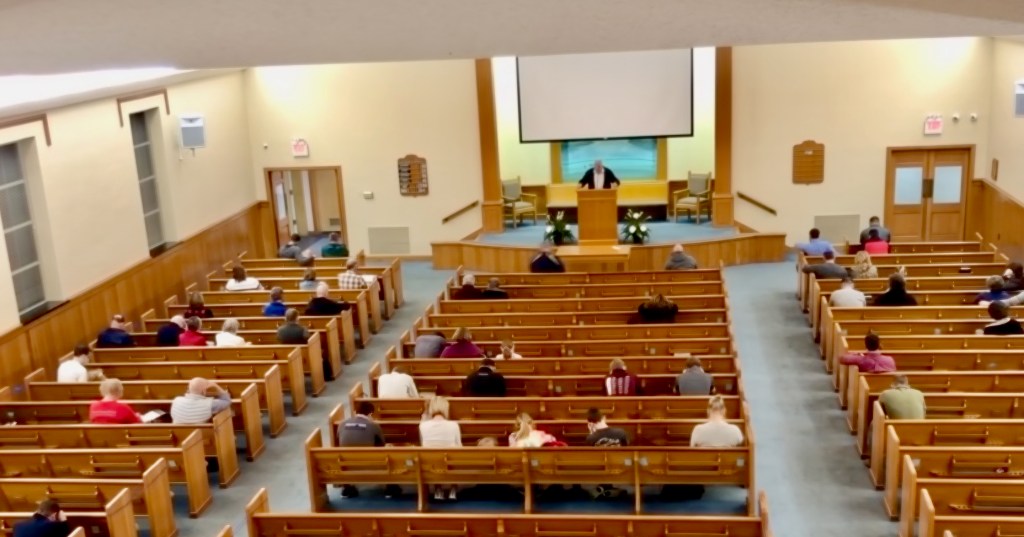
Over 50 members came to pray Tuesday night for our soul-winning plans, including our “Fill The Void” seminar (photo credit: Randy Simpson)


























 The Preacher Pollard Blog