Judah And Boaz

Neal Pollard

There is a very interesting blessing directed to Boaz in Ruth 4:11-12. “Then all the people who were at the gate and the elders said, ‘We are witnesses. May the Lord make the woman, who is coming into your house, like Rachel and Leah, who together built up the house of Israel. May you act worthily in Ephrathah and be renowned in Bethlehem, and may your house be like the house of Perez, whom Tamar bore to Judah, because of the offspring that the Lord will give you by this young woman.’” There are three parts to this blessing and all are framed as comparisons between events in Genesis in the Patriarchal Age and the events of this book.

  1. How Rachel and Leah came into Jacob’s family and how Ruth came into Boaz’s.
  2. How this built up the nation and how they pray for this marriage to continue the same.
  3. How one widow was blessed through deception and sin and how they wanted honorable Boaz and Ruth to be blessed in this admirable arrangement.

The whole, three-part blessing, seems to be a contrast between the lesser (Genesis characters) and the greater (Boaz and Ruth). God had done incredible things through the faulty characters of the former. Leah was at times jealous and bitter. Rachel was conniving and petulant. Jacob was a deceiver. Judah reneged giving his third son to Tamar, who disguises herself as a prostitute to raise up seed to give her a name and place among them. Judah’s character problems in that situation are many and apparent.

The beautiful story of Ruth shows a woman who willingly returns, a widow, with her mother-in-law to be among her people and serve her God. An abiding trust in God’s providence brings about this relationship between Ruth and the highly-honorable Boaz. Unlike Judah’s sons, Boaz accepts his role in this levirate marriage and takes the near kinsman role. This blesses not only Ruth and Boaz, but the once forlorn mother-in-law, Naomi.

God had tremendously blessed the descendants of Jacob, Rachel, Leah, Judah and Tamar, despite their moral failings. In the same lineage, what would He do for Boaz and Ruth? It seems the people are calling on the God who had blessed their weaker ancestors to amplify His goodness and gifts on those who so faithfully acted through this union. What a thoughtful and powerful blessing!

Even when we are faithless, God is faithful, “for He cannot deny Himself” (2 Tim. 2:13). God was fulfilling His promises to Abraham (Gen. 12:2-3). At times, this was accomplished despite the contrary and sinful actions of people. At other times, this was accomplished through the godly, selfless deeds of good people. Knowing that God is always at work (Rom. 8:28), would you like your part to be remembered like Judah or Boaz? Like Rachel and Leah or Ruth?


Standing In The Gap

Prayer is a divine weapon, a sacred act that Satan dreads when wielded by faithful Christians. In the church, prayer is God’s design to weave us into a tight-knit community, binding us closer than proximity ever could. James 5:16 says, “The prayer of a righteous person is powerful and effective.” Intercessory prayer, lifting others before God’s throne, is a duty and privilege that transforms both the pray-er and the prayed-for.

Carl Pollard

Prayer is a divine weapon, a sacred act that Satan dreads when wielded by faithful Christians. In the church, prayer is God’s design to weave us into a tight-knit community, binding us closer than proximity ever could. James 5:16 says, “The prayer of a righteous person is powerful and effective.” Intercessory prayer, lifting others before God’s throne, is a duty and privilege that transforms both the pray-er and the prayed-for.

Why pray for each other? Scripture commands it. Matthew 5:44 urges us to pray even for enemies, fulfilling the call to “love your neighbor as yourself” (Matthew 22:39). Pray for others the way you’d pray for yourself! Colossians 1:9 Paul models ceaseless prayer for others’ spiritual growth, while Galatians 6:2 frames intercession as bearing one another’s burdens, fulfilling Christ’s law. Hebrews 10:24–25 reminds us that prayer knits the church together, spurring love and good deeds. Yet, how often do our prayers default to vague “bless them” pleas or focus solely on physical needs? Intentional intercession digs deeper, aligning with God’s will.

Biblical heroes show us this. Abraham pleaded for Sodom’s salvation (Genesis 18:22–33), mirroring God’s heart for the wicked to turn and live (Ezekiel 33:11). Moses stood in the gap for idolatrous Israel, offering his life to secure their forgiveness (Exodus 32:11–14, 31–32; Psalm 106:23). Jesus, in His High Priestly Prayer (John 17:1–26), interceded for His disciples’ protection, sanctification, and unity, modeling prayers for eternal impact. Paul’s prayers for the churches (Ephesians 1:15–23; Colossians 1:9–12) prioritized spiritual wisdom and strength over physical circumstances.

To pray intentionally, embrace three keys. First, keep God’s bigger story in mind. While praying for safety or healing is valid, God often uses trials to shape us into Christ’s image (Romans 8:28–29; James 1:2–4). Like Jesus in Luke 22:42, balance requests for relief with surrender to God’s will, praying for faithfulness through suffering. Second, use biblical models to form your prayers. The Lord’s Prayer (Matthew 6:9–13) prioritizes God’s will and provision, while Paul’s prayers (Ephesians 3:16–17) seek spiritual depth. Third, pray specifically and with persistence, as 1 John 5:14–15 assures that prayers aligned with God’s will are heard.

Intercessory prayer is a sacrificial act of love, a call to stand in the gap for others, as Moses did, or to plead for unity, as Jesus did. It’s a rebellion against Satan’s schemes, a bridge to connect our church, and a path to spiritual maturity. So, who are you praying for today? Let’s commit to intentional, fervent intercession, trusting God to work mightily through our prayers.

Trust In God

Faith is not a fleeting emotion or a vague hope; it is the foundation of a life surrendered to God. Hebrews 11:1 says, “Now faith is the assurance of things hoped for, the conviction of things not seen.” This is not a blind leap but a resolute trust in the unseen promises of a God who never fails.

Carl Pollard

Faith is not a fleeting emotion or a vague hope; it is the foundation of a life surrendered to God. Hebrews 11:1 says, “Now faith is the assurance of things hoped for, the conviction of things not seen.” This is not a blind leap but a resolute trust in the unseen promises of a God who never fails. Faith is what steadies us when life’s uncertainties threaten to unravel our peace. After all that has happened recently, faith has never been more essential for Christians. 

Scripture offers countless examples of faith in action. Take Abraham, called by God to leave his homeland for a place he did not know (Genesis 12:1-4). He had no map, no clear destination, only a promise from God. Yet he obeyed, not because he saw the outcome, but because he trusted the One who spoke. This is the essence of faith: moving forward when the path is hidden, anchored by confidence in God’s unchanging nature.

Jesus Himself taught that faith doesn’t need to be grand to be powerful. In Matthew 17:20, He said faith as small as a mustard seed could move mountains. This is the truth: God does not demand perfect or unshakeable faith, but simply a heart willing to trust Him one step at a time. Whether facing loss, uncertainty, or fear, faith is the quiet resolve to believe that God is sovereign, good, and working all things for His purpose (Romans 8:28).

In a world that prizes what can be seen and measured, faith sets us apart. It’s not ignorance or denial but a deliberate choice to rest in God’s truth over visible circumstances. When trials come, when the job is lost, the diagnosis is grim, or the future feels uncertain, faith is the anchor that holds us fast. It reminds us that we do not walk alone, because the One who holds all things together is with us (Colossians 1:17).

Faith, then, is both our shield and our strength. It is trusting God’s promises when doubt whispers and hope seems distant. It is the courage to say, “I cannot see the end, but I know the One who does.” And in that trust, we find the peace and power to endure.

The Foreshadowing Of Faith

The Bible’s divine nature never ceases to amaze me. The more I study it, the more I’m convinced it’s God’s Word—perfect, infallible, and life-giving. It’s unlike any other book, offering purpose, wisdom, and a unified story of salvation through Christ.

Carl Pollard

The Bible’s divine nature never ceases to amaze me. The more I study it, the more I’m convinced it’s God’s Word—perfect, infallible, and life-giving. It’s unlike any other book, offering purpose, wisdom, and a unified story of salvation through Christ.

What proves a book is divinely inspired? It must be free of errors, contain knowledge beyond human reach, and fulfill prophecies with precision. The Bible does all this. It reveals scientific truths unknown until recently, remains consistent from Genesis to Revelation, and fulfills thousands of prophecies. The odds of just 48 prophecies coming true by chance are 1 in 10^157—an impossibility for human authors. Isaiah 53 and Psalm 22, written centuries before Christ, detail His suffering with uncanny accuracy. Archaeological discoveries and identical manuscripts further confirm its reliability.

For a moment, let’s explore one proof of the Bible’s divine origin: the parallel between Abraham and Isaac in Genesis 22 and God’s sacrifice of Jesus. Written 2,000 years before Christ, this account mirrors His sacrifice with stunning precision.

1. A Father’s Love: God asked Abraham to sacrifice his beloved son, Isaac (Gen. 22:2). Similarly, God gave His only Son, Jesus, for us (John 3:16). God’s love for humanity surpassed even His love for His Son.

2. The Son’s Obedience: Isaac, a young man, carried the wood for his sacrifice and didn’t resist (Gen. 22:6, 9). Jesus carried His cross to Golgotha, submitting to God’s will (Luke 22:42). Both show obedient trust we’re called to emulate.

3. The Journey: Abraham and Isaac traveled three days to Moriah (Gen. 22:4). Jesus’ ministry led to the cross. Both journeys reflect trust in God’s plan.

4. A Substitute: God stopped Abraham, providing a ram instead of Isaac (Gen. 22:11-13). Jesus, the Lamb of God, became our substitute, bearing our sins (John 1:29).

5. Resurrection Hope: Abraham believed God could raise Isaac (Heb. 11:19). Jesus rose on the third day (1 Cor. 15:4). Both stories proclaim God’s power over death.

6. Blessing for All: Through Abraham’s obedience, God promised blessings for all nations (Gen. 22:18), fulfilled in Christ’s salvation (Gal. 3:16).

Genesis 22 foreshadows God’s sacrifice of Jesus for humanity. Both Isaac and Jesus, only sons, carried the means of their sacrifice. Isaac was spared; Jesus took our place. The Bible points to the One who gives eternal life. Do you know Him?

Chaos

The argument is often made that biblical writers ripped off much older myths and adapted them for a monotheistic faith. The problem with this is that, while creation order and chaos are indeed reflected in many of these legends, that’s basically where the similarities end.

Gary Pollard

“Chaoskampf” is a prominent theme in the myths of Babylon, Egypt, Canaan, Greece, and even the Norse sagas. It’s also in our Bible, but with obvious differences. In the Babylonian tablets collectively called the Enuma Elish, creation begins with a great battle. Marduk defeats Tiamat, a sea goddess who represents chaos. He fashions the heavens and the earth from her remains after defeating her in battle. In Canaanite myth, Baal battles Yam, the sea god, also a symbol of chaos. In Egyptian stories, Ra must overcome the serpent Apep every night—a coiling monster of darkness and disorder (and don’t forget Osiris/Seth). In Norse mythology, at the edge of the world lies Jörmungandr, the world serpent, who they said will one day rise in Ragnarök, the day of final chaos. In Greek mythology, the Titans battle the Olympians and the victors reorder the destroyed world. 

The pattern is the same: a divine being, representing order and stability, faces the chaos of the sea, often personified as a serpent. Genesis 1 is greatly simplified and much cleaner — “In the beginning God created the heavens and the earth. The earth was formless and empty, and darkness covered the deep waters. And the Spirit of God was hovering over the surface of the waters.” The great patriarchs were raised in these traditions: Abraham was from Ur of Babylonia, and Moses was raised and educated in Egypt. Asaph wrote, “With your great power you split open the sea and broke the heads of the sea monster. Yes, you smashed the heads of Leviathan and left his body for the animals to eat. You make the springs and rivers flow, you make the rivers dry up. You control day and night. You made the sun and moon. You set limits for everything on earth, and you created summer and winter” (Ps 74). 

The argument is often made that biblical writers ripped off much older myths and adapted them for a monotheistic faith. The problem with this is that, while creation order and chaos are indeed reflected in many of these legends, that’s basically where the similarities end. Unlike other cultures, whose myths are all about cosmic battles between gods, Moses and Asaph speak of the unchallenged power of the God who tamed the seas and chaos with just his words

Revelation ties this theme up nicely. John says, “Then I saw a new sky and a new earth. The first sky and first earth had disappeared. Now there was no sea. And I saw the holy city, New Jerusalem, coming down from God, down from the sky.” The detail about the sea might seem out of place, but it’s not. “Sea” was often synonymous with chaos, violence, death, and fear. It was personified as a great enemy that had to be defeated. On New Earth, tehom — chaos, the abyss, Tiamat, Leviathan, the sea — is finally gone forever.

Three quick things: 

  1. Chaos is nothing to panic over. We serve the God who calmed the seas with a word (Mk 4). 
  2. God can and does bring order from chaos. Our life might feel “formless and void” but God will ultimately bring order and beauty (Rom 8). 
  3. God has already won — the sea is on borrowed time, Leviathan has lost. 

Weird Dreams

Where do dreams come from and what do they reveal about us? What did the ancients say? How does God communicate with us today? What do we do with what He communicates?

Dale Pollard

        Aspects of our dreams are often a concoction of reality blended with absurdity. You might dream about the house you grew up in but surely that argument with the giant worm wasn’t real. Nobody’s heard a worm speak since probably never. From what you can recall, the argument was over a sweater that the worm was knitting and whether or not it should include sleeves. You don’t remember how the worm was knitting without arms but you remember feeling a heavy and uncomfortable tension in the room when you said, “Just knit a long tube sock and cut the end off.” What seems orderly in dream land often transforms into chaos right after our eyes open. 

Plato acknowledged that dreams could be a source of prophecy or messages from the divine. It’s evident in dialogues like Crito where he touches upon the idea of dreams stemming from an otherworldly source (Crito 1.43a-44b). This was accepted as fact in the world of the Ancient Greeks, but Plato offered his own theories stating that dreams could reveal hidden desires, fears, and impulses that reside within us. He modified a once-popular myth in an attempt to explain the abstract nature of the human soul and— at least partially—what he imagined to be the nature of dreams. Plato likened the human soul to a chariot and charioteer (reason) trying his best to control the two rowdy horses (appetite and spirit). It’s always moving in our mind but the relationship of the driver and the horses is a constant battle between order and chaos. When one sleeps the thundering chariot can no longer be controlled by the driver and those irrational steeds assert themselves and our dreams are born out of the chaos (Phaderus 245c-249d). 

At one point ancient man could talk with God face to face (Gen. 3.18), but this privilege is sharply contrasted in the words of a surprised Jacob when he said, “I have seen the face of God and yet I’m still alive” (Gen. 32.30). In the place of personal interaction with our Creator we were provided with something that, while effective, was not nearly as intimate— dreams. But what they lacked in intimacy, they made up for in mystery. The first words of the first recorded dream in the Bible are, “Behold you are a dead man…” (Gen. 20.3b). This was a terrifying glimpse into the future of the dreamer, King Abimelech. If he didn’t give Abraham’s wife back, he was dead. 

       God spoke to Abraham previously but there seems to be some distinction between a vision and a dream. The word dream occurs fifty-nine times in the Bible and fifty-two of those are found in the Old Testament. When God communicates to a character in the text the reader is either left in the dark as to how He did so or, as in the case of Abimelech, we have the method of transmission stated each time God initially responds. God came to him in a dream “at night” (Gen.20.3a).

God has always desired to communicate with us and that hasn’t changed today. Opening our Bible is what allows Him to have a word with us today, but like Abimelech, our future is determined by what we decide to do with the information received. 

The Hornets Of God

Did God actually send hornets against the Canaanites? What do you think is meant by God sending a hornet before Israel?

Dale Pollard

God not only told the Israelites that He would give them the land of Canaan, He also told them how He would do so. Moses records the very words of God as He explains what the initial steps of the conquest was going to look like and it’s as fascinating as it is strange. 

Angelic (Conditional) Assistance 

“Behold I send an angel before you to guard you on the way and to bring you to the place I have prepared. Pay close attention to him and obey his voice; do not rebel against him, for he will not pardon your transgressions, for my name is in him” (Ex. 23:20-21). 

We’re told that the angel would “go before them” and bring them to pagan armies and peoples such as the Amorites, Hittites, Perizzites, and of course, the Canaanites— to name a few. (V.23). 

The Terror & The Hornet 

After this the reader is thrown a curve ball as two additional names are introduced. 

“I will send my terror before you and will throw into confusion all the people against whom you shall come…” (v.27). 

“…I will send hornets before you, which shall drive out the Hivites, Cannanites, and the Hittites before you” (v.28). 

The angel, terror, and hornet are each different Hebrew words but share a commonality— they go before the Israelites. 

It sounds like these terms could describe three separate beings or forerunners that were meant to accomplish separate tasks. It’s an interesting idea so that’s reason enough to dive in and investigate. Hopefully by the time we come up for air it’ll make more sense. 

Hornets In The Bible 

First, let’s deal with “the hornets.” Only three other times in the Old Testament do we find passages with hornets. Exodus 23:28 is the first time it’s used and here Moses is quoting what God told him that He would do. 

The next occurrence is in Deuteronomy 7:20 where Moses reminds the Israelites just before they storm the Promise Land about those hornets God said he would send ahead of them. 

Finally, the last mention is the most elucidating. In Joshua 24:12 there’s a subtle hint found in most English translations. It says, “And I sent the hornet before you, which drove them out before you…”. All three passages about hornets refer to the conquest event. More importantly, Joshua seems to recall a single hornet rather than multiple hornets. 

Make It Make Sense 

Joshua is the only passage in most translations that describes a singular hornet but the other two passages actually use the same Hebrew word. Meaning, the translators chose to make the hornets plural in two passages but chose to make it singular in Joshua’s account. 

Well, now it’s time to revisit Exodus. Here the angel is mentioned in the singular and then what the angel does to the Lord’s enemies. The angel will bring the Lord’s “terror” on the pagan people which will “throw them into confusion.” The terrified and confused people will “turn their backs” and run from the Israelites. Like a hornet, the angel will literally put the fear of God in them and chase them. Anybody who’s been chased by a hornet will know that fear and madness all too well. 

The guardian angel of the Israelites is mentioned several more times throughout the Old Testament but this particular event showcases the role that their angel played in the conquest of Canaan. It’s probably not talking about literal hornets or even just one nasty hornet that buzzed into battle. You could even argue that Exodus 33:2 further attests to this. It states, “I will send an angel before you and I will drive out the Cannanites, the Amorites, the Hittites…” God explains how He’s going to assist them and then what His assistant is going to do. God’s  angel is going to run off the bad guys like an angry hornet. 

Could God accomplish His will with just one little hornet? I think every believer knows the answer to that— absolutely. 

Show Your Trust

Carl Pollard

In 1799, Conrad Reed discovered a seventeen-pound rock while fishing in Little Meadow Creek. Not knowing what it was made of, his family used it as a doorstop for three years. In 1802, his father, John Reed, took it to a jeweler who identified it as a lump of gold worth about $89,000. That lump of gold, which was used as a doorstop for three years in North Carolina, is one of the biggest gold nuggets ever found east of the Rockies. Until its composition was determined, its value was unknown. 

Until the composition of our faith is determined, its strength is unknown. God will give you the opportunity to prove your faith. What kind of faith will we have? James 2:20-26, “Do you want to be shown, you foolish person, that faith apart from works is useless? Was not Abraham our father justified by works when he offered up his son Isaac on the altar?  You see that faith was active along with his works, and faith was completed by his works; and the Scripture was fulfilled that says, “Abraham believed God, and it was counted to him as righteousness”—and he was called a friend of God. You see that a person is justified by works and not by faith alone. And in the same way was not also Rahab the prostitute justified by works when she received the messengers and sent them out by another way? For as the body apart from the spirit is dead, so also faith apart from works is dead.” 

These two examples could not be any different to the Jewish mind. Abraham, the father of faith, and Rahab, a Gentile prostitute. Abraham was justified by works. 

When was he justified? When he physically took his son to a physical mountain, and placed his physical son on a physical altar. HIS FAITH LED HIM TO DO SOMETHING IN THE WORLD AROUND HIM. What is your faith causing you to do? At some point your faith needs to move from your mind to the world around you. Rahab was justified through the “working of her faith.” Faith demands action. 

It requires Intellect, Emotion, and ACTION. 

Noah had a devoted faith so he believed and obeyed. God told him what was going to happen, and how to avoid the destruction of the world. And Noah believed and obeyed. God has warned us what is going to happen, and how to avoid the destruction of the world. Do you believe that? Then have a devoted faith. A belief that will lead you to devote your life to God. A faith that acts on the word of God. What is the designed end of faith? Why are we to have faith? Because true faith leads to justification (salvation) 

Just like Noah obeyed, and Abraham and Rahab obeyed. 

If Abraham didn’t offer Isaac, what kind of faith is that? If Noah didn’t build an ark, what kind of faith is that? God expects us to have a work of trust. Abraham didn’t know what would happen to Isaac, but he knew God made a promise to Him. Noah spent 100 years building a boat on dry land, but he knew that rain was coming. What will we do with our faith? 

God has warned us of the destruction of our world with fire one day; are you gonna build a boat? He has told us how to be saved–through His son. Many will struggle with dead faith. All talk, no action. Many struggle with demonic faith, God has their intellect and emotion, but He doesn’t have their life. Some have a devoted faith. A trust that is seen through the life they live. What kind of faith do I have? If I don’t have works, if God doesn’t own my life, my faith is no good. 

My belief in God is useless. The only thing that comes from that is regret, because one day we will know exactly why we aren’t in paradise with God. 

We failed to act on our belief.

Devoted Faith

Carl Pollard

In 1799, Conrad Reed discovered a seventeen-pound rock while fishing in Little Meadow Creek. Not knowing what it was made of, his family used it as a doorstop for three years. In 1802, his father, John Reed, took it to jeweller who identified it as a lump of gold worth about $89,000. That lump of gold, which was used as a doorstop for three years in North Carolina, is one of the biggest gold nuggets ever found east of the Rockies. Until its composition was determined, its value was unknown.

Until the composition of our faith is determined, its strength is unknown. God will give you the opportunity to prove your faith. What kind of faith will we have? James wraps up a section in chapter 2 on faith and works with two examples. 

Verses 20-26 say, “Do you want to be shown, you foolish person, that faith apart from works is useless? Was not Abraham our father justified by works when he offered up his son Isaac on the altar?  You see that faith was active along with his works, and faith was completed by his works;  and the Scripture was fulfilled that says, “Abraham believed God, and it was counted to him as righteousness”—and he was called a friend of God. You see that a person is justified by works and not by faith alone.  And in the same way was not also Rahab the prostitute justified by works when she received the messengers and sent them out by another way?  For as the body apart from the spirit is dead, so also faith apart from works is dead.” 

These two examples could not be any different from each other to the Jewish mind. Abraham, the father of faith, and Rahab a gentile prostitute. Abraham was justified by works. When was he justified? When he physically took his son to a physical mountain, and placed his physical son on a physical altar. 

HIS FAITH LED HIM TO DO SOMETHING IN THE WORLD AROUND HIM. 

What is your faith causing you to do? At some point your faith needs to move from your mind to the world around you. Rahab was justified through the WORKING OF HER FAITH. Faith demands action. It requires Intellect, Emotion, and ACTION. Noah had a devoted faith so he believed AND obeyed. God told him what was going to happen, and how to avoid the destruction of the world. 

God has warned us what is going to happen, and how to avoid the destruction of the world. Do you believe that? Then have a devoted faith. A belief that will lead you to devote your life to God. A faith that ACTS on the word of God. What is the designed end of faith? Why are we to have faith? Because true faith leads to Justification (Salvation). Just like Abraham and Rahab obeyed. 

If Abraham didn’t offer Isaac, what kind of faith is that? God expects us to have a work of trust. Abraham didn’t know what would happen to Isaac, but he knew God made a promise to Him. Noah spent 100 years building a boat on dry land, but he knew that rain was coming. 

What will we do with our faith? God has warned us of the destruction of our world with fire one day, are you gonna build a boat? He has told us how to be saved, through His son. Many will struggle with dead faith. All talk, no action. Many struggle with demonic faith, God has their intellect and emotion, but He doesn’t have their life. Some have a devoted faith, a trust that is seen through the life they live. 

What kind of faith do I have? If I don’t have works, if God doesn’t own my life, my faith is no good. My belief in God is useless without works. The only thing that comes from that is regret, because one day we will know exactly why we aren’t paradise with God–if we failed to act on our belief.

Never Give Up!

Jermie Emmanuel

If you like fishing, you know it can be fun; and overwhelming sometimes.

 One  day I was just sitting at home and one of my friends invited me over to go fishing with them,  so I packed my gears and went. On that day I did not catch anything, not even a little fish. On the second I got invited over to go fishing but still I did not catch any fish. On the third day I got invited again so I packed  my gear and went and I caught a big fish! That third trip taught me something, to never give up.

Just like the story of Daniel as we read about in in (Daniel 6:10). He never gave up. He prayed to God three time a day and he never stopped praying and God delivered him from the lion’s den.  

Or the story of Abraham, as we read about it in Romans 4:18-21. He never gave up. He kept believing he would have a son and trusted God. 

 We can also learn something from the story of Job as we read about it in James 5:11. Job didn’t give up when he was suffering. He kept waiting for God’s help.  

 Or as we read in Luke 8:40-48 about the bleeding woman. She didn’t give up trying to be healed. She came to Jesus and he healed her.

Or as we read it in John 17:4. Jesus didn’t give up on saving us!

So we shouldn’t give up either;  just because you are having a bad day or dealing with a life crisis that shouldn’t stop you or discourage you from praying to God. Leave you worries to God. You know that He will never leave you if you keep on seeking Him first. And stay courageous because there’s a happy ending and endless joy in God’s kingdom!

Do not give up!

(Jermie is a refugee originally from the Congo who came to the International Center in Bowling Green. He obeyed the gospel only a few months ago! He was invited by another new Christian and fellow refugee, Jonas Gwishi, who was invited by one of our young adults, Chase Johnson)

Deuteronomy: The Second Giving Of The Law (X)

Why Israel Was Inheriting The Land (9:1-29)

Neal Pollard

The challenge was formidable! The inhabitants still included giants and their fortifications were still high and impregnable (1-2). How would they do it? More to the point, why should they anticipate that it would happen? 

The power and promise of God (3-4a,5). He builds on something he has just said,  “But you shall remember the Lord your God, for it is He who is giving you power to make wealth, that He may confirm His covenant which He swore to your fathers, as it is this day” (8:18). God would be a consuming fire destroying, subduing and driving the natives out of the land (3-4). They could believe this because God had sworn it with an oath to their forefathers, Abraham, Isaac, and Jacob (5; Gen. 12:7). The ark of the Lord would go ahead of them as they invaded Canaan (Josh. 3:11). Consider the prayer the weeping prophet would pray, thinking back to this moment in history, when his people faced a self-induced crisis (read Jeremiah 32:17-22). 

The wickedness of the Canaanites (4-5). God makes a point of it to say that the conquest was not a matter of Israel’s meritorious goodness. He warned against such self-righteousness. He corrects the mindset, stating, “It is not for your righteousness or for the uprightness of your heart that you are going to possess their land, but it is because of the wickedness of these nations that the Lord your God is driving them out before you” (5). Genesis 15:16 had predicted this day would come. Now it was time. Even today, we are saved “not on the basis of deeds which we have done in righteousness, but according to His mercy, by the washing of regeneration and renewing by the Holy Spirit” (Titus 3:5). This should humble us and combat any self-righteousness on our part. 

The righteousness of God (6). This is implied by Moses’ three-fold use of “righteousness” (4,5,6), when the people are told it was not because of their righteousness. The word means “the state of doing what is required according to a standard, the state or condition of fairly deciding what is right in a legal case, without prejudice, and the state of not having any sin or its associated guilt, according to a standard” (Swanson, DBL, np). This does not describe man at his best, much less the conduct of Israel from the moment they left Egypt. Instead, God’s faithful character was bringing this conquest about. They needed to never forget that. Through Christ, we are made the righteousness of God through Him (2 Cor. 5:21). We have no basis to establish our own righteousness (Rom. 10:1ff). Isaiah would describe our righteous deeds, at best, as “filthy garments” (64:6). 

The intercession of Moses (7-29). What a powerful illustration we have in the bulk of this chapter. Moses reviews how they provoked the Lord to wrath, from Mount Sinai through these 40 years in the wilderness (7-8). They were rebellious against God (7,24). They acted corruptly and turned aside (12). They were stubborn and fit for destruction (13-14). They sinned against God (16). They were wicked (27). They needed to clearly understand this to grasp why they were alive to hear this impassioned sermon. In addition to the character of God already mentioned, there was the righteous intercession of their godly, earthly leader. Moses pleaded with God on their behalf. What did he do?

  • He fell down before the Lord (18).
  • He fasted for 40 days and nights (18).
  • He prayed for Aaron and the people (19-20,26).
  • He destroyed what offended God (21). 
  • He appealed to God’s goodness and promises (27-29).

Consider how wonderful it is to know that godly people are praying for us. Many times throughout the years, I have bowed my head in meetings with elders where they prayed earnestly on behalf of their sheep who struggled physically, financially, emotionally, and spiritually. This is in addition to their private petitions. What about the godly women, older and younger, whose ministry includes intercessory prayer? How much have we been spared and what floodgates of blessings have been opened to us because of the righteous prayers of others on our behalf (Jas. 5:16)? Thank God for godly Christians who steadfastly pray for their brethren, for you and me (1 Th. 5:17). May we be people who do that for others, too! 

Genesis: These Are The Generations (L)

Blessing Ephraim And Manasseh (48:1-22)

Neal Pollard

James Smith points out the nine things Jacob does in Genesis 48:

1) He told the story of God’s appearing to him at Bethel.

2) He adopted Joseph’s two sons as his own.

3) He reminded Joseph about his mother, Rachel’s, death.

4) He received his two grandsons.

5) He expressed amazement at God’s grace in seeing Joseph again.

6) He prepared for the blessing of the boys by crossing his hands.

7) He blessed Joseph in the person of the two boys.

8) He prophesies about the two boys’ future.

9) He willed to Joseph’s sons an Amorite sword and bow (the only reference to any war waged by Jacob).

(The Pentateuch, OT Survey Series, p. 224).

This is an excellent summary of the content of the chapter. What can we glean from this encounter that bears a lot of parallels to the encounter he had with his own father in similar circumstances when he stole Esau’s blessing?

Jacob is more theocentric than egocentric. Note how he acknowledges the significance of divine revelation in his past (3). He credits God for His blessings (4). He acknowledges God as the God of his fathers (15) and the guide of his life (15). He encourages Joseph to trust that God will be with him in following His plan (21). Remember how earlier in his life, Jacob relied on his own guile and craftiness. He encountered people, like his father-in-law, who ran a clinic on self-centeredness, and no doubt the object lesson did him some good. He had lived through decades of grief and sorrow, further refining him. Through his many ups and downs, his material prosperities and emotional disparities, Jacob had come to see his need of God through it all.

The book’s themes of blessings, descendants, and land continue. “Bless” (“blessing”) is a key word in Genesis, appearing 72 times in 61 verses. The importance of divine blessing is woven throughout the narrative of the book. “Sons” is found 367 in 302 verses in the book, factoring prominently in the genealogical emphasis of Genesis. “Land” (“earth”) appears 312 times in 252 verses in Genesis. How do they work together? God is responsible for blessing the descendants of His chosen people with a promised land. While we have to wait until the sixth book of the Old Testament to see that promise fulfilled, it was the stated, divine intention from as early as the twelfth chapter of the Bible. Notice how all those elements come together in verse four, as Jacob addresses Joseph: “and He [God Almighty, vs. 3] said to me, ‘Behold, I will make you fruitful and numerous, and I will make you a company of peoples, and will give this land to your descendants after you for an everlasting possession.” Do you see the blessing, descendants, and land? Jacob has Ephraim and Manasseh on his knee for this very purpose. He adopts them among his own sons, and they will both be allotted tribal inheritances. 

The younger is blessed above the older. God’s sovereignty will always prevail, and His choice will reign whatever choices His people make. Jacob supplanted Esau, but God chose Jacob over Esau (Rom. 9). Now, Jacob delivers the firstborn blessing to the younger son, despite Joseph’s overt displeasure. If God moves Jacob to do this, the text is silent about it. But that God approves of it is clear. In the unwinding history of the nation, Ephraim and Manasseh would be the chief tribes of what will become the northern kingdom when the nation divides. They would be more numerous and occupy more land in Canaan. Joseph is honored above his brothers will a “double portion,” having two of his sons in the place of two of his brothers (we see more about that in chapter 49). Among other things, this shows us that God’s power is not magnified more through the bigger, stronger, smarter, and like superiorities mankind may recognize. He exercises His power through choosing to do as He wills. Often, His ways shock and surprise us. As God would later say, “My thoughts are not your thoughts, nor are your ways My ways” (Isa. 55:8,9). 

Jacob will soon be dead. But the promises of God march on! As His people trust in and depend on Him, He is bringing them closer to the fruition of His purpose for them. May we remember that as we serve His Son today. God has a purpose for us and a promised land that awaits us as we faithfully serve Him. Each day we serve, we get closer to the fruition of His precious promises (2 Pet. 1:4). 

Genesis: These Are The Generations (XLVIII)

All Together Again (46:1-34)

Neal Pollard

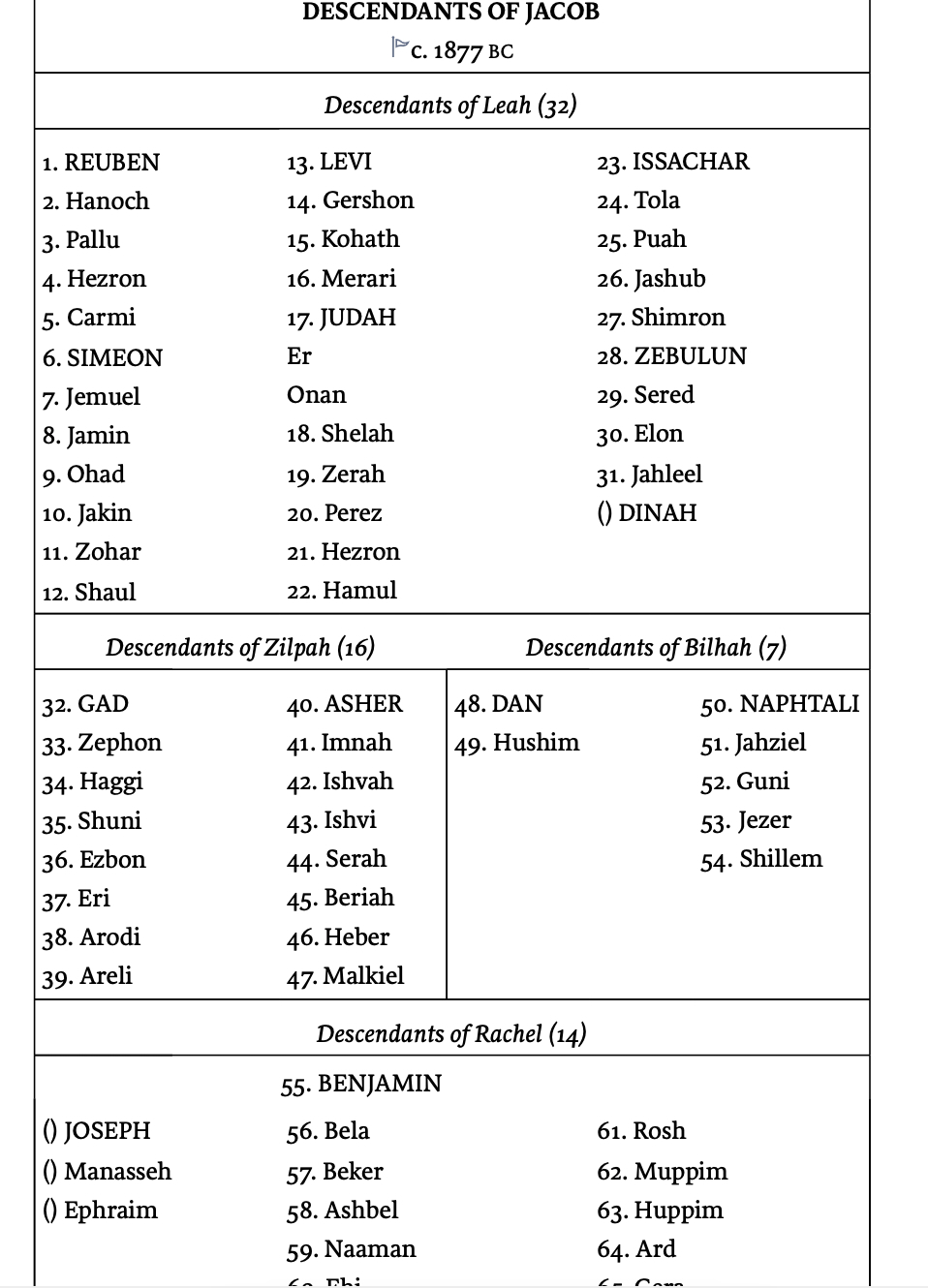
The caravan noted in this chapter will make up 70 in Jacob’s household who will eventually blossom into the nation of Israel (remembering that this is the name God gave Jacob). Moses will revisit this in setting up the bondage period in Exodus 1:5, then review it at the end of his life in Deuteronomy 10:22, while Stephen in Acts 7:14 follows the Greek Old Testament (and Dead Sea scrolls) for the number 75. There are any number of ways to account for the slight disparity in numbers–like asking who was counted or omitted among the sons’ families or Joseph’s sons’ families or how many daughters besides Dinah Jacob had (37:35). The point of this chapter is to emphasize, one last time, the genealogical importance of a family central to the explanation of how the nation of Israel was formed and how the Messianic line was being formed, too. What else might we observe?  

Worship was the first order of business (1-4). The evolution of Jacob’s faith was such that he was compelled to offer sacrifice when he came to the significant place of Beersheba, where his father had built an altar (26:24-25). God reveals Himself to Jacob there and reassures him that this move to Egypt was in accordance with His will. He pledges His presence to Jacob and tells him of the peaceful future that awaited him. Though some of the variables in this situation differ from what we will encounter today, may it be suggested that worship still is powerful and transforming today. God, through His Word, is still revealing Himself to us today and reassures us with His promises and helps us see that our future will be punctuated by eternal peace. 

God’s foreknowledge was demonstrated and His promises fulfilled (5-27). In Genesis 15:13-14, God told Abraham that this was going to happen. Now, about 200 years later, it is occurring. Don’t miss that God tells Jacob’s grandfather, “Know for certain…” (15:13). Repeatedly, the Bible highlights that God keeps His promises (Josh. 21:43-45; 1 Ki. 8:56; 2 Cor. 1:20). 

Truly, God’s promise to Abraham was now being fulfilled (8-27).It is interesting to read what undoubtedly is Egyptian confirmation of the Genesis account of Jacob’s family’s travel from Canaan to Egypt. Wilkinson writes, “A scene depicted on the tomb of Chnumhotep, the near relative and successor of Osirtasen I., at Beni-hassan, represents a company of immigrants, apparently Shemitic in their origin, entering Egypt with their goods, as well as women and children, borne upon asses. Without affirming that this was the Egyptian version of the descent of Israel into Egypt, it may serve as a striking illustration of that event” (‘Ancient Egyptians,’ vol. i. p. 480, ed. 1878; et al). Just one generation after it was only Abraham, Sarah, and Isaac, 70-plus people, enumerated in this paragraph, are filing into Goshen. 

Once again, we are indebted to James Smith for his masterful charts. He gives a summary of the household of Jacob which settles in Egypt in the land of Goshen.

Screenshot

God provided a land of plenty for them to flourish in (28-34). While Canaan is called the land flowing with milk and honey and the destined possession of Jacob’s descendants, what a mark of God’s goodness to provide a place for them to burgeon into a people so numerous that Moses writes, “But the sons of Israel were fruitful and increased greatly, and multiplied, and became exceedingly mighty, so that the land was filled with them” (Ex. 1:7; cf. Ex. 1:12, 20). Goshen was that sector of Egypt where Joseph’s family is given to tend their vast herds of livestock. While we do not know exactly where Goshen is today, we do have clues. Jamie Banister says, “Clues to Goshen’s location are based on the description of the region, seemingly close to the Nile River, and the mention of Pithom and Rameses (Exod 1:11) as supply cities built by the forced labor of the Israelites who were living in Goshen. The general consensus is that Goshen was somewhere along the eastern part of the Nile Delta, probably in or near the Wadi Tumilat, a fertile valley connecting the Nile Delta east to Lake Timsah” (Barry, ed., Lexham Bib. Dict., np.). 

Does it not make us think of God’s goodness, giving every good and perfect gift (Js. 1:17)? Even in time of famine, His children have all they need to fulfill God’s purpose. That does not mean that following God always brings about material prosperity; we know from the whole of Scripture that it may bring tribulation (John 16:33). Yet, we do know God is at work to fulfill His purpose through those of us who serve and follow Him (Rom. 8:28). 

There is a foreshadowing of trouble to come is implied (34). There is a footnote at the end of the chapter, foreboding future events. Shepherds are loathsome to the Egyptians. That was the occupation of this family, and it would be of their descendants. At this time, the Pharaoh’s feelings of indebtedness to Joseph are recent, profound, and strong. But, later, it would not be the case (Ex. 1:8). While there would be additional reasons why later Egyptians would despise Israel (Ex. 1:10), this was an early one. 

Genesis: These Are The Generations (XXVII)

Isaac Travels Familiar Ground (26:1-34)

Neal Pollard

This chapter records three major incidents in the life of Isaac, and it most clearly reveals the character, the ups and downs on this man than any other in Scripture. The content of Genesis 26 can be divided geographically, with his sojourn in Gerar (1-16), his settlement in the valley of Gerar (17-22), and finally his move to Beersheba (23-35). Something significant happens in each location.

GERAR

According to Genesis 24:62 and 25:11, Isaac lived in Beer-lahai-roi from before his marriage to Rebekah all the way up to the time of the famine recorded in Genesis 26:1. This forced Isaac and his family to move in search of food. They came to Gerar (1), where they would have a familiar encounter.  Given the passage of time, we have to assume that “Abimelech” was a title rather than a personal name. Almost a century of time has passed from Abraham’s contact with Abimelech (20:1ff) and this incident. I think Kenneth Mathews explanation is best, that “the name “Abimelech,” meaning ‘my father is king,’ may be a throne name among the rulers at Gerar, as in Egypt’s practice of ‘pharaoh'” (NAC, Vol. 1B, 403). 

He arrives in the same place, encounters a ruler with the same name, is forced to go for the same reason (famine), and makes the same foolish decision as the father. While the events of chapter 20 occurred before his birth, Isaac responds to his crisis of faith strikingly similar to Abraham. Isn’t it interesting that his deception of Abimelech followed the Lord’s appearance and promise to Isaac (2-5). Isaac arrives in Gerar having heard the direction to avoid Egypt and the assurance that He would multiply his descendants, give him this land, and bless all nations through his seed.

“Beautiful” Rebekah (7; 24:16) caught the eye of the locals. Fearful, Isaac traded the same lie his father did concerning his wife by saying she was his sister. This ruse went on for “a long time” (8) until Abimelech witnessed an interaction between Isaac and Rebekah that revealed unmistakably that they were not brother and sister (8). As Abimelech had done with Abraham, Isaac is reprimanded for his deception (10) but also protected from harm (11). Isaac prospers “a hundredfold” that year, blessed by God abundantly (12-14). This did not sit well with the envious Philistines, who in spite filled all his father’s wells with earth (15). 

Abimelech recognizes how God is blessing Isaac, and the Philistine king suggests this powerful man leave their city (16). So, in Gerar we see the grace and generosity of God even with a man struggling with his faith and character. We see the integrity of God, keeping the promise He made to Abraham and reiterating it with Isaac. We see the purpose of God, equipping Isaac for what is to come through the man’s prosperity and power. 

THE VALLEY

Isaac hoped to avoid turmoil and conflict by descending into the valley below Gerar. He re-digs the wells his father had dug and the Philistines had later stopped up (18). Twice, Isaac’s servants dig wells only to have them contested by the locals who claimed the water should be theirs (19-21). Isaac named those wells “contention” and “enmity.” Finally, they dig a well in a completely different area of the valley. This one was not contested, and Isaac named it “Rehoboth” (“broad places”), declaring, “At last the Lord has made room for us, and we will be fruitful in the land” (22). 

This incident in Isaac’s life reveals a strength of character all too rare in the world. He pursued peace, even in the face of aggression. The Philistines goaded him by stopping up his wells, so he leaves them. The inhabitants of the valley contest not one but two of the wells his servants went to the effort to dig, but Isaac peacefully withdraws and eventually digs a well which is uncontested. The late Wendell Winkler once remarked, “He practiced the Sermon On The Mount many hundreds of years before it was given (Matt. 5:38-48). 

BEERSHEBA

Here, Isaac imitates his father’s faith. God appears to Isaac at the place where his father made a covenant with Abimelech and instituted public worship (21:31-33). Now, Isaac is going to enter into covenant with Abimelech after instituting public worship in the same village (25). Abimelech experiences a change of heard regarding Isaac, no doubt swayed by the way God was blessing this patriarch (26-29). They feast together, make oaths to one another, and as icing on the cake his servants find water there. They call the well “Shibah” (“seven” or “full”). 

Do you see an interesting parallel in how this chapter ends with how our own lives can go? Life is definitely going Isaac’s way, spiritually, socially, and materially. He has gained a hard-fought peace with his powerful neighbors. He is worshipping the right God in the right way and is growing and maturing his faith. His financial portfolio is exploding! However, he is battling domestic issues with a son who brings them grief (35). As long as we are in this fallen world, we will be on some sort of roller coaster. Joy will often and regularly be dampened by heartache and disappointment. What Adam and Eve lost in Eden will not be restored on this earth or in this life! We can be faithful overcomers, but we cannot avoid the proverbial wisdom of Job that “man, who is born of woman, is short-lived and full of turmoil” (14:1). 

Genesis: These Are The Generations (XXVI)

The Generations Of Ishmael And Isaac (25:1-34)

Neal Pollard

Genesis: These Are The Generations

The Generations Of Ishmael And Isaac (25:1-34)

Neal Pollard

Here at what we might consider the halfway point of the book of Genesis we read about the death of Abraham. Before his death, he remarried. Her name was Keturah, and she bore him six sons (2). Everybody remembers Ishmael and Isaac, but what about Zimran and Jokshan and Medan and Midian and Ishbak and Shuah (2)? Moses gives a short genealogical record of his descendants through Keturah. It is clear that Abraham became the father of many nations.

It also appears that Keturah is considered a “concubine” alongside Hagar in the inspired record, given the statement in verse six. Whether he had other concubines we do not know. But an impressive table of nations emanates from Abraham’s lineage, which James Smith reveals in one of his trusty charts:

We will see many of these peoples and nations later in Scripture.

Abraham dies an old man (175) and satisfied with life, and he is buried by Ishmael and Isaac alongside his wife in the cave of Machpelah (7-10). The focus now turns to Isaac (11), but only after Moses gives a genealogical account of Ishmael’s descendants (25:12-18). Note at the end of this record, when speaking of their settling to the east and south, that the text says, “he settled in defiance of all his relative” (18b). That entire verse shows the beginning of the fulfillment of Genesis 16:12. Watching current events, we would concur that this Scripture continues to be fulfilled today by Ishmael’s descendants!

Pursuing his examination of the seed promise given to Abraham, Moses is moved to rivet his attention on Isaac. We’re told Isaac’s age (40) at the time of his marriage to Rebekah (v. 20). They would be married 20 years before they have children (26). We’re told that Rebekah is an Aramean (20). Aram (or, Paddanaram) is approximately in the area of modern-day Damascus, Syria. We will see the Arameans intersect with the Jews throughout Old Testament history from Balak (Num. 23:7) to David’s subjugation of them (2 Sam. 8:6) to Ahab’s war with them (1 Ki. 22:1ff). 

History will repeat itself with Isaac and Rebekah experiencing some of what his parents went through. While her struggle is condensed into only one verse, Rebekah was barren (21). Isaac intercedes for her, and she becomes pregnant with twins (21-22). She has a difficult pregnancy! The Lord appears to her, explaining, “Two nations are in your womb; And two peoples will be separated from your body; And one people shall be stronger than the other; And the older shall serve the younger” (23). Perhaps this revelation to her influences the favoritism she shows the “younger” (28). 

Foreshadowing of troubles to come emerge literally from before their births. Esau is born first, but Jacob (“supplanter”) is grasping his heel (26). The boys are a study in contrast. Esau is a hunter and the favorite of his father. Jacob is a homebody and the favorite of his mother. Esau is also revealed to be an impetuous young man, selling his birthright for bread and red lentil stew. Esau is nicknamed “Edom” (red), and his descendants will be the bane of Israel’s existence on numerous occasions. 

The writer of Hebrews offers Esau as a cautionary tale for those who would rashly abandon Christ. He urges, “See to it that no one comes short of the grace of God; that no root of bitterness springing up causes trouble, and by it many be defiled; that there be no immoral or godless person like Esau, who sold his own birthright for a single meal. For you know that even afterwards, when he desired to inherit the blessing, he was rejected, for he found no place for repentance, though he sought for it with tears” (Heb. 12:15-17). Do not let the pull of this temporary world cause you to give us what is infinitely greater and better! 

Through the genealogies, Moses is marching us through the important establishment of the covenant with the very people through whom the Messiah would one day come! So many questions we might have in the New Testament are explained by a careful reading of the first book of the Bible. And they are written for our learning (Rom. 15:4). 

Genesis: These Are The Generations (XXV)

Finding The Right Wife (24:1-67)

Neal Pollard

The spiritual growth of Abraham was so incredible that, though God had blessed him so much in a material sense, he is burdened about finding Isaac a wife God would approve of (1-9). Abraham makes his servant swear by the God of heaven that he would assist him in finding his son a wife in keeping with the promises and protections he had received from the Lord. Abraham expected divine guidance and providence in the process (7-8).

Abraham’s servant sets out on this mission endowed with material goods and livestock for use in luring a potential bride and her family (10-11). Perhaps Gideon later would have had privy to the plan of this servant, or perhaps the practice of seeking a non-miraculous sign of God’s providence was common among the ancients. But, he prays for Isaac’s wife to be the woman who voluntarily draws water not just him but also for the camels (12-14). God answers his prayer while he’s still praying it, and her name was Rebekah. Rebekah is described as beautiful (16), sexually pure (16), and servant-hearted (17-21). Despite God clearly sending what he asked for, the servant still ponders whether or not it was God’s hand (21). What a reminder of the importance to ask God in faith with nothing wavering (Js. 1:6). 

The servants wants to know about her family, and what she tells him causes him to know that not only is she from Abraham’s homeland, but that she is related (22-24). Any doubt he had about God’s intervention is resolved, and “the man bowed low and worshipped the Lord” (26). He exclaimed, “Blessed be the Lord, the God of my master Abraham, who has not forsaken His lovingkindness and His truth toward my master; as for me, the Lord has guided me in the way to the house of my master’s brothers” (27). We are impressed that either Abraham cherished this servant because of his faith, or his faith flourished because he was exposed to the example of Abraham–or maybe it was both. 

Rebekah reports this exchange to her mother’s household. Her brother, Laban, becomes her representative and spokesman. What we come to learn of his character, ultimately, makes us wonder if his angle is financial more than spiritual. The text mentions that he saw the lavish gifts on her wrist before he heard her report (30). Laban welcomes Abraham’s servant, whose motives seem much nobler. Before he will eat or relax after his long journey, the servant recounts the details of his mission and the events that had just transpired (31-49).

Rebekah’s father, Bethuel, and brother are quick to confirm this as providential (50), and they are ready to offer Rebekah in exchange for the gold, silver, and garments for her benefit, and also “precious things to her brother and to her mother” (53). Abraham’s servant worships God again (52). The servant and the men with him enjoy their hospitality, but they are ready to return to Abraham the next day (54). Despite Rebekah’s family’s request that she remain for up to ten days, the servant is anxious to return. The family let Rebekah decide, and she is ready to immediately go (55-59). Her family blesses her and sends her off (60-61).

Isaac and Rebekah’s meeting might even be classified as romantic. Isaac is meditating in the field as she comes in the procession at the close of day. Curious, he walks toward the caravan. She veils herself as they meet, “then Isaac brought her into his mother Sarah’s tent, and he took Rebekah, and she became his wife, and he loved her; thus Isaac was comforted after his mother’s death” (67). 

Isn’t this one of the purest, most inspiring love stories not only in Scripture but in recorded history? A father who placed his son’s spiritual well-being above his portfolio or prestige. A man who trusts his father’s efforts to bless his life. A woman who prepared herself for vast blessings through a lifetime of humble service. A servant who depended on God every step of the way to play his part to get them together. And a God who at work the whole time. Isaac was devastated by his mother’s death, yet comforted by the wife God gave him. 

Genesis: These Are The Generations (XXIV)

Sarah Dies (23:1-20)

Neal Pollard

In our modern world where women typically outlive their husbands, we may find it surprising that Abraham will outlive Sarah by nearly a half century. “The years of the life of Sarah” were 127 (1). She dies in Hebron, in the land their descendants would one day own, and Abraham mourned her loss (2). Afterward, he had practical matters to settle (3). He approaches “the sons of Heth,” descended from Canaan (10:15) and the ancestors of the Hittites. In Scripture, they are typically allies of Israel rather than enemies (2 Sa. 11:3; 2 Ki. 7:6; 2 Chr. 1:17). 

Perhaps it is an overlooked evidence of faith that Abraham wants to buy a burial place in the land promised to but not yet possessed by him (4). Throughout Genesis, we will see more and more of Abraham’s family buried there–Abraham (25:9), Isaac and Rebekah (49:30-31), and Jacob (50:13). After the conquest, Hebron would belong to the inheritance of the nation descended from Abraham.

These proto-Hittites first propose one of their own tombs, but Abraham wants a place of his own that he does not have to share with these generous people (4-6). Not only that, but Abraham names the place, the cave of Machpelah, which he wants to buy from their presumed leader, Ephron (7-9). Ephron wishes to give the cave as a gift to Abraham, but the patriarch wants ownership to be clear for subsequent generations (10-13). Is there a bit of horse-trading humor when, after saying he would give it to Abraham, Ephron says when pressed, “My lord, listen to me; a piece of land worth four hundred shekels of silver, what is that between me and you? So bury your dead” (15). Abraham was listening (16), and paid the full price and was given the deed to the field and the cave along with all the trees in the field (17-20).

By burying his wife there and buying the land, Abraham was making a small downpayment on a place that would someday belong to the nation descending from him. This wife, Sarah, is remembered as really an ideal model for all wives in 1 Peter 3:1-6. She was submissive and obedient to her husband, she did what was right, and she was courageous. The writer of Hebrews likewise exalts her faith to believe that at 90 years old she could become a first-time mother (Heb. 11:11). Her loss was a source of grief and mourning to Abraham. Despite their inevitable foibles and faults, they were a “power couple”! They were driven together by a partnership that embraced the promises of God and “being fully assured that what God had promised, He was also able to perform” (Rom. 4:21). 

Genesis: These Are The Generations (XXIII)

Sacrificing Blessings (22:1-24)

Neal Pollard

Not only is this chapter probably the best-known concerning Abraham’s life, but it is an event repeatedly reflected upon by New Testament writers. Abraham is mentioned 76 times in the New Testament, and this event is explicitly mentioned in Hebrews 11 and James 2. It is definitely a turning point in Abraham’s relationship with God. God has been abundantly supplying Abraham with blessings, the chief of which is this son of promise. Now, God asks Abraham to make a sacrifice for Him. It is called a “test” (1), and any of us can imagine how great a trial it was!

We see the specifics of the test (1-2). God tells Abraham to take his promised son, Isaac, go to the land of Moriah, and offer him as a burnt offering at the spot designated by God. None of these variables could be bypassed or substituted. God gives the place, the item, and the nature of the sacrifice. Of course, we will see Moriah again–first as the site of the temple (2 Chron. 3:1) and later as the site of the cross since Jesus was crucified outside the gates of Jerusalem. Moriah is established early on as the place of important sacrifice and it is always a place where faith is put to the test. 

We see Abraham’s submission to the test. Abraham’s response is almost unfathomable! There is no argument, rationalizing, or protest recorded; instead, Abraham rises early and sets out to obey the rigorous commands of this test (3-5). There is a steadfast determination to obey God from the moment Abraham hears up to the moment he attempts to finish the task (10). 

We see his struggle to complete the test. First, we see it intuitively. Abraham is asked by his God to make Isaac a burnt offering. What he knows and has learned of God seems at odds with the requirement.  Then, there is the physical struggle of the three days’ journey and the climb up Mt. Moriah. All three days are spent walking with Isaac along with his servants. Further, there is the innocent question Isaac has about the specific nature of the sacrifice–Scripture is silent about Abraham’s reply. 

We see his strength in passing the test. Abraham gets to the place God told him about, builds the altar, binds his son, and attempts to slay him (9-10). What fueled the strength is faith (Heb. 11:17-19), and what proved the strength was his faith working (Js. 2:21-22). Forever, the Jews would honor Abraham for such faith and afterward Christians would call for an imitation of such strong faith. 

We see God’s supply in “grading” the test. Reading subsequent statements from God about child sacrifice (Deut. 18:10; 2 Ki. 17:17; Jer. 32:35) and understanding the nature and character of God throughout Scripture, we can look in retrospect and anticipate that God would not allow Abraham to go through with this. Instead, God provides a substitute sacrifice for Abraham (12-13). In fact, Abraham will name the place “Jehovah Jireh” (The Lord will provide)(14). See his faith, promising Isaac on the way up Moriah, saying, “God will provide for Himself the lamb for the burnt offering, my son” (8). At that time, Abraham could not foresee how but he trusted God. May we always remember that through our tests!

The divine supply continues after the ram is offered. The angel of the Lord (the preincarnate Christ who knows that on this spot much later His Father would not stop His being a sacrifice), who stopped the slaying (12) and commended his faith (12), speaks a second time from heaven and reiterates the future blessings Abraham would receive in the land promise (16-17) and the seed promise (18). 

NOTE:

I found a breakdown of this chapter in my Logos Bible software, from a chapel delivered several years ago by Mike Vestal at the Bear Valley Bible Institute. It is a great analysis of the text, with wonderful application. He points out that we have:

  • A call (1)–“Abraham”
  • A response (1)–“Here I am”
  • A command (2)–“Take…go…offer”
  • A response (3)–Six action verbs (beginning with “So Abraham rose…”)
  • Worship (5)–“We will worship…”
  • Preparation for sacrifice (6-10)–Six more action verbs
  • A call (11)–“Abraham! Abraham!”
  • A response (11)–“Her I am”
  • A command (12)–“Do not stretch…do nothing to the lad”
  • Worship (13)–“Abraham went and took the ram and offered him”

His provocative application is, “When God asks you to sacrifice blessings, are you willing to sacrifice?” Our faith will be tested, and when it is we must trust in God’s character and promises. When God reveals His will, we should obey without delay or complaint. When God has spoken, we must not only act but also worship. When we hold back, God blesses more than we ever thought possible. I especially love the observation that Abraham so loved his God that he gave his only son. 

So, Abraham returns to Beersheba with his heart and life revolutionized by this incredible test. His obedience is lauded (18b). His faith is vindicated (5 + 19). Moses rounds off the chapter by giving us the family line from which Rebekah, Isaac’s wife-to-be, will appear. 

Genesis: These Are The Generations (XXII)

A Birth, A Rivalry, And A Covenant (21:1-34)

Neal Pollard

We have constant reminders in the Bible that God keeps His promises, even ones that seem impossible or far-fetched. The chapter begins with the assertion that the Lord “took note” of Sarah, doing what He promised (1; 17:15-21; 18:10-14). The name “Isaac” (laughter) is fitting since both Abraham and Sarah laughed when they were first given the promise from God, but at his birth a different kind of laughter filled their home (6-7). There is abundant joy as this elderly couple welcome the son of promise into their family. Domestic tranquility does not last forever, though. The rivalry that first appeared between Sarah and Hagar has transferred to the next generation.

Ishmael mocks Isaac on the day he is weaned (9). Sarah makes the extraordinary demand that Abraham drive out Hagar and Ishmael, for whom he felt responsibility–especially for his first-born son. Yet, God assures Abraham that what Sarah wants is appropriate (12; Gal. 4:30) and that He will take care of them in the wilderness. He assures Abraham that Ishmael would father a nation, since he was his descendant (13). But “through Isaac [his] descendants would be named” (12).  

Undoubtedly, Hagar is not privy to this revelation Abraham received. She is left to cope with the frightening prospect of fending for herself and her teenage son with only the bread and water Abraham sends her away with (14). She wanders about and when the supplies run out, she braces for their deaths (15-16). They are helpless on their own, but God intervenes. 

I find several interesting parallels between what happens in this chapter with Hagar and Ishmael and what happens in the next chapter with Abraham and Isaac. First, both leave Beersheba at the command of God. Second, each time a son of Abraham faced seeming certain death. Third, neither time do we hear the child speak in protest or self-defense. Fourth, the angel of the Lord speaks in both cases to intervene. Fifth, God makes promises about the descendants of both sons. Finally, God opens the eyes of both parents to see what God provided, for Sarah a well of water and for Abraham a ram. 

God is with Hagar. He develops a life-preserving skill (archery) and his mother finds him a wife from their native Egypt. They live in the wilderness of Paran, a place we first encounter in the wars of Genesis 14:6. It is between Canaan and Egypt, northeast of Mt. Sinai. It will be the site of much of the wilderness wanderings in Numbers as well as the place David goes following Samuel’s death (1 Sam. 25:1ff). 

With the domestic issues settled and Abraham and Sarah fully focused on raising Isaac, a familiar face reemerges in their lives–Abimelech (22-33). He and his army commander can see how God is blessing everything Abraham had and did, and so they want there to be a covenant between the two clans. They swear peace between themselves, but Abraham has a complaint against Abimelech’s servants (25). They had seized the well of water Abraham’s servants were using. Abimelech, seemingly consistent with his character as revealed in Genesis, is totally unaware of such a breach and did not endorse it. Abraham shows great wisdom in gifting sheep and oxen and making a covenant with him (27). Additionally, he provides Abimelech seven ewe lambs, explaining to the puzzled king that they were a witness that he had dug the well at the place he calls Beersheba (“the well of the oath” or “swearing by seven lambs”). 

After Abimelech and Phicol return to the coastal area called here “the land of the Philistines” (32), Abraham plants a tamarisk tree there and worships “the Lord, the Everlasting God” (33). He resides for many days at what apparently was the northern end of Abimelech’s domain (Smith, 160). Abraham continues to do what he has been doing, publicly worshipping his God (12:8; 13:4). 

The table certainly seems set. They have the improbable son of promise. There is no domestic strife or competition between sons to distract the family. They are at peace with their neighbors. Life is good! How often do we encounter the calm before the storms of life, blissfully ignorant of impending crisis? Faith and spiritual strength are built in such times of peace and help us weather the storms that inevitably calm. We will see this more clearly when we turn the page to chapter 22. 

Genesis: These Are The Generations (XXI)

Abraham Deceives Abimelech (20:1-18)

Neal Pollard

God’s choice of people to carry out His plan is never solely based on merit. If so, who could He use? Noah had exceptional, extraordinary faith, but he also struggled with weakness. Abraham is renowned for his faith, but in Genesis 20 he is going to fall back into the same moral trap he had previously laid for himself. In fact, this chapter reveals a habitual failing on his part (12-13). Developing faith is not flawless or perfect, even as it grows and matures. Let’s notice five things in Abraham’s stumbling steps on his road of trusting God’s providence. 

The Deception (1-2). It seems like deja vu, a repeat of the circumstance with the Pharaoh in Egypt (12:11-13). Abraham has journeyed south, back near the border of Egypt. He encounters the king of Gerar, Abimelech, there, and he tells the king that Sarah is his sister. Taking Abraham’s word at face value, Abimelech “sent and took Sarah” (2) in order to make her his wife. 

The Dream (3-7). We know nothing of the man’s character until God comes to him in a dream. Abimelech could declare his blamelessness to God (4), his integrity of heart, and the innocence of his hands (5). God validates his claim and informs him that He had intervened to prevent sin in his interaction with Sarah (6). The heart of God’s message to Abimelech is to restore Sarah to Abraham, a prophet, to have him intervene on his behalf. There is also a warning concerning His wrath if the king disobeys (7). 

The Discussion (8-13). Abimelech’s first discussion is with all his servants, “greatly frightened” at their master’s news (8). There had to be no small amount of righteous indignation when the king addresses the patriarch, asking, “What have you done to us? And how have I sinned against you, that you have brought on me and on my kingdom a great sin?” (9a-b). Abraham receives a deserved, stinging rebuke (9c). The king also shows incredible empathy, wondering aloud what Abraham had experienced to resort to such tactics (10). The best Abraham could do is rationalize that he anticipated widespread unbelief and aggression wherever he went, and telling a half-truth (whole lie!) would keep his wife and himself safe (11-13). You wonder if Abraham could see the flimsiness of his excuse as he said it out loud. 

The Diplomacy (14-16). Abimelech believes what God says about his counterpart, and the offended shows great kindness and generosity to the offender. He endows Abraham with sheep, oxen, male servants, female servants, land, and 1000 pieces of silver. With this, he shows his integrity and character from beginning to end in this matter. 

The Devotion (17-18). The best thing Abraham did in this encounter was pray to God for the king of Gerar. In response, God opened the wombs of Abimelech’s household, wombs he had closed because of the appropriation of Sarah. While there was certainly a lesson for Abimelech to learn concerning the uniqueness and greatness of Jehovah (we will see this king not only in the next chapter, but in the next generation in an eerily similar situation with Isaac in chapter 26), was there also a lesson for Abraham? He had already shown so much faith in his life, going where God said go and believing what God promised. But, he had this blind spot in his faith. 

We should constantly evaluate our faith. Are there any blind spots? Maybe we trust Him in our relationships, but not in our finances. Maybe we are trying to seek Him first in so many areas, but we keep falling into the same bad habits or poor coping mechanisms in some area of struggle. This incident shows us God’s patience and special regard for His children, but it also reveals the need we have for letting our trials and temptations refine us and get us to a better spiritual place. We might occasionally be shamed by those outside of Christ who prove greater integrity than we show in a moment of weakness. That should drive us closer to God and make us trust Him more in subsequent trials! It appears to work that way for Abraham.