
The Assumption Of Moses

Dale Pollard

The Assumption of Moses

 One of the strangest references in the New Testament appears in the tiny letter of Jude. Jude makes a passing reference to a supernatural confrontation that seems to have taken place immediately after Moses’ death:

“But when the archangel Michael, contending with the devil, was disputing about the body of Moses, he did not presume to pronounce a blasphemous judgment, but said, ‘The Lord rebuke you.’” Jude 9

That raises an obvious question:

Why was Satan arguing with Michael over Moses’ body?

The Old Testament tells us that Moses died on Mount Nebo and that God buried him, but it gives no explanation for what happened afterward:

“So Moses the servant of the LORD died there in the land of Moab… and he buried him in the valley in the land of Moab… but no one knows the place of his burial to this day.” Deuteronomy 34.5–6

Jude’s statement is therefore unusual because it introduces a supernatural dispute that is not recorded in Deuteronomy.

The Book of Moses’ Assumption

One ancient Jewish work appears to relate to Jude’s mysterious reference, and it’s called the Assumption of Moses (Assumptio Mosis), a Jewish text probably originating around the first century AD. Early Christian writers knew the work, and Jude’s wording appears closely connected with the tradition.

The second-century Christian writer Origen In De Principiis (On First Principles), Book 3, chapter 2, writes that Michael and the devil disputed concerning the body of Moses and makes mention of the Assumption of Moses as well.

The surviving manuscript breaks off before the relevant material, leaving us with one frustrating gap in the evidence.

Why Did Satan Want the Body?

Ancient commentators offered possibilities, but Scripture never gives us the answer.

One possible explanation relates to Moses’ murder of the Egyptian (Exodus 2.11–12). Satan could have been portrayed as accusing Moses before God because of his past sin.

Another possibility is that the dispute concerned Moses’ body itself and God’s purpose for it. Moses had been uniquely chosen by God, appeared with Elijah at the Transfiguration (Matthew 17.1–3), and had a unique death and burial.

There is also another detail in Jude’s wording. Michael does not personally condemn Satan. Instead, he says:

“The Lord rebuke you.”

The point appears to be that even an archangel doesn’t arrogantly pronounce judgment on Satan by his own authority.

Whatever the original dispute involved, Jude clearly presents it as a genuine supernatural confrontation—interesting enough on its own.

And perhaps the strangest part is what Scripture leaves out.

Moses’ body was buried by God. Its location was never revealed. Yet Jude tells us that, somewhere beyond the human story, “heaven and hell” were apparently concerned with what happened to it.

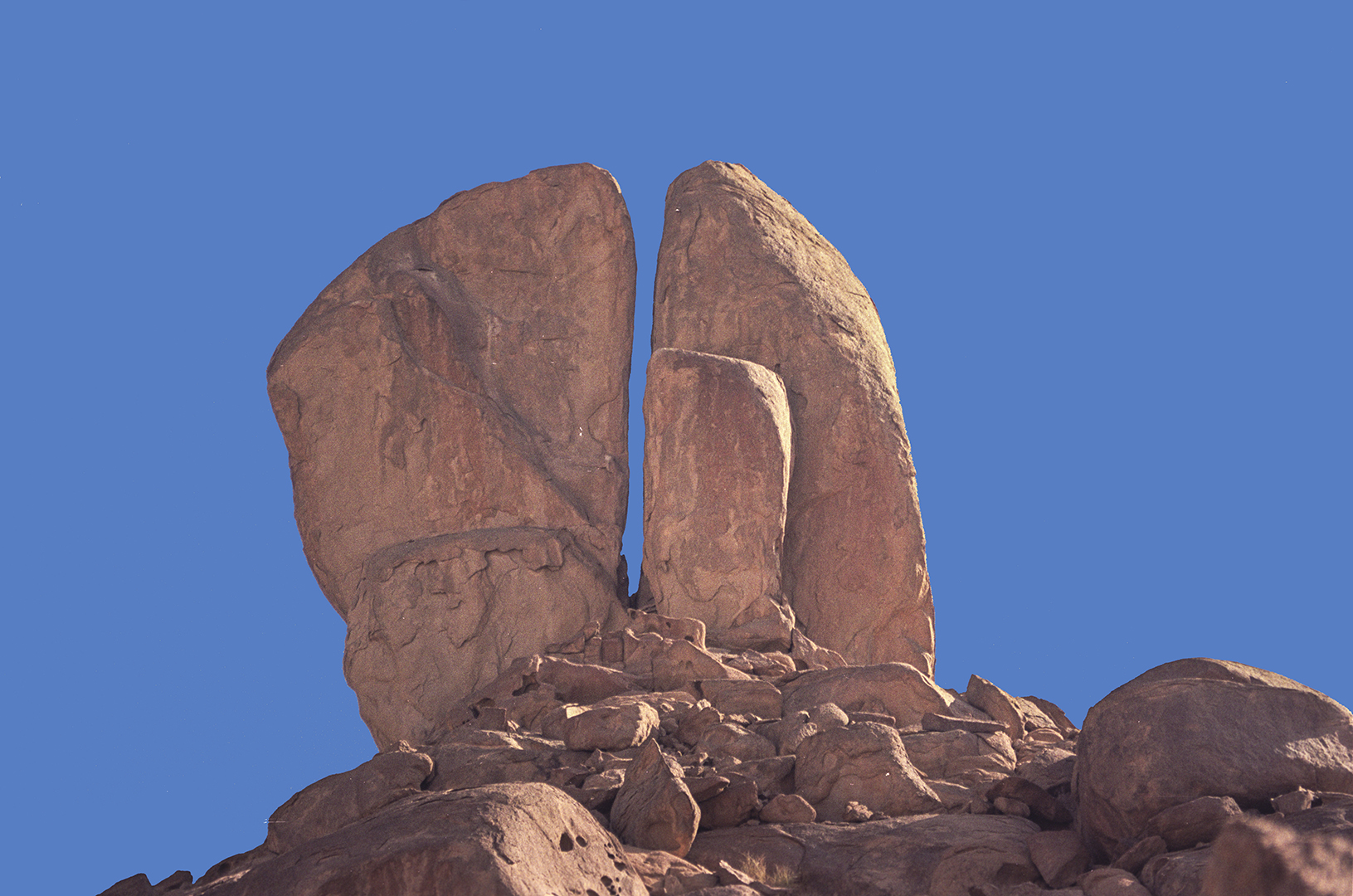
The Split Rock Of Horeb

Rising stark and solemn from the barren Saudi wilderness, the Split Rock of Horeb stands like a silent sentinel of ancient power. Towering nearly 60 feet high, the colossal granite monolith looms over the desolate plain, its weathered and tan flanks are etched by wind and time. But what sets it apart, what seizes the imagination…

Dale Pollard

 —————————————————

It’s not just a rock. 

It’s a rock surrounded by empty silence and scorched earth. It appears, not as a mere geological feature, but a thunderstruck altar where the desert drank. A place where a miracle met stone. 

Rising stark and solemn from the barren Saudi wilderness, the Split Rock of Horeb stands like a silent sentinel of ancient power. Towering nearly 60 feet high, the colossal granite monolith looms over the desolate plain, its weathered and tan flanks are etched by wind and time. But what sets it apart, what seizes the imagination—is the cleft. A prodigious vertical split that is so unnaturally straight it’s as though it were torn by an invisible hand. 

The two halves, still joined at the base, are separated by a gap so wide a man could walk between them. Where is the magic sword from heaven that must have struck it so cleanly? 

At its base, the rock bears smooth channels and grooves—as if torrents of water once burst forth, carving trails into the stone that in wild obedience submit itself to divine command. Light filters through the divide, casting shadows that whisper about that day even to this day.

Yes, the rock still stands. 

Despite centuries of exposure to harsh desert winds, sand, and temperature extremes, the massive split rock remains tall and intact. It has an imposing presence, seemingly sliced vertically in a way that defies typical erosion patterns. The site receives occasional attention, but not too much and rarely up close. 

It’s in a remote, restricted area which is often under military control, and access has historically been limited or even outright prohibited by Saudi powers. 

NO TRESPASSING?

Many of the widely circulated photos and videos of the rock come from unauthorized expeditions, but here’s a couple  stand outs (Ron Wyatt won’t get any attention here). 

Jim and Penny Caldwell

 (1992) 

They were just the average American oil workers living in Saudi Arabia, but with a neat twist.

On numerous occasions they took considerable personal risk by sneaking into restricted areas to document the rock and other sites, including:

  • The Split Rock 
  • The blackened peak of Sinai 
  • Altar-like structures and petroglyphs of bulls (linked to the golden calf story)

Oh, and they had to smuggle all  pictures and footage out of the country. 

Bob Cornuke 

(Late 1990s-Early 2000s)

He was just your average former police investigator, but with a neat twist! 

He collaborated with the Caldwells and visited the site to gather photographic and testimonial evidence. His trips were perfectly reasonable, just slightly (ok, entirely) unauthorized and clandestine.

Other explorers have faced interrogation, arrest, or deportation by Saudi authorities and the government has since built a fence around Split Rock. Access is now heavily restricted or off-limits to the public. 

                      ————————-//————————

Bonus Neat 

Local Bedouins have called it the “Rock of Moses” for generations and their oral traditions speak of how water once flowed from it. Some Bedouins avoid the site entirely. 

Bread Facts 

“And the LORD said to Moses, ‘Pass on before the people, taking with you some of the elders of Israel, and take in your hand the staff with which you struck the Nile, and go.

I will stand before you there on the rock at Horeb, and you shall strike the rock, and water will come out of it, and the people will drink.’ And Moses did this in the sight of the elders of Israel.”

Exodus 17:6-7 

(see also, Numbers 20:1–13) 

The Hornets Of God

Did God actually send hornets against the Canaanites? What do you think is meant by God sending a hornet before Israel?

Dale Pollard

God not only told the Israelites that He would give them the land of Canaan, He also told them how He would do so. Moses records the very words of God as He explains what the initial steps of the conquest was going to look like and it’s as fascinating as it is strange. 

Angelic (Conditional) Assistance 

“Behold I send an angel before you to guard you on the way and to bring you to the place I have prepared. Pay close attention to him and obey his voice; do not rebel against him, for he will not pardon your transgressions, for my name is in him” (Ex. 23:20-21). 

We’re told that the angel would “go before them” and bring them to pagan armies and peoples such as the Amorites, Hittites, Perizzites, and of course, the Canaanites— to name a few. (V.23). 

The Terror & The Hornet 

After this the reader is thrown a curve ball as two additional names are introduced. 

“I will send my terror before you and will throw into confusion all the people against whom you shall come…” (v.27). 

“…I will send hornets before you, which shall drive out the Hivites, Cannanites, and the Hittites before you” (v.28). 

The angel, terror, and hornet are each different Hebrew words but share a commonality— they go before the Israelites. 

It sounds like these terms could describe three separate beings or forerunners that were meant to accomplish separate tasks. It’s an interesting idea so that’s reason enough to dive in and investigate. Hopefully by the time we come up for air it’ll make more sense. 

Hornets In The Bible 

First, let’s deal with “the hornets.” Only three other times in the Old Testament do we find passages with hornets. Exodus 23:28 is the first time it’s used and here Moses is quoting what God told him that He would do. 

The next occurrence is in Deuteronomy 7:20 where Moses reminds the Israelites just before they storm the Promise Land about those hornets God said he would send ahead of them. 

Finally, the last mention is the most elucidating. In Joshua 24:12 there’s a subtle hint found in most English translations. It says, “And I sent the hornet before you, which drove them out before you…”. All three passages about hornets refer to the conquest event. More importantly, Joshua seems to recall a single hornet rather than multiple hornets. 

Make It Make Sense 

Joshua is the only passage in most translations that describes a singular hornet but the other two passages actually use the same Hebrew word. Meaning, the translators chose to make the hornets plural in two passages but chose to make it singular in Joshua’s account. 

Well, now it’s time to revisit Exodus. Here the angel is mentioned in the singular and then what the angel does to the Lord’s enemies. The angel will bring the Lord’s “terror” on the pagan people which will “throw them into confusion.” The terrified and confused people will “turn their backs” and run from the Israelites. Like a hornet, the angel will literally put the fear of God in them and chase them. Anybody who’s been chased by a hornet will know that fear and madness all too well. 

The guardian angel of the Israelites is mentioned several more times throughout the Old Testament but this particular event showcases the role that their angel played in the conquest of Canaan. It’s probably not talking about literal hornets or even just one nasty hornet that buzzed into battle. You could even argue that Exodus 33:2 further attests to this. It states, “I will send an angel before you and I will drive out the Cannanites, the Amorites, the Hittites…” God explains how He’s going to assist them and then what His assistant is going to do. God’s  angel is going to run off the bad guys like an angry hornet. 

Could God accomplish His will with just one little hornet? I think every believer knows the answer to that— absolutely.