For a long time it seems that every October when this ancient holiday comes around many issues come with it. Somebody will undoubtedly bring up their problems with this holiday, but are they right? If they are, I suspect there will have to be a major change in many Christian families around the US. The ancient holiday really did have some creepy and messed up origins. It was originally a day set aside for the dead. More specifically, the people’s deceased relatives (history.com). To try and communicate with their loved ones, they would perform many rituals. The idea of masks came later when people would try and ward off the evil spirits. They hoped that the masks would help them to blend in, or even scare them off. It’s understandable that this would make some people wary of this holiday. Claims have been made against this day that it is a “satanic holiday,” is this true?
In order to answer this question we need to look at what Halloween is today. I suppose there are those out there that may attempt to spend their halloween nights trying to duplicate the practices of the olden times. On the whole, Halloween is a day for kids. It’s a time for children to dress up, walk around the neighborhood and stuff themselves with candy. Like most things in this world, it can be a day that is abused. Any day, can be a day that is abused. Most people are not thinking about the devil, or trying to worship the devil. When it comes down to it, Halloween controversies are not salvation issues. It only becomes wrong when we try and force an unbiblical opinion on somebody else. This goes either way. If somebody’s conscience is affected by the celebration of Halloween, we should not be a people that try and convince them otherwise (Acts 24:16). We can explain if they’re interested, but that’s probably where we should leave it in order to maintain unity (Ephesians 4:3).
The Herodian dynasty actually began during the civil wars of the first century B.C., when Palestine passed from Hasmonean (a Jewish family that included the Maccabees) into Roman rule. “The name ‘Herod’ is Greek and originated with a shadowy ancestor about whom, even in antiquity, little was known. Two ancient traditions make him either a descendant of a notable Jewish family with a lineage traceable to the Babylonian exile or a slave in the temple of Apollo in the Philistine city of Ashkelon. Neither can be proved” (Achtemeier 385). For well over a century and a half, the Herods would figure prominently in the Roman government under a multitude of emperors from 67 B.C. to about 100 A.D. The first ruler of this dynasty is Antipater I, who is appointed governor of Idumaea by the Hasmoneans. The Idumaeans are forced to “convert” to the Jewish faith, making them Jews at least in name. Meanwhile, Antipater’s son, Antipater II, through military and political savvy, earned Roman citizenship for his family and positions of power for his oldest two sons, Phasael and Herod. The latter was named governor of Galilee and was ultimately known as “Herod the Great.”
“Herod the Great” is the first of this dynasty to be mentioned in Scripture. He has a long reign characterized by guile, violence, and political alliance. By the time we read about him at the birth of Jesus, he’s months from dying. He had had ten wives and borne several sons who would fight with each other before and after his death. He had won acclaim among the Romans for his grandiose building projects, including the city of Sebaste, Strato’s Tower, Caesarea Maritime, Masada, Machaerus, the Herodium in Perea, the Alexandrium, Cypros, Hyrcania, and the Herodium southeast of Bethlehem (ibid. 386-387). No doubt his greatest architectural achievement was the extravagant rebuilt Jewish temple in Jerusalem, which the disciples of Jesus took such great pride in (Mark 13:1).
This Herod is shown to be cunning (Mat. 2:7), deceitful (Mat. 2:8), violent-tempered (Mat. 2:16), and vicious (Mat. 2:16-19). Information gleaned from outside the Bible confirm these character traits. Josephus especially chronicles Herod’s depravity with reams of material about murders he committed, intrigues he entered into, and power struggles he fought (Antiquities 14-18). Blomberg observes,
It is often observed that there are no other historical documents substantiating Herod’s “massacre of the innocents.” But given the small size of Bethlehem and the rural nature of the surrounding region, there may have been as few as twenty children involved, and the killings would have represented a relatively minor incident in Herod’s career, worthy of little notice by ancient historians who concentrated on great political and military exploits (68).
In addition to what we read of him in Matthew 2, “many of Herod’s building projects serve as backdrops for events of the New Testament” (Winstead, n.p.). Bethlehem is near the Herodium. Gospel writers repeatedly reference his rebuilt Jerusalem temple (John 7-10). The book of Acts refers to his coastal city of Caesarea, called Caesarea Maritima (Acts 8; 21:8; 23:33)–different from Caesarea Philippi in Matthew 16:13. As a living legacy to his wickedness, three of his sons disputed over what and how much territory they would rule. Augustus Caesar settled the matter by dividing the kingdom “but withholding the royal title of “king” from all of the heirs” (Garcia-Treto 378).
The most notable thing about a man who pursued and was granted a measure of earthly greatness is the contrast between himself and the baby Jesus, “king of the Jews” (Mat. 2:2). He sought power and greatness. Jesus emptied Himself to be born in our likeness (Phil. 2:5-7). Herod sought self-preservation, but Jesus came for our preservation (1 Tim. 1:15). Herod jealousy guarded his position, but Jesus “gave the right to become children of God” (John 1:12). We will see the contrast between Jesus’ kingdom and the sordid legacy of King Herod, revealed in what the Bible says of his wicked descendants.
Sources Cited
Achtemeier, Paul J., Harper & Row and Society of Biblical Literature. Harper’s Bible dictionary 1985 : 385. Print.
Blomberg, Craig. Matthew. Vol. 22. Nashville: Broadman & Holman Publishers, 1992. Print. The New American Commentary.
Garcia-Treto, Francisco O. “Herod.” Ed. Mark Allan Powell. The HarperCollins Bible Dictionary (Revised and Updated) 2011 : 378. Print.
Winstead, Melton B. “Herod the Great.” Ed. John D. Barry et al. The Lexham Bible Dictionary 2016 : n. pag. Print.
Herod’s Palace at Masada (Photo Credit: Kathy Pollard, July 2017)
The life of a true Christian is filled with change. We learn where we are weak, and try to be better. It’s kind of like a never ending home improvement project. There will always be areas of our spiritual walk with God that could be better. Because this is the case, many religious books, sermons and Gospel meetings are created around a theme that will help us to grow. In the Church there is a plethora of information to help us in our Christianity, but I want to focus on the basics and answer a vital question. What does it mean to be a Christian?
I want to answer this question with a passage in scripture that we may not immediately think of. We may think of 1 Timothy 1:5, or 2 Peter 1:5-7, which are great verses, but I’d like to suggest that Jesus in Luke 18:15-17 gives us the bottom line of Christianity.
It reads, “Now they were bringing even infants to him that he might touch them. And when the disciples saw it, they rebuked them. But Jesus called them to him, saying, “Let the children come to me, and do not hinder them, for to such belongs the kingdom of God. Truly, I say to you, whoever does not receive the kingdom of God like a child shall not enter it.”
Jesus teaches the importance of humility. You want to enter the Kingdom of God? Have an attitude of humility. He uses the example of children, and Luke even uses the Greek word for infant. These are very young kids and babies that are being brought to Jesus. So He uses this as a moment to teach a valuable lesson.
Babies show their humility in their inability to provide for themselves. Every child that is born is completely dependent on its parents and has a wholehearted trust in them to provide what they need. What does it mean to be a Christian? It means being humble enough to admit that we need God. It means we trust in God, rather than our own “power.”
Humility plays an important role in every aspect of Christianity. It helps with showing love to others, it helps us subject ourselves to God’s Word, it helps us treat others the way we want to be treated, it helps us accept the hard topics that scripture contains, and the list goes on and on.
Do you want to be a part of the Kingdom? Make humility an everyday practice. That is what it means to be a Christian.
I wonder if Kathy felt like she was living with Briscoe Darling and the boys (imagine them if they were talkative) through the years they were growing up. She is refined and genteel, words that are not usually connected to our three sons and me. One thing she impressed upon us was the importance of timely, thoughtful thank you notes. Gratitude, though it can be expressed with very little time and expense, is telling. It acknowledges the kindness and generosity of the giver.
One of the elements of worship, generally, and prayer, specifically, is thanksgiving. Our songs call for it: “Give Thanks With A Grateful Heart,” they express it: “Thank You, Lord,” “For All That You’ve Done,” “How Great Thou Art,” “10,000 Reasons,” and “He Has Made Me Glad.” Though that songwriter, Leona Von Brethorst, apparently wrote the song from Psalm 100, she includes a line from Psalm 118:24: “This is the day that the Lord has made.”
Five times in Psalm 118, the psalmist says “give thanks” (1,19,21,28,29). He urges others to do so, but also expresses his resolve to do the same. Why?
GIVE THANKS FOR HIS GOODNESS (1-4)
“Good” is a general word that takes in pleasantness, desirability, and beauty. The good quality specified here is His everlasting mercy (lovingkindness). The writer moves from the broad to the specific–Israel, house of Aaron, those who fear the Lord. Everyone is the object of God’s lovingkindness. The righteous freely express their thanks for it.
GIVE THANKS FOR HIS DELIVERANCE (5-13)
There is a sudden, dramatic shift in tone in verse five. From an upbeat, positive tone, he turns to thoughts of trouble and difficulty. Distress, hatred, being surrounded, and violence threatened him, but God was there for him as protection and help. This kept him from fearfulness. It gave him refuge.
It is an amazing thing to think of all the ways and times God has been with me, but those are just the instances I’m aware of. How many trials has God spared me from, disasters has He caused me to avoid, and troubles has He averted for me that I won’t know about on this earth? Just what I do know humbles me, and it should fill my heart with gratitude.
GIVE THANKS FOR HIS GREATNESS (14-17)
The writer turns to the Giver. He is strong, a Savior, valiant, and exalted. Summarizing God’s qualities, the writer says, “I will not die, but live, And tell of the works of the Lord” (17). Awareness of who God is for me, physically, materially, and spiritually, will drive me to grateful thanks.
GIVE THANKS FOR HIS DISCIPLINE (18)
Though it is almost a parenthetical phrase in the middle of this song of thanksgiving, it is important and an additional reason for gratitude. He writes, “The Lord has disciplined me severely, But He has not given me over to death.” Who is brave enough to say that with the psalmist? He implies gratitude for God’s severe discipline. Hebrews 12:7-10 tells us that God disciplines those He loves and calls His children. It is for our good and allows us to share His holiness. Can I thank Him for the trials and challenges that refine me and grow my dependence on Him? Or do I just plaintively ask, “Why?”
GIVE THANKS FOR HIS PROVISION (19-29)
He uses the imagery of a city here–gates, stones, and chief corner stone. Then, he ends with a temple analogy, with the house of the Lord, festival sacrifice, and the horns of the altar. Saved inside God’s walls of protection, we are free to offer worship which He accepts. We marvel, we rejoice, we are glad, we prosper, and we extol. He has given us light. The primary thrust is not material, but spiritual. However prosperous or impoverished you are, financially, however strong or weak you are, emotionally, we have the greatest provision of all in Christ. Eternal salvation, the hope of heaven, fellowship with God and the saved, the church, strength to endure, the list is endless.
Today, as you go through the day, why not stop and spend time in prayer to God thanking Him categorically: physical blessings, relationship blessings, emotional blessings, national blessings, and spiritual blessings. No doubt, there are things in your life right now that are dissatisfying and disappointing. You may be struggling mightily. Perhaps those are ways God is disciplining you in His love. Whatever is happening in your life, choose to give thanks and know God is trustworthy! It’s more than polite. It’s righteous!
When I get discouraged, I read a few specific verses. They will hopefully encourage you, too!
Philippians 3.20f: But we are citizens of heaven, where the lord Jesus Christ lives. And we are eagerly waiting for him to return as our savior. He will take our weak mortal bodies and change them into glorious bodies like his own, using the same power with which he will bring everything under his control.
Romans 8.1-4: So now there is no condemnation for those who belong to Christ Jesus. Because you belong to him, the power of the life-giving spirit has freed you from the power of sin that leads to death…God did what the law could not do. He sent his own Son in a body like the bodies we sinners have. In that body God declared an end to sin’s control over us by giving his Son as a sacrifice for our sins. He did this so that the just requirement of the law would be fully satisfied for us, who no longer follow our sinful nature but instead follow the Spirit.
I Corinthians 15.51-53: But let me reveal to you a wonderful secret. We will not all die, but we will all be transformed! It will happen in a moment, in the blink of an eye, when the last trumpet is blown. For when the trumpet sounds, those who have died will be raised to live forever. And we who are living will also be transformed. For our dying bodies must be transformed into bodies that will never die; our mortal bodies must be transformed into immortal bodies.
II Corinthians 4.16ff: That is why we never give up. Though our bodies are dying, our spirits are being renewed every day. For our present troubles are small and won’t last very long. Yet they produce for us a glory that vastly outweighs them and will last forever! So we don’t look at the troubles we can see now; rather, we fix our gaze on things that cannot be seen. For the things we see now will soon be gone, but the things we cannot see will last forever.
II Corinthians 5.1-4: For we know that when this earthly tent we live in is taken down (that is, when we die and leave this earthly body), we will have a house in heaven, an eternal body made for us by God himself and not by human hands. We grow weary in our present bodies, and we long to put on our heavenly bodies like new clothing. For we will put on heavenly bodies; we will not be spirits without bodies. While we live in these earthly bodies, we groan and sigh, but it’s not that we want to die and get rid of these bodies that clothe us. Rather, we want to put on our new bodies so that these dying bodies will be swallowed up by life.
God speaks of Himself as simply “I Am.” This is one powerful statement depicts His infinite presence and His existence through every age. What does it mean to know Him? How do you know if you do? To know of Jesus is very different than knowing Him.
John is one of those books in the New Testament that will help us to become better aquainted with the Christ. John paints us a vivid picture of who He was and is on a deeper level than even the three previous books.
He’s the Bread of life, Light of the world, the Gate, Good Shepherd, Resurrection and Life, the Truth, and the Vine. All of these titles found within the book teach us a little more about the Savior of the world. There are seven “I Am” statements in John referring to Jesus and three hundred throughout the entire Bible. They begin in Genesis and end in Revelation, and in many books in-between. You just can’t read very far without discovering something very profound about it’s Writer.
He’s eternal. God’s desired response to this is simply for us to believe, respond, and live with our minds and hearts prepared to live with Him. When Jesus describes Himself as the “I Am” it makes the religious leaders want to kill Him in John 8. To know Jesus, to really know Him, is something that many people have not fully understood. Even as Jesus walked among us mortals and witnessed His miraculous power there were still several that didn’t realize what it meant to follow Him Luke 9:57-62.
While it’s true that everyone is made in the image of God, few reflect the Father’s image. Those that know Jesus introduce others to Him. With the knowledge that we are imperfect, let’s not forget that we also have the ability to have a relationship with Him. I am flawed and I am weak, but the Great I Am is interested in who I am.
By the grace of God, I am His child. He is the bread of life that sustains us, the light that guides us, the gate we’ll walk through, and the truth that will save us. It’s not how great I am, but how great the Great I Am is. Do you know Jesus?
Jesus has come to Jerusalem and taken the gloves off. By His unparalleled authority, He is directly challenging the religious establishment whose shallow righteousness has been rejected by His Father. He has come to take the Old Law out of the way and establish His church. It’s teaching like this parable in Luke 20:9-18 that will provoke those leaders to the point that they will trump up charges and bribe false witnesses to arrest, try, and have Him crucified. This parable is stark and shocking, and the moral as heavy as an anvil. Notice.
THESE LEADERS WERE GUILTY OF IMPROPER STEWARDSHIP (9). The “man” in the parable represents God, the Father. He made Israel a nation and gave the Jews a Law to follow and keep. The Jews, particularly the religious leadership, were entrusted with faithfully carrying it out, but they did not.
THEY WERE GUILTY OF TAKING WHAT DIDN’T BELONG TO THEM (10). In fact, these leaders–dubbed “the vine-growers” by Jesus in this parable–thought that they were in charge. They sought to make people subject to them, to follow their rules (cf. Rom. 10:3-4). The end result was vain religion (Mat. 15:8-9).
THEY WERE GUILTY OF ABUSING THOSE SENT TO THEM (11-15). The “slaves” sent to them were presumably prophets and teachers, no doubt inclusive of John the Baptist. These were the Father’s spokesmen, come to teach and correct them. Each one sent was treated the same, sad way: they “beat him and sent him away empty-handed.” Last of all, the son was sent (13-14). The “owner” (the Father) sent Him, saying, “I will send my beloved son; perhaps they will respect him” (13). Instead, seeing Him as the heir, they plotted to kill Him (14). Obviously, Jesus is referring to Himself and the very thoughts these religious leaders were thinking as He told the parable!
THEY WERE GUILTY OF LOSING WHAT WAS ENTRUSTED TO THEM (16-18). Instead of being convicted by this parable, these religious leaders recoil at the moral of the parable: “What, then, will the owner of the vineyard do to them? He will come and destroy these vine-growers and will give the vineyard to others” (15-16). Their emotion boils over and they audibly reply to Jesus’ parable, “May it never be!” They missed the travesty of the behavior they and their forefathers had shown to God’s messengers and the sin they were about to perpetrate on His Son. They didn’t want to lose their grip on the power and influence they had taken. But Jesus doubles down, changing the imagery from a vineyard to building construction. They were going to reject Jesus, the stone, but He would be made the chief corner stone. He would judge and destroy them, if they did not abandon their rebellion.
Jesus is full of love, kindness, and peace. But, that’s an incomplete picture of Him. He came to establish His rule and reign. He must be King and Lord of our lives. We must submit to His way and truth to enjoy His life.
On August 13, 2004, Hurricane Charley brought fierce destruction to areas of Florida. During the storm, 25-year-old Danny Williams went outside to find protection under the branches of a 55-year old banyan tree. Friends and family said that Danny saw this tree as a peaceful place. But on that day, his place of safety became a death trap. The tree fell on Williams and killed him.
Sometimes, the places and situations we look to for protection can ultimately be the most harmful. When it comes to finding peace, the world often looks for it in all the wrong places. What many believe will bring peace and comfort usually brings pain and harm.
Paul would say in Col. 3:15, “And let the peace of Christ rule in your hearts, to which indeed you were called in one body. And be thankful.” The word “peace” that Paul uses here is defined as “a state of well-being.” Let this state of well being that comes from the Messiah rule in your hearts. How? We aren’t able to physically be around Christ, so how does this happen? Notice the very next verse, “Let the word of Christ dwell in you richly.”
This peace (state of well-being) comes from a steady diet of His Word. Specifically here we do this by singing songs centred around the Words of Life. We follow the Bible because it brings peace when we fill our lives with its words.
Peter would say in 2 Peter 1:2, “May grace and peace be multiplied to you in the knowledge of God and of Jesus our Lord.”
“Grace and peace be multiplied” how? Grace and peace multiplied through a knowledge of God and Christ. The French have a proverb which states, “A good meal ought to begin with hunger.” It is hard to enjoy a meal when you are not yet hungry. But, when you are hungry, almost anything tastes good. If we approach the Word with a hunger to be satisfied, we will be satisfied every time. True peace begins with a hunger for God and His word. The Bible gives peace to those who hunger for what it contains.
We’re impressed by the intricacies of craftsmanship or artistry. A well-made instrument or diorama or painting can sell for thousands or more. Watching the process of those things coming to life leaves an even more profound impression of the talent required! I’ve lost track of time while watching hyper-realistic dioramas take shape (by other artists, not me). The sheer effort involved is incredible. While those artists are very, very talented and impressive, they’re nothing compared to reality’s architect! Hours, weeks, or months are invested in breathtaking artwork, yet those pieces come from extant materials and are based on extant concepts. Humanity cannot create anything new. It took God less than a week to fabricate an unfathomably large universe. We explore and investigate our world, only to be blown away by its complexities. Even the simplest life forms require highly intelligent minds and sophisticated equipment to understand. The more we discover, the more we understand how little we know. For several years, science has been adopted by many as an explanation for reality. Besides the fact that science is merely our observations of what already exists, it still leaves plenty of questions unanswered. For example, look into how many medications say something like (paraphrased, of course), “We don’t know how this works, but we think it…” We can perform complex surgeries using robots, but we can’t cure the common cold. We can explore our galaxy, but we’re not sure how exactly some antidepressants work to alleviate symptoms. Humanity has accomplished some amazing things, but even the most “basic” issues continue to evade our understanding. Therefore, it isn’t entirely unreasonable to assume that something or someone intelligent was responsible for our incredible existence. Our greatest accomplishments pale in comparison to the magnitude of our universe. Every great piece of art has an artist behind it. Every piece of groundbreaking technology has a design team behind it. Our universe must have also had an immensely powerful, creative, compassionate designer. Far from somehow disproving the existence of God, our greatest accomplishments merely highlight how powerful God really is. He gave us a beautiful world and way more than we need to survive. The sheer beauty of this planet alone should tell us that our God is a loving God. “I look at the heavens you made with your hands. I see the moon and the stars you created and I wonder, ‘Why are people so important to you? Why do you even think about them? Why do you care so much about humans? Why do you even notice them?’ But you made them only a little lower than angels and crowned them with glory and honor. You put them in charge of everything you made. You put everything under their control…Lord our Lord, your name is the most wonderful name in all the earth” (Ps 8.3-9)!
When it comes to the families that make up the church, what ties us together is a common bright future. While every family has its differences, one constant remains— the church. All strive to follow those guidelines laid out in scripture. Paul says in Philippians 1:6, “And I’m SURE of this, that He who began a good work in you will bring it to completion at the day of Jesus Christ.”
The writer speaks with assurance and that confidence is well-placed. From His-story we see that God always completes His projects. He never dreams, He creates. He decided to create the world and here it is. He decided to save the world, and here we are.
Paul also would write in Romans 7-8 that the flesh tends to get in the way of the spiritual. God is perfect, but we’re not. That’s what makes us a work in progress. Aren’t we thankful that God provides the solutions to “fix” us up?
We’re involved in a great work because there simply is no better work than what is being done by His church. That being said, many of us struggle with overcomplicating things. We try to make sense of our individual lives, and when we leave God out it all becomes a discouraging battle. Where’s the peace? Joy? Confidence? Maybe it was left behind when we left God’s path. Thankfully God came down to earth years ago to teach us everything we need to know. We see that in His interactions with people. Even His twelve original followers were an odd group.
Each had a diverse background. Some were Fishermen and some tax collectors.
Each one had a unique personality too! They ranged from timid to assertive.
Each one had spiritual battles from greed to crippling doubt.
Yet each one rallied under His leadership and were united through a common hope.
What’s changed? Not much.
The personalities, talents, backgrounds, and flaws mixed together create a unique blend that make up each one of us. Yet, here we are rallied under His leadership, united in common hope.
Members of the church in the Bowling Green area at an FCA fundraiser.
When I was younger I liked to play basketball and so I decided to play for a team so after joining the team the coach would cuss and give us a piece of his mind when he was mad. And of course being in the church my whole life and hearing him cuss made me mad so I quit. So I got bored after a while, not having anything to do so I decided to play football. And within a week of starting the coach started to cuss big time. So eventually I realized I was slowly being introduced to the world. In 1 John 2:15 we read that we should not love the world or the things in it. Also in Ephesians 4:20-32 we read of a new man versus the old man. The old man grows corrupt according to the deceitful lust. It reads, “But you have not so learned Christ, if indeed you have heard Him and have been taught by Him, as the truth is in Jesus: that you put off, concerning your former conduct, the old man which grows corrupt according to the deceitful lusts, and be renewed in the spirit of your mind, and that you put on the new man which was created according to God, in true righteousness and holiness. Therefore, putting away lying, “Let each one of you speak truth with his neighbor,” for we are members of one another. Be angry, and do not sin: do not let the sun go down on your wrath, nor give [a]place to the devil. Let him who stole steal no longer, but rather let him labor, working with his hands what is good, that he may have something to give him who has need. Let no corrupt word proceed out of your mouth, but what is good for necessary edification, that it may impart grace to the hearers. And do not grieve the Holy Spirit of God, by whom you were sealed for the day of redemption. Let all bitterness, wrath, anger, clamor, and evil speaking be put away from you, with all malice. And be kind to one another, tenderhearted, forgiving one another, even as God in Christ forgave you.” I once read a story about two girls that ran away from home. They were in a little alleyway between two buildings. One girl looked at the other and said tell me why you are here. She said I ran away from home because the rules are so strict but I kind of miss my parents. So the other girl looked her right in the eyes and said why don’t you go back home? She looked at her right in the eyes and said I don’t know where home is. If you don’t know where home is, please get right with the Lord.
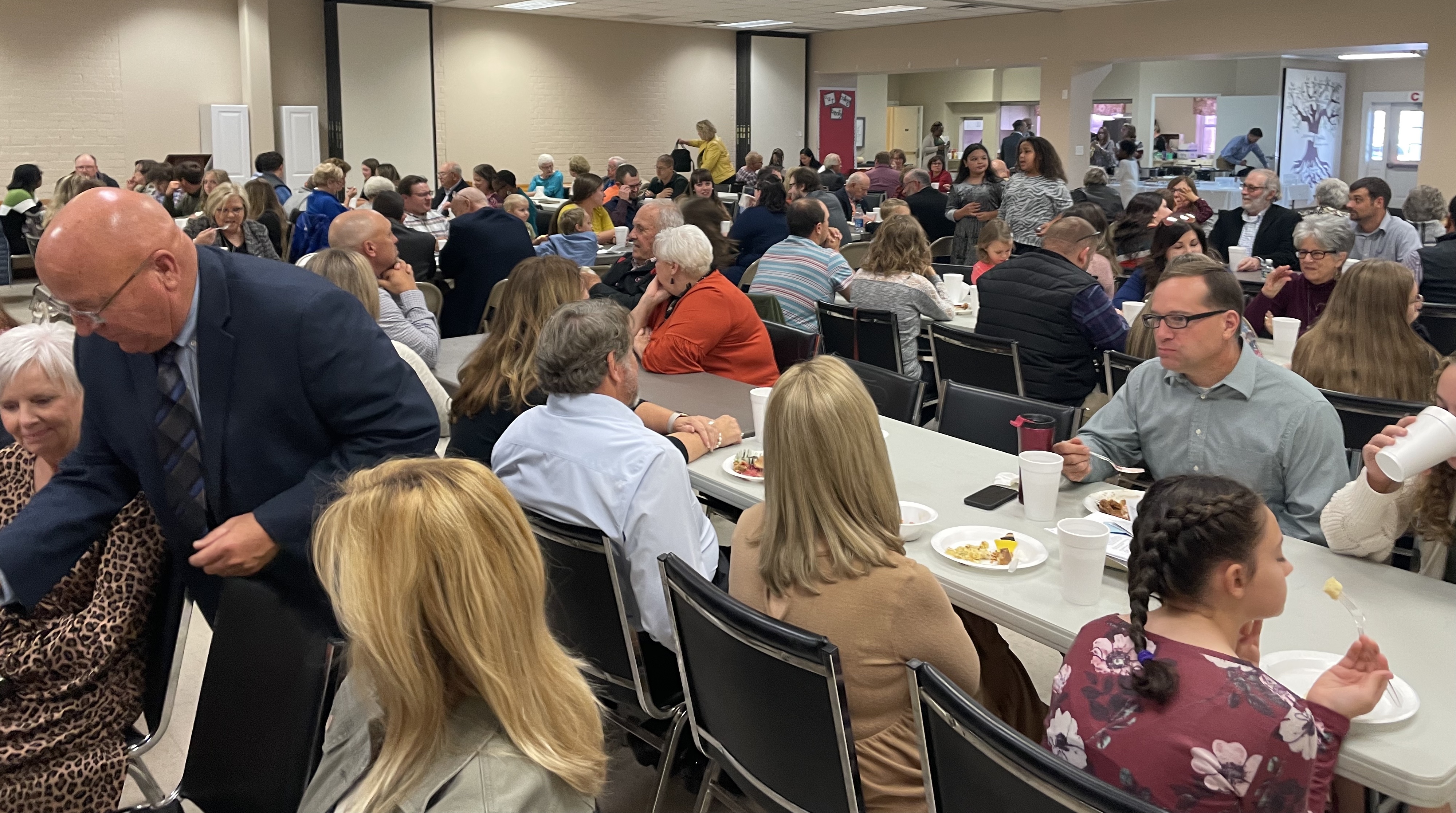
It was our largest crowd since before the Pandemic. It was a targeted effort to fill the building. The building was full! I asked several how many non-members were present and the most conservative answer was dozens, perhaps fifty. While we know that filling the pews is only one factor in encouraging people to follow Jesus (discipleship), it is a pretty fundamental and important one. Let me share a few exciting things I saw.
I saw the power of an invitation. The elders laid out a challenge to us to invite every non-member we could think of, coworkers, family members, friends, classmates, acquaintances, etc. That’s not revolutionary. Perhaps it was the sheer volume of invitations so many members issued. Such seeds were spread far and wide, and Sunday was an indication that some will come if asked. I am confident that many who were invited will come in the future, if we continue to ask. Philip invited Nathanael to “come and see” (John 1:46), and it changed Nathanael’s life! Andrew told his brother, Peter, “We have found the Christ” (John 1:41)! It changed not just Peter’s life, but the thousands of lives Peter eventually touched. Who knows the eternal impact made by all the invitations issued this weekend, but it shows that there’s still power in a simple invitation!
I saw the strength of teamwork. That was on display in so many ways. There was a huge team of people greeting those who entered our doors. Anticipating a lot of visitors, this was organized beyond the ordinary measure. It was exciting to see so many doing this, and it seemed to be infectious. Others joined in. It was evident in the efforts of multiple deacons and vision groups coordinating various works. It extended to members in the auditorium warmly welcoming unfamiliar faces and making our visitors feel at home. It continued on to the potluck after Bible class with the scores of people bringing an abundance of food, serving, assisting, and cleaning up. We were a finely-tuned machine of coordination. I could not help but think of Paul’s words, to Philippi (“make my joy complete by being of the same mind, maintaining the same love, united in spirit, intent on one purpose,” 2:2) and Colosse (“beyond all these things put on love, which is the perfect bond of unity,” 3:14). Sure, he had more in mind that one event on one day, but this is a key way such overall unity is built.
I saw the example of leadership. This began with the eldership. They not only challenged us to invite, they led the way. It’s not an exaggeration to suggest that the four of them invited hundreds of people by text, phone, and face-to-face. They invited friends, family, acquaintances, and strangers! True leadership shows the way! This included those who led in worship. There was forethought, effort, and coordination from the greeting to the announcements and every act of worship in between them. This involved the membership who enthusiastically engaged in the worship. It also takes in every one that helped people find bathrooms and classrooms. Leadership always breeds more leadership. The writer of Hebrews says, “Remember those who led you, who spoke the word of God to you; and considering the result of their conduct, imitate their faith” (13:7).
I saw the hope of tomorrow. The effects of the last 18-plus months have been deflating and demoralizing. We have lost members to Covid, physically and spiritually. It has derailed plans. It has distracted us. But Sunday showed that by faith in God and by following His plan, the best is yet to be! As we were reminded at the end of the day yesterday afternoon, we have worship every Sunday so let’s keep inviting. How many Bible studies will result from inviting others to church? How many future preachers, elders, deacons, soul-winners, and Bible class teachers are represented in those who walked through our doors yesterday, some for the first time ever? To some degree, we’ve got to be like Paul and say, “forgetting what lies behind and reaching forward to what lies ahead, I press on toward the goal for the prize of the upward call of God in Christ Jesus” (Phil. 3:13b-14).
There’s more to do! There’s more inviting to do. There’s more follow up to do. But I see more than a special event in what occurred on Sunday! I see a culture change and a purposed people. Think what God can do with that!
In Brian De Palma’s The Untouchables (1987), loosely based on historical events, Elliot Ness must stop gangster Al Capone. Ness, portrayed by Kevin Costner, is recruiting capable men to help him accomplish his task. One of the men he selects is an Irish beat cop, Jimmy Malone. Malone, played by Sean Connery, asks Ness what he is prepared to do to stop Al Capone. Ness replies he is willing to do anything within the law. However, Malone reminds him that Capone doesn’t play by those rules, implying that Ness will have to dirty his hands to bring Capone to justice. Sadly, one of Capone’s cronies mortally wounds Malone later in the movie. As he lay dying, he again asks Ness what he is prepared to do. Malone’s death finally causes Ness to take his gloves off and give Capone a hard fight.
Obviously, our devotional thoughts are just as loosely based on The Untouchables as the said movie was on the actual events occurring during Prohibition. Thus, I am primarily focusing on Malone’s question of what one is prepared to do. This question strikes me as pertinent to two parables spoken by Jesus to His disciples in Matthew 13.44-45. There are seven parables in Matthew 13, but Jesus gave only four of those to the assembled masses. The remaining three he spoke to the disciples alone. Of those three parables, two deal with people making an incredible discovery and the lengths they go to secure it. The Pearl of Great Price and the Hidden Treasure is parables requiring sacrifice from those wishing to obtain what Jesus equates to the kingdom of heaven.
Wait a minute. Are these not disciples to whom He addresses these parables? Yes. So, have they not already found the treasure, having decided to follow Jesus? Indeed, they have. However, there remains something even they must do. Even though they have acknowledged that there is something special about Jesus, that He is the Messiah, there is still a price to be paid. If they wish to complete their faithfulness, they must be willing to forfeit all to secure God’s precious promises. In the case of some, this knowledge came because of a diligent search. For the others, they had chanced upon the Messiah. Regardless of the circumstances, though, both groups had to surrender everything to receive the kingdom.
Recalling Matthew’s original audience, we note Matthew’s message is Jesus is the Messiah. Thus, he wrote primarily for the benefit of the Jews looking for the Messiah. They had to recognize that Jesus of Nazareth was He about whom the prophets had spoken, even Moses. Yet, they had to do more than mentally assent to Jesus’ identity. The believer’s conviction would cause them even to forfeit their former spiritual wealth obtained under the Law of Moses since God’s kingdom is invaluable in comparison. Elsewhere in Matthew’s Gospel, Jesus tells those who would follow Him that they had to remove all stumbling blocks from obedience, even if that were a foot or an eye (Matthew 18.7-9). Jesus was using this language figuratively, of course, as He was not advocating self-mutilation. But the message is the same as that of the Pearl of Great Price and the Hidden Treasure. You must remove absolutely everything coming between you and the acquisition of the kingdom of heaven without prejudice.
That is a sober message for those of us reading Matthew’s Gospel today. We may have satisfied ourselves with the knowledge that we have grasped the identity of Christ. Perhaps, we have even taken steps to become Christians. We are His disciples. But even to us, Jesus asks, “What are you prepared to do?” If the answer is not the equivalent of forfeiting all for the sake of the kingdom, then we have not yet done enough. As those to whom the Hebrews’ writer wrote, “You have not yet resisted to the point of shedding blood in your striving against sin” (Hebrews 12.4 NASB1995). The implication, of course, is Christians elsewhere in the first century were shedding their blood for their faith. Hence, the road taken by the recipients of the Hebrews letter was calmer in comparison. Thus, as I read those parables of the Pearl of Great Price and the Hidden Treasure, I must ask myself if I likewise will give my all to receive the kingdom of heaven. So then, when the situation calls for it, I must do whatever it takes to receive the kingdom of heaven. Only then will I have obtained the Pearl of Great Price and the Hidden Treasure.
We have abused this word. We say things like, “I hope there’s some food at the house” or, “I hope the weather is nice tomorrow,” and “I hope my team wins the Super Bowl.” The hope that’s mentioned in scripture has a completely different definition.
The word in Romans 15:13, for example, is the Greek word “elpis. “Now may the God of hope fill you with all joy and peace in believing, so that you will abound in hope by the power of the Holy Spirit.” This word is defined as, “Looking forward to something with confidence” (BDAG 319). It is an expectation that we have as Christians. We have hope because we call God our Father.
The world does not have that relationship and because of this they have nothing to hope in. If they look forward to anything it’s pay day, or the weekend, or vacations. Every one of these come to an end and once again they are left with no hope.
Don’t get me wrong, we look forward to these things too. And there’s nothing wrong with that, but this isn’t what we look forward to solely. We know that there is more to life than vacation.
1 Peter 5:10 is an incredible verse that describes the hope we have. It says, “After you have suffered for a little while, the God of all grace, who called you to His eternal glory in Christ, will Himself perfect, confirm, strengthen and establish you.”
This is true hope. It is the God of the universe Himself that will do this for each one of his children. We may not see it every day, but the world is lost and desperate. We have what they need. They’re desperate for guidance because they’re lost. They’re desperate for purpose because they have none. They’re desperate for Hope because the world offers nothing to those who are struggling.
God has entrusted us with the answers to life, so what are we doing with this knowledge?
Being well-informed is an essential part of remaining free. Without an understanding – from reliable sources – of what’s going on in the world, we make ourselves vulnerable to deception. That said, it’s my humble opinion that we need a news detox/vacation.
We need a detox because virtually all information sources pander to their political audiences.
We need a detox because most reports are negative, defamatory, or otherwise divisive.
We need a detox because it’s caused many to determine a person’s value by their opinions on current issues.
We need a detox because it’s increasingly affecting our churches.
We need a detox because God expects us to love people (Phil 2.3-4; Gal 6.10; I Cor 13.4-7). Being constantly bombarded with reasons to dislike others doesn’t help.
We need a detox because there’s so much more to life than politics and negativity. It’s much harder to appreciate or recognize positivity if we’ve overdosed on current events.
We need a detox because constant exposure has not done anything good for our mental health.
Please don’t see this as a suggestion to live under a rock. That helps no one. Instead, see it as an opportunity to step back, cool off, and recalibrate how we view other people. It simply cannot hurt society to have more patience, compassion, and empathy!
Do you remember what any of your childhood fears were? Maybe you never really grew out of those fears. I can remember a number of phobias I had as a child but one of them was not arachnophobia. In fact, me and my younger brother would collect spiders from the backyard and put them all in a container in our bedroom. At night we would put a flashlight behind a clear cage and watch all the spiders make their webs— occasionally fight each other. I don’t believe mom ever discovered this little secret. For some reason as I grew older (more mature) I developed a fear of spiders, despite having played with them often as a young kid.
Fears can be funny like that. They can come from bad experiences or just somewhere in the back of our minds. There’s a lot of fear in the world today!
One of my favorite psalms in the Bible is Psalm 46. We read about what seems to be those worst case scenarios, but God still reigns over all. What if the earth gives way? What if the mountains are thrown into the sea? What if the wrong man becomes our new president? What if this virus never goes away? Even so, we have no reason to fear. God is bigger than our fears. We serve a Being with that much power and it should fill us with courage. What are you afraid of?