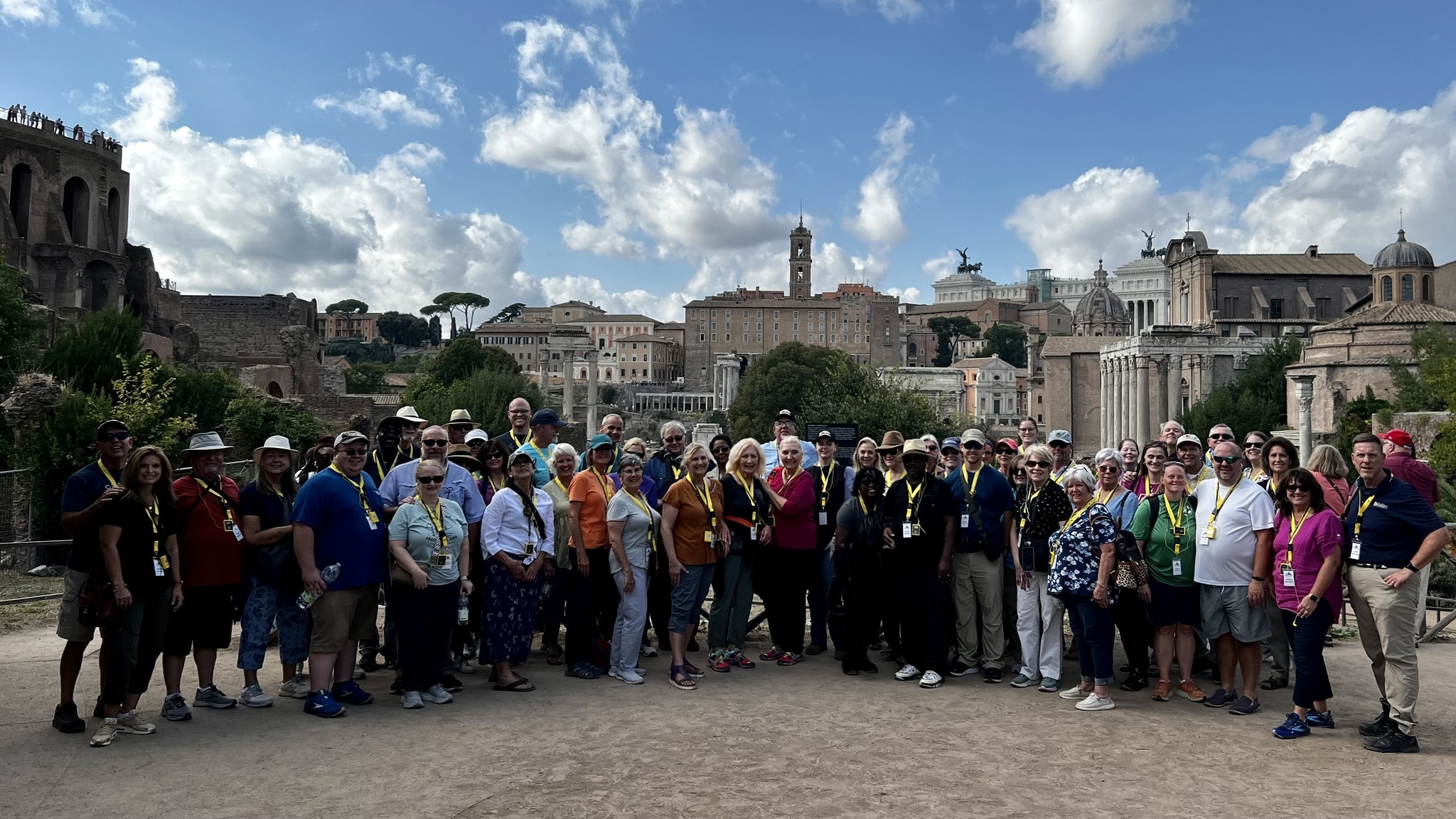
56 Christians from Arizona, Arkansas, California, Colorado, Kentucky, Michigan, Mississippi, Nebraska, South Carolina, Texas, and Virginia converged on the Hotel Gioberti in Rome, Italy, to begin a tour of places where the great preacher, evangelist, writer, and leader, Paul, shared the gospel of Christ. We began where it all ended for him: Rome. While our visit to where it all began for him, Israel, will sadly not be a part of our itinerary due to the tragic events now occurring there, we will visit a great many places where he helped fulfill Christ’s Great Commission in incredible, far-reaching ways.
He longed to get to Rome to “obtain some fruit among” them (Rom. 1:13), converting the citizens of that city the same as he had in so many other places. We know from Acts 28 that he did reach this city. This weekend, we saw what he found in his day. Emperors who would be declared gods by their senate, idolatry and the worship of gods of war, water, the sun, and a pantheon of others, and immorality like that described by Paul in Romans 1:18-32. Perhaps the first Christians came to Rome after hearing the first gospel sermon and obeying it (Acts 2:10). There are plenty of Christians to greet Paul as he approaches Rome in chains (Acts 28:14-15).
We encountered a city with stunning architecture, engineering marvels, Renaissance giants, and rich history that spans across, as John Moore eloquently put it, three eras–the pagan era, the Christian era, and the modern era. In a few hours, we will assemble with the saints at the church in Rome. It will be an exciting opportunity to meet in the capital city of what was, in the first century, the center of a global empire into which Christianity was born (Dan. 2:40-44). Standing in the midst of that city, imagining what our first-century spiritual family not only encountered but also endured, is a rare and beautiful opportunity to appreciate the power and spread of God’s eternal truth even in unfavorable social and political circumstances. It is a reminder, as Paul first put it, of the power of the gospel of Christ that brings salvation (Rom. 1:16). As Paul exhorted the Christians at Rome, I must not be ashamed of that gospel!
Reading comments on social media posts is bound to irritate you, like an eyelash that has gotten into your eye. People frequently share the most repulsive thoughts hidden in their hearts on the internet because of the relative anonymity it provides. I have seen the same confirmed regarding the recent Hamas-led assault against Israel. People are trying to gloss over the actions of terrorists by equating them to the alleged occupation of Jews in the region since the creation of the nation-state of Israel in 1948.
This defense of terrorism is an equivocation. Though the creation of the Israel nation-state indeed allowed many Jews of the diaspora to return, it is naive to believe that no Jews lived in the region before May 1948. Indeed, records show that at least 600,000 Jews lived in Jerusalem before David Ben Gurion became Israel’s first Prime Minister. There were even enough Jews present in 1909 to create the city of Tel Aviv as a suburb of the Arabic city of Jaffa (Joppa). Thus, framing this argument in terms of colonialism or imperialism or accusing Israelis of perpetuating apartheid against Palestinians is a ridiculous attempt by the enemies of Western culture to validate their radical, often violent ideology.
As a Christian and an earthly citizen of the United States, it would be easy for me to sit back and watch things play out on the evening news. I can close my eyes and say that this does not concern me, even though the United States has previously been subject to jihadi attacks. But I am only fooling myself. I saw the pro-Palestinian protesters in New York City and other metropolitan areas brandishing Nazi swastikas and using the “Free Palestine: From the River to the Sea” slogan. This current protest is not about a two-state solution. Instead, these protests openly advocate for eliminating the Jewish presence in Israel. And if that sounds ominous, consider that pro-Palestinian protesters in Australia were on video chanting, “Gas the Jews.”
But allow me to play the devil’s advocate. What if the Jews have committed atrocities against Palestinians? What then? Would the type of violence we witnessed be acceptable? The Jewish and Arab concepts of an eye for an eye and a tooth for a tooth notwithstanding, we know what one Jew from Nazareth taught. When the rabble Judas led came to arrest Jesus, impetuous Peter pulled his sword and cut off Malchus’ ear (John 18.10). Jesus, the Jew under consideration, told Peter to put his sword away. Note Matthew’s account of these events in Matthew 26.51–53:
And behold, one of those who were with Jesus reached and drew his sword, and struck the slave of the high priest and cut off his ear. Then Jesus said to him, “Put your sword back into its place; for all those who take up the sword will perish by the sword. Or do you think that I cannot appeal to My Father, and He will at once put at My disposal more than twelve legions of angels? (NASB)
Jesus sought to contrast His followers with those coming to arrest Him. Those men Judas led had swords and clubs. And Jesus asked them why they treated Him like He was the leader of some revolt (see Matthew 26.55). This mob did not need to threaten His person with physical violence. Jesus was not going to fight them. If He wanted to, Jesus could have called for 72,000 angels to protect Him (Matthew 26.53). However, 72,000 angels would have been overkill. With but one angel, God slew 185,000 Assyrians that had come to attack King Hezekiah (see 2 Kings 19.35).
Jesus acknowledged the legitimacy of the other sword, which was present, and had come to arrest Him in this moment of the “two swords,” even though His arrest was unjust (see Romans 13.4; John 18.3). In other words, Jesus recognized and submitted to the authority of the Romans. As He told Pilate, the spiritual nature of His Kingdom meant that His servants would not fight (see John 18.36).
Though Jesus did not teach us to be doormats, He reminded us to “turn the other cheek” when the situation requires it (Matthew 5.39). If you observe the text from Matthew 26 again, Jesus did not tell Peter to disarm himself but to put his sword back in its place. Again, this was not a time for violence. Jesus was aware of the bigger picture and the larger purpose of His mission. Jesus knew that resorting to violence at that moment would detract from His more excellent message and mission. One can apply this strategy to any cause; the methods used to advance a cause can significantly impact the perception and success of the cause itself. Jesus knew that His path required that His enemies lift Him up so He could draw the world to Himself (see John 12.31–33).
Hence, even if we were to say that Israelis “earned” the violence dealt to them by Hamas, the methods used to advance the cause—beheading babies, raping women, killing the elderly—impact public perception of their alleged cause. It sours the stomach and jaundices the eye. It’s better to walk the path of nonviolent resistance than give your detractors the rationale they need to justify their violent retribution against you. And in the days ahead, we will no doubt see much more violence in Gaza.
As we continue to follow the unfolding events between Israel and Hamas, we must learn the lessons that history and the Bible have to teach us about violence and the repercussions of our actions and beliefs. The advice to avoid escalation and seek understanding is universally applicable, regardless of whether we are policymakers, commentators, or observers. Wisdom and compassion pave the way to long-lasting solutions, while violence breeds more violence irrespective of the justification or historical context. We can only hope that the leaders of all parties learn from history and pursue paths that lead to peace, reconciliation, and coexistence.
Growing up our parents had a hard time calling us. I’d be in the living room and dad would say, “Gary-Er Dale-I mean Carl!” This would happen almost every time they would call for us. I don’t think this is a problem unique to our family. This is a problem that almost every parent has, and I know that once our daughter is born I’ll get Rich and Amara mixed up.
Similar to our parents calling for us, there’s a phrase used in scripture that sounds almost identical. In various texts throughout scripture you’ll come across the phrase, “call on the name of the Lord.” There’s a lot of confusion surrounding this phrase, so let’s take a few moments to figure out what it means, and what it looks like to call on the name of the Lord.
In Acts 2:21 Peter uses this phrase, but to get a better idea of the context and meaning we need to start in the book of Joel. In this short book there are a few important facts we need to recognize. Not much is said about Joel, but many believe that he ministered to those in Judah. In this prophecy to Israel He speaks of a plague of locusts and tells the people that it represented the coming day of the Lord.
These locust would bring complete and total destruction. The day of the Lord was a time greatly anticipated by Israel because they believed that God would then judge the nations and restore Israel to her former glory. But Joel says that God would punish not only the nations but unfaithful Israel as well. This day of the Lord was going to be like nothing they were expecting. Joel urges everyone to repent, and told of a day when God would “pour out [his] Spirit on all flesh” (2:28). That day arrived on Pentecost (Acts 2:17). In the middle of the book Joel arrives at the peak of his writing and in verse 32 he says this, “And it shall come to pass that everyone who calls on the name of the Lord shall be saved.”
Peter uses this exact quote In his sermon on the day of Pentecost. We read the same phrase in Romans 10:13 when Paul says, “For “everyone who calls on the name of the Lord will be saved.” We now know the origin of this phrase, but what does it mean? How do we call on the name of the Lord? Some believe that in order to be saved all you need to do is literally call out the Lords name. Others say that calling on the name of the Lord means praying a certain prayer in order to be saved.
In Acts 2, we can see an example of what it means to call on the name of the Lord.
It Requires a Proper Attitude. The Israelites thought that the Lord was theirs to control. They thought He would bend to their wills and wishes. They wanted the day of the Lord to be a day that would liberate Israel. And so they spun this phrase to fit their narrative, to the point that their meaning for the day of the Lord was the exact opposite of its true meaning. Joel and Peter clear up the air and explain who God really is. He’s not a gene, he’s not our puppet, He has a will of his own that we are to conform to. Calling on the name of the Lord requires a proper attitude. An attitude of submission to God and His will. An attitude of humility, recognizing our failures, and understanding Gods perfection.
The Israelites had it all wrong, and sadly sometimes we are the same way. We want God to make us happy. To grant every request we bring to him. We go to Him in prayer with everything that is wrong in our lives and say, “Okay God, fix it.” If what we pray for doesn’t happen, we think God didn’t answer. God always answers us, but the answer is sometimes “no.” Jesus in the garden asked God to take away His responsibility of going to the cross, but He was still crucified. Paul asked God to remove the thorn in his flesh, and the answer was no. God knows just what we need, what is best for us in the long term. We should never treat prayer as a gene in a lamp.
This is not what calling on the name of the Lord means. The Greek word for call is Kaleo, in this context it is the act of calling upon deity. The reason we call upon deity is because we understand our own imperfection. We need help seeing God’s will. Not our own like Israel did.
Calling on the name of the Lord requires a proper attitude, one of humility and understanding. And now more than ever we need to call on the Lord in order to find salvation.
“The signs” are a thread that run throughout the gospel of John. It is the signs observed by Nicodemus that brings this Pharisee to Jesus by night to speak with Him. He is a member of the Sanhedrin (7:50; 19:39), which is what John highlights by calling him a “ruler of the Jews” (cf. 7:48). The Sanhedrin, from the Greek word meaning “seated together,” was “a council in Jerusalem that functioned as the central judicial authority for Jews” (Myers, Eerdmans, 912). Yet, while that group will notoriously and constantly oppose Jesus and plot His death, Nicodemus approaches Jesus as a believer. He says, “Rabbi, we know that You have come from God as a teacher; for no one can do these signs that You do unless God is with him” (2). Who is the “we”? We are not told, but we do know that faith in Jesus is already beginning to spread.
Jesus, however, controls the direction of the conversation. He responds by teaching Nicodemus about the necessity of one being born again (3ff). This intrigues and mystifies that respected teacher. In this starlit classroom, Jesus lays the groundwork for a truth which future students like you and I also need to grasp.
The new birth is essential (3-5). Jesus says one must be born again. One must be born of water and the Spirit. Without this new birth, one cannot see or enter the kingdom of God. Paul is going to call this the “washing of regeneration and renewing by the Holy Spirit” (Titus 3:5).
The new birth is spiritual (6-8). Nicodemus is trying to understand Jesus’ teaching from a physical perspective, wondering if He meant literal rebirth–which he knew was impossible. Jesus contrasts that fleshly idea with being born of the Spirit. He likens this rebirth to the wind, something real but not something observable. We can see someone being baptized, but the cleansing of the soul and becoming a child of God is something actual which God sees but which we accept by faith.
The new birth is understandable (9-15). Now, Nicodemus is struggling to make sense of it, but Jesus says that is because he is thinking in earthly rather than heavenly terms. Those signs Nicodemus marveled at were designed to verify the truths He was teaching. All of it was meant to create faith in open hearts. To aid his understanding, Jesus asserts that He had come down from heaven to be “lifted up” (14). He refers this Old Testament scholar to an event during the wilderness wandering, when the brazen serpent was put on a pole to save the sinful Israelites who had complained and been bitten by serpents (Num. 21:9). Those who trusted in this remedy God provided to save their lives and looked on the pole did not die. Those who did not believe and look died. Jesus ties God’s grace and man’s obedient faith together to teach the new birth.
The new birth is providential (16-21). Simply put, God provided the new birth as part of His eternal plan. Jesus came to earth to teach that plan, but also to enact that plan. He was like the brazen serpent. He would have to be lifted up (14). He would have to be “given” (16). It was because men would not believe this that they would act in violence to kill Him, ironically facilitating God’s eternal plan of redemption (18-20). Jesus was going to expose the evil of men’s deeds, and they would hate Him for it. But Jesus, referring to Himself as Light (five times from verse 19 to 21), was illuminating the path of righteousness for those who believe (21).
I wonder what went through Nicodemus’ mind when he left Jesus that night. How many times did he review this lesson in his mind, pondering the weighty truths Jesus shared with him? What about when he tactfully defended Jesus when the Sanhedrin doubtfully disputed about Him (7:50-52)? What about when he helped fellow-Council member Joseph prepare Jesus’ body for burial after His crucifixion (19:38-39)? However that went, Nicodemus was taught one of the most important, yet basic, truths of all. He was faced with embracing it, and so are we. A place in God’s kingdom, eternal life, salvation, and coming to the Light are all blessings of being born again! It is an awesome thought that Jesus not only invites us to that, but gave His life to make it a reality.
We all need to come to ourselves in life so that we can make the right changes and do the things that God would have us to do. In Luke 15 we read about the prodigal son who went out and lived a life of sin and rebellion. But one day when he was away in a far country, the Bible says, “he came to himself” and then decided it was time to go home (Luke 15:17). Here are three times in life when I have come to myself and when you might need to do the same thing.
#1. Sobriety and turning from sin.
There was a time in my life when alcohol had a strong hold on me, and I was not living a sober and healthy life. I was allowing it to ruin me as a person and I had to come to myself and realize it was time to make a change. The Bible says whoever is led away with alcohol is not wise (Proverbs 20:1). I was being led away and nothing was going to change until I came to myself. We all sometimes notice sin in our lives, and we need to come to ourselves to repent and change it, Jesus said, “I tell you; but unless your repent, you will all likewise perish.” (Luke 13:3).
#2. Salvation
I came to a point when I recognized I needed God in my life and started to read and study the Bible. At that point I came to myself and realized that I was lost. I needed to be baptized into Jesus for the forgiveness of my sins as stated in Acts 2:38. I came to myself and made spiritual changes, and this is something everybody in the world needs to do.
#3. Service
After being baptized we need to find out where we can serve God and how we can be of use in his church. We need to come to ourselves and see how we can use our talents and abilities to serve in the church, help others, and glorify God. The Bible says, So, whether you eat or drink, or whatever you do, do all in the glory of God (1 Corinthians 10:31).
Be honest with yourself, find out what you can do, and then do it.
As I prepared for an appointment, the television commercial advised me to take advantage of their services so that I could “expect the unexpected.” I’m not too fond of that phrase. It could be considered a pet peeve. The statement’s paradoxical nature irritates me. It is impossible to anticipate something that is, by definition, unexpected or unforeseen. So, why do we keep using this illogical expression?
Since I grasp this idiom’s meaning, I recommend replacing it with “prepare for the unexpected.” The second option is feasible for us. Since we anticipate the possibility of unexpected events, we can plan accordingly to deal with or adapt to them. It’s like preparing for an accident by stocking your first aid kit with bandages for occasions when you get a cut or scrape. You didn’t know you would get that cut, but you had a dressing ready just in case.
Spiritually, Jesus tells us to prepare for the unexpected. Contextually, the unexpected is His Second Coming. To teach us this lesson, Jesus told the Parable of the Ten Virgins (see Matthew 25.1–13). The titular maidens are members of the bridal party. Unbeknownst to most contemporary readers, weddings in the first century were a different type of affair.
The bridegroom’s arrival was cause for both celebration and anticipation in first-century Jewish wedding customs. After the engagement, the bride would wait at her father’s home for her future husband to come and take her away. The groom had complete control over when this occurred.
The groom frequently transformed the process into a joyful game or challenge in which he attempted to surprise the bride and her attendants. This element of surprise heightened everyone’s excitement and enthusiasm for the party. Shouts announced the bridegroom’s arrival, so the wedding party members had to prepare to join the procession anytime, even after dark.
The five prudent virgins were ready for whatever might happen. They had brought extra oil because of the potential for the groom to be late. Those considered foolish should have considered the possibility of the bridegroom arriving late at night. According to the parable, the shout announcing the bridegroom’s arrival woke them up.
The foolish virgins woke without oil for their lamps and asked the wise ones to borrow some. The wise virgins said they didn’t have enough oil to spare for the foolish virgins’ lamps. The bridegroom led the wise virgins to the wedding feast while the foolish virgins went to get more oil. By the time the foolish came, it was too late; the groom shut the doors.
Jesus ends the parable by telling us to be alert since we do not know the day or the hour of His return. Hence, you and I must prepare for the unexpected (i.e., the Second Advent).
We need general preparedness. The most crucial general preparation is to obey the Gospel. For those who felt the weight of their sins on the Day of Pentecost, Peter preached repentance and baptism (Acts 2.38). Individuals submitting to baptism resulted in church growth. The Bible says that the Lord kept adding to that number those He saved (Acts 2.47). Once one is a part of the Body, he must make other general spiritual preparations such as prayer, good deeds, and maintaining a solid relationship with God (see 1 John 1.7).
We need mental preparedness. Christians should have a strong faith and accept that God’s timing may not coincide with their own. Like the bridegroom in the parable, we cannot know when Jesus will appear “with a shout, with the voice of the archangel and with the trumpet of God” (see 1 Thessalonians 4.16 NASB). Predicting when our Lord will return is fruitless, but people have been trying for years. Jesus declares that not even He knows when that day will be, only His Father (Matthew 24.36). Thus, we don’t know the exact date, but we know that God has chosen it (Acts 17.31).
We need to practice risk management. Believers waiting for Christ’s return should take precautions against the spiritual “risks” or pitfalls that could undermine their faith or readiness. Do you remember what Jesus taught in the Sermon on the Mount? If your right eye and right hand are the source of your sin, Jesus says it is better to have them amputated than go to hell as a fully functional human (Matthew 5.29-30). Jesus isn’t suggesting we physically cut out our eyes, but instead that we turn away from the things that trigger our lust. Jesus isn’t telling us to cut off our hands, but rather that we turn away from the things that trigger our greed. The gates of hell are not a place where Christians play chicken. Instead, we manage risks.
In conclusion, even though paradoxical sayings like “expect the unexpected” can be annoying, “preparing for the unexpected” is a powerful reminder of the deeper truths embedded in our spiritual journeys. Like the prudent virgins in Jesus’ parable, we must be ready for anything, including the unanticipated events of everyday life and, most importantly, the return of Christ. There are many facets to this kind of readiness, including general and mental preparedness, recognizing our human limitations when it comes to divine timing, and taking proactive measures to protect our faith from harm.
Let us go beyond waiting for the Lord’s return and establish ourselves in purpose, deed, and unwavering faith. By getting our heads and hearts in the right place, we anticipate His return and make strides toward spending eternity with Him.
Today’s families are falling apart. The home is divided, and God has been moved to the back burner. That is why now more than ever we should be able to see a difference in the Christian home, and the home that Christ is not in.
If we can’t see a difference, how will the world ever change? If we can’t see a difference in our homes and the world, chances are we aren’t glorifying God. The family that Christ is in will have unique attributes that are difficult to come by in our society. The Family that glorifies God:
Admits their sins.
The ability to be open and honest about sins and failures results in accountability and change. Paul says in Romans 8:1, “There is therefore now no condemnation to those who are in Christ Jesus, who do not walk according to the flesh, but according to the Spirit.” God has given us Christ as payment and He covers our sins, but we should be open and honest in order to find growth. Parents won’t be perfect and neither will children. Admitting sin to each other helps us to grow and change as a family.
The family that Christ is in:
Is Gracious To Each Other
Once again this is a trait that is rarely seen in a worldly family. As a people who have found forgiveness through Christ, we must be gracious towards each other. The Bible teaches us that by the grace of God we can be forgiven and set free from the control and imprisonment to sin. With the freedom to confess sin comes the freedom to repent of it and seek God’s forgiveness. Knowing God’s forgiveness gives us the ability to ask and receive forgiveness from those we have sinned against. In the same way God has forgiven us, we should forgive each other. Sometimes it is those we hold dear and love that hurt us the most. Be forgiving. My brothers and I used to have plastic lightsaber fights, and we’d really get into it. It often ended in screams of pain and anger. Be forgiving to your siblings. Parents, be forgiving of your children. By doing so we will glorify God.
The family that Christ is in is:
Ever Growing and Improving
Where there is spiritual life there is spiritual growth. No true Christian can remain the same. The Christian home is a place of constant spiritual growth. Every day we should do our best to glorify God even more.
How can we glorify God in the family? How can we make Christ a part of our home? Deuteronomy 6:5 says, “You shall love the LORD your God with all your heart and with all your soul and with all your might.” Give yourself to God, be wholly devoted to Him, and watch as you, your spouse, and your children bring glory to the Most High God.
This is a tough one to read, and it was certainly a tough one to write. This is one of those texts where “quick to listen, slow to speak about it, and slow to become angry [at scripture]” (Js 1.19) certainly applies. Those who know me know where I stand on most political and social issues. As a Christian, though, some of those things occasionally have to take second place. This is extremely difficult (even painful), as some of these things completely fly in the face of our political convictions. We sometimes conflate our political and spiritual values. While our political values should absolutely be influenced by our spiritual ones, the two aren’t inseparable. Sometimes we have to go against our political convictions if pursuing them means violating a Christian principle.
I Peter 2.13-25 is a difficult passage for many of us to swallow because it’s about giving up our own rights and freedoms for the sake of the message. God expects us to obey all government officials, even when their policies are unfair (or blatantly unconstitutional). Only when what they tell us to do violates God’s law are we permitted to disobey them. What does this mean practically? As a Christian, we have to comply with any policy upheld by a governing body who has authority over us (2.13-14, 16). This applies to any regulation that — even though unconstitutional — is upheld by government (cf. Rom 13). God expects us to comply because that falls in line with not causing trouble and living a quiet, peaceful life (I Tim 2). We often talk about how difficult the Christian life is, but these kinds of things make it real. My inalienable rights aren’t worth losing my eternal soul.
In 2.16-17, Peter addresses a loophole we might be tempted to exploit. Yes, we’re God’s people first. Yes, we’re an independent nation as his church, and we’re subject to him first before government. But that doesn’t give us the right to disobey laws we don’t agree with. We’re told to “live as servants of God”, which in context means “complying with all government regulations that don’t violate God’s law.” That’s hard. Nothing about this is easy, especially for us Americans who enjoy life in a country whose founding documents recognize and legally restrain government from interfering with natural freedoms. But the reward for following God’s word on this issue is immortality on a perfect new earth where — among many other blessings — there are no three-letter agencies or any other corrupt human act of authoritarianism.
He was born of a virgin, foreseen by the few A miraculous event— many know to be true He would save those in sin both friend, neighbor, and stranger But all that happened when He got out of the manger
His life was a short one, at least on this earth Some overlooked Him, his power, and worth He faced many challenges, his future looked bleak He was tortured and beaten, but turned the other cheek
A beautiful life— filled with joy and with danger, But all that took place once the Lord left the manger He holds many titles, king of kings and Lord of Lords He established His kingdom without even a sword
He’s the healer, our Savior, and any-life-changer But there’s more to His story He’s coming in glory Because Jesus left the manger
You may had heard once about the couple archaeologists dug up in an excavation in Rome, Italy. They found the bones of a couple who would have possibly lived before Noah, but how they found them was most unique. The skeletons were found in embrace, suggesting especially to the sentimental the profoundest expression of love and togetherness possible (source here).
Who knows what it truly means, who they were, and if they were even husband and wife? Yet, I would like to think that they were a couple so close and whose lives were so intertwined that their repose in death was symbolic of how they were to each other throughout life. We certainly need good role models, wherever we can “dig them up.”
Society does not do so much to encourage married people staying together. In fact, infidelity and fornication are idolized character traits. Those who stick together through thick and thin are portrayed as foolish or at least boring. Yet, God laid out a blueprint for the whole that includes a bond much stronger than an embrace for couples staying together (cf. Gen. 2:18-24; Mat. 19:3-9; 1 Pet. 3:1-7; etc.). The Lord’s church needs men and women who are committed to staying together, to building healthy, happy and close marriages. Societies, to long endure, need such values embraced and encouraged. You, if you are married, need to rededicate yourself to your spouse each day, finding ways to stick close and reasons to stay together.
As many of you know, in sports a team has to work together to succeed in the game. According to the Merriam Webster Dictionary teamwork is “work done by a group acting together so that each member does a part that contributes to the efficiency of the whole.”
Turn with me to Psalms 133:1 “Behold, how good and how pleasant it is For Brethren to dwell together in unity.” Just as team members are unified in the goal of winning, we as Christians should be unified in our efferts to please God and win a home in Heaven.
Proverbs 27:17 says, “As iron sharpens iron so a man sharpens the countenance of his friend.” this verse demonstrates the positive effect we can have on one another.
Ecclesiastes 4:9-12 reads, “Two are better than one because they have a good reward for their labor. For if they fall one will lift up his companion. But woe to him who is alone when he falls, for he has no one to help him up. Though one may be overpowered by another, two can withstand him. And a threefold cord is not quickly broken.” We should be uplifting to each other, and working together we can accomplish more.
A month ago I had the opportunity to play with the JV soccer team against Monroe County, In that game our team had many assists for our goals. These assists were very important in the game because without them there wouldn’t be a goal.
Romans 12:4-8 teaches, “For as we have many members in one body, but all the members do not have the same function,so we, being many, are one body in Christ, and individually members of one another. Having then gifts differing according to the grace that is given to us, let us use them: if prophecy, let usprophesy in proportion to our faith;or ministry, let us use it in our ministering; he who teaches, in teaching;he who exhorts, in exhortation; he who gives, with liberality; he who leads, with diligence; he who shows mercy, with cheerfulness.” Just like our team, not every one has the same job- one has to score the goal, someone provides the assist, others provide defense, while the goalie protects the goal. Not every one has the same position, every one plays a different role.
Just as a team practices for a winning game. God has provided us with the necessary things to win.
In Ephisions 6:13-18, Paul says, “Therefore take up the whole armor of God, that you may be able to withstand in the evil day, and having done all, to stand. Stand therefore, having girded your waist with truth, having put on the breastplate of righteousness, and having shod your feet with the preparation of the gospel of peace; above all, taking the shield of faith with which you will be able to quench all the fiery darts of the wicked one. And take the helmet of salvation, and the sword of the Spirit, which is the word of God; praying always with all prayer and supplication in the Spirit, being watchful to this end with all perseverance and supplication for all the saints.”
Just as teams strive to win a championship, we too can win a reward living for God.
Colossians 3: 23-24 says, “And whatever you do, do it heartily, as to the Lord and not to men, knowing that from the Lord you will receive the reward of the inheritance; for you serve the Lord Christ.”
Wisdom, Governance, and the Search for Fulfillment
Brent Pollard
What events so enraged the majority of Israel’s tribes that they chose to secede from the Davidic monarchy? In 1 Kings 12, Jeroboam and a group of Israelites confronted the recently anointed monarch.
“Your father made our yoke hard; but now, lighten the hard labor imposed by your father and his heavy yoke which he put on us, and we will serve you.” (1 Kings 12.4 NASB)
I read this passage for a long time without fully comprehending its significance. Solomon used corvée (kor-VAY) labor to build extravagant structures. Many of these people chosen to work were foreigners discovered during David’s disastrous census (2 Chronicles 2.17). Solomon is portrayed more favorably in the Book of Chronicles than in the Book of Kings. However, in 1 Kings 5.13, Solomon “conscripted forced laborers from all Israel” (NASB, emphasis mine).
Is there a modern equivalent of corvée labor? Military service is mandatory in some modern nations. Some countries that do this include Israel, South Korea, and Switzerland. However, the focus of corvée labor is on infrastructure projects. It would be a more fitting analogy if the Civilian Conservation Corps of the New Deal had mandated rather than recruited young men. I live in an area with state parks built by the Civilian Conservation Corps. Photographs document their hard work cutting trees and building park facilities.
As a result, the populace informed Rehoboam that they did not appreciate the yoke his father had imposed upon them. Rehoboam told the people he would respond to their complaint in three days (1 Kings 12.5). Within those three days, Rehoboam consulted his older advisors. They told Rehoboam to lift the burdens placed on the people by his father. Rehoboam also consulted his young advisors. Their advice was different.
“And the young men who had grown up with him spoke to him, saying, ‘This is what you should say to this people who spoke to you, saying: ‘Your father made our yoke heavy, now you make it lighter for us!’ You should speak this way to them: ‘My little finger is thicker than my father’s waist! Now then, my father loaded you with a heavy yoke; yet I will add to your yoke. My father disciplined you with whips, but I will discipline you with scorpions!’” (1 Kings 12.10-11 NASB)
To the ruin of the united monarchy of Israel, Rehoboam went to his peers’ advice. Of course, given the sins of Solomon in going after the gods of his many wives (see 1 Kings 11.4–8), we know that this was the determination of God to tear away the kingdom from him and give it to his servant, Jeroboam (1 Kings 11.11–13). 1 Kings 12.15 clearly states that Rehoboam did not listen to the people “because it was a turn of events from the Lord, in order to establish His word which the Lord spoke through Ahijah the Shilonite to Jeroboam the son of Nebat.” (NASB)
On the one hand, it is hard to feel sympathy for the Israelites. God had warned them that such a scenario was possible when they clamored for a king. Note 1 Samuel 8.10ff:
“So Samuel spoke all the words of the Lord to the people who had asked him for a king. And he said, “This will be the practice of the king who will reign over you: he will take your sons and put them in his chariots for himself and among his horsemen, and they will run before his chariots. He will appoint for himself commanders of thousands and commanders of fifties, and some to do his plowing and to gather in his harvest, and to make his weapons of war and equipment for his chariots. He will also take your daughters and use them as perfumers, cooks, and bakers…He will also take your male servants and your female servants, and your best young men, and your donkeys, and use them for his work…Then you will cry out on that day because of your king whom you have chosen for yourselves, but the Lord will not answer you on that day.” (NASB)
Despite hearing this, the people said, “No, but there shall be a king over us, so that we also may be like all the nations, and our king may judge us and go out before us and fight our battles.” (1 Samuel 8.19-20). God told Samuel to let the people have what they wanted.
On the other hand, we have to wonder how the wisest man, other than the Son of Man, who ever lived, could so choose to burden his people as to make them grumble and complain. After all, Solomon imparted some wisdom about rulers to his son in Proverbs. For example, in Proverbs 28.16, Solomon says, “A leader who is a great oppressor lacks understanding, But a person who hates unjust gain will prolong his days.” (NASB) It is a paradox that someone can be both wise and demonstrate a lack of understanding. Yet, this describes Solomon well.
The greatest tragedy is how Solomon felt after considering everything he achieved using corvée labor. Note Ecclesiastes 2.4-6 and 11:
I enlarged my works: I built houses for myself, I planted vineyards for myself; I made gardens and parks for myself, and I planted in them all kinds of fruit trees; I made ponds of water for myself from which to irrigate a forest of growing trees. (NASB)
So I considered all my activities which my hands had done and the labor which I had exerted, and behold, all was futility and striving after wind, and there was no benefit under the sun. (NASB)
Thus, he built things thinking it would bring him a sense of satisfaction, only to realize that after he was gone, everything he had made would fall into the hands of another (see Ecclesiastes 2.18). The reality made him realize that this, too, was vanity. Solomon proves that having wisdom on a personal level doesn’t always translate seamlessly to governance. Making decisions impacting an entire nation can vastly differ from making personal decisions or offering advice to individuals.
The story of Solomon and the division of the kingdom that followed is a timeless cautionary tale about the difficulties of leadership, the perils of absolute power, and the universal human yearning for meaning and purpose. We may find it hard to relate to the specifics of Solomon’s rule and the events leading to Israel’s division, but the underlying themes remain relevant to our time. No matter how experienced or knowledgeable they are, leaders can still make mistakes. Pursuing one’s ambition can frequently result in undesirable outcomes without moderation and self-reflection.
This story serves as a reminder for those in authoritative roles to listen to sound advice and stay in touch with the wants and feelings of the people they govern. For everyone else, it highlights the futility of placing one’s hope for happiness in material things and the fleeting nature of life itself. It’s a sobering reminder that pursuing lasting happiness should take priority over acquiring worldly power and prestige.
There’s a good chance you’ve probably heard this phrase before. While the sentiment is understandable, is this true?
I believe a better way we could say this is, “All things are possible for God.” Whether we believe it or not, for God all things are possible! What I mean is that God blesses and uses those who will faithfully trust him, but our belief isn’t what makes things possible. It’s the One we choose to believe in who does that. I believe that Georgia is going to be the number one team this year, but not everyone will agree with me.
So according to the phrase, “all things are possible to those who believe” whoever believes the most is the team that’s going to win…sadly that’s not how it works. All things are possible for God, but it doesn’t depend on our belief.
This is one of those phrases that can ruin someone’s faith. If they believe and the desired outcome doesn’t happen, does that mean God doesn’t care? This is exactly what faith healers say. If someone isn’t healed, what is their response? “They didn’t have enough faith.” This isn’t what scripture tells us.
This phrase comes from a wrong interpretation of Mark 10:27. Beginning in verse 24, it says:
“And the disciples were amazed at his words. But Jesus said to them again, “Children, how difficult it is to enter the kingdom of God! It is easier for a camel to go through the eye of a needle than for a rich person to enter the kingdom of God.” And they were exceedingly astonished, and said to him, “Then who can be saved?” Jesus looked at them and said, “With man it is impossible, but not with God. For all things are possible with God.””
For us to understand what Jesus is talking about we have to look at context. He’s not talking about a football game, or taking a test, He’s talking about entering the kingdom of God! Without God it would be impossible for us to enter Heaven and to have eternal life, but with God, all things (pertaining to our walk with Him and our journey to heaven) are possible.
Thankfully we have a caring Father that wants nothing more than for us to succeed in our walk with Him. All things are possible WITH God. We should never forget what we can accomplish when He is in our life. But our greatest accomplishment is eternal life in the Kingdom of God.
How many times has it happened that two Christians had such different ideas and drew such different conclusions that it affected their ability to work together? Often, this rift permanently affects the relationship. They don’t speak to each other and even speak poorly of each other. Such a reaction actually hurts the influence and progress of the church, and it contradicts the biblical remedy (Rom. 12:17-18; Mat. 5:23-24).
In Acts 15, as is often the case when these schisms occur, the parties involved are actually trying to do good for the Lord. After the Jerusalem meeting (15:1-35), Paul suggests to Barnabas that they “return and visit the brethren in every city in which we proclaimed the word of the Lord, and see how they are” (36). Barnabas loved the idea. These men had obviously worked well together (ch. 13-14). From the earliest days of his conversion, Paul had had an advocate and supporter in Barnabas (9:26-31). They had been in some difficult trenches on the first journey. In other words, they had forged a strong bond.
But, trouble arose! “Barnabas wanted to take John, called Mark, along with them also. But Paul kept insisting that they should not take him along who had deserted them in Pamphylia and had not gone with them to the work” (37-38). Barnabas was ever the encourager (4:36). John Mark was his cousin (Col. 4:10), which had to have complicated the situation for him. Paul was a tenacious go-getter, willing to risk his neck for the gospel. Did he see John Mark as soft, unreliable, or immature?
There is no doubt that this created so much friction that the Holy Spirit through Luke calls it a “sharp disagreement” (39). This word, when used physically, described an attack of fever at its highest point–which often causes delirium! It was an irritation that reached exasperation. It was so bad that they separated from one another. This could have been the pathetic ending of so much global evangelism. They could have gotten out their competing scrolls and “written each other up” across the brotherhood, or posted on some ancient equivalent of social media about how much of a victim they were or how evil each other was. We have seen such small-mindedness in our own day. But, what did they do?
Barnabas went ahead and took Mark and they sailed to Cyprus (39). Paul took Silas with him, sent by the Antioch church and “strengthening the churches” (40-41). Luke traces the rest of Paul’s heroic, faithful mission work throughout the rest of the book of Acts. What about Barnabas? It appears that the Holy Spirit is pretty silent about his activity after their parting of the ways (1 Cor. 9:6; Gal. 2:1ff seem to record events during the first missionary journey or before). Yet, his legacy is implied through the mention of John Mark. When Paul was in prison, after his missionary journeys are done, he calls him “my fellow worker” (Phile. 24). He recommends Mark to the church at Colossae about the same time (4:10). Some of Paul’s last recorded words are, “Pick up Mark and bring him with you, for he is useful to me for service” (2 Tim. 4:11).
Does that sound like the Hatfields and McCoys? Does it sound like competitors and enemies? They could not resolve their difference and they went their separate ways, but they remained brethren. Apparently, they continued to work together even if in different ways. Perhaps they might say they regretted letting this disagreement get so sharp, but they did not let it distract them from the mission. May that spirit live in you and me today!
“Do not let any unwholesome talk come out of your mouths, but only what is helpful for building others up according to their needs, that it may benefit those who listen.”
If you were to open up any Greek interlinear (like in the BlueLetter Bible app) and look at the key words in this verse it becomes even more practical.
Unwholesome:
“Rotten, putrefied”
Helpful:
“good, pleasant, agreeable, joyful, happy”
Benefit:
“that which affords joy, pleasure, delight, sweetness, charm, loveliness: grace of speech”
There are three rules for winning words in Ephesians 4.29 and they are…
1. Don’t let anything rotten come from your mouth. If it comes from a bad place keep your mouth shut.
2. If it doesn’t build someone up don’t say it. Our ultimate goal must be to promote growth and if it doesn’t do that, it’s not worth saying.
3. If It doesn’t bring delight, show grace, or joy in the end— don’t say it.
This is the way Jesus treats us. If it’s God’s approach then who are we to say otherwise? No excuse, situation, or feeling should remove grace from the words we say.
Despite our cultural baggage, making us shy away from terms like “master” and “slave,” nothing more accurately reflects the inequity between ourselves and the sovereign control Christ should have in our individual lives (cf. John 13:13). When the New Testament speaks of a “lord,” it means one who is possessor or owner and one who is in a position of authority. Both senses reveal who Jesus is. He bought us with blood, but He only has full control if we allow Him. He has been given all authority by the Father Himself (Colossians 1:16-18), but the more we let Him have control of us and the more we submit to Him the more we appreciate Him and have peace within ourselves. But, the slave does not tell the master what to do, how to run things, or sneak around trying to subvert his wishes. Our every effort should be to try and please Him.
He Will Be Our Judge
Many times the New Testament tells us we will appear before the judgment seat of Christ. He is a consummately fair Judge. In fact, He comes into the proceedings not wanting to find anyone guilty. What is more, He once died to keep us from being found guilty. He loves every single defendant from Adam to the last person born before His second coming. But, He will judge the world in righteousness (Acts 17:31). He will not allow into heaven those who refused to obey Him (2 Thessalonians 1:7-10; Revelation 20:11-15). But to those who obey Him, He will say “well done” and “come home.”
He Is Our High Priest
He is called this ten times in the book of Hebrews and only in that epistle. To fully appreciate the work of the High Priest, we need to read the first five books of the Bible. But, the book of Hebrews gives a great overview of Christ as our High Priest. Three adjectives, “faithful,” “merciful,” and “great” (2:17; 4:14), describe this High Priest. But the textbook definition is in Hebrews 5:1, “selected from among men” and “appointed to represent them in matters related to God, to offer gifts and sacrifices for sins.”
Our High Priest was selected from among men (5:4-6), but Christ was perfect for the job because He has no weakness or sin (9:7). Despite knowing our many weaknesses and sins, He is gentle.
Our High Priest represents us to God. The role of High Priest exists for the welfare of the people. There is a great distance between ourselves and God because of our nature and our sins. But there is also a deep feeling on God’s part to have fellowship and relationship with us. While He had no weakness or sin, He came to know suffering (4:15; 5:7). Who could be a better advocate than God who became man and now represents man to God. Our High Priest made atonement for people’s sins. If you mark every time the word “atonement” appears in the Pentateuch, you will use a lot of ink–it is found 76 times just between Exodus and Numbers. Yom Kippur, the holiest day on the Jewish calendar, is better known as the “Day of Atonement.” We were united to God, we broke the union by sin, atonement (making right or holy) was needed, and an acts is made to bring us back into union with God. Under the Old Law, there was no permanent act the High Priest could per- form to take care of sin once for all (9:28-10:5,10). To understand Jesus is to understand One who willingly left heaven to provide this act that brings man and God back together (7:25-27).
It is incomprehensible, but the High Priest and the sacrifice are one and the same. Let us never fail to stop and ask, “Why would He do this?” This helps us to better know Jesus. As the song suggests, it was “because He loved me so.”
He Is Our Intercessor
The Bible says Jesus makes intercession for us (Romans 8:34; Hebrews 7:25). Like atonement, intercession can seem like a difficult concept. Intercession simply means, “An act of pleading on somebody’s behalf, petition, or act of trying to settle a dispute.” A defense attorney is an intercessor, and so is an arbitrator. Remarkable, Christ is both at the same time. He passionately defends us, but He is as much God as He is man. So, He has as much standing in heaven as He has concern for men on earth.
As our intercessor, He allows us access to the Father. In prayer, God listens to us but also hears His Son pleading on our behalf. The question to ask is, “Do I know Jesus like that?” If I do not, I am depriving myself. When we fail to pray, we miss out on this. The greatest part of Jesus’ intercession is that our case will never be turned over to another representative in heaven. Christ ever lives to make intercession for us. So He wants to represent us, is able to, and ever lives to do so. We draw near to God through Him.
He Is Our Friend
We could have no better friend than Jesus. He is willing to befriend people most people would not befriend (Matthew 11:19). He looks out for the best interest of His friends (John 15:15). He spares no sacrifice for His friends (John 15:13). Friendship means devotion, genuine care, and longing for our best interest. Jesus offered His friendship when we were undeserving, undesirable, and ungodly (Ephesians 2:5). The question is, “What kind of friend am I to Jesus?” (cf. John 15:14).
How do you know Jesus? Is He friend, acquaintance, or stranger? We sing another song, one sung as if Jesus were saying it to us. One verse reads, “I’ve suffered much for thee, more than thy tongue can tell, of bitt’rest agony, to rescue thee from hell; I’ve borne, I’ve borne it all for thee, what hast thou borne for Me?” What kind of friend have we been to Jesus? He has done so much for us! May our greatest desire be to come to know Him better every day!
I hope I am not injuring Matthew’s text by sharing this. Still, I have recently been reflecting on Jesus’ testimony about John the Immerser as recorded in Matthew 11.7ff. Jesus asked the assembled crowd about their rationale for venturing into the wilderness to hear John. Were they going to see: “A reed shaken in the wind?” “A man dressed in fine clothes?” “A prophet?” What were they hoping to find?
Had they anticipated someone whose opinions and beliefs could be easily changed? John did not easily change his mind or bow to the masses’ will. Did they think they would meet someone living a life of luxury? John’s simple lifestyle, which included camel-hair clothing and the consumption of locusts and wild honey, was meant to highlight his prophetic calling and set him apart from the rest of society. John was a prophet, Jesus says, and not just any regular prophet. He prophesied in the Old Testament to come before the Messiah and pave the way for him (see Malachi 3.1).
Jesus spoke highly of John and emphasized the significance of His upcoming kingdom, stating that even the least in it would be greater than John. We must recognize that we can be a part of this kingdom by obeying the gospel. With this understanding in mind, let’s consider a new perspective. Why should we attend church assemblies now that Jesus has established His kingdom and added to it those He saves (Acts 2:47)?
To paraphrase Jesus, “Did you come here for a show?” Like Jesus’s question about the reed, this challenges the idea of fickleness and superficiality in worship. If attendees primarily seek entertainment, they may miss the depth and reverence of a genuine relationship with God. Desires to develop spiritually, interact with other Christians, and actively participate in the body of Christ should be the driving forces behind attending church services. It is an opportunity to learn from biblical teachings, receive guidance and support, and collectively worship and glorify God. Engaging in these gatherings strengthens our faith, builds meaningful relationships, and contributes to advancing God’s kingdom on earth.
Would Jesus ask, “Did you come here for personal gain?” Analogous to the question about “a man dressed in fine clothes,” this question challenges those who attend church for social status, networking opportunities, or personal recognition. Jesus would prioritize the sincerity of one’s intentions and the desire to grow spiritually rather than seeking personal gain. He emphasized humility, selflessness, and a genuine love for God and others. Therefore, attending church should be driven by a genuine hunger for spiritual growth and a desire to serve and love others rather than personal gain or recognition.
Or would He ask, “Did you come here to meet God?” As Jesus confirmed John’s prophetic role, this question reinforces the primary purpose of the church: to engage in communal worship and seek a deeper relationship with God. Attending church is more than fulfilling a religious obligation; it is about connecting with a higher power and finding meaning in our lives. Through this connection, we can experience personal transformation and contribute to the well-being of our community.It’s important to regularly evaluate our reasons for attending church services and ensure that we understand what true worship means. Worship is not about us but showing our love, respect, and admiration for God. It’s not about receiving anything but about giving. We should avoid letting the latest gimmicks or methodology take away from the message or purpose of coming together, which is to honor God. Each of us can contribute by demonstrating humility and service and emphasizing that the focus is on God, not on any one person.
Here’s what I noticed in the last few days, just in the church and community where I preach. I’m sure it’s not just happening here.
A new Christian calling on a weekday to ask doctrinal questions to better answer people she’s sharing the gospel with.
A Christian woman facing horrible prospects humbly trusting God’s will as she faces the future.
A Christian quietly helping an elderly Christian woman, getting her groceries and to her doctor’s appointments (they’re not related, though they are neighbors).
An eldership showing tender affection and taking much time to unselfishly help a brother in Christ, providing him wise and helpful counsel.
A sizable group of Christians getting together for an “optional” Bible study at the building on a weekday.
A quiet, teenage young man delivering an excellent devotional despite being extremely nervous doing his first lesson.
A brand new Christian helping interpret in a Bible study with an elderly woman who cannot speak English.
A Christian teen young woman helping get her boyfriend into a Bible study.
A small group of Christian men, including deacons, pouring much time and attention into a growing young adult Bible study.
A Christian woman using her considerable artistic skills to help the congregation do some advertising for a big, upcoming event.
Several of our church members showing up to support a gospel meeting in the neighboring county.
A woman not yet a Christian driving to the building to donate several Bibles for our missionary in South Africa (along with several members who did so).
A deacon who successfully persuaded a coworker in town for the week to come to mid-week Bible class.
Some of our teenagers meeting at a local coffee shop for a group Bible study.
I’m frustrated to bring that list to a close, but I do so certain that I have overlooked several more, similar situations. Here’s the thing. If I were to do this every week, I would be able to produce an equally impressive list. Why? Because God’s people are the best people in the world! Perfect? Far from it! Persevering? In so many cases!
It lifted my spirits to spend a few moments reflecting on the good I’m seeing in the local church. Why not take a moment to focus your gaze in that direction? You’ll be surprised at the good you find. You don’t need to be the preacher to uncover all these secrets. Just plug in and tune in.
“Your Father who sees what is done in secret will reward you” (Matt. 6:4,6,18)!
I Pt 2.1-3 (bad chapter break): because we have this unstoppable hope for new life after this one’s over, we have to be good to each other. Stop hurting each other. Stop lying. Stop trying to trick people. Stop being jealous. Quit gossiping. Crave God’s word as if it was life-giving nutrition (because it is). We already know it’s beneficial, so we shouldn’t stop craving it.
2.4-10 reassures us that Jesus is the only way to go. If the church is a house, Jesus is the primary load-bearing structural component. Each Christian makes up the other materials used in construction. Between Jesus and his church, we have a complete, functional house. It’s word imagery that may not be native to our thinking, but it works. The rest of the world doesn’t think Jesus should be the foundation we build on. They don’t think his teaching or existence is worth anything (7-8). Beyond seeing no value in our lifestyle, they even get offended at the things we believe and practice. God will take care of them in the end, they’re not our problem.
2.11-12 — What is our problem is how we live. The world hates who we are and what we believe. We can’t let them pressure us into giving up or living like they do because it’s easier. If we live morally pure lives, they’ll be forced to acknowledge God (and us— 2.12; 4.13; 5.12) when he returns!
What did He look like as a child or grown man? Isaiah 53:2 leads one to believe He had no remarkable, distinguishing physical characteristics. What earthly interests did He have? What was His favorite subject in school? Who did He spend time with the first 30 years of His life? Was He tall or short? How did He sound when He laughed?
These questions have long fascinated man, but they matter little. If they mattered to His contemporaries, they would have written about them. If they mattered to God, surely there would be a record of them. Yet, the physical things about Jesus tell one little about who He is. When little children sit on His knee, when the poor and hurting find comfort from Him, and when the enemies of truth are on the scorched end of His rebukes, He is teaching the things about Himself that mattered most. As we seek to know Jesus, here is what we learn.
He is Our Teacher
On 12 separate occasions, the gospels record somebody calling Jesus “rabbi”–never in jest or ridicule. In John 20:16, He is called “Rabboni.” The former term meant “my master” and the latter meant “my great master.” The terms were meant to rank a person’s ability and proficiency as a teacher of the Law. People marveled at Jesus’ teaching ability (cf. Luke 20:26; John 7:46; Matthew 7:29). He taught with so many different methods, whether object lessons, parables, questions and answers, or through questions. His teaching changed lives, from the apostles to strangers to even enemies. People may have debated Christ’s claims and doubted the power behind His miracles, but they could never answer His teaching.
Jesus is our teacher, too. Certainly, He teaches us through the Scripture (cf. 2 Peter 1:3). He left us everything we need to go to heaven, and He is holding us accountable for it (John 12:48).
But He also teaches us with His example. He practiced perfectly the things He taught, so that even His enemies could find no fault in Him (Luke 23:4; John 8:46). He had the perfect attitude toward truth, so that while He was never abusive or unkind He did set forth truth in plain, simple terms to make clear that if the shoe fit His listener should wear it. He loved His students with a perfect degree of love. He loved truth, but He also loved everyone. When people rejected truth, He sorrowed for them. He wanted all saved, even those who crucified Him.
He further teaches us with His approach. He had the widest of vision, intending everyone of every race and nation to hear the gospel (Matthew 28:18-20). He had the clearest of insight into His students. He set an incomparable moral standard. He did not just condemn sinful acts, but also the hearts behind such actions and so emphasized that we should act out of perfect love and faith.
He had a perfect method of teaching, teaching, as Franklin Camp might say, “old truths in new robes.” He adapted His methods to His audience, and He utilized the common things of life they knew. Jesus came to show us the Father. But, He also came to show us ourselves. His teaching also showed us so much about who He is!






 The Preacher Pollard Blog