The Battle We Fight

Carl says, “Many Christians go about their daily lives completely unaware of the spiritual battles raging around them. It seems we’ve underestimated the impact this war has on our lives.” What can we do about it?

Carl Pollard

Many Christians go about their daily lives completely unaware of the spiritual battles raging around them. It seems we’ve underestimated the impact this war has on our lives. Imagine if World War III were to break out; there wouldn’t be a single person in this country who wouldn’t know about it. It would dominate the news, fill the papers, and be the talk of every household and workplace. We’d see evidence of war in videos, photos, soldiers writing home, and leaders addressing the nation. There would be no doubt that we were at war.

Now, what if I told you that, as true Christians, we already see the signs of a spiritual war? It’s evident on social media, in our homes, in the films we watch, and in the curriculum being taught to our children. Evidence of spiritual warfare is all around us, yet we often choose to live as if it doesn’t exist.

April 18, 1775, Paul Revere was awakened and warned that the British troops were coming by sea. He mounted his horse and rode through the countryside shouting, “The British are coming!” Imagine the militia hearing this news, springing into action, getting dressed, and grabbing their weapons, ready to fight.

Ephesians 6:10-18 serves as our warning that the enemy is approaching. This passage of scripture is meant to prepare us for battle. The enemy is not just coming; he is already here. Are you ready?

One of the most powerful stories in the Old Testament is that of Elisha and his servant in 2 Kings 6:17-20. Surrounded by a Syrian army, Elisha’s servant panicked, questioning how they could possibly defeat such an overwhelming force. Elisha prayed, “Lord, open his eyes; there are more with us than there are with them.” When the servant looked up, he saw the spiritual realm filled with chariots of fire and an army of angels ready to fight.

Just as there is an invisible army of God, there’s also an invisible army of Satan. We must open our eyes to the spiritual forces of evil poised to destroy our faith. 

Do we live as if we’re at war? How often do we recognize that the enemy is attacking us? This happens in the videos you watch in solitude, in the thoughts that drift through your mind, in the anger you harbor towards others, and in the gossip you spread. Do you see the enemy at work? We must be more vigilant.

Satan and his demons have a grip on so many lives, so what do we do? Three quick points from Ephesians 6:10-13 regarding our spiritual warfare:

It Is Real

We need to understand that spiritual warfare is as real as anything else in life. Ephesians 6:10-12 tells us, “Finally, be strong in the Lord and in the strength of his might. Put on the whole armor of God, that you may be able to stand against the schemes of the devil. For we do not wrestle against flesh and blood, but against the rulers, against the authorities, against the cosmic powers over this present darkness, against the spiritual forces of evil in the heavenly places.”

Notice that Paul emphasizes that our struggle isn’t against flesh and blood. If you’re a Christian, you are in a war. We face an enemy unlike any other. When you think of wrestling, recall those childhood moments spent grappling with siblings, often ending in parental intervention. This is the intensity of the fight Paul describes. He tells Timothy to “fight the good fight of faith” (1 Timothy 6:12). We are engaged in a daily battle—not a physical one, but a spiritual one.

It Is Relentless

Our spiritual enemy is unwavering in his pursuit. Verse 11 states, “Put on the whole armor of God, that you may be able to stand against the schemes of the devil.” Our enemy is strategic and constantly plotting. Think of Wile E. Coyote—always concocting new traps for the Road Runner. Satan does the same with us, looking for our weaknesses to exploit.

1 Peter 5:8 warns us that “the devil prowls around like a roaring lion, seeking someone to devour.” He studies us, waiting for moments of vulnerability to strike. The battle is unceasing, and he is cunning, using lies to manipulate our thoughts and emotions. We must recognize how he attacks our families, our children, and us personally.

Be Resolved

James 4:7 instructs us to “resist the devil, and he will flee from you.” It’s not you he fears; it’s the power of God within you. God equips us with spiritual armor to withstand the enemy. We need to be steadfast, recognizing that little by little, day by day, we are defeating Satan.

Ephesians 6:10-11 presents three critical commands for spiritual warfare:

1. “Be strong in the Lord and in His mighty power.” Remember, you cannot win this battle alone; victory comes through Christ.

2. “Put on the full armor of God.” Utilize what God has provided—truth, righteousness, peace, faith, salvation, and the Spirit.

3. “Take your stand.” We’re called to stand firm, and Paul emphasizes this 4 different times in this section of scripture. 

Do you see the battle that is all around us? Open your eyes to the reality we find ourselves in and pick up your weapons. God has won, but we must be prepared to face our enemy.

The Devil’s “Classifieds”: Help Wanted

Neal Pollard

Everyone must have an occupation. Paul, Aquila, and Priscilla were, “by their occupation,” tent makers (Acts 18:3). Demetrius and others at Ephesus were “silversmiths” (Acts 19:24-26). Joseph and his household were shepherds (Genesis 46:33-34). Jonah was a preacher (cf. John 1:8).

Spiritually, everyone will have a “vocation.” Christians have a calling of which they are to “walk worthy” (Ephesians 4:1). An individual, in obeying the gospel, is “hired” by God to “fulfill all the good pleasure of his goodness” and work “the work of faith…” (2 Thessalonians 1:11). The workers are “holy brethren,” the work a “heavenly calling,” the foreman is “Christ Jesus,” and the work order was appointed by “Him” (the Father) (Hebrews 3:1-2,4). but. even within the context of Hebrews 3, there is warning that Christians might, through hardness of heart, switch employers. The devil surely considers Christians as his most coveted and prized workers, for he already had the world on his “roll” (cf. 1 John 5:19). If the devil advertised, can you imagine the enticing tasks he would list to draw away God’s child?

“Needed: Hungry Cannibal. Must enjoy the taste of division and have an appetite for ‘devouring your brother.’ This job is risky, as you may get consumed by him. But, if you enjoy having ‘the brethren for lunch,’ this job is definitely for you. Ignore Galatians 5:15.”

“Skilled stage-actor wanted. If you are an experienced pretender at religion, enjoy playing church, and wear the name Christian only as a ‘front,’ your skills are needed immediately. Impure motives (Matthew 6:16), lip-service (Matthew 15:7-8), a knack for pretending to be holy while actually being wicked (Matthew 23:13-15,23, et al), and a joy of danger (Matthew 24:51) all are pluses!”

Opening for sheep thieves. Must employ ‘innovative approaches’ (John 10:1), have a willingness to ‘finish the job’ (John 10:10), have a glaring disrespect for the Shepherd, and intimidate the Shepherd’s hired hands (John 10:12). Will supply one camouflage uniform (Matthew 7:15).

“Work for pirates available. Can you shipwreck faith (1 Timothy 1:19)? Are you the type who enjoys ‘lying in wait’ to upset the ‘vessel’ of weak Christians (cf. Ephesians 4:14)? Are you bold enough to take hostages for your employer (2 Timothy 2:26)? An ability to take away from God’s word is an asset (Revelation 22:19). Apply immediately. Too much good is being accomplished.”

“Would you like a sales position? We need you to sell Divine truth (Proverbs 23:23), bargain for this world’s goods with your soul (Matthew 16:26), and be willing to make your children expendable to be a ‘success’ (cf. 1 Timothy 5:8; Proverbs 22:6). All receipts are kept on file (cf. 2 Peter 2:13).”

“Experienced travel agent desired. Can you give tours of the :Far Country” of sin (cf. Luke 15:13)? Applicant needs to be able to lead others on our charted destinations (2 Timothy 3:6; 2 Peter 3:17). If you can find creative routes away from the worship assemblies (Hebrews 10:25) and provide distracting excursions that lead groups away from involvement in church work (cf. Haggai 1:4,6; John 4:35; Matthew 25:24), we want you! Slothfulness (Hebrews 6:12) an appreciated quality for this job! Must be willing to travel away from your first love (Revelation 2:4).”

“Calling all unskilled carpenters: We are looking for individuals who build on the sand (Matthew 7:26-27). We will provide every foundation for you to build upon except Christ (1 Corinthians 3:10). You don’t even need to be good at framing (cf. Ephesians 2:21). We prefer that you keep busy rebuilding the sinful lifestyle you tore down by coming to the Lord (cf. Galatians 2:18; 2 Peter 2:0-22).”

All the while, Christ calls for workers, too (Matthew 9:37-38). Too many have answered the adversary’s ads (2 Corinthians 11:13; Philippians 3:2). both the Lord and “the Liar” (John 8:44) provide extensive retirement plans [after all, they’re both everlasting] (Matthew 25:46). While everyone will be rewarded according to his works (Matthew 16:27), the devil’s “perks” are profitless (cf. Romans 6:23)! Who are you working for?

Beyond The Fruit

Recognizing The “Big Three” Temptations In The Bible And Today

Brent Pollard

The number three is significant in many areas, reflecting its longstanding presence in human consciousness and the natural world. Often, it represents balance, harmony, and the union of opposites, making it a powerful symbol in spiritual practices. The “rule of threes” is a common phenomenon, likely due to confirmation bias, where people tend to notice and remember patterns more quickly, leading them to attribute significance to events that occur in threes.

The number three holds significant importance in religious contexts, especially in Christianity. In 1 John 2.16, John identifies three fundamental categories of temptation leading to sin: the lust of the flesh, the lust of the eyes, and the pride of life. These categories offer insight into the underlying causes of human moral struggles, with most sins attributable to one or a combination of these three factors.

This pattern of temptation is evident in several biblical narratives:

The Beguiling of Eve (Genesis 3.1–6):

  1. Lust of the flesh: The fruit was “good for food.”
  2. Lust of the eyes: It was “a delight to the eyes.”
  3. Pride of life: It was “desirable to make one wise.”

The Choice of Lot (Genesis 13.10–13)

  1. Lust of the flesh: Fertile plains to support abundant livestock.
  2. Lust of the eyes: The appealing appearance of the land.
  3. Pride of life: Desire for social and economic advancement near Sodom.

The Temptation of Jesus (Luke 4.1–13)

  1. Lust of the flesh: Satan tempted Jesus to turn stones into bread.
  2. Lust of the eyes: Satan offered Jesus all the kingdoms of the world.
  3. Pride of life: Satan challenged Jesus to prove His divinity by jumping from the temple.

These examples show how the “big three” temptations shaped human decision-making and moral choices throughout biblical history. Recognizing these patterns allows us to understand better temptation and how it affects human behavior.

In today’s world, Christians face similar temptations in various forms. The lust of the flesh manifests itself in overconsumption, addiction, and sexual immorality (Galatians 5.16–17). The lust of the eyes manifests itself in materialism, covetousness, and the constant pursuit of the next best thing (1 John 2.15–17). The relentless pursuit of status, power, and self-importance gives rise to life’s pride (James 4.6). However, just as Jesus resisted temptation by referring to Scripture (Luke 4.4, 8, 12), modern believers are encouraged to arm themselves with God’s Word (Ephesians 6.17). They are encouraged to “flee from youthful lusts and pursue righteousness, faith, love, and peace” (2 Timothy 2.22), remembering that God has provided a way out of every temptation (1 Corinthians 10.13). By recognizing these patterns of temptation and actively seeking God’s guidance, Christians can navigate the complexities of modern life while remaining spiritually intact.

Five Things Jesus Teaches Us About Temptation

Neal Pollard

Jesus knew temptation. The writer of Hebrews makes that point about Him in assuring us He, as our High Priest, knows just what we are going through in this life (2:18; 4:15). His suffering allows Him to sympathize. I am comforted to know that He understands, since He is like me (Heb. 2:17). Luke records this significant and pivotal moment in Jesus’ life before He begins His public ministry (Luke 4:1-13). It gives me necessary insight into who Jesus is, and it helps me fight the common battle against the enticements of my flesh, my eyes, and my pride.

TEMPTATION STRIKES THOSE IN A HEALTHY RELATIONSHIP WITH GOD. To be clear, temptation strikes “every man” (Heb. 4:15). But, sometimes we conclude that it’s not so bad or so frequent for the spiritually strong. Here is the perfect Son of God, described as full of the Holy Spirit and led by the Spirit (1), who encounters the tempter (2). Being spiritually strong can help make navigating temptation easier than it is for those who live according to the flesh (Rom. 8:5-14), but no one was closer to God and more spiritually healthy than Jesus as He walked the earth. How helpful to consider Paul’s warning here: “Therefore let him who thinks he stands take heed that he does not fall” (1 Cor. 10:12). 

TEMPTATION STRIKES IN PREDICTABLE AREAS. John classifies temptation into three major categories: “the lust of the flesh and the lust of the eyes and the boastful pride of life” (1 Jn.2:16). Methodical Luke lists Jesus’ temptation in that very order (cf. Mat. 4:1-11). The serpent, approaching Eve, must have appealed to these very areas at the beginning (Gen. 3:6). The devil does not have to get more complicated than that because these avenues are overwhelmingly effective for him. Though this and other passages reveals the evil one’s intentions and efforts, we are fully accountable for how we respond to temptation (Jas. 1:13-15). We must take responsibility for how we handle temptation. 

TEMPTATION STRIKES WHEN WE ARE VULNERABLE. Jesus has gone an unfathomable 40 days without food when He encounters the devil (2ff). The devil goes straight for this susceptible area. Think back to times when you haven’t gotten proper rest, you faced stress and pressure, you were sick or felt poorly, and other trying times. These can easily become doors we open to sin. All of us will experience physical and emotional weakness. We must be aware that these lead to spiritual exposure. 

TEMPTATION CAN MAKE US CALL WHAT WE KNOW INTO QUESTION. Twice, the devil uses conditional statements to try and create doubt. First, he says, “If You are the Son of God” (3). He called Jesus’ identity into question. Then, he says, “if You worship me” (7). He seeks to get Jesus to question His loyalty. It was not a matter of what Jesus intellectually knew, but Jesus dwelled in the flesh (John 1:14; Heb. 2:14). Be aware that temptation will cause us to question things we know, too. That includes our exalted identity and our true motivation.

TEMPTATION IS THWARTED BY AN OMNIPOTENT TOOL. Jesus wins His battles with the devil and temptation by leaning on truth. There are 86 quotations of Deuteronomy (the second giving of the Law of Moses) in the New Testament, and Jesus quotes this book in reference to each of the devil’s temptations (8:3; 6:13; 6:16). Proper knowledge and handling of Scripture helps even when enemies of truth, even the devil, try to misuse Scripture against us (as he does with Jesus, misapplying Psalm 91:11-12). Scripture is God’s own weapon, given to us not to cut and maim others but to fight off temptation and fend off the biggest threats to our faith and soul (Heb. 4:12; Eph. 6:17). 

It is wonderful to contemplate a day in which temptation will be permanently past-tense (cf. Rev. 21:1ff; 1 Cor. 15:55-58). Until then, we benefit so much from seeing how Jesus coped with the bane of temptation. It also helps us appreciate what He endured in order to give us salvation. 

From Disciple To Devil

Dale Pollard

Matthew, Mark, and Luke’s gospels all showcase for us the growth of Peter as a Christ-follower. In Matthew’s account Peter will be praised by Jesus— then rebuked by Him. The roller coaster ride Peter experienced is felt in the text but there’s more to this account than just an uncomfortable interaction. Peter declares the sonship of Christ through heavenly revelation, then Jesus refers to him as Satan just a few verses later. 

From that time on Jesus began to explain to his disciples that he must go to Jerusalem and suffer many things at the hands of the elders, the chief priests and the teachers of the law, and that he must be killed and on the third day be raised to life.

Peter took him aside and began to rebuke him. “Never, Lord!” he said. “This shall never happen to you!”

Jesus turned and said to Peter, “Get behind me, Satan! You are a stumbling block to me; you do not have in mind the concerns of God, but merely human.” – Matt. 16.21-23

When we step back and look at the chapter as a whole we can see Peter’s response to Jesus as he informs  them (the disciples) that He must die and be raised seems to be one motivated purely out of love. Peter doesn’t want his teacher, friend, and master to die. That’s understandable. He even takes the Lord aside so as to not rebuke Jesus in front of the other disciples. This wasn’t something done in Peter’s mind to thwart the plans of God, but the response to this is unexpected. Did Peter deserve to be called Satan

His rebuke was a stumbling block to Jesus. 

Jesus was on a mission but the Pharisees, Scribes, the Roman government, and plenty of others had made the ministry of Jesus difficult- still He was able to overcome. When challenged by them Jesus was able to masterfully handle their questions and accusations. Those were challenges He faced by the wicked and cunning crowds, but someone as close to Jesus as Peter would have presented a different temptation. It’s difficult for us to hear persuasive voices from those close to us like friends and family. They have the ability to talk you out of or into all manner of things and many times this is a great help. Their advice is often appreciated more than those of outsiders. However this can also be a challenge to us in negative ways if their counsel leads us further from God. Peter deserved such a swift and blunt response because it was a threat to the will of the Father, and this is a good principle for us to follow today. 

Because It’s Forbidden

Tuesday’s Column: Dale Mail

Dale Pollard

The moment evil takes hold, we’re as good as dead. The fall of man is deeper than just the poor decision to eat forbidden fruit. It began when Eve began making multiple poor choices. 

She spent time in the presence of the evil snake. There’s nothing inherently sinful taking place at this point. It’s just unwise. 

The snake struck when it saw it had an opportunity. It’s victim was in ear shot, so it began to speak. There’s nothing sinful about listening to evil, either. After all, the snake couldn’t override Eve’s freewill. 

The snake was crafty. Crafty enough to realize that Eve’s young and poor decisions could potentially develop into a strong and mature sin. He just needed to make a compelling case that was tailored to Eve’s underlying and natural human instincts. 

If the snake could manage to redirect her healthy desires in another direction, he would effectively unleash sin on the world. That’s temptation. Temptation is both universal and unique. Most of us share similar wicked proclivities, but those unique temptations that only a portion of society might find intoxicatingly beautiful can be repulsive to you. Eve’s choice to be near sin and to converse with it led her to reach, pluck, and eat. 

Now her marriage had been destroyed, whether she knew it or not. Adam and Eve are already incompatible. Eve could ask  for forgiveness but living with those consequences would be tough. It might be better to share in the guilt and suffer with someone who understands her. Her misery needed company and If she’s going to die, she didn’t want to die alone. 

That drive to have shared experiences and enjoy a commonality with someone has been tainted but she still craves intimacy. Instead of taking responsibility for her own actions alone, she decides to lead her husband into the same mess so that they might clean it up— together. 

Soon the two of them would live in a new world of hardship. Their options were, 

   1. work together and live 

2. or die alone. 

Fix the problem as a team, or make poor choices that will lead to more sins which will further the destruction of their pure desires. That’s a foundational principle and it applies to every relationship we have. God’s creation wasn’t made better by our selection of evil. Our freewill caused God pain as well. His creation would turn on Him and be the source of terrible grief, anger, and frustration. God’s forgiveness and patience is a testament to His perfect love for us. 

Jesus Didn’t Retire

Wednesday’s Column: Third’s Words

garyandme521

Gary N. Pollard III

Satan tried to trip Jesus with a killer deal: “I’ll give you every nation in the world if you worship me” (Matt 4.8-10). This wouldn’t have been a temptation if he couldn’t deliver. What might Jesus have gained by having Satan give up control of every nation on earth? It would have made his job a lot easier! He wouldn’t have to fight with Pharisees or other hostiles. He wouldn’t have to disappear after teaching or healing. He could avoid the kind of rejection that broke his heart (Luke 19.41). 

Sometime after this encounter, Jesus started to recruit followers. He may have had Satan’s offer on his mind as he was calling Peter (Matt 4.18ff). He knew Peter would be so ashamed of him that he’d deny any connection to him (Matt 26.69-75). He knew that every one of his followers would abandon him when he most needed them (Matt 26.56). 

He still lived his life, he still taught, he still sacrificed himself for everyone. How many of us would still pursue something if we knew how painful or difficult the outcome would be? How many of us would continue to pursue something if we were given the option to take an easier path? 

Jesus didn’t even retire once his mission was accomplished! He faced homelessness, assault, rejection, betrayal, injustice, torture, and execution. I would have retired after that in a heartbeat, and I would feel that I had more than earned that retirement. 

After he went back to be with the father, he rolled up his sleeves and got to work. He’s a full-time mediator (I Jn 2.1-2). He’s making sure the natural universe operates as it should (Heb 1.3; Col 1.17). He’s keeping evil in check (Phil 3.21; I Cor 15.27). When the end comes, he’ll destroy the universe and judge every human who’s ever lived (Heb 9.27; II Pet 3.7-10; Rev 20.12, 21.1-2). 

Whew. He still loves us (Rom 8.35; II Cor 5.14; Gal 2.20; Rev 1.5)! He still gives grace with generosity (I Jn 1.7; Rom 5.15-21, 6.14). We serve a tireless God who invested everything in us and will do so until the end of time. Life gets us down and we ask, “Why?” Just remember who’s watching our backs and won’t ever let us down! 

The wilderness of Judea

Lessons We Learn From Jesus’ Temptations

Monday’s Column: Neal At The Cross

img_5670

Neal Pollard

Jesus knew temptation. The writer of Hebrews makes that point about Him in assuring us He, as our High Priest, knows just what we are going through in this life (2:18; 4:15). His suffering allows Him to sympathize. I am comforted to know that He understands, since He is like me (Heb. 2:17). Luke (4:1-13) records this significant and pivotal moment in Jesus’ life before He begins His public ministry. It gives me necessary insight into who Jesus is, and it helps me fight the common battle against the enticements of my flesh, my eyes, and my pride.

TEMPTATION STRIKES THOSE IN A HEALTHY RELATIONSHIP WITH GOD. To be clear, temptation strikes “every man” (Heb. 4:15). But, sometimes we conclude that it’s not so bad or so frequent for the spiritually strong. Here is the perfect Son of God, described as full of the Holy Spirit and led by the Spirit (1), who encounters the tempter (2). Being spiritually strong can help make navigating temptation easier than it is for those who live according to the flesh (Rom. 8:5-14), but no one was closer to God and more spiritually healthy than Jesus as He walked the earth. How helpful to consider Paul’s warning here: “Therefore let him who thinks he stands take heed that he does not fall” (1 Cor. 10:12). 

TEMPTATION STRIKES IN PREDICTABLE AREAS. John classifies temptation into three major categories: “the lust of the flesh and the lust of the eyes and the boastful pride of life” (1 Jn.2:16). Methodical Luke lists Jesus’ temptation in that very order (cf. Mat. 4:1-11). The serpent, approaching Eve, must have appealed to these very areas at the beginning (Gen. 3:6). The devil does not have to get more complicated than that because these avenues are overwhelmingly effective for him. Though this and other passages reveal the Evil One’s intentions and efforts, we are fully accountable for how we respond to temptation (Jas. 1:13-15). We must take responsibility for how we handle temptation. 

TEMPTATION STRIKES WHEN WE ARE VULNERABLE. Jesus has gone an unfathomable 40 days without food when He encounters the devil (2ff). The devil goes straight for this susceptible area. Think back to times when you haven’t gotten proper rest, you faced stress and pressure, you were sick or felt poorly, and other trying times. These can easily become doors we open to sin. All of us will experience physical and emotional weakness. We must be aware that these lead to spiritual exposure. 

TEMPTATION CAN MAKE US CALL WHAT WE KNOW INTO QUESTION. Twice, the devil uses conditional statements to try and create doubt. First, he says, “If You are the Son of God” (3). He called Jesus’ identity into question. Then, he says, “if You worship me” (7). He seeks to get Jesus to question His loyalty. It was not a matter of what Jesus intellectually knew, but Jesus dwelled in the flesh (John 1:14; Heb. 2:14). Be aware that temptation will cause us to question things we know, too. That includes our exalted identity and our true motivation.

TEMPTATION IS THWARTED BY AN OMNIPOTENT TOOL. Jesus wins His battles with the devil and temptation by leaning on truth. There are 86 quotations of Deuteronomy (the second giving of the Law of Moses) in the New Testament, and Jesus quotes this book in reference to each of the devil’s temptations (8:3; 6:13; 6:16). Proper knowledge and handling of Scripture help even when enemies of truth, even the devil, try to misuse Scripture against us (as he does with Jesus, misapplying Psalm 91:11-12). Scripture is God’s own weapon, given to us not to cut and maim others but to fight off temptation and fend off the biggest threats to our faith and soul (Heb. 4:12; Eph. 6:17). 

It is wonderful to contemplate a day in which temptation will be permanently past-tense (cf. Rev. 21:1ff; 1 Cor. 15:55-58). Until then, we benefit so much from seeing how Jesus coped with the bane of temptation. It also helps us appreciate what He endured in order to give us salvation. 

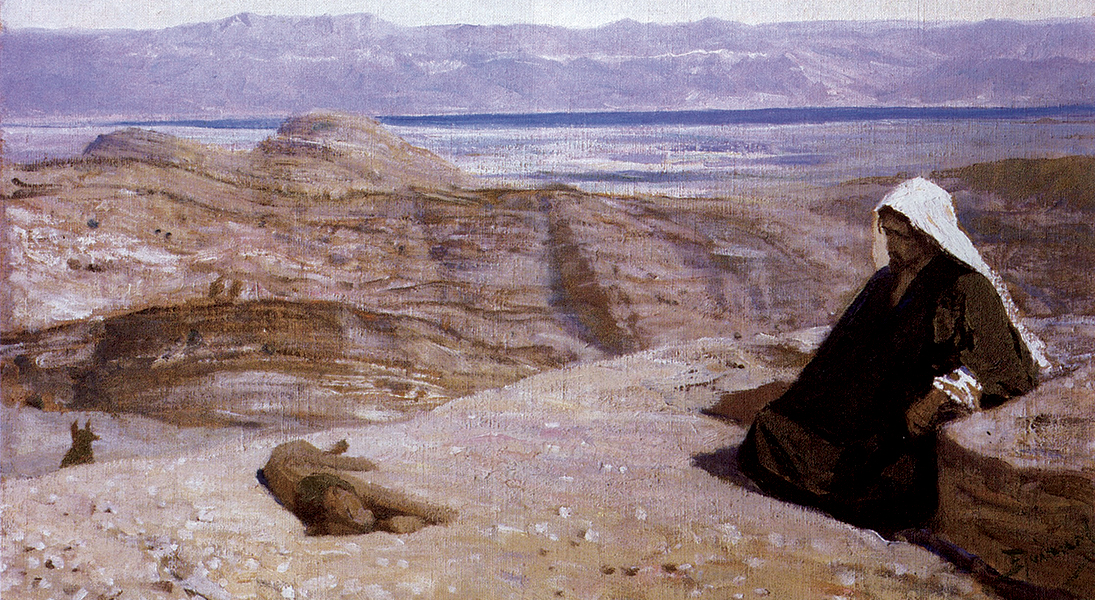
Vasily Polenov (1909), “Christ In The Desert”

How Satan Tempts

Thursday Column: Captain’s Blog

carl-pic

Carl Pollard

 
Genesis 3 records for us the fall of man. This account reveals to us the methods Satan uses to tempt us, and the choice that changed the course of the world. We can learn a lot about the devil in his first interaction with God’s creation.
 
“Now the serpent was more crafty than any other beast of the field that the Lord God had made. He said to the woman, “Did God actually say, ‘You shall not eat of any tree in the garden’?” And the woman said to the serpent, “We may eat of the fruit of the trees in the garden, but God said, ‘You shall not eat of the fruit of the tree that is in the midst of the garden, neither shall you touch it, lest you die.'” But the serpent said to the woman, “You will not surely die. For God knows that when you eat of it your eyes will be opened, and you will be like God, knowing good and evil.””
 
We don’t know how long Adam and Eve were in the garden. There is no timeframe between chapter 2 and 3.
It could’ve been a month, a year, a century that has gone by. Whatever the time frame, Satan comes to Eve and places doubt in her mind. This is quite possibly the worst lie ever told. “Did God really say…?” While Satan doesn’t physically appear and speak to us today, he still uses this same tactic. He has destroyed many churches’ worship to God. “Did God really ask for music with no instruments?” “Did God really say for the women to be silent?” By casting doubt Satan has corrupted the worship and faith of millions.
 
After he casts doubt, he then blatantly contradicts God, “you will not surely die.” And once again he continues to blatantly contradict God’s word today. The message Satan tells the world is completely different from what God has given to us. Satan contradicts the Father. Rather than “love you neighbour as yourself” he says “love yourself above your neighbour.” Rather than “serve God and keep his commandments, he says “serve yourself and listen to no one.” Satan contradicted God in the past and continues to do so today.
 
After he casts doubt and blatantly contradicts God, he then offers power, “you shall be like God.” Obviously in their close relationship with God, they understood who created the world. The created wanted to be like the creator, but the devil offered a lie. Satan only has one thing to offer– sin. He oftentimes portrays this lifestyle of sin as a lie.
He offers happiness and joy, but at the end of the day all he has to offer is sin and regret.
 
Eve was tempted by Satan, and he used the same methods then as he does now. Eve experienced:
  • The lust of the flesh (she wanted to eat of the fruit)
  • The lust of the eyes (literally says “it was a delight to the eyes,” v.6)
  • Pride of life (she wanted to become wise and have power)
The devil always knows what to say in order to get us to stumble. We must be vigilant and ready to refuse the tempter when he appears.

The Gripsholm Terror

Tuesday’s Column: Dale Mail

dalejanelle2021

Dale Pollard

The Gripsholm Castle, in Sweden, is home to the world’s oldest portrait gallery. This might be of interest to some art enthusiasts, but there’s something else in this castle you’d never forget seeing. Inside of a glass box in Gripsholm’s upper armory, there is an 18th century stuffed lion. This lion, nicknamed “Leo,” is a beast that tends to provoke a wide arrange of emotions from it’s viewers. It has a disfigured face and human like teeth with an oversized (fake) tongue hanging out of it’s mouth. The history of the lion is also somewhat of a mystery. However, there’s a particular legend about this taxidermy terror that the writer finds hilarious. In 1731 the king of Sweden was given an incredible gift. He was once the proud owner of a handsome lion and he loved this beast. Unfortunately, it died at a young age and the king’s heart was broken. He sent the lion’s pelt and bones to a taxidermist to have it stuffed so that it’s memory would be kept “alive.” There was only one problem. The taxidermist had no idea what a lion actually looked like because he had never seen one before. This being the days before the internet, he was forced to try his very best. The finished product remains part atrocity and part masterpiece to this day.

 In 1 Peter 5.8 we are warned about our adversary, the Devil, and that he is currently stalking the earth looking for his next potential prey. The sad truth is the fact that many in this world aren’t sure what this lion looks like. The Devil can disguise himself in the form of sinful pleasures and promises and as a result he has become the, “King of this world” (John 12.31). The Scriptures and the king of Sweden can both agree that things will get ugly if we aren’t sure what a lion looks like. 

How Not to Deal With Your Addiction 

Friday’s Column: Brent’s Biblical Bytes

Brent Pollard

Robert Aaron Long serves as a vivid example of how one should NOT deal with his addiction. While politicians and activists may seek to politicize the “massage parlor shooter’s” motives, law enforcement is painting the picture of a mentally disturbed man who seeks to justify the murder of others because of his sex addiction. Long evidently has a problem dealing with his lusts. Hence, these massage parlors’ existence, which he patronized in the past, presented such a temptation that he felt it necessary to kill the proprietors and workers of said establishments.   


As rationally thinking people, we readily see the problem with Long’s logic. Why would the perpetrator of the violence not turn his anger inwardly? He is the sinner, regardless of who the temptress may be. Would it not have been more effective to actually pluck out his eyes or remove other body parts causing him to sin? At least, one could twist Jesus’ hyperbole in Mark 9.34ff in such a fashion to justify self-mutilation for the sake of entering the Kingdom of God. If you seek to live righteously, would such extremes not be better than taking the life of eight people? 


If anything, this incident demonstrates the sad state in which our modern world finds itself. Long knew enough to realize he had a problem with his fleshly appetites. Had no one taught him to “flee from youthful lusts and pursue righteousness, faith, love and peace, with those who call on the Lord from a pure heart” (2 Timothy 2.22)? Had he pursued righteousness with others calling on God’s name, he would have learned how to “possess his own vessel in sanctification and honor” (1 Thessalonians 4.4 NASB1995). Older Christian brothers could have encouraged Long to exercise self-control (Titus 2.6).  


I cannot claim to know the particulars of Long’s home life, but I can inspect the fruit born of contemporary society (cf. Matthew 7.20). These types of crimes result from a nation that has excluded God from the public square. With God’s teachings, one notes that the one accountable for sin is the individual committing it (James 1.13-15). John identifies the three main avenues the world uses to tempt us: “lust of the flesh and the lust of the eyes and the boastful pride of life” (1 John 2.16 NASB1995).  


The correct application of the passage from Mark 9.34ff mentioned previously is that one takes personal responsibility in removing such influences. In the case of sex or pornography addiction, turn off the television and internet. Avoid the parts of town where more seedy businesses operate. Remove your libertine friends who desire to patronize things like strip clubs and “massage parlors.” As Paul indicates of his daily walk, it is self-discipline (1 Corinthians 9.24-27).  


And do not try to tackle addiction alone. Again, we observed that Paul told Timothy to flee lusts and pursue righteousness, faith, love, and peace with other Christians. (2 Timothy 2.22) Addiction is difficult to overcome. The addicted can fall off the wagon periodically. Hence, he or she needs others to help lift them back up. We are mindful of the truth that “two are better than one” (Ecclesiastes 4.9-12). Join this truth with prayer and Bible study, and one can find the necessary strength to overcome. Isaiah reminds us that God gives strength to the weary and increases the power of the weak. (Isaiah 40.29) 

Having seen how not to deal with your addiction, like Robert Aaron Long, decide to take responsibility, purge your life of the evil leaven, ask others for help, and turn to God for strength.  


Sources Consulted: 

Pagones, Stephanie. “Atlanta Shooting Suspect Tells Police Attacks Not Racially Motivated, Was Purportedly Driven by Sex Addiction.” Fox News, FOX News Network, 17 Mar. 2021, www.foxnews.com/us/atlanta-shooting-suspect-police-attacks-not-racially-motivated-sex-addiction.  


The Angels’ Struggle (And Ours)

Wednesday’s Column: Third’s Words

Gary III

Gary Pollard

We sometimes have a tendency to give up when we mess up spiritually. We’ll think, “Guess I blew it, there’s no point in trying now.” Guilt or frustration over the difficulty of living for God and falling short is a powerful Achilles Heel of ours. Paul describes our struggle with sin as combat with self (Romans 7). 

A Christian who is fighting to follow God is still going to sin at some point. We sometimes allow the loss of that battle to drag us into a pattern of sinning solely because we’ve become discouraged that we even allowed that sin to happen. 

I’d like to point out that we aren’t alone in that struggle. Consider Job 38.7: angels – who do not need faith because they live in the presence of God – were up close and personal to the creation of our incredible universe. They watched in awe as God fabricated the stars. They heard those stars sing, which means that they were amazed by the sheer power and majesty of what we can only hear as obscure signals. They were right there! 

Some of those same angels were caught up in sin (II Peter 2.4ff; Jude 6-9). Satan currently has followers who were at one time up close and personal to the Power behind our existence (Romans 12.7ff; Matthew 25:41). 

If an angel, a being who does not serve God based on a mere belief in His existence, but because they were originally created for the sole purpose of carrying out His will, and who are eyewitnesses to His existence and unlimited power, can be tempted to the extent that they are willing to abandon the presence of God and forfeit ever seeing His face again, who are we to think that our struggle is that defeating? 

God does not have a salvation plan for angelic beings (II Peter 2.4). When they breach their boundaries, that’s it. The moment they act outside of God’s will is the moment they forfeit the presence of God for eternity. 

We are lower than angels on the creation totem pole (Psalm 8.5), yet we have Jesus as a mediator defending us before God (I John 2.1) and constantly making us sinless in God’s eyes when we’re doing our best to live for Him (I John 1.7). We have a gift that angels do not enjoy: we get extra chances. As long as we are willing to wage war with our sinful desires, as long as we are striving to be like Him, and as long as we are trying to incorporate the word of God into our lives, we have grace. 

We’re stepping out of the concrete and into conjecture, but there is at least some evidence that lust (Genesis 6; II Peter 2; Jude 6-9) and perhaps tragedy (Matthew 18.10) are enough to make an angel forfeit their home. Again, this is pure conjecture but it has, at the very least, some scriptural evidence to suggest legitimacy. 

When we sin, we need to take a step back and get some perspective. We must not brush off sin as being inconsequential, but we also must avoid allowing a mistake to send us into a dysfunctional pattern just because we think, “I’ve blown it, there’s no point in trying now” or, “This struggle is too great for me.” If angels aren’t immune, why on earth would we think that we are supposed to be? 

The beauty of Christianity is found in God’s grace. It is understandable, seeing how some have abused the subject, to want to avoid the topic altogether. How many, though, have found themselves trapped in sin because they did not understand or believe in the power of God’s continual forgiveness?

Understanding what we have when we make a concerted effort to follow God is of the highest importance. We will sin. If we say that we have no sin, we are liar and there is no truth in us (I John 1.8). When we do sin, let’s remember that not only can we have forgiveness if we’re walking in light, we’re not especially awful just because we find ourselves falling short. If even God’s angels can be tempted to the point of leaving His presence forever, so can we who have not seen His face. And let that cause us to seek His face with even more enthusiasm than before! 

I Corinthians 10.13

II Peter 3.9

573a4f4881b5ac289f8fd610e9755dcb

When the Tempter Has You Out On A Limb

Friday’s Column: Supplemental Strength

brent 2020

Brent Pollard


You can learn much by observing nature. Not only can one know God by looking at nature (Romans 1.18-20), he can learn specific lessons on various topics by looking at specific aspects of God’s creation (e.g. ants teach industry, Proverbs 6.6-8). I was watching a humorous scene outside my office window recently and was reminded of this.

 Our household, despite being full of “dog-people,” has cats for “pets.” Let’s just say that we feed the cats and provide them outdoor shelter for keeping mice, moles, and snakes away from the house. In many respects, they’re feral but become domesticated long enough to eat the kibble we put out. And, if they feel like initiating it, contact resembling petting may occur. If there is one thing I don’t like about cats, though, it is their murderous nature. Even though well-fed, cats will kill for sport. 1

 This latter observation creates a conflict for someone who has always enjoyed feeding and watching birds as well. We had to give up putting out birdseed when the cats became a part of our household. At first, the birds avoided our house. Yet, kittens learn by watching adult cats. If adult cats don’t teach kittens how to hunt, they aren’t as successful at it. As the senior hunters have passed from disease and predation or gone fully feral, being chased off by other cats, the birds have begun coming back without our encouragement. Frankly, I think a few of those “birdbrains” must be rather smart.

 One such smarty was teasing one of our cats the other day. He or she served as a good example of the tempter. As Angelo, a cat with a pattern of “angel’s wings” on his back, was slowly climbing up a budding, dogwood tree, the bird did not fly away. Instead, the avian adversary just side-stepped further to the right out on to thinner branches. The higher Angelo climbed, the thinner the branch on which the bird rested became. It seemed as if the bird knew that if Angelo tried to pounce on him or her, he would go crashing to the ground while he or she would just fly away. Angelo really thought about his situation. It took him several minutes, but he finally understood that despite his prowess, continuing towards his coveted prize would lead to his harm. Thus, to his chagrin, he slowly made his way back down the tree to the safety of the ground below.

 Herein is the lesson from nature. The tempter will lure you out from “relative safety” in order to bring your desire close, only to ensure when you pounce on it, you will end up falling flat on your face (consider Romans 6.23). We must ensure we are aware of where we are (Hebrews 2.1-4). The branches upon which we make our way may grow thin quickly, depriving us of a solid foundation, and causing us to fall.

 Of a truth, no one ever sets out to fall, he just fails to appreciate the gravity of the situation. Keep your eyes on what lies beneath your feet (1 Corinthians 10.12).

cat-1647775_960_720


1 Traywick, Catherine. “Killer Kitties: Study Proves They’re Not as Innocent As They Look.” Time, Time, 9 Aug. 2012, newsfeed.time.com/2012/08/09/killer-kitties-study-proves-theyre-not-as-innocent-as-they-look/.

Coping With Thorns

Neal Pollard

Satan is the accuser of the brethren (Rev. 12:10). He is the author of audacity, and he showed it first in Eden. He is at work today through temptation and suffering to try and dismantle our faith. He is a presence in our personal lives (1 Pet. 5:8). If there’s hurt, he’s happy. If there’s sin, he’s satisfied. He can’t force anyone to sin (Js. 1:13-15). He can’t make us fall away (John 10:28-29). But, he’s at work. Paul writes about something that has long mystified the Bible student, in 2 Corinthians 12:7-10. In that passage, we have:

  • The reality of the thorn (7)
  • The reproach of the thorn (7)
  • The reason for the thorn (7)
  • The result of the thorn (7)
  • The response to the thorn (8-10).

Paul reveals Satan’s involvement in that thorn. This troubles me. I have never asked for a thorn in the flesh and I have no reason to think Paul asked for his, but he got one anyway. What do you do when you have a thorn in the flesh? Consider at least three things Paul teaches us in this powerful passage.

No one is immune from thorns. Who’s talking in this text? The great apostle Paul, a man God gave revelations, who’s preaching across the world, converting so many, and achieving name recognition for the best of reasons. If you ever thought anybody would be sheltered for doing right, it would be him. But Paul says there was given to him a thorn in the flesh. That makes me uncomfortable. I need spiritual lessons about God and myself, as Paul and even Job, who Satan was allowed to buffet, did. If a great Old Testament patriarch and great New Testament preacher had thorns to deal with, I know I am not immune.

Sometimes, God lets the thorn stay. We may have to accept that our given affliction may never come to an end as long as we’re on this earth. A recurring or chronic illness, constant adversary, or irreversible limitation may not be removed. I wish I knew why God told Paul “no” and why he sometimes tells us “no” when we ask for our thorns to be removed. But, even if we keep the thorn, God’s grace is sufficient and He can use that very thing to accomplish good through us for the Kingdom. God uses thorns to supply us with humility and grace. If our thorn comes and stays rather than comes and goes, God will use it for our good and to accomplish good if we will properly view it.

Thorns are growth opportunities. If we remain faithful to God through our thorns, we will spiritually grow. Satan is rebuffed and defeated, as he was with Paul and Job. But, for every Paul and Job, how many have let affliction and adversity destroy their faith? We know God’s power eclipses Satan’s. But don’t underestimate this enemy (2 Cor. 2:11; 11:14; 12:7). One of Paul’s final points in the letter is about God’s great power (13:4). Paul was weakened by affliction, but he could endure because of faith. God is more powerful than Satan and Paul’s thorn is but one proof of it. Lyte wrote,

As woods, when shaken by the breeze, take deeper, firmer root,
As winter’s frosts but make the trees abound in summer fruit;
So every Heaven-sent pang and throe that Christian firmness tries,
But nerves us for our work below, and forms us for the skies.

Is it a trial or a blessing in disguise? Doesn’t it depend on how we view it and what we do with it? Satan wants to use afflictions to destroy us, but God is greater. He can transform our tragedies into triumphs. Trust Him through the thorns. The roses will appear!

d854897661b1aa845ddca7a690139563

The Shocking Truth Of The Alligator That Bit The Electric Eel


Neal Pollard

All puns aside, the event really happened in the Amazon back in 2010 and was captured on You Tube.  An unidentified Brazilian fisherman documents the rare, extraordinary event.  The electric eel can generate up to 600 volts of electricity.  A hungry caiman with a fatal appetite found this out too late to let go and live.  The best reports indicate that both creatures, intended predator and potential prey, lost their lives in the interaction (www.telegraph.co.uk).

While the fisherman had caught the eel and had gone to get a knife to cut the line, the caiman saw the eel thrashing and could not resist trying to make a meal of it.  Animals are instinctive creatures and thus such intellectual and emotional responses as lust, malice and forethought, or hostility did not drive its decision to dine.  Nevertheless, it was still a fatal food choice!

Think about the instances where we can get into even more serious, spiritual trouble than the aforementioned reptile.

  • The allure for a married person to have an affair or an unmarried person to have an illicit sexual encounter or relationship.
  • The decision to get drunk or high.
  • Provoked by the words or actions of another, unloading on the provoker with sinful anger expressed by ungodly words and/or actions.
  • Exacting revenge on someone, thinking it will be “sweet” and not “bitter.”
  • Sending that angry email without deliberating, praying, or consulting a trusted friend first.

Really, any impulsive reactionary word or act can create ramifications we cannot predict or anticipate.  So many, in a momentary heat of passion, have created longterm headaches and heartaches.  Before we give in to temptation, we need to give due thought to the consequences all the while appreciating that we cannot foresee them all or the extent of them.  Eve was the first to fail to do this (Gen. 3:6), but she was far from the last.  May we pray for and pursue the wisdom to mull before we munch!


These Snakes Can Find Their Way Back


Neal Pollard

Even those not inherently squeamish about snakes are uneasy about a phenomenon occurring in Florida.  Former pet owners of Burmese Pythons probably started releasing them in south Florida back in the late 1990s.  On February 4, personnel found an 18-foot specimen in the Everglades.  That they are huge predators was already a known fact.  Yet, researchers from Davidson College and members of the U.S. Geological Survey organization trapped six of these snakes and moved them 13 to 20 miles away. In less than a year, all six had navigated to within three miles of their original location.  This means these huge creatures are capable of “homing,” whether by sight, smell, or by way of the earth’s magnetic field (Elizabeth Weise, USA Today, 3/19/14).

As unsettling for some of us as that idea might seem, there is a predator far more deadly than that whose cunning and wiles are even greater.  Satan, called “that serpent of old,” is said to have “devices” (2 Cor. 2:11), and is depicted by Peter as being predatory (1 Pet. 5:8). While he is not able to make us do evil—that’s something we do ourselves (Js. 1:13-15), he is subtle and beguiling and desires our destruction.

The implication of the article and those researchers is that moving the snake is not the answer.  They make their way back.  The answer is to destroy the snake.  As we fight temptations in our lives, we must be aggressively proactive!  We must take radical, decisive steps to keep the snake from coming back.  From faithful Bible study and prayer to exerting will-power and self-control, we can prevent the old serpent from invading our lives!  James urges us on, telling us that by resisting the devil we can put him to flight (Js. 4:7-8).