SATAN ENTICED DAVID TO… COUNT?

The first time we read the name “Satan” in the Bible, it’s under very strange circumstances. Ready?

Here’s the passage: 

“Satan rose up against Israel and incited David to take a census of Israel.”

Dale Pollard

The first time we read the name “Satan” in the Bible, it’s under very strange circumstances. Ready?

Here’s the passage: 

“Satan rose up against Israel and incited David to take a census of Israel.” 

(I Chronicles 21:1, NIV)

Alright, so Satan decides to pick a fight with God’s man. So  how does he do it this time? Well, he incites (or entices) David to take a census of Israel— of course. You might be thoroughly confused at this point but just wait, you’ll want to throw something breakable in a second. 

So Satan takes his shot at David and apparently the most devious plan he could come up with was, “Operation Headcount.” There must be more to it than that. Surely. 

Make it Make Census

A census in the ancient world—especially in Israel—was not just a headcount. It carried spiritual, political, and economic weight. 

It typically involved counting all the men and for at least a few practical reasons. A ruler could use the census to determine the size of his army, or make sure proper tax revenue was collected, or get an idea of how capable his labor force was. Oh, and for Israel, it better be done right. 

Exodus 30:12 warns that a census must be accompanied by a ransom/offering, or else a plague would come upon the people:

“Then each one must give a ransom for his life to the LORD… so that no plague may come on them when you number them.”

So maybe now’s a good time to address an alleged contradiction. 

Our original passage in question (I Chron. 21:1) is already interpreted in a few ways, especially when compared to its parallel account in 2 Samuel 24:1, which says:

“Again the anger of the LORD burned against Israel, and he incited David against them, saying, ‘Go and take a census of Israel and Judah.’”

Did you catch that too? Seems like Samuel contradicts the Chronicler by saying that God was really the one who enticed David into counting folks, not Satan. So which is it— and did you throw something yet? 

It Was Satan….. Probably 

No matter how you slice it, Satan is the one doing the enticing and here’s how we can be sure. 

First, let’s start by contrasting the similarities between this case and Job’s situation. God allowed Satan to test Job— but He remained sovereign. God was clearly in control while Satan had to ask His permission before making Jobs life so miserable. God let the devil torment his most faithful servant, but with strict conditions (Job 1.8,12). 

Secondly, it’s possible that “Satan” in 1 Chronicles 21:1 should really be translated “adversary.” Now, this next part isn’t typed with any real certainty, it’s only a personal observation (by the author). 

Remember the account of Balaam and his donkey? It’s worth reading again, even if you’re familiar with it. Just before the conversation between a man and his animal takes place we read: 

“God’s anger was kindled because he [Balaam] went, and the angel of the LORD took his stand in the way as his adversary” (Numbers 22:22). 

The word adversary is the exact same word that’s translated as Satan in 1 Chronicles 21:1. However, it was the angel of the Lord that stood as an adversary. The language is strikingly similar in both passages. Take a peek, but this time side by side…by side: 

1 Chronicles 21:1 

“Then Satan stood against Israel and incited David to number Israel.” 

Numbers 22:22

“God’s anger was kindled because Balaam went, and the angel of the LORD took his stand in the way as his adversary”

2 Samuel 24:1

“…the anger of the LORD was kindled against Israel, and he incited David against them, saying, “Go, number Israel and Judah.”

How satisfying is that? Instead of a contradiction you see consistency; inspired perfection on full display. 

So What Happened To David? 

Well, he messed up. A lesser known misstep on David’s part, too. God sent a plague as a consequence—exactly as Exodus 30 had warned. As tragic as that was, again the consistency is amazing. There was a thousand years or so between Exodus and Chronicles but God still remembered exactly what He had told Moses.

After the census, David felt guilt immediately (2 Sam. 24:10) and repented. As anybody after God’s heart would do. 

Handed Over To Satan?

Gary Pollard

I Timothy one ends with 19, “Continue to trust God and do what you know is right. Some people haven’t done this and their faith is now in ruins. Hymenaeus and Alexander are men like that. I have given them to Satan so they will learn not to speak against God.” 

This is a difficult passage, but not the only time Paul has used the phrase “given them to Satan.” He also said this in I Corinthians 5.5, which gives us more insight into what this might mean. 

The member in I Corinthians 5 was handed over to Satan for physical punishment so that he could be saved at the end. This appears to be very similar to what Satan was allowed to do in the book of Job — though in these situations, it appears that he has the power to punish Christians physically when they have one foot in the world and one in Christianity, but with a lot more weight on the foot that’s in the world. 

This obviously doesn’t happen to every — or probably even most — Christians who fall away, but I Corinthians 5.5 gives us at least some hope for those who end up in Satan’s hands. This passage uses a phrase that likely means, “I have given Satan permission to kill this person.” But it doesn’t end there: “…so that their spirit will be rescued in the day of the Lord.” The original word used here (ινα or hina) means, “Resulting in,” or, “So that”. It’s used to describe the purpose or intended result of something. 

Perhaps this means that God’s grace will allow some Christians’ physical lives to be lost before they reach the point of no return, ultimately saving their soul. After all, God doesn’t want anyone to die spiritually, but for everyone to be converted (II Pt 3.9), something repeated by Paul in I Timothy 2.4. Even in judgment God shows mercy! 

If The Devil Had A Self-Help Book

Friday’s Column: Brent’s Bent

I recently preached a sermon based on an idea I took from Paul Harvey’s “If I Were the Devil.” My inspiration came from reading in John 15.18-25 about Jesus’ words to His disciples shortly before His betrayal about how the world would hate Christians as much as they hated Him. I immediately thought of Andrew Carnegie’s book, How to Win Friends and Influence People, for reasons I can only attribute to my ADHD. God created us to be social creatures. Remember, God said it was not good for man to be alone (Genesis 2.18). So I expected the devil to twist Jesus’ words to persuade potential converts that their desires should be more like Carnegie’s and less like Christ’s. In other words, he’d write a self-help book about how to make the rest of the world fall in love with you rather than hate you. 

So, if the devil had a self-help book, he’d write, “If you are of the world, the world loves its own.” (Compare John 15.19) Rather than risking the world’s wrath by becoming a disciple, make friends with it. Ignore James’ statement that being friendly with the world makes you an enemy of God (James 4.4). Instead, give in to your flesh’s desires, even if it means separating yourself from God (Romans 8.5-8). Yes, give in to the desires of your flesh, eyes, and pride, and forget that God will destroy this world and its lusts in the end (1 John 2.15-17). The pleasure of sin is yours for the taking if you’re willing to go to such lengths, unlike poor old Moses (Hebrews 11.25). The world will make it worthwhile until you pay for all the fun (Romans 6.23). 

The devil will try to convince readers that serving yourself is better than following another, especially if there are no tangible benefits from subservience, such as better treatment than your master. (Compare John 15.20). So it’s best to go your way, to be free to choose for yourself, without being yoked (Matthew 11.28-30). This restraint is especially true when one considers that Jesus steers him down a “constricted” path (Matthew 7.13-14 NASB). But there is an alternative highway that is easy. And the way must be correct if it seems fitting (Proverbs 14.12). Besides, who needs some dusty old road from a long time ago when men have built newer roads since then (Jeremiah 6.15-17)? So, be your own man or woman; aim to be autonomous. 

Finally, the devil would remind his readers that Jesus revealed that people treated Him cruelly “simply because they could.” (Compare John 15.25) What Jesus did, did not matter. There were just those who despised Him. So, what was Christ’s compensation for being loyal to His Father, healing the sick, and raising the dead? The people crucified Him. Why take the risk that someone will persecute or despise you even though you are doing good? It just seems like too much trouble. Avoid worrying about the welfare of others and focus on your interests instead (Philippians 2.4). It’s the proverbially “dog eat dog” world. The iron rule of “might makes right” is what people practice, not the golden rule (Matthew 7.12). 

Yes, the devil will try to convince you that he has your best interests at heart. The apparent problem with the devil’s self-help book is that it is full of lies and mistruths. Jesus reminds us that the devil is the father of lies (John 8.44). Thus, lies are all that the devil can authoritatively speak. Jesus was honest with us, not discouraging or scaring us away when He gave us His warning about how the world would receive us. And Paul told Timothy that “all who want to live in a godly way in Christ Jesus will be persecuted” (2 Timothy 3.12 NASB). If the world hates us, that is a good thing, as long as their reason for hating us is because we are one of God’s “peculiar people” (1 Peter 2.9 KJV).  

Death was not the end for Jesus, and He assures us that it will not be the end for us, either. The author of Hebrews reminds us that Jesus was able to endure the cross and disregard its shame because of the joy set before Him (i.e., His return to Heaven)—Hebrews 12.2. So likewise, there is no reason for us to sorrow regardless of what may occur. And those of us in the United States have yet to put our lives in danger as a result of practicing our faith (cf. Hebrews 12.4). At most, men may take our lives, but they cannot take our eternal reward (Matthew 10.28). And for those facing physical persecution as those of olden Christians, we take heart from Paul’s words to the Corinthians:  

“But we have this treasure in earthen vessels, so that the surpassing greatness of the power will be of God and not from ourselves; we are afflicted in every way, but not crushed; perplexed, but not despairing; persecuted, but not forsaken; struck down, but not destroyed; always carrying about in the body the dying of Jesus, so that the life of Jesus also may be manifested in our body. For we who live are constantly being delivered over to death for Jesus’ sake, so that the life of Jesus also may be manifested in our mortal flesh” (2 Corinthians 4.7-11 NASB95). 

If you want to make friends and influence people, stick with the Bible. It truly is the best book on the subject. And, wherein his principles find a Scriptural foundation, also consult Mr. Carnegie’s work for the business world. But avoid those books on the subject written by the adversary (1 Peter 5.8). Instead, he writes self-help books that are how-to guides for self-immolation (cf. Revelation 20.14-15). 

Brent Pollard

The Serpent

Tuesday’s Column: Dale Mail

Dale Pollard

Interesting conversations with godly people are some the best ways you can stir your desire to get into His word more. Studying the Bible will always bring to the surface questions we didn’t even know we had— along with the answers to the most important questions you could ask. 
Here’s an idea. Find somebody with a wealth of Biblical knowledge and create a shared note on your cell phone or computer. If there’s something on your mind or something you’d like to know more about, it helps to have another brain working to help you get to the bottom of it. 
It’s also a great way to keep you thinking about Biblical subjects! Below is a portion of a shared note that my brother and I have had for months now (Gary’s input is italicized and correspond with the numbers you see). 
Thoughts On The Serpent 

  • The serpent was crafty and could walk. Why this animal? Its craftiness seems to be linked with its intelligence (1). When the subject of possession is brought up, demons typically come to mind. The possessor of the serpent (2) seems to change form once again as Satan is described as “walking about on the earth” (Job 1) and traveling to the pinnacle of the temple (Matt. 4.5). Satan’s mobility had improved since the removal of his serpentine legs (3). Could it be that he was never a serpent from the beginning? What if he merely chose the animal for reasons unknown, and used his intelligence to utilize this particular creature’s capabilities. If the serpent changed his form to the Leviathan, then that would be a logical explanation for his mobility in Job (4). A mighty beast, with unnatural intelligence (5) that humans couldn’t tame. This would also explain how humans are able to dominate and tame all animals (Gen. 1.26-28) but weren’t able to tame the beasts in Job. 
  • (1) Rev 12.9; 20.2
  • (2) Satan is always portrayed as a serpent…except when he isn’t (i.e., cursed to crawl in Genesis, walking in Job 1 & 2, flying in synoptic gospels at temptation of Jesus, moving tactically in I Peter). I have to think that, like the angels, he had the ability to project his consciousness into non-sentient beings (i.e., no free-will override), or disguise himself as humanoid (II Cor 11.14; Gen 3.18; Heb 13.2). We know very little about who/what satan really is, but because he was a fixture in God’s entourage before banished to earth, I have to assume he was a watcher of some kind. 
  • (3) A curse that improves mobility is no longer, by definition, a curse. 
  • (4) God specifically names Leviathan as the pinnacle of his non-human creation. He would not have extolled leviathan if its characteristics were synonymous with the accuser in Job 1, 2. This would also imply a duality of personhood never attributed to satan (i.e., existing as two entities simultaneously). Since this predates Jesus’s arrival by probably 4500 years, satan is likely still in the accuser position in God’s entourage. This would make him a powerful cosmic being with the same abilities other watchers enjoyed. When he became the ruler of planet earth, his power was “chained” or throttled (II Cor 4.4; Eph 2.2; Lk 10.18; Rev 20.1-15). 
  • (5) I was unable to verify the leviathan’s unnatural intelligence, but Job does describe its unnatural strength. 

Happy studies! I hope this inspires you to begin your own interesting conversations. 

Know The Enemy And Know Yourself 

Friday’s Column: Brent’s Bent

Brent Pollard

For wisdom, one cannot beat God’s inspired Word. That Word, Jesus said, is truth (John 17.17). Even so, the secular works of man can be insightful. For example, soldiers and captains of industry alike still quote China’s Sun Tzu. From his work, The Art of War, we take our title. However, the full quotation is longer. Therefore, I will share it to provide context. 

“If you know the enemy and know yourself, you need not fear the result of a hundred battles. If you know yourself but not the enemy, for every victory gained you will also suffer a defeat. If you know neither the enemy nor yourself, you will succumb in every battle.” 1  

I realize some might say this is obvious enough to be a truism. Yet, for some, it is advice that seems so novel despite having parallels in Holy Writ. Doesn’t the Bible teach us to know our enemy as well as ourselves? Of course, it does.  

  • “Be of sober spirit, be on the alert. Your adversary, the devil, prowls around like a roaring lion, seeking someone to devour.” (1 Peter 5.8, all ref. NASB1995 unless otherwise indicated) We see our enemy is on the prowl. That noun denotes stealth. Yet, it likewise signifies he is continuously on the move, a restless foe. This restlessness seems evident in the introduction of Job when we find Satan flippantly admitting to God’s question of where he has been that he has been “roaming about on the earth and walking around on it” (Job 1.7). Hence, in knowing our enemy, we expect that he will attack us at any time from any location. Thus, we must maintain our sobriety (i.e., sensibility) and state of preparedness (i.e., alert). As we introspectively examine ourselves, do we note that state of readiness to combat a cunning enemy? Do we have the tools for offense and defense ready? 
  • Paul reminds us that our battle is against spiritual enemies (Ephesians 6.12). And those enemies have a leader that likes to use “schemes” (“wiles” KJV) (Ephesians 6.11). In other words, we do not expect our enemy to fight fairly. In pure militaristic terms, the devil is engaged in guerrilla warfare. He cannot win the war against a superior enemy (i.e., God), so he snipes those he can. Within the same context, though, we observe what we have at our disposal: the panoply of God. God’s armor consists of a loin covering (truth), breastplate (righteousness), shoes (readiness), shield (faith), sword (God’s Word), and helmet (salvation) (Ephesians 6.13-17). These items we must wield with prayer and alertness if we desire to win (Ephesians 6.18). Do we actively use God’s armor, or has our apathetic spirit cast it aside? 

In all fairness, Sun Tzu admits that knowledge alone cannot ensure every victory. And we acknowledge that, as Christians, there are times when we lose a battle against the enemy. Everyone sins (Romans 3.23). There are even occasions when the enemy is in more significant numbers. In such situations, Tzu says it is best to avoid the enemy. Of course, we cannot do that as Christians (John 17.14-16). But we can flee from sin (1 Corinthians 6.18; 10.14; 1 Timothy 6.10-12; 2 Timothy 2.22). And we must keep good company to ensure we are not corrupted (1 Corinthians 15.33). We must periodically check our footing (1 Corinthians 10.12). And when we are seeking to restore someone, we must look to ourselves so that we are not tempted (Galatians 6.1). In the end, though, Tzu’s truism serves us well. We must know our enemy and ourselves. In the interim, as we fight this good fight, we look forward to the day when God will destroy the enemy. Until then, we take comfort from these inspired words: 

“For whatever is born of God overcomes the world; and this is the victory that has overcome the world—our faith.” (1 John 5.4) 

Sources Cited 

1 Tzu, Sun. “A Quote from the Art of War.” Goodreads, Goodreads, https://www.goodreads.com/quotes/17976-if-you-know-the-enemy-and-know-yourself-you-need

Jesus Didn’t Retire

Wednesday’s Column: Third’s Words

garyandme521

Gary N. Pollard III

Satan tried to trip Jesus with a killer deal: “I’ll give you every nation in the world if you worship me” (Matt 4.8-10). This wouldn’t have been a temptation if he couldn’t deliver. What might Jesus have gained by having Satan give up control of every nation on earth? It would have made his job a lot easier! He wouldn’t have to fight with Pharisees or other hostiles. He wouldn’t have to disappear after teaching or healing. He could avoid the kind of rejection that broke his heart (Luke 19.41). 

Sometime after this encounter, Jesus started to recruit followers. He may have had Satan’s offer on his mind as he was calling Peter (Matt 4.18ff). He knew Peter would be so ashamed of him that he’d deny any connection to him (Matt 26.69-75). He knew that every one of his followers would abandon him when he most needed them (Matt 26.56). 

He still lived his life, he still taught, he still sacrificed himself for everyone. How many of us would still pursue something if we knew how painful or difficult the outcome would be? How many of us would continue to pursue something if we were given the option to take an easier path? 

Jesus didn’t even retire once his mission was accomplished! He faced homelessness, assault, rejection, betrayal, injustice, torture, and execution. I would have retired after that in a heartbeat, and I would feel that I had more than earned that retirement. 

After he went back to be with the father, he rolled up his sleeves and got to work. He’s a full-time mediator (I Jn 2.1-2). He’s making sure the natural universe operates as it should (Heb 1.3; Col 1.17). He’s keeping evil in check (Phil 3.21; I Cor 15.27). When the end comes, he’ll destroy the universe and judge every human who’s ever lived (Heb 9.27; II Pet 3.7-10; Rev 20.12, 21.1-2). 

Whew. He still loves us (Rom 8.35; II Cor 5.14; Gal 2.20; Rev 1.5)! He still gives grace with generosity (I Jn 1.7; Rom 5.15-21, 6.14). We serve a tireless God who invested everything in us and will do so until the end of time. Life gets us down and we ask, “Why?” Just remember who’s watching our backs and won’t ever let us down! 

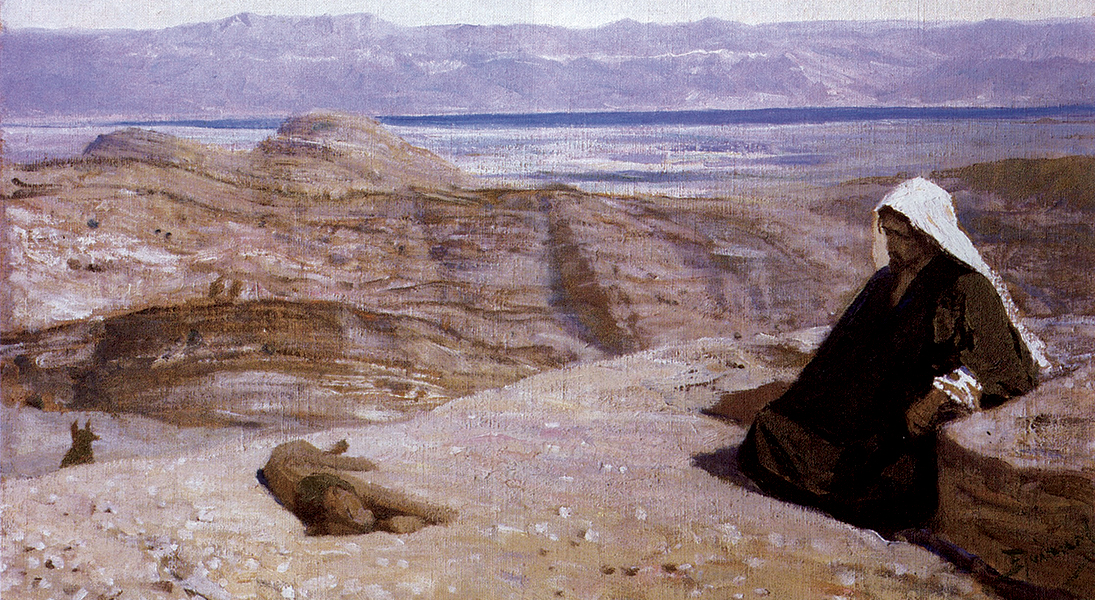
The wilderness of Judea

Lessons We Learn From Jesus’ Temptations

Monday’s Column: Neal At The Cross

img_5670

Neal Pollard

Jesus knew temptation. The writer of Hebrews makes that point about Him in assuring us He, as our High Priest, knows just what we are going through in this life (2:18; 4:15). His suffering allows Him to sympathize. I am comforted to know that He understands, since He is like me (Heb. 2:17). Luke (4:1-13) records this significant and pivotal moment in Jesus’ life before He begins His public ministry. It gives me necessary insight into who Jesus is, and it helps me fight the common battle against the enticements of my flesh, my eyes, and my pride.

TEMPTATION STRIKES THOSE IN A HEALTHY RELATIONSHIP WITH GOD. To be clear, temptation strikes “every man” (Heb. 4:15). But, sometimes we conclude that it’s not so bad or so frequent for the spiritually strong. Here is the perfect Son of God, described as full of the Holy Spirit and led by the Spirit (1), who encounters the tempter (2). Being spiritually strong can help make navigating temptation easier than it is for those who live according to the flesh (Rom. 8:5-14), but no one was closer to God and more spiritually healthy than Jesus as He walked the earth. How helpful to consider Paul’s warning here: “Therefore let him who thinks he stands take heed that he does not fall” (1 Cor. 10:12). 

TEMPTATION STRIKES IN PREDICTABLE AREAS. John classifies temptation into three major categories: “the lust of the flesh and the lust of the eyes and the boastful pride of life” (1 Jn.2:16). Methodical Luke lists Jesus’ temptation in that very order (cf. Mat. 4:1-11). The serpent, approaching Eve, must have appealed to these very areas at the beginning (Gen. 3:6). The devil does not have to get more complicated than that because these avenues are overwhelmingly effective for him. Though this and other passages reveal the Evil One’s intentions and efforts, we are fully accountable for how we respond to temptation (Jas. 1:13-15). We must take responsibility for how we handle temptation. 

TEMPTATION STRIKES WHEN WE ARE VULNERABLE. Jesus has gone an unfathomable 40 days without food when He encounters the devil (2ff). The devil goes straight for this susceptible area. Think back to times when you haven’t gotten proper rest, you faced stress and pressure, you were sick or felt poorly, and other trying times. These can easily become doors we open to sin. All of us will experience physical and emotional weakness. We must be aware that these lead to spiritual exposure. 

TEMPTATION CAN MAKE US CALL WHAT WE KNOW INTO QUESTION. Twice, the devil uses conditional statements to try and create doubt. First, he says, “If You are the Son of God” (3). He called Jesus’ identity into question. Then, he says, “if You worship me” (7). He seeks to get Jesus to question His loyalty. It was not a matter of what Jesus intellectually knew, but Jesus dwelled in the flesh (John 1:14; Heb. 2:14). Be aware that temptation will cause us to question things we know, too. That includes our exalted identity and our true motivation.

TEMPTATION IS THWARTED BY AN OMNIPOTENT TOOL. Jesus wins His battles with the devil and temptation by leaning on truth. There are 86 quotations of Deuteronomy (the second giving of the Law of Moses) in the New Testament, and Jesus quotes this book in reference to each of the devil’s temptations (8:3; 6:13; 6:16). Proper knowledge and handling of Scripture help even when enemies of truth, even the devil, try to misuse Scripture against us (as he does with Jesus, misapplying Psalm 91:11-12). Scripture is God’s own weapon, given to us not to cut and maim others but to fight off temptation and fend off the biggest threats to our faith and soul (Heb. 4:12; Eph. 6:17). 

It is wonderful to contemplate a day in which temptation will be permanently past-tense (cf. Rev. 21:1ff; 1 Cor. 15:55-58). Until then, we benefit so much from seeing how Jesus coped with the bane of temptation. It also helps us appreciate what He endured in order to give us salvation. 

Vasily Polenov (1909), “Christ In The Desert”

How Satan Tempts

Thursday Column: Captain’s Blog

carl-pic

Carl Pollard

 
Genesis 3 records for us the fall of man. This account reveals to us the methods Satan uses to tempt us, and the choice that changed the course of the world. We can learn a lot about the devil in his first interaction with God’s creation.
 
“Now the serpent was more crafty than any other beast of the field that the Lord God had made. He said to the woman, “Did God actually say, ‘You shall not eat of any tree in the garden’?” And the woman said to the serpent, “We may eat of the fruit of the trees in the garden, but God said, ‘You shall not eat of the fruit of the tree that is in the midst of the garden, neither shall you touch it, lest you die.'” But the serpent said to the woman, “You will not surely die. For God knows that when you eat of it your eyes will be opened, and you will be like God, knowing good and evil.””
 
We don’t know how long Adam and Eve were in the garden. There is no timeframe between chapter 2 and 3.
It could’ve been a month, a year, a century that has gone by. Whatever the time frame, Satan comes to Eve and places doubt in her mind. This is quite possibly the worst lie ever told. “Did God really say…?” While Satan doesn’t physically appear and speak to us today, he still uses this same tactic. He has destroyed many churches’ worship to God. “Did God really ask for music with no instruments?” “Did God really say for the women to be silent?” By casting doubt Satan has corrupted the worship and faith of millions.
 
After he casts doubt, he then blatantly contradicts God, “you will not surely die.” And once again he continues to blatantly contradict God’s word today. The message Satan tells the world is completely different from what God has given to us. Satan contradicts the Father. Rather than “love you neighbour as yourself” he says “love yourself above your neighbour.” Rather than “serve God and keep his commandments, he says “serve yourself and listen to no one.” Satan contradicted God in the past and continues to do so today.
 
After he casts doubt and blatantly contradicts God, he then offers power, “you shall be like God.” Obviously in their close relationship with God, they understood who created the world. The created wanted to be like the creator, but the devil offered a lie. Satan only has one thing to offer– sin. He oftentimes portrays this lifestyle of sin as a lie.
He offers happiness and joy, but at the end of the day all he has to offer is sin and regret.
 
Eve was tempted by Satan, and he used the same methods then as he does now. Eve experienced:
  • The lust of the flesh (she wanted to eat of the fruit)
  • The lust of the eyes (literally says “it was a delight to the eyes,” v.6)
  • Pride of life (she wanted to become wise and have power)
The devil always knows what to say in order to get us to stumble. We must be vigilant and ready to refuse the tempter when he appears.

The Fall Before The Fall

Tuesday’s Column: Dale Mail

image

Dale Pollard

The Bible indicates a battle between Satan and his rebellious followers in several key passages. The reason for this spiritual spat is not given to us in great detail but we are told that it began after they abandoned their rightful habitation (Jude 1:6). While many have speculated as to what and how this happened, we simply aren’t told. Some have also made the argument that this event took place after the Creation of the world, but this is also not certain. Genesis 2:1 says, “the heavens and the earth were completed and all their hosts.” While that may seem to clearly indicate that angels must have been created alongside everything else, Job 38:7 states that angels gave “shouts of joy” after the creation of stars.

The spiritual conflict ended with Satan and his apostate followers cast from the heavenly realm (2 Peter 2:4, Rev. 12:14, Jude) just before, it seems, the creation of earth with the Archangel Michael taking a significant role in his defeat and expulsion. 

Satan seems to have been at one time a high ranking Angel who thought he somehow stood a chance against his very Creator. That is a ridiculous thought! The application of this historical (pre-historical?) event is evident. Nobody, whether Angel or man, can win against God’s will. It’s mind boggling to imagine taking on God Almighty in some kind of battle, yet Paul tells us in Romans five that we were enemies of God at one point while living in sin, and are currently waging a war with God if we are living in sin. We should let that long ago battle in the heavenly realm be a reminder to us that God always wins the war. He’s already won! Now is the time to make sure that you’re on the side of the truth and triumph and not the devil and the defeated. 


Why Doesn’t God Just Kill the Devil?

Thursday’s Column: Captain’s Blog

carl pic

Carl Pollard

This is a question that has been asked for centuries. If God is all powerful, why doesn’t He just kill Satan? In order to adequately answer this question we will need to look at a few different aspects of the Devil himself, as well as the attributes of God.
It’s not hard to find evidence of a world filled with sin, and logically it would make sense for God to just destroy the source of the problem…or would it? Let’s notice a few things about Satan.
Where did he come from? In Genesis 1:31, God sees His creation and it says, “everything was very good.” All of God’s work was perfect. From this we can conclude that Satan started off as good and became evil. While Scripture doesn’t reveal his exact origin, it says enough for us to draw a logical conclusion. For example, 2 Peter 2:4, Matthew 12:24, and 25:41 point to Satan as the leader of a groups of angels that have abandoned heaven. So we have to ask, why was Satan cast out of Heaven?
Based on the previous verses and what we read in Jude 6, the angels were created with free choice. And Peter explains that the angels sinned (2 Peter 2:4). We read the phrase “The Devil and HIS angels” so Satan was most likely the leader and instigator of this rebellion in heaven. Satan tried to rebel against God and failed miserably and will face the consequences of his actions (Revelation 20:1-3). Since Satan cannot win against God, he now wants to get payback by taking his anger out on God’s creation.
So why doesn’t God destroy Satan? Aside from the fact that he’s an angel and killing him would be different from killing a human, we run into another issue.
Even if Satan were destroyed, man would still sin. James 1:14 tells us that as humans we are carried away by our OWN desires, and these desires lead to spiritual death. Satan doesn’t cause everyone to sin, at every location on earth, because he doesn’t have this kind of power. Even if God destroyed Satan, there would still be sin on earth.
There is one other aspect we must look at in order to answer this question; What is the definition of good? Without evil, how can good exist? If God is good, then evil must exist. Without darkness, how can we recognize light? There is balance and perfection in everything.
We are given free will, and if there were no other choice except faith in God, we would not have faith by choice. We would have faith by force. I think about when I was younger and got in a fight with my siblings. Mom would force us to hug each other. That hug was not done out of love, but by mom telling us to get it done. Do you prefer to be loved by choice or by force?
Satan will get what he deserves, but God is defined as a God of love. If God took away our free choice (either to serve Him or sin) then He would be a God of Force. God has the power to destroy Satan, but in doing so we would still be in a fallen world filled with sin. God loves us enough that He wants us to come to Him by choice. This is something each one of us should strive to do.
reptile-5043671_960_720

Walk With Me Through The Crowd

Monday’s Column: Neal At The Cross

pollard

Neal Pollard

Walk with me through the crowd. At times, it will be frightening, heartbreaking, disgusting, even angering. Some are in masks. Some aren’t. You see far-left and far-right extremists, assaulting each other and maybe threatening you. Past the rioters, the protesters, the grief-stricken. You even see political activists posing as Christians spewing divisive rhetoric around–acting and reacting. There are racists of every color. Politicians. The lukewarm and apathetic. Some are jobless. Some homeless. Some wealthy and well-to-do. Many enjoy a comfortable lifestyle. They are from literally every walk of life. In many ways, this crowd is full of folks who are nothing alike or have little in common with others in it. But, in the way that counts most, they are so much alike.

You try to push through the enormous crowd full of the listless, the rudderless, the hopeless, the lonely, and the misunderstood. As you get back behind them, there’s the devil and his angels pouring over their playbook. He is the ruler of this world (John 12:31), unleashing the spiritual forces of wickedness (Eph. 6:12). There is a connection between this “prince of the power of the air” and “the spirit that is now working in the sons of disobedience” (Eph. 2:2). He wants us all distracted from what he’s trying to hide behind him. He’s pushing the crowd further away from it. But look. You see bands of faithful, committed disciples at the foot of a rough hewn cross. You join them there and look up at your Savior. It was worth the effort to swim through the crowd and see through the devil at God’s answer. He is hanging there for that enormous crowd, to help them escape the clutches and curse of darkness.  He offers light, love, grace, goodness, hope, forgiveness, reconciliation, and life. Contrast this with the carnage you have just sifted through.

Now, go back through that crowd and find someone else who needs Him, someone who realizes that for all the sin, evil, suffering, and problems they will not find the answers in that crowd. They certainly will not find it in the one who’s behind that crowd, inciting and inflaming it. Get them through the crowd to the cross (Mat. 7:13-14). Each one liberated from the crowd will be eternally grateful!

150624-A-TR629-023

How To Slay A Dragon

Thursday’s Column: Captain’s Blog

IMG_0806

Carl Pollard

There’s a part in Sleeping Beauty where the Prince slays a fire breathing dragon with his sword. This is at the climax of the movie, so this entire time the story has been building up to this one, final moment. It’s pretty epic. In our lives, we have many “Fire Breathing Dragons.” At this moment I would like to talk about three of them and how to “kill” them.

First, notice with me the “dragon” of lying. If you look at Colossians 3:9, it says, “Don’t lie to each other, for you have stripped off your old evil nature and all it’s wicked deeds.”
Lying in Colossians is labeled under “evil nature.” If we have stripped our old ways, why do we continue to lie? Because much of the lying that we do is for personal gain. For example, someone could come up to me and ask, “How much can you bench?” and I might say “850 pounds.” That’s a classic example of lying for personal gain. From now on that person will believe that lie I told them and possibly tell others. We can slay this dragon by telling the truth. Challenge yourself to tell full truths, and not half-truths.

Second, there is the “dragon” of Hate. Luke 6:27 says, “But I say to you who hear, Love your enemies, do good to those who hate you.” The hardest part of this verse is the second half. Trying to love those who hate us is extremely difficult because in our minds they started it so we have the right to hate them back. If you look at Jesus, our example, He says to love those who hate us. How do we do this? It requires a change of vision. We should try to look at those who hate us as a lost soul that needs saving. Looking at them this way might help us to love them more.

Third, and finally, is the “dragon” of Gossip. This one can be very dangerous because it might tear apart a friendship, a person, and the church. If you look at Ephesians 4:29, It reads, “Let no corrupt communication proceed from your mouth, but that which is good to the use of edifying, that it may minister grace unto the hearers.” Instead of tearing down someone or spreading rumors, let’s try to build up one another! To keep from letting something slip about someone, let’s try to practice what our parents told us from day one: “Think about what we say before we say it.”

Now there is one more thing we can use to slay “dragons.” The ultimate Two-Edged Sword is for slaying any kind of “dragon.” This Two-Edged Sword, the Bible, can slay any dragon that Satan sends our way. Today we only looked at three of the dragons that Satan uses against us. There are many more, and we must study Scripture to see what they are, and how we can slay them.

73667.jpg.cf

Satan’s Schemes

Neal Pollard

Paul makes an interesting statement while addressing the successful effort the Corinthian church made in disciplining an erring brother along with the successful outcome of his having repented. He urges them to show him love, comfort, and forgiveness. The bottom line Paul gives for the urgency of their obedience is “so that no advantage would be taken of us by Satan, for we are not ignorant of his schemes” (2 Cor. 2:11). Back in the first letter, the church’s attitude and actions regarding a brother needing discipline was horrible, and Paul commanded them to act (1 Cor. 5). Here, they have acted and their efforts worked. They were in a prime position to grow and thrive. Yet, Paul reminds them of Satan’s motivation (to take advantage of us) and means (his schemes). 

But, when does Satan like to try and employ his schemes and take advantage of us? When we aren’t being sober and vigilant (1 Pet. 5:8). When we aren’t focused on resisting him (Jas. 4:7). When we aren’t standing firm in the Lord or against his schemes (Eph. 6:10ff). When we aren’t exercising self-control (1 Cor. 7:5). If you study those contexts and others that mention Satan more closely, you will see that he would like to take advantage of us in good times and bad times. He may be at work through the willing choices, words, and actions of people who unwittingly aid his cause through their sins. 

When might he seek to employ his schemes?

  • When new elders are appointed
  • During building programs
  • As numbers swell through baptisms and families placing membership
  • When preachers come and go
  • In a flurry of exciting activities
  • In the heart of some church problem or struggle
  • At the center of some personality struggle or conflict within the congregation
  • Through some controversial doctrinal, moral, or even cultural issue
  • When brethren put politics, race, or another issue of lesser importance over Christ and His church

Obviously, there are many more examples. The point is that Satan would love to use the good times or bad times we experience as a church to undermine and harm the work of the Lord. That should not make us paranoid, so paralyzed by fear that we refuse to act, or petrified to make needed changes. It does mean that we must not be ignorant of the fact that he doesn’t want the church to grow or move forward, and he will do what he can to stop it. What is so exciting is that he stands no chance against God. James says, “Submit therefore to God. Resist the devil and he will flee from you” (4:7). Let us never be afraid to “dare and do” for God. We can do great things for Him and keep an eye out for the devil’s schemes.

25073405_10155181501925922_4154416753663879067_o
Picture from my last trip to Ngorogoro Crater, Tanzania, 12/17.

The Rasputin Rule

Neal Pollard

Very little good can be said of Gregory Rasputin. Robert Goldston, in The Russian Revolution, writes that he “was, like his father before him, essentially a rowdy peasant. He soon developed a reputation in his hometown as a horse thief, drunkard, seducer of young girls, and general good for nothing. He had no education and remained largely illiterate all his life. His one apparent attribute was great physical strength. He was a coarse-featured man with a heavy black beard and strangely piercing eye” (82). Because times in Russia circa 1905 were desperate and grim, a rascal like Rasputin could rise. He went to Saint Petersburg, weaseled his way up the ranks of nobility, and eventually rose to become the most intimate advisor of Czar Nicolas II and especially the superstitious Czarina Alix. Many historians believe that, in the fateful, final years of the Romanov dynasty, Rasputin was the unofficial, yet undisputed, ruler of Russia.

He was grossly immoral and unscrupulous. At his words, jobs and even lives were spared or taken. Though he had abandoned his wife and children, Rasputin made his way as a self-professed prophet and “holy beggar.” The Czarina, in all her correspondence, simply called Rasputin “the Friend.” The royal family implicitly trusted Rasputin. Rasputin, in turn, urged the royal family to rule by absolute despotism. Many thought Rasputin to possess powers of hypnotism and the ability to do magic. Giving him the control of hundreds of millions of peoples’ lives, the Czar contributed to his own murder and that of the entire royal family in the revolution of 1917. For Rasputin’s part, he was murdered in 1914 by a small group of conspiring nobles who lured him to one of their houses and shot him repeatedly after poisoned food and wine did not do the trick.

The most amazing part of this story involves the irony of it all. A ne’er-do-well essentially becomes head of the largest country in the world. A grossly immoral man is viewed as a “holy man.” The head of a dynasty that had lasted hundreds of years put all its trust and hope in such a one. What incredible folly!

However, the majority of humanity has done the same thing from time immemorial. The prince of darkness, the king of ne’er-do-well, is their spiritual advisor. As foolish as it is, people stake their eternal destiny on his wholly corrupt guidance. They risk it all, mesmerized by his wiles. Consequently, they are duped into calling “evil good and good evil…who are wise in their own eyes and clever in their own sight” (Isa. 5:20-21). Yet, it is not a revolution but The Judgment that will undo them. They stand to lose more than physical life; they will lose their souls (Mat. 10:28). Beware of the pied piper of souls! Be careful who you make your spiritual counselor. It matters!

grigori-rasputin-4

Coping With Thorns

Neal Pollard

Satan is the accuser of the brethren (Rev. 12:10). He is the author of audacity, and he showed it first in Eden. He is at work today through temptation and suffering to try and dismantle our faith. He is a presence in our personal lives (1 Pet. 5:8). If there’s hurt, he’s happy. If there’s sin, he’s satisfied. He can’t force anyone to sin (Js. 1:13-15). He can’t make us fall away (John 10:28-29). But, he’s at work. Paul writes about something that has long mystified the Bible student, in 2 Corinthians 12:7-10. In that passage, we have:

  • The reality of the thorn (7)
  • The reproach of the thorn (7)
  • The reason for the thorn (7)
  • The result of the thorn (7)
  • The response to the thorn (8-10).

Paul reveals Satan’s involvement in that thorn. This troubles me. I have never asked for a thorn in the flesh and I have no reason to think Paul asked for his, but he got one anyway. What do you do when you have a thorn in the flesh? Consider at least three things Paul teaches us in this powerful passage.

No one is immune from thorns. Who’s talking in this text? The great apostle Paul, a man God gave revelations, who’s preaching across the world, converting so many, and achieving name recognition for the best of reasons. If you ever thought anybody would be sheltered for doing right, it would be him. But Paul says there was given to him a thorn in the flesh. That makes me uncomfortable. I need spiritual lessons about God and myself, as Paul and even Job, who Satan was allowed to buffet, did. If a great Old Testament patriarch and great New Testament preacher had thorns to deal with, I know I am not immune.

Sometimes, God lets the thorn stay. We may have to accept that our given affliction may never come to an end as long as we’re on this earth. A recurring or chronic illness, constant adversary, or irreversible limitation may not be removed. I wish I knew why God told Paul “no” and why he sometimes tells us “no” when we ask for our thorns to be removed. But, even if we keep the thorn, God’s grace is sufficient and He can use that very thing to accomplish good through us for the Kingdom. God uses thorns to supply us with humility and grace. If our thorn comes and stays rather than comes and goes, God will use it for our good and to accomplish good if we will properly view it.

Thorns are growth opportunities. If we remain faithful to God through our thorns, we will spiritually grow. Satan is rebuffed and defeated, as he was with Paul and Job. But, for every Paul and Job, how many have let affliction and adversity destroy their faith? We know God’s power eclipses Satan’s. But don’t underestimate this enemy (2 Cor. 2:11; 11:14; 12:7). One of Paul’s final points in the letter is about God’s great power (13:4). Paul was weakened by affliction, but he could endure because of faith. God is more powerful than Satan and Paul’s thorn is but one proof of it. Lyte wrote,

As woods, when shaken by the breeze, take deeper, firmer root,
As winter’s frosts but make the trees abound in summer fruit;
So every Heaven-sent pang and throe that Christian firmness tries,
But nerves us for our work below, and forms us for the skies.

Is it a trial or a blessing in disguise? Doesn’t it depend on how we view it and what we do with it? Satan wants to use afflictions to destroy us, but God is greater. He can transform our tragedies into triumphs. Trust Him through the thorns. The roses will appear!

d854897661b1aa845ddca7a690139563

Identifying The Source Of Trouble In The Congregation

Neal Pollard

One of my dad’s most memorable sermons, which he preached in more than one location, was actually a two-parter.  The first part was preached Sunday morning. Dad warned that he was going to identify the source of the problems in the congregation. He used a wipe board or chalkboard, and only put the first initial of each one up there as he preached. He said that everyone should come back that night and he would disclose the full names that went with the initials.  At one congregation, after the morning sermon, a large number of people came forward in response to the invitation.  Sure enough, that evening dad put the full names next to the initials:

  • Accuser of the brethren (Rev. 12:10)
  • Adversary (1 Pet. 5:8)
  • Beelzebub (Mat. 12:24)
  • Belial (2 Cor. 6:15)
  • Devil (Heb. 2:14)
  • Enemy (Mat. 13:39)
  • Father of lies (John 8:44)
  • God of this world (2 Cor. 4:4)
  • Prince… (Eph. 2:2; John 12:31)
  • Roaring Lion (1 Pet. 5:8)
  • Satan (Mat. 4:10)
  • Spirit that works in the sons of disobedience (Eph. 2:2)
  • Tempter (Mat. 4:3)

Now, in no way am I discounting the free will choices people make. James 1:13-15 very clearly places the blame of sin on the individuals choosing to act on their lusts and desires. One is not possessed or overtaken by the devil to do his will any more than a person is overtaken by God and made to do what’s right. But Jesus calls the devil the “father” of sinful behavior (John 8:44). John tells us that the one who practices sin is “of the devil” (1 Jn. 3:8). Those who sin are doing his will (2 Tim. 2:26).

Satan is at the heart of national, congregation, familial, and individual sin.  We’re told to resist him (Jas. 4:7; 1 Pet. 5:9). The hopeful fact is that, with God’s help, we can always successfully do so.  Let’s be aware that the devil does not want God’s children or His work to succeed. If he can thwart our efforts as a church to be united, faithful to God’s Word, evangelistic, and productive, he will do so. Knowing this, we should be more determined not to let him win!

lion-692219_960_720

WHO KILLED CUSTER?

Neal Pollard

There’s quite the controversy over who killed General George Custer at the Battle of Little Big Horn in Montana on June 25, 1876. There is even a book by the title, “Who Killed Custer?,” authored by Bruce Brown. There are so many mysterious and hard-to-document events that made up this notorious battle that symbolizes the “Indian Wars” of the late 1800s.  Brown, analyzing eye witness accounts, gives an interesting top three suspect list:  (1) an Oglala Sioux warrior named White Cow bull, shooting him near the beginning of the battle, (2) Custer himself, committing suicide as he dashed away from the battlefield near the battle’s end on his horse Victory, and (3) Brave Bear, a Southern Cheyenne warrior, given the honorary title of “Custer’s Killer” at an Indian council in 1909 (www.astonisher.com/archives).  About ten years ago, the Helena Independent Record revealed the long-circulated, but secret oral history of the Northern Cheyenne Indian storytellers, crediting a woman, Buffalo Calf Trail Woman, for striking the fatal blow (helenair.com).

It is fitting that a man surrounded by so much controversy and whose reputation and achievements are incredibly enigmatic would have such a mysterious cloud hanging over his death. His killer is upheld by many as a tangible standard-bearer of justice and righteous revenge. For others, it is simply a matter of historical fascination.  There are even those who lamented his death, as the brash and rash Custer was widely viewed as a “war hero” by his U.S. contemporaries in the years immediately following his death. Yet, one thing we know for sure.  Custer was killed.  Two fatal bullet wounds loudly testify.

There is another mystery, one with far weightier and eternal implications.  Who killed Jesus?  He is the most enigmatic figure in human history.  He was viewed contemptuously as a blasphemer and traitor by the religious leaders of His day. He was viewed with depraved indifference by the masses who switched from adoration to execration in a matter of days.  He is viewed even more diversely today, 2000 years after He died on the cross.  The power and proof of the resurrection is a matter to write about another day (see, for example, https://www.christiancourier.com/articles/644-resurrection-literal-or-merely-symbolic).

But, there is another vital question surrounding the death of Jesus.  Who was really responsible?

  • Was it the devil? Yes!
  • Was it the Jewish leaders? Yes!
  • Was it the onlookers that day? Yes!
  • Was it Pilate? Yes!
  • Was it the Roman soldiers? Yes!
  • Was it God? Yes!
  • Was it you and me? Yes!

How could all of these be mutually responsible for the death of Christ? There is no controversy.  The devil desired Jesus’ death, through which he longed to defeat the Lord’s purpose (cf. Gen. 3:15; Rev. 12:4ff). In this, he failed (Heb. 2:14). The people that day were instruments in the hands of God, who accomplished His eternal plan of salvation through Christ’s death, burial, and resurrection (Acts 2:23; 3:18; etc.). We are responsible because we sin (Rom. 4:25) and He had to be made sin for us (2 Co. 5:21). The good news is that the death of Jesus was not the defeat of God’s plan. It accomplished the plan.  However, for the plan to be effective, we must properly respond to it.  The fact of His death does nothing for us, if we do not respond to it the way Scripture tells us to.  Thus, there is a much more important question than, “Who killed Jesus?” It is, “Who will follow Jesus?”

“Under The Sway Of The Wicked One”

Neal Pollard

In 1 John 5:19, John readies the close of this epistle by observing, “We know that we are of God, and the whole world lies under the sway of the wicked one” (NKJ). The Greek word translated “lies in the power of” (ESV, NAS) or “is under the sway of” is a word meaning “to be in the power of one” (Zodhiates) and “to lie in” (TDNT). Bauer adds, “As the believer abides in Christ, so that he is nourished and fruitfully sustained by Him, so the world lies in the devil, by whom it is controlled and rendered helpless and powerless, and finally killed” (ibid.).  This gives us a clear picture of not only what the saints in John’s day dealt with, but also what our current spiritual climate is.

There is a growing culture of unbelief in contemporary society, a skepticism toward a truly biblical worldview.  With that, there is an intolerance bred by ignorance, a bias against the objective truth of Scripture.  In its place, there is a glorification of and infatuation with people and things the Bible calls sin.  That is not novel to our age.  Yet, it is good for us to be reminded that such misplaced affection is the result of a culture that lies in the devil, controlled and subdued by his way of thinking.  Paul tells the would be soul-winner to approach that work this way, “gentle to all, able to teach, patient, in humility correcting those who are in opposition, if God perhaps will grant them repentance, so that they may know the truth, and that they may come to their senses” (2 Tim. 2:24-26a). What’s their problem? They are in “the snare of the devil, having been taken captive by him to do his will” (2 Tim. 2:26b).

We encounter people every day whose choices are the result of having come under the sway of the devil.  They have shaped their lives, their goals, and their desires, by the way he says that fulfillment, satisfaction, and pleasure are derived. For many, they do not know another way much less the way God has laid out in His Word.  Perhaps if we remind ourselves how people got where they are, we can help them get where Christ wants them to go. So many are looking for a better way and they know they have not found it.  Let us invest ourselves in them and through that relationship show them “the way, the truth, and the life” (John 14:6).

PINPOINTING THE PROBLEM

Neal Pollard

Terrorist madmen shoot up a school in Pakistan and kill over 100 people, mostly children.  A politically correct society is close to forbidding biblical teaching on matters that violates its bombastic code.  Pluralism (all religious paths are equally valid) and syncretism (blending two or more religious belief systems into a new system) seem to grow more popular in the religious philosophy of a great many.  An erosion of morality and ethics seems to daily redefine acceptable norms and boundaries so that things not long ago thought outrageous are now not just tolerated but celebrated.  The culture of unbelief and agnosticism spreads while the spirit of humble dependency upon God seems to shrink.  When we pause to consider all of this, our head can spin and we can begin to question how this happened and so quickly.

Paul often writes that we are engaged in spiritual warfare (Eph. 6:10-13; 2 Cor. 10:3-5; 1 Tim. 1:18; 1 Tim. 6:12). While we will witness violence, hatred, gross immorality, an anything goes mentality, and the like, lost sinners are not the enemy.  They embrace the thinking and values of the enemy, but Paul says such people are ensnared and held captive by the enemy (1 Tim. 6:9; 2 Tim. 2:26), “caught” (Gal. 6:1), and “subject to slavery” (Heb. 2:15).  New Testament writers pinpoint the source of this enormous problem as:

  • The ruler of this world (John 12:31; 16:11).
  • The god of this world (2 Cor. 4:4).
  • The prince of the power of the air (Eph. 2:2).
  • World forces and spiritual forces (Eph. 6:12).
  • The whole world lies in the power of the evil one (1 Jn. 5:19).

Peter simply calls him our adversary (1 Pet. 5:8).  In the gospel, Jesus often alludes to him as the enemy.  From Christ’s temptations in Matthew 4, we learn that he has been given the power over “all the kingdoms of the world and their glory” (8).  They are his to dispense and disperse (9).  New Testament writers pinpoint this domain with its unrighteous thinking simply as “the world” (Jas. 4:4; 1 John 2:15-17).  All who submit to living according to the thinking and values of this world are submitting to this ruler, god, prince, force, and evil one. They are pledging allegiance to his way and being guided by his leadership.

We can see the devastating effect this is having on the peace and the practice of the masses.  Yet, we must resist it in our individual lives.  Perhaps Paul said it most concisely when he wrote, “Do not be conformed to this world, but be transformed by the renewing of your mind, so that you may prove what the will of God is, that which is good and acceptable and perfect” (Rom. 12:2). Many of the spiritual problems in our lives can be pinpointed to our following the wrong leader.  May God give us the wisdom and discernment to see through his destructive schemes!

Would You Let Your Kids Sit On The Goat?

Neal Pollard

Have you heard about a “goat situation” in Oklahoma City that, well, stinks?  Members of a Satanic Temple there want a 7-foot Satanists’ statue to be placed at the capitol building right next to a monument of the 10 commandments.  The group submitted to a panel with oversight of the capitol grounds “an artist’s rendering that depicts Satan as Baphomet, a goat-headed figure with horns, wings and a long beard that’s often used as a symbol of the occult. In the rendering, Satan is sitting in a pentagram-adorned throne with smiling children next to him” (via Huffington Post, Sean Murphy, 1/6/14). Temple spokesman Lucien Greaves added, “”The statue will also have a functional purpose as a chair where people of all ages may sit on the lap of Satan for inspiration and contemplation” (ibid.).

I first heard about this from one of our local news networks, reporting on the story.  They were aghast and appalled at the very idea, especially the thought that this would potentially be a place where children could sit on Satan’s lap.  While I wholeheartedly agree that even the idea is disturbing, we as parents need to make sure we do not, in our negligence, allow our kids to figuratively do such.

That means being plugged into our kids’ social media (they are abandoning Facebook for other forms like Instagram, Snapchat, and Twitter, by the way), knowing who their friends are and something of their friends’ character, safeguarding our homes from ways Satan gets in (TV, computer, movies, phone, etc.), and modeling proper and biblical values as parents.  It also means arming them, encouraging and sharing Bible study, prayer, and Christian service with them.  It is about setting our affections on things above, not on things of the world (Col. 3:1-2).  It is about being transformed and not conformed to this world (Rom. 12:1-2).

While most everyone would never set their children in that creepy Satan statue, are we, through their wardrobe, activities, friends, priorities, and the like, doing what is tantamount to that?  God has entrusted us with an eternal stewardship—our children!  Like those in Luke 18:15-17, let us ever be bringing our children to the “lap” of Christ!