No Ordinary Man, No Ordinary Story

Neal Pollard

The tribune (commander), in charge of the Roman regiment posted at Jerusalem, rescues Paul from the Jewish mob in Acts 21. He proves an interesting character, exposed to the local plots and intrigues and familiar with the temperamental behavior of the local Jews. He could have been a foreigner in the eyes of the Empire who earned the right of citizenship through military service, or perhaps he was a slave freed by his owner and given opportunity to buy his citizenship. His story must have been pretty interesting. We learn that his name is Lysias (23:26; 24:7,22). 

But the man he found even more interesting whose story is equally intriguing is the apostle Paul. He was surprised when he heard this controversial Jewish man speaking Greek (21:37), and he mistook him for an Egyptian revolutionary (21:38). If he understand Hebrew, Lysias would have also heard Paul say that he was highly educated (22:3) and a former persecutor of the way he now preached and promoted (22:3-5). He would have discovered that Paul had a supernatural encounter with Jesus on Damascus Road (22:6-9), instructed by Him to go to the city and wait until ultimately a man named Ananias came and told him what Jesus wanted him to do: (1) Immediately arise and be baptized to wash away his sins (22:16) and (2) Be Jesus’ witness to everyone, but especially to the Gentiles (22:15,17-21). The Jewish mob, who understood everything Paul was saying, threatened to attack Paul upon hearing he was offering salvation to Gentiles (22:22-23). So, Lysias had to isolate Paul from the crowd in the barracks (22:24). Seeing Paul as this huge enigma, Lysias decides to chain Paul, flog him, and beat information out of him (22:24-25). This is when Paul tells a centurion that what he was about to do was illegal. He was a Roman citizen (22:25-26). Then, Lysias finds out that Paul was a free-born citizen, meaning his parents were citizens before him. That obviously impresses and frightens the tribune, since he had acted illegally against Paul. What we read next (22:30ff) shows us that Lysias is extremely curious to get the root of this riot and know more of this fascinating man’s story.

But as fascinating as Lysias was and even more fascinating as Paul surely was, the truly extraordinary man with the extraordinary story was the man Paul was persecuted for declaring–the Son of Man! This “Jesus of Nazareth” (22:8), “Lord” (22:8,10), and “Righteous One” (22:14) had changed a man so accomplished and impressive as Paul, and Paul had been transforming lives and saving souls by preaching and teaching Him throughout the known world. The story of God in the flesh, living among His creation, dying for them, and being raised for their justification, who now was back in heaven, is the most extraordinary of all. Its implications are eternal! 

Perhaps you have lived a fascinating life and can wow people with your story. But, God has you here to share His story and to help transform the life and change the story of people destined to stand before Him some day. It’s a story too good to keep to ourselves! 

On the Mountain or on the Plain? A Clear Understanding of Jesus’ Sermons in Matthew 5-7 and Luke 6.20-49.

Brent Pollard

Throughout human history, there are moments when eternity meets time—when the divine voice breaks through earthly noise with clarity that future generations will recognize. One such moment was when Jesus of Nazareth, the Word made flesh, ascended the hills of Galilee to deliver a profoundly transformative sermon.

Picture the scene in first-century Palestine, where a diverse crowd gathers—not only to observe but to seek truth, find solace from the burdens of religious facades, and heal from the pain of Roman oppression and spiritual emptiness. They long for what their scribes and Pharisees cannot provide: genuine hope, fundamental transformation, and a direct message from God.

The Setting: Mountain and Plain as One Theater

Skeptics may view this as a contradiction, while thoughtful believers see it as the intricate beauty of divine revelation through human witnesses. Matthew mentions a mountain, and Luke describes a plain. This illustrates that divine wisdom offers us not a single rigid narrative, but a range of perspectives that together provide a fuller understanding.

Imagine the hill country of Galilee, where the mountains are gentle slopes topped with flat plateaus—ideal natural amphitheaters for a teacher. Jesus, a master communicator, seeks out this setting. He stands with His disciples on level ground, allowing His voice to reach the gathered crowd.

Deeper factors are at play here. It is fitting that the One who connects heaven and earth, making the lofty accessible to the humble, would share His kingdom manifesto from a place that symbolizes both mountain and plain. This setting is not just a coincidence; it is a deliberate symbol. Christ’s message is both elevated—rooted in divine insight—and open to all who wish to listen.

The Message: One Truth, Multiple Tellings

Let’s pause to reflect on an essential aspect of divine revelation. Are we discussing a single sermon or two distinct ones? This question shows our tendency to view God’s revelations as a unified whole. For example, when musicians perform a grand symphony in different concert halls, are they presenting one symphony or separate performances? The answer is both.

Jesus, the most remarkable Teacher in history, recognized that to share a meaningful truth, He must repeat, adapt, and present it anew for each audience. As He spoke to congregations across Galilee, He consistently revisited His core messages, tailoring them to resonate with different hearts and diverse needs in the unique moments of His ministry.

This is a remarkable gift! Matthew addresses Jewish believers by echoing Moses’ proclamation of the law from Mount Sinai, presenting Jesus as the new and greater lawgiver who fulfills sacred promises rather than abolishing them. In contrast, Luke, with his compassionate focus on the marginalized and Gentile readers, highlights God’s unique care for the forgotten and forsaken.

The Heart of Both Accounts: Revolutionary Love

Whether we examine Matthew’s detailed account or Luke’s brief narrative, a common transformative message shines through, resembling the dawn illuminating the hills of Galilee. This is not just a moral lesson or a philosophical debate; it is the proclamation of a kingdom that operates on principles distinctly different from the kingdoms of this world.

“Blessed are the poor in spirit,” Jesus proclaims, shaking the foundations of the established order. In a society that values power, achievement, and independence, Christ highlights the significance of a humble spirit. This humility isn’t about material poverty; instead, it’s the fortunate acknowledgment of our deep need for God, which He sees as essential for His kingdom.

“Love your enemies,” He commands, highlighting a tension between divine principles and human justice. This profound truth reveals that loving those who hurt us embodies God’s essence, as He bestows blessings on both the righteous and the unrighteous.

Reflect on the profound reasoning behind this idea. If we only love those who love us back, what value does that hold? Even tax collectors, the most despised individuals in Jesus’ time, practice this fundamental reciprocity. Kingdom love, however, mirrors our heavenly Father; it offers grace to the ungracious, mercy to the unmerciful, and blessings to those who curse us.

The Foundation That Cannot Be Shaken

Jesus masterfully concludes His profound sermon with a timeless image that has both haunted and comforted believers for two millennia: the story of two builders. One builds on solid ground, while the other builds on unstable terrain. When storms inevitably arrive, only one house withstands the test.

Now is the time to show genuine compassion. Many of us have built our lives on seemingly solid foundations—career achievements, personal relationships, financial security, and religious beliefs—only to see them collapse when faced with life’s inevitable challenges. A divorce can shatter our faith in lasting commitment, job loss can expose our reliance on worldly resources, and a health diagnosis reminds us of the fragility of our carefully constructed lives.

The hope presented in this timeless parable is remarkable. There is an unshakable foundation, a rock that withstands any storm—Jesus Christ. His words hold the creative power that formed the universe, and His promises resonate with the weight of eternity.

Living the Great Reversal

Jesus’ teachings from the hillside—whether delivered on one occasion or many, on a mountain or on flat land—reveal the profound transformation of His kingdom. The last will become first, the humble will be lifted, the grieving will find comfort, the hungry will be satisfied, and those who show mercy will receive mercy in return.

This is not merely sound advice; it reflects the reality seen by God, illustrating how things truly are in His kingdom, both now and in the future. Embracing principles like loving our enemies, blessing those who curse us, giving generously, and forgiving freely does not make us unrealistic idealists. Instead, it keeps us practical, aligning our lives with the true nature of existence in God’s universe.

The Call That Echoes Still

The crowds that once gathered on the hillside in Galilee may have faded into dust, but the words of Jesus endure. Each generation faces the same choice: Will we build our lives on the shaky foundations of worldly wisdom, or will we ground ourselves firmly in the solid rock of Christ’s teachings?

The skeptic wrestles with the differences between Matthew’s mountain and Luke’s plain, questioning whether Christ spoke once or multiple times. In contrast, the disciple sees something more profound: the steadfastness of grace, the reliability of truth, and the enduring nature of the One whose words remain timeless.

It’s uncertain whether Jesus conveyed these truths on a single occasion or throughout His ministry. However, this ambiguity enriches our understanding, regardless of whether His teachings are found in one account or multiple instances, their transformative power remains constant.

The exact location of Jesus, whether on a hillside or flat ground, matters less than our openness to listen to His voice and follow His guidance. His kingdom continues to transform the world for all who are willing to believe.

Come now, weary builder. Bring your broken foundations and lost aspirations. The Rock continues to provide a reliable foundation. The Teacher continues to call. The kingdom continues to embrace the downtrodden, offers solace to the grieving, and fulfills the desires of those yearning for justice.

His words endure. His promise remains. His love never gives up.

Build on the Rock.

I Am The True Vine

Our chief end is to glorify God and enjoy Him forever, transforming even mundane moments into eternal significance. Three things endure forever: God, His Word, and human souls. By abiding in Jesus, we invest in eternity. So, how do we abide?

Carl Pollard

In Deuteronomy 32, Moses presented a song to Israel, a powerful reminder of God’s justice, power, and mercy, urging the nation to live faithfully to receive His promises. After the song, Moses declared in verse 47, “These words aren’t just empty words, they are your life.” Today, every opportunity to worship and study God’s Word offers us not just empty stories but the words of life. In John 15:1-8, Jesus teaches a powerful message about connection, urging us to “abide” in Him. The word “abide” appears repeatedly in this passage, emphasizing the need to remain connected to Jesus, especially as He spoke these words during the Last Supper, preparing His apostles for a world about to be turned upside down.

Jesus illustrates this connection by calling Himself the True Vine, a familiar image to Israel, where a branch relies on the vine for water and nutrients. Similarly, we must stay connected to Jesus, our source of life. This is His seventh and final “I AM” statement in John, underscoring its significance. Without this vital connection, we face eternal consequences. Jesus warns in John 15:4, “As the branch cannot bear fruit by itself, unless it abides in the vine, neither can you, unless you abide in me.” An independent branch withers and dies, just as a soul disconnected from Christ becomes fruitless and spiritually dead. Jesus emphasizes in verse 5, “for apart from me you can do nothing.” A fruitless branch is cut off (verse 2) and thrown away (verse 6). Without Jesus, we cannot fulfill our purpose—to bear fruit that glorifies God.

But on the flip side, abiding in Jesus leads to a fruitful life. John 15:5 promises, “Whoever abides in me and I in him, he it is that bears much fruit.” This connection transforms our prayers, aligning our desires with God’s will (verse 7). By bearing fruit, we glorify God and prove to be His disciples (verse 8). Our chief end is to glorify God and enjoy Him forever, transforming even mundane moments into eternal significance. Three things endure forever: God, His Word, and human souls. By abiding in Jesus, we invest in eternity.

So, how do we abide? First, meditate on His Word. Personalize Scripture to move it from head to heart. Second, obey His commands, particularly to “love one another” (verse 12). Third, pray continuously about everything, maintaining a constant conversation with Jesus. Finally, rest in His love, as He assures us in verse 9, “As the Father has loved me, so have I loved you. Abide in my love.”

Abiding in Jesus, the True Vine, brings life, fruitfulness, and joy while glorifying God. As Colossians 3:4 declares, “When Christ who is your life appears, then you also will appear with him in glory.” Are you connected to the Vine? If not, now is the time to put your faith in Him, obey the gospel, and live for Jesus!

The Way, The Truth, And The Life

In a world with countless beliefs, how do we know what’s true? Christianity, Islam, Hinduism, and Buddhism are the four most practiced religions globally, with Christianity making up over 33% of the world’s population. Each of these beliefs acknowledges Jesus in some way…

Carl Pollard

In a world with countless beliefs, how do we know what’s true? Christianity, Islam, Hinduism, and Buddhism are the four most practiced religions globally, with Christianity making up over 33% of the world’s population. Each of these beliefs acknowledges Jesus in some way: Islam sees Him as a prophet and Messiah, Buddhists view Him as an enlightened figure, and Hindus consider Him a deity. They all agree—Jesus is worth listening to. But what did Jesus say about Himself? In John 14:6, He says, “I am the way, and the truth, and the life. No one comes to the Father except through me.” If these religions point to Jesus, and Jesus points only to Himself, that’s a bold claim worth considering! 

This statement comes from Jesus’ farewell talk with His disciples during the Last Supper, recorded in John 13–17. It’s Thursday night, hours before His crucifixion. Judas has left to betray Him, and Jesus is preparing His followers for His death, resurrection, and ascension. He comforts them, saying, “Let not your hearts be troubled… In my Father’s house are many rooms… I go to prepare a place for you” (John 14:1–4). But Thomas, confused, asks, “Lord, we don’t know where you’re going. How can we know the way?” Jesus’ response is direct: He is the way, the truth, the life. The Greek words emphasize exclusivity—He’s not a way but the way. This isn’t just for Thomas; it’s for all of us searching for God. 

The Way: Jesus is the only path to God. In November, 1975, seventy-five convicts started digging a secret tunnel designed to bring them up at the other side of the wall of Saltillo Prison in northern Mexico. On April 18, 1976,6 months later, they tunneled up into the nearby courtroom in which many of them had been sentenced. The surprised judges returned all 75 to jail. It helps to know the direction you’re going in life. We can’t find our way to God by guessing or following our gut. Acts 4:12 says, “There is salvation in no one else.” Following Jesus means trusting and obeying Him, walking the narrow path (Matthew 7:14).

The Truth: In a world that says truth is relative, Jesus stands as alētheia, reality itself. He calls us out above the world telling us to “just chase what feels good.” His truth tells us we’re sinners who need a Savior (Romans 3:23) but are loved and forgiven (John 3:16). His truth sets us free (John 8:32).

The Life: Jesus offers “zōē,” abundant, eternal life. Not a life running on empty, but one full of purpose and hope (John 10:10). He proved it by rising from the dead (Revelation 1:18). No job, bank account, or relationship can match that.

The Only Way: Jesus says no one reaches the Father except through Him. In 2025, that’s not popular, but it’s clear. He’s the bridge to God (1 Timothy 2:5). We don’t have to be harsh about it—Jesus loved everyone, and so should we. But love means pointing people to Him.

So what do we do? Follow the Way—trust Jesus, obey the gospel, stay on His path. Live the Truth. Let His teachings guide your life. Share the Life, tell others about Him. Jesus isn’t just a way, truth, or life—He’s THE way, THE truth, THE life. Trust Him, follow Him, and share Him with a world that needs Him now more than ever.

“Madden”

Neal Pollard

If you are a football fan and you see “Madden,” you are most likely to think video games. An annual, updated version of Madden NFL has been released since 1994, and before that it was called “John Madden Football” (from 1988 to 1994). Many of the earlier game players, those up to 2009, would have heard John Madden’s voice providing commentary. However, if you are old enough, you know that the man for whom the ever-popular video game is named was a successful head football coach for the Oakland Raiders from 1969-1978. After that, he was an NFL broadcaster for 30 years for CBS, Fox, ABC, and NBC. Before that, as diehard Madden people can tell you, he was head coach of Hancock Junior College for two years (1962-1963).

What’s the point? Over time, John Madden went from football coach to broadcaster to namesake of one of the most popular video games of all time. “Madden” means one thing to a kid with a Playstation or Xbox and another to his Raiders-loving grandpa who chants “the autumn wind is a pirate blustering in from sea, with a rollicking song he sweeps along swaggering boisterously.”

How many people, ideas, and words appeal to us differently, depending on our age, outlook, or experience. Of all these, take the name “Jesus.” To the child, He is the theme of Bible story books, the answer to every Bible class question, the subject of “Pew Packer” songs. To the skeptic or the searcher, He is an enigmatic religious figure who may be seen only as a teacher or a good man. To the nominal Christian, He is a shadowy, mysterious figure, a virtual stranger.

But to one who has walked with Him and is in an ever-deepening relationship, He is “far above all rule and authority and power and dominion, and every name that is named…” (Eph. 1:21). He is the highly exalted one, bestowed with “the name which is above every name” (Phil. 2:9). “He is Lord of all” (Acts 10:36). He is the Christ, the Son of God (John 20:31). He is unchanging, and therefore, “the same yesterday and today and forever” (Heb. 13:8). But, the longer and better I know Him, my connection to Him grows more intimate.

How well do you know Jesus? I don’t know how far back you go with Him, but each day should mean knowing Him better and seeing Him in a different light. God wants Him to be, “Christ in you, the hope of glory…” so that He can “present every man complete in Christ” (Col. 1:27,28).

Jesus Was Amazed, Angry, And Grieved

Dale Pollard

The New Testament begins with the book of Matthew which records the life and ministry of Jesus. Mark does nearly the same thing and then Luke will repeat many of the accounts as well. We spot the differences in each of their writing styles and we appreciate the additional details that help to create a more complete picture of some of the events— but there’s something unique about each of them. Consider how Mark pays special attention to the emotions of Jesus. 

Mark 1:41moved with pity”No emotion in Matthew 8:2-4 orLuke 5:12-16.
Mark 3:5“he looked around at them with angerNo emotion mentioned in Matthew 12:9-14 orLuke 6:6-11.
Mark 3:5“he was grieved at their hardness of heart”No emotion mentioned in Matthew 12:9-14 orLuke 6:6-11.
Mark 6:6“he was amazed at their unbelief’No emotion mentioned in Matthew 13:35-58,Luke 4:16-30.
Mark 6:34“he had compassion for them”Same phrase in Matthew 14:14, no emotion mentioned in Luke 9:12-14
Mark 10:14“he was indignantNo emotion mentioned in Matthew 19:13-15 orLuke 18:15-17.
Mark 10:21“Jesus, looking at him, loved him”No emotion mentioned in Matthew 19:16-30 orLuke 18:18-30.
Mark 14:34“I am deeply grieved, even to death”Same phrase in Matthew 26:28, no emotion in Luke 22:39-45

“Who Do People Say I Am?”

Neal Pollard

Mark 8:27ff is the pivotal moment of Mark’s gospel. Before the conversation in this section of Scripture, Mark records 20 miracles performed by Jesus. There are only six miracles recorded in the last half of Mark, which follows this conversation. People have been marveling at Jesus and people have been trying to determine who He is. So Jesus’ question here, “Who do people say that I am?,” is not just important for the disciples walking with Jesus in Mark 8, but for those of us who read the book today. Notice a few answers we glean from Mark 8:27-9:1.

He is “Jesus” (27). The name means “Savior,” and is, in fact, the Greek form of the Hebrew name “Joshua” (“Jehovah saves”). Matthew connects the name and the person of this Jesus with the salvation He came to bring. An angel of the Lord explains to Joseph, “Do not be afraid to take Mary as your wife; for the Child who has been conceived in her is of the Holy Spirit. She will bear a Son; and you shall call His name Jesus, for He will save His people from their sins” (1:20-21).  “Jesus” also expresses His humanity, as it is the name He goes by and even used with His hometown when He is called “Jesus of Nazareth” (1:24; 10:47). The fact that my Savior shares my humanity encourages me. I know He can empathize with me (Heb. 2:14; 4:15; 5:7). 

He is “Christ” (29). While this designation of Jesus is found seven times in the gospel, He does not use it of Himself until after Peter confesses Him to be the Christ (9:41; 12:35; 13:21). It is this claim that enrages the High Priest (14:61) and draws the mockery of the crowd at His crucifixion (15:32). “Christ” means “anointed one” or “Messiah.” In the Old Testament, the anticipated deliverer is called “Anointed” (Ps. 2:2) and “Messiah” (Dan. 9:25-26). Kings (1 Sam. 24:7), priests (Lev. 4:3), and the patriarchs (Ps. 105:15) are said to be anointed. All of these have connection to Jesus. He came to become “King of kings” (1 Tim. 6:15; Rev. 17:14; 19:16). He is our great High Priest (Heb. 4:14). Those patriarchs are part of the Messianic lineage. No wonder Jesus (John 14:6) and His disciples (Acts 4:12) communicate that salvation from sin can only come through Him. Peter correctly discerned that Jesus is no mere prophet or harbinger. He is the expected deliverer. I must come to, live with, and share with others this conviction! That fact is the central difference in how I live my daily life!

He is “Son of Man” (31,38). Jesus connects this designation with more than one thing. First, He connects it to His upcoming suffering, death, and resurrection (31). Then, He connects it to His Lordship (8:34-9:1). Properly understood, “Son of Man” will “convey if possible a (messianic) sense of dignity, authority, and responsibility. Strictly to be avoided is any translation which would equate the title merely with ‘man,’ ‘a human being” (Bratcher-Nida, Handbook on Mark, 81). It is Mark’s most common designation for Jesus, found thirteen times in this book (2:10,28; 8:31,38; 9:9,12,31; 10:33,45; 13:26; 14:21,41,62). But by using this designation, which Jews would equate with authority and majesty (Dan. 7:13-14), Jesus is connecting dots in revealing the great mystery of God’s eternal plan. The majestic Messiah was about to suffer. It’s this aspect that Paul shares with us in the necessary development of our mindset, illustrated by God emptying Himself and lowering Himself for the purpose of sacrificing His life for us (Phil. 2:5-8). When I consider this designation for my Savior, I am reminded of the greatness of service and His worthiness to be completely followed and obeyed. But, His suffering does not indicate weakness, but rather power (9:1). The Lamb will one day be the Judge. 

In his book The Essence Of Life: The Book Of Answers, Ralph B. Smith noted that children ask 125 questions per day (many parents can attest to this being a reasonable estimation). Adults ask only six questions per day, on average. Yet, there is one question we all must ask and properly answer. Who do we say that He is (29)? Is He my Savior? Is He my King and High Priest? Is He my Deliverer? Is He my Lord and Master? Is He my Authority? He must be my everything and my all! If not, I have missed who He is but I will also miss all He came to offer. I cannot do that! 

The Questions of Christ

Carl Pollard

It’s always refreshing to spend time with young children. Often, we as adults aren’t always willing to be honest. No worries about that with young kids; they are brutally honest. If you ask a small child, “How do I look?,” you will get the truth. Emily’s nephew, when he was around 3-4, came up to me while I was sitting on the couch and asked why my stomach moved so much when I laughed. It wasn’t an insult; he was genuinely curious. You’re going to get the honest truth from the young, and maybe that’s not such a bad thing! 

If you spend any amount of time with children, you’ll also be guaranteed to get a million questions. 

“What’s this?” “Why?” Our cousin, when he was younger, would ask “why?” to every thing you said. But everything is new and unknown to a child. Asking questions is how they learn! This is something worth imitating. Never stop asking questions, as questions are how we grow! That’s one thing you’ll never hear a know it all do: ask a question. Especially in our spiritual lives, we must never stop asking questions. 

In His ministry, Jesus was always asking questions. These were asked not out of ignorance, but because His questions got those listening to think. His questions made people confused, angry, sad, curious, and excited. These questions are worthy of our attention as we try to answer some personally, that He asked His followers. 

“Why are you afraid?” 

“Why do you call me good?” 

“Where is your faith?” 

Each of these need answering on a personal level. Jesus’ natural response when confronted was to ask a question. If He were to look at your personal life, what questions would He ask? He sees your faith now, and there are questions we need to answer. 

Christ sees our hearts, He knows our thoughts, He watches our daily actions. 

What would the Son of God ask of me? 

If you were to count every question posed by Jesus from start to finish you’d find around 307. Why? Why so many questions? Perhaps, it’s because when we ask ourselves questions, we grow. And Jesus is solely concerned about our spiritual growth. 

When we ask ourselves questions, or we read a question from Jesus, we are forced to ponder the answer. Why DO I call the Lord good? Where IS my faith? Why AM I afraid? 

Asking the right questions is everything. 

Answering the perfect questions of Christ is essential if we are going to grow in our faith. 

“Who Do You Say That I Am?” (Matthew 16:15)

In the verses leading up to this point Jesus asks His disciples who the people think He is. The apostles begin answering with some of the things they have heard the people say. “Some say you’re John the Baptist. Others say Elijah or Jeremiah. Some say you’re a prophet.” There were many who acknowledged the Lord’s power and wisdom. 

His miracles were too blatant to ignore, so that even the Pharisees acknowledged He was a miracle worker. The people heard Him teach, they saw His interactions with the sick, the blind, the possessed. Their conclusion? He is a prophet! 

In verse 15, Jesus narrows the focus. His first question was broad, concerned with how everyone saw Him. Notice what He asks next: “But who do YOU say that I Am?” Who you believe Jesus is can only be answered by YOU. 

Many in our culture believe Jesus existed, but He was just a good teacher, a wise man, or a prophet. Many in our part of the country even believe that He is the Son of God. 

But who do YOU say that He is? Our personal view of Christ determines how much we will take what He says seriously. 

Who is Christ to you? Do you truly believe in Him? Peter responds in verse 16 with the answer we should all have for this question. 

“You are the Christ (anointed one), the Son of the Living God.” This is the only right answer. If we are unable to grasp the implications of this statement, we may need to spend more time in God’s word. The fact that Jesus is the Son of God is the SOLE reason we have eternal life. Many will go their entire life claiming to believe Jesus is the Son of God, but never live as though this were true. 

Who do You say that Christ Is? 

Jesus: The Captain of Our Salvation

Brent Pollard

For it was fitting for Him, for whom are all things and by whom are all things, in bringing many sons to glory, to make the captain of their salvation perfect through sufferings.” (Hebrews 2.10 NKJV)

Hebrews has a powerful picture of Jesus that stands out for its clarity and brilliance. The book of Hebrews refers to Jesus as the captain of our salvation. To truly comprehend the breadth and scope of this title, we must first understand the Greek word some translators render captain – “archegos.”

When applied to a person, “archegos” indicates that they are the first in a line of characters or events. Jesus made our salvation possible and is the perfect savior. Furthermore, the term can refer to the originator or founder of something significant. Using the word “captain,” the translators of the King James Version intended to highlight Jesus’s role as a leader and guide for Christians on their spiritual path.

The book of Hebrews extols Jesus’ important role as our high priest and the leader of our faith, demonstrating the way forward by enduring suffering and ascending to glory. This illustration is symbolic and closely resembles the role of a captain in an army, historically and today.

The Captain’s Charge on the Battlefield

A captain in the military is responsible for a wide range of duties. A captain is responsible for overseeing the execution of orders from higher ranks by a company of anywhere from 75 to 100 soldiers in the United States military. The parallel is Jesus’ dedication to carrying out the Father’s will (John 5.30).

In the heat of battle, a captain must put their strategic abilities to the test. They must assess circumstances quickly, make immediate decisions, and modify strategies. Jesus is our compass, showing us how to break down the barriers of sin and live a righteous life.

Furthermore, a captain ensures that his troops are well-supplied, whether with ammunition, food, or medical supplies. This provision is echoed in Jesus’ teachings, where He promises abundant life, is our eternal bread and water, and is the source of all spiritual blessings (John 10.10, 6.35; 7.37; Ephesians 1.3).

The captain has an essential role in raising morale among the troops. A soldier’s hope and confidence can turn the tide of battle. Jesus encourages us on our spiritual journey by assuring us that He has already conquered worldly challenges (John 16.33).

The captain acts as a liaison between the higher-ranking officers and the troops, facilitating effective communication and meeting the needs of both sides. In 1 Timothy 2.5, we learn that Jesus mediates between us and God.

Lastly, captains lead from the front, setting examples of bravery, decision-making, and resilience. In His life and teachings, Jesus exemplifies these characteristics, encouraging us to follow in His footsteps (John 13.15; 1 Peter 2.21).

In Conclusion

By comparing Jesus to a captain, we can better understand His unrivaled role as guide, leader, and supporter on our spiritual voyage. We are more than just soldiers with Jesus as our leader; we are more than conquerors (Romans 8.37). We must put our faith in the One leading us to eternal glory, the Captain of our Salvation.

Jesus, Let Us Come To Know You (Part Two)

Neal Pollard

He Is Our Lord

Despite our cultural baggage, making us shy away from terms like “master” and “slave,” nothing more accurately reflects the inequity between ourselves and the sovereign control Christ should have in our individual lives (cf. John 13:13). When the New Testament speaks of a “lord,” it means one who is possessor or owner and one who is in a position of authority. Both senses reveal who Jesus is. He bought us with blood, but He only has full control if we allow Him. He has been given all authority by the Father Himself (Colossians 1:16-18), but the more we let Him have control of us and the more we submit to Him the more we appreciate Him and have peace within ourselves. But, the slave does not tell the master what to do, how to run things, or sneak around trying to subvert his wishes. Our every effort should be to try and please Him.

He Will Be Our Judge

Many times the New Testament tells us we will appear before the judgment seat of Christ. He is a consummately fair Judge. In fact, He comes into the proceedings not wanting to find anyone guilty. What is more, He once died to keep us from being found guilty. He loves every single defendant from Adam to the last person born before His second coming. But, He will judge the world in righteousness (Acts 17:31). He will not allow into heaven those who refused to obey Him (2 Thessalonians 1:7-10; Revelation 20:11-15). But to those who obey Him, He will say “well done” and “come home.”

He Is Our High Priest 

He is called this ten times in the book of Hebrews and only in that epistle. To fully appreciate the work of the High Priest, we need to read the first five books of the Bible. But, the book of Hebrews gives a great overview of Christ as our High Priest. Three adjectives, “faithful,” “merciful,” and “great” (2:17; 4:14), describe this High Priest. But the textbook definition is in Hebrews 5:1, “selected from among men” and “appointed to represent them in matters related to God, to offer gifts and sacrifices for sins.”

Our High Priest was selected from among men (5:4-6), but Christ was perfect for the job because He has no weakness or sin (9:7). Despite knowing our many weaknesses and sins, He is gentle. 

Our High Priest represents us to God. The role of High Priest exists for the welfare of the people. There is a great distance between ourselves and God because of our nature and our sins. But there is also a deep feeling on God’s part to have fellowship and relationship with us. While He had no weakness or sin, He came to know suffering (4:15; 5:7). Who could be a better advocate than God who became man and now represents man to God. Our High Priest made atonement for people’s sins. If you mark every time the word “atonement” appears in the Pentateuch, you will use a lot of ink–it is found 76 times just between Exodus and Numbers. Yom Kippur, the holiest day on the Jewish calendar, is better known as the “Day of Atonement.” We were united to God, we broke the union by sin, atonement (making right or holy) was needed, and an acts is made to bring us back into union with God. Under the Old Law, there was no permanent act the High Priest could per- form to take care of sin once for all (9:28-10:5,10). To understand Jesus is to understand One who willingly left heaven to provide this act that brings man and God back together (7:25-27).

It is incomprehensible, but the High Priest and the sacrifice are one and the same. Let us never fail to stop and ask, “Why would He do this?” This helps us to better know Jesus. As the song suggests, it was “because He loved me so.”

He Is Our Intercessor

The Bible says Jesus makes intercession for us (Romans 8:34; Hebrews 7:25). Like atonement, intercession can seem like a difficult concept. Intercession simply means, “An act of pleading on somebody’s behalf, petition, or act of trying to settle a dispute.” A defense attorney is an intercessor, and so is an arbitrator. Remarkable, Christ is both at the same time. He passionately defends us, but He is as much God as He is man. So, He has as much standing in heaven as He has concern for men on earth.

As our intercessor, He allows us access to the Father. In prayer, God listens to us but also hears His Son pleading on our behalf. The question to ask is, “Do I know Jesus like that?” If I do not, I am depriving myself. When we fail to pray, we miss out on this. The greatest part of Jesus’ intercession is that our case will never be turned over to another representative in heaven. Christ ever lives to make intercession for us. So He wants to represent us, is able to, and ever lives to do so. We draw near to God through Him.

He Is Our Friend

We could have no better friend than Jesus. He is willing to befriend people most people would not befriend (Matthew 11:19). He looks out for the best interest of His friends (John 15:15). He spares no sacrifice for His friends (John 15:13). Friendship means devotion, genuine care, and longing for our best interest. Jesus offered His friendship when we were undeserving, undesirable, and ungodly (Ephesians 2:5). The question is, “What kind of friend am I to Jesus?” (cf. John 15:14).

How do you know Jesus? Is He friend, acquaintance, or stranger? We sing another song, one sung as if Jesus were saying it to us. One verse reads, “I’ve suffered much for thee, more than thy tongue can tell, of bitt’rest agony, to rescue thee from hell; I’ve borne, I’ve borne it all for thee, what hast thou borne for Me?” What kind of friend have we been to Jesus? He has done so much for us! May our greatest desire be to come to know Him better every day!

Jesus, Let Us Come To Know You (Part One)

Neal Pollard

What did He look like as a child or grown man? Isaiah 53:2 leads one to believe He had no remarkable, distinguishing physical characteristics. What earthly interests did He have? What was His favorite subject in school? Who did He spend time with the first 30 years of His life? Was He tall or short? How did He sound when He laughed?

These questions have long fascinated man, but they matter little. If they mattered to His contemporaries, they would have written about them. If they mattered to God, surely there would be a record of them. Yet, the physical things about Jesus tell one little about who He is. When little children sit on His knee, when the poor and hurting find comfort from Him, and when the enemies of truth are on the scorched end of His rebukes, He is teaching the things about Himself that mattered most. As we seek to know Jesus, here is what we learn.

He is Our Teacher

On 12 separate occasions, the gospels record somebody calling Jesus “rabbi”–never in jest or ridicule. In John 20:16, He is called “Rabboni.” The former term meant “my master” and the latter meant “my great master.” The terms were meant to rank a person’s ability and proficiency as a teacher of the Law. People marveled at Jesus’ teaching ability (cf. Luke 20:26; John 7:46; Matthew 7:29). He taught with so many different methods, whether object lessons, parables, questions and answers, or through questions. His teaching changed lives, from the apostles to strangers to even enemies. People may have debated Christ’s claims and doubted the power behind His miracles, but they could never answer His teaching.

Jesus is our teacher, too. Certainly, He teaches us through the Scripture (cf. 2 Peter 1:3). He left us everything we need to go to heaven, and He is holding us accountable for it (John 12:48).

But He also teaches us with His example. He practiced perfectly the things He taught, so that even His enemies could find no fault in Him (Luke 23:4; John 8:46). He had the perfect attitude toward truth, so that while He was never abusive or unkind He did set forth truth in plain, simple terms to make clear that if the shoe fit His listener should wear it. He loved His students with a perfect degree of love. He loved truth, but He also loved everyone. When people rejected truth, He sorrowed for them. He wanted all saved, even those who crucified Him.

He further teaches us with His approach. He had the widest of vision, intending everyone of every race and nation to hear the gospel (Matthew 28:18-20). He had the clearest of insight into His students. He set an incomparable moral standard. He did not just condemn sinful acts, but also the hearts behind such actions and so emphasized that we should act out of perfect love and faith.

He had a perfect method of teaching, teaching, as Franklin Camp might say, “old truths in new robes.” He adapted His methods to His audience, and He utilized the common things of life they knew. Jesus came to show us the Father. But, He also came to show us ourselves. His teaching also showed us so much about who He is!

Jesus Has All Authority

Monday’s Column: Neal At The Cross

Neal Pollard

Jesus has come to Jerusalem and taken the gloves off. By His unparalleled authority, He is directly challenging the religious establishment whose shallow righteousness has been rejected by His Father. He has come to take the Old Law out of the way and establish His church. It’s teaching like this parable in Luke 20:9-18 that will provoke those leaders to the point that they will trump up charges and bribe false witnesses to arrest, try, and have Him crucified. This parable is stark and shocking, and the moral as heavy as an anvil. Notice.

THESE LEADERS WERE GUILTY OF IMPROPER STEWARDSHIP (9). The “man” in the parable represents God, the Father. He made Israel a nation and gave the Jews a Law to follow and keep. The Jews, particularly the religious leadership, were entrusted with faithfully carrying it out, but they did not. 

THEY WERE GUILTY OF TAKING WHAT DIDN’T BELONG TO THEM (10). In fact, these leaders–dubbed “the vine-growers” by Jesus in this parable–thought that they were in charge. They sought to make people subject to them, to follow their rules (cf. Rom. 10:3-4). The end result was vain religion (Mat. 15:8-9).

THEY WERE GUILTY OF ABUSING THOSE SENT TO THEM (11-15). The “slaves” sent to them were presumably prophets and teachers, no doubt inclusive of John the Baptist. These were the Father’s spokesmen, come to teach and correct them. Each one sent was treated the same, sad way: they “beat him and sent him away empty-handed.” Last of all, the son was sent (13-14). The “owner” (the Father) sent Him, saying, “I will send my beloved son; perhaps they will respect him” (13). Instead, seeing Him as the heir, they plotted to kill Him (14). Obviously, Jesus is referring to Himself and the very thoughts these religious leaders were thinking as He told the parable! 

THEY WERE GUILTY OF LOSING WHAT WAS ENTRUSTED TO THEM (16-18). Instead of being convicted by this parable, these religious leaders recoil at the moral of the parable: “What, then, will the owner of the vineyard do to them? He will come and destroy these vine-growers and will give the vineyard to others” (15-16). Their emotion boils over and they audibly reply to Jesus’ parable, “May it never be!” They missed the travesty of the behavior they and their forefathers had shown to God’s messengers and the sin they were about to perpetrate on His Son. They didn’t want to lose their grip on the power and influence they had taken. But Jesus doubles down, changing the imagery from a vineyard to building construction. They were going to reject Jesus, the stone, but He would be made the chief corner stone. He would judge and destroy them, if they did not abandon their rebellion.

Jesus is full of love, kindness, and peace. But, that’s an incomplete picture of Him. He came to establish His rule and reign. He must be King and Lord of our lives. We must submit to His way and truth to enjoy His life. 

Open Bible on a black table with book marker and pink highlighting
Jesus Has All Authority

Tap Root

Thursday’s Column: Captain’s Blog

IMG_0806
Carl Pollard
There’s a tree in the Sonoran Desert called the Mesquite. This is a very hardy, drought-tolerant tree. It survives the harsh climate by drawing water up from the water table through its taproot. This root has been measured to reach upwards of 190 feet long.
 
How does a desert tree with a tap root apply to us? In Colossians 2:6, 7 there is a command to walk in Christ. How do we walk in Christ? Paul through inspiration explains that the one who walks in Christ is:
 
  • Firmly rooted
  • Built up in Him
  • Established in faith
  • Overflowing with gratitude, and
  • Rejects False Doctrine
Being firmly rooted (I’m talking a super-long taproot) in what you believe is an important part of how to walk in Christ. How would we know how to walk in Christ if we didn’t believe in what we…believe?
 
Being built up in Christ, is like finishing a building that already has a foundation. If we are firmly rooted, then we must continue to build. It’s like buying a night at a hotel, and trying to stay a week. You can’t do that. We either keep paying the fee, or we’re kicked out. Or, applying it to Colossians two, keep studying and growing closer to Christ.
 
Being established in faith, we have the faith that the sacrifice of Jesus will keep us holy and blameless before God.
 
Overflowing with gratitude is a very important part of this. There is a saying that goes, “Some Christians don’t want to pray in the cafe. Dogs wag their tails when they get food, and pigs grunt. But what does man do?” Are we showing gratitude for what God has done for us? Can people see it in us?
 
Making sure no one takes you captive with false doctrine can be very hard. 2 Peter 3:17 warns, “You therefore, beloved, knowing this beforehand, be on your guard so that you are not carried away by the error of unprincipled men and fall from your own steadfastness.” False doctrines can be tempting because they appeal to what we want, and not what God wants. Rejecting these teachings takes a knowledge of the word, and a desire to do what God wills.
 
Today and every day, let’s practice walking in Christ using these principles from God’s inspired word.

A Box Of Mushrooms

Tuesday’s Column: Dale Mail


Dale Pollard


It’s special to receive a gift from someone who truly cares. You know why? Because they know you, and they know what you like. If someone got me a box of mushrooms for my birthday, I’d assume that person didn’t know me very well. Mushrooms are a fungus and should never be consumed— in my humble opinion.

Let’s take a moment to think about how well the average person in this world knows Jesus. Many people would say that Jesus was a great guy. Some would say that He was a good teacher, and still others would say that Jesus was an important figure in world history. All of those things are true. But, how well do they know Him? 

Too often phrases like, “well the Bible says…” or “well Jesus said…” are thrown around thoughtlessly, but there’s no biblical backing behind the words spoken. It happens in the world, and truth be told it happens in the body of Christ. Usually it’s said when we’re trying to make a point or when we don’t or can’t remember where some scripture is, or maybe even what that particular scripture actually says. It’s as easy to declare “Jesus says” as  “Simon says.” 1 John 17:3 it says, “This is eternal life, that they may know you, the only true God, and Jesus Christ whom you have sent…” Now, without ripping this out of context, you might notice the simple phrase, “that they may know…Jesus Christ.” There was a reason that Christ came. He came so that we might know Him. What are we doing in our daily lives that is helping us to know Jesus better? 

Communicating with Him, and letting Him communicate with you is vital to a healthy and intimate relationship when it comes to your spouse and certainly— your Savior. 

Much More Better

Wednesday’s Column: Third’s Words

IMG_3575

Gary Pollard

Jesus wants us to have a perfect eternity with him because he sees us as family (Heb. 2.11-14). He took drastic measures to make sure anyone who wants to could easily get a passport to heaven. 

  • He took a 33 year demotion to save us (Heb. 2.9). The engineer and fabricator of reality stepped down to an entry-level position so His own creation could abuse and kill him. 
  • An immortal being allowed Himself to die. He did this to experience what all of us have to experience (2.9). 
  • The best pulmonologists have a respiratory disorder (or a family member with one). They empathize and know from personal experience what works. Jesus was the perfect person to give out freedom because He personally experienced what we go through. If someone’s going to be in charge of handing out grace, who better than someone who can empathize with our struggles (2.10; 17,18)? 
  • He makes us perfect in God’s eyes (2.11). 
  • He brags on His family to the father and to the faithful dead who are hanging out with Him until judgment (2.11-13; 12.21-23). 
  • Death is scary and uncertain, but not for Christians. Satan used our fear of death against us (2.14; cf Rom. 8.15), but Jesus confiscated Satan’s power.  
  • He made God very accessible, which makes it easy to stay faithful (4.16). 
  • He’s better than ancient human priests – and even they were gentle/patient with ignorant and weak believers (5.1,2). If they were patient with ignorant, weak believers, He’s even more patient (5.5-10). 
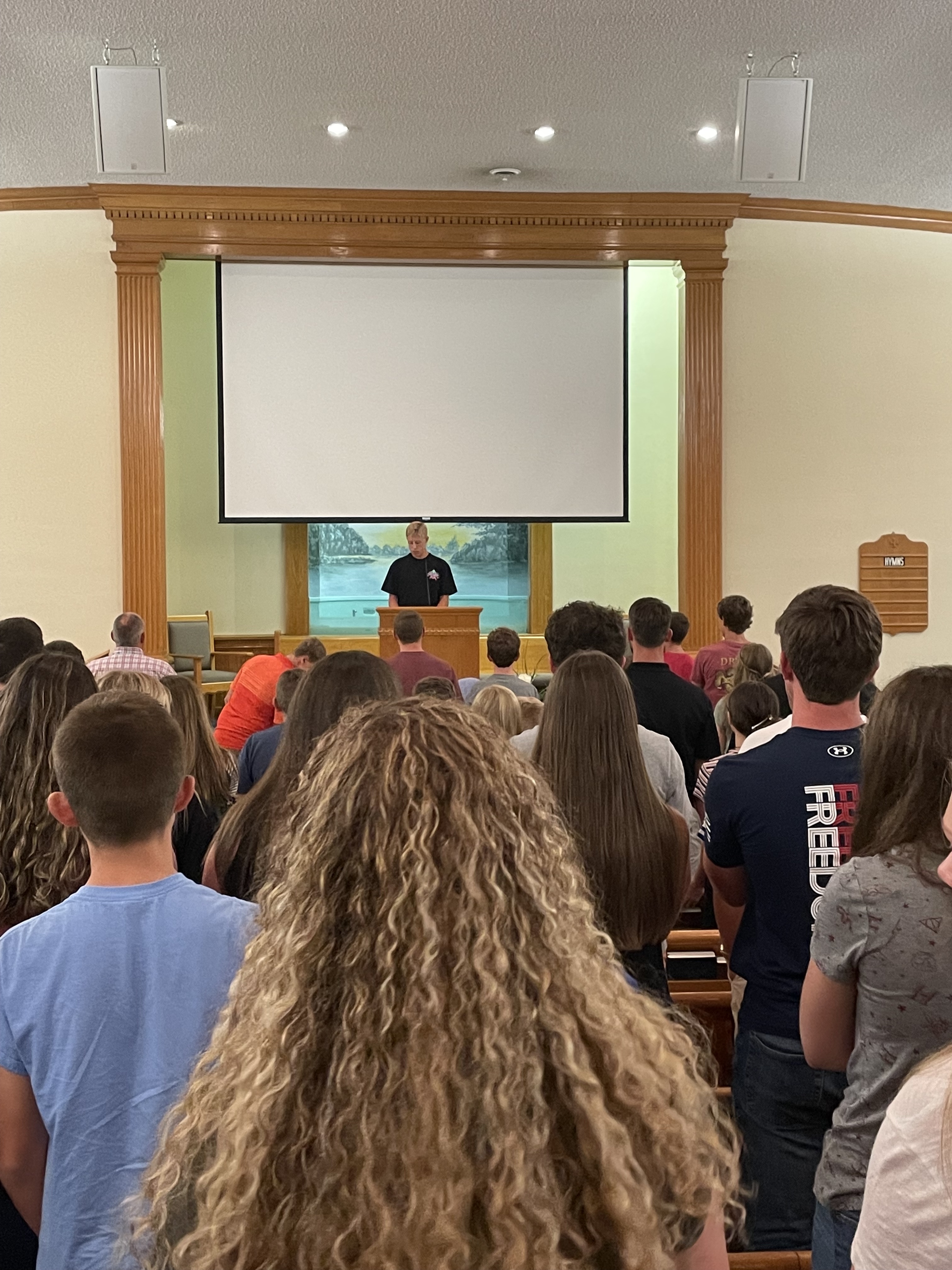
Teens stand for Scripture reading at recent Summer Youth Series (Chase Johnson reading)

“Charakter”

Monday’s Column: Neal At The Cross

Safari 2017

Neal Pollard

Character is defined as the mental and moral qualities distinctive to an individual and involves a person’s good reputation. The Greek word “charakter” first referred to the die used in minting coins, then came to include the sense of an image, stamp, seal, or copy. The Greeks used the word to speak of the typical features of an individual or nation, from which came the idea of “moral character” and then “the “distinctiveness” of a language, the “style” of a writer, or a “type” of philosophy (Kittel and Bromiley, TDNT, 1308). Arndt tells us the word means something produced as a representation or reproduction, and that human beings are formed by God as a representation of His own identity (1078).

The word is only found in the Bible in Hebrews 1:3. The epistle’s writer is describing Jesus, saying, “He is the radiance of His glory and the exact representation of His nature, and upholds all things by the word of His power.” It is an absolutely amazing truth that we are made in the image of God (Gen. 1:27), but the writer of Hebrews is saying something even more powerful about Jesus in Hebrews 1:3. He was not created by God as a reflection of God’s identity. The writer uses this specific word in Hebrews as part of His explanation that the Son is God! The NASB and NIV translate χαρακτήρ (CHARAKTER) as “exact representation.” The ESV has “exact imprint,” the NKJV has “express image,” the NLT says “expresses the very character of God,” and the ASV puts “the very image of His substance.” 

The author of this epistle leads out in his overall theme that Jesus is better by establishing the most important reason why. He is God. The writer uses Old Testament Scripture to prove it, citing Psalm 45 and Isaiah 61 to call Him God (Heb. 1:8-9). He then quotes Psalm 102:25 to say of Jesus, “You, Lord, in the beginning laid the foundation of the earth….” Then, in Hebrews 1:13, he quotes Psalm 110:1, which begins, “The LORD (Yahweh) said to my Lord (Adonai)….”

Let’s not miss the initial point of the letter driven home by the unknown writer. With a multitude of Old Testament passages, he proves this point about the essential character of Jesus Christ. He is God. He is as much God as Father and Holy Spirit. He is as powerful, all-knowing, omnipresent, perfect, sovereign, transcendent, self-existent, eternal–He is as Divine as Deity can be. 

That makes His willingness to be made a little while lower than the angels to taste death for everyone (Heb. 2:9) and to call us His brethren (2:11ff) all the more incredible. God lowered Himself not only to save us but to make us part of His family. We could spend the rest of the day meditating on that profound truth and still not fully grasp it. 

Here’s the question. God made us, became  one of us, died for us, and then opened the door to us to be His brother. What does that say about His character? As we try to fathom and appreciate that, it should give rise to another question? How should that affect  our character?

Facts About Jesus From John One That Many Deny

Monday’s Column: Neal At The Cross

preachingatPBL

Neal Pollard

Perhaps it is inevitable that someone as well-known as Jesus Christ would be subject to so much misinformation. Think about how things are said about Jesus that are not true. John’s gospel begins in a different way. His audience was wider than just Jews, just Romans, or just Greeks. His was truly a universal gospel, so he was writing to the whole world. In just the first several verses of his gospel, he affirms several things people subsequently denied about Him.

  • He is eternal (1-2)–“In the beginning was the Word” (see also 1:15,30).
  • He is deity (1)–“The Word was God” 
  • He created everything (3,10)
  • He became flesh (14)
  • He came to show us God, the Father (18)
  • His coming was to take away the sins of the world (29)
  • He is the Son of God (34)

There are those even in religion that say Jesus was a created being rather than being co-eternal as God. There are those who would reject the idea of the worship of Jesus being acceptable, though He is expressly called God. There are those who say that everything came into being by the process of evolution rather than Moses’ record (Gen. 1-2) being carried out by the Word (Col. 1:16-17). There are those who say God could not become flesh, since flesh is evil. There are those who deny the inspiration of Scripture, and thus would deny the New Testament actually records Jesus showing us the Father or otherwise communicating His will. 

It is incorrect to say that we can accept the biblical record of Jesus without faith. He existed eternally before becoming flesh. He was born of a virgin. He lived a totally sinless life. He died a death that satisfied God’s justice as a substitute for our sins. He was buried in a tomb, but was raised from the dead to live forevermore. He appeared to many of His disciples over forty days before ascending to heaven from which He will some day come again to judge the entire world. How can we say it takes no faith to follow Jesus? Instead, we should say that it takes more faith to embrace any competing explanation. The leading candidate to rival the biblical account is godless evolution. Try examining that with any level of care without discovering the infinitely greater amount of faith to explain how random chance and mindless, amoral matter produces the meticulously orderly, complex universe filled with intelligent life. 

Sometimes we are benefited by going back to basics. John one is written so simply and straightforwardly, yet it contains some of the biggest, broadest truths which so many reject. May we reflect carefully on the power of those truths so that it causes us to live better and differently! 

“Was Jesus Really A Carpenter?”

Tuesday’s Column: Dale Mail

image

Dale Pollard

  • “Is this not the carpenter, the son of Mary, brother of James, Joses, and Judas and Simon? Are not His sisters here with us? And they took offense at Him. Then Jesus said ‘a prophet is not without honor except in his hometown among relatives and those of his household.” – Mark 6:4 
  • Where did this man get this wisdom and these mighty works? Is not this the carpenters son?” – Matthew 13:54
  • Was Jesus a carpenter and were these fair questions to ask Him?

      Let’s examine FOUR quick factors:

 Factor 1 – LOCATION: Nazareth was located 3 miles from                Sepphoris which at the time was developing quickly as part of Herod   Antipas beautification project. It would eventually be known as “The               Jewel Of All Galilee.” Jesus would have witnessed and perhaps helped his father cut stone in the quarry that was half way between Nazareth and the developing city. 

 Factor 2DEMAND – In the days of Jesus there weren’t many trees in       the area, and there still aren’t many today. To try and make a living working with a material that wasn’t readily available or even used much would be difficult. 

Factor 3 LANGUAGE – “Tekton” simply means “builder” The Messiah                             was a handyman, and the spiritual connections in your mind may  already be forming. 

Factor 4 – SCRIPTURE – Luke 20:17ff – Jesus tells the parable about the wicked tenants, after Jesus is questioned about His authority in the  temple by the scribes/chief priests, He looks at them and says “The STONE the builders rejected has become the cornerstone?” quoting from Psalm 118. 

Again quoted by Peter as he defends himself in front of religious leaders in Acts 4 “This Jesus is the stone that was rejected by  you the builders.” It was a reference to David’s lineage to the  Messiah and it would have been familiar to Jewish stone builders.  

So with this in mind, let’s revisit the questions asked by those in Jesus’ hometown

  1. Where did this man get this wisdom? 

A. Their perspective: “You’re the son of a common builder. He didn’t teach you these things, he  taught you to build.” 

B. The reality: It wasn’t wisdom from Joseph, it was His heavenly fathers wisdom.   But Joseph, no matter how talented he was in his craft, did not teach Him to build…

1. A ship that would carry christians safely into eternity, he may have taught Jesus to  work with stones, but he no idea that on a rock He’d build His church. 

2. He did not teach Him to build a home that would last for all eternity, but that’s       what  Jesus is building now! 

3. He didn’t teach Him to build a walkway that would bridge the gap of separation between God and man, but He did.

2. Where did He get these miraculous abilities?

A. Their perspective: “You’re the son of a common builder. You’re performing things with your hands that the hands of a common builder      can’t perform!”

B. The reality: Jesus is the master builder. The only one that could claim to build things out of the very stones and pieces of wood He spoke into    existence. 

What does all this mean? 

1. In the hands of the Master builder, you can be something better.

2. In the hands of the master builder, you can be somewhere better. 

3. If you’re broken, you can be fixed. If you’re not a child of God, your life is broken.

4. You can be something better than you are. Your imperfections can be made perfect through the blood of Christ. 

5. You can be somewhere better. You can be In good standing with the God above. You could be In a loving family bound for glory— the home built by God. 

“Received Up Into Heaven” 

Friday’s Column: Supplemental Strength

81121814_2462862270639428_5746232403106463744_n

Brent Pollard

With the death of Nero, a path to the imperial throne was opened to Vespasian by those soldiers serving under the former’s command. Vespasian had made a reputation for himself in the conquest of Britain and the subjugation of Jewish revolts beginning in AD 66. Thus, given the opportunity by his men, Vespasian founded the Flavian Dynasty, which his son, Titus, would succeed. As emperor, Vespasian left the task of quelling the Jewish rebellion to his son, Titus. Thus, Titus remained in the theater of conflict while his father returned to Rome.

In AD 70, Titus crushes the Jewish rebellion by destroying Jerusalem and the Second Temple. Vespasian dies from an illness within a decade, opening the throne to his son, Titus. As emperor, Titus completed the Roman Colosseum and dealt with the crisis of Pompeii and Herculaneum. Upon his death, Titus’ younger brother, Domitian, became emperor and built the Arch of Titus in AD 81 to commemorate Titus’ conquest of Jerusalem. Titus serves only about three years as emperor.

It is of note that the triumphant arch Domitian dedicates is to Titus, who only completes his father’s work in Judea and Jerusalem. No doubt, Vespasian would have approved seeing as he desired to lay the foundation for his family’s rule. In life, Vespasian had likewise sought to emphasize his son’s actions. In other words, though ambitious, Vespasian was generous enough to share the spotlight with his son to further his machinations. As homecomings go, Titus was a son well-received by his father. One can question if the son was as accomplished as his father, given the brevity of his reign. If for no other reason than establishing the desired optics, though, Vespasian knew to give Titus a grand reception upon the completion of his task on the battlefield, since it glorified himself as well.

I recently completed a study on the Harmony of the Gospels; that is, the complete narrative one finds when fleshing out the revealed narrative of Christ by coalescing all four gospel accounts into a single account.  I noted that despite being the shortest gospel, only Mark ends in a manner consistent with the once-coveted literary “happily-ever-after.” Indeed, Mark 16.19-20 has Jesus returning to the Father and the disciples carrying out their Master’s work. Matthew ends his gospel with our Lord’s promise to remain with us. Luke ends his thoroughly-researched gospel by showing the rejoicing disciples continuing in their praises to God. John ends the last written gospel by telling us that despite not having a complete record of Christ’s life, we have enough information to develop a saving faith.

As a Christian, I appreciate the perspective of each inspired gospel author. I have always been partial to John’s gospel with its unique approach, but now find myself most enamored by Mark’s inspired conclusion. In stark contrast to the prodigal son, in which a rebellious son squanders his father’s inheritance in the far country, but finds a gracious, welcoming father upon his repentance, we have in Mark’s closing an obedient Son returning triumphantly to the deserved adulation of His Father. The text is simple enough. The New American Standard Version states, “…He was received up into heaven and sat down at the right hand of God” (Mark 16.19).

That was what Jesus eagerly anticipated. The Hebrews writer said it was this impending joy enabling Him to endure the shame of the cross (Hebrews 12.2). If Titus deserved a triumphant arch for doing his father’s bidding, shouldn’t a much more deserving Son receive from His Father the name above all names? (Philippians 2.9-11) No Christian doubts Jesus was worthy of this honor, but is there not something uplifting about reading the confirmation Mark provides? Given what Jesus accomplished, we relish this affirmation since we know His vicarious sacrifice enables us likewise to join Him in His death, burial, and resurrection (Romans 6.3-5,8-9). We can see by faith Stephen’s vision granted him before his martyrdom of the Christ standing at God’s right hand, looking at human events intently (Acts 7.56). Truly, He is our great High Priest (Hebrews 4.14-16), interceding for us (Romans 8.34).

Further Reading:

Wasson, Donald L. “Vespasian.” Ancient History Encyclopedia, Ancient History Encyclopedia, 11 Aug. 2020,www.ancient.eu/Vespasian/.

Chilver, Guy Edward Farquhar. “Vespasian.” Encyclopædia Britannica, Encyclopædia Britannica, Inc., 20 June 2020, www.britannica.com/biography/Vespasian.

Wasson, Donald L. “Titus.” Ancient History Encyclopedia, Ancient History Encyclopedia, 11 Aug. 2020, www.ancient.eu/titus/.

“Arch of Titus.” Wikipedia, Wikimedia Foundation, 4 June 2020, en.wikipedia.org/wiki/Arch_of_Titus.

800px-arch_of_titus_283250104217829

“High Carb Diet”

Thursday’s Column: Captain’s Blog

IMG_0806

Carl Pollard

We all love a good piece of bread. Whether it’s garlic bread, cheesy bread, or just plain bread, everyone loves it. Bread is the greatest invention of all time, maybe ever (can you tell I wrote this before lunch?).
Jesus is described as being our spiritual bread. In John 6:35 Jesus is the “bread of life.” And in verse 32 He is called “the bread out of heaven.” Why would Jesus be called bread? When we take a closer look at these two verses, we can notice a few reasons why.
“Jesus then said to them, “Truly, truly, I say to you, it was not Moses who gave you the bread from heaven, but my Father gives you the true bread from heaven” (John‬ ‭6:32‬). There’s an analogy given by John that helps us to wrap our mind around Jesus being the Bread. Moses provided manna in the wilderness for Israel (bread from heaven), and Jesus (the bread) was sent from heaven to feed us spiritually.
It was amazing growing up with mom, THE Kathy Pollard, as the cook. And many times we would describe her food as “out of this world.” When we think of Christ, the Bread out of Heaven, He is literally out of this world.
Point is, we need to be feeding ourselves with this Bread. We need to be consistently meditating on God’s word, continually making it apart of who we are, and courageously manifesting it in our everyday lives.
“Jesus said to them, “I am the bread of life; whoever comes to me shall not hunger, and whoever believes in me shall never thirst” (John‬ ‭6:35‬). Two words in this verse are in the present tense– “comes” and “believes.” This means that for Jesus to be our bread we must continually come to Him and believe. Jesus is nourishment to those who are spiritually starved, mentally broken, and emotionally lost.
No matter how much bread we physically eat, it will never compete with how full and complete we will be in Christ. Are we turning to Him?

12764594_10208245679077795_625453659382235834_o
Just an example of some of the bread mom sustained me with growing up