Make It A Momentous Monday

Neal Pollard

  • Pick out a local church leader and pray for him and his family for several minutes, being very specific in your petitions on their behalf.
  • Email a missionary to encourage them and get an update on how their work is going.
  • Buy a gift card and try to give it anonymously to a young or struggling family you know.
  • Thoughtfully select several people to compliment and encourage by writing on their Facebook wall or other social media platform.
  • Briefly visit a brother or sister in an assisted living facility or nursing home.
  • Ask a co-worker, classmate, or neighbor what you can be praying for them about.
  • Listen to a book of the Bible in its entirety on your commute.
  • Let go of a grudge or deep-seated resentment.
  • Do an unexpected deed of kindness for a random stranger.
  • Speak to someone you see regularly about your faith–what God is doing in your life, what’s going on at church, etc.
  • Spend some one-on-one time with one of your children (playing a game they enjoy, going for a walk, taking them out to eat, etc.).
  • Show love to your mate in some tangible way you know he/she enjoys (speak their “love language”).
  • Practice pleasantness with everyone you meet today, being mindful of your facial expressions and body language.
  • Carve out some time for meaningful, personal devotion (including Bible reading, singing, and prayer)–make worship more than a Sunday matter!

None of these are overly time-consuming. Pick as many as you can. If you cannot get to them all today, then pick up where you left off tomorrow. Grow your list. Use your imagination and creativity. Find yourself looking and acting more like Jesus!  See yourself in Matthew 5:13-16.

candle-335965_960_720

THE MYSTERY OF INFLUENCE

Neal Pollard

Several years ago, a fourteen-year-old girl named Shannon Smith was shot to death in her own back yard. A bullet lodged in her brain. Though already tragic and horrific, the story was made more tragic by the inexplicable nature of the shooting. Police, judging from the trajectory made by the entry would, concluded that the bullet fell from the sky. Somewhere nearby, some unknown person had fired a gun for no known reason. The bullet completed its path of travel inside an unsuspecting teenager. Tragic, indeed!

Who fired the gun and why? The action pales next to the consequence. Someone aimlessly fired a weapon. A child died and parents were left to mourn her loss. It was all so unnecessary and avoidable!

Christians are a special people, a God-possessed, holy group (1 Pet. 2:9). The world sees Christians (Matt. 5:16). They react to children of God, either “glorifying” (Matt. 5:16) or “blaspeming” (2 Sam. 12:14) Him. Christians are either transformed from worldliness or conformed to it (Rom. 12:2). Conformity carries tragic consequences.

Influence is an inevitable burden carried by every Christian. Others watch what we do, hear what we say, and evaluate our judgments. What we wear, how we talk, where we go, and with what we entertain ourselves may seem harmless or at least harmful only to us. Yet, we can aimlessly fire and eternally wound another’s soul by our influence.

The man or woman who fired that gun may not realize even now what they did with one “harmless” squeeze of a trigger. Maybe they will not know on this side of time. Just so, we may be shocked on that day to realize how many or exactly whom we influenced. We’re on a spiritual battlefield (Eph. 6). Let’s be careful not to shoot at the wrong side! We may wind up doing harm to the very people we’re commissioned to save. Let’s watch our aim!

635556363784254557-phxdc5-5gjqo8l36pjzj76wfkp-original
Shannon Smith (undated photo)

How Will We Be Remembered?

Neal Pollard

Seven churches in Asia Minor (modern-day Turkey). Each remembered for an overall characteristic. The same is true for individual Bible characters, isn’t it? Most remember Moses, Samson, David, Jeroboam, Jonah, Jeremiah, Nehemiah, Judas, Peter, Paul, and John for a particular attribute, whatever else could describe their lives. That’s more than fascinating. It’s sobering.

What about you and me? Is there a word others–those we attend school with, work with, live near, attend church with, or share family ties with–would use to describe us? Here are some possibilities:

  • Grumpy
  • Disagreeable
  • Dishonest
  • Hot-tempered
  • Unreliable
  • Divisive
  • Worldly
  • Gossiping
  • Selfish

Such attributes are the cumulative result of the attitude, words, and actions that we portray each day we live. Everybody has good days and bad days. But, there is an overall tenor and flavor to our lives that cause people to associate something with us. However, the word might be different:

  • Gentle
  • Patient
  • Loving
  • Kind
  • Serving
  • Sacrificial
  • Unselfish
  • Humble
  • Uniting
  • Faithful
  • Courageous

That, too, is being built moment by moment, day by day.

With both groups of words, we can think of people who epitomize characteristic above. But I want to know, “Which one would best describe me?” Don’t you want to know that about you?  The good news, if you don’t like the answer there’s time to change that. Dickens’ Christmastime novel about Ebenezer Scrooge is written to make that very point. Infinitely more importantly, the Bible is written to make that point. We can be transformed through the influence of Christ in our hearts and lives (Rom. 12:1-2; 2 Cor. 3:18). How will you be remembered? 

40178175_715421765474325_1935029354081812480_n

Out-Cheered At Home

Neal Pollard

It’s hard to beat the weather and the views at the average Rockies baseball game. This past Tuesday, 29 Bear Valley guys converged on the upper deck overlooking first base as the “good guys” took on those world-champion Houston Astros. For the unfamiliar (or disinterested), the Astros are the defending Worlds Series champions. They’re very good this year. But, so are the Rockies. Whenever Colorado can sniff first place when August is in view makes it a “great” season, by their standards (spoken by a long-suffering fan). We came into that game having won 12 out of 16 games in July. Several of us got there early–for a game which would start an hour late due to bad weather–and the thing that struck us was how many orange shirts and jerseys there were. Again, for the uninitiated, those are Astro rather than Rocky colors. But, it wasn’t their apparel that stuck out. It was their boisterous, relentless cheering. As much as I like Colorado baseball, I get frustrated with how quiet the average fan in the stand is (perhaps they are lulled into a tranquil state by those rich sunsets and cool breezes. Opposing teams’ fans seem less affected. We were louder than usual, but they were louder than us.

“Home field advantage.” It’s supposed to mean something, but Tuesday night was a reminder that it can be taken away. These were committed fans. We saw Texas license plates in parking lots. No doubt, some arranged their travel to attend a game while visiting our fair state. Or, they’re locals whose allegiance is strong enough to brave the prospects of tens of thousands of people who oppose their point of view. They weren’t embarrassed or ashamed to proclaim their loyalty. They were eager.

We often sing, “This world is not my home.” Truly, Peter calls the Christian an alien and stranger (1 Pet. 2:11). Our citizenship is in heaven (Phil. 3:20). The Devil has control of this world and its domains (Eph. 2:2; 6:12; John 12:31; 1 Cor. 15:24; etc.), though Jesus will win in the end and He causes us to triumph now (2 Cor. 2:14; 1 John 4:4). 

We enter the daunting arena of the world clothed with Christ. He wants us to stand out and to be heard. No, not obnoxious, but He expects us to infiltrate it with His influence (Mat. 5:13-16). We won’t sway the crowd or determine the outcome, but we will make a difference if we show up, stand up, and speak up. The world will be aware of our presence, even if it disapproves. That’s not really the point is it–to have their approval? The point is to show our unswerving loyalty. We know that we are on the winning side! With humility but also boldness, we should make that known!

37756309_10155703074395922_7614667387320664064_n

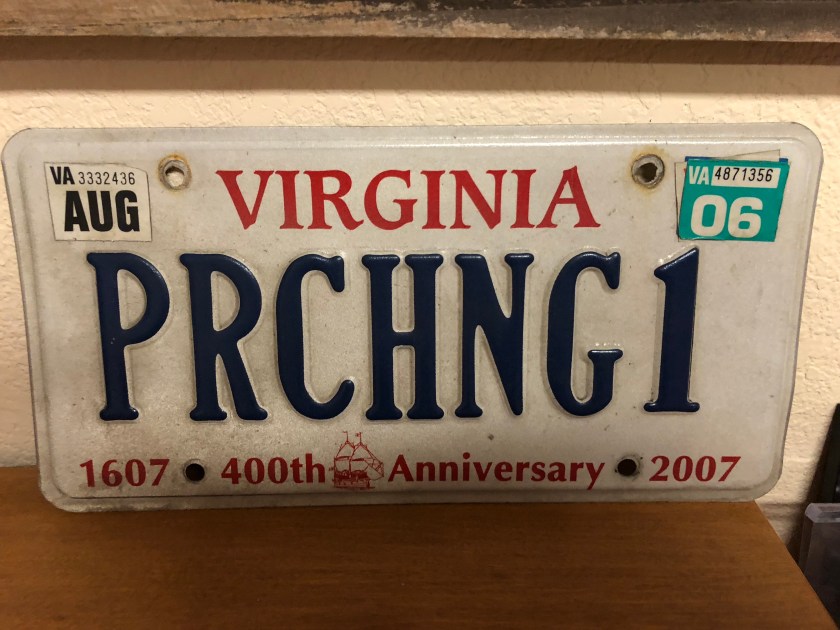
“PRCHNG1”

Neal Pollard

The title above, PRCHNG1, was once the vanity tag on a truck I owned. When in 2004 I said a sentimental goodbye to the “Black Bullet” (as Kathy affectionately named my 1985 Chevrolet Custom Deluxe pickup, which I traded in on a “new” 1992 Dodge Dakota), I transferred the tags down at the DMV.

As I picked up a number at the front counter, I had my tags in hand, and the receptionist saw them. It launched an interesting conversation.

She said, “Oh, I’ve always wanted to try that. I bet that’s so fun. Is it scary?”

I was puzzled and said so.

She said, “Your tags. How long have you been parachuting?”

I guffawed.

You may have surmised by now that my tag stood for “Preaching One.” I worked with DMV originally to find something that gave that clue. “Preacher,” “Mr Preach,” “Preacher,” and several others were already snagged. So I settled on “PRCHNG1.”

I thought it was clear, but apparently my fellow motorists either thought I was in some airborne division or maybe purchased hand guns. I don’t know.

As Christians, we’re told to be salt, light, and leaven, to clearly point others to Jesus.

When others see your works (cf. Mat. 5:16; 1 Pet. 2:12), do they conclude that you are a Christian? Or does the general tone and slant of your life lead people to contrary conclusions?

Be careful! Others are watching us, and they make assumptions about our character and lives by what they see. Let us make it plain (cf. Hab. 2:2)!

IMG_4176


My Social Media Pledge

Neal Pollard

  • I will try to use social media to encourage and edify others (1 Thess. 5:11; 1 Cor. 14:26b).
  • I will avoid the shocking, inflammatory, and divisive tactics increasingly characteristic of S.M. (cf. 1 Cor. 1:10; Prov. 12:18; Prov. 15:2,4; etc.).
  • I will ask, “Would I say this in the way I am saying this?,” if face to face with this person or this group of people (Prov. 23:7).
  • I will not use Social Media to pick fights or put people on the defensive (cf. 2 Tim. 3:1ff).
  • I will not be Nellie Nitpicker and Contrary Charlie. About. Every. Single. Little. Thing.
  • I will respect that my connections have connections that are not Christians and I want to be sure to say what I say in accordance with Ephesians 4:15 and 2 Timothy 2:24-26.
  • I will sever connections with individuals who consistently display a lack of self-control with their words and attitudes. Souls are too precious.
  • I will abhor the thought of doing what would put Christ to an open shame (cf. Heb. 10:29).
  • I will double-check myself to avoid bragging and self-promotion (1 Cor. 13:4-5).
  • I will conquer the desire to have the last word, pile on, or fight fire with fire (Mat. 5:39-42).
  • I will not let the false teaching, bad attitude, or meanness of another be my rationale for behaving in a way that brings Christ shame or jeopardizes my own soul (cf. 1 Cor. 9:24-27).
  • I will always be trying to set the table for productive evangelism or retrieving the wayward (Jas. 5:19-20; Col. 4:6).
  • I will always try to portray the doctrinal, moral, and ethical values of my Lord, thus avoiding reflecting and glorifying whatever values conflict with His (Mat. 5:14-16).
  • I will try to promote, not pummel, the bride of Jesus, appreciate, not attack, the elders, and unite, not untie, wherever possible.
  • I will shun passive aggression in myself first, but also in others.
  • I will deal with dirty laundry in its appropriate way, which is not on Social Media.
  • I will actively try to show grace to everyone, including cantankerous curmudgeons.
  • I will, foremost, realize my own imperfections and try every day I use Social Media to do so in the way Jesus would, if He had Facebook, Snapchat, Instagram, Twitter, a blog, LinkedIn, etc. In a way, through you and me, He does. I will let that sink in!

20080704_p070408jbweb-0279-515h

Coarse Discourse

Neal Pollard

Is it just me or are we much more open about using profanity in ordinary discourse? Our sitting president has exhibited an unprecedented amount of “curse words” in the public square, even if transcripts of historic documents reveal that a great many of the last several presidents have used language salty enough to make sailors blush. Hollywood reactors to the president have seemingly been trying to “trump” his salacious speech and have, in many cases, upped the ante in indecent language. Recent news story include Bette Midler, congresswoman Kamala Harris, and Kirsten Hillibrand (aka “Senator Potty Mouth,” via The Daily Mail) using shocking words that the thoroughly secular media acknowledges as inappropriate and indecent—at least measured by cultural norms and moors.

I have to admit being thoroughly baffled by church members, even teachers and preachers, who adamantly argue that Scripture has nothing to say about such things. Implicitly, even explicitly, their point is that such speech is legitimate for a follower of Christ. While we must be careful not to make laws God does not make in His Word, neither can we be so reckless as to hurt Christ’s cause by encouraging the Christian to mimic the world’s behavior, speech, or attitudes without discernment. When godless media, non-believing coworkers, classmates, and cul-de-sac compadres, and others in society associate certain words with the rebellious, humanistic lifestyle, shouldn’t we take pause?

Is there room in Paul’s admonition to Ephesus (4:29; 5:4) and Colosse (4:6) or Jesus’ public discourse (Mat. 12:34ff) for the kind of words that so many in society still find shocking and inappropriate? Are the principles of godly influence (Luke 17:1), salt and light (Mat. 5:14-16), example (cf. 1 Tim. 4:12), and the like not enough to cause us to feel strongly about how we use our words with people? Do we feel like well-chosen swear, scatological, and smutty words are essential to successfully relate to and connect with the rougher elements of society in an effort to win them to Christ?

We can relate to and reach people without resorting to irreverent and indecorous words. We can keep pure in speech without becoming isolationists in society. It does not have to be an either-or proposition.  May we realize that what we say (and how we say it! See Gal. 5:20, Rom. 3:14, and Jas. 10, for example) will impact people like we do not realize and in ways that we do not realize. It extends well beyond just our speech, but our words paint a picture of us for the very people we should desperately want to reach for Jesus. Please, give thought to the power of your words (cf. Prov. 18:21).

597px-profanity-svg

The Tactics Of The Tactful

Neal Pollard

“To ensure people listen to you, insult their race, politics, and intelligence. Be sarcastic. Be close-minded. Don’t attempt to hear what they have to say. Do not gently reason and certainly do not be patient and thoughtful. Courtesy should be thrown to the wind, along with assuming the best and thinking before speaking. Inflammatory statements are sure to win the hearts of people on the fence or on the other side of the issue from you. When they disagree or offer a dissenting view, really let them have it. Call them names, make baseless assumptions and accusations, and angrily dismiss them. Persuade them with harsh, rude, coarse, crude words and phrases, and even resort to cursing to strengthen your point.”

I don’t suppose I’ve ever seen anyone give the advice above, but an incredibly large number of people seem to have adopted those very tactics through social media to promote their own points of view and to attack those of others. Beyond the right and wrong of specific issues, there is the attitude and demeanor the Christian is to maintain. The late Wendell Winkler would often tell us “preacher boys” that “you can be right and still be wrong.” How sad to lose the moral high ground of an issue because we yield to the fleshly tendency to rip, tear, and insult “the other side.”

Scripture counsels this approach instead: “Be kind to one another, tender-hearted, forgiving each other” (Eph. 4:32); “The Lord’s bond-servant must not be quarrelsome, but be kind to all, able to teach, patient when wronged, with gentleness correcting those who are in opposition” (2 Tim. 2:24-25a); “Do not be overcome by evil, but overcome evil with good” (Rom. 12:21); “Let your speech always be with grace, as though seasoned with salt, so that you will know how you should respond to each person” (Col. 4:6); “A gentle answer turns away wrath, But a harsh word stirs up anger” (Prov. 15:1).

Oh, sure. People will rationalize their ugly, insulting speech through distorting the words and actions of Jesus, Paul, and others. People often rationalize their sin and disobedience. How many have done the same thing in the face of Scripture commanding baptism and teaching the singular nature of the church? But, make no mistake about it! Venomous, hateful, insulting speech is not the way of the faithful Christian.  The source of that is from a distinctly different direction!

Be convicted and courageous, but cloak it in Christlike kindness! In addition to being right, it will be far more successful. May our goal be to win hearts and souls and not just arguments!

636044778227119944-152056580_another20guy20yelling20at20his20computer

A Footprint, A Fingerprint, And An Imprint

Neal Pollard

“What do you want to be when you grow up?” “What will they put on your headstone?” It’s the kind of fundamental questions that accompany us all along the road of life. We want to have significance, to serve purpose, and to matter.  Whether motivated by legacy or something larger than self, the thoughtful periodic evaluate the difference they are making to those whose lives they touch. Of all people, Christians should take that matter seriously.  Consider this.

You Are Leaving A Footprint. Your decisions are observed by friends, family, and even those who only know you incidentally or even not at all. You are a leader.  So many people will eventually wind up somewhere because of what you do with and in your life. Paul could say, “Be imitators of me, just as I also am of Christ” (1 Cor. 11:1). In the most dramatic facet of this fact, people will be led toward an eternal destination through your influence. You are leading people toward or away from heaven. It’s in your heart, attitude, words, priorities, conduct, and passions.  To a line of folks longer than you could imagine, you are yelling, “Follow me!” Ask yourself, “Where am I going?”

You Are Leaving A Fingerprint. You are touching people’s lives. Your hands are in a variety of endeavors—your occupational life, your social life, your personal life, and your spiritual life. You are a servant of something and someone. Paul says it’s inevitable (Rom. 6:16). Everyone works at something, even if it’s laziness. It’s a legacy of labor. Where will people remember that your hands were most often seen? Will your chief legacy be whatever your occupation was? Your civic service? Your material accumulation and notoriety? Your pursuit of pleasure? Or will it be your involvement in people’s lives and with people’s souls? Consider this challenge, to “strengthen the hands that are weak and the knees that are feeble” (Heb. 12:12). Your hands will find something to do (cf. Ecc. 9:9). Make it count for God.

You Are Leaving An Imprint. Isn’t it sobering to think that all of us are associated with some quality. When our name is brought up, something—either directly or indirectly—is attached to it. For some, it will be: “grouchy,” “gossipy,” “complaining,” “foul-mouthed,” “critical,” “selfish,” “dishonest,” “arrogant,” “icy,” and the like. Fair or not, such broad labels are typically made interaction by interaction. For others, it will be: “humble,” “sincere,” “encouraging,” “dependable,” “loving,” “joyful,” “godly,” “positive,” etc.  You may feel yourself plain and insignificant, but you will leave an indelible impression on others throughout your life.  Even the one talent man, who tried to bury his talent, had to give an account for it (Matt. 25:14-30).

Leadership, labor, and legacy. These are gifts given by God to us all. What a powerful opportunity, one that lies before us daily! The great news is that if we don’t like the footprints, fingerprints, and imprints we have left and are leaving behind, we can change course. My favorite version of A Christmas Carol (and the best version!) is the one starring George C. Scott. He captures the remarkable transformation of Ebenezer Scrooge, a malevolent miser who becomes a merry mirth-maker. Charles Dickens shows us that anyone is redeemable if they’ll genuinely and fervently change. Of course, the Bible beat him to that message (Rom. 12:2; Acts 3:19; etc.).  Our time here is so short. May we all have the wisdom to know what is most important and pursue it relentlessly.


george_c_scott_fixed

Unmistaken Identity

Neal Pollard

They both had a mole next to one eye and a scar on the left wrist. They lived 54 miles apart, one in Brookville and the other in Mooresville, Indiana. It was said they were practically identical twins. For notorious bank robber John Dillinger, that was no problem. But, for upstanding Ralph Alsman, it was a nightmare. Alsman was arrested 17 times and shot 11 times. When arrested, though he was always released, he had to undergo stressful interrogations in which he had to prove he wasn’t Dillinger. Only when the real Dillinger was gunned down in 1934 did the unbelievable saga end for the hapless Alsman (information taken from The Pittsburgh Press, 6/18/34, p. 11). Can you imagine having to look over your shoulder everywhere you went just because you looked like someone else—a really bad someone else?

The thought occurs to me as I read that harrowing account, based on my attitude, speech, and actions, “Who or what would people mistake me for?” As I live out my life before the world, waiting in lines or in traffic, when under pressure at work, as people mistreat or frustrate me, judging from my relationships, my ethics, and my morality, would people say that I strongly resemble Jesus? He is supposed to be living in me (Gal. 2:20). It has been the case that bystanders have recognized people as having been with Jesus (Acts 4:13). Of course, Scripture does not at all emphasize the physical appearance of Jesus (Isaiah 53:2), but Paul speaks of bearing the marks of Jesus (Gal. 6:17). While his “marks” were literal stripes from a tormentor’s whip, there are unmistakeable traits of Jesus that we, too, can and must bear.

I have so much need and room for improvement in my spiritual life.  Every day, I want to look more like Jesus. I want people to see Him when they look at me. If they do, He will be pleased and they just might be saved. Let’s work on our appearance! It may mean eternal life for somebody in our life.

588ee71ddf6914b974d4e69f24c6b8c8

The Eye Test

Neal Pollard

We covet those parking spaces close to the store, whether because we think we will save a little time or several steps by nabbing them.  Yet, we are in “competition” with others who are seeking the same spaces. No one rushes to the back of the parking lot to grab up those spots. But at a Costco in Canada recently, this vying turned violent as two middle-aged couples literally fought over a parking space. As in, it came to fisticuffs. As of this writing, police are still investigating and there may be fine details to be added to the story. Basically, however, as a YouTube video shot by a local realtor shows, anger over who should put their automobile in that space escalated to foul language, pushing, shoving, name-calling, and thrown punches. Four people who might otherwise be respectable, dignified contributors to society now share an infamy that may dog them for a long time. All because of a failure to conduct themselves properly in a public place.

We shake our heads at this animalistic behavior, but in our self-righteous sense of superiority we might do well to examine how exquisitely we execute our example before the eyes of the world. Consider some places where Christians can be oblivious to the watchful eyes of others:

  • Social media brawls, whether over matters clearly addressed in Scripture or matters of judgment and opinion.
  • Bible class discussions, where visitors, new Christians, and weak Christians might see the redeemed’s  inhumanity to the redeemed.
  • Public arenas, from the retailers to the restaurants and from the grocery store to the department store, where subpar (or even adequate) customer service evokes an unChristlike response from a disciple of Christ.
  • Arguments between spouses or parents and children, members of a “Christian home,” who resort to the tactics of their worldly counterparts as they wage war before such witnesses.
  • At ball fields, concerts, movie theaters, and the like, where something displeasing to us provokes an impatient, harsh, and retaliatory response that eclipses any view of Christ.

Certainly, these are just a few ways and places where we might forget ourselves and squash our precious influence by allowing the flesh to dominate our presumed spirituality. It is good for us to consider that those things cannot come out of us unless we are allowing improper things come into us. We must guard against the things that might creep in—“immorality, impurity, passion, evil desire, and greed, which amounts to idolatry” (Col. 3:5), “…enmities, strife, jealousy, outbursts of anger, disputes, dissensions, factions…” (Gal. 5:20, which are a bulk of the works of the flesh specifically identified by Paul), and more (cf. Mark 7:22-23, etc.).  We must work to control what comes out, harnessing the tongue (Jas. 3:2ff) and controlling the temper (cf. Eph. 4:26). We must strive to cultivate thoughts and feelings that, when expressed, build up and draw others to Christ (Col. 3:12-13; 1 Pet. 3:8-11; Gal. 5:22-23; etc.).

Like it or not, we’re hilltop cities and lighthouses (Mat. 5:14-16). Let us keep our behavior excellent among the “Gentiles,” as they observe our deeds, so that they will see Jesus at work in us (cf. 1 Pet. 2:12). Our attitudes, speech, and actions may not become a viral video, but we are still being watched. Let’s take care to display ourselves in a way that would not embarrass (or condemn) us were we to see it again, played by the Lord, at the Judgment Day.

cju0cyfw0aaufb9

I Don’t Want To Know!

Neal Pollard

Too often, it’s a great disappointment to learn about the personal lives of politicians, athletes, musicians, actors and actresses, and other professional entertainers. Their public persona and abilities may attract, inspire, and move us, but the aforementioned details are all too sordid. What might look wholesome on closer examination has a very seedy side.  Perhaps this says as much about any of us who place them on a pedestal, but that doesn’t lessen the chagrin.

Hypocrisy is something that can occur among “normal” people like Christians, too. Sadly, we can appear to be one thing around those of “like, precious faith” but have a different side that we show away from them. This is a spiritual malady that can afflict anyone, preachers, elders, deacons, and their families included. It can have such a devastating effect. To think that our poor example could cause a new, a weak, or any other Christian to stumble and fall should fill us with dread.  The precious influence we build by our talents and positions must never be squandered by defects of character or even bowing to pressures in specific circumstances.

Peter preached the first and second recorded gospel sermons. He was an apostle and one of Jesus’ closest friends on earth. Yet, Paul recalls an occasion where Peter succumbed to his flesh and sinned in a way that hurt his influence. In Galatians 2:11-14, Paul says,

But when Cephas came to Antioch, I opposed him to his face,
because he stood condemned. For prior to the coming of certain
men from James, he used to eat with the Gentiles; but when they
came, he began to withdraw and hold himself aloof, fearing the
party of the circumcision.  The rest of the Jews joined him in hypocrisy,
with the result that even Barnabas was carried away by their hypocrisy.
But when I saw that they were not straightforward about the truth of the
gospel, I said to Cephas in the presence of all, “If you, being a Jew, live
like the Gentiles and not like the Jews, how is it that you compel
the Gentiles to live like Jews?

Peter was driven by fear and favoritism. His action was devastating, dragging even “the son of encouragement” to follow his discouraging behavior. Thankfully, Paul loved Peter (and the Lord) enough to challenge the hypocrisy.

Friends, none of us will ever be perfect. We’re continually susceptible to sinful words and deeds. But let us guard against secret, double, or insincere lives knowing that such can totally destroy the faith of those who look to us to show them what Christlikeness looks like. In other words, let us be what we tell others that we are and that they should be. Consistency and integrity are some of the Lord’s most potent tools in our lives to bring others to Him.  Take care of His tools!

SONY DSC

What’s So “Social” About It?

Neal Pollard

“Social” is an interesting word. It can be a noun, as in “church social,” referring to a gathering of people to socialize. Usually, it is an adjective–“social studies,” “social club,” “social butterfly,” or “social grace.” “Social” modifies another word to form a phrase normally found only in the restraints of religious discussion. The phrase is “social drinking.” Social drinking implies situations such as guests in the home, friends at a meal or bar, or business dinner or party where a typically smaller amount of alcohol is consumed than occasions where drunkenness is typical. Certainly, this is an emotional issue for some either adamantly for or against its practice. In the spirit of fools going where angels fear to tread, please allow me to consider with you a few questions about “social drinking.”

  • What constitutes the limit on social drinking? In other words, when does one cross the social line in social drinking? If one of the drinkers has two rather than one, is it still social drinking? Three rather than two? Four rather than three? When is it excessive? Who, of the other drinkers, is to be the judge of that? Often, there are those in the “social drinking” crowd who try not to miss a shot, glass, or refill. For all the sippers, there are guzzlers, too. What makes four wrong and one right?
  • What positive social messages does it send? Sophistication? Success? With social drinking, what is the Christian hoping to achieve? A soul-winning opportunity? A Christlike influence? A demonstration of the transformed life (cf. Rom. 12:1-2)? Or, is it simply a way of conforming, bowing to the social pressures of a worldly-minded culture? Is it ever simply a way to seek the acceptance, approval, and advancement of secular friends, co-workers, employees, and employers (Jas. 4:4)?
  • Are there negative social implications? What message does it send to non-Christians or new-Christians, to whom we would share scripture’s condemnation of drunkenness (Gal. 5:21; Eph. 5:18; 1 Th. 5:7-8). Furthermore, the landscape is continually changing. Social drinking, to teenage and college party-goers, stretches all the way to bald-faced drunkenness. It is not uncommon to hear stories of “social drinkers” dead of alcohol poisoning on frat-house floors. Can we envision a preacher gesturing carefully during his sermon with his shot of whiskey? Or an elder pleading with a wayward Christian to come home, laying down his beer long enough to pray with them? Or the church fellowship, with a deacon in charge of bartending?

Let us be careful endorsing something so fraught with potentially negative side-effects, socially as well as physically. Certainly, you will ultimately decide which side of the ledger social drinking falls on. But, consider this a loving plea. Be careful with the precious commodities you possess as God’s child–your influence, your example, your holiness, and your righteousness. “Each of us is to please his neighbor for his good, to his edification” (Rom. 15:2).

a_wee_glass_of_wine

“The Island Where Men Are Disappearing”

Neal Pollard

About one quarter of the men on Old Providence Island are gone, and in many cases their families have no idea where they are. They are not vanishing into thin air. These Caribbean islanders are excellent mariners, and, being technically part of the country of Colombia and lying off the coast of Nicaragua, they have been swept into the net of drug trafficking. Very often, they are hired as pilots of “narco-speedboats.” If they successfully deliver their load, they make thousands of dollars. If they fail, they go to jail.  Old Providence veteran journalist, Ampara Ponton, says, “There are families where the great-grandfather, grandfather, father and son are imprisoned” (via BBC.COM).

The impact of these “vanishing” husbands and fathers is incalculable. Children grow up without having a daddy to train, guide, and provide an example for them. Wives are deprived of helpmeets.

This mirrors a figurative epidemic that has been in place in many cultures, not only in our day but in days gone by.  One derogatory term for this is “deadbeat dads,” those who sire children but are uninvolved, physically, spiritually, emotionally, and financially, in their lives. This dysfunctional model spreads its influence in society causing further dysfunction.

Yet, too many homes have men who are physically present but spiritually absent.  They do not provide spiritual guidance, do not study or model the Bible, never pray in their family’s hearing, show no interest in or commitment to the way of the Lord, and prioritize one or several things before the kingdom of God and His righteousness.  These have not technically disappeared, but they are spiritually invisible.

We cannot forget who God holds most responsible for the direction of the home.  Asaph says God told the fathers to tell their children about God and His work (Psalm 78). Fathers are to bring up children in the discipline and instruction of the Lord (Eph. 6:4). In both testaments, God commands fathers’ presence, making right and lasting impressions upon their families.  Husbands and fathers, let’s do our best to be present and impactful in the lives of our families as faithful stewards of this charge. Eternity hinges upon it!

Lessons From Yogi Berra’s “Yogi-isms”

Neal Pollard

One of the great American personalities of the 20th Century, Yogi Berra, has died. The 90 year old died Tuesday, September 22, in West Caldwell, New Jersey.  In his wake, Berra, a Hall of Fame catcher with the New York Yankees in the 1940s-1960s, left a book full of memorable quotes, such as:

  • “It’s deja vu all over again”
  • “you should always go to other people’s funerals, otherwise, they won’t come to yours”
  • “if I can hit it, it’s a good pitch”
  • “when you come to a fork in the road…take it”
  • “you can observe a lot by watching”
  • “it gets late early out here”
  • “a nickel isn’t worth a dime anymore”
  • “if it’s an emergency, it’s usually urgent”
  • “nobody goes there anymore. It’s too crowded”
  • “never answer an anonymous letter”
  • “pair off in threes”
  • “I really didn’t say everything I said”    (via USA Today and Fox News)

Yogi’s inimitable wit and wisdom will long outlive him.  Those of us who were born after his amazing baseball career more likely remember him for the Yoo-Hoo ads or the Aflac Commercials. However, observers of human behavior can learn a lot from this legendary figure.

—“Death and life are in the power of the tongue” (Prov. 18:21). Yogi reminds us of the influence we wield by the very words we speak.  Paul would urge us to let our “speech always be with grace, seasoned with salt” so that we will know how we should answer every man (Col. 4:6).  Daily, people hear our speech. Are we “killing” them or “saving” them?

—Cause people to think.  The longer you mull over a “Yogi-ism,” the more profound it becomes. With the Bible, our source material is unmatched. Whether a preacher or a Bible class teacher or a one-on-one Bible teacher or even as a Christian being light and salt in the world, the “attention getter”—not to ever draw attention to us but to the Lord—is powerfully effective. Jesus caused hardened officers to confess, “No man ever spoke like this Man!” (John 7:46). He had a wisdom and insight we’ll never attain, but we have a message unmatched by even a wordsmith like Berra.

—You will be remembered. Do you remember how the writer of Hebrews memorialized righteous Abel? “…Through faith, though he is dead, he still speaks” (11:4).  Of course, how we are remembered is etched by the lives we live in these bodies. We will be recompensed for this before Christ one day (2 Cor. 5:10).  We’ll be remembered by the people we leave behind, from the eulogy and obituary to the memories people keep with them of us. We’ll be perfectly remembered by God (cf. Rev. 14:13).

We lost an iconic cultural figure with Yogi Berra’s demise. But people like that continue to leave an impression on us after they are gone. As Christians, may we live so that when we die the impression we leave can influence and positively alter the eternal destiny of those we touch.

How To See The Good In Others

Neal Pollard

Some just can’t! They assume bad motives, intentions, and behaviors in others. They like to predict failure and disaster. Some take that attitude toward people, including Christians. “They won’t last!” “They can’t cut it as a deacon/elder.” “He won’t ever be a good preacher!” “They just want the praise of men.” Think about all the people you know and interact with. Some are exceptionally talented and pleasant and some are pretty worthless and repulsive, but most are in-between the two extremes. But, what if I told you that you could influence what others become?  Barnabas did (Acts 4:36).  He was so good at encouraging people, “encouragement” wasn’t his middle name but his first name. Who was the first one to see good in Saul of Tarsus (Acts 9:27)? Who saw great potential in Antioch (Acts 11:23-26)? Who still believed in John Mark (Acts 15:37), who Paul would later think valuable once more (2 Tim. 4:11)? Barnabas was a great leader because of what he could see in others. We can make an eternal difference in people by seeing the good in them.

First, take them where they are. Jesus did.  Do you remember when Jesus met Peter (Luke 5:1-11)? Peter calls himself sinful.  We know he was impetuous (John 18:10) and could use unsavory words (Mat. 26:74). Peter’s business partners, the Sons of Thunder (Mark 3:17) seemed to have some anger management issues. In fact, Jesus made it an emphasis to take sinful people and work with them wherever they were (the woman at the well, the sinful woman caught in adultery, Bacchus, publicans, sinners, etc.). We will never help people get to heaven if we can’t take them where they are.

Then, see them for what they could be. Whether it’s a non-Christian or Christian, they need us to be able to see their potential and think the best of them. I don’t mean gullibility or compromise, but optimism! Why did Christ put such effort into Peter? He was a sinful man when He met him, made many mistakes while he was with Him, and denied Him in His greatest moment of need (Luke 22:60-62). He saw what Peter could be (John 21:15-17). Look past people’s quirks and flaws; imagine the possibilities.  There’s got to be a soul-winner in every Christian, since Christ commands it of us all (Mark 16:15-16). Every one of us can be faithful, dedicated, and fruitful Christians. Every lost person could have their hearts softened by the gospel–at the least the gospel has the power (Heb. 4:12; Rom. 1:16). Remember, love “hopes all things” (1 Cor. 13:7).

Finally, help them be what they can be. It’s far easier to be the critic and tell people what they’re doing wrong. But remember, “To belittle is to be little.” Criticism alone is useless.  It’s a lot tougher to help people improve and to go about helping with patience. Jesus didn’t end His work by telling people what sinners or failures they were. He guided them to the better way (Mat. 7:13). He told the adulteress to stop sinning (John 8:11). He told Peter to go feed His sheep (John 21). When He was through with Zaccheus, he went from thief to philanthropist. Jesus’ whole purpose was to take people afflicted with sin and transform them. It is rewarding work to invest in people and to help them grow. The Bible tells us to help people do better and be better (Gal. 6:1). To see the best in others, be willing to help and lead them (Luke 6:39-40).

If we are negative and pessimistic, that really is just a commentary on us. Look for good in others. Accept, anticipate, and assist!

Whoa, Whoa, Whoa Your Boat!

Neal Pollard

Unfortunately for folks in southwestern Colorado and several surrounding states, it’s more than a matter of staying out of the Los Animas River.  Due to a mishap by some federally-supervised workers in which there was a blowout in the Gold King Mine in the mountains above Silverton, millions of gallons of toxins that include mercury and arsenic are in downstream water supplies. It has contaminated domestic wells and endangered fish and livestock. It has negatively impacted tourist industries that rely on customers who raft, canoe, and fish in the river.  It has impacted irrigation and city water intake facilities.  All from a single incident in a mine hundreds of miles away from some of the affected areas.

Who knows how this will ultimately be resolved, but a lot of people and money will be thrown at the matter until it is finally resolved.  A problem that started in a relatively small, remote area has finally become a national story.  As the river continues to flow, the troubles continue to compound.

Have you considered the power of your influence?  A single conversation, an impulsive act in a moment’s time, or a thought unchecked and fed all can lead to outcomes that spill into a lot of lives and potentially do damage that could not be anticipated.  David learned this (2 Sam. 11:1-2).  The young lads from Bethel learned this (2 Ki. 2:23-24).  Judas learned this (Mat. 26:15).  So many others in Scripture, from thoughts to words to deeds, learned of the destructive power of negative spiritual influence.  It can cause spiritual babes to stumble (Mat. 18:6), the offender to stumble (Mat. 18:8), the world to blaspheme (2 Sam. 12:14), and so much more.  No amount of remorse, regret, and retreat can undo the toxic damage it does.

If you find yourself in the “clean up” stage, realize that with time and effort you can work to counteract the impact of poor influence.  There may be lingering consequences, but you can mitigate that through genuine repentance.  It doesn’t have to end catastrophically, as it did for Judas.  It can end triumphantly, as it did for Peter.

Keep in mind, too, that positive influence works the same way (Mat. 13:33).  A kind, righteous thought, word, or deed can trigger a powerful effect that leads the lost to be saved and those on the broad way to turn onto the narrow way.  You may never know it in this life or see the end result of it in your lifetime.  May the great power of our influence drive us to our knees and fill our thoughts with how we may use our lives to bless and help the lives of others, knowing that, for good or bad, our lives touch way more lives than we think.

I Had No Idea What “Pollard” Meant!

Neal Pollard

For years, I’ve told people the two things I knew about my surname—(a) It’s English and (b) it means “tree topper.” It gave me a little satisfaction to think of my solidly blue-collar roots.  Other research shows my ancestors to have been among the early inhabitants of this country, as one Robert Pollard, II, was born in Devon, England, in 1610 and died in King and Queen County, Virginia, in 1668. Anne Pollard was the first female to step foot on Boston’s shores (info from Maurice J. Pollard’s The History of the Pollard family in America, 1961). You’ll find Pollards in the French and Indian War, the Revolutionary War (Asa Pollard was “the first man to fall at Bunker Hill”), and the Civil War (Pollard Genealogy, Stephen Pollard, 1902, p. 3ff, via babel.hathitrust.org). As pride swells, I drive by ancestry.com only to find earlier history.  The name is actually Irish, dating back to the 14th Century, and it was a “nickname for a person with a large or unusually shaped head.” Wow. Not that I don’t know that from trying on hats my whole life. In my case, try freakishly huge melon. I’m extra-Pollard!

So, I maintain a mixture of pride and humility as I trace my name back through history.  That is due to more than etymology.  If I look hard enough at genealogy, I’ll find some Pollards who make me proud and some that make me ashamed that we share the same last name.  Even in contemporary times with Pollards I know I’m related to, this will be the case.

Solomon wrote, “A good name is better than a good ointment” (Ecc. 7:1a).  He said, “A good name is to be more desired than great wealth” (Prov. 22:1a).  That gets more personal.  When people hear my name, they have distinct, specific thoughts about my character, my nature, and my reputation.  Over a lifetime, there have been people who have known me who may have a bad taste in their mouths when they say my name.  Occasionally, as I’ve dealt with people in customer service situations, my name might not be the sweetest on their lips.  When I think of my failure to be an example as a Christian before the world, going back to days when I was in school, my name did not always have a true association with the name of Christ.

What does your name mean? What does your name mean to the people you work with, go to school with, do business with, and live near?  What does your name mean to the people who know you best?  We wear the name of Christ, as Christians, and we must strive to honor that great name! He’s counting on us to promote His name through the way we wear our name and His name each day.

“Snodgrass’s Muff”

Neal Pollard

It happened on October 16, 1912, the eighth (*) and deciding game of the World Series. In the bottom of the 10th, with his New York Giants winning by a run, Clyde Engle sent a lazy pop fly to centerfield.  Fred Snodgrass, an average hitter and dependable fielder, settled under it and ultimately dropped it.  A lot of other things happened. Snodgrass made a spectacular catch on the next play.  Hall of Fame pitcher walked the next batter.  Tris Speaker, before driving in the winning run with a single, hit a pop foul that both Fred Merkle (aka “Bonehead Merkle,” but that’s a story for another day) and Chief Meyers failed to catch.  Snodgrass’ blunder was the scapegoat for the Giants’ series loss to the Boston Red Sox. Fred would go on to be successful in business as a banker, an appliance merchant, and a rancher, was elected mayor of Oxnard, California, and served on the City Council for three terms.  There was so much more to Fred Snodgrass than a single unfortunate moment in time, but even his obituary read: “Fred Snodgrass, 86, Dead; Ball Player Muffed 1912 Fly.” In a 1940 interview, Fred spoke of how that fated fly ball would come up as he met or spoke with people (info via sabr.org and history.com).

Isn’t it interesting how a mistake or sin committed in a moment can have such lasting implications, bringing infamy and an enormous challenge of trying to live it down?  But doesn’t Snodgrass also prove that we do not have to be defined by our failures? Maybe our blunder is not played out with such renown and infamy, but it can still stay with us and dog our continued steps.

Have you dropped the ball with something?  Maybe you let down somebody you loved or somebody that was really counting on you.  Maybe you hurt someone special to you.  It might have been a foolish or ungodly word or deed when someone was watching.  The bigger the blunder, the heavier that burden of guilt might be in your heart.  There’s no excusing it. But what will you do now?  Will you let it keep you down or will you refuse to be defined by it?  The writer of Hebrews urges us, “Let us lay aside every encumbrance and the sin which so easily entangles us, and let us run with patience the race that is set before us” (Heb. 12:1b). The focal point must be what’s before us, not what’s behind us.  So said Paul (Phil. 3:13).

Dust yourself off. Regroup. Get ready for what’s next! Focus on what’s next, not on what’s over and done.

(*) Game 2 was called on account of “impending darkness”

Imposters!

Neal Pollard

C.J. Schexnayer reports of the hilarious antics of some South Carolina football fans almost 54 years ago. It seems that a certain USC fraternity, Sigma Nu,  commandeered official-looking Clemson uniforms, chartered a bus and went to the Gamecocks’ stadium. They were able to fool the police, who let them go inside and run through the tunnel onto the football field. Clemson fans wildly cheered with enthusiasm as they welcomed “their team.”  Schexnayer writes, “On Nov. 11, 1961, with more than 47,000 spectators on hand in Colombia’s Carolina Stadium the group put their plan into action. As the bands warmed up for the game the Sigma Nus suddenly came streaming out the Southeast corner of the end zone as if they were the Clemson squad. They were accompanied by one prankster dressed as the Clemson’s folksy coach complete with a pillow under his shirt to approximate Howard’s girth…The Clemson band started playing the school’s fight song and the team’s fans began cheering for the group on the field they believed were their players. Everything seemed normal as the bogus Clemson squad assembled as if to do their warm ups. But after a few minutes, the group began to display some… problems.  The punter began kicking the ball behind him, running backs were doing somersaults at the line of scrimmage and everyone wearing orange seems incapable of holding onto the ball. The faux Frank Howard began spitting massive spurts of tobacco juice just about everywhere. Finally the whole group gathered in the end zone to perform ‘the most prissified dance you’ve ever seen’ according the participant’s accounts” (from http://www.footballstudyhall.com).  That story made me laugh, as I considered the creativity of those hijinxers! It got points for flamboyance, originality, and hilarity. Those poor Clemson fans!

Yet, something infinitely sobering takes place in our world today. There are people getting fooled into thinking that certain men who make out as though they are preaching the Bible who are teaching something different. It is false. They have ways to convince people who are otherwise intelligent, thoughtful, and undoubtedly sincere and committed. Paul says such preachers use “smooth and flattering speech” to “deceive the hearts of the unsuspecting” (Rom. 16:18). Peter says that some would introduce destructive heresies. He warns, “And in their greed they will exploit you with false words…” (2 Pet. 2:3). He says they are really slaves, yet they promise others freedom (2 Pet. 2:18). Again, it was Paul who pleaded, “Let no one deceive you with empty words” (Eph. 5:6).  Everyday and everywhere, people are getting sold a raw bill of goods. When they ask what to do to be saved, how to worship, about the end of the world, and how to live morally, they are told lies (cf. 1 Tim. 4:2). There is more at stake than pride and embarrassment. Too many people will not know they were deceived until the repercussions are eternally serious!

Watch out for imposters.  Jesus says they will sneak into other “uniforms,” too (Mat. 7:15). Listen closely, watch, and observe. As you study diligently, you will be able to distinguish between the fakes and the genuine article!