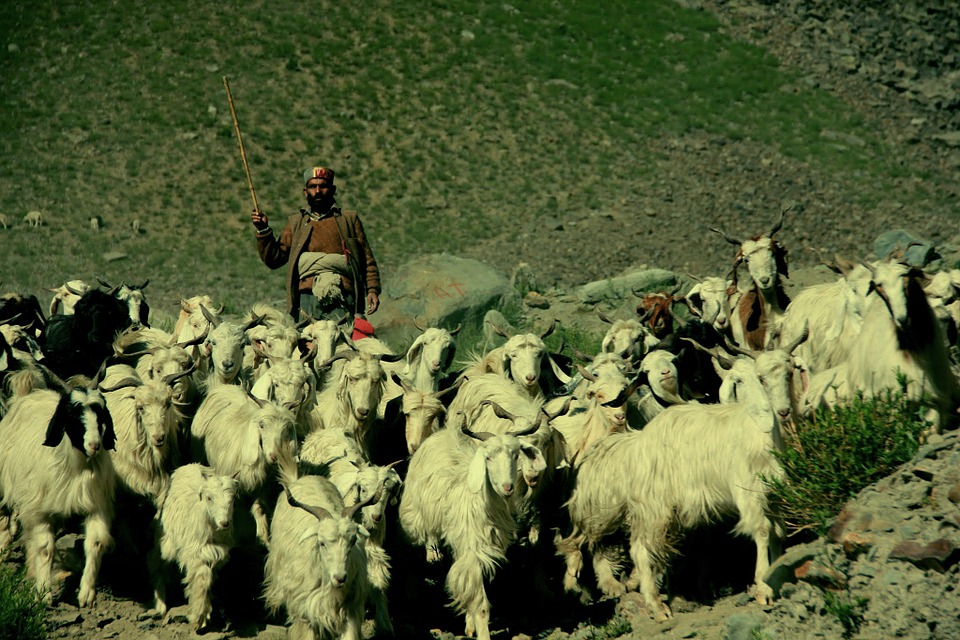
Loving The Elders

Dale Pollard

Though Scripture doesn’t say, you can be sure
David’s sheep had no idea how lucky they were to have a
shepherd like him. They were just sheep after all. How could
they fully appreciate the extent that David went to in order to
keep them safe? Before this begins to sound ridiculous, let’s
remember that at least two of David’s sheep were carried off
in the jaws of a lion and a bear. When the terrified bleating
of an unfortunate sheep is heard by the shepherd, he sprints
after the wild animal knowing all the while — it’s just a sheep.
It’s just one sheep! Nevertheless, David strikes the predator
and saves the sheep (1 Sam. 17:34-35).

What made David a good shepherd? It certainly
wasn’t his stature. The average male of his day stood around
five feet tall. He was also the youngest of his family, and often
unappreciated (1 Sam. 16:11; 17:29, 33). It was David’s heart,
not his height, that made him exceptional. He was a natural
shepherd of sheep, and of people.

David is sent by his father, Jesse, to deliver bread for
his brothers, who are among Saul’s army. When he arrives on
scene, everyone is afraid and unwilling to take a stand against
the arrogant Goliath. But before the giant warrior from Gath
meets the shepherd boy from Bethlehem, a few more giants
will be faced.

The first giant was the giant of degradation.
David’s own brother, Eliab, would greet him with
two belittling questions that would make a lesser man feel
sheepish, but not this shepherd. Eliab asks, “why have you
come down here?” and, “who is watching the few sheep?”
David’s brother doesn’t think he belongs among warriors and
that he is only capable of handling a small number of simple
animals.

The second giant was that of accusation.
In the same breath, Eliab would accuse and insult
David three different times. He claims, “I know how
conceited you are and how wicked your heart is. You’ve only
come to watch the battle.” How wrong he was and how dare
he insult such a godly man! It’s interesting to note that David
had an answer to each of these questions and accusations, but
never attempts to defend himself. His father sent him, that’s
why he was there. He was there to deliver nourishment for
this dear brother who had, no doubt, worked up an appetite
doing absolutely nothing. No retaliation or snarky remark
would escape from the shepherd’s mouth because nothing like
that was in his heart (Matt. 12.34).

The third giant David would conquer would be the towering
giant of indignity. He didn’t shame his brother and he didn’t let his
brother’s shaming keep him from shining.

Shepherds put up with a lot, don’t they? Good
shepherds really put up with a lot. Faithful God-fearing elders
within the Lord’s church all over the world are faced with
giants more often than they should be. Sometimes, the giants
they face are their own sheep. How easy it is to make
confident accusations against them and to question their
intentions, hearts, and capabilities. That unpaid servant of
God is more often than not the first one to come running
when the bleating of a wayward member is heard. When we
find ourselves in clutches of our various trials, they attempt to
pry us out. At times they earnestly pray over and take on
burdens that aren’t theirs to carry. Faithful elders will find
themselves in a position in which they could make the sheep
feel ashamed, but choose to save the feelings of others
because that’s what a good shepherd does. It’s not their
height, it’s their heart. The sheep need to love their
shepherds because the shepherds love their sheep.


Six Hands And A Stick 

Tuesday’s Column: Dale Mail

Daleheadshot

Dale Pollard

In the opening verses of Exodus 17, the faith of the Israelites is being tested. They’re in the wilderness and their human limitations begin to lead them to say and do things that end up defining their character for all eternity. It’s chapters in the Old Testament like this that set the stage for God to teach difficult lessons for them— and us.
There’s no water for them to drink and the feeling of thirst ignites a wild-fire of complaints. The text reads, “‘Therefore the people quarreled with Moses and they said ‘give us water to drink!’ And Moses said ‘Why do you do you quarrel with me? Why do you test the Lord?’” From here, it only escalates. The children begin to accuse Moses of attempted genocide.  They say, “Why did you bring us out here from Egypt? To die of thirst?” These people have seen the power of God, and they knew that the miracles which Moses performed were evidence of his Divine connection. The fact that they ask him for water when there is none proves that they knew Moses could do something about it.
It’s not only the Israelites that struggle with their rocky faith in God, however.  Moses also pleads with the Lord. He prays, “What shall I do with these people? They’re almost ready to stone me!” God responds by saying in verse five, “…take in your hand the staff which you struck the Nile, and go.” The wording is deliberate here. God is reminding Moses and the children what He has already done with that simple wooden staff in their past.  As Moses walked through that  wilderness leading his people, he holds in his hand a constant reminder. In his hand is a stick— a stick that God used to provide for His people.
If God can use some wood as an instrument to satisfy thirst and protect a large crowd of complainers, why do some still question God’s ability to care for us today? The place where Moses struck the rock was named, “Massah and Maribah” which translates, “Is the Lord among us or not?” It’s both a name and a question His children still ask from time to time today.
In the last section of this chapter, we can observe an intentional layout of the text. The army of Amalek challenges the Israelites to battle. With his faith restored in God’s power, Moses says, “Tomorrow I will stand on top of the hill with the staff of God in my hand.” On the day of battle, Moses holds the staff above his head. Whenever it was held up, the Israelites prevailed. When the staff was lowered, Amalek’s army prevailed.
Verses twelve and thirteen carry much application for us today. They say, “But the hands of Moses grew weary, and they placed a stone under him and he sat on it, while Aaron and Hur held up his hands on either side. So His hands were steady until the going down of the son.” At least three major lessons can be derived from this section of scripture.
Lesson one, church leaders can’t lead us to our eternal victory alone. Moses did not win the battle that day. God did.
Lesson two, church leaders need help because even a stick can become heavy after a while. God never intended for one man to lead His people. There must be an eldership so that these men can help each other hold up the word of God. Their victory came when four more hands took on the burden and shared the weight.
Lesson three, there is no obstacle we will face that God’s faithful people can’t overcome. Even if all the armies in the world had decided to attack the Israelites that day, three men and God would have still brought them to victory. If God can accomplish so much with a piece of wood, who are we to limit His power today? There is nothing we can’t do under the leadership of, not mere men, but God. Moses knew God could accomplish anything through him and some wood— today we would do well to remember what God can do with us and our willingness to serve.
biblical-leadership-not-as-simple-as-you-think-702x336-1

Elders Who Shepherd

Monday’s Column: Neal at the Cross

IMG_1922

Neal Pollard

There was a problem with the shepherds of Ezekiel’s day. They tended to their own needs, but not the flock’s (34:2-3). There were tangible needs and problems, but these shepherds sinned by omission (34:4). The sheep were scattered and these shepherds did not work to get them back or save them from predators (34:5-6). Then, God through Ezekiel utters these harrowing words: “Behold, I am against the shepherds, and I will demand My sheep from them and make them cease from feeding sheep” (34:10). 

In the New Testament, Paul tells the elders of the church at Ephesus to “be on guard for yourselves and for all the flock, among which the Holy Spirit has made you overseers, to shepherd the church of God which He purchased with His own blood” (Acts 20:28). Guard the flock, watch over the flock, and shepherd the flock. What a weighty work! To be on guard means “to be in a continuous state of readiness to learn of any future danger, need, or error, and to respond appropriately” (Louw-Nida 332). An overseer has the responsibility of seeing to the spiritual safety and proper conduct first of themselves but also of those they watch over (Arndt 379). The idea of shepherding indicates care, concern, love, provision, relationship and intimacy, knowledge, and familiarity (see Kittel et al 902ff). These lexicographers who define what Bible words mean give insight into what elders are to be like as they do this crucial work. Isn’t it incredible and encouraging to see spiritual, albeit inevitably imperfect, men who “aspire to the office of overseer” (1 Tim. 3:1)?

Yesterday is a day I’ll never forget. We tagged along with three elders and their wives as they went around to 26 houses of members of our congregation. Exercising due caution under the current medical crisis, they nonetheless drove to see members young, old, and in-between. They visited with, sang to, and prayed for so many face to face, delivering Dana’s delicious baked goods. Seeing their enthusiasm to do this and watching the genuine joy on their faces as they served and ministered was a blessing that will stoke my spiritual fire for a long time to come. 

But, that’s just what I got to see. I’m not seeing the other times they’ve done this. I’m not there as they’re making so many phone calls to everyone. Over the weekend, they met together for several hours to strategize about a reopening and communication plan not just to get back to “normal” but to thrive and grow as we go into the future. Another of the elders has since spent hours piecing together that plan to provide clear communication to the church. 

All of them work full-time jobs and are hard workers. All of them have families to love and care for. All of them have hobbies and interests. But, all of them have Christ in the center of their hearts and lives. That last fact is what drives them to know about, care about, and reach out to the sheep. 

Thank God for the many churches who are being shepherded through unprecedented times like these by engaged, concerned, and involved shepherds. Church growth, doctrinal soundness, examples of Christ-centered living, and so much more depend on elders who shepherd. Will you take the names of your shepherds to the throne of God each day, imitate their faith, and assist them in their work? They are a vital part of God’s plan to touch and transform eternity! 

elders
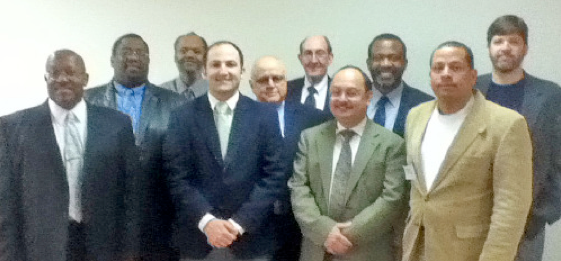
Only ten in this group picture! 

“First, Sit Down…”

Screen Shot 2019-12-21 at 9.08.51 AM
Not pictured: Riley, who was under the weather. 

Neal Pollard

In Luke 14, Jesus gives a couple of short parables about counting the cost of discipleship. He prefaces them by saying, “If anyone comes to Me, and does not hate his own father and mother and wife and children and brothers and sisters, yes, and even his own life, he cannot be My disciple. Whoever does not carry his own cross and come after Me cannot be my disciple” (26-27). If we drink deeply of this statement, we see exactly how challenging it is. The choice is always between Jesus and everything and everyone else. How badly do we want what only Jesus can give? Think hard, then decide!

Then come the parables. The first is a construction parable, of one building a tower. He first sits down and calculates the cost in order to be able to finish and avoid ridicule (28-30). The second is a military parable, of a king going into battle. He first sits down and considers whether or not he can win (31-32). The common denominator in both parables is to first sit down and deliberate. Ultimately, there is action which follows, but the planning precedes it.

In how many congregations do elderships or men in the absence of elders never get proactive and formulate a plan for the immediate, intermediate, and far off future? Leadership must cast the vision and deliberate about where that congregation is going and how it will get there. What will be done to grow? How can we get more members active? How can we best utilize the collective resources of the congregation? The Bible reveals all the answers, but it is essential for the church’s leaders to gather around the drawing board.

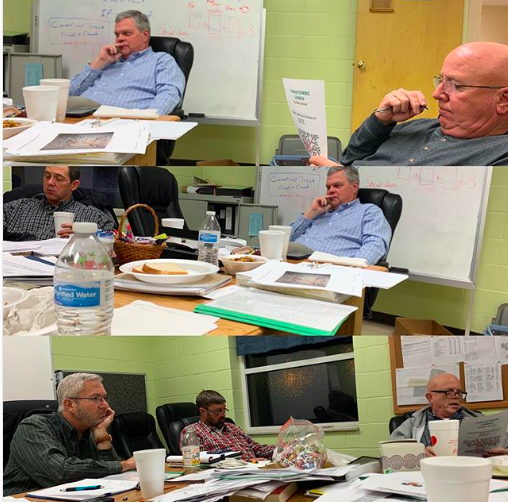
It was exciting to spend a few hours at the Lehman elders’ 2019 retreat to discuss the short-term plans of the congregation. These men are convicted about the stewardship of the work they eagerly consented to do as our shepherds. They want us to be more effective, but they are determined to set the tone and example for us. I’m amazed at how deeply they care about us and the growth they want us to collectively experience. Words like emphasis, accountability, and purpose continually came up. Building a biblical culture, which works against our contemporary culture of consumers rather than producers, is foremost in their minds. They desire for us to “grow together” as a church, drawing those outside of Christ to our spiritual family.

I cannot wait to see what God will do through such capable leaders in 2020 and beyond. We are blessed with such godly, conscientious elders. Please don’t miss a day praying for Russell, Riley, Kevin, John, Darrell, and Bobby and their families. Also, please never miss an opportunity to express your love, encouragement, and support of them as they strive to do their best to fulfill their God-given duty. Or, as Paul put it, “But we request of you, brethren, that you appreciate those who diligently labor among you, and have charge over you in the Lord and give you instruction, and that you esteem them very highly in love because of their work. Live in peace with one another” (1 Th. 5:11-12). 

They are first sitting down this weekend, but then they will challenge us all to “rise up and build” (cf. Neh. 2:18). 

A New Testament Leadership Style

Neal Pollard

USA Today ran a story about New York Knicks’ owner James Dolan. He’s depicted as a heavy-handed micromanager who feels more allegiance to his shareholders than the fans of the iconic professional basketball team. He’s contrasted with successful franchises, which the Knicks certainly are not at present, whose leadership sees themselves as stewards of a public trust and who casts a vision of a team which belongs to the people more than it does to those writing the paychecks and making the profits (Zillgitt, Jeff. USA Today, 3/15/19, 6C). 

While the article is prone to the subjective and fallible viewpoint of the author and his ability to properly research the subject, there’s a valid point to be made and applied much more broadly than just the world of sports.  Leadership approach is pivotal to the way and degree to which “followship” responds and participates in the vision and direction provided. Leaders who micromanage, arbitrarily dictate, fail to facilitate opportunity to be involved, and lead from fear stifle and prevent those in their stewardship from investing and contributing to the overall success of the organization.

Think about how this applies in the context of church leadership. When the Bible describes an elder’s role, one of the terms it uses for him is an “overseer” (Acts 20:28). This word means “one who has the responsibility of safeguarding or seeing to it that something is done in the correct way” (Arndt, Gk.-Eng. Lex. Of the NT, Et al,  2000: 379).  Neither the definition nor New Testament passages outlines, specifically, how that is to be done by means of method and judgment. It has to get done and it must be done correctly. Sometimes, elders hang on to “deacon duties” because it’s easier to do something than seeing to it that others do it correctly. Sometimes, it can be easier just to say “no” to some program idea or ministry than to endure the headaches of the trial and error in getting it off the ground.

Yet, there is wisdom in shepherding as stewards who help members invest and share in the success of fulfilling the purpose of the church as laid out in the New Testament. Such leadership encourages members to find ways to serve, to propose new ideas and methods to fulfill the New Testament mandates to evangelize, edify, and be benevolent. It facilitates their success–it announces, promotes, and advocates. It provides a watchful oversight that puts biblical rails around whatever the specific work is. Paul’s counsel helps elders know how to oversee: be on guard and shepherd. That means pay attention and take care rather than be aloof and detached. It also means to watch out for people and provide for and help them what it takes for them to spiritually survive. 

This leadership style is what makes such works as Bible camps, Lads to Leaders, Monday Night for the Master, lectureships, Bible classes, in-home Bible studies, fellowship groups, workshops, and the like thrive and grow. The more of us that feel invested in the work and success of the church, the more effort will be put toward growing and improving how it all gets done. Let’s show our appreciation (1 Th. 5:12), loving esteem (1 Th. 5:13), and cooperative submission (Heb. 13:17) to our overseers as they continue to try and lead us in this way. 

bvelders2
So thankful for the great, godly elders. of the Bear Valley church of Christ

A Tribute To Harry Denewiler On The Morning Of His Passing

Neal Pollard

I met him 20 years ago, the man with the twinkling eyes
He and his wife opened their home to me, and I could recognize
Their love for Christ and Christians, and how well they’d harmonize
Those loves in all their actions, it was there in those twinkling eyes

He shepherded me for several years, the man with twinkling eyes
He had a tenderness so deep, he’d often maximize,
His laugh infectious, his insight savvy, so tough to criticize,
He loved Bear Valley with all of himself, this man with twinkling eyes

I visited many members here with the man with twinkling eyes
Spent hours in meetings and planning, trying God’s will to realize
He was youthful and spry for his age, his resources he’d optimize
A steward of stewards in every way, the man with twinkling eyes

A servant’s heart with savvy hands, the man with the twinkling eyes
Involved and willing, helpful and hopeful, we couldn’t help but idolize
When hearing and memory faded, you still could characterize
This man of God, through ups and downs, by those twinkling eyes

I saw him last week, he greeted me with joyful, twinkling eyes
So hard to believe this morning he gained his heavenly prize
While his long life is fresh in my memory, I’ll try hard to memorize
As kind a face and heart as I’ve seen, the man with the twinkling eyes

1935132_1226524188954_3106107_n
Photo credit: Michael Hite

The Kindest Elder I’ve Ever Known

Neal Pollard

He was appointed an elder during the Reagan administration. At the very time he was appointed, the congregation was reaching the climax of a very traumatic incident. A man who was a charter attender, but not a member, when Bear Valley began meeting, he has seen every great work this congregation has dared to do, walked through its every valley, and he has done so with as even-keeled and unflustered way as I have ever known. I have heard him preach both here and abroad, watched him do short-term missions, make difficult shepherd visits, hug and encourage more people than I can remember, and seen his kindness and humor generously displayed. He was not usually the first to speak when elders conversed, but his insights have always been profound. He always did what he did with class and compassion.

I was crestfallen when I recently heard Maynard Woolley tell the eldership that he was ready to step aside as an elder after nearly 30 years of service. Only Harry Denewiler served more years in that role for the Bear Valley church of Christ. He stayed on a couple of years after five great men were appointed to this work in 2016, helping them to acclimate, learn, and grow under his, Ernie Barrett’s,  and Dave Chamberlin’s tutelage. A telling tribute to the breadth of his leadership was the collective, deeply respectful, regret that he was going to resign. Maynard is a man who one appreciates more and more the longer one works alongside him.  His faithful wife, Donna, has both encouraged him and endured, as an elder’s wife for so long, what not many women living have.

Some men impress with refined oratory, outspoken and charismatic ways, and larger-than-life personalities. Others live more understated ives, but their value cannot be overstated. Maynard Woolley is such a man. We will miss his formal oversight, but we look forward to his continued faithful service and loving example. Thank you, Maynard, for what you’ve done and for who you are.  Bear Valley bears the imprint of your bearing.

35328348_1752403114806253_5029729612142215168_n

What Preachers Wished All Members Knew About Their Elders

Neal Pollard

While there are doubtless men who wear the name “elder” that do not meet the biblical qualifications, many of the church’s greatest heroes and biggest assets are her shepherds. I have been privileged to serve under a total of 21 elders in 26 years of full-time preaching, and what I am about to say applies to each of them. Part of their work is public and visible, but I dare say so much more of it is conducted before the eyes of only a few or one sheep or even at times only before the eyes of God. My experience with elders is that they are humble men and they will never tell you what I am about to tell you.  Here are a few things elders wish all members knew about them.

—Elders do…

  • Care.
  • See people at their messiest.
  • Sometimes get the brunt of the lashing out people do when in pain.
  • Always, always put people first.
  • Give generously of their time.
  • Agonize.
  • Hard things none of the rest of us can or will do.
  • Have insight into sensitive situations that others may not.
  • Have feet of clay.
  • Pray fervently for the needs and problems of the flock.
  • Desire to communicate to the church as much as they feel they can.
  • Want to have a relationship with every member.
  • Love God and seek to please Him above all else.

—Elders don’t…

  • Give up on sheep.
  • Defend themselves.
  • Do it for the glory.
  • Seek the praise of men.
  • Hold a grudge.
  • Play favorites or have double standards.
  • Read minds or judge motives.
  • Want to lose a single sheep.
  • Publicly share everything that’s on their plate or comes their way.
  • Want to lead God’s people away from Him and His will.

In an elders meeting last night, one of our shepherds was asked to read Hebrews 13:17. The elder chairing the meeting said, “This passage encourages me.” The elder who read said, “This passage frightens me!” As each of them discussed the sober meaning of that passage, I thought back to things I’d seen each of them do recently. It made me so thankful to serve under an eldership that takes their work seriously. Are they perfect men? Impossible! Are they God’s men? Absolutely! Please pray for the eternal work elders do in congregations around the world every day!

shepherd-and-sheep-e1446124496929

“I Praise, I Participate, I Proclaim”

Neal Pollard

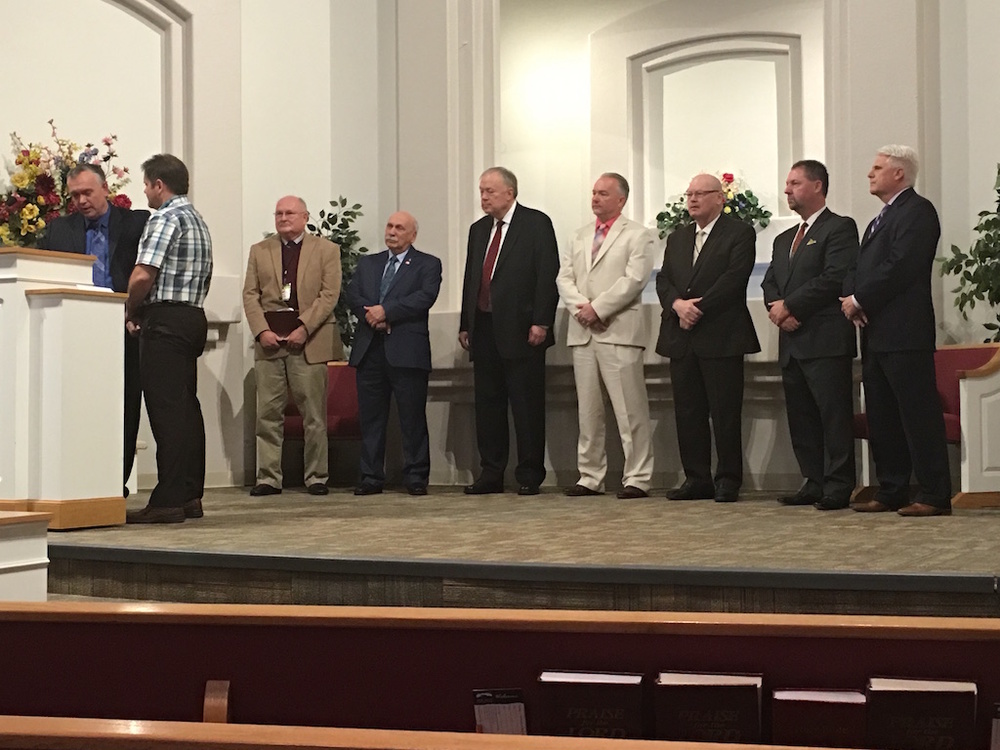
Yesterday afternoon, the Bear Valley eldership stood before us one by one to talk about their priorities both for themselves and for us. They distilled them into five simple words that describe five profound concepts: (1) Worship, (2) Communication, (3) Fellowship, (4) Accountability, and (5) Leadership. They told us that as the religious world is growing more homogenous in their worship style (a la community church model; rock concert-ish), distinctive New Testament worship has a chance to stand out even more. Yet, we need to always be improving our efforts in leadership and participation. They emphasized that communicating news, ideas, and needs is a process that will always need work and priority. No church ever arrives in this regard. They spoke of the importance of building a closer church family, knowing each other through age-related opportunities and entire congregation opportunities. This happens when we’re all together, in the classroom, and away from the building. They stressed the importance of holding one another accountable, for faithfulness, commitment, and support. Otherwise, there is no way to move from ideas to action. They told us that all of us exert leadership in some area. There is formalized leadership positions, as outlined in the New Testament (elders, deacons, preachers, teachers). But, inasmuch as we all have a sphere of influence (cf. Mat. 5:14-16), God expects us to lead. Throughout their entire presentation, they were specific about strategies aimed at helping us be successful. I appreciated the great challenge this was for us to work and grow. There were so many quotable sayings from their collective lesson, but the one that struck me most was made near the end. As we have adopted three planks of emphasis as a church, based on Acts 2:42-47 (praise—worship, participation—fellowship, and proclamation—evangelism), we were challenged to think: “I praise,” “I participate,” and “I proclaim.” It can be so easy for us to approve the church’s need to grow and improve in these areas or to expect the elders to do these things. But, no matter who we are, we can and must ask, “What can I do?” The key to being a great church is the willingness of every member to make personal application. It’s not, “What are they doing?,” “what are you doing?,” or even “what are we doing?” No! It must always primarily be, “What am I doing?” I’m thankful that our elders spoke with confidence and clarity about the fact that there is plenty of opportunity to be involved in making Bear Valley a strong, relevant church, a city set on a hill shining a light in spiritual darkness. Thank God for strong leadership, which encourages me to say, “Here am I, send me!” (cf. Isa. 6:8).

29513166_10155440294575922_8869656347900125980_n

Armchair Elders

Neal Pollard

He shouts at his TV with a mouthful of Cheetos. “I can’t believe you! Four receivers downfield and you throw it behind the line of scrimmage to a man who’s double covered! You’re pathetic. Must be nice to get millions of dollars to make awful decisions. Where do I sign?” After several additional one-sided conversations with the TV, Mr. Potato (first name: “Couch,” aka “Armchair Arnie”) dusts crumbs off his potbelly with those trademark orange fingertips and limps into the kitchen, stiff from sitting three hours, to get another snack before the second half of the NFL doubleheader.

Water cooler wide receivers. La-Z boy linebackers. The game’s true experts do not prowl the sidelines with headsets, nor do they actually suit up, strap on, and sweat it out. The guys with all the answers are the ones who would crumble with fear if placed on the same field with the athletes they so roundly criticize for bungling with the ball.

I have observed that the same temptation can occasionally strike some with regard to elders. Whether it be their judgment or painstaking decisions, their handling of a member’s problems or needs, or their overall “job performance,” elders get taken to task more often than they realize by pew chair presbyters. They may criticize elders for what they did or for their failure to act, for being too strict or too lenient, for showing favoritism or trying to please everyone, for being too conservative or too liberal–all with the regard to a single action taken or decision made.

There is a striking similarity to the “armchair quarterbacking” done by unfit, unqualified spectators at sporting events. Those who can’t are apt to criticize those that can and do. It is far easier to question and condemn the actions taken by elders without the benefit (and angst) of wrangling with problems and decisions oneself. How we can eloquently outline the plan of action we would take absent the pressure and responsibility of being in the position.

Let’s pray more for our elders and pass judgment less! Let’s support them with might, not scrutinize them under a microscope. They need our cooperation and submission (Heb. 13:17). They could do with less backbiting and murmuring (cf. 1 Co. 10:10).

That’s not to say that elders are beyond reproach and rebuke (1 Tim. 5:20). Occasionally, an elder or eldership may be deserving of question–particularly in the area of doctrine or their personal qualification. As a longtime Falcons fan, I had to endure the likes of Scott Hunter, Pat Sullivan, and June Jones! They were terrible quarterbacks, though much better than I could ever have been. Elders will answer directly to Christ for their shepherding of the local flock. We, as embers, will also answer for how we cooperated with and supported them. Let’s all resolve to get out of the chair and join them on the field (cf. John 4:35)!

sedentary

Watching Godly Elders

Neal Pollard

We are blessed with seven wonderful elders here! They span in age from 48 to 81, are of varying backgrounds, personalities, and skillsets, but collectively they reflect God’s wisdom for a plurality of godly men shepherding the flock. With the magnitude of the work and workload here, I cannot help but stand in awe of the great job they are doing. To watch men like these, I’m reminded of the powerful good done by apt, able elders. Far from an exhaustive list, they:

  • Show Hospitality—They open their homes freely and frequently, getting to know the sheep.
  • Keep Track—They make it their business to account for the sheep, knowing they will give an account for each of them ultimately.
  • Cast Vision—They do not lead from the rear; they thoughtfully, decisively get out front and show the way.
  • Greet Visitors—They care about our members, but they are constantly focused of who’s new around here.
  • Contemplate Problems—In the spirit of Solomon, they are presented with and must decide often complex, hairy matters…in real time.
  • Faithfully Pray—Listen to men pray and you get a pretty good idea how practiced they are. These men are devoted to it.
  • Show Heart—They aren’t afraid to demonstrate their care, concern, and love. We see it in their passion, their tears, and their involvement.
  • Manage People—Sheep are also of differing temperaments, needs, problems, and levels of maturity. They deal with “all kinds.”
  • Consult God—How exciting to see overseers humbly searching for and submitting to a “Thus saith the Lord.”
  • Balance Time—They do all of this while being competent employees, conscientious family men, and character-filled Christians.
  • Set Direction—They are tone setters in a basic way; What they emphasis, we will make important. We hear their voice, in the assemblies, meetings, and private conversations.
  • Make Mistakes—Despite sometimes unreasonable expectations from some, they are terminally human and inevitably subject to imperfection.
  • Follow Jesus—They are good shepherds walking behind the Good Shepherd. They want to serve, please, and imitate Him. Ours do a fantastic job of that.

Have you seen what a great job these men are doing? Have you taken the time to stop and let them know? Many churches veer from the straight and narrow path because of ungodly elderships. Thank God for the shepherds at Bear Valley!

13239021_10153682591930922_3851531815462243933_n

WHERE ARE THE ELDERS?

Neal Pollard

  • At the hospital, attending a surgery
  • At home, hosting a family or families and getting closer to the sheep
  • Hosting and attending church activities
  • In private meetings with hurting, needy members
  • In meetings together, praying over and discussing the needs of the sheep
  • Spending time with their wives and children, nurturing that needed part of their lives
  • On their knees and in their Bibles, strengthening their walk with the Good Shepherd
  • Teaching our Bible classes, leading our worship, and even preaching as needed
  • On the job, exemplifying Christ before the world in a superlative way
  • Weeping with the weepers at funerals
  • Found among our graduates, parents of newborns, celebrating newlyweds, and other happy moments experienced within the flock
  • In Bible studies with non-Christians or Christians wrestling with some Bible matter
  • Looking for visitors and new faces in our assemblies
  • Working, sleeves rolled up, on workdays and other occasions where they can serve
  • Enjoying fellowship, their very actions reminding us they’re normal and one of us
  • Watching and listening carefully, especially at the teaching and preaching that is done, ensuring the spiritual food their sheep ingest is healthy and nourishing
  • Holding up the hand of faithful gospel preaching, having their hands help up by their preachers
  • Touching base with the deacons, encouraging and aiding their success in ministry
  • Attentive to little children, the elderly, the alone, and others that many might unintentionally overlook
  • Ensuring the unity of the Spirit in the bond of peace, rooting out divisiveness
  • On the phone and in the homes with erring sheep, striving to retrieve them and, sadly, if necessary, leading the flock to withdraw fellowship from the irretrievable
  • Setting the spiritual tone, emphasis, and direction of the flock

Our elders, like faithful elders everywhere, do a lot that is unseen by the majority.  It is hard to quantify the time and effort each of these godly men put into their work, but God sees it. What is more, God rewards it. My prayer is that righteous elders everywhere will take heart at what an inspired elder once wrote: “Therefore, I exhort the elders among you, as your fellow elder and witness of the sufferings of Christ, and a partaker also of the glory that is to be revealed, shepherd the flock of God among you, exercising oversight not under compulsion, but voluntarily, according to the will of God; and not for sordid gain, but with eagerness; nor yet as lording it over those allotted to your charge, but proving to be examples to the flock. And when the Chief Shepherd appears, you will receive the unfading crown of glory.”

13239021_10153682591930922_3851531815462243933_n
Bear Valley elders among our 2016 High School graduates

What God Does Not Expect Of Elders

Neal Pollard

Sermons preached on the qualifications of elders often, rightly, emphasize the importance of selecting men who qualify to serve. In the Lord’s church,  covetous, inhospitable, intemperate, cold, imprudent, biblically ignorant, pugnacious, and newly-converted men (among others) have been appointed to that important work who should not have been. That hurts the local church! Many times it has been said that “bad elders” are worse than “no elders.”

Harboring unfair expectations of men who would serve as elders is another hurtful trend that occasionally surfaces. A hypercritical spirit is a quality of human nature, though a quality the spiritually-minded ought to fight to personally eliminate. Let us briefly consider what God does not expect of elders.

  • More Than The Qualifications Specify. Gut feelings, intuitions, and hunches might work well when hunting, fishing, or making March Madness picks, but there is no call for them in selecting men to serve as elders. God does not need our help, tacking on additional requirements for an elder than He felt the need to supply for us. Adding to the Word of God carries a stiff penalty (cf. Rev. 22:18); therefore, our scrutiny of a man’s fitness to serve needs to stop where the Bible’s does.
  • Sinless Perfection. He expects maturity (1 Tim. 3:6), ability (Ti. 1:9), and stability (1 Ti. 3:4-5), but not impeccability (the Latin origin of this word means “not to sin”)! If so, no man could ever conceivably qualify to serve. Gnat-straining can keep a qualified man from serving as surely as camel-swallowing can allow an unqualified man to sit as watchman. With a 1000-tooth-comb, some would inspect the minutia of his life and his family’s. Those searching for flaws, who look hard enough, will always find things. Yet, such findings do not necessarily prove anything except his humanity and fallibility (cf. Rom. 3:10,23).
  • To Neglect Their Own Families. It is unfair to expect a man, as elder, to always place the needs of the congregation over those of his own family. Too many wives and children have been deprived of husbands and fathers due to disproportionate expectations of time, resources, and attention placed upon elders by members. Elders need the full cooperation and understanding of their families, while elders are obligated by God to supply the needs of their families (cf. 1 Tim. 3:4-5,7). Elders (and their families) are entitled to vacations and nights at home together. Elders will answer for not only their service as elders (Heb. 13:17; 1 Pe. 5:4) but also their influence and leadership in the home (1 Tim. 3:4-5; 1 Co. 11:3; Eph. 6:1-4).
  • To Be The “Complaint-Receiving Committee.” It is impossible but that complaints will come, but woe unto him (or her) through whom they constantly come. Murmuring and complaining got Israel into trouble (cf. 1 Co. 10:10), and members who find it impossible to speak to elders without doing such may find themselves in the same predicament. How many times has an elder heard you say something positive about another member, a successful program, or their efforts on your behalf? How many of your complaints have they fielded? Elders will answer for our souls. Let us find ways and opportunities to encourage, praise, and support them. Complain whenever you must, but compliment whenever you can.

Did you realize members have qualifications to meet with regard to the elders?

  • Love and appreciate them (1 Th. 5:12-13)
  • Honor them (1 Ti. 5:17)
  • Do not recklessly accuse them (1 Ti. 5:19)
  • Obey and submit to them (He. 13:17)

As we examine who would serve as elders, let us not forget to examine ourselves (2 Co. 13:5). How spiritually fit are we? Jesus’ words about beams and specks apply to our relationship with elders, too (cf. Mt. 7:3-5). Let us have high expectations of elders, but let us have only those expectations God has!

screen-shot-2013-03-14-at-1-01-53-pm

The Shepherd Of The Sheep

Neal Pollard

“That grass is greener,” so he thought,
The sheep who wandered from the fold
Watching carefully the shepherd caught
The wanderer, so soon in the overseer’s hold.

The roaring waters so dangerously near
Forms a hazard for the trembling herd
But the herdsmen is wise, his vision is clear
With his guidance their safety is assured.

Surveying the cliffs or helping them rest
His vigilance is timely and needful,
For the sheep he labors to give them the best
For their well-being the shepherd is heedful.

The Lord chose imagery, graphic and vivid
To illustrate how His church should function
Lackadaisical leadership leaves Him livid
He urges them have compassionate compunction.

Watchful shepherds who tend with care
Are assets in the heavenly realm
Who carry, calm, who steer and spare
Who are willing to assume the helm

Stewards for the Great Shepherd of the soul,
They lead as they point out the way
And help us keep our sight on the heavenly goal
And prepare us for the Great Judgment Day!

shepherd-489292_960_720

L.E.A.D.

Neal Pollard

When speaking of the work of elders, there are multiple aspects of his work and his life outlined in Scripture.  He is an “elder” (“A person of responsibility and authority in socio-religious matters,” Louw-Nida, 53.77; “being relatively advanced in age, older, old,” BDAG).  He is a “pastor” or “shepherd” (“To care for, provide,” WSNT, Zodhiates; “To care for the congregation…to seek the lost…and to combat heresy,” TDNT, Kittel, et al, eds.).  He is an “overseer” (“one who serves as a leader in a church…caring for the needs of a congregation as well as directing the activities of the membership,” Louw-Nida, 53.71).  His qualifications are seen in 1 Timothy 3 and Titus 1, his relationship to the membership seen in such passages as 1 Thessalonians 5:12-13 and Hebrews 13:7,17, and his authority in such passages as 1 Timothy 5:17, but among the three designations identifying him nothing may be more pressing and important than his leadership.  Too often, preachers or other influential members fill the vacuum and void of leadership left by elders who fail to assume this role.  When this happens, God’s pattern for church life is not followed.

Wendell Winkler once wrote, “Leaders cannot lead where they do not go anymore than they can come back from where they have not been.  They influence some by what they say, more by what they do; but, most by what they are” (Leadership: The Crisis Of Our Times, 15).  Citing the example of Isaiah, Franklin Camp wrote, “Isaiah’s response (to God’s question in Isa. 6:8, NP) was as though he were afraid that someone else might volunteer before he did. This attitude is that of which real leadership is made. When there is a challenge placed before the church, read leaders, like Isaiah, are ready to accept it” (Principles and Perils of Leadership, 50). Then, J.B. Myers adds this, that “a leader is one who guides others and directs a course of action. Fundamental to leadership is the willingness to take the initiative in behalf of a group, such as the church” (Elders and Deacons, 166).  These and other men have written books or articles, preached sermons, and taught classes urging the church’s elders to be leaders.  The need is as great today for this as ever!

How can elders effectively lead today?

Love.  Be tender and compassionate, as a shepherd. Be gentle and wise, as an elder.  Be faithful to God’s will, loving Him first, as a leader.

Exemplify.  Study and follow the example of the Great Shepherd.  Have a long track record of righteous living, as an elder. Show before you tell as a leader.

Admonish.  Realize the care attached to warning, as a conscientious shepherd. Summon the benefit of experience, as an elder, to be reminded of the abject neglect attached to ignoring sin “in the camp.”  Appreciate that sheep need a clarion, understandable voice from the leaders.

Decide.  Know that confusion and scattering lies in the wake of an indecisive shepherd. Trust the accumulation of wisdom gained as one who has reached the age befitting an elder. Grasp the connection between decisiveness (even if unpopular) and leadership.

Bigger, stronger congregations hinge upon good, godly leaders.  The faithfulness of Christians rests in the hands of capable leaders. Evangelism flags and fails minus the sure guidance and equipping of leaders.  Pray for every elder everywhere to L.E.A.D.!

 What It Means to Be An Overseer

Neal Pollard

Elders are identified with three broad terms.  As Gary Hampton has put it, those who serve congregations in this honored way should not be offended that the term most often associated with them is the one that identifies them as old.  Not only are they “elders,” but they are also “shepherds” and “overseers.”  “Shepherd” describes their pastoral function:  caring for the spiritual and emotional needs of the flock, knowing the sheep, and building relationships with the sheep.  Too often, people confuse preachers as the ones associated with this role.

They are also “overseers.”  In one way, this term is almost self-defining.  They are to oversee the affairs and activity in the congregation they serve.  In another way, there may often be confusion about what it means to oversee.

  • They should not be “over hearers.”  They must be communicators and “contactors.”  They cannot rely solely on hearsay and rumor.  They cannot afford to be so detached from sheep life that they are uninformed. While they rely on information from preachers, deacons, and the “general membership,” that cannot be their sole means of information regarding church life.
  • They should not be “over meeters.”  I have heard it said that elders should visit two hours for every one hour they meet.  Although that may be unscientific, is it not saying that personal contact with church members is at least twice the job that coming together and making decisions about those members is?  How can anyone best decide about sheep with whom they have not spent quality time?  Certainly, lengthy meetings are draining and frustrating to elders.  Often, overseers are in danger of burn out from marathon sessions.
  • They should not be “over workers.”  God has not placed the entire workload of the church on elders’ shoulders.  Almost always, men are appointed elders because they have proven themselves diligent workers in various areas of church life.  Yet, as it was in Moses’ day, when elders are overloaded with the church work “alone” (Ex. 18:14) what they are doing “is not good” (Ex. 18:17), it is “too heavy” for them (Ex. 18:18), and they “are not able to do it alone” (Ex. 18:18).  That means elders should not be doing deacons’ work and deacons, by definition, should.

David E. Smith, an elder with the Birdville congregation in Heltom City, Texas, said, “Let me confess up front that I’m guilty.  Guilty of not letting deacons do their jobs so I’ll have more time to do mine.  I think most elders fall in this category from time to time.  There is an urgent need for us to change our “modus operandi”! …Sometimes I get overly involved with our deacons’ work which distracts my attention from spiritual matters.  And there is never a lack of spiritual matters needing attention” (“Questions Of Eternal Consequences,” Ft. Worth Lectures 1999, pp. 267-268).  With regard to church work, let overseers be delegators of work rather than devourers of it all.

  • They should not be “overreactors.”  Faith is vital to effective pastoring.  Financial contribution is vital to church work.  Disgruntled members are an unpleasant reality from time to time, and some can never be placated short of letting them always have their way.  People are growing older.  Most every church should be more evangelistic and all churches could be growing more.  These are some of the burdens God’s shepherds must bear.

Elders no doubt regularly lose sleep and generate stress over such matters.  Yet, as God makes elders overseers (Acts 20:28), He will supply their needs (Phil. 4:19).  It is God’s work, and He blesses all Christians who step out in faith in service to Him.  That certainly applies to the valiant work and oversight of His shepherds.

We cannot “over praise” elders.  They are definitely not over-rated.  They work over time. It is amazing that they are not overcome by the heavy task they execute.  Let us all be reminded of what these special men known as overseers are truly called to do.  It takes extraordinary men to do this heavenly task. “Let them do this with joy and not with groaning, for that would be of no advantage to you” (Heb. 13:17b).

“To Protect And To Serve”

Neal Pollard

This now famous motto came into the public consciousness as part of a contest run by the Los Angeles Police Department’s internal magazine, BEAT, in 1955. Officer Joseph Dorobek submitted the winning entry with “to protect and to serve.” Nearly 60 years later, it continues to be seen on the side of the department’s patrol cars and serves to “embody the spirit, dedication, and professionalism” of the LAPD’s officers (via joinlapd.com).

With so much animus and distrust of law enforcement in some circles right now, it can be easy to forget their vital role of keeping peace and enforcing the law.  Without them, anarchy and violence would reign, with no one to restrain the lawless from violating and harming those incapable of defending themselves.  While there are unethical, lawless individuals in every profession, many who hear reports against law enforcement never stop to ask whether there is ever bias on the part of the reporters.  Perhaps it is a bias against law, authority, or the perceived power delegated to those wielding a badge.  It is good to remember that God has appointed the governing authorities of each locale (cf. Rom. 13:1ff).

God does not have an official position in His Kingdom for watchdogs or police officers to police the actions of others.  He made us creatures of choice and He allows us to choose good or evil.  While occasionally there are preachers and other members who are self-appointed to such a position, the concept is foreign to Scripture.  However, He did organize the church with elders who protect (Acts 20:28; 1 Pet. 5:2) and deacons who serve (1 Tim. 3:10,13).  In fact, all members are to be servants of Christ (Gal. 5:13).  Preachers are to preach the word, and when they declare the whole counsel in love (Acts 20:27; Eph. 4:15), they will sometimes convict the hearts of the hearers.  Particularly elders, who are commissioned to protect and serve the flock, deserve our respect and esteem (1 Th. 5:12-13).  Especially is that vital in an age that disdains authority.

It was an honor for me to serve as a reserve police officer in Livingston, Alabama, for a couple of years in the early 1990s.  I was able to see the dedication and sense of honor held by these extraordinary men and women. Let us honor those public servants of God (Rom. 13:6) and those spiritual servants of God (1 Th. 5:13)!

Submitting To Elders

Neal Pollard

Elders are not infallible, and most of the men I’ve known who serve as elders do not think they are.  On the whole, the rank and file of elders I have known are humble, selfless, sacrificial, magnanimous, and spiritual men who embrace the often difficult work of herding and leading that often strong-willed species of us known in biblical terms as “sheep.”  They are so often second-guessed and may be the most commonly backbitten group of people among God’s people.  I have found that there are a few—sadly too often a “vocal minority”—who, in practice, are hesitant to submit to eldership’s decisions.  In my experience, here are some of the reasons why:

  • They do not agree with the judgment call(s) made by the eldership
  • They do not understand why the elders have decided as they have
  • They feel they would or could handle a situation better than the elders did
  • They feel that they would be immune from perceived pressures or weaknesses
  • They see some deficiency in them

Such attitudes are very frustrating to encounter.  I would go so far as say that these are bad attitudes.  They reflect more on the sheep than the shepherds. Here is what they often fail to understand:

  • The elders probably have privy to more information than they do
  • They are likely privy to sensitive information they cannot share
  • They are almost always involved in more than anyone else
  • Since they will give an account to God for their work, they face the reality of making choices for which they have to answer
  • They submitted to a congregational process and found qualified to lead
  • We are commanded to submit to them, and that necessarily implies in matters of judgment even when we do not agree with their judgment

The vast majority of elders are sensitive to the concerns and objections they hear from the sheep.  Should we not exercise an equal measure of humility, selflessness, sacrifice, magnanimity and spirituality in our words and attitudes regarding our shepherds?  Remember, “Obey those who rule over you, and be submissive, for they watch out for your souls, as those who must give account. Let them do so with joy and not with grief, for that would be unprofitable for you” (Heb. 13:17).