Making The Most Of Difficult Circumstances

Perhaps you are facing a difficult circumstance. It should not be trivialized or minimized. It might be painful and protracted. But it should neither be the source of defeat or an excuse to stop serving the Lord.

Neal Pollard

In Acts 28:16, Luke tells us that when Paul came to Rome he was allowed to stay by himself (in a house he paid for himself, according to verse 30). However, he was guarded by a Roman soldier. Paul again refers to this in Philippians 1:13, 17, and your version probably has either the word “imprisonment” or “bonds.” Many ancient historians tells us that the Romans would chain the prisoner and soldier together in a practice known as “Custodia Militaris.” Polybius, a Roman historian writing more than a 100 years before the first century, wrote, “They kept them bound with a chain to a soldier who was responsible for their custody” (Histories 1.88.8). Seneca and Josephus also record this practice.

Can you imagine what a daily problem this would have been? Consider the invasion of privacy, the unpredictable disposition of your companion, and the potential for scorn and humiliation? Yet, day after day, Paul would be chained to a soldier. The chains were 18-24 inches long (the British Museum has archaeological finds from the period), and the guards were rotated every four to six hours (Vegetius 3.8). Maybe the last guard was a nice guy, but the next was not so much. It could not have been an enjoyable task for the soldier either, and he might be inclined to take that out on the prisoner. 

But, how did Paul respond? Paul implies what he did as one guard came and another went. “my imprisonment in the cause of Christ has become well known throughout the whole praetorian guard and to everyone else” (Phil. 1:13). These praetorian guards were elite Roman soldiers, also known as the imperial guard. This might further explain how the gospel reached members of Caesar’s household (Phil. 4:22). Imprisoned for preaching Jesus and shackled to worldly, hardened men, Paul taught the gospel. He learned to be content in every circumstance (Phil. 4:11), but that didn’t mean idle or self-absorbed.

Perhaps you are facing a difficult circumstance. It should not be trivialized or minimized. It might be painful and protracted. But it should neither be the source of defeat or an excuse to stop serving the Lord. Paul had a captive audience, literally bound to hear the good news from a man enduring what most would deem a bad fate. He transformed his difficulty into opportunity. May we have the will and wisdom to do the same! 

Let Go And Let God: Finding Peace Through Surrender

To say that crisis is welcomed is inaccurate, but strength in suffering is one of the most faith-building examples we can find in others. I invite you to read a brief glimpse of one such example.

Brent Pollard

My recent stay in a long-term acute medical facility resulted in my return home on a ventilator. I was unable to entirely wean off the ventilator, as I had done successfully in 2021. As a result, I find it necessary to connect myself to the ventilator every night as I prepare to sleep. The ventilator helps me expel excess CO₂ from my body, which my restrictive lung disease makes challenging to do. Since returning home, I’ve become more aware of how much trust I need to place in my ventilator to avoid panic. Suppose you have ever remained conscious while on a ventilator; you may understand what I am saying. The device helps you breathe, but you must fully surrender and refrain from interfering with the machine’s operation on your behalf. Using a ventilator presents a significant learning curve, contradicting our natural inclination.

As I reflect on my new reality, I can’t help but think of an expression you’ve probably heard before: “Let go and let God.” Organizations like Alcoholics Anonymous used that expression in the middle of the twentieth century, but its origin is unknown. Although it is not rooted in a specific scripture, several passages in the Bible convey a similar sentiment. Here are some such passages:

Proverbs 3.5-6: “Trust in the Lord with all your heart and do not lean on your own understanding. In all your ways acknowledge Him, and He will make your paths straight” (NASB95).

Psalm 46.10: “Cease striving and know that I am God; I will be exalted among the nations, I will be exalted in the earth” (NASB95).

1 Peter 5.7: “Casting all your anxiety on Him, because He cares for you” (NASB95).

Surrender is deeply complex. In the face of uncertainty about what lies ahead, the burden of expectation to solve every problem, and the unyielding grip of anxiety, we frequently overwork, cling more tightly, and eventually exhaust our resources. It is then we need to “let go and let God.” This expression does not advocate idleness or inaction; instead, it promotes a proactive faith. It takes faith to rely on the Divine’s strength, wisdom, and love to handle what is beyond our abilities. It represents a receptive and generous attitude, emphasizing openness over defensiveness.

By releasing, we make room for the divine to work. When we give up our efforts, we can begin to hear the Lord’s voice. As we release our burdens, we feel the comforting embrace surrounding us. Jesus invites us to experience this release.

“Come to Me, all who are weary and heavy-laden, and I will give you rest” (Matthew 11.28 NASB95).

Releasing is not the same as giving up—surrendering our control, not our hope. It represents giving up our fears, letting go of our timing, relinquishing our desired outcomes, and surrendering our sense of control. In this pursuit, we discover tranquility and divine peace that surpasses all understanding (Philippians 4.7).

Surrendering our burdens to God ultimately opens us to a peace beyond comprehension. Faith in His intentions for our lives brings a profound sense of peace and confidence. He comforts our weary souls and assures us that He will bear our burdens if we seek Him out.

What burden are you still trying to carry on your own that God is inviting you to release today? Let go and let God! Let us find comfort in releasing our grip and welcoming the peace only He can provide.

Habakkuk: Living By Faith (III)

Do you have a “no matter what” faith? How does one develop such a faith, one that grows and develops even when life is hard? Habakkuk knows.

FAITH TRIUMPHANT (3:1-19)

Neal Pollard

Nothing has changed in the circumstances Habakkuk is wrestling with. Babylon is still coming to execute God’s wrath for Judah’s sin. Babylon is still more wicked than Judah, the catalog of sins just reviewed in the previous chapter. But we notice the change in tone in the last verse of Habakkuk 2. The prophet has gladly resigned himself to the fact that God is on the throne, still in charge and perfectly knowing what He is doing.

This transformation leads directly to the prayer with which he ends this short book. The odd notation, “according to Shigionoth,” identifies it as a highly emotional poem. BDB Lexicon speaks of it as a “wild, passionate song, with rapid changes of rhythm” (993). So dramatic was this form of poetry that it “would be a song which provoked great excitement by its performance” (Koehler, HALOT, 1414). Habakkuk has come through the thick and dangerous fog of the trial of his faith, and he emerges into the clear blue sky of confidence in God’s character and work. What does his triumphant faith look like?

Appeal (2). He petitions God out of a deep fear and reverence that is apparent throughout this prayer. Yet, he is bold enough to ask God to revive His work and make it known. He asks for mercy amid His just wrath. It’s the only two things he asks for in the whole prayer. Habakkuk will describe the wrath in the latter part of the chapter (8,12). He wants God to swiftly answer (“in the midst of the years”). 

Admiration (3-4). As he copes with God’s pending judgment, Habakkuk still has a heart to praise. He writes of God’s splendor, radiance, and unmistakable power. He is pictured as a king coming in procession, only His harbingers are the radiance and rays of His glory. 

Awe (5-12). Habakkuk’s response to the greatness of God’s power is to describe His coming in judgment. He envisions the carnage in the aftermath of God’s wrath on the disobedient. He comes with pestilence and plague (5), standing, surveying, then shattering (6), rage, anger, and wrath (8), chastisement (9), and indignation and anger (12). All creation trembled at His coming (10-11). This God with whom Habakkuk had debated is transcendent, doing what is right in the proper measure at the proper time. Habakkuk can only watch in jaw-dropping wonder. 

Acknowledgement (13-16). Habakkuk proclaims the acts of God with four “you” statements–You went forth, You struck, You pierced, and You trampled. He acted in salvation for His people and in retribution against the wicked. Habakkuk’s acknowledgement of such perfect justice is telling: “I heard and my inward parts trembled, At the sound my lips quivered. Decay enters my bones, And in my place I tremble. Because I must wait quietly for the day of distress, For the people to arise who will invade us.” Not only does he acknowledge the greatness of God, but the justice of His decision to bring about the Babylonian Captivity against his sinful brethren. 

Acceptance (17-18). Out of this comes the resignation of trusting faith. It’s a “no matter what” faith on Habakkuk’s part. These verses have become some of the best known and most quoted of the entire book (along with 1:13, 2:4, and 2:20). How can we illustrate triumphant faith? How about these words? “Though the fig tree should not blossom And there be no fruit on the vines, Though the yield of the olive should fail And the fields produce no food, Though the flock should be cut off from the fold And there be no cattle in the stalls, Yet I will exult in the Lord, I will rejoice in the God of my salvation.” If every earthly blessing is withheld from me, I know that God is worthy of my trust and deserving of my worship and praise. This is the faith that will cause us to live (2:4)!

Acclamation (19). Habakkuk’s final declaration is of his strength through the Lord (cf. Phil. 4:13). Though the Chaldeans are knocking on the door, ready to break it in and take them away, the prophet pictures himself (and the faithful) as those who are still standing through God’s help. Like Job, praising God despite his pain (Job 42:2), Habakkuk rises from the ashes of his perplexity and the trial of his faith. He stands on the rock solid foundation of God’s trustworthiness. After the trial, with God’s help and by God’s mercy, he will stand. 

Where am I in my faith? Is it being tested? Am I listening to God’s truth as He teaches it? If so, then, no matter what, I will triumph through Him! 

Habakkuk: Living By Faith (II)

Faith often requires waiting patiently. What is now may seem like what will be, but trust in God’s character and power calls on us to “wait upon the Lord” (Isa. 40:31). What does Habakkuk have to say for the one struggling to keep faith in faithless times?

Faith Taught (2:1-20)

Neal Pollard

Habakkuk is struggling, but he desires to know God’s answer in the situation. There is a tremendous difference between railing out at God like a spoiled, uncontrolled toddler and reaching up to God begging for clarity and understanding while trusting that He can help. So, Habakkuk dutifully reports himself like a guard looking out from the walkway of a defensive wall, watching and waiting for an answer from God (1).

Starting in verse two, the Lord answers him. God wants him to write His answer down, a permanent and practical record for others to read. Habakkuk is told that these words are for the not-too-distant future (3). 

From verse four to the end of the chapter, God gives Habakkuk a lesson on faith.

LIVING BY FAITH (4). God starts the lesson with the contrast between the proud and the righteous. What He says about the proud sets the stage for what follows in the bulk of the chapter. His heart is not right within him. As the result, we will see what he is capable of. Yet, the righteous will live by his faith. This had to be comfort for Habakkuk as he struggles, by faith, to understand why God is using the wicked Chaldeans to punish the sin of the prophet’s country of Judah. The righteous would need to cling to their faith as they endured the events prophesied in chapter one. Think about how that has not changed today, even if the specifics are different. The world seems to be winning, and at times God may even use people and events to try and refine our faith. The proud has an impure heart, but the just shall live by faith (Rom. 1:17; Gal. 3:11; Heb. 10:38). 

LOSING BY FAITHLESSNESS (5-19). It appears that God is describing the character and behavior of the Babylonians. Though they are stronger and winning for the present, their immorality and ungodliness would undo them. Their voracious appetite for sin and destruction (5) would bring about their downfall (cf. Gal. 6:7-8; Prov. 22:8; Hos. 8:7). 

This is captured by the five “woe” statements in this chapter. “Woe” is an interjection of lamentation, found 50 times in the prophets. Ten percent of the occurrences are right here. It forms a list of charges that would indict the Babylonians. It would be a song sung by those who witnessed and endured their cruelty (6). The lamentation would be for those who:

  • …Take advantage of others financially (6-8). They would be overwhelmed by those who got the financial advantage over them. 
  • …Trust riches to get them what they think they want (9-11). They were impoverishing themselves, sinning against themselves. 
  • …Turn to violence and bloodshed to get what they want (12-14). God’s glory would eclipse not only whatever they temporarily achieve, but the name they briefly have for themselves (cf. Heb. 11:25). 
  • …Take advantage of others socially and sexually (15-17). What they sought to do to others would happen to them. The cup of judgment in God’s hand, which He was making others (like Judah) drink from as Babylon passed it to them, would come around to them and turn glory to disgrace. 
  • …Trust idols to save and lead them (18-19). They are proud of their invention, then turn and serve and worship it even though it cannot speak, guide, or save. 

We may feel more sophisticated than the Babylonians today, but we are wise to learn from their mistakes. The law of love will keep us from taking advantage of others in any way. Nor will we put our trust in money or anything that competes with the place only God is to occupy (Mat. 6:33). But if we do, God wants us to know how it will end. 

LOOKING UP BY FAITH (20). The end of the lesson is short and succinct. It will only be heeded by the faithful one of verse four. “The Lord is in His holy temple. Let all the earth be silent before Him.” This truth should produce hope, patience, confidence, but also reverence and fear. It will keep us from being hasty and impulsive, remembering that “God is in heaven and you are on the earth; therefore let your words be few” (Ecc. 5:2b). 

A Shot In The Arm

Carl Pollard

The promises of God can get us through the toughest of times. His love is the shot in the arm we need to remain faithful. Paul says in Romans 8:35, “Who shall separate us from the love of Christ? Shall tribulation, or distress, or persecution, or famine, or nakedness, or danger, or sword?” So far in this section, Paul has asked four questions: 

  1. Who Can Be Against Us? 
  2. Who Can Accuse Us? 
  3. Who Can Condemn Us? 
  4. Who Can Separate Us? 

The Love of Christ is unbreakable, nothing can affect it. “Shall tribulation, or distress, or persecution, or famine, or nakedness, or danger, or sword?” We can let these push us away from Christ and His love, but His love toward us is unbreakable. 

Several years ago, on a hot summer day in South Florida, a little boy decided to go for a swim in the pond behind his house. He flew into the water, not realizing that as he swam toward the middle of the lake, an alligator was swimming toward the shore. His mother, in the house and looking out the window, saw the two as they got closer and closer together. In utter fear, she ran toward the water, yelling to her son as loudly as she could. Hearing her voice, the little boy became alarmed and made a U-turn to swim to his mother. It was too late. Just as he reached her, the alligator reached him. From the dock, the mother grabbed her little boy by the arms just as the alligator snatched his legs. That began an incredible tug of war between the two. The alligator was much stronger than the mother, but the mother was too passionate to let go. A farmer happened to drive by, heard her screams, raced from his truck, took aim and shot the alligator. After weeks and weeks in the hospital the little boy survived. His legs were extremely scarred by the vicious attack of the animal. On his arms, were deep scratches from where his mother’s fingernails dug into his flesh in her effort to hang on to the son she loved. The newspaper reporter who interviewed the boy after the trauma asked if he would show him his scars. The boy lifted his pants legs. And then, with obvious pride, he said to the reporter, “But, look at my arms. I have great scars on my arms too. I have them because my Mom wouldn’t let go.” 

Just like a mother who loves her child, so God loves us. The scars on the hands and feet of Jesus remind us that God, in His great love for us, could not let us go. But His love doesn’t mean that we won’t face famine or peril or sword. We will still have to endure suffering, Just know that no matter what scars may be on your legs from the world, Christ has scars on His hands and feet. If The Son of God suffered, what makes us think we won’t as well? 

36 As it is written, “For your sake we are being killed all the day long; we are regarded as sheep to be slaughtered.” Paul isn’t saying that none of these things will happen to followers of Jesus. He isn’t saying Christians won’t experience hardship or distress; or that they won’t be persecuted, or face famine, nakedness, danger, or sword. Paul knows this firsthand. If our earthly bodies survive the tribulation, distress, persecution, famine, nakedness, danger, or sword, then all of those things will draw us into a closer relationship with God. If our bodies don’t survive, then we will find ourselves in the presence of God. Either way, we win. 

This is what Paul was talking about when he said in Philippians one that to live is Christ, and to die is gain. The love of God makes us immune to the worst of the world’s fears. And that love can be a shot in the arm in the worst of times!

The Fight Going On Inside

Clint Raymer

An old Cherokee grandfather is teaching his grandson about life: “A fight is going on inside me,” he said to the boy. ”It is a terrible fight and it is between two wolves. One is Evil. He is anger, envy, jealousy, sorrow, regret, greed, arrogance, self-pity, guilt, resentment, inferiority, lies, false pride, superiority, and ego. The other is good. He is joy, peace, love, hope, serenity, humility, kindness, benevolence, empathy, generosity, truth, compassion and faith. The same fight is going on inside you – and inside every other person, too.” The grandson thought about it for a minute and then asked his grandfather: “Which wolf wins?” The grandfather simply replied, “The one you feed.” 

This proverb reminds me of something Paul said in Romans 7:19-25. First I would like to share vs 19-23. “For the good that I will to do, I do not do; but the evil I will not to do, that I practice. Now if I do what I will not to do, it is no longer I who do it, but sin that dwells in me. I find then a law, that evil is present with me, the one who wills to do good. For I delight in the law of God according to the inward man. But I see another law in my members, warring against the law of my mind, and bringing me into captivity to the law of sin which is in my members.” Good and Evil is a battle that can be fought and seen externally in this world. However this fight is one that is both without and within. Inside each of us is a fight, a struggle, between that of the flesh and Spirit. A battle between that which is baser, and that which is better. To become more adept in both wisdom and skill when it comes to mastering this struggle requires time, effort, and self-control. There is a quote I like which says, “Self-Discipline begins with the mastery of your thoughts. If you don’t control what you think, you cannot control what you do.” 

The power and discipline of our thoughts, our mind, is paramount in controlling our actions. Henry Ford has a quote which goes, “Whether you think you can, or think you can’t, you’re right.” We must also face a hard truth in this fight to master the flesh versus the Spirit. As Paul himself said, at times we will fail. The things that we will not to do will become the things we have done, and we will fall short of the glory of God. It always seems that in these moments of failure or mistake that we are our own harshest critic. We tend to bring about our own discouragement by focusing on our shortcomings and failures again and again like a broken record until it seems hopeless to try. Yet this is not the way. 

When the walls come crashing in, nothing you do works or is good enough, and this struggle against the flesh seems hopeless. I am reminded of a simple message we all know. “For God so loved the world that He gave His only begotten Son, that whoever believes in Him should not perish but have everlasting life.” (John 3:16). While everyone is equally guilty of having succumbed to sin, fallen prey to sin, we are also equally united by one single fact. Love. God’s love, Christ’s love which was freely given so that though we were chained by sin, condemned by sin, we might be set free for a brighter future. I am often reminded of Christs words in John 15:13 “Greater love hath no man than this, that he lay down his life for his friends.” These were not just Jesus’s words, they were His actions. He freely and willingly gave His life for our sakes because He knew that in our struggle between flesh and Spirit. Sometimes we would give in to the flesh. So we would not have to suffer eternal separation from God, Christ paid the debt for those and all transgressions. All we need do to benefit from this is to submit, repent, dust ourselves off, and try again. Paul confirms this in Romans 7:24-25, “O wretched man that I am! Who will deliver me from this body of death? I thank God—through Jesus Christ our Lord! So then, with the mind I myself serve the law of God, but with the flesh the law of sin.” From this message I can draw but one conclusion. We are truly completely known and completely loved by God. 

I want to share one final thought with you, a line from one of Shakespeare’s plays, Henry the V. This line is part of what is known as the St. Crispins Day speech. It goes “We few, We happy few, We band of brothers.” This is what we are. A band of brothers and sisters in Christ, united by Christ’s love and empowered by His sacrifice to daily fight the battle of flesh versus Spirit. Firm in the knowledge that though sometimes the battle may be lost, ultimately the war is won.  

No Death

Gary Pollard

Many substances give a temporary feeling of euphoria/well-being while harming the cells and systems of our bodies. Some of them don’t alter our state of consciousness (refined sugar, salt, tobacco products), some of them do (alcohol, amphetamines, narcotics). Sin is the transcendent version of those things — it often makes us feel good for a little while, but always leads to death. 

Sin is simultaneously opposed to law (I Jn 3) and uses law to kill us (Rom 6-8). This is a very confusing dynamic at first, but it all comes down to the heart. Paul says that a heart set on God is going to sin, but not because it wants to. It’s because sin uses our weakness compared to the standard of God’s law to trip us up. John says that we’ll always have sin, and that not all sins lead to eternal death. What John and Paul both agree on is this — we are totally powerless by ourselves, but God’s grace covers our mistakes. 

Sin is also a relentless, enslaving force. Few passages more clearly demonstrate this than Romans 6-8. This discourse seems almost contradictory at several points, but I believe this is by design. There is a constant tension between gratitude for grace and recognition of our own sinful nature. I believe this is stated the way it is to keep us in the proper mindset. On the one hand, we have God’s grace and that covers our sins. On the other, we don’t want to run too far with it and fall from grace. This section details a struggle within each Christian to serve God only, while our bodies furiously pull us towards sinful actions and thoughts. Paul’s conclusion at the end is two-fold: Wretched man that I am, who will deliver me from this body that only brings me death and There is no condemnation for those who are in Christ Jesus.

Marks

Gary Pollard

Every normally functioning person is acutely aware of something wrong within them. Most people subconsciously or consciously understand that they’re horribly wrong somehow. Historically we’ve tried to fix this in different ways. The Pharisees and Sadducees are two archetypal mentalities among religious people — one extreme goes to the right and mandates excessive behavioral restrictions in an attempt to earn God’s favor through what is not far from asceticism. The other side says, “What’s the point in dwelling on it?” and mostly ignore the problem.


The problem with both groups is that they cannot control their bodies’ enslavement to sin. Paul warns against the legalist and traditionalist by saying, “These rules may seem to be wise as part of a made-up religion in which people pretend to be humble and punish their bodies. But they don’t help people stop doing the evil that the sinful self wants to do” (Col 2.23). He warns against those who show no self restraint when he said, “So do you think we should keep sinning so that God will give us more and more grace? Of course not!” (Rom 6.1).


Right now reality is enslaved to death. Death is still a thing because sin is still a thing. Death was not a part of earth’s reality until sin was. Sin introduced death to earth, and it hasn’t left us since. Sin is a proof that we will die — everyone carries that proof because everyone is going to die at some point.


We carry a different proof with us, though. We still have the proof of sin because we’re all still going to die (Hb 9.27). But we also carry proof of immortality. Paul makes it very clear in I Corinthians 15 that our death is no different from a seed being planted. It is planted as one thing, it comes back to life as something much more impressive. So death is imminent for each person because of sin, but our death brings us life! Just like sin is transcendent proof of imminent death, grace is transcendent proof of imminent immortality!

DIY

Wayne Moyers

If you have ever watched any home improvement TV shows, I’m sure you have seen the ads for Home Depot and their slogan, “Getting Projects Done.” This ad is aimed at the do-it-yourself’er, the DIY’er.

I have to admit that I am a DIY’er. I enjoy watching TV shows and YouTube videos of other DIY’ers and experts, trying to learn as much as I can to make my next project easier and hopefully have better results. I’m confident that many of you are DIY’ers as well. There is a certain satisfaction that comes from successfully completing a DIY project. No matter how large or small, no matter if it’s something around the house, a landscaping project in the yard, a repair or something to the car, truck, or, my personal favorite, the tractor.

No matter how much we learn on how much knowledge we acquire taking on these projects, there is one project that is way too big and way too important for any DIY’er. That project is our salvation. No matter what our DIY abilities are, we cannot save ourselves. Paul says, “For I am not ashamed of the gospel. For it is the power of God for salvation to everyone who believes, to the Jew first and also the Greek” (Romans 1:16). Then, he writes, “For by grace you have been saved through faith, and this is not your own doing; it is the gift of God, not a result of works, so that no one may boast” (Ephesians 2:8).

No man’s wisdom, knowledge, message, experience or abilities can save him, but God’s gospel can. It is the only thing that can save us and the only way to salvation (John 14:6). God, through the death, burial, and resurrection of Jesus Christ has provided a way to rescue us from the consequences of sin. He offers us salvation so that we can have a second chance at life and an opportunity to experience a spiritual rebirth into a new life in the Spirit and ultimately eternal life with Him in heaven (Acts 2:46-47). God says, “Come now, let us reason together, says the Lord: Though your sins are like scarlet, they shall be white as snow; though they are red like crimson, they shall become like wool” (Isaiah 1:18).

If you have not been obedient to the gospel and need to take advantage of the salvation that God has offered or you have need of the prayers of God’s people, don’t try to do it yourself. Do what God says do for the help only He can give.

“Increase Our Faith”

Carl Pollard

Jesus in Luke 17 gives us some challenging commands. In the previous chapter, He tells His followers that you can’t serve two masters, that God’s Law can’t be changed, and divorce for the wrong reason is adultery. He tells a very sobering story about the Rich man and Lazarus. 

He begins chapter 17 with a warning to the ones who cause others to sin. He then moves on to teaching us about forgiveness toward others. Everything that Jesus has been teaching up to this point was very challenging for His listeners, and for us as readers! 

He told them to go beyond what they thought was righteous. His teachings were difficult to hear, and yet essential to practice. 

The apostles say this in Luke 17:5, “Lord, Increase our faith!” They recognized that their faith was in need of improvement if they were going to obey Christs commands. 

It is the same for us today. Often times we lack faith to follow through with the commands Jesus gives to each one of us. It’s hard to rejoice in trials, it’s tough to say no to temptation, it’s difficult to walk the narrow path that leads to salvation. What’s stopping us from asking God the same thing the apostles asked? 

Lord, increase my faith. The stronger our trust in God, the easier it becomes to make those difficult changes. Jesus responds to the apostles by telling them the power that is found in faith (Luke 17:6). 

Lord, increase our faith. So that through our unwavering trust we can be found forgiven on that last day. 

How strong is your faith? We can all take a step in the right direction today if we would ask God to strengthen our faith. Trust in Him! With even the smallest amount of faith Jesus tells us we can move mountains. 

If we will trust God completely, our lives will be shaped by His desires and not our own. The commands from Christ our for our own benefit, but it takes faith to see that. Lord, strengthen our faith! 

Macaroni And Ketchup

Wednesday’s Column: Third’s Words

Gary Pollard

For the next few weeks, I’ll be sharing passages that help me in some way. Our faith is a lifelong work-in- progress. It can be high maintenance. The Bible helps us maintain a healthy faith in any circumstance. It counsels us, convicts us, excites us, scares us, and gives us hope for a perfect future.

I once thought I was the only person who liked ketchup on macaroni. Turns out, there’re like four other people on earth who like it, too. Finding out that we aren’t alone in something is super cool!

Maybe we’ve thought, “Man, I don’t know if other Christians struggle as much as I do.” I’ve used these passages in an article before, but they’re very powerful. We aren’t alone in our struggles!

“So I have learned this rule: when I want to do good, evil is there with me. In my mind I am happy with God’s law. But I see another law working in my body. That law makes war against the law that my mind accepts.

That other law working in my body is the law of sin, and that law makes me its prisoner. What a miserable person I am! Who will save me from this body that brings me death?

I thank God for his salvation through Jesus Christ our lord! So in my mind I am a slave to God’s law, but in my sinful self I am a slave to the law of sin.

So now anyone who is in Christ Jesus is not judged guilty. That is because in Christ Jesus the law of the spirit that brings life made you free” (Rom 7.21-8.2).

Tortured Spirits 

Friday’s Column: Brent’s Biblical Bytes


Brent Pollard

From the title, one might assume I am writing an article about hell. While it is true that God’s Word describes hell as eternal torture for disobedient spirits, my topic is something else entirely. You see, I have become more aware of a disparity between those three parts comprising my singular being with each passing birthday. There is my intellect that still recalls youthful exuberance. In my mind, I can still free climb Mount Yonah in White County, Georgia. My body snarkily responds, “Are you crazy?” And then there is that part of me that will never die. Yes, my spirit. My spirit becomes tired. Not only do I crave to be clothed with my heavenly habitation (2 Corinthians 5.1ff), but I also want to leave this body that is subject to the temptation of sin (cf. Romans 7.14-8.1). I grow weary of hurting God.  

Fortunately, God created the “inner man” with the ability to experience daily renewal (2 Corinthians 4.16). Yet, this renewal will not occur if I am passive, sitting around waiting on God. Yes, He provides the inner man with strength through His Spirit (Ephesians 3.16). But you and I must engage in spiritual service, thereby enabling this renewal (Romans 12.1-2). This service requires that we strive for mastery over the boorish flesh holding our spirits prisoner. If we indulge our flesh, we will reap corruption (Galatians 6.8). Conversely, if we sow to the Spirit, we will reap eternal life. This choice makes all of the difference.  

So, to facilitate our daily renewal, our mindset plays a crucial role. Following Paul’s exhortation to “be anxious for nothing,” he reminds us that we have better things upon which to meditate (Philippians 4.6-8). In addition, we must follow David’s example of hiding God’s Word in our heart to prevent sin (Psalm 119.11). Thus fortified from within, we positively affect our actions (cf. Proverbs 23.7; Matthew 15.18-20). The execution of this task comprises the majority of our battle against the whims of our flesh. When successful, we maintain a tender heart that retains awareness of sin and prompts swift repentance when we occasionally stumble.   

Yes, we are all tortured spirits imprisoned by crude flesh.  But “Thanks be to God through Jesus Christ our Lord!” (Romans 7.25a NASB1995) His blood will offer continuous cleansing as long as we walk in fellowship with Him (1 John 1.7).        

“Pollard Boys” practicing for a great Doyle Lawson tune for Carl’s wedding today.

Hope For The Christian Who Struggles With Sin

Wednesday’s Column: Third’s Words

Gary Pollard

We are imperfect people trying to get to Heaven, and we make mistakes. Throughout scripture is a distinction between people who live to sin and people who struggle with sin, but live for God. 

I John 5.16, 17 and Romans 7.5-8.17 are perhaps the most encouraging passages for a Christian who struggles with sin. These passages demonstrate God’s willingness and great desire to keep us pure, even when we struggle with sin. 

Paul teaches us that sin is something we struggle with and should hate (Rom. 7.15-20). We don’t want to sin, but we do. We love God’s law, we recognize that it’s good, and we want to live up to it, but we often don’t (7.22, 23). Paul even goes so far as to say, “I don’t understand my actions. I don’t do what I want, but I do what I hate” (Rom. 7.15). It causes him great distress, and he expresses a desire that all creation shares: release from sin’s power and life with God without the possibility of sin’s influence (7.24; 8.22-24). He says twice that sins we struggle against are not held to our account (7.17 and 7.20). 

I John 5.16, 17 shows that a Christian who struggles with sin is still pure in God’s eyes. The key idea is struggle. We can’t fool God – He looks at our hearts to determine whether we hate the sin in our lives or welcome it with open arms (Rom. 7.27). If sin is something we hate, grace keeps us pure despite our weakness (I John 1.9, 10; 3.19-24; 4.13-19; 5.18-20; Romans 7.25)! 

This is so encouraging because it shows that God does everything within His power to keep us pure. We are lost when we reject Him to pursue a sinful lifestyle, certainly. But if we hate our sin and fight our sin, He keeps us faithful! 

Heaven is attainable, God is good. 

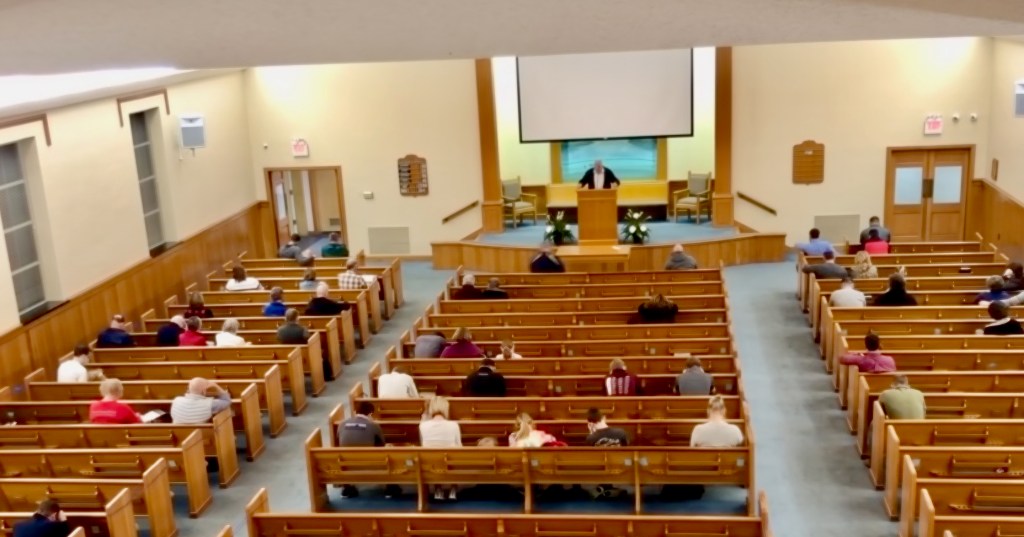
Over 50 members came to pray Tuesday night for our soul-winning plans, including our “Fill The Void” seminar (photo credit: Randy Simpson)

The Price Of Flight

Tuesday’s Column: Dale Mail

image

Dale Pollard

The cost of leaving God’s presence is more than many fully realize. 

It’s interesting how the phrase “away from the presence of the Lord” is used twice in Jonah 1:2-3. 

Leading up to the second mention, the text states that Jonah “paid the fare.” In the very next verse we read of a terrible storm that would end with the beginning of Jonah’s three day stent in solitary confinement within the belly of a great fish. 

He paid the fare— but the price was a little steeper than he thought. It’s expensive to flee from the presence of the Almighty. Too many Christians run away from the responsibilities that God has given us only to discover that the dark waters of sin and separation just aren’t worth it. 

Some discover this when it’s too late, but others are fortunate enough to realize this truth and return to the safety of God’s presence. May we learn from Jonah to go where the Lord leads and not make our own alternative routes. 

“But Jonah rose to flee to Tarshish from the presence of the Lord. He went down to Joppa and found a ship going to Tarshish. So he paid the fare and went down into it, to go with them to Tarshish, away from the presence of the Lord.” Jonah‬ ‭1:3‬ 


Words For The Aching Heart 

Tuesday’s Column: Dale Mail

image 

Dale Pollard

Why do we hurt? In Bible classes and in sermons you have been pointed to scriptures such as James 1:2, which says, “Count it all joy my brethren, when you fall into various trials.” You may then find yourself wondering about that specific trial you are forced to miserably wade through. 

Perhaps you think, “But what good could possibly come from this?” Or maybe you even question, “why would God let me experience this kind of heartache?” This is when a faithful Christian may sink into a pessimistic kind of bitterness that slowly steals each smile and smothers even the faintest glimmer of hope. If Jesus could sit with you and lovingly give you some wisdom, I’d imagine this is what He’d say.

I dreaded that cross, the cruel instrument of death.
I felt such intense emotion with each painful and strained breath.
Embarrassed, I was stretched naked amid a hateful crowd—
but prayed for their forgiveness, with my bleeding head bowed.

I intimately knew trauma, isolation, abandonment, and shame.
I lost everything for everyone, so peace and glory you would gain.
It’s that joy I’ve set before you, even seen through tearful eyes,
that will push you, as it did Me, through each valley and each sigh. 

No matter what you’re fighting here, don’t worry, stress or fear.
Today it hurts, tomorrow it’s over, in the twinkling of an eye I’ll appear.
Life is brief and fragile like that of a lowly dove, and like the dove,
with broken wing still mending, look hopefully above.
–Dale Pollard
(These words were inspired by the words found in Hebrews 12:1-3.)

I’d like to encourage you, if you’re suffering through a trial in life, to read Psalm 69.  It’s a lament psalm, which may help you put into words what your aching heart is feeling.

“What we really need and what the psalms of lament provide is a way to live through times of disorientation with God as an intimate traveling companion.”
– Glenn Pemberton

gettyimages-155353005-58bdb2013df78c353c7f2a6d

David’s Prayer In the Cave (Psalm 142)

Thursday’s Column: Captain’s Blog

carl pic

Carl Pollard

It was in one of the lowest points in his life that David finds himself hiding in a cave praying to God. He says, “With my voice I cry out to the Lord; with my voice I plead for mercy to the Lord” (Psa.‬ ‭142:1‬).

David describes the circumstances that have caused him to feel discouraged. He says in verse 4, “Look to the right and see: there is none who takes notice of me; no refuge remains to me; no one cares for my soul.”

How often do we find ourselves feeling this same way? It could be the people we work with that don’t see the value of our Christianity. It could be friends at school pushing us to break our Christian values. It could even be our own families that don’t care for our souls.

David felt the loneliness of desertion with his own son, he felt betrayal from Saul, and he even willfully separated himself from God when he went after Bathsheba.

Many times we find ourselves in the cave. It could be that outside circumstances have put us there, or we sinned and are feeling the consequences of those choices.
‭‭
Put yourself in his shoes, hiding in a dark, desolate and damp cave feeling alone and deserted by everyone. Everyone except God. David never lost sight of God, and he knew that God would answer his prayer.

When we find ourselves in the dark, feeling deserted and alone, don’t lose sight of God. He will never turn His back on a struggling Christian. He cares for your soul.

havo_20080520_nc481huku-3_dboyle

How To Make The Best Of A Bad Situation 

Tuesday’s Column: Dale Mail

IMG_1381

Dale Pollard

Rattlesnakes are large, venomous snakes that live throughout North and South America. In my humble opinion, they are one of the most terrifying creatures on the planet–from the hair-raising sound of that rattle to those intimidating fangs that can be up to six inches long. The bite from one of these monsters is excruciatingly painful. If you were to be bitten, at first you would experience a tingling feeling, followed by an intense burning sensation. After this you would feel lightheaded and begin sweating profusely. Your vision would become blurry, and each breath would be more strained than the last one.

If left untreated, it can be fatal to humans. All of that sounds terrible doesn’t it? What good could possibly come from a deadly rattlesnake? Well, at some point in history, somebody looked at these snakes and decided that they would make a beautiful pair of boots. That’s how to make something great, out of something terrible. There is no doubt in my mind that the inventor of snakeskin boots was an optimist. He could see the good, even when staring into the dark vertical pupils of pure reptilian evil.

When faced with hardship, that simply comes from living in a fallen world, it can be a challenge to see the silver lining in each dark cloud. American basketball player, Charles Barkley once said, “Sometimes the light at the end of the tunnel is a train.” That’s definitely how it can feel sometimes! Although we have books in the Bible like Job and James that teach us how we should view our earthly struggles, here are just a few reminders from our God.

Number one, remember that each day is worth rejoicing over. Psalm 118:24 gives us the reason why— because today is another day that the Lord has made. It’s not my day; it’s God’s day. Reminder number two, what we can’t see in times of difficulty, is worth waiting for. Paul would inform us in Romans 8:27, “But if we hope in what we don’t see, we wait for it with patience.” In the muck of life it may feel at times that there’s just no way out. Just because you may not see the end in sight, rest assured that our hope is in a promise that was put in place before time itself began (2 Timothy 1:9). The last reminder is simply this, that God made the world you are living in and Jesus is currently creating the world we will one day live in (John 14:1-3). I firmly believe each day that passes can only mean that heaven will be that much more beautiful. If God created this world in six days, in all it’s beauty, imagine the splendor of our home to come. Now, if that doesn’t make a bad situation a good one, I don’t know what will! Here are the lyrics to an optimistic hymn that I hope get stuck in your head for quite a while.

“I care not today what tomorrow may bring, if shadow or sunshine or rain. The Lord I know ruleth o’er everything, and all of my worry is vain. Living by faith in Jesus above, trusting confiding in His great love. From all harm safe in His sheltering arm, I’m living by faith and feel no alarm.”

rattlesnake boots
One of two pair of rattlesnake skin boots I own.

Marriages Secretly In Trouble

Neal Pollard

Social media has done us no favors, with the temptation it presents to project happiness and perfection while masking the trials and challenges inevitable for such a long-term commitment as marriage is. Not only can we be guilty of misrepresenting our own relationship, but we can unwittingly put pressure on other couples who see these projections and increase dissatisfaction with their less than perfect and happy marriage. Of course, the answer to this is not to use forums like social media to air the sordid stains on our life’s laundry. But, there is a need for some reasoning and common sense that can assist us in building better marriages.

The University of Wyoming’s Family And Consumer Sciences department has an excellent study by Ben Silliman entitled, “Intimacy Means Conflict.” They begin with a profound, if provocative, statement, saying, “To love may not mean to fight, but it does mean to become close, to care a lot, and eventually to discover differences and disagreements. Those who love much have a better chance of conflict” (click here). This great study includes some common sense suggestions for working through the conflict:

  • Focus on needs, not solutions.
  • Brainstorm possible solutions.
  • Choose the best option. 
  • Make a plan.
  • Implement the plan. 
  • Seek feedback and evaluate both the process and the outcome (ibid.).

He does not overtly come from a biblical worldview. He is not exclusively focused on monogamous marriage relationships. But his counsel is sound and consistent with biblical principles.  Cross-check each of his suggestions with Scriptural guidance:

  • Philippians 2:3-4
  • Ecclesiastes 4:9
  • 1 Corinthians 10:23
  • Proverbs 16:3
  • Psalm 37:5
  • 1 Peter 3:7; James 3:17

The passages represent that the Bible talks about all these methods and approaches, but it does not suggest that this is all the Bible has to say about these. I am convinced the devil would love nothing more than for married couples, beset by conflict and even repeatedly addressing the same issue or issues, to just give up on their marriages. Wouldn’t he love for us to be convinced that we’re the only ones struggling and our situations are hopeless? I know such thoughts are not of God, who urges us to see possibilities even through improbabilities because of His capabilities (Phil. 4:13). 

It’s fatal to a marriage to ignore or be in denial about the things that produce conflict. And it’s foolish to believe that a marriage is doomed because conflict is present. There is no way to achieve closer relationships without negotiating the unavoidable differences between two individuals striving to be a united couple. May I encourage all of us who are married to redouble our commitment to working through conflict in order to reach closer, Christ-centered relationships. 

66631203_10219065622729624_1950954779282767872_n

Satan’s Schemes

Neal Pollard

Paul makes an interesting statement while addressing the successful effort the Corinthian church made in disciplining an erring brother along with the successful outcome of his having repented. He urges them to show him love, comfort, and forgiveness. The bottom line Paul gives for the urgency of their obedience is “so that no advantage would be taken of us by Satan, for we are not ignorant of his schemes” (2 Cor. 2:11). Back in the first letter, the church’s attitude and actions regarding a brother needing discipline was horrible, and Paul commanded them to act (1 Cor. 5). Here, they have acted and their efforts worked. They were in a prime position to grow and thrive. Yet, Paul reminds them of Satan’s motivation (to take advantage of us) and means (his schemes). 

But, when does Satan like to try and employ his schemes and take advantage of us? When we aren’t being sober and vigilant (1 Pet. 5:8). When we aren’t focused on resisting him (Jas. 4:7). When we aren’t standing firm in the Lord or against his schemes (Eph. 6:10ff). When we aren’t exercising self-control (1 Cor. 7:5). If you study those contexts and others that mention Satan more closely, you will see that he would like to take advantage of us in good times and bad times. He may be at work through the willing choices, words, and actions of people who unwittingly aid his cause through their sins. 

When might he seek to employ his schemes?

  • When new elders are appointed
  • During building programs
  • As numbers swell through baptisms and families placing membership
  • When preachers come and go
  • In a flurry of exciting activities
  • In the heart of some church problem or struggle
  • At the center of some personality struggle or conflict within the congregation
  • Through some controversial doctrinal, moral, or even cultural issue
  • When brethren put politics, race, or another issue of lesser importance over Christ and His church

Obviously, there are many more examples. The point is that Satan would love to use the good times or bad times we experience as a church to undermine and harm the work of the Lord. That should not make us paranoid, so paralyzed by fear that we refuse to act, or petrified to make needed changes. It does mean that we must not be ignorant of the fact that he doesn’t want the church to grow or move forward, and he will do what he can to stop it. What is so exciting is that he stands no chance against God. James says, “Submit therefore to God. Resist the devil and he will flee from you” (4:7). Let us never be afraid to “dare and do” for God. We can do great things for Him and keep an eye out for the devil’s schemes.

25073405_10155181501925922_4154416753663879067_o
Picture from my last trip to Ngorogoro Crater, Tanzania, 12/17.

LANDMINES IN RESOLVING CONFLICT

Neal Pollard

“I.” The late Wendell Winkler once said that beneath most marital conflict is basic selfishness. “What about my needs?” “What have you done for me?” “I am not happy, fulfilled, etc.”  The Bible warns of the destructive nature of selfishness (Luke 9:23; Eph. 4:22,24; Phil. 2:3; 2 Tim. 3:2)! One of the most frequent casualties of selfishness is marital happiness. 

“You.” This is really the other side of the conflict coin that blows up progress and growth in relationships. If selfishness is blind to the needs and concerns of the other person, blame and deflection is the total denial of guilt or shared responsibility. “You don’t treat me right.” “Why don’t you pull your weight?” “You are not enough of ‘X’ or too much of ‘Y’!” Accusation, which puts one’s mate on the defensive, is a poor framework for resolving conflict. The very first couple played the blame game, to no avail and with no success. 

“They.” A mirage is “something that appears real or possible but is not in fact so.” We usually think of a mirage in the desert, an optical illusion created by extreme conditions. How often do married couples in conflict see marital mirages? A couple is hurting, and as they look across the burning sand they see “perfect couples” and “perfect marriages.” We are not helping ourselves by comparing ourselves to what is not what it appears anyway (cf. 2 Cor. 10:12). Every marriage is comprised of flawed, sinful people who are constantly faced with overcoming. Whatever you think you see in other couples “is not in fact so.”

“God.” Now, hear me well. God is the answer to all conflict, if we consult Him. Yet, when we blame God or let conflict affect our faith, then our attitude toward God can become a major landmine preventing resolution. “God doesn’t care.” “God isn’t listening to my cries and prayers.” “Where is God when I need Him?” Trials are going to test our faith, but be careful not to give God credit for blame that rests upon us and our spouses. 

The good news is that “I,” “you,” “they,” and “God” can all play a fruitful role in resolving conflict. When “I” am humble and honest and focus on my role and responsibility, good will result. When “you” are treasured, valued, and sincerely loved, things will start looking up. When “they” are reasonably treated as role-models and inspiration, it can be helpful. When “God” is totally trusted and obeyed, there is no insurmountable problem! I wish marriage had no saboteurs or hazards, but the best of them do. Let’s work to avoid triggering them, trusting that God’s pattern for everything, including marriage, gives us the best shot at success. 

blast