The Danger of Tradition: When Human Custom Replaces God’s Word

Brent Pollard

The Unexpected Birth of a Christmas Tradition

Christmas Day 2025 has already passed. In Japan, where Shinto and Buddhism are part of daily life, Jesus Christ is often seen as just one deity among many—if acknowledged at all. As a result, most Japanese do not observe Christmas as a religious holiday on December 25. Instead, the holiday has become a romantic occasion for couples, more like Valentine’s Day than a Nativity celebration. Interestingly, since the 1970s, a tradition has persisted: to properly celebrate Christmas in Japan, people should eat fried chicken, especially from KFC.

This story shows how easily tradition can take hold in fertile ground. Takeshi Okawara, Japan’s first KFC manager, allegedly heard foreigners complain that turkey was hard to find in Japan, so they had to settle for chicken during Christmas. This casual remark inspired an idea. Okawara saw a chance to promote “party barrels” as the perfect Christmas celebration. Since Japan didn’t have strong Christmas customs, KFC found a valuable niche in the food industry, which was exactly what the franchise needed to grow.

How Marketing Became Tradition

In 1974, KFC Japan introduced its famous Kurisumasu ni wa Kentakkii! campaign—”Kentucky for Christmas!” The campaign’s success surpassed expectations. By 2019, around 5% of KFC Japan’s yearly revenue came from Christmas sales. During the holidays, customers must pre-order their party barrels weeks ahead since they sell out fast. Long lines form outside locations featuring Colonel Sanders statues dressed as Santa Claus, blending commercial symbols in a way that might surprise Western observers.

If you asked the Japanese about their Christmas tradition, they’d surely say fried chicken is the holiday’s proper food. Many are surprised to learn Americans eat turkey, not KFC, on Christmas. Interestingly, young Japanese now prefer KFC for Christmas because their grandparents started this practice long ago. In only 51 years, what started as a marketing stunt has become a genuine part of Japanese culture.

The Innocence of Cultural Misunderstanding

Japan’s misinterpretation of Christmas customs is harmless—simply a mistaken understanding of cultural practices far removed from their roots. However, this highlights a deeper spiritual risk that requires our careful reflection. We tend to be creatures of habit, often confusing familiarity with genuine faithfulness. What starts as an innovation by one generation can quickly become a duty for the next, leading us to forget to question whether our actions are truly aligned with the truth.

When Jesus Confronted Tradition

However, some customs require our careful attention. Jesus Christ sharply criticized the religious leaders of His era because they forsook God’s commandments to prioritize their traditions (Matthew 15:3; Mark 7:8-9, 13). His words resonate through time: “You are experts at setting aside the commandment of God in order to keep your tradition.” (Mark 7.9 NASB95)

If you had asked these leaders about their practices, they probably would have confidently claimed that their traditions fully aligned with Moses’ Law. These customs, after all, had been preserved through generations of faithful Jews, supported by the weight of history and validated by respected teachers. Certainly, this alone demonstrated their legitimacy.

The Sovereignty of God’s Word Over Human Custom

Yet Jesus, with divine authority, revealed how these traditions deviated from His Father’s original commands. This offers a serious warning to all generations of believers. God’s sovereignty extends not only to salvation but to every aspect of worship and obedience. We do not decide what pleases God through majority opinion or tradition. God has spoken, and His Word alone is authoritative (2 Timothy 3.16-17).

The Pharisees believed that their detailed fence laws safeguarded God’s commands, but in reality, these traditions became obstacles that kept people from approaching God as He intended. They overlooked—or never understood—that God requires genuine obedience, not just the outward observance of religious rituals (1 Samuel 15.22; Hosea 6:6).

The Call to Examine Our Own Practices

This is more than just a history lesson for our curiosity. Let us take the core message of the application: Which traditions have we accepted uncritically? What practices do we maintain just because they have always been done that way, rather than because of the commands or approval in Scripture?

We need to regularly reassess our traditions and practices to confirm they reflect the truth—Jesus Himself stated that God’s Word is truth (John 17.17). The religious leaders during Jesus’ era were so immersed in their traditions that they failed to recognize how far they had strayed from God’s revealed will. Today, we encounter the same risk.

Practical Steps for Guarding Against Empty Tradition

We shouldn’t just recognize this danger; we need to take concrete measures to protect against it. This is advice for every Christian who aims to worship God in spirit and truth (John 4.24):

Begin by cultivating the habit of asking, “Where is this written?” When someone claims that a practice is vital to Christian faith or worship, consult the Scriptures to verify if it truly is (Acts 17.11). The Bereans were praised not for blindly accepting teachings but for diligently testing them against God’s Word.

Second, differentiate clearly between issues of faith and issues of opinion. Romans 14 directly addresses this, indicating that certain practices are explicitly commanded or forbidden and must be followed. Other issues are part of Christian liberty, allowing sincere believers to hold different views without opposing God’s will. Confusing these categories can result in legalism or license—both serious mistakes.

Third, understand that sincerity alone does not justify mistakes. The Pharisees sincerely believed their traditions honored God. However, genuine sincerity does not turn disobedience into obedience or human customs into divine laws. As Proverbs 14.12 NASB95 states, “There is a way which seems right to a man, but its end is the way of death.”

The Spiritual Reality Behind Religious Performance

Religious tradition often serves as a substitute for a genuine relationship with God. It is much simpler to follow inherited rituals than to develop a meaningful connection with the living God. While tradition calls for mere conformity, authentic worship requires transformation.

Reflect on how we often find comfort in familiar routines. The Pharisees felt secure in their traditions because these practices were predictable, controllable, and measurable. They could simply check off requirements and think they were righteous, all while neglecting God’s Word in their hearts. Jesus highlighted this superficial religiosity: “This people honors me with their lips, but their heart is far away from me. But in vain do they worship Me, teaching as doctrines the precepts of men” (Matthew 15.8-9 NASB95).

The Origin and Significance of Our Traditions

It’s crucial to honestly consider where our traditions originate and what they truly mean. Are they rooted in Scripture, or have they developed through cultural choices, historical happenstance, or well-meaning but unauthorized changes?

Some traditions are simply matters of convenience or custom—neither mandated nor prohibited by Scripture. We may choose to keep or change them based on wisdom. However, when tradition conflicts with Scripture or supersedes God’s actual commands, we must have the courage to set aside human traditions and follow divine authority.

The religious leaders Jesus challenged had broken God’s clear commandments by following their own traditions. He pointed out their use of “Corban”—a practice where resources were declared dedicated to God to bypass the fifth commandment’s demand to honor parents (Mark 7.10-13). Despite this apparent contradiction to God’s Law, they vigorously defended their tradition. It shows how easily tradition can blind us!

Ensuring Our Customs Serve Rather Than Supplant Truth

We need to stay alert to make sure customs do not mask the true intent of our actions. This awareness calls for more than just occasional checks—it requires ongoing dedication from hearts committed to Scripture’s authority. We must uphold the principle that Scripture alone should be the ultimate authority in faith and practice.

Reflect on these important questions: If all traditions were taken away, would your faith stay strong because it is based on God’s Word? Or would losing familiar practices make you feel lost and uncertain? Are you worshipping God in line with His revealed will, or just following the accepted ideas of past generations?

The Jerusalem church encountered this challenge when tradition risked overshadowing truth. Jewish Christians, ingrained in ancient practices, found it difficult to accept that Gentile converts did not have to follow ceremonial laws to be saved. God intervened to clarify that salvation is by grace, not by obeying traditional rules (Acts 15.1-29; Galatians 2.15-16).

The Freedom Found in Scriptural Authority

Here’s a liberating truth: By grounding our faith and actions in Scripture rather than tradition, we find freedom rather than limitations. God’s Word serves as a lamp to guide us and a light to illuminate our path (Psalm 119.105). His commands are not burdensome but bring life (1 John 5.3). Letting go of unapproved traditions allows us to open our hands and receive what God truly intends to give.

The Japanese will keep celebrating Christmas with KFC, unaware that this fifty-year-old tradition isn’t linked to actual Christmas customs. While this harmless confusion causes no harm, problems arise when religious tradition replaces divine command and human customs overshadow biblical truth. In such cases, the core foundation of faith is compromised.

Walking in Truth Rather Than Tradition

Let’s honestly assess our hearts and actions. Instead of asking “What have we always done?” we should focus on “What has God commanded?” We should seek worship rooted in Scripture rather than sentiment, doctrine grounded in revelation rather than routine, and obedience driven by love for God rather than mere human expectations.

As we transition from this Christmas season into the new year, let us renew our commitment to the primacy of Scripture. May we find the courage to let go of traditions that oppose God’s Word, wisdom to preserve practices that align with His purposes, and discernment to distinguish between them. Ultimately, our accountability is to God, who has spoken plainly through His Word and calls us to obey Him rather than human traditions (Acts 5.29).

The History of Christmas: How Christendom Came to Celebrate Christ’s Birth

Brent Pollard

Consider for a moment how we came to stand where we are. The manger scene feels ancient—as though Christendom has always paused each December to marvel at the incarnation. Yet history reveals something startling: the first Christians never celebrated Christmas.

This is not a scandal but a testimony. The cherished celebration emerged slowly, like dawn breaking over centuries, as believers reflected deeply on what it means that God became man. What began as an unobserved event in Bethlehem became a worldwide moment of worship—not by apostolic command, but through man’s appreciation of glory made flesh.

The New Testament: A Conspicuous Silence on Annual Celebration

Matthew and Luke give us the nativity accounts with luminous detail: angelic announcements, shepherds startled in the night, magi following a star. These chapters overflow with wonder. Then the narrative rushes forward to Jesus’ ministry, His cross, His resurrection, His return.

What’s missing? Any instruction to celebrate His birth annually.

The apostles gathered on the first day of the week, remembering Christ’s death and resurrection through the Lord’s Supper. They proclaimed His gospel with urgency. But they left no pattern, no command, no practice for memorializing His birth each year. This was not oversight—it was simply not their focus.

Early Christianity: Avoiding Birthday Traditions

The earliest believers lived in a world where birthdays carried pagan associations. Jewish tradition paid little attention to such celebrations, and Roman birthday customs often intertwined with idolatrous practices. As a result, Christians in the first two centuries steered clear of birthday observances entirely—even Jesus’ birthday.

Origen, writing in the third century, expressed the prevailing sentiment: only the birthdays of sinners like Pharaoh and Herod were celebrated in Scripture. The righteous did not.

This wasn’t legalism. It was discernment. God’s people were learning to walk differently in a pagan world, careful not to blur the lines between sacred and profane.

The Growing Curiosity: When Was Christ Born?

By the late second and early third centuries, Christian scholars began asking a natural question:

When, exactly, was Jesus born?

Their calculations varied widely—March, May, November—but the question itself signaled something important. These believers were not merely theologians; they were people falling deeper in love with the incarnation. To wonder about the timing of His birth was to treasure it.

Yet even then, no feast day emerged. The curiosity was intellectual, not liturgical.

December 25: The First Christmas Celebration

The earliest solid evidence for celebrating Christ’s birth on December 25 appears in a Roman calendar from around AD 336. Why this date?

Two theories dominate:

Theological Calculation: Some early Christians believed Jesus was conceived on the same date He died—March 25. Counting forward nine months places His birth on December 25.

Cultural Context: December 25 fell near Roman festivals like Sol Invictus (the ‘Unconquered Sun’) and Saturnalia. Choosing this date may have offered believers a Christian alternative to pagan revelry, declaring boldly that the true Light has come into the world.

Both explanations reflect the church’s dual task: theological precision and cultural engagement. The church was not absorbing paganism—it was confronting it with truth.

East Meets West: Different Dates, Same Savior

While the West settled on December 25, Eastern Christians initially observed Christ’s birth on January 6, called Theophany or Epiphany. By the fifth century, most Eastern congregations also adopted December 25 for the nativity, reserving January 6 for celebrating Christ’s baptism and the revelation of His divine identity.

This convergence is instructive. Though separated by geography and culture, believers across the empire felt the same pull—to set aside a day each year to contemplate the mystery Paul described:

‘Great indeed is the mystery of godliness: He was manifested in the flesh’ (1 Timothy 3:16).

The Medieval Church: Layering Tradition on Truth

As Christianity shaped Europe’s cultures through the Middle Ages, Christmas absorbed many traditions: nativity plays dramatizing the Bethlehem scene, carols sung in village streets, gift-giving recalling the magi’s offerings, and evergreen decorations symbolizing eternal life.

These additions were not corruptions. They were expressions—imperfect, human, sometimes misguided—of a truth too glorious to contain in words alone. The church has always been a community of storytellers, and Christmas became the story believers told again and again, in every creative form available.

The Reformation: Christmas Under Scrutiny

When the Reformation arrived, Christmas faced fresh examination. Lutherans and Anglicans embraced the celebration as a legitimate way to honor Christ’s incarnation. Puritans, however, rejected it, viewing Christmas as an invention unmoored from Scripture.

Both positions reflected sincere convictions about how to honor God. The Puritans feared idolatry and human tradition; the Lutherans treasured gospel proclamation wherever it appeared.

Modern Christmas: Sacred Truth Meets Cultural Expression

From the 1800s onward, Christmas continued to evolve. Charles Dickens’ writings awakened social conscience, Santa Claus captured children’s imaginations, and commercialization introduced both celebration and distraction.

Today’s Christmas is a complex blend: nativity scenes beside reindeer, worship services near shopping frenzies, profound theological truth intertwined with consumer excess.

Conclusion: Celebrating the Incarnation

Christmas is not commanded in Scripture. The apostles did not practice it. Its date may be symbolic rather than historical. Yet it endures because it points to something utterly real:

God became man.

In Bethlehem, divinity clothed itself in human flesh. The infinite became finite—the eternal entered time. The Creator took the form of a creature. This is the heartbeat of Christianity—not merely that God loves us, but that He came to us.

John wrote it plainly:

‘The Word became flesh and dwelt among us, and we have seen his glory, glory as of the only Son from the Father, full of grace and truth’ (John 1:14).

So whether we observe Christmas or not, let us never stop marveling at what happened in Bethlehem. Let us preach it, sing it, tell it to our children and our neighbors. Let us declare with unshakable confidence that God has acted in history, that heaven has invaded earth, and that nothing will ever be the same.

This is the glory of the incarnation—and it deserves to be celebrated every single day.

All Things New

Revelation 21 isn’t fantasy; it’s certain. God will fulfill this promise. For early Christians and us, it’s a call to persevere.

Carl Pollard

The book of Revelation is often misunderstood, neglected, and misused. Its complex imagery and cultural gap make it tough for 21st-century readers. As Peter noted in 2 Peter 3:16, some “twist” such texts to their own destruction. Sadly, Revelation suffers this fate.

In Revelation 21, John shares a vision given to the seven churches of Asia—a message of victory through Christ. Written for Christians under Roman persecution, it offered hope amid suffering. Its Hebrew numerology and imagery resonated then, but today, many distort its meaning. Yet, Christ’s victory remains clear.

John sees the end: God’s triumph over evil, a glimpse of the world’s future, and the faithful’s reward. This prophecy is certain, like all God’s promises. For those in Christ, it’s the ultimate experience. Revelation 21 shows God making “all things new.” Notice what is new: 

A New Creation (Verses 1-2)

John sees a new heaven and earth, the old gone. No sea—symbol of chaos—remains. The New Jerusalem descends, God’s people radiant, ready for eternal fellowship. God restores creation, erasing all brokenness.

A New Connection (Verses 3-4)

God will dwell with His people, His presence intimate. Tears, death, and pain vanish. This is perfect fellowship, every sorrow erased by God’s nearness.

A Final Condition (Verses 6-8)

God declares, “I am making all things new!” He offers eternal life freely, but those rejecting Him face separation. This is God’s final justice and mercy.

Revelation 21 isn’t fantasy; it’s certain. God will fulfill this promise. For early Christians and us, it’s a call to persevere. In a broken world, we await a new creation, connection, and condition. Let’s live faithfully, eyes on the day God makes all things new.

The Fight Going On Inside

Clint Raymer

An old Cherokee grandfather is teaching his grandson about life: “A fight is going on inside me,” he said to the boy. ”It is a terrible fight and it is between two wolves. One is Evil. He is anger, envy, jealousy, sorrow, regret, greed, arrogance, self-pity, guilt, resentment, inferiority, lies, false pride, superiority, and ego. The other is good. He is joy, peace, love, hope, serenity, humility, kindness, benevolence, empathy, generosity, truth, compassion and faith. The same fight is going on inside you – and inside every other person, too.” The grandson thought about it for a minute and then asked his grandfather: “Which wolf wins?” The grandfather simply replied, “The one you feed.” 

This proverb reminds me of something Paul said in Romans 7:19-25. First I would like to share vs 19-23. “For the good that I will to do, I do not do; but the evil I will not to do, that I practice. Now if I do what I will not to do, it is no longer I who do it, but sin that dwells in me. I find then a law, that evil is present with me, the one who wills to do good. For I delight in the law of God according to the inward man. But I see another law in my members, warring against the law of my mind, and bringing me into captivity to the law of sin which is in my members.” Good and Evil is a battle that can be fought and seen externally in this world. However this fight is one that is both without and within. Inside each of us is a fight, a struggle, between that of the flesh and Spirit. A battle between that which is baser, and that which is better. To become more adept in both wisdom and skill when it comes to mastering this struggle requires time, effort, and self-control. There is a quote I like which says, “Self-Discipline begins with the mastery of your thoughts. If you don’t control what you think, you cannot control what you do.” 

The power and discipline of our thoughts, our mind, is paramount in controlling our actions. Henry Ford has a quote which goes, “Whether you think you can, or think you can’t, you’re right.” We must also face a hard truth in this fight to master the flesh versus the Spirit. As Paul himself said, at times we will fail. The things that we will not to do will become the things we have done, and we will fall short of the glory of God. It always seems that in these moments of failure or mistake that we are our own harshest critic. We tend to bring about our own discouragement by focusing on our shortcomings and failures again and again like a broken record until it seems hopeless to try. Yet this is not the way. 

When the walls come crashing in, nothing you do works or is good enough, and this struggle against the flesh seems hopeless. I am reminded of a simple message we all know. “For God so loved the world that He gave His only begotten Son, that whoever believes in Him should not perish but have everlasting life.” (John 3:16). While everyone is equally guilty of having succumbed to sin, fallen prey to sin, we are also equally united by one single fact. Love. God’s love, Christ’s love which was freely given so that though we were chained by sin, condemned by sin, we might be set free for a brighter future. I am often reminded of Christs words in John 15:13 “Greater love hath no man than this, that he lay down his life for his friends.” These were not just Jesus’s words, they were His actions. He freely and willingly gave His life for our sakes because He knew that in our struggle between flesh and Spirit. Sometimes we would give in to the flesh. So we would not have to suffer eternal separation from God, Christ paid the debt for those and all transgressions. All we need do to benefit from this is to submit, repent, dust ourselves off, and try again. Paul confirms this in Romans 7:24-25, “O wretched man that I am! Who will deliver me from this body of death? I thank God—through Jesus Christ our Lord! So then, with the mind I myself serve the law of God, but with the flesh the law of sin.” From this message I can draw but one conclusion. We are truly completely known and completely loved by God. 

I want to share one final thought with you, a line from one of Shakespeare’s plays, Henry the V. This line is part of what is known as the St. Crispins Day speech. It goes “We few, We happy few, We band of brothers.” This is what we are. A band of brothers and sisters in Christ, united by Christ’s love and empowered by His sacrifice to daily fight the battle of flesh versus Spirit. Firm in the knowledge that though sometimes the battle may be lost, ultimately the war is won.  

God’s Endless Love

Dawson Eubank

Since the world this week celebrated Valentine’s Day, I saw it fitting for us to talk about God‘s love. In the bustling noise of life with all its hardships, trials and tribulations, there is an unwavering truth–God’s endless love,. Let’s jump through Romans and unravel the depths of this divine love that sustains and transforms our lives.

Romans 5:8 – Sacrificial Love: 

“But God demonstrates his own love for us in this: While we were still sinners, Christ died for us.” Reflect on the sacrificial love of Christ, willingly laying down His life for us, even in our brokenness. It’s a love beyond comprehension, a love that saw our flaws yet chose to redeem us.

Romans 5:5 – Overflowing Love: 

“And hope does not put us to shame, because God’s love has been poured out into our hearts through the Holy Spirit, who has been given to us.” Let’s dwell on the overflowing nature of God’s love, filling every corner of our hearts through the presence of the Holy Spirit. It’s a love that brings hope, assurance, and a sense of belonging.

Romans 8:38-39 – Unbreakable Love: 

“For I am convinced that neither death nor life, neither angels nor demons, neither the present nor the future, nor any powers, neither height nor depth, nor anything else in all creation, will be able to separate us from the love of God that is in Christ Jesus our Lord.” Meditate on the unbreakable bond of love between us and our Creator. Nothing in this world, no circumstance or force, can sever this divine connection. It’s a love that endures through eternity.

As we ponder Romans, may we experience the richness of God’s love. Let’s embrace the truth that we are cherished, forgiven, and empowered by His love. Let this love be our anchor in the storms of life, our light in the darkest nights, and our joy in every season. For in God’s love, we find our ultimate fulfillment and purpose.

Imperfection And God’s Plan

Carl Pollard

Imperfect people have been called by a perfect God. Our imperfection can hinder the church’s unity, contaminate our own faith, and corrupt our relationship with God as well as with each other. What steps can we take to make sure our humanity doesn’t pollute the unity of Christ’s body? In Romans 15 we find four tips that Paul gives us on how we can achieve unity in Christ. 

We can find perfect unity in Christ if we: 

  • Serve One Another
  • Accept Each Person (As Christ did) 
  • Join Together in Glorifying God 
  • Have the Same Mind

This unity in Christ leads to stronger relationships with each other. Our healthy relationships with each other can help us achieve our designed end. When we are unified in mind, our weaknesses and imperfections are minimized. If we want to accomplish the tasks that God has set before us, we must be unified as a church body–a body that is connected by a shared goal.

God in His infinite wisdom knew that we wouldn’t always get along, so He gave us His word to help us in our relationships with each other. We could never achieve unity if it wasn’t for God’s Word. It is the source of unity and wisdom. 

God has always had a plan for His creation. He wants every person to be saved and have access to salvation. Whether it was through the Patriarchal Law, Mosaic Law, Moral Law, or the Christian dispensation, mankind has always had a means to be saved. 

But the Jewish Christians didn’t agree with God’s decision to include the Gentiles. 

Romans 15:8-12 explains why everyone has access to salvation. The Jews had a hard time letting go of their background. They didn’t see it as right to let Gentiles into the church. But Paul tells them they’re wrong. In fact, Paul uses writings the Jews were familiar with. He says, 

“For I tell you that Christ became a servant to the circumcised to show God’s truthfulness, in order to confirm the promises given to the patriarchs, and in order that the Gentiles might glorify God for his mercy. As it is written, “Therefore I will praise you among the Gentiles, and sing to your name.” And again it is said, “Rejoice, O Gentiles, with his people.” And again, “Praise the Lord, all you Gentiles, and let all the peoples extol him.” And again Isaiah says, “The root of Jesse will come, even he who arises to rule the Gentiles; in him will the Gentiles hope.”

God’s plan from the beginning was to include the Gentiles. The early church was divided because the Jews had their own ideas about who could be a Christian and who could not. If we wish to have unity, we must recognize God’s plan. We must respect and follow God’s plan rather than our own. The problem with humans is that each person usually thinks his or her own ideas are the best. Every one of us has our own ideas. We have an opinion on just about every little thing. 

So how do we get a church body that is filled with many different ideas and opinions to be unified? By following the plans of someone Who is greater than us. God’s plan is flawless and perfect. If we want to have unity in our relationships we must recognize God’s plan for His church. We should see God as the ultimate authority. We should submit to His plan understanding that He knows what is best for His creation. 

The Jews Didn’t want to include the Gentiles because it wasn’t what THEY had in mind. Paul reminds them that it isn’t up to them to decide, and that God has ALWAYS longed for EVERY person to come to salvation. 

Why is this important for us? I’ve never heard anyone in the church complain about Gentiles. So whats the application for us? We should be thankful that God wanted Gentiles in the church because thats exactly what we are. If God didn’t include the Gentiles, we would never be a part of the church. 

These verses should move us to be grateful that God wanted us. They should also serve as a warning to obey God’s commands over our own. Unity in Christ is created when we recognize God’s plan.

Whose Son Is The Christ?

Andy Wright

The last week of Jesus’ life on earth was an eventful one. He arrived in Jerusalem to thronging crowds shouting, “Hosanna!” And, His enemies peppered Him with questions. They questioned His authority. They asked Him a Catch-22 question, which was admittedly impressive since it would be almost 2000 years before Catch-22 was written. They even asked Him a gotcha questioned designed to make the resurrection look ridiculous. But after He had answered all of their questions, He had one for them. Matthew’s account of this is in chapter 22, verses 41 and following:

“While the Pharisees were gathered together, Jesus asked them, saying, ‘What do you think about the Christ? Whose Son is He?’

They said to Him, ‘The Son of David.’”

Now, at this point, especially in my younger years, I could see myself nodding along in agreement with the Pharisees. Yes, the Christ is the Son of David. That’s in prophecy, isn’t it? Wasn’t important enough that Matthew opened his gospel account with a genealogy of Jesus going back to David and Abraham? Didn’t Luke also trace Jesus’ genealogy through David back to Adam? But this is what Jesus said:

“He said to them, ‘How then does David in the Spirit call Him “Lord,” saying: “The Lord said to my Lord, ‘Sit at My right hand Till I make Your enemies Your footstool’”? If David then calls Him “Lord,” how is He his Son?’ And no one was able to answer Him a word, nor from that day on did anyone dare question Him anymore.”

Jesus pointed out something very important, which the Pharisees were missing: the Messiah was more than David’s son, He was David’s Lord. The Pharisees missed it because they were expecting an earthly kingdom, with an earthly king like David who would put Israel back on top, overthrow the Romans, and rule in Jerusalem. But God had in mind something much better; instead of freeing them from the Romans, the Christ would free them from their sins—a much more powerful and implacable enemy. In another place, Jesus talked about God giving good gifts and said, “If your son asks for bread, would you give him a stone?” An important cultural note about the way they baked bread in Jesus’ time is that they used clay ovens and heated stones, and the stones in the area were very round and smooth, resembling loaves of bread. It wouldn’t be much of stretch of the imagination to think it wouldn’t be uncommon for a small Jewish boy to point in the oven and say, “Father, I want that one,” but be pointing at a stone. And what kind of father is going to give his child that? No, he’ll give him bread instead even if it isn’t what he wanted because it’s better than what he wanted.

That’s the way God operates; He always gives us what’s better than what we want. He did it back then. When they wanted to be free of Rome, free of their taxes, free of their rules, God offered them freedom from sin, which is of infinitely greater value. It is a shame, though, that when offered bread, sometimes people still want the stone.

The Man From Meroe

Friday’s Column: Brent’s Bent

We know little about the treasurer from “Ethiopia,” introduced in Acts 8. How did he come to believe in Judaism? What was his given name? What happened to him after Phillip baptized him into Christ? A study of this enigmatic figure is fascinating.

Did you know that the treasurer’s homeland was known as the “Kingdom of Meroe”? The remnant of the once-powerful Kingdom of Kush ruled over even their Egyptian neighbors for a time. If you recognize the name “Kush,” it is because Noah had a grandson named “Cush” (cf. Genesis 10.6-8; Daniel 11.43). The “Ethiopians” are Cush’s descendants.

The “Kandake” line of queens ruled over Meroe. It is known as “Candace” in English Bible translations. The sequence of queens is likely named Candace, a famous empress who ruled the Kushites during Alexander the Great’s conquest. She was a well-known military general and tactician. According to legend, Alexander refused to invade “Nubia” for fear of being defeated by her.

The Ethiopian eunuch, as treasurer, would overlook an impressive treasury. Meroe was a prosperous kingdom due to her trade with the Romans and African tribes from Africa’s western grasslands. They traded with the Romans for gold and other sub-Saharan products until the third century AD. Meroe maintained prominence after their trade with the Romans declined in the early third century due to her ability to smelt iron. Meroe’s workers’ tools and weapons were sought after by her neighbors. Meroe eventually fell from grace and was conquered by her southern neighbor, Axum. This formerly independent state is now an integral part of Sudan.

Meroe’s inhabitants worshiped Egyptian gods and a few gods of their creation. Someone proselytized people in the region at an unknown point in antiquity. According to the Old Testament book of Jeremiah, Jews were living in lower Egypt just before Judah and Benjamin’s Babylonian captivity (cf. Jeremiah 44.1ff). God foresaw those fleeing south to avoid the Babylonians and warned them against their actions (cf. Jeremiah 42.19ff). The treasurer is an example of someone who converted to Judaism. There remain adherents to Judaism in the region today. 

What distance did the treasurer go to worship God? Meroe to Jerusalem was about 3,000 miles round trip. So, the treasurer was devout. And consider that once in Jerusalem, the Old Law prohibited his entry into the Temple proper because he was a eunuch and forbade entry. Thus, his desire to be close to God was strong!

Though we do not know the treasurer’s name, we know some of the Meroitic men’s surnames. Arkinidad, Amanislo, Pakheme, Shorkaror, Teritegas, and Yesbokheamani were some of their names. Such names are foreign to the English-speaking ear. It’s possible that the treasurer’s name sounded strange to Philip as well. 

What happened to the Ethiopian treasurer after he became a Christian? The treasurer returned to Meroe and converted Queen Candace and many of his fellow Meroites, according to Irenaeus and Eusebius, two Christian writers of the second century AD. They also stated that the treasurer was a martyr dying in Ceylon after preaching the Gospel throughout Arabia Felix (i.e., Yemen). Though we cannot verify the information of Irenaeus and Eusebius, it is consistent with the character introduced on the sacred page.

Brent Pollard

Is the Bible Homophobic?

Thursday’s Column: Captain’s Blog

Carl Pollard

Romans 1:27 says, “In the same way the men also abandoned natural relations with women and were inflamed with lust for one another. Men committed shameful acts with other men, and received in themselves the due penalty for their error.” 

There is no denying the fact that scripture clearly states that it is a sin to commit shameful acts that go against what God intended. Since this is the case, many will take this verse and others and claim that the Bible (God) is homophobic. 

While the Bible does label it as a sin, it does not encourage Christians to hate homosexuals or anyone else! Homophobia is defined as “having or showing a dislike of or prejudice against gay people.” The Bible does not approve of this. 

Several things we need to consider: 

  • Sin is sin. There is no greater or lesser sin. 
  • Just because some can’t fathom it and feel tempted by it, doesn’t justify hating those who are. 
  • Cheating on a test is just as much a sin in God’s eyes as homosexuality, and both will separate man from God. 
  • Sin will always be found in mankind. 
  • Remember that all have sinned and fallen short of the glory of God. 
  • Just because someone sins in a way that might be different doesn’t give us the right to hate and ridicule them.

Above all else, the Bible calls for us to love everyone. The second greatest command outside of loving God is to love your neighbor as yourself (Mark 12:31). 

We are called to love each person. Every sinner; even our enemies. Love the sinner, and hate the sin.

Following The Will Of God

Thursday’s Column: Captain’s Blog

Carl Pollard

Romans 12:1-2, “I appeal to you therefore, brothers, by the mercies of God, to present your bodies as a living sacrifice, holy and acceptable to God, which is your spiritual worship. Do not be conformed to this world, but be transformed by the renewal of your mind, that by testing you may discern what is the will of God, what is good and acceptable and perfect.”

As we enter chapter 12 the point is, “what are the practical implications of 1-11?” It is the start of a five chapter section on how we can put what Paul has said into action. In the first section of the book we learn that we all have sinned, but through faith we have received justification. This gift of justification should motivate us to faithful service. 

Paul begins 12:1 by saying “I urge,” which is the powerful petition verb (parakaleo). It is always used by Paul to indicate a significant point. 

Here it represents a transition from the doctrinal discussion to the practical. It also represents a key thought, that we must present ourselves to God as a “living sacrifice.” This is in contrast to the dead sacrifices of the Old Testament (slaying of innocent animals that wasn’t enough). 

We must give to God while we are young, alive, and capable of service.

We must present ourselves to God as a living sacrifice that is Holy and acceptable. Holy means we are free from moral filth. Holy means that we are devoted to serving God. Holy means that we are an instrument of righteousness. 

Then we come to verse 2 where Paul says, “Do not be conformed.” As Christians that are wanting to build our character we cannot let the world be our standard when it comes to: 

  • Our morals (the way we act) 
  • Philosophy (the way we think)
  • In context the way we dress and the way we worship. 

Rather than being conformed to the world, we must “renew our minds.” 

  • In intellect (change the way we reason, and think about things) 
  • In emotion (Renew our state of mind, the way we respond to different circumstances)
  • In will power (have the strength to restrain our human impulses) 

Have we found ourselves living without righteous thinking? We must renew our minds. When our gym membership runs out, we renew it. When our car insurance policy period is over, we renew it. When our thinking isn’t in line with God’s, we renew our minds. 

Why do we sacrifice, and renew our minds? To prove/discern: 

  • What the good will of God is
  • What the acceptable will of God is 
  • What the perfect will of God is

And by discerning these things, we can be known as Christians who think righteously.

via Bible Study Tools

The Commands Of Scripture

Thursday’s Column: Captain’s Blog

Carl Pollard

In Romans 12:9-21, Paul reveals to us what a true Christian looks like. He gives a list of actions we should always strive to accomplish. This list is totally different from the message we hear from the world. The apostle tells us that as true Christians we: 

  • Have genuine love 
  • Hate evil 
  • Hold on to what is good 
  • Love one another 
  • Outdo each other in showing honor
  • Have zeal
  • Have a Fervent spirit 
  • Serve the Lord 
  • Rejoice in hope
  • Are patient in tribulation 
  • Pray constantly
  • Contribute to the Saints 
  • Are hospitable 
  • Bless our persecutors 
  • Do not curse our enemies 
  • Rejoice with those who rejoice 
  • Weep with those who weep 
  • Live in harmony 
  • Aren’t haughty 
  • Associate with the lowly 
  • Don’t think too much of ourselves
  • Don’t repay evil with evil 
  • Do what is honorable in the sight of everyone 
  • Live peaceable 
  • Don’t take revenge 
  • Care for our enemies 
  • Don’t let evil overcome us
  • Overcome evil with good

That’s a whole lot to remember. But if we love God, we will try our best to follow these commands. Christianity is practical because it gives us the best life on this earth and the one to come. 

We know what’s truly important. We have a purpose and we know how we are to act, speak and think. We know why we’re here on earth and we know where we are going if we are faithful to God’s word. This list in Romans 12 gives us practical tips on how to handle the situations that come up in life. We have the key to a happy, meaningful, and fulfilling life. We follow the Bible because it is practical. It contains wisdom and knowledge that is found nowhere else on earth. It provides a map to salvation and it gives us the answers to life’s problems. 

The story is told of an old man who was wandering in the desert looking for water. He approached an old shack and on the porch area he found a water pump. 

Next to the water pump he saw a one gallon jug. A note on the jug said, “Use all the water to prime the pump.” The man’s instincts said to drink the water and not trust the pump. Nevertheless he poured the water into the pump and began pumping until an abundance of cool water came to the top. The Bible is like the note on that water jug. Sometimes the instructions contained in the Bible do not make sense to us, but it is always right. The commands given to us from God are practical. He knows what is best for His own creation. They help us in our decisions, and they teach us how to act and think. We can have confidence in knowing that our lives are based on the perfect commands of Scripture. 

Macaroni And Ketchup

Wednesday’s Column: Third’s Words

Gary Pollard

For the next few weeks, I’ll be sharing passages that help me in some way. Our faith is a lifelong work-in- progress. It can be high maintenance. The Bible helps us maintain a healthy faith in any circumstance. It counsels us, convicts us, excites us, scares us, and gives us hope for a perfect future.

I once thought I was the only person who liked ketchup on macaroni. Turns out, there’re like four other people on earth who like it, too. Finding out that we aren’t alone in something is super cool!

Maybe we’ve thought, “Man, I don’t know if other Christians struggle as much as I do.” I’ve used these passages in an article before, but they’re very powerful. We aren’t alone in our struggles!

“So I have learned this rule: when I want to do good, evil is there with me. In my mind I am happy with God’s law. But I see another law working in my body. That law makes war against the law that my mind accepts.

That other law working in my body is the law of sin, and that law makes me its prisoner. What a miserable person I am! Who will save me from this body that brings me death?

I thank God for his salvation through Jesus Christ our lord! So in my mind I am a slave to God’s law, but in my sinful self I am a slave to the law of sin.

So now anyone who is in Christ Jesus is not judged guilty. That is because in Christ Jesus the law of the spirit that brings life made you free” (Rom 7.21-8.2).

Why Do We Sin?

Thursday’s Column: Captain’s Blog

img_0806-e1578582831473

Carl Pollard

 
Have you ever wondered why someone would take the life of another human? Or destroy another man’s property? Or kidnap a child? Or abuse their spouse? I can never wrap my head around why someone would do something so sinful. I understand why someone would cheat, lie, or gossip. I can see why someone would do something like this because it’s a temptation that I understand. But the bottom line is that a sin is a sin.
 
Cheating on a test will separate you from God just as quickly as murder. Gossip will ruin a relationship with God just as quickly as robbing a gas station. Granted there are earthly consequences that make one sin seem more serious than another, but God sees all sin  as just that, an action that goes against His Will.
 
Why do people sin? What is it about mankind that makes us want to sin? Why does the murderer take a life? Why does the liar refuse to speak the truth? There are a couple of instances I can look back on and think, “Why didn’t I just do the right thing?” When we sin we do it because we believe it to be the easier choice. If we lie we don’t have to face the hard truth. If we cheat we don’t have to put in the work of being honest. If we lust we don’t have to practice self control. Why do people sin? In most instances we sin because it’s easy, because it’s what we want to do.
 
In Romans 3:3-8, Paul is refuting the arguments of men that are claiming that we should sin more. These men reasoned that grace comes because of sin, more sin requires more grace, grace is a good thing, and, therefore, we should sin more to receive more grace. Paul responds to this claim with 3 arguments:
  1. On what basis does God inflict wrath (5)?
  2. Is He unjust for judging the world (6)?
  3. Sinners should be congratulated for being the object of God’s Grace (7).
If more sin was a good thing, then why not just preach “do more evil” so that “good may come”?
 
Since we can’t argue that more sin equals more grace, why do people continue to sin? The answer is simple. Romans 3:18 says, “There is no fear of God before their eyes.” The underlying reason that people sin stems from a lack of fear in God. We live in a fearless world, and it shows. Fearing God is understanding Who He is and what He can do. Those who fear God try to avoid the things that make God angry. If we lose our fear of the Almighty we open the door to a sinful lifestyle.
 
The world says being fearless is a good thing, but we must never lose our fear of God.

ROMANS 5:5 AND THE LOVE OF GOD

Wednesday’s Column: Third’s Words

Gary III

Gary Pollard

Romans 5.5 is a verse that I know I’ve read many times, but never paid attention to. 

It says, “and hope does not disappoint, because the love of God has been poured out in our hearts through the Holy Spirit who was given to us.” 

This whole section of Scripture is awesome, but this verse really caught my attention. How is the love of God poured into our hearts? How do we experience this? Is it a feeling or understanding? Are we given a sense of calm knowing we are saved? 

Context reveals that Jesus showed this love by dying for those who hated Him. God’s love is experienced through Jesus’ death (Romans 5.6, 8). So in that sense, we are able to access God through the sacrifice Jesus made with the Spirit who was given to us. 

However, it does seem that the love mentioned in verse five is something a little different. 

Firstly, it isn’t the only thing we have with God. We also have peace with God and grace (Romans 5.1, 2). The context of this chapter and much of the next is about the benefits of salvation. 

Secondly, the love of God seems to be pretty directly applied. The word “poured” in 5.5 is ἐκχέω (encheo), which means, “to cause to fully experience” (BDAG 312). It’s also a perfect passive verb, which means it was poured in the past and continues to be poured; God was the one doing the pouring. 

The destination of this love is our (that is, those who are saved) hearts. When we have been justified, and when we take pride in our trials because they develop endurance, proven character, and hope, God pours love into our hearts. 

Because of the multitude of “for”s and “therefore”s following this verse, I lean more towards the idea that this love is something we experience as a result of gaining rational confidence of our salvation through Christ. 

My goal in writing this article is not necessarily to explain Romans 5.5 – I do not pretend to know the answer – but to hopefully provoke thought and demonstrate the depth of scripture. I love these difficult passages, and hope that you will study them as well. 

pouring-water-on-glass-bowl

The Religion Of Resolutions

Neal Pollard

Have you ever wondered about the origin of New Year’s resolutions? I have. If they are to be trusted, the folks at the History Channel denote the Babylonians, nearly 4,000 years ago, as the founder of such culture-wide determinations. It was as part of a 12-day religious festival known as Akitu. Later, at the prompting of none other than Julius Caesar, the Romans, again as a nod to a god—Janus, the two-faced god who looked backward and forward—observed the advent of a new year with the intent of improving areas of their lives in need of such. Sarah Pruitt, author of the piece, claims that Christians, since early times, have approached the new year to rededicate themselves to Christ. Pruitt seems to be indicting so many today who observe this holiday in a purely secular fashion, and wonders if such humanistic emphasis is why so many resolutions fail (source).

It is noteworthy that the history of making resolutions is so closely tied to religious devotion. Perhaps this is because we, as human beings, recognize our innate inadequacy. Paul, feeling it necessary to defend himself against unnamed critics of his work, wrote, “Such confidence we have through Christ toward God. Not that we are adequate in ourselves to consider anything as coming from ourselves, but our adequacy is from God, who also made us adequate as servants of a new covenant…” (2 Cor. 3:4-6a). Paul, so accomplished as a Christian, preacher, leader, mentor, missionary, and more, was always striving to do more for Jesus. He was not trying to earn God’s love and approval. Whether looking back at his successes or failures, Paul, in his love for his Lord, wanted to serve Him more effectively. He told Philippi that he pressed on (Phil. 3:12), “forgetting what lies behind and reaching forward to what lies ahead” (Phil. 3:13). He advised the conscientious Christian to follow his example (Phil. 3:15-16).

Christianity is not a religion of annual intention. It is the religious of daily determination (Luke 9:23). January 1 is an ideal time to reflect, review, and resolve, but is far from the only time.  In a significant sense, each new day for us involves a resolve within ourselves to deny self and dedicate to the Savior. As I have done every year of my adult life, I will again set out objectives and goals, physically, financially, and familial. Yet, the most important will involve my faith. As always, these will need review, not just in January, but throughout the year. In my prayers today, I prayed for every Christian who resolves to conquer a sin problem, reach a lost soul, be more active in their local congregation, and any other noble aim for the Master. If you make some such specific resolution and would honor me with the privilege of partnering with you in prayer about it, please email me (mrnealpollard@gmail.com) and let me know. Then, let me know how it goes and especially tell me about your success. May God bless each of us with the resolve to be more faithful in our relationship with Him.

o-new-years-resolutions-facebook

Who Can Be Against Us?

Neal Pollard

Have you ever had someone that seemed to have it out for you? Not only did they not like you, but they actively undermined you. They may have slandered you or even lied about you. You may have even felt that they were trying to ruin your life!

Have you ever had something that seemed to overwhelm and overshadow you? It could be something from your past, present, or future, worry, guilt, regret, fear, trouble, pain, problem, or other stress. Maybe it was something that was nearly impossible to shake or something of which you were constantly reminded.

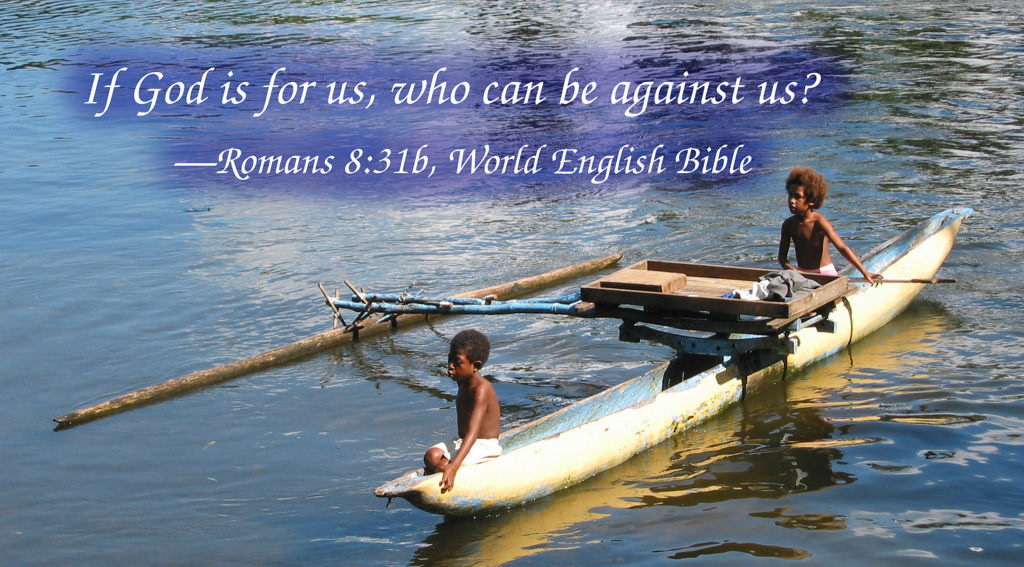
In a beautiful context writing about assurance, Paul asks, “If God be for us, who can be against us?” (Romans 8:31). That is an eminently fair question to ask. Here are some potential foes that could undo us: tribulation, distress, persecution, famine, nakedness, sword, death, life, angels, principalities, powers, the present, the future, height, depth, or any other created thing (35, 38-39). Examine that list closely. Doesn’t it include just about every potential threat and trial? Do we believe the assertion of Romans 8:31, this rhetorical question firmly implying that God is bigger and stronger than any potential problem or person?

When it comes to our righteous plans, isn’t this same principle vital to our process? What can we do and be as a church? The only limitation is that which goes against God’s will or that which can dominate God’s will. We must give great care to the first part, but we need not worry for a second about the second part. There will be factors that strain or intimidate. There will be reverses and failures. But, if we will persist and persevere, what can defeat us?

How exciting, in our personal and congregational lives, to serve a God more powerful than any foe or fear! We can succeed by His help and to His glory, come what may! Let us trust this timeless truth and live our lives as though we believe it!

24587741766_468160c634_b

Five Facts About A Faithless People

Neal Pollard

The percentage of Americans who identify as atheists doubled from 2007 to 2014 (Michael Lipka, Pew Research Center). But that hardly tells the whole story. Our culture is drowning in a political correctness that stigmatizes Christian Values and that makes nearly any public stand or statement regarding what Scripture says about such things as homosexuality, objective truth, the sanctity of life, and creation a point of fierce contention and object of greatest scorn. A moral erosion and slippery slope has been in motion for several generations that has brought us to our current position. The Bible foresaw such decline as comes when a people turn their backs on God (cf. Prov. 14:34). In discussing the universal problem of sin, Paul points out five facts about a faithless people (Rom. 1:18-32):

  • Faithlessness ignites God’s fury (18). Wrathfulness is as much a part of God’s nature as graciousness. In fact, we appreciate grace so much because God gives it when we deserve His wrath. Paul says the object of His wrath is all ungodliness and unrighteousness. The unrighteous behavior Paul specifies is “men who suppress the truth in unrighteousness.” They don’t live the truth and they don’t want the truth to be told. Paul ends the section by pointing these out as those who practice ungodliness and heartily approve of those who do the same (32). It is clear that those who remain faithless are “sinners in the hands of an angry God.”
  • Faithlessness ignores the facts (19-20). Paul says that faithlessness is not due to an absence of facts, but a willful ignorance of them. He says that even the faithless can see God as they look inside themselves and outside themselves at the creation. It takes a deliberate effort to arrive at a position of unbelief. So much has to be continuously ignored.
  • Faithlessness includes futility (21). Faithlessness is built upon a flimsy foundation. It’s the slab of speculation. The faithless spend their lives running from the facts in favor of a worldview that makes no sense, gives no purpose, and instills no hope.
  • Faithlessness involves folly (22-23). It’s not just empty, it’s foolish. Paul’s words here are akin to David’s words in Psalm 14:1 and 53:1, that “the fool has said in his heart, ‘There is no God.’” Paul describes intelligent people who have made the most fundamentally foolish decision of all. They exchange faith in an infallible God for faith in fallible man.
  • Faithlessness instigates a fall (24-32). Paul pictures how a person arrives at wholesale immorality. One must first turn from God and run the other way. Then, God lets them go to find out what lies at the end of that broad way. He gives them over in the lusts of their hearts to impurity (24), He gives them over to degrading passions (26), and He gives them over to a depraved mind (28). The lusts led to the wrong object of worship and submission. The passions led to unnatural desires. The depraved minds led to every imaginable behavior, a long list of actions that have in common the fact that they lead to spiritual death. It encompasses both the perpetrators and those who validate them and tell them it’s OK to do them.

Why does Paul mention these faithless ones? It is proof of divine inspiration, because although this was written 2000 years ago it perfectly describes the current culture. But, there is a more important reason for Paul to write this. This horrible condition has a remedy. The theme of Romans is contained in the four verses prior to this section. The gospel has the power to save us from this. The solution is faith. Faith saves (1:16) and it gives life (1:17). The world is being swallowed by spiritual darkness, but God’s light is brighter. We who have faith have the light. We must share it. When we do, we help people have the most important possible commodity: faith!

birth_of_all_hope_by_mr_morph-d62i5un

“To Protect And To Serve”

Neal Pollard

This now famous motto came into the public consciousness as part of a contest run by the Los Angeles Police Department’s internal magazine, BEAT, in 1955. Officer Joseph Dorobek submitted the winning entry with “to protect and to serve.” Nearly 60 years later, it continues to be seen on the side of the department’s patrol cars and serves to “embody the spirit, dedication, and professionalism” of the LAPD’s officers (via joinlapd.com).

With so much animus and distrust of law enforcement in some circles right now, it can be easy to forget their vital role of keeping peace and enforcing the law.  Without them, anarchy and violence would reign, with no one to restrain the lawless from violating and harming those incapable of defending themselves.  While there are unethical, lawless individuals in every profession, many who hear reports against law enforcement never stop to ask whether there is ever bias on the part of the reporters.  Perhaps it is a bias against law, authority, or the perceived power delegated to those wielding a badge.  It is good to remember that God has appointed the governing authorities of each locale (cf. Rom. 13:1ff).

God does not have an official position in His Kingdom for watchdogs or police officers to police the actions of others.  He made us creatures of choice and He allows us to choose good or evil.  While occasionally there are preachers and other members who are self-appointed to such a position, the concept is foreign to Scripture.  However, He did organize the church with elders who protect (Acts 20:28; 1 Pet. 5:2) and deacons who serve (1 Tim. 3:10,13).  In fact, all members are to be servants of Christ (Gal. 5:13).  Preachers are to preach the word, and when they declare the whole counsel in love (Acts 20:27; Eph. 4:15), they will sometimes convict the hearts of the hearers.  Particularly elders, who are commissioned to protect and serve the flock, deserve our respect and esteem (1 Th. 5:12-13).  Especially is that vital in an age that disdains authority.

It was an honor for me to serve as a reserve police officer in Livingston, Alabama, for a couple of years in the early 1990s.  I was able to see the dedication and sense of honor held by these extraordinary men and women. Let us honor those public servants of God (Rom. 13:6) and those spiritual servants of God (1 Th. 5:13)!

The Origin Of Scruples

Neal Pollard

Wes Autrey gave me an incredibly cool book by Charles Earle Funk.  The title of it is, “Thereby Hangs A Tale.” The book divulges the origin of words in modern usage, a study known as etymology. The fascinating explanations of many of our words is virtually endless, but the origin of our word “scruples” is particularly interesting.  Apparently, the Romans were prone to get sharp pebbles in their sandals.  They called those “pointed bits of stone” scrupulus. Funk says, “It is easy to see how the uneasiness one would feel from a pebble in the sandal gave rise to the figurative use of scrupulus for an uneasiness of the mind” (254).  In time, scrupulous has come to mean “extreme caution and carefulness.”  Scruples are “a feeling of doubt or hesitation with regard to the morality or propriety of a course of action.”

There is a connection between scruples and conscience.  It is the conscience that informs our scruples.  Our sense of right and wrong determines our caution, care, and even hesitation when we are in a given situation.  How sharp our conscience is effects how scrupulous or unscrupulous we are.

The Bible does not use the word “scruples,” but the word “conscience” is mentioned 27 times in the New Testament alone. Some people’s conscience forbids them to do what may be acceptable (cf. 1 Cor. 8:7), but others’ consciences allow them to do what is forbidden (Acts 23:1; 1 Tim. 4:2). Thus, the goal is for us to properly train and adequately sharpen the conscience.

What helps in this process is growing close to God by communing with Him in Scripture, application of Scripture, and prayer.  As we walk the narrow way, we want to feel the pain of those “pebbles” that may keep us from finishing the journey.  Is this not the idea conveyed by the writer of Hebrews, who says, “Let us also lay aside every encumbrance and the sin which so easily entangles us, and let us run with endurance the race that is set before us” (Heb. 12:1).  That rock in the shoe may be some ethical or moral practice that ultimately takes us off course.  Let us be careful to gauge the morality or propriety of any course of action, making sure it is in harmony with the goal of eternal life and not more likely to ultimately lead us away from God.

Have We Misunderstood Grace?

Neal Pollard

Perhaps the subject of grace has been neglected in some pulpits and congregations.  Undoubtedly, it has been misunderstood and improperly taught since the first century (cf. Rom. 6:1; Gal. 5:4).  It is vital to properly emphasize and explain such a huge concept within the gospel message.  Why? Because of what it is—the completely free and undeserved expression of God’s lovingkindness and favor toward mankind, because of what it does—brings salvation (Ti. 2:11; Eph. 2:5) and comfort and hope (2 Th. 2:16), and because of what it cost to make available (2 Co. 8:9; Heb. 2:9).  Perhaps some try to restrict God’s grace, making the requirements of Christ more stringent than Scripture teaches.  If we forbid what God permits, we are distorting grace.

However, our age tends toward the other extreme.  Far more try to make God’s grace extend further than Scripture teaches.  This is not novel to our times.  From the time of the early church, some apparently wanted to make God’s grace embrace things it simply does not cover.  Jude contended against some who attempted to have grace cover excessive indulgence in sensual pleasure (Jude 4). By leaving Christ’s grace for another gospel, teachers contradicting the gospel message distort not just the gospel but also grace (Gal. 1:6-9).  Paul also contradicts the idea that continuing in sin, without repentance, is abiding in God’s grace (Rom. 6:1).  Passages like these serve as a warning not to make God’s grace cover what it simply will not.

Grace will not cover willful disobedience, a refusal to repent, a lifestyle or habit, or relationship that violates the expressed will of God.  Some in adulterous marriages defend the relationship, trying to hide behind grace. Some feed addictions, sure that God’s grace will sweep away the guilt of it.  Some refuse to follow God’s plain plan of salvation, claiming that they will ultimately be saved by grace on the day of judgment.  Such ideas and claims are tragic misunderstandings and ignorance of revealed truth.  The source of grace is Divine.  So are the explanation and terms of it.  Paul’s teaching is definitive when he says, “How shall we who died to sin still live in it?” (Rom. 6:2).  The life in Christ is a new life (Rom. 6:4), a life characterized by turning away from sin, lust, and unrighteousness (Rom. 6:12-13).

Let us never restrict God’s grace.  By the same token, let us never redefine it—especially to excuse or validate a lifestyle of sin.  How that disgraces and cheapens the act that brought grace, Jesus’ painful sacrifice.  May each of us grow in knowledge and appreciation of this great Bible doctrine!