God Doesn’t Hate You

Tuesday’s Column: Dale Mail

Dale Pollard

“Who does he think he is?”

It’s easy to imagine how the grumbling began among Korah and other religious leaders of the Israelites. Eventually 250 joined and as the grumbling grew so did Korah’s confidence. It all came to a head as the mob approached Moses and the heated accusations start. Korah cries out, “We’re all just as righteous as you are! Why do you stand before us and bark orders?” 

Moses does something unexpected and falls face down. He tells them, “In the morning the Lord will show you all who is holy.” How did those wicked Levites sleep that night? Were they confident that God would deliver them from their “tyrannical” ruler? Maybe they tossed and turned as all sleep escaped them. The following day we read in Numbers 16.32-35, 

“and the earth opened its mouth and swallowed them and their households, and all those associated with Korah, together with their possessions. They went down alive into the realm of the dead, with everything they owned; the earth closed over them, and they perished and were gone from the community. At their cries, all the Israelites around them fled, shouting, “The earth is going to swallow us too!” And fire came out from the Lord and consumed the 250 men who were offering the incense.”

This wasn’t the end of the line for all of Korah’s family though. We read in Numbers 26.9-11, 

“…Nemuel, Dathan, and Abiram. These are the Dathan and Abiram, chosen from the congregation, who contended against Moses and Aaron in the company of Korah, when they contended against the Lord and the earth opened its mouth and swallowed them up together with Korah, when that company died, when the fire devoured the 250 men, and they became a warning. But the sons of Korah did not die.”

Some of Korah’s family live on. Now, how would many people feel about God if they had watched their family and possessions swallowed up by the earth? A horrific event like that might make them bitter, angry, and traumatized. What a cruel and selfish God. 

Interestingly enough, the sons of Korah are responsible for writing a few of the Psalms. They aren’t laments reflecting back on how God had treated them unfairly. In fact, it seems as though they had their eyes opened to the character of God. He is holy and they are in awe of their awesome Father. 

Here are a few segments taken from Psalm 84, written by the sons of Korah. 

Verses 1-2 

“How lovely is your dwelling place,
    Lord Almighty!

My soul yearns, even faints,
    for the courts of the Lord;
my heart and my flesh cry out
    for the living God.”

Verse 4 

“Blessed are those who dwell in your house; 
    they are ever praising you.”

Really? Blessed? Ever praising Him? 

Verse 10 

“Better is one day in your courts
    than a thousand elsewhere;
I would rather be a doorkeeper in the house of my God
    than dwell in the tents of the wicked.”

The language does not reflect a family who has witnessed tragedy brought on by the hand of God. It seems they were spared because the Lord saw something inside them that wasn’t found in the hearts of the others. A heart willing to repent and live differently. God knew they could handle rebuke and had a sincere desire to live righteously. It’s been speculated that perhaps they were too young to understand why their father and the other Levitical leaders were outraged. Maybe they thought they were a part of a just cause? After all, these evil men were in a position of authority. They were their teachers. How could 250 religious rulers be wrong? Whatever the reasons, God proved to be right again. 

There are people in this world who don’t understand the righteousness of the Lord. This lack of knowledge leads to terrible—often costly, decisions, and lifestyles. 

If you ever find yourself questioning God and His Law we should look in rather than up for who’s to blame. History proves time and again that God is never the issue— we are. Sin, injustice, unfairness, and evil are human inventions. God has given us His son as the solution and in Him we find answers. Those answers bring us satisfaction and peace every time. 

Water well dating back to the early 1800s. Location, Valhermoso Springs hotel. 
Lacey’s Spring, Alabama 

“How Do I Love Thee?”

Monday’s Column: Neal At The Cross

Neal Pollard

The English Romantic poet, Elizabeth Barrett Browning, is famed for her Sonnet 43. It is also known by its first line: “How do I love thee? Let me count the ways.” She was reared with privilege, wealth, and the finest education, but her health was compromised by an equestrian accident. Her father was controlling, and when she eloped to marry Robert Browning she was disinherited. She published many works of various types throughout her life, and this allowed her to become independently wealthy though her health made her an invalid. Robert became enamored with her writing, and they corresponded for two years. During this time, she wrote fervently romantic poems showing her love for Robert. For all that she wrote in her relatively brief life, her poetry stands out most of all. Of her poems, Sonnet 43 may be most famous.

The title above Psalm 92 reads, “a song for the Sabbath day.” That connects its words to worship, and this psalm shows the writer’s deep adoration for God. He never uses the word “love,” but his affection for God is obvious. It seems that the writer gives several proofs of that love here. Notice how.

  1. HE GIVES THANKS TO THE LORD (1)
  2. HE SINGS PRAISES TO HIS NAME (1,3-4)
  3. HE DECLARES HIS LOVINGKINDNESS AND FAITHFULNESS (2)
  4. HE PRAISES GOD’S WORKS AND THOUGHTS (5,8)
  5. HE SCORNS THE WICKED WHO OPPOSE GOD’S WAY (6-7,9,11)
  6. HE APPRECIATES THE BLESSINGS OF A GOD-APPROVED LIFE (10,12-14)
  7. HE EXPRESSES CONFIDENCE IN THE CHARACTER OF GOD (15)

One of the most rewarding exercises you can engage in is to enumerate the ways you love and appreciate God. Do it in your prayer life; spend time praising God and be specific in expressing your adoration and admiration. Think deeply about it. Look around. Look into your life. Consider what looks like His providence in your life and the life of others. Count your blessings, and tell God what you are thankful for. Wait! Did you mention running water, hot water, reliable vehicles, paved roads, coffee, air-conditioning, music, puppies, baby’s breath, eyesight, and brisket? What about the church, salvation, prayer, the Bible, peace, the hope of heaven, His guidance and protection, the elders, deacons, Bible teachers, your spouse, your parents, and your children? 

This will build your love and appreciation for God. It will remind you of how much He loves you and cause you to love Him more. It will humble you and help you focus on the fount of your every blessing! It should make you a better, more obedient servant for Him. How do you love Him? Like this psalmist, count the ways! It will lift your spirit and open your eyes to a harvest ripe with those who need what you have. Get counting!

Sheep, Love The Shepherds

Tuesday’s Column: Dale Mail

blond man with goatee smiling at camera with blazer on
Dale Pollard

Though scripture doesn’t say, you can be sure David’s sheep had no idea how lucky they were to have a shepherd like him. They were just sheep after all. How could they fully appreciate the extent that David went to in order to keep them safe? Before this begins to sound ridiculous, let’s remember that at least two of David’s sheep were carried off in the jaws of a lion and a bear. When the terrified bleating of an unfortunate sheep is heard by the shepherd, he sprints after the wild animal knowing all the while— it’s just a sheep. It’s just one sheep! Nevertheless, David strikes the predator and saves the sheep (1 Sam. 17.34-35).  

What made David a good shepherd? It certainly wasn’t his stature. The average male of his day stood around five feet tall. He was also the youngest of his family and often unappreciated (1 Sam. 16.11,17.29,33). It was David’s heart and not his height that made him exceptional. He was a natural shepherd of sheep, and of people. 

David is sent by his father, Jesse, to deliver bread for his brothers who are among Saul’s army. When he arrives on scene everyone, including the king, is afraid and unwilling to take a stand against the arrogant Goliath. But before the giant warrior from Gath meets the shepherd boy from Bethlehem, a few more giants will be faced. 

The first giant was the giant of degradation. 

David’s own brother, Eliab, would greet him with two belittling questions that would make a lesser man feel sheepish, but not this shepherd. Eliab asks, “why have you come down here? And who is watching the few sheep?” David’s brother doesn’t think he belongs among warriors and that he is only capable of handling a small number of dumb animals. 

The second giant was that of accusation.

In the same breath Eliab would accuse and insult David three different times. He claims, “I know how conceited you are and how wicked your heart is. You’ve only come to watch the battle.” How wrong he was and how dare he insult such a godly man! It’s interesting to note that David had an answer to each of these questions and accusations, but never attempts to defend himself. His father sent him, that’s why he was there. He was there to deliver nourishment for this dear brother who had, no doubt, worked up an appetite doing absolutely nothing. No retaliation or snarky remark would escape from the shepherd’s mouth because nothing like that was in his heart (Matt. 12.34).

The third giant David would conquer would be the towering giant of indignity.

He didn’t shame his brother and he didn’t let his brothers shaming keep him from shining. 

Shepherds put up with a lot, don’t they? Good shepherds really put up with a lot. Faithful god-fearing elders within the Lord’s church all over the world are faced with giants more often than they should. Sometimes the giants they face are their own sheep. How easy it is to make confident accusations against them, to question their intentions, hearts, and capabilities. That unpaid servant of God is more often than not the first one to come running when the bleating of a wayward member is heard. When we find ourselves in the clutches of our various trials, they attempt to pry us out. At times they earnestly pray over and take on burdens that aren’t theirs to carry. Faithful elders will find themselves in a position where they could make the sheep feel shame, but choose to save the feelings of others because that’s what a good shepherd does. It’s not their height, it’s their heart. The sheep need to love their shepherds, because the shepherds love their sheep!

Praise The Lord!

Neal Pollard

Your version may use the word “hallelujah” to begin Psalm 135. Hallelujah means “praise the Lord.” While it is synonymous with giving thanks, it means to laud a superior quality or act, to acclaim and express joy in doing so. What is so noteworthy is that the psalmist does this in very specific ways, recounting times in history when God demonstrates His power and glory on behalf of His people. As we walk through the psalm, we see this. Why is He to be praised?

  • HIS CHOOSING OF HIS PEOPLE (4)
  • HIS NATURE (5)–Great, Above All
  • HIS WORK IN CREATION (6-7)–Heaven, Earth, Seas, All Deep, Vapors, Lightning, Wind, Rain
  • HIS DEFEATING OF THEIR ENEMIES (8-11)–Egypt, Amorites, Canaanites
  • HIS BLESSINGS (12)–Gave His People A Heritage (Possession)
  • HIS POWER (13)–His Name And Remembrance
  • HIS PROMISES (14)–Compassionate Judgment
  • HIS SUPERIORITY OVER HIS RIVALS (15-18)–Deaf, Dumb, And Blind Idols, Just Like Humans

The writer calls on God’s people to praise and worship Him in song, expressing their adoration (1-3). He ends with a threefold call to “bless the Lord” (19-21). May I suggest that you work through something both in your daily life and in your preparation before every time you assemble to worship? Call it setting the table for fellowship with the Divine. Either meditate on the specific works and ways of God that are worthy of admiration, praise and honor or pray to Him, expressing these matters in specific terms. Focus on how He’s demonstrated greatness in blessing your life and the lives of those around you. Perhaps it’s answered prayer, providence, deliverance, or relief. Focus on His power and might in the affairs of our nation, in the activities of our congregation, and the occurrences within your family and personal life. Let the worship flow as you look around at all you see in nature, from the universe to right out your window. Think about the gift of Jesus for your sins. All of this will surely cause you to echo the writer in Psalm 135 and call out to others, “Praise the Lord!”

Photo credit: Kathy Pollard

“Have Yourself A Merry Little Christmas”

Friday’s Column: Brent’s Bent

Brent Pollard

“Have Yourself a Merry Little Christmas” was featured in the 1944 movie Meet Me in St. Louis. Judy Garland was the original performer. I will provide the song’s setting without spoiling the film since it is pertinent to our topic. 

Circumstances cause the family patriarch depicted within the film to declare that the family is moving to New York. He is alone in wanting to make such a move. Everyone else is content to stay in their current hometown, especially with the upcoming World’s Fair that St. Louis will be hosting in 1904.  

The youngest daughter, Tootie, took the news especially hard. Judy Garland’s character, Esther, tries to console Tootie by singing, “Have Yourself a Merry Little Christmas.” The original lyrics, which you’ve likely not heard unless you’ve watched the movie or listened to an older cover of the song, were “Until then, we’ll have to muddle through somehow.” Garland also sang, “Next year, all our troubles will be out of sight.”1 

We can credit Frank Sinatra for changing a melancholy Christmas song into a happier one. He told the song’s writer, Hugh Martin, in 1957 that his album was called “A Jolly Christmas.” So, he asked the songwriter if he could “jolly up” that line for him. The songwriter obliged, changing the lyric to “Hang a shining star atop the highest bough.” “Next year…” likewise became “From now on all our troubles will be out of sight.”2 

We cannot say that every Christmas season is as great as those experienced in our youth. As we get older, economics impact our celebrations. We take note of those missing. Perhaps, we no longer have good health. Or an every-hundred-year-pandemic might decide to come along and interfere with our plans. For those Christmases, we must “muddle through somehow.”  

At least one time in David’s life found him “unmerry” from life’s circumstances. And David likewise had to muddle through until things could get better. This occasion was when David was fleeing for his life because of his son Absalom’s political coup. David and his retainers found themselves in a position where they were “hungry and weary and thirsty in the wilderness.” (2 Samuel 17.29 NASB1995) What David did during this muddling remains an example for those finding it difficult to be joyous today. 

First, David did not isolate himself, having the company of his retinue (2 Samuel 17.22). People tend to isolate themselves when depressed.  But it is not the isolation causing difficulties. It is the resulting loneliness often found in isolation. People may think they are all alone in the world or that the world is against them. God said it is not good to be thus isolated (Genesis 2.18; Ecclesiastes 4.9-12). So, reach out to others, if necessary, since the assistance others give enables them to fulfill Christ’s law (Galatians 6.2). 

Second, David accepted the kindness of others (2 Samuel 17.27-29). I do not think it an exaggeration to say David could not have defeated Absalom without the aid of such people. Christians must be kind and tender-hearted to one another (Ephesians 4.32; Colossians 3.12-15; 1 Peter 3.8). And since we must extend such love and kindness to others, we must learn to receive these same overtures in return. That seems to be tricky for some people to realize. Muddling through is easier with brethren!  

Third, David wisely used his time of muddling (2 Samuel 18.1ff). David counts the number of able-bodied men with him who could fight. Then, he divides them into companies and appoints men over thousands and hundreds. The result, of course, was an army capable of battling Absalom. Despite resulting in the death of Absalom, the battle ensured that David could return to Jerusalem. His muddling days were over. In like manner, perhaps now is not an excellent time for us; we are muddling through life. But do what you can, with what you have, where you are. During these difficult times, the plans you make may result in a later victory.  

So, as others seem to be having “…the Most Wonderful Time of the Year,” you may find yourself unable to experience that coveted merry time. Emulate David’s example. If you see a family member or friend muddling through, ensure they are not lonely, providing them whatever aid is needed.  In so doing, may we all note, Lord willing, that “Next year, all our troubles will be out of sight.” 

Sources Consulted 

1  “Judy Garland- Have Yourself A Merry Little Christmas Lyrics.” AZLyrics, AZLyrics.com,www.azlyrics.com/lyrics/judygarland/haveyourselfamerrylittlechristmas.html

2 Willman, Chris. “How ‘Have Yourself a Merry Little Christmas’ Became One of the Season’s Most Beloved Songs.” EW.com, Meredith Corporation, 22 Dec. 2006, ew.com/article/2007/01/08/history-popular-holiday-song/. Updated December 23, 2020 

Four Waves On The Sea Of Life

Monday’s Column: Neal At The Cross

Neal Pollard

For whatever reason, I have been fascinated with stories of maritime disaster. I have read about the Titanic, but have even read more closely about the Lusitania, the Edmund Fitzgerald, the HMS Hood (for more, click here), and more. Perhaps few things could conjure up more fear than the thought of being thrust into a cold, deep ocean with no way to stay afloat, subject to attack and almost certain drowning. Poets have drawn upon such imagery, but so do the psalm writers. Read Psalm 42:7 or Psalm 69:2, 14-15 or Psalm 88:7. It is also the way Psalm 130 begins.

It seems to me that the writer is depicting the rolling waves we encounter in life, the ups and downs and the good and bad. How will I respond when I am in the storm, whether a literal storm, a storm others bring upon me or a storm I bring upon myself? What will I do when the winds have subsided and the storm has passed? Let’s look at this psalm as depicting four successive waves. 

APPREHENSION: Our Cries And Supplications (1-2)

(Wave One)

We find the writer in a watery valley, looking up at a high, but descending, wave. It causes him to cry out and voice his pleas and supplications. The crisis may be financial, medical, familial, personal, or spiritual. It may seem like the world is crashing in on top of you. Do you sink in waves of worry, fear, and doubt? Or do you cry out to God for help? The writer sets an example for us, when we feel like we will be buried by trouble!

TRANSGRESSION: Our Iniquities And Unforgiven Sins (3-4)

(Wave Two)

Though the writer moves away from the metaphor, the idea continues. When you wade in the ocean and reach a shelf, you can no longer put your feet on the bottom. You can sink or swim, but you cannot stand. Verse three asks, “If You, Lord, should mark iniquities, O Lord, who could stand?” The question is rhetorical, but a lifesaver is thrown! “But there is forgiveness with You, that You may be feared.” Perhaps better imagery is to see the Omnipotent Hand of God reaching into the deep, grabbing our outstretched, up- stretched hand! Perhaps self-inflicted trouble, our sins, cause us to sink deeper than any other trouble. 

EXPECTATION: Our Waiting And Hoping (5-7a)

(Wave Three)

Perhaps we could envision this as one floating to the top or having their head come up out of the water. The writer uses two significant, connected words–“wait” and “hope.” Help is coming! Just wait. Hope. You’re trusting, praying, studying, serving, and enduring. Maybe you feel like you’re holding onto a splintered plank that’s separating in the aftermath of your shipwreck, but you hear the sound of the rescue vessel humming on the waters. You know Who is at the helm, so you hang on!

REALIZATION: Our Mercy And Redemption (7-8)

(Wave Four)

I don’t know about you, but I don’t think I could be coaxed off a massive barge onto a rickety rowboat. But, most of us would make the exchange in the opposite scenario. Yet, the world clings to the leaky carrier of lostness when the ship of salvation is within reach. The writer calls heaven’s help “lovingkindness” and “abundant redemption.” This is the way I want to view the tumultuous waves of this world, from the safety of God’s saving grace. Resting in His everlasting arms, I can experience confidence and assurance at life’s worst while keeping my focus on Him at life’s best! 

You are probably facing, enduring, or looking back at one of those first three waves right now. We sometimes singing, “Jesus, Savior, pilot me over life’s tempestuous sea; Unknown waves before me roll, hiding rock and treacherous shoal, chart and compass came from Thee, Jesus, Savior, pilot me.” We are echoing the sentiments of the psalmist in Psalm 130. Wherever you are in life, be sure you are letting Him lift and lead you! It’s the only way to reach eternal safety (John 14:6)! 

Ascending Hearts And Hills

Monday’s Column: Neal At The Cross

pollard

Neal Pollard

Fifteen consecutive psalms (120-134) are so-called “Psalms of Ascent.” They were given this name because they were songs designated for the Israelites to sing on their way to worship in Jerusalem. Moses had instructed them at the giving of the Old Law, “For I will drive out nations before you and enlarge your borders, and no man shall covet your land when you go up three times a year to appear before the Lord your God” (Ex. 34:34). You can imagine how especially those who came a long distance to Jerusalem (it’s over 100 miles from Mt. Hermon and Beersheba, for example) might benefit from a reminder of why they were making this lengthy journey. As most would walk, this would help pass the time while preparing their minds. This is not a bad idea for us even on a 10 or 20 minute drive to the church building on Sunday morning. 

There is quite a bit of uneven terrain, mountains and valleys, in the area around Jerusalem, and the temple required a steep climb as there were three valleys surrounding Mount Zion and the temple complex. So, people coming from every direction would have to “go up to Jerusalem” (Zech. 14:17; John 2:13; 5:1). But, it was more than a physical ascent, this trip to the temple. It was more significantly a spiritual ascent, an effort to get closer to God. While we can and should draw near to God daily in our personal devotion, there is still great significance and benefit when we join each other in the presence of God to worship Him and fellowship with Him and each other (Heb. 10:24-25). Each time, this should be an ascent for us! 

Notice the repetitive use of “will” in Psalm 121. The word is used eight times in these eight verses. The word points to the future and indicates either anticipation or trust. The writer is confident, especially of what he expects God will do. Such assurance had to take his heart higher!

I WILL LIFT UP MY EYES TO HIM (1)

He starts with what he will do. The writer will look up to God, seeking help and strength. A heart ready to worship is one who sees things as they really are. I am spiritually destitute and needy, and I depend on God for everything. When that is my mindset, I am prepared to praise, thank, and petition Him!

GOD WILL HELP ME (1-2)

Whatever problems, distractions, struggles, and temptations are weighing me down and wearing me down, God will help me! His power is proven. Just look at the creation (2). He has not lost an ounce of strength from that moment to now.

GOD WILL NOT LET ME FALL (3)

The terrain around Jerusalem is often rocky and uneven. I suppose it is easy for anyone’s foot to slip on those roads up to the holy city. But, spiritually, it is a different matter. If I fall, it will not be God’s fault (John 10:27-29). If I hold to God’s unchanging hand, I will successfully complete my journey.

GOD WILL NOT FALL ASLEEP ON THE JOB (3-4)

Night and day, moment by moment, God is alert. He sees everything I do and everything that is done to me. How comforting to know that the All-seeing eye never droops or closes. He does not nod off, even for a moment. 

GOD WILL GUARD AND PROTECT ME (5-8)

Half of this psalm is devoted to this idea. God is not just passively involved, watching me. He is actively involved, keeping me (5,7), providing me shade (5-6), protecting me (7), and guarding me (8). Our God is not inanimate! He is involved! It is why we pray. It is why we trust in His providence. It is why we serve and obey Him. As we love to sing, “There is a God! He is alive. In Him we live and we survive.” The writer of Hebrews quotes three Old Testament passages (Deut. 31:6; Josh. 1:5; Psa. 118:6) to convey two promises: “Let your conduct be without covetousness; be content with such things as you have. For He Himself has said, “I will never leave you nor forsake you.”  So we may boldly say: “The Lord is my helper; I will not fear. What can man do to me?” (13:5-6). 

When you enter to worship, enter with the heart and faith of the righteous pilgrims on their way to the temple for one of the annual festivals. Come with your heart ready, and come with a heart full of faith and trust in the object of your worship. You will leave rejuvenated and resolved.

Our God Is An Awesome God!

Monday’s Column: Neal At The Cross

Neal Pollard

Are there songs that really pump you up in your faith? While there are several that strike that chord in me, none do that more than the song, “Our God is an awesome God.” I know the melody helps, but just that short, sweet, and profound reminder puts wind in my spiritual sails. It reminds me that I can overcome because of who He is.

Psalm 104 is a much more detailed, exhaustive song that lays out how “very great” our God is. It is exciting to think about who we are serving, and sobering to think of the cost of rejecting Him. Look at the awesomeness of God.

LOOK UP (1-4)

My boys call me “sky guy.” I am known to take some pictures of sunrises, sunsets, and skies in general. I remember a night at the Ngorogoro Crater with our oldest son, Gary, when the sky looked, as the late Andrew Connelly once described it, like diamonds laying on black velvet. I remember looking over the Caribbean Sea with Kathy in Cozumel, Mexico, with the moon above us and reflected in the water as yellow as gold. But, I get the same sense on many nights when I cut off the porch light and walk out my front door. God did that!

God’s garments are splendor, majesty, and light (1-2). He stretches out heaven like a curtain, rides the clouds, and walks on the wings of the wind (2-4). How can anyone look up and fail to see God?

LOOK AROUND (5-23)

Where is the most beautiful place on earth? Often, we could say it is wherever we are at the moment. Creation’s beauty is so diverse and its complexity is so incredible. Look at its order and durability (5). Think back to how He changed it all through the flood, using water to raise up mountains, form valleys, and then prevent it from ever happening like that again (6-9; Gen. 9:11). Look at how he sustains us and all creation with water (10-11,16), food (13-15), habitat (12,17-18), seasons (19), and daylight and darkness (19-23). The earth is full of His possessions (24), the sea (25), animals (25), the sea and its wonders (26). He sustains and provides and He shows His power (27-30). On the first hike my family ever took as residents of Colorado, in Rocky Mountain National Park, we met a young woman on a trail. We had in common the fact that we had all just moved there from out of state.  We told her why we had moved, to work with the church in Denver. She, though very polite, said that she moved out there to get away from God. We were all standing, facing such incredible grandeur, and I thought, “Good luck with that!” Where do you go to get away from God when His fingerprints are everywhere? 

LOOK BEYOND (31-32)

As the psalmist begins to wrap up this tribute to God’s awesomeness, he speaks of God’s unlimited power. He makes earth tremble and mountains smoke (32). It gives Him glory and gladness (31). Really, this point is made throughout the entire psalm. Everything we see is a reflection of the One who is above all, through all, and in all (Eph. 4:6). 

LOOK WITHIN (33-35)

In a psalm paying tribute to creation, what should be my response? How should it change and shape me? I will sing to Him as long as I am (33). I will meditate about Him (34). I will be glad in Him (34). I will follow Him, knowing what awaits the sinner and the wicked (35). Listen to the psalmist’s summary: “Bless the Lord, O my soul. Praise the Lord!”  What I see above, around, and within me should melt my heart in praise. It should leave me singing every day, “Our God is an awesome God!”

(taken near the summit of Torrey’s Peak, 2018)

Make Like A Tree And “Leaf”

Friday’s Column: Captain’s Blog

carl-pic

Carl Pollard

The Redwood National Park in California is home to the world’s tallest tree. Standing at over 380 feet tall this tree is incredible to look at. The California Redwood is estimated to be able to reach a staggering 425 feet in its lifetime. It continues to grow all its life and there’s a reason it gets so tall, as the lifespan of this tree is up to 2,200 years. Think about that! There are redwood trees that are still growing today that were planted 200 years before Christ was born.
The California Redwood is massive. It is over 29 feet in diameter and has a root system that spreads over three miles underground. These trees are truly incredible. But like most trees, the key to their growth is water. California redwoods consume over 56,000 gallons of water each year or 150 gallons of water each day!
 
In Psalm 1:1, we are given this description: “Blessed is the man who walks not in the counsel of the wicked, nor stands in the way of sinners, nor sits in the seat of scoffers.” This person is blessed when they avoid the progression of sin. Notice how the psalmist describes the progression:
 
  • Walk not in the counsel of the wicked.
  • Nor Stands in the way of sinners.
  • Nor Sit in the seat of the scoffers.
 
These steps illustrate what people do when they are tempted by sin. They walk among it, noticing the wicked and their deeds. Once they walk among it, their curiosity gets the best of them and they begin to pause and spend time in the presence of sinners. Finally they are fully drawn into sin and they sit down and practice the evil that they have observed.
 
Rather than walking, standing and sitting with sinners, the righteous man delights in the law of the Lord. Verse two says, “But his delight is in the law of the Lord, and on his law he meditates day and night.” The choice is obvious for the righteous man. He avoids the sin and chooses the Word of God over anything else.
 
Verse three reads, “He is like a tree that is planted by the waters that yields its fruit in its season, and its leaf does not wither, in all he does he prospers.” The source of life for this tree is water. Just like the California Redwood needs water in order to grow, the saved man spends his time next to the source of life. What is this water? John 4:14 reveals, “But whoever drinks of the water that I will give him will never be thirsty again. The water that I will give him will become in him a spring of water welling up to eternal life.” For the Christian, our source of life comes from Christ. We are able to grow and thrive on the words of God.
 
Let’s make the decision daily to be firmly planted in the words of life. That way, we too can be counted as righteous!
General Sherman (Sequoia National Park)

“Charakter”

Monday’s Column: Neal At The Cross

Safari 2017

Neal Pollard

Character is defined as the mental and moral qualities distinctive to an individual and involves a person’s good reputation. The Greek word “charakter” first referred to the die used in minting coins, then came to include the sense of an image, stamp, seal, or copy. The Greeks used the word to speak of the typical features of an individual or nation, from which came the idea of “moral character” and then “the “distinctiveness” of a language, the “style” of a writer, or a “type” of philosophy (Kittel and Bromiley, TDNT, 1308). Arndt tells us the word means something produced as a representation or reproduction, and that human beings are formed by God as a representation of His own identity (1078).

The word is only found in the Bible in Hebrews 1:3. The epistle’s writer is describing Jesus, saying, “He is the radiance of His glory and the exact representation of His nature, and upholds all things by the word of His power.” It is an absolutely amazing truth that we are made in the image of God (Gen. 1:27), but the writer of Hebrews is saying something even more powerful about Jesus in Hebrews 1:3. He was not created by God as a reflection of God’s identity. The writer uses this specific word in Hebrews as part of His explanation that the Son is God! The NASB and NIV translate χαρακτήρ (CHARAKTER) as “exact representation.” The ESV has “exact imprint,” the NKJV has “express image,” the NLT says “expresses the very character of God,” and the ASV puts “the very image of His substance.” 

The author of this epistle leads out in his overall theme that Jesus is better by establishing the most important reason why. He is God. The writer uses Old Testament Scripture to prove it, citing Psalm 45 and Isaiah 61 to call Him God (Heb. 1:8-9). He then quotes Psalm 102:25 to say of Jesus, “You, Lord, in the beginning laid the foundation of the earth….” Then, in Hebrews 1:13, he quotes Psalm 110:1, which begins, “The LORD (Yahweh) said to my Lord (Adonai)….”

Let’s not miss the initial point of the letter driven home by the unknown writer. With a multitude of Old Testament passages, he proves this point about the essential character of Jesus Christ. He is God. He is as much God as Father and Holy Spirit. He is as powerful, all-knowing, omnipresent, perfect, sovereign, transcendent, self-existent, eternal–He is as Divine as Deity can be. 

That makes His willingness to be made a little while lower than the angels to taste death for everyone (Heb. 2:9) and to call us His brethren (2:11ff) all the more incredible. God lowered Himself not only to save us but to make us part of His family. We could spend the rest of the day meditating on that profound truth and still not fully grasp it. 

Here’s the question. God made us, became  one of us, died for us, and then opened the door to us to be His brother. What does that say about His character? As we try to fathom and appreciate that, it should give rise to another question? How should that affect  our character?

My Mouth’s Motivation

Thursday’s Column: Captain’s Blog

Carl Pollard

In Psalm 19:14 David says, “may the words of my mouth be acceptable in your sight.” In the previous verses of this chapter David writes about the perfect law of the Lord. Moved by the knowledge that the author of scripture is God almighty, David hopes that the words he speaks would be impacted by his knowledge of the Law. This is something we must long for as Christians. We know who the author of the Bible is, we understand the way we are called to live and speak, and that should influence our words. The Bible is very clear on how we are to speak.

Our words are a direct reflection of our faith. James 1:26, “If anyone thinks he is religious and does not bridle his tongue but deceives his heart, this person’s religion is worthless.” Do we call ourselves Christians but fail to control our words? James would say we are deceiving ourselves. Our speech is directly impacted by our religion. Our faith should change our speech and make it stand out from the world.

The Bible also gives us a very sobering warning in Matthew 12:36. Jesus says, “I tell you, on the day of judgment people will give account for every careless word they speak, 37 for by your words you will be justified, and by your words you will be condemned.” On that day will we find justification or condemnation from the words we have spoken? We should use this knowledge to help guard our speech.

Scripture also tells us in Luke 6:45 that, “The good person out of the good treasure of his heart produces good, and the evil person out of his evil treasure produces evil, for out of the abundance of the heart his mouth speaks.” We can know the condition of our hearts by what is contained in our words.

Our tongue has a way of getting us in trouble. Ever heard the saying, “keep your words soft and sweet because you never know when you may have to eat them”?We can do a lot of damage if we aren’t careful. On every car there’s this handy little device called a fuel filter. A fuel filter is in between your car’s engine and the gas tank. Its job is to keep all the sediment and dirt that accumulates in the gas tank over time from getting to the engine. Basically it keeps impurities from destroying your engine. Our words need a fuel filter between the mind and the mouth. Think about what we are about to say. Is it impure or harmful in any way? Then don’t say it.

President Calvin Coolidge was famously known as a man of few words. His nickname was “Silent Cal.” His wife, Grace Goodhue Coolidge, told the story of a young woman who sat next to her husband at a dinner party. She told Coolidge she had a bet with a friend that she could get at least three words of conversation from him. Without looking at her he quietly retorted, “You lose.” Coolidge understood very well the value of using only carefully considered words—and those being few in number. We filter our words and carefully choose them because like David, we understand who we belong to when we are Christians. God now owns our words and we use them to glorify Him in everything.

Psalm 19 is a beautiful tribute to the perfection of Scripture. Like David, each one of us should strive to let God’s word motivate us to live more like Christ in every way.

HE’S SO EXCITED TO GO TO CHURCH

Thursday’s Column: Carlnormous Comments

pollard

(Pinch-hitting for the groom-to-be)

Neal Pollard

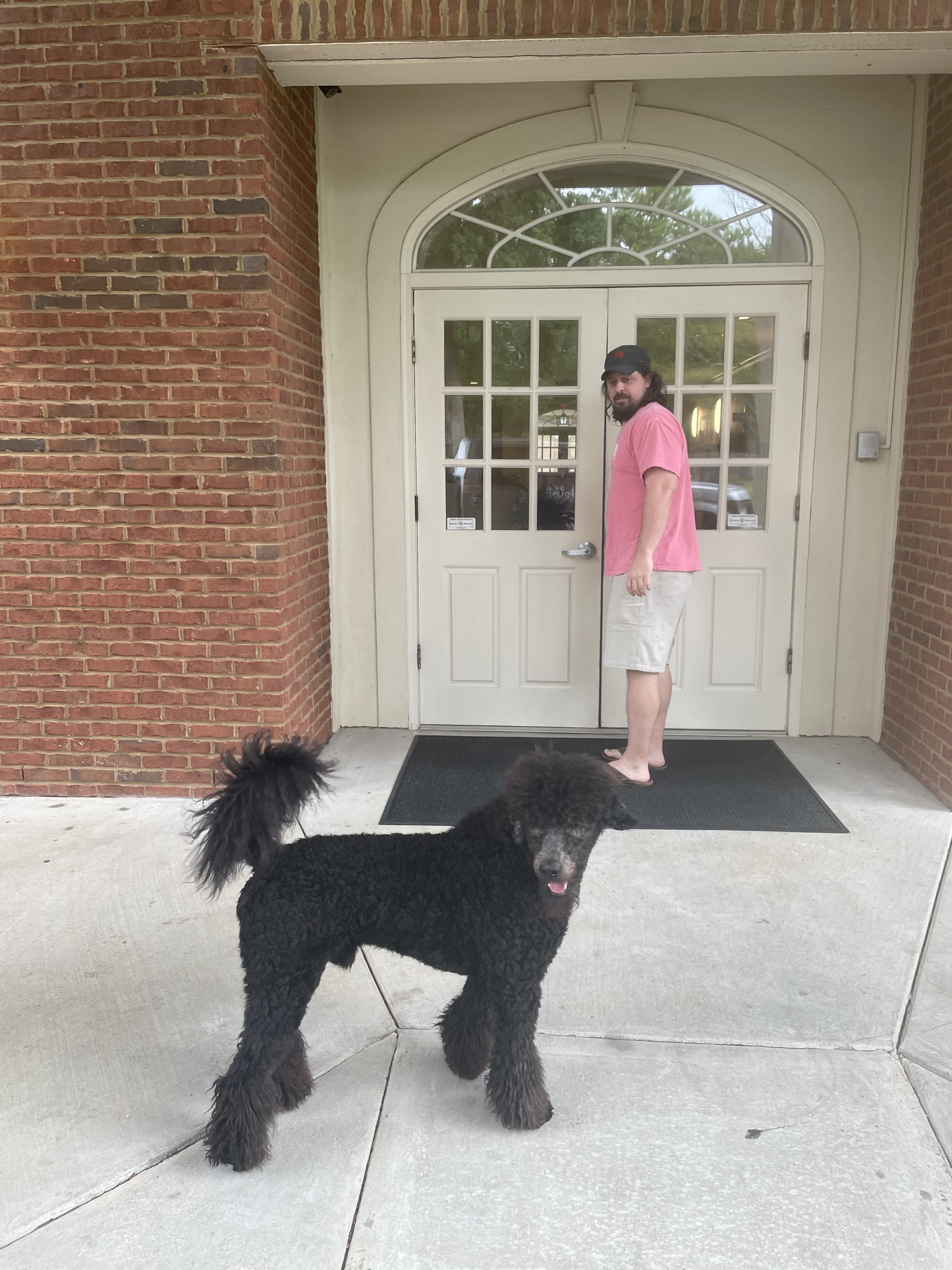
Last weekend, we had an opportunity to see good friends of ours when Kathy did a Ladies Day in “L.A.” (Lower Alabama). We met Justin and Anna Maynard when they served as missionaries in Tanzania, and we have also been to Israel with them. They have two beautiful Standard Poodle puppies, a girl named Ruby and a boy named Colton. They are both smart, but Colton has to be a canine Einstein. Perhaps the best measure of his intelligence is his absolute love of going to the church building with Justin (see picture below). Some years ago, I wrote about a dog from my childhood that was faithful to be at the building when the church met (The Dog At Church). What I appreciate about Colton is how eager he is, every single time, to “go to church.” When Justin asks, “You wanna go to church?,” Colton goes ballistic! When he gets there, he sprints to the door and impatiently waits for his “dad” to open the door. Then, he runs around excitedly (I watched him do laps around the auditorium for several minutes before contentedly sprawling out on the floor to rest). He does a flying leap onto one of the other minister’s couch and thoroughly enjoys the whole experience at the church building.

His enthusiasm is so high, it made me think of what David once said: “I was glad when they said to me, ‘Let us go to the house of the Lord’” (Psa. 122:1). The sons of Korah described being in the house of the Lord, “with the voice of joy and thanksgiving” (Psa. 42:4). Maybe it was his memories of “sweet fellowship together” with others who “walked in the house of God in the throng” (Psa. 55:14). In those last two passages, the writers look back with longing to a time when they could do freely what now was impossible to do. They longed to be there. The psalms, as much as any book, describes zealous worshippers. Think about Psalm 95:6, which admonishes, “Come, let us worship and bow down, let us kneel before the LORD our Maker!”

I watched Colton and I asked myself, “Do I have that attitude toward going to ‘church’?” Frankly, I can let a sour mood or personal problems or distractions dampen my joy and zeal for being there. Here’s a creature who will not live eternally, is not made in the image of God, and for whom Jesus did not die, but whose unbridled enthusiasm is overflowing! The next time I’m tempted to grumble or grimace as I approach the “next appointed time,” I hope I will remember Colton Maynard, who loves to go to church! 

Colton and Justin

Meditation: What is it? Why do it? How do I do it?

Tuesday’s Column: Dale Mail

Daleheadshot

Dale Pollard

The concept of Biblical mediation is viewed as a mystery to many of us. The simple answer to “How do I do it?” can seem frustratingly vague. Common answers are—

“you read a passage that stands out over and over and then you think about it.”

Or maybe…

“you find a verse and then pray about it.”

Here’s what you should know about true Biblical meditation.

Three Facts About Biblical Mediation

1. It does not involve emptying your mind, but rather filling your mind with God’s mind.
2. It’s not a complex ritual in which you must reach a higher “spiritual place” to accomplish. It’s a simple act that God intended for everyone to be able to do— in order to bring you to a better spiritual place.
3. It is an intentional act. You won’t find yourself meditating accidentally. We must make time for God.
Here’s why we should all be doing this.
Four Reasons To Meditate
1. For Improved Worship
2. For Perfect Instruction
3. For Needed Encouragement
4. For Spiritual Transformation
Here’s what you will need to accomplish it.
Three Tools For Great Meditation
OBSERVATION – What does the text say?
INTERPRETATION – What does it mean in context?
APPLICATION – What does it mean for me?

Note: Combine With Prayer before and after for best results.

Here’s what you will get out of it.
Ten Benefits Of Biblical Meditation
1. Proven to lower blood pressure
2. Decrease anxiety
3. Improve heart rate
4. It enables your to relax
5. It brings peace
6. It draws you closer to God
7. It gives us confidence
8. It offers an escape from temptation
9. It provides helpful correction
10. It makes us better Bible students (Psalm 119:11)

Finally, here’s an exercise to help us see the many categories on which we can mediate. Simply answer the questions in your mind, and try to develop a habit of asking yourself personal questions about what you’re reading.

A Meditation Exercise From The Psalms
You could meditate…

On His rules (Ps. 119; look up in the ESV)
• What rules do you tend to break?
• Why do you break them?
• What’s the point behind His “rules”?

On His Promises (Ps. 119:148)
• Which of His promises bring you the most comfort?
• Has God kept His promises to you? How?

On His mighty deeds (Ps. 77:12)
• Which specific mighty deeds has God performed in the history?
• What mighty deeds do you believe God has performed in your life?
• What could God do with you today if you allowed Him to?

On His unfailing love (Ps. 48:9)
• There has never been a moment in your life when God hadn’t loved you.
• What does that tell you? What does it expose about yourself?

I hope this helps clarify what real mediation is— and how it can change your life!

person-prayer-book-bible

Reflections On Worship, From A-Z

Neal Pollard

How great to say with David, “I was glad when they said to me, “Let us go to the house of the Lord” (Psalm 122:1).  Another psalm also urges, “Come, let us worship and bow down, Let us kneel before the Lord our Maker” (95:6).  Both verses are the attitude of a redeemed, transformed heart.  Worship is not a substitute for daily living, and we may find ourselves primarily or solely focused on assembling to the neglect of Christian duty or evangelism. But, though those be true, we cannot lose sight of the importance of fulfilling God’s command for His people to faithfully worship Him (John 4:24; Heb. 10:24ff).  More than that, as recipients of His grace, we will want to come before Him with what He wants, giving Him our best from an enthusiastic heart. What can help us do that?

A–TTENDANCE (It puts us in the right position–for ourselves, each other, and God)
B–
RETHREN (There’s a community, communion, and camaraderie in worship)
C–
HILDREN (Is there anything sweeter than seeing and hearing them worship?)
D–
ELIVERANCE (Delivered for a few moments from the profane, delivered for a lifetime by the Prince of Peace)
E–
FFORT (Hardwork, dedication, and preparation truly pay off!)
F–
AITHFULNESS (Obedience, consistency, and holiness fuels acceptable worship)
G–
OSPEL (Bible-centered worship highlights the best news of all time)
H–
EAVEN (Worship better prepares us for it, reminds us of it, and gives us a foretaste of it)
I–
NTEREST (See “attendance” and “faithfulness”; At some level, you can’t fake this)
J–
ESUS (We lift Him up, obey Him, and center everything around Him in every service)
K–
NOWLEDGE (We seek to know God more and understand Him better, in part, by worship)
L–
ISTENING (To God, through His Word, and each other, through the various acts)
M–
EMORIES (Young or old, each occasion provides an opportunity to make more of them)
N–
OTHING (What’s more special, important, fulfilling, and encouraging)
O–
PPORTUNITY (Different places and times have been forbidden from what we get to do multiple times per week)
P–
ARTICIPATION (Not just in the door and in a seat, but actively taking part)
Q–
UALITY (Not measured by voice quality or dynamic speech, but the very best we can with what we bring)
R–
ESPONSE (Each time we assemble to worship, we are responding to God and His gospel)
S–
ACRIFICE (You cannot properly define worship without it; It may be a sacrifice to come, but it must be an offering when you do)
T–
OGETHERNESS (Worship means fellowship and building our common bond)
U–
RGENCY (Feeling a pressing need to be here, and then to act on what we hear)
V–
ISITORS (These take note of how much worship means to us; They can see and sense it)
W–
ONDERFUL (God knew we needed worship, and that can touch us deeply)
X–RAY (Worship should lay our hearts bare and show us ourselves)
Y–OU (The presence of everyone, including you, spells the difference!)
Z–EAL (Passion and enthusiasm is observable, by others and, most of all, by God!)

Maybe we cannot fully grasp all of why God wants us worshipping Him, but He, as our Creator, knew we would need it to draw us closer to Him and each other. Let’s never let anything occupy a higher place in our hearts!

537893_378947542128289_990183257_n


Singing With The Understanding–Miscellany* 

Neal Pollard

We are a diverse group who gather to sing for worship. We vary in age, education, religious background and literacy, race, and doubtless other factors. Some of us have been singing the same hymns for decades, while others may be seeing those hymns for the first time.  There is a mutual responsibility, one for the song leader and one for the participant. Yet, I would argue that the leader has the greater obligation to assist the participants in offering better worship. Mindless participation is the fault of the participant, but being led to speak and teach words they don’t understand is not.  What can the song leader do to increase the effectiveness of “singing with the understanding.”

Engage In Thoughtful Preparation. When picking out songs to lead, opt for simplicity. Archaic or technical words can hang up and distract the worshipper. It is fruitful to ask the question, “How will this be comprehended by the average participant?” Does the song read like we speak today? If we’re not careful, we can tend to speak through song in mystical terms that help disconnect the mind and the mouth. Do we know what it means to “vanquish all the hosts of night”? Do we know what “cassia-dipped” garments are? Do we know what’s referenced “where Eden’s bowers bloom”? How do I “launch my bark”? These are lyrics from songs that are sung every week in congregations across the land, but words I’d venture to say that many, if not most, do not comprehend. We must give thought in preparation.

Engage In Adequate Explanation. Something that can help in song leading is to point out words or expressions we’re about to sing, defining and explaining them. This does not necessitate a second sermon, but as part of preparation we should be ready to clarify obscure or difficult words. For example, from songs we often sing, we find:

  • “Repining”–To feel or express discontent; to fret
  • “Guerdon”–A reward
  • “Warble”–To sing (especially used of birds)
  • “Fain”–Gladly
  • “Trysting”–Meeting 
  • “Essay” (as used in I’ll Never Forsake My Lord)– To attempt
  • “Cloven”–Divided
  • “Garish”–Bright and gaudy
  • “Fen”–A swamp

While some songbooks, like Praise For The Lord, have footnoted some of these difficult words, many worshippers don’t pay attention to them. So many of us project our hymns in worship. The onus (i.e., duty) is on the leader to explain.

Engage In Balanced Variation. Everyone has their favorite type and genre of psalms, hymns, and spiritual songs. Song leaders are no different than worshippers. How important it is to balance out old and new hymns, considering the typical “audience” present to participate. 

Engage In Heavenly Petition. Anyone who leads in worship should season their preparation and participation with petition to God. Pray about doing what you’re tasked with doing as effectively as possible. 

What a blessing to have willing, talented worship leaders. We have a powerful opportunity to show God’s wisdom in singing according to the authority of the New Testament (cf. Col. 3:16; Eph. 5:19). Let’s capitalize on that by putting everyone in the optimal position to sing with proper spirit and understanding!

*–Miscellany–A group or collection of different items; a mixture

Screen Shot 2018-11-26 at 10.56.34 AM

Learning To Pray From A Man After God’s Own Heart

Neal Pollard

When the disciples asked Jesus to teach them to pray (Luke 11:1), they were asking the most qualified instructor. However, they had a good teacher from the background of their own heritage in David. The book of Psalms is at times a songbook and at other times a prayer journal. Numerous examples of David’s prayers are contained in this beautiful book of Old Testament poetry. In Psalm 141, for example, we have several characteristics of prayer from a man after God’s own heart (cf. Acts 13:22).

First, David’s prayer was urgent (Psalm 141:1). He writes, “Lord, I cry out to You; make haste to me!” David saw prayer, not as a last resort, but as a first retreat. Since David knew God was able to help, he wasted no time in bringing matters into God’s own hands.

Then, David’s prayer was intense (Psalm 141:1b). He continues, “Give ear to my voice when I cry out to You.” You will not hear rote memorization of prayers or lackadaisical lethargy in David’s prayer. David cried out to God. He is pleading with God. These are indicators of a fervent prayer life, which God includes as typical of righteous people of prayer (James 5:16).

Further, David’s prayer was sincere (Psalm 141:2). He treated his prayers as if they were actually offerings or sacrifices. He says, “Let my prayers be set before You as incense, the lifting up of my hands as the evening sacrifice.” He was willing to lay open his prayers to the All-Seeing eye for His scrutiny. The entirety of this psalm reflects no superficial piety or pretentiousness. David simply laid his heart before God.

David put obvious trust and hope in the power of prayer. He had confidence in God’s ability and he had cognizance of his own dependence upon God’s ability. Never wait to turn to prayer until the need is desperate. The man after God’s own heart made prayer a staple in his religious diet. So should we.

pray-2558490_960_720

“You Can Find Somebody To Tell You What You Want To Hear”

Neal Pollard

Someone wants to be involved in an illicit relationship, defend an unscriptural marriage (or enter into one), engage in some vice or sinful behavior “in moderation” (or otherwise), and they talk to someone who shows them from scripture why it should not be done. Perhaps they ask several people and get the same discouragement. Sometimes, the inquirer is wise enough to let that guide them away from wrongdoing. Other times, they persist in looking for someone to tell them what they want to hear. Without exception, such a searcher will eventually—and probably sooner than later—find someone to validate and endorse their desire.

Solomon wrote, “The thoughts of the righteous are just, But the counsels of the wicked are deceitful” (Prov. 12:5). His father kicked off the songbook of Israel by saying, “How blessed is the man who does not walk in the counsel of the wicked…” (Psa. 1:1a). Job speaks of how he shunned “the counsel of the wicked” (Job 21:16; 22:18). Wicked Ahaziah was rejected by God, in part, “for his mother was his counselor to do wickedly” (2 Chr. 22:3).  This characteristic of human nature, whether giving or taking wicked counsel, is timeless. But, seeking counsel from the proper sources is encouraged by Scripture (Prov. 11:14; 15:22; 24:6). How can we make sure that we are hearing what we need to hear, not just what we want to hear?

  • We must realize our personal accountability (2 Cor. 5:10). No matter what anyone else tells us, we’ll stand individually in the Judgment. Christ’s word, as Judge, is the only one that ultimately matters. What has He said?
  • We must pray for wisdom and discernment (Col. 1:9). Are we ignoring a pricked conscience, clear teaching, or red flags? Is self in control, or is the Savior’s will?
  • We must grow in knowledge (2 Pet. 3:18).  Have we studied this out yet? Are we convinced beyond a doubt? What does the Lord say?
  • We must be honest with ourselves (Psa. 15:2). We cannot deal fairly in any situation if we’re deceiving ourselves. Lying to ourselves does not change God’s truth. It simply hurts us.
  • We must train our hearts to desire what is good (cf. 2 Pet. 2:14). This can be excruciatingly hard! Proverbs 21:10 says, “The soul of the wicked desires evil.” But listen to a cleansed heart: “Behold, You desire truth in the innermost being, and in the hidden part You will make me know wisdom” (Psa. 51:6).
  • We must put emphasis on the eternal rather than the temporary (2 Cor. 4:16ff). Is what we wish to pursue destructive to heavenly objectives? Are we risking an eternity in heaven for a few years of fleeting pleasure on earth? Nothing is worth sacrificing salvation!
  • We must weigh the advice of our counselors on the scales of truth (Prov. 18:17). The Berean Christians fact-checked an inspired apostle (Acts 17:6). We owe it to ourselves to compare what our advisers tell us—however much we love and respect them—with what God’s Word says. Many times they will align. If they do not, we must choose God’s Word every time!

Beware! At times, what we want to hear is right and good. Many times, it is not. As we lean on others, let us lean most heavily on “the rock” (Mat. 7:24)!

dreamstime_l_20586429

Why We Need The Word

Neal Pollard

Many know that Psalm 119 is the greatest, inspired tribute to the Word of God known to man. 176 verses, eight verses under the heading of every Hebrew letter, grace these pages of our Bibles. All but a few verses mention some synonym for God’s Word. So many individual studies can be made of themes and thrusts in Psalm 119, but by reading it one discovers David giving many benefits or needs for studying the Bible. Consider what is no doubt an inexhaustible study.

  • To keep from sinning against God (11)
  • I am a stranger in the earth (19)
  • The influential can be against us at times (23)
  • Our soul often melts from heaviness (28)
  • To keep our eyes from worthless things (37)
  • To have an answer for him who reproaches us (42)
  • It causes hope (49)
  • For comfort in affliction (50, 76)
  • It causes righteous indignation (53)
  • It leads us to seek God’s favor with our whole heart (58)
  • It makes us choose better companions (63)
  • It brings good judgment and knowledge (66)
  • It prevents apostasy (67)
  • It makes us more attractive to the God-fearing (74)
  • That I may live (77, 93, etc.)
  • For revival (88)
  • For greater understanding (99)
  • To be upheld and safe (117)
  • To have a proper sense of self (125)
  • For a proper sense of values (128)
  • For proper emotional investment (136)
  • For righteous zeal (139)
  • For a proper sense of dependency (147)
  • It brings confidence (152)
  • It gives us the proper sentiment toward the world (158)
  • To develop a proper “praise life” (164)

psalm119

Struggling Through Our Troubles

Neal Pollard

Have you ever had a problem or struggle that started out small but kept growing until it was larger than life? Did it come to consume your thoughts, keep you up at night, and become an overwhelming obsession? Maybe you devoted a lot of emotion to it.

Just by virtue of living on this earth, we will struggle (Job 14:1-2). Job knew struggle and turmoil! He lost one thing after another. His life seemed to unravel before his eyes.  Teddy Roosevelt is credited with saying, “When you are at the end of your rope, tie a knot and hold on.” Have you ever found yourself struggling at the end of your rope of faith? You are certainly far from alone in that. We certainly see Job dangling there, asking, “Why was I ever born?” (3:11) and “Why can’t I go ahead and die?” (3:20-22). David was there (Psa. 22:1). So was Jeremiah (ch. 37-38).

Of course, trouble takes on many forms and comes from many directions. Any number of passages can help us cope with the struggle of trouble, but consider Psalm 10. It refers to the wicked seven times and to the afflicted four times. It also speaks synonymously of the wicked as the greedy (13), evildoer (15), and those of the earth (18). It speaks of the afflicted as the unfortunate (8,10,14), humble (14), the orphan and oppressed (14,18). We know that our trouble can come from the wicked, but it can also come from no one source we can identify though it hurts just the same. Consider this Psalm about our troubles and what we can do about them.

Our perception in times of trouble (1-11). Our vision can become blurry by tears or rage, but our point of view is altered when trouble comes. The psalmist goes through this. He sees God as being distant (1). He saw the wicked as being in control or prospering (2-11). God seemed far away and life seemed unfair. The majority of every generation is wicked, and each generation of God’s faithful must reconcile the seeming success of the wicked and oppression of the affilicted righteous. We don’t begrudge the psalmist for his struggle to see through spiritual eyes. We can relate.

Our prayers in times of trouble (12-15). The psalmist admits his own struggle, then he shows us how to overcome it. His first response is to pray. He asks God to deliver (12). He asks God to remember (12-14). Finally, he asks God to vindicate (15).

Our praise in times of trouble (16). Before the prayer he’s perplexed and indignant. Afterward, he has insight, peace, and greater confidence. He springs from his knees with new perspective. Doesn’t prayer do that for us? The psalmist acknowledges God’s nature—“Lord” (Jehovah, five times in the Psalm), position—“King”, and duration—“forever and ever.” Do we spend more time focusing on the source of our troubles than on the solution?

Our proper perspective in times of trouble (17-18).  The psalmist is confident at the end of this psalm, saying, “you have heard” and “you will strengthen and listen.” Do you approach God that confident in His ability and desire to do what is best? We can be as confident as he is that God hears and helps when we hurt.

What is the greatest trouble we can face in this life? A disfiguring accident? Financial ruin? Loss of a parent, spouse, or child? The deterioration of health? The fall of our nation? Through Christ, none of these are too difficult to overcome. This Psalm reminds me that God still cares and He won’t abandon me. You and I can look at the cross and the church and be reassured of that. We know we can trust God (Rom. 8:28). God is able and willing to help us through every trouble.

6359108530478803001617573448_1112-gmat-struggle-970-630x420

Some Hurdles I Just Cannot Jump Regarding Instrumental Music In Worship

Neal Pollard

How often the matter gets discussed among preachers in churches of Christ, I cannot say. But, I know that it does. More members of the church than we might care to think do not have this matter settled in their minds, especially as it has to do with the state of those who have been immersed for the forgiveness of sins, submit to the authority of Christ in other areas of their lives, but who use the instrument in worship. Some have said they think its use is wrong and we have been right to argue against its use but do not think they can say it is a salvation or fellowship issue. It should be stated that many of these are sincere brethren who love the Lord and people nor are they change agents intent on trying to destroy the Lord’s body. Too often, we have lacked an environment where we could have healthy, constructive dialogue free of name-calling, suspicion, and visceral discussion. But failing to discuss and work through matters like these does not make them disappear.

Having said that, here are some hurdles I just cannot jump regarding this matter:

  • The presence of singing and absence of instruments in New Testament passages. The fact that every instance of singing in the context of the Christians’ activity together reveals singing (Greek is a precise language; ado means to utter words in a melodic pattern [Louw-Nida] and ). Psallo, according to Lexicographers, encompassed playing musical instruments at an earlier time in its linguistic history, but did not mean that in New Testament times (e.g., BDAG, 1094; TDNT, 8:494). Interestingly, the translators of English translations, beginning with the King James Version, were unanimously members of religious groups that used mechanical instruments in music. Despite their obvious bias in worship practice, they translate the Greek “singing and making melody in your hearts.”
  • The absence of instrumental music in worship in early church history. Though a member of the church of Christ, Everett Ferguson has the utmost respect from scholarship across the religious spectrum. In multiple volumes, Ferguson meticulously sets forth the case that instrumental music was absent in the church from its establishment until many centuries later. His studied conclusion is that this was neither incidental nor coincidental. He writes, “The historical argument is quite strong against early Christian use of instrumental music in church” (The Instrumental Music Issue, 98; the whole chapter is a worthwhile read). In another work, he states, “The testimony of early Christian literature is expressly to the absence of instruments from the church for approximately the first thousand years of Christian history” (The Church of Christ: A Biblical Ecclesiology for Today, 272). John L. Girardeau, a Presbyterian scholar, devotes an entire, well-documented chapter to the historical case of only vocal music in Christian worship for many centuries and upon doctrinal grounds (see Instrumental Music in the Public Worship of the Church, 86-100).
  • The examples of how God dealt with unauthorized worship throughout history. What do we make of what God does with Cain’s worship in Genesis 4, Nadab and Abihu’s worship in Leviticus 10, and Jeroboam’s worship in 1 Kings 12? Why would God care in the Patriarchal and Mosaic Dispensations that His commands for worship be followed per His instructions, but lose that desire under His Son’s covenant?
  • The fact that God draws definitive, doctrinal conclusions through the use of silence. The writer of Hebrews says, “For it is evident that our Lord was descended from Judah, a tribe with reference to which Moses spoke nothing concerning priests” (7:14). The argument shows that Jesus could become a High Priest after the order of Melchizedek, but not under the Old Testament rule and covenant. Why? God specified Levi as the tribe for the high priest under the old law. It did not explicitly say that a high priest could not come from any other tribe, but it did not have to. What it specified was sufficient, an argument made in the New Testament.
  • The fact that authority can and must be tangibly determined.  Why is it that we sing in worship at all? Is worship merely a matter of what we come up with and wish to offer? Few would argue such. The basis for worship arises from what the New Testament teaches. Nearly everyone, then, would say there are definitive, delineated boundaries. If there is and must be divine authority for worship, and thus “rules” that are objectively determined, there must be activity that falls out of those bounds. Where will we find the boundary markers if not in Scripture?

This list is not meant to be exhaustive and it cannot, in one brief article, be exhaustive. It is included here to show us the great pause that should exist in changing our minds or our teaching on a matter where God has been vocal and specific. The weight of that is not insignificant or inconsequential. May we lovingly and wisely approach this matter and take great care before we relegate a matter of divine importance to a mere matter of human preference.

music-musician-piano-player-audio