Contrasting Situations, Same Power

Whether He is responding to the faith of a devout Roman or responding to the grief of an indigent widow, He knew He could help and He was willing. He knew He had something to offer they could not find anywhere else.

Neal Pollard

Luke shows us two demonstrations of Jesus’ power as He traverses the roads and villages of the northern half of Palestine during the early part of His public ministry (Luke 7:1-17). These show the diversity of Jesus’ work, even what He did simultaneously. This ultimate example of “multi-tasking” was performed for two situations that were about as opposite of each other as could be. Notice some of these contrasts:

The Centurion’s Servant

The Widow’s Son

The Centurion reaches out to Jesus (3)

Jesus reaches out to the widow (12-13)

The Centurion was already convinced of His power

The widow was seemingly oblivious to His power

The Centurion was rich and powerful (2,5,8)

A widow with no children had no prospects (12)

The servant is about to die (2)

The son is dead already (12)

Jesus marveled at the man’s faith (9)

Jesus felt compassion for the grieving mother (13)

The Centurion was a Gentile

Nain, a Galilean city, would be Jewish (12)

Jesus healed the servant from afar (6-10)

Jesus touched the coffin and raised the son (14)

Nothing is said of the people’s reaction (10)

The crowd fears and glorifies God (16-17)

Yet, Jesus is the thread that holds them both together. Whether He is responding to the faith of a devout Roman or responding to the grief of an indigent widow, He knew He could help and He was willing. He knew He had something to offer they could not find anywhere else. He is willing and able to transform sorrow into celebration. These events serve to spread good news about Him all around Him (17). People may not yet understand who He is, but these actions let them know He was no ordinary man or rabbi. Those in the funeral procession say, “A great prophet has arisen among us!” And, “God has visited His people!” (16). As glowing a tribute as this was, they didn’t yet grasp the full picture of Jesus. But, they knew He was special. 

I think about the diverse people we see and know every day. They are black and white, young and old, male and female, rich and poor, educated and uneducated, natives and transplants. Perhaps you can take two people in your circle of influence and make up a column of contrasts like the one above. Despite their differences, they will be united by one significant thing. They need what only Jesus can give, and He can certainly give it to them. Whether they are actively seeking Him or unaware of their need of Him, you and I can forever change their life and circumstance when we introduce them to Jesus. May God help us to do that for someone today! 

The Power Of The Resurrection (Pt. 2)

Carl Pollard

The power of the gospel is grounded and built on four essential facts. If just one of these is wrong, there’s no point in being a Christian. No point in worshipping as a family, no need to change the way we live, and no eternal life. These four essential facts are simple–I’m sure you’ve heard them before–but they are life changing. 

Fact number one…He Lived

This simple truth determines the outcome of the gospel truth. We need to establish that Jesus lived, before we can determine if there was a resurrection. If there is no life, there can be no death, no death means no resurrection. Jesus of Nazareth walked the earth. 

Scripture says this in John 1:14, “And the Word became flesh, and dwelt among us, and we saw His glory, glory as of the only begotten from the Father, full of grace and truth.” The apostles here claimed to have seen God in the flesh. He dwelt among them, flesh and blood. ALIVE. The Logos, the word took on flesh. He was fully human! 

He was flesh and blood just as we are. 

For example, Jesus ate (Luke 7:34), He slept (Matt. 8:24), He walked (Luke 24), sometimes on land, sometimes on water…but nevertheless God took on flesh. He wore sandals, His feet got covered with dust from this very world. He felt emotions. He expressed joy (Luke 10:21), He wept (John 11:35), He loved (1 Jn. 4:19). A straight forward reading of scripture teaches us that Jesus truly lived. 

But let’s take it a step further and look at some historical proof. The fact that Jesus lived is pretty much universally accepted. 

Even people who were enemies of Christ admitted that He lived. Flavius Josephus, a non Christian historian spoke of Jesus in his history of Judaism titled “Jewish Antiquities.” In AD 97. He said this about Jesus, “There was about this time Jesus, a wise man, if it be lawful to call him a man, for he was a doer of wonderful works—a teacher of such men as receive the truth with pleasure. He drew over to him both many of the Jews, and many of the Gentiles. He was Christ; and when Pilate, at the suggestion of the principal men amongst us, had condemned him to the cross, those that loved him at the first did not forsake him, for he appeared to them alive again the third day, as the divine prophets had foretold these and ten thousand other wonderful things concerning him; and the tribe of Christians, so named from him, are not extinct at this day.”

Just so this article doesn’t turn into history class, we will keep the old quotes to a minimum. But if you want to look it up on your own time, there are many more historians who wrote of Christs existence. Pliny the Younger and Tacitus both reference a man named Jesus who died on a cross. 

Point is, history gives us undeniable truth that Jesus lived. Do you believe in George Washington? How about Abraham Lincoln? How come? You’ve never seen him! Historians and eye witnesses give us proof. We have the exact same evidence for Christ.

The power of the Gospel is found in the truth that Jesus the Son of God came down to this earth, took on flesh, and walked among us! He taught, He healed, He was a servant. And to this day He continues to impact millions with the life He lived. 

Tune in next week for fact number 2.

Rational Faith

Gary Pollard
  1. Universal constants (ie. truth) exist. They must, or civilization would not be able to sustain itself. 
  2. Only one religious system has a flawless narrative from beginning to end: Christianity. The collection of sacred writings we call the bible is uncanny in its preservation and authenticity. No other ancient document has ever held up to academic scrutiny like the bible has. 
  3. While no organization is perfect, none have positively impacted the planet like Christianity has. Not even close. No civilization has been as functional as those which have been built on Judeo-Christian principles. Literacy is as wide-spread as it is because of the bible. 
  4. Evidence for the existence of a higher power is everywhere. If the bible — which contains a supernaturally infallible narrative — claims that the God we serve is that higher power, it is only rational to serve that God. 

“Faith is what makes real the things we hope for. It is proof of what we cannot see. God was pleased with the people who lived a long time ago because they had faith like this. Faith helps us understand that God created the whole world by his command. This means the things we see were created by something that cannot be seen” (Hb 11.1-3). 

We were not there 2,000 years ago when Jesus walked the earth. We were not there when he created the earth. We were not there when he came back to life. We were not there to witness any miracles. 

But what has been left to us is a series of compelling proofs, such as the complexity and order of the universe from the cosmic scale to the microscopic scale. We have a collection of ancient documents which have been preserved to a degree that no other ancient documents have, and which contain no narrative contradictions. We have a system of belief that, when followed properly, is the most functional way to live. We will not see with our own eyes until Jesus returns. Until then we are satisfied with the evidence we have, and we are confident in who God is and that he exists. This is the very definition of faith. 

Love Your Neighbor

Gary Pollard

Jesus told a story about a Jewish man who was attacked while traveling. He was seriously injured and left for dead by the side of the road. Two of his own countrymen — considered spiritual leaders by their people — completely ignored their unconscious brother and went about their day. A Samaritan man — considered inferior by the Jews at that time — helped him. He didn’t say, “I hope everything works out for you.” He rendered medical aid, took him to shelter, and made sure he had everything he needed to recover. 

The conclusion of this story was a question: “Which one of these three men do you think was really a neighbor to the man who was hurt by the robbers?” The answer was obvious. Loving your neighbor (i.e. other humans) necessarily means providing for their physical needs. How important is this? “Teacher, what do I have to do to get eternal life?” The Good Samaritan illustration was Jesus’s answer to that question. 

“When we have the opportunity to do good to anyone, we should do it. But we should give special attention to those who are in the family of believers” (Gal 6.10). 

“My brothers and sisters, if a person claims to have faith but does nothing, that faith is worth nothing. Faith like that cannot save anyone. Suppose a brother or sister in Christ comes to you in need of clothes or something to eat. You say to them, ‘Go peacefully, warm yourself and find some food,’ but you don’t give them the things they need. If you don’t help them, your words are worthless” (Js 3.14-16). 

“Suppose a believer who is rich enough to have all the necessities of life sees a fellow believer who is poor and does not have even basic needs. What if the rich believer does not help the poor one? Then it is clear that God’s love is not in that person’s heart. My children, our love should not be only words and talk. No, our love must be real. We must show our love by the things we do” (I Jn 3.17-18). 

“The Son of Man will come again with divine greatness, and all his angels will come with him. He will sit as king on his great and glorious throne. All the people of the world will be gathered before him. Then he will separate everyone into two groups. It will be like a shepherd separating his sheep from his goats. He will put the sheep on his right and the goats on his left.Then the king will say to the godly people on his right, ‘Come, my Father has great blessings for you. The kingdom he promised is now yours. It has been prepared for you since the world was made. It is yours because when I was hungry, you gave me food to eat. When I was thirsty, you gave me something to drink. When I had no place to stay, you welcomed me into your home. When I was without clothes, you gave me something to wear. When I was sick, you cared for me. When I was in prison, you came to visit me’” (Mt 25.31-36).

The Truth Is Out There

Wednesday’s Column: Third’s Words


Gary Pollard

I believe that God exists. I believe that He communicated with His creation by direct contact, messengers, and a series of ancient texts. I believe that He wants His human creation to be with Him after they die. I believe that He expects those who claim to be His to act within the guidelines He set in those ancient texts. I believe that there is life after death and that where we go depends on whether or not we follow this God.

Why do I believe this, though? What reason do I have to believe in something I cannot experience with my senses? I was not there thousands of years ago when the prophets and Hebrews talked to God. I was not there when God came here to teach. I was not there when the authors of the original texts delivered their writings to the early church. The ancient texts translated into English sometimes do not effectively communicate the emotion of the words and concepts in the original language. So why do I believe these things? Why do you believe these things?

Think about this carefully. From Genesis to Revelation the message is clear: God wants His people to exist with Him after time is destroyed. This message was communicated to an impossible variety of people, sometimes separated by hundreds of years, thousands of miles, culture, kingdom, race, and language. There are tens of thousands of manuscripts of these ancient texts in many, many different languages. There are some 25,000 New Testament manuscripts or fragments that are separated by about a thousand years, at least 8 different languages, thousands of miles of geography, and many different cultures. Yet, they are at least 95% accurate to each other. The remaining 5% do not contain a single contradiction; rather, they are spelling errors, slips of the pen, writing on the wrong line, or minor variances (“God said” vs. “He said” or “and” vs. “but”).

Of the rich libraries we have of ancient literature, none can hold even the dimmest candle to the profound accuracy and unity of the scriptures. They could not have been produced by man alone. There had to be Someone not confined by time supervising each person as they wrote. Keep in mind, these ancient cultures did not have the advantage of modern communication. They were almost totally isolated from each other and would have known little of the others’ existence, much less what they experienced or wrote from God. Our Bible has supernatural origins and its contents reveal the nature of our Creator. What I believe comes from this book because I know it is God’s message to mankind. I encourage those who have not already done so to do an in-depth study of the origin of scripture. It is one of the most faith-building studies anyone could undertake. When you know with certainty that what you are reading contains the actual thoughts and desires of God, it bolsters your faith in ways I could not begin to adequately describe.

God Shows His Love

Thursday’s Column: Carlnormous Comments

tempImagehquiDk

Carl Pollard

As Christians we are called to love like God (John 13:34). If we are to love each other in the same way that God loved us we need to ask how God shows His love? People claim that there are generally five love languages that every person relates to: 

        • Words of Affirmation
        • Quality Time
        • Gift Giving
        • Acts of Service
        • Physical touch

Each one of us feels love in different ways. Your love language may be different than mine, and your spouse’s love language may not be the same as yours. God has shown His creation that He loves us by speaking and interacting with us using all five languages. 

Words of affirmation. When we use words of affirmation we think of phrases like: “You’re the only one for me baby” or “You mean so much to me” or even “Let’s go get Krispy Kreme.”  We use words of affirmation to show our love to our significant others. God has done the same for us. In showing His love God said to us, “For the mountains may depart and the hills be removed, but my steadfast love shall not depart from you” (Isa. 54:10). God uses words of affirmation and has told us that His love will never depart from us. Even when we deserted Him and chose to live a life of sin, God still kept His word. He loved us even when we were corrupted by sin (Rom. 5:8). Words of affirmation are a way to tell someone how you feel. God opened up to us through His word, and He revealed that He loves us more than we will ever be able to understand. 

Quality time. God desires nothing more than to spend quality time with His creation. In the beginning God spent quality time in the presence of Adam and Eve. He longs for this to be the case again in heaven. Sin ruined any chance of spending quality time with Him. But God showed that He loved us. And He looks forward to the day when He can dwell with His children for an eternity. 1 John 4:16 says, “So we have come to know and to believe the love that God has for us. God is love, and whoever abides in love abides in God, and God abides in him.” I can’t think of a better way to spend quality time with God than by having Him abide in me. He loves us and He desires to spend quality time with you and me.

Gift giving.  God has clearly expressed His love to us through gift giving by giving us someone that is invaluable. “God showed His love for us in that while we were still sinners, Christ died for us” (Rom. 5:8). Want to see God’s love? Look at what He has sacrificed for you. John 3:16 says, “For God so loved the world, that he gave his only Son, that whoever believes in him should not perish but have eternal life.” God expressed His love by giving a gift that has the power to eternally change our spiritual outcome. “For the wages of sin is death, but the free gift of God is eternal life in Christ Jesus our Lord” (Rom. 6:23). There is no denying that God has expressed His love to us through gifts. 

Acts of service. A person that feels loved through acts of service enjoys acts such as: cleaning out the garage, washing the car, doing the dishes, or folding the laundry. They feel loved because they recognize that their spouse cares enough about them to make their life easier. It’s love that is felt when a spouse sacrifices their time and energy to do something for you. God has shown His love to us through several different acts of service. Christ took on the sin of the world so that we wouldn’t be condemned by it. Christ illustrated this in the flesh when He washed the disciples’ feet (John 13). What does this say about God? It says that He loves you more than you love yourself. It says that the God of the universe is willing to place Himself below His own creation. It says that God’s love is so perfect and strong that He will grab a rag and wash the feet of imperfect men. There’s no denying that someone loves you when they are willing to humble themselves and serve you. This is exactly what God has done for us. 

 Physical touch. A person that feels loved through physical touch is looking for connection. They feel love when they are close to their spouse, they experience love through the physical side of their relationship. While God doesn’t physically touch us today to show His love, He has done it in the past. Mark 1:40ff, “And a leper came to him, imploring him, and kneeling said to him, “If you will, you can make me clean.” Moved with pity, he stretched out his hand and touched him and said to him, “I will; be clean.” And immediately the leprosy left him, and he was made clean.” Leprosy was a disease that immediately made you an outcast. If you had this disease you were considered unclean and you were forced to live in isolation from everyone else (Lev. 13:45-46). The leper was forced to live alone because this disease was spread through physical touch. This is what makes what Jesus did even more incredible. Jesus didn’t have to touch the leper, but He went above and beyond by physically touching him. God expressed His love through the physical touch of a compassionate Savior. 

We serve a God that has displayed His love to us perfectly. He has shown it to each one of us, and we will never deserve the love that He gives. Thank God for His love! 

It’s A “Miracle”?

Wednesday’s Column: Third’s Words

20638721_440919206307154_5479040032968788217_n

Gary Pollard

It is tempting to believe that an incredible recovery, acquisition of a needed job or asset, or escape from a major life issue is an example of the miraculous. In the religious world, a miracle is something a few believe can be invoked with prayer, a special religious service, or even a social media post (“pray that ______ will be healed by a miracle from God”).
Despite living in an age where notions of the supernatural are considered unscientific or are chalked up to circumstances we simply don’t understand yet, there is still much confusion surrounding the miraculous.
Miracles served a specific purpose both in the Old and New Testaments: they were designed to glorify God. Parting the Red Sea, striking a rock to get water, a talking donkey, an endless supply of oil and flour, the sun standing still, and all of the other miracles were – by design – impossible to perform without divine help. The Hebrew word for miracle meant “a sign or wonder” (Hebrew & Aramaic Lexicon of the Old Testament). Its purpose was to prove to the recipient that God was in control, was all powerful, was perfect, righteous, to be feared, and to be obeyed. Miracles were also used to prove that someone’s message was actually from God or that God was with them.
In the New Testament, miracles served to prove that Jesus was the Son of God and that the Apostles’ message was certainly from God. Water was turned into wine, the dead were raised, sicknesses were healed, people who were uneducated could suddenly speak multiple languages, predict the future, read someone’s mind, etc. The Greek word for miracle meant “a deed that exhibits the ability to function powerfully” (BDAG 263). These deeds were impossible to perform without God’s help, and they served a specific purpose: to prove that a message came from God, or to prove that a purpose originated with God.
While it certainly is a nice sentiment that an otherwise unlikely recovery or escape is an example of the miraculous, it’s important to remember that miracles served a specific purpose no longer relevant to our time. We no longer need miracles to prove our message comes from God because we have His complete and perfect word in scripture (I Corinthians 13).
Not having miracles in our world may be a downer to some, but we have this to look forward to: a place without sin for those who die faithful (II Peter 3.13). A place without death for those who die in Christ (Revelation 20.14). A place without sorrow for those who sleep in God after a lifelong battle in this sinful world (Revelation 21.4).
Miracles existed because this world is fallen (Romans 8). Their purpose was to demonstrate God’s power over Satan and sin in a world characterized by all that cannot coexist with goodness. Those who are living life in view of the next find hope and comfort in the miracle of Scripture, the miracle that will bring us home if we follow it.

66043362_10156431482270922_6278654536441659392_o
A view of the Valley of Aijalon, where God caused the sun to stand still. 

The Ankgor Wat Dinosaur

Neal Pollard

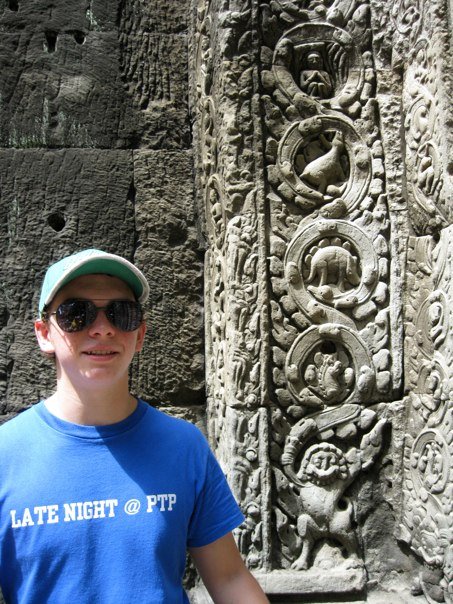
I have been to the Ankgor Wat temple complex, near Siem Reap, four times. It’s a fascinating tourist attraction, but there is one carving, among literally thousands, that stands out above the rest. It is found at Ta Prohm Temple. The temple was built between the late-1100s to early-1200s by King Jayavarman VII and dedicated to his mother. Today, it is “shrouded in dense jungle” and “fig, banyan, and kapok trees spread their gigantic roots over stones, probing walls and terraces” (tourismcambodia.com). “It took 79,365 people to maintain the temple including 18 great priests, 2,740 officials, 2,202 assistants, and 615 dancers” (ibid.). But it’s that stone carving that it most unforgettable.  One particular trip, which I made in 2009 with two elders, three deacons, and my oldest son, Gary, stands out in my mind.

I asked our guide, hired out by the Kazna Hotel in Siem Reap and of the Buddhist faith, what he thought this particular creature was. He said he had no idea what it was and added, “They must have had a really good imagination.”  The question such a response raises is, “How did they know to imagine that?!”

Well, a group from Canada was following close behind our group of seven from Denver, Colorado.  A son asked his father for an explanation of the carvings on the pillar, and dad replied with some authority, “Son, that was their version of a geological timetable.”  Of course, it begs the follow up, “How did 12th-Century Khmer people, well before Darwin and others planted their geological seeds, know of such a timetable?”  Furthermore, this “timetable” looks nothing like anything you will ever see in a textbook–a man above it and a monkey below it.  Based upon what fossil evidence did they create their carving?  There must have been hundreds of fellow “explorers” viewing these temple ruins with us in the few hours we were there.  Some of the fascinated people spoke in languages I cannot understand, but body language was pretty telling.  Others, Americans, British, Australians, and Canadians, all seemed to see that carving for what it most apparently was.  No one said, “That’s a rhino or pig.”  They called it a Stegosaurus.

How many other similar discoveries await reclamation from jungle vegetation, archaeological excavation, and geographic exploration?  In the different disciplines of science and history, man uncovers gems like Angkor Wat’s Ta Prohm from time to time.  Such clear, incontrovertible evidence from a time before our modern “war” between evolutionists and creationists begs to be examined with unprejudiced eyes.  While some may never change their mind regardless of how many items are offered into evidence, I believe that there are a great number of people out there who are honestly, objectively looking for truth.  The Stegosaurus at Ta Prohm near Siem Reap, Cambodia, might be the item that convinces many!

1937409_160820505921_3751983_n
Gary standing next to the column. Notice what/who else is in the carving with the Stegosaurus.

“I Know Who You Are!”

Neal Pollard

A rich detail in the study of the gospel of Mark is the testimony of the unclean spirits about Jesus. 

  • Mark 1:24—A man in the synagogue with an unclean spirit said, “What business do we have with each other, Jesus of Nazareth? Have you come to destroy us? I know who You are—the Holy One of God!”
  • Mark 3:11—“Whenever the unclean spirits saw Him, they would fall down before Him and shout, ‘You are the Son of God!’”
  • Mark 5:7—The man with the unclean spirit named Legion said, “What business do we have with each other, Jesus, Son of the Most High God? I implore You by God, do not torment me!”

In addition to these encounters, the gospel repeatedly shows Jesus’ power over the unclean spirits—He gave authority to the apostles over the unclean spirits (Mark 6:7), He healed the little girl with the unclean spirit (Mark 7:25), and He cast out the unclean “deaf and mute” spirit from the man’s son (Mark 9:25). Reading just those few accounts of Jesus’ power over them, no wonder they testified about Him! Who knows what they had seen of Him in the spirit realm that people on earth had not seen?  

Consider a few observations about these believing, confessing evil spirits we read about in the gospel record. 

Their faith exceeded the faith of the apostles, disciples, and religious leaders.  Jesus rebukes the absence and littleness of faith in the people who encounter Him, even those who were His closest followers. In Mark 8:28, so many were wrong about who He was. The disciples showed fear instead of faith or they missed the point on occasions where faith would have made things clear. How humbling for them that unclean spirits were crystal clear in their knowledge about Jesus. 

Their faith did not benefit them.  James’ epistle drives this point home. He writes, “You believe that God is one. You do well; the demons also believe, and shudder” (2:19). These unclean spirits were working against Christ. Just knowing who Jesus was did not save them nor did it make them submissive to Him.

Their faith is presented as a prominent proof of Jesus’ identity.  The miracles, wonders, and signs performed by Jesus help the apostles and disciples ultimately figure out who Jesus is. Peter would preach this (Acts 2:22ff). John would write this (John 20:30-31). Reading about this in the Bible, countless men and women through the centuries have believed based on the record about Jesus that includes His power over the spirit world. Mark presents these encounters to establish the fact confessed by Peter: “You are the Christ” (8:29).

How does this apply to us today?  First, let’s not let the world live with greater faith and understanding than we do. Second, let’s understand that merely understanding and believing the identity of Jesus will not save us. Faith must be accompanied by works. Third, may we allow the various proofs about Jesus to build and grow our faith and trust in Him, and by this yield a foundation which stands up to the fiercest storms (cf. Matt. 7:24-25). Let’s not merely say to Jesus, “I know who You are!” Let’s show Him!

kitab_al-bulhan_-_devil

Good Deeds

Neal Pollard

Good deeds don’t make the nightly news.  When a person serves or is nice to others, it rarely goes beyond the circle of occurrence.  That’s OK, because Jesus urges us, “Be careful not to do your acts of righteousness before me, to be seen by them. If you do, you will have no reward from your Father in heaven” (Mat. 6:1).

That probably wasn’t a problem for Titus, since the Cretans weren’t renowned for doing good deeds. In fact, a Cretan prophet said of his fellow-citizens, “Cretans are always liars, evil beasts, lazy gluttons” (Ti. 1:12). How would you like to live in a neighborhood or work on your job with such charming people as that? Paul calls them lying, wild, evil animals and slaves to their stomachs.

So, Paul spends some significant time in his letter talking about good deeds. There were some on Crete, particularly Jews, who by their deeds denied God and were “worthless for any good deed” (1:16). Thus, he urges Titus to show himself a pattern of good deeds (2:7). These deeds were not to earn salvation (3:5), but instead to please God. Notice how Paul emphasizes deeds in this letter.

  • Good Deeds Show The Right Example (2:7). I heard about a pair of identical twins.  One was a preacher and the other was a doctor. It was impossible to tell the two apart. A woman approached one of them and asked, “Are you the one that preaches?” He said, “No, ma’am. I’m the one who practices.” Paul tells Titus to show himself a pattern of good deeds in three areas: (1) Through sound teaching, (2) Through a serious life, and (3) Through his speech.
  • Good Deeds Show Where Our Passions Lie (2:14). Christ wants us zealous for good deeds. Wrongly directed zeal is destructive.  The Jewish zealots of the first-century helped bring about the demise of Jerusalem. But, a zealot with the right cause and conduct is powerful!  If we appreciate that we’ve been redeemed from every lawless deed (13), we’ll be zealous for good deeds. It should be natural for us, when saved from our sins, to be passionate about it to the point that our lives boil over with gratitude! That shows up in good deeds.
  • Good Deeds Show Our Faith In God (3:8). Paul urges Titus to share with all believers the need to be ready for every good deed (3:1). What will motivate us to do these good deeds? God’s mercy (3:5)! What will this motivate us to do? Share the good news (3:7-8). The world walks by sight and not by faith. Our challenge is to rise above that disbelief and show by our deeds our faith in the God who saved us from our sins! Our challenge is also to rise above the strife and division of those who profess to believe but whose lives yield evil deeds (3:9-11).  Doing good is broad and takes in the whole will of God for us, being all He wants us to be in marriage, parenting, the church, our neighborhood, the workplace, the nation, and in our relationships (cf. Titus 2). What will our good behavior in all these relationships tell others? Simply, that God is the guide of our lives and we put our trust in Him.
  • Good Deeds Meet Pressing Needs (3:14). Paul ends the letter by mentioning four Christians by name. The last two, Zenas and Apollos, would need financial help. Paul’s encouragement in Titus 3:14 seems directly related to this need. Whether it’s supporting missionaries or weekly giving, we are God’s hands on earth to help the needy when we give.

The old adage is true.  “Actions speak louder than words.” Paul writes of some who profess to know God, but in works deny Him. What a reminder that the Lord will not say, “Well said,” but “well done!”  Dorcas was a woman “full of good works and charitable deeds” (Acts 9:36). The woman with the Alabaster box did what she could (Mark 14:8).  What about us? What will be said about our deeds?