God’s “Seal Training”

Jon Paschal

During the mask era, while I was playing on social media, I found this inspirational speech made by Navy Seal Admiral William H. McRaven during the 2014 University of Texas in Austin commencement.

Most of you are aware that the Navy Seals make up the tip of the spear for our military. Although I do not have the distinction of having trained with them, I have known a few and I can tell you they are some of the most tested, battle hardened, and confident men you will ever encounter.

Wouldn’t it be great to have similar confidence, spiritual fortitude, and faith like a seal has? I believe this is the faith described by Jesus in Matthew 17:20 and displayed by Peter as he steps from a boat of full of scared men out on to the waves of the lake in a storm expecting walk on water to his Lord.

I highly recommend you listen to the admiral’s speech. His 10 key points are very similar to a lot of Bible lessons.

1. Start off by making your bed. This may sound a little silly, but the premise is that if you complete something simple it can build a level of confidence. This confidence carries with you through the day as you attempt to overcome harder tasks. -This is a lot like little prayers before you start on a difficult task. Just like Nehemiah asking for direction, protection, and strength, I guarantee a short plea to God will be way easier to accomplish than anything else you do. And the knowledge that you have requested the assistance from God, the one entity that can make you overcome all obstacles is quite comforting. His will might not be for you to succeed every time, but by asking you have a better opportunity than not asking and it will bring you closer to the Lord.

2. Find someone to help you paddle – This is a lot like Hebrews 10:24-25: “Let us consider how to stir up one another to love and good works”.

3. Measure a person by the size of the heart, not the size of their flippers – This is a lot like Matthew 7:15-20 where Jesus says to measure a person by their fruits.

4. Get over being a sugar cookie and keep moving forward. When the admiral failed in BUD/S training, he ended up wet and covered with sand or, as he referred to, as a sugar cookie. -Basically, sometimes no matter how hard you try you still fail. And even though you fail we must be like Paul in Philippians 3:13-14 “forgetting what lies behind” and “press on toward the goal”.

5. Don’t be afraid of the circuses. Circuses are the extra work that the would-be seals must do when they fail a test to build strength. – And like in James 1:2-4 these extra trials produce steadfastness and make you complete.

6. Sometimes you have to slide down an obstacle headfirst – basically you must use your personal skills to do things more efficiently. In Matthew 25:14-32 the 5 and 2 talent men illustrate this point.

7. Don’t back down from the sharks – This story exemplifies overcoming fear like Deuteronomy 31:6: “Be strong and courageous… for it is the Lord your God who goes with you.” Or Isaiah 41:1-20, which says, “Fear not, I am the one who helps you”

8. You must be your very best in the darkest moment- This lesson is similar to what Paul provides to Timothy in 1 Timothy 6:11-16 “Fight the good fight of the faith”

9. Start singing when you’re up to your neck in mud- Singing can help lighten a mood and strengthen your resolve. I believe this is why Psalm 96 teaches us to sing to Lord, daily.

10. Don’t ever, ever ring the bell. – Never give up. Look at the stories of Job, the apostles, and Jesus. All went through great adversity and never stopped praising God.

Although most of us will never be a navy seal, we can take the admiral’s stories along with what the Bible has taught us to do our part in changing the world and make us better Christians.

Jesus: The Captain of Our Salvation

Brent Pollard

For it was fitting for Him, for whom are all things and by whom are all things, in bringing many sons to glory, to make the captain of their salvation perfect through sufferings.” (Hebrews 2.10 NKJV)

Hebrews has a powerful picture of Jesus that stands out for its clarity and brilliance. The book of Hebrews refers to Jesus as the captain of our salvation. To truly comprehend the breadth and scope of this title, we must first understand the Greek word some translators render captain – “archegos.”

When applied to a person, “archegos” indicates that they are the first in a line of characters or events. Jesus made our salvation possible and is the perfect savior. Furthermore, the term can refer to the originator or founder of something significant. Using the word “captain,” the translators of the King James Version intended to highlight Jesus’s role as a leader and guide for Christians on their spiritual path.

The book of Hebrews extols Jesus’ important role as our high priest and the leader of our faith, demonstrating the way forward by enduring suffering and ascending to glory. This illustration is symbolic and closely resembles the role of a captain in an army, historically and today.

The Captain’s Charge on the Battlefield

A captain in the military is responsible for a wide range of duties. A captain is responsible for overseeing the execution of orders from higher ranks by a company of anywhere from 75 to 100 soldiers in the United States military. The parallel is Jesus’ dedication to carrying out the Father’s will (John 5.30).

In the heat of battle, a captain must put their strategic abilities to the test. They must assess circumstances quickly, make immediate decisions, and modify strategies. Jesus is our compass, showing us how to break down the barriers of sin and live a righteous life.

Furthermore, a captain ensures that his troops are well-supplied, whether with ammunition, food, or medical supplies. This provision is echoed in Jesus’ teachings, where He promises abundant life, is our eternal bread and water, and is the source of all spiritual blessings (John 10.10, 6.35; 7.37; Ephesians 1.3).

The captain has an essential role in raising morale among the troops. A soldier’s hope and confidence can turn the tide of battle. Jesus encourages us on our spiritual journey by assuring us that He has already conquered worldly challenges (John 16.33).

The captain acts as a liaison between the higher-ranking officers and the troops, facilitating effective communication and meeting the needs of both sides. In 1 Timothy 2.5, we learn that Jesus mediates between us and God.

Lastly, captains lead from the front, setting examples of bravery, decision-making, and resilience. In His life and teachings, Jesus exemplifies these characteristics, encouraging us to follow in His footsteps (John 13.15; 1 Peter 2.21).

In Conclusion

By comparing Jesus to a captain, we can better understand His unrivaled role as guide, leader, and supporter on our spiritual voyage. We are more than just soldiers with Jesus as our leader; we are more than conquerors (Romans 8.37). We must put our faith in the One leading us to eternal glory, the Captain of our Salvation.

The End Is Near?

Gary Pollard

The message of I Peter could be summarized like this: God calls us to endure suffering, just like Christ suffered. He calls us to live morally pure lives, if for no other reason than our fear of dying in a lost state. We can live morally pure lives through exposure to his word and through submission to each other. We have no idea how much time we have, so we should make the best of it. 

The key verse of I Peter is 4.7 — The end of all things is near. Keep your minds clear and control yourselves. This will help you in your prayers. 

Several times throughout the letter, Peter warns them of their impending suffering, which would cause many of them to die. He uses what sounds like military terminology in a few verses, the kind of pep-talk a leader would give his soldiers before doing battle. “Many of you won’t make it through this. What’s more important than this life is how you live it, because this life isn’t the end for any of us.” 

Over the next few weeks, we’ll do an application-based study of I Peter. For those interested in reading more than will be discussed in these articles, I highly recommend using the Easy to Read Version (free on biblegateway.com and on their app). It does a fantastic job of relaying the full meaning of the original text using language a child could understand.

Weak Is Strong

Wednesday’s Column: Third’s Words

Gary Pollard

The United States of America has one of the most powerful militaries on earth. Its funding, equipment, and training are second to none. Most countries understand that head-on attacks against the US armed forces are impossible – even our greatest enemies have a healthy fear. That said, asymmetric warfare has thwarted even our great military. Hostile groups with long-obsolete, repurposed equipment have made decisive victory nearly impossible.

Their tactics often involve war crimes/crimes against humanity, so these groups serve as an illustration of a point and nothing more. They will answer to God for their crimes. The point is this: God often displays great power through insignificant, weak people.

God worked through Paul’s weakness to grow the church (II Cor 12.9).
God saved the world as an impoverished person (Matt 8.20).
God designated the poor to great faith and eternal life (Js 2.5).
God included uneducated, blue-collar men in his group of closest followers (Acts 4.13).
God considers service-oriented people to be the most important (Matt 20.26).
God used Job as an example of endurance, proving his power when Job was at his lowest (1.9, 22).

All of us will face issues that are way beyond our power to handle. In those moments, remember that God does incredible things through insignificant people.

Exaleipsei

Wednesday’s Column: Third’s Words

Gary Pollard

Jesus is the great healer and the Bible is full of passages that comfort, encourage, give endurance, and help us cope with a broken world. It’s full of so much more! A higher purpose gives us existential meaning, and the Bible outlines that purpose. It also has a few passages that fire me up, and those are the ones I want to share today.

Revelation 21

This is our reason to live the Christian life (Matt 19.28; Rom 8.18-25; I Pet 1.3-7, 13; 4.12-19; II Pet 1.3-4, 10-11; 3.3-13; I Jn 3.1-3). We’re looking forward to something much better, but what kind of stuff are we looking for?

  • –  Zero dysfunction! No pain, grief, disease, crime, taxes, tornados, war, death in general, aimbots (if you know you know), etc.
  • –  God gets rid of tears (Rev 21.4)! The context is a message of hope for early Christians who were dealing with devastating loss. But God will ἐξαλείψει all tears. Exaleipsei is future (will happen), and seems to be a comfort word. I had always pictured a Men in Black kind of thing, where all painful memories are obliterated and new ones made. But the word seems to indicate that an interaction with an infinitely compassionate Father will be more than adequate to get rid of any pain. If you’ve ever comforted a spouse or child who was grieving and physically wiped their tears away, that’s what this word describes.
  • –  Everything is brand new (21.5)! None of the junk that we’ve dealt with here will be compatible with our new home.It will be wildly exciting: the best accomplishments of each nation will be there (21.25-26). God and his son provide all we need (21.22-24). True unity exists because we’ll all be on the same side (21.27). No need for healthcare or accountants or coroners or search and rescue or militaries or law enforcement! Those exist to push back against evil, which won’t exist in our new home. Revelation 21 is a rich chapter, but it’s full of excitement! God doesn’t speak empty words. Take him at his word and read the chapter very carefully. It’s hard to walk away from that study without getting pumped for heaven!!!

The Good, The Bad, & The Lucky

Tuesday’s Column: Dale Mail

Dale Pollard

In 1951, two to three miles off the coast of Point Reyes, California, a military plane went down after battling faulty electrical issues and then eventually running out of fuel. The plane made a crash landing in the ocean and to make matters a little more terrifying, it was a Great White shark haven. There was one Army service man who managed to escape the aircraft, but once in the water he had no idea where to go. It was in the early morning and the fog was too thick to see through. Knowing he had to do something, he simply chose a direction and began to swim. After a couple of miles of swimming he finally, to his relief, reached land. Later on in life he’d go on to become the star of several Hollywood movies, direct his own movies, and even star in movies that he himself directed! His name was Clint Eastwood. 

He got lucky. Occasionally, that happens in life. We flip a coin, spin a bottle, or make a random turn and it all ends up working out in the end. Accidental fortune might happen in some areas of life, but not when it comes to our spiritual lives. There won’t be anyone in heaven who says, “I have no idea how I got here. I just randomly went through life and made the right choices, I guess!”

 If we’re looking for a deeper faith, a closer walk with God, or directions along the narrow way, we’ll have to be intentional about that. 

Psalm 25:5 reminds us that not only does God guide us into all truth, but that this is a path that must be taught. 

Roy Benavidez: Cheating Death For A While

Monday’s Column: Neal At The Cross

pollard

Neal Pollard

Thanks to MrBallen, popular millennial YouTuber, I reacquainted myself with the incredible story of Roy Benavidez through his video, “This man died 37 times.” His story, from childhood to death, is incredible. But it was his heroic acts on May 2, 1968, serving in Vietnam as an Army Special Forces Airborne team that he survived his most incredible, heroic feats. He was shot, hit with grenade shrapnel, bayoneted, and clubbed with numerous injuries so serious that at one point he was mistakenly put into a body bag, presumed dead. He charged with a helicopter rescue team so suddenly that he left his machine gun behind, armed with only a Bowie knife. He ran repeatedly into enemy fire at point blank range and continued bouncing back until he successfully rescued eight soldiers who undoubtedly would have been killed without him. When Ronald Reagan gave him the Medal of Honor 13 years later, he told White House Reporters, “You are going to hear something you will not believe if it were a script.” The Mexican-American orphan, raised in poverty and determined to serve his country, stared death in the face armed with little more than a devout faith and a devotion to his fellow soldiers. This after stepping on a land Mine in 1965 on his first tour of duty, after which doctors proclaimed he would never walk again. To the utter disbelief of medical personnel, he walked out of the hospital less than a year later and had qualified for special forces less than two years after that (additional information via psywarrior.com).

Schools, parks, and even a Navy ship have been named in his honor. He was often referred to as the man who could not be killed. He is a military legend. But, ultimately, in 1998, diabetes did what an array of enemy fighters trying their hardest could not do. It took his life. 

No one would want people to know this divine fact more than Mr. Benavidez would: “…it is appointed for men to die once…” (Heb. 9:27). Solomon adds, “For the living know they will die” (Ecc. 9:5). The sons of Korah echo, ” For he sees that even wise men die; The stupid and the senseless alike perish..” (Psa. 49:10a). The message is clear. One may evade death repeatedly, but not ultimately. Only the second coming of Christ will avert the unpreventable appointment with death (cf. Gen. 3:19). 

What can and must be prevented is what the book of Revelation four times refers to as “the second death” (2:11; 20:6,14; 21:8). It is powerful, painful, and punishing. But it’s avoidable. Christ died to defeat the power of physical death and the justice of spiritual death (Heb. 2:14-15). Jesus is the greatest hero of time and eternity, who faced death and overcame it to live forevermore and offer eternal life to those who follow Him (Mat. 16:24-27). He faced the worst that the most powerful enemy of all could throw against Him, and He utterly defeated him and  it. We needed rescue, and Jesus delivered us. Surely no one who understands that would choose to remain where he or she will eternally die. Physical death is sure. Spiritual death is not. God still pleads, “Choose life in order that you may live” (Deut. 30:19). 

Is Peace Possible?

By Gary Pollard

Wednesday’s Column: Third’s Words

Peace conjures a number of different images in our minds; from hippies to nature’s beauty to inner calm to lack of anxiety. Nearly every group of people in the world craves peace as no rational human being wants to live in constant upheaval. We all want to have peace, but our world somehow is still getting worse and worse. Why is this? The prince of this world is not a being who desires peace (II Corinthians 4.4; Ephesians 2.2; John 12.31). His very existence is dedicated to bringing down anyone who believes in God (I Peter 5:8) and he has no care or concern for the fate or well-being of anyone on this earth. Total, lasting world peace will never be possible as long as time continues (see Romans 8.18-25: sin caused the earth to be subjected to futility).

Total, lasting world peace may not be possible in this life, but this does not mean the world cannot experience any peace at all. How can we experience peace in our lives?
Firstly, it has to come from us. The world will never act in a way that brings peace. Anytime the world wishes to better its conditions, it incites civil unrest in the form of riots, protests, and other not-very-peaceful behaviors. Christians, however, are called to be different. I Timothy 2.1ff tells us that praying to God on behalf of all men, for kings, and all who are in authority, will allow us to lead quiet and tranquil lives in all godliness and dignity. We can have peace by being obedient to government authorities – even if we do not agree with them politically – because God put them in place (Romans 13). If we want peace, we have to show that peace by how we live. Since man is naturally attracted to peace, our quiet, godly lives will draw others to Christ.
Secondly, even if our world is in chaos we can have inner peace. Philippians was written to break up a nasty fight between Euodia and Syntyche. To have the “peace beyond what we can understand,” they had to rejoice in the Lord, be reasonable, not be anxious, and reach out to God for their every need. The same applies to us today! Do we get our joy from God or from worldly pursuits? Are we worried about meeting personal needs or do we rely on God (see Phil. 4.19; Matt. 6.25)? Do we try to fix our own problems, relying on our own strength, or do we place them in God’s hands and work with His guidance and providence? The Christian life is not easy, nor is it always peaceful, but the inner peace that a faithful Christian experiences, knowing that his/her name is in the book of life and that nothing in this short life can disrupt God’s love for them makes every struggle in this life worth the pain.
If we want peace we have to be that peace. We have to live peaceful lives. We have to submit to governing authorities (as long as it is within the parameters of godliness). We have to be unified as a church. We have to look to God for all of our needs. We have to trust that He will take care of us, even if that isn’t in this life. If we can do these things, we will have peace.

In Their Steps (Poem)

Neal Pollard

They fought a fight of sacrifice
On land, by air, and sea
Privation, starvation, an awful price
To guard our liberty

Some were cut down in prime of life
Others came home with scars
They faced great fears and perilous strife
For country, for stars and bars

We owe a debt of gratitude
We never could repay
May we have a humble attitude
This aptly named Memorial Day

And looking backward to a different nation
One more ancient, but still existent
We are humbled by their proclamation
Of their allegiance most persistent

They gave their lives in spiritual war
Fighting the wily adversary
Faithful unto death, this sanctified score
Wore their armor, though the battle was scary

We walk behind these noble groups
One in nation, the other in doctrine
Our lives should be changed by these gallant troops
We should be better because of this squadron

Each reminds us that freedom is not cheap
Each shows us the greatness of service
If fidelity is sown, then great honor we reap
Cowardice would do them both disservice

May we step forward, the church of our Lord
While these freedoms remain to us all
And share Christ boldly, with vigor restored
And answer our Chief Commander’s call!

0ca8082c69414c56efb550d71f3e64a8

Tora! Tora! Tora!

Neal Pollard

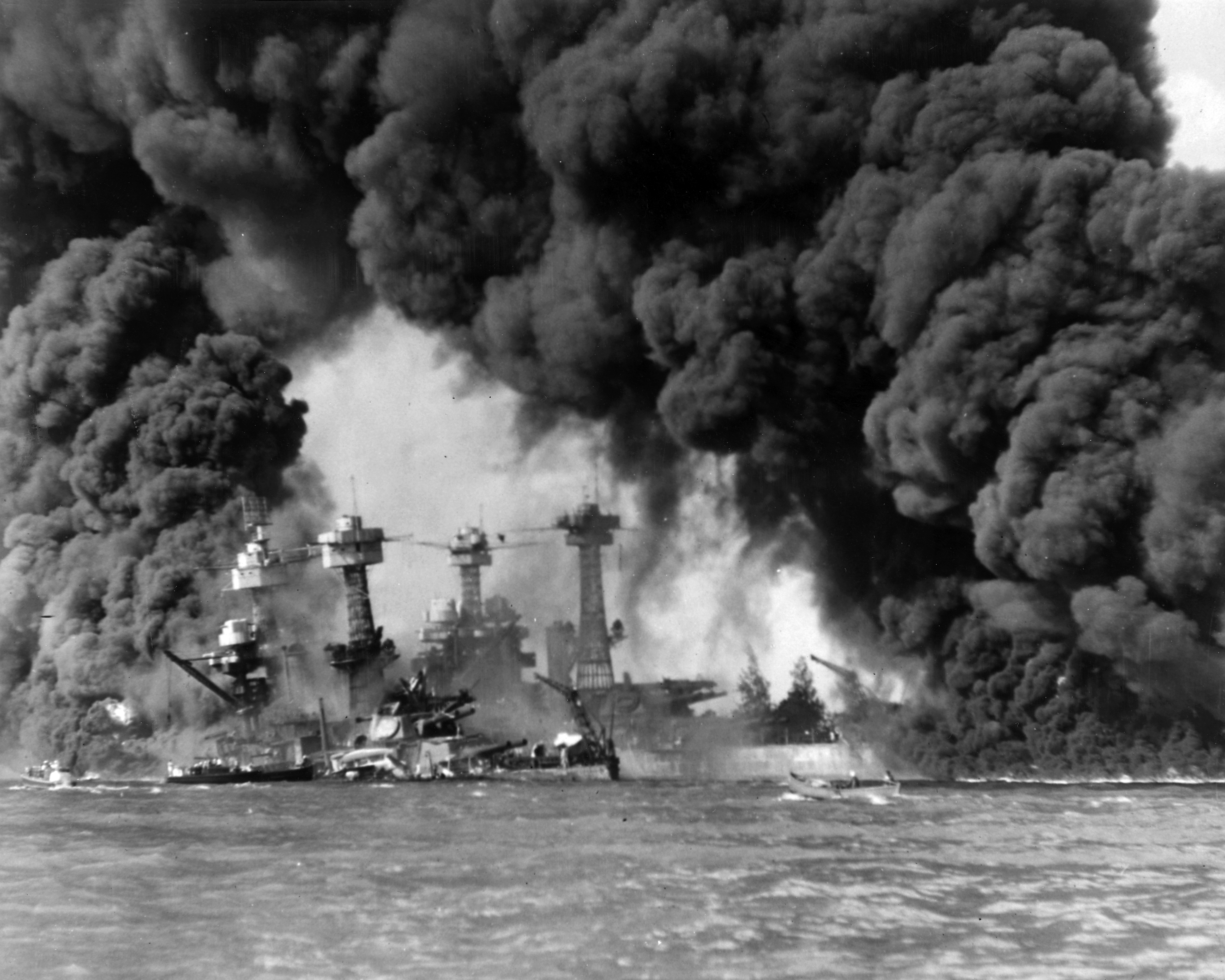
Today marks the 75th anniversary of the attack on Pearl Harbor, the event which drew our country into World War II. 2,343 men were killed, 1,143 were wounded, and 960 unaccounted for or missing. The Japanese chose Sunday to attack as it was the most relaxed day of the week for the servicemen. Many were still in their pajamas or having breakfast when the attack began at 7:55 that morning. Kermit Tyler, an Air Force lieutenant serving as the officer on duty that morning, told the radar operator not to worry about the large blip on the radar screen. He thought it was a flight of U.S. bombers coming from our mainland. Instead, it was the first wave of attackers. Captain Mitsuo Fuchida, the airstrike leader for the Japanese carrier force, could see that Pearl Harbor was totally unaware of the impending attack. He radioed back a coded message, repeating an abbreviated word three times—“to ra, to ra, to ra”—meaning “lightning strike.” The transmission began at 7:49, undetected by the soon-to-be victims of the attack that began a mere six minutes later (read more here).

Among so many significant facts, what we most remember about the attack on Pearl Harbor was how utterly surprising it was. No one stood vigil, considering the possibility of it. Like its later counterpart, “9/11,” and even natural catastrophes like Pompeii, the Galveston hurricane, the 2004 tsunami, or Mexico’s El Chicon volcano, serious and deadly events can occur without warning. With our most sophisticated technology and detection systems, we are without the ability to forewarn about the greatest surprise that will ever be.

Paul says that the resurrection of the dead of all time will occur “in a moment, in the twinkling of an eye” (1 Cor. 15:52). Paul and Peter both refer to “the day of the Lord” as that which will come “as a thief in the night” (1 Th. 5:2; 2 Pet. 3:10). Jesus warned that the day could be a disaster, a trap that comes on one “suddenly” (Luke 21:34). He taught that it will come at an hour unknown to everyone (Mark 13:32-33).

While it will surprise everyone, the coming of Christ will be a devastating event for the great majority of mankind. For them, it will infinitely exceed the loss of physical life. It will be an everlasting loss (Mat. 25:46; 2 Th. 1:9). Yet, God has made preparation eminently possible. He desires escape for everyone (2 Pet. 3:9). One can be prepared for that day and be saved from harm and for something inexpressibly superior. Those of us who have discovered the way of preparation must hold fast to it (cf. Heb. 3:6) and strive to share this vital information with as many as possible. The sudden coming of Christ need not be a defeat, but can instead be the harbinger of the greatest victory ever.  May Paul’s inspired exclamation be our song of victory: “Death is swallowed up in victory. O death, where is your victory? O death, where is your sting?” (1 Cor. 15:54b-55). Amen. Come, Lord Jesus (Rev. 22:20)!

burning_ships_at_pearl_harbor

THE ULTIMATE “HATE SPEECH”

Neal Pollard

A couple of days ago, many of the major conservative news outlets broke the story of former Navy SEAL and current chaplain Lt. Col. Wes Modder who was removed from duty and threatened with expulsion from the military.  An office assistant, a young lieutenant junior grade officer, showed up last December with two “Equal Opportunity representatives and a five-page complaint documenting grievances against the chaplain” (foxnews.com). The officer, who turns out to be homosexual, had constantly drilled Modder with questions about his views on the matter. The ensuing handling of the case appears very unfavorable for a person in a position of spiritual guidance trying to use the Bible as the guide in helping people with right and wrong on such matters as sex outside of marriage and homosexuality.

Time will tell how this plays out, but we are living in different times.  It appears that one of the more unconscionable crimes against society is to promote an objective standard of right and wrong which dares to call specific behaviors and lifestyle choices “sinful.”  Readers of my blog have written me and told me they have seen posts of mine occasionally labeled as “hate speech” (I would invite the reader to peruse my archives in search of inflammatory, derogatory, or unkindly written articles).  I have seen writers who would profess to be Christian and/or religious who are caustic, obnoxious, and unnecessarily offensive in tone and manner.  Such hurt the cause of Christ and do not reflect His spirit.  Hateful speech is, by biblical standards, sinful speech.  Scripture speaks against it (Gal. 5:20; Eph. 4:31; Col. 3:8).  It also exalts godly speech: “Sweetness of speech increases persuasiveness” (Pr. 16:21), “Let your speech always be with grace” (Col. 4:6), “In speech…show yourself an example of those who believe” (1 Tim. 4:12), and be “sound in speech which is beyond reproach” (Ti. 2:8).

But, when we let the world—without knowledge of what the Bible actually teaches—define “hate speech,” we will often get things turned upside down.  We will have evil called good and good called evil (Isa. 5:20).  We need to remain convicted in the belief that nothing could be more hateful toward a person than to have the opportunity to tell them the truth about anything God has revealed in Scripture and speak lies, whether to comfort, avoid offending, or to validate what God will not condone.  We must reach out to anyone who rebels against the will of God in love, but what could be more hateful than encouraging anyone along a path that leads away from Him?  Any word of false comfort and hope is the ultimate hate speech!

BRAVE MEN IN BELLEAU WOOD

Neal Pollard

In March, 2006, I spent nearly an hour walking in Belleau Wood, a 200 acre tract behind the Aisne-Marne American Cemetery about 50 miles east of Paris, France, accompanied by Kathy as well as the preacher for the Eglise du Christ in Paris, Roland Mohsen. Seeing the World War I cemetery, chapel, and memorial was exciting for me, given not just my love for history but my special interest in “The Great War.”  It was in those woods that the U.S. Marines made their first big impression on the whole world.  At a 1923 ceremony for an American battle monument there at Belleau Wood, the Army General who led the Marines in the decisive battle against the Germans, James G. Harbord, said this:  “”Now and then, a veteran … will come here to live again the brave days of that distant June. Here will be raised the altars of patriotism; here will be renewed the vows of sacrifice and consecration to country. Hither will come our countrymen in hours of depression, and even of failure, and take new courage from this shrine of great deeds” (Kozaryn, Linda. “Marines’ First Crucible: Belleau Wood.” 6/18/98. Armed Forces Press Service).

The Marines won a hard-fought victory, at great price requiring such persistence. The memorial erected on that ground has been an inspiration for countless soldiers as well as those from many nations who have stood at that spot.  Now, almost 100 years after the battle, memories have faded and fewer go to that spot for inspiration despite the predictions of General Harbond.

For the last several days, I’ve been mentally devouring the sermonic masterpieces of men like V.P. Black, Franklin Camp, Roy Lanier, Bobby Duncan, Wendell Winkler, and others at a great audio site called preachersvault.com. Most of the men on that site have transitioned from time to eternity.  My heroes have always been preachers, and I appreciate the depth of understanding and motivational value found in listening.  I recall the incredible blessing of attending the 1988 Faulkner University Lectureship, where brother Winkler invited men who at that time were 65 years old and older.  Only 18 years old, I sat with my dad, who was also in attendance, to hear Camp, Black, Hugo McCord, Winfred Clark, Rex Turner, Sr., Bob Hare, Leroy Brownlow, George DeHoff, Basil Overton, and many others.  Over a quarter-century later, I still revel in the memories of those lessons.

Military memorials may begin to fade with time, but the value of good Bible teaching only grows with the passage of time.  There is great reward in taking the time to sit at the feet of seasoned students of Scripture, drawing from their deep wells of knowledge.  These opportunities are not just relegated to days gone by and various media selections.  Try prepared, studied Bible class teachers, guest speakers, and local preachers. Those of us in those positions need to be challenged to go deeper and make truth live more powerfully.  Those of us who hear need to value this treasure in earthen vessels (2 Cor. 4:7).  Won’t you reserve a few spots in your heart for heroes whose weapon is the sword of the Spirit?

(L-R): Kathy Pollard, Gary Pollard III, Wendell Winkler, Betty Winkler, Shellie Holder, Clay Holder, and Jacob Holder (1994, Livingston, Alabama)

“Go To The Ant, You…DARPA?”

Neal Pollard

The Defense Advanced Research Projects Agency was formed in 1958 for technological advancements and has been responsible for so many of the gadgets and conveniences we enjoy today. They use a variety of means to “both advance knowledge through basic research and create innovative technologies that address current practical problems through applied research” (darpa.mil). SRI International, one of the agencies DARPA partners with, “has taken inspiration from the giant mound of insects, to create their own swarms of tiny worker robots that can put together mechanical assemblies and electronic circuits” (Michael Trei, dvice.com). The military has given thought to using these robots to rebuild and repair, even in the midst of battle.  Who can foresee where this technology may show up in our daily lives?

People can be incredibly brilliant and innovative.  There is no limit to our imagination and invention.  Yet, this (and many other examples) points up to God in at least two ways.  First, our intelligence points to an intelligent designer. Moses informs us that we are made in the very image of our Creator (Gen. 1:26-27).  Second, our brightest developments and designs are drawn from what God’s created world.  Solomon once admonished, “Go to the ant, O sluggard, Observe her ways and be wise, Which, having no chief, Officer or ruler, Prepares her food in the summer And gathers her provision in the harvest” (Prov. 6:6-8).  They say imitation is the highest form of flattery.  How ironic that in a world growing more unbelieving, mankind keeps paying tribute to the wisdom and power of the One who made it all.

WAITING EIGHTY-SEVEN YEARS FOR A MEDAL

Neal Pollard

Ernest Pusey was the third-oldest person in the world the day he died at age 111 on November 19, 2006. Nine days before, the man who had worked 32 years for General Motors and drawn retirement for 48 years entertained a visit from Florida Governor Jeb Bush. Bush was delivering something a bit overdue to Pusey-the Victory Medal he had earned from fighting in World War I from 1917-1919. He was a sailor in the Navy, charged with patrolling the seas around the British Isles. He went to church each Sunday and was able to walk from a friend’s car into his trailer (he preferred living there to nursing homes). A man extraordinary for longevity and survival, “Ernie” was a true hero remembered by his country on Veteran’s Day if a bit overdue.

Repeatedly, Bible writers speak of our Christian service in military terms. We are like soldiers, not serving at our own expense (1 Cor. 9:7). Epaphroditus (Phil. 2:25) and Archippus (Phile. 2) are referred to as Paul’s “fellow soldiers.” Paul urges young Timothy to behave properly as a soldier of Christ, telling him to endure hardness and avoid entanglement in the affairs of daily life (2 Tim. 2:3-4). Our Christian soldiering is implied through the imagery of the “whole armor of God” in Ephesians 6:10-17. But, when do we receive our “honor” and reward? We may want the world to appreciate and acknowledge our faithful service in our battle for souls, but that will not happen. We may suffer and struggle on the battlefield, stuck in the anonymity and anxiety of the trenches without fanfare or commendation. We will have to wait what seems like a long time before receiving “official recognition” for our tour of duty. Yet, our reward will be imperishable (1 Cor. 9:25) and eternal (1 Thes. 4:17)! Don’t lose heart. God will not forget your service for Him (Heb. 6:10).