Why The Restoration?

Gary Pollard

As I’ve mentioned in a previous article, a well-intentioned man named Rufinus made significant changes to Origen’s writings when he translated them from Greek into Latin. Unfortunately, the overwhelming majority of what has survived to this day is Rufinus’s Latin text. My goal in this series is to restore the text as it would’ve been read in Greek — before Rufinus’s sometimes radical changes. 

So how does anyone restore a text if most of it’s in Latin? Thankfully, sections of these books have survived in the original Greek — especially Book III. This allows us to read the Latin and Greek texts side-by-side. Rufinus was also kind enough to write a preface for Book III, explaining further why he made the changes he made. 

To be abundantly clear, I am not qualified to do serious textual criticism. While I’m interested in Greek and have studied it for some years now, I’m not nearly competent enough to do this unaided. For several weeks, I painstakingly worked on the text of Book I using the resources at my disposal (most helpfully Dr. Begley’s dissertation containing a critical apparatus for De Principiis). I compared this to what survives of Peri Archon, as well as Philocalia

Then I used ChatGPT 4 to read every scrap of Greek text written by or quoting Origen himself. From this, ChatGPT was able to make a profile of the way Origen thought and spoke, and what he believed. It would flag texts that appeared to be redacted based on several criteria — e.g. words, traditions, teachings, or beliefs that weren’t seen prior to the 4th century, and the use of Latinisms. I check these flagged texts myself, especially when they may be controversial. AI fatigue is real, and I’m no AI apologist. However, the fact that some are now far more “intelligent” than any one human is well-established. This should keep my own bias out of the text as much as possible, and has provided a very helpful critical apparatus. 

To demonstrate how needed this textual restoration is, I will share Rufinus’s Preface to Book III and a single verse of the same book translated from both Latin and Greek. I highly recommend reading an interlinear translation of Book III on your own so you can see the more egregious errors for yourself.

Preface of Rufinus, Book III

Reader, remember me when you pray so we may both emulate the spirit. I translated the last two books on The Principles, not only because you asked me to, but also because of the pressure you put on me during the days of Lent. Since you, my devout brother Macarius, were living closer to me and had more free time back then, I worked even harder on the books. It has taken me longer to translate these last two books, partially because you now live far away and haven’t had to hurry me on. 

Don’t forget what I warned you about in my first preface — some people will get angry if I don’t speak evil of Origen. I’m sure you’ve already experienced this yourself! But if those daemons who compel people to slander are so enraged by Origen’s first two books (in which he has not yet fully revealed their secrets), what do you think they’ll do about these last two? In these books, Origen exposes all of the dark and subtle ways that they take over the hearts of men, and deceive weak, unstable souls. 

You should expect to see many things thrown into confusion, seditions stirred up, and plenty of fuss raised. You should expect the person who makes these texts available to be summoned for condemnation; what do you expect when someone tries to dispel daemonic darkness with the light of the Gospel? 

This isn’t a big deal for anyone more concerned with being trained in divine learning, though. We just have to maintain the integrity of the rule of Catholic faith while we do so. I’ll remind you that I’m still observing the same principles I did in the former two books: 

  1. I won’t translate anything that appears to contradicts Origen’s other teachings. 
  2. I won’t translate anything that contradicts our own beliefs. I’ll skip those as if they were forged by others. 

If he talks about intelligent beings (a subject that does not threaten the essence of our faith), I’ll keep those texts for the sake of discussion and of adding to our knowledge. If I have to refute some heretical opinions, I’ll mention them. If he repeats the heresy in another book, I’ll just omit it. 

If anyone wants to read these passages purely to expand their knowledge (and not to raise stupid objections), it would be best to have someone qualified explain it to them. Who would use a grammar expert to explain the finer aspects of poetry or comedy? Who tries to learn things spoken by God or the “heavenly virtues” without a master interpreter? It’s too easy to make mistakes and fall into some pagan error or heresy. 

It is typical human nature to harshly and ignorantly condemn things that are obscure and difficult, rather than to try to understand them fully through great effort and study. 

Book III, 3 from Greek: 

Human beings, unlike other animals, not only have imagination but also reason. Reason helps us judge our thoughts and mental images—it rejects some and approves others—so that we can act according to sound judgment. Because reason naturally helps us recognize virtue and vice, we can choose good over evil. When we choose to live rightly, we deserve praise; when we choose the opposite, we deserve blame.

Still, we shouldn’t ignore the fact that different creatures have these abilities in varying degrees. For example, hunting dogs and warhorses have instincts that come surprisingly close to reason in some ways. Now, when something outside of us triggers a thought, feeling, or impulse, that’s not something we can always control. But what is within our control is how we respond—whether we decide to use that experience in a good way or a bad one. This power of choice belongs only to our reason, which can guide us either toward what is virtuous and fitting or away from it.

Book III, 3 from Latin: 

Human beings, unlike other animals, not only have natural instincts and impulses but also possess reason to a much greater degree. This reason allows us to judge our natural urges—rejecting some and approving others—so that our actions can be guided toward a good and honorable life. Because reason enables us to tell the difference between right and wrong and to choose what we recognize as good, we deserve praise when we make good choices and blame when we choose what is evil or shameful.

It’s worth noting, though, that some animals seem to act with a kind of order or intelligence—like hunting dogs or warhorses—which might look like reason. But this isn’t truly rational thought; it’s an instinct they’ve been naturally given for their particular roles.

As we’ve already said, since human nature is rational, certain things can happen to us from the outside—through sight, hearing, or our other senses—that stir us toward good or bad thoughts and actions. Because these things come from outside ourselves, we can’t control their arrival. But we can control how we respond to them. It’s the job of our reason—our inner judgment—to decide how to use these experiences. Guided by reason, we can direct our natural impulses toward good actions or, if we choose poorly, toward the opposite.

Halloween: A Reflection on Darkness and Light

Brent Pollard

A Matter of Personal Conviction

Whether or not a Christian should take part in Halloween festivities is ultimately a matter of personal conviction and conscience. As Paul wrote, “Each one should be fully convinced in his own mind” (Romans 14.5). I respect that there is a difference between believers attending wholesome community events—such as church-sponsored “trunk-or-treats”—and those who embrace the world’s fascination with the macabre. However, I want to caution Christians not to join the world in celebrating darkness, fear, and death.

Jesus taught that His followers are to be “the light of the world” (Matthew 5.14). How can we reflect His light if we participate in a celebration that often glorifies the very darkness we are called to overcome (Ephesians 5.8–11)?

The Pagan Origins of Halloween

Halloween’s origins trace back to the Celtic festival of Samhain, which marked the end of the harvest and the start of winter. The Celts believed that on this night, the barrier between the living and the dead weakened, allowing spirits to roam freely. To protect themselves, they lit bonfires and wore disguises to confuse wandering souls.

Scripture repeatedly warns against attempts to communicate with or ward off the dead. God told Israel, “There shall not be found among you… a medium or a necromancer or one who inquires of the dead” (Deuteronomy 18.10–11). Though today’s observance may seem harmless, its roots were steeped in superstition and fear of spirits rather than faith in God’s providence.

Roman Influence and Ancient Traditions

When Rome conquered Celtic lands, two Roman observances were merged with Samhain—one honoring the dead (Feralia) and the other celebrating Pomona, the goddess of fruit and trees. Some historians suggest that the custom of bobbing for apples originated from Pomona’s symbol, the apple.

This blending of pagan and civic ritual was typical of the ancient world. Yet Christians are urged not to conform to the world’s customs (Romans 12.2) or mix holy devotion with pagan superstition (2 Corinthians 6.14–17).

The Catholic Church and All Saints’ Day

In 609 AD, Boniface IV consecrated the Roman Pantheon to “All Saints,” creating a day to honor Christian martyrs. This celebration, later shifted to November 1 in the eighth century by Gregory III, is now called All Saints’ Day or All Hallows’ Day. The night before—All Hallows’ Eve—gradually evolved into “Halloween.”

Later, All Souls’ Day (November 2) was added to pray for all departed believers, forming a three-day observance known as Hallowtide. The intent may have been to Christianize pagan customs, but as with many such efforts, the old superstitions persisted under new names.

How Halloween Came to America

Medieval Europeans practiced “souling,” going door to door to offer prayers for the dead in exchange for food. Children later began “guising,” dressing in costumes to receive gifts. These traditions were brought to America by Irish and Scottish immigrants. In America, pumpkins replaced turnips as lanterns, and Halloween evolved into a largely secular, community-centered celebration.

However, Christians should remember that not all cultural inheritance is worth keeping. Paul reminded the Corinthians that while “everything is permissible,” not everything is beneficial (1 Corinthians 10.23).

The Dark Turn: From Pranks to Violence

From the late 1800s through the early 20th century, Halloween was often marked by destructive mischief—toppled outhouses, broken fences, and vandalized property. Communities responded by encouraging “trick-or-treating” as a safer alternative, channeling youthful energy into friendly fun instead of lawlessness (cf. Romans 13.10).

The Wholesome Era: Mid-Century Innocence

For several decades, Halloween reflected a more innocent, child-centered character. The imagery of It’s the Great Pumpkin, Charlie Brown (1966) captures that gentler spirit. But this era was short-lived. Beginning with Alfred Hitchcock’s Psycho and crystallized by 1978’s Halloween, the holiday once again took a darker tone. Instead of laughter and imagination, horror and bloodshed became its trademarks.

Modern Halloween: A Culture of Fear and Death

Today, many Halloween attractions and films glorify brutality and fear. The Saw franchise, “haunted” attractions that simulate torture, and “extreme haunts” that require liability waivers all reveal a troubling fascination with terror and pain. This fascination often crosses the line from harmless fun to a celebration of evil. The prophet Isaiah’s warning feels relevant: “Woe to those who call evil good and good evil, who put darkness for light and light for darkness” (Isaiah 5.20).

When society laughs at what should make it grieve, something vital has been lost. As Thomas Aquinas noted, when fear and cruelty turn into entertainment, compassion withers.

What Does the Bible Say About Halloween?

The Bible does not explicitly mention Halloween, but its principles still apply. We are told to “abstain from every form of evil” (1 Thessalonians 5.22) and to think on “whatever is true, honorable, just, pure, lovely, commendable” (Philippians 4.8). These principles guide our decision-making and help us discern what is beneficial to our faith.

Christ’s victory over darkness is total. “The light shines in the darkness, and the darkness has not overcome it” (John 1.5). We do not need to dabble in darkness to prove our courage or find excitement. Our joy comes from walking in the light (1 John 1.7).

Practicing Christian Discernment on Halloween

Discernment is essential. Paul commands, “Abhor what is evil; cling to what is good” (Romans 12.9). The question isn’t whether a Christian can hand out candy or dress up—it’s whether we are celebrating fear or reflecting faith.

Our participation should always glorify Christ (Colossians 3.17). If we choose to engage with the day at all, let it be to share light, kindness, and the gospel with our neighbors. “Do not be overcome by evil, but overcome evil with good” (Romans 12.21).

Conclusion: Light in the Midst of Darkness

On a night when much of the world delights in fear, the Christian’s calling is to stand as a beacon of peace and truth. Rather than imitating the darkness, we can offer an alternative—a message of victory through Christ, who conquered death itself. Let us be inspired to be that beacon, to share the light of Christ in the midst of darkness.

“For once you were darkness, but now you are light in the Lord. Walk as children of light” (Ephesians 5.8).


Ancient Phenomenon Of Grip Lock In Battle

Throughout history, soldiers have been remembered for their courage and skill — but sometimes, a warrior stands out for their extreme endurance. In high stress situations, combatants have been known to grip their weapon so tightly that their fingers can’t release them— even after the danger is gone.

Dale Pollard

Throughout history, soldiers have been remembered for their courage and skill — but sometimes, a warrior stands out for their extreme endurance. In high stress situations, combatants have been known to grip their weapon so tightly that their fingers can’t release them— even after the danger is gone. This phenomenon is known as “grip lock” (or, in death, cadaveric spasm) and it appears in sources from the Biblical record to various other battle chronicles.

The Biblical Case of Eleazar 

One of the earliest recorded examples comes from 2 Samuel 23:9–10 (10th century BC). Eleazar, one of David’s “mighty men,” fought the Philistines long after the rest of the army had retreated. His effort was so great that “his hand clung to the sword” after the battle — an epic but physiologically accurate description of “sustained tetanic muscle contraction” from hours of exertion and an extreme adrenaline overload.

More Military Accounts 

Battle of Marathon (490 BC) – Herodotus records Athenian hoplites whose hands were “welded” to their spear shafts after the fight.

Battle of Cannae (216 BC) – Polybius describes Roman infantry unable to drop their shields or swords, even in retreat, with some death grips preserved in fallen soldiers.

Boudicca’s Revolt (AD 60–61) – Tacitus notes Briton warriors locked to their chariot rails or spears, requiring force to release them.

Battle of Stiklestad (AD 1030) – Norse sagas speak of hands “frozen to the sword like ice to iron.”

Physiology 

Modern science explains grip lock as a combination of:

Adrenaline surge – The sympathetic nervous system floods the body with epinephrine and norepinephrine, boosting muscle contraction power.

Full recruitment of fast-twitch fibers – Grip muscles in the forearm contract at maximal force, overriding fine motor control.

Loss of inhibitory signals – The brain suppresses “release” commands in favor of survival-driven holding or pulling actions.

Muscle fatigue and tetany – After prolonged strain, the muscles seize in a sustained contraction, sometimes lasting minutes or hours.

Eleazar’s hand that refused to let go eliminates any chasm between a myth and medical reality. The Bible is accurate down to the finest details and it teaches us more than just history; it shows us the future (Rev. 22, 1 Thess. 4.16-18, Matt. 24.42-44).

“…..but Eleazar stood his ground and struck down the Philistines till his hand grew tired and froze to the sword. The LORD brought about a great victory that day. The troops returned to Eleazar, but only to strip the dead”

I Samuel 23:10

Chaos

The argument is often made that biblical writers ripped off much older myths and adapted them for a monotheistic faith. The problem with this is that, while creation order and chaos are indeed reflected in many of these legends, that’s basically where the similarities end.

Gary Pollard

“Chaoskampf” is a prominent theme in the myths of Babylon, Egypt, Canaan, Greece, and even the Norse sagas. It’s also in our Bible, but with obvious differences. In the Babylonian tablets collectively called the Enuma Elish, creation begins with a great battle. Marduk defeats Tiamat, a sea goddess who represents chaos. He fashions the heavens and the earth from her remains after defeating her in battle. In Canaanite myth, Baal battles Yam, the sea god, also a symbol of chaos. In Egyptian stories, Ra must overcome the serpent Apep every night—a coiling monster of darkness and disorder (and don’t forget Osiris/Seth). In Norse mythology, at the edge of the world lies Jörmungandr, the world serpent, who they said will one day rise in Ragnarök, the day of final chaos. In Greek mythology, the Titans battle the Olympians and the victors reorder the destroyed world. 

The pattern is the same: a divine being, representing order and stability, faces the chaos of the sea, often personified as a serpent. Genesis 1 is greatly simplified and much cleaner — “In the beginning God created the heavens and the earth. The earth was formless and empty, and darkness covered the deep waters. And the Spirit of God was hovering over the surface of the waters.” The great patriarchs were raised in these traditions: Abraham was from Ur of Babylonia, and Moses was raised and educated in Egypt. Asaph wrote, “With your great power you split open the sea and broke the heads of the sea monster. Yes, you smashed the heads of Leviathan and left his body for the animals to eat. You make the springs and rivers flow, you make the rivers dry up. You control day and night. You made the sun and moon. You set limits for everything on earth, and you created summer and winter” (Ps 74). 

The argument is often made that biblical writers ripped off much older myths and adapted them for a monotheistic faith. The problem with this is that, while creation order and chaos are indeed reflected in many of these legends, that’s basically where the similarities end. Unlike other cultures, whose myths are all about cosmic battles between gods, Moses and Asaph speak of the unchallenged power of the God who tamed the seas and chaos with just his words

Revelation ties this theme up nicely. John says, “Then I saw a new sky and a new earth. The first sky and first earth had disappeared. Now there was no sea. And I saw the holy city, New Jerusalem, coming down from God, down from the sky.” The detail about the sea might seem out of place, but it’s not. “Sea” was often synonymous with chaos, violence, death, and fear. It was personified as a great enemy that had to be defeated. On New Earth, tehom — chaos, the abyss, Tiamat, Leviathan, the sea — is finally gone forever.

Three quick things: 

  1. Chaos is nothing to panic over. We serve the God who calmed the seas with a word (Mk 4). 
  2. God can and does bring order from chaos. Our life might feel “formless and void” but God will ultimately bring order and beauty (Rom 8). 
  3. God has already won — the sea is on borrowed time, Leviathan has lost. 

Latest News: Noah’s Ark

While skeptics might claim that the formation is made up of natural limonite, counter evidence such as the uncanny alignment/shape, subsurface architecture, ancient marine traces, and organic soil signatures prove to be an ensemble unlikely to occur by chance. Yes, I was looking for an excuse to use the word “ensemble.”

Dale Pollard

LATEST NEWS: NOAH’S ARK 

Shrouded in snow and a little suspicion, the Durupınar Formation is a mysterious boat-shaped mound just over 18 miles south of Mount Ararat, is at the center of a groundbreaking (ha!) discovery.

CAPTURING THE PAST 

Soil samples collected after 2021 by a collaborative team from Istanbul Technical University, Ağrı İbrahim Çeçen University, and Andrews University put its dramatic past on display. These samples contain clay-like sediments, marine deposits, and mollusk shells, dating between 3,500–5,000 years ago—coinciding with the biblical “Great Flood” era. Some coincidental findings, if you believe in coincidences. 

MULTIPLE DECKS 

At approximately 538 feet long, the formation mirrors the ark dimensions (300 × 50 × 30 cubits). However, the real juicy discoveries lie beneath the surface: re‑analyzed 2019 ground‑penetrating radar (GPR) scans reveal angular structures, central corridors stretching 234 ft, and a tunnel measured at 13 ft—features that align uncannily with the arks multi‑deck design (Gen. 6.16). 

WE FOUND SOME WOOD 

Inside the formation, the vegetation tells its own story—grasses grow with altered color and vigor, tied to elevated organic matter, higher potassium levels, and lower pH readings. These soil anomalies suggest the decay of ancient wood remnants. The author is no scientist, but old wood sounds good. 

The project, led by Andrew Jones and William Crabtree of Noah’s Ark Scans, aims for a carefully controlled excavation—delayed until non‑invasive scans, thorough soil mapping, and site preservation methods are fully in place. When? Who knows! 

SKEPTICS & EVIDENCE 

While skeptics might claim that the formation is made up of natural limonite, counter evidence such as the uncanny alignment/shape, subsurface architecture, ancient marine traces, and organic soil signatures prove to be an ensemble unlikely to occur by chance. Yes, I was looking for an excuse to use the word “ensemble.” 

What Comes Next? 

• Continued GPR and radar surveys,

• Core drilling for deeper context,

• Last but not least, a permitted excavation under strict guidelines.

MAN RIDES A TRICERATOPS

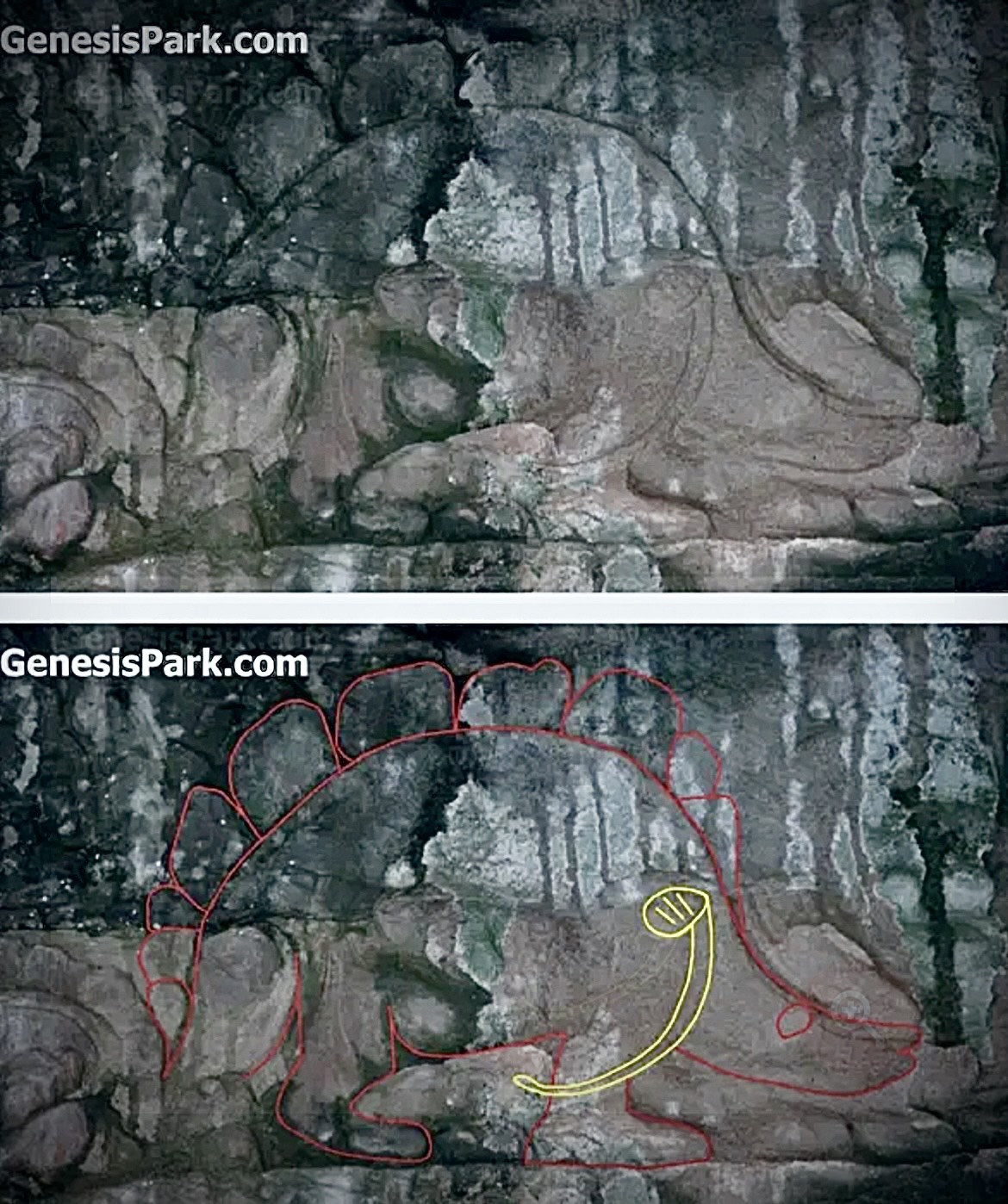
A carving on a temple wall shows an animal with a row of vertical plates along its back, sharply resembling a Stegosaurus. Some arguments have been levied against this claim but they’re hardly worth covering as most, upon seeing it, know exactly what’s being depicted. It’s not a porcupine. 

Dale Pollard

The Ta Prohm Temple Stegosaurus

Location: Angkor, Cambodia

A carving on a temple wall shows an animal with a row of vertical plates along its back, sharply resembling a Stegosaurus. Some arguments have been levied against this claim but they’re hardly worth covering as most, upon seeing it, know exactly what’s being depicted. It’s not a porcupine. 

In addition to that well-known stegosaurus carving, the existence of a second, lesser-known relief can be found in the same complex. This carving is larger and more eroded but the features of a stegosaurian dinosaur are clear enough. A bulky body, dorsal plates, and tail are easily made out— along with something else. Interestingly, the head appears elongated and slender in comparison to the first making it more realistic, but it’s what’s on the head and neck that you’ll find amazing. 

An unusual feature around the neck shares uncanny similarities to a bridle or harness— suggesting domestication. The work that could (hypothetically) be done with an animal of that size is fascinating to think about. Perhaps it could even explain the massive amounts of stone which were moved to complete the temple it was carved into. Many don’t realize that the volume of stone used at the Angkor Wat complex is greater, proportionally, than even the largest pyramid on Giza plateau in Egypt. But back to the stegosaurus bridle. The evidence is mainly that it mirrors other carvings around Ta Prohm depicting bridles on horses, elephants, and oxen in the same manner. 

The Triceratops Rider 

Location: Acambaro, Mexico 

A clay sculpture depicting a human figure riding a Triceratops was discovered in 1944. This piece is part of a larger collection of around  33,000 ceramic figurines near Acámbaro, Guanajuato, Mexico, by a German man named Waldemar Julsrud.

In the 1950s, Professor Charles Hapgood investigated the site and supported the idea that the artifacts were genuine. Apparently, thermoluminescence dating was done in the 1960s and 1970s (don’t ask me how that works) and the results indicated that the figurines might have a pre-Columbian origin. 

Could it be that the mainstream evolutionary timeline is that blatantly false? The author obviously believes that to be the case. Humans and dinosaurs walked the earth at the same time. While some were predators that our ancestors feared (Job 40-41), it seems that some were also tamed and used in a ways not unlike the ox or horse. Could you imagine?

Cos: An Interesting Example Of Inspiration

Neal Pollard

The city and harbor of Cos is mentioned in passing as a brief stopover made by Paul and perhaps also his large crew of fellow laborers (Acts 20:6), including Luke. Luke simply writes, “When we had departed from them (the Ephesian elders at Miletus, 20:17-38) and had set sail, we rain a straight course to Cos and the next day to Rhodes and from there to Patera” (Acts 21:1). Cos was apparently a night’s stay for the missionaries making their way to Jerusalem.

But, to the ancient world, Cos was a place of great importance. Consider what Allen Myers says about it: 

Settled by the Greeks ca. 1500 B.C., Cos became one of the most beautiful harbors of antiquity. As a Greek city-state it played a significant role in the Delian League during the Peloponnesian War (fifth century), and in 354 succeeded in its revolt against Athens. The island was renowned for its medical school, of which Hippocrates was a member, and a sacred shrine dedicated to Asclepius, the god of medicine (Eerdmans Bib. Dict., 239).

What’s more, Cos was the birthplace to the aforementioned Hippocrates, the “father of medicine” (and namesake of the Hippocratic Oath). “Under King Herod’s rule Cos received perpetual revenues, and a statue was built there to honor his son Herod Antipas” (Elwell and Beitzel, Baker Ency. Of The Bible, 527). 

It was a literary center, home of Philetas and Theocritus, and also a place noted for its fine weaving in the few centuries before the birth of Christ (McKay, New Bible Dict., 229). The emperor Claudius even exempted it from taxes (ibid.). 

But, it is a divine footnote on one of three missionary journeys made by Paul. He stopped and worked in important imperial cities like Ephesus, Philippi, Athens, and Corinth, but  the Holy Spirit through especially Luke is not blind to the existence of other important ancient places. Noting sites like Cos, these writers were showing us historical and geographic markers that puts the Bible in a context revealing its accuracy. This remarkable understatement regarding such a historic place reflects the many layers to be discovered by the Bible student reading through this sacred book. Just in Luke’s writing alone, there are literally dozens more like Cos. What a testimony to the sacred authorship of Acts and the other 65 books! 

Is Your Ox Getting Heavy?

Have you heard of Milo of Croton? Perhaps you are carrying some heavy burdens that would take a strength greater than his to bear? Is there help?

Dale Pollard

Milo of Croton was a six-time Olympic wrestling champion and legendary athlete from the 6th century BC Greek city of Croton. He’s a well known figure in ancient history for many impressive feats including winning the boys’ wrestling competition in 540 BC and then the men’s wrestling competition for four years in a row (62nd through 66th Olympiads). However, Milo is probably best known not for his wrestling career but  for his strength training methods. This supposedly involved carrying a young calf over his shoulder every day until it progressively grew larger and larger until eventually the calf became a fully matured ox. Afterwards he allegedly even carried the ox through the stadium at Olympia. 

It’s unknown exactly how heavy the confused ox on Milo’s shoulder was but today they can weigh between 1,500 and 3,000 pounds. Oxen are larger and heavier than cows, are intentionally bred to be the strongest and largest animals capable of doing work. It typically takes about two years from birth to maturity which doesn’t seem like a long time— unless you’ve been picking it up every day. 

Hebrews 12:10 encourages the Christian by reminding us that the temporal discipline we receive from God is for our eternal benefit. Taking up the name of Christ and lifting up our cross on a daily basis may seem daunting but it’s only for a season. The process itself increases our endurance and firms up our faith and the most encouraging part of all is that we aren’t expected to make the lifts alone. 

“You shall not see your brother’s donkey or his ox fallen down by the way and ignore them. You shall help him to lift them up again” 

(Deut. 22.4). 

“I was pushed hard, so that I was falling, but the LORD helped me” (Ps. 118.13). 

“For my yoke is easy and my burden is light”

 – Jesus (Matt. 11.30) 

185,000 Soldiers Killed By Angel

Dale Pollard

Account: Isaiah, 37:36-38; 2 Kings, 19:35ff; 2 Chronicles 32

A Serious Assyrian Threat: 

Sennacherib is on a campaign to control all routes across the Syrian Desert leading to the Mediterranean Sea. Assyria  had already carried the Northern Kingdom of Israel off into captivity and invaded the southern kingdom of Judah. 

Jerusalem is now under threat of attack and king Hezekiah sends his servants to the prophet Isaiah to ask for prayers on behalf of the people. Yahweh, through Isaiah, tells the people to not be afraid. For as unlikely as it seemed to the surrounded inhabitants of Jerusalem, their salvation would come in the middle of the night. 

“That night the angel of the LORD went out to the Assyrian camp and killed 185,000 Assyrian soldiers. When the surviving Assyrians woke up the next morning, they found corpses everywhere” (2 Kings 19.35).

Sennacherib Cylinder Evidence: 

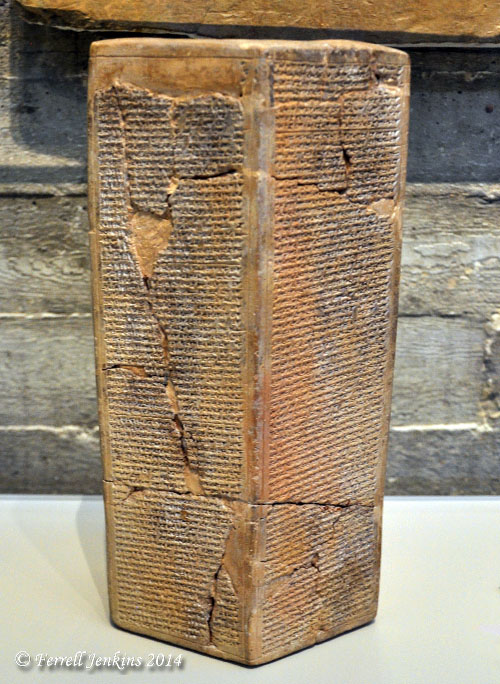
Sennacherib left behind a record of his campaign against Judea and it can still be seen in the British Museum today.

Here’s a translation of his inscription, 

“As to Hezekiah, the Jew, he did not submit to my yoke. I laid siege to 46 of his strong cities, walled forts, and to the countless small villages in their vicinity.  I drove out of them 200,150 people, young and old, male and female, horses, mules, donkeys, camels, big and small cattle beyond counting and considered  [them] spoils. Himself I made a prisoner in Jerusalem, his royal residence, like a bird in a cage.”

Sennacherib claims he conquered all of Judea except Jerusalem.  He also claims that he surrounded the city of Jerusalem with his army, and trapped Hezekiah “like a bird in a cage.” 

Curiously, that’s where he chose to end the story. To continue any further would mean to either fabricate or include a loss of such magnitude that it would tarnish the reputation of a proud Assyrian king.

The Heavenly Lifeboat

Art Shannon

In Belfast, Ireland, in the Spring of 1909, approximately 20000 workers began construction on a ship for the White Star Company of which U.S. mogul J.P. Morgan was a major stockholder. This vessel was designed to be bigger and better than anything currently out there on the market. When completed three years later, it would measure an impressive 10 decks high and three football fields long. 

This ship was named the RMS Titanic and was lauded worldwide for its grandeur. Superlatives such as opulent, luxurious, elegant, lavish, grand, and elegant were used to describe it. Ticket prices ranged from $35-$4300. It could accommodate 1500 passengers and 750 crew members. 

On April 10, 1912, it set out on its maiden voyage from England to New York. Within three hours, the bow was submerged and chaos ensued as people were scrambling to get on one of the 16 lifeboats or four collapsible boats. Only one ship, The Carpathia, responded to distress signals in those early morning hours and it picked up as many Titanic passengers as possible. The rough waters and frigid temps made survival difficult.

By daybreak on April 15, 1912, the world was waking up to news of the worst maritime disaster in history. The New York Times headline read: “Saved–866  Probably Drowned–1254.” In the days that followed, final estimates recorded 32% survivors and 68% fatalities. 

I would imagine that 99% of the 2200 souls onboard the Titanic thought they were totally safe before the iceberg pierced the right side of the hull just below the waterline. How many of the 2200 were spiritually prepared for possible death? How many of us are?

If there were to be a newspaper headline following Judgment Day, which column do you want your name? Saved or lost? I think of the Book of Life somewhat as a headline. Revelation 20:12-13 says that those whose name is not written there are cast into a lake of fire. Matthew 7:13-14 tells us about the broad gate that leads to destruction or the narrow gate that leads to life. 

Later, in Matthew 7:21, it tells us that not everyone who thinks they are going to heaven will enter the kingdom, but those who do the will of the Father. Jesus says in John 14:6, “I am the way, the truth, and the life. No one comes to the Father except through Me.” We are not promised tomorrow, but we do have the here and now. 

God offers each of us a “lifeboat” like no other with His Holy Word. It is up to us and our free will if we will accept His invitation and desire for us to be part of His heavenly home. The good news is each of us, as long as we have breath, have the ability to “write” our final headline of lost or saved. 2 Peter 1:10 tells us to make our calling and election sure, whether the need is to get into our heavenly lifeboat or adjust our life vest. 

God’s Zoo

Monday’s Column: Neal At The Cross

IMG_1857 2

Neal Pollard

God created the animals on the sixth day (Gen. 1:24-25). From that time throughout the rest of the Bible, He mentions them for a variety of purposes. They feature prominently in various biblical accounts: the serpent in the garden (Gen. 3:1ff), the dove and the raven on the ark (Gen. 8:7-12), Israel’s quail (Ex. 16:13), Balaam’s donkey speaks (Num. 22:28), a great fish swallows Jonah (Jon. 1:17), the father’s fatted calf (Luke 15:23), Peter’s rooster (Mat. 26:75), and, of course, so many others. They are used in a figurative sense from cover to cover, too. 

  • The devil is likened to a roaring lion (1 Pet. 5:8), a serpent and a dragon (Rev. 12:9).
  • The false teacher is likened to a wolf (John 10:12; Acts 20:29) and to dogs (Ph. 3:2; Rev. 22:15). 
  • The apostate are likened to the leopard (Jer. 13:23) and the dog and sow (2 Pet. 2:20-22). 
  • The wicked ruler (Herod) is likened to a fox (Luke 13:32).
  • Jesus is likened to both a lamb (1 Pet. 1:19; Rev. 5:12) and a lion (Rev. 5:5). 
  • The saved are likened to sheep and the lost to goats (Mat. 25:31-34).
  • The patient, but weary, are likened to the eagle (Isa. 40:31).
  • The thirsty for God are likened to the deer (Psa. 42:1).
  • The divinely-provided for are likened to the birds of the air (Mat. 6:25; 10:29). 

Whether for food (Gen. 9:3) or food for thought (Prov. 6:6), God provides the animal for us to consider. They depict the intimacy of marriage (Song 4:5; 7:3) and the ferocity of judgment (Hos. 13:7-9). They illustrate plenty (Ezek. 34:23) and desolation (Jer. 9:11). They picture joy (Isa. 35:6) and sorrow (Mic. 1:8). 

There are great lessons to be learned upon the pages of inspiration (2 Tim. 3:16-17), messages that guide and influence our eternal destiny (John 12:48). There are facts to be instructed by, internalized, and interpreted. Yet, in addition, God has allowed the heavens to declare His handiwork (Psa. 19:1). Creation reveals a Creator who weaves lessons into the characteristics of His creatures. It is just one of the infinite marvels of our great God, endlessly complex and inexhaustibly incredible! How great is our creative God!

23131823_10155089718695922_7691536111229550439_n
Photo from Safari to Tarangire National Park, Tanzania, 2012

Tora! Tora! Tora!

Neal Pollard

Today marks the 75th anniversary of the attack on Pearl Harbor, the event which drew our country into World War II. 2,343 men were killed, 1,143 were wounded, and 960 unaccounted for or missing. The Japanese chose Sunday to attack as it was the most relaxed day of the week for the servicemen. Many were still in their pajamas or having breakfast when the attack began at 7:55 that morning. Kermit Tyler, an Air Force lieutenant serving as the officer on duty that morning, told the radar operator not to worry about the large blip on the radar screen. He thought it was a flight of U.S. bombers coming from our mainland. Instead, it was the first wave of attackers. Captain Mitsuo Fuchida, the airstrike leader for the Japanese carrier force, could see that Pearl Harbor was totally unaware of the impending attack. He radioed back a coded message, repeating an abbreviated word three times—“to ra, to ra, to ra”—meaning “lightning strike.” The transmission began at 7:49, undetected by the soon-to-be victims of the attack that began a mere six minutes later (read more here).

Among so many significant facts, what we most remember about the attack on Pearl Harbor was how utterly surprising it was. No one stood vigil, considering the possibility of it. Like its later counterpart, “9/11,” and even natural catastrophes like Pompeii, the Galveston hurricane, the 2004 tsunami, or Mexico’s El Chicon volcano, serious and deadly events can occur without warning. With our most sophisticated technology and detection systems, we are without the ability to forewarn about the greatest surprise that will ever be.

Paul says that the resurrection of the dead of all time will occur “in a moment, in the twinkling of an eye” (1 Cor. 15:52). Paul and Peter both refer to “the day of the Lord” as that which will come “as a thief in the night” (1 Th. 5:2; 2 Pet. 3:10). Jesus warned that the day could be a disaster, a trap that comes on one “suddenly” (Luke 21:34). He taught that it will come at an hour unknown to everyone (Mark 13:32-33).

While it will surprise everyone, the coming of Christ will be a devastating event for the great majority of mankind. For them, it will infinitely exceed the loss of physical life. It will be an everlasting loss (Mat. 25:46; 2 Th. 1:9). Yet, God has made preparation eminently possible. He desires escape for everyone (2 Pet. 3:9). One can be prepared for that day and be saved from harm and for something inexpressibly superior. Those of us who have discovered the way of preparation must hold fast to it (cf. Heb. 3:6) and strive to share this vital information with as many as possible. The sudden coming of Christ need not be a defeat, but can instead be the harbinger of the greatest victory ever.  May Paul’s inspired exclamation be our song of victory: “Death is swallowed up in victory. O death, where is your victory? O death, where is your sting?” (1 Cor. 15:54b-55). Amen. Come, Lord Jesus (Rev. 22:20)!

burning_ships_at_pearl_harbor

Avoiding A Ride On An Ancient Cycle

Neal Pollard

It has been called “The Dark Ages Of The Old Testament.” During the period of the judges, there was moral, economic, social, political and religious decline. We often read that, during this time, the children of Israel did that which was evil in the sight of the Lord.

History keeps repeating itself in the book of Judges. The people do evil, God allows and oppressor to persecute them, the people turn back to God and plead for deliverance, and God raises up a deliverer to defeat the oppressor and deliver Israel. Here, we speak of the “cycle” of Judges: sin, servitude, sorrow, supplication, and salvation.

Their enemy invaders came from the East (Mesopotamia), the Southeast (Moab), the North (Canaan), the East (Midian and Ammon), and the Southwest (Philistia). It is interesting that Israel overcame Canaan in the militarily brilliant strategy orchestrated by God (Central Canaan—Josh. 7-8, Southern Canaan—Josh. 9-10, and then Northern Canaan—Josh. 11-12). As a result of Israel’s failure to utterly destroy the inhabitants of Canaan, the six oppressions came from the central, south, and north—each places where God had given them victory. What a reminder that when we don’t defeat the enemy, he will return! The enemy was sin!

Here is my summary of the book of Judges, as seen in Judges 2:16-19:

  • The rulers—“Judges”
  • The role—“Delivered”
  • The rescued—“Them” (Israel)
  • The rivals—“Those” (God’s enemies)
  • The ruination—“Plundered them” (oppression)
  • The refusal—“They did not listen to their judges”
  • The reveling—“Played the harlot after other gods”
  • The retreat—“Turned said quickly”
  • The right road—“In which their fathers had walked”
  • The role models—“Father, obeying the commands of the Lord”
  • The resolution—“They did not so”
  • The raising—“The Lord raised them up judges”
  • The relationship—“The Lord was with the judges”
  • The restoration—“Delivered them from the hand of their enemies”
  • The repentance—“The Lord was moved to pity” (KJV—“It repented the Lord because of their groanings…”)
  • The return—“When their judge died, they would turn back”
  • The retrogression—“Acted more corruptly than their fathers”
  • The resilience—“Didn’t abandon their practice or stubborn ways”

The judge was the savior of the people. Time and time again, the people put themselves in a position to need some serious rescue, and our long-suffering God was willing to soften His heart to their cries. Eventually, His patience ran out and even in this time period there were severe consequences. How often do we need the blood of Christ and the forgiveness of the Father? Often, we need forgiveness for the same sins repeatedly. We wonder how Israel could fall into the same traps, but we do well to identify and avoid them in our own times. We have the benefit of both Old and New Testament Scripture, and they would have only had the writings of Moses and Joshua when they lived. May we learn from these ancient lessons (cf. 1 Cor. 10:11) and stay off that ancient cycle.

bicycle_two_1886

Copperopolis, California

Neal Pollard

It boomed when “copper was king” and owed its thriving existence to shell casings made for the Union Army in the far-away Civil War.  Fittingly, her downtown streets were Union, Grant, Lincoln, and Sherman. There were 90 businesses in “Copper City” from 1865-1867. The extraction and production of copper ore found in such strikes as at Gopher Ridge, Quail Hill, and Hog Hill made Copperopolis a boom town for a short time.  A huge fire in the center of town, in 1867, coupled with the enormous drop in demand for copper following the end of the Civil War, left the community a virtual ghost town. So, despite a few modest copper mining rebounds periodically through World War II, Copperopolis, which yielded $12 million in copper from 1861 to 1946, is a shell of its former self. It is a resort and recreation area today, a modest little town who  once entertained the likes of Mark Twain, Nikola Tesla, and “Black Bart” (Charles Boles)(mymotherlode.com,  calaverashistory.org/copperopolis).

History is fascinating, with its “rags to riches,” “riches to rags,” and even “rags to riches to rags” stories.  Family histories play out the same way.  So can the rise and fall of nations.  The history of the church, wherever she has existed, may follow the same trajectory.  The Jerusalem church of Christ, where it all began, once boasted thousands of members.  In time, due to persecution and the introduction of false doctrines, the church there faded from view.  Today, it has only a modest presence. The same could be said of other congregations we read about in the New Testament.  Our congregation is somewhere on its course from the past to the future.  Where will it be in 10 years? 50 years?

Then, I look at my own life.  I have been a Christian for over 30 years.  I have preached for over 25 years. There have been Bible studies with non-Christians and new Christians. There have been efforts to try and influence others with the gospel.  My three sons are all nearly grown and on their own.  My wife and I have labored together to serve Christ.  But, each day, I must look and sincerely investigate what my spiritual trajectory is.  Am I growing nearer to Christ, acting more like Christ? Am I bearing more or less fruit? Are my best days in His kingdom behind me or in front of me? The good news is that, to a great degree, that lies within the scope of my free will and deliberate choices. With God’s help and to His glory, I can make today, tomorrow, and beyond the brightest days of service to Him.

Look at your life.  What legacy are you building? You will help determine that by what you do today.  Paul says, “Therefore be careful how you walk, not as unwise men but as wise, making the most of your time, because the days are evil” (Eph. 5:15-16).

Photograph taken of ruins in Copperopolis, California.

1962

Neal Pollard

The Beatles first album was released. The first Kmart and the first Wal-Mart opened their doors for business. West Side Story wins for best motion picture at the Academy Awards. Mandatory public prayer in schools are ruled unconstitutional by the Supreme Court.  Wilt Chamberlin scores 100 points in a single basketball game. Marilyn Monroe dies from an overdose.  Spider-Man appears in comic books for the first time. Johnny Carson takes over as permanent host of the Tonight Show, where he would remain for 30 years. The Cuban Missile Crisis occurs (facts via Wikipedia, Infoplease, Timelines, et al).

Depending on your perspective, the facts above either make the date seem ancient or almost like yesterday.  The records of what was happening in the church in 1962 are harder to obtain, especially as that was nearly a decade before I was even born.  I know that my dad enrolled in Freed-Hardeman College that year as a Bible Major.  The anti-cooperation movement was growing stronger and more prominent within our brotherhood.  Most congregations, especially in the deep south, were racially segregated.  Widely-known preachers included Gus Nichols, B.C. Goodpasture, Marshal Keeble, Joe Malone, Batsell Barrett Baxter, George Bailey, George Benson, and Roy H. Lanier.

In the growing western city of Denver, at the behest and with the help of some area churches, the Bear Valley church of Christ began meeting.  Though a building would not be erected until March, 1964, and the school of preaching would not begin operation until September, 1965, the body of Christ began meeting together.  Most of the charter members have passed away, but who among them would have believed that one congregation would be involved in a work touching so many lives around the globe as we look back, look around, and look ahead here in 2012.  Graduates who have gone to be missionaries in Australia, New Zealand, China, Russia, Ukraine, Japan, Italy, Poland, Scotland, Brazil, Peru, Canada, Germany, Philippines, Guatemala, Bolivia, Ghana, Tanzania, Slovakia, Vanuatu, and no doubt other countries.  They have also gone to preach in all 50 United States.  We have started extension schools in a total of more than 20 locations, with 15 currently in operation and others soon to begin.  Then, there are the sheer number of our former members who are spread out all over this country serving the Lord and helping the kingdom grow.  There are the countless fruitful labors that have gone on here that have resulted in hundreds of baptisms since 1962.

Did the Bakers, Hughes, Denewilers, Wrights, Milams, Whartons, Tharps, Laniers, and others know where this would lead?  Probably not, and that is not to their shame.  But the God of 1962 is still the God of 2012.  What will He do with this church, and His church universal, in the next 50 years?  It will be just as unpredictable, and it can just as grand if we keep looking for greater ways to serve Him!