Origen’s “On First Principles” (Book 1, Ch. 3.3-5)

Gary Pollard

[Editor’s Note: Gary is translating the Ante-Nicene Fathers works, beginning with Origin’s work. It is meant to update the British English of Roberts and Donaldson. What follows is part of that translation]

Note: For this article, it is possible (if not likely) that Tyrannius Rufinus — the fourth century monk responsible for preserving the bulk of this writing by translating it from Greek to Latin — made changes to keep it compliant with the theology of the day. He admitted to “smoothing and correcting the stumbling blocks” in The Prologue of Rufinus, but did not specify where he made such changes. Since Theodosius I’s Edict of Thessalonica (AD 380, almost 20 years before Rufinus likely translated On First Principles) made it illegal — with severe criminal and civil penalties — to practice anything other than Nicene/Catholic Christianity, Origen’s teachings had to be redacted where they conflicted with the Nicene Creed. Since it is impossible for me to determine where these changes were made, I will leave the text as-is and include footnotes where a statement seems to reflect more Nicene theology than is typical of Origen’s writing. Recreating the original theology of early Christians is made easier by the fact that one group of “Christians” severely persecuted believers who didn’t accept the dogmatism of Nicene Creed. “You will know a tree by the fruit it produces.” 

That all things were created by God—and that no creature exists apart from Him as its source—is clearly established by many statements in Scripture. This truth refutes and rejects the claims made by some, who wrongly suggest that there exists a kind of matter that is co-eternal with God, or that souls existed without beginning. According to them, God did not give these souls their being, but merely ordered and organized what was already there, granting them structure and balance rather than existence itself.

However, even in the brief work known as The Shepherd, or The Angel of Repentance, written by Hermas, we find this declaration: “Before all else, believe that there is one God who created and arranged all things; who, when nothing previously existed, brought all things into being; who contains all things, yet is Himself contained by none.” We find similar statements in the book of Enoch as well.

To this day, however, we have not found any passage in holy Scripture where the Holy Spirit is said to have been made or created—not even in the way Solomon speaks of divine Wisdom, or in the expressions we discussed earlier that refer to the life, or the Word, or other titles of the Son of God. Therefore, the Spirit of God who is described as moving over the waters at the beginning of creation is, in my view, none other than the Holy Spirit—at least as far as I can discern. This, indeed, we have demonstrated in our interpretation of those passages, not by relying on a purely historical reading, but by following a spiritual understanding of the text.1

Some of our predecessors have noted that in the New Testament, whenever the word “Spirit” appears without any qualifying descriptor, it should be understood as referring to the Holy Spirit. For example: “The fruit of the Spirit is love, joy, and peace,” and, “Having begun in the Spirit, are you now being perfected by the flesh?” We believe that this distinction also applies in the Old Testament. Consider the passage, “He who gives His Spirit to the people on the earth, and Spirit to those who walk upon it.”2 Surely everyone who walks the earth—that is, all earthly and physical beings—also receives the Holy Spirit from God.3

My Hebrew teacher also used to say that the two seraphim in Isaiah, each with six wings, who call out to one another, saying, “Holy, holy, holy is the Lord God of hosts,” should be understood as representing the only-begotten Son of God and the Holy Spirit. We also believe that the line in Habakkuk’s hymn—“In the midst of the two living beings” (or “two lives”)—refers to Christ and the Holy Spirit. For all knowledge of the Father comes through revelation by the Son, and that revelation is made through the Holy Spirit. Therefore, both of these beings—whom the prophet calls “living beings” or “lives”—are the basis of the knowledge of God the Father.

Just as it is said of the Son, “No one knows the Father except the Son, and anyone to whom the Son chooses to reveal Him,” so it is also said of the Holy Spirit by the apostle: “God has revealed them to us through His Spirit, for the Spirit searches all things, even the deep things of God.” And again in the Gospel, when Jesus speaks of the deeper truths He could not yet reveal to His disciples, He says: “I still have many things to say to you, but you cannot bear them now. However, when the Holy Spirit, the Comforter, comes, He will teach you all things and remind you of everything I have said to you.”4

We must understand, then, that just as the Son—who alone knows the Father—reveals Him to whomever He chooses, so also the Holy Spirit—who alone searches the depths of God—reveals God to whomever He wills. “For the Spirit blows where He wills.”5

However, we must not imagine that the Holy Spirit receives His knowledge of the Father through revelation by the Son. If the Holy Spirit only comes to know the Father through the Son’s revelation, that would mean He was once ignorant and then came into knowledge. But to say the Holy Spirit is, or ever was, ignorant is both impious and irrational. Even if something else existed before the Holy Spirit, it is not by gradual development that He became the Holy Spirit—as if He had once been something else, lacking knowledge, and only later gained understanding and was thereby made the Holy Spirit. If that were the case, then He could not be considered part of the Trinity6—united with the unchanging Father and the Son—unless He had always been the Holy Spirit.

When we use words like “always” or “was” or other time-related terms, we must not take them in a strictly temporal sense. These terms are, by necessity, borrowed from our limited human perspective, since the realities we speak of ultimately transcend all concepts of time and all finite understanding.

Now, it is important to ask: why is it that someone who is regenerated by God for salvation must relate to the Father, the Son, and the Holy Spirit—and cannot be saved without the cooperation of the whole Trinity?7 And why is it impossible to share in the life of the Father or the Son apart from the Holy Spirit? In exploring these questions, we will need to describe the distinct roles of the Holy Spirit, the Father, and the Son. I believe that the activity of the Father and the Son is present not only in saints but also in sinners, in rational beings and in animals without reason, even in lifeless objects—in short, in all created things. But the work of the Holy Spirit is not present in lifeless things, nor in living creatures that lack reason. It is also absent in rational beings who persist in evil and have not turned to a better way of life.

I believe the Holy Spirit is active only in those who are beginning to turn toward goodness, who are walking the path that leads to Jesus Christ—that is, those who are doing good works and remaining in God.

 1This reading of Gen 1 is found in the LXX. The Hebrew text also includes the reading, “And a powerful wind was blowing over the face of the waters.” 

 2While this is certainly true, Is 42.5 is talking about the breath of life. 

 3If this is Origen speaking, he contradicts himself in the next-to-last paragraph of this article. “The Holy Spirit is absent in rational beings who persist in evil…” and, in the last paragraph, … “is active only in those who are beginning to turn toward goodness.”  

4John further clarifies this statement about the Παρακλητος (Jn 14.26) in I Jn 2.1 where he explicitly identifies this Comforter as “Jesus Christ, the righteous.” 

Jn 3.8 says το πνευμα όπου θελει πνει (“the wind blows where it wants”), possibly a play on words given the context. 

 6 See footnote 7

 7While it is certainly possible that Origen used this word, it seems unlikely. Theophilus of Antioch (AD 170) used Τριας to describe God, the Word, and his Wisdom as a “set of three”. But the word “trinity” (from trinitas — a Latin word, and Origen wrote in Greek) is generally credited to Tertullian (c. AD 210). This would’ve been around the same time that Origen wrote On First Principles, but he was distinctly Greek in his thinking, not Latin. Perhaps Τριας is what Origen originally used, which fits his earlier section on God’s Wisdom more appropriately than the distinctly Latin trinitas.  

Chaos

The argument is often made that biblical writers ripped off much older myths and adapted them for a monotheistic faith. The problem with this is that, while creation order and chaos are indeed reflected in many of these legends, that’s basically where the similarities end.

Gary Pollard

“Chaoskampf” is a prominent theme in the myths of Babylon, Egypt, Canaan, Greece, and even the Norse sagas. It’s also in our Bible, but with obvious differences. In the Babylonian tablets collectively called the Enuma Elish, creation begins with a great battle. Marduk defeats Tiamat, a sea goddess who represents chaos. He fashions the heavens and the earth from her remains after defeating her in battle. In Canaanite myth, Baal battles Yam, the sea god, also a symbol of chaos. In Egyptian stories, Ra must overcome the serpent Apep every night—a coiling monster of darkness and disorder (and don’t forget Osiris/Seth). In Norse mythology, at the edge of the world lies Jörmungandr, the world serpent, who they said will one day rise in Ragnarök, the day of final chaos. In Greek mythology, the Titans battle the Olympians and the victors reorder the destroyed world. 

The pattern is the same: a divine being, representing order and stability, faces the chaos of the sea, often personified as a serpent. Genesis 1 is greatly simplified and much cleaner — “In the beginning God created the heavens and the earth. The earth was formless and empty, and darkness covered the deep waters. And the Spirit of God was hovering over the surface of the waters.” The great patriarchs were raised in these traditions: Abraham was from Ur of Babylonia, and Moses was raised and educated in Egypt. Asaph wrote, “With your great power you split open the sea and broke the heads of the sea monster. Yes, you smashed the heads of Leviathan and left his body for the animals to eat. You make the springs and rivers flow, you make the rivers dry up. You control day and night. You made the sun and moon. You set limits for everything on earth, and you created summer and winter” (Ps 74). 

The argument is often made that biblical writers ripped off much older myths and adapted them for a monotheistic faith. The problem with this is that, while creation order and chaos are indeed reflected in many of these legends, that’s basically where the similarities end. Unlike other cultures, whose myths are all about cosmic battles between gods, Moses and Asaph speak of the unchallenged power of the God who tamed the seas and chaos with just his words

Revelation ties this theme up nicely. John says, “Then I saw a new sky and a new earth. The first sky and first earth had disappeared. Now there was no sea. And I saw the holy city, New Jerusalem, coming down from God, down from the sky.” The detail about the sea might seem out of place, but it’s not. “Sea” was often synonymous with chaos, violence, death, and fear. It was personified as a great enemy that had to be defeated. On New Earth, tehom — chaos, the abyss, Tiamat, Leviathan, the sea — is finally gone forever.

Three quick things: 

  1. Chaos is nothing to panic over. We serve the God who calmed the seas with a word (Mk 4). 
  2. God can and does bring order from chaos. Our life might feel “formless and void” but God will ultimately bring order and beauty (Rom 8). 
  3. God has already won — the sea is on borrowed time, Leviathan has lost. 

Origen Was Smart

Gary Pollard

I cannot recommend enough the books Origen wrote against an Epicurean named Celsus. He uses incredible (if wordy) arguments refuting the attacks Celsus levies against the church in his work entitled True Discourse. In his defense of Christianity and the gospels, we get this little gem (Cont. Cels. 3.39): 

And I am of opinion that it was on this account that Jesus wished to employ such persons as teachers of his doctrines, namely that there might clearly appear to all who were capable of understanding, that the guileless purpose of the writers being, so to speak, marked with great simplicity, was deemed worthy of being accompanied by a diviner power, which accomplished far more than it seemed possible could be accomplished by a periphrasis of words, and a weaving of sentences, accompanied by all the distinctions of Grecian arts. 

The power of scripture lies in its simultaneously simple and profound nature. It’s simple enough to be understood by the least-educated among us, and profound enough to give intellectuals something to chew on. Another evidence of supernatural origin, attested to by Origen. 

Unveiling Sheol

Brent Pollard

Unveiling Sheol: Exploring the Depths of the Old Testament’s Concept of the Afterlife

During my junior year at Faulkner University, I enrolled in Hebrew classes. Unfortunately, I had to miss a semester due to illness. Because of the rotational nature of the Biblical languages courses at Faulkner, I took Greek when I returned and only passed thanks to Dr. Carl Cheatham’s grace. Because the documents of the Christian faith are written in Koine Greek, knowing the language makes more sense. However, I’ve always been interested in archaeology and Old Testament history. I still wish I could have barely passed Hebrew instead.

Consequently, I always like to plumb the depths of Jewish scholarship, tempering it with my Christian worldview. The idea that the Greek Hadean realm influenced the Christian concept of the afterlife has always piqued my interest, even though I know it is incorrect. People will say the Old Testament presents no such ideas about the afterlife. Yet that is not true. There is one word that one encounters particularly within the poetry section of the Old Testament: Sheol. The King James Version calls it “the grave.” Unfortunately, the King James translators ruined the tapestry’s richness by rendering it generically.

Sometimes the context tells you that the realm of the dead being discussed is associated with the concept of destruction. This association makes it sound like Tartarus (translated “hell” in 2 Peter 2.4) in Hades . This possibility becomes apparent when you pair Abaddon with it, as in Proverbs 27.20.

“Sheol and Abaddon are never satisfied, Nor are the eyes of man ever satisfied.” (NASB95)

Proverbs 27 extols virtues such as humility, wise decision-making, healthy relationships, self-control, and diligent stewardship as keys to a fruitful life. In verse 20, Solomon compares this life and one where greed rules. Greed has the same appetite as Sheol and Abaddon. 

Indeed, such concepts denote a location, but they take on a personification akin to our true adversary, who roams the earth seeking whom he may devour (cf. 1 Peter 5.8). As a result, by the time one reaches the end of the New Testament, assuming that John’s Apocalypse was the last book written, he finds Abaddon and his Greek counterpart Apollyon as rulers of the abyss (Revelation 9.11).

I understand that Revelation is difficult for modern readers to comprehend fully, but it is simple to imagine this figure as the devil. It is not my intention to delve into the interpretation of Revelation here. To summarize, there is no need to read a future yet to-be-realized into this text as if there were some nebulous end times ahead of us. Because these concepts are associated with destruction, more than one commentator has pointed out that they could easily describe the actions of Christians’ persecutors that resulted in their deaths. And as the angel told John at the outset of his Revelation, these things would shortly occur (Revelation 1.2-3; 22.10). As a result, rather than a demonic figure or a fallen angel, the rulers of destruction could have been imperial Rome’s rulers. 

However, when Sheol appears alone, it refers to the concept of the realm of the dead. For example, when Joseph’s brothers convinced their father Jacob that a wild animal had killed him, Jacob tore his clothes and put on sackcloth. Jacob warned his family that his mourning would send him “down to Sheol” (Genesis 37.35 NASB95). Jacob uses a trip to Sheol to suggest his mourning will kill him.

Hebrew is a unique language because it lacks vowels. As a result, assigning vowel sounds is dependent on the diacritical marks Jesus referred to as “tittles” or “strokes” (Matthew 5.18). As a result, you have some pairings that can mean different things depending on where one places those strokes. In other words, changing the vowel sounds creates an entirely different word or meaning. Therefore, we can reduce Sheol to “shin-aleph-lamed.” In this case, the root is aleph-lamed,” which one uses as a negation word. As a result, Sheol would be a place of nothingness or belonging to nothingness.

This understanding does not refer to the atheistic belief that after death, one becomes like the dog Rover: dead all over. Instead, it demonstrates that current opportunities are no longer available. Consider Solomon’s words in Ecclesiastes 9.10:

“Whatever your hand finds to do, do it with all your might; for there is no activity or planning or knowledge or wisdom in Sheol where you are going.” (NASB95)

That understanding fits well with what the writer of Hebrews says in Hebrews 9.27. We have a date with death, and then we will be judged. The implication is that there are no actions we can take after death to change our fate.

Returning to the concept of “shin-aleph-lamed,” the word means “to ask.” When the Israelites left Egypt, they were to ask their neighbors for gold and silver articles (Exodus 3.22). With this new dimension to Sheol, we get the idea of the earth reclaiming what God took away when he created man (cf. Genesis 2.7). It reminds us of the fleeting nature of life, that we are like vapors appearing only for a brief moment (James 4.14). As a result, as Moses stated in Psalm 90.12, we must learn to number our days. As Paul puts it, we must redeem our time (Ephesians 5.15–17).If there is an overarching theme to this brief discussion of Sheol, it is not to impress you with my research but to encourage you to go deeper in your study of God’s word. Simple tools such as Greek and Hebrew lexicons, Bible dictionaries, and reliable commentaries can help you extract far more value from the scriptures than a casual reading. And sometimes, a better understanding of even the most straightforward words can change your entire perspective on life and death. 

Darkness, Earthquakes, And The Dead Walking!

Tuesday’s Column: Dale Mail

Dale Pollard

In Matthew 27 we find the start of what appears to be a mixture of supernatural and natural phenomena. 

Clearly, Matthew, Mark, and Luke (the inspired authors of the synoptic gospels) make an airtight case for the diety of Jesus. Additionally, three extra biblical historians validate their accounts as well: Thallus, Africanus (the name of Janelle’s and my future first born— I hope), and Phlegon. 

The Darkness 

“From noon until three in the afternoon darkness came over the land.” Matt. 27.45 

Phlegon records in the 2nd Century AD, 

“…in the time of Tiberius Caesar, at full moon, there was a full eclipse of the sun from the sixth hour to the ninth—manifestly that one of which we speak. But what has an eclipse in common with an earthquake, the rending of rocks, and the resurrection of the dead, and so great a perturbation throughout the universe? Surely no such event as this is recorded for a long period. But it was a darkness induced by God, because the Lord happened then to suffer.”

Not that we need Phlegon to confirm what God told us three times, but it’s interesting! 

The Earthquake That Freed The Dead 

Beginning in v.51ff, an earthquake splits the veil in the temple. The veil wasn’t a thin piece of fabric either— it’s thickness was equivalent to a man’s hand. 

Next, the earthquake (used directly or providentially by God) cracks the circular stones open and the dead walk the earth. There’s some discussion over the identity of these “Saints” or “Holy ones” but it’s likely that they are followers of God who died in the past. Whether they were faithful servants that we read about in the Old Testament or followers of Jesus who were killed for their loyalty isn’t made clear in the text. My personal opinion on the matter is that they are Old Testament followers of God as this would indicate to “many” that a new Covenant or Testament is being fulfilled. These risen ancient followers would effectively convince those following the Jewish religion that Jesus is now who they should look to, and not Moses or Elijah (see the Transfiguration, Matt.17). 

The Timeline Of Events 

View One Of Chronology: 

“The dead rise with Christ.”

Matthew captures the magnitude of Jesus’ death on the cross by describing the abnormal events surrounding his death in chapter 27. It’s important that the reader keep in mind the goal of the letter, and that’s Jesus. The tombs splitting open, then, likely occurred during the death of Jesus. After three days, the dead would then emerge along with Jesus and appear to many. 

Matthew records what literally takes place, then, as well as alludes to the Day of His return. On that Day, all of the dead in Christ will rise. 

View Two Of Chronology: 

“The dead rose first before Jesus.”

The Bible is saturated in types and apocalyptic language. The New Testament brings a new light and depth to the things of the past. For instance, the flood account directs our minds to the second destruction of earth. The crossing of the Red Sea alludes to baptism. The blueprint of the tabernacle is symbolic of church and the entrance to her. 

With that in mind, 1 Thessalonians 4.16 says, 

For the Lord Himself will descend from heaven with a cry of command, with the voice of an Archangel, and with the sound of the trumpet of God. And the dead in Christ will rise first.”

This seems to indicate an order of resurrection. Those who followed God in life— rise first. This would fit beautifully with Matthew’s record of events in Matthew 27. 

View Three of Chronology: 

“The dead rise at the death of Christ, but enter Jerusalem three days later with Jesus.” 

The NIV suggests that the dead were resurrected when Jesus died and then went into Jerusalem after Jesus’ resurrection. A number of theologians and Christians agree with this view. 

Many others say that since Christ is the firstfruits of the dead (1 Cor. 15.22), then the resurrection did not occur until He was raised. This view takes the phrase “after Jesus’ resurrection” and then fits them with “…were raised to life and came out of the tombs.” This is possible in the Greek and is also hinted at in the KJV and the NASB. The tombs broke open at Christ’s death due to the earthquake, but the bodies were not raised till Christ was raised— which is the view I currently hold. 

A special thanks to Brittany Dyer for posing some interesting questions. She’s a committed student of the Bible and an excellent example to the Tompkinsville church of Christ family. 

1 Peter 1– Hope’s Value

Wednesday’s Column: Third’s Words

Gary Pollard

For the next several weeks, I’ll be repeating the book of I Peter in present-day terminology. It’s not a true translation of the book, as I am not qualified to do so. It will be based on an exegetical study of the book and will lean heavily on the SBL and UBS Greek New Testaments, as well as comparisons with other translations (ESV, NASB, NIV, ERV, NLT). My goal is to reflect the text accurately, and to highlight the intent of the author using concepts and vocabulary in common use today. 

This is not an essentially literal translation, and should be read as something of a commentary. 

I Peter I – Hope’s Value

The prophets who told us about this rescue were very curious about it. They investigated and obsessed over the identity and timing of the rescuer Christ’s Spirit was telling them about. He told the prophets that he would suffer at first, but would gain everything after. He told the prophets that their writings were for people in the future, not for them. You are those people in the future! Through God’s influence, people told you about our hope for rescue. By the way, even angels are deeply interested in the hope you have right now! 

Since you have this hope for rescue, don’t ever let it go. Everything you do must be influenced by this hope. Make sure you’re mentally preparing yourself for spiritual combat. Make sure you have self-control going into this. We’ll be rescued when we see Jesus, so hang on tight to hope. 

Don’t go back to your old lives. You had those old, unhealthy desires before you knew any better. Instead, you must live like God wants you to. Jesus did! God’s word said, “You have to be morally pure, just like I am.” You know that God will judge everyone without bias. Live like you know this, and let that give you a healthy dose of fear. He didn’t use an unstable asset like money to secure your rescue. He used the most valuable thing in existence: his own flawless blood. 

Jesus’ plan was in motion before we were even created! He recently made his appearance just for us. Because of him, we believe in God, who brought Jesus back to life and gave him recognition and power. We believe in him. We have hope because of God. 

Fragment containing 1 Peter 1:23–2:5 on Papyrus 125 (3rd/4th century).

Beware Of The Dog

Friday’s Column: Brent’s Bent

Brent Pollard

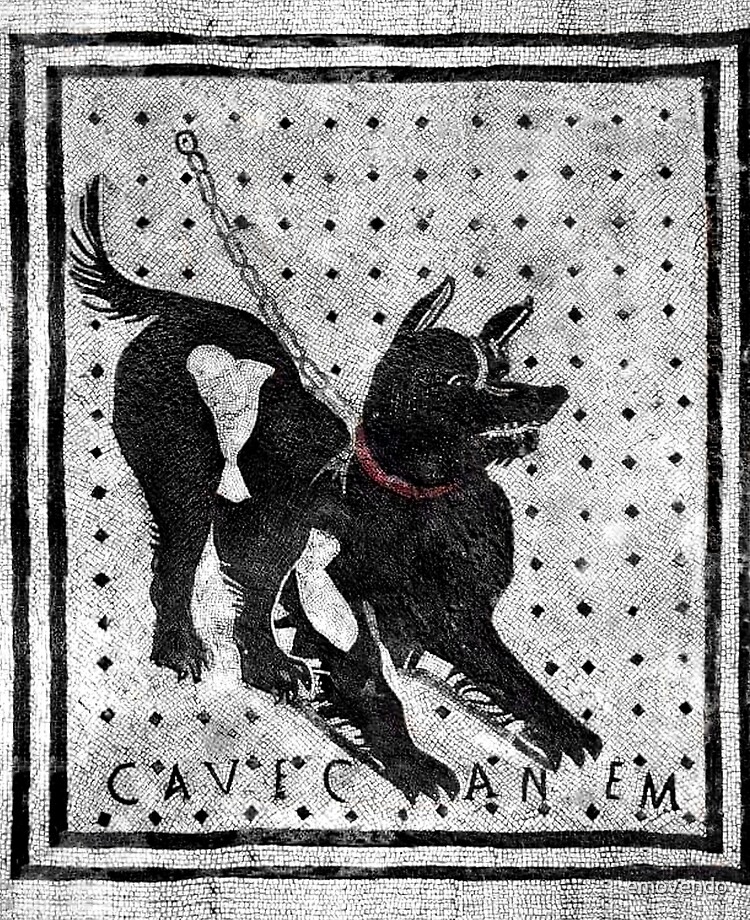
Worry not. I am not writing an article about the 2021 National Champion Georgia Bulldogs, even though that is an article I had wished to write for decades. No, I am thinking of an archaeological discovery made in a Pompeiian house (“House of the Tragic Poet”) renowned for its exquisite frescoes and mosaics. Within the house’s vestibule, there is a dog mosaic. Below the dog, there are also these two words in Latin: “Cave Canem.” I imagine you have guessed from the context of our title what those Latin words mean. Yes, they read, “Beware of the dog.” (Literally, “Beware the dog.”) The mosaic dates to the second century BC.1  

Did you imagine that the ancient Romans had “Beware of the Dog” signs? I admit being unaware of this until I stumbled upon a bit of clickbait on social media promising interesting archaeological finds. OK, so maybe this “sign” wasn’t the most breathtaking discovery ever. But it was interesting. It serves as an example of Solomon’s inspired truth that there is nothing new under the sun (Ecclesiastes 1.9).  

Typically, we think of the “Beware of the Dog” sign as a warning to unwanted visitors. It says, “We have a dog, and it may bite you.” However, scholars believe that the sign’s original purpose was the opposite. Visitors did not have to worry about dog attacks but needed to avoid trampling the family dog. “When you come inside, you will encounter a small animal we cherish. Please be mindful of him.”  

The Italian Greyhound, for example, is an older breed originating more than two thousand years ago. It is the smallest of the sighthounds. The AKC states that breeders bred them as “noble companions.”That fits what we know of Pompeii, a resort town for wealthy Romans who would surely own such canines. Indeed, the House of the Tragic Poet was not the only house in Pompeii with a “Cave Canem” mosaic. It was just the first one excavated.  

Now, why would I spend so much time within a religious forum talking about a “Beware of the Dog” sign? It so happens that Paul used that expression in Philippian 3.2: “Beware of the dogs, beware of the evil workers, beware of the false circumcision” (all ref. NASB1995 unless otherwise indicated). In Koine Greek, that is “Βλέπετε τοὺς κύνας.” As odd as it sounds to the dog-loving United States today, Arabs and Jews were more likely to despise dogs. Remember that even Jesus cautioned us, “Do not give what is holy to the dogs…” (Matthew 7.6).  

Dogs were often wild and roamed in packs in ancient Judea. There was no archaeological evidence of pet dogs in the region until the post-exilic era.3 In their nondomesticated state, these dogs would do disgusting things like eating the bodies of the dead (e.g., 1Kings 14.11). These reasons are why generic Biblical scholarship believes Jews and Arabs dislike dogs and use the term as a byword for detested people. (Indeed, Western languages now likewise use “dog” in a derogatory manner, but it doesn’t impact the Western perception of the animal.)  

Paul didn’t straddle the fence when it came to the truth, but he did straddle a cultural divide. He who was the “Hebrew of Hebrews” (Philippians 3.5) would be the Apostle ordained to take the Gospel to the gentile world (Acts 8.15). That is why as outrageous as it sounds, we benefit from “Cave Canem” since knowing cultural concepts helps us better understand a verse’s context.  

So, what was Paul saying here? To the Gentile, being asked to “beware of the dog” meant looking out for him,  lest you trip over him. To the Jew, “beware of the dog” meant being wary of the one with a vile nature, fitting with their cultural perception of a dog. So, Paul begins with a Jewish insult. The third noun, translated as “concision” (KJV) or “false circumcision” (NASB1995), actually means “mutilation.” Would those Judaizers insisting that Gentiles be circumcised to become Christians enjoy being called a “mutilator?”  

It sounds less like we are talking about multiple groups troubling the church at Philippi and more like Paul describes one group by using three noun descriptions. Two of the nouns speak more loudly to one cultural group. So then, what of the “evil workers?” Would this not also describe the same “mutilating dogs?” That seems to fit the context better. This second noun and its adjective also remind one of the words of Jesus in Matthew 7.23, particularly in the King James Version: “Depart from me, ye that work iniquity.” These latter “iniquity workers” felt they had done laudable things but discovered they neglected to do God’s Will (Matthew 7.21-23). We can make the case that such was true of the Judaizer also.  

Lest anyone interpret this sentiment as anti-Semitic, we emphasize that the three nouns used by Paul work as well for any false teacher. Yet, the Judaizers were a thorn in Paul’s side as he fulfilled his ministry. And even though Gentiles doubtlessly read the words of this epistle, their Jewish brethren in this cosmopolitan congregation of Philippi could provide greater meaning while also helping their Gentile brethren be wary of the “leaven of the Pharisees and Sadducees.” (cf., Matthew 16.6)  

In conclusion, although the Bible serves as its own best commentary, we note we can obtain understanding through additional sources of information. Sometimes those sources can be surprising, like a dog mosaic in the vestibule of a Pompeiian house. Yes, there might be some put off by this idea that it takes effort to delve deeper into the word of God as we look for answers within God’s Word and without, in sources like archaeology. However, the proper mindset makes Bible study more attractive, even fun. You can find faith-building things everywhere. Just think about that the next time you see those words, “Beware of the Dog.”   

Sources Cited  

1 Arellano, Anastasia. “Ancient Mosaic ‘Beware of Dog’ Sign Found Dating Back 2,000+ Years.” Dusty Old Thing, Great Life Publishing, 4 Mar. 2021, dustyoldthing.com/pompeii-ancient-beware-of-dog-sign/

2 “Italian Greyhound Dog Breed Information – American Kennel Club.” American Kennel Club, The American Kennel Club, Inc,www.akc.org/dog-breeds/italian-greyhound/.  

3 White, Ellen. “No, No, Bad Dog: Dogs in the Bible.” Biblical Archaeology Society, Biblical Archaeology Society, 28 Sept. 2021,www.biblicalarchaeology.org/daily/ancient-cultures/daily-life-and-practice/dogs-in-the-bible/

Narcissus and Echo 

Friday’s Column: Supplemental Strength

81121814_2462862270639428_5746232403106463744_n

Brent Pollard

Greek mythology is fascinating. So much so, in fact, that the Romans co-opted it as their own. As such, the Roman poet, Ovid, tells us the story of Narcissus and Echo within Metamorphoses. You likely recognize Narcissus’ name because of the mental disorder named for him. Narcissism. You may not have known that the phenomenon called an “echo” also derives its name from a mythic figure. Echo was a beautiful, but talkative, forest nymph. She cut off the goddess Juno so much during conversations that the peeved goddess cursed her with the capacity only to repeat the last words spoken by others. 

Without delving too deeply into the mythology, suffice it to say Echo fell in love with the picky Narcissus, whose standard for a consort was so high that none could meet his expectations, including poor Echo. Already cursed, Echo was not able to convey her feelings to Narcissus. On one fateful day, however, Narcissus had sensed Echo’s presence and called out, “Is anyone there?” After she replied in the same, he said, “Come here!” Echo ran to Narcissus as she repeated his command. Echo’s actions repulsed Narcissus. He told her he would sooner die than allow her to enjoy his company. Echo was humiliated and ran away. Yet, she continued to love Narcissus. The vengeful goddess, Nemesis, saw Narcissus’ actions. She cursed him by making him fall deeply in love with his reflection. 

There was no redemption for Narcissus and Echo. Narcissus lingered by the pool of water, looking longingly at his reflection. Echo persisted in her love for Narcissus. As the years passed, Echo’s beauty faded, and her body wasted away, leaving only her voice. Narcissus committed suicide, realizing his impossible love would remain unrequited. A flower bloomed where he killed himself. Yes, the narcissus.  

It is easy to use Narcissus as an object lesson for us, spiritually.  Both James and Peter quote Proverbs 3.34 from the Septuagint to remind us that God resists the proud (James 4.6; 1 Peter 5.5). A haughty look is something we know God hates (Proverbs 6.17). Our Lord went about doing good (Acts 10.38). Since He is our example (1 Peter 2.21), Paul tells us: “do not merely look out for your own personal interests, but also for the interests of others.” (Philippians 2.4 NASB) 

But what lessons do we derive from Echo? Her tongue is what initially got her into trouble. Just because the tongue is an unruly member, per James 3, doesn’t mean that we should not seek to control it. There is the talk we must avoid (Ephesians 4.29; 5.4; Philippians 2.14). Besides this prohibited speech, there remains gossip and lying, which both Testaments condemn (Exodus 20.16; Psalm 15.1-3; Proverbs 6.19; 2 Corinthians 12.20; 1 Timothy 5.11-13; Titus 2.3). 

Echo also squandered a precious commodity in her quixotic pursuit of Narcissus, time. We are supposed to take advantage of the time given to us (Ephesians 5.15-17). There comes the point where even preaching the Gospel to the hard-hearted equivalent of a brick wall is like casting “what is holy to dogs” and throwing “pearls before swine” (Matthew 7.6). 

Lastly, Echo loved someone incapable of justifying the precious investment of her heart. The world is like Narcissus in that regard. John reminds us that the world with its lusts will one day pass away (1 John 2.15-17). Even so, how many have laid up treasure on the earth? (Matthew 6.19-21; Luke 12.33-34). We cannot pursue both God and mammon (“wealth” NASB— Matthew 6.24).  

May it be that as you search your heart that you find no kindred spirit with Narcissus and Echo. Focus outwardly upon others’ needs, be mindful of the precious commodity of time, and give your heart—and tongue—to the One Who will best use and appreciate it (cf. Matthew 22.36-38). 


Sharing The Filling Fullness Of Christ

Wednesday’s Column: Third’s Words

Gary III

Gary Pollard

Some phrases in the Bible are simple to read, but very difficult to comprehend. In this article, I’d like to walk through a process together in an attempt to make sense of a difficult phrase (thanks, Paul). One of those is in Ephesians 1.23: “…the fullness of him who fills all in all.” This is a description of Jesus, specifically as it relates to His being the head of the church. But what does that phrase mean? 

I will not pretend to have the answer, but I would like to make a couple of suggestions. Firstly, “fullness” appears to describe the church. In my limited knowledge of Greek, it seems to be grammatically tied to “body.” The church – His body – is His fullness. Both are nominative, both are the subject of the sentence. 

Secondly, Jesus fills all in all. It’s that last phrase that’s so hard for me to comprehend. What does it mean, that “He fills all in all?” Based on the fact that some form of “fullness” is used three times in a single phrase, it appears to have reference to his nature. He is not confined by time or space and is present everywhere. 

If the church is His fullness (the word is possessive in Greek), and He is omnipresent (or, creation is full of Him), then the church must be extremely important. Again, I am not a scholar, I may be mistaken. 

I would, though, like to attempt to make application from this difficult phrase. If the church is, ideally, representative of the very nature of Christ, are we living up to it? Is our passion for the lost like His was/is? Is our love for each other as strong as His is for the church? Do we treat the church as if it were the body of Christ (because it is)? Do we keep in mind, as we interact with each other, that we all answer to Him? Are we trying to mold culture to His image, or are we being molded to culture? 

We really have to think about this one to try to make sense of it. Comprehending this phrase is anything but easy (at least for me!). But the church – which is one distinct unit, not a series of denominations – is supposed to represent Jesus. Our values, our demeanor, our goals, our mission, our attitudes, our behavior, and our purpose should scream to others, “We are not of this world.” If these do not, we are not representing Jesus. No one will do this perfectly, but the standard is high. 

When we begin to understand this phrase a little more, it shifts from being hard to understand to being hard to hear. We have a huge responsibility, but we also have a global family to support us. The standard is high, but our Head is also our Savior. As things slowly go back to normal, let’s keep this in mind! We’re not just Christians to be good people, we’re Christians to show the world who Jesus is.

“It’s all Greek to me.”

Tuesday’s Column: Third’s Words

20638721_440919206307154_5479040032968788217_n

Gary Pollard

This is a familiar phrase to most of us, usually used when responding to something so difficult to understand that it warrants saying. Advanced math brings this phrase to my mind (no one should never mix the alphabet with numbers, by the way). For most people, any topic or conversation with very difficult-to-understand components will prompt, “It’s all Greek to me.” We understand that it is used in good humor and not as a slight against Greek, but I believe that it has also discouraged the “average” Christian from studying the original language of the New Testament. 

Before I continue, allow me a disclaimer: I am not a scholar, by any means, in the use of the Attic/Ionic-based ancient language known as Koine Greek. I am an enthusiastic student of the language, but not an expert. The purpose of this article is to hopefully knock down some of the myths surrounding the language and hopefully encourage us all to pursue a knowledge of it. 

Myth #1: Greek Is Super Hard to Learn

This could not be further from the truth. Greek makes a lot more sense than English! This is not to say that it is easy (learning any language is difficult), but it is most certainly attainable. Start with the Greek alphabet and memorize it. Once you can sound out words, try memorizing as much vocabulary as you can. If you can, find a Greek New Testament with a lexicon in the back and memorize those. With that base, learning the more complex grammar rules and language structure becomes significantly easier. 

Myth #2: You Need to Be an Expert to Get the Benefits of Greek Study

Regardless of what anyone says, the New Testament really comes to life when you can read it without the third party that is translation. You get the full emotional and intellectual impact of a writer when you can read his words first-hand. You do not have to be a Greek scholar to get some of that impact! Technology today can be an incredible tool. One such tool is Logos Bible Software. It is a free app that allows anyone to look up a word in the New Testament and understand more about its meaning. Another resource is a good lexicon like BDAG. This can be had (in an earlier edition) on abebooks.com for a couple of dollars. 

Why study Greek? It will help you grow immensely in your spiritual life. It will help you understand truths more clearly. It will give you even more joy and excitement in your study. It will give you a better grasp of the English language. It will give you a firsthand look at scripture without the bias sometimes present in translation. This is not, by any means, necessary for salvation or even spiritual growth and maturity. It is, however, one of the most incredible tools any Christian will have for in-depth bible study. As an added bonus, you can chuckle a little more anytime someone says, “It’s all Greek to me.” 

authentic-greek-1649223_1280

Spiritual Olympics

Neal Pollard

Well, as the Olympics pervade our attention and national and individual stories of overcoming odds and working hard to achieve greatness make the news over the coming weeks, I want to remind you that Scripture, in many places, encourages us as we are writing our stories which will someday be known by all. Paul, especially, draws on imagery that would have described the Greek Games that were popular in his time. They had been played for hundreds of years by the time of the first century.

  • We run a race that’s winnable, competitive, won by discipline, meaningful, purposeful, but also losable (1 Cor. 9:24-27).
  • We vie for that which requires forgetting the past, pressing in the present, and reaching for the prospective prize (Phil. 3:12-14).
  • We flex our discipline for godliness by exercising our godliness to help us here and hereafter (1 Tim. 4:7-8).
  • We must compete according to the rules (2 Tim. 2:5).
  • We can fight a good fight, finish the course, and keep the faith, and if we do we will be honored by the greatest giver of all (2 Tim. 4:7-8).

Your race may not be run in a huge stadium, be billed as an international event, be recorded in the history books of this life, or be seen all over TV and the internet, but the All-Seeing-Eye is watching. More people than you know are watching you run, both Christians and non-Christians. The stakes exceed that of these or any other earthly games and the reward is immeasurable! Best of all, whatever your physical shape, you can win this race! God is rooting for you!

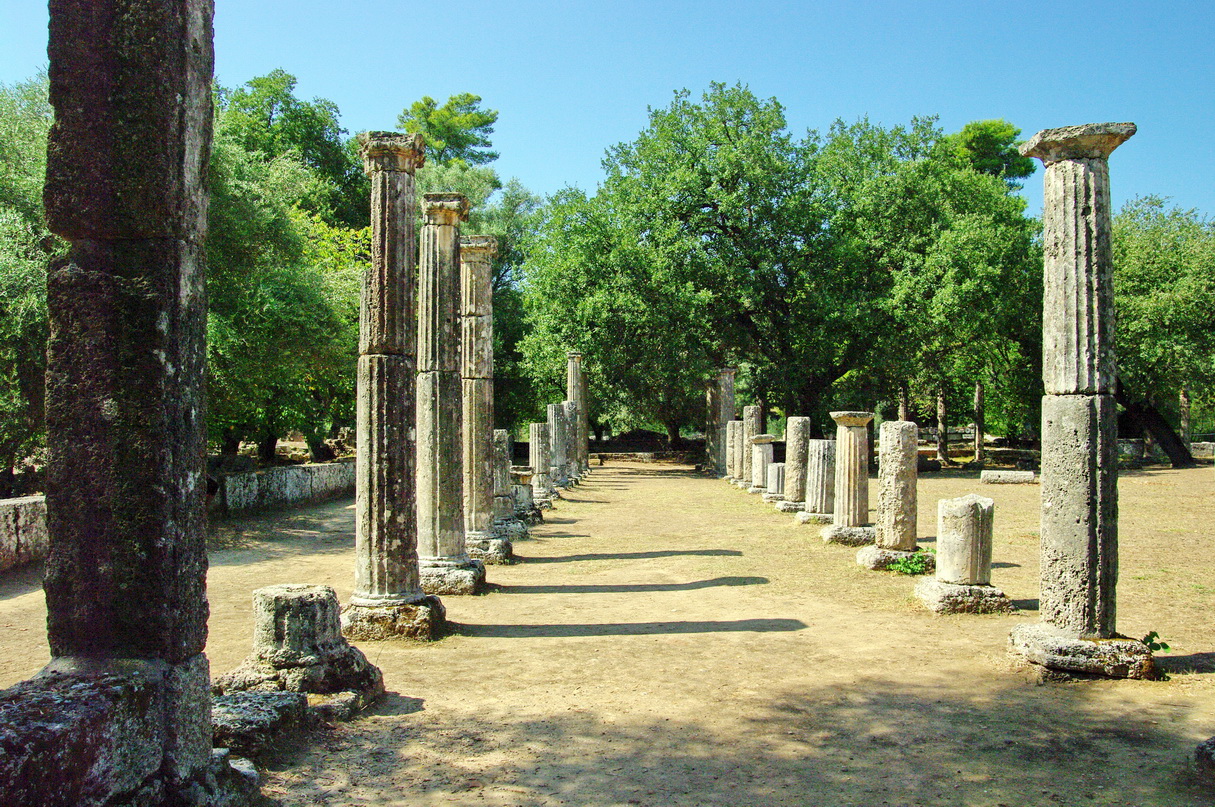
gr-olympia-palaestra
The Palaestra