Pillars Of Truth

Carl Pollard

Scripture offers deeper insights into the nature of truth. When you choose to integrate faith into your everyday life, you will find meaning and you will be fulfilled. 

You will find a purpose driven existence that the world longs to have. With God, life has meaning. 

Notice with me 5 biblical truths that shape our worldview. There are many more, but these five have been the fundamentals of our faith. These are the ones that the apostles taught to the world after the ascension of Jesus. I am thankful that God has given to us a framework as Christians, a framework through which we are supposed to interpret the world.

We don’t rely on opinions, or feelings, or traditions, or our families, to tell us these truths. These truths were laid upon us by the Lord of Lords. He tells us these truths so that we would have a lens through which we can interpret the world. Without them we are Velma from Scooby Doo. We NEED these glasses to see the world properly.

Pillar number 1 in the biblical worldview…

We Were Created

How does the world say that we got here? 

In the beginning there was a cosmic boom. 

This is what our children our taught, and what more and more people are believing. 

This is totally contrary to the words of Scripture. We say “In the beginning God created.” The world says, “In the Beginning nothing created.” It takes more faith to believe evolution than it does the first five words of the Bible. Pillar number 1 of a biblical worldview contradicts the very nature of modern historical scientists. 

In the beginning God said, “Let us make man in our own imagine, in our own likeness” Gen. 1:26 

We were created and molded after the Creator. From this first pillar we learn many things. Because we have a Creator we better understand the world God placed us in. 

The knowledge of a Creator helps us understand ourselves better since we were made in the image of God. Because we were created we learn of the Creator who shaped us out of dust and breathed life into our bodies. We were created to ENJOY fellowship with our God.

Pillar number 2…

We Fell

In Genesis 3, man rebelled against God and as a result of that, sin entered into the world. This sin caused

  1. Spiritual separation: Adam and Eve and their children were separated from God, both physically and spiritually. They could no longer walk and talk with God face to face. 
  2. Physical changes: Adam and Eve became mortal, and they and their children would experience sickness, pain, and physical death. 
  3. Cursed environment: The ground was cursed in the Garden of Eden and throughout the earth. 
  4. Loss of righteousness: Adam and Eve became aware of their nakedness and knew that their former perfection was gone. 
  5. Guilt and shame: Adam and Eve felt guilt and shame they had NEVER felt this before. 
  6. Judgment: Satan was judged with a divine curse. The woman would experience pain in childbirth, and her husband was to rule over her. Man must now labor for his existence on a cursed earth. 

And if that wasn’t enough, Paul says this in Romans 5:12: “Therefore, just as sin entered the world through one man, and death through sin, so also death was passed on to all men, because all sinned.” From the moment we fell, all people are born into a sinful world, and with a desire to rebel against our God. No matter who you are, you will have sin in your life (Romans 3:23).

There are so many people who don’t believe in God because of the consequences of the fall. They’re angry because there is suffering and death in the world. They think if God exists, why is there so much death and pain? Either He doesn’t exist, is too weak to fix it, or just doesn’t care. In their minds, they don’t believe in God because of these things. Why do so many feel this way? They fail to have a biblical worldview. Otherwise they would realize that all of this death and suffering and sorrow is a direct result of the fall. We recognize through a biblical worldview that we live in a fallen world. 

And because of this, although God is good and He exists, suffering also exists because we live in a SINFUL world. 

Do you see how these worldviews can start changing your attitude? Every tear you’ve ever shed. Every graveside you’ve ever attended. Every hospital you’ve been in. Every NICU a child is taken to. Every war that is fought. Every cancer treatment you take. Every grey hair or lack of hair. Every divorce, every death, every diseases. Every failure, every insecurity, every struggle ALL exists because we LIVE in a fallen world! 

What is the point if there is no God to save us from our sin?

Pillar 3…

We Are Redeemed

We are currently living in the Christian era or dispensation. We exist in a time, after the fall, but before the end. We are in the last times. No newer covenant, this is it. 

God has given His Son, we either accept Him or reject it. What more could God give? 

How else could He prove to His creation that He loves us? He chose us after the fall. 

We are now redeemed through Christ. We are living in a time after the resurrection and before the second coming. God is working on this earth to redeem those whose hearts are soft so that we can escape judgment. 

We are redeemed by the blood of Christ, and God is going to make sure that everybody has an opportunity to respond. 

And that is where we are now. God is redeeming for Himself a people who will spend an eternity with Him. Ephesians 1:7 says, “In him we have redemption through his blood, the forgiveness of sins, in accordance with the riches of God’s grace.” This word redeemed literally means, to release from a captive condition, to deliver. What are we being released from? What holds us captive? The SIN we find ourselves in as we are living in a fallen world!

Christ is our redeemer who saves us again and again. God has regained His prize possession through the payment of His Son. 

Not everyone will be saved, only those who have come in contact with the blood of Christ. This is why call Him our redeemer. 

Those who are redeemed will be taken to paradise and saved from the destruction of this world. We live in the era of redemption. 

If you don’t have this biblical worldview, you will see no reason to stop sinful behavior. 

You will be just like those in the days of Noah, MOCKING the ones who are getting in a boat on dry land. This worldview should shape our perspective of life, to its CORE. 

Pillar 4…

We Are A Part of The Kingdom

The Kingdom of God is the reign and rule of God in our lives. We were redeemed to be a new creation in Christ. We are a part of the reign of God in the world. As citizens in this Kingdom, we are called to live in a way that reflects His values and priorities. 

We are called to live out the principles of our King in our daily lives. Jesus came, according to Mark one, preaching the kingdom of God is at hand. 

It’s here now! Our worldview, that is, our jobs, our families, our friends, our words, our thoughts, our actions, our attitude, our perspective, must ALL be shaped by our citizenship. We. Belong. To God. “But our citizenship is above, and from it we await a Savior, the Lord Jesus Christ, who will transform our lowly body to be like his glorious body, by the power that enables him even to subject all things to himself” (Phil. 3:20).

We are here, but don’t belong. Live like you are in God’s Kingdom.

Pillar 5…

We Will Be Restored

This final pillar looks forward to the ultimate restoration of all things. We are promised that God will make everything new, just as it was in the beginning. Pillars 1 and 5 are connected by redemption and a kingdom. 

Through these things we will be restored to God’s original perfection. This is hope greater than any earthly thing. This promise of restoration helps us persevere through this fallen world. This promise helps us live as citizens of the Kingdom. The promise of restoration provides hope for the future. 

It encourages the redeemed to work toward godly love, to show mercy and forgiveness.

Not Relevant

Neal Pollard

Before getting to my article, I need to make a correction to last week’s article that I didn’t catch in my hurry to submit it on time: the genitive plural of ουρανος is ουρανων (I had said ουρανους, which is accusative plural). Rookie mistake. 

Everyone knows what happened last weekend. We came very, very close to some terrifying times in this country. These are some observations specific only to Christians in the aftermath of the nation’s divided response (and potential futures): 

  1. We don’t know what the future holds. While things certainly aren’t ideal (from an earthly perspective) right now, they could have been made much worse overnight. Our earthly security is not as stable as we might be tempted to think. 
  2. Earthly security is not what we’re here for. We exist to be people who model Jesus’s love as effectively as we can. External events are just details, the directive never changes. 
  3. To a Christian, these events should be considered largely irrelevant. There’s nothing wrong with being informed! It can help us mentally and emotionally prepare our response in times of crisis (cf. I Pt 3.14-17). But that’s about the extent of its value. 
  4. God installs presidents, not us (Rom 13.1, Dan 2.21). Whoever he wants in the White House will be in the White House. 
  5. We are never permitted to be ugly or hateful to our enemies (cf. Eph 4.29-31; Mt 5.43-45). 
  6. This earth is not our home (II Pt 3.7, 10-13). At least not in its current form. 
  7. As a holy nation and God’s people, our allegiance is first to Jesus (I Pt 2.9; Phil 3.20), second to whoever he decides to put in charge of our country later this year (Ac 17.26; Dan 2.21; I Pt 2.14-17; Titus 3.1, 8). 

A Hope For The Future

Carl Pollard

 Hebrews 7:20-28 compares and contrasts Christ to the Levitical priesthood. In these verses Jesus’ Superiority is clearly seen. With Christ we have hope in the future, and with that comes power for the present. Christ is a better hope because He is the Appointed Priest. Being appointed caries with it the idea of being assigned a role or job. Christ has been assigned the role of being our very own priest. 

Hebrews 7:20-22 says, “And it was not without an oath. For those who formerly became priests were made such without an oath, but this one was made a priest with an oath by the one who said to him: “The Lord has sworn and will not change his mind, ‘You are a priest forever.'” This makes Jesus the guarantor of a better covenant.”

The Levitical priests were appointed by command. Exodus 28:1-4, “Then bring near to you Aaron your brother, and his sons with him, from among the people of Israel, to serve me as priests—Aaron and Aaron’s sons, Nadab and Abihu, Eleazar and Ithamar. And you shall make holy garments for Aaron your brother, for glory and for beauty. You shall speak to all the skillful, whom I have filled with a spirit of skill, that they make Aaron’s garments to consecrate him for my priesthood. These are the garments that they shall make: a breastpiece, an ephod, a robe, a coat of checker work, a turban, and a sash. They shall make holy garments for Aaron your brother and his sons to serve me as priests.”

‭‭God created the role of priests. It was a Divine command, but without an oath. In contrast to this, the great High Priest was made Priest with an oath. Psalm 110:4 says, “The Lord has sworn and will not change his mind, “You are a priest forever after the order of Melchizedek.””

This is a promise joined with an oath. Hebrews 6:17, “So when God desired to show more convincingly to the heirs of the promise the unchangeable character of his purpose, he guaranteed it with an oath.” Jesus is a guarantee of the better covenant appointed by an oath from God, Christ guarantees the new covenant that is better. 

Since He is appointed by God, we have direct access through Our Great High Priest. We have hope in knowing that the very Son of God is active in our relationship to the Father. That is a better hope. Beyond anything in the world. 

What do you hope for in the future? A better job? More money? A bigger home? If so, know that people get fired, money gets spent, and homes rot away. If our hope is anything but our great High Priest, we have lost sight of what’s most important. Christ is our better hope because He has given us what we need most, a relationship with God the Father.

Who Is Man? Unraveling Our Identity In Psalm 8:3-4

Brent Pollard

“When I consider Your heavens, the work of Your fingers, The moon and the stars, which You have ordained; What is man that You take thought of him, And the son of man that You care for him?” (Psalm 8.3–4 NASB95)

We discover divine wisdom hidden in the heart of these lovely words as we delve into their heart. Consider King David, the author of this psalm. David, a humble shepherd who rose to become king, was astounded by how the Lord created the world and chose him to lead His people.

Even though the universe, the moon, and the stars are all beautiful, they pale in comparison to God’s choice of David, an ordinary person. But the Bible repeatedly demonstrates that God’s ways are not our ways. He selects the humble, familiar, and overlooked and then uses them to accomplish amazing things (cf. 1 Samuel 16.7). For example, the Sanhedrin even thought that Jesus’ chosen twelve were “uneducated and untrained men” (Acts 4.13 NASB95).

David’s words reassure us that God genuinely cares. Even though he has done many bad things, David claims that God has been thinking of him because of His great love and mercy. Let this serve as a reminder to all of us that God loves us regardless of what we’ve done or have done in the past.

The second way to interpret this psalm is as a representation of Christ, the true personification of the psalms. We encounter divine awe in Christ. The wonder of His birth, His teachings, the extent of His love that cost Him His life, and His miraculous resurrection demonstrates how much God loves people. He is mindful of us.

The psalm demonstrates how much God the Father loved His one and only Son, even though He allowed Him to die for us. This gracious gift is the most effective way to demonstrate how much God loves and cares for us.

Finally, let’s look at the psalm through our own eyes. The psalm asks us to view ourselves honestly. We seem so insignificant and unworthy compared to the marvels of God’s creation. Nonetheless, amid all this, we find an acknowledgment and a joyful realization that God cares about us, despite our smallness. God watches out for us. He is concerned about us (cf. Matthew 6.25ff). This truth allows us to learn more about God, His promise, and His love for each of us. 

The psalm also makes us reflect on ourselves. What are we as individuals? We are born into a fallen world and will inevitably choose sin with our free moral agency, but God’s grace makes us new. God loves and selects us despite our flaws.

Ultimately, this psalm drives home an important truth: we need to give God the same amount of thought He gives us. We should not view this requirement as a burden but as a source of comfort. Even though we know God is always present, He calls us to maintain a deep, loving relationship with Him.

Let’s keep our eyes fixed on God and constantly remind ourselves of His presence and the eternal future He has promised us as we navigate life with its ups and downs, joys and sorrows.

Major Message: Minor Prophets

Tuesday’s Column: Dale Mail

blond man with goatee smiling at camera with blazer on
Dale Pollard

MAJOR MESSAGES FROM A MINOR PROPHET: AMOS 

Who’s The Prophet?

  • Shepherd and fig tree farmer. 
  • Lived on the border of northern and southern kingdoms 
  • The North was ruled by Jeroboam the 2nd who brought wealth and prosperity to the people 

What Are His predictions?

  • Warning Israel, Judah, Benjamin and all nations of a coming destruction described as “the Day of the Lord.” 

What Was His Purpose?

  • He about the oppression of the poor, sexual immorality, greed, and corrupt government In the Northern kingdom 
  • The wealthy Israelites had become apathetic and spiritually lazy 

SIMPLE CHAPTER BREAKDOWN 

  • 1-2 messages to the nations and Israel 
  • 3-6 poems expressing the message to leaders and people 
  • 7-9 God’s judgment is explained 

SKY HIGH SNAPSHOTS 

  1. The 9 chapter book spends time circling the surrounding nations and pointing out their evil. He starts with the nations furthest away from the people and works his way closer to the target, the Northern tribes.
  2. Amos expresses God’s anger towards Damascus, Gaza, Ammon, Moab, Edom, and even Judah 
  3. Finally, the primary audience is shocked to hear that they (Northern territory) are the source of God’s anger as well 

Top 2 Practical Lessons From The Book 

Our lives will also be lessons for future generations. When they look back they will either say, 

“we ought to live as they did” or 

“we ought not live as they did.” 

PLUGGING IT IN 

“WHAT DOES GOD NEED FROM US?”

  1. God needs more fig tree farmers. He needs community preachers in the form of plumbers, school teachers, electricians, nurses, surveyors, dentists, accountants, mechanics, and engineers. 
  2. We need more preachers. It’s more common than it was, but there’s a great need for gospel preachers in the LORDs church. Amos spoke for God, but he was in the minority.
  3. We need more elders. Great elders are rare. It’s been said and proven to be true, “The church will never outgrow the shadow of her leadership.” 
  4. We need more seriousness. Not more piety, not an immovable allegiance to man’s tradition, more people who take their God seriously. 

Amos in a sentence: 

“Service does not mean salvation if our service is not from the heart.” 

Real faithfulness means worship that is holy— not habitual. He wants committed people, not costume parties. He wants our attention to be placed on our purity, not our performance. 

“Future Form” (1 John: Part Six)

Wednesday’s Column: Third’s Words

Gary Pollard

I’ll be repeating the book of I John in present-day terminology. It’s not a true translation of the book, as I am not qualified to do so. It will be based on an exegetical study of the book and will lean heavily on the SBL and UBS Greek New Testaments, as well as comparisons with other translations (ESV, NASB, NIV, ERV, NLT). My goal is to reflect the text accurately, and to highlight the intent of the author using concepts and vocabulary in common use today. 

This is not an “essentially literal” translation, and should be read as something of a commentary. 

Future Form

Look into the kind of love the father gave us: we can be called “God’s children,” and we actually are! The rest of the world doesn’t know us, but that’s because they never knew God. 

We are God’s children right now, but we have no information about what we’re going to be in the future. What we do know is this – when it’s made known, we’ll be just like him. We know this because we’ll be able to see him the way he is now! 

Anyone who has the kind of hope that comes from him is pure, the same way he’s pure. 

Becoming More Honorable

Tuesday’s Column: Dale Mail

Dale Pollard

It takes a special individual of both breed and brand to truly impact the world. The fact is, many will live their lives comfortable and content to never break any molds or “step outside the box,” as they say. Most believers understand that God has called us out of this world to be lights and to be different, but that means being uncomfortable (James 1:2-4). We don’t like that aspect of faithful walking and at times the fire inside us and the will to go on is at the verge of being snuffed out. On every side we are surrounded by a raging current of mainstream ideologies and beliefs that drown the masses sweeping them closer towards eternity—unprepared. That familiar and depressing reality can discourage and frustrate us to the point of tears. Preachers, elders, and leaders are constantly fighting these feelings as they huff and puff under the weight of it all. Christian fathers and mothers anxiously worry about that painfully uncertain future their children will battle. Young people are plagued with convincing thoughts that a faithful life is all but impossible today. How can we make an impact? You may wonder what difference you could possibly make as you observe such a powerful and evil force. Here is the bad news, it’s hard. But here is the wonderful news; it’s worth it! God has given us an instruction manual on how to become mighty misfits in a culture that rejects righteousness. There are permanent footprints left by the feet of godly men throughout history, and their tracks lead to victory for those that choose to follow them.

For example, there is the trailblazer and zealous disciple, Paul. He serves as an inspiring nonconformist when he abandons his previous life of riches, respect, and comfort. His courage, faith, and determination can produce a powerful stirring in our spirits. If that man with the thorn can overcome fear and defeat the devil’s endeavors, despite his own weakness, then by the grace of God we can too. Our lives can leave an impact and they can serve as beacon of light for generations to come. 

Notice how Jabez demonstrates this point in 1 Chronicles 4:9-10. Within a lengthy list of family lines that make up the sons of Judah, Jabez breaks the mold. While numerous names are given, there is something more to be said of Jabez. He stands out as one who was “more honorable” than those who were before him in verse 9. Though his name means “son of my sorrow,” a label associated with affliction, he refuses to let this name define his future. 

The key to his success is given in the following verse which says, 

Jabez called upon the Lord saying, ‘oh that you would bless me, your hand be with me, and that you would keep me from harm so that it might not give me pain!’ And God granted what he asked.”

 That verse is loaded with valuable lessons for this age and every age to follow. 

Lesson one: 

Don’t interpret your future by looking at your past. 

It doesn’t matter what family you were born into or how you were raised. We all have been given at least three common blessings. If you are made in the image of God, and you are, then that means you have talent, opportunity, and a life. The amount of talent, number of opportunities, and quality of that life is irrelevant. You have everything you need to succeed which is precisely what our Father desires. 

Lesson number two: 

Only God can grant you gainful glory.

 Jabez  established his lasting legacy and was victorious because he understood one thing. God is the God of impartiality. He offers a heavenly hand to help the stereotypically weak and sinful human break the stereotype. The cards of life you hold in your hand mean little to the God who owns the deck. Jabez, Paul, and many faithful others understood the weakness of humanity. Their lives are a statement and a confession— God can help anyone rise above the crowd. He can help you achieve the only recognition that counts and give you the precious gift of a future with certainty. The path to victory is a narrow one according to Matthew 7:14. Few have found it and few have finished it, but with the right Guide it can definitely be done. Are you unsure of your current location? Look down at the tracks you are following, and the guide  walking with you. If you are holding the hand of the Savior— you can be sure you’re going in the right direction. Allow that comfort to strengthen you and break out of whatever mold you are in. Let God use your weakness and failures to leave an eternal mark on a world that needs it. There is no congregation that can’t grow, no Christian that can’t improve, and no unsaved person that doesn’t deserve the chance to hear that life changing message of the cross. There’s a great day coming, and that should provoke some excitement as well as motivate us all to diligently and fearlessly work until then.

Why Going To Church Matters

 Saturday’s Column: Captain’s Blog

Carl Pollard

There’s the story told of an elderly lady that was amazed at how nice the young man next door was. Everyday he would help her gather things from her car or help her in her yard. One day the old lady finally asked the young man, “Son, how did you become such a fine person?” The young man replied, “Well, when I was a boy, I had a drug problem.” The old lady was shocked and said, “I can’t believe that.” The young man replied, “It’s true, my parents drug me to church on Sunday morning, drug me to church on Sunday night, and drug me to church on Wednesday night.”
Have you ever paused and thought about why you go to church? What reason causes you to bring your kids to worship? What’s the point? Contained in the pages of God’s Word we can find at least three reasons why we go to church. 

A Past Example

God is a God of remembrance. He would repeatedly instruct, comfort, and encourage the Israelites by reminding them of things He had done in the past. He used reminders of past instances to help motivate His people. God’s Word continues to do that for us today. It is filled with past examples to help remind us why we come together each week. We go to church because of a past example (Acts 2:41-47; Acts 20:7). 

A Present Encouragement 

1 Thessalonians 5:11 says, “Therefore encourage one another and build one another up, just as you are doing.” Hebrews 3:13 says, “But exhort one another every day, as long as it is called ‘today,’ that none of you may be hardened by the deceitfulness of sin.”
Each week in the world we may feel outnumbered trying to live a godly life. When we come together we’re reminded that we aren’t the only ones that are trying to be like Christ. William Ward once said, “Flatter me, and I may not believe you. Criticize me, and I may not like you. Ignore me, and I may not forgive you. Encourage me, and I will not forget you.” Our present encouragement comes from unity and the sharing we all have with each other. We’re encouraged through fellowship, but also praise. Worship is a time to reflect on God and what He has done for us. We focus on His nature and His love and we praise Him because we are blessed beyond belief. Our present encouragement comes from our time spent praising God our Father. We come to worship to receive our present encouragement.

A Future Event

On February 3, 2018, Robert Meilhammer, 51, of Crapo, Maryland, was struck in the head by a dead Canada goose. The bird that hit him was 14 pounds and had a nearly 6 foot wingspan. It plunged from the sky after a fellow waterfowl hunter fired a blind shot on a flock overhead. The goose fell about 90 feet, knocking the hunter out instantly and causing head and facial injuries. If you could see what was coming you would prepare. If Robert Meilhammer would’ve known about the goose coming he could’ve taken a step forward to keep from getting knocked out. If we knew what was coming, we would prepare. God in his love and grace has revealed what is coming and what needs to be done in order to prepare. We come together to remind each other of the day that is coming in the future. We come together to encourage our church family to fight the good fight, keep the faith, and to stay the course. Mark 16:16 says, “Whoever believes and is baptized will be saved, but whoever does not believe will be condemned.” The judgement day is coming and God is clear on what we should be doing. Get prepared and stay prepared by going to church. 
We assemble as a family on the first day of the week because of a past example, a present encouragement, and a future event. 

A Passion For Heaven

Sunday’s Column: Learning From Lehman

Cayden is a student at Western Kentucky University and is from Scottsville.

Cayden Ross

If you’ve ever taken any kind of introductory biology or ecology class, you’ve probably heard of a few animals that display what we call migratory patterns. It’s pretty self-explanatory, but what these animals do is they live at one location for one part of the year and somewhere else for the other part of the year. For example, there are certain species of whales that inhabit the waters around Alaska. In the Alaskan summers, there’s an abundance of food for these whales to feed on, but when the harsh winter temperatures set in, these whales’ food source becomes scarce, and these whales will migrate south to waters around Hawaii, Central Mexico, and even Asia. But when the summer returns in Alaska, these whales have this instinct to return home. Another example that might hit closer to home is that we saw tons of migratory birds flying right over Kentucky, heading south for the winter within the last few weeks and months. When spring comes back around, we will see these same birds heading back north for the summer. I find it interesting that these animals have this instinct to return home, but the neat thing is that God gives us this instinct as well. Now obviously, I’m not talking about some sort of strange migratory pattern or anything of that nature. I’m speaking about a homesickness, a passion that we Christians should have for heaven.

Ecclesiastes 3:11 says, “He has made everything beautiful in its time. Also, he has put eternity into man’s heart, yet so that he cannot find out what God has done from the beginning to the end.”

This verse tells us that we are all eternal and that God created us with eternity in mind. We know that when we pass on from this life, we are going to either one of two places, but we as Christians have this desire to live in heaven with our father forever. This world just simply isn’t our home.

Let me give you this illustration…  imagine you take a fish out of water and put it on land. That fish will never be happy! It doesn’t matter if you give that fish a wad of 100-dollar bills or build it a giant home and give it a fancy car. It still won’t be happy because it doesn’t belong on land.

As Christians, our life here on Earth is similar. It doesn’t matter how much money we have, or how big our house is, or what kind of car we drive because we will never be as happy here as we will be in heaven. 

Heaven is a place that we cannot even imagine… 

1st Corinthians 2:9 says, “What no eye has seen, nor ear heard,

     nor the heart of man imagined,

 what God has prepared for those who love him.”

We don’t have all the answers to what our home in heaven will look like or what it will feel like, but the most important thing is that when we get there, we will be in the presence of God for eternity, and He wants each and every single one of us there.

Soul Food

Wednesday’s Column: Third’s Words

man with classes and beard smiling and wearing a ball cap.
Gary Pollard

When I get discouraged, I read a few specific verses. They will hopefully encourage you, too! 

Philippians 3.20f: But we are citizens of heaven, where the lord Jesus Christ lives. And we are eagerly waiting for him to return as our savior. He will take our weak mortal bodies and change them into glorious bodies like his own, using the same power with which he will bring everything under his control. 

Romans 8.1-4: So now there is no condemnation for those who belong to Christ Jesus. Because you belong to him, the power of the life-giving spirit has freed you from the power of sin that leads to death…God did what the law could not do. He sent his own Son in a body like the bodies we sinners have. In that body God declared an end to sin’s control over us by giving his Son as a sacrifice for our sins. He did this so that the just requirement of the law would be fully satisfied for us, who no longer follow our sinful nature but instead follow the Spirit. 

I Corinthians 15.51-53: But let me reveal to you a wonderful secret. We will not all die, but we will all be transformed! It will happen in a moment, in the blink of an eye, when the last trumpet is blown. For when the trumpet sounds, those who have died will be raised to live forever. And we who are living will also be transformed. For our dying bodies must be transformed into bodies that will never die; our mortal bodies must be transformed into immortal bodies. 

II Corinthians 4.16ff: That is why we never give up. Though our bodies are dying, our spirits are being renewed every day. For our present troubles are small and won’t last very long. Yet they produce for us a glory that vastly outweighs them and will last forever! So we don’t look at the troubles we can see now; rather, we fix our gaze on things that cannot be seen. For the things we see now will soon be gone, but the things we cannot see will last forever. 

II Corinthians 5.1-4: For we know that when this earthly tent we live in is taken down (that is, when we die and leave this earthly body), we will have a house in heaven, an eternal body made for us by God himself and not by human hands. We grow weary in our present bodies, and we long to put on our heavenly bodies like new clothing. For we will put on heavenly bodies; we will not be spirits without bodies. While we live in these earthly bodies, we groan and sigh, but it’s not that we want to die and get rid of these bodies that clothe us. Rather, we want to put on our new bodies so that these dying bodies will be swallowed up by life.

Plate full of food with turkey, dressing, vegetables, mashed potatoes

8 Reminders For The Restless Mind

Tuesday’s Column: Dale Mail

dalejanelle2021

Dale Pollard

  1. Don’t carry burdens that aren’t yours (Proverbs 3.5-6)
  2. Remember the extraordinary times that God has carved out a path where there was no path before (Isaiah 43.16-19) 
  3. Don’t forget, God can see what you can’t see (Proverbs 16.9) 
  4. Even if you stumble, God won’t let you stay down (Psalm 37.23-24) 
  5. God’s vision is bigger and better than yours (Jeremiah 33.3) 
  6. God hasn’t forgotten about you (Proverbs 20.24) 
  7. Remember to be very specific when praying to God (2 Samuel 5.19) 
  8. Always be sure your will is His will (James 4.15) 

If you’re struggling with the anxieties that can come from making life’s difficult decisions, read these verses. Perhaps they will give you some insight that help you to answer that crucial question, 

“How should I be praying about this?” 

Give it to God and rest up! 

“When you lie down you will not be afraid, when you lie down your sleep will be sweet.” 

Proverbs 3.24 

How To Avoid Worrying About Your Kids

Monday’s Column: Neal At The Cross

pollard

Neal Pollard

For those not on social media and connected either with Kathy or any of our three sons, Carl, our youngest (and Thursday’s blog writer), was in a serious motorcycle accident a little over a week ago. A large pickup truck tried to turn left onto the highway and Carl hit it going highway speed. Our concern was for both his immediate safety and longterm health. Add this to two sons unofficially assisting police in breaking up a local theft ring, a son tackling a shoplifter attempting to flee a store and interrupting a gang initiation beating, broken bones, ER trips, ICU stints for health issues, and that’s not to mention innumerable “close calls,” “near misses,” “close shaves,” and “narrow escapes.”  Of course, it’s not just health. What about their relationships? What about their jobs, careers, and financial futures? What about the country they are inheriting or the children God may bless them with? Most of all, what about their spiritual condition, their faith, and their relationship with Christ? With each new phase of life, we are left to numerous consider “what ifs.” For future empty-nesters, that does not decline or disappear when they leave home. If anything, it mounts. So, how does a Christian not worry about their children?

Philippians 4:6. Paul urges us to “be anxious for nothing.” That word for anxious depicts apprehension, being unduly concerned about possible danger or misfortune. We can drive ourselves crazy thinking of all the scary scenarios. Paul says instead to pray (speak to God and petition His help), supplicate (urgently request God to meet the need, suggesting begging and pleading), and express gratitude. Specifically articulate the help you seek from God. Won’t this just make things worse? Not at all. Instead, “the peace of God, which surpasses all comprehension, will guard your hearts and your minds in Christ Jesus” (7).

Luke 12:25-26. Luke records Jesus’ voluminous teaching on various material concerns. In the middle of it, Jesus shares a principle that applies to any number of matters. He teaches, “And which of you by worrying can add a single hour to his life’s span? If then you cannot do even a very little thing, why do you worry about other matters?” What a practical, sensible truth. What do we change by endless fretting and worrying? Does it change outcomes? Does the exercise of worry keep the bad and scary things from occurring? Does it override the freewill choices of our children or others? We are at one place at a time. God knows everything (30). “He who keeps you will not slumber…nor sleep” (Psa. 121:3-4). Trust that! 

Matthew 6:33. What Matthew records is close to parallel to the material in Luke 12, though the wording and setting are different. The counsel here is about prioritization. It’s hard to “let go and let God,” but that’s Jesus’ bottom-line guidance. Again, in context, He’s dealing with material things rather than our kids. But substituting the one concern for the other does not change the principle. We are well-served to practice “God-firstness” from as early as possible, before our children are born. We should strive to live by that principle throughout the years they are in our homes, trying to show it to them. Then, we must continue to live it out personally and exemplify it before them after they leave the home. God’s kingdom, His will, His righteousness, His goals, His Word comes first and foremost. Keeping focus on that, trust Him to take care of not only us but those whose lives we care about. Jesus sweetly consoles us, “So do not worry about tomorrow, for tomorrow will care for itself. Each day has enough trouble of its own” (34).

1 Peter 5:7. I love how Peter acknowledges that we all have anxiety. We’re all tempted (and all of us at least occasionally succumb to the temptation) to worry. Peter’s words are practical. Humbling yourself under God’s all-powerful hand, throw all your anxieties on Him. He is strong enough to carry it. Do you know what’s the best part? Not only can He do it, He wants to. Why? He cares for you! He’s your Father. “Care” here means concern and anxiousness. Our lives matter to Him. His heart is involved. We may not stop to think that all of us are His children. The difference is that this Father can see the future, is fully in control, will never be startled or surprised, and never lacks for what to say, how to react, and what to do. How foolish not to give Him the things we would obsess over, be consumed with, and eaten up by. 

I wish I could tell you I will never worry about Gary, Dale, and Carl again. Those who know them know what a tall task that is. I wish I could tell you that you will never worry about your precious children again. But, none of us should. We can make progress and get better if we’ll feed on the rich truths of passages like the ones we’ve visited briefly together today. Go back and read them again. Drink deeply of their comforting, helpful truths. They will help you trust Him more with whatever frightening prospects you face regarding your children’s lives. I don’t promise. He does! 


Saturday at Hebron church of Christ (where Carl, center, preaches). This was at Carl and Emily’s wedding shower. The boys had just returned from hunting wild hogs near Demopolis, AL. It never ends!

Tips For Improving Your Outlook

Monday’s Column: Neal At The Cross

pollard

Neal Pollard

“Outlook” is one’s point of view or general attitude about life. It’s really the way one looks out at the world and sees it. Your outlook may be colored by a lot of things going on in the world right now. It’s easy to let the negative, scary, and discouraging events cloud our view. Are there some proactive measures we can take to improve that picture? Yes!

  • Invest in someone. Perhaps no one should have had a harder time keeping positive than the apostle Paul. Read all that he suffered and endured (2 Cor. 11:23-33). He repeatedly labored under the threat of danger (1 Cor. 15:30) and death (cf. 2 Tim. 4:6). Yet, he exuded positivity (Phil. 4:13,19; 2 Cor. 9:8). Surely one reason was Paul’s knack for investing in others. He mentored Timothy (1 Tim. 1:2; 2 Tim. 1:2), Titus (Ti. 1:4), and Onesimus (Phile. 10). He spent time nurturing and developing churches like Corinth (1 Cor. 4:14-15) and Thessalonica (1 Th. 2:7-8, 11). He was willing to run the risk of being disappointed by the people he invested in (2 Tim. 4:10). For every Demas, there was a Luke (2 Tim. 4:11). There is someone who needs to benefit from your wisdom, maturity, experience, and understanding. Seek them out and help them, for their sake but also for yours. 
  • Clarify your purpose. It is easy to reduce our view of this life to a daily grind we find ourselves working at. We can get lost in our routine, not unlike Martha whose outlook was distorted by hers (Luke 10:41). Being organized and fulfilling our responsibilities are vital, but what can help restore joy and meaning to all of it is regularly remembering why we engage in it all. Marriage, parenting, friendships, occupation, education, daily Christian living, church membership, and personal growth all serve a deeper purpose. Paul’s advice to slaves with earthly masters has broader application: “Whatever you do, do your work heartily, as for the Lord rather than for men, knowing that from the Lord you will receive the reward of the inheritance. It is the Lord Christ whom you serve” (Col. 3:23-24). 
  • Reduce media consumption. If you constantly monitor news and current events, you will stay discouraged and fearful. The media has always thrived on reporting on the worst events happening, and it seems there is more and more of it to report. The same kind of thing can happen with too much social media consumption. Polarizing, inflammatory posts and reactions can form a black cloud over you pretty quickly. When Paul urges us to ponder things that cause pleasure and delight (Phil. 4:8), I’m pretty sure he wasn’t thinking of anything like what the media is churning out. 
  • Increase personal interaction. Technology has steadily pushed so many toward isolation and disconnection. The pandemic forced this tendency further. Those monitoring the news cycle du jour (see previous point) retreat into virtual bunkers of suspicion against people of different colors, nationalities, and political persuasions. They become impersonal caricatures, grotesquely exaggerated and larger than life. How do you break through resulting prejudices? The Lord’s way was to be in people’s lives. Engage them. Listen to their stories. Grow empathy. Understand their hurts, fears, and needs. Realize their humanity and remind yourself how profoundly and infinitely God loves each and every one of them (John 3:16; 1 Tim. 2:4). People can be broken, full of dysfunction, and even prickly, but we will brighten our outlook when we get out of our shells and into their lives. 
  • Focus on encouragement.  Several times, I heard the late gospel preacher, George Bailey, say, “A man wrapped up in himself makes a pretty small package.” I have yet to meet a self-absorbed person who is happy with what they’ve filled themselves with. We’re just not wired that way. Paul’s central focus with the Philippians is on how to think right, their mindset and attitude. He urges placing others above self and looking out for others’ interests (Phil. 2:3-4). It’s amazing how God has wired us. When we find people to uplift and build up, it improves our own outlook. There are countless folks all around you who are struggling with their outlook. Compliment, express appreciation for, and gratefully acknowledge them. It’s a godly thing to do, but a side-effect will be what it does for you!
  • Look up and look ahead. Though not every time, usually my dampened outlook can be attributed to not only looking too much at this world and myself but also by not looking more at the world to come and God. It’s harder to focus on what’s invisible to the naked eye, but it’s crucial. Paul reminds us, “for we walk by faith, not by sight” (2 Cor. 5:7). Spend more time in God’s throne room and His inspired library. Deepen your dependency upon Him. In doing so, focus more intensely on His promise of the world to come (John 14:1-3; 2 Pet. 3:13; Rev. 21:1ff). This life is temporary. Eternity is–well–eternal!  Looking up, you’ll see the all-knowing, all-powerful, ever-present, and all-loving God (Psa. 139:1-18). Looking ahead, you’ll see victory (1 John 5:4). 

I think we’ll always struggle with dark days and discouragement. Did Paul? Read 2 Corinthians and 2 Timothy. But, he and other Bible writers give us a laundry list of ways to combat these and make them temporary. David was walking through the valley of the shadow of death, but He could still see divine presence, divine comfort, divine provision, divine blessings, and divine promise (Psa. 23:4-6). So can we!  It just may take adjusting the way we look out at the world. 

“We Have Nothing to Offer but Fear Itself” 

Friday’s Column: Brent’s Biblical Bytes

81121814_2462862270639428_5746232403106463744_n

Brent Pollard

We have entered the vestibule of a new year. Upon reflection, one might realize how subjective the significance of this day is. Neil deGrasse Tyson likes to point this out annually. For example, in 2011, he tweeted: “January 1, 2011: Happy New Year to all –at this arbitrary spot in Earth’s orbit around the Sun.” (Tyson) Consider China. They may observe the Gregorian calendar to conduct global business, but they will not celebrate the new year until February 12, 2021. Why is there a discrepancy? The Chinese, like the Jews, have a lunar-based calendar. God may have created time as a construct in our material universe, but the only “clocks” He provided were the moon and the sun (Genesis 1.14-19), and it is easier to mark time by the moon since we watch it wax and wane. The sun may appear a little lower or higher in the sky, but it is always making its same east-west circuit.  

Even so, we choose January 1 as a special day to begin making necessary or desirable changes to our lives. I would hope that in an age of “fear porn,” the child of God will choose calm. I apologize if the use of that four-letter word is offensive. However, “fear porn” is an expression that has entered our vernacular. Oxford defines this specific usage of the word “porn” as follows: “[in combination or with modifier] Television programs, magazines, books, etc. that are regarded as emphasizing the sensuous or sensational aspects of a nonsexual subject and stimulating a compulsive interest in their audience.” (“Porn”)  Perhaps the definition provided by a user of the less-authoritative Urban Dictionary is more accessible.  “Mainstream Media content that deliberately and enticingly plays on people’s fears about disaster, disease, and death.” (Animalfarm1984) 

While addressing the Great Depression, Democrat Franklin Delano Rosevelt famously stated, “…the only thing we have to fear is fear itself.” Among others, Michael Reagan, speaking of his political opponents, has altered the maxim to be “the only thing we have to offer is fear itself.” (Reagan) I imagine there are those considering that indictment up to debate. However, it is not my point to assign blame to political parties or politicians. Many thrive on instilling fear regardless of political affiliation. As one writer for a pop-psychology magazine opined, fear is “the most powerful motivator of all.” (Wilson)    

I set out to recall a time in my life in which no Chicken Little was trying to scare me about something. I fail to remember a season when all was well with the world. In nearly a half-century of life, alarmists told me of the perils I face from nuclear war, a new ice age, a hole in the ozone layer, acid rain, killer bees, the deforestation of the Amazon region, the policies of Ronald Reagan, Y2K, global-warming-no-wait-let’s-call-it-climate-change-to-cover-all-our-bases, the policies of Barrack Obama, Ebola, the very existence of Donald Trump, the Illuminati, Globalists, Antifa, Black Lives Matter, COVID-19, and, now, Joe Biden’s socialist regime. Phew. Sadly, I have occasionally given such Chicken Littles a greater hearing than the assurances found in God’s Word.  

What was it that the inspired Apostle John said? “You are from God, little children, and have overcome them; because greater is He who is in you than he who is in the world” (1 John 4.4 NASB1995). Jesus created and now sustains creation (Colossians 1.16-17). It is He who will destroy it when the time comes (2 Peter 3.10). In the interim, as God promised Noah: “While the earth remains, seedtime and harvest, and cold and heat, and summer and winter, and day and night shall not cease (Genesis 8.22 NASB1995).” It may be that we figuratively see the writing on the wall as Belshazzar indeed did in Daniel 5, but even so, God will be our Rock. Even if the mountains crumble and fall into the sea, He is still our refuge (Psalm 46). It is OK to face uncertainty with apprehension like Habakkuk did as he awaited the impending Babylonian invasion (Habakkuk 3.2,16). Yet, like Habakkuk (and the Apostle Paul), we must bravely move forward, recognizing our dependence upon Providence (Habakkuk 3.17-19; Philippians 4.11-13). Regardless of what 2021 may hold, if you seek God and His Kingdom first, God has your back (Matthew 6.33)! 

Works Cited 

Tyson, Neil deGrasse (neiltyson). “January 1, 2011: Happy New Year to all –at this arbitrary spot in Earth’s orbit around the Sun.” 1 January 2011, 2:55 p.m. Tweet. 

“Porn: Definition of Porn by Oxford Dictionary on Lexico.com Also Meaning of Porn.” Lexico Dictionaries | English, Lexico Dictionaries,www.lexico.com/en/definition/porn

Animalfarm1984. “Fear Porn.” Urban Dictionary, Urban Dictionary, 26 June 2020, www.urbandictionary.com/define.php?term=Fear+Porn

Reagan, Michael. “Stories in the News – Ketchikan, Alaska – The Fear Peddlers.” Sitnews, Stories in the News, 15 May 2003, 4:25 p.m.,www.sitnews.net/Columnist/051503_reagan.html

Wilson, Robert. “The Most Powerful Motivator.” Psychology Today, Sussex Publishers, 23 Sept. 2009, www.psychologytoday.com/us/blog/the-main-ingredient/200909/the-most-powerful-motivator


Peace On Earth?

Tuesday’s Column: Dale Mail

image

Dale Pollard

Peace on earth? Is that even possible? I mean boy look at this place. 

Could it be that peace and joy mean something else entirely? 

It’s true that for the faithful Christian peace and joy await us, but there are some who believe we can only experience these blessings in heaven. 

  1. We may feel that we are allowed only moments of Joy. 
  2. History shows us only times of peace, but never peace everywhere.

Can we have peace and joy for our life here on earth? 

Let’s look at how this is most definitely possible. Perhaps it’ll make the holiday season that much more enjoyable and hopefully every day after. 

 Real PEACE 

  1. Peace is not the lack of war— we know we’re in a spiritual battle (2 Cor. 10:3-5)
  2. We can have peace knowing that Jesus already won the ultimate war of death and gave us the victory.
  3. Peace comes from confidence in your salvation (Romans 8:31-38) 
  4. God is on our side. He’s bigger than any problem we will ever face— peace comes from knowing what many assume to be the unknown.

Real JOY 

What is joy? 

  1. It’s not happiness 
  2. Like peace, it relies on an understanding of faith and and the appreciation of victory. 
  3. It’s also a conscious awareness that God is active in our lives. James 1:2 says, “Count it all joy!” That doesn’t mean when trials tumble in you embrace them with a smile, but it’s an awareness that God is working in the world and that He has everything under control.

What’s there to be joyous about?

  1. If you’re a faithful Child of God— there’s everything to be joyous about. Your life is one of abundant joy, but you may just need to choose it.
  2. Decide how you will view future trials ahead of time. Now is a great time at the beginning of a new year. 

These are God’s gifts to you that keep on giving— all year long. 

Peace to you and may this new year be the one we all decide to be joyful about the certainty we share in a world full of uncertainty. 

Election & Covid & Anxiety, Oh My! 

Tuesday’s Column: Dale Mail

image

Dale Pollard

I bet you’re probably sick hearing about two big topics right now so for the sake of this little article and your sanity— I won’t even mention them by name. Believe me, I wish my blog posting day didn’t fall on this particular Tuesday. I thought about avoiding any p*******l-related angles all together. The fact is, it’s a big deal and it’s probably what’s on your mind today. 

Well we better pray about it!

 I’m sure you’ve heard that in your congregation many times. Let’s clarify what that needs to look like in my life and in every God-fearing individual’s life. 

When we bring God a petitioning prayer concerning anything, large or little, let’s first remind ourselves of the sacred ingredients that make up an effective prayer. 

  1. Evaluate your spiritual life. The prayers of “righteous” men and women make an impact. James 5:16 
  2. God can’t be seen as one option. Think of the rascally child who, after receiving a “no” from his father, approaches his mother in secret seeking a “yes.” That child should receive a stern chat— perhaps a spanking? When we approach God, we must do so with His will above our wants. Sometimes the two line up! If they don’t, accept the answer and press on. 
  3. Saturate your petitions with praise and thankfulness. Though the virus remains active or the “wrong” man takes the office— The Almighty deserves your praise and thankful heart. After all, He reigns with perfection and justice on His throne (Psalm 97:1). God has given us the cure to a horrible sickness that not even all the scientists in the world could cure (Ephesians 2:8). Nothing that happens today or any day will ever change those things. We’ve only scratched the surface here, too. God deserves every bit of your praise and thankfulness— no matter what. 
  4. Don’t miss the big picture when you pray. Our minds have a way of fooling us into thinking that current events ARE the big picture. That’s just not true. What’s more important? The growth and faith of every member of His church. I can’t help but think of congregations that have been spiritually strengthened and grown— despite an earth shaking pandemic. What’s most important is not this country or nation, it’s His kingdom and that kingdom to come. 

Are you righteous? 

Please pray for this world and pray for His church. If there’s something keeping you from the righteousness of God, that’s far more urgent than anything else. Your faith is  what deserves your full attention. 

Let’s be a happy and hopeful people— let’s be those who practice righteousness. 


What Happens After “Happily Ever After”?

Monday’s Column: Neal at the Cross

pollard

Neal Pollard

It’s something they never tell you in the romantic movie. The ending of the storyline so full of twists and turns, where he and she might not have ended up together but seemed destined to be together, is so happy and perfect. Both are all smiles, with stars in their eyes, when we see “The End” and the credits roll.

They never tell you what happens after the fairy tale wedding or the long-awaited kiss. He refuses to ask directions as they fade into the sunset. They argue over where to eat that romantic dinner. He speaks without thinking and says something thoughtless, followed by tense silence. 

I am not critiquing one of the sacrosanct principles of romantic movies and books. Happy endings can be a great escape from reality and a feel good experience. Yet, when we hold it up as the unqualified expectation for our own lives, we set ourselves up for trouble. Social media is rife with posts and pictures which can perpetuate the fiction that the people we friend and follow are constantly living out “happily ever after.” Life is always grand, and success and satisfaction is the constant. 

Don’t misunderstand. So much of what we experience in life is shaped by attitude. Being positive can help us negotiate those hairpin curves in the road of life. But, coping through positivity is different from allowing disappointment to make us disenchanted with failing to meet the unrealistic expectation that every problem and adversity can be wrapped up into a pretty, neat package with a frilly bow on top. 

It’s quite the balancing act, isn’t it? Scripture teaches to think on healthy, beneficial things come what may (Phil. 4:8). Or, as Solomon puts it, “All the days of the afflicted are bad, but a cheerful heart has a continual feast” (Prov. 15:15). Yet, Job (14:1) and Solomon (Ecc. 2:23) do not sugarcoat the reality that life is often painful, grievous, and full of trouble both day and night. 

May I offer some encouragement?

  • To the newlyweds, neither of you is perfect and there is no way you can always agree and get along without mutual compromise and effort. You will have so many great days, but there will be some mountains to climb and valleys you must pass through. No couple out there is breezing through married life. Turning to one another (and God) rather than on one another when marriage is hard will forge your bond come what may (1 Pet. 3:7).
  • To the new parents, though that baby looks perfect and angelic, he or she will introduce demands, needs, concerns, and challenges you never knew existed before. Each developmental stage will be accompanied by incredible highs and lows. As you look into the faces of your children, you will be looking at eternity and knowing the weight of your decisions and leadership. But, savor those little ordinary moments. You are placing puzzle pieces that will one day become your children’s picture of their childhood. How you handled the hard times will be at least as important as how you handled the fun times (Prov. 22:6). 
  • To the new Christian, it is right for you to relish the feeling of relief and joy over being forgiven and cleansed from sins. The burden of guilt has been lifted. You are experiencing something in Christ that you never knew existed. But, there will be difficult days. The devil lurks (1 Pet. 5:8). Selfish desires can derail (Jas. 1:13-15). Suffering for your faith should be expected (1 Pet. 4:16; Acts 14:22), but by hanging on your eternal destiny is better than you can imagine. Along the journey, you will grow, mature, and develop into someone better and stronger as Christ lives in you (Gal. 2:20). 
  • To the Christian who publicly repents, you had no idea how much support, love, and encouragement you were going to receive. You feel the relief of forgiveness and restored hope. There’s clarity and purpose where there had been confusion and distraction. Things are better now (cf. Jas. 5:16; 1 Jn. 1:9), but the battles and temptations that led you away are still there. You will still have to face the consequences of bad choices, but you will not regret turning to God and your spiritual family for help. This is the first step of your rededication. Keep walking and never stop (Mat. 7:13-14; 1 Th. 2:12).

There are so many other phases and circumstances deserving the same kind of encouragement. The bottom line for each is the same. When viewed with heavenly eyes, each of us is staring at the ultimate happy ending. Even as our exterior deteriorates, our inner man is renewed daily (2 Cor. 4:16). Our momentary difficulties will give way to incomparable glory (2 Cor. 4:17-18).  The best is yet to come (2 Cor. 5). But, between now and then, we all have to negotiate bumps in the road. That’s OK. Keep following Christ on this narrow road and the “ever after” will transcend your greatest hopes (Mat. 16:24ff). 

Understanding “Gospel” In The Colossians Epistle

Wednesday’s Column: Third’s Word

Gary III

Gary Pollard

If you’re remotely religious, you’re familiar with the word “gospel.” It has a wide semantic range, describing everything from a genre of music (and a few sub-genres) to the trustworthiness of a statement (“gospel truth”) to an all-encompassing description of religious doctrine. 

The word literally means, “God’s good news to humans,” from εὐαγγέλιον. It is mostly about the life and times of Jesus and the spiritual rewards we have when we accept that hope and follow God’s plan of salvation. It is so common and familiar to many of us that we sometimes overlook its importance. 

We often hear about “spiritual blessings,” but the definitions we are given of them are sometimes (if not often) frustratingly ambiguous. Colossians 1:3-12 gives us a beautiful description of those blessings. One of them is the gospel! Here’s why: 

1. The Gospel is Hope

A phenomenon so common to my generation (it’s immortalized in more than a few memes) is the idea of existential crisis. We ask questions like, “What am I doing? Why am I here? What’s my purpose? Why am I working this dead-end job?” We don’t like to think of where we’ll be in 20 years because that’s downright depressing. Will it be more of the same? The crushing weight of a meaningless existence is at the forefront of so many minds. 

The good news we have is described in Colossians 1:5 as, “…the hope reserved for you in heaven…” That’s purpose! What kind of hope? What are we looking for? We have been given the means to live a life with purpose. It won’t be easy, but it guarantees a perfect existence after we’re gone. This hope for heaven is central to the gospel. 

2. The Gospel Makes Us Better People

Once the Colossian Christians changed their lives, were immersed, and changed their lifestyles, they had a great love for each other and all of the other Christians (1:4). We can be friendly to others (even complete strangers), but Christianity promotes unconditional love for others. The world tries to achieve this artificially, but Christianity accomplishes this through unity and self-sacrifice based on guidance from scripture. 

If we are as dedicated as we should be, it also gives us endurance and patience when we deal with difficulty (1:11, 12). Those who follow God’s will and are dedicated to serving Him are guaranteed a perfect and meaningful existence after this life (Colossians 1:5, 12). 

We are confronted with our own mortality more often than we’d like (especially today). This has a whole lot of people questioning their purpose and their destiny. Christianity offers the greatest gift ever given: purpose and destiny. God has told us how to have both of those things; we can live a meaningful life here, no matter how difficult, and we can have a perfect life there. If you are looking for meaning and purpose in this life, look no further than the gospel – it is how we can be pure here, living a purposeful life with perfect hope for the next. 

vault-1144249_960_720

Longing For Hope

Thursday’s Column: Captain’s Blog

IMG_0806

Carl Pollard

We’ve spent three weeks looking at a few areas where the world is desperate. They long for guidance, purpose and finally, hope (1 Pt. 5:10).
We have abused this word. We say things like, “I hope there’s some food at the house” or, “I hope the weather is nice tomorrow,” and “I hope my team wins the super bowl.” The hope that’s mentioned is scripture has a completely different definition.
The word in Romans 15:13, for example, is the Greek word “elpis. “Now may the God of hope fill you with all joy and peace in believing, so that you will abound in hope by the power of the Holy Spirit.” This word is defined as, “looking forward to something with confidence” (BDAG 319).  It is an expectation that we have as Christian. We have hope because we call God our Father.
The world does not and because of this they have nothing to hope in. If they look forward to anything it’s pay day or the weekend or vacations. Every one of these come to an end and once again they are left with no hope.
Don’t get me wrong, we look forward to these things too. And there’s nothing wrong with that, but this isn’t what we look forward to solely. We know that there is more to life than vacation.
1 Peter 5:10 is an incredible verse that describes the hope we have. It says, “After you have suffered for a little while, the God of all grace, who called you to His eternal glory in Christ, will Himself perfect, confirm, strengthen and establish you.”
This is true hope. This is the God of the universe Himself that will do this for each one of his children. We may not see it every day, but the world is lost and desperate. We have what they need. They’re desperate for guidance because they’re lost. They’re desperate for purpose because they have none. They’re desperate for Hope because the world offers nothing to those who are struggling.
God has entrusted us with the answers to life, so what are we doing with this knowledge?
66510003_10156443547920922_292784965630820352_o

How To Make The Best Of A Bad Situation 

Tuesday’s Column: Dale Mail

IMG_1381

Dale Pollard

Rattlesnakes are large, venomous snakes that live throughout North and South America. In my humble opinion, they are one of the most terrifying creatures on the planet–from the hair-raising sound of that rattle to those intimidating fangs that can be up to six inches long. The bite from one of these monsters is excruciatingly painful. If you were to be bitten, at first you would experience a tingling feeling, followed by an intense burning sensation. After this you would feel lightheaded and begin sweating profusely. Your vision would become blurry, and each breath would be more strained than the last one.

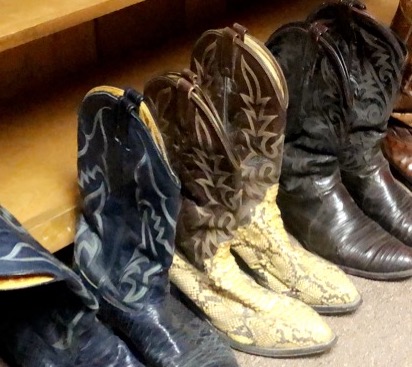
If left untreated, it can be fatal to humans. All of that sounds terrible doesn’t it? What good could possibly come from a deadly rattlesnake? Well, at some point in history, somebody looked at these snakes and decided that they would make a beautiful pair of boots. That’s how to make something great, out of something terrible. There is no doubt in my mind that the inventor of snakeskin boots was an optimist. He could see the good, even when staring into the dark vertical pupils of pure reptilian evil.

When faced with hardship, that simply comes from living in a fallen world, it can be a challenge to see the silver lining in each dark cloud. American basketball player, Charles Barkley once said, “Sometimes the light at the end of the tunnel is a train.” That’s definitely how it can feel sometimes! Although we have books in the Bible like Job and James that teach us how we should view our earthly struggles, here are just a few reminders from our God.

Number one, remember that each day is worth rejoicing over. Psalm 118:24 gives us the reason why— because today is another day that the Lord has made. It’s not my day; it’s God’s day. Reminder number two, what we can’t see in times of difficulty, is worth waiting for. Paul would inform us in Romans 8:27, “But if we hope in what we don’t see, we wait for it with patience.” In the muck of life it may feel at times that there’s just no way out. Just because you may not see the end in sight, rest assured that our hope is in a promise that was put in place before time itself began (2 Timothy 1:9). The last reminder is simply this, that God made the world you are living in and Jesus is currently creating the world we will one day live in (John 14:1-3). I firmly believe each day that passes can only mean that heaven will be that much more beautiful. If God created this world in six days, in all it’s beauty, imagine the splendor of our home to come. Now, if that doesn’t make a bad situation a good one, I don’t know what will! Here are the lyrics to an optimistic hymn that I hope get stuck in your head for quite a while.

“I care not today what tomorrow may bring, if shadow or sunshine or rain. The Lord I know ruleth o’er everything, and all of my worry is vain. Living by faith in Jesus above, trusting confiding in His great love. From all harm safe in His sheltering arm, I’m living by faith and feel no alarm.”

rattlesnake boots
One of two pair of rattlesnake skin boots I own.