“Rhosts!”

Wednesday’s Column: Third’s Words

Gary Pollard

My favorite show is Scooby Doo (the originals, of course). It’s packed with ghosts and monsters, most of which are exposed as frauds or criminals. Mankind has been fascinated with ghosts and other postmortem apparitions for a while. They make great stories and nearly every culture has ghost stories. We point to widespread legends of dragons as one evidence of man’s coexistence with dinosaurs. Since so many cultures have these ghost stories, is it possible they’re true? 

Life and death are God’s jurisdiction, so let’s see if he’s said anything about the subject. Who better to ask about the other side than the one who controls it? 

Look at Luke 16.19-31. Whether this is literal or figurative is immaterial, I just want to look at something Jesus described in detail. A rich man neglected Lazarus (an impoverished man) and ended up in torment after death. He lets Abraham know that he has family on earth who don’t believe and he wants to prevent them from sharing his fate. 

Abraham points out that a large abyss acts as a barrier, preventing anyone from moving between realms. He’s specifically talking about passing from torment to paradise and vice versa, but the rich man was nonetheless incapable of leaving under his own power. 

Hebrews 9 says that we die one time and face judgment. This seems to indicate some permanence to our destination. We know that some spiritual entities are capable of interacting with our world (angels/demons) in some capacity, but the Bible doesn’t give us much detail. 

We can state with a decent degree of confidence, though, that the dead are stuck where they are. That’s a major comfort, too, because our future is secure if we die in Christ (I Peter 1.3-7). They make for great plots (and the best cartoon ever), but ghosts remain solidly in our awesome imaginations.  

TIME

Tuesday’s Column: Dale Mail

image

Dale Pollard

Our lives are based on time. Everything we do is on a schedule. We all have limited time, we waist time, we spend time, we invest time, we make time, the world is on a clock. 

God has the title of the Creator. 

He created 

  • You
  • me
  • the world 
  • Galaxy 
  • Universe 

He was and is and ever will be, the Alpha Omega beginning and end. 

He is the God of history, of Abraham, Isaac and Jacob.

He is God of the present, and God of the future. 

God is the originator of time; He invented it, it’s His. 

Here are three quick thoughts to consider about this precious commodity.

  1. Money and time share similarities. Don’t waste it. Spend it wisely. Invest it in the future. 
  2. All good things come to an end but thank God that the best thing, heaven, will never end.
  3. With the proper perspective we can clearly see that we’re all on God’s time. 

What will we do with the time God gave us today?

But do not overlook this one fact, beloved, that with the Lord one day is as a thousand years, and a thousand years as one day. – 2 Peter 3:8 

Keeping Eternity Nearby

Thursday’s Column: Captain’s Blog

carl pic

Carl Pollard

Eternity is a topic that many of us have heard taught many times. We have Sunday classes on eternity, and we hear sermons about heaven and hell. We learn about the life that comes after this one, but sometimes it doesn’t feel real. I’ve known about eternity for as long as I can remember, but I didn’t truly grasp this idea until later in my life. The extent of my knowledge was that heaven was where I wanted to go, and hell was for sinners. 

It didn’t seem very real. I found myself thinking, “I have my entire life ahead of me, I’ll worry about it later down the road.” I saw eternity like any other young guy. It was a place that I knew was coming in the future, but failed to live with this knowledge in mind. Lately I’ve noticed a few things that need to be said.

Eternity is so much more than what I believed it to be. It can be an eternity filled with life, or an eternity filled with torment. John 5:24 says, “Truly, truly, I say to you, whoever hears my word and believes him who sent me has eternal life. He does not come into judgment, but has passed from death to life.” The Word of God has the ability to make our eternity be one that is filled with life and joy. But then we read verses like Romans 6:23 that say, “The wages of sin is death, but the free gift of God is eternal life” I can’t tell you how many times I’ve heard this verse before, but I was failing to grasp what Paul is really saying. We deserved punishment. We were lost and consumed with sin, and we should’ve been punished for what we had done. Instead of punishing us or giving us what we deserved, God offered us eternal life. 

Paul describes eternal life as being a free gift. He uses the Greek word “charisma” which translated means “that which is freely and graciously given.” I have major trust issues when it comes to car dealerships. They say a bunch of words that they apparently don’t understand. Things like, “no interest” and “zero down” or “totally free.” But I have a hard time believing that something could be completely free with no strings attached. Eternal life was given to us. God wasn’t forced to do it. He wasn’t pressured into giving it, instead He chose to give it to us. No strings attached. 

In the church, some have failed to see eternity for what it is; a place that is very real. It is a place that everyone will end up going to. If we live with eternity in view, we will begin to focus on what is truly important. Living with eternity in mind gives us the clarity we need to make the right choices, knowing that our actions will impact our final destination. 

If we live with eternity in mind we will realize the importance of time. I’ve been preaching at the Hebron church of Christ in Grant, Alabama, for two years and it feels like I just moved here. Every year seems to slip away faster than the one before it. James 4:14 tells us that our life is a vapor. We weren’t meant to be here forever. When I was younger I failed to see how quickly life will pass by. Without eternity in mind we won’t see each day as an opportunity to share the Gospel or a chance to tell the world about a loving God that longs for everyone to be saved. We would find ourselves spending less time on the insignificant. 

As a teen I was horrified at the thought of hell. And while hell is still very real, the longer I live, the less I fear hell, and the more I long for heaven. I long for the day when I will be in the presence of God. I long for the day when God will give me a comfort and peace so powerful that it will completely remove all sorrow and pain. I long for heaven because I’ll never have to say a painful goodbye, but instead I’ll be with faithful and likeminded men and women for all eternity. The longer we live the more pain and heartache we go through. The stronger our desire becomes to be with God in that perfect home. 
Life has a way of changing our outlook on eternity. Let life’s issues be the motivation to reach eternity, and not the reason we lose eternal life. 

THE GREATNESS OF LOVE

Thursday’s Column: Captain’s Blog

IMG_0806

Carl Pollard

Love is the ultimate gift we can have as Christians. Paul in 1 Corinthians 13 shows us why love is greater. It’s patient, kind, humble, and selfless. He wraps up this section by saying, “But now faith, hope, love, abide these three; but the greatest of these is love.” Why is love the greatest?
The Importance of Faith. Paul tells us that now “abide these three.” He uses the Greek word meno (“to continue to exist, remain, last, persist, continue to live).” We are commanded to remain in and live in faith. What does this mean? It means our lives must be transformed by our faith. It must be a LIVING faith. Not a one time faith, but a continual faith and trust in God. And this applies to all three attributes. Continue to live in faith, hope and love. We have to ask, “What does it look like when a Christian lives in faith?” To understand this we need to recognize that faith is “state of believing on the basis of the reliability of the one trusted, trust, confidence.” Faith is the Christian fully trusting in God because we believe in His promises.
People have ruined the meaning of faith. They will say that Christians have a “blind faith,” one that is almost illogical and irrational. As Christians we aren’t commanded to have a blind faith, but a faith based off of the evidence that we can see. There is evidence of an almighty creator, evidence that is seen in His infallible word, evidence that can be seen in His marvelous creation, and evidence that is based in logic by just taking a moment to look at the many different ways that God has revealed Himself to us. Paul tells us to live in faith, a faith that is backed by confidence.
The Need For Hope. The Christian walk is based on the hope of heaven. Biblical Hope is a confident expectation of the future we have as Christians. There’s a great need for Hope. Many in the world feel hopeless, especially when they see the news and look at what is going on around them. It can be easy to feel hopeless at times. To feel overwhelmed by the sin that surrounds us. It’s natural to feel this because we live in a fallen world where people do whatever they want with no regard for others. Paul remind us that we have hope, and even more than that, he tell us to remain in this hope and let it be an encouragement in times of need.
If we ever feel helpless, think of what we have to hope in as people that God has Called: The hope of a reunion with fellow Christians that have gone on, the hope of an eternity spent with the Father, the hope of a time where God will wipe away the tears of his children, and the hope of a time where we will never have to experience heartbreak and say those painful goodbyes. Each one of us will experience death, but it is not the end because we have hope.
The Greatness Of Love. Love is greater than faith and hope. Why? Why is love the greatest? What happens to our faith? It becomes sight. The One we have had faith in will be with us in person. The future we have hoped for all our lives will become a reality. But love, love will continue on for an eternity.
As Christians we will be separated from those who are filled with hate and be in a place filled with love. Our faith and hope will end, but love will never cease. Think about a place filled with pure love. Surrounded by likeminded people that have this sacrificial love, and living forever with the Author and perfecter of true love.
Why is love the greatest? Because it lasts.
98076001_10222323083564109_2429609840536977408_o

God Shall Wipe Away All Tears

Thursday’s Column: Captain’s Blog

carl pic

Carl Pollard

Tears are a very interesting and important part of the human anatomy. Tears are produced by the tear gland, which are small glands that are in our upper eyelid. Tears keep the surface of your eyeball clean, and help protect your eye from damage. But there’s another function of tears. They appear when we experience heartache and sadness. They form when we encounter joy, heartbreak, and sometimes for no reason with some people.

When we cry because of something emotionally painful, most of the time we wish that the problem never would’ve happened In the first place. Tears are a natural part of life. It’s going to happen, no matter how tough we claim to be. At some point we are going to break under the pressure of this world. That’s why I’d like to spend a few moments in one of the most encouraging passages of scripture in the Bible, Isaiah 25:8-9. In these two verses we will notice three painful types of tears that will be wiped away.

It reads, “He will swallow up death forever; and the Lord God will wipe away tears from all faces, and the reproach of his people he will take away from all the earth, for the Lord has spoken. It will be said on that day, “Behold, this is our God; we have waited for him, that he might save us. This is the Lord; we have waited for him; let us be glad and rejoice in his salvation.”

The first type of tears that will be wiped away are tears of death (v. 8). Every human on earth will experience death. Our lives will end in death, and scattered all throughout our days on earth we will lose those we love. Death is terrible. It tears us apart– we feel like we are drowning in heartbreak– that this pain will never end. We have to watch as mothers and fathers lose their children, children lose their parents, and spouses lose each other. Death is inevitable and something none of us ever want to go through. But there will come a day when we will never have to shed a tear over a loved one. We will never stand at a graveside again. God will make sure that his children never have to experience this heartache ever again. I long for heaven because the tears of death will be wiped away.

He will wipe away the tears of disgrace (8b). We can all agree that this world is full of evil. There is murder, rape, liars, gossip, and broken homes. This world is a place full of tears over the pain that comes from evil. Homes are torn apart and hearts are broken over the sin of others. A day will come when Christ will wipe away all tears (Rev. 21:4).  A day will come when Christ will mend the hearts of the broken. David spoke of his Joy in God. He says, “Hear, O Lord, and be merciful to me! O Lord, be my helper!” You have turned my mourning into dancing; you have loosed my sackcloth and clothed me with gladness” (Psa. 30:10-11). As Christians we can turn to God with hope, knowing that He is our helper and strength. We don’t have to face the evil of this world on our own. God can turn our heartache into Joy. He can wipe away the tears that sin has placed in our eyes. A time will come when the tears of disgrace will be wiped away.

God will wipe away the tears of distance and discouragement (9). It is common after a tragedy has occurred to hear someone pray, “Jesus come quickly.” We say this because we know that Christ is our way of escape from this world. Christ is our hope. We want Him to come back, to help us escape the sin that is around us. Sometimes this distance from God can cause us to become discouraged and to think that He isn’t coming back to save us. God will wipe away the tears of discouragement.

And on that day we will say, “This is OUR God.” The God that we have placed all hope and faith in. “This is OUR God that we have waited on to save us.” “This is OUR God that has brought us salvation.” The day will come when God will wipe away the tears that have been formed by the distance and discouragement we encounter on earth.

The day will also come when we will be judged for how we lived on earth. Can we say that we have waited on God? Can we rejoice in His return? Can we truthfully say that we have placed our faith and hope in God? On that day our tears will either be wiped away, or they will continue on into eternity. The question we must ask ourselves is this:  “Will God wipe away my tears?”

blue-eye-blue-eyes-cry-crying

Great song

CORONA VIRUS

Thursday’s Column: Captain’s Blog

carl pic

Carl Pollard

Now that I have your attention…
I want you to think about the furthest place you have ever traveled from home. For me, the furthest I have been is Cambodia which is approximately 9,320 miles from where I live in Alabama. There are a lot of places we could travel to that are very far away. There’s Africa, Asia, Russia or Antarctica, but there is one place in our relationship with God that is further than any place on earth.
Jesus, when he was talking about the final judgment in Matthew 25, tells of people who will be cast away from God. In verse 34,  He says there will be sheep on His right and tells us of the blessing they will receive– an eternal life with God. They received this because of their good works they did on earth and their willingness to follow God.
Verse 41 says, “Then he will say to those on his left, ‘Depart from me, you cursed, into the eternal fire prepared for the devil and his angels.” This word “depart” is a very interesting word. It is the Greek word “poruomai,” which is described as, “go away [or to keep] walking the way you originally were headed.” These people have already made their choice. In life they were already headed for destruction. God just tells them to depart or to keep walking the way they had already chosen to walk.
This place is one of eternal separation from God. This is the farthest place we could be from our heavenly home. I know that no one wants to go to this place, yet sadly many are unknowingly drifting away from God. Some even choose to live a sinful life and are throwing away an eternity of perfection for a brief moment of pleasure.
The good news is that God is a God of love. He wants us to be with him, and we have the opportunity to repent and turn to God. As you’ve been reading this, I want you to think about the direction you are walking. Is it toward eternal life or an eternity of suffering?
walking on frozen lake

Be Fearlessly Fervent 

Tuesday’s Column: Dale Mail

83538761_557569434843824_1603081807199207424_n

It takes a special individual of both breed and brand to truly impact the world. The fact is, many will live their lives comfortable and content to never break any molds or “step outside the box,” as they say. Most believers understand that God has called us out of this world to be lights and to be different, but that means being uncomfortable (James 1:2-4). We don’t like that aspect of faithful walking and at times the fire inside us and the will to go on is at the verge of being snuffed out. On every side we are surrounded by a raging current of mainstream ideologies and beliefs that drown the masses sweeping them closer towards eternity—unprepared. That familiar and depressing reality can discourage and frustrate us to the point of tears. Preachers, elders, and leaders are constantly fighting these feelings as they huff and puff under the weight of it all.
Christian fathers and mothers anxiously worry about that painfully uncertain future their children will battle. Young people are plagued with convincing thoughts that a faithful life is all but impossible today. How can we make an impact? You may wonder what difference you could possibly make as you observe such a powerful and evil force.
Here is the bad news, it’s hard. But here is the wonderful new, it’s worth it! God has given us an instruction manual on how to become mighty misfits in a culture that rejects righteousness. There are permanent footprints left by the feet of godly men throughout history, and their tracks lead to victory for those that choose to follow them.
For example, there is the trail blazer and zealous disciple, Paul. He serves as an inspiring nonconformist when he abandons his previous life of riches, respect, and comfort. His courage, faith, and determination can produce a powerful stirring in our spirits. If that man with the thorn can overcome fear and defeat the devil’s endeavors, despite his own weakness, then by the grace of God we can too. Our lives can leave an impact and they can serve as beacon of light for generations to come.
Notice how Jabez demonstrates this point in 1 Chronicles 4:9-10. Within a lengthy list of family lines that make up the sons of Judah, Jabez breaks the mold. While numerous names are given, there is something more to be said of Jabez. He stands out as one who was “more honorable” than those who were before him in verse nine. Though his name means “son of my sorrow,” a label associated with affliction, he refuses to let this name define his future. The key to his success is given in the following verse which says, “Jabez called upon the Lord saying, ‘oh that you would bless me, your hand be with me, and that you would keep me from harm so that it might not give me pain!’ And God granted what he asked.” That verse is loaded with valuable lessons for this age and every age to follow.
Lesson one, don’t interpret your future by looking at your past. It doesn’t matter what family you were born into or how you were raised. We all have been given at least three common blessings. If you are made in the image of God, and you are, then that means you have talent, opportunity, and a life. The amount of talent, number of opportunities, and quality of that life is irrelevant. You have everything you need to succeed which is precisely what our Father desires.
Lesson number two, only God can grant you gainful glory. Jabez established his lasting legacy and was victorious because he understood one thing. God is the God of impartiality. He offers a heavenly hand to help the stereotypically weak and sinful human break the stereotype. The cards of life you hold in your hand mean little to the God who owns the deck. Jabez, Paul, and many faithful others understood the weakness of humanity. Their lives are a statement and a confession— God can help anyone rise above the crowd. He can help you achieve the only recognition that counts and give you the precious gift of a future with certainty.
The path to victory is a narrow one according to Matthew 7:14. Few have found it and few have finished it, but with the right Guide it can definitely be done. Are you unsure of your current location? Look down at the tracks you are following, and the guide walking with you. If you are holding the hand of the Savior— you can be sure you’re going in the right direction. Allow that comfort to strengthen you and break out of whatever mold you are in. Let God use your weakness and failures to leave an eternal mark on a world that needs it. There is no congregation that can’t grow, no Christian that can’t improve, and no unsaved person that doesn’t deserve the chance to hear that life changing message of the cross. There’s a great day coming, and that should provoke some excitement as well as motivate us all to diligently and fearlessly work until then.

69867656_10156590049995922_5862977611440848896_n

“It Shall Stand Forever”

Neal Pollard

Kathy and I visited the Notre Dame Cathedral in Paris, France, in February of 2006. It is an ornate, historic building. It dates to the 1100s, surviving the threats of many wars including World War I and World War II. But, it has been dilapidating for some time. Earlier today, a fire inside the spire caused it and one of its towers to collapse. Now, officials are saying that the whole frame is burning and will not survive. Whether or not they rebuild this Catholic Church building, this 900 year edifice will be gone.

There are buildings that have been around millennia before New Testament Days on most of the continents. If they continue until the Second Coming of Christ, they will cease to exist that day (2 Pet. 3:10). King Nebuchadnezzar had a dream over 500 years before Christ, and God helped Daniel understand its meaning (Dan. 2:28). The colossal figure he saw in that dream was a vision about the coming Kingdom of Christ. Daniel says, “In the days of those kings the God of heaven will set up a kingdom which will never be destroyed, and that kingdom will not be left for another people; it will crush and put an end to all these kingdoms, but it will itself endure forever” (Dan. 2:44). 

A careful study of unfolding history reveals this particular kingdom to be the church of our Lord, a Kingdom Jesus said would be established during the lifetime of some of His disciples (Mat. 16:28). It would come with power (Mark 9:1), a promise Jesus reiterates in Acts 1:8-11. That power came by way of the Holy Spirit’s coming upon the apostles on the Day of Pentecost in Acts 2. Through this means, the Lord’s church was established in Jerusalem that day (Acts 2:37-47). The Roman Empire, which ruled the earth that day, eventually collapsed. No nation or empire can rival the spiritual Kingdom of Christ. His church will stand forever (Heb. 12:28). Nothing can overtake or overpower it (Mat. 16:18). 

Assaults against the church have been ongoing for twenty centuries. At times, it has been invisible to recorded history, but it continues to stand. Her members have been assaulted many times throughout the centuries. Property has been destroyed. Possessions have been taken. Lives have been lost. But, still she stands! This Kingdom shall stand forever! A Divine promise encircles it. This confidence is fire proof! 

notre_dame_a_paris_01
Notre Dame Cathedral before today’s fire

“I’ll Love You Forever”

Neal Pollard

We read it to our sons when they were growing up. We made up our own tune to the song, “I’ll love you forever, I’ll like you for always, As long as I’m living, my baby you’ll be.” It’s been hard to remember those days in the rocking chair, reading it over and over to them, without getting tearful ever since they weren’t little boys. It turns out that many people can relate. The book’s author, Robert Munsch, reports that it has sold 15,000,000 copies (http://robertmunsch.com/book/love-you-forever). His publisher didn’t want to publish it because it didn’t seem like a traditional children’s book.

If just reading the title gets you choked up with personal memories, you may not want to read the true story behind the book. Munsch says that the song came first:

I made that up after my wife and I had two babies born dead. The song
was my song to my dead babies. For a long time I had it in my head and
I couldn’t even sing it because every time I tried to sing it I cried. It was
very strange having a song in my head that I couldn’t sing (ibid.).

He later built a story around the song, and the rest is history for millions of parents and their children. I imagine Gary, Dale, and Carl would tell you this is their favorite book from childhood. It’s certainly ours.

Isn’t it interesting that such a beautiful, intense love story surrounds something heartbreaking and tragic. Out of pain and sorrow, this incredible, enduring legacy was created. Knowing the backstory only intensifies the power of the words in the book.

Have you ever looked at the story of the cross in that light? Scripture teaches us from beginning to end that God loves us, His children. He cares for us, protects us, and wants us to live with Him forever.

But there is a backstory. In fact, it goes back to eternity. There, the Godhead made a plan to make sure we could live with Him forever. But it would require His Son dying for us in order to make it happen. Discovering that may bring tears to our eyes, but it also melts our hearts. What love! It’s a forever love, one that can make us the best we could ever be.

Here is God’s message throughout Scripture: “I have loved you with an everlasting love; Therefore I have drawn you with lovingkindness” (Jer. 31:3). In other words, “I’ve loved you forever and I’ll love you forever.”

tumblr_inline_o0urztubwd1t2pr7r_1280

“What’s Your Passion?”

Neal Pollard

Most of us, repeatedly throughout our lives, get asked or ask ourselves the question, “What’s your passion?” The word, defined as “a strong and barely containable emotion,” is one we may use for ourselves but one as likely to be used by others to describe us. Thanks to social media, we can see people’s interests, hobbies, and diversions whenever we choose. They post pictures, make comments, and talk about them with great frequency. However, there are some people whose focus is so intent on some topic that their emotion spills over. If anyone else brings it up, they cannot refrain from jumping in “with both dogs.” Yet, they themselves are always finding and sharing relevant material that supports or upholds their views. Maybe it’s guns (for or against), race (black, white, or hispanic), politics (R or D), illegal immigration (for or against), or some equally charged issue. Have you ever noticed someone whose passion seems to be for being argumentative and disagreeable? Passion is unmistakeable.

Not only through social media, but through my every social interaction, my life is declaring what my passion is. Those closest to me are best equipped to reveal what that is, but everyone who is exposed to me for any period of time can figure it out. What a sobering thought! I know what I would want that to be. Paul said, “For I determined not to know anything among you except Jesus Christ, and Him crucified” (1 Cor. 2:2). In Philippians 3:10, he simply says, “I want to know Christ—yes, to know the power of his resurrection and participation in his sufferings…” We have the corpus of Paul’s inspired writings, and it is filled with his expressing that passion. We have eyewitnesses to his ministry, especially Luke, who verify that this is what drove him and ignited his passion.

A lot of people know that I enjoy dark roast coffee, all things Georgia Bulldogs, running, peanut butter, traveling, and my family, but do they see passion for Christ in my life? I don’t get to say what my passion is, simply by thinking about what it should be in some moment of reflection. It is what my life shows that it is. When all is said and done, what will have been the great passion of my life? What about you?

coffee_beans_closeup

A Man Fell

Neal Pollard

I was connecting in Dallas for my flight back to Denver and had just come down the escalator from the SkyLink. Around the corner from me, I heard an agonizing cry. At first, I didn’t recognize it for what it was. Then, I heard it again. And again. It was chilling. Walking just a few steps, I saw the source. A very large man was laying face down in the middle of the concourse. He was immobile. Several people were gathering around him, but no one seemed to know what to do. Most had no idea what had happened to him. I feared it was a heart attack and wondered if this was going to be a fatal event. EMTs soon arrived with a gurney to administer aid to this traveler. While I have no idea how this will turn out, what struck me was the looks on everyone’s faces. He was trying to maintain his dignity, but people everywhere around this scene were visibly distraught and felt for this man. They looked fearful or at least concerned. Things like this do not happen every day, to say the least.

Seeing this unforgettable scene made me appreciate the sober picture God has painted for us in His Word about those who are separated from Him. Galatians 5:4 terms it “fallen from grace.” Hebrews 6:6 speaks of some who have “fallen away.” Revelation 2:5 reveals that the Ephesus church had “fallen.” Jesus speaks of some who “fall away” (Luke 8:13). Romans 11:11 speaks of one stumbling so as to fall.  The rich can fall (1 Tim. 6:9), but so can any child of God (Heb. 4:11; 2 Pet. 3:17). Repeatedly, this imagery is used of those who enter spiritual peril. It’s a dangerous position!

How often do I look at the people I encounter every day, who may seem physically fit and strong, but whose sins are not covered by Christ’s blood? Do I realize how dire their situation is? Too often, I’m afraid I don’t. As I looked at this poor, fallen man in Dallas, I thought about his soul. But in those moments, I did not think as soberly about the souls of the concerned onlookers. Statistically speaking (cf. Mat. 7:13-14), nearly all of them had to be traveling the broad rather than the narrow way. Would you help me to see the souls of men in this way, to feel a concern and sense of urgency for them? I know the Great Physician and know that He can help every case! May God grant us the courage to step through the open doors that may spell the eternal difference between life and death!

IMG_4166

“You Can Find Somebody To Tell You What You Want To Hear”

Neal Pollard

Someone wants to be involved in an illicit relationship, defend an unscriptural marriage (or enter into one), engage in some vice or sinful behavior “in moderation” (or otherwise), and they talk to someone who shows them from scripture why it should not be done. Perhaps they ask several people and get the same discouragement. Sometimes, the inquirer is wise enough to let that guide them away from wrongdoing. Other times, they persist in looking for someone to tell them what they want to hear. Without exception, such a searcher will eventually—and probably sooner than later—find someone to validate and endorse their desire.

Solomon wrote, “The thoughts of the righteous are just, But the counsels of the wicked are deceitful” (Prov. 12:5). His father kicked off the songbook of Israel by saying, “How blessed is the man who does not walk in the counsel of the wicked…” (Psa. 1:1a). Job speaks of how he shunned “the counsel of the wicked” (Job 21:16; 22:18). Wicked Ahaziah was rejected by God, in part, “for his mother was his counselor to do wickedly” (2 Chr. 22:3).  This characteristic of human nature, whether giving or taking wicked counsel, is timeless. But, seeking counsel from the proper sources is encouraged by Scripture (Prov. 11:14; 15:22; 24:6). How can we make sure that we are hearing what we need to hear, not just what we want to hear?

  • We must realize our personal accountability (2 Cor. 5:10). No matter what anyone else tells us, we’ll stand individually in the Judgment. Christ’s word, as Judge, is the only one that ultimately matters. What has He said?
  • We must pray for wisdom and discernment (Col. 1:9). Are we ignoring a pricked conscience, clear teaching, or red flags? Is self in control, or is the Savior’s will?
  • We must grow in knowledge (2 Pet. 3:18).  Have we studied this out yet? Are we convinced beyond a doubt? What does the Lord say?
  • We must be honest with ourselves (Psa. 15:2). We cannot deal fairly in any situation if we’re deceiving ourselves. Lying to ourselves does not change God’s truth. It simply hurts us.
  • We must train our hearts to desire what is good (cf. 2 Pet. 2:14). This can be excruciatingly hard! Proverbs 21:10 says, “The soul of the wicked desires evil.” But listen to a cleansed heart: “Behold, You desire truth in the innermost being, and in the hidden part You will make me know wisdom” (Psa. 51:6).
  • We must put emphasis on the eternal rather than the temporary (2 Cor. 4:16ff). Is what we wish to pursue destructive to heavenly objectives? Are we risking an eternity in heaven for a few years of fleeting pleasure on earth? Nothing is worth sacrificing salvation!
  • We must weigh the advice of our counselors on the scales of truth (Prov. 18:17). The Berean Christians fact-checked an inspired apostle (Acts 17:6). We owe it to ourselves to compare what our advisers tell us—however much we love and respect them—with what God’s Word says. Many times they will align. If they do not, we must choose God’s Word every time!

Beware! At times, what we want to hear is right and good. Many times, it is not. As we lean on others, let us lean most heavily on “the rock” (Mat. 7:24)!

dreamstime_l_20586429

The Rasputin Rule

Neal Pollard

Very little good can be said of Gregory Rasputin. Robert Goldston, in The Russian Revolution, writes that he “was, like his father before him, essentially a rowdy peasant. He soon developed a reputation in his hometown as a horse thief, drunkard, seducer of young girls, and general good for nothing. He had no education and remained largely illiterate all his life. His one apparent attribute was great physical strength. He was a coarse-featured man with a heavy black beard and strangely piercing eye” (82). Because times in Russia circa 1905 were desperate and grim, a rascal like Rasputin could rise. He went to Saint Petersburg, weaseled his way up the ranks of nobility, and eventually rose to become the most intimate advisor of Czar Nicolas II and especially the superstitious Czarina Alix. Many historians believe that, in the fateful, final years of the Romanov dynasty, Rasputin was the unofficial, yet undisputed, ruler of Russia.

He was grossly immoral and unscrupulous. At his words, jobs and even lives were spared or taken. Though he had abandoned his wife and children, Rasputin made his way as a self-professed prophet and “holy beggar.” The Czarina, in all her correspondence, simply called Rasputin “the Friend.” The royal family implicitly trusted Rasputin. Rasputin, in turn, urged the royal family to rule by absolute despotism. Many thought Rasputin to possess powers of hypnotism and the ability to do magic. Giving him the control of hundreds of millions of peoples’ lives, the Czar contributed to his own murder and that of the entire royal family in the revolution of 1917. For Rasputin’s part, he was murdered in 1914 by a small group of conspiring nobles who lured him to one of their houses and shot him repeatedly after poisoned food and wine did not do the trick.

The most amazing part of this story involves the irony of it all. A ne’er-do-well essentially becomes head of the largest country in the world. A grossly immoral man is viewed as a “holy man.” The head of a dynasty that had lasted hundreds of years put all its trust and hope in such a one. What incredible folly!

However, the majority of humanity has done the same thing from time immemorial. The prince of darkness, the king of ne’er-do-well, is their spiritual advisor. As foolish as it is, people stake their eternal destiny on his wholly corrupt guidance. They risk it all, mesmerized by his wiles. Consequently, they are duped into calling “evil good and good evil…who are wise in their own eyes and clever in their own sight” (Isa. 5:20-21). Yet, it is not a revolution but The Judgment that will undo them. They stand to lose more than physical life; they will lose their souls (Mat. 10:28). Beware of the pied piper of souls! Be careful who you make your spiritual counselor. It matters!

grigori-rasputin-4

Why We Are Here

Neal Pollard

It’s so easy to lose sight of our purpose. Even as Christians, our identity can become the things that are associated with this earth and this life. We can move along the road of life, unmindful of why we’re hear and what we’re to be doing with our time. Since at least my college days, I have asked God, “Help me make the most of my opportunities to Your glory.” He has opened doors I did not even know existed. These have not happened because of who I am, but all of it has happened because of who He is. That doesn’t mean that any of us can sit back passively until God makes things happen, but it is an exciting thing to try and order your life in such a way that He can use you for His purposes in the brief time we have on this earth.

The longer we live, the more we see our utter dependency upon Him and understand that “it is God who causes growth” (Col. 2:19; 1 Cor. 3:6-7). The Bible is His Word revealing His will, and we serve at His pleasure for His glory (Phil. 2:13). We can never forget that as long as we live in this life. None of us is indispensable and irreplaceable. Yet, for the brief period of time we’re here, we are a tool in God’s hand (cf. Rom. 6:12-13). We should work hard and prepare ourselves for service, but it’s exciting to watch God open doors and make things happen!

Life has its difficult moments, dark days, trials, temptations, and disappointments. But no life can compare to the Christian life. With all the temptation to be distracted by issues that will ultimately not matter to the dead and those in eternity, let us reflect daily on why God has us here.

If you would make for self a name, to seek for glory or for fame,
At life’s quick end, you’ll know the shame of serving self, not God.

If you make pleasing men your aim, and fawn and fumble for their acclaim,
When life is done, an empty same, of serving self, not God.

But if for Him you will proclaim, and let His glory be your flame,
At life’s great end He will exclaim, “Come home, O servant of God!”

—NP

04052016083009an-article-of-life-1000x0

EVERY NAME IMPORTANT

Neal Pollard

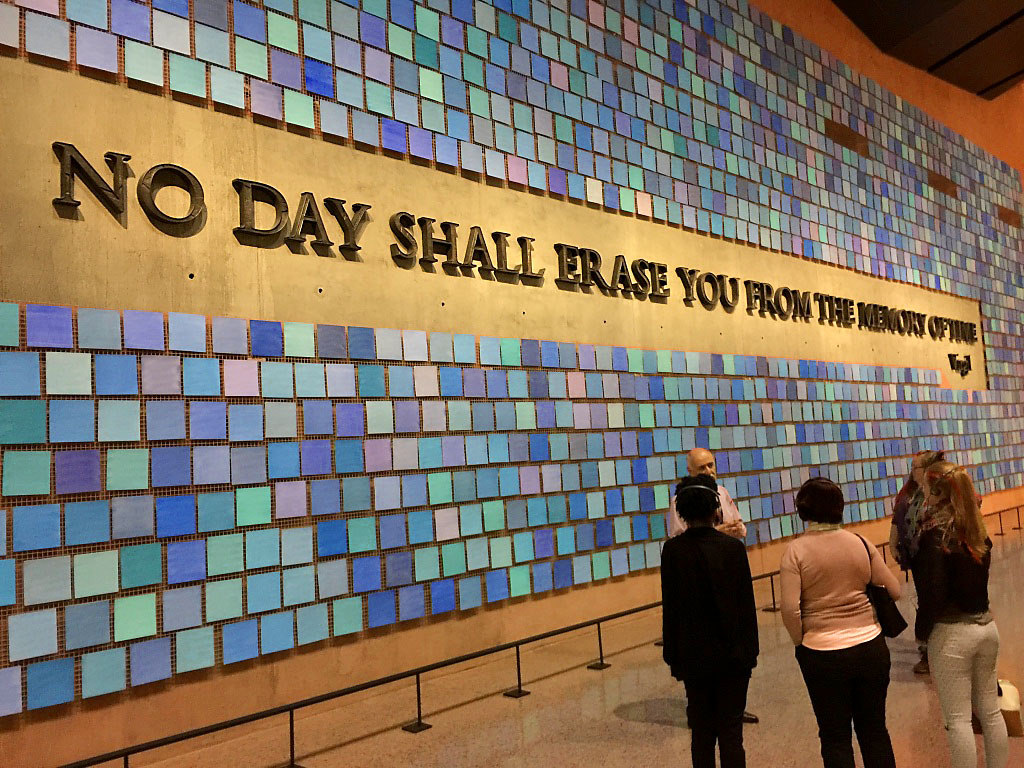
Today marks 16 years since the most infamous and iconic attack rocked our collective consciousness. Each year, there is a solemn ceremony conceived in such wisdom and executed with a poignancy that never abates. That is the reading of the names of those who died in the 911 Attacks in New York, Pennsylvania, and Washington, D.C. The soft music playing behind the readers accents the mood, punctuated by every reader mentioning the name of a family member they lost that fateful day. September 11th resonates with us so deeply because it was an attack on our country, but also because of the death of each and every individual who perished that day. Behind each name are family members, memories, joy and sorrow. Each person, in such a dramatic, untimely way, was taken from time into eternity. God loved and loves each one with an infinite, eternal love and wanted each one to be saved. Christ gave His life to provide salvation for each one. The Bible was written for the benefit of each one. The Lord’s church was meant to pursue and teach each one.

Though each individual is numbered among such a large group, around 3,000 of them, each one means more than the whole world (Mat. 16:26). This touching memorial is a tribute to the overall value of human life. It reminds us that we are surrounded by individuals all possessing an eternal soul.  Everyone you see today is heading toward eternity. Each one will either hear “well done” or “depart from me” (cf. Mat. 25:31ff). What is said about God’s attitude toward those victims specially remembered today is true of every person we meet and see today.

May we have our hearts stirred by the sobriety of that truth. May we never lose sight of our urgent responsibility to share the message of Christ with the people in our lives. As moving as the ceremony that occurs each year in New York City on September 11th, we really cannot imagine what the Day of Judgment will be like. Each person who ever lived, including you and me, will hear our name called (cf. 2 Cor. 5:10). As important as our own name is, every name is important. Let us pray that this realization will propel us to tell the best news of human history and help someone find the only way, truth, and life.

26687246253_33721e4ba2_b

Why Travel The Road Less Taken?

Neal Pollard

Gunnar Garfors is the youngest “hobby traveler” to have visited every country in the world. He’s written a book about it, entitled 198: How I Ran Out Of Countries. I have not read the book, but his website offers a very interesting article on The 25 Least Visited Countries in the Whole Wide World. Guess which one is least visited. He tells us, statistically, it is Nauru, a Pacific island country with no capital and no armed forces. It is 8.1 square miles in size, having only 10,000 inhabitants. They have the world’s highest level of type 2 diabetes and the highest obesity rate in the world (97% of men and 93% of women are overweight or obese). It has no seaport and no daily news publications. Perhaps some or all of these factors lead this country to be most frequently avoided by travelers, but somebody has to own that distinction (read more here: Independent UK, BBC, and Gunnar Garfors).  Perhaps none of these facts inspire you to work to help Nauru lose its notorious tourism distinction.

Robert Frost wrote his famous poem about the two roads which diverged in a yellow wood. He took the one less traveled by, and that made all the difference.  It appears he may have actually stood before such a fork, but he used the experience to speak metaphorically. We can all appreciate this figurative choice. We must choose a path in life, and the one we choose does make all the difference!

Jesus uses such a metaphor to describe the way of life we choose on this earth. He says, “Enter through the narrow gate; for the gate is wide and the way is broad that leads to destruction, and there are many who enter through it. For the gate is small and the way is narrow that leads to life, and there are few who find it” (Mat. 7:13-14). In this familiar passage, He gives us multiple reasons why we should take His way.

  • Its aim (“leads to life”).
  • Its alternative (“leads to destruction”).
  • Its autonomy (it is a road each one chooses to “enter through”; it is not arbitrarily chosen for us).
  • Its assumption (one must choose between these two, and no other, ways).
  • Its accessibility (it can be “entered” and “found”).
  • Its attainability (Jesus says “few” find it and not “none” find it).
  • Its associability (one is not absolutely alone, for there are “few” rather than “none”).

Jesus compares our brief time on this earth with a road trip. We are not fated to stay on the broad way, but we are not unconditionally guaranteed a spot on the narrow road. As Frost surveyed the two paths and made his choice, so must we. Jesus says we make this decision daily (cf. Lk. 9:23). And our choices determine which path we are traveling. Be deliberate and prepared for this arduous journey that terminates all too quickly. The right choice is the one less taken and most avoided, but take it anyway!

2784284196_2d950420d6_b
That’s the whole country of Nauru

PREVENTING A POST-ANTIBIOTIC APOCALYPSE

Neal Pollard

Economist Jim O’Neill had readied a report about drug-resistant infections, “bacteria and other microbes that have become impervious to antibiotics” (The Atlantic, Ed Yong, 5/19/16). O’Neill’s prognostication is grim and macabre. On our current trajectory, 10 million will die every year by the year 2050 and that doesn’t include those undergoing procedures only safe because of antibiotics (surgeries, transplants, and chemotherapy, for example). No doubt, this report is no fodder for a bedtime story, but it is not without suggestions of what can be done to prevent such an ominous occurrence. O’Neill gives a nice, round ten suggestions to avert this potential “plague” on humanity.  They include: improve sanitation, a global surveillance network, a public-awareness campaign, better diagnostic tools, avoid unnecessary use of antibiotics in agriculture, promote effective alternatives, improve incentives for workers, rewards those working on the problem, adequately fund those working, and build a global coalition (ibid.). All in all, this seems like a practical, workable solution.

I read this in light of the global epidemic you and I are engaged in to fight together. It is the most dangerous threat any of us will face and it will be with us, if the world continues, in 2050 and beyond. What I find interesting is that many of O’Neill’s suggestions for fighting these microbes are the marching orders God has given us to fight our plaguing antagonist—sin.  Holiness, unity, improved evangelism, Bible study, avoid unnecessary fights, example, focusing more on eternity, better giving, and increased mission efforts all factor in saving more souls! It’s a system that will work locally, nationally, and globally.

Frankly, we don’t know that O’Neill’s prediction will come to pass. But, the Bible tells us in no uncertain terms that “it is appointed unto men once to die, and then the Judgment” (Heb. 9:27). The majority will be lost (cf. Mat. 7:13-14)! God is counting on us, Christians, stemming that tide as much as possible (Mark 16:15-16).  Every individual you and I reach with the gospel is one less who will succumb to this eternally fatal threat!

novamoxin_antibiotic

What Is Your Trajectory?

Neal Pollard

The New Oxford Online Dictionary defines trajectory as “the path followed by a projectile flying or an object moving under the action of given forces” (n/p). The term is used of everything from ammunition to astronomy, but in its figurative sense can be used to speak of the law of sowing and reaping or cause and effect.  There appears to be three elements to this definition: the path, the object, and the action of given forces. Apply this to a person’s life and the discussion becomes eternally serious.

  • The path: Jesus teaches that there are really only two paths to take, “the broad way” and “the narrow way” (Mat. 7:13-14).  Some have given no thought as to which road they are taking. Others convince themselves they are on the narrow way when an honest, objective look reveals it to be the other way. Some change roads, for good or bad. However, we cannot successfully argue that we are not on a path leading somewhere, whether the destination is “destruction” or “life.”
  • The object: Friend, the object (projectile) in this path of trajectory is the individual. It is you and me. We are moving closer to eternity every day and to some eternal destination. God created a never-dying soul within us (Mat. 25:46; Ec. 12:7). As it was with the rich man and Lazarus (Lk. 16:19-31), we will lift up our eyes in either Abraham’s bosom or in torment. That soul was precious enough to God to pay the highest price to ransom it (John 3:16), but we may choose to give it away by allowing the trajectory of our life to miss the intended target (cf. Mat. 16:26).
  • The action of given forces: We are not helpless regarding this, but force implies pressure, resistance, and influence. The decisions we make, the people we allow to have prominence, our choices, what we prioritize, and what values we establish become the forces moving us to the destination. It’s not what we say is important, what we know is right, or what we intend to do. It is seen in our attitudes, words, and actions.

The earlier we figure this out, the sooner we will make it our aim to do everything we can to head in the only right direction. We can change paths, but the longer we are aimed the wrong target the harder we make it on ourselves to change course. This is true with finance, physical health, occupation, marriage and family, but nowhere are the stakes as high than as concerns our eternal destiny. Let’s give thought to the trajectory of our lives and be sure that where we are heading is where we really want to go.

2000px-parabolic_trajectory-svg

“Truly In Vain Is Salvation Hoped For From…”


  • A politician or political party.
  • Wall Street.
  • Military might.
  • Our net worth or economic savvy.
  • Government programs.
  • The second amendment.
  • Popularity and fame.
  • The worship of nature.
  • Exercise and fitness.
  • The appeal of our good looks.
  • Walls.
  • The importance of our occupation or position.
  • Our national identity.
  • The Supreme Court.
  • Ethnicity and race.
  • Science and technology.
  • Any religious figure besides Jesus Christ (even those claiming to represent Him).
  • Family members and friends.

In Jeremiah 3:23, the prophet writes, “Truly in vain is salvation hoped for from the hills, and from the multitude of mountains: truly in the Lord our God is the salvation of Israel.” Jeremiah’s brethren put all their eggs in the wrong baskets. They neglected to see where true hope was found and where saving faith was to be put. Their misguided trust led to their downfall. It cannot be otherwise in any generation, including our own.

We may never say we put our trust in anything besides God, but “the proof is in the pudding.” We demonstrate what’s first and foremost to us every day, in word and deed. Ultimate deliverance from our greatest trials, struggles, and challenges comes from only one source. Jeremiah succinctly identifies it.  Is that what you are trusting? If so, let’s make sure everyone who knows us knows that!

—Neal Pollard

11800435_10153091791310922_2631856048550949852_n

What Are You Living For?

Neal Pollard

A man had the good fortune and insight to take a chance with a credit card company in the Baltimore area several decades ago. He retired a wealthy, high ranking executive. In the course of his career, he put together a streak so impressive–35 years in which he never missed a day of work–that “Iron Man” Cal Ripken, Jr., wrote him a letter commending him for it. When he retired, the company gave him a classic car as well as many other lavish gifts. He had a great many benefits and perks, the admiration of peers and competitors, resort townhouses, and considerable wealth. But, one day very soon after he retired his life was dramatically changed after a visit to the doctor. He had an aggressive form of cancer. A few months later he was dead.

This is not a commentary on the morality or priorities of the man. I know nothing about either. His story points out that his well-laid plans and successful career could not forestall the inevitable end result common to every man.

It should also provoke a question. What are we living for? Is our identity tied to our career? Do we want to be known as the life of the party? Is it all about travel and adventure? Does life revolve around going to the river, campground, fishing hole, beach, or mountains? Is it sports, shopping, spending, or spirituality? Of necessity, all of us have a central focus. It is the thing that forms the bull’s eye we repeatedly find ourselves aiming at. Too many times, some thing becomes the thing in “first place” over Christianity. Colossians 1:18 reminds us Christ must come to have first place. When it comes to our jobs, Jesus must take first place. When it comes to our recreation, same thing. When it comes to relationships, He deserves primary position. Whatever we say or do, Jesus must be at the forefront.

He warns that we may invest in the wrong kind of treasure rather than the true riches (Mat. 6:19-21). He admonishes us to seek the kingdom first over “things” (Mat. 6:33). He warns against choosing family members over Himself (Mat. 10:37).

When life draws to a close, one will be confronted by the reality of what he or she made first place. Certainly, when we cross the sea of time to eternity, there will be no denying, rationalizing, debating, or arguing what our “bull’s eye” was. But, in our heart of hearts, don’t we all know what’s most important to us right now? It’s what occupies the greatest amount of our interest, time, energy, emotion, and effort. It is what we live for. When we die, will what we live for help us live eternally or be the cause of eternal death (cf. Rev. 21:8)? Let’s hear Paul’s encouragement to “set your affection on things above and not on things of the earth” (Col. 3:2).

Spofforth Church Grounds