Decades earlier, out in the wilderness, a young Caleb stood (nearly) alone. Moses sent the twelve spies into Canaan to scout the land (Numbers 13), in the minds of the terrified ten– the land of giants was unconquerable. Only two men believed that God was bigger, Joshua and Caleb. They urged the rest to move forward and take what He had promised, but it wasn’t going to happen.
Dale Pollard
Decades earlier, out in the wilderness, a young Caleb stood (nearly) alone. Moses sent the twelve spies into Canaan to scout the land (Numbers 13), in the minds of the terrified ten– the land of giants was unconquerable. Only two men believed that God was bigger, Joshua and Caleb. They urged the rest to move forward and take what He had promised, but it wasn’t going to happen.
For his courage, God vows to Caleb:
“But my servant Caleb, because he has a different spirit and has followed me fully, I will bring him into the land into which he went, and his descendants shall possess it” (Numbers 14:24).
That promise wouldn’t be fulfilled for nearly half a century! By the time the land being divided among the tribes, Caleb was 85 years old. His spirit, however, was stronger than before. In Joshua 14, Caleb goes confidently to Joshua. He says,
“I am 85 years old. I am still as strong today as I was in the day that Moses sent me… Now therefore give me this mountain of which the Lord spoke in that day” (Joshua 14:10-12).
Which mountain? That would be Hebron. A mountain that was still inhabited by the Anakim– giants descended from the very people who melted the hearts of those ten spies years ago. To anybody else Caleb’s inheritance seemed like an impossible one. It would have appeared more like a curse– certainly not a blessing.
But up the mountain he went. God and Caleb secured that territory (Joshua 15.13-14), and the mountain that covered the people in a shadow of their previous shame now serves as a reminder. Between Faith and fear, the former is the more formidable force.
Four Quick Lessons:
Faith will always outlast fear.
Waiting is not wasted. Caleb looked forward for 45 years, but never became bitter or gave up on God.
Strength is spiritual. That “different spirit” that Caleb possessed sounds similar to that of the saints (Romans 8.9-11, I Corinthians 3.16).
Excuses are useless, God uses the toothless (Caleb was 85).
The Cleveland team was dreadful. It showed on the field and in the stands, where they drew an average of 199 fans after their first 16 home games. Only 6,088 fans watched them play that year, an average of 145 diehards per home game. They were so bad, they decided to play most of their games on the road.
Neal Pollard
Inexplicably, I remain a Colorado Rockies fan when many of my Denver-area friends have abandoned ship with this historically bad baseball team. The Rockies are last in total pitching and fielding (defense) and seventh-worst in hitting. That means they can’t pitch, hit, or field. They go into the All-Star game 22-74, on pace to join some dubious, infamous company. In the “modern era” (since 1901), there was the 1916 Philadelphia A’s who won 36 and lost 117. The 1935 Boston Braves and 1962 New York Mets were almost as bad. Closer to the present, you’d have to include the 2003 Detroit Tigers (43-119) and the 2024 Chicago White Sox (41-121). But, the symbol and epitome of terrible baseball has to be the 1899 Cleveland Spiders. They finished that season 20-134! But, their hard luck was more of a business decision.
The 1898 team boasted Hall of Famers Cy Young, Jesse Burkett, and Bobby Wallace, but the owners, who also owned the St. Louis Browns, felt that a good team would draw more fans in Missouri than Ohio. So, they depleted the Spider roster and stocked the Browns roster. The Cleveland team was dreadful. It showed on the field and in the stands, where they drew an average of 199 fans after their first 16 home games. Only 6,088 fans watched them play that year, an average of 145 diehards per home game. They were so bad, they decided to play most of their games on the road. To commemorate the centennial “celebration” of Clevelands wandering exiles, J. Thomas Hetrick memorialized them in his 1999 book, Misfits! Baseball’s Worst Team Ever. Apparently, the Spanish-American war, a failed effort to clean up bad language on the field, and “too many games” (expanding to 154; today, it’s 162) had already cut into fan attendance, but watching a “sideshow” like the Cleveland Spiders led to a disastrous end to a once-proud, championship-caliber franchise.
To fail in athletics may lead to a less than desirable footnote in sports history. To fail in academics and economics can create a legacy that stains one’s family name. But, in just about every arena, failure need not affect one’s spiritual standing. Think of biblical underdogs that had little chance of success, if God was not factored in. Why, all of Israel were sitting ducks against the Canaanites without God (Deut. 7:24; Josh. 21:44)! David looked like no match for Goliath (1 Sam. 17:33)! Hezekiah and lowly Judah, on paper, were no match for Sennacherib and the Assyrians (Isa. 37:14-20)! Even the early church seemed overwhelmed in their objectives and mismatched in their mission (1 Cor. 1:26-29)!
How do we explain this? How can we seem to lack the talent, resources, exposure, and influence of the world, and yet still be described as over-comers (John 16:33), conquerors (Rom. 8:37), victors (1 Cor. 15:57), and greater (1 John 4:4) than the world? Perhaps this helps. The final tally has not been recorded, and it will not be in this life! Evaluation day will surprise the whole world, when we stand before The Judge (Mat. 7:13-14, 21-23; Rev. 20:11-15). God’s not going to reward the most accomplished by earthly measurements. Our eternal success or failure will be tied to our response to the One who defeated death and the devil (Heb. 2:14-15). If we trusted and obeyed Him and His blood covers our sins, we will go to heaven even if we don’t have a nickel to our name, a well-defined skill in our toolbox, a diploma or degree on our wall, or a celebrity in our family tree. Maybe others deem you a “loser,” but if you are a “winner” with God that’s the record you want to have!
This is a break from Origen’s First Principles. I’m slow: it takes me a long time to wrap my head around something. Romans 7 and 8 are about our constant battle against our sinful nature. We have the side that wants to be holy and serve God, and we have the side that betrays our human weaknesses. It’s an awful existence in many ways. Even Paul said, “What a miserable person I am! Who will save me from this body that brings me death?”
Then we get to 8.17 where Paul talks about suffering. I always assumed this was a shift in topic because he gets into stuff that won’t happen until Jesus returns. But since he spent the previous several paragraphs talking about our constant, sometimes-demoralizing struggle against sin, I don’t think this is necessarily about physical suffering.
God’s Spirit helps our spirit — our mind, emotion, intent, any aspect of being that can’t be measured — in that fight. There are outside influences in our struggle against sin, of course, but Paul really focuses on the stuff that hurts: our own sinful weakness. We hate that we’re weak. We’re ashamed of our failures. We’re “waiting for God to finish making us his own children…we are waiting for our bodies to be made free.”
In the meantime, we suffer. Maybe not physically — though in some places on this earth that’s a reality — but certainly spiritually. We know our faults and failures better than anyone. Our spirits, burdened by the knowledge of our own weakness, groan to God with pain too deep for words. And he helps us!
“We are very weak, but God’s Spirit helps with our weakness. We don’t know how to pray like we should, but the spirit speaks to God for us, begging on our behalf with groaning too deep for words.”
Guilt is a powerful weapon in the enemy’s hands, and we all have too much of it. The struggle and the pain is normal — it’s guaranteed for anyone who wants to be like God. It’s never going to happen in this life! We can’t ever be good like God! But we can try, and we can at least ensure that sin isn’t the master we serve. If you feel that pain, odds are you’re on the right track.
Right after this section, full of empathy and hope and reassurance and warning, Paul says,
“Who can accuse the people God has chosen? No one! God is the one who makes them right.
Who can say that God’s people are guilty? No one! Christ Jesus died for us, but that is not all.
He was also raised from death. And now he is at God’s right side, speaking to him for us. Can anything separate us from Christ’s love? Can trouble or problems or persecution separate us from his love?”
The struggle and its pain is normal. It’s a sign that our hearts are set on something we won’t achieve until our bodies have been freed. God helps us, he understands, and we cannot let the enemy demoralize us into giving up. It’s harder to keep struggling against our sinful weakness, but it will be so worth it!
“But in all these troubles we have complete victory through God, who has shown his love for us. Yes, I am sure that nothing can separate us from God’s love—not death, life, angels, or ruling spirits. I am sure that nothing now, nothing in the future, no powers, nothing above us or nothing below us—nothing in the whole created world—will ever be able to separate us from the love God has shown us in Christ Jesus our Lord.”
Many Christians serve a “God of good times,” praising Him when life is easy. But the God of the Bible is bigger. When the fig tree fails, the vines are bare, and the fields are empty, will you get angry, give up, or rejoice?
Carl Pollard
Corrie ten Boom was born on April 15, 1892, in the Netherlands to a devout Christian family. Her father, Casper, ran a thriving watchmaking business. Their deep faith shaped their response to the Nazi occupation of the Netherlands during World War II. The ten Booms joined the underground resistance, transforming their home into a safe haven for Jews and others persecuted by the Nazis. Using a hidden room in their house, they saved countless lives. Tragically, in 1944, a betrayal led to their arrest. Corrie and her sister Betsie were sent to a concentration camp, enduring brutal conditions. Betsie died there, and their father passed away in prison. Corrie survived and later wrote, “There is no pit so deep that God’s love is not deeper still.”
How could she say this after such devastating loss? Life often feels like a pit—barren, hopeless, empty. The prophet Habakkuk faced a similar pit in Judah, a nation crumbling under the threat of invasion. Yet, he wrote one of the Bible’s boldest declarations of faith in Habakkuk 3:17-19: though everything fails, “I will rejoice in the Lord.” Unlike most prophets who spoke for God to the people, Habakkuk spoke to God for the people, asking two questions we often wrestle with: “Why?” and “How long?” His story offers three vital truths for navigating life’s darkest moments.
The Reality of Fear (v. 16)
Habakkuk trembled when God revealed His plan: the Babylonians would bring judgment on Judah. “I hear, and my body trembles; my lips quiver at the sound; rottenness enters my bones; my legs tremble beneath me.” He knew destruction was certain—starvation, cannibalism, the ruin of Solomon’s temple, the end of his nation. The dread was so deep it made him physically weak. We’ve all felt fear like this—news of a tragedy, a diagnosis, or loss that shakes us to the core. Yet, Habakkuk chose to “quietly wait for the day of trouble” to come upon the invaders. God promised to judge the Babylonians and deliver His people, though not in Habakkuk’s lifetime. The Hebrew word for “wait” means to rest or settle down, like David’s soul finding rest in God (Psalm 62:1). Instead of letting fear consume him, Habakkuk anchored his heart in God’s promises. Can we trust God’s timing, even when we’re afraid?
The Choice of Joy (vv. 17-18)
“Though the fig tree should not blossom, nor fruit be on the vines, the produce of the olive fail and the fields yield no food, the flock be cut off from the fold and there be no herd in the stalls, yet I will rejoice in the Lord; I will take joy in the God of my salvation.” Habakkuk describes total ruin in an agricultural society—permanent crops like figs and olives gone, annual crops like wheat vanished, livestock dead. This wasn’t just financial loss; it was famine, hopelessness, death. Yet, he declared, “I will rejoice in the Lord.” Like Job, who praised God after losing everything, Habakkuk’s faith didn’t rely on blessings. Satan once questioned if Job trusted God only because of His gifts. Job proved his faith was real, and Habakkuk does the same. True joy, rooted in Christ, can’t be taken away. When life strips everything else, can we choose to find joy in God alone?
The Strength to Rise (v. 19)
“God, the Lord, is my strength; He makes my feet like the deer’s; He makes me tread on my high places.” Habakkuk found strength not in himself but in God. Spiritual maturity means refusing to rely on our own resources. God gave him “feet like a deer’s” to walk confidently in difficult, high places—places he’d rather avoid. I’m terrified of heights; anything over 6’5” makes me weak. But God equips us to go where we wouldn’t choose, strengthening us for the journey. Sometimes, God strips away what we depend on to make Him our only joy. Faith says, “The just shall live by faith.” Habakkuk knew God would either rescue him or allow his death, but even death is under God’s control. Are we willing to let God lead us to higher places, trusting His strength?
Habakkuk had questions, and so do we. But faith rests in these truths: God is too wise to make mistakes, too kind to be cruel, and always in control.
A man once saw a butterfly struggling to escape its cocoon. Frustrated, he cut it open, only to watch it die, unable to fly. The struggle strengthens its wings, just as trials strengthen our faith. Many Christians serve a “God of good times,” praising Him when life is easy. But the God of the Bible is bigger. When the fig tree fails, the vines are bare, and the fields are empty, will you get angry, give up, or rejoice? “And yet, I will rejoice.” If you’re struggling to praise God, battling sin, or need to obey the gospel, trust His promises—they never fail. Let God lead you today.
In her fascinating book, The Bloody Bozeman: The Perilous Trail to Montana’s Gold, Dorothy Johnson includes an interesting anecdote as she chronicles life in the territory of Montana in the 1860s. As the population in the territory grew, the people felt a need for a newspaper, more organized law enforcement, a legislature, schools, churches, mail service, stage coaches, and mail service. They also sought forms of entertainment like they enjoyed back east in the United States. On January 2, 1865, Virginia City held a historic prize fight between Hugh O’Neil and Con Orem. O’Neil was 34 years old, 5 feet, 8.5 inches tall and 190 pounds. Orem, a tee-totaling saloon keeper, was 29 years old, 5 feet, 6.5 inches tall and 138 pounds. Johnson summarizes it with incredible understatement: “The fight went 185 rounds, lasted three hours and five minutes, and was declared a tie. It was stopped by mutual consent of the backers” (149). Both men wore snug buckskin gloves without padding and pounded on each other round after round. Neither would give up!
I’m not sure what you make of that curiosity, but it struck me. The Bible depicts our individual lives as a spiritual fight. Especially Paul illustrates life in this world as a battle. We are in a fight with the devil. In Ephesians 6:12, Paul, having said that we must “stand firm” against the “schemes” of the devil, says, “For our struggle is not against flesh and blood…” The word he uses there means “engagement in a challenging contest” (BDAG, 752). The Greeks used the word originally to describe wrestling, then all fights and battles (ibid.). Zodhiates adds that it was “a wrestling, struggle or hand-to-hand combat. It was used of the wrestling of athletes and of the hand-to-hand combat of soldiers both of which required deftness and speed. It denoted the struggle between individual combatants in distinction from an entire military campaign” (np).
The devil’s positions, principles, and pursuits are in direct conflict with God’s. As His followers, we must fight the devil. We are not in physical combat with people, as Paul points out. But we are to “resist” and “stand firm” (Eph. 6:11,13,14). We cannot yield or forfeit that fight.
But there is another fight we are in, and Paul describes this one as equally formidable. The opponent is our own flesh. Every day, we go to battle against the lust of the flesh, the lust of the eye, and the pride of life (1 John 2:16). Paul depicts this graphically in Romans 7:14-25). As James points out, we can get “carried away and enticed by our own lust. Then when lust has conceived, it gives birth to sin; and when sin is accomplished, it brings forth death” (1:14b-15).
Yet, it is a far from a foregone conclusion that we are doomed to lose! Not at all. Paul tells us that we are spiritual prizefighters. We must be prepared to go, not 185 rounds, but round after round, day after day, moment after moment. Here is Paul’s analogy in 1 Corinthians 9:26-27. He says, “I box (“fight with the fist,” Swanson, np.) in such a way, as not beating the air; but I discipline my body and make it my slave, so that, after I have preached to others, I myself will not be disqualified.” Your opponent, be it the devil or your own flesh, will land some punches. At times, you may even hit the deck. Through His Word, God is cheering you on and calling, “Get back up! Keep fighting! Don’t give up!” He believes in you. He is in your corner, giving you perfect instructions for defeating your bigger and stronger opponent named “sin.” Even if your lying on the floor, you can get back up. Through God’s help, you can win the fight. Remember that with this battle, eternity is in the balance. You can go the distance!
During the mask era, while I was playing on social media, I found this inspirational speech made by Navy Seal Admiral William H. McRaven during the 2014 University of Texas in Austin commencement.
Most of you are aware that the Navy Seals make up the tip of the spear for our military. Although I do not have the distinction of having trained with them, I have known a few and I can tell you they are some of the most tested, battle hardened, and confident men you will ever encounter.
Wouldn’t it be great to have similar confidence, spiritual fortitude, and faith like a seal has? I believe this is the faith described by Jesus in Matthew 17:20 and displayed by Peter as he steps from a boat of full of scared men out on to the waves of the lake in a storm expecting walk on water to his Lord.
I highly recommend you listen to the admiral’s speech. His 10 key points are very similar to a lot of Bible lessons.
1. Start off by making your bed. This may sound a little silly, but the premise is that if you complete something simple it can build a level of confidence. This confidence carries with you through the day as you attempt to overcome harder tasks. -This is a lot like little prayers before you start on a difficult task. Just like Nehemiah asking for direction, protection, and strength, I guarantee a short plea to God will be way easier to accomplish than anything else you do. And the knowledge that you have requested the assistance from God, the one entity that can make you overcome all obstacles is quite comforting. His will might not be for you to succeed every time, but by asking you have a better opportunity than not asking and it will bring you closer to the Lord.
2. Find someone to help you paddle – This is a lot like Hebrews 10:24-25: “Let us consider how to stir up one another to love and good works”.
3. Measure a person by the size of the heart, not the size of their flippers – This is a lot like Matthew 7:15-20 where Jesus says to measure a person by their fruits.
4. Get over being a sugar cookie and keep moving forward. When the admiral failed in BUD/S training, he ended up wet and covered with sand or, as he referred to, as a sugar cookie. -Basically, sometimes no matter how hard you try you still fail. And even though you fail we must be like Paul in Philippians 3:13-14 “forgetting what lies behind” and “press on toward the goal”.
5. Don’t be afraid of the circuses. Circuses are the extra work that the would-be seals must do when they fail a test to build strength. – And like in James 1:2-4 these extra trials produce steadfastness and make you complete.
6. Sometimes you have to slide down an obstacle headfirst – basically you must use your personal skills to do things more efficiently. In Matthew 25:14-32 the 5 and 2 talent men illustrate this point.
7. Don’t back down from the sharks – This story exemplifies overcoming fear like Deuteronomy 31:6: “Be strong and courageous… for it is the Lord your God who goes with you.” Or Isaiah 41:1-20, which says, “Fear not, I am the one who helps you”
8. You must be your very best in the darkest moment- This lesson is similar to what Paul provides to Timothy in 1 Timothy 6:11-16 “Fight the good fight of the faith”
9. Start singing when you’re up to your neck in mud- Singing can help lighten a mood and strengthen your resolve. I believe this is why Psalm 96 teaches us to sing to Lord, daily.
10. Don’t ever, ever ring the bell. – Never give up. Look at the stories of Job, the apostles, and Jesus. All went through great adversity and never stopped praising God.
Although most of us will never be a navy seal, we can take the admiral’s stories along with what the Bible has taught us to do our part in changing the world and make us better Christians.
In the very intimate correspondence to his spiritual son that we call the epistle of 2 Timothy, Paul seems very aware that the time of his departure from this earth had come (4:6). Paul was not under house arrest, like we read at the end of Acts. He is in chains (1:16).
The city of Rome burned between July 19-24, 64 AD. The fire started in the Circus Maximus stadium, but burned 10 of the city’s 14 districts before it was extinguished. Some historians blame Nero, but there is no doubt Nero blamed the Christians. He rounded up Christians already in the city, including Peter (cf. 2 Pet. 1:14-15), and had many of them executed that same fall.
Lenski says Paul was in Spain at the time of the fire, but he was captured in a continuing dragnet of Christians: “Christianity had become a religio illicita, and especially its propagation became a crime against the state. Not long after Paul’s return from Spain he was arrested. Now he would be charged with a crime; Paul was, therefore, thrown into a dungeon as a felon. After some delay he was tried and executed. Tradition asserts that he perished under Nero who died June 9, 68. The details of his martyrdom are not known. He must have been condemned to death for spreading a religio illicita” (474).
So, as the time drew nearer for him to die, Paul uses an interesting word to describe his anticipated situation. He reviews some of the events of his first missionary journey, reminding Timothy that at Antioch, Iconium, and Lystra he endured many persecutions, “and out of them all the Lord rescued me!” (3:11). You may remember that this including being stoned by the Jews and left for dead. That was a miraculous rescue!
Now, confined to chains with an insane emperor breathing down his neck, Paul says that the Christians had deserted him. Considering the enormous scrutiny they were under simply for being Christians, visiting a notorious, incarcerated Christian was risky! He charitably prayed that it might not be counted against them (4:16). Then, he says that he was rescued from out of the lion’s mouth (4:17), and “interpreters have identified the lion as the literal lions of the amphitheater, the emperor Nero, or Satan” (Lea and Griffin, The New American Commentary, Vol. 34, 256). But, we cannot be sure. But, even if the lion was figurative, the rescue was literal.
At nearly the end of his last letter, Paul confidently adds, “The Lord will rescue me from every evil deed, and will bring me safely to His heavenly kingdom” (4:18). Consider Nero and the Roman machine! He had already been beaten numerous times. Who knows the terrible hardships he endured in the squalor of this dungeon? Yet, he would state with confidence that God would rescue him from the worst of them. Perhaps weeks or days after he dispatched this letter to Timothy, guards unlocked him and took him to the chopping block where, as a Roman citizen, he died by beheading rather than a harsher death like crucifixion or burning. What about his inspired words in 2 Timothy 4:18?
Paul teaches us to think eternally and heavenly. On the other side of that beheading, there was safety and arrival to God’s heavenly kingdom. It was what he lived for. It was what he died for. What a reminder as we live in this body for such a short time, that we await our rescue. Our rescuer is Jesus, “who rescues us from the wrath to come” (1 Th. 1:10). He “delivered us from so great a peril of death, and will deliver us, He on whom we have set our hope. And He will yet deliver us” (2 Cor. 1:10).
Juliana Koepke was 17 years old when she boarded a flight with her mother and 90 other people in Lima, Peru, on Christmas Eve, 1971. The plane had a terrible service record and her father urged his wife and daughter to wait for a better one, but they wanted to be reunited for Christmas. That was the disposition of the airline and flight crew, too. So they pressed on, even as severe weather stood between them and their arrival at Iquitos. A lightning strike broke the plane apart, ultimately killing every crew member and passenger except Juliana. She survived a fall of 10,000 feet, landing in the Amazon Jungle still strapped to her seat.
She suffered a broken collar bone, deep gash in her arm, an eye injury, and a concussion. The near-sighted Juliana lost her glasses and one of her sandals. She then walked through the dense Amazon Jungle for 10 days and finally found shelter in a hut that night. Local fishermen found her and took her by canoe to civilization. She used the survival skills her parents had taught her since early childhood and combined it with her sheer will to survive. Now 70 years old, she continues her parents’ work of biological research to this day in the same jungle where she survived the crash. There were things she had no influence over that helped her survive the initial crash, and the help of others was indispensable to her survival. But being saved from death, she didn’t give up until she was ultimately rescued.
Don’t you think our circumstances are similar, in a figurative sense? We didn’t influence God’s eternal plan of salvation, but we can benefit from it. We will not be saved without the influence and assistance of others along the way. But being saved from death, we can and must endure to the end (2 Tim. 2:12; Heb. 10:36). If we do, we will experience an eternal rescue. God wants to rescue every one of us from spiritual death (Gal. 1:4). But He won’t save us without our cooperation!
Understanding Revelation’s Message for Then and Now
Brent Pollard
John wrote the Book of Revelation when the Roman Empire persecuted Christian communities. Emperor Domitian had exiled John to the island of Patmos. So, while in exile during Domitian’s reign, John wrote to encourage other persecuted Christians. Given the focus of the first three chapters on seven specific churches in Asia Minor (i.e., Turkey), as well as the emphasis on this being an urgent message (1.3; 22.10), we can conclude that the original audience of John’s apocalypse was these seven churches located in the heart of the imperial cult.
The imperial cult’s prominence in Asia Minor created significant tensions for Christians in Ephesus and Smyrna, two of the seven cities to which Jesus sent His message. Polycarp, a disciple of John, was martyred in 155 AD in his hometown of Smyrna. Domitian (81–96 AD) declared himself to be a god, adopting the title “Dominus et Deus” (Lord and God). Loyal Romans believed participating in cultic rites was a way to pledge allegiance to the emperor and Rome. We can quickly see how this caused problems for the burgeoning Christian community, which only referred to Jesus as their Lord and God.
The Christian community suffered socioeconomic consequences as a result of this refusal. Evidence shows that participation in the Imperial Cult was a prerequisite for engaging in certain types of business or trade in some parts and times of the Roman Empire. Members of trade guilds, which governed various kinds of commerce and industry, for example, might be expected to participate in the Imperial Cult as part of their membership.
Christians who refused to worship the emperor would have been economically marginalized. It’s no surprise that John compares imperial cult submission to having the “mark of the beast” (Revelation 13.16–18). The gematria system reveals the meaning of the number “666” to be “Nero Caeser.” As such, the beast was Rome, with Nero as the first prominent persecutor of Christians, responsible for the deaths of Peter and Paul, among others.
The calls for faithfulness and warnings against compromise in Jesus’ direct messages to the seven churches would have resonated in the context of the temptation to assimilate and abandon spiritual beliefs for worldly acceptance or prosperity. While the specific nature of persecution differed across time and emperors, the struggles referenced in Revelation reflect a consistent tension between the emergence of Christianity and the Roman imperial system.
Symbols like Babylon the Prostitute and the Beast represent the decadence and oppression of Rome, especially under despotic rulers who declared themselves gods and demanded worship. Revelation transitions from tribulation under oppressive powers to expressing hope in God’s ultimate triumph over evil. This message of persevering faith leading to redemption would have encouraged early Christian communities to face real-world hardships and persecution.
While modern forms of oppression differ, Revelation reminds believers that staying true to one’s values in adversity is critical. Its themes demonstrate that faith and integrity will triumph over darkness. Deliverance comes through steadfast devotion. And, in a world of growing groupthink and social credit systems, Christians in the twenty-first century may need this message of perseverance even in the face of socioeconomic isolation and persecution as a reminder not to bow the knee to anyone but Christ.
Revelation, with its intricate tapestry of symbols, warnings, and prophecies, is a testament to the enduring human spirit in the face of overwhelming oppression. Its timeless message transcends its ancient origins, providing comfort and guidance to generations. As believers faced the might of the Roman Empire in the past, today’s challenges, while different, are no less demanding. Revelation reminds us that faith can move mountains in any age and that the light of truth, no matter how dimmed by adversity, will always find its way.
2 Timothy 4:2 Paul says, “preach the word; be ready in season and out of season; reprove, rebuke, and exhort, with complete patience and teaching.”
This is a verse that many have heard before, but as usual with scripture I found something I hadn’t seen before. At the end of verse 2 it says, “with great patience.” In context, why would we need great patience when we are preaching the Word? Starting in verse 3 Paul gives a list of why we need patience.
First, a time will come when the world will not “endure sound doctrine.” Second, they will accumulate for themselves teachers in accordance to their own desires. And third, they will turn away their ears from the truth and turn to myths.
As Christians when we are spreading the Gospel it takes patience because the people we meet have turned to their own desires. The message we bring is completely different from what the world has taught them. To truly understand the gospel is to acknowledge sin. Many today have been convinced that who they are is enough. They won’t always like what we are telling them. The world will be angry at Christians for proclaiming the truth. Paul tells us that it’s in these times when we are to be patient.
But we are patient for a reason!
2 Timothy 4:8 says, “Henceforth there is laid up for me the crown of righteousness, which the Lord, the righteous judge, will award to me on that day, and not only to me but also to all who have loved his appearing.”
We have a reward for our trials on this earth. We have a motivation to bring up those difficult topics that makes us hated by the world. We’ll receive a crown of righteousness if we fight the good fight!
Let’s remember the next time we are in study or a conversation with someone that their soul hangs in the balance. How we act may determine their reaction to the Gospel. So stay patient with the lost, because every soul is important to God. Think souls.
Perhaps Jeremiah seemed to be mean, harsh, even unloving, to his brethren. His message is certainly what we could categorize as negative, but we remind ourselves that its source was God. What may get lost in Jeremiah’s challenging message is how it affected him to share it. Chapter nine is full of the struggles he endured in being God’s spokesman with a message of divine judgment.
Jeremiah endured mourning (1). While Judah would be hypercritical and threatening toward Jeremiah for his message, they had him all wrong. He did not relish his unpleasant message. He would have preferred to have kept his mouth closed (20:9). They had no idea of how his mission was wearing on him. He writes, “Oh that my head were waters And my eyes a fountain of tears, That I might weep day and night For the slain of the daughter of my people!” He knew that they were hurting themselves by their lifestyle, and he wanted them to escape judgment. It can be heartbreaking work to share God’s word on any number of unpleasant, unpopular subjects. No rational preacher, elder, or teacher is excited to share such a message, but it must be done (2 Tim. 4:2). Jeremiah is rightly called the “weeping prophet” (8:18; 13:17; Lam. 2:18). Revealing this was an emotional struggle.
Jeremiah endured isolation (2). The pressures of sharing a message nobody wanted to hear created inevitable isolation. He felt alone and like nobody understood or cared. He longs to escape such disappointing, unrighteous behavior. He wanted to run like Jonah. He felt alone like Elijah. It can go with the business of declaring God’s message. There are times when you may feel like you are standing all alone, but you never will if you are sharing God’s word God’s way. He will never leave you (Mat. 28:20; Heb. 13:6).
Jeremiah endured disillusionment (3-6). He expected more and better from his brethren. They knew better, but they were guilty of treachery and adultery (2), lies and deceit (3,5-6), ignorance (3), violence (4), slander (5), and general iniquity (5). Have you ever overheard someone you looked up to use foul language or stumbled upon someone doing something sinful? It’s like a punch in the gut. But imagine a congregation full of people doing what God through Jeremiah reports. It had to have been discouraging and caused feelings of hopelessness.
Jeremiah endured a sinking realization (7-11). What was the cost of this? Sin is not without consequences (Gal. 6:7-8; Hos. 8:7; Prov. 6:26). At the heart of God’s message was this rhetorical question: “Shall I not punish them for these things?” (9). Jeremiah knew what was coming. There would be weeping, wailing, and dirges (funeral songs)(10). Judah would be ruined and desolate (11). Jeremiah knew this ahead of time. Whatever normalcy he witnessed each morning and evening, he knew that would ultimately change. The fact of judgment looms over the horizon of time. It will be a day of rejoicing for the righteous and prepared, but not for the rest of humanity. The people of Judah were not ready for this judgment, and Jeremiah knew that.
Jeremiah endured being overwhelmed (12-16). The message gets specific about the nature of what was coming. It was going to be more devastating than any of them had experienced. Because of their stubborn rebellion, they would be scattered and annihilated. Hope belongs to the penitent, but there’s just no good news for those who are determined to oppose God’s way.
Jeremiah endured unpleasant duty (17-22). God tells Jeremiah to call for mourning, wailing, and tears (17-19). He is help them focus on their shame (19). The heart of the message was death (20-22). Don’t you think Jeremiah would have loved to have spoken of grace, mercy, lovingkindness, and blessings? But the circumstances did not call for that. Jeremiah had to be faithful to God’s message. Like Micaiah, every faithful spokesman for God should say, “As the Lord lives, what the Lord says to me, that I shall speak” (1 Ki. 22:14).
There is a ray of hope starting in 9:23. Amid the folly of idolatry, there will be a reminder of the wonderful, perfect character of God in chapter ten. But even here, there is encouragement for God’s faithful servant. It was a message for the worldly wise, for the mighty man, and for the wealthy (23) not to trust in those things, but to trust in Him. Everyone should boast of knowing and understanding God, that He is “the Lord who exercises lovingkindness, justice and righteousness on earth; for I delight in these things” (24). Punishment was for the spiritually uncircumcised (25-26). It was not for the faithful, like His man Jeremiah. Whatever we have to struggle through for the Savior, may we know that God will be with us through thick and thin. He has not left us alone. He will always be with us, help us, and strengthen us! Declaring His word is right, and He will not let us lose for being unswervingly loyal to it and Him!
Joy is a decision based on knowledge. It is a choice we can make.
You can have joy in every moment of life if you choose to do so. We won’t always feel happy, but joy is a trait that goes deeper than emotions. It is a feeling of hope because of salvation. As a saved child of God, you can have joy in the knowledge of Christ, the church, and an eternity with God.
We all know people that are joyful 24/7. No matter what happens they seem to always look on the bright side. On the other hand, I’m sure you can think of someone that’s always down. They can always find something to complain about. They could have a perfect life and still be looking for something negative to dwell on. Two people can go through the same situation and have two completely different reactions.
As Christians we should be people of joy. Why? Because we have every reason to be joyful! But what about having joy in tribulation? How can we be joyful when our world comes crashing down around us? We need to remember that joy isn’t the same as happiness. Joy comes from an understanding of the bigger picture. Happiness is short term and based on current events.
The faithful Christian can go through heartache and feel sadness, but still have joy in the bigger picture. We can face trials, no matter what they are, and still have joy because we know this world is not our home. James 1:2 says “count it all joy when you encounter various trials, knowing that the testing of your faith produces endurance.”
We can have joy in knowing that if we face trials with endurance, we will ultimately receive the greatest reward we could ever get. This kind of joy isn’t something that comes naturally. It takes time to develop, and trials to perfect it.
Not every day will be a happy day, but in Christ every day can be joyful.
I’ll be repeating the book of II Peter in present-day terminology. It’s not a true translation of the book, as I am not qualified to do so. It will be based on an exegetical study of the book and will lean heavily on the SBL and UBS Greek New Testaments, as well as comparisons with other translations (ESV, NASB, NIV, ERV, NLT). My goal is to reflect the text accurately, and to highlight the intent of the author using concepts and vocabulary in common use today.
This is not an essentially literal translation, and should be read as something of a commentary.
Introduction
This is from Simon Peter. I’m a dedicated follower of Jesus Christ and one of his apostles. I’m writing to everyone who has a faith that’s just as valuable as ours. Your faith is just as valuable because it also came from the perfection of our God and rescuer Jesus Christ. My wish for you is that you enjoy grace and peace because you know God and Jesus, our master.
JesusHelpedYouEscape
We have everything we need to be alive and live a morally good life thanks to him. His power made that possible! We have everything we need because of our relationship with him. He called us to his family because he is amazing and perfect. He’s made some incredible promises to us. Those promises were designed to give us access to his nature. We have access because we’ve escaped a worldly lifestyle characterized by unhealthy desires. Since we’ve escaped, make sure you back your faith with moral goodness. Once you have moral goodness, expand your knowledge of God. That knowledge should lead to self-control. Self-control should lead to endurance. Endurance should lead to godliness. Godliness should lead to good relationships with each other, which should lead to love. If you are growing in these areas, you can’t be described as useless or unproductive in your relationship with our master, Jesus Christ. If you don’t have these qualities, you’re blind or shortsighted because you’ve forgotten that your record was cleared.
Before a track meet in Omaha, Nebraska, the first Saturday of this month, Terence “Bud” Crawford was most renowned for his perfect 38-0 record as a professional boxer. His unblemished record includes 29 knockouts, but he, then later millions more, saw his seven-year-old daughter deliver the most unlikely knockout blow many of us have seen. Little Talaya ran out of her shoe at the starting block, then fell behind the rest of the pack by 20 meters in this 200 meter race while she put it back on. Not only did she not give up, she stormed back and won the race with seconds to spare. She has aptly with words like grit, determination, and undaunted. Heroic and inspiring have also been bandied about. Perhaps her drive not to lose comes from her father, but she certainly reflected well on him (ESPN report here).
The Bible refers to life as running a race (Heb. 12:1). Paul urges us to run in order to win (1 Cor. 9:24). He was concerned about running in vain (Gal. 2:2). He was determined to finish the course (2 Tim. 4:7). While Paul and the writer of Hebrews describe a race that sounds more like a marathon than a couple hundred yards, it will require all the more grit and determination to successfully complete. There will be encumbrances and entanglements. Whether problems or pressures, things will happen that can bring us to a standstill. In those moments, we may be tempted to quit. Those are the times we can remember our Father and reflect His ways! In our case, He’s not just watching! He can help us win.
Are you discouraged? Do you feel defeated? Maybe it’s something someone has done to you. Maybe it’s something you have done. Whatever it is, perhaps you feel it’s useless to go on. By getting back on track, you may not only win the race yourself but inspire so many others through your successful finish! Don’t give up! The reward is worth the effort. “In the future there is laid up for me the crown of righteousness, which the Lord, the righteous Judge, will award to me on that day; and not only to me, but also to all who have loved His appearing” (2 Tim. 4:8).
In the lead up to the College Football Playoff National Championship, I have read a few articles about tonight’s game. More than once, the players and coaches have talked about the need to “trust the process.” That idea applies to the entire program, to the season, to preparing for every game including this last one, to both sides of the ball, down to the individual player’s preparation for this game. “The process” is comprised of every fundamental principle intended to bring about the highest success. There will be trying moments and setbacks, even failures. But when the tendency to doubt is the greatest, it is then that you most need to “trust the process.”
They say that athletics are a metaphor for life. The inspired apostle Paul thought so. Long before Nick Saban or Kirby Smart and their players used the mantra, the first-century native of Tarsus was teaching the idea in the Bible. Here is how he put it, “Share in suffering as a good soldier of Christ Jesus. No soldier gets entangled in civilian pursuits, since his aim is to please the one who enlisted him. An athlete is not crowned unless he competes according to the rules. It is the hard-working farmer who ought to have the first share of the crops” (2 Tim. 2:3-6). No, he does not say, “Trust the process.” He gives it instead: Endure, focus, follow the rules, and work hard. Just as coaches use metaphors, making comparisons to chopping wood, flying the plane, rowing the boat, etc., Paul refers to the soldier, the athlete, and the farmer to illustrate principles in the process of living the Christian life.
Our goal is the enjoy ultimate success. The Bible defines that as overcoming the world (Jn. 16:33; 1 Jn. 4:4; 5:4; Re. 2:7,11,17, etc.). There are times this is very difficult, but at all times we must “trust the process.” Trust the process…
When you are encountering various trials (Js. 1:2ff).
When you are aiming at church growth (Acts 2:42-47).
When you are combatting temptation (Js. 4:7-8).
When you are offended or have offended (Mt. 5:23-24; 18:15-17).
When you are trying to win back a fallen brother (Gal. 6:1-2).
When you are seeking to follow Jesus (Lk. 9:23-26).
When you are working on your marriage (Eph. 5:22-33).
When you are running the marathon of childrearing (Eph. 6:1-4; Dt. 6:4-9).
When you are building your relationship with God (Ps. 1; Col. 3:1ff).
When you are shepherding the flock (1 Pt. 5:1-4; Acts 20:28).
When you are dealing with prosperity (1 Ti. 6:17-19) or poverty (Js. 1:9-12).
When you are struggling with sins of the tongue (Js. 3:1-12).
When you are wondering if it’s worth it to keep going (2 Tim. 4:1-8).
When you are being persecuted for your faith or for no good reason at all (Mt. 5:38-48).
In other words, whatever our specific struggle, problem, difficulty, or trial, God has given us a proven process. How many, through the ages, have overcome and won simply because they trusted it? As a loyal, long-suffering fan of the guys in red and black, I am hoping their overall process ends a 41-year drought. If it doesn’t, life will go on. As you follow Jesus, I am hoping that by trusting the process found throughout Scripture you win the crown of eternal life (Js. 1:12). When all is said and done, that is all that matters!
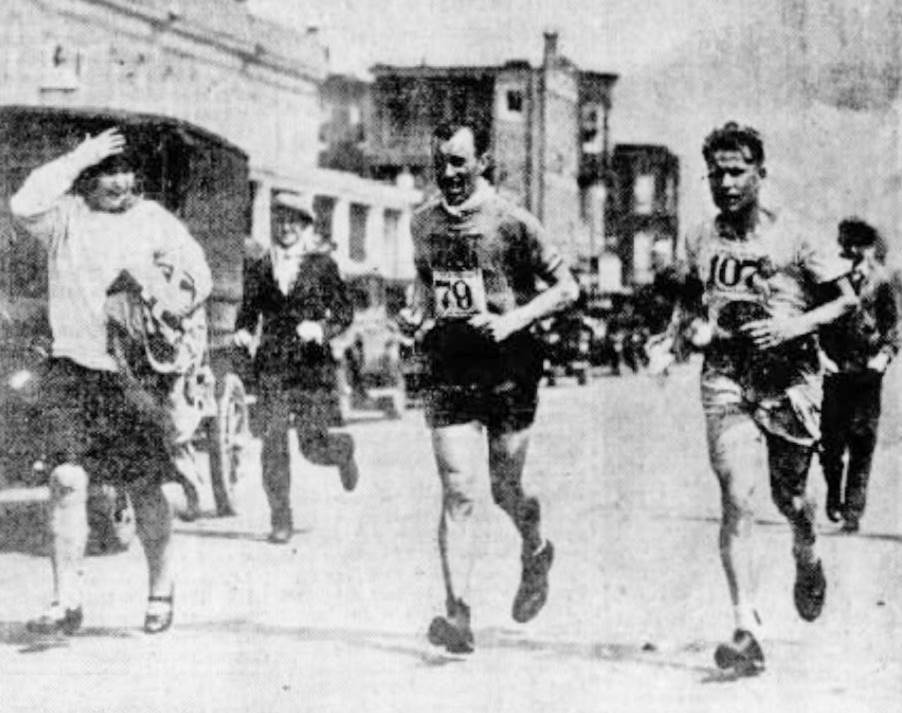
The farthest anybody has ever run on foot happened back in 1929. A trans-continental race was set from New York to California and it spanned 3,653 miles in total. It’s difficult to imagine that anybody would be willing to sign up for this race but there were. The winning place went to a man named Johnny Salo and he accomplished something spectacular and historic in just 79 days.
In 1 Peter 2.11-12 the Christian is compared to a “sojourner” and that paints a picture of someone temporarily staying, but always on the move. Many other passages, like James 1.12, 2 Timothy 4.7, Galatians 5, and 2 Corinthians 9, all reference the race of life.
It’s been noted that the race is one of endurance and not a sprint. While few people will ever cover the amount of physical ground that Johnny Salo did, there are many faithful Christians who have shown themselves to have incredible endurance of a different kind. Through trials, heartbreak, and severe loss there are Christians who hold fast to their faith and push on. They inspire us to keep going when the going gets tough, and we should encourage these spiritual athletes to look towards the finish line— it’s not too far away.
Since March Madness begins later this week, I was reading about all the teams to help me fill out my brackets. I came across the incredible story of Damian Chong Qui, a guard for the Mount St. Mary’s basketball team that won the Northeast Conference tournament and will play Texas Southern for the right to play against Michigan. The odds of Mount St. Mary’s winning the NCAA tournament are so astronomical that the team is more likely to be hit by an asteroid in their team bus going to the arena to play, but Chong Qui symbolizes the team’s grit, determination, and uncanny ability to defy the odds. His story is both heartbreaking and inspiring. Born and raised in crime-riddled East Baltimore, his father and mother were shot in separate incidents less than two months apart in 2002, when he was only four. His father recovered, but his mother was murdered. Eight years later, his father was shot again and paralyzed from the waist down. Damian has been his father’s most consistent caregiver since then, dressing him and helping him into his wheelchair. Damian found an outlet in basketball, starting on his High School basketball team as a freshman. He was only 4 feet, 9 inches tall. A growth spurt helped him reach his current height of 5 feet, 8 inches tall. No Division One teams showed interest, so he walked on with the Mountaineers. Not only did he go on to earn a scholarship, but he is a star and the heart and soul of this scrappy squad. From his father to coaches and teammates, Damian is called dependable, hardworking, and focused (much biographical data from a 1/17/20 Baltimore Sun article by Edward Lee: “…Damian Chong Qui has overcome tragedy to shine at Mount St. Mary’s”).
There is no one who would want to go through what this young man has endured. Many might use such tragedy as an excuse or a crutch to let life defeat them, but Chong Qui shows the resiliency and resolve which is in mankind. While the Chong Quis do not sound especially devout, Damian’s father, Edward, said of him, “I feel like God has been working things out for him” (ibid.).
God does not cause evil (Jas. 1:13), but God is able to bring about good in the worst of circumstances. It is evidence of His omnipotence and omniscience. Do you remember Job’s wise and righteous assessment, even as he was in the dark about the cause of his pain and suffering? He tells God, “I know that You can do all things, And that no purpose of Yours can be thwarted” (42:2). As James assesses Job’s situation, he writes, “We count those blessed who endured. You have heard of the endurance of Job and have seen the outcome of the Lord’s dealings, that the Lord is full of compassion and is merciful” (5:11). Paul experienced this, too. He speaks of his “thorn in the flesh,” which God saw fit to allow him to retain. Why? Paul explains, “And He has said to me, “My grace is sufficient for you, for power is perfected in weakness.” Most gladly, therefore, I will rather boast about my weaknesses, so that the power of Christ may dwell in me. Therefore I am well content with weaknesses, with insults, with distresses, with persecutions, with difficulties, for Christ’s sake; for when I am weak, then I am strong” (2 Cor. 12:9-10).
Maybe you are struggling with some thorn in the flesh, some pain and suffering, some adverse circumstance that looms over you and seems poised to undo you. How will you respond? Will you see it as an advantage? A chance for God’s power to be perfected in weakness? For the power of Christ to dwell in you? As the means of strength in weakness? Do not forget that there is no force, earthly or spiritual, that can withstand the advantages that God can bring into your life even in times of greatest adversity! His purpose cannot be thwarted. And if our lives are being lived according to His purpose (Rom. 8:28), that is confidence that can propel us through the worst of situations!
As a young boy I can clearly remember the feelings I had in school. I was ready to be done with text books, math, science, and all the other trials and tribulations that I felt were too much for me to bear. I longed for the day when I could set my own bedtime, go where I wanted to go, spend money on whatever I wanted, and be looked at as an adult. I wish there was still a once-hated nap time scheduled in my daily life. My life, like many others, consisted of school and play, yet I looked forward to a future life that my young heart deemed better. It’s not better and it’s not worse— rather I’m just faced with new challenges that come with a new stage in life. We look forward to the future, and there’s nothing wrong with that as long as we are content with the present. Older couples will often state how fast the time has gone! Parents will look back on the years that flew by and always seem to ask the question, “Where did the time go?” Every hour was sixty seconds, every day was twenty four hours, and every year was a full three hundred and sixty five days. Our bodies run down, our hair turns gray, and our problems don’t end– they just differ from chapter to chapter. We are all living a vapor of a life, then off to eternity! When the dust settles over our caskets, when friends and family leave the cemetery, when they move on with their lives, what is left behind is our legacy and the impact we made. If life is a vapor and eternity is endless, our focus should be on the latter.
Endurance In Life
Wilbur Wright was playing ice hockey as a young man when one of the players struck him in the mouth with his hockey stick. Wilbur Wright, who was known for being outgoing and articulate, had plans to teach at Yale college. The complications with his injury made him give up that dream and go into a depression. The man that gave him the injury was known as the neighborhood bully, and it is speculated that he did this to Wilbur on purpose. That bully later on became addicted to cocaine and eventually he was discovered to be a mass murderer. He killed sixteen people after reading the book Dr. Jekyll and Mr. Hyde because he related to Mr. Hyde. Wilbur, despite an unfair and unplanned accident, went on to invent the first motorized airplane and change the world forever. Bad things happen to good people, but we have a choice on how we respond and what we chose to do next.
The Last Blink
God created the world in 6 days. 144 hours. 8,640 minutes. 518,400 seconds. But He’ll come back and end it all in the blink of an eye. Just like that time is gone and everybody is sent into eternity. Though it’s a figure of speech, the average human can blink in 3/10ths of a second. God made “the blink” that quick so you could close your eye quickly enough to protect it from debris, bright bright light, and to illustrate for us the way He’ll return.
Since being mainly confined to home, we’ve had a lot more time to do outdoor activities. One of those activities (besides mowing and building a chicken house) has been target practice and clay shooting. Not only has it been an enjoyable activity, it has also been a great way to spend time with family and engage in some friendly competition.
After the range is cold and we’re ready to stop, the process of cleaning our guns begins. Some don’t require as much cleaning as others, but all of them get a brush, cleaning rod, and some lubricant. This helps to prevent wear and tear in the long term, but it also prevents build-up from causing malfunctions or damage next time. It’s not always the most enjoyable activity but is necessary anyway.
It’s far too easy to get caught up in the concerns of life (especially now!), to the neglect of our spiritual maintenance. Most of us are currently unable to worship physically with our spiritual family. We have had to cancel many of our church events and get-togethers. We are more-or-less confined to our homes. Financial and health concerns are at the front line of our minds.
If we don’t stay on top of our spiritual maintenance while this craziness is going on, all kinds of nastiness will build up in our lives. While the world is more or less halted, are we continuing to be tools for good? Have we used some of this time to inspect our spiritual well-being? This is such a great opportunity to do a self-checkup using scripture to clean parts of our lives that need to be removed.
As stated earlier, cleaning guns is not exactly exhilarating. It can be painstaking, monotonous, dirty, and time consuming. If it isn’t done, though, it will lead to premature wear and tear and malfunctions.
Breaking sinful behaviors, leaving our uncertainties in God’s hands, confronting our spiritual struggles, resolving doubts in our faith, repairing relationships that we have damaged, and working towards tangible growth in our spiritual lives can be far from exciting or fun. These things require effort, discomfort, confrontation, and dedication. While not the most pleasant in the moment, they will help us to be the best that we can be.
When we do our spiritual maintenance we become better encouragers, better soul-winners, better friends/family, and we develop strong endurance. Our goal in all of this is to reduce the wear and tear of our spiritual lives by living like Jesus. This kind of maintenance will allow us to do more than last a while – properly maintaining our spiritual lives and relying on God’s grace will cause us to last for eternity with Him.
Growing up, I heard my dad preach a sermon comparing different type of shoes to various people’s religious attitudes. You can imagine the application of such shoe types as the slipper, the loafer, the work boot, the Sunday shoe, the combat boot, etc. It was a clever illustration to encourage everyone to live a faithful Christian life and avoid a mentality that hurts the church.
Do you have a favorite kind of shoe? I’d venture to guess that you even have a favorite pair or couple of pairs of shoes. Usually, you’ll find me either in a pair of cowboy boots or in a pair of running shoes. What goes into why you favor a pair of shoes? Quality? Style? Comfort?
To make a spiritual point by referring to footwear is more ancient than my dad’s efforts to do so. No less than the apostle Paul referred to “having shod your feet with the preparation of the gospel of peace” (Eph. 6:15). Indirectly, Isaiah and Paul give attention to this very idea by complimenting the “beautiful feet” of those who bring good news of good things (Isa. 52:7; Rom. 10:15).
You would think, to borrow dad’s analogy, that some “shoes,” figuratively, shouldn’t be adorned as part of our Christian armor. Flip-flops aren’t good (Jas. 1:8). Neither are skate shoes (Rom. 12:11; Col. 3:23). Camouflage boots can be a liability (Rom. 12:2). It would seem counterproductive for a preacher or teacher to favor tap dancing shoes (2 Tim. 4:3), since our responsibility is to stand firm (Eph. 6:11,13,14).
Staying with the analogy, some shoes are excellent if used according to their design. Running shoes are essential to running the Christian race (1 Cor. 9:24,26; Heb. 12:1), but not to run in vain (Gal. 2:2; Phil. 2:16), run with sinners to sin (1 Pet. 4:4), or run after false teachers (Luke 17:23). Work boots can be misused in prioritizing occupation and career over the kingdom, but when used in the exercise of our talents and resources to grow the kingdom they are worn well (Mat. 5:16; 9:37-38).
You get the idea, and you can no doubt add to the analogy with your own ideas. But, spiritually, what is your favorite pair of shoes? John the Baptist suggests that Jesus, like most all others of His day, wore sandals (Mark 1:7). John felt unworthy to even untie them. Yet, Peter, later on, would say “follow in His steps” (1 Pet. 2:21). Jesus’ shoes carried Him to Samaria to minister to the woman at the well. They presumably walked on water. They took Him to Lazarus’ tomb. He doubtless wore them as He ascended the mountain to preach the greatest sermon ever delivered. Was He permitted to wear them as He carried His cross to Calvary?
We aren’t qualified and worthy to be in His shoes, but, as the song suggests, we must be “trying to walk in the steps of the Savior.” Another hymn avers, “Where He leads me, I will follow.” Our favorite shoes should be the ones revealing the footsteps of Jesus. We follow Him and anyone can follow us (1 Cor. 11:1). They will help us walk in good works (Eph. 2:10), in a worthy manner (Eph. 4:1), in love (Eph. 5:2), and carefully (Eph. 5:15).























 The Preacher Pollard Blog