Jesus quoted Genesis 2 when he said, “That is why a man will leave his father and mother and be joined to his wife. And the two people will become one” (Mt 19.5).
That last phrase — ‘become one flesh’ — is extremely cool. Its literal meaning is a polite way of saying, “They will be physically intimate.” In God’s eyes this is the moment a man and woman become One. It’s also why Paul warned so strongly against abusing this gift in I Corinthians 6.16.
But it goes so much further than that. God gives us the ability to develop a transcendent, impossible-to-describe closeness with another human being that rivals anything else in reality. If husband and wife are willing to put in the work, practice selflessness, value each other, and aim for Jesus’s return, God gives you the best friend you’ll ever have.
You’ll know things without having to ask. You’ll communicate without having to speak. Your lives will — in many literal ways — become One. You’ll have a closeness with someone that defies any ability to describe it, a relationship that you’ll value above anything else. Life’s problems become so much smaller when two peoples’ souls merge.
And this is how we get to experience marriage after humanity’s fall! I am thankful for marriage because God gave us a way to have a connection with someone else that’s almost spooky. The world will always be chaotic. We’ll often have reminders of how stinky this life can be. We’ll experience grief, anger, happiness, peace, anxiety, chaos, and everything else — but as two who became one. Marriage is a tangible proof that God loves us and wants only what’s best for us.
A strong marriage is the most powerful weapon we have against our enemy. It’s the most fulfilling aspect of being alive. It gives us the potential to become something far greater than we could achieve alone. It’s grounding, inspiring, sustaining. It makes us stronger, it models forgiveness, it shows how powerful real love is.
God gave us a lot of cool stuff — marriage is by far the greatest physical blessing of them all. It merges our limitations with some of the transcendent and gives us a glimpse into what new life will be like. Thank God for marriage!
H.G. Wells, an English writer, was never particularly religious, but after he had studied the history of the human race and had observed human life, he came to an interesting conclusion. He said, “Religion is the first thing and the last thing, and until a man has found God and been found by God, he begins at no beginning, he works to no end. He may have his friendships, his partial loyalties, his scraps of honor. But all these things fall into place and life falls into place only with God.”
I am thankful there is a God. That He exists, that He is in control, and that He offers eternal life. My life would be nothing if it wasn’t for His grace and love. There are a million different ways one could go about describing God the Father. Kind, loving, merciful, jealous, powerful, etc. Knowing God requires revelation. All that we know about Him is revealed in scripture. He chose to tell us who He is and what He has done for us.
To dwell on the revealed knowledge of God is one of life’s highest pursuits. There is no better way to spend your time than to learn of the God who created, restored, and saved us. In scripture we read of His perfect attributes, His unfathomable love, His gift of salvation. If we took every writer, philosopher, poet, Christian, and put them to work describing the nature of the Father, the book would be added to until the end of time. As finite humans, it is impossible for us to comprehend the infinite. Our limits will forever keep us from fully knowing God.
To know God completely and totally we would have to be God.
Of all the places in scripture we could look, there is one that stands out. It’s not John 3:16, Eph. 2:8, Rom. 1:16, 1 John 4:8, 2 Peter 3:9. This perfect description for God isn’t found in 10,000 words, it is found in one.
One single, Hebrew word incapsulates all of scripture, the theme of the Bible, and the attributes of God.
In the beginning God created the heavens and the earth, the sea and all that is in them. He created with His words, the very world we see today. However, the world we are in now isn’t exactly what it used to be.
God made man in His image, His likeness is found in us. He created Adam first, then Eve.
We ruled the earth, God’s prize possession.
He created us to love, to tend to the garden, to be with Him in perfect harmony. That is exactly what we see in Genesis 1-2, but things fundamentally changed in chapter three. The God who lovingly created the world, the garden for Adam and Eve, gave one single command. Don’t eat from the tree of knowledge.
This command gave His special creation a choice. A choice to love, or a choice to disobey. True love is a choice, it is never forced. Sadly as we are familiar with, Eve listened to the serpent and ate of tree. She then turned to her husband and He ate. It is at this moment they realize they are naked and made clothes for themselves. And then…nothing happens. No lighting bolt, no death, no thundering voice from God condemning them to hell forever. The Lord himself comes out to Adam, and notice how he comes. He comes walking. He wasn’t in a hurry to strike the offender. walking in the garden. “In the cool of the day”—not in the dead of night when things are all the more scary.
God is longsuffering, slow to anger, and of great mercy; and so He came walking, in the cool of the evening, when the sun was setting on the last day of Eden. Adam runs and tries to avoid the very God he had once met with confidence, the One he had the sweetest fellowship, talking with him as a man talks with his friend.
Gen. 3:9 The Lord God called to the man, and said one word, “ayyekkah” which is translated, “where are you?” Imagine hearing the voice of God as He cries, “Adam, where are you? This question reveals more than we have time to discuss. It showed that Adam was lost, or God would not have needed to ask him where he was.
Until we have lost something, we do not need to enquire about it. God’s first words after the fall, a question posed to His creation. In this one Hebrew word is compressed a whole theology. In this ONE word, we find the nature of God. Understand these are God’s first words to the FIRST sinner. In asking this question we learn that
God Pursues The Lost Sinner.
What Adam and Eve did was wrong.
They knew it, and so did God. God was very clear on what would happen if they ate of the fruit. “In that day you will surely die” are the exact words God used. When Adam and Eve heard God walking they chose to hide.
Why? Man had sinned against God. Notice the alienation of the heart that sin causes in the sinner. Adam should have sought out his Maker. He should have been running through the garden crying out for God,
“My God, my God, I have sinned against you. Where are you?” Adam should have fallen in humility at the feet of the Father.
He had a closer relationship with God than anyone in today. HE LIVED IN THE PRESENCE OF God. He should have called out to God, ran to His feet, and fallen on his face begging for mercy. But instead, Adam flees from God. The sinner does not come to God; God comes to him. It is not “My God, where are you?” but the first voice that broke the silence after the fall is the voice of grace, “Sinner where are you?” God comes to man; man does not seek his God.
Isn’t this how it has always been? From this one Hebrew Word, we read of a God who reaches out to us, even when we have done our best to hide ourselves from Him. “But God shows His love to us, in that while we were sinners, Christ died for the ungodly (Romans 5:8).” While we spit on the body of Christ, God is crying out, “where are you, sinner?” In this one word, a love like mankind has never experienced is displayed. When God asked, “where are you?” We learn of a God who pursues the sinner.
Today He continues to call, hoping that we will come to Him.
This week’s is possibly one of the most-asked existential questions out there. “Why is suffering a part of the human experience?” Believer and non-believer alike struggle with this one. Believers and even many agnostics struggle to justify the existence of an all-powerful, all-loving God with “bone cancer in children” and other seemingly senseless evils. Non-believers may struggle with the existence of suffering, too, especially if their worldview involves progressivism. After thousands of years of lessons learned, shouldn’t we have found a way to eliminate suffering?
The Bible answers this question: we brought suffering to the human experience by violating the relationship we had with God. The story of the Bible is one that ultimately repairs this condition, thanks to God becoming human and sacrificing himself to repair that breach. On top of that, he came back to life as proof-of-concept and as a promise — we will have immortality, too. The message of Christianity is one that looks forward to a time without evil’s consequences (especially suffering and death). For many people, accepting the hard truth of our (i.e. humanity’s) culpability in the existence of suffering is too much. It can’t be that simple!
We could illustrate this with an adapted pagan myth. Pandora’s box is well-known to many — she opened a box that contained all of the evil in the world, but with hope attached to them. There was no returning those things to the box and it affected everyone. While the framework of the story is decidedly pagan, it is rooted in historical fact. The first woman on earth did actually open something like Pandora’s box, introducing entropy to the planet for the first time. The consequences were far-reaching, as Christians believe all of humanity came from her. We are living with the consequences of Pandora’s box having been opened.
Even if we look at this from a totally naturalistic standpoint, the existence of suffering does not necessarily preclude an all-powerful, loving God. In fact, it offers a fairly reasonable explanation for why suffering affects good people! What it does lack is anything resembling meaningful hope for a brighter future — this explanation ends with physical death, the beginning of eternal non-existence. A naturalistic explanation is something like this: There is suffering in the world because we’re all born ignorant and have to learn from the mistakes we make. Mistakes often have a ripple effect, and can sometimes negatively affect others. For example, a new driver’s inexperience may cause an accident that takes the life of an innocent person. It’s seemingly random, chaotic, senseless. What did that other person do to deserve death? Nothing, they were just in the wrong place at the wrong time. Even the naturalistic worldview understands that bending nature’s laws to prevent all tragedies would have devastating consequences in our current framework.
So why doesn’t God intervene in every situation? The short answer is “we don’t know.” He does often intervene (cf. Hb 1.14; I Kgs 17.8-16; Ruth; Dan 3.8-30, and many, many others), but we don’t always know why. His perspective is infinite, ours is not. It’s frustrating, painful, and confusing at times, but we all accept that it’s temporary. We know that he won’t allow us to deal with more than we’re capable of handling with character intact (I Cor 10.13), but not too much beyond this. Christianity views suffering as part of the human experience that we’re quite ready to leave behind. This is why death is something we look forward to!
We have sufferings now, but they are nothing compared to the great glory that will be given to us. Everything that God made is waiting with excitement for the time when he will show the world who his children are. The whole world wants very much for that to happen (Rom 8.18-19).
I have told you these things so that you can have peace in me. In this world you will have troubles. But be brave! I have overcome the world” (Jn 16.33).
Recognizing The “Big Three” Temptations In The Bible And Today
Brent Pollard
The number three is significant in many areas, reflecting its longstanding presence in human consciousness and the natural world. Often, it represents balance, harmony, and the union of opposites, making it a powerful symbol in spiritual practices. The “rule of threes” is a common phenomenon, likely due to confirmation bias, where people tend to notice and remember patterns more quickly, leading them to attribute significance to events that occur in threes.
The number three holds significant importance in religious contexts, especially in Christianity. In 1 John 2.16, John identifies three fundamental categories of temptation leading to sin: the lust of the flesh, the lust of the eyes, and the pride of life. These categories offer insight into the underlying causes of human moral struggles, with most sins attributable to one or a combination of these three factors.
This pattern of temptation is evident in several biblical narratives:
The Beguiling of Eve (Genesis 3.1–6):
Lust of the flesh: The fruit was “good for food.”
Lust of the eyes: It was “a delight to the eyes.”
Pride of life: It was “desirable to make one wise.”
The Choice of Lot (Genesis 13.10–13)
Lust of the flesh: Fertile plains to support abundant livestock.
Lust of the eyes: The appealing appearance of the land.
Pride of life: Desire for social and economic advancement near Sodom.
The Temptation of Jesus (Luke 4.1–13)
Lust of the flesh: Satan tempted Jesus to turn stones into bread.
Lust of the eyes: Satan offered Jesus all the kingdoms of the world.
Pride of life: Satan challenged Jesus to prove His divinity by jumping from the temple.
These examples show how the “big three” temptations shaped human decision-making and moral choices throughout biblical history. Recognizing these patterns allows us to understand better temptation and how it affects human behavior.
In today’s world, Christians face similar temptations in various forms. The lust of the flesh manifests itself in overconsumption, addiction, and sexual immorality (Galatians 5.16–17). The lust of the eyes manifests itself in materialism, covetousness, and the constant pursuit of the next best thing (1 John 2.15–17). The relentless pursuit of status, power, and self-importance gives rise to life’s pride (James 4.6). However, just as Jesus resisted temptation by referring to Scripture (Luke 4.4, 8, 12), modern believers are encouraged to arm themselves with God’s Word (Ephesians 6.17). They are encouraged to “flee from youthful lusts and pursue righteousness, faith, love, and peace” (2 Timothy 2.22), remembering that God has provided a way out of every temptation (1 Corinthians 10.13). By recognizing these patterns of temptation and actively seeking God’s guidance, Christians can navigate the complexities of modern life while remaining spiritually intact.
One of the greatest gas engines ever made was Ford’s 300L6. That thing will run without any oil for some time, and you’d have to be paying attention to know it’s low on oil. I once drove from Littleton, Colorado, to Ft Collins, Colorado, and back (total of about 150 miles) with zero oil in a 1972 F-100 and it was fine(ish). But the life expectancy of any engine in that condition is radically diminished, even in such a well-designed platform.
Our bodies are incredibly complex and we still don’t fully understand them. Half our medications have in their literature something like, “We don’t know how this works, but we think it…” We’re well-made engines running without oil because of sin. We’ll run, but we’re destined to die because sin runs us dry.
Romans 5.18 says, One sin of Adam brought the punishment of death to all people.
Romans 8.2 says, In Christ Jesus the law of the spirit that brings life made you free. It made you free from the law that brings sin and death.
Romans 5.12 says, Sin came into the world because of what one man did. And with sin came death. So this is why all people must die — because all people have sinned.
Romans 6.23 says, When people sin, they earn what sin pays — death.
I John 5.16 says, There is a sin that leads to death.
John 8.21 says, Jesus said to the people, “I will leave you. You will look for me, but you will die in your sin. You cannot come where I am going.” A few verses later, If you don’t believe that I AM, you will die in your sins.
I have been seeing this 15-second commercial on TV recently. It is a picture of the sky above the clouds and the words, “When you die, are you going to heaven or not? You can know for sure. Heaven or not.net.”
Purchasing commercial time is very expensive. Someone is dedicated, and the subject matter could not be more important! As an ’80s song put it, we are living in a material world. Many do not think deeply enough about what happens after this life. A website dedicated to the very subject had me hopeful.
Visiting the website, I was impressed with the number of Scriptures used and the effort to use the Bible for every single point made. They cover the biblical explanation for our origin, the reliability of Scripture, the problem of sin, the sacrifice of Christ, and the need of salvation. I say biblical because they cite Scripture in each of these subject areas.
Please believe me when I say that I want to endorse and commend this website. I do not know who is behind it, other than the site “God Life,” a well-put-together website full of resources. But there were at least two erroneous statements made which contradict what the Bible teaches.
First, they claim that we are born with sin. Introducing the problem of sin, they write, “That makes it (heaven, NP) a problem for us…because we sin. It is our heritage. We are born with it.” We are born into a sinful world. Eventually, every one of us make the choice to sin. Their next statement, Romans 3:23, is correct. But it is different to say that “all have sinned” and that we are all born with sin. Ezekiel 18:4,20 state the truth that the son does not “bear the punishment of the father’s iniquity.” Teaching that we are born in sin is communicating the false idea that we inherit Adam’s sin. We surely inherit a fallen world because of his choice (Rom. 5:12), but as surely do not inherit his guilt. Our guilt comes through our own accountability. A newborn or small child is not accountable.
Second, their suggested remedy for addressing our sin problem in order to go to heaven is one of the most egregious religious errors formulated by religious people: “the sinner’s prayer.” They urge the reader to pray, “Dear God…I know I have sinned against you. Please forgive me. I receive Jesus…your only Son…right now as Savior of my life…having died to pay for my sins. Thank you for forgiving my sins…and for my new life.I pray this prayer in Jesus’ holy name, Amen!”
They are right to say that going to heaven means “you have to receive God’s gift of forgiveness and acceptance,” but wrong to suggest something that we have no biblical teaching or example for. The very first time Jesus was preached and the listeners asked what they should do, Peter could have given the counsel in the paragraph above. But he did not. He called for repentance and baptism (Acts 2:38), and those who gladly received the word did just that (Act 2:41). Please consider Mark 16:16, John 3:3-5, Acts 22:16, Romans 6:1-4, Galatians 3:26-27, Ephesians 4:4-6, Colossians 2:12, Titus 3:5, and 1 Peter 3:21.
All these passages show us that receiving God’s gift of forgiveness and acceptance goes beyond saying a prayer. It requires doing what people did in the first-century, when the gospel began to be preached and people first sought to do what they were taught. We need biblical example and teaching to adequately answer these sincere people’s powerful question.
The moment evil takes hold, we’re as good as dead. The fall of man is deeper than just the poor decision to eat forbidden fruit. It began when Eve began making multiple poor choices.
She spent time in the presence of the evil snake. There’s nothing inherently sinful taking place at this point. It’s just unwise.
The snake struck when it saw it had an opportunity. It’s victim was in ear shot, so it began to speak. There’s nothing sinful about listening to evil, either. After all, the snake couldn’t override Eve’s freewill.
The snake was crafty. Crafty enough to realize that Eve’s young and poor decisions could potentially develop into a strong and mature sin. He just needed to make a compelling case that was tailored to Eve’s underlying and natural human instincts.
If the snake could manage to redirect her healthy desires in another direction, he would effectively unleash sin on the world. That’s temptation. Temptation is both universal and unique. Most of us share similar wicked proclivities, but those unique temptations that only a portion of society might find intoxicatingly beautiful can be repulsive to you. Eve’s choice to be near sin and to converse with it led her to reach, pluck, and eat.
Now her marriage had been destroyed, whether she knew it or not. Adam and Eve are already incompatible. Eve could ask for forgiveness but living with those consequences would be tough. It might be better to share in the guilt and suffer with someone who understands her. Her misery needed company and If she’s going to die, she didn’t want to die alone.
That drive to have shared experiences and enjoy a commonality with someone has been tainted but she still craves intimacy. Instead of taking responsibility for her own actions alone, she decides to lead her husband into the same mess so that they might clean it up— together.
Soon the two of them would live in a new world of hardship. Their options were,
1. work together and live
2. or die alone.
Fix the problem as a team, or make poor choices that will lead to more sins which will further the destruction of their pure desires. That’s a foundational principle and it applies to every relationship we have. God’s creation wasn’t made better by our selection of evil. Our freewill caused God pain as well. His creation would turn on Him and be the source of terrible grief, anger, and frustration. God’s forgiveness and patience is a testament to His perfect love for us.
Genesis 3 records for us the fall of man. This account reveals to us the methods Satan uses to tempt us, and the choice that changed the course of the world. We can learn a lot about the devil in his first interaction with God’s creation.
“Now the serpent was more crafty than any other beast of the field that the Lord God had made. He said to the woman, “Did God actually say, ‘You shall not eat of any tree in the garden’?” And the woman said to the serpent, “We may eat of the fruit of the trees in the garden, but God said, ‘You shall not eat of the fruit of the tree that is in the midst of the garden, neither shall you touch it, lest you die.'” But the serpent said to the woman, “You will not surely die. For God knows that when you eat of it your eyes will be opened, and you will be like God, knowing good and evil.””
We don’t know how long Adam and Eve were in the garden. There is no timeframe between chapter 2 and 3.
It could’ve been a month, a year, a century that has gone by. Whatever the time frame, Satan comes to Eve and places doubt in her mind. This is quite possibly the worst lie ever told. “Did God really say…?” While Satan doesn’t physically appear and speak to us today, he still uses this same tactic. He has destroyed many churches’ worship to God. “Did God really ask for music with no instruments?” “Did God really say for the women to be silent?” By casting doubt Satan has corrupted the worship and faith of millions.
After he casts doubt, he then blatantly contradicts God, “you will not surely die.” And once again he continues to blatantly contradict God’s word today. The message Satan tells the world is completely different from what God has given to us. Satan contradicts the Father. Rather than “love you neighbour as yourself” he says “love yourself above your neighbour.” Rather than “serve God and keep his commandments, he says “serve yourself and listen to no one.” Satan contradicted God in the past and continues to do so today.
After he casts doubt and blatantly contradicts God, he then offers power, “you shall be like God.” Obviously in their close relationship with God, they understood who created the world. The created wanted to be like the creator, but the devil offered a lie. Satan only has one thing to offer– sin. He oftentimes portrays this lifestyle of sin as a lie.
He offers happiness and joy, but at the end of the day all he has to offer is sin and regret.
Eve was tempted by Satan, and he used the same methods then as he does now. Eve experienced:
The lust of the flesh (she wanted to eat of the fruit)
The lust of the eyes (literally says “it was a delight to the eyes,” v.6)
Pride of life (she wanted to become wise and have power)
The devil always knows what to say in order to get us to stumble. We must be vigilant and ready to refuse the tempter when he appears.
William T. Turner was captain of the Lusitania when it was torpedoed by a german U-boat in May, 1915. He was one of the few officers saved (Montreal Gazette, 6/24/33, obituary). The Atlantic writes in an article that Turner was “relieving captain” of the SS Ivernia when it was torpedoed by a German U-boat on New Year’s Day, 1917, and he once again survived (James Gould, 5/7/15). Turner was a man renowned for heroics and not a coward, which makes a captain surviving the sinking of two ships all the more incredible. But in 1933, after three, bed-ridden months, Turner succumbed to intestinal cancer (Gazette).
A few years ago, I wrote about Roy Sullivan, the park ranger who had survived seven lightning strikes (Preacher Pollard Blog). What an incredible tale of survival, but Sullivan insured his own mortality when he committed suicide in 1983 (ibid.). The man was incredible, but not invincible.
Jeanne Louise Calment is thought to be the world’s longest living person in modern times. She was born in 1875 in France, met Vincent Van Gogh as a young teenager, but eventually died in a nursing home in 1997, 122 years old! She took up fencing at 85, rode a bicycle until she was 100, ate two pounds of chocolate each week and quit smoking at 119 (http://anson.ucdavis.edu/~wang/calment.html). Back in the antediluvian period, in a purer world closer to creation, several lived over 900 years. But in each case, scripture punctuates their earthly existence by saying, “…and he died” (Gen. 5:5).
I have been involved in so many funerals as a preacher, from the first I assisted with Gary Hampton in Gainesville, Alabama, in 1992, until as recently as a couple of weeks ago. What strikes me as much as anything, whether in preparation for it visiting with the family or during slide shows during the service, is watching the progression of life unfolded in photos. Usually they are arranged chronologically, so that the fresh faces of the baby becomes the look of vitality found in children and young adults gives way to the robust strength of early to middle adulthood. Signs of aging subtly appear as the photos fade in and out, the added pounds or gray hairs or the advent of wrinkles. Pictures eventually show frailty and signs of physical deterioration. Then, one in attendance simply needs to gaze at the casket, if present, to see that this once fresh, new physical life does not go on forever.
The writer of Hebrews speaks in hopeful, positive terms to Christians as he proclaims the superiority and potency of Jesus, our great High Priest. At the cross, He offered His own life to “put away sin by the sacrifice of Himself” (9:26). Having a human body, Jesus was destined for death “inasmuch as it appointed for men to die once…” (9:27). Death is unavoidable, but it does not have to be unhinging. Death is followed by judgment, but that day can be the day of salvation realized and eager anticipation (9:28). What happens on the other side of death depends on what we do with Jesus on this side of it. Whatever we decide, we will make the appointment Turner, Sullivan, Calment, Adam, and billions of others have already made. We must decide if we will meet it prepared.
He was named after a World War I general, born in Los Angeles in 1918 just after the American doughboys went “over there.” There are four men who played Major League Baseball older than Robert Pershing (“Bobby”) Doerr (Mike Sandlock in 99, Eddie Carnett and Alex Monchak are 98, and Carl Miles in 16 days older than Bobby), but his Major League debut was the earliest. Unlike anybody else among the top 15 oldest living baseball players, Doerr was an everyday player who achieved some notoriety. He’s the oldest living player who is in the Hall of Fame. But, making his debut in 1937, Doerr is a part of these interesting facts. He played against Lou Gehrig, Joe Dimaggio, Mel Ott, Hank Greenburg, Schoolboy Rowe, Lloyd and Paul Waner, and Pie Traynor, as well as many other all-time greats. Jimmy Foxx and Lefty Grove were teammates. Lefty pitched to Babe Ruth, Ty Cobb, and Tris Speaker. In 1925, his rookie season, Grove sat across the dugout from Jimmy Austin (age 46), Oscar Stanage (age 42) and Chief Bender (age 41). Sitting in his dugout, though, was Jack Quinn (age 42), who was a teammate of Austin’s on the 1909 New York Highlanders, a team that also included Willie Keeler and Jack Chesbro. We could keep going, but we’ll stop there. Doerr, a man still in his right mind, could tell you all about Lefty Grove and heard who knows how many stories Grove told about players who played in the 1800s, connections to the earliest days of baseball. Doerr is a link to history (info via baseball-reference.com).
How many have pointed out the interesting facts from the Genesis genealogies, where it is possible that Noah’s grandfather, Methusaleh, may have known Adam? They were most certainly contemporaries, and that covers a span of 1656 years (https://answersingenesis.org/bible-timeline/timeline-for-the-flood/). Noah and Seth, Adam’s third son, would have been alive together for 34 years before Seth’s death. To appreciate how incredible that is, consider that 1656 years ago was the year 359 A.D., 4 years before Constantine’s grandson, Julian the Apostate, becomes Roman emperor (http://www.fsmitha.com/time/ce04.htm).
It would not take a lot of digging around in our congregations to find individuals who provide us a link to church history. Consider Bear Valley for a moment. Johnson Kell had Hugo McCord stay in his home one summer several decades ago, the two even going on a long run together. Converted as a soldier during World War II, Johnson would have been in the church when great preachers like Marshall Keeble, N.B. Hardeman, and others were helping the church grow so much. Harry Denewiler grew up in the church, and at nearly 90, could have been in the assemblies when great preachers of the 1920s were filling the pulpits of the midwest. Two of our members, Jean Wilmington and Maurya Fulkerson, were baptized by Rue Porter when they were school-age girls. No doubt others have recollections of the church that reach back to the 1920s and 1930s, like Neva Morgan, Carolyn Barber, the Brennans, and others. Many conversations I had some years ago with Rooksby and Bea Stigers centered around their recollections of those who spoke of the establishment of the church in the Denver area.
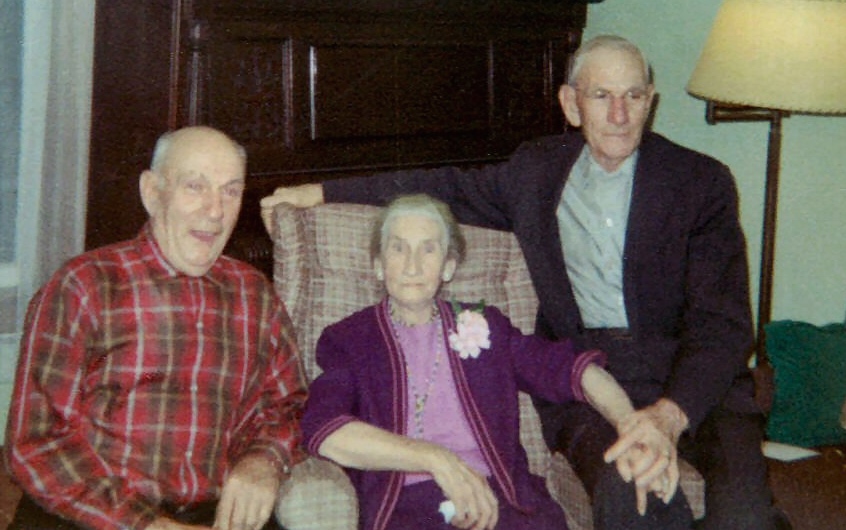
As a lover of history, I am thrilled in my soul to think that we are linked to great men and women of God who helped start and build up the Lord’s church. When I was seven years old, my family and I visited in the home of Zana Michael, a then 100-year-old sister in Christ who was a member where dad was preaching in Barrackville, West Virginia. She was four years old when the church there was established. Some of the great preachers of the 19th Century traversed the bergs and valleys around Barrackville and sister Michael heard several of them. We got to hear her, regaled by her clear recollections, and linked through her to such wonderful history.
Zana Michael is the lady in the middle
Isn’t it thrilling to think of ourselves as being surrounded by so great a cloud of witnesses (Heb. 12:1), sometimes getting to hear from those who heard from those who take us further back in time toward the beginning of the church? This afternoon, as Carl and I sit and watch the Rockies and Cardinals lock horns on the baseball diamond, we’ll get another chance to join the historical continuum of a grand old game. Every Lord’s Day, as we engage together in worship to God, we join in the grandest historical continuum of all, linked ultimately to Peter, Paul, John, and the rest. Until we exult in heaven some day, what could exceed that thrill?













 The Preacher Pollard Blog