My Mouth’s Motivation

Thursday’s Column: Captain’s Blog

Carl Pollard

In Psalm 19:14 David says, “may the words of my mouth be acceptable in your sight.” In the previous verses of this chapter David writes about the perfect law of the Lord. Moved by the knowledge that the author of scripture is God almighty, David hopes that the words he speaks would be impacted by his knowledge of the Law. This is something we must long for as Christians. We know who the author of the Bible is, we understand the way we are called to live and speak, and that should influence our words. The Bible is very clear on how we are to speak.

Our words are a direct reflection of our faith. James 1:26, “If anyone thinks he is religious and does not bridle his tongue but deceives his heart, this person’s religion is worthless.” Do we call ourselves Christians but fail to control our words? James would say we are deceiving ourselves. Our speech is directly impacted by our religion. Our faith should change our speech and make it stand out from the world.

The Bible also gives us a very sobering warning in Matthew 12:36. Jesus says, “I tell you, on the day of judgment people will give account for every careless word they speak, 37 for by your words you will be justified, and by your words you will be condemned.” On that day will we find justification or condemnation from the words we have spoken? We should use this knowledge to help guard our speech.

Scripture also tells us in Luke 6:45 that, “The good person out of the good treasure of his heart produces good, and the evil person out of his evil treasure produces evil, for out of the abundance of the heart his mouth speaks.” We can know the condition of our hearts by what is contained in our words.

Our tongue has a way of getting us in trouble. Ever heard the saying, “keep your words soft and sweet because you never know when you may have to eat them”?We can do a lot of damage if we aren’t careful. On every car there’s this handy little device called a fuel filter. A fuel filter is in between your car’s engine and the gas tank. Its job is to keep all the sediment and dirt that accumulates in the gas tank over time from getting to the engine. Basically it keeps impurities from destroying your engine. Our words need a fuel filter between the mind and the mouth. Think about what we are about to say. Is it impure or harmful in any way? Then don’t say it.

President Calvin Coolidge was famously known as a man of few words. His nickname was “Silent Cal.” His wife, Grace Goodhue Coolidge, told the story of a young woman who sat next to her husband at a dinner party. She told Coolidge she had a bet with a friend that she could get at least three words of conversation from him. Without looking at her he quietly retorted, “You lose.” Coolidge understood very well the value of using only carefully considered words—and those being few in number. We filter our words and carefully choose them because like David, we understand who we belong to when we are Christians. God now owns our words and we use them to glorify Him in everything.

Psalm 19 is a beautiful tribute to the perfection of Scripture. Like David, each one of us should strive to let God’s word motivate us to live more like Christ in every way.

7000 Chances

Friday’s Column: Captain’s Blog

carl emily truck


Carl Pollard

Research shows that the average person speaks at least 7,000 words a day, while many (you know who you are) speak much more than that. Think about what that means. 7000 words that will leave an imprint on those who hear. That’s an incredible opportunity that we are given…or maybe it’s a bad thing?
 
How do we use our words? As Christians those 7000 words should help us fulfill the command given to “make disciples” (Mt. 28:18-20). That begs the question, what should those 7000 words contain? Even more, what am I saying with those words?
 
We have the responsibility to share the good news with others, so what are my words doing to help accomplish this goal? Colossians 4:6 tells us what our daily speech should consist of. But first, notice the context. Colossians 4:5 says, “walk in wisdom towards outsiders, making the best use of the time.”
 
We have been called to make the best use of the time. Ephesians 5:15-16 reads, “Look carefully then how you walk, not as unwise but as wise, making the best use of the time, because the days are evil.” How do we do this? Colossians 4:6 tells us it’s by talking the right way. “Let your speech always be gracious, seasoned with salt, so that you may know how you ought to answer each person.”
 
If we want to walk with wisdom and be effective towards those in the world, we must use the proper words. As Christians, our speech should be attractive. “Let you speech always be gracious.” Gracious is defined as, “A winning quality or attractiveness that invites a favorable reaction.” What does it mean to look attractive? We use this word to describe someone or something that has favorable qualities that we enjoy. Applying that to our speech, it must ALWAYS be described this way. There should never a moment where we stop.
 
Ephesians 4:29 says, “Let no corrupting talk come out of your mouths, but only such as is good for building up, as fits the occasion, that it may give grace to those who hear.” We want people to leave conversations feeling better than when they first saw us. We want people to see Jesus in our speech.
 
We must always try our best to use attractive words. Always look for ways to encourage and help others with our speech. This means on the internet or in person. Our words are attractive when they are sincere and honest. We are called to have attractive speech, and the words we use must be genuine and real. Not saying them to sound holy or to look good, but out of love and concern for the souls of those who hear.
Got to see these two Huntsville area preachers and their lovely wives Wednesday night.

Panic Buying 

Friday’s Column: Brent’s Biblical Bytes

81121814_2462862270639428_5746232403106463744_n

Brent Pollard

Panic buying was in the news again following the Colonial Pipeline hack. People fearing a gasoline supply interruption bought up all the gasoline in many stations throughout the southeast and mid-Atlantic. You might also recall the panic buying of 2020 when the coronavirus pandemic inexplicably caused people to panic-buy toilet paper and paper towels. Why do people engage in this type of behavior? In a word, it is anxiety. Dr. Shahram Heshmat provides seven reasons people choose panic buying as the balm for uncertainty. I would like for us to consider those reasons in addition to the proper, Biblical response. 


  1. Emotions trump logic. People know they don’t need 100 rolls of toilet paper, but driven by fears of a possible shortage, their emotions convince them they would be “safer” buying enough to fill a shopping cart while it is available. Though we equate sobriety with abstention from intoxicants, it also highlights a watchful frame of mind. Paul counseled the brethren of Thessalonica to avoid spiritual stupor by remaining vigilant and sober (1 Thessalonians 5.6). Even if I know that there might be an upcoming shortage, my trust in God should prompt me to act rationally regarding the needs of others who likewise need to secure provisions for their own. Hence, all of us can get by with our typical toilet paper purchases.


  1. Fearful expectation. I anticipate the worst and become fearful before having a cause. Could it be that there will be a shortage of goods? Perhaps. If my compatriots and I hastily grab all of the items from a store’s shelf, then it becomes a self-fulfilling prophecy. Jesus told us to pray for our daily bread. Then, after reminding us of Providence, Jesus concluded this section of the Sermon on the Mount by saying: “So do not worry about tomorrow; for tomorrow will care for itself. Each day has enough trouble of its own” (Matthew 6.34 NASB1995). In other words, Jesus says to take things a day at a time. Tomorrow has its own set of concerns, and we can only deal with what is in front of us.


  1. & 4. The contagion of fear and herd mentality. Dr. Heshmat lists these as two of his seven reasons. The entwining of these ideas is such I will consider them together. Fear spreads like a virus. People sense fear in a group, believe there is justification for it, and follow the cues of others. God knew this about us when giving Moses instruction: “You shall not follow the masses in doing evil, nor shall you testify in a dispute so as to turn aside after a multitude in order to pervert justice” (Exodus 23.2 NASB1995). It doesn’t matter if “everyone is doing it” because we will give an accounting of ourselves before God (Romans 14.12). The incident of the Golden Calf illustrates how easy it is for us to get caught up in groupthink (cf. Exodus 32.1ff).


  1. & 6. Inability to deal with uncertainty and the desire to be in control. Once again, Dr. Heshmat deals with these separately, but I think they are related. Some people find it harder to deal with the unknown. Do you know someone who keeps watching the news or checking social media about a current event? Does it not seem to fuel their anxiety? Such a person likely keeps an eye open for which gas station has fuel or store has toilet paper. He convinces himself he is on top of things by swiftly grabbing up supply as it becomes available. But man is not in control due to the uncertainty of life (cf. James 4.13-15). There are things that we cannot know (Deuteronomy 29.29). We do best to trust the One Who will supply all our needs (Philippians 4.19).


  1. Misinformation. Dr. Heshmat explained how social media spread the misinformation about the toilet paper shortage. People in Japan thought there would be a toilet paper shortage because of what they had seen on social media. Given that we had a mad dash to buy toilet paper in the United States, it is apparent that the online rumors crossed the Pacific. The spread of false information is undoubtedly a hazard to having an interconnected world. It is interesting to note how Paul connects gossip (or being a busybody) to idleness. Paul tells Timothy that the church should not financially support young widows since their inactivity might encourage gossip (1 Timothy 5.11-15). Paul said that their undisciplined life led some in Thessalonica to act as busybodies (2 Thessalonians 3.11). In regards to such Thessalonians, Paul famously reminded that those unwilling to work should not eat (2 Thessalonians 3.10). Hence, if we enough time on our hands to entertain rumors, we may well be neglecting our Christian duty elsewhere.


Panic buying is a peculiar problem of modern man. However, it ultimately stems from anxiety, a commodity of which Christians are to be in short supply. Not only did Jesus tell us not to worry (Matthew 6.25ff), but Paul reminds us that prayer brings incomprehensible peace (Philippians 4.6-7). Let us avail ourselves of the precious promises of our Lord and cast our anxiety upon Him (1 Peter 5.7). 


Works Consulted 

Heshmat, Shahram. “7 Reasons for Panic-Buying Behavior.” Psychology Today, Sussex Publishers, 22 Mar. 2020, www.psychologytoday.com/us/blog/science-choice/202003/7-reasons-panic-buying-behavior


Is Hyperbole a Sin? 

Friday’s Column: Brent’s Biblical Bytes

81121814_2462862270639428_5746232403106463744_n

Brent Pollard

Someone asked if traffic had increased on our little country road. My mother replied that we had more traffic than the nearby town. This response is an example of hyperbole. Hyperbole has long been used rhetorically for effect. So, was my mother lying? It seems that in recent years some are equating hyperbole to lying. Critics routinely called our nation’s previous president a liar because of his frequent use of hyperbole. Reuters published an article in 2015 about how the president’s habit, as extolled in his Art of the Deal, might backfire against him (Flitter and Oliphant). They were correct.

Consider the treatment that the word “hyperbole” receives from Webster’s Dictionary, as demonstrated in the original 1828 edition and 2021 online version. The former is more nuanced.

“In rhetoric, a figure of speech which expresses much more or less than the truth, or which represents things much greater or less, better or worse than they really are. An object uncommon in size, either great or small, strikes us with surprise, and this emotion produces a momentary conviction that the object is greater or less than it is in reality. The same effect attends figurative grandeur or littleness; and hence the use of the hyperbole which expresses this momentary conviction.” (Webster)

And here is what Merriam-Webster tells modern students of English:

“: extravagant exaggeration.”

In other words, as noted by Daniel Webster himself, hyperbole might reflect one’s emotional state rather than a conscious decision to deceive. However, the successful use of hyperbole requires an unbiased and knowledgeable audience. In other words, they must be able to understand you are exaggerating for effect.

Even so, we admit people can use hyperbole to manipulate. Perhaps, this is the type of hyperbole usage that caused President Trump’s political enemies to call him a liar. For example, was he the “best jobs president?” He did create an economic environment that led to historic job growth. However, if God allows time and the United States to continue, another president may create even more jobs. Hence, we can only qualify his statement. The truth as to whether his message is a lie boils down to intent, which may be something requiring omniscience to determine.

We asked at the outset, with our title, whether hyperbole is a sin. It might be helpful to know that the Bible contains hyperbole. Jesus used hyperbole in Mark 10.25.

“It is easier for a camel to go through the eye of a needle than for a rich man to enter the kingdom of God.” (NASB1995)

What about Jesus’ usage of hyperbole in Matthew 5.29-30?

“If your right eye makes you stumble, tear it out and throw it from you; for it is better for you to lose one of the parts of your body, than for your whole body to be thrown into hell. If your right hand makes you stumble, cut it off and throw it from you; for it is better for you to lose one of the parts of your body, than for your whole body to go into hell.” (NASB1995)

How would you qualify our Lord’s speech? Was He lying? Certainly not!  Clearly, He is using exaggeration for rhetorical effect. In the latter case of hyperbole cited, He says that you should be willing to do whatever it takes to enter heaven, even if it seems unreasonable or extreme to you since your entry into heaven is of greater importance than anything sacrificed.

If people equate hyperbole with lying today, it seems more likely an indictment of our public education system’s failure or an unwillingness to evaluate the intended purpose of its usage fairly. Someone may be acting too nitpicky. But we do remind the Christian desirous of communicating the Gospel to others that Paul commands us to ensure our speech’s soundness is beyond reproach (Titus 2.7-8). There are groups with whom we must exercise caution since they take things literally, primarily children and those on the autistic spectrum. Neither should we use hyperbole derogatorily since James cautions us not to use the same tongue to praise God while cursing men (James 3.8-10). Otherwise, our hyperbole use may be the greatest seasoning we can add to our speech when making a point. As with all communication, it is best to season it with grace (Colossians 4.6).

5159999696_66bc9f0de2_b

Sources Cited:

Flitter, Emily, and James Oliphant. “Best President Ever! How Trump’s Love of Hyperbole Could Backfire.” Reuters, Thomson Reuters, 28 Aug. 2015, www.reuters.com/article/us-usa-election-trump-hyperbole-insight-idUSKCN0QX11X20150828.

“Webster’s Dictionary 1828 – Hyperbole.” Websters Dictionary 1828, webstersdictionary1828.com/Dictionary/hyperbole.

“Hyperbole.” Merriam-Webster, Merriam-Webster, www.merriam-webster.com/dictionary/hyperbole.

THE POSITIVE USE OF THE TONGUE

Neal Pollard

David spoke of his tongue as a pen (Ps. 45:1) and his enemies’ tongues as sharp swords (Ps. 57:4). We learn that God hates a tongue which forms lies (Prov. 6:17).  Isaiah prophesied a future time so happy that it would case “the tongue of the dumb [to] sing” (Isa. 35:6). The ungodly tongue is described by Jeremiah as a “deadly arrow” (Jer. 9:8). James calls the unruly tongue a “fire” (Js. 3:6).

The tongue is unique among the body’s members.  It has so many uses. With taste buds, it judges the palatability of the food we consume. With sensitive nerves, it screens the temperatures of the food and drink which enter the mouth.  William McPherson, who lost his sense of sight, hearing, and all four limbs in a mining explosion, used his tongue to read the Bible in Braille. Coordinating with brain and various, undergirding muscles, the tongue is that powerful tool of communication responsible for speech and song.  Like so much of what God created, it is a neutral invention.  According to how it is used, the tongue is either a blessing or curse upon families, communities, and nations.  Benjamin Franklin wrote, “A slip of the foot you may soon recover, but a slip of the tongue you may never get over.”  How can we identify a tongue positively used?

A POSITIVE TONGUE WILL NOT BACKBITE.  Those who wield their tongues positively will say something nice, or at least say nothing at all, about an occupant on the “rumor mill.”  in fact, we should use our tongues to stop the backbiting of others (Prov. 25:23).  A Welsh proverb goes, “Lord, remind us often that a gossip’s mouth is the devil’s mailbag.”  Remember, there’s only one thing more difficult than unscrambling an egg and that’s unspreading a rumor.  We wish only the best for others.  We don’t want to contribute to another’s harm or embarrassment by saying or repeating something evil about them behind their back (Ps. 15:1; Rom. 1:30; 2 Cor. 12:20).

A POSITIVE TONGUE WILL SPEAK GOD’S WORD.  On multiple occasions, the psalmist pledged to use his tongue this way (71:24; 119:172).   When opportunities with our neighbors and friends clearly present themselves, how can we refrain our tongues from speaking Bible truth and divine expectations? When the Bible is disparaged in our presence, how can we hold back our tongues from defending words more precious than gold? God’s Word contain “glad tidings” (Acts 13:32; Lk. 8:1; Rom. 10:15).

A POSITIVE TONGUE WILL SPEAK WHOLESOME WORDS. The Bible praises those who use wholesome words (Prov. 15:4; 1 Tim. 6:5). Profanity, vulgar stories, suggestive language and sexual innuendos do not drop off of a positive, wholesome tongue. Instead, we speak words that improve and sustain our good character.

A POSITIVE TONGUE WILL BE BRIDLED. That’s how you know who is religious (Js. 1:26).  A hot head and a positive tongue don’t rest in the same skull. A blessing tongue and a cursing tongue do not lead to the same end (1 Pet. 3:10-11). A hypocritical tongue and a sincere tongue cannot belong to the same individual (1 Jn. 3:18).  Self-control includes tongue-control.

Someone has written, “To speak kindly does not hurt the tongue.”  It may only be about three inches long, but it can be trained not to do miles of damage. It can be positively controlled.  A bridle for the tongue is a necessary tool which, when used, will cause one to be a shining light in the house of God.

The Worth of One’s Word 

Friday’s Column: Brent’s Biblical Bytes

Brent Pollard

I am not seeking to get into a debate about the outcome of the 2020 general election. However, everyone can agree that Trump has insisted that he won the election and has a team of lawyers trying to prove it. Again, whether he is correct is not my point. However, I wish to point out that Trump’s lawyers offer the affidavits from a few hundred people as evidence of voter fraud. For example, there are 220 affidavits in Michigan alone. I understand that most news outlets have moved on and ignored Trump’s legal team’s efforts.  

Yet, lying on an affidavit is perjury. It is as if you have lied on the witness stand in court while under oath. Perjury is a felony. In many states, felons cannot even vote. So, in Michigan, and other States, hundreds of people testify something that, if false, would make them criminals and, ironically, prevent them from voting in an election in the future. Here is the question. Do people care about lying anymore? We have a former President who was impeached but not convicted for committing perjury because the subject matter of his lie concerned sexual relations with his intern. People dismissed it as political maneuvering by Republicans about a private matter, “just sex.”  

To say, “A man’s word is his bond,” is no longer fashionable, it seems. When did you last have a “verbal contract” with someone? So, it would not surprise me that people would ignore the affidavits of hundreds of people. We are so accustomed to people lying for political expediency that we believe people would become felons to achieve their political goals.  I would hope that Christians give greater value to their words. Indeed, Jesus told us that our testimony is our bond.  

In Matthew five, Jesus discusses how the men of his day diluted their promises with unnecessary verbiage. In reading about the culture of first-century Judea, I noted that if a man wanted to create a loophole for himself, he would swear by something temporary, like his head’s hair. However, if he were making a promise he intended to keep, he would swear by the Temple or something invoking God. Jesus says, “But make sure your statement is, ‘Yes, yes’ or ‘No, no’; anything beyond these is of evil origin.” (Matthew 5.37 NASB) Jesus reminded them that the principle they were violating was that one must keep his vow to the Lord (Matthew 5.33).  

The wise man of God reminds us that it is better to make no promise at all than to promise and fail to keep our word (Ecclesiastes 5.4-5). Under the Old Law, Moses commanded, “If a man makes a vow to the Lord, or takes an oath to put himself under a binding obligation, he shall not break his word; he shall act in accordance with everything that comes out of his mouth” (Numbers 30.2 NASB). The judge, Jephthah, learned this the hard way. Jephthah made a foolish vow to God that he would offer as a sacrifice whatever met him at his house when returning victorious from battle (Judges 11.30-31). Little did Jephthah know that it would be his daughter who would first greet him upon his return. Judges 11.34 states that Jephthah’s daughter was his only child. Thus, Jephthah grieved when she greeted him.  

To her credit, Jephthah’s daughter told her father to keep the promise made with God (Judges 11.36). Given God’s feelings about human sacrifice (cf. Jeremiah 32.34-36), one wonders if Jephthah had to take her life. Jephthah’s daughter’s request was to bewail her virginity with her friends. Women of antiquity, sadly, established their worth by having children. She would be childless. Therefore, there is the possibility that Jephthah’s daughter lived a life of perpetual virginity since that is the emphasis of the last verses of Judges 11. There is no mention of her death.  

Yes, Jephthah kept the promise, understanding the worth of one’s words. He knew his obligation to God. Therefore, let us observe great care, as Jesus taught when making promises to others. Neither let us seek ways of getting out of our commitments. May our words always carry the weight of sworn testimony before the Judge of the Court of the Most High!  

Sources Consulted 

Hurd, Dale. “Where’s the Evidence of Election Fraud? Trump Legal Team Delivers Opening Arguments.” CBN News, The Christian Broadcasting Network, Inc., 20 Nov. 2020, www1.cbn.com/cbnnews/politics/2020/november/wheres-the-evidence-of-election-fraud-trump-legal-team-delivers-it

Spengler, Teo. “What Is the Penalty for a False Affidavit?” Legal Beagle, Leaf Group Ltd. / Leaf Group Media, 18 May 2020, legalbeagle.com/7642670-penalty-false-affidavit.html

File:150306-D-AF077-067 (16736531555).jpg - Wikimedia Commons

Encouraging Encouragement

Thursday’s Column: “Carlnormous Comments”

carl-pic

Carl Pollard

Quite possibly one of the most important actions we can do as Christians is encouraging others. With these words we have the ability to build up and unify the church. Encouragement is a very prevalent concept in scripture, but let’s focus on just one passage.
 
Ephesians 4:29, “Let no unwholesome word proceed from your mouth, but only such a word as is good for edification according to the need of the moment, so that it will give grace to those who hear.”
 
Paul commands us to refrain from unwholesome words. This word, “unwholesome,” would literally be translated as “rotten.” A sane person doesn’t eat rotten fruit or spoiled meat. Why? Because it isn’t safe. It tastes bad. It smells bad. And it’s lost its appeal. Our speech shouldn’t be rotten; that is, our speech should never be filled with words that are bad or unwholesome to the extent of being harmful–words that tear people down. In our new walk in Christ, we should be thoroughly devoted to encouragement, not tearing others down.
 
So we must ask, what is good speech and what does it sound like? Simply put, this would be words that build people up, words that help us reach eternity, words that brings unity and peace, and words that help to encourage and exhort.
 
For example, you would say “Georgia is a great team” instead of “they are the worst team ever.” You would say, Carl you’re looking extra handsome today.” On a serious note, we should be saying words that aren’t negative, that are free from gossip and sin.
 
When Scripture talks about our words, it’s talking about positive versus negative. It is not necessarily a word that is bad, but it is focused on how our words are used. So, how are we using our speech? Are people around me encouraged by what I say? Or are they torn down and destroyed?
 
The Christian walk is to be filled with encouraging words. Specifically, Paul says use words that bring about edification (that which builds up) and that fits the need of the one who hears it. He says in verse 29 that our words can bring grace to those who hear. The word grace here is “the showing of human favor.” When we use edifying words we are showing others that we favor them. We care about them and want what is best.
 
Our new life in Christ is defined by our speech. Speech that stands out from the world. Speech that is clearly seen as different and appealing. May we also look for ways to encourage and build up our church family.
Dave Steeves speaking for the first time encouraged the Lehman congregation with his words and his example!

“Let Us Sing!”

Don’t miss the latest TBNB Podcast with Dale and Carl (subscribe here)

Monday’s Column: Neal at the Cross

Neal Pollard

I counted 96 people present for the singing at the Waddells’ home Friday night, sitting in our camping chairs in their beautiful backyard. Beyond the hospitality and tasty desserts, this was such a wonderful, needed time of fellowship and singing. There were babies up through senior saints, with a whole lot in between. It was exciting to see visitors, several who have been attending but have not yet placed membership, elders, deacons, and so many others. Though the air was surprisingly chilly, you could not help but feel the warmth and glow of brothers and sisters enjoying life together. It felt so first-century!

While it is extremely valuable for us to make as a goal improving our singing, from training our song leaders to becoming better, more attentive followers, it is even more important to understand what God is trying to do for us and through us in our singing. Notice just a few of the objectives God achieves through those who follow His will by singing psalms, hymns, and spiritual songs.

  • We communicate to one another in a special, spiritual way (Eph. 5:19).
  • We teach and admonish one another with all wisdom (Col. 3:16).
  • We express gratitude in our hearts to God (Col. 3:16; cf. Psa. 28:7).
  • We proclaim God’s name to our brethren (Heb. 2:12).
  • We praise God’s works and nature in a unique way (Rev. 15:3; cf. Exo. 15:1,21; Psa. 68:4).
  • We offer up a sacrifice of praise by the fruit of our lips giving thanks to His name (Heb. 13:15).
  • We help others see and fear and trust in the Lord (Psa. 40:3). 

Certainly, much more is implied concerning the power, effect, and blessings of saints singing together. But, it is helpful for us to consider the value of singing on its own. As a sacrifice of praise, singing is, of itself, worship. Worship is ” to express in attitude or gesture one’s complete dependence on or submission to a high authority figure” (BDAG 882). From “I Need Thee Every Hour” to “Holy, Holy, Holy” to “You Are My All In All” (and literally hundreds more), we prostrate ourselves before God as an act of reverence, fear, and supplication (Louw-Nida 217).  Our Creator designed us to connect to words and their meanings in a unique way through singing. We memorize better when we set something to music. We connect music to events and people, forming deeply touching memories and recollections. We touch our own hearts and those of others in a crucial way through melody. It is not just “filler” between prayers and the Lord’s Supper. It is a profoundly meaningful act God purposed for us to help us grow and be strong. By doing it together, we are connecting our hearts and encouraging one another’s spiritual lives. 

So, think about what you can do to make this act of worship so much more effective.

  • Clear your mind and focus intently on the message of each word of each song.
  • Focus on the people around you, deliberately trying to teach and admonish them.
  • Sing out so that your teaching and admonishing can be heard (forgetting yourself and how you think you “sound” to others).
  • Put forth effort, not just with your vocal cords but with your heart and mind.
  • Do not be afraid to connect your singing with your feelings.
  • Consciously work to communicate to God your praise and adoration each and every time you sing.
  • Let the word of Christ dwell in you richly by your singing.

Do you remember when government mandates suggested that church goers not sing for fear that virus germs might be spread? Will you consider that God intends for something vital to be spread through our psalms, hymns, and spiritual songs? His Word! It should spread to our own hearts and to others. It should even reach the throne of God in heaven! Whether you are worshipping Him alone or with your physical family in song, assembled on the Lord’s Day, or gathered with saints in other places, let us sing!

Photo Credit: Shedona Tillman

σαπρός (Unwholesome)

Wednesday’s Column: Third’s Words

20638721_440919206307154_5479040032968788217_n

Gary Pollard


Yesterday Carl and I smelled something absolutely awful in his house. Bailey, his trouble-making Carolina dog, had just been let back in; she had evidently rolled around in the remains of an animal that recently reached putrefaction and it showed. We were gagging and gasping for air while attempting to find the source of the odor traumatizing our olfactory lobes. The deceased animal outside was found (kind of) and Bailey was forced into the bath. The sheer power of that stench was incredible.

Our words can have the same effect on a person’s ears that the decaying body of roadkill has on the nose. Ephesians 4.29 says, “Let no unwholesome word proceed from your mouth, but only words good for encouragement according to the need of the moment, so that it will give grace to those who hear.”

I want to focus on the word “unwholesome” here. When we hear “unwholesome,” we might think of a dirty joke, curse word, or some other graphic form of speech. That can be included in this word, for sure, but we need to take a closer look at what it means in scripture.

The word is σαπρός (sapros) which means, “to be of such poor quality as to be of little or no value,” or, “bad or unwholesome to the extent of being harmful.” It generally described something that was rotten or decayed and completely useless. That really widens the range of words we can describe as being unwholesome. In modern Greek, σαπρός means “putrid” and is used to describe the same putrefaction process Bailey unfortunately rolled in. It was awful to smell, and putrid words are awful to hear.

The next time we speak to someone, let’s put our words through a simple filter. Let’s ask ourselves, “Is this rotten? Is it going to be beneficial to the person hearing this? Does it encourage?” If our words are closer to rotting flesh than graceful encouragement, we must rethink them before they escape our lips. It’s not just a good idea, it’s certainly imperative to godly living.

82191052_10220859791302717_8552934994933186560_o

6 Things About Gossip That I Don’t Like

Neal Pollard

As masterfully and humorously portrayed in the 15th episode of the first season of the Andy Griffith Show (“Those Gossipin’ Men”), gossip can seemingly appear, full-blown, out of thin air. It can be personally hurtful, but it’s part of the territory of living and breathing.  Here are 6 things I particularly dislike about the ugly specter of gossip.

  • It’s GallingIt “reveals secrets” (Prov. 11:13). It separates friends (Prov. 16:28), yeah even “intimate friends” (Prov. 17:9). While cowardly, it still takes a lot of nerve!
  • It’s Obstructive. Billing itself as “helpful” and “instructive,” it usually serves the opposite purpose. It “reveals secrets” (Prov. 20:19) and is the hallmark of idle busybodies (1 Tim. 5:13).
  • It’s Spurious. As previously mentioned, gossip is as apt to be false and inaccurate as it is to be trustworthy.  Even if there is a grain of truth, it can have an admixture of inaccuracy blended in.  Tragically, it is often received as the truth and nothing but the truth.
  • It’s Sinful. Find it listed alongside “strife,” “jealousy,” “slanders,” and “arrogance” (2 Cor. 12:20). God calls the spreader of such “a fool” (Prov. 10:18). It’s an “evil weapon” (cf. Isa. 32:7) and “stubborn rebellion” (Jer. 6:28). See also Romans 1:29, 2 Timothy 3:3, and Titus 2:3.
  • It’s Inconsiderate. Few gossips would want to be treated the way they treat their subjects (Luke 6:31).  Repeatedly, Christians are urged to “be kind to one another” (Eph. 4:32). We’re to love each other without hypocrisy and “be devoted to one another in brotherly love; give preference to one another in honor” (Rom. 12:9-10).  Gossiping is rarely wrapped in forethought and careful circumspection.  It’s not “friendly fire.” It’s just fire.
  • It’s Presumptuous. Gossip is acting with entitlement, believing that it is fair and right to spread (whether true or false) information about the subject thereof. The gossip believes himself or herself qualified to share something about someone else, and such are usually mortified if the tale is traced back to them.

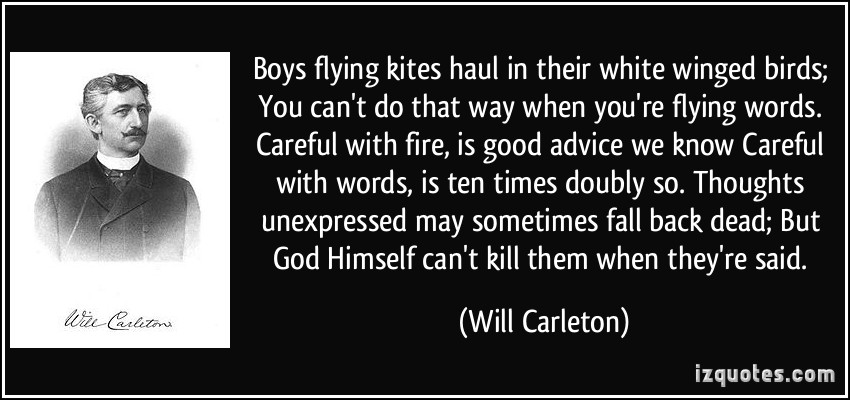
Yet, indignation should be tempered with realization.  Few have so mastered the tongue that they are above the fray we mention here.  Let’s be convicted to practice saying good and kind things behind each other’s backs. Remember to investigate before you propagate, and even then only carefully and prayerfully. Usually, prayer and care will render the “juicy tidbit” dead on the floor of your mind, safely unspoken and incapable of doing any harm. Remember the famous words of 19th Century Michigan poet Will Carleton: “Boys flying kites haul in their white winged birds; You can’t do that way when you’re flying words. Careful with fire, is good advice we know Careful with words, is ten times doubly so. Thoughts unexpressed may sometimes fall back dead; But God Himself can’t kill them when they’re said.”

quote-boys-flying-kites-haul-in-their-white-winged-birds-you-can-t-do-that-way-when-you-re-flying-words-will-carleton-377399

“Vain Jangling”

Neal Pollard

The English language has done some changing in the 400-plus years since the King James Version was made available. Within its pages, you’ll find phrases like “straitened in your own bowels” (2 Cor. 6:12), “superfluity of naughtiness” (Jas. 1:21), “bloody flux” (Acts 28:8), “filthy lucre” (Ti. 1:7), and “the thick bosses of his bucklers” (Job 15:26). There is a beauty and picturesqueness to the Elizabethan English, though. One example of this is in 1 Timothy 1:6, which warns against “vain jangling.” To me, that’s a vivid way of translating a compound Greek word translated elsewhere as “fruitless discussions” (NASB), “idle talk” (NKJV), “vain discussion” (ESV), “meaningless talk” (NIV), and “empty talk” (MEV). Have you ever heard anyone jangling keys or coins in their pockets? It’s usually a nervous tic and mindless habit, but it can loud and annoying. In the 17th Century, the word meant to “talk excessively or  noisily, squabbling” (Apple Dictionary, 2.2.2).

In context, Paul gives the culprits, the creed, the consequence, the contrast, and the cause of this “vain jangling.” The culprits are “certain men” (1:3) or “some men” (1:6). Their creed is “strange doctrines” (1:3), “myths and endless genealogies” (1:4), and this “fruitless discussion” (vain jangling). The consequences are dire, as such will “give rise to mere speculation” (1:4). The contrasts are “the administration of God which is by faith” (1:4) and “instruction (in) love from a pure heart and a good conscience and a sincere faith” (1:5). The cause is revealed in verse 7, that “they want to be teachers of the Law, even though they do not understand either what they are saying or the matters about which they make confident assertions.” Paul had a particular circumstance in mind, but is there an application to us today?

In 2018, there are numerous platforms and avenues to communicate. It can be easy to forget that James’ warnings about the tongue are not limited to words which are audibly heard, but whatever we speak. I need to be cautious about being a religious noisemaker, banging and clanging with reckless abandon. My words have meaning, and they hold the power of spiritual life or death within them (Prov. 18:21). Thus, great restraint, copious forethought, and thoughtful execution ought to permeate my speech, wherever it is “heard.” Otherwise, I may simply be declaring my thoughtless ignorance, both uninvited and unwelcome, and come off sounding like three dollars of pennies churning in the pocket of a champion fidgeter.

Paul speaks of Christians as “ambassadors” for Christ (2 Cor. 5:20). We must represent Him righteously and accurately. We may be the first and only megaphone through which Christ is proclaimed, so let us speak accordingly. Let’s make Him proud, for His message is “words of sober truth” (Acts 26:25), not vain jangling.

ntts3l5

WHEN MISUNDERSTOOD

Neal Pollard

It will happen, at least occasionally. A remark you make gets taken out of context, will not be correctly heard, or will be heard through the personal filters of the listener. Your facial expressions and body language may not accurately express your feelings or at least not tell the whole story. People may ignore the adage, “Believe none of what you hear and only half of what you see.” While that truism may be naive and certainly not entirely true, we’ve all been on the receiving end of others’ misunderstandings of what we’ve written, said, or done. What do we do when we feel we’ve been unfairly treated by the misunderstandings of others? Consider the following:

  • Try to understand others better.  Everybody has been through the same thing. I need to make sure I’ve not misunderstood intonation, intention, motivation, emotion, or information. It’s easy to happen.
  • Don’t obsess over the hurt. The world has enough victims, and the perpetual victim is exhausting. I cannot afford to fixate on the fracture. I am usually best served to let it g.
  • Rejoice in the great company you are keeping. Jesus’ whole life and ministry was misunderstood by the religious leaders of His day. Their misunderstanding was certainly not the meat of His mission. His eyes focused on the bigger picture. He was perfectly sinless and still unjustly treated. I can rejoice when I’m in a similar position, sinful though I am.
  • Turn to God, not gossip. This is hard! The urge to lash out and retaliate can seem irresistible, but it’s definitely possible. How much greater peace and harmony would come if we resolved to pray (even for the “misunderstander”) when misunderstood?
  • Redouble your efforts to spread salt and light. I may be tempted to throw up my hands and say, “What’s the use? If this is what I get, I quit.” That doesn’t sound so good when I can read it in print. Instead, I need to strive harder to do good.
  • If necessary, clarify but with utmost love and kindness. But, let me do some serious soul-searching and ask, “Is it really necessary?” Can I turn my cheek(s) and move on? If I truly cannot, I need to cleanse my heart of sinful anger and act in genuine love and kindness toward my “aggressor.”
  • Remember that wisdom is justified of her children. Ultimately, the body of work that is your life will leave a clear impression. Most people who know us know more about us than we think. They see what side of the ledger our lives are lived on and they draw conclusions accordingly. I just need to be characterized by righteousness and good works.
  • Be sure you are communicating clearly. Communication is a problem in every medium and relationship. Some do better than others, but all make mistakes. When I am misunderstood, I need the humility and honesty to step back and ask if I asked for a reaction through unclear meaning or veiled messages.

I hate to be misunderstood. But as with every other trial, I can often find blessings even in these distasteful situations. My prayer is that I will not be conformed to the world (or the worldly), but I can be transformed by the renewing of my mind. That’s going to turn out for the best (Rom. 12:1-2).

misunderstood1

It Didn’t Go Like He Planned

Neal Pollard

G. Gordon Liddy once related a bazaar story about a man, jilted by his girlfriend. Apparently, he tried to commit suicide in front of his rival (the girl’s new boyfriend). He pointed the pistol at his chin, pulled the trigger, and fully intended to die. However, the bullet somehow ricocheted off his teeth and fatally struck the other fellow. Intending to “end it all,” the young man was charged with manslaughter, third-degree murder, kidnapping, and assault.

That was not in his script. He had not planned it to go like that. He was going to show his counterpart, his girlfriend, and the rest of the world that his emotional wounds were so great that he was going to engineer his final exit strategy. How remarkably foolish!

How often, though less dramatically, does this occur? In words or actions, we tell others, “I’ll show you! You’ll be sorry!” With such haste and waste, we rashly do something we live to regret. We put our souls in jeopardy to get even with actions or words we perceive  offensive and injurious to us.

Solomon warned, “He that is slow to wrath is of great understanding, but he that is hasty of spirit exalts folly” (Prov. 14:29). When we act without weighing the consequences, we rue the choice we make. Appropriately, the wise man again said, “Do not be hasty in word or impulsive in thought to bring up a matter in the presence of God. For God is in heaven and you are on the earth; therefore let your words be few” (Ecc. 5:2).

Spiteful actions are futile and sinful (Psa. 10:14; Luke 18:32). “Get even-ism” is a sickness and a symptom of worldliness. It disregards Christ’s mandate for God’s children to turn the other cheek (Luke 6:29). It is written, “If you have been foolish in exalting yourself
Or if you have plotted evil, put your hand on your mouth” (Prov. 30:32). If everyone practiced this sage advice, fewer would overreact and more would overcome.

Think before you speak. Consider the consequences of rash decisions (remember Jephthah?). Avoid the tragedy of thoughtlessness. The failure to control our lives results in a punishment far outweighing a jail sentence.

Consider the words of this poem, written anonymously.

“Boys, flying kites, haul in their white-winged birds,
But you can’t do that when you’re flying words.
Thoughts unexpressed may sometimes drop back dead,
But naught can kill them when they’ve once been said.”

1

My Social Media Pledge

Neal Pollard

  • I will try to use social media to encourage and edify others (1 Thess. 5:11; 1 Cor. 14:26b).
  • I will avoid the shocking, inflammatory, and divisive tactics increasingly characteristic of S.M. (cf. 1 Cor. 1:10; Prov. 12:18; Prov. 15:2,4; etc.).
  • I will ask, “Would I say this in the way I am saying this?,” if face to face with this person or this group of people (Prov. 23:7).
  • I will not use Social Media to pick fights or put people on the defensive (cf. 2 Tim. 3:1ff).
  • I will not be Nellie Nitpicker and Contrary Charlie. About. Every. Single. Little. Thing.
  • I will respect that my connections have connections that are not Christians and I want to be sure to say what I say in accordance with Ephesians 4:15 and 2 Timothy 2:24-26.
  • I will sever connections with individuals who consistently display a lack of self-control with their words and attitudes. Souls are too precious.
  • I will abhor the thought of doing what would put Christ to an open shame (cf. Heb. 10:29).
  • I will double-check myself to avoid bragging and self-promotion (1 Cor. 13:4-5).
  • I will conquer the desire to have the last word, pile on, or fight fire with fire (Mat. 5:39-42).
  • I will not let the false teaching, bad attitude, or meanness of another be my rationale for behaving in a way that brings Christ shame or jeopardizes my own soul (cf. 1 Cor. 9:24-27).
  • I will always be trying to set the table for productive evangelism or retrieving the wayward (Jas. 5:19-20; Col. 4:6).
  • I will always try to portray the doctrinal, moral, and ethical values of my Lord, thus avoiding reflecting and glorifying whatever values conflict with His (Mat. 5:14-16).
  • I will try to promote, not pummel, the bride of Jesus, appreciate, not attack, the elders, and unite, not untie, wherever possible.
  • I will shun passive aggression in myself first, but also in others.
  • I will deal with dirty laundry in its appropriate way, which is not on Social Media.
  • I will actively try to show grace to everyone, including cantankerous curmudgeons.
  • I will, foremost, realize my own imperfections and try every day I use Social Media to do so in the way Jesus would, if He had Facebook, Snapchat, Instagram, Twitter, a blog, LinkedIn, etc. In a way, through you and me, He does. I will let that sink in!

20080704_p070408jbweb-0279-515h

Open Mic At Bear Valley

Neal Pollard

It is one of the preacher or teacher’s public speaking nightmares. And it happened to me yesterday morning between Bible class and worship services. I had no clue until I began to be approached by multiple members. My wireless mic was “hot,” and I was visiting with several people and, true to form, I was having plenty to say. As far as I know, I said nothing personal or embarrassing, but after I was informed of my amplified voice I began thinking back to who I spoke to and what I said. My private conversations were being broadcast throughout the auditorium, foyer, nursery, and beyond.

The Bible gives us some insights into what the day of judgment will be like. How much is accommodative language and how much depicts what it will be like is something we must leave until we are there. Yet, there are some statements made that are not open to interpretation. Solomon writes, “For God will bring every act to judgment, everything which is hidden, whether it is good or evil” (Ecc. 12:14). There is appointed a day when “God will judge the secrets of men through Christ Jesus” (Rom. 2:16; cf. 14:10-12; 2 Cor. 5:10). Jesus taught, “But I tell you that every careless word that people speak, they shall give an accounting for it in the day of judgment. For by your words you will be justified, and by your words you will be condemned” (Mat. 12:36-37). Clearly, the words we speak—even those which are not public—are subject to the universal judgment at the end of time.

With that in mind, I want to be more careful to control that hard-to-tame tongue (cf. Jas. 3:2ff). Lying, gossiping, complaining, bitter, slanderous, angry, malicious, backbiting, or jealous words can flow freely, especially in private conversations. I may think I am covered by the cloak of secrecy or privacy, but how would I speak if I knew that everything I said what being broadcast for everyone to hear? If I could think of my speech in that way, how much more positively would I speak of others, of my own circumstances, of the church, and of my God?

Yesterday was good for me! If all of us could experience an unplanned moment like that at least once, it might cause us to reflect on what we are saying when we think that those around us can’t (or won’t) hear. It might help us live soberly, righteously, and godly in view of the end.

shure_mikrofon_55s

HURT PEOPLE HURT PEOPLE

Neal Pollard

Several have made the observation that hurt people are inclined to hurt people.  I have been told that by others to explain mean, hurtful, rude, and inappropriate remarks.  Yet, since everyone experiences significant hurt (so the Holy Spirit said through Job in Job 14:1), why doesn’t everyone lash out and wound others as they suffer from their own and various “injuries”?  Why do others, including those claiming to be Christians, seem inclined to injure others with especially their speech? It is good to get some perspective and not take personally the times someone cuts and slashes us or we witness a hurt person hurting someone else.  While it never excuses bad behavior, it does help to understand it better.  However, what can we say to the hurtful hurt person?

  • Take your hurts to God’s throne.  He is perfect and perfectly impartial (Acts 10:34-35).  He also has all the facts and all the answers.  He can help our life’s situations better than anyone else.  Let Him help you bear the load.
  • Don’t allow your pain to injure your influence or your spirituality.  It is possible for us to earn a reputation as sarcastic, biting, mean-spirited, passive-aggressive, critical, etc.  Yet, we never want to do anything that threatens to douse our Christian lights.
  • Find healthy ways to work through the hurt.  Prayer has already been mentioned.  Loving, spiritual confrontation is another (cf. Gal. 6:1; Mat. 18:15ff). Part of healthy coping is avoiding the unhealthy.
  • Focus intently on the spirit of the “Golden Rule.”  Be sure that you would want said to you what you are tempted to say or if you’d want it said in the way you’re going to say it before you let it fly.  It requires tremendous self-awareness and self-examination to successfully do this, but it can make all the difference.
  • Try to move from hypersensitivity to genuine concern for others.  We cannot keep our feelings on our sleeves and keep a record of wrongs done to us. It’s not loving (1 Co. 13:5).  What is loving is to work to look out for the interest of others (Phi. 2:4).
  • Measure the impact of your words before you say them.  You cannot unsay things, so think it through first!  The late Marshal Keeble once said, “Before we speak, we must chew our words and taste them and see if they are pleasant words.”  If not, swallow them!

Since “death and life are in the power of the tongue” (Pro. 18:21), we must make the choice to say words that heal rather than kill, that restore and do not demolish.  We should never wish to contribute to another’s struggle to walk in the light or get to heaven, and we must consider how our words either encourage or discourage.  If hurt people hurt people, what do saved people do?