As a Vapor Vanishes: Reflecting on the Brevity of Life

The tragedy of Fauja Singh’s passing should stir us, not just with grief, but with resolve. Not everyone will run marathons. But all of us are race runners.

Brent Pollard

“Yet you do not know what your life will be like tomorrow. You are just a vapor that appears for a little while and then vanishes away.” (James 4.14)

At 114, Fauja Singh had outrun time itself—until time caught up with him on a quiet village road.

The world mourned the tragic death of Fauja Singh, the legendary marathon runner from Punjab, India. At 114 years old, he was hit and killed by a vehicle while walking in his village. Known as the “Turbaned Tornado,” he started running in his late 80s, broke age-related barriers, and inspired people worldwide. His sudden and heartbreaking passing reminds us painfully that life is uncertain. (Singh, 2025)

Even the most lively and resolute spirit cannot escape the limited nature of time.

Scripture speaks with sobering clarity about the fragility of life. “As for the days of our life, they contain seventy years, or if due to strength, eighty years, yet their pride is but labor and sorrow; for soon it is gone and we fly away” (Psalm 90.10). This psalm of Moses captures both time’s swift passage and life’s inevitable end. Even for someone like Fauja Singh, who surpassed expectations by living over 110 years, the outcome remains the same. “…it is appointed for men to die once and after this comes judgment” (Hebrews 9.27).

Life’s Fleeting Nature

King David wrote, “Man is like a mere breath; his days are like a passing shadow.” (Psalm 144.4). Job adds, “Man, who is born of woman, is short-lived and full of turmoil. Like a flower he comes forth and withers. He also flees like a shadow and does not remain” (Job 14.1–2). These are not ornamental flourishes for funerals; they are divine truths designed to ground the living.

Even in Isaiah’s reflective sorrow, we read, “Like a shepherd’s tent my dwelling is pulled up and removed from me; as a weaver I rolled up my life. He cuts me off from the loom; from day until night You make an end of me.” (Isaiah 38.12). Scripture layers these images deliberately—vapor that dissipates, flowers that wither, shadows that fade. Each metaphor reinforces the same sobering truth: nothing in this life endures.

The Illusion of Control

The book of James highlights our assumption. We often speak confidently about “tomorrow,” make arrangements for profit and travel, and forget that we have no control over even a single heartbeat. James doesn’t forbid us from planning, but advises us to include God in our plans. “Instead, you ought to say, ‘If the Lord wills, we will live and also do this or that’” (James 4.15).

Our culture idolizes productivity and mastery of time, filling calendars, chasing deadlines, and marking anniversaries as if we can control time. But a single accident on a quiet village road can shatter that illusion.

We are not the masters of our fate. We are the stewards of fleeting days.

A Call to Wisdom

What, then, shall we do with this fleeting existence? Moses offers a simple but profound prayer: “So teach us to number our days, that we may present to You a heart of wisdom.” (Psalm 90.12). This is not a morbid obsession with death; rather, it is a prudent recognition of it.

A devoted child of God lives each day with eternity in mind. As the Hebrew writer reminds us, judgment comes after death (Hebrews 9.27). There is no second race or alternative path. Whether we die at 14 or 114, the race concludes for everyone—and ultimately, the finish line that truly counts appears.

For those in Christ, that finish line is not fearful. The apostle Paul, nearing his end, wrote with confidence, “I have fought the good fight, I have finished the course, I have kept the faith” (2 Timothy 4.7). We are not guaranteed a long race, but it must be a faithful one.

Redeeming the Time

The tragedy of Fauja Singh’s passing should stir us, not just with grief, but with resolve. Not everyone will run marathons. But all of us are race runners. The Hebrew writer exhorts us to “lay aside every encumbrance and the sin which so easily entangles us, and…run with endurance the race that is set before us” (Hebrews 12.1).

This life—delicate and brief as it is—is a gift. It’s not meant for self-indulgence but for obedience. It’s not for procrastination but for preparation. If today is all we have, let it be a day that honors God.

Conclusion

Like the marathons he ran for decades, Singh’s life had a clear beginning, a long middle filled with purpose, and an end that came suddenly. The race is over, but the legacy of how he ran remains. He reminds us that neither extraordinary strength nor advanced age can prevent the end of life. For everyone, death is certain—sometimes sudden, sometimes anticipated, but always unavoidable.

The vapor will vanish. But until then, let us live wisely, walk humbly, and prepare fervently for what lies ahead.

“For what is your life?” (James 4.14 KJV)

This is a question worth asking before our last breath answers it.

Unless otherwise indicated, Scripture quotations are taken from the NASB® (New American Standard Bible®, 1995 Updated Edition). Copyright © 1995 by The Lockman Foundation. Used by permission. All rights reserved.

Reference list:

Singh, I. P. (2025, July 15). At 114, oldest marathon runner Fauja Singh killed in road accident. The Times of India. https://timesofindia.indiatimes.com/city/chandigarh/at-114-oldest-marathon-runner-fauja-singh-killed-in-road-accident/articleshow/122460660.cms


Does Consciousness Continue After Death?

Gary Pollard

One of the commonly asked questions on my list is, “Does consciousness continue after death?” I was fairly confident in what I believed about this one until 3:00 PM today (11.19). Carl dropped the problem of the Transfiguration on me: How are Moses and Elijah present with Jesus before the resurrection? The purpose of this article is to sort out the Gnostic and the scriptural, but also to hopefully put more minds on this question. It’s been bothering me for several hours now. 

The overwhelming weight of scripture seems to be in favor of death being (from our perspective) an instantaneous transition to Jesus’s return and the resurrection. There are some teachings that potentially complicate this view (like the Rich man and Lazarus, thief on the cross, saints under the altar), but the concept of a “place of waiting” made no sense to me in light of the rest of scripture. What’s the point of dividing the sheep and the goats if they’ve been tortured/resting for the last umpteen years? And why are the “goats” surprised at their fate if they’ve already been punished for however long? And how/why is poor Abraham dealing with the pained cries of the rich man in torment? There is, after all, a wide abyss separating the two places (maybe the acoustics are really good). It makes the most sense that Jesus was using an image they would’ve been familiar with (from I Enoch 22, 51) to illustrate the importance of viewing money appropriately. Paul clearly says that we’re given life only when Jesus returns (cf. I Thess 4.14ff), and that Jesus being brought back to life was a visible example of what will happen to all of us too (I Cor 15.20-24). Our hope for consciousness after this life is solely in God’s promise to bring us back when his son returns. 

William Tyndale (1484-1536) said, “By putting the departed souls in Heaven, Hell, and Purgatory, you have destroyed the arguments that Christ and Paul used to prove the resurrection. … What’s the point of resurrection, then? And what’s the point of judgment? … The true faith affirms the resurrection, which is what we’re told to always watch for. Pagan philosophers deny this and claim that the soul is immortal. The Pope combined the spiritual doctrine of Christ and the fleshly doctrine of philosophers, things so dissonant that they’re totally incompatible. And because the fleshly-minded Pope is okay with pagan doctrine, he has no problem corrupting the scripture to establish the doctrine [of Heaven]. If the soul is in Heaven, tell me what the point of resurrection is?” The doctrine of “heaven” widely adopted by our culture is unsupported by scripture and has far more in common with Gnostic and Egyptian beliefs (i.e. Pleroma and Duat). 

So is there an intermediate place where departed souls go to experience the beta version of eternity? I didn’t think so. I’m pretty confident that our culture’s concept of heaven is wrong — on linguistic (ουρανος means “sky” or the place above the sky, which we call “space” today), scriptural (our new life comes when Jesus returns), and historical-cultural grounds (the early, pre-Catholic Christians believed that we would get life in a new body on a new/renewed earth when Jesus returns). 

But the original question was, “Is there consciousness after death?” From a biblical point of view, I believe (until the Transfiguration Conundrum is sorted anyways) the answer is yes and no. From the perspective of the dead, the transition between death and resurrection is instantaneous. I was comatose for about a week several years ago and couldn’t believe I’d been out for that long. Now, that’s not dead — but it at least proves a point. If you aren’t conscious you aren’t aware of time passing. So the “blink of an eye” statement in I Corinthians 15 makes perfect sense! But the bible does suggest that the dead are not conscious, though this is contested (cf. Ecc 9.5, Dan 12.2, Ps 115.17, 146.4 I Thess 4.14-17, and the 50+ times the bible describes death as “sleep”). Regardless of which answer is correct, what we can all agree on is this: 

Brothers and sisters, we want you to know about those who have died. We don’t want you to be sad like other people — those who have no hope. We believe that Jesus died, but we also believe that he rose again. So we believe that God will raise to life through Jesus any who have died and bring them together with him when he comes (I Thess 4.13-14). 1

“Do You Fear Death?”

Gary Pollard

Davy Jones asked this question in the second Pirates of the Caribbean. “Do you fear(rrr) that dark ahbees?” It’s basically rhetorical, most people would say, “Duh.” Staying alive drives most of our behavior. We avoid certain activities if there’s even a modest possibility of death! Not everyone is negatively preoccupied with this unknown state, but many (perhaps most) are. Why do we fear death? And can we be certain that there’s life after death? We’ll look at those in order. 

  1. Why do we fear death? There are too many reasons to list here, so we’ll look at just the big ones. We fear death because it’s unknown. It’s been thousands of years since someone came back to life, and they didn’t share any details about it. We fear what we don’t understand. It’s not physically possible to study consciousness after death, so it’s the ultimate unknown! This is a religious blog, so we’ll approach this from that angle. John tells us that if we fear death two things are to blame: one, we’re instinctively afraid of God’s punishment because our lives aren’t where they need to be. Two, we haven’t matured in love. God’s perfect love overrides our fear of death (I Jn 4.17-18). If someone orders their life around their fear of death, they need to make changes. Adopt selfless love — “everyone who lives in love lives in God, and God lives in them” (4.16). John also says, “If God’s love is made perfect in us, we can be without fear on the day when God judges the world. We will have no fear because in this world we are like Jesus.” This tracks with what Jesus said in Lk 21.25-28, “They [all people on Earth] will be afraid and worried about what will happen to the world. … When these things happen, stand up tall1 and don’t be afraid.2 Know that it is almost time for God to free you.” Jesus’s sacrifice removed our fear of death (Hb 2.15). Death is just a “sting”, it’s the consequence of our sin. But it’s no longer an issue. It’s only for a microsecond (from our perspective), and the best thing that could happen to a believer (I Cor 15.51-52, 56-57). Jesus took away any legitimate fear of death because it no longer means we’re destined for punishment! 
  2. Can we know for sure that there is life after death? From a material perspective, no.  Not yet, anyways. Even Solomon struggled with this question (Ecc 3.21), “Who knows what happens to a person’s spirit? Who knows if a human’s spirit goes up to God while an animal’s just goes into the ground?” When every person who ever lived comes back to life at Jesus’s return, we’ll know for sure. What we were only confident in — even though we hadn’t yet observed it firsthand — will become incontrovertibly real. For now, our confidence comes from promises made in scripture, and from a universal, intuitive sense that something exists beyond this life (Is 25.8; Hos 13.14; I Cor 15.57; II Pt 3.13; Rv 21.4). 

  1.  This is imperative mood (command) in Gk. The idea is to stand up with confidence.  ↩︎
  2.  Also imperative mood, lit. “raise up your head”.   ↩︎

The Precious Stones Of Revelation

Dale Pollard

In Revelation 21, there are 12 gemstones listed that are believed to be the same gemstones from the Mountain of God. 

These are the 12 gemstones mentioned in Revelation: 

Jasper, Sapphire, Chalcedony, Emerald, Sardonyx, Sardius, Chrysolite, Beryl, Topaz, Chrysoprasus, Jacinth, and Amethyst.

Interestingly, the gems of Revelation are inorganic. Most of the rocks and stones you see in the natural world around you today are organic and were created through a process of death. Plants, animals, and microorganisms died and their remains were crushed down through various processes before eventually turning into rock. 

Inorganic stones would be the only stones Adam and Eve would have been familiar with. These aren’t made up of deceased creatures, they’re made by a fascinating chemical process within the earth. Meaning, the components that make up inorganic stones were never alive and therefore nothing had to die in order for them to exist. 

Not every gem is inorganic, but all twelve precious stones mentioned in Revelation are. How fitting that in God’s city, death has never been a visitor. Death is not allowed in heaven, even in the construction material. 

This can be appreciated even if the gems weren’t meant to be taken literally. God was the one who had John record those specific gems. Death isn’t even allowed in His symbolic city! Either way— how satisfying. 

Marks

Gary Pollard

Every normally functioning person is acutely aware of something wrong within them. Most people subconsciously or consciously understand that they’re horribly wrong somehow. Historically we’ve tried to fix this in different ways. The Pharisees and Sadducees are two archetypal mentalities among religious people — one extreme goes to the right and mandates excessive behavioral restrictions in an attempt to earn God’s favor through what is not far from asceticism. The other side says, “What’s the point in dwelling on it?” and mostly ignore the problem.


The problem with both groups is that they cannot control their bodies’ enslavement to sin. Paul warns against the legalist and traditionalist by saying, “These rules may seem to be wise as part of a made-up religion in which people pretend to be humble and punish their bodies. But they don’t help people stop doing the evil that the sinful self wants to do” (Col 2.23). He warns against those who show no self restraint when he said, “So do you think we should keep sinning so that God will give us more and more grace? Of course not!” (Rom 6.1).


Right now reality is enslaved to death. Death is still a thing because sin is still a thing. Death was not a part of earth’s reality until sin was. Sin introduced death to earth, and it hasn’t left us since. Sin is a proof that we will die — everyone carries that proof because everyone is going to die at some point.


We carry a different proof with us, though. We still have the proof of sin because we’re all still going to die (Hb 9.27). But we also carry proof of immortality. Paul makes it very clear in I Corinthians 15 that our death is no different from a seed being planted. It is planted as one thing, it comes back to life as something much more impressive. So death is imminent for each person because of sin, but our death brings us life! Just like sin is transcendent proof of imminent death, grace is transcendent proof of imminent immortality!

What Could I Say At The Funeral Of A Non-Christian?

Dale Pollard

God is far wiser than we are, and there’s plenty of guidance for such potential scenarios (2 Pt. 1.3). Here are some quick things to fill your mind with before you walk into a room filled with the grieving. 

First, we all need to be reminded

A good name is better than fine perfume, and the day of death better than the day of birth.

It is better to go to a house of mourning than to go to a house of feasting, for death is the destiny of every man; the living should take this to heart.

Sorrow is better than laughter, because a sad face is good for the heart.

The heart of the wise is in the house of mourning, but the heart of fools is in the house of pleasure.” – Ecc. 7.1-4 

A funeral is better than feasting… for three reasons. 

  1. Because a funeral serves as a motivator for needed change. 
  2. Because it serves as a reminder that life is finite. 
  3. Because we inevitably think of what will be said at our own funeral. 

Your name is assigned at birth but defined in life. 

The Trans–Siberian Railway which connects Moscow with the Russian far east is still the world’s longest direct rail route, running for 5,753 miles. The journey passes through the Ural Mountains, Siberia’s birch forest and Lake Baikal, and the entire trip, were you to ride from beginning to end, would take six days. 

We’ll all reach the end of the line at some point. Each of our journeys are at various stages of completion, some just beginning, some farther along, but the meaning of life is that it stops. However, it doesn’t end. The vast majority of all the world’s religions teach and believe in an eternal existence of some kind. 

Death is a reality that’s juxtaposed. 

It’s the end and it’s the beginning. Or as Solomon said, “…the destiny of every man.” 

Many would rather not think of their final destination because they feel it’s unknown while others avoid the thought because the subject of death is an unpleasant one. While we should celebrate the accomplishments and one’s life, funerals have always been for the benefit of the living. 

The “house of mourning” requires at least four areas of focus in order for it to benefit us. 

  1. A time to grieve loss.
  2. A time to reminisce. 
  3. A time to comfort one another.
  4. A time for reflection. 

It’s healing, it’s healthy, and it’s enlightening. Every culture on every continent would attest to this, but more importantly— God’s provided us with this truth. 

Use the time, while in the house of mourning, for the  intended purpose. 

Don’t dismiss any sobering thoughts of mortality and use this valuable time properly. 

“I will not doubt, tho all my ships at sea come drifting home with broken masts and sails 

From seeming evil worketh good to me. 

And tho I weep because those sails are battered, 

Still will I cry,while my best hopes lie shattered, ‘I trust in thee’ 

19th Century poet, Ella Wilcox 

Roy Benavidez: Cheating Death For A While

Monday’s Column: Neal At The Cross

pollard

Neal Pollard

Thanks to MrBallen, popular millennial YouTuber, I reacquainted myself with the incredible story of Roy Benavidez through his video, “This man died 37 times.” His story, from childhood to death, is incredible. But it was his heroic acts on May 2, 1968, serving in Vietnam as an Army Special Forces Airborne team that he survived his most incredible, heroic feats. He was shot, hit with grenade shrapnel, bayoneted, and clubbed with numerous injuries so serious that at one point he was mistakenly put into a body bag, presumed dead. He charged with a helicopter rescue team so suddenly that he left his machine gun behind, armed with only a Bowie knife. He ran repeatedly into enemy fire at point blank range and continued bouncing back until he successfully rescued eight soldiers who undoubtedly would have been killed without him. When Ronald Reagan gave him the Medal of Honor 13 years later, he told White House Reporters, “You are going to hear something you will not believe if it were a script.” The Mexican-American orphan, raised in poverty and determined to serve his country, stared death in the face armed with little more than a devout faith and a devotion to his fellow soldiers. This after stepping on a land Mine in 1965 on his first tour of duty, after which doctors proclaimed he would never walk again. To the utter disbelief of medical personnel, he walked out of the hospital less than a year later and had qualified for special forces less than two years after that (additional information via psywarrior.com).

Schools, parks, and even a Navy ship have been named in his honor. He was often referred to as the man who could not be killed. He is a military legend. But, ultimately, in 1998, diabetes did what an array of enemy fighters trying their hardest could not do. It took his life. 

No one would want people to know this divine fact more than Mr. Benavidez would: “…it is appointed for men to die once…” (Heb. 9:27). Solomon adds, “For the living know they will die” (Ecc. 9:5). The sons of Korah echo, ” For he sees that even wise men die; The stupid and the senseless alike perish..” (Psa. 49:10a). The message is clear. One may evade death repeatedly, but not ultimately. Only the second coming of Christ will avert the unpreventable appointment with death (cf. Gen. 3:19). 

What can and must be prevented is what the book of Revelation four times refers to as “the second death” (2:11; 20:6,14; 21:8). It is powerful, painful, and punishing. But it’s avoidable. Christ died to defeat the power of physical death and the justice of spiritual death (Heb. 2:14-15). Jesus is the greatest hero of time and eternity, who faced death and overcame it to live forevermore and offer eternal life to those who follow Him (Mat. 16:24-27). He faced the worst that the most powerful enemy of all could throw against Him, and He utterly defeated him and  it. We needed rescue, and Jesus delivered us. Surely no one who understands that would choose to remain where he or she will eternally die. Physical death is sure. Spiritual death is not. God still pleads, “Choose life in order that you may live” (Deut. 30:19). 

Salvation

Wednesday’s Column: Third’s Words

gary and chelsea

Gary Pollard

We don’t typically associate salvation with death. Normally the opposite is true! In the New Testament salvation normally describes forgiveness of sins (Acts 4.12, for example). Escaping spiritual death is how the word is primarily used. The exception to this rule is fascinating and sobering. 

Human instinct compels us to avoid unpleasantness, suffering, and death. When faced with danger or difficulty, our default response is avoidance at all cost. This was a great temptation for many in the early church. 

Peter wrote to Christians who were about to face some awful hardships. He encouraged them by promising salvation, but it was a hard message to swallow. In the following examples, Peter used “salvation” to mean something different (it would have been understood to mean this because of context): 

  1. I Peter 1.5 – Death
  2. I Peter 1.8ff – Death
  3. I Peter 2.2ff – Death

How is death the same thing as salvation? For those who were suffering and stayed faithful, death was the ultimate salvation. For those whose lives were upended because of persecution, being with God forever was salvation. For those who lost their family members, salvation meant reunion. The ultimate result of faith is eternal life with God. 

How do we view difficulty? Do we compromise faith to avoid suffering? At worst, suffering leads to death. At best, suffering leads to death. Nothing can slow a faithful Christian down! We have salvation in this life (guilt does not weigh us down), and the end of this life is salvation. We have an awesome God. 

All the Time in the World 

Friday’s Column: Supplemental Strength

81121814_2462862270639428_5746232403106463744_n

Brent Pollard

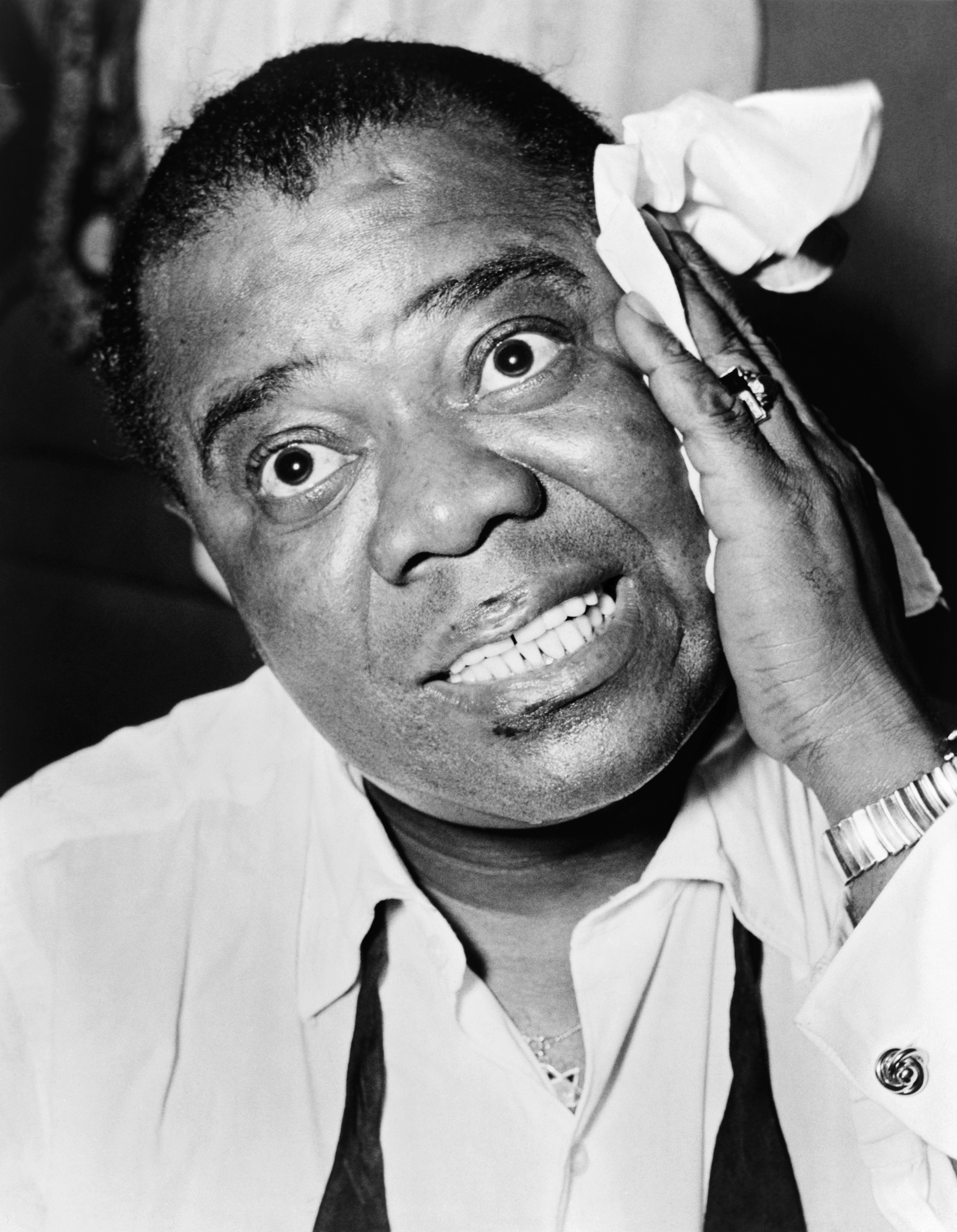
1969 was a landmark year in many respects. Most notably, the year saw a man walk on the moon. Of much lesser note, 1969 witnessed George Lazenby take on his sole (some say, forgettable) performance as the iconic spy, James Bond. I am not a Bond fan, seeing as nothing is entertaining about an unrepentant philanderer. Yet, I do enjoy music. Thus, I am familiar with this Bond movie because of its soundtrack, which featured a Moog synthesizer for the first time in its main theme. Louis Armstrong recorded the love theme for On Her Majesty’s Secret Service. The song was titled, “We Have All the Time in the World.” It was Armstrong’s last studio recording. 1Sadly, he was too weak to play the trumpet during the piece, performing only the vocal. 2

The love theme belies the movie’s sad ending well. Music composer, John Barry, chose Louis Armstrong to do the vocal for the love theme precisely because he felt that Armstrong could deliver the titular line with irony. 3 The song’s title is Bond’s last spoken dialogue in both the Ian Fleming book and the film of the same name. I doubt I am spoiling a movie that is 50 years old by revealing its ending but provide warning that there is spoilage ahead.

With the sixth Bond installment, Bond is finally allowed to fall in love and marry. In the closing moments of the story, however, the antagonist kills Bond’s wife as they are heading out on their honeymoon. The movie’s love theme, as an instrumental, Armstrong’s vocal performance, and several reprises play prominently throughout the film’s score. Hence, this pretty false promise crashes down under the weight of reality in the end. Not even spies saving the world have time promised to them.  The atypical Bond ending makes it more of a cult favorite among fans of the franchise. It didn’t do well at the box office. Of course, that may likewise be attributable to Sean Connery’s absence from the screen. Critically, the movie is well received, with at least one reviewer considering it the third best film of the franchise. 4

I think this subject strikes a chord with me more because of it being Armstrong’s last recorded song than for anything otherwise related to On Her Majesty’s Secret Service. Armstrong is a man of declining health singing about having all the time in the world. I wonder if Armstrong had a sense that he was nearing his departure. In the final years of his life, Armstrong battled poor health but went against the advice of physicians by continuing to tour and perform. 5 I suppose one may chalk that up to dying doing what one loves?

But what of us? Do we ignore the stark reality of James 4.14? We are like the morning fog burned away by the rising noontime sun. And sometimes our lives are such that even if lengthy we may sound as Jacob speaking to the pharaoh: “The years of my sojourning are one hundred and thirty; few and unpleasant have been the years of my life…” (Genesis 47.9 NASB). Even so, we act as if we have all the time in the world. Jesus reminds us that we have but a small window in which to do what we must (John 9.4). Yes, the night is coming. Perhaps, you have been putting off those things you know must be done to save your soul or improve your example as a Christian. Don’t listen to Satan’s sweet melody telling you about the time you do not have. Your only time is now.

“Behold, now is ‘the acceptable time,’ behold, now is ‘the day of salvation’” (2 Corinthians 6.2b NASB).


REFERENCES

1 “On Her Majesty’s Secret Service (Soundtrack).” Wikipedia, Wikimedia Foundation, 24 June 2020, en.wikipedia.org/wiki/On_Her_Majesty%27s_Secret_Service_(soundtrack).

2 “We Have All the Time in the World.” Wikipedia, Wikimedia Foundation, 14 July 2020, en.wikipedia.org/wiki/We_Have_All_the_Time_in_the_World.

3 ibid

4 Hausmannsgate. “All 25 Bond Films, from the Best to the Worst.” IMDb, IMDb.com, 21 Nov. 2015, www.imdb.com/list/ls055107293/.

5 “Louis Armstrong.” Wikipedia, Wikimedia Foundation, 2 Aug. 2020, en.wikipedia.org/wiki/Louis_Armstrong#Death.

louis_armstrong2

How Can I Go On?

Tuesday’s Column: Dale Mail

DaleandJanelledirectorypic

Dale Pollard

How can we handle the hurt of losing someone we love?

Many emotions run through our hearts when we’re faced with the loss of a loved one. These emotions can present themselves as questions:

  • Confusion. Why did this happen?
  • Sadness. How will I go on?
  • Anger. Who allowed this to happen?

Who can answer these questions?  Who can provide comfort?  Who can guide our hearts through the heartbreaking moments of life?

Is it not the Creator of life who can explain the end of life, even though “end” is a very human term?

100 years from now I’ll be alive and so will you. 150 and 200 years from now,  I’ll be alive and so will you.

In Genesis 1:26-28, God said,  “Let us create man in our own image.”

  1. When God breathed into you the breath of life He gave you a piece of Himself called the soul which will live on forever…somewhere.
  2. When God created you in a more intimate way unlike the beasts of the field and the birds of the air He gave you free choice.
  3. He gave you the ability to reason.
  4. He gave you the ability to contact Him and be contacted by him.

How sad and how tragic it would be to live your life with no hope! Today, I’m here to offer wonderful, comforting news, at a time where such news seems all but missing.

God loves you more than anyone else does.

Though many cry for and with you when you grieve the loss of a loved one, that love falls short of the one who expresses His love in a way that’s perfect and unfailing. You will experience feelings you may not be able to put into words, but God feels and understands them. God can walk you through them. Life doesn’t have to be impossibly tragic and void of purpose.

God created the heart, so He can heal yours. God created the mind, so He can sort yours out. God made the soul, so He can save yours. God created the body, so He can give you rest. God created the eyes, so He can wipe your tears away. God created the shoulder, but His are the only shoulders capable of bearing the weight of all those who lean on them.

“Therefore comfort one another with these words” (1 Thes. 4:18).

garan_sunrise


Mbah Gotho, Methusaleh, And Mortality

Screen Shot 2019-09-30 at 11.21.58 AM
Neal Pollard

Incredibly, his residency card and his nation’s official documents, state his birthday as December 31, 1870 (The Guardian). For clarification, that was almost three weeks before Germany became an official nation, only five years after the end of the Civil War (reconstruction was just underway and Ulysses Grant was president), 28 years before the Spanish-American war, 33 years before the airplane was invented, 44 years before the start of World War I, and America was less than 100 years old. Mbah Gotho died in 2017, making him 146 years old at the time. The only reason it is questioned is because his native Indonesia did not begin recording births until 1900. Officials stand firm that it is accurate. Can you imagine? What was it like to live almost a century and a half? To see almost all of 15 decades? 

To put it in perspective, the ancient Methuselah lived almost seven times longer than Mbah. He died at almost 1,000 years old.  Genesis 5:27 faithfully records, “So all the days of Methuselah were nine hundred and sixty-nine years, and he died.” Methuselah was contemporary with Adam and Shem, a gap of over 1,600 years. In a day of pristine gene pools and a water canopy-covered atmosphere, everyone and every thing lived much longer. But God determined a general rule of thumb to which humanity has almost universally submitted, saying, “Then the Lord said, “My Spirit shall not strive with man forever, because he also is flesh; nevertheless his days shall be one hundred and twenty years” (Gen. 6:3). Thus, an Mbah Gotho is an almost singular oddity. The official oldest age in modern times was reached by Jeanne Calment, who was 122 when she succumbed in 1997. 

Average life expectancy throughout much of recorded time falls more closely in line with what Moses states, in Psalm 90:10, somewhere between 70-80 years of age. War, disease, famine, poverty, and the like sometimes curtail those numbers, but what is true of those who die at birth or who make it 122, 146, or even 969 years is that they do die. Hebrews 9:27 affirms the inevitability of it barring only the second coming of Christ in one’s lifetime (1 Cor. 15:52).

Most people make decisions as though they will live forever. People who know better put off obedience to the gospel, put other things before Christ in their priorities, serve sin, and neglect their reason for existence. While too many do this in ignorance, how tragic for the untold number who know how they ought to spend their lives but either deny or delay doing it. The moment of surrender will come. The body and spirit separate (Jas. 2:26). The body returns to dust and the spirit returns to God (Ecc. 12:7). At death, one’s eternal existence begins (Mat. 25:46). God gives one only the moments between birth and death to prepare for that existence, but He does not tell any of us how long that is. He simply tells us to be ready (Mat. 24:42,44). May we all get ready and stay ready for that day!

“She Had Difficulty Accepting Death”

Neal Pollard

Each death marks a transition and passing of an era. The recent death of Doris Day certainly represents this well. The 97-year-old had a stipulation in her will that she not have a funeral, memorial service, or grave marker. She did not want a lot of time spent memorializing her death. She didn’t like death, and, as her manager and friend, Bob Bashara, told reporters, “She had difficulty accepting death” (Tyler McCarthy, FoxNews.com).

Most of us won’t refuse a burial plot and funeral service, but few of us enjoy imagining the process or moment of death in our lives. There is something sobering and precious to us about at least our own lives and mortality. We think it is unhealthy and unusual for someone to have little or no regard for their lives.

Sometimes, we struggle to accept the death of someone else. For how many years have people been in denial about Elvis Presley’s death, thinking him to be living in hiding somewhere. Though she would be dead of natural causes today, many, for years, chose to believe that Amelia Earhart did not die but rather landed on some deserted island or similar conspiracy. Don’t even get me started on Jimmy Hoffa. No compelling evidence was enough to convince ardent fans that these notorious people were actually dead.

Did you know that some people have tried to say that Jesus did not actually die, but only “swooned” on the cross? It’s even called the “Swoon Theory.” The Koran says that he feigned death (Surah IV: 157) and others say Jesus was drugged and only appeared dead (Geisler 347). But, as Geisler notes, there were experienced Roman soldiers there, there was significant blood loss from many wounds that bled for hours, there was an outpouring of blood and water when Jesus’ side was pierced, the governor, Pilate, inquired into the fact of His death before He turned over the body to Joseph of Arimathea, and much more sufficiently prove that Jesus actually died on the cross (ibid 347-348).

Each Sunday, we readily embrace the fact that Jesus died. In fact, we base our entire lives upon the truth of that death. We understand that it was necessary for Jesus to die, in our place and for our sins (Rom. 14:9; 2 Cor. 5:15; 1 Pet. 3:18). Though it breaks our heart that it was necessary for Jesus to die, we do not have difficulty accepting it. We’re counting on it! As you memorialize the Lord in the Supper today, be grateful for that substitutionary death. He was able to do for us what we could not do for ourselves (2 Cor. 5:21). Of course, what makes the difference in our eternity is that He did not stay dead. He arose (1 Cor. 15)! But, He wants us to embrace His death and let us change who we are and what we do.

doris-day-401256_960_720

The Influence Of Papaw Mitchell

Neal Pollard

May 14, 2004, was the day I preached my maternal grandfather’s funeral. It was a signal honor to do so. He had passed away early on Wednesday morning, May 12. The morning he passed, I wrote this about him:

Within you today are a temper and trends
A view toward the unfolding tomorrow
Have you stopped to question on what that depends
From what spiritual bank you do borrow?

Though each person forges his own internal road
Based on unique decisions and conscience
Before him to help pave it is an influence to goad
A role model, an example bestowed.

For those so endowed with a godly loved one
One righteous, driven by the Giver of grace.
To see their own faith is to look at one done
A journeyman who victoriously ran his own race.

I know one like that, a follower of Him
Who led much family both of flesh and of faith
Who shaped hearts and lives in times good and times grim
Who laid course that to follow was safe.

When we all get to heaven and give praises unending
Who knows what will be or how we’ll appear?
I know that for anyone in that Paradise spending
That all who shaped our faith will be clear.

Everyone that knew Harold Edward Mitchell, Sr., was closer to heaven because of his influence. He lived over 90 years, converting from denominationalism in young adulthood and ultimately serving decades as an elder. At his funeral, I shared five facts about my “Papaw Mitchell.”

  • He loved his family. He wasn’t gregarious, but rather reserved. Yet, he taught his family the right way to live and how to face death, to know what ultimately counts, what was right and what was wrong.
  • He had a sense of adventure. From semipro baseball as a teen to seeing the entire country in retirement, a lifelong cotton farmer had a wider view of the world. He came of age in the depression and endured some terrible grief, but no one could remember hearing him complain. 
  • He worked hard. He wasn’t a waster of resources, least of all time. He was up with the sun and down with the sunset. He instilled that work ethic in his children and grandchildren. 
  • He put Christ above all else. As a Christian, he took what the Bible guided him to do and be in life at face value. His life went beyond mere rule-keeping. He kept the rules, but he loved the rule-maker. You could see Jesus living in him.
  • He was ready to die. That’s the most important thing any of us could have said of us.

I saw grandpa the Monday night before he passed away. He was able to talk, but it was the first time I saw him that I felt he might not live forever in that earthly body he took such good care of. It was probably the first time I thought seriously about my own mortality. Our spirits are engineered for eternity, but our bodies of clay wind down more each day. In the fifteen years that have passed since then, I am more aware of that than I was even then. Our pilgrimage here won’t go on indefinitely, though we’ll live as long as God lives.

Examples like my Papaw motivate me to clear the hurdles from my path and stay dependent upon God to help me, like him, to finish my face. To die faithful and prepared means to live faithfully and make preparation. One day, someone will speak at your funeral and mine. What can they honestly say about the example and influence we will have left on others?

grandpa mitchell and uncle larry
Papaw (L) and Uncle Larry (my mom’s older brother), probably between 30-40 years ago.

A Tribute To Harry Denewiler On The Morning Of His Passing

Neal Pollard

I met him 20 years ago, the man with the twinkling eyes
He and his wife opened their home to me, and I could recognize
Their love for Christ and Christians, and how well they’d harmonize
Those loves in all their actions, it was there in those twinkling eyes

He shepherded me for several years, the man with twinkling eyes
He had a tenderness so deep, he’d often maximize,
His laugh infectious, his insight savvy, so tough to criticize,
He loved Bear Valley with all of himself, this man with twinkling eyes

I visited many members here with the man with twinkling eyes
Spent hours in meetings and planning, trying God’s will to realize
He was youthful and spry for his age, his resources he’d optimize
A steward of stewards in every way, the man with twinkling eyes

A servant’s heart with savvy hands, the man with the twinkling eyes
Involved and willing, helpful and hopeful, we couldn’t help but idolize
When hearing and memory faded, you still could characterize
This man of God, through ups and downs, by those twinkling eyes

I saw him last week, he greeted me with joyful, twinkling eyes
So hard to believe this morning he gained his heavenly prize
While his long life is fresh in my memory, I’ll try hard to memorize
As kind a face and heart as I’ve seen, the man with the twinkling eyes

1935132_1226524188954_3106107_n
Photo credit: Michael Hite

Deathbed Repentance?

Neal Pollard

“From the stirrups to the ground,
Mercy I asked for, mercy I found”
That is a distorted view of grace,
Which seeks God only in death’s face.

It cheapens that which cost Him much,
To use Him only as a deathbed crutch.
Unlike the seeker at his eleventh hour,
Who sincerely reaches for His saving power,

The hardened sinner who in last resort
Hedges his bets for some eternal life support.
So many never reach a deathbed sound in mind,
Or care for His will ’til their death warrant’s signed.

While God is long-suffering, wanting all to be saved,
The majority spend their lives to sin’s power enslaved
They only think heaven when earth’s living is through,
But an afterthought gesture will just not do.

Scripture says “come now,” not “wait til tomorrow,”
So many delayed to their own regret and sorrow.
Instead of relegating God to a last-ditch recourse,
Submit to Him now, you He’ll publicly endorse.

Deathbed repentance is not found in His Word,
No matter what men from their wisdom you’ve heard.
Obey from the heart what His doctrine requires,
Let His word be your truth, let all others be liars.

thinkstockphotos-sb10069454g-001

If Today Was My Last Day On Earth (Poem)

Neal Pollard

[NEAL’S NOTE: This poem was from the conclusion to the sermon I preached on this subject from Psalm 90]

If today was my last day and tomorrow found me gone
How would life be different, if that unknown somehow was known

Would I be a better person, would I live a better life
How much would I feed resentment, envy, bitterness and strife?

How would I choose to live, and what would be my emphasis
Being a blessing or a burden, full of service or selfishness?

Where would God be in my life, what place would He occupy,
If today was my last day, and before tomorrow I would die.

If today was my last day, and second chances all were through
And I stood before my judge and my eternal fate I knew

I would mourn and fall before Him, if I had not done what’s right
If I had chosen self and sin, if I had chosen eternal night.

But there’s no reason for apprehension, I can die w/head held high
If I die to self & live to Him, it won’t matter when I die.

The Appointment We Cannot Escape

Neal Pollard

William T. Turner was captain of the Lusitania when it was torpedoed by a german U-boat in May, 1915. He was one of the few officers saved (Montreal Gazette, 6/24/33, obituary). The Atlantic writes in an article that Turner was “relieving captain” of the SS Ivernia when it was torpedoed by a German U-boat on New Year’s Day, 1917, and he once again survived (James Gould, 5/7/15). Turner was a man renowned for heroics and not a coward, which makes a captain surviving the sinking of two ships all the more incredible. But in 1933, after three, bed-ridden months, Turner succumbed to intestinal cancer (Gazette).

A few years ago, I wrote about Roy Sullivan, the park ranger who had survived seven lightning strikes (Preacher Pollard Blog). What an incredible tale of survival, but Sullivan insured his own mortality when he committed suicide in 1983 (ibid.). The man was incredible, but not invincible.

Jeanne Louise Calment is thought to be the world’s longest living person in modern times. She was born in 1875 in France, met Vincent Van Gogh as a young teenager, but eventually died in a nursing home in 1997, 122 years old! She took up fencing at 85, rode a bicycle until she was 100, ate two pounds of chocolate each week and quit smoking at 119 (http://anson.ucdavis.edu/~wang/calment.html). Back in the antediluvian period, in a purer world closer to creation, several lived over 900 years. But in each case, scripture punctuates their earthly existence by saying, “…and he died” (Gen. 5:5).

I have been involved in so many funerals as a preacher, from the first I assisted with Gary Hampton in Gainesville, Alabama, in 1992, until as recently as a couple of weeks ago. What strikes me as much as anything, whether in preparation for it visiting with the family or during slide shows during the service, is watching the progression of life unfolded in photos. Usually they are arranged chronologically, so that the fresh faces of the baby becomes the look of vitality found in children and young adults gives way to the robust strength of early to middle adulthood. Signs of aging subtly appear as the photos fade in and out, the added pounds or gray hairs or the advent of wrinkles. Pictures eventually show frailty and signs of physical deterioration. Then, one in attendance simply needs to gaze at the casket, if present, to see that this once fresh, new physical life does not go on forever.

The writer of Hebrews speaks in hopeful, positive terms to Christians as he proclaims the superiority and potency of Jesus, our great High Priest. At the cross, He offered His own life to “put away sin by the sacrifice of Himself” (9:26). Having a human body, Jesus was destined for death “inasmuch as it appointed for men to die once…” (9:27). Death is unavoidable, but it does not have to be unhinging. Death is followed by judgment, but that day can be the day of salvation realized and eager anticipation (9:28). What happens on the other side of death depends on what we do with Jesus on this side of it.  Whatever we decide, we will make the appointment Turner, Sullivan, Calment, Adam, and billions of others have already made. We must decide if we will meet it prepared.

jeanne_calment_1895

jeanne-calments-quotes-7
Jeanne later in life

Confident And Unafraid

Neal Pollard

Some are afraid of death because they’re uncertain of where they are going, but others are afraid of death because they are certain of where they are going! Paul was confident even in the face of death (2 Tim. 4:6-8). He could see his end coming but he embraced it. While it is possible to have a false hope and confidence about eternity (cf. Mat. 7:21-23), the faithful New Testament Christian should be confident and unafraid of death. By looking at the last words we have from Paul, we can learn from him how to face death. How could he be so confident even in the face of death?

He was going to face Jesus as judge (1). Our relationship with Christ makes the difference. If I don’t know Jesus and haven’t made Him Lord, I don’t want to face Him in the judgment. But if I’m in Christ, there are several reasons why I long to face Him there.

  • He understands us (Heb. 2:17-18; 4:15). Even before Christ came to earth, God was “mindful that we are but dust” (Psa. 103:14). When I stand before Christ, He will know what it was like to be me. He will have experienced temptation and be sympathetic and merciful.
  • He will be fair (2 Tim. 4:8—He’s the righteous judge). This means in accordance with what God requires. That means He won’t be more lenient than He’s promised, so I can’t expect to disobey His will in this life and hear Him say, “Claim your eternal inheritance in My Father’s house.” If I never obey the gospel, when I face Christ at the judgment He’ll be fair. If I obey the gospel but become unfaithful, when I face Him at the judgment He’ll be fair. But if I’ve tried to walk in His light, though I sometimes fell short, He’s going to be fair (1 Jn. 1:7-9). He knows I’ll be struggling with sin up until the day I die, but if He sees me struggling, He’s going to be fair. More than that, He’ll be merciful and faithful to atone for my sins!
  • He’s told us by what we’ll be judged (2 Tim. 4:2). It’s why we must faithfully present it in spirit and in truth “with great patience and instruction.” Jesus said His word will judge us in the last day (John 12:48).

I can face death confidently because it won’t be just any man judging me. Like you, I’ve had some people judge my actions and motives pretty harshly and unfairly. They may have thought they knew my heart or every fact, and they were ready and seemingly eager to pronounce me guilty. That’s not going to happen with Jesus! He’ll be consummately fair!

He spent his life doing good (5). This verse is the measuring stick of every gospel preacher, who asks, “Was my mind, endurance, work, and ministry as God wanted it to be?” No preacher wants to go through life and have these answers to be no. But in a broader sense, that’s a question every Christian needs to ask. Paul could look at his life with spiritual confidence (7). Three times, Paul, in essence, says, “I have” lived a faithful Christian life. You’ll remember that the first part of Paul’s life was spent not doing good, but from his conversion to his death he did good. Think about his missionary journeys in Acts. Think about all he went through for Christ that we read about in 2 Corinthians 11. What about the trials he mentions in Philippians 1? You may have a past you are ashamed of. Even as a Christian, you may have some regrets and things you wish you could change. But, if you’ve tried to walk in the light of Christ, you can face death and the judgment with blessed assurance.

He knew that he had a crown waiting (8). When we stop to think about death, it contains many variables that tend to make us anxious if not fearful. But Paul could look to death with the idea of its reward. The crown Paul speaks of is described in many ways in the New Testament:

  • It’s perfect (2 Tim. 4:8).
  • It’s permanent (1 Cor. 9:25).
  • It’s payment (Jas. 1:12).
  • It’s preeminent (1 Pet. 5:4).
  • It’s personal (Rev. 3:11).

But there’s not just one crown or a few crowns available. There’s one for “all who have loved his appearing.” If you sincerely desire it, you can receive it.

He knew that God would be with him (16-18). At the time he wrote, Paul knew betrayal and abandonment. Good friends had left him (10). At times, he had no one to stand with him. But he knew that One was always there (17). He was even confident of the future. Being delivered didn’t mean escaping physical death, but it meant rescue in the eternal sense.

You and I can live with the same blessed assurance of Paul. We’ll never go through anything alone (cf. Mat. 28:20). We may be pilgrims and strangers on earth (1 Pet. 2:11), but we aren’t one this journey by ourselves. The Lord will preserve and deliver us, as He did Paul.

I want to remain on this earth to enjoy family, friends, and brethren. I want to be as useful as I can be for as long as I can. But, like Paul, I can look forward to dying (cf. Phil. 1:21-24). We can be confident, even in the face of death!

leap_of_faith3

WHO KILLED CUSTER?

Neal Pollard

There’s quite the controversy over who killed General George Custer at the Battle of Little Big Horn in Montana on June 25, 1876. There is even a book by the title, “Who Killed Custer?,” authored by Bruce Brown. There are so many mysterious and hard-to-document events that made up this notorious battle that symbolizes the “Indian Wars” of the late 1800s.  Brown, analyzing eye witness accounts, gives an interesting top three suspect list:  (1) an Oglala Sioux warrior named White Cow bull, shooting him near the beginning of the battle, (2) Custer himself, committing suicide as he dashed away from the battlefield near the battle’s end on his horse Victory, and (3) Brave Bear, a Southern Cheyenne warrior, given the honorary title of “Custer’s Killer” at an Indian council in 1909 (www.astonisher.com/archives).  About ten years ago, the Helena Independent Record revealed the long-circulated, but secret oral history of the Northern Cheyenne Indian storytellers, crediting a woman, Buffalo Calf Trail Woman, for striking the fatal blow (helenair.com).

It is fitting that a man surrounded by so much controversy and whose reputation and achievements are incredibly enigmatic would have such a mysterious cloud hanging over his death. His killer is upheld by many as a tangible standard-bearer of justice and righteous revenge. For others, it is simply a matter of historical fascination.  There are even those who lamented his death, as the brash and rash Custer was widely viewed as a “war hero” by his U.S. contemporaries in the years immediately following his death. Yet, one thing we know for sure.  Custer was killed.  Two fatal bullet wounds loudly testify.

There is another mystery, one with far weightier and eternal implications.  Who killed Jesus?  He is the most enigmatic figure in human history.  He was viewed contemptuously as a blasphemer and traitor by the religious leaders of His day. He was viewed with depraved indifference by the masses who switched from adoration to execration in a matter of days.  He is viewed even more diversely today, 2000 years after He died on the cross.  The power and proof of the resurrection is a matter to write about another day (see, for example, https://www.christiancourier.com/articles/644-resurrection-literal-or-merely-symbolic).

But, there is another vital question surrounding the death of Jesus.  Who was really responsible?

  • Was it the devil? Yes!
  • Was it the Jewish leaders? Yes!
  • Was it the onlookers that day? Yes!
  • Was it Pilate? Yes!
  • Was it the Roman soldiers? Yes!
  • Was it God? Yes!
  • Was it you and me? Yes!

How could all of these be mutually responsible for the death of Christ? There is no controversy.  The devil desired Jesus’ death, through which he longed to defeat the Lord’s purpose (cf. Gen. 3:15; Rev. 12:4ff). In this, he failed (Heb. 2:14). The people that day were instruments in the hands of God, who accomplished His eternal plan of salvation through Christ’s death, burial, and resurrection (Acts 2:23; 3:18; etc.). We are responsible because we sin (Rom. 4:25) and He had to be made sin for us (2 Co. 5:21). The good news is that the death of Jesus was not the defeat of God’s plan. It accomplished the plan.  However, for the plan to be effective, we must properly respond to it.  The fact of His death does nothing for us, if we do not respond to it the way Scripture tells us to.  Thus, there is a much more important question than, “Who killed Jesus?” It is, “Who will follow Jesus?”

Christ-less In Crisis

Neal Pollard

It is hard to describe the beauty of faith evidenced in Room 913 yesterday as all the elders and their wives, Wes and Teri Autrey, and Tiffanie and Bethany Vaught stood with Myrna and the rest of the Murphy family at University Hospital yesterday.  We sang songs and Dave Chamberlin prayed a touching, loving prayer.  Moments later, a godly, wonderful woman made her transition from this life to the better one. Despite the inevitable, natural flow of tears, the heartache of separation, and the final earthly stanza of a beautiful, 59-year-old love song played by Ray and Myrna.  Myrna was an obvious success as a mother, wife, grandmother, and friend, but central to everything she did and who she was was Christ.  She did not fear death nor the condition that brought it.  She was ready because of Christ.

When I think of the red-letter days that have occurred in our nation and world during my lifetime, whether the bombing of the Murrah Building, the horrors of 9/11, the unbelievable natural disaster of the December 26, 2004, tsumami (“Boxer Day Tsumami”), the disappearance of the Malaysia Airliner, and the like, I am made to think how many stood in the wake of such tragedy without the hope and promise made possible through Christ.  Yet, every ordinary day where death looms through the natural course of life, people come to those final moments either ignorant or bereft of the bright prospect of what happens beyond death.  Certainly, some think they have hope, but it is not hope rested in what they can find in Scripture but rather what they think, feel, or have been told is real and true.  In some ways, those situations are the most tragic of all. Others are convinced that we are the result of chance and will cease to be when we draw our last breath, yet they continue to try and live with purpose and even act in the interest of others without bothering to ask why they behave civilized with such an animalistic point of view.

But for the one whose hope is built on the truth of what God’s Word says, there is no tidal wave of heart or explosion of life powerful enough to wrench us free from that hope. Paul exalts that we are saved by unseen hope (Rom. 8:24-25). In the rest of the chapter, he proclaims the unfailing love and promise of God for the redeemed who place their trust in Him.  Paul encourages the Thessalonians not to face death, sorrowing like a world without hope (1 Thess. 4:13).  Without Christ’s resurrection, there is no hope (cf. 1 Cor. 15:19-20).  However, because He lives, we can face tomorrow, all fear is gone, we know who holds the future, and life is worth living (Bill Gaither lyrics from “Because He Lives”).

The Murphys will have sorrow and grief to bear.  This is a testimony to their humanity.  But they look at tomorrow with an even brighter anticipation.  This is a testimony to the Christ who lives in them.  It is available for us all!

A dear sister in Christ, Myrna Murphy