After the six days of creation God rested (Gen. 2.2). The word rest literally meant to stop or, according to Strongs, “desist from exertion” (H7673). Once He finished His work, God does something else that carries a mysterious significance— God blessed a day. So what does that actually mean? Looking at our passage (Gen. 2.3) it says that He does two things and the two verbs that are used are important to help us grasp what’s being said. God blessed the seventh day and made it holy.
Blessed (barak):
In ancient Hebrew thought, to bless something was to fill it with life, fruitfulness, or some kind of ongoing benefit. When God blesses living creatures (both man and beast), they multiply (Gen. 1.22, 28, 9.1). When He blesses the seventh day, He bestows on time itself some kind of divine favor. It was a day that gives spiritual renewal rather than physical productivity. Maybe all the details of that won’t be fully understood or appreciated on this side of eternity.
Made holy (qadash):
To “make holy” meant to set apart. This is also the first time in the Bible that anything is called holy — not a place or an object, but a day. The early Hebrew understanding saw the seventh day as more than a simple pause in labor. God gave them this and He made it a healthy spiritual function of creation.
What’s so significant about all that? This is God blending the spiritual and physical elements of His creation together. It wasn’t like a model train that a boy puts together just for fun. This was proof that existence would be more than a complex physical shell. God “created” an entire day, in part, so we could reflect on that.
There was a chaotic, inky, and endless cosmic ocean raging in the great nothingness before time began. But, if we could traverse back in time and glimpse the earth after it had just started spinning we’d likely surmise that we had stepped onto another planet. Animals spoke in a tongue which the first humans understood, bipedal serpents stalked the infant earth, and a mighty conflict exploded in the heavens among the sons of God. The thundering footsteps of giants could be heard roaming the ancient landscape; turning the blood of our ancestors to ice. Sorcery and witchcraft, though banned by our Creator, was successfully practiced and the consequences of those actions are not understood. From the garden of God to the hellscape of godless cities came accounts of good and evil. These accounts left a permanent impact on every generation that followed and the stories that have been passed down feel almost familiar somehow. It’s as if they were tattooed on our hearts or that eternity was ingrained in the human psyche.
A plethora of ancient cultures echo the same biblical imagery in their written and oral traditions. Mainstream astronomers, geologists, archeologists, and the secular slew of mighty minds have fooled themselves and others into believing that they’ve made discoveries that have enlightened the modern age. Our ancestors, as they’re painted in the history books, stumbled about in blind ignorance— longing to have access to the vast amounts of wisdom we’re privy to. This is simply not the case. The Bible serves as mankind’s one and only peek behind the spiritual veil. It’s a book that was attacked during its formation and ever since the completion of its closing revelation. Of all the accusations and allegations levied against the inspired texts, only the ignorant could make the claim that the Bible is boring. There’s a wide range of baggage one might bring with them as they crack open its precious pages but who could close the book and walk away with such a thought? It’s fascinating. It’s a gripping literary masterpiece with such historical, scientific, and spiritual implications that it’s powerful enough to upend the lives of its readers and reroute their eternal destination. The Bible is a book of life. It’s about life back then and right now. It’s about spiritual life; the bleak state of it then and our justified life now. It’s about the Creator of life. It elucidates, improves, elevates, and transforms. So, the Book is quite literally everything for everyone.
The sum of your word is truth, and every one of your righteous rules endures forever (Psalm 119:160).
Every word of God proves true; he is a shield to those who take refuge in him (Proverbs 30:5).
The grass withers, the flower fades, but the word of our God will stand forever (Isaiah 40:8).
The greatest secret in the universe has been revealed to humanity: Jesus himself (Col 2.2-3). This is perhaps a hint that the groups harassing the believers at Colossae were Gnostic as well as Jewish. Gnostics were all about secret knowledge and asceticism (at least in this group, cf. 2.18). Paul addressed the Jewish elements in this section too. I’m certainly not dogmatic about this, but it does seem possible that at least elements of Gnostic thought were influencing Colossae, on top of the pervasive traditionalism of the Jewish Christians.
Either way we should pay attention to an important point — all of humanity from the dawn of civilization has been trying to figure out what a specific something is. We’ve always been impressed with a sense that something bigger than us is out there. Since we’ve recently been able to take a crude glimpse into the cosmos itself, we’ve only been more impressed with how powerless we are on this little blue marble. Cosmic scales are something we can’t even wrap our minds around. There’s so much raw power that can only be viewed from distances so vast that we could never hope to travel them physically (eg. supernovas). But a simple cometary fragment could wipe out our little rock, if God willed it!
Most early civilizations deified some element or other natural force on this planet, or they deified what they could observe with the naked eye in the heavens. Many ancient cultures worshipped powerful or beautiful animals, stars, or even political/military celebrities (sometimes all of the above). They were searching everywhere, desperate to find the source of infinite cosmic power, wisdom, and guidance that they instinctively knew existed, but could not identify. Since God is invisible (cf. 1.15), he had to be revealed to us. This great mystery was solved once and for all with the arrival of Jesus on the planet he created (2.16-17). He is that power, and he cares about us! That means he wants to take us with him when this earth is destroyed (2.18-20). The mystery is far more profound (and practical and humbling) than we thought. What is that thing every ancient culture has tried to identify and worship? The Great Mystery of the Eons — Jesus: Creator, Teacher, Civilizer, Rescuer, God.
This message is the secret truth that was hidden since the beginning of time. It was hidden from everyone for ages, but now it has been made known to God’s holy people. God decided to let his people know just how rich and glorious that truth is. That secret truth — which is for all people — is that Christ lives in you, his people. He is our hope for glory (2.27).
In 1929, a German chronobiologist named Ingeborg Beling conducted experiments where she trained honeybees to come out of their hives at a specific time to collect sugar water. These experiments demonstrated that bees have an accurate and consistent memory of time, but only within a 24-hour cycle. Other researchers conducted experiments in dark, temperature-controlled rooms and even 180 meters underground in a salt mine to eliminate external cues such as sunlight, warmth, humidity, and air ionization. Despite these circumstances, bees maintained their timekeeping skills.
Chronobiologists conducted various tests to examine the circadian rhythms of bees. These tests included raising bees in specialized incubators, altering their metabolism with chemicals, and exposing them to near-freezing temperatures. Despite these disruptive conditions, cooling only delayed the bees’ 24-hour rhythm by 3-6 hours. The most convincing evidence came from an experiment where bees were trained in Paris and transported to New York. The bees experienced jet lag while searching for food around Central European Time. Still, they gradually adjusted to the Eastern Time Zone by resetting their internal clocks using the sun, similar to humans. Thus, bees can tell time.
According to the study, despite having tiny brains, bees possess higher cognitive abilities than previously believed. They can measure short intervals ranging from 6 to 36 seconds and potentially manage multiple timings simultaneously. However, the exact mechanism by which bees keep time is still unknown. Several hypotheses have been proposed, including counting heartbeats, observing temperature cycles in the hive, or having an innate sense of time passing. This discovery has significant implications for understanding the complex cognitive functions of bees and other insects. It also opens up new avenues for research into the cognitive abilities of small-brained species.
The discovery of such incredible abilities within these tiny creatures creates a striking contrast that reminds us of Carl Gustav Boberg’s experience. After a storm, the serene beauty and birds singing contrasted sharply with the previous chaos. It made Boberg reflect on the wonders of creation and the power of God, which eventually inspired him to write the verses of “How Great Thou Art.”
In the same way that we have discovered the honeybee’s sophisticated sense of time, it leads us to question the level of intelligence and cognitive capacity of animals. This discovery encourages us to appreciate the intricacies we can find in even the smallest creatures, just like how Boberg contemplated the wonders of creation and the omnipotence of God after the storm. As we continue to uncover the mysteries of nature, it makes us wonder about the other remarkable abilities possessed by the creatures around us. How often do we disregard the extraordinary while striving to comprehend the world, and how might these revelations inspire us to consider the grander mysteries of existence?
Paul’s words to the Romans (1.18–23) explain that the Gentiles were unrighteous because they rejected God’s testimony about Himself in nature. This scriptural perspective reminds us that the marvels of the natural world, as uncovered by scientific inquiry, can also be a testament to something greater than ourselves. When we explore the intricacies of nature, from the tiniest bee to the vast cosmos, Paul’s words about eternal power and divine nature face us, pointing us toward an ever-present nature that is waiting to be discovered and revered.
Combining science and spirituality leads to a deeper understanding of the world’s complexities. Whether we look through a microscope, read a hymn, or study scripture, each perspective offers a unique insight into the vastness of our world. As we stand at the intersection of knowledge and wonder, we can echo the sentiment expressed by Boberg in “How Great Thou Art” and continue to be inspired by the wonders of nature and divinity.
Christians are not immune to existential crisis. While this overwhelming feeling of meaninglessness is a trademark of younger people, older people often deal with it too. Young people may seek meaning, direction, and purpose for their lives as they look to the future. Older people might look to their past, wondering if their life’s work was a functional/worthy investment of their lifespan. We all have fundamental questions to work through.
This series will explore some of those questions we have:
Why was I created? What is my purpose? How can I be happy? What is true/real? Why does God allow evil to exist? What do we mean by “next life”?
This week we’ll look at the first question. Not one person ever asked for consciousness or existence. Why were we brought into a dysfunctional world? Even though none of us requested existence, we exist — and we’re going somewhere after we die. None of us asked for that burden, either.
Here are some of the commonly given answers:
We’re here for the glory of God.
God gave us the ability to choose our fate, whether to reject him or be obedient to his will.
The problem with those statements is that they don’t actually answer the question, at least not adequately. The Bible answers those questions, and with a little effort we can find out why God created us.
Why are we here?
1. We’re here to interface with God’s reality.
2. We exist, ultimately, to populate a perfect world.
God created us in his image and likeness (Gen 1.26-27, 5.1-3, 9.6; Js 3.9; I Jn 3.1-3). This is emphatic in scripture — he made us in his image AND his likeness. Let’s put the Hebrew words sal-me and de-moot (image and likeness) in modern English. The one speaking in Genesis 1 is Logos, according to John 1. That’s Jesus. He made us to look just like him. He is the visible form of the invisible father, according to Colossians 1.15.
Genesis 5.1 — When God created people, he made them look like himself.
Genesis 5.3 — Adam had a son who looked just like himself, and he named him Seth. Same exact words used in 5.1.
James 3.9 — Uses ομοιωσιν, which means in that context, “to look the same.”
God made us self-aware, intelligent living entities to interface with the reality he created. This life is just a trial run. We exist, and that’s something we have to accept. We have a life, so what we do with it is up to us.
That leads to the second reason we were created — to populate a perfect world. II Peter 3.13 says, “Based on what he promised us, we’re looking for a new sky and a new earth where only morally good people can live.” Because we messed up and introduced evil to this planet, it’s no longer a paradise (Rom 8.20-25). But that’s not natural. We weren’t originally created to coexist with dysfunction or entropy.
We can thank Satan for most of the dysfunction we face today:
Ephesians 2.1-2 — Satan has control over natural functions of the planet.
I John 5.19 — Satan has control over political power on this planet.
Luke 4.6 — Satan has power over every population group on earth.
Ephesians 6.12 — Those dysfunctional powers aren’t based on earth.
The church is a combat unit. We aren’t fighting other people, we’re fighting an enemy that has far more power than we could ever dream of confronting. That’s what “spiritual warfare” means in Ephesians, for example. God is our ally, so we can never be destroyed for good. Satan may have control of the planet, but God has control over the universe.
Our job is to make the best of our existence, ideally living by our Creator’s definition of functional. If we do, we get to live in a perfect world without any potential for dysfunction. In Matthew 19.28, Jesus describes it as a “return to the way things originally were” or “regeneration”.
Why were we created? To interface with God’s reality in a limited capacity, and to populate a new earth after this earth’s time is up.
Your version may use the word “hallelujah” to begin Psalm 135. Hallelujah means “praise the Lord.” While it is synonymous with giving thanks, it means to laud a superior quality or act, to acclaim and express joy in doing so. What is so noteworthy is that the psalmist does this in very specific ways, recounting times in history when God demonstrates His power and glory on behalf of His people. As we walk through the psalm, we see this. Why is He to be praised?
HIS CHOOSING OF HIS PEOPLE (4)
HIS NATURE (5)–Great, Above All
HIS WORK IN CREATION (6-7)–Heaven, Earth, Seas, All Deep, Vapors, Lightning, Wind, Rain
HIS DEFEATING OF THEIR ENEMIES (8-11)–Egypt, Amorites, Canaanites
HIS BLESSINGS (12)–Gave His People A Heritage (Possession)
HIS POWER (13)–His Name And Remembrance
HIS PROMISES (14)–Compassionate Judgment
HIS SUPERIORITY OVER HIS RIVALS (15-18)–Deaf, Dumb, And Blind Idols, Just Like Humans
The writer calls on God’s people to praise and worship Him in song, expressing their adoration (1-3). He ends with a threefold call to “bless the Lord” (19-21). May I suggest that you work through something both in your daily life and in your preparation before every time you assemble to worship? Call it setting the table for fellowship with the Divine. Either meditate on the specific works and ways of God that are worthy of admiration, praise and honor or pray to Him, expressing these matters in specific terms. Focus on how He’s demonstrated greatness in blessing your life and the lives of those around you. Perhaps it’s answered prayer, providence, deliverance, or relief. Focus on His power and might in the affairs of our nation, in the activities of our congregation, and the occurrences within your family and personal life. Let the worship flow as you look around at all you see in nature, from the universe to right out your window. Think about the gift of Jesus for your sins. All of this will surely cause you to echo the writer in Psalm 135 and call out to others, “Praise the Lord!”
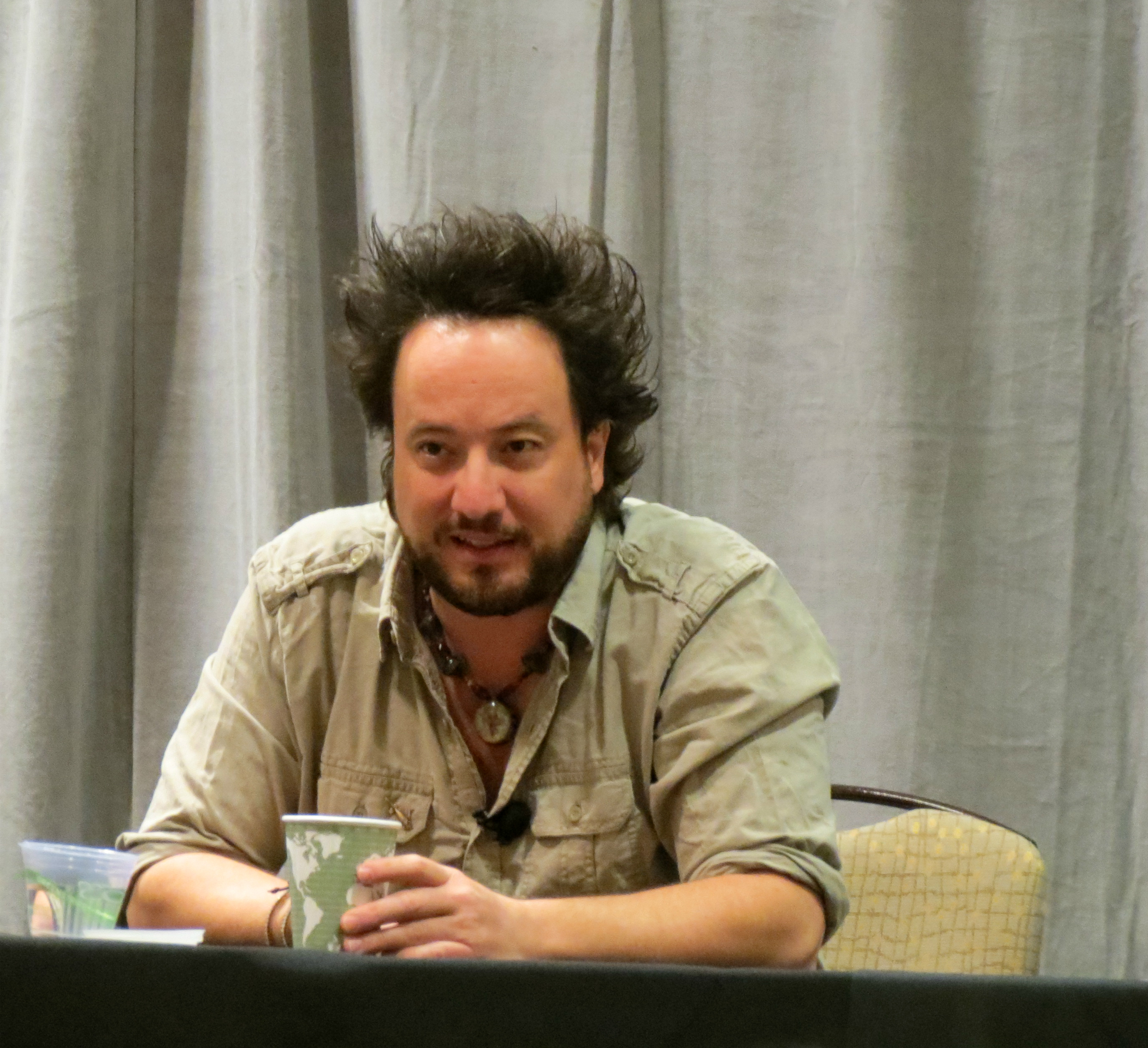
An older internet meme, originating in 2010, features Giorgio A. Tsoukalos from the History Channel’s Ancient Aliens program.1 As Tsoukalos believes ancient astronauts visited our planet in our distant antiquity, he often speaks enthusiastically about how such extraterrestrial visitors interacted with our remote ancestors. Hence, a screenshot of Tsoukalos from Ancient Aliens sporting his crazily coiffed hair and hands frozen in mid-gesticulation conveys the simple message to the viewer of “Aliens.” Another version of the meme, also featuring the same screenshot of Tsoukalos, reads, “I’m not saying it was aliens, but it was aliens.”
What is the point of posting random pictures on the internet? Honestly, what is the purpose of any meme? The word “meme” derives from the Greek word “mimeme,” meaning something imitated.2 Without becoming too bogged down in explanation, a meme is a vehicle by which internet posters convey ideas. Then, others who identify with the message share it. In that simple act of reposting, one “imitates” the intent of the meme’s creator. When many people do this, we proclaim that the meme has “gone viral.” However, the power of the meme is that it will invoke a response so that even those angered by it will respond to it. For example, the “Aliens” meme is employed by those jokingly offering a Deus ex machina-type explanation for things to which we may or may not have the answers. How did ancient builders erect megalithic structures? Aliens. Who ate my last donut? Aliens.
I cannot help but hear the voice of Giorgio A. Tsoukalos saying “aliens” in my head as I read headlines like this one from Yahoo!News: “How would humans respond to the discovery of aliens? NASA enlisted dozens of religious scholars to find out.”3 For some reason that escapes me, Hollywood has often speculated that the revelation of extraterrestrial life would destroy the faith of believers. You have likely seen such movies. There is typically some cabinet member telling the fictional President to keep things quiet lest the disclosure of the existence of extraterrestrials leads to chaos. By the way, rather than becoming terrified by the thought of aliens, the article suggests that religious people would most likely be better prepared to receive such visitors from afar. I agree with that conclusion.
I cannot speak for other Christians, but I can say why I wouldn’t lose my faith in Jesus Christ because someone proves that the Roswell greys exist. First, my belief that God created everything that exists convicts me of the truth that if “aliens” also exist, God created them too. Genesis 1 details how God made the heavens with their inhabitants. A Christian realizes that, though the creation account mentions nothing about planets, the voice of God made Jupiter and Saturn, which are planets. Would it require more faith to believe that there could be one planet orbiting a star capable of supporting life in that sea of stars we see at night? No. Again, Genesis 1 tells us God created the heavens and the earth. It would be more a matter of what God has chosen to reveal to us. Deuteronomy 29.29 reminds us that God has only given us what He has revealed. The secret things belong to Him alone.
Second, we ask what we can even understand about God apart from His Word. Isaiah 55.8-9 reminds us that the thoughts and ways of God are above our own. Science fiction author Arthur C. Clarke once stated what has since become known as one of Clarke’s Laws: “Any sufficiently advanced technology is indistinguishable from magic.”4 We might substitute the word “supernatural” for “magic.” The existence of aliens would not destroy my faith because I might ask whether the strange phenomena I was witnessing were not “aliens” but “heavenly visitors.” Maybe Ezekiel’s “wheel in the middle of the wheel” was a UAP (Unidentified Aerial Phenomena) (Ezekiel 1.4ff). Would it matter to you if God created the universe using advanced technology to which only He has access? Either way, He has the power to create and destroy us (cf. 2 Peter 3.12).
Ultimately, all of this talk has more to do with scientists’ expectations regarding the recent launch of the James Webb Space Telescope.5 In addition to thinking they will see the Big Bang, scientists believe we might finally see those elusive extraterrestrials and life-sustaining planets. And why not? The government has even declassified reports about the existence of “Unidentified Aerial Phenomena.”6 Having said what I have about not having my faith shaken by the sudden revelation that there is other life out there, though, I find it more likely that each discovery reveals what we have known all along. God placed us in a particular spot within the cosmos to see His intelligent design and realize, yes, it had a beginning. It is not eternal. And one day, we will meet Him, Who created it all.
God speaks of Himself as simply “I Am.” This is one powerful statement depicts His infinite presence and His existence through every age. What does it mean to know Him? How do you know if you do? To know of Jesus is very different than knowing Him.
John is one of those books in the New Testament that will help us to become better aquainted with the Christ. John paints us a vivid picture of who He was and is on a deeper level than even the three previous books.
He’s the Bread of life, Light of the world, the Gate, Good Shepherd, Resurrection and Life, the Truth, and the Vine. All of these titles found within the book teach us a little more about the Savior of the world. There are seven “I Am” statements in John referring to Jesus and three hundred throughout the entire Bible. They begin in Genesis and end in Revelation, and in many books in-between. You just can’t read very far without discovering something very profound about it’s Writer.
He’s eternal. God’s desired response to this is simply for us to believe, respond, and live with our minds and hearts prepared to live with Him. When Jesus describes Himself as the “I Am” it makes the religious leaders want to kill Him in John 8. To know Jesus, to really know Him, is something that many people have not fully understood. Even as Jesus walked among us mortals and witnessed His miraculous power there were still several that didn’t realize what it meant to follow Him Luke 9:57-62.
While it’s true that everyone is made in the image of God, few reflect the Father’s image. Those that know Jesus introduce others to Him. With the knowledge that we are imperfect, let’s not forget that we also have the ability to have a relationship with Him. I am flawed and I am weak, but the Great I Am is interested in who I am.
By the grace of God, I am His child. He is the bread of life that sustains us, the light that guides us, the gate we’ll walk through, and the truth that will save us. It’s not how great I am, but how great the Great I Am is. Do you know Jesus?
We’re impressed by the intricacies of craftsmanship or artistry. A well-made instrument or diorama or painting can sell for thousands or more. Watching the process of those things coming to life leaves an even more profound impression of the talent required! I’ve lost track of time while watching hyper-realistic dioramas take shape (by other artists, not me). The sheer effort involved is incredible. While those artists are very, very talented and impressive, they’re nothing compared to reality’s architect! Hours, weeks, or months are invested in breathtaking artwork, yet those pieces come from extant materials and are based on extant concepts. Humanity cannot create anything new. It took God less than a week to fabricate an unfathomably large universe. We explore and investigate our world, only to be blown away by its complexities. Even the simplest life forms require highly intelligent minds and sophisticated equipment to understand. The more we discover, the more we understand how little we know. For several years, science has been adopted by many as an explanation for reality. Besides the fact that science is merely our observations of what already exists, it still leaves plenty of questions unanswered. For example, look into how many medications say something like (paraphrased, of course), “We don’t know how this works, but we think it…” We can perform complex surgeries using robots, but we can’t cure the common cold. We can explore our galaxy, but we’re not sure how exactly some antidepressants work to alleviate symptoms. Humanity has accomplished some amazing things, but even the most “basic” issues continue to evade our understanding. Therefore, it isn’t entirely unreasonable to assume that something or someone intelligent was responsible for our incredible existence. Our greatest accomplishments pale in comparison to the magnitude of our universe. Every great piece of art has an artist behind it. Every piece of groundbreaking technology has a design team behind it. Our universe must have also had an immensely powerful, creative, compassionate designer. Far from somehow disproving the existence of God, our greatest accomplishments merely highlight how powerful God really is. He gave us a beautiful world and way more than we need to survive. The sheer beauty of this planet alone should tell us that our God is a loving God. “I look at the heavens you made with your hands. I see the moon and the stars you created and I wonder, ‘Why are people so important to you? Why do you even think about them? Why do you care so much about humans? Why do you even notice them?’ But you made them only a little lower than angels and crowned them with glory and honor. You put them in charge of everything you made. You put everything under their control…Lord our Lord, your name is the most wonderful name in all the earth” (Ps 8.3-9)!
We exist and interact with our reality. We drive cars, fly planes, take rockets to space, and use information technology. We study language arts and sciences. We have economies. We have feelings and opinions. We get incredible images from satellites that blow us away. We attempt to understand the complexities of life on this incredible rock. The more we learn, the more we are blown away.
We have stuff, so where did all this stuff come from? Something had to put it there. That something is clearly intelligent beyond our wildest imaginations. It would take an enormous amount of energy to fabricate all this stuff. Studying stars and galaxies leaves us dumbfounded at their sheer size and raw power. Naturalism is a comforting worldview because it removes the necessity for an entity powerful enough to create what we still don’t fully understand. Accepting the existence of such an entity forces us to admit that we’re powerless. That’s scary.
Anyways, stuff exists. We can’t do anything about that.
We have to assume that whoever’s responsible for reality is very advanced. When we research and develop incredible technologies, we’re just using extant material. Metals, power sources, polymers, silicones, electricity, all of this already exists. We just rearrange it into rockets or robots or ring lights. Whoever put everything here is, therefore, way ahead of us.
A handful of theories attempt to explain how everything got here. Many believe an explosion is responsible for reality, but cannot identify its origin. Some believe ancient aliens were responsible for life on earth, but cannot identify the origin of those aliens. Christians believe an intelligent being who exists without limitations of any kind was responsible. Of all the origin theories, this one is the most logical.
Unlike explosions or little gray men, our creator is deeply invested in his creation. He ensures our physical survival (Heb. 1.3). He gave humanity a way to live forever in a perfect world (1.3). Reality is one of the strongest evidences of a sentient, infinitely powerful being (Rom. 1.20). Once we face that reality, we have some choices to make. The choice we make determines our fate, and no choice is more critical.
Are there songs that really pump you up in your faith? While there are several that strike that chord in me, none do that more than the song, “Our God is an awesome God.” I know the melody helps, but just that short, sweet, and profound reminder puts wind in my spiritual sails. It reminds me that I can overcome because of who He is.
Psalm 104 is a much more detailed, exhaustive song that lays out how “very great” our God is. It is exciting to think about who we are serving, and sobering to think of the cost of rejecting Him. Look at the awesomeness of God.
LOOK UP (1-4)
My boys call me “sky guy.” I am known to take some pictures of sunrises, sunsets, and skies in general. I remember a night at the Ngorogoro Crater with our oldest son, Gary, when the sky looked, as the late Andrew Connelly once described it, like diamonds laying on black velvet. I remember looking over the Caribbean Sea with Kathy in Cozumel, Mexico, with the moon above us and reflected in the water as yellow as gold. But, I get the same sense on many nights when I cut off the porch light and walk out my front door. God did that!
God’s garments are splendor, majesty, and light (1-2). He stretches out heaven like a curtain, rides the clouds, and walks on the wings of the wind (2-4). How can anyone look up and fail to see God?
LOOK AROUND (5-23)
Where is the most beautiful place on earth? Often, we could say it is wherever we are at the moment. Creation’s beauty is so diverse and its complexity is so incredible. Look at its order and durability (5). Think back to how He changed it all through the flood, using water to raise up mountains, form valleys, and then prevent it from ever happening like that again (6-9; Gen. 9:11). Look at how he sustains us and all creation with water (10-11,16), food (13-15), habitat (12,17-18), seasons (19), and daylight and darkness (19-23). The earth is full of His possessions (24), the sea (25), animals (25), the sea and its wonders (26). He sustains and provides and He shows His power (27-30). On the first hike my family ever took as residents of Colorado, in Rocky Mountain National Park, we met a young woman on a trail. We had in common the fact that we had all just moved there from out of state. We told her why we had moved, to work with the church in Denver. She, though very polite, said that she moved out there to get away from God. We were all standing, facing such incredible grandeur, and I thought, “Good luck with that!” Where do you go to get away from God when His fingerprints are everywhere?
LOOK BEYOND (31-32)
As the psalmist begins to wrap up this tribute to God’s awesomeness, he speaks of God’s unlimited power. He makes earth tremble and mountains smoke (32). It gives Him glory and gladness (31). Really, this point is made throughout the entire psalm. Everything we see is a reflection of the One who is above all, through all, and in all (Eph. 4:6).
LOOK WITHIN (33-35)
In a psalm paying tribute to creation, what should be my response? How should it change and shape me? I will sing to Him as long as I am (33). I will meditate about Him (34). I will be glad in Him (34). I will follow Him, knowing what awaits the sinner and the wicked (35). Listen to the psalmist’s summary: “Bless the Lord, O my soul. Praise the Lord!” What I see above, around, and within me should melt my heart in praise. It should leave me singing every day, “Our God is an awesome God!”
One of the most concise and beautiful teachings about God is in John. He plainly states some awesome things, full of impact and depth.
“The Word existed in the beginning…” This, along with other statements made in this context, highlights how tragic it is that the world systemically rejects him. There was only a “beginning” because of him.
“…the Word existed with God, and the Word was God. He existed in the beginning with God, who created everything through Him. Nothing that exists was created without Him.” God took a demotion to save us (Heb. 2.9). The same one who used the Father’s power to fabricate reality.
“Life came from Him…” Humans only had the power to take life away from the source of life because He let them.
“…and this life was humanity’s light.” His selflessness gave us hope for a better existence.
“This light shined through the darkness, and darkness can’t smother it.” Evil is on borrowed time and it knows it. Jesus put a countdown on the existence of evil. When its time runs out, it’ll never bother His people again (II Pet. 3.13; Rev. 20.12-15).
We deal with real problems thanks to darkness. What Jesus did wasn’t just a nice gesture. He destroyed the very possibility of darkness, creating a reality in which His own – made eternally perfect through His sacrifice – can never mess things up again. I want to live in that kind of reality with that kind of God.
The Bible indicates a battle between Satan and his rebellious followers in several key passages. The reason for this spiritual spat is not given to us in great detail but we are told that it began after they abandoned their rightful habitation (Jude 1:6). While many have speculated as to what and how this happened, we simply aren’t told. Some have also made the argument that this event took place after the Creation of the world, but this is also not certain. Genesis 2:1 says, “the heavens and the earth were completed and all their hosts.” While that may seem to clearly indicate that angels must have been created alongside everything else, Job 38:7 states that angels gave “shouts of joy” after the creation of stars.
The spiritual conflict ended with Satan and his apostate followers cast from the heavenly realm (2 Peter 2:4, Rev. 12:14, Jude) just before, it seems, the creation of earth with the Archangel Michael taking a significant role in his defeat and expulsion.
Satan seems to have been at one time a high ranking Angel who thought he somehow stood a chance against his very Creator. That is a ridiculous thought! The application of this historical (pre-historical?) event is evident. Nobody, whether Angel or man, can win against God’s will. It’s mind boggling to imagine taking on God Almighty in some kind of battle, yet Paul tells us in Romans five that we were enemies of God at one point while living in sin, and are currently waging a war with God if we are living in sin. We should let that long ago battle in the heavenly realm be a reminder to us that God always wins the war. He’s already won! Now is the time to make sure that you’re on the side of the truth and triumph and not the devil and the defeated.
There’s a reason why we know who Galileo is. In 1610, with his telescope, the astronomer discovered four moons orbiting Jupiter. The same year, he discovered a strange oval around Saturn eventually known to be its rings. Then, in 1623, he observed an astronomical event, happening once every 20 years, known as the “Great Conjunction.” This is when the two giant planets in our solar system, Jupiter and Saturn, travel together across the sky and appear aligned. In fact, they are so close that to the naked eye they almost appear to be one giant star (known popularly as “The Christmas Star”)(Bill Keeter, Nasa.gov). Tonight, 12/21/2020, is the closest our two biggest planets have appeared together since that night 397 years ago when Galileo dubbed this phenomena with its popular name. The last time most of the earth had the view it will have tonight was March 5, 1226. A popular theory for “the star” of Matthew 2:2, which drew the Magi from the east, was the “Great Conjunction” (which happened three times in 7 B.C., in May, September, and December)(Joe Rao, space.com).
Did God, in His providence and the process of holding all things together (Col. 1:17), make the “Great Conjunction” part of His fulness of time (Gal. 4:4) that brought about the events surrounding the wise men and Herod in Matthew two? We cannot know that, but it is a powerful demonstration of the order and design of an omnipotent creator.
This God of order has made known some other “Great Conjunctions” through His eternal word:
Belief and baptism (Mark 16:16)–Together, they bring salvation
Faith and works (James 2:14-26)–Together, they ensure life
Repentance and baptism (Acts 2:38)–Together, they effect remission of sins
Faith, hope, and love (1 Cor. 13:13)–Together, they are the “abiding” things
Repentance and belief (Mark 1:15)–Together, they form the gospel of God
Righteousness, peace, and joy (Rom. 14:17)–Together, they constitute the kingdom of heaven
Life and peace (Rom. 8:6)–Together, they are consequences of the mind set on the Spirit
Spirit and truth (John 4:23-24)–Together, they form the essentials of true worship
Goodness, righteousness, and truth (Eph. 5:9)–Together, they form the fruit of the light)
Deed and truth (1 John 3:18)–Together, they demonstrate true love
There are actually so many more of these “combinations” or conjunctions that God has brought together. As compelling and awe-inspiring as His creative power is, as shown in tonight’s incredibly rare celestial occurrence, it simply builds our faith in His ability to fulfill the many great promises that saturate His Word. I hope skies are clear where you are tonight and that you will take the time to view the southwest sky right after sunset. Why not take a moment, as you gawk, to thank and praise the God who has so thoroughly revealed to you who He is and what He wants for your life?
While in college, I accompanied a friend to Chattanooga to pick up her car from her parents. Both of us were from rural Appalachia and shared a love for nature. Thus, learning that the Tennessee Aquarium was our rendezvous point did not surprise me. It was my first visit to this establishment, and I was impressed. Among the permanent exhibits, there was a temporary one featuring jellyfish. I thought that was lackluster from the sound of it. As I discovered, jellyfish can be quite beautiful.
There were varieties of jellyfish (i.e., comb jellyfish) looking like UFOs, filled with running lights. I felt like I was watching a science fiction movie as the jellyfish slowly moved through the water. If you have seen Close Encounters of the Third Kind, you may recall the scene where the aliens converge on Devil’s Tower in Wyoming. The “men-in-black-types” atop Devil’s Tower used musical tones associated with colored lights to “communicate” with the extraterrestrial visitors who replied with the same notes and colors. That is what I recalled watching those jellyfish.
I suppose there may be a sense in which I was watching ambassadors from another world. These are creatures that humanity does not usually get to see, outside of a documentary such as the BBC’s Blue Planet. I suppose prey are attracted to the light. However, a blind mechanism, like evolution, would not have given them the beauty I witnessed. Intelligence must have designed them this way since a single glowing color would be sufficient to attract their meals. Jellyfish would not need a rainbow of colorful lights. Indeed, these comb jellyfish spoke to me of an unseen God (cf. Romans 1.20).
Isaiah 43.7 informs us God created Israel for His glory. I wish to treat this passage with great care since Christians sometimes use it to give rationale to God’s creation of all humanity. Yet, God made it clear that He picked an insignificant group on purpose (Deuteronomy 7.7). To what end? He could show the world His power and bring salvation through their seed (cf. Genesis 3.15; 22.18). That said, we may safely conclude that God created everything with a purpose. When one can view amazing spectacles, usually observed only by an omnipresent God (cf. Psalm 139), it is hard not to suppose God made things also for His enjoyment.
In addition to these alienesque gelatinous animals, God has other interesting “sights” to which only He has a regular vantage. Beneath the arctic ice, for example, one can find coral with, admittedly, more subdued colors than their kin in warm, tropical waters. Yet, here is something beautiful and unexpected no human typically sees. But God does. What about other aspects of creation that suggest they exist for God’s enjoyment? Some people say platypuses show God’s “sense of humor.” Consider the amalgamation of creatures one sees within the platypus. The platypus is a mammal but lays eggs. Like an avian, platypuses have duckbills and webbed feet. A platypus has a tail like a beaver and otter-like fur. Male platypuses are even venomous! Platypuses are so odd, in fact, that the first scientists examining them felt someone was pranking them. (“platypus”1)
Yes, God created the universe and all that is in it per His Will. Maybe God makes nations that can show His glory like ancient Israel. Perhaps, God creates organisms for no other reason than His enjoyment, like comb jellyfish and platypuses. But we know God created humanity so He could have a relationship with us. That is why the Father intervened by sending His Son (Isaiah 53.10-11; John 3.16), and why we find our purpose in doing God’s Will (Ecclesiastes 12.13-14).
Death Valley. The very name is foreboding. Yet, Death Valley is the home to an extraordinary phenomenon known as “sailing rocks.” On the border of California and Nevada, there is a section of the Death Valley National Park called the Racetrack Playa. It is a dry riverbed. Why is it referred to as a “racetrack?” Dotting the Racetrack Playa are those sailing stones that seemingly move of their own accord. No human eye has observed one of the rocks move, and yet, it is evident that they do. Stones weighing even hundreds of pounds move across the dry riverbed, leaving evidence of their journey in a trail through the sand behind them. One of the longest observed tracks was 1,500 feet long. And so, these rocks race across Death Valley.
First recorded in the early 1900s, scientists have endeavored to discover the truth behind the sailing stones. In 2014, scientists were finally able to capture the movement of the rocks using timelapse photography. As the National Parks website suggests, “The results strongly suggest that the sailing stones are the result of a perfect balance of ice, water, and wind.” 1 The National Park Service further detail the findings of cousins, Richard and James Norris:
Their observations show that moving the rocks requires a rare combination of events. First, the playa fills with water, which must be deep enough to allow formation of floating ice during cold winter nights but shallow enough to expose the rocks. As nighttime temperatures plummet, the pond freezes to form sheets of “windowpane” ice, which must be thin enough to move freely but thick enough to maintain strength. On sunny days, the ice begins to melt and break up into large floating panels, which light winds drive across the playa pool. The ice sheets shove rocks in front of them and the moving stones leave trails in the soft mud bed below the pool surface. 2
It is undoubtedly a remarkable sight. The wonder this phenomenon instills likewise reminds us of the majesty and power of the Invisible Intelligence (cf. Romans 1.20), creating the very physics making moving rocks possible.
As I read about the sailing stones, I could not help but recall the words of Jesus when asked by the Pharisees to rebuke His followers. The occasion was Jesus’ triumphant entry into Jerusalem. The people were crying out their “hosannas” to the Lord. Jesus told the Pharisees, quoting from the prophet Habakkuk, that “if these become silent, the stones will cry out!” (Luke 19.40 NASB; Habakkuk 2.11) Indeed!
If you ever question your worth to God, recall the sailing stones. Without the benefit of intelligence or purpose, they still point to their Creator. They appear to be immovable, and yet are pliable by the laws God put in place. As I take stock of what I can do, I note that even I can do more than the sailing stones, possessing locomotion and free will. How shameful, then, when I choose to sit silent as a boulder. May God use me like a rock so others can see my deeds and give God the glory (Matthew 5.13-16).
God created the animals on the sixth day (Gen. 1:24-25). From that time throughout the rest of the Bible, He mentions them for a variety of purposes. They feature prominently in various biblical accounts: the serpent in the garden (Gen. 3:1ff), the dove and the raven on the ark (Gen. 8:7-12), Israel’s quail (Ex. 16:13), Balaam’s donkey speaks (Num. 22:28), a great fish swallows Jonah (Jon. 1:17), the father’s fatted calf (Luke 15:23), Peter’s rooster (Mat. 26:75), and, of course, so many others. They are used in a figurative sense from cover to cover, too.
The devil is likened to a roaring lion (1 Pet. 5:8), a serpent and a dragon (Rev. 12:9).
The false teacher is likened to a wolf (John 10:12; Acts 20:29) and to dogs (Ph. 3:2; Rev. 22:15).
The apostate are likened to the leopard (Jer. 13:23) and the dog and sow (2 Pet. 2:20-22).
The wicked ruler (Herod) is likened to a fox (Luke 13:32).
Jesus is likened to both a lamb (1 Pet. 1:19; Rev. 5:12) and a lion (Rev. 5:5).
The saved are likened to sheep and the lost to goats (Mat. 25:31-34).
The patient, but weary, are likened to the eagle (Isa. 40:31).
The thirsty for God are likened to the deer (Psa. 42:1).
The divinely-provided for are likened to the birds of the air (Mat. 6:25; 10:29).
Whether for food (Gen. 9:3) or food for thought (Prov. 6:6), God provides the animal for us to consider. They depict the intimacy of marriage (Song 4:5; 7:3) and the ferocity of judgment (Hos. 13:7-9). They illustrate plenty (Ezek. 34:23) and desolation (Jer. 9:11). They picture joy (Isa. 35:6) and sorrow (Mic. 1:8).
There are great lessons to be learned upon the pages of inspiration (2 Tim. 3:16-17), messages that guide and influence our eternal destiny (John 12:48). There are facts to be instructed by, internalized, and interpreted. Yet, in addition, God has allowed the heavens to declare His handiwork (Psa. 19:1). Creation reveals a Creator who weaves lessons into the characteristics of His creatures. It is just one of the infinite marvels of our great God, endlessly complex and inexhaustibly incredible! How great is our creative God!
Photo from Safari to Tarangire National Park, Tanzania, 2012
The mighty arm of creation, brooding or building
The hand that tipped the canopy, drowning sinners
The finger that stirred the languages, babblers yielding
The heart that made the heirs of Abram winners
The Majesty presented in a bush, resilient though burning
The Master who through plagues made Pharaoh submit
The Merciful One who longed for Israel’s returning
The Measuring Rod whose justice sin did not acquit.
The everlasting to everlasting, whose word’s a holy knife
Inhabitant of the heavens, swaddling Incarnate babe
Kindling Spirit, Father, Son, the way, truth and life
Perfect in character, with power the obedient to save.
Gatekeeper of heaven, consigner of the wicked to hell
Served by angels, ruler of the living and the dead
Spirit, love and light, divinest nature not one part frail
Eyes all-seeing, mind all-knowing, power unlimited.
Hope of the hopeless, joy for the tearful mourner
Source of strength for the heavy-laden soul
Lifter of the penitent fallen, all-glory adorner
Author of salvation who one day will call the judgment roll.
Since He is and is rewarder, let not one refuse His order!
If Satan’s power you’d have repealed, obey the God the word’s revealed!
A child was sent to school one day,
By parents walking the narrow way,
The child learned many a concrete rule,
On Math and English in that school.
The history class did pretty well,
Spelling and language arts were swell,
But right before lunch, to science class,
Biology lessons one needed to pass.
Talk was made of ironclad “fact,”
“Evolution!” Of course. The talk was packed
With tales of geology billions of years old,
And transformations a wonder to behold.
Every smart person, any rational mind
Accepts this “fact,” oh who’d be so blind,
So Neanderthalish to speak of design—
Intelligent purpose, such talk unbenign!
‘Tis a danger, the courts should never allow
A nod up to heaven or a teacher to bow
To the concept of design purposefully forged
Such poisonous food for a young mind to be gorged.
What’s next? Talk of accountability?
A Creator in heaven? Judgment? Eternity?
Outrageous that Bible thumpers insist
To include in school teaching such mythical mist.
Let’s stick to the concrete, from our father of faith
Brother Darwin’s didactics, so sacred and safe.
“Amen!” to Precambrian. Naturalism? “Preach on!”
Such humanistic glory, let God talk be gone!
We got here by purposeless, meaningless oops,
Universal precision via primordial soups.
So close up your Bible, turn off your mind,
Away with your dangerous, intelligent design.
Content yourself wholly with invertebrate grandmothers,
And bask in the beauty of babboonish brothers.
Any questions, young minds? No? Class is dismissed!
Go out into a world of designless abyss.
Ignore clues from systems both solar and lunar,
Or circular or vascular, far better the sooner,
The opposite of intelligent? Slow-minded and shallow
Of design? Confusion, a mess, a fog, or fallow.
How many a little mind, trusting and bright?
Are being led blindly minus logical light?
By teaching unintelligent, but doubtless by design,
To eternal unreadiness via moral decline?






















 The Preacher Pollard Blog