The apostle John was a genius and a philosopher. He wrote in simple, easy-to-understand language, which is a mark of intelligence. Einstein is (erroneously) credited with saying something like, “You don’t understand a subject until you can explain it to a child.”
John liked to write about irreducible principles. They are deceptively simple, and we might be tempted to look at his writings and think, “There’s not really a whole lot to say about this, these principles speak for themselves.” At some level, this is true! The Bible was written — according to those (like Origen in Against Celsus) whose native language and culture these letters were addressed to — in a “dualistic” way: on one side, it’s very easy to understand its most important principles. We could think of these as the “milk” of the word. This would be teachings about what Jesus did, how we become his children, and the most important things he wants us to do.
But on the other side — which is perhaps most evident in John and Paul and Peter’s writings — there is nearly unlimited, profoundly deep material in their sometimes deceptively simple wording. This is the “meat” of the word, something Paul expected the Corinthians to be able to understand after just a couple years of being Christians (I Cor 3.2ff). This would be things like teachings about the gray areas in Christian doctrine, the nature of God, the destination of a Christian, and the nature of the new creation promised by Jesus (identified in I Peter 1 as the object of our hope, and its hope in Romans 8 as the reason we were saved). Paul explicitly said, just five years or so after these people converted from paganism to Christianity, “You should be able to understand the deep principles of Christianity well enough to be teachers by now.”
We do our spiritual health a disservice to get bogged down in the familiar stories of the Old Testament, in the plan of salvation, and in the thou-shalt-nots of scripture. This is milk. I Timothy 1.9 makes it clear that most of those things are already self-evident to most Christians! After conversion, God expects us to dive as deep into the word as each person’s intellect allows. Of course, Ephesians 4 does suggest that God doesn’t expect every Christian to be an expert in textual analysis, biblical languages, or philosophical exposition. However, each of us has a responsibility to be as familiar with the meat as we are able to be.
Colossians 2 repeats the confidence theme — “I want them to be strengthened and joined together with love, and to have the full confidence that comes from understanding.” We can only get this confidence by sticking to the essentials that Jesus gave us.
2.4 says, “I tell you this so no one can fool you by giving you ideas that seem good, but are false.” Then 2.7-8, “You must depend on Christ only, drawing life and strength from him. Just as you were taught the truth, continue to grow stronger in your understanding of it. Never stop thanking God. Be sure you aren’t led away by the teaching of those who have nothing worth saying and are only trying to trick you. That teaching isn’t from Christ. It’s only human tradition and comes from the powers that influence this world.”
Man-made traditions are powerless and often damaging, since they come from the powers that influence this world. But that wasn’t Jesus’s purpose!
2.13-14 says, “You were spiritually dead because of your sins and because you weren’t free from the power of your sinful self. But God gave you new life with Christ. He forgave all of our sins. Because we broke God’s laws, we owed a debt — a debt that listed all the rules we failed to follow. But God forgave us of that debt. He took it away and nailed it to the cross.”
This leads to 2.16 — “So don’t let anyone make rules for you about eating or drinking or about Jewish customs. In the past, these things were like a shadow that showed what was coming. But the new things coming are found in Christ.”
The entire book of Colossians is summarized with 2.18 — “Some people enjoy acting as if they are humble. They worship angels, and they always talk about the visions they’ve seen. Don’t let them cheat you out of your reward. It’s foolish for them to feel any kind of pride because it’s all based on their human ideas.”
The keyword of 2.18 is καταβραβευετω (translated “cheat” in the verse above) — today we might say something like “umpire”. Don’t let anyone try to force you to observe a man-made tradition and then say “you’re out” if you don’t follow it. Paul lists some specific traditions in Colossians — circumcision (2.11) and prohibitions like “don’t eat that” or “don’t taste that” or “don’t touch that stuff” (2.21).
This is after he says, “You died with Christ and were made free from the powers that influence this world. So why do you act as if you still belong to the world? I mean, why do you still follow those rules? Those rules are talking about earthly things that are gone after they’re used. They are only human commands and teachings. These rules may seem to be wise as part of a made-up religion in which people pretend to be humble and punish their bodies. But they don’t help people stop doing the evil that our sinful self wants to do.”
This section reminds us that the power of our faith comes from Jesus, not man-made traditions. In fact, enforcing man-made traditions as important to our faith is sinful. If we follow those enforced traditions, we run the risk of losing our reward. If we want to see God, we need only what Jesus told us and nothing more (2.13-14).
The Tay Bridge in Dundee, Scotland, opened for passenger services on June 1, 1878. That very summer, Queen Victoria was a passenger onboard the train that passed over that bridge, at the time at over a mile and a half the longest railway bridge in the world. This led her to knight the bridge’s builder, Thomas Bouch. But on Saturday, December 28, 1879, the bridge collapsed in a violent wind and rainstorm as a train carrying 75 passengers was crossing it. All perished! It was the worst engineering disaster of its time. Commissioners blamed faulty design, construction and maintenance, a too narrow bridge, inferior materials, and improper precautions against wind loads for the tragedy. Shortcuts, financial problems, and engineers driving too fast all contributed to the collapse. It was a tragic loss for Scotland.
As tragic as this was, equally tragic was the response of the Church of Scotland which blamed those responsible for running and riding the train on the Sabbath for drawing God’s wrath. A bridge builder built a faulty bridge, but several supposed ministers misused the Bible to build faulty theology.
Properly handling the Bible is the responsibility of more than preachers. God expects it of all of us. So much is passed off as religious truth that bears little if any connection with what the Bible actually says. In 2 Timothy 2:14-19, Paul instructed Timothy to promote of a culture of not only reading, but of investigating that leads to understanding.
What good things happen when you properly study the Bible? You accurately handle the word of truth (15), you have no cause for shame (15), and you stand on the firm foundation of God (19). What bad things do you avoid by properly studying the Bible? You avoid “ruin” (14), ungodliness (16), straying from the truth (18), upsetting the faith of some (18), and wickedness (19).
When dealing with something as important as eternal truth and its counterparts, we must be skilled workmen (15). Shoddiness leads to disastrous results. People claim that the Bible teaches all sorts of things, many of whom have done little if any studying regarding their claims. Our job is to counter useless (14), ruinous (14), worldly (16), empty (16), gangrenous (17), upsetting (18), foolish (21), ignorant (21), and argument-producing (23) teaching that comes from men rather than God. Our job is to help build a bridge between men and God over the chasm that leads to spiritual death. What we build with and how we build makes all the difference!
How many of you have ever sat at a red light in traffic only to realize when that light turns green there’s still no place to go… and then before you get through the intersection the light turns red again. Frustration at its finest.
Who has ever been seated to eat somewhere and it takes over 15 minutes for a waiter or waitress just to come take your drink order? I can feel my blood pressure rising just thinking about it!
I can’t be the only one who has ever lost my cool with my kids or other family members. Sometimes what seems to be for no apparent reason at all? Hopefully you’ve taken the time to at least realize you reacted poorly and made your apologies.
I’d like to share with you my struggle with being a patient man. How I always need to consciously work on it, what works for me, what doesn’t work for me, and maybe open your eyes to the reality of what true Christian patience looks like.
My wife, Rebecca, always tells me, “Don’t ever ask God for patience, or else He’ll give you something to be patient about.” I can see that. To a certain point, I believe it too. But let’s take a second look at it in James 1:2-8.
“Consider it all joy, my brethren, when you encounter various trials, knowing that the testing of your faith produces endurance. And let endurance have its perfect result, so that you may be perfect and complete, lacking in nothing.” So let’s look at this. I have faith. My faith can be tested.
This doesn’t mean I’ve lost faith, just that I’m being tested for how strong my faith is.
“But if any of you lacks wisdom, let him ask of God, who gives to all generously and without reproach, and it will be given to him.” – Here I see my struggle with patience as the wisdom aspect. Maybe I’m not feeling wise. Maybe I’m having trouble figuring out this patience thing you all speak of. Is it wrong of me to at least let God know, hey I’m struggling with this… No! Absolutely not. Philippians 4:6 says, “Be anxious for nothing, but in everything by prayer and supplication with thanksgiving let your requests be made known to God.”
Let me be clear, I’m not disagreeing with my wife. I would never do that honey… I’m simply saying that asking God for patience and asking God for grace and understanding while I figure out what I need to change in my life to be more patient, are two completely different things. Verse 6 says,
“But he must ask in faith without any doubting, for the one who doubts is like the surf of the sea, driven and tossed by the wind. For that man ought not to expect that he will receive anything from the Lord, being a double-minded man, unstable in all his ways.”
So we have some ground rules here. James tells us, “you must ask in faith. You cannot doubt God. For if you have any doubt, any doubt at all you can expect to receive nothing.”
Maybe my best course of action does not stem from asking God for help. What I have done and learned to do lately is called connecting the dots. If I am unhappy, frustrated and struggling to find joy at home, I ask myself why? Where did that come from? There doesn’t seem to be anything that my family is doing wrong. Sure, dishes pile up in the sink,kids room is not picked up, laundry room is overflowing… Those things happen, they’ve happened before and it didn’t bother me that much in the past. Maybe all those little things just seem like big things now because something else is bothering me, but what? What’s changed? Connecting the dots for me almost always leads back to work. A bad run I’ve been on, problems with co-workers, added duties and responsibilities to an already stressful job. I have had to learn to be more aware of my stressors. I’ve had to do a hard reset on what I bring home vs what I leave at work. Most of all I’ve had to remember to lean on Jesus.
“Come to me, all who are weary and heavy laden, and I will give you rest. Take my Yoke upon you and learn from me, for I am gentle and humble in heart, and you will find rest for your souls” (Matthew 11:28-29).
“Therefore humble yourselves under the mighty hand of God, that he may exalt you at the proper time, casting all your anxiety on Him because he cares for you” (1 Peter 5:6-7).
Learn to lean on Jesus. Learn to do it early. Learn to do it often. I urge you to join a private Bible study. Find an elder, find a deacon, or find a friend and ask them to study the Bible with you. Studying the word of God is the biggest stress reliever I have ever found. I am so grateful for those that have taken the time to study with me.
If you are not a Christian, you have a choice. Don’t wait. Learning to be a disciple takes time. But making the decision to desire discipleship takes no time at all. Be baptized into Christ Jesus and rest easy knowing your soul is in safe hands.
If you are a Christian, perhaps you’ve let your anxiety, stress or impatience get in the way of being a solid Christian, a rock star husband or wife, a nurturing mother or father, or a fierce friend. We are here to help you, guide you or pray for you. Do not be weary, whatever you may need.
One of the cherished tenets of Christianity is the High Priesthood of Christ. Therefore, we relish the Hebrew writer’s assurance that we have a sympathetic High Priest Who endured temptation without sin (Hebrews 4.14-15). Thus, I tend to hear the words of Jesus in Matthew 26.41 and Mark 14.38 a little differently: “the spirit is willing, but the flesh is weak.” Unfortunately, I think many people take that as a rebuke. Yet, compassion is a word oft associated with Jesus in the Gospels. And Jesus knew the hearts of these men. He knew they had a desire to watch and pray but were physically exhausted.
Now, it is true that remaining diligent in watchfulness and prayer would have better served Peter, James, and John. However, these apostles were ultimately human and needed rest. There is a discernible difference between laziness and fatigue. If Peter, James, and John were sleeping because they were bored or took the situation lightly, would Jesus have credited them with having the willing spirit? Of course, not. Jesus recognized that they wanted to do as He told them.
Jesus knows well the limitations of the flesh. If you recall the Apostle Paul’s words, he says that Jesus emptied Himself, taking the likeness of man, to become a bondservant (Philippians 2.5-11). His obedience to His Father was so complete that He even tasted of death for every man (Hebrews 2.9). Hence, Jesus sometimes felt tired. So, where do we find Jesus after a day of performing signs and healing the sick in Matthew 8.24? He was sleeping on a boat. Yes, the disciples woke Him up because they feared the storm, but Jesus was resting. Do we think He went to sleep only to show His disciples proof of His Sonship?
The point here is that Jesus understands. Some saints may experience issues sidelining them from service. It could be one has a chronic illness, advanced age, military deployment, or employers who disregard his pleas to have Sundays and Wednesday nights off from work. I know that I beat myself up sometimes, thinking I should do more. But I’m not always honest with myself. In my mind, I can do anything I want. However, COPD and my current efforts to walk correctly again after prolonged hospitalization hamper me. In moments like this, I remind myself of how Jesus looked at the exhausted three in Gethsemane’s garden. His grace says, “The spirit is willing, but the flesh is weak.”
Obviously, this is not something one abuses. Just because Jesus understands the human condition doesn’t mean we can willfully neglect our spiritual service (cf. Romans 12.1-2). As Paul reminds us, grace is not a license to sin (cf. Romans 6.1-2). But take heart when you feel that you are a failure. The Lord knows your heart. Yes, He may remind you of your duty through the Word, but He will acknowledge a willing spirit hindered by the flesh.
It’s special to receive a gift from someone who truly cares. You know why? Because they know you, and they know what you like. If someone got me a box of mushrooms for my birthday, I’d assume that person didn’t know me very well. Mushrooms are a fungus and should never be consumed— in my humble opinion.
Let’s take a moment to think about how well the average person in this world knows Jesus. Many people would say that Jesus was a great guy. Some would say that He was a good teacher, and still others would say that Jesus was an important figure in world history. All of those things are true. But, how well do they know Him?
Too often phrases like, “well the Bible says…” or “well Jesus said…” are thrown around thoughtlessly, but there’s no biblical backing behind the words spoken. It happens in the world, and truth be told it happens in the body of Christ. Usually it’s said when we’re trying to make a point or when we don’t or can’t remember where some scripture is, or maybe even what that particular scripture actually says. It’s as easy to declare “Jesus says” as “Simon says.” 1 John 17:3 it says, “This is eternal life, that they may know you, the only true God, and Jesus Christ whom you have sent…” Now, without ripping this out of context, you might notice the simple phrase, “that they may know…Jesus Christ.” There was a reason that Christ came. He came so that we might know Him. What are we doing in our daily lives that is helping us to know Jesus better?
Communicating with Him, and letting Him communicate with you is vital to a healthy and intimate relationship when it comes to your spouse and certainly— yourSavior.
The Index Librorum Prohibitorum was a Roman Catholic list of prohibited Bible versions. Anything other than the Vulgate was illegal to possess. Violations had severe penalties. No lay person would ever want to be caught with a common, modern translation while the Index had force of law.
While not nearly as dramatic as a forbidden book list, some have inadvertently created similar prohibitions. Their reasons are different, their motives less nefarious, but the outcome is equally destructive.
Are translations like the ERV and NIV perfect? No! But no one translation is perfect. Read multiple, but be sure to include versions like these in your study. If and when something comes up that seems different, investigate it! Spend some time figuring it out! Look at context, consult multiple translations, see how it fits with the author’s overall message.
This is a difficult statement, but true: many Christians do not understand the Bible. Some equate memorization with knowledge, but could not accurately elaborate on what a passage means. Secularization and hectic schedules are partially to blame, but difficulty understanding their translations is often the culprit.
Some examples:
(ESV): Long ago, at many times and in many ways, God spoke to our fathers by the prophets, but in these last days he has spoken to us by his Son, whom he appointed the heir of all things, through whom also he created the world. He is the radiance of the glory of God and the exact imprint of his nature, and he upholds the universe by the word of his power. After making purification for sins, he sat down at the right hand of the Majesty on high, having become as much superior to angels as the name he has inherited is more excellent than theirs.
(KJV): God, who at sundry times and in divers manners spake in time past unto the fathers by the prophets, hath in these last days spoken unto us by his Son, whom he hath appointed heir of all things, by whom also he made the worlds; Who being the brightness of his glory, and the express image of his person, and upholding all things by the word of his power, when he had by himself purged our sins, sat down on the right hand of the Majesty on high; Being made so much better than the angels, as he hath by inheritance obtained a more excellent name than they.
(ERV): In the past God spoke to our people through the prophets. God spoke to them many times and in many different ways. And now in these last days God has spoken to us again. God has spoken to us through his son. God made the whole world through his son. And God has chosen his son to have all things. The son shows the glory of God. He is a perfect copy of God’s nature. The son holds everything together with his powerful command. The son made people clean from their sins. Then he sat down at the right side of the Great One (God) in heaven. God gave him a name that is a much greater name than any of the angels have. And he became that much greater than the angels.
Which was easier to read? Which was easiest to understand? The last probably shed some light on the ESV and KJV. How? It’s translated the way people actually communicate. It removes an obstacle to understanding that formal equivalence has kept in place for some time.
This quote is famously attributed to Albert Einstein, “If you can’t explain it simply, you don’t understand it well enough.” The same readily applies to the Bible, which was originally written in the recipients’ common language.
The translation committee for the English Bible for the Deaf include this statement at the beginning of their work:
“The main concern of the translators was always to communicate [the message] of biblical writers as effectively and as naturally as the original writings did to people in that time. Faithful translation is not just matching words in a dictionary. It is a process of expressing the original message in a form that will not only have the same meaning, but will sound as relevant, attract the same interest, and have the same impact today as it did thousands of years ago.”
Reading a modern translation that utilizes dynamic equivalence (alongside other translations) in personal Bible study is extremely helpful. Doing so can have no other effect than enhancing one’s understanding of God’s word!
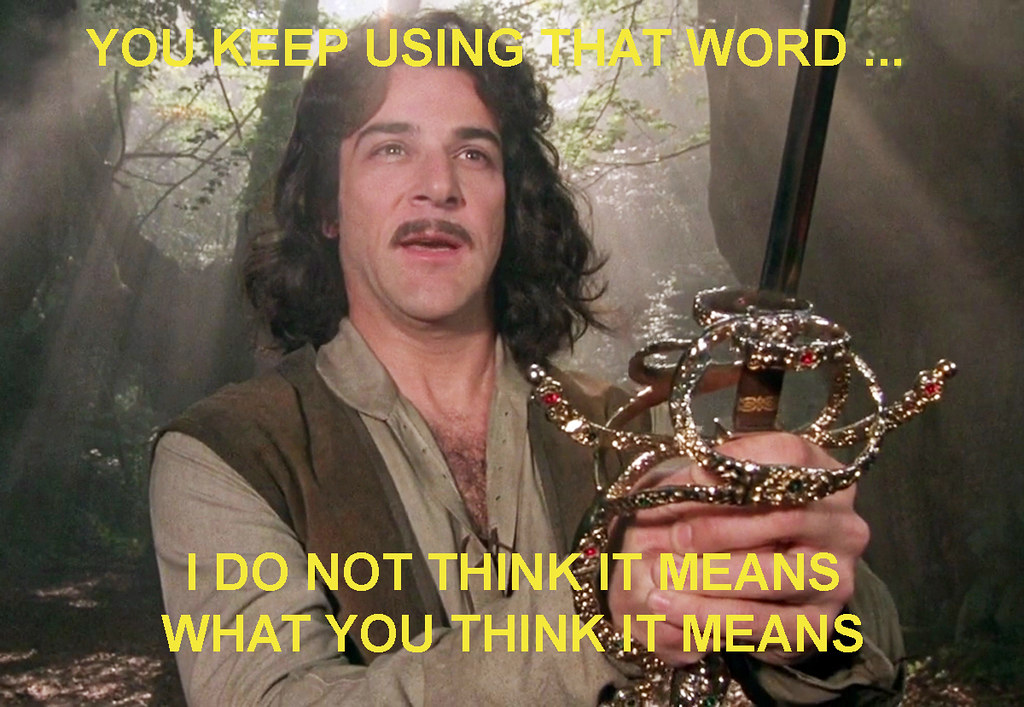
In The Princess Bride, one character questions another for the latter’s repeated use of a word telling him that he did not think that word meant what the one using it thought it meant. I have run into a little bit of that myself recently with the odd usage of the word “wholesome.” I grew up when “wholesome” described something good for the body, mind, or spirit. The folks at Lexico dot-com have my back on this one:
“Conducive to or suggestive of good health and physical well-being.”
1.1 “Conducive to or characterized by moral well-being.” 1
However, for current usage, it sometimes helps to consult a tertiary source like Urban Dictionary dot-com. Anyone can define a word, and users vote for the meanings they think are best. User, 265daysofpatandspongebob, provided the most current and popular user-contributed definition of “wholesome.”
“An embodiment of the following: self-less, considerate, sweet, compassionate, thoughtful, generous, genuine, doesn’t talk trash about other people,”2
Yes, I realize that the grammar is not perfect, but that is not the point. Somehow people have come to associate this adjective with the result of having been nurtured by the wholesome. For example, it would be hard to be selfless without wholesome influences. A secondary definition offered by another contributor was essentially something or someone bringing a smile to another’s face.3 Finally, there was the usage I had encountered. The fourth most popular submission asserted that something wholesome expressed love and affection, not lewdness.4
While I can appreciate that people realize that lewdness is not a virtue, not all love and affection are “wholesome.” The forum in which I encountered this word recently was about a story of a young adult who took in a runaway teen. Sadly, the young woman previously traded her body for a place to stay and assumed her new caretaker would desire the same type of “payment.” To his credit, he told her that she had value other than just her body and deserved good treatment with no strings attached. Those who are saying that the story was wholesome, I suppose, were expressing surprise that a vehicle of popular culture was not glorifying casual relations, especially between those of about a ten-year age difference. Thus far, the relationship presented is platonic. Perceptions of the story’s “wholesomeness” among audience members may change if a romance develops between the adult and the teen, even if the former waits to pursue romantic feelings until the latter reaches what the West considers the age of majority.
While I would prefer people to react this way because of moral instruction, I fear it stems more from the self-righteousness associated with political correctness. In other words, it has more to do with #MeToo than God said. After finally understanding how people are using “wholesome,” I thought of how I’ve previously seen the word used by other forum members in the past. The very first time I encountered this odd definition of “wholesome” was in a story with a fantasy setting. A woman befriends a female dragon. The dragon assumes a human form and lives with the woman, and takes care of her like a maid. The dragon acts smitten with the human, but the human has no romantic interest. But with the addition of other dragons who take up residence with the human, the setting assumes the form of a non-traditional family. Like the other story, I referenced, the relationship is platonic. However, the LGBTQ+ community lifted it as a positive example of the gay lifestyle. Commentators talked about how “wholesome” it was. Again, the idea was that it highlighted love and affection without lewdness. Hence, making it more acceptable to the “straights” in the audience.
It seems religious instruction is as lacking as English education today. If newspeak continues replacing our language, we might see other words perverted to accommodate meanings wordsmiths never intended for them. I am mindful of the warning from God as given by His prophet, Isaiah.
“Woe to those who call evil good, and good evil; Who substitute darkness for light and light for darkness; Who substitute bitter for sweet and sweet for bitter!” (Isaiah 5.20 NASB1995)
In the interim, take the time to teach the young people in your life what is wholesome. Let them know that being wholesome requires more than the absence of lewdness, causing others to smile, or remaining selfless. To be wholesome means you surround yourself with makes you a better, more moral person. The only thing capable of doing this is Christ, the Word, and the church.
Works Cited
1 “WHOLESOME: Definition of WHOLESOME by Oxford Dictionary on Lexico.com Also Meaning of WHOLESOME.” Lexico Dictionaries | English, Lexico Dictionaries, www.lexico.com/definition/wholesome.
I wrote those words in the back of my Bible. It has helped me on several occasions to gather my wits and remember Who I serve.
In America one of the most common fears is the fear of death. I’m sure it must be true all over the world. Some are afraid of the unknown as humans don’t fully comprehend everything about the physical process of death.
While Solomon reminds us at the end of Ecclesiastes that we are to fear God, It never ceases to amaze me how an understanding of God eliminates so many of our earthly fears.
It seems that fear is really an infant quality of the new Christian. It should be. We fear God’s wrath, power, and potential punishment, but with spiritual growth comes the absence of fear.
While uncertainty shrouds the details of our future day by day, the Christian can take comfort in knowing our eternal home with God can be certain.
Timothy needed the reminder that the Lord has the ability to empower us when fear begins to creep in. Paul tells him, “For God has not given us a spirit of timidity, but one of power and love and a sound mind” 2 Timothy 1:7.
I know that Timothy wasn’t the only one that needed to hear that. So many of us today, especially in these times, need to here those precious words of comfort. Whatever fears may be weighing you down today, may God’s Word give you the power, love, and sound mind that you need to face the day before you.
If I had the courage to ask a few random guys watching the football game at the local Applebees, they might give me a few stereotypical male answers. Some of them might say,
“Well a good wife should be a good cook!”
or “A good wife makes sure I got tea in my glass when I sit in my chair at the end of the day.” Or “A good wife keeps the house nice and clean.”
The question isn’t what makes a good maid— but a good wife.
I’m one day in to my second year of marriage. I still have no idea what I’m doing. However, I know exactly what makes a good wife.
Here are five qualities of, not just a good, but a great spouse. I’m incredibly blessed to see these things in my bride every day.
A Good Wife Is…
Filled with a desire To please God, more than her husband.
Not sinless but not satisfied with the status quo— she seeks to always grow spiritually.
Constantly encouraging, but not afraid to be honest about the faults in her husband.
Focused on eternity and helps her husband focus on eternity. Every day.
Forgiving, just like Jesus.
According to scripture, a good wife is someone that’s always growing but will always be a child of God.
Proverbs 31
Now, excuse me— my wife needs me to run an errand for her. 🙂
I found a treasure in a chest of drawers in my parents’ house this week. It was a Mother’s Day present I gave my mom when I was 8 years old. Actually, it was a project our third-grade teacher helped us put together. It was a recipe book concocted by us students without any adult assistance. The spelling and the recipes confirm this fact. My two recipes were “Peanut Butter ‘Crisbys’” and “Lemon Pie.” The first recipe was brief, but profound:
Put 3 C. rice crisbys in a bowl. Then put 2 tablespoons peanut butter in. 4 C. Sugar. Put in oven at 200 for 30 min.
The second recipe was more complex:
Put 4 eggs in the pan Put 3 cups of lemon mix in 1 1/2 c. sugar 2 C. “flower” Put in pan and cook for 1 hour at 200 degrees.
I assure you that nearly every recipe in this small book showed about as much culinary acuity. Why? We had been in the kitchen, but we had no concept about ratios, temperature, or baking times (or even if we used stovetop or oven). The result were “recipes” that would have been problematic to follow or eat.
What a challenge to me as I try to grow in grace and knowledge (2 Pet. 3:18)! I want to move beyond a childlike knowledge of Scripture and move on toward maturity (Heb. 5:11-6:1)! May I never be so lacking in knowledge that I cannot tell someone what to do to be saved, help someone know Christ, or speak about any matter pertaining to life and godliness (cf. 2 Pet. 1:3). May I have the humility to never “think more highly of” myself than I ought to think (Rom. 12:3). Otherwise, I may look naive or ignorant when asserting my expertise in a matter where I need considerable growth. I must bring the same humility to such complex subjects as marriage and parenting, as well as Christian living. That is not to say that I should not grow to the point where I cannot be helpful, but instead temper my advice and assertion with deference and cover it with lovingkindness and patience. On multiple occasions, the younger me made this mistake. In fact, I am still prone to do so. It reminds me to grow what I know and be careful not to share what goes beyond that.
Most of us have favorite songs and hymns. My favorite category of hymns is songs about the cross. I love the somber, dramatic feel of Beneath the Cross of Jesus, a hymn penned right after the close of the Civil War by Elizabeth C. Clephane and one set to the music we sing with it by Frederick Maker a dozen years later in 1881. The cross of Calvary is treated as a metaphor of protection for one in a wilderness. One might envision the wandering Israelites making their way to the Promised Land and apply that, figuratively, to our journey through this world of sin toward heaven. But the song will change scenes multiple times until, in the last verse, it is a most personal challenge to each of us to be faithful disciples of this crucified Lord.
The first verse introduces the foot of the cross as a shadow of a mighty rock where we find relief and a home to rest in from trials and difficulties while pilgrims in a weary land (the world). We might easily think of Israel’s exodus from Egypt. Some songbooks have a notation to define “fain,” a word used in the first line. It means “gladly.” I am happy to shelter behind Christ’s cross in adversities.
The second verse builds upon the metaphor of the first verse, then subtly shifts to an event from the book of Genesis. The cross is, again, a shelter and refuge. But, then, he shifts to an allusion to Jacob’s dream (Genesis 28:10ff). He has left his father’s house and his brother’s wrath and beds down near Haran. He lays down, using stones for a pillow, and falls asleep. Moses writes, “He had a dream, and behold, a ladder was set on the earth with its top reaching to heaven; and behold, the angels of God were ascending and descending on it.And behold, the Lord stood above it and said, “I am the Lord, the God of your father Abraham and the God of Isaac; the land on which you lie, I will give it to you and to your descendants” (12-13). This is where God reaffirms the promise He had made to Jacob’s grandfather and father to make of them a great nation. It symbolized hope, reward, and heavenly assistance. The song writer says the cross is just like the ladder in Jacob’s dream, except that I ascend to heaven by way of the cross. Again, Clephane uses a poetic, if obscure word, in this verse: “trysting.” The word means “meeting.” At the cross, God’s perfect love and justice meet. His love is shown and His justice satisfied by Christ’s sacrifice.
The third verse becomes a straightforward look at a literal remembrance of the graphic, horrific suffering of Jesus on the cross. She focuses on what our reaction should be–a smitten heart, tears, and a proper conclusion. How great is His love! How unworthy I am that He would demonstrate it to me (cf. Romans 5:8).
The last verse is the challenge to respond to that sacrifice. We are to live in the shadow of the cross, daily reflecting upon it and letting it affect how we live. We are to ignore all else to focus on Him. Clephane seems to allude to Paul’s words in Galatians 6:14, if ever so subtly. Too, there’s a challenge to not be ashamed of Jesus and the cross, but reserve our shame only for the sin in our life that made the cross necessary.
It is beautifully and intricately woven. Despite some unfamiliar, even archaic, poetic words, it is powerfully written. What a great song to prepare our minds for the Lord’s Supper or to sing when our motives gets clouded and our priorities get muddled. May we take the time, when we sing it, to consider the truth it teaches and the challenge it contains.
I read the words of David today
They were so full of hope and trust
They spoke of God’s merciful way
That He is mindful we’re but dust.
He knows that transgressions we commit
That His forgiveness is a must
His lovingkindness He gives those who try to quit
Because He knows that we are dust.
Like David, I’m glad God has not dealt
Just with justice toward my anger, sin, and lust
As exalted His nature, so His tender heart will melt
Because He’s mindful we are but dust.
Like a father pities his erring child,
He reacts with compassion, not disgust,
When we fear Him, we learn He’s tender and mild.
He is mindful that we are but dust.
So as I embark on this unique day,
I know God is holy, perfect, and just,
But He balances this with a most merciful way
As He dwells on the fact that we’re but dust.
How should I treat you, my fellow pilgrim
Who’s also driven by imperfection’s fierce gust?
May I see you as I’m seen by Him,
And remember that you are but dust.
Extend you grace and excuse your stumbles,
Be willing to forgive, forget, adjust,
Because David’s inspired truth forever humbles,
He is mindful that we are but dust!
The tendency to try and make subjective experience as more meaningful and valuable than objective truth is age old. We would rather feel something than learn or obey something. Yet, notice how thoroughly the Bible shows that adequate knowledge of God relies upon studying and knowing the Bible.
• GENESIS (24:12-14)–God’s KINDNESS is knowable.
• EXODUS (14:4-18)–God’s MATCHLESS HONOR is knowable.
• LEVITICUS (23:43)–God’s PROTECTING NATURE is knowable.
• NUMBERS (16:28)–God’s SPOKESMEN are knowable.
• DEUTERONOMY (4:35)–God’s PREEMINENCE is knowable.
• JOSHUA (23:13)–God’s CONDITIONS are knowable.
• JUDGES (6:37)–God’s INTERVENTION is knowable.
• RUTH (2:12)–God’s REWARD is knowable.
• 1 SAMUEL (17:46-47)–God’s MEANS OF SALVATION is knowable.
• 2 SAMUEL (7:18-29)–God’s PROMISES are knowable.
• 1 KINGS (20:28)–God’s SUPREMACY is knowable.
• 2 KINGS (19:19)–God’s UNIVERSAL AUTHORITY is knowable.
• 1 CHRONICLES (28:9)–God’s DIVINE QUALITIES are knowable.
• 2 CHRONICLES (25:16)–God’s DISAPPROVAL is knowable.
• EZRA (7:25)–God’s LAWS are knowable.
• NEHEMIAH (9:14)–God’s REVELATION is knowable.
• ESTHER (4:14 + rest of book)–God’s USE OF PROVIDENCE is knowable (even if we don’t know what is or isn’t providence).
• JOB (19:25)–God’s REDEMPTIVE WORK is knowable.
• PSALMS (100:3)–God’s CREATIVE POWER is knowable.
• PROVERBS (24:12)–God’s LIMITLESS ABILITY is knowable.
• ECCLESIASTES (3:14)–God’s PERFECTION is knowable.
• SONG OF SOLOMON–God’s DEVOTION TO MARRIAGE is knowable.
• ISAIAH (60:16)–God’s SALVATION & REDEMPTION are knowable.
• JEREMIAH (16:21)–God’s NAME & MIGHT are knowable.
• LAMENTATIONS–God’s STANDARD FOR PUNISHMENT is knowable.
• EZEKIEL (5:13)–God’s ZEALOUS WORD is knowable.
• DANIEL (11:32)–God’s STRENGTHENING is knowable.
• HOSEA (13:4)–God’s WORSHIP REQUIREMENTS are knowable.
• JOEL (2:27)–God’s PRESENCE is knowable.
• AMOS (3:2)–God’s HATRED OF INIQUITY is knowable.
• OBADIAH–God’s FEELINGS TOWARD PRIDE are knowable.
• JONAH (4:2)–God’s GRACIOUSNESS is knowable.
• MICAH (6:5)–God’s RIGHTEOUSNESS is knowable.
• NAHUM (1)–God’s PROTECTIVE CARE is knowable.
• HABAKKUK (2:14)–God’s GLORY is knowable.
• ZEPHANIAH (2:3)–God’s DESIRE TO BE SOUGHT is knowable.
• HAGGAI–God’s MISSION is knowable.
• ZECHARIAH (2:9-13)-God’s PLAN OF SALVATION is knowable.
• MALACHI (2:4-5)–God’s COVENANT is knowable.
• MATTHEW (22:16)–God’s TEACHINGS are knowable.
• MARK (1:24)–God’s HOLINESS is knowable.
• LUKE (11:13)–God’s BENEVOLENCE is knowable.
• JOHN (17:3)–God’s UNIQUENESS is knowable.
• ACTS (2:36-47)–God’s REQUIREMENTS FOR SALVATION are knowable.
• ROMANS (8:28)–God’s ASSURANCE TO THOSE WHO LOVE HIM is knowable.
• 1 CORINTHIANS (2:12)–God’s SPIRITUAL BLESSING OF REVELATION is knowable.
• 2 CORINTHIANS (8:9)–God’s GRACE is knowable.
• GALATIANS (3:7)–God’s HEIRS are knowable.
• EPHESIANS (1:17-19)–God’s BESTOWED WISDOM & HOPE are knowable.
• PHILIPPIANS (3:8-11)–God’s SON is knowable.
• COLOSSIANS (4:1)–God’s MASTERFUL ROLE is knowable.
• 1 THESSALONIANS (1:4)–God’s MEANS OF ELECTION is knowable.
• 2 THESSALONIANS (3:7)–God’s GOOD EXAMPLES are knowable.
• 1 TIMOTHY (3:15)–God’s CODE OF CONDUCT IN THE HIS HOUSEHOLD is knowable.
• 2 TIMOTHY (3:15-17)–God’s HOLY SCRIPTURES are knowable.
• TITUS (1:9-16)–God’s SOUND DOCTRINE is knowable.
• PHILEMON–God’s FREEDOM FROM SIN & CALL FOR SERVICE IN CHRIST is knowable.
• HEBREWS (8:11-13)–God’s SUPERIOR SALVATION is knowable.
• JAMES (2:20)–God’s DEMAND FOR ACTIVE FAITH is knowable.
• 1 PETER (1:18-19)–God’s INCORRUPTIBLE MEANS OF SALVATION is knowable.
• 2 PETER (3:17)–God’s FOREWARNINGS are knowable.
• 1 JOHN (4:2)–God’s SPIRIT is knowable.
• 2 JOHN 1–God’s TRUTH is knowable.
• 3 JOHN 12–God’s INSPIRED WRITERS’ TRUTHFUL RECORD is knowable.
• JUDE (4-23)–God’s ENEMIES are knowable.
• REVELATION (2:10,17)–God’s REWARD is knowable.
This does not begin to exhaust the list of things which the Bible tells us we can know! God has not left us to grope in the dark. Neither has He left it up to us to decide to live however we want to live.
As part of the personal evangelism class I just taught in Cambodia, I had the students engage in role-playing for a couple of days. It was wonderful and memorable. Some of the students are brand new Christians and have no experience doing personal work. All of them got into it wholeheartedly. Perhaps the most poignant moment came about purely accidentally. We had a table set up, with a teacher, silent partner, and student. The “student” was to come up with the issue or dilemma for the “teacher” to solve. In one particular scenario, the “student” hit the teacher with his true background. He said, “When I was born, I did not even get to see my parents. They died and I am an orphan. If there is a God, why did this happen?” His teacher gently and unassumingly said, “I think I understand. I lost my parents when I was young, too, and I am an orphan.” There followed a beautiful lesson on God’s love and pretty good insights on why there is suffering in this world. But the fact his teacher not only comprehended, but experienced his situation made a huge impact on everyone in the room.
We will suffer in a great many ways throughout our short sojourn on this earth. At times, we may think that not another soul on earth understands. Perhaps, there will come a time when that is actually true. However, we will never encounter a single trial but that someone will always understand. He may not be on earth, but He is ever-present. He is actually omnipresent. The Hebrews writer says of Him, “For we do not have a high priest who cannot sympathize with our weaknesses, but One who has been tempted in all things as we are, yet without sin. Therefore let us draw near with confidence to the throne of grace, so that we may receive mercy and find grace to help in time of need” (Heb. 4:15-16). As we bring our biggest, most debilitating issues into His presence, He gently says, “I think I understand.” Praise God!















 The Preacher Pollard Blog