We love our enemies and show kindness to people who hate us.
We focus on the transcendent — I know some Christians who are upset about the election results because it may mean their families never get into the country. As an American, I wholly disagree with that mentality — immigration is not a right but a privilege, and must be done legally. That said, I understand their frustration. Our immigration system has become insanely corrupt. It usually takes years, an enormous amount of money, lots of traveling, and miles of paperwork to do it legally. Our ancestors didn’t face anywhere near the same bureaucratic challenges that are in place today. Yes, they came here with nothing but a good work ethic and a desire to contribute, which is arguably not present today. I’m saying all of this because many — understandably — become defensive when someone says, “Maybe we should be compassionate.” What they hear is, “We should just dissolve our borders and overlook the rampant violent crime it causes.” Nope. But we should be patient with and compassionate toward our foreign-born Christian families. We’ll never win hearts and minds by leaning further into our national identity than we do our transcendent one.
Be grateful, always. Our hope isn’t in any human being or human administration. The powers that be exist because God put them there! Whatever happens in the coming years, we’re grateful that God is and rules.
Remember the past. The ancient Israelites met the most trouble when they forgot lessons learned by their predecessors. Repeated mistakes result in repeated outcomes.
Keep eyes on the ultimate goal, first and foremost. My wife and I are expecting our first child after ten years together. Yes, that changes a lot about how I view the world! Yes, I’m breathing a little easier with the possibility of better economic times ahead. But those issues pale when compared with the responsibility of aiming a conscious mind at God. Nothing matters more than hearing, “Good job,” when our Creator returns. Ideally, my loved ones hear the same thing. We’re in for perhaps brighter days — but that can’t distract from what actually matters.
You have heard that it was said, “Love your neighbor and hate your enemy.” But I tell you, love your enemies. Pray for those who treat you badly. If you do this, you will be children who are truly like your father who is in the heavens. He lets the sun rise for all people, whether they are good or bad. He sends rain to those who do right and to those who do wrong. If you love only those who love you, why should you get a reward for that? Even the tax collectors do that. And if you are nice only to your friends, you are no better than anyone else. Even the people who don’t know God are nice to their friends. What I am saying is that you must be perfect, just as your father in the heavens is perfect (Mt 5.43-48).
Before getting to my article, I need to make a correction to last week’s article that I didn’t catch in my hurry to submit it on time: the genitive plural of ουρανος is ουρανων (I had said ουρανους, which is accusative plural). Rookie mistake.
Everyone knows what happened last weekend. We came very, very close to some terrifying times in this country. These are some observations specific only to Christians in the aftermath of the nation’s divided response (and potential futures):
We don’t know what the future holds. While things certainly aren’t ideal (from an earthly perspective) right now, they could have been made much worse overnight. Our earthly security is not as stable as we might be tempted to think.
Earthly security is not what we’re here for. We exist to be people who model Jesus’s love as effectively as we can. External events are just details, the directive never changes.
To a Christian, these events should be considered largely irrelevant. There’s nothing wrong with being informed! It can help us mentally and emotionally prepare our response in times of crisis (cf. I Pt 3.14-17). But that’s about the extent of its value.
God installs presidents, not us (Rom 13.1, Dan 2.21). Whoever he wants in the White House will be in the White House.
We are never permitted to be ugly or hateful to our enemies (cf. Eph 4.29-31; Mt 5.43-45).
This earth is not our home (II Pt 3.7, 10-13). At least not in its current form.
As a holy nation and God’s people, our allegiance is first to Jesus (I Pt 2.9; Phil 3.20), second to whoever he decides to put in charge of our country later this year (Ac 17.26; Dan 2.21; I Pt 2.14-17; Titus 3.1, 8).
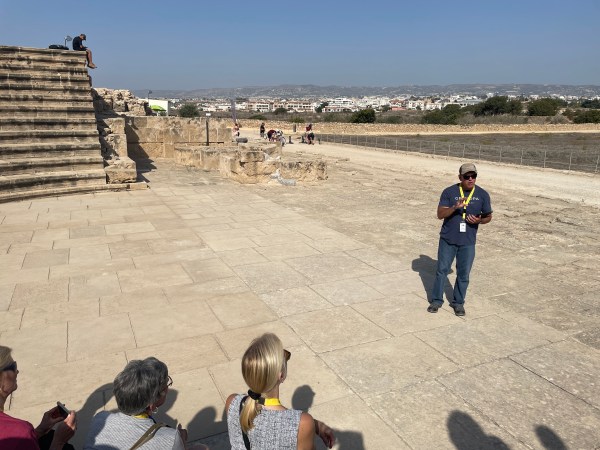
Especially since we lost the ability to visit Israel, I have been looking forward to visiting the country of Cyprus. Though it was a hurried trip, it did not disappoint me. Cyprus is mentioned so frequently in Scripture, Kittim (Chittim) and Elishah in the Old Testament (as well as Cyprus in the Major Prophets), then featuring prominently in the book of Acts–the first stop on the first Missionary Journey, the home of a disciple named Mnason, and an early stop on Paul’s ill-fated ship in Acts 27:4. It is also the native country of Barnabas, one of the unsung heroes of the New Testament. Our group was able to go to Paphos, where Paul and Barnabas converted Sergius Paulus.
There was so much more to see in the country, even more than we possibly had time to see in the course of just a few hours. What we dearly wanted to do did not work out, going to Fumagusta to meet the only known New Testament Christian in this country–Kith Nambale. He is a student in Eastern Mediterranean College who searched for the truth and was baptized by Rod Seaman earlier this year. Soon, Wayne Parker, a long time missionary is moving to Cyprus to work as a missionary. To me, it is always exciting where the gospel returns to places where it was in the early days of Christianity.
I have appreciated the daily habit we have developed of meeting on deck after dinner to sing and pray. It has drawn the attention of quite a few passengers. We also have sung on the bus each day as we have gone on our excursions. It is such a blessing when God’s people love to sing and take time to do so. It will be one of the treasured memories of this trip, a souvenir like no other! I have also appreciated how evangelistic John Moore is, taking every opportunity to teach and share the gospel with each guide, bus driver, and other non-Christian we have as a “captive audience.” He and Carla do such an incredible job in this ministry.
While I am sad that this was the last Bible land excursion, I am beyond thankful for each opportunity. It has enriched our faith and built our appreciation for especially the sacrificial service of the great apostle Paul! Like him, we are on a ship headed for Rome. We pray that our experience will mirror the ship he stepped onto in Acts 28 rather than the one in Acts 27!
Even though his name wasn’t on the list of scheduled participants, you could tell the debate was centered on him. All of the candidates had no choice but to acknowledge his influence. Ironically, the show’s biggest winner wasn’t even there in person, though he certainly was in spirit.
I’m talking about Donald J. Trump, the 45th President of the United States. Trump, the current Republican frontrunner, opted out of the first debate of the 2024 presidential election cycle. He didn’t need to attend. The debate host, Fox News, repeatedly mentioned Trump’s absence and decision to skip the first debate. Many questions focused on Trump, including a request for a show of hands from those who would vote for him as the Republican nominee in 2024.
Although several candidates, like DeSantis, raised their hands cautiously, only Asa Hutchinson abstained. Moderator Bret Baier referred to Trump as “the elephant not in the room.” Even though Trump wasn’t there in person, he still managed to steal the show.
Preacherpollard.com isn’t a political blog; instead, the primary goal of this space is to delve into the Bible and talk about how to apply its teachings to daily life. Nonetheless, occasionally, mundane occurrences trigger spiritual musings. In this case, Trump’s conspicuous absence from the debate prompted such a notion on my part.
Archaeological discoveries and ancient history have always piqued my interest. Beginning in the late twentieth century, I began to notice an increase in the usage of “BCE” and “CE” instead of “BC” and “AD” in historical dating. I was initially perplexed, but I quickly realized that these titles meant “Before the Common Era” and “Common Era,” respectively. What, I thought, made this time “common”? The response, unsurprisingly, was Jesus Christ. The impact of His followers, notably in the West and its global financial influence, led to the worldwide adoption of this calendar system, often for economic objectives.
Although I was late to the party, the attempt to downplay Christ’s temporal relevance has historical antecedents. In the 17th century, Johannes Kepler referred to it as the “vulgar era,” where “vulgar” translates to “common” in Latin. Similarly, “BCE” and “CE” were used by a few scholars in the 1800s.
However, the 1990s saw an explosion in the adoption of these nontraditional words for dating. During this time, there was a broader shift toward diversity, multiculturalism, and secularism, particularly in academic contexts. Many textbook publishers and academic publications adopted the BCE/CE system to be more “inclusive” and “unbiased.” This nomenclature gradually became standard in textbooks, and eventually, museums adopted it.
The paradox is that the system isn’t more inclusive when Christ’s name is left out. The “common era” still has Him as its starting point. His absence only emphasizes His power, much like how our current calendar system, which has been in place for over 1500 years, finds it more convenient to change nomenclature than history.
Jesus Christ’s influence extends far beyond religious belief. He is also a historical figure. He has profoundly impacted global culture, values, and history, and we inseparably perceive time through Him. Whether or not one acknowledges it, His legacy has had and will continue to impact how people think about and experience time.
Thus, I remembered Him while noticing how another figure, a much more flawed and insignificant figure, was still the winner of a debate the latter won in absentia.“And there is salvation in no one else; for there is no other name under heaven that has been given among mankind by which we must be saved.” (Acts 4.12 NASB)
The election is over – or is it? Some states are still counting ballots as of this writing. Nevertheless, it doesn’t change our responsibility to those God’s Providence has placed into leadership over us. One needs to remember several things about government. First, God “changes the times and the periods; He removes kings and appoints kings….” (Daniel 2.21 NASB). As Nebuchadnezzar testified, “the Most High is ruler over the realm of mankind, and He grants it to whomever He wishes” (Daniel 4.17 NASB). Second, God gave them the authority to punish the evildoer (Romans 13.1-7). Thus, they have a heavenly mandate. Third, we must give them what they are due: taxes (Matthew 22.15-22). Fourth, we must lift their names to the Heavenly Father (1 Timothy 2.1-3). Finally, we must give them honor (1 Peter 2.17).
In addition to these five principles, Solomon suggests ways to interact with those who would rule over us wisely. I will present them in their order of appearance in the book of Proverbs.
Never put a leader in a bad light; doing so would be detrimental to both of you. While we have a constitutional right to criticize because the First Amendment protects it, that doesn’t mean we have to or should.
“The king’s favor is toward a servant who acts wisely, but his anger is toward him who acts shamefully” (Proverbs 14.35 NASB).
This reminder holds more weight for someone who works directly for the leader, but it’s still a principle to which we should all adhere. A leader can make our lives difficult, whether his reasoning is justified or motivated by vanity. Of course, we can address such issues at the ballot box, but in the meantime, we must act prudently.
Don’t be a “yes-man.” When we addressed leaders last week, we included advice on “yes-men.” Indeed, a leader should not surround himself with such sycophants. But we should not try to appease our leaders by becoming the “yes-men” that the Bible condemns.
“Righteous lips are the delight of kings, and one who speaks right is loved” (Proverbs 16.13 NASB).
While taking care not to contradict the first point above, we should still righteously speak when asked. A leader who is worth his salt appreciates a truthful constituent.
Leaders prefer those who can articulate their morals. The idea is that a leader will discover in you a deserving individual to offer advice when he needs it.
“One who loves purity of heart and whose speech is gracious, the king is his friend” (Proverbs 22.11 NASB).
Set yourself apart with your skills. In the years following the upheaval of the Civil War, African Americans continued to confront discrimination and repression, making progress toward their goals challenging. As a result, different perspectives on the way forward emerged. As a result of one such way of thinking, NAACP founder W.E.B. Dubois established an organization to promote the advancement of African Americans. Alternatively, Booker T. Washington opened the Tuskegee Institute to appeal to a competing viewpoint among members within the black community.
Washington believed that if blacks possessed a necessary skill that made them an indispensable part of the community, prejudiced whites in the South would accept them as peers, even if reluctantly. I’m not here to argue which of these men was correct, but I will say that Solomon would have likely supported the latter. Solomon saw one’s trade as a way to distinguish himself and attract the attention of kings.
“Do you see a person skilled in his work? He will stand before kings; He will not stand before obscure people” (Proverbs 22.29 NASB).
The best way to get the attention of a captain of industry or the President of the United States is to develop a skill to make your presence necessary. It will prevent you from living an ordinary life.
Exercise restraint when in their presence. Sitting down to dine with a world leader would be exciting, especially if you eat at their expense. However, you may make a terrible impression if you are not self-disciplined. I understand that it is unlikely that any of us will be dining with the king, but we might get an invite from our boss. The principle is the same.
“When you sit down to dine with a ruler, consider carefully what is before you, And put a knife to your throat if you are a person of great appetite. Do not desire his delicacies, for it is deceptive food” (Proverbs 23.1-3 NASB).
I read a legend (as Snopes refers to it) about an employer who conducted job interviews over dinner. This employer evaluated applicants on whether they added salt to food without tasting it to determine if it was necessary. The reasoning is that it shows impulsiveness and a failure to analyze data before deciding. Furthermore, it is impolite to your host because it implies that you do not trust his dining establishment preferences.
The bottom line is that whether a king or a boss, no one likes someone who will run up expense accounts and exercise no self-control.
Be humble. Solomon’s advice was undoubtedly the source of our Lord’s future warning in Luke 14.7-11 against seeking the chief seats. If your host wishes to seat someone else in your chair, you will be embarrassed. So instead, find a secluded spot and wait for the host to invite you to the guest of honor table.
“Do not boast in the presence of the king, and do not stand in the same place as great people; For it is better that it be said to you, ‘Come up here,’ Than for you to be placed lower in the presence of the prince, whom your eyes have seen” (Proverbs 25.6-7 NASB).
The reason that leaders like the humble are because they are typically better team players. The humble also learn from their mistakes. And best of all, the humble lead by example. As the Chinese say, “Not the cry, but the flight of a wild duck, leads the flock to fly and follow.”
Be Persistent. Some commentators believe that Jesus was thinking of our last proverb when He gave the parable of the Unjust Judge in Luke 18.1-8. At least, brother Burton Coffman noted that in the 1901 American Standard Version, the translators felt they could substitute the word judge for the word ruler in Proverbs 25.15.
“Through patience a ruler may be persuaded, and a gentle tongue breaks bone” (NASB).
It would be impolite to refer to the woman about whom Jesus spoke as a nag, but she did so tire the unjust judge with her numerous inquiries that the judge eventually tipped the scales of justice in her favor. We think of using violence to persuade others, but the truth is that pleading with them can be just as effective. When we require our elected officials’ assistance, anger is not an appealing method of obtaining it. It is preferable to use a gentle tongue to break their bones through persistent questioning and insistence that they hear our plight.
I chose these Scriptures because they all dealt with subjects who had dealings with the king or ruler. However, I believe we can see how they apply to other relationships in which one person is of a lower station than the other. Remember what another wise man said to my grandfather Pollard years ago about our newly elected leaders: “Democrat or Republican, I still have to go to work.” Indeed, we all have a responsibility to those who exercise authority over us, and we can also treat them properly to endear ourselves to them.
Since next Tuesday is Election Day, it seems appropriate to reflect on the Proverbs’ teachings on leadership. Of course, those in positions of authority would do well to consider all the wisdom in the book of Proverbs. But there are eight passages they would do well to contemplate that speak specifically to those exercising secular authority. Here they are in the order of their appearance.
If you don’t help the people you lead, you won’t be in charge for long.
“In a multitude of people is a king’s glory, But in the scarcity of people is a prince’s ruin” (Proverbs 14.28 NASB). This verse tells us two things: 1) You cannot be a leader if no one is willing to follow, and 2) Deprivation will make your constituency turn on you.
What you say will get greater attention, so carefully choose your words.
“A divine verdict is on the lips of the king; His mouth should not err in judgment” (Proverbs 16.10 NASB). This verse does not mean that leaders are infallible, as some interpreted in the past, but rather that people put more weight on a leader’s words.
You cannot turn a blind eye to evil.
“A king who sits on the throne of justice disperses all evil with his eyes. A wise king scatters the wicked, And drives a threshing wheel over them.”(Proverbs 20.8,26 NASB).
One of the reasons God gives men authority is to wield the sword against the evildoer (Romans 13.4). As a result, being lenient toward lawbreakers harms the dominion over which you exercise control.
Taxation should not be excessive.
“The king gives stability to the land by justice, But a person who takes bribes ruins it” (Proverbs 29.4 NASB).
Commentators agree that this speaks of excessive taxation. I doubt any of us would view paying taxes as equal to a bribe, but it speaks to the ruler’s greed. Do you recall what happened when Rehoboam took the wrong advice and increased the already excessive tax burden on the people? The ten northern tribes of Israel broke away and formed a new kingdom under King Jeroboam (1 Kings 12.6ff).
Avoid surrounding yourself with “yes-men.”
“If a ruler pays attention to falsehood, All his ministers become wicked” (Proverbs 29.12 NASB).
People in power often attract sycophants who may speak lies that the ruler finds favorable. If he is the type who delights in those stroking his ego, he might discover himself surrounded by those seeking to use him to accomplish their means.
Don’t forget that your constituency includes people who can’t help you.
“If a king judges the poor with truth, His throne will be established forever” (Proverbs 29.14 NASB).
A popular leader fights for fair treatment for all citizens, especially the poor unable to lobby their cause. If you’ll also note that type of character wins one re-election.
If you want to further your political career, stay away from scandal.
“Do not give your strength to women, Or your ways to that which destroys kings. It is not for kings, Lemuel, It is not for kings to drink wine, Or for rulers to desire intoxicating drink” (Proverbs 31.3-4 NASB).
Those in positions of authority are surrounded by more than just sycophants. Additionally, they have domestic and foreign foes. One strategy used by these foes involves the fairer sex. A honey trap is a name for this kind of strategy. Honey trapping entails luring a target into a romantic or sexual relationship to gain access to sensitive information. Recent history in the U.S. Congress reveals at least one Representative who fell victim to such a trap, having a relationship with an agent of communist China.
Persons in authoritative roles should never partake in excessive drinking. You may say or do something you will regret in a drunken state. People suspect one now-deceased politician murdered a political operative with whom he may have been having an affair while driving drunk in his car. His stature, however, protected him from even being arrested. While it did not end his political career, it derailed his chances of ever becoming President of the United States.
This list is not exhaustive. Further, Solomon discusses the proper way to interact with those in authority. However, the points I’ve made here appear particularly relevant during this election season.
For the next several weeks, I’ll be repeating the book of I Peter in present-day terminology. It’s not a true translation of the book, as I am not qualified to do so. It will be based on an exegetical study of the book and will lean heavily on the SBL and UBS Greek New Testaments, as well as comparisons with other translations (ESV, NASB, NIV, ERV, NLT). My goal is to reflect the text accurately, and to highlight the intent of the author using concepts and vocabulary in common use today.
This is not an essentially literal translation, and should be read as something of a commentary.
I Peter – Pt V
I say this because I love you: stay far away from unhealthy desires. They’re the sworn enemies of your souls, and they attack without mercy. Remember, this isn’t your permanent home. You’re strangers and outsiders on this earth. Remember this when you’re around earthly people. Make sure you behave like you’re supposed to. They’ll treat you badly and say horrible things about you since you don’t act like everyone else. Maybe they’ll notice your awesome morality and follow God themselves!
Speaking of people on earth, God wants us to obey whoever’s in charge of us (as long as it isn’t sinful). If it’s your president, obey him. Anyone acting on the president’s behalf is just as in charge. God uses them to punish bad people and praise good people. By doing what they tell us, we’re doing what God wants. Maybe we’ll even shut down the ignorant things others say about us!
If you’re reading this right now, it means you have access to electricity and internet. If you have access to those, you’re already familiar with the subject of this article. This specifically applies to Christians living in the United States, but I encourage those who don’t consider themselves religious to think about the following as well. There’s no other way to address this, so I apologize for having to write it.
“Let’s go Brandon” is everywhere: gas pumps, sporting events, social media posts, bumper stickers, etc. I thought it would die out by now, but it’s everywhere. I see it almost every day on gaming platforms, with many adopting some form of it as a username/handle. It’s become colloquial, used to “thank” the president for any less-than-ideal circumstance.
I am not a fan of our current president. If you drive, you know how much gas is right now. Afghanistan. The Russian ammo ban (and other anti-freedom measures). If you eat food, you’re already familiar with inflation’s impact on groceries. We could go on for a week, but this is a long-winded disclaimer and I need to get to the point.
No Christian should ever adopt the mentality behind the phrase at the beginning of the second paragraph. Besides the crass and hateful language it represents, it’s a sinful way to view our president. Christians are supposed to respect their government leaders (I Pt 2.17). In that passage it’s not a suggestion, it’s an order. The word τιμᾶτε (timate) is an imperative. It means “to show high regard for” someone (BDAG, τιμάω).
Paul wrote, “You should pray for rulers and for everyone who has authority. Pray for these leaders so we can lead a quiet and peaceful life…” (I Tim 2.2). Paul was under an emperor similar to our own president. God’s expectations for Christian behavior don’t change when the president is bad. We don’t have to like him, but we certainly have to respect him and pray for him.
We should not expect to live with God forever if we talk about the president the way so many others do. I get it – it’s hard. Politicization of the medical field under his administration has had a direct impact on my own quality of life. Praying for/respecting the president is not easy at all. But it wouldn’t have been easy for Christians under any of the Roman emperors in the first century, either. If they could do it, so can we. Please think about the serious impact our words have on where we spend eternity. Our first allegiance is to God. If He’s really our King, we’ll have respect for our president.
One night Chelsea and I were walking the dog before bed and came across an enormous armadillo. We were in a rural area and it was pitch black outside except for her flashlight. I had a rifle with me, so I took a shot at the armadillo. Instead of falling where it stood (as they had usually done), this one jumped a couple feet into the air and then ran off with surprising speed.
We thought that was the end of it, so she walked the opposite direction with the flashlight and the dog. In the pitch black, I heard the angry armadillo heading towards me full-steam.
Being rushed by an armadillo in the dark is terrifying, no two ways around that. The darkness accentuates our helplessness and makes defense a lot harder. I John 2.11 makes it very clear that if we hate our church family, we’re walking in darkness and don’t know where we’re going because the darkness has blinded us. If we’re in darkness, we have no fellowship with Jesus and we’re liars (1.6).
2020 has given our mortal sides quite a bit of strain. We’re so divided as a nation that a person’s political party alone is enough to preclude their value in the eyes of their opposition. The church has to be different.
Had the moon not come out just a little and the laser on my optic not worked, I would have been cut up pretty good by that armadillo. Light gave me the means to save my skin!
If we show love to our church family and are walking in the light, we have been given the ability to be saved. If we live and die in the light, we gain an eternity where there is no night or darkness in a new heaven and a new earth (Rev. 21 ). As November 3rd looms ominously over us, let’s remember that our eternal destination hangs – at least partially – on how we treat one another after this stressful election.
Have you ever researched famous people born on your birthday? I have. I share a birthday with Babe Ruth, Bob Marley, Zsa Zsa Gabor, Queen Anne, Isidor Strauss, J.E.B. Stuart, Tom Brokaw, and, of course, a great many others. Two of the more fascinating, by contrast, were born a year apart. The one born in 1911 was a man. The one born in 1912 was a woman. He was an American patriot and two-term president. She was the companion of a Nazi dictator. He was shot, but survived. Her end was presumably self-inflicted. He lived into his 90s. She died in her 30s. He was Ronald Reagan. She was Eva Braun.
Both were born in two-parent households of modest means. Both had Catholic backgrounds. Both were second-born children. Both were athletes in their youth. Both possessed a talent for the arts. Both were fiercely loyal.
There is much more that could be said by way of comparison and contrast, but consider this. They were born and raised into the world at almost the same time. They were both born with the freedom to choose. Both found themselves in a place of great influence. Why was their ultimate influence so different from one another? It is surely more complex than can be measured from so great a distance of time and geography. Yet, it is a question played out an infinite number of times every day.
The day you were born, you were given a set of resources: time, talent, inclinations, opportunities, and influencers. For all of us, some of those resources present challenges and some present advantages. In other words, all of us have problems to overcome and privileges to leverage. In every case, we get to decide what we do with what we are given.
One of the applications of the parable of the talents (Mat. 25:14-30) is stewardship. Each man was given resources. Each was held accountable for what he did with them. Each made choices regarding them. Each reaped what he sowed.
I do not know how my final epitaph will read. It will certainly not be American president or German dictator’s companion. For that matter, it will not be Hall of Fame baseball player, British royalty, actor, composer, or broadcast journalist.
I know how I want it to read–Faithful Christian, faithful husband, faithful father, faithful preacher, and faithful friend. Am I using my resources to work toward that goal? The only way I get to choose my legacy is by building it day-by-day, decision-by-decision. The same is true of us all. That means we must all use time wisely (Eph. 5:16) to forge it. By doing so wisely, we can be numbered among those to whom the Lord, at the end of it all, says, “Well done, good and faithful servant” (Mat. 25:21).
Braun and Reagan shared a legacy that includes Berlin, Germany.
I do not mean to suggest that God is pleased with this nation today. Scripture would indicate that He is anything but happy with our immorality, materialism, and hypocrisy from the highest levels of government on down to the citizenry (cf. Prov. 14:34). From 2008-2016, He put Barak Obama in the White House. In 2016, He put Donald Trump there. The very idea of both of these statements has managed to put a lot of people, including Christians, into a whipped up frenzy for the last decade-plus. But Scripture reminds us, “God reigns over the nations; God is seated on his holy throne” (Psalm 47:8).
In Romans 13, Paul reveals some startling, difficult truths:
The authorities that exist are established by God (1)
Resisting them is resisting God (2)
Governmental authority is a minister of God to you for good (4)
It is necessary to be in subjection to such (5)
It is disheartening to see so many good people of God sidetracked and distracted by the world of politics, especially in the fevered pitch of the activities currently ongoing. Without true insight into what’s really going on, from “deep state” to “abuse of power,” too many are up at verbal arms metaphorically going door to virtual door in search of a fight about all of this. Wherever we see ourselves on the political spectrum, as we face seeming corruption from both sides of the political aisle, we should ask ourselves a question. Why is this happening in our land today?
God reigns over the United States today. He is at work. Is all of this His means of refining or judging us? I do not purport to know with certainty.
Does God want us to spend our precious time debating politics, fighting our philosophical foes on it? Does He want us to hitch our precious influence to crusading for or against impeachment and its endless tributaries? Or does He want us redoubling our efforts to seek and save the lost, being salt and light in an unsavory, dark world?
God is going to settle the matters swirling in and around D.C. in accordance with His sovereignty. Meanwhile, we must keep our focus on the eternal souls of humanity helping to prepare them for the inevitable appointment before the King of kings and Lord of lords (Mat. 25:31-33; 1 Tim. 6;15). While we don’t know what He has in mind in these matters, we do know what He has in mind at the end of time.
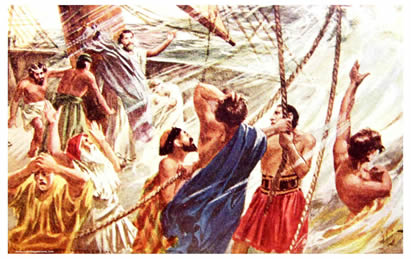
The ship is breaking apart. The timbers of civility. Crack! The planks of morality. Splinter! The mast of critical thinking. Pop! As we hope to stay afloat, we cannot help but feel growing apprehension over the current state of our society. It’s not a matter of preserving or plastering over a past. It’s a matter of preserving peace in the present, but only if that means God’s people are serious about sharing the only possible remedy–Jesus! Yet, as it increasingly seems our country is ratcheted by prejudice, hatred, division, and rancor, we see the tranquility and calm from so many quarters threatened with the dark storms of violence and uncertainty.
In Acts 27, Paul was with 275 other passengers on a boat bound for Rome from Caesarea, and its captain decided to test the Mediterranean Sea at a turbulent time. A violent storm, known as Euraquilo, caught the ship and ultimately battered it to pieces. It must have been an apprehensive time for the passengers and crew. Luke says the wind was violent, the ship was driven, the sun and moon didn’t appear for days, violently storm-tossed, they incurred damage and loss, and that all hope of their being saved was gradually abandoned. I cannot imagine the helpless, vulnerable feeling they must have felt. At least not literally.
It would be easy to let our national unrest and storminess tempt us to act irrationally (like some on Paul’s ship were tempted) or to give in to fear. But, Paul did five things we should do as we try to respond to the current turbulence.
He listened to God (Acts 27:23-24). Nobody else had a better or equal solution to their dire problem. The only way to be saved was to listen to God. Paul sought to persuade the people of this. In the ruckus and tumultuous noise, listen harder to God’s Word! It’s an anchor in stormy waters.
He believed God’s Word (Acts 27:25). It’s one thing to comprehend something, but quite another to put your trust in it. What God promised must have seemed quite far-fetched, that this way would save everyone. But, Paul didn’t waver. He said, “I believe God that it will turn out exactly as I have been told” (25). We are surrounded by people who need to witness our faith. As many as are persuaded will escape a shipwreck of faith (cf. 1 Tim. 1:19).
He encouraged hope (Acts 27:21-26). Despite the foolishness of their leaders, these people were given a message of hope. Paul says, “Keep up your courage!” (22,25). Despite the frightfulness of the moment, Paul offered a possible escape. Right now, you and I are uniquely positioned to give the only true hope available. It’s like an anchor for the soul, both sure and steadfast (Heb. 6:19)!
He warned the disobedient (Acts 27:31-32). There were those trying to break from God’s Word and will and do things another way. They were trying to take matters into their own hands. Paul spoke up against this! Such was defiance against the divine plan. What a message for us, who justify their sins rather than repent of them. We need to keep the message of righteousness, self-control, and the judgment to come before people (Acts 24:25).
He prayed faithfully (Acts 27:35). In this ordeal, Paul was a public example of prayer. Read every epistle of Paul’s and you’ll see his faithfulness in and dependency upon prayer. He appealed to the God he knew was the only hope for salvation. How much are we praying about the turmoil in our country (and world)? How much do those around us believe that we are dependent upon God?
Instead of focusing on the frightful winds currently blowing, let’s focus on the One who can calm the storm. Let’s get others to join us in that focus. Whatever happens to our nation, we must save as many souls as possible!
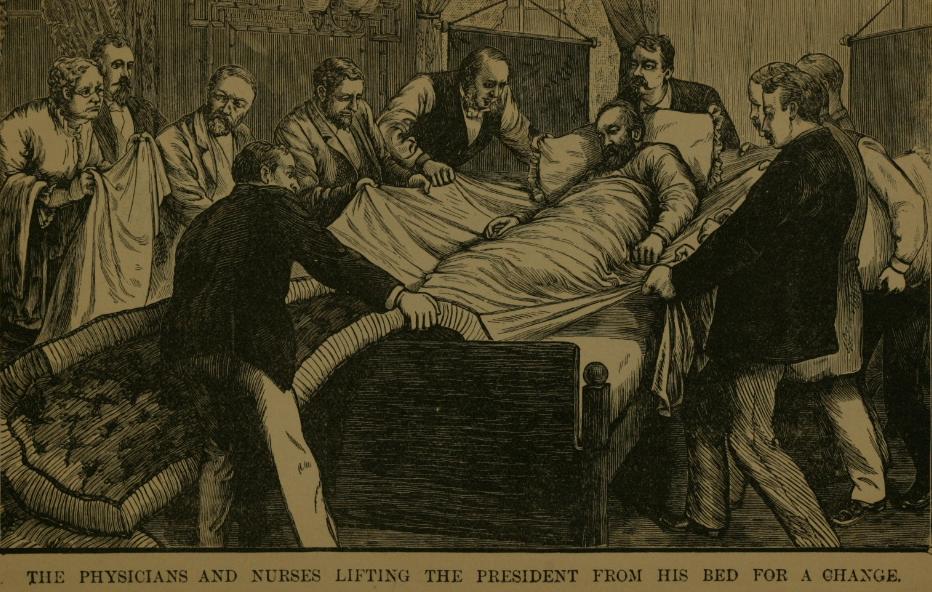
Judging from Candice Millard’s straightforward account of the assassination of James Garfield, there were two men responsible for his death. The more obvious villain was the shooter, Charles Guiteau, an unquestionably insane loner. The less obvious accomplice, judging from her words, was the man who seized control of Garfield’s care and appointed himself the president’s chief physician. The bullet that wounded the president would not have been fatal, but the medical attention he received afterward was. In fairness, a medical discovery already made in 1881 that could have helped Garfield was considered controversial and would not be generally embraced in America for a few more decades. Yet, Dr. Joseph Lister’s use of carbolic acid to sterilize surgical instruments and clean wounds had been in existence since the 1860s. The Englishman attended the Centennial Exhibition in Philadelphia in 1876, attempting to convince American doctors of its effectiveness. Alexander Graham Bell, whose telephone was discovered at that same exhibition, heard the news that Bliss could not find the bullet inside the president. The incredible inventor came up with the “induction balance”—a metal detecting machine. But Bliss waited too long to call Bell, and when he did he never allowed the inventor to check his left as well as his right side for the bullet. Bliss was sure it was on the right; an autopsy found it on the left. In court, Guiteau made the argument that the president died from malpractice rather than his attempt. While almost certainly true, Guiteau was still hung. Yet, most historians name Bliss as a proud, ignorant accomplice. Portrayed as a glory seeker, Bliss relied on his prowess and rejected several people and principles that could have prevented Garfield’s death (Millard, Destiny of the Republic: A Tale of Madness, Medicine, And The Murder of a President, Anchor: New York, 2011).
To be fair, it would have taken uncommon clarity and vision for Bliss to ignore the prevailing views of his colleagues and embrace Lister’s techniques and Bell’s invention, but he could have.
There will be people we encounter today, who appear to be in great health and no danger. Yet, the vast majority of them will face a fate infinitely more terrible than the one Garfield succumbed to. They will eventually die, unprepared for the eternity that will follow (Mat. 7:13-14). The most tragic part of this will be, if you and I are in their lives, that it will not have had to be this way. At least, we have the solution from the “Great Physician” and we should know how to administer it. God needs us to make use of the resources He’s made available to us—prayer, Bible knowledge, influence, personality, courage, love, and a sense of urgency (cf. Col. 4:2-6; 1 Pet. 3:15; Eph. 4:15; 2 Tim. 2:24-26; John 4:35; etc.). We can look within our congregations and see those who were reached in this way. We see others who are not far from the cure, but who need us to help them. How inexcusable is it to have the remedy but refuse to share it? May God help us use the resources we have available to us!
Neal Pollard
When Greek politician Andreas Papandreou died in 1996, he left his entire hefty estate to his third wife, Dimitria Liani. His three sons and a daughter, who had married a politician who was Papandreou’s political enemy, were disinherited when she and her siblings’ refused to ostracize this enemy. It was contested in Greek court for years, but so far that will has apparently not been overturned. Certainly, money can bring out the best and worst in people. The children’s point of view is almost certainly that they, as blood relatives, have as much or more right to their father’s inheritance than a woman he married in the last decade of his life (information via Ray Moseley, Chicago Tribune, 9/29/96).
In the New Testament, sin is legitimate grounds for the Heavenly Father to disinherit us. Paul tells the Corinthians this in 1 Corinthians 6:9-11. But his message is one of good news. With God, it is possible to go from disinherited to inheritors. He tells them, “Do you not know that the unrighteous will not inherit the kingdom of God? Do not be deceived. Neither fornicators, nor idolaters, nor adulterers, nor homosexuals, nor sodomites, nor thieves, nor covetous, nor drunkards, nor revilers, nor extortioners will inherit the kingdom of God. And such were some of you. But you were washed, but you were sanctified, but you were justified in the name of the Lord Jesus and by the Spirit of our God.” This passage reveals several important truths.
First, there is a pertinent fact. “The unrighteous will not inherit the kingdom of God.” He repeats the thought in verse 10. That phrase indicates missing heaven and all the reward of it (cf. Mat. 25:34).
Second, there is a potential fraud. “Do not be deceived.” How vital that message is for our current culture! There is so much deception about the consequences of sin that it is impossible to keep up with, document, or catalog it.
Third, there are the particulars framed. Notice the sinful individuals enumerated—”fornicators…idolators…adulterers…homosexuals…sodomites…thieves..covetous…drunkards…revilers…extortioners.” Each of those lifestyles and behaviors merit greater study, but these are the ones who are disinherited by the Father. It is His estate and, as such, His call to make.
Then, there is a past forgotten. Human beings can carry vendettas and grudges to their graves, but the living God is not prone to such weakness. He does require repentance, implicit in the phrase “such were some of you.” Because they changed, God put the guilt of their sins in the rear-view mirror.
Finally, there is a purification forged. Paul concludes, “But you were washed…sanctified…justified in the name of the Lord Jesus and by the Spirit of our God.” God does not just leave us to wallow in our sins. He provides a way of escape. If we take it, He will make those past sins as if they never existed!
In other words, we can go from disinherited to inheritors!

















 The Preacher Pollard Blog