What You Owe Your Leader

Friday’s Column: Brent’s Bent

Brent Pollard

The election is over – or is it? Some states are still counting ballots as of this writing. Nevertheless, it doesn’t change our responsibility to those God’s Providence has placed into leadership over us. One needs to remember several things about government. First, God “changes the times and the periods; He removes kings and appoints kings….” (Daniel 2.21 NASB). As Nebuchadnezzar testified, “the Most High is ruler over the realm of mankind, and He grants it to whomever He wishes” (Daniel 4.17 NASB). Second, God gave them the authority to punish the evildoer (Romans 13.1-7). Thus, they have a heavenly mandate. Third, we must give them what they are due: taxes (Matthew 22.15-22). Fourth, we must lift their names to the Heavenly Father (1 Timothy 2.1-3). Finally, we must give them honor (1 Peter 2.17). 

In addition to these five principles, Solomon suggests ways to interact with those who would rule over us wisely. I will present them in their order of appearance in the book of Proverbs. 

Never put a leader in a bad light; doing so would be detrimental to both of you. While we have a constitutional right to criticize because the First Amendment protects it, that doesn’t mean we have to or should.  

“The king’s favor is toward a servant who acts wisely, but his anger is toward him who acts shamefully” (Proverbs 14.35 NASB). 

This reminder holds more weight for someone who works directly for the leader, but it’s still a principle to which we should all adhere. A leader can make our lives difficult, whether his reasoning is justified or motivated by vanity. Of course, we can address such issues at the ballot box, but in the meantime, we must act prudently. 

Don’t be a “yes-man.” When we addressed leaders last week, we included advice on “yes-men.” Indeed, a leader should not surround himself with such sycophants. But we should not try to appease our leaders by becoming the “yes-men” that the Bible condemns. 

“Righteous lips are the delight of kings, and one who speaks right is loved” (Proverbs 16.13 NASB). 

While taking care not to contradict the first point above, we should still righteously speak when asked. A leader who is worth his salt appreciates a truthful constituent.  

Leaders prefer those who can articulate their morals. The idea is that a leader will discover in you a deserving individual to offer advice when he needs it. 

“One who loves purity of heart and whose speech is gracious, the king is his friend” (Proverbs 22.11 NASB). 

Set yourself apart with your skills. In the years following the upheaval of the Civil War, African Americans continued to confront discrimination and repression, making progress toward their goals challenging. As a result, different perspectives on the way forward emerged. As a result of one such way of thinking, NAACP founder W.E.B. Dubois established an organization to promote the advancement of African Americans. Alternatively, Booker T. Washington opened the Tuskegee Institute to appeal to a competing viewpoint among members within the black community. 

Washington believed that if blacks possessed a necessary skill that made them an indispensable part of the community, prejudiced whites in the South would accept them as peers, even if reluctantly. I’m not here to argue which of these men was correct, but I will say that Solomon would have likely supported the latter. Solomon saw one’s trade as a way to distinguish himself and attract the attention of kings. 

“Do you see a person skilled in his work? He will stand before kings; He will not stand before obscure people” (Proverbs 22.29 NASB). 

The best way to get the attention of a captain of industry or the President of the United States is to develop a skill to make your presence necessary. It will prevent you from living an ordinary life. 

Exercise restraint when in their presence. Sitting down to dine with a world leader would be exciting, especially if you eat at their expense. However, you may make a terrible impression if you are not self-disciplined. I understand that it is unlikely that any of us will be dining with the king, but we might get an invite from our boss. The principle is the same.  

“When you sit down to dine with a ruler, consider carefully what is before you, And put a knife to your throat if you are a person of great appetite. Do not desire his delicacies, for it is deceptive food” (Proverbs 23.1-3 NASB). 

I read a legend (as Snopes refers to it) about an employer who conducted job interviews over dinner. This employer evaluated applicants on whether they added salt to food without tasting it to determine if it was necessary. The reasoning is that it shows impulsiveness and a failure to analyze data before deciding. Furthermore, it is impolite to your host because it implies that you do not trust his dining establishment preferences. 

The bottom line is that whether a king or a boss, no one likes someone who will run up expense accounts and exercise no self-control. 

Be humble. Solomon’s advice was undoubtedly the source of our Lord’s future warning in Luke 14.7-11 against seeking the chief seats. If your host wishes to seat someone else in your chair, you will be embarrassed. So instead, find a secluded spot and wait for the host to invite you to the guest of honor table. 

“Do not boast in the presence of the king, and do not stand in the same place as great people; For it is better that it be said to you, ‘Come up here,’ Than for you to be placed lower in the presence of the prince, whom your eyes have seen” (Proverbs 25.6-7 NASB). 

The reason that leaders like the humble are because they are typically better team players. The humble also learn from their mistakes. And best of all, the humble lead by example. As the Chinese say, “Not the cry, but the flight of a wild duck, leads the flock to fly and follow.”  

Be Persistent. Some commentators believe that Jesus was thinking of our last proverb when He gave the parable of the Unjust Judge in Luke 18.1-8. At least, brother Burton Coffman noted that in the 1901 American Standard Version, the translators felt they could substitute the word judge for the word ruler in Proverbs 25.15.  

“Through patience a ruler may be persuaded, and a gentle tongue breaks bone” (NASB).  

It would be impolite to refer to the woman about whom Jesus spoke as a nag, but she did so tire the unjust judge with her numerous inquiries that the judge eventually tipped the scales of justice in her favor. We think of using violence to persuade others, but the truth is that pleading with them can be just as effective. When we require our elected officials’ assistance, anger is not an appealing method of obtaining it. It is preferable to use a gentle tongue to break their bones through persistent questioning and insistence that they hear our plight. 

I chose these Scriptures because they all dealt with subjects who had dealings with the king or ruler. However, I believe we can see how they apply to other relationships in which one person is of a lower station than the other. Remember what another wise man said to my grandfather Pollard years ago about our newly elected leaders: “Democrat or Republican, I still have to go to work.” Indeed, we all have a responsibility to those who exercise authority over us, and we can also treat them properly to endear ourselves to them.   

Three Ways Pride Distorts Our Thinking

Monday’s Column: Neal At The Cross

Neal Pollard

Some people’s sin struggles are evident. If they wrestle with foul language or lying, you can hear it. If they wrestle with immodesty or drunkenness, you can see it. Some spiritual weaknesses, though, are insidiously difficult to see–especially in ourselves. In Luke 9:46-56, in events that follow each other in very short order, the disciples’ struggle with pride is exposed by Jesus. We can understand why they struggled with pride. They were walking with the Messiah! He was training them for a special mission. Now, the only matter for them to settle was how they ranked among each other. Jesus exposes that very mindset in these verses.

PRIDE SEEKS PREEMINENCE (46-48). The disciples argue among themselves about who might be the greatest. Not only is this childish, but it reflects their short memory. They just displayed a deficiency of faith that prevented them from casting out the unclean spirit. Perhaps Peter, James, and John, given privy to the transfiguration, might have felt that if they had been among these other disciples they would have been able to cast it out. We don’t know. All we know is that Jesus rebukes the very idea of the arguing by placing a child in their midst. Children were barely noticed among first-century adults, but Jesus makes paying attention to and ministering to the least of people the mark of greatness. Discipleship is not about glory and visibility. It’s about having our eyes open to the humble and our hearts open to serving them. 

PRIDE SHOWS PREJUDICE (49-50). While some have tried to use these verses to say that there are saved Christians in religious groups outside of the New Testament church, they totally misunderstand Jesus’ point (not to mention, miss the teaching of a great many passages). What was John’s bone of contention? There was a disciple of Jesus who was doing works in His name (acting by His authority; recognizing His identity). They tried to prevent him “because he does not follow along with us” (49). They concluded this person couldn’t be acceptable because he wasn’t accompanying them. Jesus knows this man is on His side, but the disciples’ needed to hear this: “Do not hinder him; for he who is not against you is for you” (50). This territorial mentality can creep into our thinking. We should hold hands with all those who are on the Lord’s side, doing the Lord’s work. This is true if it regards the good works of others in the local congregation or if it is area congregations. 

PRIDE SEEKS PUNISHMENT (51-56). Pride shows itself in a very different way shortly after this. Jesus sends some followers on a mission, but they were rejected. James and John’s solution was to exact vengeance on them. They were anxious to call down fire from heaven and consume them. Whatever they expected as Jesus’ reaction, they had to be surprised at His rebuke. He corrects their thinking, saying that He came to this earth to save rather than destroy men’s lives. Jesus’ solution was simply to move on to more receptive hearts (56). Sometimes our impatience with others or disappointment in their displays of unbelief can make us trigger happy. Whether we are indignant on the Lord’s behalf or we feel personally slighted, we need to remember the patient, charitable response Jesus makes to those who, in the moment, refused to receive Him. That patience and kindness may or may not ultimately reach their hearts, but it is the best route to success in trying to both be a disciple and win disciples for Jesus. 

Do a Bible search and see what God says about pride. It’s at the top of the list in those deadly sins of Proverbs 6:16-19, things God says He hates! Both Testaments say that it leads to our downfall (Prov. 3:34; Jas. 4:6; 1 Pet. 5:5). So often, we see it as a struggle for those who are already in the body of Christ. I must constantly watch for this self-centered behavior, keeping my focus on other disciples, the lost, the less fortunate and weak, and especially the Lord. Let me remember that it’s all about Him and them, and say with John the Baptist, “He must increase, but I must decrease” (John 3:30). 

Avoiding The Samaritans

Friday’s Column: Supplemental Strength


Brent Pollard

I recall a decision in 1999 to take the “scenic route” home from the Richmond (Virginia) metropolitan area, where I had attended a lectureship, to my home in Coffee County, Tennessee. West Virginia and Kentucky indeed proved to be beautiful states, but I added about three hours to my trip. I was exhausted. I decided to stick to the fastest route in the future.

In New Testament times, there were many routinely taking the longer route. No, they were not enjoying the scenery. According to Charles F. Pfeifer, author of Baker’s Bible Atlas:

“Prejudice was so great that many Jews chose to detour across the Jordan and travel through Peraea, rather than go through the land of the despised Samaritan, when making trips from Galilee to Judah.”  (Pfeifer 1)

It appears a trip through Peraea was more palatable since it was a district inhabited by Jews during New Testament times. I wonder how many hours this detour added to their journeys?

Jesus made a point by traveling through Samaria on this one occasion. What was that point?  Everyone needs Him. I imagine this point seems less significant compared to the “meatier” portions of John 4. Typically, we focus on His discourse with the woman at the well. Yet, note verse 4. Translations vary in the wording, of course, but the gist is that Jesus had to travel through Samaria.  (I do not deny that His rationale may have been logistical, to save time. Regardless of the exact reasoning, however, Jesus intended for the Samaritans to hear the Gospel. We see early Christians taking the Gospel there in Acts 8. Therefore, Jesus provides an example by speaking to the Samaritan woman, showing Samaritans deserve the Truth.

That the Gospel is for all was a hard lesson for even the Apostles to learn. Consider the example of Peter. The Lord chose Peter to preach to the first Gentile convert to the Faith (cf. Acts 10.9-15,28). Even so, Paul had to later rebuke Peter for avoiding the company of Gentiles for the Jews who had recently come from Jerusalem (cf. Galatians 2.11-14). Can this not also be a hard lesson for us? In our era of identity politics, it is easy to feel uncomfortable among those who do not share our demographic. Thus, we go out of our way to avoid others with whom we share less in common. We avoid others because they have more or less melanin in their skin. Socioeconomic difference likewise becomes a justification for avoidance. Maybe we don’t want to associate with someone less educated than ourselves. Whatever the reason, we may go out of our way to avoid such persons.

It is time for us to stop the unnecessary detours we take to avoid contacting those making us “uncomfortable.” Everybody needs Jesus. The Lord expects that you and I must go through Samaria too!

Sources Cited:

1 “New Testament Palestine.” Baker’s Bible Atlas, by Charles F. Pfeiffer, Baker Book House Co., 1961, pg. 191. 

Of One the Lord Has Made the Race

Friday’s Column: Supplemental Strength

81121814_2462862270639428_5746232403106463744_n

Brent Pollard

 John Moody McCaleb was a missionary in Japan for the better part of his life. He moved to the island nation during the Meiji era, in which Japan was sprinting to catch up to the technology and emulate the political philosophy of the West. The war-weary pacifist, David Lipscomb, strongly influenced McCaleb. (I would dare say that it did not take much to sway him since his father, a Union soldier, was shot and killed by a fellow Union soldier as he was crossing a stream since he did not hear the latter’s order to halt. 1)

 Hence, when Japan became an Imperial state in its early Showa era, McCaleb’s pacifistic ideology put him at odds with his adopted home. He was sent “home” to the United States in October of 1941, just a couple of months before the Japanese bombed Pearl Harbor. Since his expulsion, McCaleb’s house, which survived the tumultuous world war, has become a museum. A contemporary caretaker of the museum noted that McCaleb never flew an American or Japanese flag in front of his residence, stating “my true nationality is the kingdom of heaven.” 2

 Perhaps, it should not surprise us that the first stanza of a hymn penned by McCaleb reads as follows: “Of one the Lord has made the race, Through one has come the fall; Where sin has gone must go His grace: The gospel is for all.” Yes, this pioneering American missionary of the Restoration Movement wrote one of the most beloved hymns highlighting the Great Commission (cf. Matthew 28:19-20), The Gospel Is for All.

 I wished to share this to drive home one point. McCaleb failed to see cultural distinctions as “racial” in nature. McCaleb understood as Paul told the Athenians in Acts 17.26-27: “and He made from one man every nation of mankind to live on all the face of the earth, having determined their appointed times and the boundaries of their habitation, that they would seek God, if perhaps they might grope for Him and find Him, though He is not far from each one of us. (NASB)” Indeed, we are of one race, the human race.

 When we look for the genesis of our divisions in God’s Word, we read Genesis 11 and the account of the Tower of Babel. Within that chapter, humanity, united, sought to use its solidarity to rebel against God. God couldn’t allow that for, because thus united, He observed, “Behold, they are one people, and they all have the same language. And this is what they began to do, and now nothing which they purpose to do will be impossible for them” (Genesis 11:6 NASB). And so, God divided us by giving us different languages.

 Someone might scoff that vocabulary is not an insurmountable barrier since we learn the tongues of others today. First, it is not as if there were primers to teach one another the new languages existing initially after the Tower of Babel. Second, thus motivated to disperse, they went on to develop cultures independent of one another centered on those communication divisions. They intermarried those of their lingual group who had developed customs different from other lingual groups. It was a positive feedback loop.

 Might I humbly suggest that this remains the source of our societal ills today when it comes to poorly labeled “race relations,” since we are only one race? We have different cultures and customs. Language is not an insurmountable obstacle because we know the syllabaries and alphabets of those speaking different languages from ourselves. With this knowledge, we take the Gospel to every creature.

 But if we want to know what causes a man to kneel on the neck of a subdued man because he has more melanin in his skin, it is not a “racial problem.” It is a sin problem. And even though we all like to think that those resembling ourselves are free of such biases, it is something against which we all must carefully guard our hearts, whether we possess little or much melanin.

 Each of us is created in the image of God and must seek to treat one another as we desire to be treated (Matthew 7.12). Please keep this in mind whenever you see the “if-it-bleeds-it-leads” type of headlines the devil likes to employ to impede the progress of the Gospel in this world. He seeks to do so by convincing men that the essential things are the least important, but that the amount of melanin in one’s skin is of greater import.

REFERENCES

1 Walker, Wayne. “‘The Gospel Is For All.’” Hymnstudiesblog, WordPress.com, 6 Nov. 2008, hymnstudiesblog.wordpress.com/2008/11/06/quotthe-gospel-is-for-allquot/.

2 Ikuma, Koji. “The Old Missionary Museum of Zoshigaya, a Story of One of the Famous Christian Missionaries in Japan.” Unfamiliar Japan Tours, Unfamiliar Japan Tours.com, 19 Aug. 2016, uj-tours.com/missionary-house/.

preview

Walk With Me Through The Crowd

Monday’s Column: Neal At The Cross

pollard

Neal Pollard

Walk with me through the crowd. At times, it will be frightening, heartbreaking, disgusting, even angering. Some are in masks. Some aren’t. You see far-left and far-right extremists, assaulting each other and maybe threatening you. Past the rioters, the protesters, the grief-stricken. You even see political activists posing as Christians spewing divisive rhetoric around–acting and reacting. There are racists of every color. Politicians. The lukewarm and apathetic. Some are jobless. Some homeless. Some wealthy and well-to-do. Many enjoy a comfortable lifestyle. They are from literally every walk of life. In many ways, this crowd is full of folks who are nothing alike or have little in common with others in it. But, in the way that counts most, they are so much alike.

You try to push through the enormous crowd full of the listless, the rudderless, the hopeless, the lonely, and the misunderstood. As you get back behind them, there’s the devil and his angels pouring over their playbook. He is the ruler of this world (John 12:31), unleashing the spiritual forces of wickedness (Eph. 6:12). There is a connection between this “prince of the power of the air” and “the spirit that is now working in the sons of disobedience” (Eph. 2:2). He wants us all distracted from what he’s trying to hide behind him. He’s pushing the crowd further away from it. But look. You see bands of faithful, committed disciples at the foot of a rough hewn cross. You join them there and look up at your Savior. It was worth the effort to swim through the crowd and see through the devil at God’s answer. He is hanging there for that enormous crowd, to help them escape the clutches and curse of darkness.  He offers light, love, grace, goodness, hope, forgiveness, reconciliation, and life. Contrast this with the carnage you have just sifted through.

Now, go back through that crowd and find someone else who needs Him, someone who realizes that for all the sin, evil, suffering, and problems they will not find the answers in that crowd. They certainly will not find it in the one who’s behind that crowd, inciting and inflaming it. Get them through the crowd to the cross (Mat. 7:13-14). Each one liberated from the crowd will be eternally grateful!

150624-A-TR629-023

Consulting The New Testament For How To Treat The Jews Today


Neal Pollard

Six months after the deadly shooting at Tree of Life Synagogue in Pittsburgh, Pennsylvania, a similar attempt was made on the Chabad Synagogue in San Diego this weekend (4/27/19). Although Jewish people are not the only ones targeted in attacks toward religious and non-religious targets, hatred and violent acts against Jews are some of the most severe and ancient known to the world. Antisemitism has often been so strong and passionate, it is incredible. Stereotypes against them are sweeping and staunch. Among those professing to be Christians, there is a wide range of views and false extremes at both ends. Let us consider some truths and then a few applications.

  • Jesus was a Jew (Mat. 1:1-17).
  • All the apostles were Jews (Matt. 10:2ff; Acts 1:21-26; Phil. 3:5-6).
  • Some of the greatest Bible heroes, including Moses, David, Elijah and the prophets, Esther, and more, were Jews.
  • Jews prompted the Romans to cause Jesus’ death (Mark 15). 
  • Salvation came first to the Jews (Rom. 1:16). 
  • The first Christians were Jews (Acts 2-9).
  • The Jews were God’s chosen people to bring the Messiah for the benefit of the whole world (Gal. 3:23-29). 
  • Jesus fulfilled the Old Law (Mat. 5:17), and by His death He ended the religious separation between Jew and Gentile (Eph. 2:11-21).
  • Jews and Gentiles are all saved by the same “Way” (John 14:6; Rom. 11). 
  • Though some believe the Jews are suffering from the curse they placed on themselves when Jesus was crucified (Mat. 27:25), that is no justification for any mistreatment of the Jews today.
  • True, New Testament Christianity seeks to harm no one (Mat. 10:16) and wants to embrace any who come to Christ (Rev. 22:17; Rom. 15:7). So, anyone doing violence in the name of Jesus is misusing and abusing His name!
  • Premillennialists, who in their misunderstanding seek to elevate the city of Jerusalem or modern-day Israel, misunderstand the nature of Christ’s Kingdom and the end of time (Mat. 24:36ff; 2 Pet. 3:10; etc.).
  • No race is inherently superior or inferior (Acts 17:26; Gal. 3:28-29). God is not one to show partiality (Acts 10:34), so neither should we.
  • God wants every Jew to be saved (1 Tim. 2:4).

These are just some of the Bible facts to keep in mind when considering our own feelings or testing the feelings of others against Abraham’s descendants. In a world of hate and fear, Christians are to rise above such (Col. 3:1-2). While most Jews (and Gentiles) will refuse the gospel (cf. Mat. 7:13-14), our heart and efforts should be dedicated to trying to share it with anyone and everyone who is willing. Hateful words and harmful conduct are the characteristics of those against Christ and certainly do not represent Him!

Jewish Star Of David Ornament Religion Judaism

Of One Blood

Neal Pollard

The NHS (National Health Service of Great Britain) says, “Blood is made up of red blood cells, white blood cells and platelets in a liquid called plasma. Your blood group is identified by antibodies and antigens in the blood” (nhs.uk). There are eight blood types among human beings in the world. In most countries, more people have either [A+] or [O+], although a few countries have more [B+] blood types. But the type of blood a person has is not specific to a race. [O-] blood types can give to all blood types, and [AB+] blood types can receive from all blood types. Most blood types can give to and receive from more than one blood type. You may not think much about your blood type, but it matters to you when you need a transfusion. It matters to everyone when you donate blood. 

In Paul’s incredible sermon in Athens, he cites a scientific truth now accepted by all science. He says that God “made of one blood all nations of men for to dwell on all the face of the earth” (Acts 17:26). While the word translated “blood” is found in the Greek New Testament, modern translations do not have that original word in the text. Instead, it has literally “He made from one (“man” inserted by translators) every nation of mankind…” (NASB, ESV, ) or “he made of one every nation of men” (ASV). This produces no great tension between versions. Science tells us that blood type is determined by genetics, so the same conclusion can be drawn from either rendering. Humanity is bound together by something that transcends racial barriers. In fact, all mankind–regardless of race–is related. God saw to that by the creating us all from the same person. He designed the human body, whatever skin color or ethnicity, to survive through the same vital substance (Lev. 17:11)–blood! 

We live in a world that desperately wants to divide us by political party, nationality, skin color, gender, and a thousand subcategories. Division is worldly minded and contrary to God’s Spirit (Jude 19). I find it incredible how God reminds us, even in Paul’s subtle phrase in an apologetics lesson, that He desires us to be united according to His will. What matters to Him is not measured by such superficial, external things as race. It is the content of character. Most of all, it’s the blood of His Son!

kids-race.jpg

What To Do When Faced With A Sinking Ship

Neal Pollard

The ship is breaking apart. The timbers of civility. Crack! The planks of morality. Splinter!  The mast of critical thinking. Pop! As we hope to stay afloat, we cannot help but feel growing apprehension over the current state of our society. It’s not a matter of preserving or plastering over a past. It’s a matter of preserving peace in the present, but only if that means God’s people are serious about sharing the only possible remedy–Jesus! Yet, as it increasingly seems our country is ratcheted by prejudice, hatred, division, and rancor, we see the tranquility and calm from so many quarters threatened with the dark storms of violence and uncertainty.

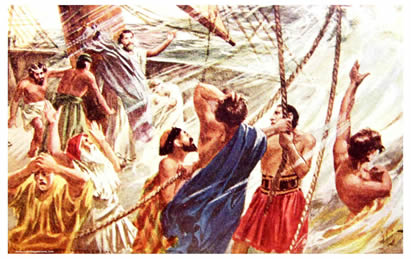
In Acts 27, Paul was with 275 other passengers on a boat bound for Rome from Caesarea, and its captain decided to test the Mediterranean Sea at a turbulent time. A violent storm, known as Euraquilo, caught the ship and ultimately battered it to pieces. It must have been an apprehensive time for the passengers and crew. Luke says the wind was violent, the ship was driven, the sun and moon didn’t appear for days, violently storm-tossed, they incurred damage and loss, and that all hope of their being saved was gradually abandoned. I cannot imagine the helpless, vulnerable feeling they must have felt. At least not literally.

It would be easy to let our national unrest and storminess tempt us to act irrationally (like some on Paul’s ship were tempted) or to give in to fear. But, Paul did five things we should do as we try to respond to the current turbulence.

  • He listened to God (Acts 27:23-24). Nobody else had a better or equal solution to their dire problem. The only way to be saved was to listen to God. Paul sought to persuade the people of this. In the ruckus and tumultuous noise, listen harder to God’s Word! It’s an anchor in stormy waters.
  • He believed God’s Word (Acts 27:25). It’s one thing to comprehend something, but quite another to put your trust in it. What God promised must have seemed quite far-fetched, that this way would save everyone. But, Paul didn’t waver. He said, “I believe God that it will turn out exactly as I have been told” (25). We are surrounded by people who need to witness our faith. As many as are persuaded will escape a shipwreck of faith (cf. 1 Tim. 1:19).
  • He encouraged hope (Acts 27:21-26). Despite the foolishness of their leaders, these people were given a message of hope. Paul says, “Keep up your courage!” (22,25). Despite the frightfulness of the moment, Paul offered a possible escape. Right now, you and I are uniquely positioned to give the only true hope available. It’s like an anchor for the soul, both sure and steadfast (Heb. 6:19)!
  • He warned the disobedient (Acts 27:31-32). There were those trying to break from God’s Word and will and do things another way. They were trying to take matters into their own hands. Paul spoke up against this! Such was defiance against the divine plan. What a message for us, who justify their sins rather than repent of them. We need to keep the message of righteousness, self-control, and the judgment to come before people (Acts 24:25).
  • He prayed faithfully (Acts 27:35). In this ordeal, Paul was a public example of prayer. Read every epistle of Paul’s and you’ll see his faithfulness in and dependency upon prayer. He appealed to the God he knew was the only hope for salvation. How much are we praying about the turmoil in our country (and world)? How much do those around us believe that we are dependent upon God?

Instead of focusing on the frightful winds currently blowing, let’s focus on the One who can calm the storm. Let’s get others to join us in that focus. Whatever happens to our nation, we must save as many souls as possible!

paul20in20storm


The Brooks-Sumner Affair

Neal Pollard

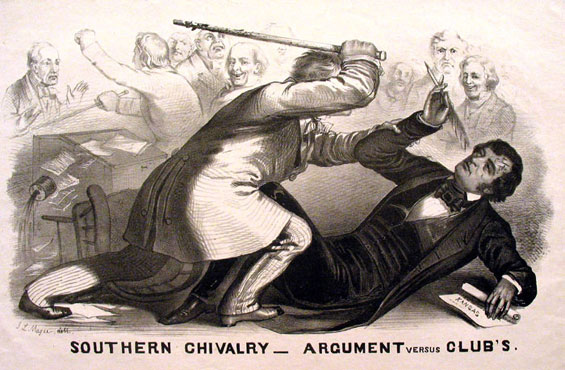
In 1856, Charles Sumner, a Massachusetts Senator, delivered an excoriating speech full of vicious name-calling and personal insults—especially against Senators Douglas and Butler—for their defense and advocation of slavery and especially the violence in Kansas in response to the actions of John Brown and his followers. The speech went on for two days, and shortly after its completion a man named Colonel Preston Brooks, a U.S. representative from South Carolina and distant relative of Andrew Butler, retaliated by beating Sumner with a cane. It was a serious enough beating that Sumner would take years to recover. Sumner would become an iconic hero to northerners and Brooks, who as punishment for the crime was fined $300, a darling of the south. Newspaper headlines of the time, in each region, painted their man a hero and the other man a demon (read a sample here: http://history.furman.edu/benson/docs/sumenu.htm). It is not the loathsome sin of slavery that I wish to highlight here, but the age-old tendency to blindly defend a person or position one feels inclined toward and the incredible efforts to vilify those on the other side of the issue—no matter what.

People are inclined to line up behind men rather than the Messiah. It is not just during political season or for certain social agenda items that this occurs, but more importantly in every season of the year when it comes to religious matters. Paul decried men’s tendency to be “of Paul…of Apollos…and…of Cephas” (1 Cor. 1:12). In the religious world, division has occurred because men have lined up behind some man’s teaching. Often, this teaching is a misconstrued view of a passage (for example, John 3:16, Acts 16:31, Mark 16:17, etc.) or a teaching without benefit of a passage (for example, having an experience of grace, saying a sinner’s prayer, infant baptism, etc.). As with politics, people can become blind apologists for their leaders and champions who promote what they already believe. Often, no amount of reason and logic can overcome the predisposed bias of the adherents. Lost in the cacophony of religious debate can be clear, simple biblical truth. Religious division is not the product or prompting of God (1 Cor. 1:10; 14:33). It is entirely of human origin. While there are some matters where God has not legislated, there are also some clear “right” and “wrong” matters in Scripture. Where God has spoken, we must take His word and will over that of absolutely anyone else. Otherwise, we will find ourselves guilty of elevating one above the One we must all ultimately give an account to. That would be an injustice and violation to top even “The Brooks-Sumner Affair.” May we keep our allegiance to God free from the taint of personal prejudices, even in the matter of our religious convictions. Psalm 119:89.

southern_chivalry

Who Is Behind This “Race War”?

Neal Pollard

I’m a child of the ‘80s, which, in south Georgia, seemed to be “post-racist.” Maybe it was the naivety of youth, but one of my closest friends, Greg Gwyn, was black. We were “Bird” and “Magic” (on the basketball court, at least in our minds). We were “Crockett” and “Tubbs.” We both rejected, out of hand, the notion of being “Wonder” and “McCartney” (too cheesy). While our High School had cliques, a timeless problem, they were determined more by interest than race. Sure, there was prejudice, as that is also timeless. But it was not the mainstream attitude.

I have preached full-time for three congregations, in Alabama, Virginia, and Colorado. All three are integrated, having not only “white-collar” (forgive the adage) professionals but also inner city representation among our African-American members. But, all three have wealthy and poor caucasians, too. Individuals in all three congregations probably struggled with making all kinds of arbitrary distinctions, including on the basis of race, but such attitudes have not been fostered. If uncovered, they are addressed with the power and authority of Scriptures like “God is not one to show partiality…” (Acts 10:34), “He made from one man every nation of mankind…” (Acts 17:26), “There is neither Jew nor Greek…for you are all one in Christ Jesus” (Galatians 3:28), “Do not hold your faith in our glorious Lord Jesus Christ with an attitude of personal favoritism” (James 2:1; and, if you do, “have you not made distinctions among yourselves, and become judges with evil motives,” vs. 4), etc. Our elders, deacons, Bible class teachers, and general leaders in these congregations, men like Kevin Turner, Ron Herman, Bill Burton, Jimmy Reynolds, Ron Thompkins, Joe Cook, King Taylor, and Ronnie Royster, would not be thought of in terms of their race if not for the point of this article.

So, as we see fiery debate, protests, wagon-encircling, hatred, and acerbic rhetoric, scratching our heads as to how all-consuming it has become, do we stop to ask who would be behind such division and strife? No, I don’t mean Republicans or Democrats, protest groups or activists, or hobby horse riders among brethren.  I think it is more sinister and serious. Who is ever behind separating not just mankind, but the Lord’s bride? Who benefits from people building walls to keep out others on any arbitrary basis? Who wins in the face of such crushing losses? Maybe we need to be asking that question and focusing on that issue more!

40492_1499404838050_6800990_n


TO THOSE WHO DIVIDE BRETHREN

Neal Pollard

—“A perverse man spreads strife, and a slanderer separates intimate friends” (Prov. 16:28).
—“A worthless person, a wicked man is one who…spreads strife” (Prov. 6:12,14).
—“There are six things which the LORD hates, yes, seven which are an abomination to Him: …one who spreads strife among brothers” (Prov. 6:16,19).
—“Hatred stirs up strife, but love covers all transgressions” (Prov. 10:12).
—“Though his hatred covers itself with guile, his wickedness will be revealed before the assembly” (Prov. 26:26).
—“Keeping away from strife is an honor for a man, but any fool will quarrel” (Prov. 20:3).
—“Through insolence comes nothing but strife, but wisdom is with those who receive counsel” (Prov. 13:10).
—“The beginning of strife is like letting out water, So abandon the quarrel before it breaks out” (Prov. 17:14).
—“He who loves transgression loves strife…” (Prov. 17:19a).
—“Like charcoal to hot embers and wood to fire, So is a contentious man to kindle strife” (Prov. 26:21).
—“An arrogant man stirs up strife, But he who trusts in the Lord will prosper” (Prov. 28:25).

Suffice it to say, the Lord has not been silent on the matter. Our age is marked by the manufacturing and fanning the flames of controversy, endless argument, and divisive issues. Men seem to take pride in starting strife and stirring the pot. When we share the gospel, in gentleness (2 Tim. 2:24) and love (Eph. 4:15), it can still be met with devastating disagreement and vehement vituperation. But, thanks to mediums like social media, some among us have seized the platform to spread division where they could as easily work to promote love and unity among brethren.  I cannot presume heart or motives, but the fruit has been to start brotherhood brawls and to stratify schisms. It is worrisome that while we manufacture outrage on politics, race, law enforcement, “guilt by association,” nitpicking the church, or constantly bringing up the latest “what’s wrong with the church” scenario, 151,600 people die around the world every day (via http://www.ecology.com/birth-death-rates/)! Most of that number will have traveled the broad way that leads to destruction. Surely we can redirect our passion and conviction away from divisive diversions and do our part to stem the tide of such an eternal tragedy!

Meanwhile, we can resolve to see people, not skin color, God’s sovereignty, not party affiliation or uniform, the local church’s autonomy, not an opportunity to be a busybody, and with every other, similar scenario, not major in the minors. Jesus condemned the Pharisees for neglecting the weightier provisions of the law, justice, mercy and faithfulness while scrupulously focusing on matters comparatively minor (Mat. 23:23).  We have a brief time to use our talents and influence on this earth. Will our cause be social justice, brotherhood policing, or political activism, or will it be building up the kingdom through evangelism, edification, and benevolence? May God grant us all the wisdom to “not work for the food which perishes, but for the food which endures to eternal life…” (John 6:27). Be a builder, not a basher!

arguing-1296392_960_720

“Every Way Of A Man Is Right In His Own Eyes”

Neal Pollard

I am sad whenever anyone in a position of power and authority abuses that, worse whenever that abuse turns deadly.  I am sad whenever anyone, of any color, demonstrates prejudice toward any group, race, ethnicity, or similar common denominator.  I am sad whenever anyone tries to commit a crime and get away with it.  I am sad whenever anyone resorts to hatred, profanity, and divisive speech, even if venting anger, hurt, and fear.  I am sad whenever anyone exerts themselves in contentious and divisive rather than understanding and unifying ways.  In essence, I am sad whenever someone does evil and commits sin, but seeks to justify and defend himself or herself in so doing.

Long ago, the Holy Spirit moved Solomon to say, “Every way of a man is right in his own eyes, but the Lord weighs the hearts” (Prov. 21:2).  In nearly identical fashion, he writes, “All the ways of a man are clean in his own sight, but the Lord weighs the motives” (Prov. 16:2).  Sin constantly occurs every moment of every day throughout every community of the world.  At times, individuals will freely confess and without making excuse.  However, the more common course seems to be what Solomon says.  Parents raising children, asking who left something on the floor or who made a mess, hear the all-too-familiar, “Not me!” If one is caught in the act of wrongdoing, he or she may still say, “It’s not my fault,” “I didn’t mean to,” “It’s not what it looks like,” or “you don’t understand.”  Perhaps that’s desperate self-preservation.  Perhaps it’s an attempt to deflect responsibility and consequence.  But, Solomon cuts through the flimsy excuses, realizing God sees with a perfect, unbiased manner and cannot be fooled. We can try to lie to others to try and mitigate or deny our guilt, but He sees all and knows all.

Horrific images out of North Charleston have sickened and scared us!  If all is as it very much seems to be, color-blind, occupation-blind justice needs to be done (cf. Rom. 13:1ff).  May it serve as an even greater object lesson that transcends race, law enforcement, and the like.  When people become their own standard of right and wrong (cf. Jud. 17:6; 21:25), they can tend to justify anything (i.e., abortion, pornography, fornication, etc.) that God deplores.  Let us remember the second part of Proverbs 16:2 and 21:2.  “The Lord weighs the hearts and motives.”  He never gets it wrong!

A Hostile Witness

Neal Pollard

There is an overlooked work that should be avoided, but may be more commonly practiced than is thought.  Yet, as the Holy Spirit through Paul included it in a larger category of works, it must be something with which even many Christians struggle.  It is mentioned in the list of fleshly works found in Galatians 5:19-21 and is simply called “enmities” (20).

The word is found nine times in the New Testament, from the Greek “ἔχθρα”, and its general meaning is, “Enmity, hostility, hatred, both as an inner disposition and objective opposition (Rom. 8:7); plural, of hostile feelings and acts animosities, hostilities, discord, feuds (Gal. 5:20)” (Friberg & Miller, 183).

Hostile feelings, unchecked and not repaired, lead ultimately to ungodly behavior toward others that can even cause division.  Another adds, “[“enmities” is] a general term referring to hostility or unneighborly acts of any kind or form” (Arichea & Nida, 138). How do “enmities” arise and is this something which you and I may fall prey to?

Enmities arise by holding a grudge.  In fact, it can be very difficult to know when you cross the line from the one to the other.  When you harbor feelings of resentment toward someone from an offense, real or imagined, it will eventually grow into hostile feelings and possibly hostile acts.  The old law warns against bearing a grudge and even makes it antonymous (i.e., opposite) with love (Lev. 19:18).  The Lord tells us what to do when we have a problem with a brother or sister (Mat. 18:15ff).  If we do not follow this, to whom are we listening?

Enmities arise through prejudice.  Prejudice occurs on much more than the basis of the color of one’s skin.  Prejudice is nothing more than a preformed opinion, one formed without all the facts but instead through “insufficient knowledge, irrational feelings, or inaccurate stereotypes” (Encarta Dictionary).  How often, based on how we think, feel, or believe another to be, do we work ourselves up against another and allow enmity to rule our hearts?

Enmities arise when the mind is set on the flesh (Rom. 8:7).  Paul is contrasting the Old Law with the gospel of Christ in this context, but he reveals a compelling principle.  When we fail to live spiritual lives, but instead make our decisions driven by our passions and fleshly inclinations, we open ourselves up to works like enmity.  Incidentally, this same bent will lead one further and further down the road of those ensuing works in Galatians 5.  Notice that this hostility is pointed toward God and His law (cf. Jas. 4:4), but it will impact our demeanor and attitude in all relationships.  This hostility plays out “in the flesh” (Rom. 8:8), the very activities and attitudes upon which Paul focuses in Galatians 5:19-21.

Are you and I immune from “enmities”?  We can strengthen ourselves against such especially through the “antidote” of love in the fruit of the Spirit (Gal. 5:22).  Love actively seeks and strives for others’ good.  If we sincerely give our hearts to loving others, our brethren or the lost, we will have a harder time harboring hostility and hatred for them.  Maybe if we will take the time to know others better and try to get insight into their circumstances, struggles, and challenges, it will temper our feelings toward them.  It will certain demonstrate that we are led by the Spirit and not by the flesh!

Temper And Tongue

Neal Pollard

Without wading into the waters of political correctness or questioning motives, Donald Sterling can blame his temper as much as his girlfriend’s surreptitious audio recording.  He joins an infinitely long line of those whose unrestrained anger has cost them much more than they anticipated.  While most people will not pay the earthly price Sterling appears destined to pay, so many have permanently damaged relationships and paid with their souls for failing to conquer temper and tongue.

James clearly sets forth God’s view on the matter.  “The tongue is a fire, a world of iniquity” (3:6). “It defiles the whole body” (3:6). “It is set on fire by hell” (3:6). “It is an unruly evil, full of deadly poison” (3:8). It can reveal hypocrisy at a disgusting level (3:9-12).  James’ words are so convicting, yet, having privy to them, we still stumble with our speech.

I have seen the untamed tongue, so often fueled by anger and even rage, tear churches apart.  But, what has it done in the lives of individual members of those congregations?  Certainly, we think of it as characteristic of those outside the body of Christ, but so often it ignites deadly fires in Christians’ lives.

If I am honest with myself, I should be more concerned with the spiritual impact my tongue has on my soul than other deeds of the flesh.  There are so many ways for me to stumble over my tongue—gossip, lying, outbursts of anger, wrath, deception, filthy or suggestive speech, greed, and just about every outlet of sin seems to intersect with the misuse of the tongue!

James speaks to our hearts when he says, “My brethren, these things ought not so to be” (3:10).  Can I comprehend the impact that has on my soul, not just yours?  Rather than counting up ways you offend me with your tongue, may I have the humility and honesty to examine my use of my tongue and see how it might be hurting you and, even more importantly, hurting Almighty God!  Lord, help us see the power of the tongue.

Should Obese Kids Get Candy?

Neal Pollard

The cynic surely believes this lady is feeding her urge for 15 minutes of fame or seeking an outlet for her social ideology.  The tenderhearted finds it cruel and unfeeling.  The overweight likely are offended.  The objective observer still must be shaking his or her head in disbelief. The Fargo, North Dakota, woman, who identifies herself only as Cheryl set off a firestorm when she called in to a local radio station declaring she was going to give those she deemed overweight children an “obese letter” in addition to candy this upcoming Halloween (Fox News Story).  We’ll see if she has the courage to go through with it, what with a national spotlight and all.  But, there is no doubt how she feels.

Are there some people to whom you would not give food or candy because of their size.  That seems unfair and pretty prejudiced behaviour, doesn’t it?  How cold and unfeeling does one have to be to be so arbitrary and callous?

But, do we ever do that in other ways?  As Christians, are we ever selective?  Do we ever discriminate in our evangelism, benevolence, fellowship, or other outreach?  Do we ever judge based on their skin color or ethnicity, their present morality or lack thereof, their seeming scamming or dishonesty as they hold the sign at the traffic light, or their plain clothes or less hygienic appearance even in our own assemblies?

At first, I thought this lady’s behavior incredulous.  Actually, I still do.  But, I am also filled with a conviction to do some introspection.  Do I do what she’s doing, but in different ways?  I shouldn’t.  After all, Paul writes that we should “not be haughty in mind, but associate with the lowly” (Rom. 12:16).  That’s what Jesus did, and the Pharisees and scribes judged Him for it (Luke 15:2).  James warns us not to have an attitude of personal favoritism because making distinctions between people makes us judges with evil motives (Jas. 2:1-5).  Isn’t that the heart of the matter, right there?  We are not judges but servants.  Our motivation is supplied to us by the Savior, and that is to save souls (cf. Jude 23). Whose souls? Who’s ever we can!


An Exhortation To White And Black Christians

Neal Pollard

I rarely modify the word “Christian” with adjectives like red, yellow, black, or white.  Occasionally, however, an event happens that threatens to divide God’s people of a racial nature.  The recently ended George Zimmerman trial in the death of Treyvon Martin is one such event.

It seems to me that so many children of God have reacted to the verdict in that trial along either political and, as often, racial lines.  Everyone from adherents of the NRA to those of the NAACP seems to have strong opinions and stronger reactions.  From such a long distance away from the facts of the case, many whose opinions are decidedly sympathetic to one side or another seem certain that either justice or injustice was served by the jury.

While forming an opinion about cases like this one may approach inevitability, there is a caution to be heeded.

We cannot allow the world’s division, whether due to politics, religion, race, or the like, to infect us and divide us.  That means that we should be very careful as we communicate with one another through the various means we use–Facebook and other social media, email, the Bible classroom and pulpit, and even our conversations with people.  Our passion cannot be rooted in these things that do not matter in eternity!  Eternal things ought to be our cause and obsession.

When I was a graduate student at Freed-Hardeman, Earl Edwards taught a course on missions.  He depicted the first-century scenario powerfully, asking, “Can you imagine Paul and the other apostles spending all their time picketing abortion clinics, lobbying Rome, or consuming themselves with the social causes of their day?”  His point was that the early Christians’ focus was on the living hope (cf. 1 Pet. 1:3).  They were not distracted by the causes and factions of their world.

Please be careful of rhetoric in defense of Zimmerman or lament of Martin that raises walls that Christ died to destroy.  While his focus was Jew and Gentile rather than black and white, his words apply to us today that Christ “is our peace, who has made both one, and has broken down the middle wall of separation” (Eph. 2:14).  The wall of separation, in context, was the Old Testament.  But, the law represented that which kept the two groups apart.  Christ reconciles us in one body and makes us “one new man” (Eph. 2:15-16).

There will be no “white heaven” and “black heaven” (or whatever race comes to mind).  That being the case, we had better develop and maintain colorblindness on earth. Let the world be divided, if they will not submit to Christ. Let us be united, submitting to our Lord!

Can A Christian Be Prejudiced And Still Go To Heaven?

Neal Pollard

What an odd question. Obviously, an alien sinner (i.e., non-Christian) will not go to heaven even if he or she is not prejudiced. One must render obedience to the gospel to enjoy eternal salvation (Heb. 5:9). It is unfortunate that a Christian would treat another Christian differently because of the color of one’s skin, the level of income one makes, or one’s physical attributes and appearance.  Yet, some things seem to prove that prejudice is alive and thriving in some places in the Lord’s church. Borrowing a phrase from James, “My brethren, these things ought not to be so” (cf. Js. 3:10).

First, consider the presence of “black congregations” and “white churches.”  With what authority do such segregated bodies exist? In fairness, when it is decided by all races in a multi-racial area to meet separately to more effectively further efforts of evangelism, that would seem fair and acceptable (so long as no one is refused or mistreated who wishes to worship at one of the other congregations).  Sadly, however, in churches which are predominantly one race, visiting minorities have been ostracized and avoided. In the days before the civil rights of black Americans were improved, a “mixed” congregation was a rare exception. While strides have been made, there are still congregations who would be quite uncomfortable having an African-American preacher preach at the congregation they attend or participating in any public way in the assembly.

Also, think about the strategy of “taking the gospel to the community.”  Evangelism can be the greatest weakness of a congregation anyway.  When a church does seek to reach out to the community, minorities seem to be passed over frequently.  Why is the “black community” or the “Hispanic community” at the bottom of the strategy list?  It would be dangerous to make judgment, but, could it be fear for our personal safety?  Could it be fear of having success in that community?  Could it be an unwillingness to reach out to someone “different” from us? These are not legitimate excuses in God’s eyes.

Finally, ponder the need for equality in the Lord’s Kingdom.  A common phrase is, “There are no ‘second class citizens’ in the Kingdom.”  Amen! So wrote James, inspired by the Holy Spirit.  He penned, ” My brethren, hold not the faith of our Lord Jesus Christ, [the Lord] of glory, with respect of persons. For if there come into your synagogue a man with a gold ring, in fine clothing, and there come in also a poor man in vile clothing; and ye have regard to him that weareth the fine clothing, and say, Sit thou here in a good place; and ye say to the poor man, Stand thou there, or sit under my footstool; Do ye not make distinctions among yourselves, and become judges with evil thoughts? (Js. 2:1-4 ASV).  Would we be willing to serve under an elder or with a deacon who is financially poor, who is of different ethnic background, or who has “only a high school education”?  Remember, “God is no respecter of persons…” (Acts 10:34,35; Rom. 2:11).  Despite racial, economic, and geographical differences, all faithful Christians are “the body of Christ, and severally members thereof” (1 Cor. 12:27).  Paul reminds us that “there is one body” (Eph. 4:4).  The Bible reveals only one heaven and one hell, not one for each race and social strata.

Christians who do not get along with all races and labor as equals in the Kingdom with faithful brethren on earth should not expect to bask in the glory of an unprejudiced Father throughout eternity.  It is hard to fathom that our soul could be red, yellow, black, or white or that one’s soul would “appear” differently because of the model car he drives, the size of her bank account, or the kind of house in which one lives.  As we “press on unto perfection” (cf. Heb. 6:1), let us “put away” the besetting sin of prejudice (cf. Heb. 12:1) so that God can fully bless our labors for Him!

–Originally printed in Fulton County Gospel News, October, 1995 (Ted J. Clarke, editor).